
Holding A/S Axel Kiers Vej 11 DK-8270 Højbjerg CVR no. 35 84 43 84
Stibo
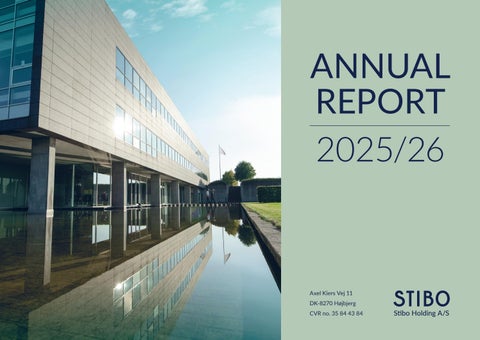
Holding A/S Axel Kiers Vej 11 DK-8270 Højbjerg CVR no. 35 84 43 84
The Stibo Group once again presents strong financial statements. Revenue grew by 2% from 3,356m in 2024/25 to 3,431m in 2025/26. Profit before interest and tax (EBIT) increased from 172.8m in 2024/25 to 186.7m in 2025/26. Profit after tax grew from 130.7m to 181.6m.
It is satisfying to see that the consolidated financial figures also this year tell a story about growth and profitability. Market development and the competitive situation vary between the businesses, and so do the financial results – also in 2025/26. For the Stibo Group, this is not a new situation, but more a fact that we constantly are aware of.
This is at the very core of Stibo: we are based on foundation ownership that allows us to take a long-term perspective and contemporaneously we execute and make things happen today and thereby ensure financial viability tomorrow. This strong outset has made it possible for Stibo to initiate a significant investment over more years in Stibo DX to lift the business to become an even better supplier to the news industry trending towards consolidation and AI supported digitalization.
The Stibo Group is an international company with roots in Aarhus, Denmark. It has facilities and offices in 20 countries and customers in most of the world. The Group is based on two independent business areas: Stibo Complete Group A/S, which is a modern graphic company with printing plants in Denmark, Sweden, and Germany, and Stibo Soft ware Group A/S, which develops and supplies soft ware systems for media houses (Stibo DX) and Master Data Management systems for companies all over the world (Stibo Systems). Stibo has a strong market position in each of the two business areas.
The two business areas each have full responsibility for the operation and development of the businesses with strong management teams and strong separate boards. This model has proven good results for the group.
The Stibo Group is well prepared organizationally and commercially. The strong cash position is available for further developing Stibo’s existing business areas, but it is at the same time not ruled out that Stibo’s ownership model with solid foundation ownership and dedicated separate boards could be att ractive for a new sound business.
At group level, the outlook for the 2026/27 financial year is a revenue of 3,100m to 3,500m and earnings before interest and tax (EBIT) of 190m to 240m.
As a final note, I would like to express my sincere thanks to all employees, customers and partners for making the Stibo Group thrive and develop.
Ebbe Malte Iversen, Chairman of the Board, Stibo Holding A/S


in DKK'000
Consolidated balance sheet
Key figures and ratios
For terms and definitions, please see the accounting policies.
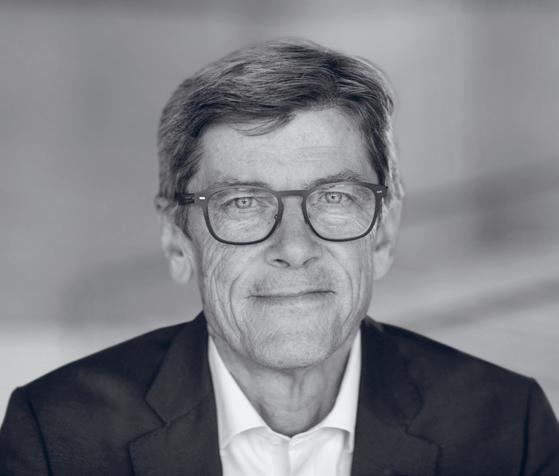
Ebbe Malte Iversen Chairman of the board
Member of the board since 2017.
Considered independent.
Ebbe Malte Iversen is a professional board member, former CEO of Per Aarsleff A/S, and holds an engineering degree with management experience from publicly traded companies.
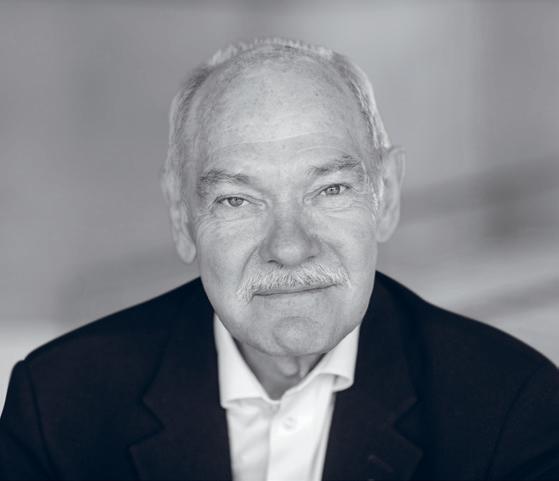
Jørgen Huno Rasmussen Vice Chairman of the board
Member of the board since 2021.
Considered independent.
Jørgen Huno Rasmussen is a professional board member and holds an engineering degree, HD, Lic. Techn. He is a former CEO of FLSmidth & Co. A/S and Hoff mann A/S, and later served as chairman of the board for Lundbeck Foundation and the Tryg Group.
He has management experience from publicly traded companies, as well as expertise in strategy and organizational development, risk management, asset management, and charitable donations.

Jakob Røddik Board member
Member of the board since 2018.
Considered independent.
Jakob Røddik is the legal director and director of property development at Salling Group. He previously worked as a lawyer at Plesner Advokat-partnerselskab, Gorrissen Federspiel, and A.P. Møller – Mærsk A/S.
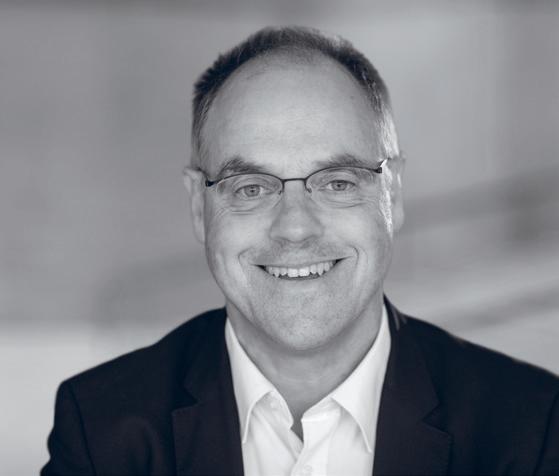
Per Asmussen Board member
Member of the board since 2019.
Not considered independent due to position as chairman of the Stibo Complete Group Board of Directors until January 13, 2023
Per Asmussen is the former CEO of Kamstrup A/S and has held leadership positions at Alstom, Grundfos, and APV. He holds an M.Sc. in Engineering supplemented with a range of international courses in strategy and management, including HD-Financing.

Thomas Lau Schleicher Board member
Member of the board since 2025.
Considered independent.
Thomas Lau Schleicher is a professional board member and holds a Master’s degree in Finance and Accounting (cand.merc.). He is the former Head of Investments at KIRKBI A/S. He has experience from boards of listed and private companies in Denmark, Sweden, Germany, England, and the USA.
Other managerial positions: Stibo Holding A/S (board member), Falck A/S (board member), Topsøe Holding A/S (board member), Ejner Hessel A/S and selected subsidiaries (board member)
Stibo Holding A/S is 100 % owned by the Stibo Foundation. Stibo Holding A/S executes the business activities of the Group.
Through stable business development the activities today cover e.g. the original business area with tailored print solutions in the Stibo Complete Group and global sale, development, implementation, and support of advanced soft ware solutions within Master Data Management and Content Management in the Stibo Soft ware Group. Stibo Holding A/S’s role is to be the owner that contributes to the value creation by providing the best framework conditions for implementing the chosen strategies regarding the current and any new businesses.
The Board of Directors of Stibo Holding A/S takes active ownership through cooperation and dialogue with primarily the chairmen of the Boards of Directors of the Stibo Complete Group and the Stibo Soft ware Group. The focus of the active ownership is long-term decisions regarding overall activity areas, strategic alliances, acquisitions, capital allocation, and risk-taking.
The Stibo Group was founded as a printing business in 1794 under the name ”Aarhuus Stift sbogtrykkerie”. In 1966 the owner at the time, Erik Kiær, transferred his ownership to a Danish enterprise foundation, the Stibo Foundation (Stibo-Fonden). The purpose was to ensure sound and independent development and growth in the long run.
A Danish commercial foundation is a self-owned legal entity pursuing enterprise business with its own Board of Directors with full responsibility and ultimately working under the oversight of the Danish Business Authority (Erhvervsstyrelsen).
The Stibo Foundation is commercial. Secondarily, and according to its charter, it makes philanthropical donations and thereby supports e.g. academic students’ travels within science, technology, engineering, and mathematics (STEM), and various societal and cultural events. The recipients of the donations are primarily located close to the head quarter in Aarhus, Denmark.
… to ensure a firm, knowledgeable and enterprising management of the company and its subsidiaries, to ensure the continued consolidation and development of the companies and in general to make every possible effort to ensure that the companies are maintained and retain the highest possible reputation under the highest achievable technical standard …
The purpose of the Stibo Foundation
Stibo group structure including major entities
Stibo Holding’s core business areas are organized in two business groups: Stibo Complete Group (tailored print solutions) and Stibo Soft ware Group encompassing the two soft ware companies Stibo Systems (Master Data Management) and Stibo DX (Content Management). The two groups for printing and soft ware are organized with self-contained Boards of Directors with externally designated members and chairmen with in-depth sector and business knowledge and experience.
The full responsibility for the respective groups, including new initiatives, strategy formulation, planning, execution, and governance, lies with their respective Boards of Directors. There is no overlap between the members of these boards and those of the Board of Directors of the immediate owner, Stibo Holding A/S, nor the final owner, Stibo Foundation.
Further to the two business groups, Stibo Holding A/S owns Stibo Ejendomme A/S (legal entity owning the Stibo headquarter building in Aarhus) and Stibo Investment ApS (investment company for selected capital investments). Stibo Holding A/S manages and invests surplus cash of the group.
Stibo’s long-term business perspective is reflected in the stability of the companies making up Stibo. The present structure with two independent business groups has been in operation since 2022. This structure serves to exploit the full potential of each business group with independent strategic directions. In the fiscal year 2025/26 the progress in the pursuit of the business plans overall has been satisfactory.
The Stibo Holding Board is responsible for the overall capital structure of the Stibo Group. The objective is to ensure a sound financial basis for Stibo’s businesses that supports profitability and growth both in the short and in the long term. Cash that is not needed for the businesses’ ordinary operation is managed by Stibo Holding. It is important to maintain a high solvency level, to be considered a stable business partner, and keep a high level of liquidity reserves, to be able to make new investments whether in the current or new business areas. The Stibo Group is not reliant on external interest-bearing debt.
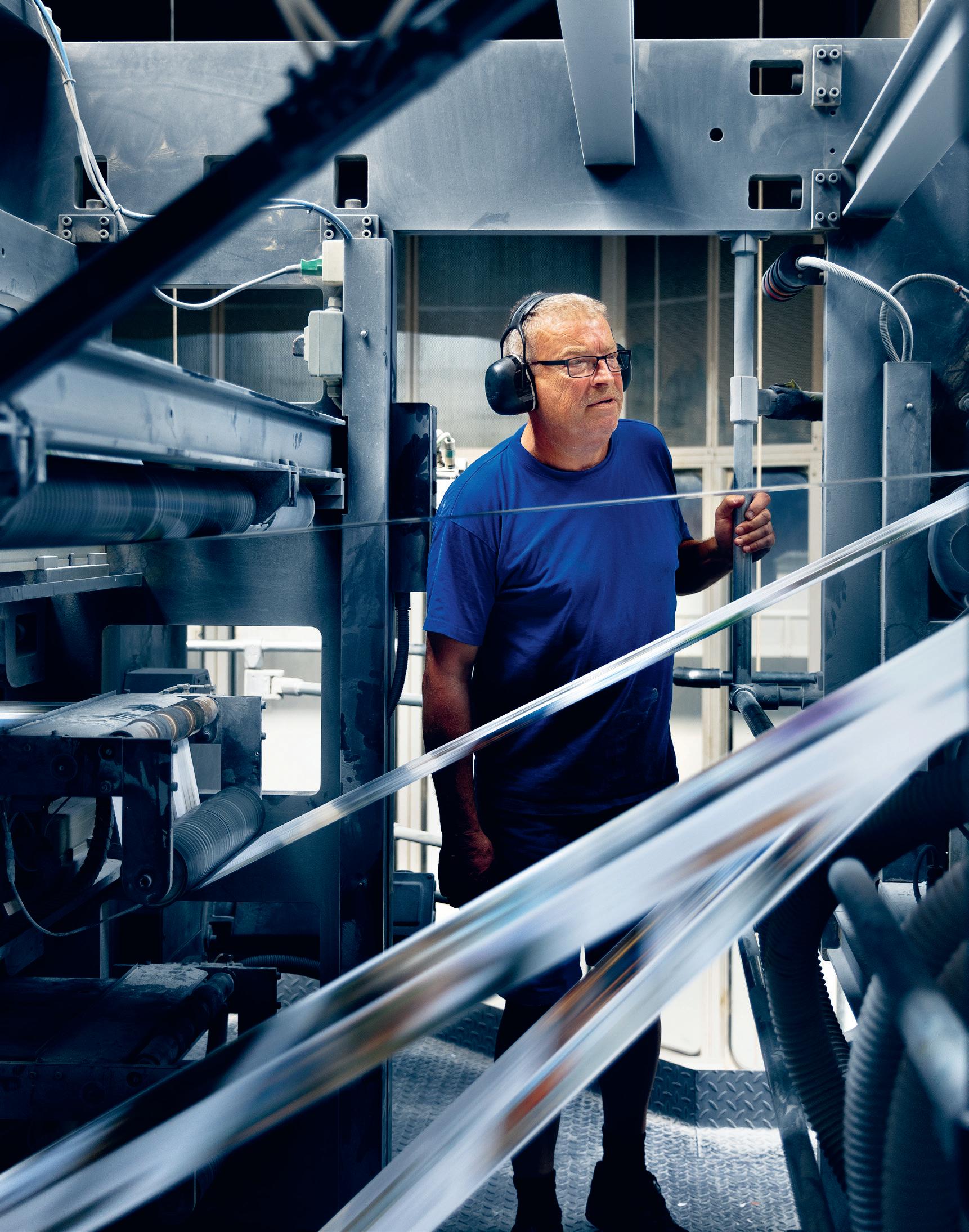
The total revenue for the year is 3,431m. This is in the middle of the expected range of 3,300m – 3,700m and therefore considered satisfactory. It means that the business of the Stibo Group has been growing at 2% compared to the year before. The growth rate is lower than in the previous four years. The reasons vary by industry.
The Stibo Complete Group’s revenue has fallen slightly from 1,897m to 1,889m (-0.4%).
This reflects a combined effect of the falling printing market and the takeover of Aller’s printing facilities late in the previous financial year. The Stibo Complete Group’s focus on adding revenue and capacity by acquiring and merging the printing activities of other market players is expected to continue. In a falling and very competitive market this has turned out to be a viable formula and it has been an integrated part of the Stibo Complete Group’s modus operandi for years.
The Stibo Soft ware Group is on an organic growth path. Stibo Systems has reached a revenue of 1,311m (+6%). This is the result of years of focus and hard and dedicated work. The investments in becoming a best-in-class Soft ware-as-a-Service (SaaS) solutions provider have been very significant but also necessary. The investments are paying off now. Being cloud native and integrating AI into the solution has increasingly become necessity to access and compete in the enterprise soft ware market.
After a minor setback the previous financial year, Stibo DX is back on a growth trajectory and has increased revenue to 232m (+4%). The news media industry is undergoing consolidation and transition which at the same time creates both challenges and new business opportunities.
Stibo is a company with a high level of internationalization. The group is present with offices and facilities in 20 countries. To stay competitive, various business functions are proactively organized across countries and locations. Stibo DX’s rapid expansion of the recently established development hub in Malaga, Spain is one example.
The revenue is distributed across continents, however with the majority in Europe. The majority of the revenue in the Stibo Complete is in Scandinavia and Germany where the print production takes place. The Stibo Soft ware Group revenue is even more international coming from all the markets mentioned.
Stibo has a diverse employee composition and had the map above been drawn based on where the employees have their background and origin, it would have shown an even more varied picture.
Stibo’s customers are spread around the globe in more than 40 countries. The local presence with offices and facilities helps to ensure proximity to customers.
The Stibo group’s total EBIT (operational profit) of 187m is in upper half of the expected range of 160m – 200m and considered satisfactory. The number has increased by 8% compared to 173m last year and it is the highest EBIT in the history of the company. The result is due to Stibo Systems being able to improve EBIT with 28% compared to last year and thereby att aining an all-time high at 232m EBIT. Stibo DX realized a deficit at -95m EBIT. A significant deficit was expected due to an ongoing transformation; however, the deficit is larger because of additional transformation cost. The Stibo Complete Group realized an EBIT at 38m which is above last year and within expectations.
The consolidated EBIT margin for the Stibo group at 5.4% is at the same level as the year before. The net financial income of 84m reflects exchange rate deviations, interest on bank deposits, and most importantly return on capital investment made by Stibo Holding A/S. Said return showed some volatility during the year but with an underlying positive trend and the result at the end of the year was a significant plus. The volatility is considered a built-in characteristic regarding especially the stockbased investments.
The Board of Directors considers the group’s profit after tax on 182m to be satisfactory in view of the current market status. It is the highest earnings in the history of Stibo.
With an equity growth of 178m to 1,647m Stibo has continued its consolidation. The solvency ratio at 59% has increased with 3% points.
To date, there have been no events after the end of the reporting period that significantly influence the annual report 2025/26.
Stibo’s two business groups have strong market positions. The overall expectations for the long-run development in revenue and profit for both groups and the Stibo Group in general are positive. At the same time, it should be recognized that Stibo Complete Group foresees even tougher market conditions, and that the transformation process in Stibo DX is comprehensive and investment intense.
Stibo will continue to develop its businesses organically. Should positive new options for developing the businesses occur, including potentially mergers and acquisitions, Stibo will take a positive approach to evaluating them duly. That could either be further consolidation of the graphical business or extending or expanding the current soft ware business.
The level of consolidation and the liquidity and the budgets for the coming fiscal year support these aims.
The consolidated expectations for the coming fiscal year for the Stibo Holding Group are revenue at a level of 3,100m – 3,500m and EBIT at a level of 190m – 240m.

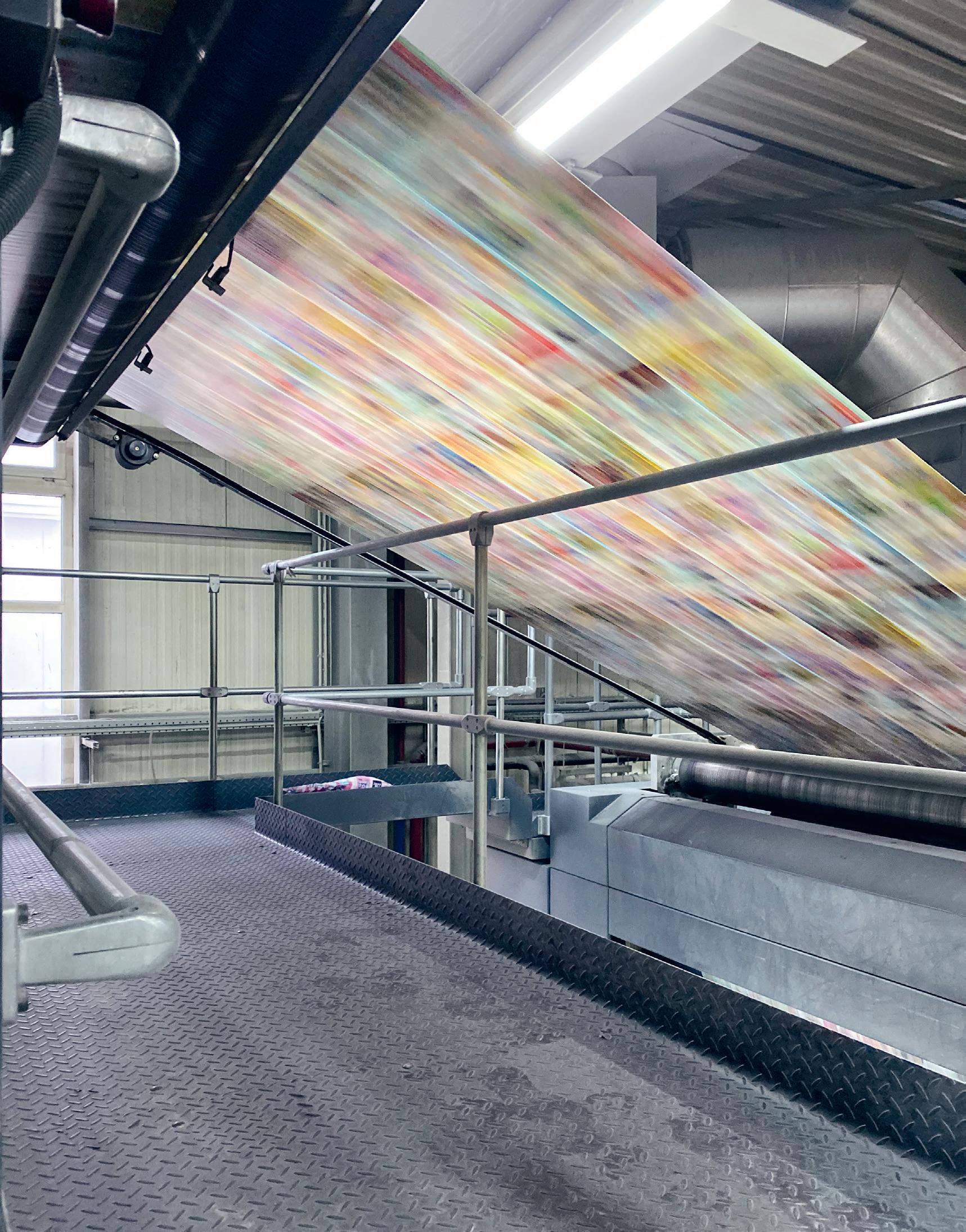
Stibo Complete is one of Europe’s leading players in the areas of designing, developing, producing, and distributing physical marketing materials. As a ‘graphic supermarket’ the company is a total solution provider.
In 2025/26, the general print market continued to trend downward at the least at the same level as previous years. The Stibo Complete Group has once again mastered to optimize prices and capacity and at the same time to deliver high quality to the customers’ satisfaction. Last year’s take-over of Aller Tryk’s printing activities was fully integrated during this financial year.
The revenue development has, despite the Aller acquisition and due to the market conditions, been slightly negative with a fall on 0.4% to 1,889m which is below expectations.
EBIT increased from 17m to 38m and is within the expectations. The reasons for the result are operational efficiency and cost savings.
The EBIT margin increased to 2.0% from the foregoing year’s level of 0.9% but it is still lower than the levels seen the years before.
Looking ahead, price competition and market consolidation are expected to continue, but due to Stibo Complete Group’s proven track record of operating successfully under difficult market conditions, profitability is still expected.
The Stibo Soft ware Group comprises of two separate companies, Stibo Systems (master data management) and Stibo DX (content management).
The total revenue for the group has grown by 6% to 1,542m, which is below the expected growth. The reason being more volatility and postponed buying decisions. The average revenue per employee has increased by 2% to 1,539t.
The EBIT result decreased from 147m to 141m due to the significant investments in Stibo DX that more than outweighed the earnings improvements in Stibo Systems.
The Stibo Soft ware Group has continued the path towards an increased level of recurring revenue. It comprises now 85% of the revenue and it has grown 9% to 1,311m. This is considered a positive development as it creates a more stable basis for the company and thus also for the continued development of IT solutions to customers.
News publishers and broadcasters are converging toward a multimedia hybrid model. The underlying business pressures accelerating this shift are clear. Navigating in this media convergence and consolidation is at the core of what Stibo DX is doing. Stibo DX develops, sells, implements, hosts, and supports a scalable content management platform that empowers enterprise customers to operate more efficiently today – and adapt confidently for the future.
This financial year, the company has continued and even increased the already significant investments in further developing the platform in areas such as planning and collaboration and AI based streamlining of content creation.
Investments in products and services will continue at a more modest level in the coming year. The investments are seen as the pathway to growth in both current and adjacent markets. This year’s revenue increase is seen as an indicator of the market’s approval of the course of Stibo DX.
Stibo Systems is a global leader in master data management (MDM) solutions, delivering cloud-native Soft ware-as-a-Service (SaaS) platforms that enable companies to make better decisions and drive smarter business outcomes. By managing critical data domains such as product, customer and supplier data, Stibo Systems empowers organizations to create transparency, consistency and trust in their data across the enterprise. In fiscal year 2025/26, this value creation was evident in key wins with leading businesses, including Hager Group, Avnet and Glencore International.
The demand from the markets is surging why it is important to notice that this fiscal year, Stibo Systems was named Leader in 2026 Gartner® Magic Quadrant™ for Master Data Management Solutions – a confirmation of the business’ strategy and execution.
In addition, Stibo Systems launched ProductGen AI, a generative AI capability that transforms how enterprises generate, govern and localize product content. AI is at the same time being integrated into more of Stibo Systems’ internal business processes such as marketing and customer support.
Having completed a significant number of migrations during the year the SaaS transformation has continued and now by far most of the customer base is on the SaaS platform.
The coming year marks Stibo Systems’ 50th anniversary – a long history for a software company, and Stibo Systems enters the new fiscal year with strong momentum. Continued investment in people, cloud innovation and a strong partner ecosystems positions the company well for future growth.
Stibo Holding has been delegated responsibility for the active ownership of the business companies and for the asset management by the Stibo Foundation.
Stibo Holding’s role is to be the owner. The Board of Directors of each business company has full mandate to develop and run the business. Stibo Holding contributes to the value creation by providing the best framework conditions for implementing the chosen strategies and being involved in any “long-term owner decision”.
Stibo Holding’s asset management concerns the investment of capital that is not required as working capital in the business companies. This is done with a responsible, balanced risk-return view as decided by the Board of Directors.
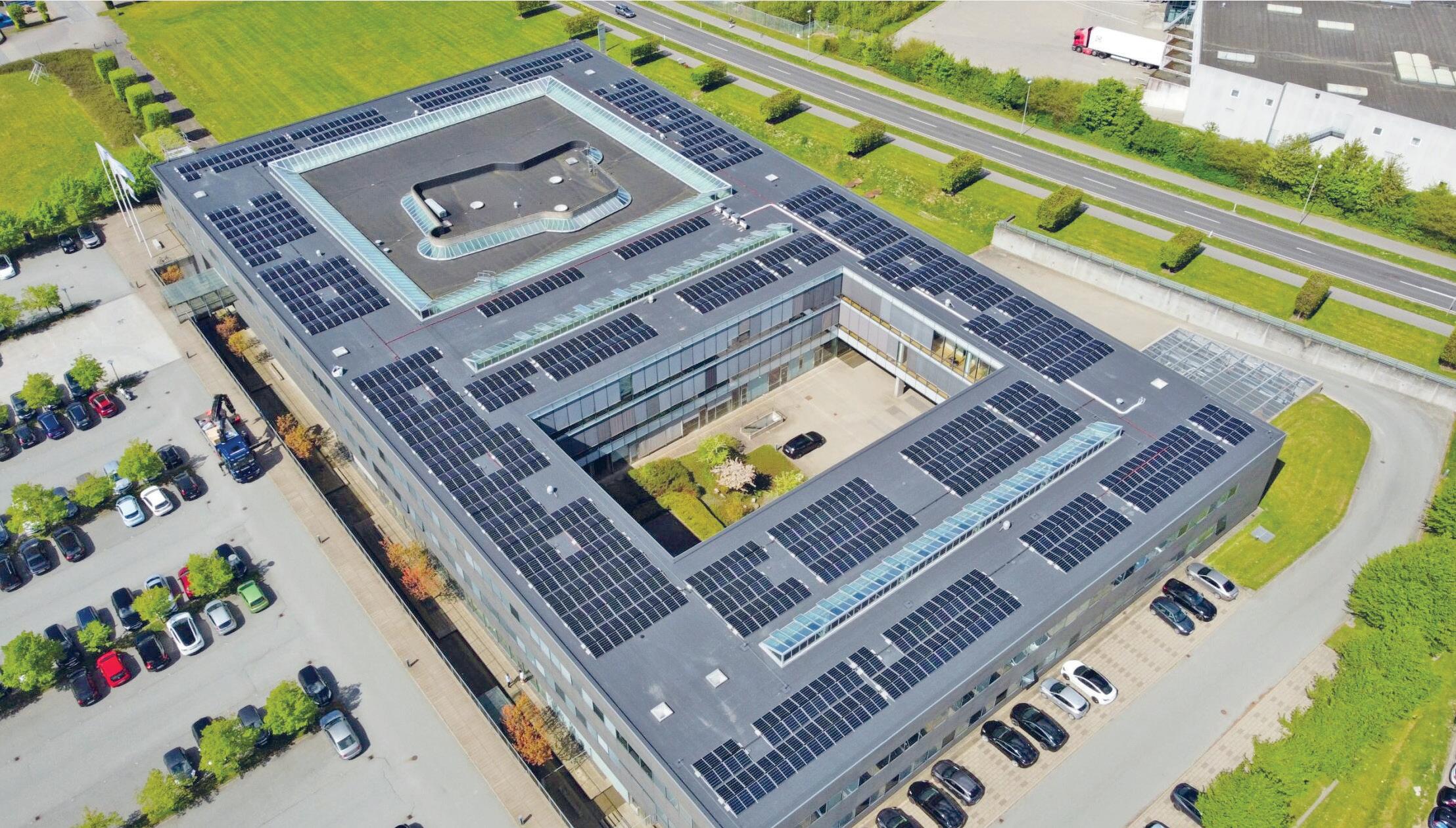
The fully owned subsidiary, Stibo Ejendomme A/S owns the head quarter building at Axel Kiers Vej 11, Aarhus, Denmark.
General
Stibo aspires to run a reputable business that contributes to society also in a broader context by:
• Making products that make a difference to our customers’ businesses.
• Providing jobs and income for around 2,000 employees in 20 countries.
• Generating activity and revenue in our supply chain.
• Generating profit for re-investment and long-run development of the business groups.
• Paying taxes and thereby contributing to the state health, welfare, and societal costs.
Stibo has focus on sustainability. It is significant to society in general, to our customers, and to our employees. In both the Stibo Complete Group and the Stibo Soft ware Group sustainability efforts are organized systematically and with ultimate reference to the executive level of the respective business groups.
The statutory reporting requirements according to The Danish Financial Statements Act section 99a (re. business model and environmental and social responsibility) and section 99d (re. data ethics) are covered below too. Stibo Holding A/S’s main impact on society is related to the two business groups, the Stibo Complete Group and the Stibo Soft ware Group, meaning that the reporting be low focuses on their selected primary areas. Please see above (on page 14 through 16) for the business model descriptions for the two business groups and for Stibo Holding A/S’ limited separate activities. The business groups’ industries differ significantly, so the data points in the following overview also differ and that is why they are not consolidated across the two groups.
The Stibo Complete Group is ISO 14001 (environmentally) and ISO 9001 (quality) certified and endorses the Graphic CSR Code. It also has license to the Nordic Swan Eco label and is certified according to FSC and PEFC. Further, it is ClimateCalc certified.
The Stibo Soft ware Group adheres to the UN Global Compact and is ISO 27001 certified. It endorses Science Based Targets, and Stibo Systems is Ecovadis and SOC2 certified. Stibo DX’s has earned the highest possible rating from the DPP ESG certification program.

Stibo fully acknowledges the importance of a two-sided environmental approach that encompasses both the company’s effects on the environment as well as the environment’s effects on the company. Regarding the latter, a key effect results from the customers’ sustainability priorities when it comes to supplier selection and product evaluation. The most significant risks for environmental and climate impact are found in the Stibo Complete Group’s production of printed paper products, as there is a risk of negative impact on the environment associated with the purchase and disposal of materials for production and a risk of negative impact on the climate associated with the consumption of energy in production. The Stibo Complete Group is therefore continuously working on improvements in the area based on the most significant environmental and climate impacts. Stibo Complete’s integrated management system is environmentally certified according to ISO 14001 and quality certified according to ISO 9001.
As can be seen from the table below, Stibo Complete Group’s carbon emission and energy consumption has decreased, and electricity consumption has increased. The decrease is related to optimized capacity utilization. The increase in water consumption is due to damaged equipment that has been fixed. Actions have been made to optimize energy consumption during the fiscal year.
In relation to the Stibo Soft ware Group it should be noted that total carbon emissions (intensity) show an almost flat development. The same goes for energy consumption intensity. The absolute numbers regarding CO2e and energy consumption have risen compared to last financial year, but the numbers are reduced compared to the base year (2021/22). Even if this may indicate that att aining improvements become still more difficult, Stibo Soft ware Group is continuing its strive with regards to the green agenda.
All in all, Stibo will continue the environmental actions going forward.
Stibo aspires to be known as an att ractive workplace and to be able to att ract and retain the best employees in all business-sectors we operate in. In all aspects of the business, Stibo is critically dependent upon the employees, their safety, commitment, and well-being.
The number of employees in the Stibo Complete Group has decreased due to capacity adjustments. The churn rate has for the same reason increased to 14%, but it is still below average for the last five years. The sick leave at 3.6% is stable.
In the Stibo Soft ware Group the number of employees has increased with 39 (4.0%) to 1,013 compared to last year, which is partly due to hires in Stibo DX for the realization of the investment plan. The churn rate has gone down to 9% from 18% last year due amongst others to Stibo DX being further in their organizational development process. The sick leave at 2.1% is considered still to be at the mid to low level in the IT industry.
The most important risks in this area relate to the Stibo Complete Group regarding the risk of accidents at work and to the Stibo Soft ware Group regarding stress and lack of well-being. The Stibo Complete Group is continuously working to improve safety in production, and all occupational accidents and near accidents during the fiscal year are registered, reviewed, and handled. In the Stibo Soft ware Group management attention towards employees’ well-being is key, meaning that regular employee satisfaction surveys are one important way of creating awareness and focus. In cases of employee stress, HR is involved in addressing the matter.
Complete Group, FTE (avg.) Complete Group, Churn rate
Complete Group, Sick leave
2021/22 2022/23 2023/24 2024/25 2025/26
Software Group, FTE (avg.) Software Group, Churn rate
Software Group, Sick leave
To support a good working environment, it is important that all employees have an att ractive environment in which to carry out their work. In addition, the Stibo Group provides several offers to employees.
With local variations, they range from health insurance, pension and insurance schemes to gym facilities and social activities. Stibo has a broad composition of employees and has, among other things, designed its premises in a disability-friendly manner.
Safety at work is a high priority, and the company’s health and safety committees therefore evaluate the procedures on an ongoing basis.
Stibo is constantly striving to improve the internal working environment, with strong focus on safety, indoor climate, temperature adaptation, etc.
In general, Stibo takes pride in long-term perspectives, also regarding employment and diversity. The tables show the median age and seniority.
Employee ages range from the early twenties until the early seventies. The seniority ranges from zero to +30 years.
Stibo considers gender diversity a strength. It increases the probability of having the best possible match between the job profile and the employee profile.
Diversity is considered to broaden the perspective on topics and challenges in general, and it has a valuable influence on the culture. The actual possibilities for reaching diversity vary by industry as can be seen from the illustration below. However, Stibo encourages job seekers of any gender to apply for vacant positions.
Stibo respects internationally recognized human rights (cf. UN Guiding Principles on Business and Human Rights) and aims at treating all stakeholders decently. Stibo does not accept any harassment or discrimination, which are considered the potential risks in respect to human rights. The assessment is that there is no major risk for human rights violations within the group’s companies. Despite this, communication to all employees regarding the importance of human rights issues has been and will be very clear.
Any risk regarding human rights is considered more closely related to upstream activities. During the fiscal year, to avoid any of such breaches the company uses risk management procedures where suppliers are being evaluated and only suppliers with a low or medium risk are used. In the Stibo Complete Group supplier evaluation is based on the Graphic CSR Code. Furthermore, whistleblower arrangements are being communicated on the intranets to enable easy and anonymous reporting on any potential breaches whether internally or in the supply chain. In the Stibo Complete Group, there has been one whistleblower reporting case during the fiscal year. The case has been carefully dealt with and is now closed after concluding “no deviation”.
Looking ahead, the mentioned activities to ensure human rights will be continued.
The risks in the business groups are measured, controlled, and mitigated by the management hierarchy and business reporting processes of the specific group. The risk management at the Stibo Holding group level is handled by the Board of Directors at an aggregate level. In the two business groups and in Stibo Holding, a two-tier management system is in place. This separates the Board of Directors’ level from the executive level (and levels below). Finally, the auditing processes at various levels also play a key role in managing risks.
The primary business risks in the Stibo Complete Group arise from the overall market trend towards digitalization, price competition, and increasing up- and downstream costs. The primary business risks in the Stibo Soft ware Group are related to the overall economic development and the investment appetite of customers in the addressable markets. As more customers move to SaaS solutions provided by Stibo, there is increased exposure to cyber-att acks. SaaS solutions also come with a dependency on the underlying cloud providers (Microsoft Azure and Amazon Web Services). For Stibo DX there is also considerable exposure with regards to the implementation of the transformation process.
Stibo is exposed to exchange rate changes due to customer and vendor agreements in foreign currencies. Due to its global presence and structure, the Stibo Group is automatically partly hedged against exchange rate risks. Financial hedging instruments are used if appropriate.
Due to Stibo’s solvency and cash position, the effect of changes in interest rate levels is mainly regarding asset management.
Inflation risk is partly hedged by provisions in customer and vendor agreements.
Credit risks are managed through credit rating checks, on-account invoicing in the software business, and in some cases through credit insurance in the printing business.
In Stibo Holding A/S, there have been 7 board meetings (3 of these were extra-ordinary) from 1 May 2025 to 30 April 2026. All board members have taken part in all meetings.
Stibo distances itself from corruption and does not tolerate bribery or other unethical behavior. The most significant risks in this area are assessed to be related to procurement and investments. Whistleblower schemes have been set up so that inquiries regarding possible illegal activities or serious violations of internal policies can be reported anonymously by any employee. There was one whistleblower reporting case during the fiscal year. The case has been carefully dealt with and is now closed. Going forward, we will continue to fight corruption and bribery and monitor reports from our established whistleblower scheme.
Stibo fully recognizes the importance and responsibility of handling data and access to it with care and following the legal requirements for this. This concerns both data covered by GDPR and customer-related data, where credibility and trust are crucial.
A data ethics policy, addressing how data is collected, stored, accessed, and protected, as well as how we meet our privacy requirements, has been implemented and communicated to all areas excluding the Stibo Complete Group. The latter expects to implement a data ethics policy over the coming years.

Consolidated financial statements and parent company financial statements 1 May – 30 April
Consolidated financial statements and parent company financial statements 1 May – 30 April
financial statements and parent company financial statements 1 May – 30 April Consolidated financial statements and parent company financial statements 1 May – 30 April
Balance sheet
Consolidated financial statements and parent company financial statements 1 May – 30 April
Consolidated financial statements and parent company financial statements 1 May – 30 April
Consolidated financial statements and parent company financial statements 1 May – 30 April
Statement of changes in equity – Consolidated
Consolidated financial statements and parent company financial statements 1 May – 30 April
financial statements and parent company financial statements 1 May – 30 April
Consolidated financial statements and parent company financial statements 1 May – 30 April
The cash flow statement cannot be directly derived from the other components of the consolidated financial statements.
Apart from cash and cash equivalents on 30 April, Stibo Holding has listed securities of DKK 684,8 million, which can be settled as cash within days’ notice.
The cash flow statement cannot be directly derived from the other components of the consolidated financial statements. Apart from cash and cash equivalents on 30 April,
Notes
1. Accounting policies
The annual report of Stibo Soft ware Group A/S for 2025/26 has been prepared in accordance with the provisions applying to reporting class C large entities under the Danish Financial Statements Act.
The accounting policies used in the preparation of the financial statements are consistent with those of last year.
Presentation currency
The financial statements are presented in Danish Kroner (DKK’000).
Consolidated financial statements
The consolidated financial statements comprise the parent company, Stibo Holding A/S, and subsidiaries in which Stibo Holding A/S directly or indirectly holds more than 50% of the voting rights or which it, in some other way, controls.
On consolidation, intra-group income and expenses, shareholdings, intra-group balances and dividends, and realised and unrealised gains and losses on intra-group transactions are eliminated.
Investments in subsidiaries are set off against the proportionate share of the subsidiaries’ fair value of net assets or liabilities at the acquisition date. Entities acquired or formed during the year are recognised in the consolidated financial statements from the date of acquisition or formation. Entities disposed of are recognised in the consolidated income statement until the date of disposal. The comparative figures are not restated for acquisitions or disposals.
Gains or losses on disposal of subsidiaries are stated as the difference between the sales amount and the carrying amount of net assets at the date of disposal plus non-amortized goodwill and anticipated disposal costs.
Acquisitions of entities are accounted for using the acquisition method, according to which the identifiable assets and liabilities acquired are measured at their fair values at the date of acquisition.
Any excess of the cost over the fair value of the identifiable assets and liabilities acquired (goodwill), including restructuring provisions, is recognised as intangible assets, and amortized on a systematic basis in the income statement based on an individual assessment of the useful life of the asset.
1. Accounting policies (continued)
Business combinations
Newly acquired entities are recognized in the consolidated financial statements from the acquisition date. Comparative figures are not restated to reflect newly acquired entities.
The acquisition date is the date when the Group obtains control of the acquiree.
The purchase method is applied to acquisitions of new businesses over which the Group obtains control. The acquired businesses’ identified assets, liabilities and contingent liabilities are measured at fair value at the acquisition date. Identifiable intangible assets are recognized if they are separable or arise from a contractual right. Deferred tax on revaluations is recognized.
Positive differences (goodwill) between, on the one hand, the consideration for the acquiree, the value of non-controlling interests in the acquired entity and the fair value of any previously acquired equity investments and, on the other hand, the fair value of the assets, liabilities and contingent liabilities acquired are recognized as goodwill in intangible assets. Goodwill is amortized on a straight-line basis in the income statement based on an individual assessment of the economic life of the asset.
Negative differences (negative goodwill) are recognized in the income statement at the acquisition date.
The purchase consideration for an entity consists of the fair value of the agreed consideration in the form of assets transferred, liabilities assumed, and equity instruments issued.
If part of the purchase consideration is contingent on future events or compliance with agreed terms, such part of the purchase consideration is recognized at fair value at the acquisition date. Subsequent adjustments of contingent purchase considerations are recognized in the income statement.
Expenses incurred to acquire entities are recognized in the income statement in the year in which they are incurred.
If uncertainties regarding the identification or measurement of acquired assets, liabilities or contingent liabilities or the determination of the purchase consideration exist at the acquisition date, initial recognition will take place on the basis of provisional values. If it turns out subsequently that the identification or measurement of the purchase consideration, acquired assets, liabilities or contingent liabilities was incorrect on initial recognition, the statement will be adjusted retrospectively, including goodwill, until 12 months after the acquisition, and comparative figures will be restated. Subsequently, any adjustments are recognized as errors.
In the consolidated financial statements, the subsidiaries accounting lines are recognized with 100%. The non-controlling interests relative share of the subsidiaries’ equity is recorded as a separate line below equity.
Acquisitions and disposals of non-controlling interests that are still controlled are recognised directly in equity as a transaction between shareholders.
1. Accounting policies (continued)
Foreign currency translation
On initial recognition, transactions denominated in foreign currencies are translated at the exchange rates at the transaction date. Foreign exchange differences arising between the exchange rates at the transaction date and at the date of payment are recognized in the income statement as financial income or financial expenses.
Receivables and payables and other monetary items denominated in foreign currencies are translated at the exchange rates at the balance sheet date. The difference between the exchange rates at the balance sheet date and at the date at which the receivable or payable arose or was recognized in the latest financial statements is recognized in the income statement as financial income or financial expenses.
Foreign subsidiaries and associates are considered separate entities. The income statements are translated at the average exchange rates for the month, and the balance sheet items are translated at the exchange rates at the balance sheet date. Foreign exchange differences arising on translation of the opening equity of foreign subsidiaries at the exchange rates at the balance sheet date and on translation of the income statements from average exchange rates to the exchange rates at the balance sheet date are recognized directly in equity. Foreign exchange adjustments of intra-group balances with independent foreign subsidiaries which are considered part of the investment in the subsidiary are recognized directly in equity. Foreign exchange gains and losses on loans and derivative financial instruments designated as hedges of foreign subsidiaries are also recognized directly in equity.
On initial recognition in the balance sheet, derivative financial instruments are measured at cost and subsequently at fair value. Positive and negative fair values of derivative financial instruments are included in ‘Other receivables’ or ‘Other payables’,
respectively. Fair value adjustments of derivative financial instruments designated as and qualifying for recognition as a fair value hedge of recognised assets or liabilities are recognised in the income statement together with fair value adjustments of the hedged asset or liability. Fair value adjustments of derivative financial instruments designated as and qualifying for hedging of future cash flows are recognised in other receivables or other payables and in equity. If the future transaction results in recognition of assets or liabilities, amounts previously recognised in equity are transferred to the cost of the asset or the liability, respectively. If the future transaction results in income or costs, amounts previously recognised in equity are transferred to the income statement in the period in which the hedged item affects the income statement. As for derivative financial instruments that do not qualify for hedge accounting, fair value adjustments are recognised in the income statement on a current basis.
Income statement
Revenue
Revenue from the sale of goods and services is recognized in the income statement provided that delivery and transfer of risk to the buyer have taken place before year end and that the income can be reliably measured and is expected to be received. Revenue is measured ex. VAT and taxes charged on behalf of third parties.
Contract work in progress in respect of delivery of large systems is recognized in revenue by reference to the stage of completion. Accordingly, revenue corresponds to the selling price of work performed during the year (percentage of completion method). Revenue is recognized when total income and expenses relating to the construction contract and the stage of completion at the balance sheet date can be reliably measured, and when it is probable that future economic benefits, including payments, will flow to the Group.
1. Accounting policies (continued)
Changes in inventories of work in progress
Changes in inventories of work in progress include the changes in the year of work in progress.
operating income
Other operating income comprises items secondary to the primary activities of the Company, including sale of waste paper, gain on disposal of fixed assets and badwill from business combinations.
Cost of sales comprise purchases of soft ware, hosting, and services for the year for the soft ware entities, as well as raw materials and consumables and change in inventories for the printing entities.
Other external costs comprise items primary to the activities, which mainly include marketing, travel, external consultants, rent and recharge cost from group companies.
Staff costs comprise wages and salaries, remuneration, pensions, and other costs regarding the Company’s employees, including members of the Executive Board and the Board of Directors.
Development costs regarding new products are expensed as incurred as the conditions for capitalization are not considered to have been met.
Comprises depreciation, amortization and impairment losses of property, plant and equipment and intangible assets.
Notes
1. Accounting policies (continued)
The proportionate share of the results after tax of the individual subsidiaries is recognized in the income statement of the parent company after full elimination of intra-group profits/losses and amortization of goodwill.
The proportionate share of the results after tax of the associates is recognized in the income statement after elimination of the proportionate share of intra-group profits/ losses.
Financial income and expenses comprise interest income and expense, gains and losses on securities, payables and transactions denominated in foreign currencies, amortization of financial assets and liabilities as well as surcharges and refunds under the on-account tax scheme, etc. Interest expenses are not capitalized.
The Company is subject to the Danish rules on compulsory joint taxation of the Stibo Group’s Danish companies. Subsidiaries are included in the joint taxation from the date when they are included in the consolidated financial statements and up to the date when they are excluded from the consolidation.
Stibo Holding A/S is the management company for the joint taxation and consequently sett les all corporation tax payments with the tax authorities.
On payment of joint taxation contributions, the current Danish corporation tax is allocated between the jointly taxed companies in proportion to their taxable income. In this relation, companies with tax loss carryforwards receive joint taxation contribution from companies that have used these losses to reduce their own taxable profits.
Tax for the year, comprising current tax and changes in deferred tax for the year, is recognized in the income statement. The tax expense relating to changes in equity is recognized directly in equity.
Goodwill is amortized over the expected economic life of the asset, measured by reference to Management’s experience in the individual business segments. Goodwill is amortized on a straight-line basis over the amortization period, which is between 3 and 10 years. The amortization period is fixed based on the expected repayment horizon, longest for strategically acquired business enterprises with strong market positions and long-term earnings profiles.
Other intangible assets include patents and rights acquired, etc.
Other intangible assets are measured at cost less accumulated amortization and impairment losses. Other intangible assets are amortized on a straight-line basis over the expected useful life of 3-10 years.
1. Accounting policies (continued)
Property, plant, and equipment
Fixtures and fittings, tools and equipment are measured at cost less accumulated depreciation.
Cost comprises the purchase price and any costs directly att ributable to the acquisition until the date when the asset is available for use.
Where individual components of an item of property, plant and equipment have different useful lives, they are accounted for as separate items, which are depreciated separately.
Depreciation is provided on a straight-line basis over the expected useful lives of the assets. The expected useful lives are as follows:
Land and buildings 10-40 years
Plant and machinery 3-15 years
Fixtures and fittings, other plant and equipment 3-10 years
Leasehold improvements 3-10 years
The basis of depreciation is based on the residual value of the asset at the end of its useful life and is reduced by impairment losses, if any. The depreciation period and the residual value are determined at the time of acquisition and are reassessed every year. Where the residual value exceeds the carrying amount of the asset, no further depreciation charges are recognized.
In case of changes in the depreciation period or the residual value, the effect on the amortization charges is recognized prospectively as a change in accounting estimates.
Gains and losses on the disposal of property, plant and equipment are calculated as the difference between the selling price less selling costs and the carrying amount at the date of disposal. Gains or losses are recognized in the income statement as other operating income or other operating costs, respectively.
The Group has chosen IAS 17 as interpretation for classification and recognition of leases.
On initial recognition, leases for assets that transfer substantially all the risks and rewards incident to ownership to the Company (finance leases) are measured in the balance sheet at the lower of fair value and the present value of future lease payments. In calculating the present value, the interest rate implicit in the lease or the incremental borrowing rate is used as the discount factor. Assets held under finance leases are subsequently accounted for as the Company’s other assets.
The capitalized residual lease commitment is recognized in the balance sheet as a liability, and the interest element of the lease payment is recognized in the income statement over the term of the lease.
Leases that do not transfer substantially all the risks and rewards incident to ownership to the entity are operating leases. Payments relating to operating leases and any other leases are recognized in the income statement over the term of the lease. The Company’s total liabilities relating to operating leases and other leases are disclosed under contingencies.
1. Accounting policies (continued)
Investments in group entities
Investments in group entities are measured according to the equity method.
Investments in group entities are measured in the balance sheet at the proportionate share of the entities’ net asset value determined in accordance with the parent company’s accounting policies less or plus unrealized intra-group gains and losses.
Group entities with negative net asset values are measured at DKK 0 (nil), and any amounts owed by such entities are written down by the parent company’s share of the net asset value if the amount owed is deemed irrecoverable. If the negative net asset value exceeds the amounts owed, the remaining amount is recognized under provisions if the parent company has a legal or a constructive obligation to cover the subsidiary’s deficit.
Net revaluation of investments in group entities is recognized in the reserve for net revaluation according to the equity method in equity to the extent that the carrying amount exceeds cost.
Other non-current investments
Other non-current investments consist of unlisted investments in shares, which are recognized at cost price.
On initial recognition, other investments are measured at cost.
In case of indication of impairment, impairment test is carried out. Impairment to a lower net realization value is made.
Inventories are measured at cost in accordance with the FIFO method. Where the net realizable value is lower than cost, inventories are written down to this lower value. The net realizable value of inventories is determined as the selling price less any discounts, costs of completion and costs incurred to effect the sale, taking into account marketability, obsolescence and developments in the expected selling price.
Work in progress are measured at cost, comprising the cost of raw materials, consumables, direct wages and salaries as well as indirect production overheads. Production overheads comprise costs of material and labor as well as maintenance of and depreciation on production machinery, buildings, and equipment as well as costs relating to plant administration and management.
Receivables are measured at amortized cost. Write-down is made for expected losses.
1. Accounting policies (continued)
Contract work in progress
Contract work in progress is measured at the selling price of the work performed. The selling price is measured by reference to the stage of completion at the balance sheet date and total expected income from the work.
When the selling price of a construction contract cannot be measured reliably, the selling price is measured at the lower of costs incurred and net realizable value.
Individual work in progress is recognized in the balance sheet under either receivables or payables depending on the net value of the sales amount less progress billings and prepayments.
Selling costs and costs incurred in securing contracts are recognized in the income statement as incurred.
Prepayments comprise costs incurred concerning subsequent financial years, among other things rent, subscriptions, contingents etc.
Securities
Securities consisting in listed shares and bonds are measured at fair value (market price) at the balance sheet date.
Proposed dividend is recognized as a liability at the date when it is adopted at the annual general meeting (declaration date). Dividend expected to be distributed for the year is presented as a separate line item in equity.
1. Accounting policies (continued)
Corporation tax and deferred tax
Payable and receivable joint taxation contributions are recognized in the balance sheet under balances with group companies.
Deferred tax is measured using the balance sheet liability method on all temporary differences between the carrying amount and the tax value of assets and liabilities. Where alternative tax rules can be applied to determine the tax base, deferred tax is measured based on Management’s intended use of the asset or sett lement of the liability, respectively.
Deferred tax assets, including the tax value of tax loss carryforwards, are recognized at the expected value of their utilization; either as a set-off against tax on future income or as a set-off against deferred tax liabilities in the same legal tax entity.
Deferred tax is measured according to the tax rules and at the tax rates applicable at the balance sheet date when the deferred tax is expected to crystallize as current tax.
Changes in deferred tax due to changes in the tax rate are recognized in the income statement.
Other provisions
Provisions include cost of restructuring and other expected liability which are uncertain in nature.
Provisions are recognised when the Group has a legal or constructive obligation as a result of a past event at the balance sheet date, and it is probable that an outflow of the Group’s resources embodying economic benefits will be required to sett le the obligation. Provisions are measured at net realisable value or fair value.
When it is probable that the total contract expenses will exceed the total contract revenue, a provision is made for the total anticipated loss on the contract. Total costs comprise costs directly related to the fulfilment of the contract, e.g. depreciation on property, plant and equipment and unavoidable costs of meeting the obligations under the contract, e.g. wages and salaries and materials as well as allocation of other costs.
Amounts owed to mortgage credit institutions and banks are recognized at the date of borrowing at the net proceeds received less transaction costs paid. In subsequent periods, the financial liabilities are measured at amortized cost, corresponding to the capitalized value using the effective interest rate. Accordingly, the difference between the proceeds and the nominal value is recognized in the income statement over the term of the loan.
Other liabilities are measured at net realizable value.
Notes
1. Accounting policies (continued)
Cash flow statement
The cash flow statement shows the Group’s cash flows from operating, investing, and financing activities for the year, the year’s changes in cash and cash equivalents as well as the Group’s cash and cash equivalents at the beginning and end of the year.
Cash flows from operating activities
Cash flows from operating activities are calculated as the Group’s share of the profit/ loss adjusted for non-cash operating items, changes in working capital and corporation tax paid.
Cash flows from investing activities
Cash flows from investing activities comprise payments in connection with acquisitions and disposals of entities and activities and of intangible assets, property, plant and equipment and investments.
Cash flows from financing activities
Cash flows from financing activities comprise changes in the size or composition of the Group’s share capital and related costs as well as the raising of loans, repayment of interestbearing debt and payment of dividends to shareholders.
Cash and cash equivalents
Cash and cash equivalents include cash at hand and in banks.
Segment information
Information is disclosed by activities and geographical markets. Segment information is based on the Company’s accounting policies, risks, and management control.
Consolidated financial statements and parent company financial statements 1 May – 30 April
Notes
1. Accounting policies (continued)
Financial ratios
The financial ratios stated in the survey of financial highlights have been calculated as follows:
EBITDA
EBITDA margin
Operating profit added depreciation, amortization and impairment losses (before minor new acquisitions)
EBITDA x 100 Revenue
EBIT margin
EBIT x 100 Revenue
Return on invested capital
Operating profit/loss x 100
Average net operating assets
Net operating assets
Net interest-bearing debt
Return on equity
Net operating assets are equity less net interest-bearing debt
Included Non-current liabilities less cash and securities
Profit/loss for the year x 100
Average equity
Solvency ratio
Equity at year end x 100
Total equity and liabilities at year end
financial statements and parent company financial statements 1 May – 30 April
2. Segment information
2Segment information DKK'000
Geographical breakdown of revenue
3. Other operating income
The items in the consolidated financial statements mainly includes income from sale of paper, rental income as well as gain on the sale of non-current assets. Consolidated financial statements and parent company financial statements 1 May – 30 April Notes
financial statements and parent company financial statements 1 May – 30 April
costs
Consolidated financial statements and parent company financial statements 1 May – 30 April
Consolidated financial statements and parent company financial statements 1 May – 30 April
Consolidated financial statements and parent company financial statements 1 May – 30 April Notes
financial statements 1 May – 30 April
Consolidated financial statements and parent company financial statements 1 May – 30 April
4 Staff costs
4 Staff costs
A/S and underlying companies, remuneration of the Board of directors and Executive Board total DKK 3,353 thousand (2024/25: DKK 3,089 thousand). Pursuant to of the Danish Financial Statements Act, remuneration to the management is disclosed as a whole. Board of directors and Executive in the Group are those the Danish business authority.
In Stibo Holding A/S and underlying companies, remuneration of the Board of directors and Executive Board total DKK 3,089 thousand (2023/24:
In Stibo Holding A/S and underlying companies, remuneration of the Board of directors and Executive Board total DKK 3,353 thousand (2024/25: DKK 3,089 thousand). Pursuant to section 98b(3) of the Danish Financial Statements Act, remuneration to the management is disclosed as a whole. Board of directors and Executive Board in the Group are those registered with the Danish business authority.
amortization and impairment losses
5 Depreciation, amortization and
In Stibo Holding A/S and underlying companies, remuneration of the Board of directors and Executive Board total DKK 3,353 thousand (2024/25: DKK 3,089 thousand). Pursuant to section 98b(3) of the Danish Financial Statements Act, remuneration to the management is disclosed as a whole. Board of directors and Executive Board in the Group are those registered with the Danish business authority.
5 Depreciation, amortization
companies, remuneration of the Board of directors and Executive Board total DKK 3,353 thousand (2024/25: DKK 3,089 thousand). Pursuant to Statements Act, remuneration to the management is disclosed as a whole. Board of directors and Executive Board in the Group are those
In Stibo Holding A/S and underlying companies, remuneration of the Board of directors and Executive Board total DKK 3,353 thousand (2024/25: DKK 3,089 thousand). Pursuant to section 98b(3) of the Danish Financial Statements Act, remuneration to the management is disclosed as a whole. Board of directors and Executive Board in the Group are those registered with the Danish business authority.
5 Depreciation, amortization and impairment losses
5. Depreciation, amortization and impairment losses
1 May – 30 April
measured at fair value based on observable inputs on regulated markets (Level 1). Fair value adjustment recognized in Income Statement Amounts to, DKK 54,487 April 2026 Securities recognized at fair value amount to DKK 684,760 thousand (30 April 2025; DKK 552,094 thousand).
thousand. On 30 April 2026 Securities recognized at
Consolidated financial statements and parent company financial statements 1 May – 30 April Notes 9. Intangible assets Consolidated financial statements and parent company financial statements 1 May – 30 April
Consolidated financial statements and parent company financial statements 1 May – 30 April
Consolidated financial statements and parent company financial statements 1 May – 30 April
and equipment
Of the consolidated non-current investments DKK 7,068 thousand is measured at fair value based on available prices for listed bonds and
DKK 7,068 thousand is measured at fair value based on available prices for listed bonds and securities.
financial statements and parent company financial statements 1 May – 30 April
Proposed dividends in the subsidiaries total DKK 200 million (2024/25: DKK 75 million).
Proposed dividends in the subsidiaries total DKK 200 million (2024/25: DKK 75 million).
Proposed dividends in the subsidiaries total DKK 200 million (2024/25: DKK 75 million).
financial statements and parent company financial statements 1 May – 30 April
company financial 1 May – 30 April
Contract work in progress
1 May – 30 April
Deferred tax Consolidated financial statements and parent company financial statements 1 May – 30 April
company financial statements 1 May – 30 April
financial statements and parent company financial statements 1 May – 30 April
expenses related to the subsequent year, among other things rent, subscriptions, contingents etc. 25,000 thousand. All shares rank equally. The share capital has remained unchanged for the past five financial years.
Prepayments comprise prepayments of expenses related to the subsequent year, among other things rent, subscriptions, contingents etc.
Prepayments comprise prepayments of expenses related to the subsequent year, among other things rent, subscriptions, contingents etc.
Equity
The share capital comprises of nom. DKK 25,000 thousand. All shares rank equally. The share capital has remained unchanged for the past five financial years.
Proposed profit allocation DKK'000
are expected to mature
provisions for loss making contracts and provisions for re-establishing of land.
The share capital comprises of nom. DKK 25,000 thousand. All shares rank equally. The share capital has remained unchanged for the past five financial years.
Other provisions relates to restructuring costs, provisions for loss making contracts and provisions for re-establishing of land.
Other provisions relates to restructuring costs, provisions for loss making contracts and provisions for re-establishing of land. Consolidated financial statements and parent company financial statements 1 May – 30 April
financial statements and parent company financial statements 1 May – 30 April
and parent company financial statements 1 May – 30 April
and parent company financial statements 1 May – 30 April
Consolidated financial statements and parent company financial statements 1 May – 30 April
18 Non-current liabilities
18. Non-current liabilities
18 Non-current liabilities
April 2026 amounts to DKK 39.7 million (30 April 2025; DKK 45.4 million) comprise lease commitments and payables to payables to Group A/S. Instalments falling due within five years total DKK 5.8 million (30 April 2025: DKK 12.5 million).
April 2026 amounts to DKK 39.7 million (30 April 2025; DKK 45.4 million) comprise lease commitments and payables to payables to
Group A/S. Instalments falling due within five years total DKK 5.8 million (30 April 2025: DKK 12.5 million).
general meeting
liabilities
The Group’s non-current liabilities on 30 April 2026 amounts to DKK 39.7 million (30 April 2025; DKK 45.4 million) comprise lease commitments and payables to payables to minority shareholders of Stibo Complete Group A/S. Instalments falling due within five years total DKK 5.8 million (30 April 2025: DKK 12.5 million). 19 Fees paid to auditor appointed at the annual general meeting
The Group’s non-current liabilities on 30 April 2026 amounts to DKK 39.7 million (30 April 2025; DKK 45.4 million) comprise lease commitments and payables to payables to minority shareholders of Stibo Complete Group A/S. Instalments falling due within five years total DKK 5.8 million (30 April 2025: DKK 12.5 million).
The Group’s non-current liabilities on 30 April 2026 amounts to DKK 39.7 million (30 April 2025; DKK 45.4 million) comprise lease commitments and payables to payables to minority shareholders of Stibo Complete Group A/S. Instalments falling due within five years total DKK 5.8 million (30 April 2025: DKK 12.5 million).
19. Fees paid to auditor appointed at the annual general meeting
19 Fees paid to auditor appointed at the annual general meeting
20 Mortgages, collaterals, and contingent liabilities
20 Mortgages, collaterals, and contingent liabilities
20. Mortgages, collaterals, and contingent liabilities Parent company
company
Parent company
5,346
liabilities Danish group companies. As group company, together with the other companies included in the joint taxation, the Company has joint corporation taxes and withholding taxes on dividends, interest, and royalties.
Danish group companies. As group company, together with the other group companies included in the joint taxation, the Company has joint corporation taxes and withholding taxes on dividends, interest, and royalties.
The Company is jointly taxed with other Danish group companies. As group company, together with the other group companies included in the joint
the
has joint and several unlimited liability for Danish corporation taxes and withholding taxes on dividends, interest, and royalties.
The Company is jointly taxed with other Danish group companies. As group company, together with the other group companies included in the joint taxation, the Company has joint and several unlimited liability for Danish corporation taxes and withholding taxes on dividends, interest, and royalties.
The Company is jointly taxed with other Danish group companies. As group company, together with the other group companies included in the joint taxation, the Company has joint and several unlimited liability for Danish corporation taxes and withholding taxes on dividends, interest, and royalties.
liabilities to Skattestyrelsen are recognized in the financial statements of the administrative company, Stibo Holding A/S. Any subsequent withholding taxes, etc. may imply that the Company's liabilities increase. etc.
The jointly taxed companies known net liabilities to Skattestyrelsen are recognized in the financial statements of the administrative company, Stibo Holding A/S. Any subsequent corrections to the joint taxation income and withholding taxes, etc. may imply that the Company's liabilities increase.
The jointly taxed companies known net liabilities to Skattestyrelsen are recognized in the financial statements of the administrative company, Stibo Holding A/S. Any subsequent corrections to the joint taxation income and withholding taxes, etc. may imply that the Company’s liabilities increase.
liabilities to Skattestyrelsen are recognized in the financial statements of the administrative company, Stibo Holding A/S. Any subsequent withholding taxes, etc. may imply that the Company's liabilities increase.
The jointly taxed companies known net liabilities to Skattestyrelsen are recognized in the financial statements of the administrative company, Stibo Holding A/S. Any subsequent corrections to the joint taxation income and withholding taxes, etc. may imply that the Company's liabilities increase.
21 Adjustments for non-cash operating items, etc.
21 Adjustments for non-cash operating items, etc.
21. Adjustments for non-cash operating items, etc. Consolidated financial statements and parent company financial statements 1 May – 30 April
of
93,205
Consolidated financial statements and parent company financial statements 1 May – 30 April Notes
22. Lease obligations
Consolidated
The Group has entered rent obligations totalling DKK 110.4 million (2024/25: DKK 115.0 million). DKK 49 million falls due within one year.
Other lease obligations (operating leases) totalling 16.0 million (2024/25: DKK 23.8 million). DKK 10.4 million falls due within one year, and DKK 0.2 million falls due after five years.
Parent company
The parent company has lease obligations totalling 0.3 million (2024/25: DKK 0 million). DKK 0.1 million falls due within one year.
Consolidated financial statements and parent company financial statements 1 May – 30 April
3 Includes receivables and payables related to sales and purchases of goods and services and intercompany financing. and parent company financial statements 1 May – 30 April DK-8270 Højbjerg.
Consolidated financial statements and parent company financial statements 1 May – 30 April
Notes
Notes
23 Related parties
24. Related parties
Parties exercising control
Parties exercising control
The STIBO-FONDEN, Axel Kiers Vej 11, DK-8270 Højbjerg.
The STIBO-FONDEN, Axel Kiers Vej 11, DK-8270 Højbjerg.
Related party transactions
Related party transactions
and subsidiaries in which STIBO-FONDEN directly or indirectly controls.
Related parties comprise the STIBO-FONDEN and subsidiaries in which STIBO-FONDEN directly or indirectly controls.
Related parties comprise the STIBO-FONDEN and subsidiaries in which STIBO-FONDEN directly or indirectly controls.
Transactions in 2025/26 with related parties:
Transactions in 2025/26 with related parties:
1 Includes sales and purchases of services.
financing. sales and purchases of goods and services and intercompany financing.
2 Includes financial items related to intercompany financing.
!89J;1+;OJ=G8G1HI;IJ1@A! +H-F.I01BC173135146 O 9 1P
!89J;1+;OJ=G8G1@A! +H- .I01BO15416M147
)9Q8I9JI89;.1R=IQ1@A! S2MT21PU
!89J;1+;OJ=G8G1@$
!"#$%FG%()*( +H-F.I0123145146147
!89J;1+;OJ=G8G1@!
H9?F.81RI9.81@$
*bGIQ1T1*bGIQ1HOJK1 T1+;01_H
*bGIQ1)IIVY1HOJK
GIF.Y1)IIVY1HOJK1T1 +;01_H
`@#[1eG98GIbGIFIJG98I.?Q1 HOJK
@-% )IIVY1HOJK1T1 +;01_H
!89J;1K;=L9.?1@A! +H-F.I01BC17313B173
!89J;1!;M8NFIG1HI;IJ1@A!
+H-F.I01O71261B6155
!89J;1)L1@A! +H- .I01351M51C7155
!89J;1)L1#.V0T1P!@
!89J;1*NG.L;OOG1@A! +H- .I01BB1421O51OO
!89J;1#.bGQ8OG.81@J! +H- .I01331BM1441B4
!89J;1!XQ8GOQ1@A! +H-F.I01BC1741421M6
!89J;1!XQ8GOQ1[8L0T1 *.?=F.L
!89J;1)L1HOJKT1 "XQY=F.L
!89J;1)L1@!T1(;I?G
!89J;1)L1@!T1 $F.?=FLGQR
!89J;1!XQ8GOQ1 !0@0!T1GIF.YI9?
!89J;1!XQ8GOQ1$0H0T1 K;==F.L
!89J;1!XQ8GOQT1 +;=IOJ9F
!89J;1!XQ8GOQ1!FI=T1 !VRNG9\
!89J;1!XQ8GOQ1 *QJF]FT1!JF.9G.
!89J;1!XQ8GOQ1);1 $IFQ9=1+;O01)G1 Q;M8NFIG1[8LF0T1 $IFQ9=9G.
!89J;1!XQ8GOQ1 SFJF.T1SFJF.
!89J;1!XQ8GOQ1#.V0T1 P!@
!89J;1!XQ8GOQ14644T1 #.V0T1P!@
!89J;1!XQ8GOQ1 HOJKT1"XQY=F.L
!89J;1!XQ8GOQ1R8X01 [8L0T1@IQ8IF=9G.
!89J;1!XQ8GOQ1#.V0T1 +F.FLF
!89J;1!XQ8GOQ1 `Ga9V;
!89J;1!XQ8GOQ1#.L9F1 Rb801[8L0T # .L9G.
!89J;1!XQ8GOQ1 _;IGF1[8L T1!;I8 R1 _;IGF
!89J;1!XQ8GOQ1 !J01c1;0;0T1R;=G.
The Board of Directors and the Executive Board have today discussed and approved the annual report of Stibo Holding A/S for the financial year 1 May 2025 – 30 April 2026.
The annual report has been prepared in accordance with the Danish Financial Statements Act.
It is our opinion that the consolidated financial statements and the parent company financial statements give a true and fair view of the Group’s and the Company’s financial position on 30 April 2026 and of the results of the Group’s and the Company’s operations and consolidated cash flows for the financial year 1 May 2025 – 30 April 2026.
Further, in our opinion, the Management’s review gives a fair review of the development in the Group’s and the Company’s operations and financial matters and the results of the Group’s and the Company’s operations and financial position.
We recommend that the annual report be approved at the annual general meeting
Højbjerg, 24 June 2026
Executive Board:
Torben B. Bedsted
Board of Directors:
Ebbe Malte Iversen
Jørgen Huno Rasmussen Jakob Røddik Thøgersen Chairman Vice Chairman
Per Eslund Asmussen
Thomas Lau Schleicher
To the shareholders of Stibo Holding A/S
Opinion
We have audited the consolidated financial statements and the parent company financial statements of Stibo Holding A/S for the financial year 1 May 2025 – 30 April 2026, which comprise income statement, balance sheet, statement of changes in equity and notes, including accounting policies, for both the Group and the Parent Company, and a consolidated cash flow statement. The consolidated financial statements and the parent company financial statements are prepared in accordance with the Danish Financial Statements Act.
In our opinion, the consolidated financial statements and the parent company financial statements give a true and fair view of the financial position of the Group and the Parent Company at 30 April 2026 and of the results of the Group’s and the Parent Company’s operations as well as the consolidated cash flows for the financial year 1 May 2025 – 30 April 2026 in accordance with the Danish Financial Statements Act.
Basis for opinion
We conducted our audit in accordance with International Standards on Auditing (ISAs) and additional requirements applicable in Denmark. Our responsibilities under those standards and requirements are further described in the “Auditor’s responsibilities for the audit of the consolidated financial statements and the parent company financial statements” (hereinafter collectively referred to as “the financial statements”) section of our report. We believe that the audit evidence we have obtained is sufficient and appropriate to provide a basis for our opinion.
We are independent of the Company in accordance with the International Ethics Standards Board for Accountants’ International Code of Ethics for Professional Accountants (IESBA Code) and the additional ethical requirements applicable in Denmark, and we
have fulfilled our other ethical responsibilities in accordance with these requirements and the IESBA Code.
Management’s responsibilities for the financial statements
Management is responsible for the preparation of consolidated financial statements and parent company financial statements that give a true and fair view in accordance with the Danish Financial Statements Act, and for such internal control as Management determines is necessary to enable the preparation of financial statements that are free from material misstatement, whether due to fraud or error.
In preparing the financial statements, Management is responsible for assessing the Group’s and the Parent Company’s ability to continue as a going concern, disclosing, as applicable, matters related to going concern and using the going concern basis of accounting in preparing the financial statements unless Management either intends to liquidate the Group or the Parent Company or to cease operations, or has no realistic alternative but to do so.
Auditor’s responsibilities for the audit of the financial statements
Our objectives are to obtain reasonable assurance as to whether the financial statements as a whole are free from material misstatement, whether due to fraud or error, and to issue an auditor’s report that includes our opinion. Reasonable assurance is a high level of assurance but is not a guarantee that an audit conducted in accordance with ISAs and additional requirements applicable in Denmark will always detect a material misstatement when it exists. Misstatements can arise from fraud or error and are considered material if, individually or in the aggregate, they could reasonably be expected to influence the economic decisions of users taken based on the financial statements.
As part of an audit conducted in accordance with ISAs and additional requirements applicable in Denmark, we exercise professional judgement and maintain professional skepticism throughout the audit. We also:
• Identify and assess the risks of material misstatement of the financial statements, whether due to fraud or error, design and perform audit procedures responsive to those risks, and obtain audit evidence that is sufficient and appropriate to provide a basis for our opinion. The risk of not detecting a material misstatement resulting from fraud is higher than for one resulting from error as fraud may involve collusion, forgery, intentional omissions, misrepresentations, or the override of internal control.
• Obtain an understanding of internal control relevant to the audit in order to design audit procedures that are appropriate in the circumstances, but not for the purpose of expressing an opinion on the effectiveness of the Group’s and the Parent Company’s internal control.
• Evaluate the appropriateness of accounting policies used and the reasonableness of accounting estimates and related disclosures made by Management.
• Conclude on the appropriateness of Management’s use of the going concern basis of accounting in preparing the financial statements and, based on the audit evidence obtained, whether a material uncertainty exists related to events or conditions that may cast significant doubt on the Group’s and the Parent Company’s ability to continue as a going concern. If we conclude that a material uncertainty exists, we are required to draw attention in our auditor’s report to the related disclosures in the financial statements or, if such disclosures are inadequate, to modify our opinion. Our conclusions are based on the audit evidence obtained up to the date of our auditor’s report. However, future events or conditions may cause the Group and the Parent Company to cease to continue as a going concern.
• Evaluate the overall presentation, structure, and contents of the financial statements, including the note disclosures, and whether the financial statements represent the underlying transactions and events in a manner that gives a true and fair view.
• Plan and perform the group audit to obtain sufficient appropriate audit evidence regarding the financial information of the entities or business units within the group as a basis for forming an opinion on the group financial statements and the parent company financial statements. We are responsible for the direction, supervision and review of the audit work performed for purposes of the group audit. We remain solely responsible for our audit opinion.
We communicate with those charged with governance regarding, among other matters, the planned scope and timing of the audit and significant audit findings, including any significant deficiencies in internal control that we identify during our audit.
Statement on the Management’s review
Management is responsible for the Management’s review.
Our opinion on the financial statements does not cover the Management’s review, and we do not express any form of assurance conclusion thereon.
In connection with our audit of the financial statements, our responsibility is to read the Management’s review and, in doing so, consider whether the Management’s review is materially inconsistent with the financial statements, or our knowledge obtained during the audit, or otherwise appears to be materially misstated.
Moreover, it is our responsibility to consider whether the Management’s review provides the information required under the Danish Financial Statements Act.
Based on the work we have performed, we conclude that the Management’s review is in accordance with the financial statements and has been prepared in accordance with the requirements of the Danish Financial Statements Act. We did not identify any material misstatement of the Management’s review.
Aarhus, 24 June 2026
EY Godkendt Revisionspartnerselskab
CVR no. 30 70 02 28
Morten Friis
Benjamin Ditlevsen
State Authorised State Authorised Public Accountant Public Accountant mne32732 mne51491
58 Annual report 2025/26
Name Stibo Holding A/S
Address Axel Kiers Vej 11, DK-8270 Højbjerg
CVR no. 35 84 43 84
Established 23 April 2014
Registered office Aarhus
Financial year 1 May – 30 April
Website www.stibo.com
E-mail info@stibo.com
Telephone +45 89 39 89 39
Board of Directors
Ebbe Malte Iversen, Chairman
Jørgen Huno Rasmussen, Vice Chairman
Jakob Røddik Thøgersen
Per Eslund Asmussen
Thomas Lau Schleicher
Executive Board Torben B. Bedsted, CEO
Auditors EY Godkendt Revisionspartnerselskab
Vaerkmestergade 25, DK-8100 Aarhus C