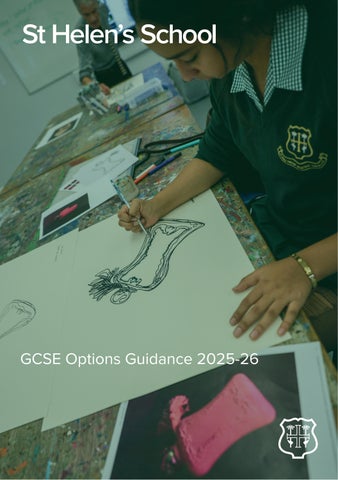
GCSE Options Guidance 2025–26
Introduction
Choosing GCSE subjects marks the first significant academic decision in each girl’s journey at St Helen’s. It represents the beginning of our formal academic pathway - one that starts with GCSEs, continues through purposeful choices at Sixth Form, and culminates in the outstanding ALevel results our students achieve at the end of Year 13.
Our Strategic Vision 2025–2030 places educational excellence at the centre of school life. The GCSE programme is a key stage in this journey, offering breadth, challenge and opportunity. It allows each girl to explore her interests deeply, nurture intellectual curiosity, and develop the confidence and independence that will support her transition into the Sixth Form and beyond.
Principles for choosing GCSE Option Subjects
Encourage your daughter to choose subjects she enjoys, feels confident in and is talented at Maintain breadth to ensure flexibility for future academic and career pathways
Consider how GCSE subjects link to possible A-Level and university choices
Ensure choices are sustainable and balanced to support wellbeing over the two-year course e.g. subjects that require coursework or portfolio work

GCSE Options Guidance 2025–
Why GCSE Choices Matter
While universities typically make offers based on A-Level achievement, GCSEs remain significant as they provide the academic foundation to build future success from, for example:
Many university courses specify minimum GCSE requirements, usually in English (at least a Grade 5) and Mathematics (at least a Grade 5)
Competitive courses such as Medicine, Law and selective universities such as Oxbridge, may look closely at GCSE profiles and grade point averages
GCSE attainment can influence eligibility to study particular A-Level subjects in our Sixth Form

GCSE Options Guidance 2025–26
The
St Helen’s GCSE Curriculum Structure
At St Helen’s all pupils’ study 10 GCSEs:
English Language and English Literature
Mathematics
Separate Sciences: Biology, Physics and Chemistry
A Humanities subject (History, Geography, Religious Studies, Classical Civilisation)
A Language: French, German, Mandarin, Spanish or Latin
Option 1
Option 2
N.B.The school enters candidates for examinations set by the three major Examination Boards (Edexcel/Pearson; OCR; AQA) for GCSE/IGCSE examinations and the Senior Academic team regularly review the specifications offered by each examination board and select the one which they feel best suits the creativity and ability of our students to prepare them to flourish in our Sixth Form.
Suggested GCSE pathway combinations
Possible combinations to support emerging interests: Medicine / STEM: Science, Mathematics, Computer Science
Law / Humanities / PPE: History or Religious Studies, with a Language
Creative / Design / Architecture: Art and Design and Technology
Computing / Data Science / Engineering: Computer Science alongside Mathematics and Science
Common Misconceptions to avoid
“10 or more GCSEs look impressive.” Achievement and depth matter more than volume
“Creative subjects are easier.” They require sustained independent effort and organisation, especially for any subject that requires an NEA component
“GCSEs are less important than A-Levels.” GCSEs influence A-Level choices and readiness for further study
“Choose GCSEs based on friendships or teachers.” Staff may change, and academic interest should lead pupil decision-making

GCSE Options Guidance 2025–
Workload
and wellbeing
Your daughter should consider: Whether she prefers coursework, practical assessment or final examinations
How she balances academic work with co-curricular involvement and wellbeing
Whether portfolio-based subjects (e.g., Art, DT, Music) suit her study habits and capacity for independent work
Questions for parents to reflect on and discuss with their daughter
Which subjects energise your daughter and spark her curiosity?
In which subjects has she shown sustained progress and confidence?
Does the subject mix maintain academic breadth and keep future pathways open?
Have potential A-Level or university interests been considered where appropriate?
Is the overall workload healthy and manageable over the next two years?
Final Guidance
Encourage your daughter to choose subjects that reflect who she is becoming: her intrinsic curiosity, strengths, talents and aspirations Breadth supports flexibility; interest supports perseverance; wellbeing supports success
Further Guidance: Informed Choices & International Pathways
The Russell Group ‘Informed Choices’ tool offers guidance on subject combinations and university pathways For students considering universities in the US or Europe, a broad academic profile, strong overall grades and meaningful co-curricular engagement are key
Our Futures Team, led by Mrs Katriona Whittingham, provides tailored guidance for international applications:
Katriona.Whittingham@sthelens.london


Mrs Bridget Ward
Head HeadsPA@sthelens.london
Dr Nick Dennis
Senior Deputy Head: Academic and Co-Curricular
nick dennis@sthelens london
Mr James Bown
Deputy Head: Academic
james bown@sthelens london
Miss Jess Payne
Deputy Head: Teaching & Learning and Pupil Progress
jess.payne@sthelens.london
Ms Julie Porter
Director of Years 8 to 11
julie.porter@sthelens.london
Mrs Katriona Whittingham
Director of Futures
katriona.whittingham@sthelens.london
Ms Brintha Skanthatheva
Head of Year 11
brintha.skanthatheva@sthelens.london
St Helen’s School
Eastbury Road
Northwood
Middlesex
HA6 3AS
admissions@sthelens.london
enquiries@sthelens.london
01923 843210
www.sthelens.london
@sthelensnorthwood
@sthelensnorthwood