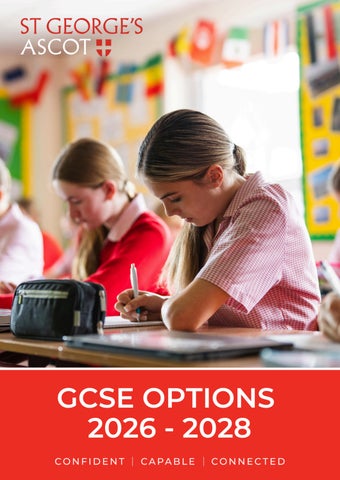
GCSE OPTIONS 2026 - 2028 | ST GEORGE’S ASCOT
Introduction from Mr Hoar Choosing your (I)GCSEs marks an exciting milestone in your St George’s journey. Until now, you’ve been exploring a broad curriculum: discovering what you enjoy, where your strengths lie, and what sparks your curiosity. (I)GCSEs allow you to take that growing sense of self and begin shaping a programme that truly reflects you. At St George’s, we guide you to build a strong academic foundation while also giving you the freedom to specialise. Alongside the core subjects, you will choose options that match your interests, talents and aspirations. These choices will stay with you as you prepare for the Sixth Form and, later on, university or other post-18 pathways. GCSEs and IGCSEs build on everything you have learnt in Years 7–9. You already have the skills you need to embark on this next stage - and your teachers will support you every step of the way. All subjects include at least one final examination, and some include coursework (called an NEA). Full details for every course can be found within this booklet. St George’s is fortunate as an independent school in being able to offer IGCSEs alongside GCSEs. The “I” in IGCSE stands for “international” as it is the qualification offered by schools across the globe who offer an English curriculum to their pupils. IGCSEs are of the same calibre and have the same standing for employers and universities as GCSEs. The ability to offer these qualifications increases the flexibility of the curriculum we offer. When considering your choices, it may help to reflect on: ● ● ● ● ●
What are you good at? What brings you joy? What might you like to study in the future - at A Level or beyond? Have you created a healthy balance? How busy is your co-curricular life and how do you manage your time?
Remember: it is quality, not quantity, that matters. Universities care far more about the grades you achieve than the number of (I)GCSEs you sit. At St George’s, every subject we offer is well respected, there are no ‘wrong’ choices. Your teachers and tutor are here to guide you, talk through the possibilities, and help you consider where each choice might lead. You do not need to make these decisions alone. I hope you enjoy exploring this booklet and imagining where your studies could take you. This is your opportunity to design a programme that excites, motivates and challenges you, and to take an important step towards becoming an independent, confident learner.
Mr Jeremy Hoar Deputy Head (Academic)
GCSE OPTIONS 2026 - 2028 | ST GEORGE’S ASCOT
Introduction to options At St George’s Ascot we encourage all girls to take 9 GCSE/IGCSE subjects. All pupils study a core curriculum of: ● English Language and Literature ● Mathematics ● Biology* ● Chemistry* ● Physics* *Either as separate sciences (3 GCSEs) or Trilogy Science (2 GCSEs) - please see below.
In addition, you should select four further subjects from the subject blocks below. You must choose no more than one subject from each block. These should consist of: ● At least one humanities subject (History or Geography or Religious Studies) ● At least one modern foreign language (French or Spanish) ● Two further subjects. Please note that this could include a second language and/or a second humanity subject. Pupils wishing to study the sciences as three separate GCSEs should choose “Separate Sciences” from Block B in the grid. There will be one block remaining from which you have not selected a subject. The subject blocks have been designed to reflect the preferences stated by pupils in the pre-options survey completed in early January. A
B
C
D
E
History
Computer Science
French
Food & Nutrition
Art
Music
Drama
Spanish
Geography
Geography
Physical Education
Separate Sciences
Textiles
History
Religious Studies
Spanish
You will also have timetabled lessons in PE/Sport, PSHE and Private Study.
GCSE OPTIONS 2026 - 2028 | ST GEORGE’S ASCOT
GCSE Computer Science OCR (J277) Computer Science has been instrumental in some of humanity’s greatest achievements, including mapping the human genome, modelling pandemics and viruses, and facilitating the major role of global communications and the internet in today’s society. Its influence on contemporary life is undeniable and is inextricably linked to our progress as a society. GCSE pupils will study the principles and practices of computing and develop computational thinking and programming skills. They will study the “biology” of the computer: how it thinks, remembers, reacts, and communicates. Pupils will learn to program, using the Python programming language, and will be able to design, develop and test their own programs. This qualification also helps pupils appreciate current and emerging technologies and the benefits of their use. They will learn to recognise ethical issues and potential risks when using computer systems.
Course content
Assessment
Year 10 ● System architecture, memory and storage ● Data representation ● Computer networks, connections and Protocols ● Network security and systems software ● Computational thinking, algorithms and programming
Paper 1 (50%) Computer Systems Written paper 1 hour 30 minutes 80 marks
Year 11 ● Ethical, legal, cultural and environmental impacts of digital technology ● Logic and languages ● Further computational thinking, algorithms and programming
Paper 2 (50%) Computational thinking, algorithms and programming Written paper 1 hour 30 minutes 80 marks
Beyond GCSE The course is an ideal foundation for further study of Computer Science at A Level. while also providing all pupils with skills, such as computational and algorithmic thinking, the application of logic, and problem-solving, which are valuable in a range of A Level and higher education courses, and are highly valued by employers. Computer Science graduates can seek employment in a wide range of areas, including: data science, software engineering, web design and development, games development, cyber security, network design and management, and business systems.
Further information from: Mr G Press, Head of Computer Science
GCSE OPTIONS 2026 - 2028 | ST GEORGE’S ASCOT
GCSE Drama Pearson Edexcel Drama (1DR0) Pearson Edexcel GCSE in Drama encourages pupils to: ● Explore theatre as performers, designers, directors and audience members. ● Develop a personal interest in why Drama matters and be inspired, moved and challenged by studying a broad, coherent, satisfying and worthwhile course of study. ● Work imaginatively and creatively in collaborative contexts, generating, developing and communicating ideas. ● Consider and explore the impact of social, historical and cultural influences on Drama texts and activities. ● Reflect on and evaluate their own work and the work of others ● Develop and demonstrate competence in a range of practical, creative and performance skills. ● Develop a basis for their future role as active citizens in employment and society in general, as well as for the possible further study of Drama. ● Actively engage in the process of dramatic study in order to develop as effective and independent learners and as critical and reflective thinkers with enquiring minds.
Course Content
Assessment
Devising Drama Pupils devise a piece of theatre which they then perform. They will record the process in a portfolio.
Component 1 (40%) Non-examined assessment
Performance from Text Performance of two extracts from a text.
Component 2 (20%) Externally assessed by a visiting examiner
Theatre Makers in Practice Section A contains questions based on the study of a full text from a list set by the examination board. Section B contains an extended response analysing and evaluating live theatre.
Component 3 (40%) 1 ¾ hours Written Examination
Beyond GCSE Drama GCSE is not just a course for pupils who aspire to work in the creative industries. In recent years, universities and employers have consistently highlighted the need for pupils to develop a range of transferable skills to enable them to respond with confidence to the demands of undergraduate study and the world of work. GCSE Drama enables pupils to develop their cognitive, interpersonal and intrapersonal skills. These transferable skills enable young people to face the demands of further and higher education, as well as the demands of the workplace, and are central to the teaching and learning that takes place in the Drama classroom.
Further information from: Mrs A Liddle, Director of Drama
GCSE OPTIONS 2026 - 2028 | ST GEORGE’S ASCOT
IGCSE English Pearson Edexcel (4EA1, 4ET1) English Language and English Literature are two separate IGCSEs, studied as an integrated course over two years. The skills of analysis, writing, interpretation and argument are taught through oral work, essays and thorough textual examination. The teacher will provide advice and guidance to pupils when producing their written coursework for English Language and English Literature.
Course content
Assessment
Year 10 Of Mice and Men (John Steinbeck) Part 3 of the Pearson Edexcel Anthology for IGCSE (poetry) Written coursework on Part 2 of the Pearson Edexcel Anthology for IGCSE (poetry and literary prose) An Inspector Calls (J B Priestley) Part 1 of the Pearson Edexcel Anthology for IGCSE (non-literary prose)
IGCSE English Language One written examination (2 hrs 15 mins), including unseen prose, Part 1 of the Pearson Edexcel Anthology for IGCSE, and various writing tasks (60%)
Year 11 Macbeth (William Shakespeare) Part 1 of the Pearson Edexcel Anthology for IGCSE (non-literary prose) continued Written coursework: Imaginative Writing Unseen poetry (for English Literature examination)
IGCSE English Literature One written examination (2 hrs) on unseen poetry, poems from Part 3 of the Pearson Edexcel Anthology for IGCSE, and Of Mice and Men (closed book: the novel is not allowed in the examination) (60%)
Written coursework: Imaginative Writing (20%) Written coursework on Part 2 of the Edexcel Anthology for IGCSE (poetry and literary prose) (20%)
Written coursework: an essay on An Inspector Calls (20%) Written coursework: an essay on Macbeth (20%)
Beyond GCSE The ability to speak and write English accurately and analytically is a skill that is valued in a wide range of careers and professions in countries throughout the world. If you would like to be: a journalist, a lawyer, a web content manager, a language teacher, a public speaker, a politician, a film director, an advertiser, a marketing director, a sports reporter - or a writer of any kind - English Language and Literature are the subjects for you.
Further information from: Ms L Baker, Head of English
GCSE OPTIONS 2026 - 2028 | ST GEORGE’S ASCOT
GCSE Fine Art OCR (J171) This subject will allow the pupil to actively engage in the process of art and design in order to develop as effective and independent candidates and as critical and reflective thinkers with enquiring minds. The course will include skills in painting and drawing, sculpture, printmaking and lens-based image-making. Pupils will develop creative skills, through learning to use imagination and intuition when exploring and creating images and artefacts. They will become confident in taking risks and learning from their experience and mistakes when exploring and experimenting with ideas, materials, tools and techniques. In addition, learners will develop competence, with increasing independence, in refining and developing ideas and proposals, and personal outcomes or solutions. Pupils studying Fine Art will gain cultural knowledge, understanding and application of art, craft, design, media and technologies in historical and contemporary contexts. Finally, girls will develop personal attributes including self-confidence, resilience, perseverance, self-discipline and commitment.
Course content
Assessment
Year 10 The course will begin with skill building exercises; the pupils will experiment with varied techniques and media in order to become confident in one or more disciplines. Pupils will start working on Component 1, the portfolio of practical work.
Component 1 (60%) For this unit a candidate needs to produce a portfolio of work showing their personal response to a starting point, brief, scenario, or stimulus.
Year 11 Component 1 will be completed in the Autumn term and Component 2 will begin in the Spring term.
Component 2 (40%) From a range of written and visual starting points, one must be selected upon which to base their personal response in an externally set task. Candidates will have a preparatory period determined by the school, followed by a supervised 10-hour period in which to complete their personal outcome.
Beyond GCSE GCSE Fine Art opens the door to A Level Fine Art, Photography and Textiles; often studied in combination. Many pupils go on to university or prestigious Art and Design colleges, leading to exciting creative careers in fashion, animation, film, video game design, architecture, graphic design, curating and illustration. Art develops highly valued transferable skills - creativity, visual communication, problem-solving and independent thinking - supporting future pathways in the creative industries, media, marketing, education, galleries and museums.
Further information from: Ms E Townsend, Head of Art
GCSE OPTIONS 2026 - 2028 | ST GEORGE’S ASCOT
GCSE Food Preparation & Nutrition AQA (8585) This is an exciting new subject, which started at St George’s in 2023. AQA Food Preparation and Nutrition provides pupils with the opportunity to learn an array of culinary techniques, as well as develop knowledge of nutrition and food science, food safety, food choices and food provenance. The science behind food is explored in great detail and pupils will learn how to conduct and design a range of experiments to understand how the functions of ingredients are key to creating successful products.
Course content
Assessment
Year 10 Pupils will learn new skills and will cook almost every week; this aims to build on the practical skills learnt during Years 7, 8 and 9. Coupled with this, theory based lessons will support the work completed in the practical lessons. This provides all pupils with the platform for more independent work, which is carried out in Year 11.
Written Examination (50%) 1hr 45m
Year 11 The majority of Year 11 is dedicated to non-examination assessment (NEA) work. The NEA is divided into two tasks: ● Task 1: Food Investigation (10 hours of lesson time) which is completed in Sept – Nov. ● Task 2: Food Preparation Assessment (20 hours), which is completed in Nov – Feb. The remainder of the year is focused on preparing for the written exam.
NEA (non-examined assessment) (50%) Task 1 Food Investigation Understanding of the working characteristics, functional and chemical properties of ingredients. A written report (2000 words max) is completed for this NEA. Task 2 Food Preparation Assessment Pupils will prepare, cook and present a final menu of three dishes within a single period of no more than three hours, planning in advance how this can be achieved. A portfolio is produced for NEA2 (20 pages max).
Beyond GCSE This GCSE will provide a foundation for further study in Food Science and Nutrition or equivalent. Pupils can also progress onto degree courses, which focus on food and nutrition including; Dietetics, Nutrition or Food Science. There are also many transferable skills developed throughout the course such as time management, confidence, teamwork and presentation skills that will support pupils in a variety of different career pathways.
Further information from: Mrs D Allen, Head of Food Preparation and Nutrition
GCSE OPTIONS 2026 - 2028 | ST GEORGE’S ASCOT
GCSE French OCR (J277) Language learning cultivates academic rigour and develops good communicators and problem solvers. Accessibility and inclusion have been at the heart of the development of the new qualifications. Straightforward assessments with relatable content have been designed to equip pupils for a life and careers in a global setting. All skills are of equal value as learning a language is a combination of communication and understanding.
Course content
Assessment
Six themes, divided into subtopics and studied over the two years.
Paper 1 Speaking in French 50 marks (25%) Higher: 10-12 mins plus 15 min prep time; Task 1: Read aloud (12 marks) Task 2: Role play (10 marks) Task 3: Picture task (12 marks) with conversation (16 marks)
THEME 1 : My personal world Family, friends, relationships and equality THEME 2 Lifestyle and wellbeing Physical well-being, mental well-being, food and drink, sports THEME 3 My neighbourhood Places in town, shopping, transport and the natural world THEME 4 Media and technology Social media and gaming, music, TV and film THEME 5 Studying and my future School and future opportunities
Paper 2 Listening and understanding in French 50 marks (25%) 60 minutes Section A: Listening (40 marks) All questions and responses are in English Section B: Dictation (10 marks) Paper 3 Reading and understanding in French 50 marks (25%) 60 minutes Section A- : Reading and Understanding (40 marks) All questions are set in English and pupils produce all responses in English. Section B- Translation into English (10 marks)
THEME 6 Travel and tourism Accommodation and tourist attractions
Beyond GCSE Studying a Modern Foreign Language can open the door to an exciting and global future. It gives you the confidence to travel, work, and communicate across borders, and creates opportunities to study or work abroad. Most universities offer a variety of single honour or combined courses with languages, many of which may include a year abroad. Language skills are highly valued by employers and can lead to careers in international business, travel, media, law, diplomacy, and humanitarian work. Even in careers where languages aren’t essential, they make you stand out, showing adaptability, cultural awareness, and strong communication skills.
Further information from: Mrs C Tea, Acting Head of MFL
GCSE OPTIONS 2026 - 2028 | ST GEORGE’S ASCOT
GCSE Geography AQA (8035) Geography is a flexible subject about the real world. It integrates with many other subject areas such as Biology, Geology, Economics, History, English, Physics, Politics, Chemistry, Information Technology and Maths. It teaches skills and content useful for many A Level and university courses. Geography assists with the development of relevant skills for the workplace such as interpersonal communication, numeracy, literacy, and data handling. It is also a subject which allows science specialists to develop important literacy skills and art specialists to develop important numeracy and graphical skills. This modern, issues-based GCSE course analyses a wide range of issues concerning the world today. Pupils are encouraged to be inquisitive and active in the classroom. Our lessons are interactive, with creative tasks set regularly.
Course content
Assessment
Year 10 ● The Challenge of Natural Hazards (tectonics, extreme weather & climate change) ● The Challenge of Resource Management (UK & water) ● Physical Landscapes in the UK (rivers & coasts)
Paper 1 Living with the physical environment (35%) 90 minute examination
Year 11 ● 2 x fieldwork trips to collect data & develop geographical skills ● The Urban World (urban change & sustainability) ● The Economic World ● The Living World (tropical rainforests & hot deserts) ● Issue evaluation
Paper 2 Challenges in the human environment (35%) 90 minute examination Paper 3 Geographical applications (30%) 90 minute examination All examinations are taken in the summer term of the Year 11.
Beyond GCSE Geography combines well with other subjects. Geographers are able to handle data, ask questions and find answers, make decisions about an issue, analyse material, organise themselves and think creatively and independently. These skills prepare Geography pupils for future study. As a degree subject, Geography is highly respected by employers with Geography graduates boasting one of the highest rates of graduate employment. Careers available to Geographers include Law, Planning, Travel and Tourism, Retail, International Aid work and everything in between.
Further information from: Mrs S Johnson, Head of Geography
GCSE OPTIONS 2026 - 2028 | ST GEORGE’S ASCOT
IGCSE History Pearson Edexcel IGCSE (4HI1) History is more than the study of the past and certainly more than just dates. From investigations into jazz parties in Germany to the threat of global nuclear war, this IGCSE course is designed not only to be enjoyable but varied in its consideration of History. It provides a fascinating exploration into the lives of people in different countries, be that dictators, spies or ordinary people. This course also offers pupils an exciting opportunity to study the development of Britain by exploring changes in opportunities for people of different races, genders, disabilities and classes. Your skills as an independent and critical learner will be enhanced. As you consider the choices made by the leaders of the modern world, your ability to ask perceptive and relevant questions will develop, enhancing your knowledge, understanding and interpretations of historical events. Historians are analytical, able to make reasoned and well-developed judgements, and communicators of the written word in very creative ways. Ultimately, the main aim of this course is enjoyment and to ensure that you become a lifelong learner with a passion for History.
Course content
Assessment
Year 10
Paper 1 (50%) 90 minute examination
Paper 1 – Depth Study Germany: Development of a Dictatorship, 1918-1945 A World Divided: Superpower Relations, 1943–72 Year 11 Paper 2 – Investigation and Breadth Study Russia and the Soviet Union, 1905–24 Diversity, Rights and Equality in Britain, 1914-2010
Paper 2 (50%) 90 minute examination
Beyond GCSE History is a well-respected subject for universities which focuses on skills as well as knowledge. It combines effectively with other arts subjects as well as sciences. A History degree can prepare you for jobs in law, journalism, the diplomatic and civil services, marketing, politics, the police, TV, film and theatre, teaching, publishing, museums, archaeology, and the armed forces. Any career requiring clear thinking, written communication, articulate speaking, and the ability to ask and answer complicated questions about how the world works will be open to a well-trained pupil of History.
Further information from: Mr J Schofield, Head of History & Politics
GCSE OPTIONS 2026 - 2028 | ST GEORGE’S ASCOT
IGCSE Mathematics Pearson Edexcel A (4MA1) The Pearson Edexcel International GCSE aims to enable pupils to: ● Develop their knowledge and understanding of mathematical concepts and techniques ● Acquire a foundation of mathematical skills for further study in the subject or related areas ● Enjoy using and applying mathematical techniques and concepts, and become confident to use Mathematics to solve problems. ● Appreciate the importance of Mathematics in society, employment and study. All pupils are set according to ability. There are two tiers of entry (Higher and Foundation). Those entered for Higher tier can obtain grades 9 to 4, and those entered for Foundation can obtain grades up to and including grade 5. We prepare pupils in sets 1 and 2 for the Higher tier and set 3 for the Foundation tier. We monitor the progress of all pupils very carefully throughout the two years of the course and may recommend a move to set 3 if we feel a pupil would be better suited to entry for Foundation tier. Any proposed set change will, of course, be discussed with parents.
Course content
Assessment
Year 10 ● Number ● Algebra ● Shape and space ● Statistics
Paper 1F or 3H (50%) ● Number ● Algebra ● Shape and space ● Statistics
Most topics covered up to grade 5, 6 or 7 Year 11 ● ● ● ●
Number Algebra Shape and space Statistics
Paper 2F or 4H (50%) ● Number ● Algebra ● Shape and space ● Statistics
Most topics covered up to grade 8 or 9
Beyond GCSE Mathematics serves as the essential foundation for high-level degrees in competitive fields like Engineering, Computer Science, Economics, and Medicine, where logical thinking and numerical fluency are vital. Beyond education, these skills lead directly into high-growth careers in data science, financial investment, architecture, and aerospace technology. Ultimately, a solid mathematical background proves to employers in every industry that you possess the advanced problem-solving abilities and analytical mindset needed to thrive in the modern workplace.
Further information from: Mr P Wilson, Head of Mathematics
GCSE OPTIONS 2026 - 2028 | ST GEORGE’S ASCOT
GCSE Music Pearson Edexcel (1MU0) There are three units in GCSE Music. Pupils learn about musical language and explore the elements underlying the organisation of sound, through listening to and appraising music, individual and group performance and composition. Pupils develop the skills of musical analysis, broaden their musical experience and interests, develop their musical imagination and foster creativity. This course aims to develop enjoyment and appreciation of a wide range of music and to enable pupils to develop their practical musical skills. During the course pupils will study music from all over the world, and from a wide range of styles and a diverse heritage including: Instrumental Music (1700-1820), Vocal Music, Music for Stage and Screen and Fusions. Pupils who take this course will be required to take lessons on an instrument or in singing.
Course content
Assessment
Year 10 Focus on listening, performing and composing. Study works from many genres developing transferable appraising skills for Component 3.
Component 1 (30%) Performance of solo and ensemble pieces: NEA
Year 11 Perfecting performance skills (Component 1) Emphasis on composition (Component 2) Study of set works (Component 3)
Component 2 (30%) 1 hour 45 minutes Appraising. Four areas of study, two set works for each. Component 3 (40%) 1 hour 45 minutes Appraising. Four areas of study, two set works for each.
Beyond GCSE Music is an arts subject which combines well at A Level and University with almost any other subject. Universities are also always pleased to welcome undergraduates who can contribute to the musical lives of the campus. Musicians are demonstrably multi-talented, logical thinkers with analytical minds, an imaginative outlook and great potential in all they do. Music A Level is well suited to pupils considering careers in many areas including performance, music therapy, conducting, film music, arts administration and events management.
Further information from: Mrs C Thomson, Director of Music
GCSE OPTIONS 2026 - 2028 | ST GEORGE’S ASCOT
GCSE Physical Education OCR (J587) Pupils will receive a full introduction to the world of PE, sport and sports science by developing an understanding of how the mind and body works in relation to performance in physical activity. They will develop knowledge and understanding of the: ● Key body systems and how they impact on health, fitness and performance. ● Basic principles of movement and their effect on performance. ● Principles of training and different training methods ● Socio-cultural factors that impact on physical activity and sport. ● Psychological factors that can affect performers in physical activity and sport. ● The impact of sport on society. ● Benefits of participating in physical activity and sport to health, fitness and well-being. ● Data analysis in relation to key areas of physical activity and sport. In addition, you will be required to participate and perform in three practical activities for assessment and to complete an Analysing and Evaluating Performance task (AEP). There are many activities on offer, which are listed in the non-exam assessment specification, and pupils need to be assessed in at least one team sport and at least one individual sport. It is strongly recommended that pupils are participating on a weekly basis in at least two sports from the specification to a minimum of School team level. Playing at least one sport at club level would be even more beneficial.
Course content
Assessment
Year 10 Topic 1: Applied anatomy and physiology – Body Systems and Movement Analysis Topic 2: Physical Training – components of fitness & principles of training, injury prevention Topic 3: Socio-cultural influences – commercialisation of sport and ethics Practical sports and participation log
Written paper 1 (30%) 1 hour Physical factors affecting performance.
Year 11 Topic 4: Sports Psychology Topic 5: Health, fitness and wellbeing Coursework: Analysing and Evaluating Performance (AEP) Practical sports and participation log
Written paper 2 (30%) 1 hour Socio-cultural issues and sports psychology. Practical Performance Non Examined Assessment (30%) Analysing and Evaluating Performance (AEP) (10%)
Beyond GCSE Pupils will find many opportunities available to you to continue with this subject area. They include coaching, teaching, playing to an elite level or becoming an official. Other opportunities include physiotherapy or becoming part of initiatives to encourage individuals to take part in sport.
Further information from: Miss S Appleby, Director of Sport
GCSE OPTIONS 2026 - 2028 | ST GEORGE’S ASCOT
GCSE Religious Studies AQA (8062) Studying GCSE Religious Studies at St George’s opens up fascinating and challenging questions, which stretch our pupils on both an intellectual and personal level. In the 21st century, religion, philosophy and ethics address the same eternal human questions about life and death, values and relationships, right and wrong. Our lessons put great emphasis upon pupils leading discussions, developing critical reasoning skills, and facing up to the moral, spiritual, and cultural issues presented by modern society. The Religious Studies GCSE at St George’s follows the AQA Philosophy and Ethics syllabus. It is a subject which enables you to explore some of the fundamental questions in life, such as: Does life have innate value and do we have the right to end it? How should we treat criminals? Is it right to go to war? Those who enjoy debating, analysing and interpreting information will thrive on this course as we teach our pupils how to delve deeper into the argument and texts to gain a better understanding of people’s ideas. Pupils will also be encouraged to put across your own thoughts and ideas about the modules we study. Ethics and philosophy are diverse areas of study which offer individuals an almost limitless world of possibilities.
Course content
Assessment
Component 1 The study of religions: beliefs, teachings and practices: ● Christianity ● Buddhism
Written exam (50%) 1 hour 45 minutes
Component 2 Four Religious, Philosophical and Ethical studies themes. 1. Religion and life e.g. Medical Ethics 2. Human Rights and Social Justice 3. Relationships and Families 4. Crime and Punishment
Written exam (50%) 1 hour 45 minutes
Beyond GCSE This course is an excellent foundation for all those wishing to study a discursive subject, such as English, History, Psychology, Philosophy, Politics, Religious Studies (and many more) at A Level or university. The skills that you will learn in GCSE Religious Studies will be useful to you in any number of careers; teaching, youth work journalism, civil service or government to name a few. If you are thinking of a career in law or medicine then an A Level in Philosophy and Ethics is looked upon favourably for undergraduate courses in these areas.
Further information from: Mrs M Magill, Head of Religious Studies
GCSE OPTIONS 2026 - 2028 | ST GEORGE’S ASCOT
GCSE Combined Science: Trilogy AQA 8464 Science uses evidence to create theories that explain the world in which we live. It has been used to create amazing technologies which have had a great impact on humanity and the Earth. Scientists should, amongst other things, be equipped to question, and engage in debate on the evidence used in decision-making. This scientific literacy is especially important when considering the impact which Science has on the lives of every person, and the way in which this information is shared. All pupils study Science at GCSE at St George’s, taking examinations in Biology, Chemistry and Physics. Those that do not choose the Single Sciences GCSE option complete the Combined Science (Trilogy) route. They will have two periods of study in each Scientific discipline; Biology, Chemistry and Physics, during the week, and will sit separate examinations in these at the end of Year 11. These results will be combined to award their grade on a 17 point grading scale, from 9–9, through to 1–1. Pupils who choose the Combined Science route will be entered for two Science GCSEs.
Course Content
Assessment
Biology
Six exam papers 1 hour 15 minutes Two for each scientific discipline Topics split across the two papers.
Paper 1 Cell biology; Organisation; Infection and response; and Bioenergetics. Paper 2 Homeostasis and response; Inheritance, variation and evolution; and Ecology.
Chemistry Paper 1 Atomic structure and the periodic table; Bonding, structure and the properties of matter; Quantitative chemistry; Chemical changes; and Energy changes. Paper 2 The rate and extent of chemical change; Organic chemistry; Chemical analysis; Chemistry of the atmosphere; and Using resources.
Tiers The majority of pupils take the higher tier assessment, however in year 11, if it is deemed to have the highest likelihood of a positive outcome, pupils can be entered into the foundation tier. Weighting Each paper is worth 16.7% with each subject having an equal impact on the overall grade. Question types Multiple choice, structured, closed, short answer and open response (maximum 6 marks).
Physics Paper 1 Energy; Electricity; Particle model of matter; and Atomic structure Paper 2 Forces; Waves; and Magnetism and electromagnetism.
Working Scientifically
All exam papers Development of scientific thinking; Experimental skills and strategies; Analysis and Evaluation; and Scientific vocabulary, quantities, units, symbols and nomenclature.
Required Practicals As part of the course, pupils undertake 21 required practicals to develop their experimental skills. These are not assessed in lessons, but through response to exam questions. Working Scientifically This content is assessed throughout all 6 exam papers and is developed throughout the course through practicals, discussions, project work, etc.
GCSE OPTIONS 2026 - 2028 | ST GEORGE’S ASCOT
Beyond GCSE Pupils who wish to study Science further at A Level will be able to do so, although they may find that there are some areas which they will find more challenging than those who took the Separate Science GCSE course. All pupils will develop a variety of practical skills which will help them to navigate the world safely and are transferable to a variety of different career opportunities. Pupils also develop the analytical mindset of a scientist, considering evidence they are presented with and evaluating it critically, key skills for every person in modern society.
Further information from: Mr J Cook Williams, Acting Head of Science
GCSE OPTIONS 2026 - 2028 | ST GEORGE’S ASCOT
GCSE Separate Sciences (Biology, Chemistry and Physics) AQA (8461, 8462, 8463) Pupils at St George’s with a passion and aptitude for Science and who wish to develop a deeper understanding of how the world works can opt for separate GCSEs in each of the scientific disciplines. They will study the GCSE Science topics in further depth, and develop a greater understanding of core scientific principles, providing an excellent foundation for further scientific study. Pupils following this route will study Biology, Chemistry and Physics as separate subjects sitting two examinations for each of these disciplines at the end of Year 11. Each GCSE is awarded a separate single grade from 9 - 1 and is assessed independently from the other Science disciplines. Pupils who choose Separate Sciences will obtain three GCSEs, one for each of Biology, Chemistry and Physics.
Course Content
Assessment
Biology
Six exam papers 1 hour 45 minutes Two for each scientific discipline Each paper 100 marks and
Paper 1 Cell biology; Organisation; Infection and response; and Bioenergetics. Paper 2 Homeostasis and response; Inheritance, variation and evolution; and Ecology.
Chemistry Paper 1 Atomic structure and the periodic table; Bonding, structure and the properties of matter; Quantitative chemistry; Chemical changes; and Energy changes. Paper 2 The rate and extent of chemical change; Organic chemistry; Chemical analysis; Chemistry of the atmosphere; and Using resources
Physics
Paper 1 Energy; Electricity; Particle model of matter; and Atomic structure. Paper 2 Forces; Waves; Magnetism and electromagnetism; and Space physics.
Working Scientifically All exam papers Development of scientific thinking; Experimental skills and strategies; Analysis and Evaluation; and Scientific vocabulary, quantities, units, symbols and nomenclature.
Tiers The majority of pupils take the higher tier assessment, however in year 11, if it is deemed to have the highest likelihood of a positive outcome, pupils can be entered into the foundation tier. Weighting Each paper is worth 50% for that particular Science GCSE grade. Question types Multiple choice, structured, closed, short answer and open response (maximum 6 marks). Working Scientifically This content is assessed throughout all 6 exam papers and is developed throughout the course through practicals, discussions, project work, etc. Required Practicals As part of the course, pupils undertake 10 Biology, 8 Chemistry and 10 Physics required practicals to develop their experimental skills. These are not assessed in lessons, but through response to exam questions.
GCSE OPTIONS 2026 - 2028 | ST GEORGE’S ASCOT
Beyond GCSE Pupils who wish to study Science further at A Level will have a strong foundational knowledge upon which this can be built. All pupils will develop a variety of practical skills which will help them to navigate the world safely and are transferable to a variety of different career opportunities. Pupils also develop the analytical mindset of a scientist, considering evidence they are presented with and evaluating it critically, key skills for every person in modern society.
Further information from: Mr J Cook Williams, Acting Head of Science
GCSE OPTIONS 2026 - 2028 | ST GEORGE’S ASCOT
GCSE Spanish Pearson Edexcel Language learning cultivates academic rigour and develops good communicators and problem solvers. Accessibility and inclusion have been at the heart of the development of the new qualifications. Straightforward assessments with relatable content have been designed to equip pupils for a life and careers in a global setting. All skills are of equal value as learning a language is a combination of communication and understanding.
Course content
Assessment
Year 10 and Year 11 Six themes divided into subtopics and studied over the two years.
Paper 1 Speaking in Spanish 50 mark (25%) Higher: 10-12 mins plus 15 min prep time; Task 1: Read aloud (12 marks) Task 2: Role play (10 marks) Task 3: Picture task (12 marks) with conversation (16 marks)
THEME 1 : My personal world Family, friends, relationships and equality THEME 2 Lifestyle and wellbeing Physical well-being, mental well-being, food and drink, sports THEME 3 My neighbourhood Places in town, shopping, transport and the natural world THEME 4 Media and technology Social media and gaming, music, TV and film THEME 5 Studying and my future School and future opportunities THEME 6 Travel and tourism Accommodation and tourist attractions
Paper 2 Listening and understanding in Spanish 50 marks (25%) 60 minutes Section A: Listening (40 marks) All questions and responses are in English Section B: Dictation (10 marks) Paper 3 Reading and understanding in Spanish 50 marks (25%) 60 minutes Section A- : Reading and Understanding (40 marks) All questions are set in English and pupils produce all responses in English. Section B- Translation into English (10 marks) Paper 4 Writing in Spanish 50 marks (25%) 1 hour 20 minutes Question 1: open-response questions, set in informal context (18 marks) Question 2: open-response questions, set in formal context (22 marks) Question 3: translation into Spanish (10 marks)
Beyond GCSE Studying a Modern Foreign Language can open the door to an exciting and global future. It gives you the confidence to travel, work, and communicate across borders, and creates opportunities to study or work abroad. Most universities offer a variety of single honour or combined courses with languages, many of which may include a year abroad. Language skills are highly valued by employers and can lead to careers in international business, travel, media, law, diplomacy, and humanitarian work. Even in careers where languages aren’t essential, they make you stand out, showing adaptability, cultural awareness, and strong communication skills.
Further information from: Mrs C Tea, Acting Head of MFL
GCSE OPTIONS 2026 - 2028 | ST GEORGE’S ASCOT
GCSE Textile Design OCR (J174) Textile Design is the creation of designs and products for woven, knitted, stitched or printed fabrics and involves an understanding of fibres, yarns and fabrics. Girls must explore, acquire and develop skills, knowledge and understanding through the application of techniques and processes specific to their chosen areas of study of Textile Design. They will explore practical and relevant critical and contextual sources such as the work of historical and contemporary textile designers and the different purposes, intentions and functions of Textile Design as appropriate to their own work. They will become confident in taking risks and learning from their experience and mistakes when exploring and experimenting with ideas, materials, tools and techniques. They will develop personal attributes including self-confidence, resilience, perseverance, self-discipline and commitment.
Course content
Assessment
Year 10 The course will begin with skill building exercises; the pupil will experiment with varied techniques and media in order to become confident in one or more disciplines. Pupils will start working on Component 1, the portfolio of practical work.
Component 1 (60%) For this unit a candidate needs to produce a portfolio of work showing their personal response to a starting point, brief, scenario, or stimulus.
Year 11 Component 1 will be completed in the autumn term and Component 2 will begin in the spring term
Component 2 (40%) From a range of written and visual starting points, one must be selected upon which to base their personal response in an externally set task. Candidates will have a preparatory period determined by the school, followed by a supervised 10-hour period in which to complete their personal outcome.
Beyond GCSE Many pupils go on to study A Level Textiles and then a wide range of degrees. These include Textiles, Fashion combined with Business/Marketing/Law, Architecture, History of Art, and Interior Design. Future careers might include editing fashion magazines, curating, fashion design, costume and theatrical outfits, work in galleries. The A Level Art and Design Textiles course is a natural progression from GCSE, allowing girls to develop their own, independent, personal journey. Pupils develop strong creative, practical and problem-solving skills valued in design-led careers.
Further information from: Ms E Townsend, Head of Art, Ms K Gilbert and Ms Morgan
GCSE OPTIONS 2026 - 2028 | ST GEORGE’S ASCOT
GCSE Grading The numerical (9-1) grading system for GCSEs was introduced for qualifications taken in June 2017. The first cohort of Georgians to take these new style examinations sat their papers the following year. In 2025 at St George’s, 43% of all results were awarded grades 8 or 9 (the equivalent of an A*), 63% at grade 7 or better and 97% at grade 4 and above.
GCSE Grading Grading structure
Equivalent grading
9 8 7
A* A
6 5 4
B C
3 2 1
D E F G
U
U
● Broadly the same proportion of pupils achieve a grade 4 or above as achieved a grade C or above in the old system. ● Broadly the same proportion of pupils achieve a grade 7 or above as achieved a grade A or above previously. ● Nationally, approximately 20% of all grades at 7 are awarded a grade 9
GCSE OPTIONS 2026 - 2028 | ST GEORGE’S ASCOT
Planning Sheet Use this page to help you plan your decisions. Please see the separate letter for details of the form you need to complete to submit your GCSE option choices. CORE CURRICULUM - EVERYBODY STUDIES THESE SUBJECTS English Language
English Literature
Mathematics
Biology
Chemistry
Physics
You will study all 3 Science subjects and will either sit the Sciences as three separate GCSEs or as Trilogy Science (a combined Science qualification worth two GCSEs). The route that you follow will be determined by aptitude, motivation and teacher endorsement. Please see below. SUBJECT OPTIONS In addition, you should select four further subjects from the subject blocks below. You must choose no more than one subject from each block. These should consist of: ● At least one humanities subject (History or Geography or Religious Studies) ● At least one modern foreign language (French or Spanish) ● Two further subjects. Please note that this could include a second language and/or a second humanity subject. Pupils wishing to study the sciences as three separate GCSEs should choose “Separate Sciences” from Block B in the grid. There will be one block remaining from which you have not selected a subject. The subject groups have been designed to reflect the preferences stated by pupils in the pre-options survey completed in early January. A
B
C
D
E
History
Computer Science
French
Food & Nutrition
Art
Music
Drama
Spanish
Geography
Geography
Physical Education
Separate Sciences
Textiles
History
Religious Studies
Spanish
You will also have timetabled lessons in PE/Sport, PSHE and Private Study.
HAVE YOU DISCUSSED YOUR CHOICES WITH YOUR TUTOR? PLEASE REMEMBER TO COMPLETE YOUR ONLINE FORM BY WEDNESDAY 11 FEBRUARY
GCSE OPTIONS 2026 - 2028 | ST GEORGE’S ASCOT