Table of contents
The Rise of Rank and File Teachers' Resistance in the United States of America
Steve Stewart ( Canada)
Between Reform and Resistance: The New High School in Brazil under the Influence of the Global Education Reform Movement (GERM) and the New Right
Jardel Pereira da Silva, Caio Ruano da Silva (Brasil)
Liberty University: The Far-Right’s Educational Vision for Mexico
María de la Luz Arriaga ( Mexico)
The Far-right's Ideological Battle for Education in Portugal: Citizenship and Development
Catarina Neves (Portugal)
The New Right's Framework in Utah's Higher Education System
Brianne Kramer, Sean P. Crossland (Estados Unidos)
Privatisation of education under the neoliberalneoconservative alliance: proposals from the new right in Brazil
Paula Valim de Lima (Brasil)
The right-wing offensive in Ecuadorian education
Ángela Zambrano Carranza (Ecuador)
The Right, Progressivisms and Coloniality
Darío Balvidares (Argentina)
Schools and reactionary indoctrination
Edgar Isch (Ecuador)
El Salvador: Between Repression and Resistance
Elsa (El Salvador)
On the political and educational imperative of combating the genocide in Gaza
Mauro Jarquín (México)
Why Does the Far-Right Target Post-Secondary Education?
Rosemary Lee, Steven Miller y Peter Brown (Estados Unidos)

EDITORIAL COMMITTEE
María Trejos (Costa Rica)
María de la Luz Arriaga (Mexico)
Andrée Gacoin (Canada)
Edgar Isch López (Ecuador)
Miguel Duhalde (Argentina)
Sara Unda (Mexico)
John Ávila (Colombia)
Roberto Leher (Brazil)
Mauro Jarquin (Mexico)
Editorial Director: Steve Stewart
Editor: María de Jesús Ramos Casiano
English Copy Editor: Ruth Leckie
Layout and Design: Tomás Licea
To read previous issues of Intercambio, visit: www.idea-network.ca www.revistaintercambio.org 'PS more about IDEA: www. idea-network.ca Follow us on Facebook: Idea Network- Red SEPA Contact us at: idea-redsepa@outlook.com
We wish to thank:
• Mauro Jarquín, for coordinating this issue of Intercambio.
• The British Columbia Teacher’s Federation (BCTF) for their support in publishing Intercambio. Intercambio is a publication of the Initiative for Democratic Education in the Americas (IDEA), a hemispheric alliance of social and labour organizations that cooperate to defend and enhance public education.
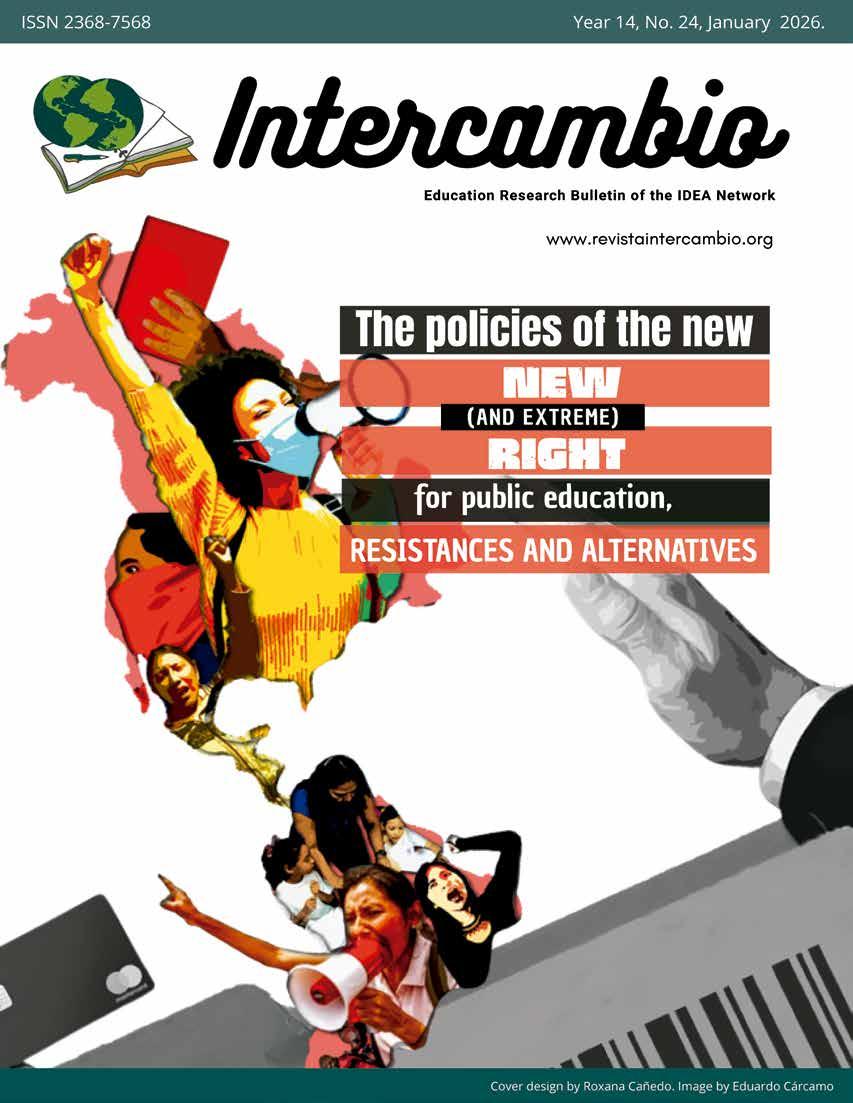
The policies of the new (and extreme) right for public education, resistance and alternatives
Over the past few years, here at the IDEA Network we have witnessed a tense atmosphere around the right-wing presence in the Americas. At the place where state authoritarianism meets the defense of capital dictatorship, the most extreme positions have gradually gained ground. From the US to Argentina, different groups that subscribe to conservative positions and share a clear animosity toward progressive and/or left-wing political projects are flourishing, articulating themselves, building alternative scenarios or openly disputing the spaces of power within the state apparatus. Even in their public rhetoric they go as far as to express their desire to destroy it from within as Argentine President Javier Milei, a self-proclaimed anarcho-capitalist, has suggested.
For the Latin American pedagogical movement, as well as for the diversity of platforms for educational transformation in the region, we are presented with a set of analytical, strategic, and tactical problems. In addition to marches in the street and public debates, the struggle against reactionism in education requires a constant epistemological exercise through which collective knowledge is constructed and oriented towards a political-pedagogical conflict and for the defense of human and social rights, as well as for the common good, from within schools. This volume aims to achieve that.
In this issue of Intercambio magazine, we seek to advance our understanding of the right-wing phenomenon in regional education. It brings together traditional right-wing political groups who resist change and the new right-wing groups that have managed to construct an extreme political discourse through the promise of changing everything. First, however, we need to recognize that schools are strategic locations for the propagation of reactionary education proposals that seek specific goals, such as:
•Control of schools and teachers
•Limitation or outright deletion of educational content related to social justice
•Expansion of privatized education
•Cultural assimilationism.
Translated by Flor Montero
In all of these cases, there is a common componentsystematically attacking social rights as well as public goods and services, particularly education. To explore this, the current issue of Intercambio magazine includes a diverse approach—from different territories and through different voices—to the situation of education in the region, as well as the current debate on education in Portugal, allowing us to link regional debates with discussions taking place at the global level. The contributions in this issue are organized around the following themes: 1) far-right education proposals and programs in Latin America and other parts of the world 2) experiences and proposals for resisting the far-right's assault on education and 3) trends in specific education policies promoted by the far right, their conceptualization and basis for analysis.
Proposals and education programs in Latin America and other parts of the world: experiences and initiatives to resist the onslaught of the far right in education.
We begin with a look at “Resistance in the US to the Ultra-right Offensive in Education,” where Steve Stewart establishes a link between education policies, the intensity of their implementation and the agenda of the New Right with its regressive policies which have intensified under President Donald Trump. However across the country, education workers, students, and parents are organizing to resist these policies.
Jardel Pereira and Caio Ruano, in their article “Between Reform and Resistance: The New High School in Brazil under the Influence of the Global Education Reform Movement (GERM) and the New Right,” analyze the reform of high school education in Brazil and the displacement of a critical, humanistic and socially just education. The authors reflect on the need to give new meaning to transformations in education, by rethinking the curriculum and developing pedagogical proposals that are more sensitive to the realities of young people.
In the article “Liberty University: the Far-right”s Educational Vision for Mexico”, María de la Luz Arriaga outlines the vision of education that business groups have for higher education. From their so-called innovative perspective, they seek to construct the university as a space without teachers, without criticism and favorable to promoting economic libertarianism. The core of this project lies in its alliances with other rightist universities in Chile and Spain, as well as with global foundations and Think Tanks—particularly with the Atlas Network and the Mont Pelerin Society.
Taking a look at another region of the world, we find the article by Catarina Neves, “The Far-right’s Ideological Battle Education for in Portugal: Citizenship and Development.”
It explores how the far right is stealthily driving changes that undermine the treatment of certain topics during students’ educational process. She highlights how the Portuguese far right has managed to mobilize discourse around "gender ideology" to reshape the public understanding of values and guaranteed rights—clearly reflecting a regressive logic
In their article “The New Right's Legislative Framework for Utah's Higher Education System,” Brianne Kramer and Sean P. Crossland reflect on how a bill to “prohibit equity, diversity, and inclusion in higher education” seeks to advance control over academic freedom and ontent, but especially how it undermines the achievements of recent years. In their opinion, halting the advance of the right's agenda will depend on trade unions and social movements joining forces to combat attacks on academic freedom, austerity measures, and issues of equity.
“Privatization of Education under the Neoliberal-neoconservative Alliance: Proposals from the New Right in Brazil,” an article by Paula Valim de Lima, analyzes the educational proposals of the new Brazilian right, composed of an alliance between neoliberal and neoconservative currents. These groups, which promote the Escuela Sin Partido (Non-Partisan School) program, homeschooling, and the militarization of schools—projects that express an ideological convergence—are advancing a process of de-democratization of public education. These measures shift responsibility from the state to individuals, families, and private entities, weakening the democratic character of the public sphere and limiting the formation of individuals committed to social justice and democracy.
In “The Right-Wing Offensive in Ecuadorian Education” (2014), Angela Zambrano shows how the right-wing’s offensive in the field of education is becoming more aggressive in new contexts where violence has entered classrooms, turning them into unsafe spaces. In response, the right returns to privatization as a way to solve the problems in education and to guarantee its quality. Halting the offen-
sive represents a challenge for the teachers organization and its struggle to defend genuine and high-quality public education for all.
Readers will also find a glimpse of the reality that El Salvador is currently facing, Between Repression and Resistance, in the face of an authoritarian and repressive government that is advancing a new offensive against education and seeking to control the teaching profession in order to neutralize resistance. Where control cannot be achieved, repression under the guise of combating violence, becomes justified.
Trends in Specific Educational Policies Driven by the Far Right: Their Conceptualization and Analytical Basis
From a theoretical perspective, which encourages us to develop a deeper understanding of changes and trends, we have Darío Baldivare's article, 'The Right, Progressivism, and Colonialism'. In it he discusses the significance of the mercantilist reform of education. Later, in “Schools and Reactionary Indoctrination”, Edgar Isch reflects on the role of education as a tool for emancipation and social transformation, recognizing it as a battleground that affects the social future of millions of people.
We close this issue with an article by Rosemary Lee, Steven Miller, and Peter Brown who describe the “Fascist Traits in the Trump Administration’s Offensive Against Higher Education". In the midst of these attacks, they identify a decisive moment of transition from resistance and protest to a politics of building political power in order to defeat fascism and corporate dominance.
We celebrate this space for reflection and the strong response to our call for papers for this issue which includes articles that highlight the persistence of neoliberalism in the education agenda, the emergence of new far-right movements and the radicalism of conservatism. We believe that, in order to analyze trends in public education, it is essential to recognize the different versions of the right. Without this, we cannot understand what is happening in Argentina, Brazil, Chile, El Salvador or Portugal.
Solidarity Note:
As the IDEA Network, we express our solidarity with the struggle of the Palestinian people and denounce the genocide driven by Zionist imperialism and supported by U.S. geopolitical interests. We believe it is not possible to speak of critical and democratic education without taking a stand against injustice. We join the multitude of voices calling for a ceasefire in Gaza and other territories historically occupied by Israeli settlers, as well as the recognition of the Palestinian people's rights over their land and respect for their life and human dignity.
The Rise of Rank and File Teachers' Resistance in the United States of America
Steve Stewart 1
Note: This article, originally written in Spanish, was submitted to the Spanish language version of Intercambio in September 2025. This was before the Trump administration had deployed massive ICE operations in large US cities such as Portland, Chicago, Washington, Charlotte and Minneapolis, and so school community defense in those operations is not covered here (Trump’s mobilization of ICE, National Guard troops and US Marines against Los Angeles began in June 2025, shortly after LA schools closed for the summer). But in ICE-occupied cities, such as Los Angeles, Chicago and Minneapolis where “common good” tendencies predominate in education union leadership, teachers have played leading roles in protecting public schools, training parents and students in their rights, organizing regular patrols to warn parents of the presence of immigration agents near schools, and setting up “walking school buses” to accompany school children whose parents cannot take them to school for fear of abduction by ICE. Common Good educators’ unions have also played important roles in organizing periodic massive national mobilization, such as May Day and various “No Kings” days, against Trump’s increasingly authoritarian administration.
1.Coordinador de la Red Social para la Educación Pública en las Américas.
Just as Chile served as the laboratory of neoliberalism in the 1970s and 80s, during the past 20 years the United States, with its 50+ public education systems, has served as a laboratory for New Right policies in education. In response, a variety of strategies have emerged to resist the New Right's offensive against secular public education.
Although in the United States there is a Secretary of Education in the cabinet of the federal government, most of the funding and policies that guide public education come through state and local governments. One role of the federal Secretary of Education has been the serving to level the inequities that exist between the multiple local school jurisdictions. For example, it provides funding to ensure access for children with special needs and injects additional funds into low-income jurisdictions in marginalized areas. It is supposed to ensure that local school policies do not violate civil rights. But the Secretary of Education has also been used by the federal governments in turn to pressure schools and school districts to adopt neoliberal school policies such as standardized tests.2
Thus, in the United States, there is a variety of public education systems in different states and even within individual municipalities (for example, there are 18 independent school districts in San Antonio, Texas, a city of 1.5 million inhabitants). Since the level of organization of unions and social organizations is heterogeneous and policies towards teachers' and social organizations vary from jurisdiction to jurisdiction, the forms and intensity of resistance to New Right policies are also different.
The Impact of the New Right on Education in the United States
At the level of basic education, education policies in the United States are divided ideologically and politically, between "red" states (traditionally governed by the Republican Party) and "blue" states (governed by the Democratic Party). While there are differences in intensity in education policies among all states, in very general terms it can be said that in the "blue" states defenders of public education face "classical" neoliberal policies(budgetcuts,managerialmodel,numbersbased “accountability”, standardized tests, charter schools etc.) while in the "red" states they face policies of the New Right, which include the neoliberal package, but add a long list of other obstacles. For example:
1. Restrictions on freedom of organization for education workers
2 Erosion and disappearance academic freedom
3 The reintroduction of religion into secular public schools (in the form of a fundamentalist Christianity)
4. An impoverishment of the curriculum, reducing it to the most basic subjects (e.g., reading, writing and mathematics)
5. Censorship of a wide variety of books and curricular tools
6. Anti-LGBTQ+ measures
7. Promotion of the concept of Paternal Authority (absolute authority of the parent in the education of their children)3
8. Prohibition of "ethnic" studies, critical education, and teaching of history that does is not focused on white men
2. In the past, the Secretary of Education has also served to impose neoliberal policies on local jurisdictions that rely on federal subsidies (usually in low-income communities). For example, the "No Child Left Behind" program of the GeorgeW. Bush administration conditioned federal aid to public schools on the imposition of an extensive series of standardized tests from kindergarten to level 12 of high school. As a result, schools in wealthier districts that don't rely on federal subsidies tend to have fewer standardized tests than in lower-income districts.
3. In some regions of Latin America, this is called "parental PIN.” Originally advanced by the far-right VOX party of Spain, it is now promoted by far-right groups in the Americas. It argues that families must have absolute to educate their children, parents must give authorization for any activity that involves issues of gender identity, gender equality, feminism or diversity, so that they can decide whether their children can take part or not. However, as the New Right takes power in the USA and other countries in the Americas, it has been expanded from a demand for opt-out to an outright ban on the teaching of these themes.
9. State funded vouchers to subsidize private and denominational schools with public funds
10 A ban in schools on sanitary measures such as masks, vaccines (against several diseases, not only Covid 19) and reproductive health education.
New Forms of Resistance to the New Right
Resistance to neoliberal policies in education in the “blue” states and to those of the New Right in the "red" states comes mainly from currents of organized educators who have built alliances with parents in marginalized areas, with community, anti-racist and pro-immigrant rights organizations, and with other public sector workers' unions. In some jurisdictions, rebellious teacher currents have gained leadership of the local structures of the two major national teachers' organizations – the National Educators' Association (NEA)andtheAmericanFederationofTeachers(AFT). In others, resistance comes from informal networks of teacherswhoorganizevirtually.Thesemovementsface hugechallenges,buteveninstateswheretheNewRight (in this case, Donald Trump's "Make America Great Again" Republicans, or MAGA) dominates state and municipalgovernmentstructures,teachers’groupsand allies have managed to resist far-right policies and win improvements in teaching and learning conditions.
An emblematic organization of the new teacher resistance movements is the Caucus of Rank and File Educators (CORE) in Chicago, Illinois.
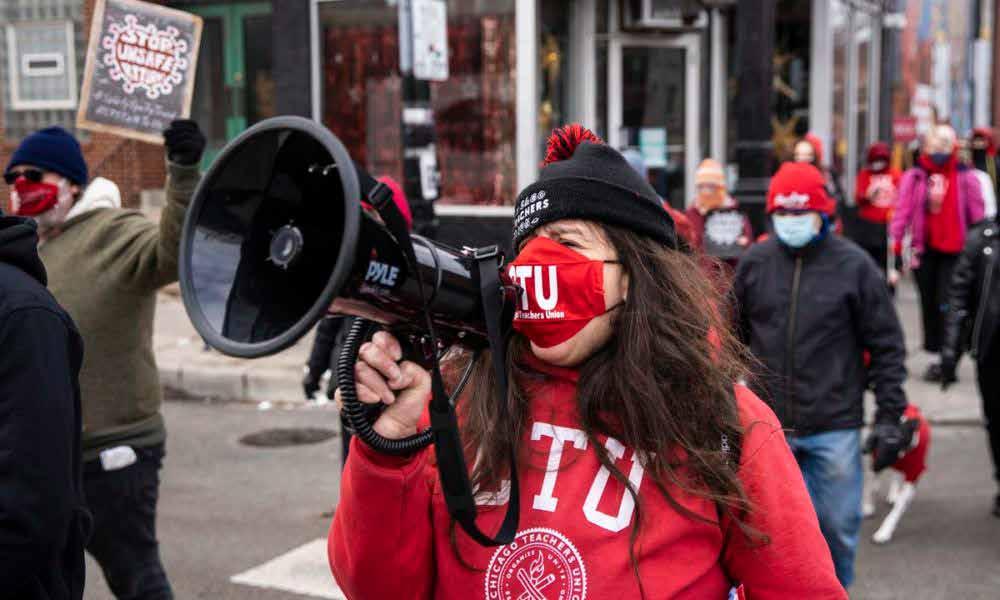
Rank and file members of the Chicago Teachers Union (CTU), dissatisfied with the limited internal democracyintheirunionandthelackofactionbytheir leadership in the face of school cuts and privatization by the appointed Chicago's Public School Authority (dominatedbyneoliberalDemocrats),establishedCORE in 2008. In 2010, the CORE tendency won the internal elections of the CTU, a union with more than 28,000 members.Uponassumingoffice,COREbeganaprocess of renewal, internal direct democracy [Stovall, 20254]
and reduction of the high salaries of union leaders. Soon after, Rahm Emanuel, former chief of staff in the Barack Obama administration, took office as mayor of Chicago and launched a package of neoliberal reforms to close schools in marginalized areas, transfer public schools to charter organizations, increase standardized testing, cut services in schools and reduce options for art, physical education and theater courses.
The CTU built community coalitions with parents of students in schools threatened with closures and cuts, and established alliances with other unions in the education sector to combat the mayor’s neoliberal package.
In 2012, 90 percent of CTU members voted for an indefinite strike. It's the union's first strike in 25 years, and in addition to the traditional demands for better pay and benefits, the union adds better learning conditions for its students. They demand reductions in standardized testing, an end to school closures and privatization, reductions in student-teacher ratios, and the restauration of music, sports, and art programs in schools in marginalized neighborhoods. These demands "for the common good" inspire strong support for the strike among parents and support workers, whose union (Local 1 of the Service Employees International Union - SEIU) joins the strike.
The strike ended with important gains for teachers and the public system and demonstrated the strategic importance of teachers' unions fighting not only for the direct interests of their members, but also for the communities that public schools serve. The concept of "bargaining for the common good" emerges, incorporating the demands and needs of the communities around public schools into union negotiations for new collective bargaining.
The CTU experience inspired teachers in other states, and soon CORE representatives received invitations to
4. According to Dr. David Stovall, Professor of Black Studies, Criminology, Law, and Justice at the University of Illinois, CORE adapted its practice of holding regular assemblies with the union's rank and file from the concept developed by the Zapatista movement in Mexico of "Leading by Obeying." – Presentation by David Stovall, Trinational Coalition in Defense of Public Education "Building Trinational Solidarity" Webinar, March 11, 2025. Link: Building Trinational Solidarity - Zoom
share at teachers assemblies in numerous states. These linkages spawned or strengthened new union tendencies, such as the Movement of Rank and File Educators (MORE) in New York, the Caucus of Working Educators (WE) in Philadelphia, the Baltimore Movement of Rank-and-File Educators (BMORE) and Union Power in Los Angeles. Informal networks also arose, such as the Badass Teachers Association that began in 2012 as a Facebook group, but in a few years’ time, grew to a broad network with thousands of members and the ability to mobilize demonstrations in several states. (Kramer 2024]
In 2013, several of the new tendencies organized a national conference to share ideas and strategies, and established the United Caucuses of Rank-and-File Educators (UCORE), a national alliance to promote mutual aid between education union tendencies that promote direct union democracy and social justice-based unionism.
At first, most of the new radical teacher groups emerged in "blue" states where unionization rates among educators is higher. New rank and file tendencies more frequently challenged traditional union leaders’ complacency with neoliberal policies in education and began to win internal elections.
But in the “red” states, where union affiliation among teachers was low, education unions did not have the right to negotiate collective contracts, and teachers were prohibited from striking, teacher activists began to organize through Facebook groups and other social media.5 This decentralized form of organizing gave birth in 2018 to a series of spontaneous walkouts collectively known as the "Red States Rebellion," or the "Red for Ed" campaign. (Red for Education). Labor resistance actions began in the state of West Virginia, but soon public school workers from the states of Oklahoma, North Carolina, Arizona, Kentucky, and Colorado joined. Throughout the year, education workers in
5.In
these states participated massively in demonstrations, strikes, marches and creative actions to advance their demands. In 2018, more than 375,000 education workers participated in the actions [Blanc 2020].
These are states where teacher salaries are very low so the movement's central demand involved salary increases. However, following the example of the CORE, the education workers' groups of the Red for Ed movement also incorporated demands to strengthen the public education system and improve learning conditions for their students. The achievements of the Red for Ed movement include salary increases for teachers and other public sector workers, protection of health programs for education workers, the withdrawal by state legislatures of pro-charter school, pro-voucher and anti-union bills, the protection of arts courses in public schools, and more services for students with special needs [Blanc 2019]. Other major impacts of the "Red for Ed" movement was a major rise in levels of unionization among educators in the states where the movement emerged, with state education unions gaining thousands of new members during 2018-19 [Blanc 2019 & 2020], and more active participation of members in states where teachers' unions actively supported the movement (West Virginia and Arizona).
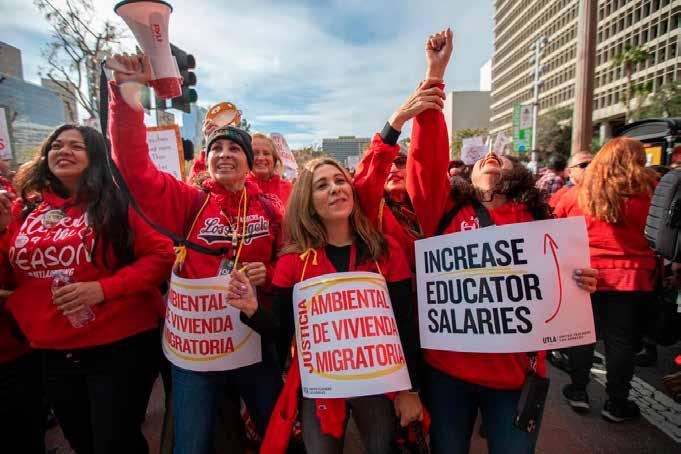
In 2019, mass teacher mobilizations continued in the U.S., but the center of action shifted back to large cities under the administration of Democratic politicians, with large strikes in Los Angeles, Chicago, Oakland, and Seattle, and marches, 24-hour walkouts, and occupations of school facilities in several more cities. The actions were coordinated by the new tendencies advocating for a "social unionism" that, under the slogan of "negotiation for the common good," incorporates social, racial and economic justice into their demands, including demands to protect their students from the incursions of the immigration authorities (ICE) and more affordable housing for the families of their students. More than 270,000 public school educators participated in the 2019 walkouts across the United States. [Blanc 2020]
37 of the 50 US states, laws prohibit teachers from going on strike, with penalties ranging from fines, to firings, to jail time for strike leaders.( Will 2023)
With the eruption of the Covid 19 virus as a global pandemic in March 2020, the wave of mobilizations subsidized as teachers sought to adapt their teaching to the pandemic conditions and were isolated by school closures. But the New Right increased its agitation during the pandemic, taking advantage of the resentment generated by school closures and other health measures to foster a "parental rights" movement that blames public schools for many of the ills seen in the country.
Much of the growing influence of the New Right's education policies in6 the "red" states over the past decade can be attributed to two important developments:
1. The rise of a "parents' rights" movement fostered by the New Right and exacerbated by school-based public
6.Policies restricting freedom of association and academic freedom, the reintroduction of religion in the classroom, banning books, anti-GBLTQ+ measures, promoting parental rights, banning "ethnic" studies and the teaching of history that does not focus on white males, vouchers to subsidize private and denominational schools and a ban on reproductive health measures and education, etc.
health measures during the pandemic, and
2. The efforts of state authorities to suppress the rise of democratizing teachers' movements.
Although the "common good” teachers' movements have not yet recovered the same level of protagonism that they enjoyed before the pandemic, they continue to organize and are gradually regaining strength. An example of this comes again from Chicago. After more than a decade of resisting the neoliberal policies of Democratic mayors, the Chicago Teachers Union (CTU) organized a broad coalition of unions and community organizations to support the candidacy of Brandon Johnson, a Chicago public school teacher and union organizer. In April 2023, Johnson was elected mayor of Chicago. Soon after, the new mayor introduced a bill to establish a school board democratically elected by the people of Chicago. This marks the first time that Chicagoans have the right to directly elect the people who run their public education system.
The political and public education advances in
PHOTO: THE LEFT DAILY
Chicago are an indication of what can be achieved when a teachers' organization is open to engaging its rank-and-file, other unions, and communities in the defense of public education.
The Second Administration of Donald Trump - New Challenges for Teachers
The second administration of US President Donald J. Trumpismuchmoreideologicallyalignedwiththefar right than his first administration (2016 to 2020). The MAGAtendencynowhasalmosttotaldominanceover theRepublicanPartyandthereisnolongeramoderating influence from traditional conservatives to curb itsexcesses.Trumphasappointedprominentfigures of theultra-righttohighstructuresofhisadministration. Almost immediately after Trump took office again on Jan. 20, 2025, he issued a series of executive orders thatprofoundlyimpactpubliceducation.Thechanges proposedbythenewadministrationarenumerous,but there are three that have significant impacts on public education and education workers. These include:
An offensive against diversity, equity, and inclusion (DEI) policies that seek to ensure that institutions demographically reflect the populations they serve, and that marginalized sectors receive the support they need to succeed. Ensuring inclusion and equity is a centraltaskofthefederalgovernment'sDepartmentof Education.Thedepartmentismeanttosupportschool districtsinimplementingprogramsthatfacilitatethefull participationofstudentswithspecialneedsandbenefit economicallyorsociallydisadvantagedchildren.Italso supported programs that contribute to more diversity amongpublicschoolteachers.Amongthefirstactions ofPresidentTrump'snewadministrationwastofireall Department of Education employees responsible for DEI programs and projects.
But beyond just cutting funding to DEI programs, Trump also issued executive orders that punish institutions that implement DEI policies, such as support programs for educationally disadvantaged sectors, teaching history that goes beyond the Euro-American
experience, the inclusion of trans people in school sports programs, teaching Palestinian studies or allowing demonstrations to take place on their campuses.
• Harassment and attacks on people who may have irregular immigration status. Among the measures of the new Trump administration to strengthen the detention and deportation of migrants was a massive investment in the budget of Immigration and Customs Enforcement (ICE) and giving its agents the power to enter schools and churches to detain people suspected of being undocumented. Raids by ICE and other Department of Homeland Security agents on schools in various regions of the country since Jan. 20, 2025, also serve to discourage undocumented parents from sending their children to school, leading to sharp drops in school attendance in a number of cities where large ICE operations continue.
• The total elimination of the Department of Education. Under the slogan "bring education back to the states and empower all parents to choose an excellent education for their children," [MacMahon 2025] the Trump admisnitration plans to dissolve the federal government's Department of Education. He appointed Linda McMahon, former CEO of the World Wrestling Federation, as Secretary of Education. On March 3, 2025, McMahon issued the statement "The Final Mission of Our Department" outlining her plans to eliminate most of the department.
• An offensive against the principle universities of the country. Under the pretext that they did not crack down hard enough on last year's massive student protests against their institutions' investments in the Gaza genocide, Trump seeks to control the leadership and internal policies of major public and private universities. It uses cuts to subsidies to universities, the cancellation of federal research contracts and the suspension of visas for international students as tools of pressure (American universities depend on high tuition fees to subsidize the education of national students). Most universities have bowed to the pre-
sident's demands. Among the top US universities, only Harvard continues to hold out.
Responses from the educational community:
Trump's executive orders affecting public education are so numerous and come so fast that the education community has yet to articulate a nationwide response. However, throughout the USA, education workers, students, and parents are resisting.
Both national organizations representing U.S. teachers – the National Association of Educators (NEA) andtheAmericanFederationofTeachers(AFT)
– filed lawsuits in court for permanent injunctions against the elimination of the Department of Education, arguing that Trump and McMahon violate the constitution by closing the department without authorization from the U.S. Congress.
For years now, the Chicago Teachers Union (CTU) hasbeenpreparingforthismoment.Inits2019
collective contract, the CTU won a commitment that the Chicago Public Schools Authority will not cooperate with ICE and will not share student or employee in-formation with the agency. Specifically, Article 46-7 of the CTU's collective bargaining agreement with the Chicagoschoolauthoritystipulates thatChicagopublicschoolsaresanctuaryspacesforall. Itprohibitsschoolauthorities from:
• Asking about a person's immigration status
• Saving or sharing information about a student’s immigration status
•Contactingimmigrationagentsaboutstudents orfamilies
•Permittingimmigrationagentstoenterschools withoutpresentingavalidwarrantsignedbya judge.(CTUBrochure,2024]
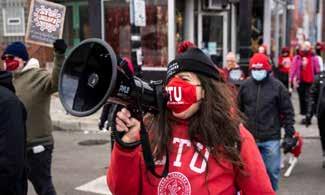
Since the beginning of 2025, CTU has been carrying out trainings for members and parents on migrant rights, emergency planning, and how to respond if ICE
PHOTO: FRANCINE ORR
agents approach their school. They have formed immediate response teams in many public schools to prevent officers from entering. To date, ICE and Department of Homeland Security agents have failed to enter Chicago public schools.
In February and March 2025, thousands of Los Angeles California public school students took to the streets demanding that the Los Angeles Union School District develop plans to prevent ICE agents from entering schools. The district declared public schools as sanctuary zones for migrants and circulates cards to students and parents informing them of their rights in the face of migration.
The union that represents the teachers – United Tea-chers of Los Angeles – issued a statement on February 26 in support of the student mobilizations and mobilized its members to protect the students on occasionswhenthey were threatened by riot police.
At the beginning of the new school year in August 2025, the Los Angeles Union School District organized observation networks and community patrols to alert students and their families to ICE activity near public schools.
LargecitieslikeChicagoandLosAngelesthathave grassroots-led educators' unions have become poles of resistance to the offensive against public schools. But throughout the country, acts of resistance are growing by teachers and students in defense of their communitiesthreatenedbyICEandotheragentsofthe
Trump administration and against New Right policies in public schools.
Reference
Blanc, E. (2019). Red State Revolt: The teachers’ strike wave and working-class politics. Verso.
Blanc, E. (2020, October 3). The Red for Ed Movement, Two Years In. New Labor Forum. https:// newlaborforum.cuny.edu/2020/10/03/the-red-for-edmovement-two-years-in/
Kramer, B. (2024). Activists, advocates, and agitators: 21st century justice-oriented teacher activist organizations. Myers Education Press.
McMahon, L. (2025, March 3). Secretary McMahon: Our department’s final mission. U.S. Department of Education. https://www.ed.gov/about/news/speech/ secretary-mcmahon-our-departments-final-mission Chicago Teachers Union, "Chicago Schools are Sanctuary Schools," (pamphlet published December 2024.)
Stovall, David, Virtual Seminar "Building Trinational Solidarity" of the Trinational Coalition in Defense of Public Education, March 11, 2025. Link: Building Trinational Solidarity - Zoom
Will, M. (2023, October 31). Teacher strikes explained: Recent strikes, where they’re illegal, and more. Education Week. https://www.edweek.org/teaching-learning/teacher-strikes-explained-recent-strikes-where-theyre-illegal-and-more/2023/10
Between Reform and Resistance: The New High School in Brazil under the Influence of the Global Education Reform Movement (GERM) and the New Right
Jardel Pereira da Silva1 Caio Ruano da Silva2
Translated by Natalie Ilianes
In recent decades, public education has been the subject of intense political, economic and cultural debate. Internationally, the so-called Global Education Reform Movement (GERM), promoted by organizations such as the Organization for Economic Co-operation and Development (OECD), the World Bank and the United Nations Educational, Scientific and Cultural Orga-
1.University of Brasília (PPGE/FE/UnB), PhD student in Education in the field of Comparative Studies in Education (ECOE), linked to the Graduate Programme of the Faculty of Education at the University of Brasília (PPGE/FE/UnB), member of the GERAJU research group, part of the Educational Policy Analysis group..(http://investigacion.politicas.unam.mx/gaped/index.php/ equipo-academico/) Email: jardelsilvapsm@gmail.com
2. Master's degree in Social Sciences and Administration from the Federal University of Espírito Santo (UFES), professor at the Federal Institute of Espírito Santo (IFES) and conducts research in
nization (UNESCO), has promoted standardization, test-based assessment and adaptation of schools to the demands of the labour market. This paradigm has had a strong impact in Latin America, where it has combined with the rise of the new right who dispute the meaning of the public sphere and the educational role of the state.
The reform of secondary education (Ensino Médio) in Brazil - instituted by Law No. 13,415/2017 - represents a concrete expression of this phenomenon, articulating
the field of education, with an emphasis on topics such as school dropout, discipline, control and freedom in the school environment. In Social Sciences, his current line of research focuses on new forms of activism, with a focus on the phenomenon of slam poetry. Email: caio.silva@ifes.edu.br
discourses of modernization, youth entrepreneurship and efficiency, while reproducing structural inequalities and reducing spaces for critical education. This article aims to analyze the effects of this reform in two specific regions: the state of Ceará and the Federal District, highlighting both the convergences in design and the divergences in local implementation.
Using a comparative approach and documentary analysis, the discourses, practices and tensions present in the implementation of the new high school are examined, identifying how a new educational rationale is taking shape that shifts the focus from citizenship to employability. We also reflect on the role of young people in this new model, the challenges of democratic participation in curriculum policy and the disputes over the meaning of public education in the 21st century.
GERM: neoliberalism and the new right
The Global Education Reform Movement (GERM), a concept coined by Pasi Sahlberg (2011), describes a set of policies that have been systematically adopted in several countries since the late 20th century. These policies promote standardization of content, performance-based assessment, management by indicators and a strong market orientation, transforming public education into a tool for economic competitiveness and managerial efficiency.
According to Sahlberg (2011), GERM is characterized by five components: standardization, focus on basic skills, test-based accountability, decentralization with centralized control and school choice as a guiding principle. These guidelines have been widely disseminated by international organizations such as the OECD, the World Bank, and UNESCO, influencing curriculum reforms across Latin America, including Brazil.
From a critical perspective, Díez-Gutiérrez and Jarquín-Ramírez (2025) argue that the new educational configurations promoted by the far right and neoliberalism also foster a logic of state
recentralization and cultural control, in which education is instrumentalized as a mechanism for social homogenization. This model reinforces the role of the school as a tool of discipline rather than a space for emancipation, subordinating the right to education to criteria of efficiency, ideological control and business management (p. 10).
These new right-wing movements promote a narrative of order, authority and a return to traditional values, which often aligns with the technocratic discourse of GERM, albeit with a particular conservative slant. This convergence produces a form of educational governance that combines neoliberal efficiency with cultural moralism, depoliticizing the pedagogical debate and weakening spaces for democratic participation.
In the case of Brazil, Hypolito (2019) observes that the reforms promoted by the National Common Curricular Base (BNCC) 3 respond to a global logic of standardization and accountability. According to the author, this policy promotes a competency-based approach that prioritizes quantifiable results and functional skills, to the detriment of critical, contextualized and social justice-oriented education. In his words, it is a "global normative framework that tends to homogenize educational practices, disregarding the sociocultural and epistemological diversity of school contexts".
Thus, the theoretical framework of this study is based on the articulation between GERM, neoliberal rationality and the cultural offensive of the new right, understanding that these forces do not operate in isolation but are intertwined in the contemporary reconfiguration of the educational field in Brazil and Latin America.
3.The National Common Curricular Base (BNCC) is a Brazilian regulatory document that defines the set of essential learning outcomes that all students must develop throughout their basic education. Approved in 2017, the BNCC establishes minimum competencies and skills for Early Childhood Education, Elementary Education, and Secondary Education, guiding the development of curricula throughout the country.
Comparative Documentary Analysis: Brazil, Ceará and the Federal District
The reform of secondary education in Brazil, consolidated by Law No. 13,415/2017, represents a profound restructuring of the curriculum, school organization and the very concept of secondary education. Based on the National Common Curricular Base (BNCC), the reform introduces educational pathways, the Life Project component, and a flexible timetable geared towards developing the skills and abilities required by the market. This reconfiguration has been applied unevenlyacrossthestatesofthefederation,generating contrasting experiences, as can be seen in the cases of Ceará and the Federal District.
The methodology used in this study was a documentary analysis of public policies, educational regulations and curriculum materials produced between 2017 and 2024. Official documents such as the text of the Reform Law, the BNCC, state implementation plans, and complementary curriculum guidelines were analyzed. This technique made it possible to identify how the principles promoted by international organizations, such as standardization, youth employability and results-based assessment, are translated into local regulatory frameworks.
At the federal level, the policy was formulated in a top-down manner, without broad public con-sultation. The BNCC imposed a common structure but delegated responsibility for defining educational pathways to the states. The "Life Project" component, for example, reflects an individualized vision of young people's trajectories, promoting an ideal of entrepreneurship and self-management, in line with the neoliberal rationality of the GERM (Silva, 2023).
In the state of Ceará, implementation took place in the context of an already established policy made to expand the Full-Time Secondary School (EEMTI)4 model. Despite the existence of specific assessment tools such as SPAECE5 and a results-
4. Full-Time Secondary Schools (EEMTI) in Ceará are exten-
based management system, the reform encountered challenges in teacher training, resource shortages and work overload. However, there are initiatives for inter-institutional coordination and a certain continuity with previous policies, which has faci-litated its acceptance (Silva, 2017).
In the case of the Federal District, the process of implementing the new educational model was more fragmented. Although technical and vocatio-nal pathways were prioritized, there was no robust pedagogical support structure in place. Participation of teachers and school communities was limited, and many teachers reported difficulties in understanding and implementing the new curriculum. Likewise, the lack of sustained pedagogical support and adequate infrastructure reinforced the perception that the reform was more of an imposition than a collective endeavour. (Ferreira et al., 2020)
The following table summarizes the main aspectsobserved at the three levels of analysis:
ded-day schools—with daily schedules of 7 to 9 hours or at least 35 hours per week—that combine general BNCC education with diversified training. The latter includes life projects, citizenship, culture, sports, and technical activities, as well as technologies and electives chosen by the students themselves. The proposal, implemented since 2016 as part of state policy, aims to improve education through a broader and more contextualized curriculum. 5.The Permanent System for the Evaluation of Basic Education in Ceará (SPAECE) is an evaluation policy implemented by the Ceará State Department of Education (SEDUC-CE) in Brazil. Its objective is to assess the learning level of public school students in the areas of reading, writing, and mathematics, both in primary and secondary education. SPAECE is administered annually and uses Item Response Theory (IRT), similar to the National High School Exam (ENEM), serving as a basis for pedagogical decision-making, teacher training, and the distribution of incentives according to the results obtained.
Comparative Table: Influence of International Organizations and Implementation of Educational Reform in Brazil, Ceará and the Federal District
Aspects
General guidelines
International Organizations (OECD, World Bank, UNESCO)
Competencies, socio-emotional skills, training for the job market
Brazil (Federal)
BNCC, Training pathways, emphasis on employability
Educational purpose
Assessment and management tools
Human capital development, integration into the global economy
Results-based evaluation (PISA, IDEB 6 ), evidence-based management
School community involvement
Challenges identified
Competencybased training, life project
Revised ENEM, increased targets and indicators
Limited in design; greater in implementation Limited consultation, top-down
Digital divide, teacher training, social inequalities
Local resistance, insufficient infrastructure
6.The Basic Education Development Index (IDEB) is an indicator created in 2007 by the Anísio Teixeira National Institute for Educational Studies and Research (INEP), linked to the Brazilian Ministry of Education. It combines two fundamental compo-
Ceará Federal District
Fully adopts the BNCC, with a strong emphasis on EEMTI and full-time education.
Reducing inequalities, connecting school and life
Partial implementation, focus on technical areas and diverse itineraries
Curriculum reorganization, diversity of pathways
Permanent monitoring system (SPAECE)
Local experiences of dialogue, but still centralized
Teacher overload, difficulties with continuing education
Own sample assessment and school performance data
Some public hearings and student consultations
Teachers’ difficulty in adapting to the model
PREPARED BY THE AUTHORS (2025)
nents: the school pass rate (obtained from the School Census) and learning outcomes in standardized tests, such as Prova Brasil and the National Basic Education Assessment System (Saeb).
This analysis shows that although the reform presents a common framework throughout the country, its implementation depends heavily on the political, institutional and pedagogical conditions of each territory. Formal decentralization does not guarantee effective autonomy when it is accompanied by pressure for results and a vertical decision-making process.
Results and discussion
Comparative documentary analysis reveals that the reform of Brazilian secondary education is not being implemented uniformly, but rather takes different forms depending on institutional capacities, local school culture and the degree of alignment with international agendas.
Despite the differences between Ceará and the Federal District, structural commonalities can be identified that allow us to affirm that the reform is part of a broader idea of reconfiguring the field of education under the influence of GERM and the new right.
One of the main challenges observed in the implementation of the BNCC in Brazil has been the precarious structural conditions in public schools. As Hypolito (2019) points out, the approach adopted tends to ignore existing material inequalities and disregards the complexity of teaching work. This policy is structured around a homogenizing and technocratic logic that presupposes equitable conditions for its application, but in practice reveals "a disconnect between normative discourse and educational reality, marked by a scarcity of resources and institutional fragility" (p. 5).
Secondly, it highlights the lack of substantive democratic participation in the formulation of education policy. The National Common Curricular Base (BNCC) was conceived under a vertical model, with little public discussion and minimal dialogue with school stakeholders. Although some states, such as Ceará, promoted specific consultation and training activities, these proved insufficient given
the magnitude of the proposed changes. As Hypolito (2019) points out, the process was guided by a technical rationale that masks a deeply ideological orientation, reducing the role of teachers to merely implementing standards and aligning the curriculum with external norms.
A third finding is that the BNCC reinforces a curriculum geared towards individual success and job placement, gradually displacing critical and collective citizenship education. As Weller (2014) explains, by focusing on the "Life Project," the system ends up reinforcing commercial expectations, and young people are trained more to adapt to the market than to transform their social environment. This curricular logic - the result of a global human capital agenda - reduces schools to a space for professional preparation, disconnected from humanistic goals and social justice.
In contrast, school stakeholders - teachers, students, and administrators - have developed strategies of reinterpretation and resistance in the face of the imposition of the new model. In Ceará, for example, the IPEA study (2023) reveals that “the national guidelines were interpreted and adapted to local realities, giving rise to three distinct models of new secondary education” (p. 1), reflecting an active adaptation of the curriculum with a local emphasis. In the Federal District, UDESC research on pilot schools shows that, although the curriculum policy "meets the requirements of capital formation under the logic of citizenship," it also points out that "education for human emancipation is the only one capable of making a contribution" (p. Summary), indicating the persistence of critical and social approaches.
In summary, the results confirm that the reform of secondary education in Brazil, although presented as pedagogical modernization, is aligned with a managerial and conservative rationale that limits the emancipatory potential of public schools. The convergence between GERM and the new right
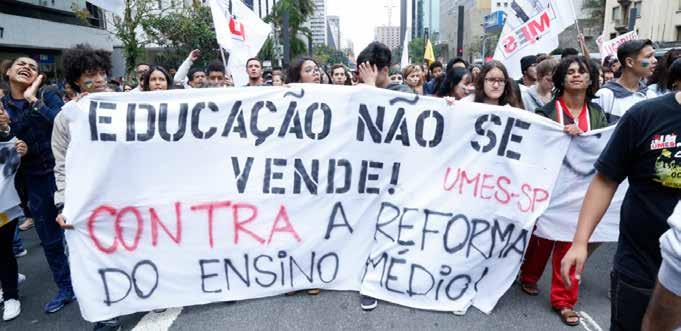
wing produces a more controlled, less democratic school system that is increasingly distant from the real interests of working-class youth.
Final considerations
The reform of secondary education in Brazil is a prime example of how the transformations promoted by the Global Education Reform Movement (GERM) and the new right wing are reshaping the field of education in Latin America. Far from representing an inclusive pedagogical innovation, this reform reflects a political and technical rationale that reinforces neoliberal thinking within public schools.
A comparative analysis between Ceará and the Federal District shows that, although local conditions vary, there is a common trend towards the implementation of standardized policies, guided by performance indicators and accompanied by limited participation from school stakeholders. This situation reveals a disconnect between the promises of modernization — greater student autonomy, flexible curricula, connection with the labour world— and the reality of educational institutions, marked by historical inequalities, lack of resources and overworked teachers.
Likewise, the discourse of employability and youth entrepreneurship has displaced that of critical, humanistic education oriented towards social justice. As Laval and Sorondo (2023) warn, these reforms are neither neutral nor merely technical but rather respond to a broader ideological debate over the meaning of the public sphere, the role of the state and the place of young people in society.
Given this scenario, it is essential to strengthen spaces for democratic dialogue in the design and implementation of education policies, as well as to recognize and support local initiatives that, starting in schools, seek to redefine the curriculum and develop teaching approaches that are more sensitive to the realities of young people. Only in this way will it be possible to resist the technocratic instrumentalization of education and defend its transformative potential as a right and as a common good.
References: Brasil. (2017). Ley n.º 13.415, de 16 de febrero de 2017. Modifica las Leyes n.º 9.394/1996 (Ley de Directrices y Bases de la Educación Nacional) y n.º 11.494/2007, e instituye la Política de Fomento a la Implementación de Escuelas de Enseñanza Media en Tiempo Integral.
PHOTO: PAN YOUNG GROUP
Diario Oficial de la Unión. https://www.planalto.gov. br/ccivil_03/_ato2015-2018/2017/lei/l13415.htm
Brasil. Ministerio de Educación. (2018). Base Nacional Común Curricular (BNCC) – Etapa de la Enseñanza Media. https://portal.mec.gov.br/docman/abril-2018-pdf/85121-bncc-ensino-medio/file
Ceará. Secretaría de Educación. (2020). Referencial Curricular de la Enseñanza Media del Estado de Ceará. Fortaleza: SEDUC-CE. https://www.seduc. ce.gov.br/wp-content/uploads/sites/37/2022/01/ dcrc_completo_v14_09_2021.pdf
Ceará. Secretaría de Educación. (2023). Plan de Implementación de la Nueva Enseñanza Media en Ceará. SEDUC-CE. https://www.gov.br/mec/pt-br/ novo-ensino-medio-descontinuado/pdfs/PLICE.pdf
Costa, F. T. S.; Liporini, T. Q. (2023). O novo Ensino Médio pós-BNCC no Distrito Federal e possíveis implicações pedagógicas. Florianópolis: UDESC.
Díez-Gutiérrez, E.-J., & Jarquín-Ramírez, M.-R. (2025). Políticas educativas de la extrema derecha en Europa: ¿La conformación de una internacional de ultraderecha en educación mediante una agenda común? Education Policy Analysis Archives, 32(44), 1–31. https://doi.org/10.14507/epaa.32.8848
Distrito Federal. SEEDF. (2019). Novo Ensino Médio: Currículo em Movimento do Distrito Federal. Brasília: Secretaria de Estado de Educação do Distrito Federal.https://www.educacao.df.gov.br/ wp-conteudo/uploads/2019/08/Curriculo-em-Movimento-do-Novo-Ensino-Medio-V4.pdf
Distrito Federal. Secretaría de Educación. (2022). Directrices para la implementación de la Nueva Enseñanza Media en el Distrito Federal. Brasília: SEDF. https://www.educacao.df.gov.br/wp-conteudo/uploads/2021/07/PLANO_DE_IMPLEMENTACAO_NOVO_ENSINO_MEDIO_20set2022__2_-1. pdf
Distrito Federal. Secretaría de Educación. (2020). Dictamen No. 112/2020-CEDF, de 8 de diciembre de 2020 – Aprobación del Plan de Estudios en el
Movimiento de Educación Secundaria de la red pública de educación del Distrito Federal; y prevé otras medidas.. Brasília: SEDF. https://drive.google. com/drive/folders/1J-AJW-8CJ_84X1QEq4N0eQuTwKG1wYw0
Ferreira, F. W., Lopes de Abreu, R. J., & Louzada-Silva, D. (2020). Desafíos de la articulación entre el nuevo Ensino Médio y la BNCC: el caso del Distrito Federal. Em Aberto, 33(107), 215–222. https:// doi.org/10.24109/2176-6673.emaberto.33i107.4527
INEP – Instituto Nacional de Estudios e Investigaciones Educativas Anísio Teixeira. (2023). Indicadores Educativos: Resultados del IDEB, ENEM y Censo Escolar. https://www.gov.br/inep/
IPEA. (2023). O novo ensino médio nos estados do Ceará, Goiás e Paraná. Brasília: IPEA. Hypolito, Á. M. (2017). BNCC, Agenda Global e Formação Docente. Retratos da Escola, 11(21), 277–292. https://retratosdaescola.emnuvens.com. br/rde/article/view/995/pdf
Laval, C., & Sorondo, J. (2023). Educación, neoliberalismo y ultraderecha: nuevas preguntas para la investigación educativa. Revista Educación, Política y Sociedad, 8(2), 11–23. https://doi.org/10.15366/ reps2023.8.2.001
Sahlberg, P. (2011). Finnish lessons: What can the world learn from educational change in Finland? Teachers College Press.
Silva, R. R. D. (2023). Emocionalización, algoritmización y personalización de los itinerarios formativos. Currículo sem Fronteiras.
Silva, R. R. D. (2017). «La BNCC del Ensino Médio: el protagonismo juvenil como vector de personalización curricular». Ensaio: Avaliação e Políticas Públicas em Educação.
Weller, W. (2014). Jovens no Ensino Médio: projetos de vida e perspectivas de futuro. In J. T. Dayrell, P. Carrano & C. L. Maia (Orgs.), Juventude e Ensino Médio: sujeitos e currículos em diálogo (pp. 130–152). Belo Horizonte: Editora UFMG.
Liberty University: The Far-Right’s Educational Vision for Mexico
María de la Luz Arriaga L.1
Translated by Flor Montero
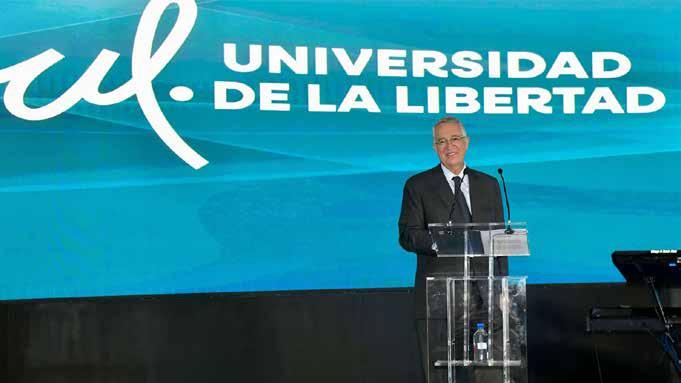
Liberty University is a recently created institution, inaugurated on September 4, 2023. It stems from a series of educational ventures promoted by a business group headed by billionaire Ricardo Salinas Pliego which is involved in various economic activities. They own the Elektra chain of furniture and appliance stores whose success is based on providing products on credit to low-income populations, with small “installments” but usurious interest rates. They also own one of Mexico's most important television networks, TV Azteca
1.Professor
at the Faculty of Economics, UNAM, and Coordinator of the Mexican Section of the Tri-national Coalition in Defense of Public Education.
Through its chain of stores, it became the recipient of large sums of remittances sent by migrants living in the United States to their Mexican families. It was later granted permission to operate as a financial institution, Azteca Bank, and then was authorized to become a Retirement Savings Fund Administrator, AFORE Azteca, which manages 17 million pension accounts for Mexican workers.
Through the Caminos de Libertad Foundation, the group had already ventured into the education business, starting with a junior and high school called Humanitree. In addition, through the Azteca Foundation, it developed a very successful project- the Azteca children's orchestras-which received enormous public funding
KARINA MIRANDA/INFOBAE
from federal and state governments. From 2009 to the first quarter of 2018, the amount totaled 1.689 billion pesos. They started 86 orchestras across the country, each with 200 children and teenagers.2 This project is a clear example of the false philanthropy of millionaires who contribute a few pesos and boast about it, while receiving major public financing. It also illustrates how various neoliberal governments canceled large-scale cultural projects but supported the philanthropic ventures of the country's business elites, including the owners of the Salinas Group.
It is also striking how these groups, with their false claim to civil society, are part of the “corporate citizenry”3 who place their members in key political positions. Esteban Moctezuma Barragán, president of his foundation, was Secretary of the Interior during
2.See García Bermejo.C, The false Philantropy of Salinas Pliego, https://quintoelab.org/falsafilantropia/
3.The term “corporate citizenry” is a concept revived by Mauro Jarquín to demystify the business corporations that hide behind the self-proclaimed “civil society.” Jarquin (2022), La pedagogía del Capital (The Pedagogy of Capital), AKAL publishing house.
the six-year term of José López Portillo and Secretary of Public Education during the Andrés Manuel López Obrador (AMLO) administration. Ninfa Salinas Sada, daughter of Ricardo Salinas Pliego, is currently president of the Caminos de Libertad Foundation, but from 2009 to 2012, she was a federal deputy, and from 2012 to 2018, she was a senator for two consecutive terms for a right-wing party, the Green Ecologist Party of Mexico.
Currently, the Caminos de Libertad Foundation maintains ties with far-right international groups such as the Atlas Network and the Minerva Project. In March 2025, the Foundation hosted the regional meeting of the influential Mont Pelerin Society which was created in the 1940s by Friedrich Hayek, a prominent representative of classical liberalism who promoted the defense of the market as the guiding force in society. Key theorists of human capital theory, such as Gary Becker4 and Theodore Schultz, later joined the organization. Today, Mont Pelerin is a stronghold of far-right libertarianism.
Becker, Gary , Human Capital, a theoretical and empirical analysis focusing primarily on education, 1983, Ed Alianza, Spain
PHOTO:
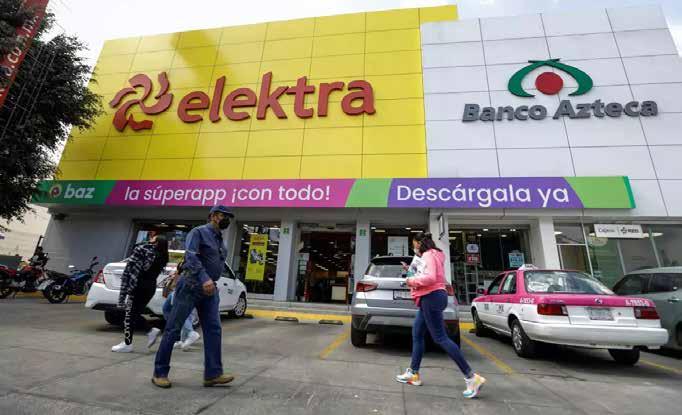
At the beginning of the AMLO administration, the Salinas business group was close to it and even imposed the Secretary of Education. However, they later became the most belligerent business group against the AMLO and Claudia Sheinbaum administrations, primarily due to their refusal to pay taxes. According to the federal government, it owes a cumulative total of more than 63 billion pesos.5 In Salinas Pliego's view, the government steals from citizens when they pay taxes, should not collect them, and each individual should use their income according to their personal decisions.
The financial group's dispute with the government reached its peak in August 2022, when free new textbooks accompanying the New Mexican School program were issued. The group used its television channels to denounce the content of the books, saying they were “communist.” On one of its television channels, presen-
5.See: https://www.gob.mx/segob/prensa/informa-gobierno-federal-situacion-de-grupo-salinas-frente-a-la-hacienda-publica-360543#:~:text=Indic%C3%B3
ter Javier Alatorre even accused the Ministry of Public Education (SEP) of spreading “a virus that was believed to have been exterminated: the virus of communism,”6 and called for the free textbooks to be burned. This resulted in small acts of vandalism by deluded people in the north of the country and in indigenous communities in Chiapas.
Liberty University: the flagship project
The name of the university reveals its political ideology: libertarianism, Milei, Trump, etc. It is a university with alliances with other right-wing universities in the United States and Spain,7 and with foundations and think tanks worldwide, in particular with the Atlas Network and Mont Pelerin Society.
It advertises itself as “an innovative educational
6.Capital 21, (2023, 2 de agosto). Medios Lanzan campaña en contra de libros de la SEP; ¿qué se ha dicho? Capital 21.https:// www.capital21.cdmx.gob.mx/noticias/?p=45323
7. It was created and promoted by Minerva Project, which defines itself as "an innovative company that designs and delivers ex-
PHOTO: LUIS CORTÉS
proposal that challenges tradition and trains leaders with entrepreneurial vision, innovative thinking, and a firm commitment to freedom.” 8 It offers one bachelor's degree and one specialization, the bachelor's degree in Innovation and Business, which consists of 52 courses and 321 credits. It advertises that it can enroll up to 450 students.
The curriculum for the bachelor's degree is structured around four core areas: (1) Ideas, (2) Business, (3) Skills, and (4) the Work Environment Experience Program (PEEL). The Ideas area includes 10 courses covering topics such as the History of Economic Liberalism, Ethics and Capitalism, and the History of Business, among others. Notably, the Business area contains the largest number of courses—26 in total—focused on logic and strategy in business decision-making, as well as applied mathematics for business strategy.
The PEEL program offers hands-on work experience with the following companies and business groups: Iris Startup Lab, Baz Súperapp, Bitácora Social, Centro de Atracción de Talento, Bayer, and the Salinas Group.
The following stand out among the “novel” features it offers:
1)the courses will not be taught by teachers but by facilitators. Students are encouraged to develop their entrepreneurial skills while studying, connecting them with experts and entrepreneurs, promoting a libertarian vision.
"We have decided to move away from the outdated term 'teacher,' as we believe it reflects a hierarchic and authoritarian view of learning—one in which a single person holds absolute truth. Instead, our facilitators completely transform this traditional dynamic, creating
ceptional educational programs through educational and business partners around the world. Minerva Project is the strategic innovation partner for institutions seeking to create new and transformative programs and to launch new universities. Its partners include the University of Miami, USC, Berkeley, Zayed University, Esade, Kentech, and the University of Liberty." www.minervaproject.com.
8.Liberty University. (s.f.). Licenciatura. https://www.ulibertad. edu.mx/es/licenciatura/
an innovative educational environment centered on the freedom to explore, question, connect, and create."
"...our facilitators are leaders in their industries— active professionals who bring real-world experience into the educational exchange. They don’t merely share theories; they present practical cases and authentic experiences, thus bridging learning with the professional and business realities."9
2) It offers students boot camps, which are intensive, accelerated training programs.
3) it also offers networking, “one of the most valuable assets in the world of entrepreneurship” and 4)students do not wait four years to earn a degree or certificate; instead, they accumulate digital badges.
“A digital badge is a visual representation that certifies specific skills, experiences, or achievements that students have acquired through their learning, detailing the competencies they have developed. For each completed course, students receive a digital badge backed by blockchain technology10, which can be added to their professional LinkedIn profile and also stored in a personal wallet.”11
Through this scheme, they maintain a rigidity imposed by competency-based education, as they set parameters for awarding their digital badges.
Finally, we would like to point out that the bachelor's degree in Innovation and Business at Liberty University lasts between 3 and 4 years, and has a quarterly program. Enrollment costs $15,000 MXN (811 USD), and tuition is measured in credits at a cost of $8,100 MXN (438 USD). In a rough estimate, the total cost of the degree would be around 2.6 million Mexican pesos (108,156 USD). Compared to a similar degree at the Tecnológico de Monterrey, a private university recognized for its academic standards, it is almost twice as expensive. At Tecnológico, the bachelor's degree in entrepreneurship also lasts eight semesters, with total
9. Ibid
10.Decentralized digital ledger that ensures the information is tamper-proof and verifiable.
11.This wallet is also provided by the University.
tuition fees of 1,398,472 Mexican pesos (75,604 USD). In ongoing research by the IDEA Network looking at the New-Right and Far-Right in Education in the Americas, we have found that there are three fundamental objectives in their cultural war: 1) to influence educational content, from elementary to higher education, in order to shape a prevailing “common sense” through the values of libertarianism, entrepreneurship and the importance of the individual over the collective 2) They despise public universities for what they represent as spaces for critical thinking and the creation of knowledge and science, but they turn to them as a place to recruit minds for their project 3) Teachers who do not fit into their idea of modernity are being purged. This business project does not have a major impact at the national level. It is a relatively small “university” (more like a business school), but it does serve its promoters as a fulcrum from which to promote their ideas and legitimize them nationally and internationally. This project is a clear example of how the ideas of the international right and far-right—once dismissed as mere rhetorical ideals—are now being put into practice.
Bibliographic references:
Capital 21. (2023, August 2). Media launch campaign against SEP textbooks; what has been said? Capital 21. https://www.capital21.cdmx.gob.mx/noticias/?p=45323
Becker, Gary. (1983). Human Capital: A theoretical and empirical analysis with special reference to education. Editorial Alianza, Spain.
Secretariat of the Interior. (2024). “Federal report on the situation of Grupo Salinas before the Public Treasury,” March 20, 2024. Available at: https://www. gob.mx/segob/prensa/informa-gobierno-federal-situacion-de-grupo-Salinas-frente-a-la-hacienda-publica-360543#:~:text=Indic%C3%B3
García, Carmen. (n.d.). “The false philanthropy of Salinas Pliego” Available at: https://quintoelab.org/ falsafilantropia/
Jarquín, Mauro. (2022). The pedagogy of capital: Businesspeople, the new right, and educational reform in Mexico. Akal Publishing, Mexico.
Salinas, Esáu. (n.d.). Institute of Faith: The key to progress, in Vértigo Político Magazine. Available at: https://www.vertigopolitico.com/nacional/notas/universidad-la-libertad

PHOTO: UNIVERSITY OF LIBERTY
The Far-right's Ideological Battle for Education in Portugal: Citizenship and Development
Catarina Neves1
Translated by Natalie Illanes
Far-right parties, especially in Europe, have demonstrated that they share a common educational agenda, which can be characterised as a Far-Right International in Education (Díez-Gutiérrez & Jarquín-Ramírez, 2025). In Portugal, the CHEGA party is part of this common agenda and has adopted some of its rhetoric and education policies. As in Italy following the election of the Fratelli d'Italia party, whose Ministry of Education was renamed the 'Ministero dell'Istruzione e del Merito' (Ministry of Instruction and Merit), the CHEGA party also proposes changing the name of the Ministry of Education to 'Ministério do Ensino' (Ministry of Teaching).
1.PhD candidate in Educational Policy at the University of Lisboa. Email: c.cerqueira@tutamail.com
In Portugal, this international far-right agenda has developed within a national context, despite the fact that the far-right is not part of the government. An example of this is the introduction of changes to the teaching of Citizenship and Development. This subject was introduced as part of the National Strategy for Citizenship Education (ENEC) which was developed by the centre-left government in power between 2015 and 2024.
As explained by ENEC (Direção Geral de Educação, 2018), "Citizenship and Development is part of the national curriculum and is taught in schools according to three complementary approaches: a trans-disciplinary approach in the 1st cycle of basic education, as a separate subject in the 2nd and 3rd cycles of basic education
and as a curricular component which is developed transversally with contributions from all subjects and training elements in secondary education." Thus, this subject only exists as a timetabled subject for students in the 2nd and 3rd cycles (11-15 years old) and should be
1st Group
introduced transversally, for example through projects, in the other cycles. Throughout the different years of schooling, students should address the topics indicated in the following table:
Human Rights (civil and political, economic, social and cultural, and solidarity); Gender Equality; Interculturality (cultural and religious diversity); Sustainable Development; Environmental Education; Health (health promotion, public health, nutrition, physical exercise).
2nd Group
Sexuality (diversity, rights, sexual and reproductive health); Media; Institutions and democratic participation; Financial and consumer education; Road safety; Risks.
3rd Group
Entrepreneurship (in its economic and social aspects); The world of work; Security, defence and peace; Animal welfare; Volunteering.
As part of the ENEC, a series of reference frameworks have been developed to provide guidance on addressing the various topics mentioned above. These guidelines have been developed by experts in each subject area and are based on national and international reference documents, such as the Universal Declaration of Human Rights.
The attack by the (far) right on Citizenship and Development
The far-right's attack on this subject is not an attack on its benchmarks for financial literacy and consumer education. On the contrary, these points are valued, and the CHEGA party has approved a proposal for a National Financial Literacy Programme for young people starting in 2025. However, in the constant discourse on this issue, the far-right has repeatedly attempted to criticise the content relating to gender equality, claiming that it is dominated by “gender ideology”, a term coined by the far-right globally with the aim, among other things, of discrediting the fight for equality between men and women.
Among the various justifications given for rejecting this subject, there is often the idea that it is parents who are responsible for educating their children, while the school is only responsible for teaching. In its programme, the CHEGA party states: "The contents of this subject are socially subjective, on the borderline between the legitimacy of the State and the no less legitimate right to family autonomy. Therefore, the introduction of a subject or curricular area of this nature can only be legitimate if it is optional and depends on the explicit consent of parents at the beginning of each school year."
Thus, one of the points in CHEGA's 2025 programme is to "ensure that parents and guardians can participate in the entire educational process, guaranteeing that their children are not exposed to content and activities that go beyond school purposes, such as gender ideology propaganda materials, and that participation in any extracurricular activity requires their formal authorisation". The programme also states that the party intends "to make the subject of Citizenship and Development optional and to ensure that its curriculum is ideologically neutral."
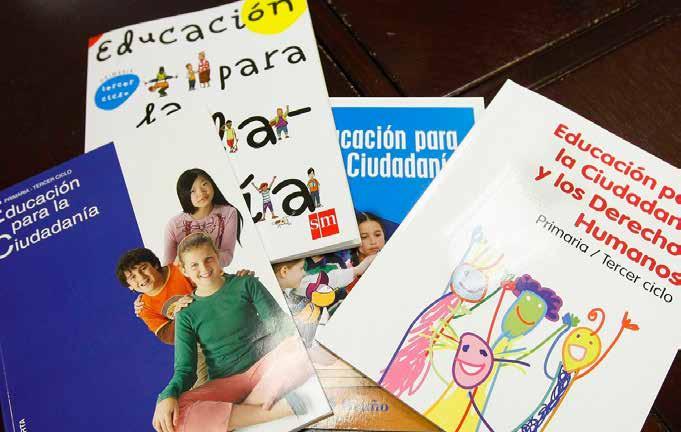
With this perspective, CHEGA presented Bill 345/ XVI/1ª, which was rejected. Its main proposals were that 1)the subject of Citizenship and Development should become optional, like Moral and Religious Education; and that 2) this subject should no longer be taken into account for the purposes of student progress.
These points, mainly related to freedom of choice, were illustrated and amplified by a case in the media of a family whose children were at risk of failing because they had decided not to send them to compulsory Citizenship and Development classes. In 2020, several figures linked to the centre-right party, including a former president of the republic and a former prime minister, called for the possibility of conscientious objection to this subject, citing the "defence of educational freedoms". It was this same ex-prime minister who had quashed a previous attempt to introduce a subject in schools that would provide students with comprehensive civic training, 2001’s 'Civic Training'.
Thus, the far-right's “battle” against the subject of Citizenship and Development is a continuation and exacerbation of the position already held by the center-right regarding whether or not certain topics should be discussed in schools. The center-right Prime Minister said at a conference in 2025 that he also wanted to “free
this subject from the shackles of ideological or radical projects.” This earned him a standing ovation from the center-right party attendees at the conference.
Although the far-right programme is based on more conservative values than those of other parties, its proposals on education are similar in certain areas. These include reducing the role of the state and strengthening families' freedom of choice. In Portugal, the far-right has amplified this 'battle' by mobilising 'gender ideology', but the agenda against the role of the state in education is shared by various right-wing parties. So, what is at stake today is the shared intention of right-wing parties (from the centre-right to the far-right) to reverse a path that has been taken to comply with the Constitution and the Basic Law on the Education System, in order to have "a school that trains citizens". This scenario is even more complex when one considers that, with the results of the May 2025 elections, the right now has a majority that allows it to change the Constitution.
Reformulating Citizenship and Development
In July 2025, the government announced the opening of a public consultation to review the Citizenship and Development subject, in relation to two documents it had prepared; the new proposal for the National Strategy
PHOTO: FERNANDO ALVARADO
for Citizenship Education and the respective Essential Learning (Direção Geral de Educação, 2025). The first document specifies the guidelines while the second details what needs to be worked on in each area.
The new strategy appears to be a simplified reformulation of the previous one, now proposing only eight dimensions and regrouping some of the previous ones: 1) human rights; 2) democracy and political institutions; 3) sustainable development; 4) financial education and entrepreneurship; 5) health; 6) road risk and safety; 7) pluralism and cultural diversity; and 8) media.
Changes were also introduced regarding when each topic should be covered in school
The topics of the first group: human rights; democracy and political institutions; sustainable development; financial education and entrepreneurship should be covered in every course at all levels and stages of education.
On the other hand, with regard to the topics of the second group: health; road risk and safety; pluralism and cultural diversity; and the media, for each cycle each school must choose at least one year of schooling for each of the topics.
This reduction and simplification, as well as the redefinition of when and how often content should be addressed, leads to considerable changes:
· "Gender equality", which was in the former 1st group, has disappeared
· "Health", which was in the former 1st group, has moved to the 2nd group and excludes sex education
· "Pluralism and cultural diversity", which was in the former 1st group, has been moved to the 2nd group;
· "World of work", which was in the former 3rd group, has been removed.
·"Financial education and entrepreneurship", which was in the former 2nd group, has been moved to the 1st group;
This brief summary of the changes made shows how this new strategy appears to be influenced by the agenda we describe above.
In response to public outcry over the omission of
sex education from the essential learning document (mandatory under Law 60/2009), the Minister of Education issued a statement saying that the document was only a summary and that this aspect could obviously be developed further in schools (PÚBLICO, 2025).
However, aside from the content, one of the most important changes brought about by this new strategy is that it establishes that the school and classroom plan must also be approved by families and that, once approved, they must be "informed of all activities carried out in the context of Citizenship Education projects". In addition, the document submitted for public consultation also states that "schools may establish partnerships with external organisations, provided that they do so in close collaboration with families, through their representative structures".
From conservatism to freedom of choice
The 2025 election results allow right-wing parties to revise the Constitution without the need for consensus with progressive and left-wing forces. The CHEGA party has proposed a change that includes replacing all references to “education” as a role of the state since the family should be the guarantor of “education”, while the state should be responsible for “teaching”.
But it also paves the way for the privatisation of education, seeking to ensure that the Constitution guarantees that private and cooperative education is "duly recognised and supported (...) as a form of exercising the freedom to learn and teach". Similarly, the Liberal Initiative party proposes complementarity between "a network of public, private and cooperative establishments with administrative and pedagogical autonomy, promoting effective freedom of choice for families".
By characterising the topics on which the National Strategy for Citizenship Education is based as left-wing “ideology,” the right has sought to discredit the education policy decisions of the previous government, the Constitution and also public schools as institutions. The CHEGA programme also proposes "valuing education at home and/or within the family, eliminating excessive
bureaucracy and attempts to limit parental freedom, provided that legal requirements are met". Thus, as the conservative agenda advances, so does the agenda of "freedom of choice in education".
Conclusions
The attacks on Citizenship and Development by the far-right party are somewhat consistent with the previous approach of the moderate right-wing parties. Howe-ver, their agenda has become increasingly dominant, particularly through the fight against so-called "gender ideology". As this article has shown, this discourse has already had concrete consequences at the level of edu-cation policy, through changes to the National Strategy for Citizenship Education. By asserting the right of families not to "expose" students to certain topics, the far-right, accompanied by the traditional right, is advancing an agenda that links conservatism and "freedom of choice" and taking steps toward the increasing privatisation of education. This means not only the submissionofthispublicgoodtothemarket,butalsothe fragmentation of education into the family sphere.
Bibliography
Díez-Gutiérrez, E.-J., & Jarquín-Ramírez, M.-R. (2025). Educational policies of the extreme right in Europe:TheformationofanUltra-RightInternationalin Education through a common agenda?. Education PolicyAnalysisArchives33.https://doi.org/10.14507/ epaa.33.8848
Direção Geral de Educação (2018). Estratégia Na-cional de Educação para a Cidadania (ENEC). URL. https://www.dge.mec.pt/sites/default/files/ Projetos_Cu-rriculares/Aprendizagens_Essenciais/ estrategia_cida-dania_original.pdf
Direção Geral de Educação (2025). Consulta pública: Estratégia Nacional de Educação para a Cidadania e Aprendizagens Essenciais de Cidadania e Desenvolvimento URL https://dge.mec.pt/ noticias/consulta-publica-estrategia-nacional-deeducacao-para-cidada-nia-e-aprendizagens-essenciais
Partido Chega (2025). Programa. URL. https:// partidochega.pt/index.php/programa_politico/
Partido Chega (2024). Proposta de alteração ao Orçamento de Estado Número 957C: Programa Nacional de Literacia Financeira para jovens a partir de 2025. URL. https://www.parlamento.pt/OrcamentoEstado/ Paginas/DetalheIniciativa.aspx?BID=71875
Partido Chega (2024). Projeto de lei nº345/XVI/1ª: Novo regime jurídico da lecionação e da organização da disciplina e área curricular de Cidadania e Desenvolvimento (CD) nos estabelecimentos dos ensinos básico e secundário. URL. https://www.parlamento. pt/ActividadeParlamentar/Paginas/DetalheIniciativa. aspx?BID=304286
Partido Chega (2022). Projeto de Revisão Constitucional n.º 1/XV/1ª. URL. https://partidochega.pt/ wp-content/uploads/2022/10/revisao.pdf
PÚBLICO (2020, 1 de Setembro). Cavaco, Passos Coelho e bispos pedem objecção de consciência em aulas de Educação para a Cidadania. https://www. publico.pt/2020/09/01/politica/noticia/cavaco-passos-coelho-bispos-pedem-objeccao-consciencia-aulas-educacao-cidadania-1929917
PÚBLICO (2012, 24 de Dezembro). Conselho da Corrupção contra fim da disciplina de Formação Cívica nas escolas. https://www.publico.pt/2012/01/24/ jornal/conselho-da-corrupcao-contra-fim-da-disciplina-de-formacao-civica-nas-escolas-23845420
Diário de Noticias (2022, 06 de Dezembro). Caso Cidadania". Tribunal de Menores de Famalicão decide destino dos alunos. URL. https://www.dn.pt/arquivo/ diario-de-noticias/caso-cidadania-tribunal-de-menores-de-famalicao-decide-destino-dos-alunos-15439280. html
PÚBLICO (2025, 23 de Julho). “Seria um retrocesso enorme se a educação para a sexualidade saísse das escolas”, diz ministro da Educação. URL. https:// www.publico.pt/2025/07/23/sociedade/noticia/retrocesso-enorme-educacao-sexualidade-saisse-escolas-ministro-educacao-2141472
The New Right's Framework in Utah's Higher Education System
Brianne Kramer1 Sean P. Crossland2
The New Right’s assault on higher education is evidenced in legislation and other legislative actions over the past few years. The Utah legislature began testing the waters in 2023 to see how far their anti-woke agenda could make it during the legislative session. Late in the 2023 legislative session, SB 283 was introduced with the original title of ‘Prohibiting Equity, Diversity, and Inclusion in Higher Education’. The bill was met with public resistance from the Commissioner of Higher Education and the President of the University of Utah. The bill would soon be pulled, even after being renamed to ‘Study of Equity, Diversity, and Inclusion in Higher Education’. The sponsor was quoted saying “I think it’s way too harsh to just cut off those departments” (Tanner, 2023c, para. 18) despite supporting the 2024 bill doing
1.Southern Utah University. 2.Utah Valley University.
exactly that. The study of DEI efforts was led by the Utah System of Higher Education, though questions remain of if and how the data was used to inform future legislation. While that failed, they quickly regrouped over the next two years to craft a way to silence university officials and then moved to pass some of the most harmful legislation in higher education. The 2024 anti-DEI bill changed the campus climate and safety networks for many students, faculty, and staff. Meanwhile, the 2025 legislative session focused on a new way to eliminate programs, faculty, and staff under the guise of how to “make a good system better” (Neitzel, 2025). Utah legislators also passed policies expanding the powers of university presidents while narrowing the power of shared governance structures like faculty senates and created a neutrality policy universities were expected to follow. The Utah legislature is carefully crafting a framework that seems less aggressive than other states
like Florida and Texas; however, the strategy of the New Right may soon be implemented in many other states who have not yet passed similar legislation.
Institutional Neutrality
In the months leading up to the 2024 Utah State Legislative Session, it was clear higher education would be a major focus; in fact, the speaker of the house cited it as the top priority of the legislative session (Tomco, 2025). The speaker alluded to a 10% cut for the entire higher education budget to be distributed evenly among all colleges was under consideration (Gerhke & Tanner, 2024), citing concerns about ‘return on investment’, increasing cost-per-student administrative costs, efficiency, and the need for the state to work together as a system (Swenson, 2024). Of note and discussed later, the legislation focuses entirely on instructional funding rather than administrative.
One month before the start of the legislative session, The Utah System of Higher Education passes the Institutional Neutrality and Free Speech resolution, outlining expectations that institutions remain neutral on public issues, and establish programs teaching news students about free speech and ‘the marketplace of ideas’ (Winslow, 2023). This almost certainly limited campus leader’s advocacy around the many bills targeting higher education.
Utah’s Anti-DEI Law
After laws passed in Florida, North Carolina, North Dakota, Tennessee, and Texas in 2023 banning DEI offices, funding for DEI efforts, the use of diversity statements, mandatory DEI training, and identity-based preferences in hiring, Utah became the first state in 2024 to pass a similar law focused on stripping DEI from the state’s public institutions. HB 261— “Equal Opportunity Initiatives forced the closure of LGBTQ, cultural, and women’s centers at every college and university. Some centers reorganized to adhere to the Utah Board of Higher Education (UBHE) policy R-131 to focus on “education, celebration, engagement, and
awareness,” ultimately providing the programs were for all students to learn and did not advocate for “differential treatment” based on students’ personal identity characteristics (USHE, 2024). However, the majority closed because they did not receive approval to stay open or the universities’ legal counsels’ interpretations of HB 261 required adherence to the law. When the bill went into effect on July 1, 2024, the effect on students was immediate. Student organizations who previously were designated University-Sponsored Organizations (USO) had to operate as Independent Student Organizations (ISO), losing the supports specifically designated to USOs such as funding, campus advisors, ease of reserving facilities, and utilizing university branding/ trademarks in advertising their events.
Utah’s Governor ran a national campaign “Disagree Better” highlighting that politics did not need to be so divisive. He featured commercials with his political appointments, and the Democratic Governor of neighboring Colorado. In a discussion about upcoming legislation focused on DEI initiatives, they stated that diversity statements as a condition of employment were “bordering on evil, where we’re forcing people into a political framework before they can even apply for a job from the state” (Spencer Cox as quoted in McKeller, 2024). This toxic rhetoric equating hard-fought civil rights and institutional responsibility to historically underrepresented students was a clear demonstration that many of those in Utah’s legislature only cared about furthering the white hetero-normative Christian agenda the Far Right clings to.
The effects of this law have been deeply felt by students, faculty, and staff. Many student organizations struggled to continue existing within the confines of USO designations, so some student groups began abandoning the campus space for spaces off campus where they could continue to operate their organizations in ways that would continue to benefit members. By fall 2024, the Black Student Union and the Pacific Islander Student Association had withdrawn from the University of Utah’s sponsorship because they were li-
mited in what they could discuss, like race and identity, and were subjected to university review of their club’s social media spaces to ensure they complied with HB 261 (Tanner, 2024). Despite identity-based student organizations being required to adhere to the stringent standards of the bill, other student organizations that have been antagonistic towards BIPOC and LGBTQ students have been allowed to remain as campus-based student organizations (Tanner, 2024). The University of Utah student group Young Americans for Freedom held a screening of an anti-transgender documentary on November 1, 2023 that was interrupted by a group of student activists with Movement Estudiantil Chicanx de Aztlán (MECHA), a group led by students of color and LGBTQ students (Tanner, 2023a). In the wake of this demonstration, the University pressed criminal charges for disrupting the operation of a school, interference with a police officer, and disorderly conduct (Tanner, 2023a). On the same day as MECHA’s march in solidarity with the Palestinians, the University of Utah pulled their sponsorship of the group (Tanner, 2023b). In protest of this, MECHA took over the Center for Student Equity and Belonging and held a six-hour sit in.
Students at other state institutions held their own demonstrations in protest of HB 261. At Utah State University, students held two silent marches and wrote letters to the Utah Board of Higher Education regarding the bill’s impact on students (Brewster, 2024). Salt Lake Community College students protested the cancellation of Lavender Graduation by creating “We Write Our Own Stories,” a graduation event that brought together all the identity-based student clubs and organizations to celebrate their history and heritage (Ashton, 2025). Weber State University and Southern Utah University students organized a funeral procession for the closed cultural and LGBTQ centers on their respective campuses in fall 2024 (Aston, 2024). At Utah Valley University, students benefited longer from a consolidation of the Women’s Success Center, LGBTQ+ Student Success Center, and Multicultural Student Services, which was transformed into the Center for Intercultural En-
gagement (CIE) after HB 261 was passed (Seegmiller, 2025). However, the CIE was ordered to be dissolved as part of compliance to HB 265, which was passed in 2025. After word of the CIE closure was sent to campus, members of the student group, Spectrum UVU, held a sit-in at the campus lounge (Seegmiller, 2025). Despite these student demonstrations, no changes to the bill have been made, and each institution has not publicly addressed students’ concerns.
Budgetary Attacks on Higher Education
Nationwide, higher education institutions are in a manufactured financial crisis. Utah has maintained college student enrollment growth over the past decade and has been projected to only see a slight ‘dip’ in student enrollment as the enrollment cliff hits the remainder of the country in the next decade (Brandley et al., 2024). However, these enviable statistics were not enough for legislators to wield their power over the state institutions by forcing cuts to programs, faculty, and staff. Prior to the 2025 legislative session, Speaker of the House, Mike Schultz began fixating on the costs of college degrees– despite Utah’s lower-than-average tuition rate– and administrative bloat he believed to exist in Utah’s higher education institutions (Gehrke & Tanner, 2024; Hanson, 2024). The 2024 cuts did not result in what the legislature wanted to see, so they moved to create a new way to force cuts at each institution.
In March 2025, the Higher Education Reinvestment Act (HB 265) was passed, resulting in a 10% cut to instructional line funding. These funds would be held by the state in a special account while each institution identified underperforming programs that should be eliminated or reduced, leading to majors, minors, emphases, and certificate programs cut and faculty and staff jobs eliminated or shifting into another position. As each institution compiled their plan, they were required to follow a set of metrics provided by the state, which push neoliberal and corporatized measures: enrollment trends, completion rates and timely graduation, discipline-related professional outcomes, current and
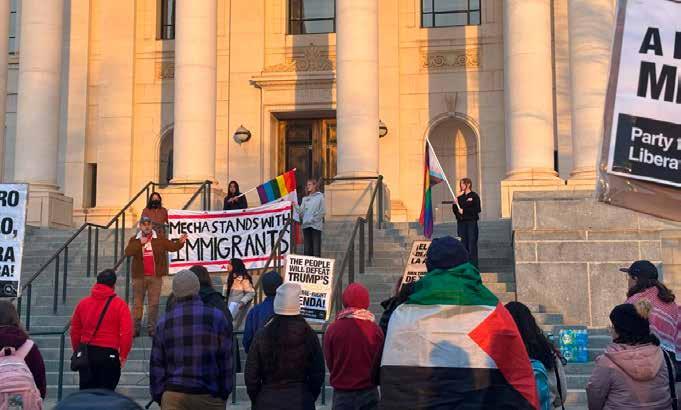
future workforce demands, program-level cost, and the university’s mission and role within the system (Neitzel, 2025). In addition to the cuts, the institutions were required to identify where the funds the state were holding (10%) could be reinvested. The plans that detailed the cuts and reinvestments were first sent to the Utah Board of Higher Education (UBHE) for approval by early June. In the board meeting, the plans were presented and given approval or suggested revisions (Committee of the Whole, 2025). Next, the plans will be submitted to the Higher Education Appropriations Committee in August for approval, then moved to the Executive Appropriations Committee in September for final approval. There is no guarantee that the institutions will receive their full 10% of funds after this date, as that was not part of the bill. The Utah legislature has the full power to keep these funds, despite institutions following through on their requirements, which included cutting programs and laying off faculty and staff at each campus in the state. The initial cuts presented to UBHE showed
an overwhelming amount of cuts to programs, faculty, and staff in the humanities, arts, and social sciences, which upholds the trend of the New Right’s attacks on diversity, equity, and critical thinking.
Conclusion
In the wake of this legislation, students, faculty, and staff have all been deeply affected. Each campus has been altered in ways that many academics would never have imagined. Despite the appalling changes these most recent laws have made, there is some potential for change. The AFT Utah College Council Chapter (UCC) inundated the legislature with meetings, testimony, and other communications during the 2025 legislative session. Many people in higher education believed that HB 265 would be pushed through the legislature as fast as HB 261 was in 2024, but the final votes for HB 265 did not come until the final days of the 45-day long session. Union members were quick to organize members to testify or communicate constantly
PHOTO: EMERSON HAGY/UTAH DAILY

with legislative staffers and the legislators in order to submit amendments to the bill. An amendment to retain a general education curriculum focused on key skills such as critical thinking was put into the 1st Substitute bill by the sponsor after several organizations, including UCC testified. UCC also crafted an amendment to include faculty, staff, and students in the campus decision-making process, which the bill’s sponsors refused to consider. Senator Karen Kwan graciously took the amendment to the Senate floor, where it was defeated in a party-line vote. The union is now working with several legislators to partner on issues in higher education and ensure faculty, staff, and student perspectives are properly represented.
It is imperative as we move forward towards the 2026 legislative session that union organizing and movement-building coalesces around the attacks on academic freedom, austerity measures, and issues of equity. As our unions grow, power builds, and members can better put into practice many of the measures used
during the past session. The current uncertainties in higher education will continue both nationwide and in individual states as the New Right finds new areas in which to overreach, so unions and adjacent organizations must work together now in order to protect academia.
References
Ashton, P. (2025, April 28). SLCC clubs unite, create new ceremony to celebrate student graduates. The Globe: Student Voices and Views for the SLCC Community. https://www.globeslcc.com/2025/04/28/we-write-our-own-stories-graduation-celebration/ Aston, R. (2024, December 5). Weber State University students hold ‘funeral procession’ for shuttered cultural centers. Standard-Examiner. https://www. standard.net/news/2024/dec/05/weber-state-university-students-hold-funeral-procession-for-shuttered-cultural-centers/
Brandley, A.T., Prior, H., & Dean, P. (2024). Navigating Utah’s “demographic dip”: Strategically positioning
Utah higher education amid college-age population declines. Kem C. Gardner Policy Institute— University of Utah. https://d36oiwf74r1rap.cloudfront.net/wp-content/uploads/2024/10/Navigating-HigherEd-Oct2024. pdf
Brewster, J. (2024, September 19). Silent march in response to HB0261. The Utah Statesman. https://usustatesman.com/silent-march-in-response-to-hb0261/#:~:-
text=Zach%20Johnson%2C%20a%20student%20 who,on%20campus%2C%E2%80%9D%20Johnson%20 said.
Gehrke, R. & Tanner, C. (2024, October 15). “Maybe it’s more, maybe it’s less”: House speaker calls for 10% for Utah colleges. The Salt Lake Tribune. https://www. sltrib.com/news/politics/2024/10/15/utah-lawmakersdiscuss-10-higher/
Hanson, M. (2024, June 28). Average in-state vs. out-of-state tuition. Education Data Initiative. https:// educationdata.org/average-in-state-vs-out-of-statetuition
McKellar, K. (2024, January 31). Utah governor signs anti-DEI bill into law • Utah News Dispatch. Utah News Dispatch. https://utahnewsdispatch.com/2024/01/30/ utah-governor-signs-anti-dei-bill-into-law/ Neitzel, M.T. (2025, February 3). Utah higher education reinvestment bill may become a mode for others. Forbes. https://www.forbes.com/sites/michaeltnietzel/2025/02/03/utah-higher- education-reallocation-bill-may-become-a-model-for-others/ Swenson, J. (2024, November 14). Utah lawmakers are looking to make cuts to the state’s higher education budget in 2025. Deseret News. https://www.deseret. com/utah/2024/11/13/utah-higher-education-legislature-colleges-universities-budget-cuts-degrees/ Tanner, C. (2025, March 5). Everything we know about Utah’s massive higher education cut and ”reinvestment” bill, which passed its final hurdle. The Salt Lake Tribune. https://www.sltrib.com/news/education/2025/03/05/everything-we-know-about-utahs-big/ Tanner, C. (2024, November 12). Two student clubs cut ties with University of Utah over new anti-DEI
restrictions. The Salt Lake Tribune. https://www.sltrib. com/news/education/2024/11/12/student-clubs-bsupisa-cut-ties/
Tanner, C. (2023a, December 4). University of Utah students now criminally charged after disrupting conservative club’s event. The Salt Lake Tribune. https:// www.sltrib.com/news/education/2023/12/04/university-utah-students-now/
Tanner C. (2023b, November 17). The University of Utah withdrew its sponsorship of a student group. The club took over a school office in protest. The Salt Lake Tribune. https://www.sltrib.com/news/education/2023/11/17/university-utah-withdrew-its/ Tanner, C. (2023c, February 27). Republican lawmaker pulls his ‘too harsh’ bill to eliminate diversity offices at Utah universities. The Salt Lake Tribune. https://www.sltrib.com/news/education/2023/02/27/ republican-lawmaker-pulls-his-too/
Tomco, B. (2025, January 15). Inside Utah lawmakers’ plan to reform higher education in 2025. Deseret News. https://www.deseret.com/politics/2025/01/14/ utah-house-speaker-mike-schultz-plans-to-consolidate-university-programs/
Utah Board of Higher Education. (2025, June 6). Committee of the Whole. [Video Live Stream]. Utah System of Higher Education. https://video.ibm.com/ recorded/134392082
Utah System of Higher Education. (2024, June 6). R131, Review and approval of centers for compliance with Equal Opportunity Initiatives. Utah System of Higher Education Policy. https://public.powerdms.com/ Uta7295/documents2852197#:~:text=R131%2D1%20 Purpose%3A%20This%20policy,opportunity%20initiatives%20under%20Utah%20law.
Winslow, B. (2023, December 1). Utah colleges, universities to implement resolution on campus “free expression.” FOX 13 News Utah (KSTU). https://www. fox13now.com/news/local-news/utah-colleges-universities-to-implement-resolution-on-campus-free-expression
Privatisation of education under the neoliberalneoconservative alliance: proposals from the new right in Brazil
The issue of privatisation in education can be analysed from various perspectives that examine the encroachment of the private sector on public education. For this article, from a critical perspective, the relationship between the public and private sectors is considered as the correlation of forces between different societal projects and influenced by class interests (Peroni, 2016).
Thus, the construction of the public sphere is linked to strengthening a collectively constructed project inspired
1.Doctor of Education from the Federal University of Rio Grande do Sul (UFRGS). Researcher in the Research Group on Public-Private Relations in Education (GPRPPE). Primary school teacher in the Municipal Education Network of Porto Alegre, Rio Grande do Sul, Brazil.
by democratic perspectives of social justice, while the private sphere, in its commercial or reactionary forms, is related to an authoritarian project oriented towards profit and linked to capital (Peroni; Lima, 2023).
This article analyses the privatisation of education as proposed by the new Brazilian right wing. This is being implemented through various initiatives as an expression of its plan for education which is deeply linked to the broader societal project of capital. The so-called new right wing is an ideological conglomerate (Carapanã, 2018), organised around neoliberal and neoconservative ideals, with elements of libertarianism and religious fundamentalism. They share the perception of a common enemy to be fought which leads them to suspend their differences in the construction of a
Paula Valim de Lima1
Translated by Natalie Illanes
societal project aligned with the fundamental values of their respective ideological perspectives (Lima, 2020). It found its main expression in Brazil during Jair Bolsonaro's government between 2019 and 2022, which brought together a broad group of neoliberal and neoconservative individuals.
Understanding schools as a privileged space for social formation, the new right's societal project involves the formulation of a kind of education that converges with its principles and assumptions. On the one hand, the neoliberal agenda conceives of education economically from the perspective of the market, oriented towards obtaining results, centred on ideals of individualism, competition and merit and linked to business agendas. On the other hand, the neoconservative agenda, with particular influence from the Christian right, considers public schools to be a dangerous arena that work daily to destroy traditional moral values. Its actions, therefore, respond to a need to restore social order and tradition.
For these two major ideological strands that make up the new right, the expansion of privatised education is presented as a central agenda for the advancement of their project. On the one hand, through the definition of educational content by the private sector and, on the other, through the transfer of responsibility for education from the public to the private sphere.
Neoliberals and neoconservatives have joined forces to propose removing education from the hands of the state, or at least significantly reducing its involvement, based on the understanding that “public institutions, if they are democratic, are permeable to the correlation of forces, with decision-making processes in which the outcome is not predetermined” (Peroni, 2016, p. 71). Thus, they propose, on the one hand, decentralization and a reduction in the state's decision-making power over curricula, institutional management, teacher training, etc. and, on the other hand, that education be de-statized, passing into the hands of private entities, whether market-based or family-based.
The privatisation of education, combined with the notion of a culture war, - in the sense of the dispute over
values and ideals that permeate schools and society, aimed at restoring class power (Harvey, 2014) - has shaped the main proposals for education in Brazil in recent years. The Escola Sem Partido (Non-Partisan School) programme, homeschooling and the militarisation of schools are topics that will be addressed in the following sections to demonstrate how these proposals seek to respond to both neoliberal and neoconservative societal demands.
Escola Sem Partido
The Escola Sem Partido programme is unique in that it is both a collective entity (movement) and a political proposal (programme). As a movement, it originated in 2004 with the aim of combating what it describes as the abuse of freedom of education and defending the right of parents to decide on their children's education in relation to political, cultural, social and moral issues. The movement has played a significant role in public debates on education since 2010, also becoming a programmatic proposal through bills aimed at implementing the Escola Sem Partido programme in education systems.
As a proposal, Escola Sem Partido aims to combat alleged political and ideological indoctrination promoted in schools, according to its advocates, by left-wing teachers. Under the influence of the fundamentalist Christian right, the notion of political-ideological indoctrination is linked to the perspective of so-called gender ideology. Although the two have different origins, they have become two sides of the same coin. Analysis of the discourse and proposals related to the Escola Sem Partido allows us to affirm that the ideology they believe needs to be combated is one based on ideals of social transformation and the struggle against all forms of oppression and inequality—of class, gender, race, etc.—inspired by values of democracy, justice, and solidarity (Lima, 2020). All of this is based on the understanding that a cultural war is underway and that so-called cultural Marxists (or communists) are winning the battle for hegemony, which requires a response from
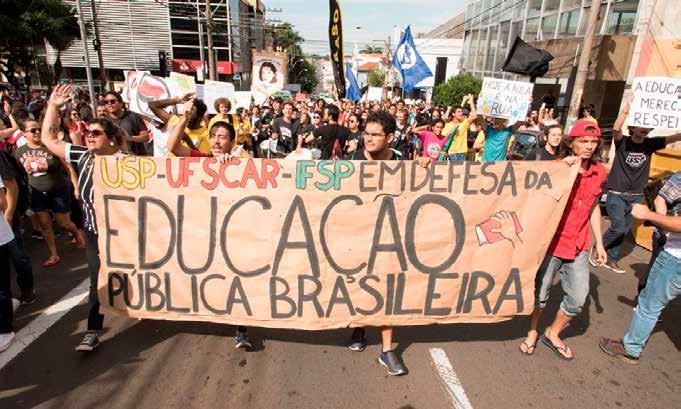
right-wing sectors in the form of censorship and the prohibition of teaching.
The rhetoric of a culture war promotes the notion that there is a common enemy that must be fought by the various sectors that make up the new neoliberal-neoconservative right. This agenda is pursued by both groups with equal vigour, although there are differences in their arguments and, above all, in the alternatives they propose as a means of restoring their class power.
By embracing the neoliberal tradition, market advocates seek to instil values and principles in education that are consistent with their assumptions. They hope that the education of new individuals will lead them to incorporate values such as entrepreneurship, meritocracy, competition and individual responsibility from an early age, leaving aside ideals of collectivity and social solidarity (Harvey, 2014), so that they become productive individuals who contribute to the reproduction of the capitalist system. For its part, the neoconservative
tradition seeks to promote moral and behavioural values, mainly linked to the ideal of the traditional family, historically constructed gender roles and sexual morality, so that individuals do not question what is valued by Western society based in Christian values. In any case, the immediate effect of the right wing's actions in the culture wars is to hinder the construction of democratic values in schools, transferring to individuals outside the school the responsibility of defining the ways of thinking, worldviews, ideas and values that should be present in schools and, above all, those that should be prohibited (Lima, 2017). In this sense, an educational project is being developed whose central axis is control of curricula, teaching work, content and the bodies and minds of school subjects.
Homeschooling
Homeschooling is an educational model in which children are excused from attending school and families assume responsibility for the educational process. This
PHOTO: LUCA LACAZ/LATIN AMERICAN LEAGUE OF IRREDENTOS
practice is not regulated or authorised by Brazilian law, although there are bills of this nature pending in various legislative bodies, both at the regional and federal levels. This was one of the main agenda items of the Bolsonaro government, integrating into the national political debate guidelines for valuing and preserving the family, issues taken up mainly by the Ministry of Women, Family and Human Rights.
The debate on homeschooling, as presented by the new right, rarely addresses the right to education of children and young people. The main argument surrounding the proposal is the right of parents to decide on their children's education, which unites neoliberals and neoconservatives in the defence of individual freedom and in opposition to any kind of state intervention. Thus, in the name of family freedom, the universality of school education and its compulsory nature are called into question.
The National Association for Home Education (Aned), the main private entity defending homeschooling in Brazil, argues that families should be able to "teach their children a specific set of values, beliefs and worldview that is cherished by the family and different from what is taught in schools" (Aned, 2024). It is no coincidence that homeschooling practices occur mainly among conservative and religious groups who reject evolutionary conceptions of life and wish to prevent their children from coming into contact with content that could challenge their traditions and ways of life, such as traditional gender roles (Vasconcelos, 2017). In this sense, private and individualised educational spaces are proposed which disregard social coexistence and diversity.
This educational format is presented as an agenda opposed to a basic public school education that is free, compulsory, egalitarian, inclusive and secular. In this sense, homeschooling becomes yet another form of privatisation of education, seeing the family as a private entity that stands in opposition to the public sphere. While the Escola Sem Partido movement seeks to eliminate certain content from schools, homeschooling is
a strategy to remove students from schools altogether. At the same time, it contributes to the commodification of education, which is treated as a product to be bought and sold, especially in terms of teaching materials, methods and manuals. The regulation of homeschooling creates a niche market, and the neoconservative defence of the family's right to educate their children obscures the emergence of a growing market for homeschooling products (Araujo; Leite, 2020).
Militarisation of schools
One proposal that is presented separately from the relationship between school, market and family, but on which there has been consensus among the new right, is the militarisation of schools, a practice that was occurring over the last decade in different regions of the country as isolated experiences and which became education policy in 2019 with the National Programme of Civic-Military Schools.
Unlike military schools, which are linked to the Brazilian Army, civic-military schools are regular, state-run public schools that have access to military resources, including human and financial resources, through partnerships between the Education Department and the Security Department. They are public schools with universal access that incorporate military routines, rules, and values. These schools have support and supervisory positions held by military police and members of the fire brigade, who are responsible for guaranteeing discipline and control among students, determining clothing, behaviour, and attitudes. The civic-military model emphasises social, ethical and moral values, and its principles include respect for teachers, discipline in the classroom and greater support for students. It is presented as a solution to educational problems, both in terms of results and the teaching-learning environment and material infrastructure.
The proposal to militarize schools is a third way between defending the family and the market, satisfying both neoliberal and neoconservative interests, once again focused on control. On the one hand, control
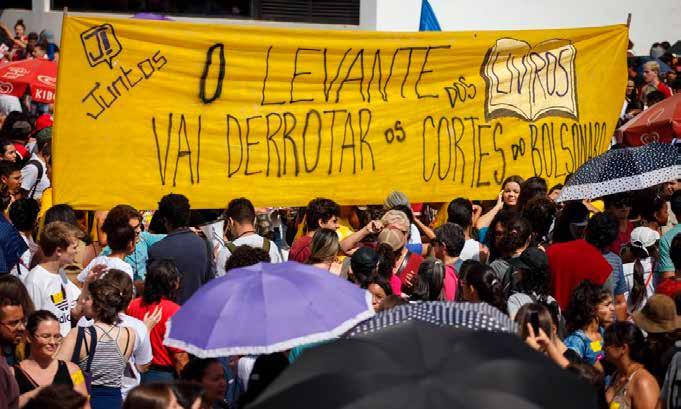
of the educational process, teaching work and school space in the name of improving results. On the other hand, control of discipline to combat deviations and departure from traditional values (Martins, 2019, p. 692). Furthermore, the police state, guided by neoconservative punitive idealism (Lacerda, 2019), takes on the task of ensuring behaviour compatible with the values of order.
Although military bodies are public institutions, the military sector assumes control not only of educational content and processes, but also of the educational institution as a whole, thus excluding the possibility of a collective and democratic space and emptying education of its public meaning. For this reason, it can be considered a project to privatise public education. The proposal incorporates neoconservative assumptions insofar as it is presented as a powerful alternative for the recovery of tradition, morality, and authority (Santos, 2020).
The militarisation of schools is developing in the
same direction as the other proposals discussed here, emptying schools of the social function of developing democratic values and collectivity by proposing a rigorous form of control over school management, teaching work and human socialization through the imposition of values such as discipline, hierarchy, merit and obedience.
Conclusions
Our analysis of the educational proposals of the new Brazilian right wing show a clear organic link between neoliberal and neoconservative ideals which is reflected in the agenda to privatise education. Although their arguments differ, these projects are aimed at undermining the notion of the public sphere as democratic and collective and contribute to restoring the power of the ruling class (Harvey, 2014).
Both perspectives operate with a goal of limiting democracy which, according to the authors, is achieved through a process of de-democratization, consisting
PHOTO: DANIEL MARENCO/LATIN AMERICAN LEAGUE OF IRREDENTISTS
of the hollowing out of democracy without an abrupt formal rupture (Laval; Dardot, 2017). This is an updated version of the anti-democratic model, presenting new strategies with respect to what occurred during the dictatorships in Latin America during the second half of the 20th century: "it is within the formal framework of the representative political system that anti-democratic devices of a frighteningly corrosive effectiveness are established" (Dardot; Laval, 2019).
In this sense, neoliberal proposals to eliminate rights and promote individualism and social disintegration are linked to neoconservative ideology which responds in a more authoritarian manner to collective interventions and the demands of social movements for rights, equality and social justice, fulfilling the role of collective disciplinarian (Lacerda, 2019).
The alliance that represents the new Brazilian right wing, as is the case internationally, redefines the role of the state, transferring responsibilities that should correspond to public authorities to individuals and proposing private solutions to collective problems. All of this highlights the link between an analysis of the public-private relationship and the hollowing out of democratic educational institutions proposed by the new right, imposing limits on the formation of individuals committed to democracy and social justice and jeopardising the building of a more democratic country.
References
Aned. (2024). Guia Aned: Iniciando a educação domiciliar. Aned.
Araujo, S. S.; Leite, M. C. L. (2020). A defesa pela “liberdade de escolha” fortalecendo uma rede empresarial: o homeschooling brasileiro. Práxis Educativa, v. 15. DOI: https://doi.org/10.5212/PraxEduc.v.15.14819.039. Carapanã. (2018). A nova direita e a normalização do nazismo e do fascismo. In Gallego, E. S. (org). O ódio como política: a reinvenção da direita no Brasil. São Paulo: Boitempo, p. 33-39.
Dardot, P.; Laval, C. (2019). A “nova” fase do neo-
liberalismo. Outras Palavras, 29 jul. 2019. Disponível em: https://outraspalavras.net/outrasmidias/dardote-laval-a-nova-fase-do-neolib eralismo/. Acesso em: 29 ago. 2024.
Harvey, D. (2014). O Neoliberalismo: história e implicações. Loyola.
Lacerda, M. B. (2019). O novo conservadorismo brasileiro: de Reagan a Bolsonaro. Zouk.
Laval, C.; Dardot, P. (2017). La pesadilla que no acaba nunca. Gedisa.
Lima, P. V. (2017). Escola sem sentido: Implicações da Escola sem Partido para a democratização da educação pública. Monografia (Graduação em Pedagogia): Universidade Federal do Rio Grande do Sul.
Lima, P. V. (2020). O projeto educativo da nova direita brasileira: sujeitos, pautas e propostas. Dissertação (Mestrado em Educação): Universidade Federal do Rio Grande do Sul.
Martins, A. A. (2019). Sobre os dias atuais: neoconservadorismo, escolas cívico-militares e o simulacro da gestão democrática. RBPAE, v. 35, n. 3, p. 689-699. DOI: https://doi.org/10.21573/vol35n32019.94577.
Peroni, V. M. V. (2016). Implicações da Relação Público-privada para a Democratização da Educação. Tese (Professor titular): Universidade Federal do Rio Grande do Sul.
Peroni, V. M. V.; Lima, P. V. (2023). A educação básica no contexto de avanço neoliberal, neoconservador e neofascista: a conjuntura atual e os desafios para a democratização da educação. Educere et Educare, v.18, n. 47, p. 34–52. DOI: https://doi.org/10.48075/ educare.v18i47.30213.
Santos, G. S. (2020). O avanço das políticas conservadoras e o processo de militarização da educação. Práxis Educativa, v. 15. DOI: https://doi.org/10.5212/ PraxEduc.v.15.15348.066.
Vasconcelos, M. C. (2017). Educação na casa: perspectivas de desescolarização ou liberdade de escolha? Pro-Posições, v. 28, n. 2. DOI: https://doi. org/10.1590/1980-6248-2015-0172.
The right-wing offensive in Ecuadorian education
Ángela
Zambrano C.1
Translated by Carl Rosenberg
Throughout the republican history of education in Ecuador, the educational models applied have been impregnated with a discourse of continuous change in educational processes and teaching-learning. This view has been expressed in different ways, such as rights conquered by popular sectors, including free education, compulsory education, the conception of education as a right, attention to rural education, implementation of literacy programs for adults, the appearance of bilingual education and the creation of legal frameworks.
In 1990, with the establishment of neoliberal policies, the national state was weakened with a significant reduction of investment in the social realm and especially in education. The country followed the prescriptions of multilateral organizations, especially the IMF and World Bank who imposed their educational proposals through foreign debt. This model has been assumed by
1.Professor at the Universidad Central del Ecuador.
successive governments for decades, without governments ever overcoming the hurdles that affect access to and quality of public education.
In the 1998 Constitution of Ecuador, education was recognized as a fundamental right, a duty of the state and a priority area for public investment. It was established that the state must guarantee access to education, promoting social equity and national development. In the context of this constitution, education once again acquired national interest, with important commitments such as the approval of eight policies in the 2006-2015 Ten Year Plan of Education which was developed with important citizen participation, similar to the national consultations for Educación Siglo XXI2. Nevertheless, all this was only partially fulfilled in practice.
In Ecuador's 2008 constitution, education was understood as a duty of the state, and free education was guaranteed until the third level of secondary educa-
2.Twenty-First Century Education. (Translator’s note.)
tion, being obligatory until the bachillerato3 level. 2010 brought the Organic Law of Intercultural Education (LOEI), which was criticized for its weakness and for taking control and management away from Indigenous peoples and nations.
In spite of the important guarantees of rights in the constitution, a series of neoliberal policies continued, utilizing punitive and homogenizing assessments. In 2012, educational standards were established, the National Institute of Evaluation (INEVAL) was created and the regulation of the LOEI formulated, initiating the Units of the Millenium project which compared quality with infrastructure and resulted in the closure of community schools. In 2013 the To Be a Bachiller4 program appeared, as well as the National Exam for Higher Education (ENES). 2016 was marked by the adoption of a new curriculum oriented towards competition and meritocracy. In 2017 the tests for To Be a Bachiller and ENES were combined. The current educational model, which has as its point of departure a constructivist focus, has not achieved significant learning or community interaction.5
Since August 2024 additions to the curriculum have come into effect, conceived as new skills or reinforcements integrated into the current curriculum, according to the Ministry of Education (s/f 6) in order to strengthen it, with subjects and spheres of local and global interest to thereby achieve a full training of students.
Through this brief summary, it becomes evident that education in this country has had important declarations, but the lived transitions, especially in the last three decades, have not been evaluated in a comprehensive manner, and decisions have been made without consultations with the main actors in education.
3. The bachillerato in Ecuador refers to the last three years of secondary school. (Translator’s note.).
4.A bachiller is a student who has passed the bachillerato program. (Translator’s note.)
5.This timeline is based on a summary carried out by Enrique Salvatierra, 2021 in https://es.scribd.com/document/523947345/ LINEA-DE-TIEMPO-DE-LA-EDUCACION-EN-EL-ECUADOR (Author’s note.)
6. sin fecha—undated, meaning that there is no date for this information. (Translator’s note.)
Curriculum reform over the last three decades.
Over the last three decades, the Ministry of Education (2016, pp. 5-6), has promoted “reform” of the Basic General Education (EGB) curriculum of 1996 which provided general curricular guidelines but did not present a clear connection between the minimum obligatory contents and the skills which must be developed. It also lacked criteria and assessment indicators.
This weakness led to a process of Curricular Modernization and Strengthening of Basic General Education, taking effect between 2009 and 2012, but this instrument was characterized as a microcurriculum for skills, structured in curricular blocks conceived as direct units of learning for the classroom.
In 2011 the General Unified Bachillerato (BGU) came into effect, weakening efforts to bring students a general training in accordance with their age, this proposal being joined together with the current curriculum of the EGB.
In 2016 a curricular adjustment was proposed for the EGB and BGU, which took as its point of departure the previous curricular designs and the experience of teachers in implementation, with a more open and flexible proposal. It also involved the revision of the graduation profile (a list of aptitudes and related characteristics) of the Ecuadorian bachiller, without involving changes for completion along neoliberal lines.
In 2024 the Ministry proposed “curricular additions,” set forth as a joining of new aptitudes or skills or reinforcement integrated into the current curriculum to strengthen it. This initiative has also received criticism because it was not accompanied by teacher training. Its application during that year was superficial, without full assessment of its relevance and lacking the resources to apply it. Under those conditions, teachers must make a greater effort to update their knowledge and integrate more content, in spite of Ministry statements to the contrary.
Thus, Ecuadorian education has experienced an openly neoliberal period which has entailed the weake-
ning of public education and favoured the incremental growth of private education and its improved public image, beyond simply the results achieved in various forms of assessment which don’t necessarily show a perceptible increase in the quality of education.
Further evidence of this are the results of assessments carried out by the Ecuadorian state itself, which show that it did not manage an improvement in educational results. This is also indicated by the assessments of the projects promoted with foreign debt (Isch, 2008). Paladines (2017) emphasises that the APRENDO tests applied between 1996 to 2007 were founded on the classical theory of testing (TCT), while the SER-ECUADOR tests after 2008 corresponded to the item response theory (TRI), a change which also did not show a significant improvement in results (Isch and Zambrano, 2019).
Furthermore, these reforms to assessment have not gone beyond the curricular sphere. Far from proposing a contextualized educational model and a curricular proposal adapted to the needs and interests of a multiethnic and pluricultural character, which requires understanding and acknowledging the multiple global and local problems of the majority of the population, the reforms have been oriented toward satisfying the demand of big corporations and businesses that profit from education and the life of the people and that favor the social sectors that occupy economic and political power.
In short, this century and the ten years of a development-oriented government that, among other definitions, has utilized that of post-neoliberal, has seen more continuities than ruptures (Isch, 2018; Zambrano, 2018).
In the government headed by Lenín Moreno, the neoliberal policy in all spheres was once again fundamental to government action, so that neoliberalism in education regained strength, with results already known. (Isch and Zambrano, 2019.) Furthermore, Molina, et. al. (2025, P. 2799) point out that Noboa7 “not only reproduces the
dynamics of authoritarian neoliberalism, but deepens them by means of patrimonial and repressive practices,” an aspect which inevitably affects education, with the impositions of the IMF, among others, and the fusion of the Ministry of Education, Sports and Culture with the government authority responsible for higher education and the consequent budgetary cutbacks.
The current right-wing offensive in the Ecuadorian education system.
Given the characteristics of the national education system, it is clear that the public policies implemented by successive governments promote a gradual and sustained privatization of education (even at the cost of indebtedness of the families who find themselves able to achieve it) and,with this, the reduction of the role of the state in investment in public education.
Educational management finds itself subjected to the intrusion of neoliberal approaches, especially seen in the implementation of educational models which promote competence and efficiency from the logic of the market. These models break with a state of justice and social equity and attack the right to access to and continuity of a decent education.
The conditions of teaching work, especially of primary, basic and bachillerato levels of education, suffer the consequences of the constant precarization of teaching work.
Among the main challenges that confront Ecuadorian education are: work that is more and more bureaucratized and that limits quality time to plan and prepare classes in accordance with the individual and collective needs of students; lack of permanent training to keep up with the increasingly complex social and environmental problems that education is called on to resolve; and the absence of educational material adapted to a flexible and relevant curriculum.
7.A
In this privatized context, a technocratic educational model is also promoted which rejects and limits the socializing role of teachers committed to a school that promotes critical thinking. The incorporation of tech-
reference to the current president of Ecuador, Daniel Roy Gilchrist Noboa Azín. (Translator’s note.)
nology and digital tools in schools, in addition to the potential which they undoubtedly have, has revealed again the profound social gaps in our country, where access to personal and institutional electronic devices is limited, internet coverage does not exist or is deficient, and the possibility of relying on information laboratories and navigation programs is limited by cost.
Illustration 1.
History of educational institutions that have internet connection, by geographical area.
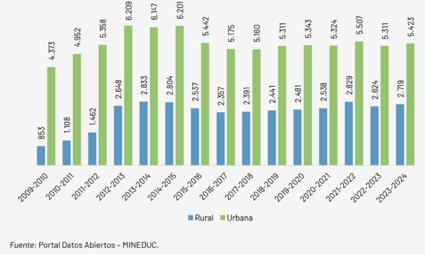
Note: If the pandemic of Covid-19 hastened the incorporation of digital technologies in Ecuadorian classrooms, it also maintained the digital gap in geographical space. (Ministry of Education, 2024, p. 31.)
Illustration 1 shows a history of educational institutions with internet connection (Ministry of Education, 2024, p. 31). Nevertheless, if one analyses the information presented for the period 2023-2024, it is clear that, in the urban área, of a total of 8,663 educational
institutions, 62.62% have internet connection; whereas, in the rural area, of a total of 7,477 educational institutions, only 36.36% can rely on internet connection, as shown in Table. 1
Table 1.
Institutions with internet connection, by geographic distribution, for the period of 2023-2024.
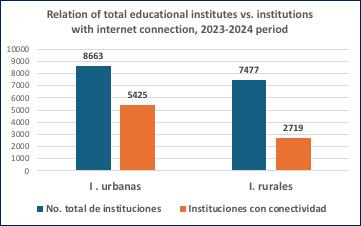
It is evident that many families, even those in urban zones, do not have enough resources at their disposal for their children to study under educational models which work more and more with digital technology, even assuming that these provide the necessary aptitudes for a globalized world.
Obviously, this scenario puts the students of the countryside, who must also travel significant distances from their homes to their schools, at a greater disadvantage. Many rural schools have only one teacher or are understaffed, lacking teaching materials and with curricular contents not reflecting the reality of their territories.
Other evidence of the current situation of national education is set forth by Quishpe et. al. (2024, p. 41) in a document presented by the National Union of
Educators in Río de Janeiro in 2024:
[The} product of lack of interest, lack of investment and unclear public educational policies on the part of Noboa, according to research carried out by UNICEF and the UNE, more than 200,000 children and adolescents have abandoned the classroom as a result of insecurity and violence in educational spaces. According to the Ministry of Education, between 2014 and 2023 there were 22,235 cases of sexual violence, and 23, 225 victims of sexual violence. This reality needs urgent and genuine answers, that is, a plan of reintegration and scholastic promotion.
In defense of public education, the position of Ecuadorian teachers must be one of continuous and sustained struggle against the offensive of the right and the impositions of organs such as the IMF.
Source: ELABORACIÓN PROPIA CON BASE A INFORMACIÓN DEL PORTAL DATOS ABIERTOS - MINEDUC.
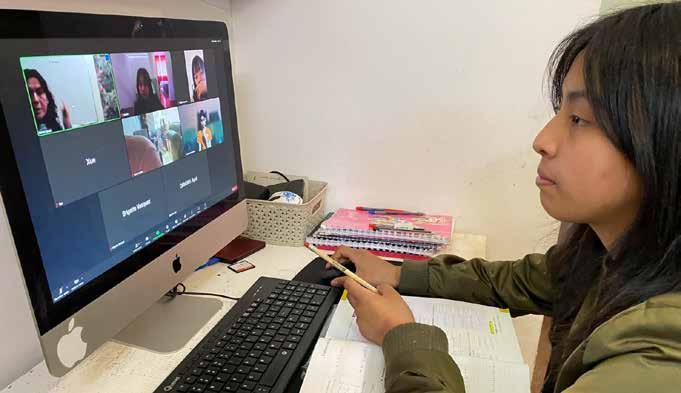
Conclusions
The offensive of the right in the sphere of education is increasingly aggressive, in a context in which the possibilities of confronting it are clearly weak; demobilized teachers’ unions; teachers submitted to bureaucratic and fruitless workloads; and violence in classrooms which have become unsafe spaces. Privatization is presented as an alternative of quality and of better opportunities for students. Technology, and virtual reality replace the teacher. Competition is the future. In the face of this, we are left with the enormous challenge of organizing and struggling for the defense of genuine public education for all.
References
Isch L. E. (2018). “Breves apuntes para una mirada crítica de la educación ecuatoriana entre 2007 y 2017”. En Aprendamos a Educar 2. Ediciones Opción, https://revistadigital.uce.edu.ec/index.php/anales/article/ view/2555
Isch L., E. y Zambrano C, A. (2019). El currículum en tiempos de neoliberalismo. La dominación internacional en la educación ecuatoriana. En: Anales de la Universidad Central del Ecuador Vol.1, No. 377 (2019), p. 211-230.
Ministerio de Educación. (s.f.). Currículo de los
niveles de educación obligatoria. https://educacion. gob.ec/wp-content/uploads/downloads/2016/03/Curriculo1.pdf
Ministerio de Educación. (s.f.). Inserciones curriculares. https://educacion.gob.ec/inserciones-curriculares/ Ministerio de Educación. (2024). Estadística Educativa. Vol. 5. https://educacion.gob.ec/wp-content/uploads/ downloads/2024/10/Estadistica-Educativa-Vol-5.pdf. pp. 102
Molina, J., Monkada, K., Torres, J. (2025). Neoliberalismo Autoritario y Patrimonialismo en el Gobierno de Daniel Noboa Azin. https://doi.org/10.61616/rvdc. v6i1.547
Ortiz, M., Fabara, E., Villagómez, M., & Hidalgo, L. (2017). La formación y el trabajo docente en el Ecuador. Quito-Ecuador: Editorial Abya-Yala. 1era. Edición. Universidad Politécnica Salesiana. pp.291.
Paladines, C. (2017). Calidad y evaluación de la educación: 1996-2018. https://academiahistoria.org. ec/index.php/boletinesANHE/article/view/164/325
Quishpe, A., Cantuña, E., Molina, S., Hurtado, C. (2024). Informe de la ofensiva neoliberal en el Ecuador. Zambrano, A. (2018). Las ideas neoliberales en el contexto educativo. https://www.nodal.am/2018/09/ aspectos-del-neoliberalismo-en-la-educacion-ecuatoriana-por-angela-zambrano-c/
PHOTO: EL MERCURIO NEWSPAPER.
The Right, Progressivisms and Coloniality
To understand the archeology of what is called educational reform, from the proposal of the nineties called “education for all,” as a standardized trigger of what would later be a process of incessant dispossession (which of course continues) to the models of growing privatization of education (within and without), subordinated to an economic policy designed under neoliberal precepts, with effects already known for the majority of the population, is an activity which we must continue
Darío Balvidares, Argentine, Professor and Licenciado in Letters (Faculty of Philosophy and Letters-University of Buenos Aires). He was a teacher for 30 years and rector of the School of Business 3, Hipólito Vieytes (Autonomous City of Buenos Aires). He is the author of The Educational Novel or the Story of Alienation (2005, prologue by Osvaldo Bayer) and Education in the Corporate Era: The Story of Dispossession (2019, Editorial Herramienta). As a researcher, he published articles in Contrahegemonía Web, Rebelion.org and Otras Voces en Educación (Other Voices in Education). He was a columnist in Novedades Educativas (Educational News) (1994-1999). He took part in the Forum of Educators of the Anticapitalist Left (FEIA). He presented in Alternative Congresses in Education, virtual discussions in Venezuela and Colombia, and talks in various universities and faculties of the country [Argentina].
travelling, those of us who have been working, not only from the perspective of critical pedagogy, but also, more fundamentally, from our place as Latin Americans, joining together in our analysis with a decolonial focus, inasmuch as Western reason reappears in all its racist and xenophobic potency.
It is indispensable to unmask the epistemological violence used by self-described “reformers” to manipulate the subjectivities of teachers and students, because it is a deep mark of the intentions of these minorities who weave our destinies, to discipline our society in its entirety, and above all workers.
In the journalistic sphere, he was a producer and columnist of the radio program La Deuda Eterna (The Eternal Debt) (FM Flores, Radio La Retaguardia) for 15 years and director and columnist of Periodismo en Movimiento (Journalism in Motion) (FM La Colectiva 2021/2022, Radio Onda Latina AM 1010 in 2024). He was a cofounder and columnist of tramas.ar, converted to huelladelsur.ar in 2025.
(Licenciado refers to someone who has completed a Licenciatura program, comparable to an Honours Bachelor’s Degree, with a thesis and often a practicum. Translator’s note.)
Darío Balvidares1
To revitalize the notion of the public as a common space becomes vital in this hour of debating the destiny of education, a human right which they seek to turn into a service. We cannot let pass the complicities of progressivisms in the processes of dispossession.
Thus in this work we take on, from a critical and decolonial perspective, the sense of market-centred reform of education.
Brief introduction.
If through the textual economic logic that this article is based on, we are unable to deepen the themes, we will nevertheless make the attempt to link the devices and machinery of reformist policies and give some proposals in the fight for public, common, free, decolonial and scientific/technological education in the twenty-first century.
This article proposes a decolonial reading of commodified education, removed from the discourses which have legitimized the transformation of education into a commodity. We will analyze the incidents of global policies in the reshaping of teaching and student subjectivity, and will explore the role of international financing, and finally, will set forth alternatives which allow the transformation of education into a space of collective resistance and construction, because the school, the university, the institutions of higher education, it must be pointed out, are places of political and ideological discussion; to claim the fallacy of neutrality is the tool of minorities who shape our destinies.
The genesis of discourse of the educational crisis
Since the end of the sixties and beginning of the seventies, there began to be formed a discourse of educational crisis that justified the progressive intervention of international organizations and the market in educational systems. This narrative did not arise in a spontaneous manner, but was constructed strategically through a series of reports and recommendations issued by global institutions.
One of the first key documents in this process was the Faure Report, Learn to Be (1971), which put forth education as a process of “permanent learning.” Nevertheless, far from consolidating an emancipatory education, this report was transformed into a conceptual base later used to reorganize educational systems under a logic of modernization aligned with interests of the market.
In 1979, General Jorge Rafael Videla of the dictatorship in Argentina (1976-1983) issued decree 371/1979 by which primary schools were transferred to the provinces. This policy of administrative decentralization began the process of denationalization of education and the beginning of social fragmentation.
During the right-wing government of Ronald Reagan in the U.S., the report A Nation at Risk: The Imperative for Educational Reform was published (National Commission on Excellence in Education, 1983), which described the U.S. educational system as “a rising sea of mediocrity” and linked it directly with the economic competitiveness of the country. This document promoted the notion of “educational quality” associated with efficiency and performance, justifying reforms that reinforce standardization and evaluation based on tests.
Since the nineties, the report Education and Knowledge: Basic Pillars of Changing Production Patterns with Social Equity (ECLA-UNESCO2, 1992) maintained that education must be conceived as a service, aligned with modernization of the state and economic development. This report contributed to the institutionalization of the logic of efficiency and competitiveness, aligning national policies with the frameworks of structural adjustment promoted by the World Bank and OECD (Organisation for Economic Cooperation and Development), while the Inter-American Development Bank continued these guidelines for the granting of credit.
In April 1993 in Argentina, the Federal Law of Education appeared during the government of Carlos
2.Economic Commission for Latin America; United Nations Educational, Scientific and Cultural Organization. (Translator’s note.)
Menem (1989-1999), continuing the process of denationalization of other levels of the educational system, initiated by the dictatorship.
Almost in parallel, the 1995 Program of Educational Reform for Latin America and the Caribbean, (PREAL) consolidated these guidelines, with the goal of “improving” quality and equity in education, but promoting the public-private link, from its central seat in Washington, as another modern appendix of the colonial Office of the Indies.
In the same way, UNESCO deepened this discourse with the Delors Report, Learning: the Treasure Within (1996), supporting the proposal of the public-private link as a central element of educational development. It suggested that cooperation between the state and business sector was key for educational progress, consolidating the presence of NGOs and corporate foundations. Their executives initially held secondary positions and came to exercise influence in the formulation of policies3, until at present they occupy government posts. This question is not exclusive to governments of the right. In some countries, self-described progressivism has tried these same paths, placing as ministers of education members of private foundations who pursued agreements with other business and corporate foundations.4
From this tour, we can observe how these reports have not only legitimized the transformation of education according to neoliberal principles, but have also operated as mechanisms of subordination to the devices of the coloniality of knowledge, granting the framework for the sanction of laws which enable its dispossession.
In summary, the reform is structured on “rituals of truth” (Foucault, 1992), and does not stem from scien-
3.During the government of Nestor Kirchner (2003-2007), the National Law of Education was promulgated which continued giving importance to the so-called Organizations of Civil Society (OSC). (Author’s note.)
4.During the mandate of President Alberto Fernández (20192023), his first Minister of Education, Nicolás Trotta (2019-2021), who belonged to the October Foundation, concluded agreements with Open Society of the magnate George Soros and with Chicos. net for the program ProgramOn, an initiative of the Coca-Cola Company for the training of students in 21st-century skills. From the scholarly bubble to the fizzing educational soft drink. Audio Columna, “Education in the Corporate Era” (Dario Balvidares, 2020). (Author’s note.)
tific discovery but from the construction of a discourse which is legitimized by the need for capitalist expansion in the creation of a new commodity: education.
The construction of the semantic field of commodification
The transformation of education according to neoliberal policies, undertaken and applauded by the centre-right and beyond by the ultra-right, were also legitimized by progressivisms with certain variations. However, they have accompanied and adapted their discourse in the acceptance of the novel semantic field which has allowed its legitimation within public and political discourse. The incorporation of terms such as quality, efficiency, decision-making, accountability, evaluation, aptitude and equity have served to reshape education as a service, conditioned to metrics of productivity and competitivity.
One of the central concepts in this process has been educational quality, whose ambiguity has allowed its instrumentalization to justify reforms aligned with the interests of the market. Neither the OECD nor the World Bank have concretely defined what “quality” means in education, which has facilitated its use as a significant vacuum, adaptable to various reformist models without a solid conceptual base.
The role of these organizations has been shown in the implementation of policies based on evidence, in which education is evaluated by means of standardized tests and performance metrics. The World Bank and the Inter-American Development Bank finance educational programs conditioned by the adoption of aptitudes and accountability.
This semantic field consolidated the coloniality of knowledge, exercising epistemological violence and forming subjectivities in accordance with the logic of the market.
Impact on teaching and student subjectivity
Educational commodification has not only transformed the systems of teaching-learning, but has also deeply
impacted the subjectivity of teachers and students. The progressive adoption of global standards, education by aptitudes and instrumental pedagogy, have generated a process of alienation within the classroom, displacing pedagogic autonomy and reducing the role of the teacher to a mere executor of predefined programs; a facilitator. The profile of the student is established in the construction of economic performativity and a capacity for adaptation and flexibility to the interests of the market. What has been described as (A) “man without qualities” (Angelique del Rey, 2011), a concept with which I fully agree, implies briefly that we are no longer dealing with subjects of knowledge, but accumulation of value-knowledge, whose goal is economic development (not of those who possess it, but of those who exploit it). Progressivist governments, from the beginning of the century, have tried to ease the difficulty of educational exclusion (a product of policies of adjustment that involve “modernization” of the state), by means of socio-educational programs, which, although they were insufficient, represented an attempt at compensation in the face of the dominant logic. These programs, oriented toward the inclusion of vulnerable sectors, were partially financed or dismantled in their totality by the governments of the right, which prioritized efficiency and the reduction of public waste.5
In the case of Argentina, the National Fund of Teacher Incentive (FONID), created in 1998, was a key tool to improve teachers’ salaries and guarantee minimal conditions of labour stability, although it was insufficient because the fragmentation of the educational system had already been perpetrated.. The FONID6 was born through the teachers’ struggle with the “White Tent” (1997-1999) in front of the Congress of the Nation during the neoliberal government of Carlos Menem; policies which continued during the
5.The governments of Mauricio Macri (2015-2019) and Javier Milei since their taking office (2023). (Author ’s note.)
6.Fondo Nacional de Incentivo Docente—National Fund of Teaching Incentive—was a supplement to teachers’ salaries begun in 1998 and discontinued in 2024. (Translator’s note.)
Kirchnerist governments. Nevertheless, the FONID was never incorporated into the initial salary, just as the system which remained and still remains fragmented in 24 jurisdictions, 23 provinces and the Autonomous City of Buenos Aires was never renationalized.
That systematic fragmentation crystalized inequalities which have deepened since the self-described anarcho-capitalist government of Javier Milei came to power and discontinued FONID, together with the Compensation Fund, (which will be discretional)7 of support to the provinces, directly affecting the structure of educational financing and deepening the precarization of teaching work. At the university level, the obscene withdrawal of financing continued in spite of the massive marches carried out in 2024 and the actions in preparation for the week of 19 to 23 May of 2025.
As we write this article, the government, with its strongly fascist aspects, closed the national teaching negotiations, taking the state out of discussions regarding the agreement framework which fixed the salary floor to establish salaries and working conditions.8
The elimination of these mechanisms of salarial compensation and institutional support have a direct impact on teaching subjectivity, increasing labour uncertainty and reducing the possibility of resistance in the face of these reforms. Union struggles are focused on working conditions and salary and must increase their magnitude against this policy with strong fascist content.
On the other hand, education by aptitude has transformed student subjectivity, promoting a logic of performance and constant evaluation. The imposition
7.The National Government modified Article 9 of Law 26.075 of Educational Financing by means of Decree 341/2025, which enables the Secretary of Education to reassign funds assigned to the provinces if these do not fulfil the purposes established for their use. (Author’s note.)
8.Before its modification by Decree 341/2025, Article 10 of Law 26.085 of Educational Financing established that the National State must participate in the negotiation of the minimum teaching salary, guaranteeing a common salarial floor to all teachers of the country. This negotiation was carried out in a three-way round-table conference together with the provinces and national unions.
of metrics of quality and standardized tests with the Program for International Evaluation of Students known as PISA (Programme for Institutional Student Assessment) has displaced the construction of knowledge as a critical and collective process, reinforcing the idea that learning must be subordinated to productivity and employability. Of course the right ponders and promotes these standardized external evaluations; here it is worth clarifying that progressivism has also continued without questioning the political and ideological essence of PISA tests as an instrument of control, its methodological inefficiency and the construction of a suspect ranking. Also added uncritically is the “financial education” promoted by the right and accepted by progressivisms. As popular as the case in which President Javier Milei played a lead role: the $Libra fraud, related to bitcoin.9
The role of EdTech10, learning platforms, training in discourse which develops in the descent of cognitive capitalism, plays an important role in this analysis of dispossession, because the political project is to appropriate directly the collective consciousness, assaulting subjectivities. The advance of transhumanist thought, proposed by the multimillionaires of tech corporations, becomes a continuous threat because it is an instrument of corporations to establish a collective dominion by means of learning and communication technologies until completing the circuit with AI as a human substitute.
The logic behind this policy corresponds to the principles of radical neoliberalism, where the state stops being a guarantor of the right to education and becomes a mere administrator of subsidies and agreements with private corporations, as happens in various Argentine provinces, among them Misiones11 and Mendoza, where the agreement of educational governance is between the
9.See, “Mr. President and the influencer in the waterline,” Darío Baldivares, rebelion.org, Feb. 27, 2025
10.See “EdTech, the privatizing advance and capitalism of platforms,” Dario Baldivares, insurgenciamagisterial.com, June 4, 2023
11.See “Behind the educational scene, nothing is transformed, everything is commodified,” Dario Baldivares, Huella del Sur https://huelladelsur.ar, April 20, 2023
provincial Ministry of Education, the CIPPEC foundation (Centre of Implementation of Public Policies for Equity and Growth) and the Natura Institute.
Conclusions and Alternatives: Towards a Critical and Democratic Education
This tour through educational commodification, from the first crisis reports to contemporary reforms, shows the transformation of education into a mechanism of economic regulation. Neoliberal and progressivist governments, in various moments, have contributed to that process, legitimizing global standards, standardized tests, and the public-private link as pillars of educational modernization.
The elimination of programs of inclusion and mechanisms of financing of teaching have deepened labour precarization and the fragility of the public system. The idea of replacement of the educating state by the educating society promoted by Carlos Torrendell, Secretary of Education of the libertarian government, represents an extreme stage of this model, consolidating the logic of the market as an organizing principle of teaching. A concept that appears novel was already in the report A Nation at Risk. The right always lags behind.
The educating society12 which Torrendell speaks of is part of the plan of dispossession of the public sphere, which of course corresponds to the advance of the world reform of education that capitalism needs. On one hand, education as a market of supply of primary material, in the two variants of human capital: a flexible and precarious workforce, and workers who are qualified but prepared and uncritical; in both cases disposable, “without qualities.”
From a critical and decolonial focus, it becomes fundamental to recover education as a common space, where knowledge is not reduced to a commodity and where the right to teaching does not depend on criteria of profitability. Some strategies to resist this model include:
12.See “The educating society, a euphemism for the advance of privatization,” Dario Baldivares, rebelion,org, Jan. 13, 2025.
Revaluing public education , guaranteeing public financing and pedagogic autonomy.
Decolonization of educational discourse, taking apart the semantic field of commodification and recovering the notion of the public (as we try to do in this brief article).
Recovery of critical thought in teacher and student training, against the standardization of learning, and promoting spaces of critical reflection towards a Latin American philosophy that incorporates epistemological keys originating in focuses of construction of knowledge.
Articulation of community networks and educational movements, to strengthen resistance in the face of neoliberal reforms and generate alternatives from specific areas. Advancing and deepening regional awareness of the overall problem by means of pedagogic congresses.
The task is to construct a horizon in which education is an egalitarian right and knowledge serves as a tool of transformation of unjust societies, not of subordination.
International organizations propose to us education based on what was popularized for the development of skills in STEM--science, technology, engineering and mathematics--in recognition of an increasingly technological world, as prescribed to us by those who weave our destinies.
From this brief tour, through the range which this work addresses (and with apologies for the slight excess), our proposal is that, once economic reform of education has been identified as another advance of the epistemological violence against the public, our common goal is the social right to education and knowledge. A contrahegemonic proposal also merits a review of those technological advances, in addition to what is revealed in the exposure of the process of dispossession, whose main function is disciplining and social control, in addition to human replacement and the accumulation of wealth.
But since we are in no way against scientific and technological advances, but are indeed against the advances of those who concentrate their “property,” and
their objectives, there is an urgent need to form and train ourselves in critical pedagogies with a decolonial and anticapitalist focus in order to enlarge the horizon which they seek to devalue and destroy (I refer to the social sciences--philosophy, the humanities, the arts and ecology), to be able to break the deformed lens of the rituals of truth which they impose on us.
Bibliographical References
Mignolo W. (2007): “La idea de América Latina, la herida colonial y la opción decolonial” Editorial Gedisa. España.
Faure, E. (1972), Learning to Be: the World of Education Today and Tomorrow. UNESCO.
A Nation at Risk: The Imperative for Educational Reform. National Commission on Excellence in education, U.S. Department of Education, 1983.
PREAL. (s.f.). Programa de Promoción de la Reforma Educativa en América Latina y el Caribe. http:// www.preal.org
Delors, J. (1996). Learning: The Treasure Within: Report to UNESCO of the International Commission on Education for the XXI Century. UNESCO.
ECLA-UNESCO (1992). Education and Knowledge: Basic Pillars of Changing Production Patterns with Social Equity. ECLA.
Foucault, M. (1979). La microfísica del poder. Ediciones de La Piqueta.
Prieto, M., & Manso, J. (2018). “La calidad de la educación en los discursos de la OCDE y el Banco Mundial: usos y desusos.” En H. Monarca (Coord.), Calidad de la educación en Iberoamérica: Discursos, políticas y prácticas (pp. 114-135). Dykinson.
Del Rey, Angelique (2011), Un hombre sin atributos. Propuesta Educativa, FLACSO.
Jarquín Ramírez, M. (2023). Capitalismo de plataformas, corporaciones y filantropía en la Nueva Escuela Mexicana on line. Profesorado: Revista de currículum y formación de profesorado, 27(1). https://doi. org/10.30827/profesorado.v27i1.24644.
Schools and reactionary indoctrination
Various studies confirm that education is a political act in two ways: on the one hand, it is structured and directedbasedonaperspectiveofsocietyandcountry thatdesiresasocialstratumand,ontheother,because theideologicalpositioningsandpoliciesofthevarious actors of the educational and social community influence public policies and scholastic practices. Given this reality, education becomes a battlefield involving thesocialfutureofmillionsofpeopleindividuallyand alsoasmembersofcollectivesbasedonclass,ethnicity and other compositions.
Thus, education can be atool for emancipation and social transformation, but also for domination and the maintenance of social differences, as established by (among others) Paulo Freire in his Pedagogy of the Oppressed (1975).
1. Professor at the Central University of Ecuador. Member of the IDEA Education Research Network
The right understands very well that the educational system can be a powerful instrument of indoctrination to achieve a so-called “single thought,” as the only socially assumed way of thinking. José Saramago would point out that in reality it should be known as “thought zero” because what it wants is that the majority do not think but rather repeat ideas transmitted by Hollywood or the mass media. Constructed as “common sense,” even the oppressed end up defending the ideas of the dominant classes and the system.
From this point of view, school at any level, including university, is a weapon in the so-called “culture war” which, according to representatives of the right, is, above all, the coordination of efforts with the goal of dominating culture. To this end, they will use the media, social networks such as TikTok, prefabricated fake news, reactionary religious trends, and presence in the streets and on the news. Promoting emotional responses, they remove people from a rational analysis
Edgar Isch L. 1
Translated by Carl Rosenberg
of reality, and promote actions which range from attacks on rights to the use of repression.
In the educational setting, these ideas are actually diametrically opposed to the basic principles of a democratic education or at least modern education. They are not interested in a contextualized education that calls for an analysis of reality and, therefore, they make use of standardized evaluation. In turn, standardization is imposed through types of evaluation that constitute a system of rewards and punishments in a massive process of behaviorism. They return to repetition and rote learning, combined with micro-texts, isolated information and oversimplification, disguised as gamification, which make the development of critical thought in students impossible. They limit secularism as far as possible, and reduce to a minimum knowledge of historic or scientific facts. They seek to reduce compulsory education and above all the humanities, which are under constant attack.
What various currents of the right demand is not that schools reinforce learning but rather that they be the centre of indoctrination in antiscientific theses that promote ignorance and make social dominance easier. If the historic objectives of education have been, on one hand, the training of productive capacities, these are now directed from business centres and limited to those that reinforce the model of accumulation of wealth and, on the other hand, cultural transmission, this is now based on the values of competitiveness and individualism.
The result is that, as victims of this culture war in teaching, educational institutions support the imposition of mechanisms to control contents and methodologies. They put no restraints on the attacks on equality of opportunity and inclusion, gender, social classes, rights, climate change, and much more. For representatives of state authorities in Argentina and Ecuador to go so far as to say that education is not a human right is something they would not have dared a few years ago. This has an immediate impact on budgets, the equity of distribution and the promotion
of the view that people only have to worry about their own survival.
If education is not a right, this leaves aside one of the fundamental reasons for public education. And if democracy has a firm basis in public education, when public education is weakened, then democracy itself is attacked. In countries with weak democracies and poor structures, this means the rapid reinforcement of authoritarianism. The right to education, and to public education guaranteed by the state, are not of interest to the extreme right, which agrees with the traditional and oligarchic right that education should be the source of a cheap and resigned workforce.
The right-wing trap would not be complete if it did not repeat, time and again, that what they do is not ideology, that it just deals with technical analysis and, of course, that it defends children from strange ideas in favour of those which for them are the only ones worthy of being promoted. With this premise - false, of course, because there is no human being without an ideological position - and the actions stemming from it, comes the prohibition of subjects and books (a modern inquisition which is already a reality in various countries) and even persecution of actions such as those of students and teachers opposed to the genocide in Gaza.
The ”school without a party” of Bolsonaro in Brazil is an example of the school of the single party which, pretending to be far removed from ideology, punishes thought itself, impedes the expression of Indigenous cosmovisions and represses and expels teachers who want to promote critical thinking. The ideology of power presents itself as impartial because it is confused with common sense, but is embraced by those who are thought to have merit and who, as reactionaries, oppose social advances and seek to return to a past of open and indisputable class domination.
Supposedly apolitical discourse has been very useful for the right in basing itself on popular dissatisfaction toward governments that do not resolve their fundamental problems, including governments that have proclaimed themselves to be development-oriented but
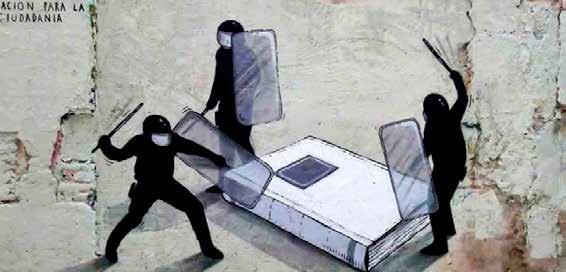
do not change the model of accumulation of wealth or the class structure of society. The repeated strategy is to take popular sayings, including terms from the social sciences, and turn them upside down and use them in a very different way.
The backsliding which the reactionary culture war leads to is, of course, also present in the educational field, as we have seen. But it has the peculiarity of presenting itself as adorned by new technologies, particularly information and communication, as well as Artificial Intelligence. In spite of the great potential of these technologies, they are used with the intention of training new generations in a technocratic, competitive, pragmatic and dehumanized mindset. Thus social considerations, which in themselves resist the attack on teaching the humanities, are left to one side.
Content such as STEM (science, technology, engineering and mathematics) is imposed as being the most useful. Reacting to criticism, the H (humanities) or the A (arts) are increased. Above all else,”entrepreneurism” is added as an ideology that maintains that the poor are poor because they want to be because they do not join the market. Because the only undertaking that is worthwhile is an economic one that enriches, those who don't make money are not even mentioned, although they may be undertaking something greater, like changing society, as did historic personalities such as Jesus or Che. Citizens are no longer being formed, but only consumers and dreamers of unattainable riches.
In this way, as throughout the history of education under neoliberal guidelines, governments increasingly weaken public education. In some cases, schools are
closed, not just with the goal of reducing budgets, but also to break the social ties that have always held a privileged place in public education. The school ceases to be a place of meeting, knowledge and social organization, and becomes a place of social conflict, pitting teachers against parents.
If this is the line of the right, the opposite must be that of people. Men and women in the teaching profession are called on to expose these positions, to evade traps and to reinforce the collective path. The education system always presents certain degrees of autonomy. One of these, small but very important, is the relationships developed within the classroom of children, adolescents and young people together with colleagues and communities. If from within the feudal universities, created to sustain kingdoms, there arose revolutionaries who transformed the system, thus from the current universities must come organic intellectuals linked to the popular sectors.
Education is a field in dispute. Everyone must become conscious of their place in it. The defense of public education is linked to the defense of democracy and of human rights, to creating the conditions for a future very different from the current one and to reclaiming popular humanism and overcoming modern mechanical philosophy. The defense of public education is also tied to the promotion of scientific thought through dialogue, to the recognition of our human diversity in all senses and to the defense of the joy of childhood.
Everyone must take their place. For those who defend public education and the right to education, it is very clear where that must be.
PHOTO: THE LEFT DAILY
El Salvador: Between Repression and Resistance
Translated by Flor Montero
Years ago the current president of El Salvador, Nayib Bukele, self-identified as a radical leftist while serving as mayor of Nuevo Cuscatlán under the Farabundo Martí National Liberation Front (FMLN). After being expelled by the FMLN, he founded the Nuevas Ideas party. In 2019 due to legal electoral issues he ran for president as the candidate of the center-right GANA (Grand Alliance for National Unity) party and won. In general, the working class had high expectations for Bukele's victory, as he promised to end corruption by challenging previous administrations (ARENA and FMLN) and showed an apparent commitment to improving the lives of Salvadorans. He offered to provide opportunities in health, education, and infrastructure for all, a message that resonated with thousands of young people. He gained decisive support from this group, as well as from previous FMLN voters.
1.Social activist from El Salvador.
A large part of the country’s teachers also gave their support, expecting improvements mainly in the areas of pensions, salary, and education. But those reforms have not taken place due to a lack of political will, since Bukele has control of the Legislative Assembly.
During his first term, he addressed the issue of security, which was of utmost concern to the population. He took a hard line against gangs, which gained him positive recognition both nationally and internationally, all achieved by resorting to a state of emergency strategy (2022). He has also used this to silence the opposition, violate the rights of the working class and promote a series of actions that violate basic human rights protections for inmates. Similarly, all previous legislation established for “transparency” at the political-administrative level is being violated.
In 2020, heavily armed troops stormed the Legislative Assembly and Bukele imposed himself as a dictator, threatening to dissolve it if it did not approve
Elsa1
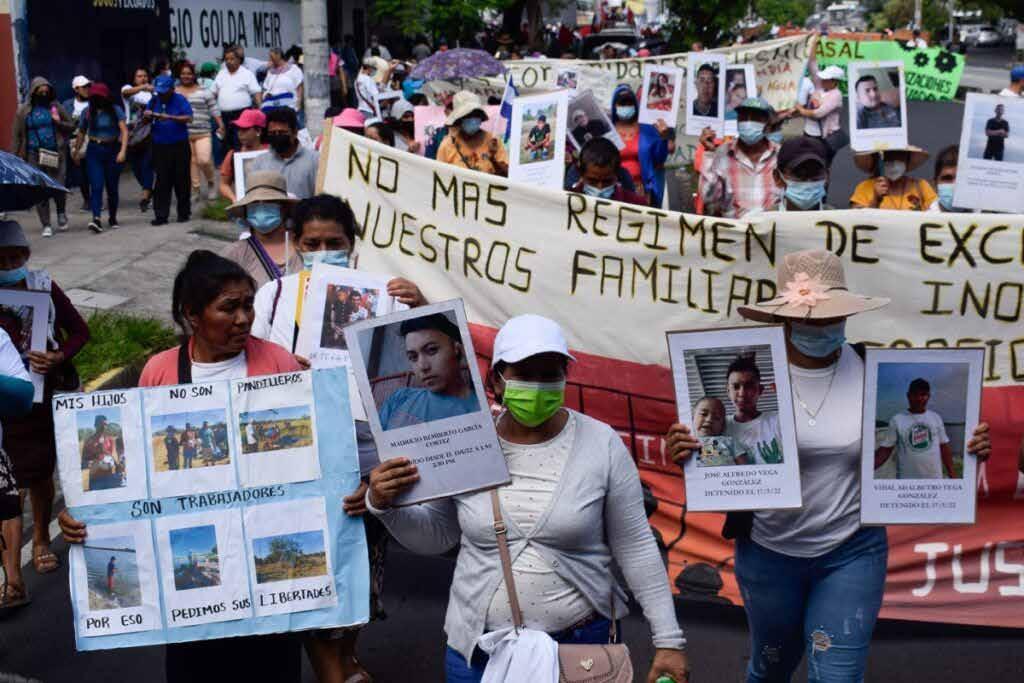
the negotiation of loans with the IMF. And recently, in early 2025, he passed a reform that allows any article of the political constitution to be changed to his will, thus consolidating his authoritarian and repressive government.
In the field of education, the electoral campaign promises to improve the system are far from being fulfilled. On the contrary, education has suffered a regrettable setback as the budget was cut, affecting hiring, maintenance, services, coverage and other areas.
The education budget for the current year, $1,535,787,204, represents 4.1% of GDP. This is a much lower figure than 2024 and represents a cut of $34,709,893. The government is moving further away from its promise to increase the budget to 6%.
Education is not a priority for this government and the economic elite it represents. In six years in office it has still not made any structural changes to address the real problems affecting the working class. Instead, it
only responds to the economic interests and guidelines of the International Monetary Fund. The closure of 67 schools is a clear example of this problem. Furthermore, the government refuses to provide any information on the matter, and many schools are in a state of complete disrepair.
Like other sectors, teachers have suffered dismissals without due process, in some cases for participating in marches and other protest actions. The intention is to shut down any opposition to these fascist policies.
This is education as imposed by a dictatorship, where there is no room for teachers to express their opinions unless they are in favor of the government. They have reformed the curriculum, controlling what is taught in classrooms and eliminating anything related to a gender perspective. This is also due to alliances with the evangelical leaders who supported them in the elections.
Bukele’s government has taken a sharp turn towards the far-right, promoting policies of racism, repression,
PHOTO: KELLYS PORTILLO/ALHARACA
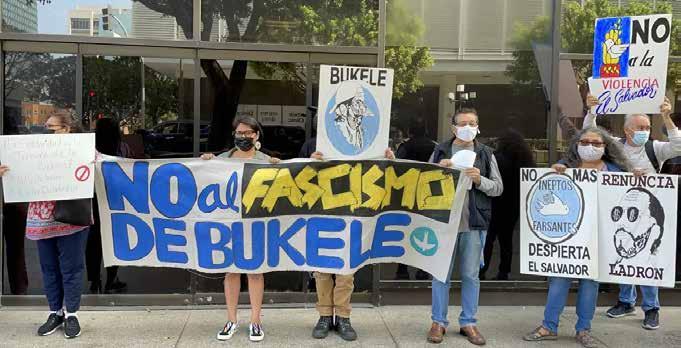
and xenophobia. His policies are similar to those of far-right governments such as Milei in Argentina, Noboa in Ecuador, Mulino in Panama, and Donald Trump in the United States.
The militarization of streets, communities, and schools is another aspect of the growing fascism that continues to generate fear among large segments of the population.
Three years into the state of emergency, this political weapon is still being used to arrest anyone who dares to denounce corruption and human rights violations, without the corresponding arrest warrents. Authorities are fabricating non-existent cases against these individuals, demonstrating that justice in this country is selective.
The most recent case is the arrest of Ruth López, representative de CRISTOSAL (a nonprofit organization dedicated to defending human rights in El Salvador).
to implement it in their own countries, as a strategy to deter any organization that opposes their interests. Despite political persecution and criminalization of all social protest and the ongoing policy of land dispossession targeting rural communities, acts of resistance and public denunciation continue.
However, being a repressive government is not everything. The rising cost of living has caused an increase in poverty in recent years. As H. Zemelman2 writes: “The fall of Eastern Europe was also caused by everyday issues”, such as those experienced by the population of El Salvador: poor healthcare due to a lack of medication, unemployment, low wages and inflation, to name a few. All of these issues have caused discontent and a decline in the president's popularity.
Fascism, a product of the capitalist crisis, and the rise of right-wing governments will continue as they attempt to consolidate power at the expense of the most economically and socio-culturally vulnerable sectors. In response, the masses are organizing and coordinating in a global context of mobilizations against imperialist wars and genocide.
Bukele has offered the US government the use of CECOT (Terrorism Detention Center),in exchange for several million dollars, to receive migrants regardless of whether they are guilty of the accusations against them. It is enough to be identified as a migrant, without having committed any crime. This is a prison model that several Latin American leaders have closely observed in order 2.Hugo Zemelman, Chilean sociologist.
PHOTO: SOUDI JIMÉNEZ/LOS ANGELES TIMES
Why Does the Far-Right Target Post-Secondary Education?
Rosemary Lee1, Steven Miller y Peter Brown
Translated by Steve Stewart
US President Trump’s attacks on universities in the USA reveals how fascism weaponizes legal action (“lawfare”), which is then facilitated by the politics of compromise. He uses illegal “Executive Orders” to threaten universities and government agencies and force them to rescind what was legally established at every level of government.
Since he returned to office in January 2025, Trump has been systematically implementing the extreme-right
1. Rosemary Lee is a retired bilingual member of United Teachers Los Angeles, a member of the Civil, Human & Women’s Rights Committee of the California Federation of Teachers. She has been active with the Trinational Coalition to Defend Public Education since 2006.
Steven Miller taught science in Oakland’s impoverished Flatland high schools for 25 years. He has been a member of theTrinational since 2008. He was a shop steward in the Oakland Education Association for 24 years.
Peter Brown has lived in East Oakland’s flatlands for over 55 years. After working as a machinist for over 14 years, and then teaching Manufacturing Technology at Laney Community College for 12 years, he is now retired. He now works full time for social justice. He has been an active member of five labor unions.
2. Project 25 is a plan published in April 2023 by far-right think
agenda proposed by the Heritage Foundation in Project 20252. The same outfit has also published “Project Esther,” a set of policies aimed at tightening control over universities, supposedly to combat antisemitism:
“The U.S. education system fosters antisemitism under the guise of “pro-Palestinian,” anti-Israel, anti-Zionist narratives across universities, high schools, and elementary schools, often under the umbrella or within the rubric of diversity, equity, and inclusion (DEI) and similar Marxist ideology.”3
tank, the Heritage Foundation, to drastically reduce the federal government and consolidate all federal departments and institutions under the executive power of the president. Although he denied knowledge of the project during his campaign, Project 25 has served as the blueprint for Trump’s first year in office.
3.PROJECT ESTHER: A National Strategy to Combat Antisemitism, National Task Force to Combat Antisemitism, 7 de octubre de 2024 - https://www.heritage.org/sites/default/files/2024-10/ Project%20Esther.pdf
We are witnessing an attempt to establish “patriotic education” by prohibiting public schools at all levels from even discussing Palestine, Black History and the history of all marginalized communities. Valiant student opposition to such policies has defined the last two years. The Trump administration has used state action, legal threats and massive propaganda to attack universities, staff, history students and teachers.
Trump implies that if Diversity, Equity and Inclusion (DEI), meant to facilitate the participation of marginalized groups, is destroyed, whites who are denied access to decent education and living conditions will then gain access to those resources. While whites are being impoverished along with everyone else now, this offers the “impression” of white supremacy, but most still won’t be able to afford higher education or other “privileges,” even if other groups are excluded. Attacking equity and inclusion means that treating all people equally is formally rejected.
The New School Year
The Fall semester is wrapping up at US universities and colleges. Students have been key to daily ICE protests and resistance around the country. Fascists have seized on the September 10, 2025 assassination of far-right activist Charlie Kirk, leader of Turning Point USA, to demand that those who “celebrate” this murder be fired. Corporations and universities have fired or suspended more than 3 dozen people for this. Thinking people recognize that mourning someone’s death does not mean we must honor their life. But universities are accepting this demand instead of challenging it. There can be no collaborating with the criminalization of free speech.
For a year, the Trump regime has used false distortions of antisemitism to attack any university that permits open discussions of genocide and Palestinian rights. One tactic is the withdrawal of federal scientific research money from universities. The universities, with a long history of collaborating with the McCarthy-driven “Red Scare” in the 1950s, have totally capitulated. Columbia gave the Trump Administration $225 million to restore $400
million in funding and Brown is paying $50 million to workplace development programs to get $500 million back. Extortion is the use of power and threats to gain control of wealth by actions that are not legal.
Now Trump extends the attack to public universities, the University of California Los Angeles (UCLA) and UC San Francisco, and university medical centers as well. He demands $1.5 billion from UCLA, which is funded by taxpayers as a public school. Trump alleges that the universities permit an atmosphere where individual Jewish students “don’t feel comfortable”.
Trump announced in July that the Berkley campus of the University of California (UC Berkley) would be punished for violating federal civil rights laws for failing to suppress antisemitism during last year’s campus protests.
One hundred and sixty Jewish professors from the University of California responded:
Let us be clear: the University of California is not being targeted because of antisemitism on our campuses. The UC is a powerhouse of independent thought, research, truth, dissent, and innovation in the public interest; it is under assault because it poses a considerable obstacle to authoritarianism...
… We urge you, the Regents of the world’s premier public university system, to recognize where the real risk of this moment lies. The University of California will survive federal funding cuts if it must. It will not survive the sacrifice of our institutional autonomy, academic freedom, or civil rights on the altar of a specious claim to be “combatting antisemitism.” Let there be no concessions, compromises, bargains, or capitulation. Not in our name.4
But in early September, in acquiesce with the Trump administration’s demands, the UC Administration turned over to the federal Department of Justice some 160
4: Letter from Jewish Faculty of the University of California to the UC Board of Regents.
names of UC Berkeley professors to be investigated for “antisemitism”. The UC administration has indicated that this is only the first step, as they report that all the schools in the UC system, the world’s largest public post-secondary education system, are under investigation. Beyond the fines, the Department of Justice seeks to drastically overhaul campus practices on hiring, admissions, sports, scholarships, discrimination and gender identity.
At precisely the same moment, the California State Assembly passed the Israeli-inspired AB 715 Bill that would criminalize anyone in public education, from kindergarten thru graduate school, who advocates for Palestinian rights or discusses the realities of the genocide we see every day in media.
Bill AB 715 adopts backdoor censorship by failing to explicitly define antisemitism, while supporting the National Strategy to Counter Antisemitism, 3 a document from the International Holocaust Remembrance Alliance (IHRA) that conflates criticism of the state of Israel with antisemitism. The Jerusalem Declaration2 correctly defines the problem and stands in direct opposition to the Zionist position that seeks to conflate Jewishness with the Israeli state. It is signed by 370 scholars in the fields of Holocaust history, Jewish studies, and Middle East studies.
While students across the country and the world, including Israeli students, protest Israeli’s genocide in Gaza, official “leaders” for the most part refuse to challenge this notion.
Will ICE now arrest teachers and students in their classrooms? Does this mean the Black History Month, as well as Hispanic History and Indigenous History months. will also be abolished? We already see how fascism aggressively keeps expanding its reach. It’s not about legality and traditional government practices; it’s about the seizure of political power.
The people’s response to that attack is still gestating at this time; we are in a defining moment of transition from the politics of resistance and protest, to the politics of building the political power to defeat fascism and the power of corporations. Rather than the collabora-
tion and conciliation pursued by many US university administrations, this requires embracing Frederick Douglass’s famous 1857 statement:
Power concedes nothing without a demand. It never did and it never will. Find out just what any people will quietly submit to and you have found out the exact measure of injustice and wrong which will be imposed upon them, and these will continue till they are resisted with either words or blows, or with both. The limits of tyrants are prescribed by the endurance of those whom they oppress.
The abundant history of US genocide is being resurrected: the slaughter of Native Americans, the chain gangs, the urban massacres in Oklahoma, Florida and so many others. Likewise, the broad US history of working-class uprisings, slave rebellions and the dayto-day sabotage and resistance of individual slaves and workers in the past points the way forward.
The real history of the United States (something that is on the chopping block) bares the lessons of how to seize the narrative instead of acquiescing to the open lies of fascism. US Vice-President JD Vance has stated “culture war is class warfare”.5 Class warfare is what fascism is organizing. These are issues of political power.
Attacking science in higher education, to advance corporate profit
Fascism always attacks science because it deals with truth. The National Institutes of Health (NIH) has been central to the rise of science in the USA for 70 years. More than 80% of the NIH’s $48 billion budget supports academic research. Trump proposes to cut this by 18%. His budget calls for “massive cuts” to spending on medical and scientific research, public health and disease-prevention programs, and health insurance for low-income Americans and their children. Robert F. 5: Zuylen-Wood. The Radicalization of J.D. Vance. https://www. washingtonpost.com/magazine/2022/01/04/jd-vance-hillbilly-elegy-radicalization/
Kennedy Jr, the new Secretary of the U.S. Department of Health and Human Services (HHS), has terminated 22 grants for mRNA research. This is the research that rapidly developed the successful vaccinations against COVID. The list goes on. This is a qualitative step beyond the privatization of public research that has been going on for decades.
Fascism historically has always been hostile to any social institution that encourages the open discussion of ideas, critical thinking and scientific perspectives. Fascism’s engine runs on lies, simplistic solutions and mystical visions to weaponize the fear, anger and scapegoating that is its stock in trade.
Fascism is also always about making profit through privatization. Now that the development of Artificial Intelligence (Ai) is in the hands of private corporations, it is being used to replace knowledge workers. This process is proceeding far more rapidly than robots replaced manufacturing workers in industry.
In July, Ford CEO Jim Farley warned that Ai will wipe out half of white-collar jobs. The 200,000+ federal workers that DOGE has fired are all knowledge workers – scientists, lawyers, accountants etc. Silicon Valley technology firms have laid off over 100,000 knowledge workers since 2020. They are being replaced by low-skilled workers and Ai6.
In this environment, university research, as it has been structured, is an impediment to the rapid evolution and application of Ai, not to mention the free flow of capital, always the imperative. Universities do not have the supply chains to put Ai into production; their funding infrastructure is simply too slow to push the technology forward. Technical progress now requires rapid experimentation and innovation, then scaling-up new products rapidly for commercialization. Ai companies must have economies of scale to produce for the market. Universities cannot supply this. So, the
6: Tim Jhons. Silicon Valley tech expert explains what workers need know as AI-driven layoffs are on the rise. https://abc7news. com/post/ai-driven-layoffs-are-rise-could-silicon-valley-tech-expert-explains-what-know/17726874/
Tech Bros want Research and Development money to go directly to them.
The vast majority of strong Ai models are now developed by industry, not academia. Industry produced fewer than 20% of notable AI models before 2006, but 60% of them in 2023 and nearly 90% in 2024. Since 2004, the number of Ai PhD graduates moving to corporations jumped from 21% to 70%. Science requires the open sharing of information to advance; but corporations no longer share their research at scientific conferences. Private researchers do not have the ability to discuss their research freely, which is vital for collaboration, because they are required to sign nondisclosure agreements.
Media corporations, legal firms and universities, and the corporate leadership of the Democratic Party, offer little serious opposition. They continue to bend the knee, and collaborate with fascism and capitulate to it, paying tens of millions to stop Trump lawsuits, which are legally recognized as bogus. This is understandable. The leadership of these institutions themselves are members of the same class as MAGA leaders, the corporations and Silicon Valley techno-fascists. They all agree that the era of bourgeois democracy is over.
Attacking universities and public education works against developing science, research, human talent and ultimately the development of technology, whether for better or worse. Education is key for developing our thinking and knowledge power, all of which is necessary to improve public well-being. The human mind - all of our human minds - is our greatest resource, if we nurture it and provide quality education for all. This requires a society that welcomes everyone’s contribution to our collective general welfare. And this requires supporting and meeting every single person’s basic human needs.
Can anyone imagine accomplishing these crucial tasks while science, technology, knowledge, and the resources of the planet are in private, corporate hands?
On the political and educational imperative of combating the genocide in Gaza
Mauro Jarquín1
Translated by Flor Montero
The final article in this issue is a call to action; yet another, in the face of the destruction faced by the Palestinian people in the Gaza Strip and other occupied territories. It is a response to the violent onslaught of an occupying power that has found a way to legitimize barbarism in the dispute over common sense. At the time of writing, at least 65,000 people have died in Gaza as a result of the violence perpetrated by the Israeli occupation forces (IOF), and more than 165,000 have been injured.
The cruelty of the genocide and the pace of events can lead, albeit involuntarily, to viewing each person
1.
as a number and the Gaza population affected by violence as a just total figure. This ultimately dehumanizes each and every one of the victims of a dispossession, expansion and exploitation project. This is an imperialist agenda, largely instigated by the Israeli far right, which has permeated different layers of its own society, and other parts of the world, with a discourse of supremacy and hatred.
That is why it is important to defend the human condition and the great cultural heritage of the Palestinian people, beyond figures and abstract elements. One area of action in this regard is to fight for their right to education, wherever we are: in university classrooms, in the various educational systems, in public squares,
Political scientist, member of the Intercambio editorial committee, and co-ordinator of the current issue
at family dinners, and in our digital interactions on social media. Everywhere, the historical memory of the Palestinian people must be disseminated through our voice. As we know, education is also a space in which diverse forms of resistance can develop. In a global context where imperial cynicism converges with the ideological mechanism of religious fanaticism that legitimizes policies of death, we join the call made by many groups and individuals to combat genocide through our political and educational practices.
By September the 8th, 2025, 637,475 children were facing their third consecutive year without access to formal education. This has had a profound effect on their personal and intellectual development, as well as their life trajectory. Teachers in Palestinian territory have also been affected due to the Palestinian Authority's financial crisis, which has impacted their salary payments. However, these problems seem insignificant in comparison to the scale of the tragedy and abuse. Close to that date, 17,237 students and 741 teachers were killed in Gaza. Zionist fire and hatred have also harmed 25,459 students and 3,096 teachers, leaving many injured. In the West Bank, Israeli violence has also wreaked havoc: 108 students and five teachers have been killed, and 704 students and 21 teachers have been injured. All of this data comes from the Occupied Palestinian Territory Education Cluster2
Historically, schools and educational communities in the Palestinian territories of the West Bank and Gaza have faced terrible levels of violence. According to the Palestinian Ministry of Education, attacks by settlers in areas close to schools increased in 2024, leading to fires around classrooms, harassment and the detention of students and education workers (incidents related to education in the occupied Palestinian territories). In addition to the closure of schools, dozens of other educational centers have received total or partial demolition orders. All of the above is part of a global strategy
2.Incidents related to education in the occupied Palestinian territories - Academic year 2024-2025 (September2024 - June 2025) -Occupied Palestinian Territory | Relief Web.
to destroy a people, whose symptom in the field of education is a systematic campaign to dismantle, disintegrate and make disappear its educational and cultural institutions, as well as the people who work in them.
In addition to mass murder and destruction, the Israeli state's genocidal policy is denying children the right to education. Genocide, then, is also driven by a desire to erase memory, the future, and the hope for a better tomorrow, based on free thought, the development of science, and respect for culture.
Although outrageous, this is not surprising when one considers that education in Palestine has historically been a form of strategic intervention by the Israeli regime, aimed at underpinning its plans for domination, dispossession and destruction of the Palestinian people. Consequently, Israel exercised considerable control over the education sector between 1967 and 1993. By 1993, the Palestinian Authority had made significant progress towards achieving educational sovereignty in the West Bank and Gaza. Following the Oslo Accords, it established a Ministry of Education and developed and national curriculum and textbooks. This allowed teachers to promote nationalist and socially critical academic content in schools, including those run by the United Nations Relief and Work Agency for Palestine Refugees in the Near East (UNRWA). This was a decisive step forward in strengthening a national education system with a long history of foreign intervention.
Currently, the military aggression of the Israeli Defense Forces, linked to the profit interests of various sectors and factions of international capital, is endangering life in the Palestinian territories more than during the decades of Israeli occupation. Consequently, education in Gaza is under constant attack.
As popular educators, members of the Latin American teaching profession, and activists in the critical pedagogical movement, as well as simply as human beings committed to defending social justice and humanity, it is essential that we support the Palestinian people, within our means, in defending their present and future.
Let us continue to confront genocide in the streets and in the classroom. Once all the efforts and struggles around the world succeed in stopping the advance of death, we must be prepared to participate decisively and with solidarity in the reconstruction of the Palestinian territories and the strengthening of their educational sys-
tems and spaces. Throughout history, internationalism has been crucial in combatting fascism. Now, solidarity and militant commitment are essential to fight against the darkness of genocide and build a better future.
This task embodies the political and pedagogical imperative of education in our time.
Oh rascal children of Gaza
KHALED JUMA
Oh rascal children of Gaza.
You who constantly disturbed me
With your screams under my window. You who filled every morning With rush and chaos. You who broke my vase And stole the lonely flower on my balcony. Come back, And scream all you want And break all the vases. Steal all the flowers. Come back. Just come back…
“Oh, Rascal Children of
by the
This poem is taken from https://www.jewishvoiceforlabour.org.uk/article/oh-rascal-children-of-gaza-a-poem/, published for its closeness to the events unfolding in Gaza since October 2023, where the Israeli state has killed more than fifteen thousand children since the beginning of hostilities.
Gaza",
Palestinian poet Khaled Juma, was written in 2014, during the Israeli bombardment of the Gaza Strip. Juma grew up in the Palestinian refugee camp Al-Shaboura in Gaza. He currently lives in the West Bank.
What is IDEA?
The Initiative for Democratic Education in the Americas (IDEA) is a flexible network that brings together organizations in the Americas that share a commitment to protecting and improving public education, seen as essential to democratic development and the protection of human rights. The Network works with other civil society organizations concerned about the impact on social rights of “free” trade agreements and other transnational neoliberal policies. The idea for a hemispheric network emerged from a meeting of teachers and students in Mexico City in November 1998. IDEA’s structure was broadened and formalized at the Initiative for Democratic Education in the Americas Conference held in October 1999 in Quito, Ecuador.
What does IDEA do?
The IDEA network carries out research, establishes communication networks, publishes documents and organizes conferences and seminars related to neoliberalism, trade agreements and the defense and democratic transformation of public education. It also organizes campaigns to defend public education and the defenders of public education. The objective of these activities is to lay the groundwork for an understanding of the impact of neoliberal policies on education in the Americas and to develop alternatives to ensure inclusive, democratic and quality public education. The objective of these activities is to lay the groundwork for an understanding of the impact of neoliberal policies on education in the Americas and to develop alternatives to ensure inclusive, democratic and quality public education.
Coordinating Committee
The work of IDEA is directed by a Hemispheric Coordinating Committee made up of representatives of the following organizations:
•National Union of Educators (UNE/Ecuador)
• Confederation of Education Workers of theArgentine Republic (CTERA)
•Federation of Central American Teachers’ Organizations (FO-MCA)
• National Confederation of Education Workers (CNTE/Brazil)
• British Columbia Teachers’ Federation (BCTF/Canada)
• LatinAmerican and Caribbean Students’ Organization (OCLAE)
•Trinational Coalition in Defense of Public Education, Mexican Section
Contact idea-redsepa@outlook.com