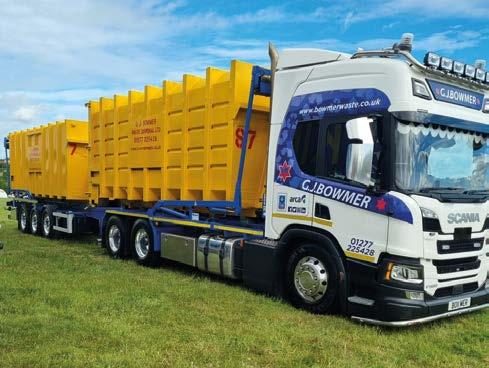
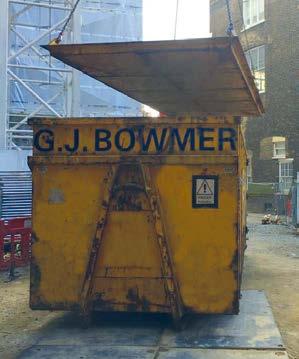
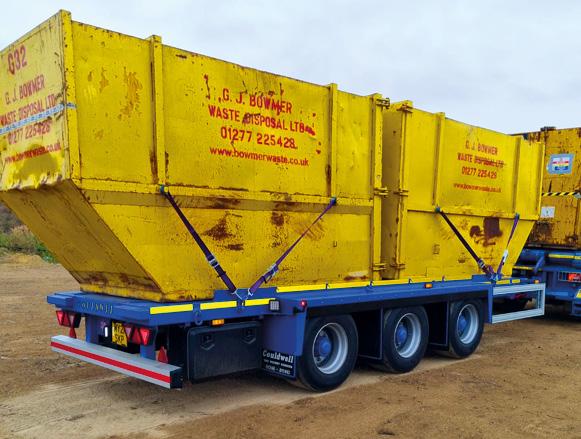
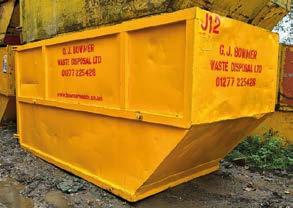
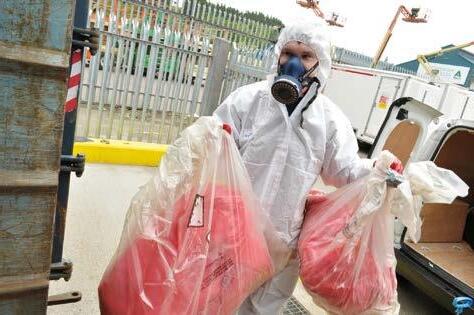
G J Bowmer (Waste Disposal) Limited provides a comprehensive and reliable skip hire, waste disposal service and waste transfer station for both the domestic user and for trade customers.
We have over 45 years experience, so whether you’re looking for a small mini skip to dispose of domestic household material, or a large 40 cubic yard roll on roll off sealed container for asbestos disposal; we really do know all there is to know about waste disposal. Trading since 1979, here at G J Bowmer (Waste Disposal) Limited we specialise in providing a professional and dependable service, which is always competitively priced.
Welcome to the Journal for Asbestos Management Professionals
Earn
AMI
CPD Points through ARCA News
Did you know you can earn AMI Continuing Professional Development (CPD) points simply by reading ARCA News? This convenient feature makes maintaining your AMI membership easier than ever. Simply read the technical articles in this issue, scan the QR code provided, and complete a brief multiple-choice questionnaire. Score 80% or above, and CPD points will be automatically added to your AMI profile.
It’s a time-efficient way to stay current with industry developments while earning the professional development points you need.
Scan the QR code above to start earning your points today!
Advertising Contributors
G J Bowmer page 2
SMH page 16
Erith page 18
Phoenix page 19
Assure 360 page 24
Casella page 25
Scaffolding Access Ltd page 29
SMH page 30
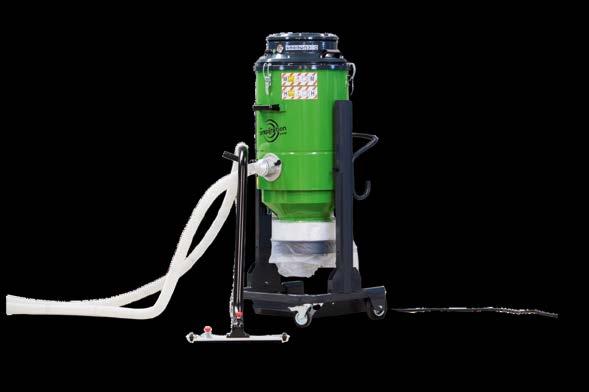
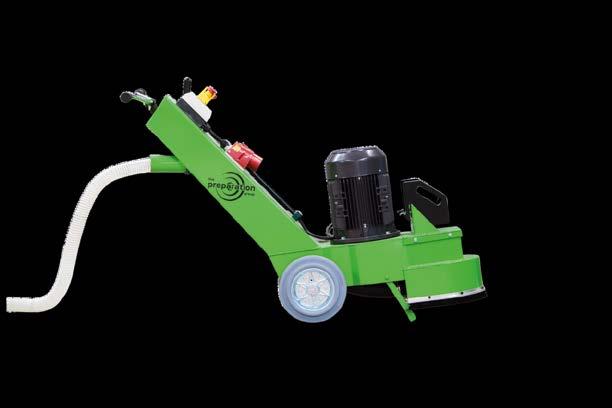
The Preparation Group page 31
Thermac page 32
Specialist Risk Group page 34
Root-5 Solutions page 36
Teams page 38
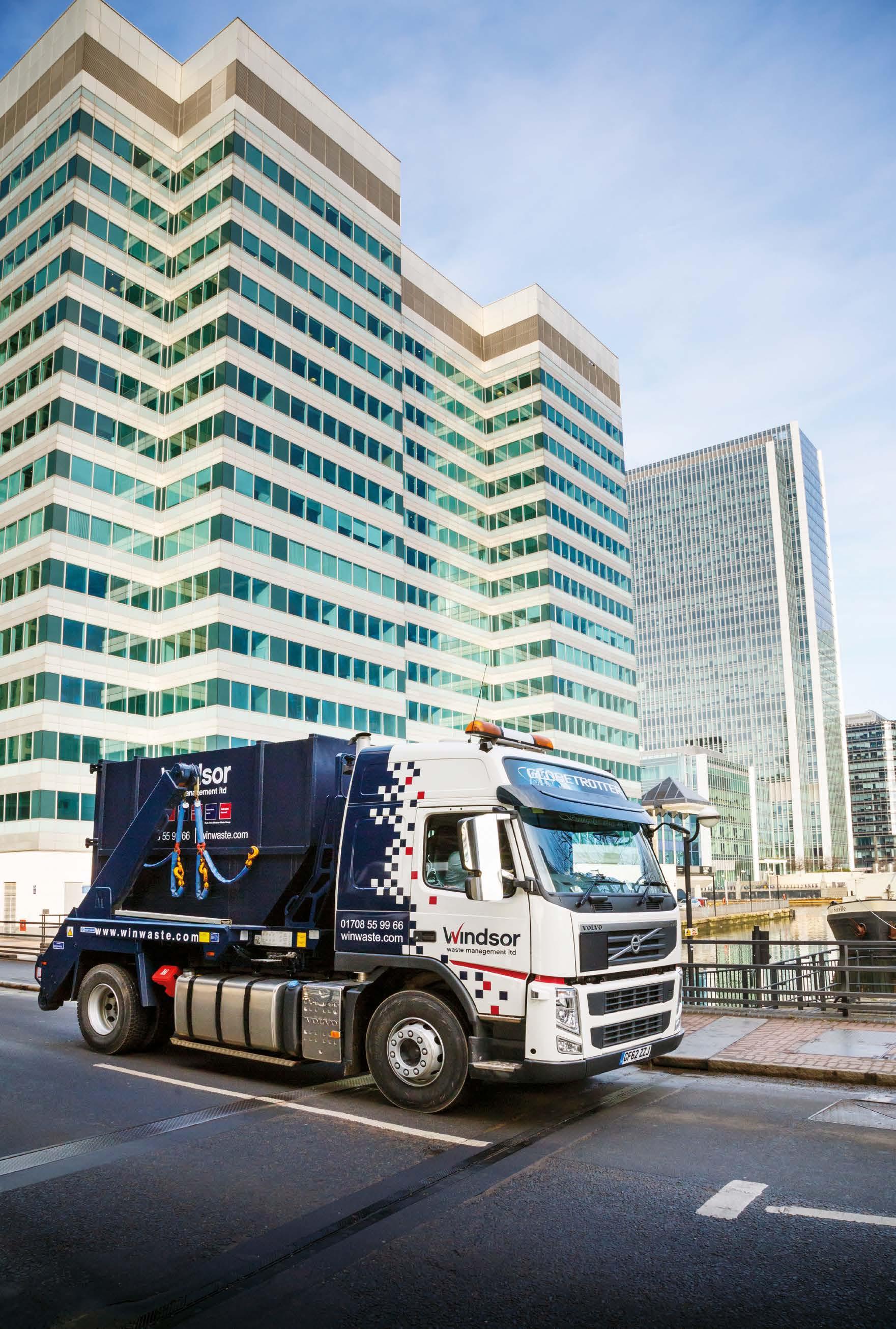
Windsor Waste page 56
Asbestos Removal Contractors Association, Unit 1 Stretton Business Park 2, Brunel Drive, Stretton, Burton upon Trent, Staffordshire DE13 0BY t: 01283 566467 e: info@arca.org.uk w: www.arca.org.uk www.arca.ie www.atac.org.uk
ARCA News is published by Asbestos Removal Contractors Association Limited. Reproduction in part or whole of any item may be undertaken only with the prior written agreement of the Editor or ARCA. Opinions, comments, reviews and articles included in ARCA News are not necessarily those of the Association and no warranty for goods and services described or advertised is implied. Contributions are included in part or in whole at the sole discretion of the Association.
All comments included in content were made/are correct at the time of going to print.
The Association’s GDPR Privacy and Cookies Policy can be found at www.arca.org.uk, www.arca.ie and www.atac.org.uk.
All Member companies may submit news articles to be considered for inclusion in the publication.
To subscribe to receive a printed copy of ARCA News email info@arca.org.uk
Unsubscribe
To unsubscribe from receiving a printed copy of ARCA News email info@arca.org.uk
Design by www.fuse4.com
Advancing Standards Through Evidence and Engagement
Welcome to the latest edition of ARCA News magazine, which you will notice has a fresh new look, redesigned to modernise the publication and ensure it reflects the professionalism and standing of our industry as we move further into the second quarter of the 21st century. We hope you enjoy the new presentation.
We now have the complete results from the annual declaration sent to members in July, and satisfaction levels with ARCA remain exceptionally high. The vast majority of respondents rated overall satisfaction at 8 or above out of 10, with around a third giving the maximum score. Simi ly strong ratings were recorded for understanding industry needs and responsiveness, where roughly two fifths of members awarded the top mark. The recommendation scores further reinforce this positive sentiment, with two thirds of members rating their likelihood of recommending ARCA to peers at 8 or above. The qualitative feedback consistently praised the helpfulness and efficiency of the ARCA
OUR MISSION
To give the best possible service and support to assist ARCA members and customers in providing safe, effective and ethical management of asbestos, thereby safeguarding the public.
team, with particular appreciation for the regional meetings, audit processes, and responsive approach to member queries. These results are genuinely encouraging and reflect the commitment of everyone at ARCA to delivering real value for our members.
The HSE consultation on changes to the Control of Asbestos Regulations has now closed, marking an important moment for our sector. ARCA has supported UKAS accredited organisations since ATAC was established in 1999, some 27 years ago, and throughout that time the HSE has strongly recommended that clients source a UKAS accredited organisation when selecting an asbestos surveyor. We have always supported this position, which is why we have advocated for making UKAS accreditation mandatory. The argument is often made that there are some good non-accredited surveyors, and whilst that may be true, there are also some poor ones. HSE’s own research demonstrates that UKAS accreditation provides clients with a significantly greater assurance of competence when selecting a surveyor. The case for mandatory accreditation is, in our view, well evidenced and we remain confident in the strength of the arguments we have put forward.
We wrote to the Minister setting out our analysis of why UKAS accreditation for asbestos surveyors should be a mandatory requirement. The Minister’s response, received on 20 January 2026, acknowledged ARCA’s longstanding engagement with HSE’s work on asbestos and confirmed that no decision on the regulatory proposals has yet been made. He emphasised that the purpose
OUR VISION
We envision being an essential strategic partner, through membership of ARCA and ATaC, to all companies providing asbestos management and licensed asbestos removal services, or services to those companies, by providing solutions which contribute to the overall success of their businesses and provide reassurance to their clients.
of consultation is to gather evidence to ensure any approach taken is both effective and proportionate. The Minister has confirmed that our comments have been forwarded to the HSE for inclusion in the consultation process.
I attended a meeting with the HSE Science Division on 22 December 2024 to discuss upcoming research projects on asbestos in buildings. Two significant projects emerged as priorities from the March 2025 asbestos research summit. The first addresses the current gap in data and air monitoring for nonlicensed asbestos work, focusing on airborne fibre concentration profiles and visual inspections to allow risk evaluation before, during and after nonlicensed removal activities. The second examines the degradation of asbestos containing materials in buildings after decades in situ, particularly whether materials installed before 1985 remain effective and safe given they have now been in place for over 40 years. Both projects aim to ensure current practices and regulations remain suitable and sufficient, and the findings will inform future guidance affecting our industry. As the representative body for licensed asbestos removal contractors, laboratories and surveyors, it is important that ARCA and its members have the opportunity to contribute to and shape research of this kind. Members who would like to find out more or express an interest in participating should contact me directly.
Steve Sadley Chief Executive
OUR VALUES
Our values define the culture at ARCA. The values of integrity, service, excellence, teamwork and responsibility guide the way we work, our behaviour and our commitment to support members, customers and colleagues.
Steve Sadley, Chief Executive
Complimentary Training for New Operatives
ARCA is pleased to offer a total of 40 free training places for new operatives entering the asbestos industry.
Places will be allocated on a first come, first served basis, with a maximum of two places available to any one-member company.
What’s included
These places are available across four New Operative courses running throughout 2026, held at two locations: Burton and Rayleigh.
• Burton-on-Trent, 7 to 9 April 2026
• Rayleigh, 11 to 13 May 2026
• Burton-on-Trent, 7 to 9 October 2026
• Rayleigh, 17 to 19 November 2026
Why we’re doing this
Bringing new people into the industry properly, with the right knowledge, the right attitude, and confidence in what they’re doing, matters to all of us. This initiative is our way of supporting members in building strong teams while helping to maintain the standards the industry depends on.
How to register
Places are allocated on a first-come, first-served basis,so we’d encourage you to register your interest as soon as possible and only available to ARCA members. If spaces remain on a course once all initial bookings have been made, we will contact members who have already booked to offer the remaining places.
To book your complimentary places, please contact 01283 505777 or book online via our portal.
ARCA Renews ISO 9001:2015 Certification Following Successful Audit
ARCA has successfully retained certification to ISO 9001:2015, following an audit by NQA that identified no minor or major non-conformances.
The Association’s quality management system (QMS) describes the approach, procedures, and processes to be followed to demonstrate the Association’s ability to consistently provide quality membership, training, and auditing services. The standard also assesses leadership, the organisation’s goals, and how these will be achieved, as well as risk-based thinking.
In her report, the auditor from NQA commented, “The system has been found to be providing the required level of control. The organisation’s context is well defined, leadership has been effectively demonstrated and commitment levels are fully evident. This is reflected in the
levels of compliance with requirements and operational control evident at the organisation during the audit process. The availability of documented information to demonstrate that the system is well implemented and well understood throughout the organisation is acceptable. This audit has involved a review of system administration activities, as well as a review of job-related records. It was fully evident that the key policy commitments are being adhered to.”
Steve Sadley, Chief Executive of ARCA, said, “We successfully passed our ISO 9001 audit with no minor or major non-conformances. This is an excellent result that reflects the commitment and professionalism demonstrated across the organisation. A massive thank you to all the ARCA team for your hard work and adherence to our procedures. This result is a testament to the standards we maintain across the organisation.”
How ARCA Membership Drives Business Success
Your decision to join ARCA continues to deliver measurable business advantages, providing concrete evidence of the value your membership delivers to your business performance and professional standards.
Your ARCA membership supports your competitive position in an increasingly demanding market. Major contractors, local authorities, and facilities managers increasingly specify ARCA membership within their pre-qualification requirements, opening doors to substantial contracts that matter most to your business stability and long-term growth. This recognition of ARCA membership as a mark of quality reflects the consistently high standards you maintain and the rigorous audit programme you engage with throughout the year.
This competitive advantage reflects the rigorous standards you maintain through our audit programme. Over the past two years, we have conducted more than 1,000 unannounced site audits across the membership. The performance trends are remarkable. Average audit scores have improved by more than 30%, with most members now consistently achieving top-tier compliance ratings. Flawless audit reports have risen from 27% to 40% of all site audits. These are not modest improvements but transformational shifts in operational excellence across the entire membership.
These improvements are not coincidental. Statistical analysis demonstrates a 99.99% confidence level that performance gains are attributable to participation in the ARCA system. When you engage with the four annual unannounced audits, immediate constructive feedback, and systematic performance reviews, sustained improvement becomes
practically guaranteed. The audit programme is designed to identify opportunities for enhancement before they become compliance issues, supporting continuous improvement rather than simply measuring current performance.
Your feedback confirms this value. Members rate our site audit service 9.77 out of 10, with supervisors scoring auditor professionalism at 9.8 out of 10. Some 95% indicate they would speak positively about ARCA site audits to others. This reflects our commitment to consistent, professional, and constructive engagement with your teams. Our auditors understand the practical realities of licensed asbestos removal work and deliver feedback that is both rigorous and realistic.
We maintain these standards through monthly meetings with our auditors, ensuring consistency across all site visits and sharing comprehensive notes with all members. This transparency regarding our operational processes and decision-making frameworks means you understand exactly how we work and why decisions are made. You receive the same detailed insights into our audit methodology that we provide to our audit team, ensuring complete clarity about expectations and standards.
The training provision you access through membership continues to receive outstanding feedback. We train over 4,500 professionals annually across the largest network of fully equipped training centres in the sector. Each year, we incorporate findings from approximately 800 unannounced site audits into industry-wide training programme development. This direct connection between
what we observe on sites and what we teach ensures practical relevance. The training you receive addresses real-world challenges identified through actual site visits, not theoretical scenarios disconnected from operational reality.
Participants rate their training experience 8 or higher out of 10 in 96% of cases, with overall satisfaction at 9.41. Your teams value ARCA training because it is engaging, practically focused, and addresses the operational challenges they encounter regularly. Our instructors bring current industry experience and understand the pressures your supervisors and operatives face on active removal sites.
Your membership provides valuable networking opportunities through three rounds of meetings annually across Great Britain. Each round comprises six in-person events plus one online session, offering 21 opportunities to network with industry leaders, receive updates directly from HSE, Asbestos Network and CITB, and access exclusive information about developments affecting your business. These meetings provide insight into regulatory changes, emerging best practices, and strategic developments within the sector. Attendance remains completely free for all personnel from member companies, encouraging your entire management team to participate and benefit from shared industry knowledge.
You also benefit from discounted CHAS accreditation, complimentary HR support from Croner, and exclusive access to Assure360’s personal monitoring system for robust exposure tracking and regulatory compliance. These additional services add substantial value to your membership beyond the core audit and training provision.
Nine out of ten members would recommend ARCA to their competitors. This extraordinary statistic reflects businesses confident enough in the value proposition to direct rivals towards membership because the benefits are demonstrably clear. Over 85% of you rate our support services 8 or higher out of 10.
We request feedback after every site audit, training course, and regional meeting. This ensures we continuously monitor member requirements and adapt our services accordingly. ARCA membership is not a static offering but rather an evolving service shaped by member input. Your feedback drives our continuous improvement just as our audits drive yours.
Your ARCA membership represents an active partnership that delivers measurable performance improvement and practical ongoing support that strengthens your competitive position in an increasingly demanding market. Your membership matters. It opens doors, wins tenders, and supports the continuous improvement that keeps your business at the forefront of professional asbestos removal contracting.
News in Brief
Introducing ARCA’s New Site Audit Scheme Auditor: Danny Buckberry
We’re delighted to welcome Danny Buckberry to his new role as ARCA’s Site Auditor.
Danny brings extensive expertise to the position, with nine years of experience as an Analyst/Surveyor. Throughout his career, he has conducted analyst audits for a diverse range of companies.
In his role with ARCA, Danny will conduct both unannounced and additional audits for ARCA members, ensuring the continued excellence and integrity of ARCA’s audit standards.
We’re excited to have Danny on board and wish him every success in this new chapter.
ARCA’s Member Portal
ARCA’s member portal serves as a central hub for ordering training courses, updating your information, requesting CSSS cards, and other related tasks. A new feature introduced last year now allows you to download your ARCA membership certificate directly from the portal. We are continuing to improve our member services to make them as seamless as possible.
For more information, visit: www.arca.org.uk/membership/member-portal/
ARCA Gold Site Audit Award Winners
Congratulations to the 2024/2025 and 2025/2026 winners **
The Gold Site Audit Award is a prestigious recognition given to our members that demonstrate exceptional compliance and risk management levels.
“Huge congratulations to all our members who have achieved the award. It is in recognition of the continuing high standards that each of these members has achieved,” commented Matthew Boulton, Site Audit Coordinator for ARCA.
To gain this award asbestos removal companies need to achieve Grades A to C*, with an average of at least a B Grade, across all unannounced programmed site audits over 2 consecutive membership years.
*A-B if no live works observed **October 2025 to January 2026
• Active Environmental Management Ltd
• Armac Environmental Ltd
• Axiom Building Solutions Ltd
• Carymar Construction Services Ltd
• Countrywide Environmental Services Ltd
• ECT Environmental Ltd
• Jackson Environmental Ltd
• Rhodar Industrial Services Ltd
• Spectra Analysis Services Ltd
• Thompsons Asbestos Services Ltd
Diary Dates
Attendance Certificate
When attending a remote member regional meeting, attendees are logged and issued with an attendance certificate. The certificate is intended to complement training records, by recording that the individual named received the information, instruction and training listed on the certificate.
HSE publishes annual work-related ill-health, injury and enforcement statistics for 2024/25
On the 20th of November 2025, the Health and Safety Executive (HSE) published statistics that cover work-related ill health, non-fatal workplace injuries, and enforcement action taken by HSE, in the 2024/25 period.
1.9 million working people suffering from a work-related illness, of which...
964,000 workers suffering work-related stress, depression or anxiety
511,000 workers suffering from a work-related musculoskeletal disorder
2,218 mesothelioma deaths due to past asbestos exposures (2023)
124 workers killed in work-related accidents
59,219 injuries to employees reported under RIDDOR
680,000 working people sustained an injury at work according to the Labour Force Survey
40.1 million working days lost due to work-related illness and workplace injury
£22.9 billion estimated cost of injuries and ill health from current working conditions (2023/24)
The figures show that an estimated 1.9 million workers suffered from work-related ill health during 2024/25, remaining broadly consistent with the levels seen in recent years.
While the recent rates of self-reported work-related ill health are similar, they continue to be higher than pre-pandemic levels recorded in 2018/19.
The HSE’s statistics on work-related ill health, non-fatal injuries and enforcement are available at www.hse.gov.uk Key figures for Great Britain (2024/25)
Mental health conditions remain the primary driver of work-related ill health, with 964,000 workers reporting stress, depression or anxiety caused or made worse by work in 2024/25. This is in line with the upward trend in recent years.
Work-related ill health and injuries resulted in an estimated 40.1 million working days lost in 2024/25, continuing to place significant pressure on both workers and businesses.
HSE Chief Executive Sarah Albon said: “Great Britain maintains its position as one of the safest places to work globally, built on more than 50 years of health and safety regulation. However, these statistics demonstrate that workplace health challenges persist, particularly around mental health.
“We remain firmly committed to protecting people and places, supporting businesses to create healthier working environments, and ensuring continuous improvement in workplace safety standards across Britain.”
The statistics also highlight the economic impact of workplace health and safety issues. In 2023/24, the estimated annual cost of workplace injuries and new cases of work-related ill health reached £22.9 billion, similar to the estimate for 2022/23.
Fatal and non-fatal workplace injuries in 2024/25 totalled 124 worker fatalities and an estimated 680,000 self-reported non-fatal injuries.
Certificate of Cleanliness
Under the Control of Asbestos Regulations 2012, Regulation 17, Cleanliness of premises and plant, there is a requirement to ensure areas where asbestos work has been carried out are thoroughly cleaned to prevent the spread and subsequent exposure to asbestos fibres.
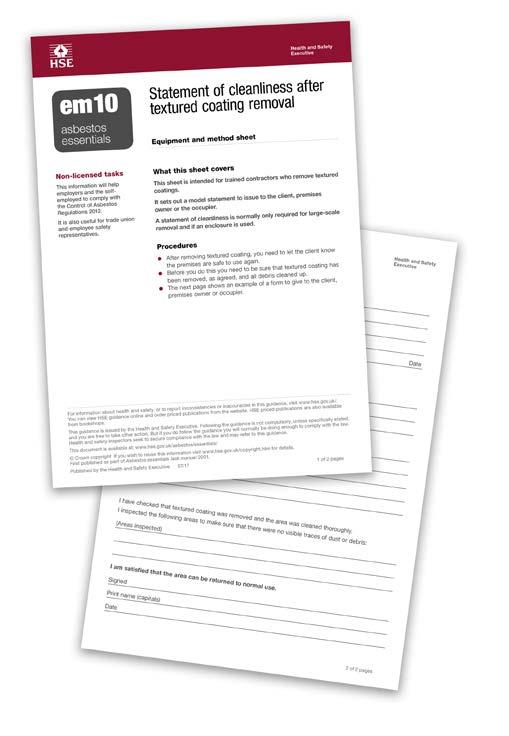
Clearance air sampling, and therefore a Certificate for Reoccupation (CfR) is not generally required for nonlicensable work. However, a written statement of cleanliness might be required, for example, after large-scale removal of textured coatings or works in sensitive locations.
What is a Certificate of Cleanliness?
As clearance air monitoring is not required as part of the clearance procedures for non-licensed work, and an independently provided CfR is not needed, the occupier should be provided with a written statement detailing that the area has been thoroughly cleaned and visually inspected to make sure that no visible traces of dust and debris remain and the area is suitable for reoccupation.
The statement should include:
• site address;
• dates of the work;
• a brief description of the work;
• name and address of the contractor;
• details of the specific areas and items visually checked;
• name and signature of the person completing the inspection.
The term Certificate of Cleanliness first appeared in UKAS Lab 30 Edition 4 as part of the initial transition from ISO17025:2005 to ISO17025:2017.
Specifically, it defines:
“The need for the Laboratory to inform the dutyholder that a 4-Stage Clearance is not required for non-licensed works, even when requested e.g. for large scale Textured Coating (TC) removal. In these scenarios, a Certificate of Cleanliness (different from CfR) should be issued.”
Along with:
“The inspection activities associated with a Certificate of Cleanliness are not recognised as accredited and should be appropriately disclaimed when reported with associated testing, for which accreditation is mandated e.g. reassurance”
The history of Certificate of Cleanliness
It is unclear when the Certificate of Cleanliness first came into use, it’s suspected the main catalyst came from the introduction of the Control of Asbestos Regulations (CAR) 2006, primarily the removal of Textured Coatings as a licensable material. This resulted in the request from Dutyholders for documented evidence for safe reoccupation. There were a number of roadshows by the HSE justifying their stance along with statistical evidence from analysis of exposure from Textured Coatings removal to justify its exclusion from licenced work. However, it is worth noting that at the time opinions in the industry were mixed to this change.
“I first came across the requirement for a Certificate of Cleanliness in 2010. The dutyholder provided a crib sheet of expectations for various types of non-notifiable works. Defining what safety equipment and minimum PPE would be expected for each task. This also included whether the removal operatives had to still be present or could be absent at the time of the inspection and whether an air test was required.” - Robin Powell, Life Environmental
In 2012, the Control of Asbestos Regulations were further amended to include the category of Notifiable Non-Licensed Work (NNLW), which created an increased demand for visual inspections from analytical organisations, in addition to the self-certification which could be conducted by the removal companies completing these works.
The
issues
The term Certificate of Cleanliness was defined in Lab 30 to ultimately stop analytical organisations from conducting 4-stage clearances on materials other than those defined as Licensable Works.
However, by defining what a Certificate of Cleanliness is, UKAS has also inadvertently defined another service, one which it acknowledges is outside the purview of the accreditation process.
This is where the issue resides, there is no formal, or informal for that matter, process in place for this assessment. From a UKAS accredited organisation’s point of view, it does not require auditing, training or any processes or procedures to define it. There is no template specification, no pass or fail criteria or even a requirement for any visual assessment completed as part of these works. Ironically any analytical lab conducting reassurance air tests following works MUST ensure that the area is dust and debris free as part of completing the Reassurance test - a requirement of HSG 248 Asbestos: The Analyst Guide.
The only template available is within HSG 210 Asbestos Essentials: task sheet EM10, Statement of cleanliness after textured coating removal. This is not only very specific, but also a very basic document. It is solely for Textured Coatings and does not include any other type of NNLW or other nonlicensable works.
Ultimately, it is the dutyholder specification which will instruct the analytical organisation whether removal works have been conducted to their required scope, and the Certificate of Cleanliness provides the detail required.
The way forward
Owing to the current licensing regime definitions, and despite UKAS defining the term “Certificate of Cleanliness” it is felt within the consultancy sector, that it should not be accredited. If it is accredited, the definitions of non-licensable works,
notifiable non-licensable works and licensable works would require better clarification and definitive distinction. The current system has degrees of vague ambiguity, where materials can be non-licensable, notifiable non-licensed and, in some cases, transcend all three category types.
Although this sits outside of a UKAS accredited organisation scope of accreditation, it still potentially falls within the UKAS assessment. Accredited organisations must conclusively disclaim the Certificate of Cleanliness is covered by ISO17025, particularly if an accredited test has also been completed as part of the works and project file, such as a reassurance air test. It must be clear what is accredited and what is not.
As previously mentioned, it is down to the dutyholder to specify their requirements. However, they may not have sufficient or suitable understanding or training to define or specify a standard. At the same time there needs to be an agreed industry methodology to allow for a baseline consistency.
As an industry body, ATaC is reviewing the current Certificate of Cleanliness process with the aim to produce definitive guidance for our members based on best practice, enabling you to provide clients with an independent, clearance-based process.
Disposal of asbestos waste generated by surveying & analytical processes
Surveyors and analysts are required to safely dispose of all asbestos contaminated waste generated on-site from surveying, sampling and analytical processes. Work areas should be left clean, with no evidence of debris from their activities, and any sampling points sealed to prevent the release of fibres.
Under the Control of Asbestos Regulations 2012, Regulation 17, cleanliness of premises and plant; individuals are responsible for cleaning up any material they have disturbed to prevent the spread of asbestos and potential exposure.
Containment of waste
Asbestos contaminated waste may potentially be generated when sampling suspect materials and conducting analytical work; decontaminating tools to prevent cross contamination; disposing of RPE filters and pre-filters, disposable category 3, type 5 coveralls, foot-covers/overshoes and gloves.
All these items, and any others not listed, must be safely stored, double bagged, and labelled as ‘waste’ which can then be disposed of at a later date.
It is important not to leave any asbestos waste on-site or loose within toolkits.
Analysts:
• Typically waste generated during the 4-stage clearance or other licenced removal processes will be disposed of on-site within the Licenced Asbestos Removal Contractor’s own waste arrangements
• Waste generated through contamination whilst conducting RPE assessment or visual inspections of Non-Licenced Work (NLW) or Notifiable Non-Licenced Work (NNLW) will be dealt with as per surveyors/sampler process below and internal company procedure.
Surveyors/samplers:
• Ziplok sample bags (doubled) of varying sizes are generally used for wipes used to decontaminate tools and small ancillary items.
• UN approved red and clear bags (doubled) for larger items. Excessive air removed and appropriately sealed with cloth tape prior to transportation and/or disposal. L143 Managing & Working with Asbestos Second Edition 2013, para 527 states when filling bags -
- make sure that the inner bag is not overfilled, especially when the debris is wet, and each bag can be securely tied or sealed.
- exclude air from the bag as far as possible before sealing. Precautions will need to be taken as the exhaust air may be contaminated.
- where practicable, the sealed packaging should be cleaned before it is removed from the work area or enclosure.
All other non-asbestos waste material generated as a result of surveying and analytical processes must be disposed of so as not to cause additional Health and Safety hazards such as trip hazards, sharp edges or exposed nails. It’s important to ensure that other items, including non-asbestos waste, do not pierce the asbestos waste bags during transportation.
Transporting hazardous waste in your work vehicle
Small amounts of double bagged and labelled waste, as described above, can be transported in a work vehicle. This waste should be securely and safely stored during transportation.
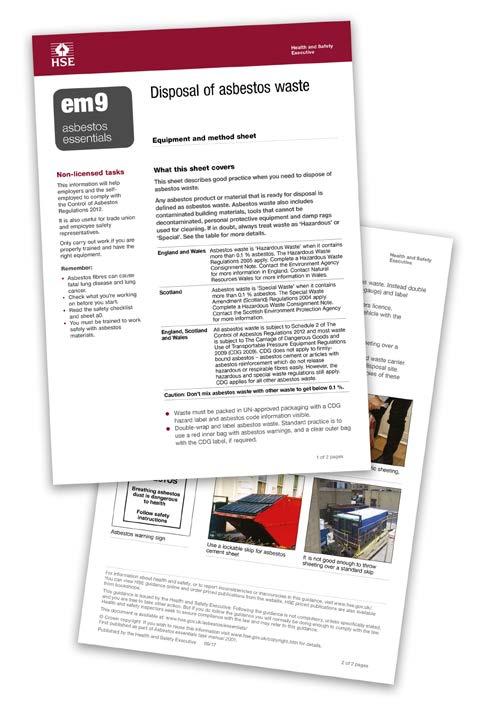
Asbestos waste should be packaged and transported in line with HSG210; Asbestos Essentials, em9; Disposal of Asbestos Waste.
Disposing
of the bagged waste
Normally, waste should be taken to their dedicated place of work to be stored in a suitable, lockable receptacle (wheelie bin or skip dependent on the amount of waste generated) displaying warning signs. The waste should periodically be collected by a registered ‘Upper tier waste carrier’ such as an Asbestos Removal Contractor.
Organisations holding a Certificate of Waste Carriage Registration (upper tier or lower tier) for the transport of asbestos waste can transport waste generated from their work directly to the nearest registered waste disposal site or transfer station.
Any waste generated will require the completion of a waste consignment note prior to transportation, either directly from site or accumulated waste from dedicated place of work –
Certificate of Waste Carriage Registration under the Waste (England and Wales) Regulations 2011
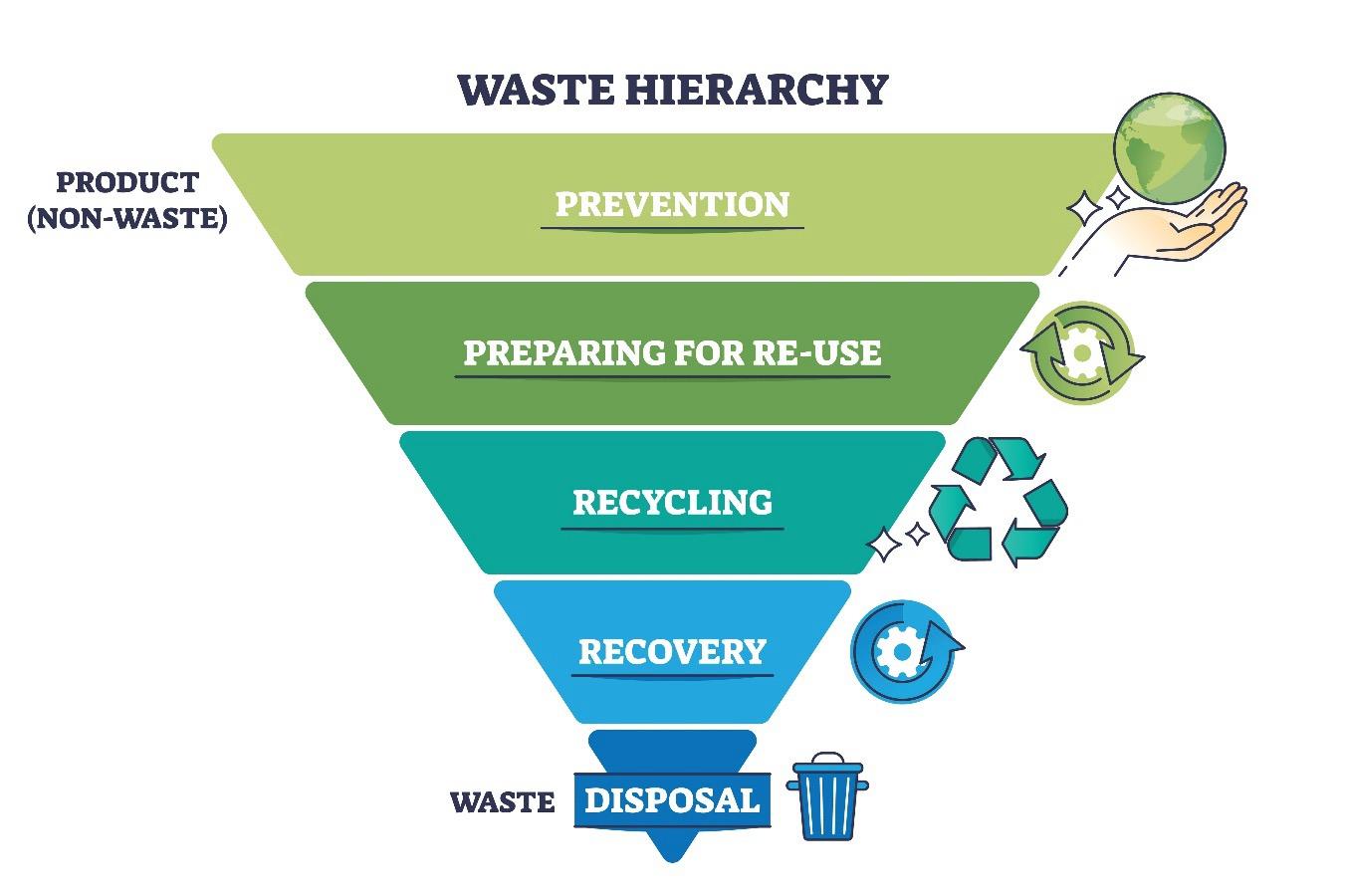
The Waste (England and Wales) Regulations 2011 implement the revised EU Waste Framework Directive and set out requirements for the collection, transport, recovery, and disposal of waste. These regulations require businesses to confirm that they have applied the waste management hierarchy when transferring waste and include a declaration on their waste transfer note or consignment note.
Who Needs to Register: If you transport waste that you produce yourself (lower tier), registration is usually free. However, if waste transport is your main business, or you transport waste generate by others, you will need to register and pay a fee (upper tier).
To obtain a Certificate of Waste Carriage Registration under the Waste (England and Wales) Regulations 2011, you must register with the Environment Agency, to registered or renew as a waste carrier -
ATaC has produced a comprehensive Guidance note: Disposal of asbestos waste generated by surveying & analytical processes, which is now available within the knowledge base of the ATAC website.
Why the RSPH Level 3 Qualification is the Right Starting Point for Asbestos Surveyors and Analysts Working for UKAS Accredited Organisations
For organisations holding UKAS accreditation for asbestos surveying and asbestos air testing, the choice of qualification for new surveyors and analysts is not simply a matter of preference. It has direct implications for how well those individuals are prepared to enter the UKAS competency framework, and how effectively they can progress through it.
ATaC exists to support UKAS accredited laboratories operating in the asbestos management sector. It is the only organisation solely representing these organisations, and that focus shapes everything ATaC does, including its ongoing advocacy for UKAS accreditation for asbestos surveying to be made a legal requirement. The qualifications ATaC has developed reflect that same commitment. They were designed specifically to meet the needs of UKAS accredited organisations, and that origin matters when considering which qualification is the right choice for new surveyors and analysts entering the sector.
The RSPH Level 3 qualifications in asbestos surveying and air monitoring sit on the Regulated Qualifications Framework, are Ofqual-regulated and nationally recognised, and are specifically referenced in HSG264, Asbestos: The Survey Guide, and HSG248, Asbestos: The Analysts’ Guide for Sampling, Analysis and Clearance Procedures. Being on the Regulated Qualifications Framework is not a technicality. It means the content, standards and assessment criteria are externally verified and cannot be altered without Ofqual approval, giving the qualifications the legal standing of a government-recognised award in a way that non-regulated alternatives simply cannot match. The RSPH Level 3 Award in Asbestos Surveying is explicitly listed in UKAS publication RG8 as an accepted qualification for persons carrying out asbestos surveys and reinspections, while the RSPH Level 3 Award in Asbestos Air Monitoring and Clearance Procedures is listed in Table 1 of UKAS publication LAB30 as an accepted
qualification for persons taking and analysing air samples. One other qualification appears alongside the RSPH awards in each of those tables, and the question worth considering is which is the better fit for the way UKAS accredited organisations actually develop their surveyors and analysts.
The answer lies in understanding how those two UKAS publications work. For surveying, RG8 sets out a structured authorisation process through which surveyors must progress before they are permitted to carry out different types of survey work across different property sectors. For air testing, LAB30 sets out the equivalent framework under ISO/IEC 17025, including the training, authorisation and audit requirements that analysts must satisfy. In both cases, UKAS does not consider a qualification alone to be sufficient evidence of competence. Under RG8, before a new surveyor can be authorised to carry out management surveys independently, they must complete at least five satisfactory witnessed audits across the relevant property sectors, assessed by an authorised technical auditor. Further audits are required before authorisation can be extended to refurbishment, demolition or reinspection work. Under LAB30, analysts progressing towards authorisation for air sampling must accumulate substantial on-site work experience under the supervision of authorised personnel, followed by competency audits conducted by a fully authorised analyst. At every stage, in both frameworks, it is the employer’s own documented competency procedures, assessed and verified by UKAS, that determine whether the individual is ready to move on. The qualification is the starting point. Everything that follows is built by the organisation.
The Ofqual framework confirms this. Level 3 describes occupational competence across a broad range of complex and non-routine activities, performed in a variety of contexts, with responsibility for initiating and completing tasks and applying factual, procedural and theoretical knowledge within
defined parameters. HSG264 and HSG248 set out clearly how surveys and analytical work should be conducted, what must be recorded, and how findings should be reported. A new entrant working within those frameworks, and developing through the employer’s authorisation programme, is operating at exactly the level that a Level 3 qualification is designed to support.
The one alternative qualification accepted within the sector sits within its own awarding body’s qualification framework rather than on the Regulated Qualifications Framework. As that framework is not publicly available it is difficult to assess with certainty what its level descriptors require. What can be said with confidence is that within the Ofqual framework, which is the nationally recognised standard for qualification levels in England, a Level 4 qualification expects something fundamentally different from a Level 3. At Level 4 a person is expected to adapt their approach independently to problems that are not always clearly defined, to evaluate whether their overall approach was the right one, and to take responsibility for the work of others and the allocation of resources. This type of competency takes several years to develop in a field as technically demanding as asbestos surveying and analysis. A qualification pitched at that level is designed for the experienced surveyor or analyst who has already built substantial practical knowledge and is ready to operate with greater independence and responsibility. Asking a new entrant to meet those expectations from the outset is the wrong fit.
The RSPH specification addresses this directly by including a formal progression route to the RSPH Level 4 Certificate in Asbestos Laboratory and Project Management. Level 3 is the foundation. Level 4 is where surveyors and analysts can progress once they have the experience to make it meaningful. That is a coherent and logical career pathway. Starting someone at Level 4 before having that experience is not.
There is also a question of assessment integrity. Ofqual’s General Conditions of Recognition are explicit: an awarding organisation must take all reasonable steps to avoid any part of the assessment of a learner being undertaken by someone with a personal interest in the result. A trainer has an inherent personal interest in the results achieved by their candidates, because a learner’s performance in assessment directly reflects the quality of the training received. Ofqual identifies this as an unavoidable conflict of interest and sets out the risks clearly. Assessment results may reflect the trainer’s desire to demonstrate the effectiveness of their training rather than the learner’s actual competence. The personal relationship between trainer and learner creates conditions in which collusion or inappropriate support becomes more likely. Assessment reliability is compromised, because results should be consistent regardless of who conducts the assessment, and that consistency cannot be assured where the assessor has a stake in the outcome. Where such a conflict of interest exists, Ofqual regards the assessment as potentially invalid and defines this as an adverse effect.
The RSPH qualifications are structured to avoid this entirely. RG8 notes that the RSPH Level 3 Award in Asbestos Surveying is gained by completing a written examination and an independently assessed practical assessment. LAB30 lists the RSPH Level 3 Award in Asbestos Air Monitoring and Clearance Procedures on the same basis. The one alternative qualification accepted within the sector requires the course tutor to carry out the formative practical assessment of the very candidates they have been teaching, and neither RG8 nor LAB30 makes any mention of independent assessment in relation to that qualification.
That independence is not incidental. It reflects the same principle that runs through the regulatory context these organisations operate in. HSE strongly recommends UKAS accreditation to ISO/IEC 17020 for surveying, and for analysts carrying out air monitoring, accreditation to ISO/ IEC 17025 under the Control of Asbestos Regulations 2012 is a legal requirement, with LAB30 setting out exactly how that standard must be applied. The RSPH Level 3 qualification was developed by UKAS accredited laboratories specifically to underpin both frameworks. It is the only qualification that can make that claim.
ATaC invests in the resources necessary to ensure that marking begins immediately after each assessment, so that results are processed without unnecessary delay. This was not accidental. When ATaC members first asked us to develop these qualifications, one of the driving reasons was frustration with how long other providers were taking to return results. That founding commitment to prompt turnaround remains, and candidates consistently receive their RSPH certificates within ten working days of completing their assessment, and often substantially less than that. For employers, that means newly qualified surveyors and analysts can get to work and begin their authorisation journey quickly, rather than sitting on the bench waiting for paperwork.
ATaC delivers these qualifications at its Burton-upon-Trent, Rayleigh and Darlington training centres through tutors with direct industry experience. Candidate feedback consistently rates both the quality of training and the likelihood of recommending ATaC at ten out of ten. The courses cover the full RSPH syllabus alongside current best practice and recent regulatory developments, so candidates leave prepared to work, not merely to pass an exam.
For more information on upcoming course dates, visit www. atac.org.uk.
Cordless Hazardous Cleaning
Cordless
• Employees exposed to asbestos risk during dismantling of wall panelling.
• Asbestos had not been identified in previous surveys of the studio buildings.
• HSE investigation found failures in assessment, training and emergency arrangements.
A film studio in Hertfordshire has been fined £6,000 after poor management of minor building works led to the disturbance of asbestos – putting employees at risk of exposure to asbestos fibres.
Maintenance staff at Elstree Film Studios in Borehamwood had been asked to remove acoustic wall panelling from one of the studio buildings in preparation for the replacement of the studio doors by an external contractor.
Employees were told that no asbestos was present and began dismantling the panels using claw hammers and crowbars on 22 July 2022.
Shortly after starting work, one employee identified a layer of insulation that he believed to be asbestos and immediately stopped. Subsequent
Film studio fined £6,000 after disturbance of asbestos during maintenance works
testing confirmed the presence of asbestos – Amosite/Chrysotile and Crocidolite – which required licensed removal.
Section of the removed wall panelling containing asbestos
An investigation by the Health and Safety Executive found that neither the studio’s asbestos management surveys nor the specific refurbishment surveys had considered the wall surfaces within stages 7, 8, and 9.
As a result, the acoustic wall panelling dismantled by employees fell outside the scope of any assessment. The investigation also identified failings in training and inadequate emergency arrangements to deal with asbestos disturbance.
HSE guidance states that employers must not undertake work liable to expose people to asbestos unless a suitable assessment has been carried out and a proper plan is in place. This often includes the use of licensed contractors with appropriate controls to manage the risks.
Elstree Film Studios Limited, of Civic Offices, Elstree Way, Borehamwood, Hertfordshire, pleaded guilty to breaching Regulations 5, 10 and 15 of the Control of Asbestos Regulations 2012. The company was fined £6,000 and ordered to pay £6,790 in costs and a £2,000 victim surcharge at Stevenage Magistrates’ Court on 20 November 2025. All sums are to be paid within seven days.
HSE Inspector Stephen Manley said:
“Poor management of asbestos can lead to workers being exposed to the harmful effects of asbestos. Those in control of buildings must ensure they have a suitable assessment in place, and those undertaking intrusive work should be provided with appropriate information – which, for this type of work, will often require a specific localised survey by a competent person.”
The prosecution was brought by HSE Enforcement Lawyer Gemma Zakrzewski and Paralegal Officer Helen Hugo.
A large amount of asbestos was dumped illegally at a beauty spot, leading to an appeal for help to track down the culprits.
The mound of hazardous waste, which included sheets of asbestos, a hi-fi and panes of glass, was found at Monument Hill near Devizes in Wiltshire.
It is thought the waste, which Wiltshire Council has said will cost a “significant” amount to clear, was dumped overnight on 19 January.
Councillor Martin Smith, said: “It’s disgusting that someone should dump this dangerous waste in a beauty spot.” The fly-tip was found dumped between
‘Dangerous’ asbestos waste dumped at beauty spot
Etchilhampton and Stert, at the western end of the Vale of Pewsey on the edge of the North Wessex Downs Area of Outstanding Natural Beauty.
Smith, cabinet member for highways, has appealed for anyone who has any information about the incident to come forward so the council can track down “these environmental criminals”.
“If you know anyone who has had asbestos removed from their property recently, or you witnessed any suspicious behaviour at this bridleway, please do get in touch,” he said.
“Someone must recognise this waste –particularly as it includes a hi-fi system and other waste.”
He said the council is “targeting flytippers” across the county.
“If we can find who has dumped this dangerous waste, we will take legal action,” he said.
“We will now have to spend significant sums safely clearing up this dangerous asbestos waste, which makes us even more determined to catch whoever did this.”
Anyone with information that leads to a conviction will receive a £200 high street shopping voucher, the council added.
https://www.bbc.co.uk/news/ articles/c5y52vpqp6no
Image Source :Wiltshire Council
Safety by choice, not by chance
The difference between a safe workplace and a dangerous one often comes down to a single factor: deliberate action. “Safety by choice, not by chance” isn’t merely a catchy phrase. It’s a fundamental principle that recognises safety doesn’t happen through luck or good fortune. It emerges from deliberate, proactive decisions, careful planning, thorough training, and personal responsibility. When organisations and individuals embrace this mindset, they acknowledge that accidents aren’t inevitable occurrences but preventable events that can be avoided through conscious choices and heightened awareness.
Too many businesses still operate under the assumption that if nothing has gone wrong so far, nothing will. This mentality is fundamentally flawed. The absence of accidents doesn’t indicate the presence of safety. It merely means that hazards haven’t yet resulted in harm. Eventually, chance runs out, and when it does, the consequences can be devastating.
Everyone’s Responsibility
Creating a safe environment requires more than management directives or safety policies gathering dust in filing cabinets. It demands that everyone, from directors to apprentices, accepts accountability for safety outcomes. This shared responsibility transforms safety from something that happens to people into something people actively create together.
When individuals recognise their personal role in preventing accidents and controlling hazards, they stop being passive recipients of safety instructions and become active participants in risk management. The driver who chooses to check blind spots, the operative who selects proper personal protective equipment, the supervisor who stops work when conditions deteriorate, each makes a conscious decision that prevents harm.
The principle extends beyond formal work environments into daily life. Whether driving on public roads, working from home, or engaging in recreational activities, the same truth applies: safety results from deliberate choices, not fortunate circumstances. Making everyone accountable for creating safe environments means acknowledging that each person’s decisions affect not only their own wellbeing but also that of others around them.
The Foundation of Intentional Safety
Creating a safe workplace starts with recognising that every aspect of health and safety requires active management. This means identifying hazards before they cause harm, assessing risks systematically, and implementing controls that genuinely reduce danger rather than simply ticking boxes.
Consider the contractor who decides to skip the risk assessment because the job seems straightforward. Or the manager who overlooks the need for proper training because workers appear experienced. These aren’t mere oversights. They’re choices that prioritise convenience over protection, and they create the conditions where accidents become inevitable rather than preventable.
The philosophy that all accidents are preventable through conscious choices challenges fatalistic thinking. It rejects the notion that some incidents are simply “meant to happen” or that certain injuries are unavoidable costs of doing business. Instead, it asserts that when we examine any accident closely, we find a chain of decisions and circumstances that, had they been different, would have prevented the harm.
Culture Matters
The most comprehensive safety systems in the world fail without the right culture to support them. A genuine safety culture emerges when organisations demonstrate through their actions, not only their words, that they value people’s wellbeing above productivity, profit, or convenience.
This means supervisors who stop work when they spot unsafe conditions, even under deadline pressure. It means workers who feel empowered to raise concerns without fear of reprisal. It means senior leaders who invest in proper equipment, adequate training, and sufficient staffing because they understand that these aren’t costs to be minimised but investments in people’s lives.
When safety becomes embedded in organisational culture, it transforms from a compliance burden into a shared value. People stop asking “Do we have to follow this procedure?” and start asking “How do we do this safely?” That shift in mindset, where individuals actively choose safe actions rather than merely following rules, makes all the difference.
The Role of Planning and Training
Choosing safety requires both knowledge and preparation. Proactive planning identifies potential hazards before work begins, allowing organisations to implement controls rather than react to emergencies. Proper training ensures that workers understand the risks they face and know how to manage them effectively.
This isn’t about one-time induction sessions or annual refreshers. It’s about creating ongoing learning environments where competence develops continuously. As work evolves, as new materials and methods emerge, as regulations change, training must adapt accordingly. An organisation that treated safety education as a one-time event years ago is no longer making an active choice for safety. It’s drifting toward danger through complacency.
Learning from Experience
Every incident, every near miss, every unsafe condition identified represents valuable information. Organisations that choose safety treat these events as learning opportunities rather than occasions for blame. They investigate thoroughly, identify root causes, and implement changes that prevent recurrence.
This requires creating an environment where people feel comfortable reporting problems. If workers fear punishment for admitting mistakes or highlighting hazards, the organisation loses access to the information it needs to improve. When everyone accepts accountability for safety, reporting becomes an act of collective care rather than individual confession.
Making the Choice
Every day presents countless opportunities to choose safety or to leave things to chance. The manager who ensures adequate resources, the worker who follows established procedures, the director who prioritises safety in business decisions, each makes a choice that shapes workplace safety.
The question facing every organisation and individual is simple: will you actively choose safety, or will you leave it to chance? One approach protects people and builds sustainable success. The other courts disaster and betrays the trust of everyone who depends on you. The choice is yours, and making it deliberately, every single day, is what transforms safety from an aspiration into a reality.
Whatever It Takes? Starmer’s Asbestos Pledge Meets Reality
When the Prime Minister declared in October 2024 that “whatever we need to do to reduce that risk, we absolutely need to do” about asbestos in schools and hospitals, his words carried weight. Fifteen months later, with the consultation period now closed, those words are being tested against a decision that campaigners fear represents yet another government U-turn.
On 21 October 2024, Sir Keir Starmer backed the Daily Mail’s campaign to strip deadly asbestos from public buildings with language that left little room for ambiguity. Standing in a London Ambulance Service centre, having just met a woman requiring a double lung transplant because of asbestos exposure, he called it an “awful, awful killer” and committed to doing whatever was necessary to reduce the risk.
Fifteen months on, and with the Health and Safety Executive consultation having closed on 9 January 2026, HSE’s preferred options suggest reliance on improved guidance rather than mandatory accreditation for the organisations conducting these surveys, despite having statistical evidence showing that accredited asbestos surveyors deliver significantly better quality work.
The irony is hard to miss. Asbestos surveys are the foundation of everything else in the regulatory chain. They tell building owners what asbestos is present, where it is located, and what condition it is in. Get the survey wrong and workers disturb materials they do not know are there, exposure happens despite apparent compliance, and people die decades later from diseases that were entirely preventable.
The Evidence Points One Way
Analysis of HSE’s own research data shows that accredited organisations score 22% higher on average than nonaccredited ones. There is only a one in 6,000 chance the difference occurred randomly. In most research contexts, this would be considered conclusive.
Accredited organisations also deliver more consistent quality, with a standard deviation of 89 in scores compared to 105 for non-accredited organisations. This consistency means fewer nasty surprises when someone commissions a survey.
Yet HSE is proposing to continue with what they call “enhanced guidance” to help customers make informed choices. The problem is that this approach has already failed. Analysis of annual declaration data from UKAS-accredited organisations shows that around 63% of asbestos surveyors in Great Britain operate without accreditation. HSE has been strongly recommending accreditation for over 20 years. If customers were listening, non-accredited surveyors would be a shrinking minority struggling to find work. Instead, they represent nearly two-thirds of the workforce and appear commercially successful.
Something is clearly not working. Either customers do not know about HSE’s recommendation, do not understand why it matters, cannot tell whether a surveyor is accredited, or simply ignore the advice. Whichever explanation applies, the current approach is demonstrably ineffective.
When Guidance Fails
HSE’s own Post Implementation Reviews add weight to the case for regulation rather than guidance. The 2022 PIR found that half of those doing non-notifiable asbestos work did not even know they had duties under the regulations. If people do not know they have basic legal obligations, expecting them to make sophisticated judgements about surveyor competence seems optimistic at best.
The reviews also showed that between 2017 and 2022, HSE revised their guidance and redesigned web pages to address confusion. The result? A fifth of dutyholders still had not heard of the new guidance, and a third of those who had were not using it. Targeted improvements over five years did not eliminate confusion or guarantee usage even among those who were aware of the changes.
This matters because, according to HSE’s consultation document CD 329, there are roughly 38,000 licensable removal jobs annually, plus 24,000 to 28,000 notifiable nonlicensed jobs and an unknown number of non-notifiable jobs. The scale is enormous. If work is spread in line with surveyor numbers, something approaching two-thirds of these jobs may be relying on surveys from non-accredited organisations.
Work on the 2027 Post Implementation Review is already underway, which will examine how recommendations from previous reviews have been implemented. This creates an accountability mechanism, but also raises the question of how many more review cycles are needed before meaningful action is taken when, according to both HSE and the Daily Mail’s reporting, 5,000 people are dying from asbestosrelated diseases annually.
The Parliamentary Dimension
The contrast with asbestos analysts is telling. For four-stage clearance work, accreditation is mandatory. There is no ambiguity, no need for customers to judge competence, no possibility of accidentally hiring someone unqualified. The requirement creates a clear baseline. Yet surveyors, whose work underpins everything that follows, have no such protection.
This inconsistency is particularly striking given that the Work and Pensions Committee recommended mandatory accreditation for asbestos surveyors in April 2022. The committee pointed to the unlevel playing field created by requiring accreditation for analysts but not surveyors. The government agreed to take the recommendation forward.
When the previous government’s formal response in July 2022 rejected the recommendation, the committee chair described the decision as “extremely disappointing”, arguing that a clear target was needed as part of a joined-up strategy to prevent needless deaths.
Ministerial Positioning
Recent ministerial correspondence provides insight into the government’s position. Writing the day after the consultation closed, the Minister of State for Social Security and Disability acknowledged “a particular interest” in the implementation of the Select Committee findings, having previously chaired that committee.
The minister confirms no decision has been made and emphasises that HSE is following “standard Government processes” in developing policy proposals. The minister states satisfaction that HSE is committed to fulfilling its role as an independent, evidence-based regulator and will “continue to monitor emerging evidence and developments to asbestos exposure risks.”
The minister confirmed that industry submissions have been logged as part of the consultation response and encouraged stakeholders to provide views and evidence through the consultative process. Decisions will be made following analysis of responses.
For campaigners, this represents both an opportunity and a risk. The consultation window has now closed, and HSE’s preferred options appear to favour enhanced guidance over mandatory requirements.
The Cost Question
Cost concerns are mentioned repeatedly in HSE’s consultation, with estimates ranging from £14.7 million to £377.7 million annually. That twentyfold variation suggests the figures are highly speculative. More importantly, analysis of the market shows around 180 organisations already hold UKAS accreditation and absorb these costs successfully. If the costs were prohibitive, these businesses would not exist. The fact that a substantial accredited sector operates commercially suggests the costs are manageable for professional organisations.
Industry sources point out that direct UKAS fees are relatively modest compared to the real costs of compliance. The larger burden relates to requirements like 5% resurveys and method witness audits that demonstrate quality assurance. But these are requirements of HSG 264, which applies to all surveyors regardless of accreditation status. The only way non-accredited surveyors can offer lower prices than accredited ones is that they face no obligation to demonstrate compliance with HSE’s own guidance.
The cost argument against mandatory accreditation turns out to be an argument for allowing operators who are never required to formally demonstrate compliance to continue winning work on price against those who are.
The Human Cost
With 5,000 people dying from asbestos-related diseases every year, roughly 14 deaths a day, the public health imperative is substantial. The Daily Mail reported that since 1980, at least 1,400 teachers and support staff and 12,600 pupils have died from mesothelioma caused by asbestos exposure. The number is expected to increase sharply as ageing school buildings expose more people to risk.
When Sir Keir Starmer said in October 2024 that “whatever we need to do to reduce that risk, we absolutely need to do”, he was responding to these stark figures. The Prime Minister called asbestos “an awful, awful killer” and said the way it kills people is “just dreadful”. He committed to doing whatever is necessary.
Evidence Limitations or Convenient Excuse?
The consultation document acknowledges “very limited evidence” about survey quality, yet uses this as a reason not to mandate accreditation. There is a logical problem here. If the evidence is too thin to support mandatory accreditation, it must also be too thin to conclude that enhanced guidance will succeed where current guidance has failed.
HSE conducted research that showed clear statistical results, then called the evidence insufficient. When asked to provide the underlying data that would enable more precise
analysis, they declined. When a study finds strong statistical significance and a large effect size, the normal response is to do a bigger study to confirm the finding, not to dismiss the result because the sample was small.
An organisation that cites evidence limitations while withholding data that would address them invites questions about its approach.
What Happens Next
The ministerial response reveals a government navigating competing pressures. Personal commitment to the Select Committee findings remains evident, but so does reliance on HSE’s “independent, evidence-based” approach. The consultation process has concluded, and analysis of responses is now underway. The question is whether the weight of evidence and stakeholder input will be sufficient to shift HSE from its preferred position.
The test of Starmer’s October 2024 commitment is playing out right now in an analysis process that most people will never hear about. If the government opts for enhanced guidance over mandatory accreditation, campaigners will be entitled to ask whether this represents another promise diluted by bureaucratic caution.
Enhanced guidance sounds reasonable, but the evidence from HSE’s own Post Implementation Reviews shows it has not worked and is unlikely to work in future. Mandatory accreditation would create a level playing field, protect vulnerable dutyholders who lack expertise, and ensure that the foundational work on which all asbestos management depends meets a consistent minimum standard.
When Sir Keir Starmer promised to do “whatever we need to do”, he spoke in the aftermath of meeting someone whose lungs were destroyed by asbestos. The minister now responsible for HSE has the authority to ensure those words translate into policy. Whether that “particular interest” proves sufficient to override bureaucratic caution will define whether the Prime Minister’s pledge becomes reality or joins the growing list of asbestos promises that somehow never quite materialise into action.
Whatever it takes, or whatever is easiest? The consultation has closed, the responses are being analysed, and a decision will come later this year. Meanwhile, an average of 14 people will die from asbestos-related diseases today, tomorrow, and every day until something changes. The question is whether this government will deliver on its commitment or whether another review cycle, another round of enhanced guidance will substitute for the clear regulatory baseline that the evidence supports and that comparable work already requires.
An employer’s roadmap to the Employment Rights Act 2025
The Employment Rights Act 2025 received Royal Assent on 18 December 2025, marking a watershed moment for a UK employment law; one of the most significant rollouts of changes in decades.
Through the Employment Rights Act 2025, the Government wants to usher in a new era of fairness at work and worker security, as well as improved industrial relations – it believes making workers’ and unions’ rights a heightened priority ultimately benefits both workers and employers.
In this article, we outline a clear roadmap of the key changes under the Employment Rights Act 2025. The updates will roll out in stages over this year, with a significant cohorts of changes set to come into effect in February, April, and October 2026, as well as further reforms in 2027.
By preparing now, employers can avoid risks such as tribunal claims (where the average award is around £11,914) and build a more resilient organisation.
Immediate changes (Royal Assent and Early 2026 – Effective from 18 February 2026).
Some provisions took effect shortly after Royal Assent, with trade union and industrial action reforms activating from mid-February 2026. These are significant changes to trade union laws that ultimately make it easier for unions to call for and sustain industrial action – here is a brief summary of these changes:
• Repeal of the Strikes (Minimum Service Levels) Act 2023 –Removes previous restrictions on strike actions in key sectors.
• Removal of the 10-year ballot requirement for trade union political funds.
• Simplification of industrial action notices and ballot notices – Makes processes easier for unions.
• Protections against dismissal for taking industrial action – Dismissal becomes automatically unfair, with extended protections.
These early changes strengthen trade union rights, making industrial action more straightforward, so review any union-related policies promptly.
Key changes due in April 2026
This phase introduces family-friendly rights, sick pay adjustments, and enhanced protections — many will become effective from day one of employment
Statutory Sick Pay (SSP) reforms
The lower earnings limit (£125 per week) and three-day waiting period will be removed. SSP becomes payable from the first day of sickness, even for low earners. This is aimed at supporting financially vulnerable workers and reduces added financial stress during sickness.
Day-one paternity and unpaid parental leave
Service requirements will be eliminated, allowing eligible employees to access these rights immediately upon starting employment. This helps working families balance responsibilities from the outset.
Improved whistleblowing protections
Allegations of sexual harassment become protected disclosures, broadening safeguards for those raising concerns.
Trade union measures
Simplified recognition processes and electronic workplace balloting reforms make union activities more accessible and easier to undertake lawfully.
Establishment of the Fair Work Agency
A new enforcement body launches to promote fairness, enforce labour rights (e.g., holiday pay and SSP), and provide guidance—expect increased scrutiny on compliance.
Doubling of collective redundancy protective award
The maximum period rises from 90 to 180 days, increasing potential awards for failures in consultation.
Changes due in October 2026
Focus shifts to harassment prevention, contractual fairness, and union access.
Duty to take all reasonable steps to prevent sexual harassment
Employers must demonstrate proactive measures to create safer, more respectful workplaces.
Protection against third-party harassment
Liability extends to harassment by clients, customers, or contractors— requiring policies to address external risks.
Restrictions on fire and rehire practices
Use is limited to exceptional circumstances; otherwise, dismissal for refusing new terms becomes automatically unfair.
Tightening of tipping laws
Mandatory consultation with workers on tip allocation ensures fairer distribution.
Extended trade union rights
Greater protections for representatives, enhanced access rights, and a requirement to provide new starters with a written statement on their right to join a union.
Employment tribunal time limits extended
From three to six months, giving claimants more time to pursue cases.
Major reforms in 2027 (including from 1 January 2027)
These build a modern framework for relations, flexibility, and security.
Unfair dismissal rights after 6 months
The qualifying period drops from two years to six months. Statutory probation periods apply, with retrospective effect for employees meeting the threshold at implementation. This significantly lowers the bar for claims.
Enhanced flexible working access
Employers must explain refusals in detail. The eight existing fair reasons for refusal remain unchanged, but the process supports better work-life balance for family, health, and other needs.
Reforms to zero-hours and low-hours contracts
Workers gain rights to guaranteed hours reflecting usual patterns, plus notice or compensation for shift changes— promoting predictable income.
Further harassment protections
Regulations detail “reasonable steps” for prevention, aiding enforcement.
Enhanced dismissal protections for pregnant women and new mothers
Stronger safeguards during pregnancy, maternity leave, and return to work.
Bereavement leave
Time off to grieve, with automatic job security.
Gender Pay Gap and Menopause Action Plans
Voluntary from April 2026, mandatory in 2027 to advance equality and women’s health support.
Regulation of Umbrella Companies
Tighter controls to ensure fair treatment.
Collective consultation thresholds
New thresholds in redundancy situations.
In summary
The Employment Rights Act 2025 represents a shift toward greater fairness, security, and collaboration in the workplace. By implementing these phased changes thoughtfully, you can safeguard employee wellbeing, reduce legal and reputational risks (as seen in rising tribunal cases — up 12% in some reports), boost morale, and enhance productivity.
Early preparation — such as updating policies, training managers, and reviewing contracts — will position your business to thrive under the new framework.
Need guidance on your responsibilities under the Employment Rights Act 2025? Contact our Croner experts on 0844 561 8133 and quote 923596 for specialised support.
Lucion Unveils New NexGen Technology
Transforming Industry Risk Management
Lucion has launched a major upgrade to its risk management platform, NexGen, a development set to transform how organisations manage environmental and safety risks.
Used across the UK by major hospitals, construction firms, universities and utilities providers, NexGen brings together data, compliance, and operational visibility in one secure, intelligent platform. The latest evolution, built in-house by Lucion’s software engineering team, has been shaped by more than 13 years of realworld use and direct client feedback, delivering a simpler, faster, and more powerful way to manage risk.
“Our goal has always been simple. Make compliance easier without compromising on standards,” said Paul Hayball, Software Engineering Director at Lucion, who led the platform’s development. “This is a huge advance for our clients and the industry, reinforcing our commitment to protecting people and the planet through smarter data.”
For sectors where safety, compliance, and operational efficiency are critical, the upgraded NexGen provides organisations with greater control and confidence over their estates and operations. Enhanced tools now give users a clear, real-time view of their compliance landscape, supporting asbestos and legionella management,
radiation safety, hazardous materials tracking, and facilities compliance, all from a single platform. Contractors and external teams can also be granted instant, secure access to relevant site-specific data, helping projects run smoothly and safely.
“We’re not just developing new software, we’re redefining what compliance technology can do,” added Hayball. “By combining Lucion’s scientific expertise with cutting-edge digital innovation, we’re enabling our clients to make better decisions, faster, while strengthening their environmental and social impact.”
The upgraded system includes a completely redesigned interface that brings the most important information to the surface, giving users the ability to turn data into decisions quickly. Additionally, the new NexGen interface is designed for a seamless mobile experience, providing users with access to all their data at their fingertips.
New capabilities such as an interactive Services Map, enhanced Sites List, Risk Map, and improved Weekly Digest mean estate and facilities teams can identify potential issues sooner, act faster, and communicate more effectively with contractors and field teams.
Beta testing partners, including Mid Cheshire Hospitals NHS Foundation Trust, have already seen the benefits first-hand. Rob Lowe, Capital Project
Manager (RAAC, Asbestos & CDM) at Mid Cheshire Hospitals NHS Foundation Trust, said, “The new NexGen portal represents a significant advancement in how we manage our compliance data. The modern, intuitive interface is a massive upgrade, and the dashboard’s six-tile layout provides exactly what we need for our board reporting requirements. The system’s enhanced tracking capabilities allow us to monitor changes efficiently, with the data intelligence providing precise insights into our compliance journey.
One of the standout features is the ‘My Jobs & Reports’ section, which provides clear visibility of upcoming work, ensuring nothing falls through the cracks. The user experience is notably improved, making data management and reporting more efficient than ever. NexGen as a platform is a game-changer for our compliance management processes, delivering exactly what we needed in terms of functionality, accessibility, and user experience.”
The timing of the NexGen launch is particularly crucial as the UK pursues its Net Zero targets. Retrofit and sustainable development programmes, while essential for a sustainable future, create additional complexities, especially in asbestos management. “Every time companies look to expand their current buildings or retrofit to meet new regulations, we’re potentially
disturbing materials that have been undisturbed for decades.” said Frank Morsman, Client Relationship Manager for asbestos compliance at Lucion Hazardous Materials Services
“Having proper documentation, historical reference, and real-time risk tracking is crucial for improved risk management, allowing coordinated works that minimise operational disruption. The upcoming platform launch will be a game-changer for our clients across all sectors,” added Frank. “The new design of the NexGen dashboard surfaces data and facilitates the ability to track degradation patterns over time and spot emerging risks before they become critical incidents.”
One of the most significant advances is the introduction of NexGenAI, Lucion’s secure in-house artificial intelligence engine. Developed in response to client demand for smarter analytics, NexGenAI delivers AI-driven insights, automated reporting, and actionable
risk intelligence entirely within Lucion’s protected AWS infrastructure. Following Lucion’s success in the AWS Generative AI Hackathon in late 2024, the team has built a solution where client data remains encrypted and is never retained, shared, or used for model training, combining innovation with uncompromising data protection.
With QR code integration for realtime access in the field and upcoming advancements in 3D modelling and GIS mapping, NexGen is designed for the future of compliance. From managing large hospital sites, coordinating asbestos removal on construction projects, to monitoring safety and environmental data across transport and infrastructure networks, NexGen provides clarity, transparency, and operational efficiency for organisations.
“With NexGen, we are equipping organisations with the tools they need to act responsibly, streamline operations, and meet environmental
Delivering Specialist Scaff olding for Asbestos Removal
and safety obligations with confidence.” Hayball concluded “This upgrade sets a new benchmark in risk management, showing how technology can protect people, improve efficiency, and support sustainable operations.”
With the upgraded NexGen, Lucion is not only supporting compliance today but shaping safer, smarter, and more sustainable operations for the future, setting a new benchmark for how organisations manage risk and protect people and the planet.
Our experienced team understands the planning, compliance, and safety requirements involved in asbestos-related projects. We deliver reliable scaffold systems designed to support licensed asbestos removal works across London and the South East. From small-scale access requirements to complex live-site environments, we work closely with contractors to ensure every project is delivered safely, professionally, and to the highest standard.
• Authorised Sundström stockist, with 4 approved service locations. Extend the warranty of your fan units up to 5 years with our service
• 3M approved supplier and service centre
• Fit2Fit accredited Service Technicians
• Mask servicing and face fitting available at any location across the UK in our mobile servicing unit
Get in touch on 0800 678 5091 or email enquiries@smhproducts.com
The Preparation Group, specialising in surface preparation, removal and finishing solutions, is proud to announce the launch of its brand-new website.
Designed with customers in mind the new website offers a modern user-friendly experience that makes it easier than ever to find the right solution for your project through our wide range of services which include Equipment Sales and Hire, Contracting Services, Servicing, Repairs and Maintenance, Training and Technical Support.
Commenting on the launch Tracey Glew Managing Director said, “Our new website reflects both our heritage and our commitment to innovation, sustainable products and cost saving solutions it gives our customers access to an infinite range of services marking a new era for our continued mission to provide high quality, value for money, clean and easy operation choices for every project specification.”
Visit: https://thepreparationgroup.com/
New Ceiling Grinders
Ceiling Grinder
Ceiling Grinder with electronic control for constant speed, soft start and overload protection. Using a unique telescopic system, the Flex Ceiling Grinder adapts to your required reach. Length adjustable from 1330 mm - 1730 mm, with easy telescopic adjustment.
Ceiling Grinder Frame
Using a Framed Ceiling Grinder requires significantly less user effort (reduced fatigue and strain), compared to standard ceiling grinding requirements. The working height can be adjusted without tools thanks to a double clamp on the lifting rod - and can extend up to a maximum of 2.8 m (including the Ceiling Grinder).
Site Surveys
A
Product Servicing
Prolong
Product Testing
A great range of testing
Product Training
Ensure that your team are confident in how to use the equipment safely and effectively.
A trio of charities are celebrating after being presented with cheques worth a total of £5,500.
The money was raised by staff at Northampton-based asbestos management consultancy, Acorn Analytical Services, who undertook fundraising events during 2025 in aid of Muscular Dystrophy UK, Mesothelioma UK and Cynthia Spencer Hospice.
Over the course of 2025, the Acorn team pulled together to embark on ten charity challenges that included a white-collar boxing event, skydive, London Moonwalk, dragon boat race, colour run, abseil, Pretty Muddy 5K, half marathon, five-a-side charity football tournament, and finished with an ambitious 100 miles in 12 hours walking challenge.
The funds were split with £2,000 going to Mesothelioma UK, £2,000 to Cynthia Spencer Hospice and £1,500 given to Muscular Dystrophy UK.
The team wanted to raise funds for Muscular Dystrophy UK after sales administrator Sarah Seal’s two sons were diagnosed with Becker Muscular Dystrophy within weeks of each other last year. The second charity, Mesothelioma UK, supports people living with mesothelioma - a cancer caused by exposure to asbestos fibres. Lastly, the team wanted to raise money for its local hospice, Cynthia Spencer Hospice.
Jill Lemon, Corporate Relations and Fundraising Manager at Mesothelioma UK, said: “I was honoured to meet with the team at Acorn and accept this vital contribution in support of those affected by mesothelioma. Thank you to everyone who took part and helped raise this fantastic amount. What an achievement!”
Nina Gandy, Corporate Partnerships and Fundraiser Lead at Cynthia Spencer Hospice, said: “Acorn have been big supporters of ours for a number of years now, taking on various fundraising challenges and volunteering in our shop. This money will help so many people, and we are incredibly grateful to everyone who has pushed themselves to take part in these fantastic challenges in 2025.”
Connal Kelleher, Community Fundraising Manager at Muscular Dystrophy UK, said: “As a charity, we support our community by funding ground-breaking research to understand the different conditions better and lead us to new treatments, along with supporting individuals living with a condition to help them live well. This wouldn’t be possible without the generous support from fundraisers, like Acorn, and their dedicated staff members. Thank you for supporting Muscular Dystrophy UK and helping to make a difference.”
Daniel Crask, Head of Operations at Acorn Analytical Services, added: “It’s been another fantastic year at Acorn, raising money for these amazing charities. The team have dug deep, faced fears and really worked together to complete these challenges. We really went for it this year, but I think next year we can go bigger! Planning is already in place and all will be revealed next year.”
For more information on Acorn Analytical Services, see www. acorn-as.com.
Three charities benefit from Acorn donation
Removing Bitumen in Soft-Strip Demolition
For demolition and soft strip contractors, bitumen is rarely a surprise, but it is often underestimated.
In demolition environments, time pressure is constant. But bitumen removal is one area where speed without control can quickly become expensive.
Soft strip specialists are increasingly expected to leave substrates in a condition that allows following trades to move straight in. That means removal, not just reduction. And it means methods that are predictable, repeatable and suitable for live, often constrained sites.
Mechanical grinding has become a go-to solution for many contractors tackling bitumen, but results depend entirely on the system used. A compact, manoeuvrable grinder with the right tooling allows operatives to work precisely, particularly in confined or phased demolition zones. When paired with highperformance, on-tool dust extraction, it also keeps airborne contamination under control, which is essential when working inside occupied or partially live buildings.
This is where combinations like the PPC 250 Grinder or PPC 250 SP and PPC M450 Longopac vacuum come into their own. Designed for controlled removal, the setup allows demolition teams to tackle bitumen efficiently while maintaining visibility, air quality and site safety. Continuous bagging systems minimise downtime, while effective filtration supports compliance with modern dust control expectations, something clients and principal contractors are scrutinising more closely than ever.
However, equipment alone is only part of the picture. Knowing when to grind, how aggressively to work, and when to stop requires experience and technical understanding. Bitumen thickness, substrate condition and end-use requirements all influence the correct approach. Overworking the surface can be just as problematic as under-preparing it.
That is why forward-thinking demolition contractors are increasingly leaning on technical support, not just hire desks. Early conversations about method, sequencing and tooling can prevent rework, reduce programme drift and protect margins.
At The Preparation Group, supporting demolition and soft strip teams means more than supplying machines. It means sharing practical knowledge built over decades on site, helping contractors make confi dent decisions under pressure, and ensuring that when bitumen is uncovered, it becomes a managed task rather than a costly interruption.
In demolition, control is everything. Bitumen removal done properly keeps projects moving, protects people, and sets the next phase up for success. And that is preparation doing exactly what it should.
Major overhaul has ended shortduration training grants and ARCA’s grant claiming service.
Significant changes to CITB’s grants and funding programme came into effect in January, representing the most substantial overhaul of the funding arrangements in recent years and affecting the majority of levy-paying construction employers, including many ARCA members.
The changes followed a 36% increase in the number of employers supported by CITB since 2021, whilst levy rates remained unchanged. With demand for financial support set to exceed levy income, CITB redesigned the scheme to ensure long-term sustainability.
Short-Duration Course Grants Withdrawn
Most short-duration training courses no longer attract grants through CITB’s traditional Grants Scheme. Support is now delivered exclusively through CITB’s Employer Networks, with match funding of 50% for eligible courses.
This represents an important change to how ARCA supports members with grant claims. Previously, as a CITB Approved Training Organisation, ARCA uploaded grant claims directly on behalf of members for asbestos training courses including new and refresher courses for Operatives, Supervisors and Licensed Contract Managers. Grants were paid directly into members’ bank accounts within four weeks, with minimal administration required from the member company.
ARCA has now processed the final grant claims under the old system, including all transitional arrangements for training booked by 8th December 2025 and completed before the end of March 2026.
Under the new arrangements, this streamlined service is no longer available for most short-duration courses.
CITB Funding Changes Now in Effect
There are notable exceptions to this change. Plant operations, scaffolding and other specialist courses continue to receive support, though employers must now work through their local CITB adviser to access funding.
Health and safety in construction courses receive support at 30% of the average market rate under the new arrangements. However, First Aid training is no longer supported.
Qualification Funding Simplified
Achievement grants for qualifications below Level 7 are now standardised at £600, regardless of qualification level. This represents a simplification from the previous tiered system but has resulted in reduced funding for some higher-level qualifications.
ARCA members will still need to claim these achievement grants directly with CITB after candidates successfully complete their NVQ qualifications, as that process remains unchanged.
Impact on Large Employers
Organisations with 250 or more employees face additional changes. These larger employers will lose access to Employer Network funding after 31st March 2026, with CITB planning to launch a new large employer fund from 1st April 2026.
What This Means for ARCA Members
For the majority of ARCA Full Contracting Members who pay the CITB levy, these changes have required a shift in how training is planned and funded.
In recent years, ARCA has claimed thousands of pounds in grants on behalf of levy-paying members, uploading hundreds of individual grant claims annually. This service, which required minimal effort from members, was a significant benefit of ARCA membership for levy-paying companies.
With the withdrawal of grants for most short-duration courses, this service is no longer available for the majority of asbestos training. Members now need to contact their local CITB adviser directly to access the new Employer Network funding for eligible courses.
The Skills and Training Fund has already been closed to new applications on 30th September 2025.
Looking Forward
ARCA members seeking training through CITB Employer Network funding should first check the ARCA website to confirm their preferred training dates are available. If your preferred dates are not currently scheduled, please contact ARCA before applying for funding, as we may be able to arrange alternative dates for you. Following this, members should contact their local CITB adviser who will book the course on their behalf. CITB will cover 50% of the course fee through the Employer Network fund, with ARCA invoicing members directly for the remaining 50%.
With regards to the Employer Network fund, please note that it operates on a fixed annual budget. We therefore recommend early engagement with your CITB adviser to secure the funding you need.
CITB has published detailed FAQs and webinar recordings to help employers understand the changes. Further information and contact details for local CITB advisers can be found at www. citb.co.uk/about-citb/what-we-do/ citb-in-your-local-area/.
For queries about how these changes affect your ARCA training, contact Training Admin Team, on 01283 505777.
To all the dedicated candidates who have diligently worked and earned their NVQ qualifications between November 2025 and January 2026.
Your exceptional skills and unwavering commitment are being recognised in this edition of ARCA News and we congratulate you all on this achievement.
Thank you to all the individuals for giving ARCA permission to include your names in this congratulations piece.
Qualification Success
RSPH Level 2 NVQ Diploma in Removal of Hazardous Waste (Construction) – Licensed Asbestos;
ARCA is now offering asbestos training courses in Darlington, providing greater convenience and accessibility for members across the Northeast region.
This additional location means that asbestos professionals in the North of England can now access high-quality ARCA training closer to home, reducing travel time and costs while maintaining the highest asbestos training standards.
Our Darlington venue will deliver courses, including Operative Training, Supervisor Courses, Licensed Contractor Manager Training to begin with and onboarding, Analyst Training, and Surveyor Courses in the future.
To view available course dates in Darlington, book your place, or discuss your training requirements, please visit the ARCA website and member portal.
Training and Qualifications
ARCA Training Terms & Conditions and Policies are available at www.arca.org.uk/page/arca-training-terms-conditions-and-policies Course dates and availability are correct at the time of going to print and may be subject to change.
Remote Training Courses
Centre-based Training Courses
Asbestos Removal Qualifications
ARCA Qualification Terms & Conditions and Policies are available at www.arca.org.uk/page/arca-qualification-terms-conditions-and-policies
On-Site Assessment and Training (OSAT)
This
Notes
Employers
Experienced Candidate Assessment Route (ECAR)
This
Notes
There
the
are based on assessing two candidates at an ARCA Centre on the same day. Assessing one candidate on-site will incur additional costs.
Employers that are registered with the CITB for Levy purposes can claim grants from the CITB and might be eligible for up to £600.00 per candidate
Employers
This
Asbestos Testing & Laboratory Qualifications
ATaC Qualification Terms & Conditions and Policies are available at www.atac.org.uk/page/atac-qualification-terms-conditions-and-policies
To achieve this qualification, you will submit two assessments.
Our submission preparation seminars provide comprehensive support throughout the process. Upon enrolment, you’ll join the next available seminar and continue until you’ve completed all required submissions.
The final step is a viva-voce assessment, which we’ll schedule at a time that works for both you and the examining panel.