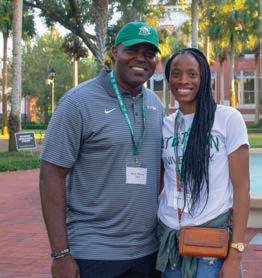
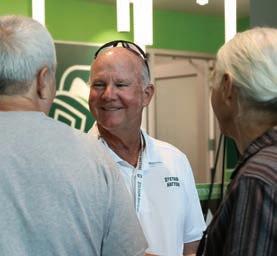
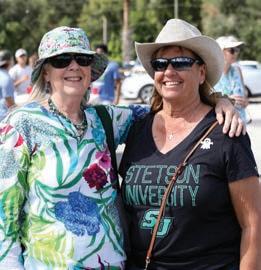
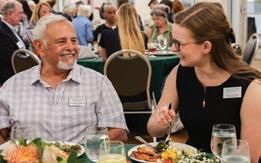
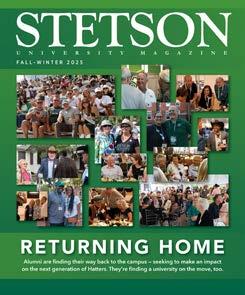
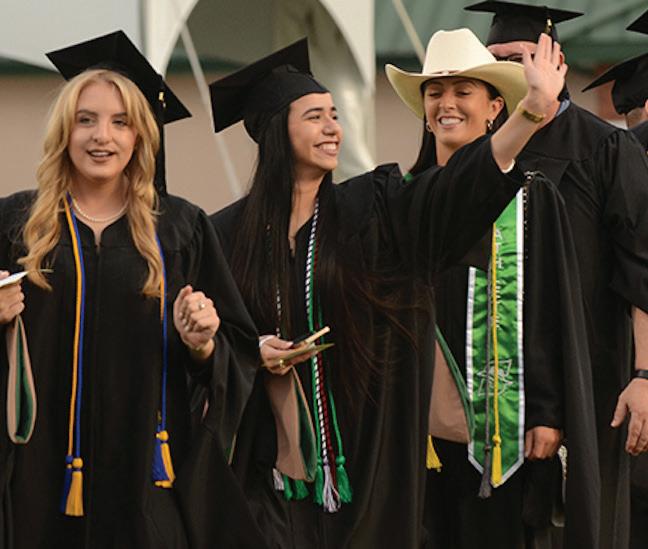
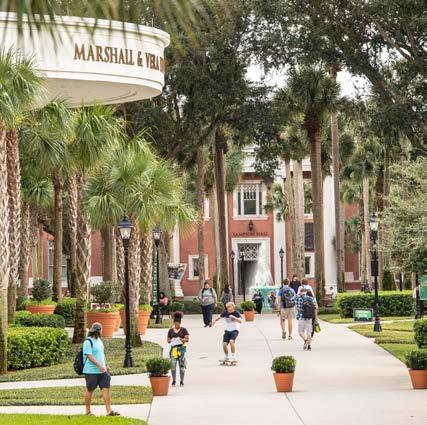
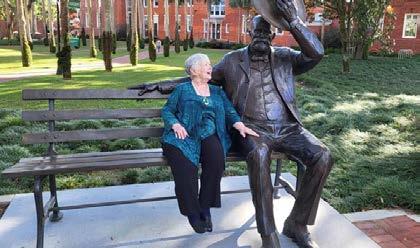
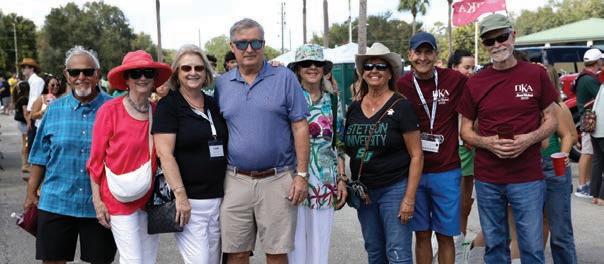
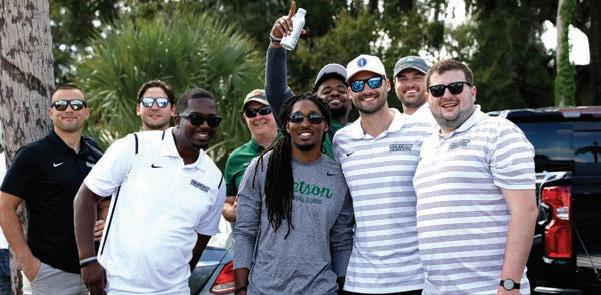
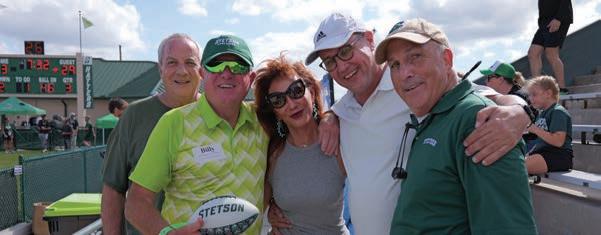
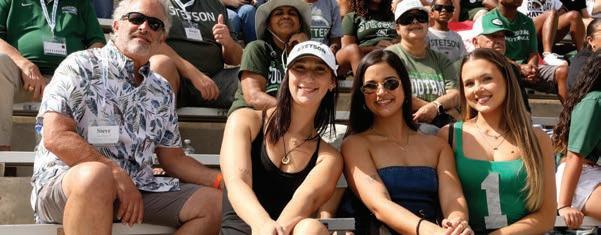
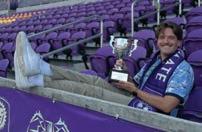
Alumni are finding their way back to the campus — seeking to make an impact on the next generation of Hatters. They're finding a university on the move, too.
DAY ONE
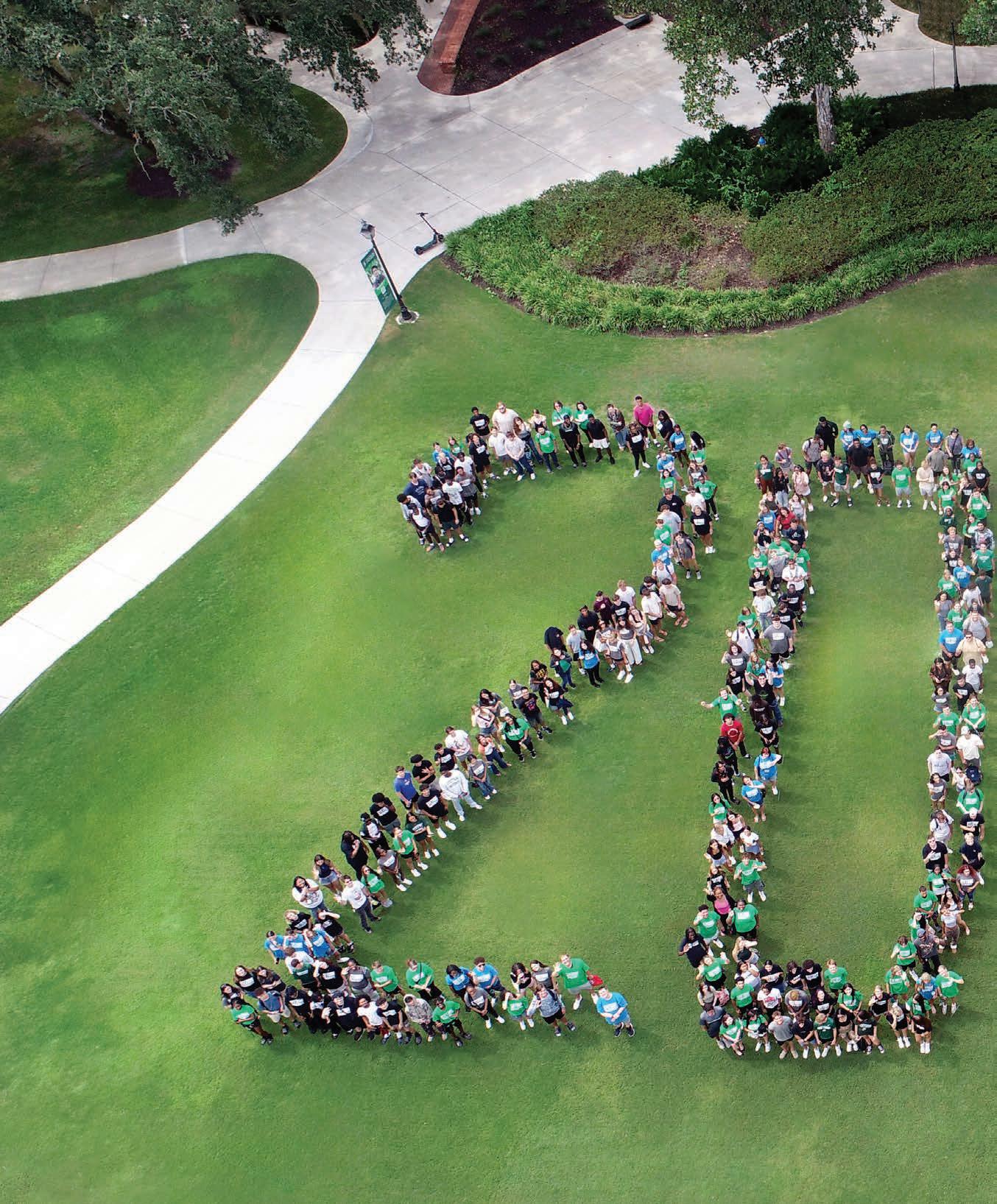
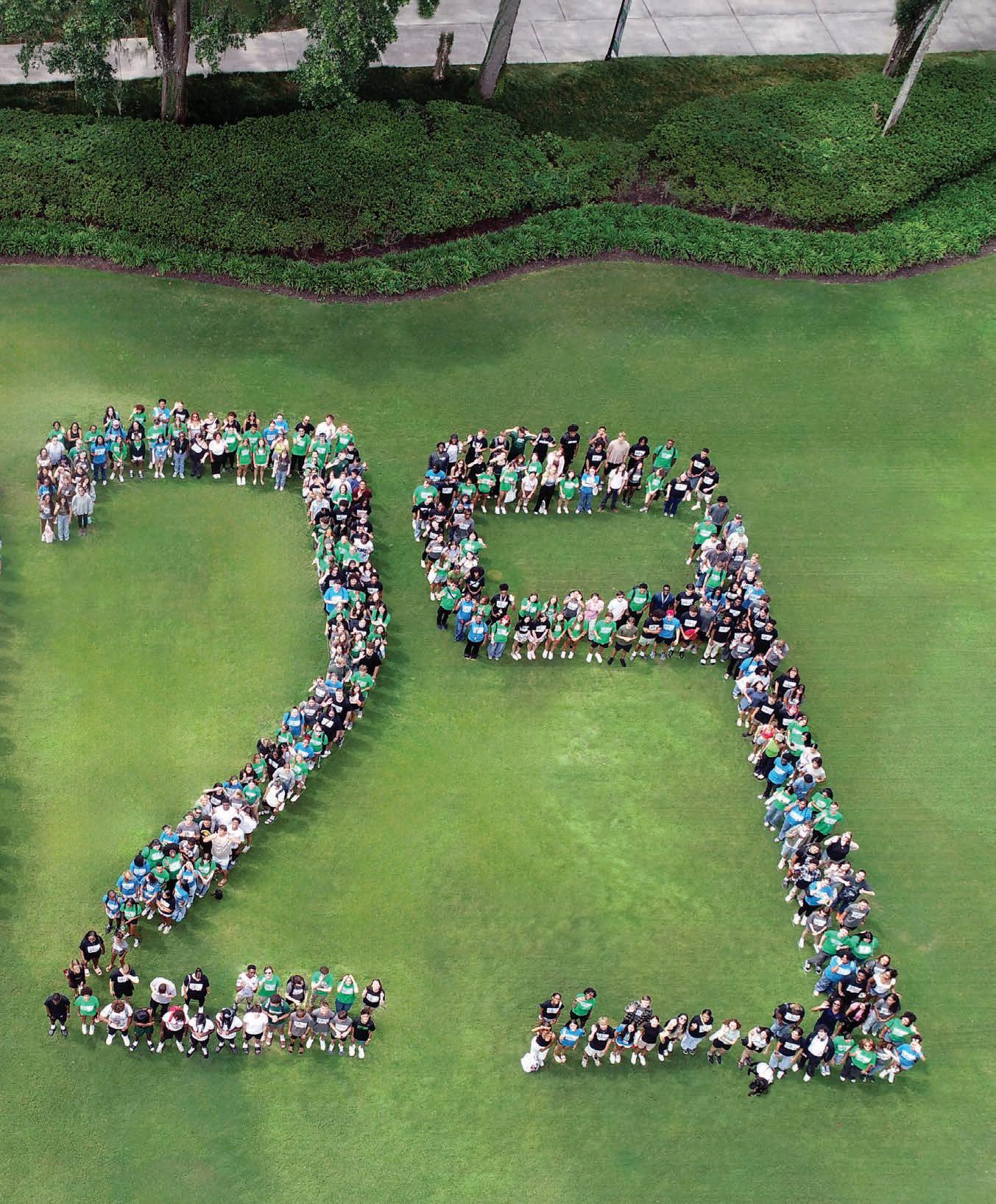
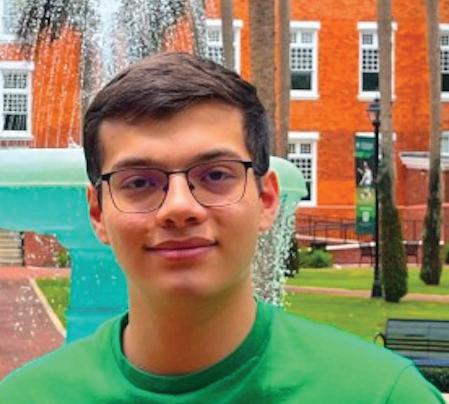
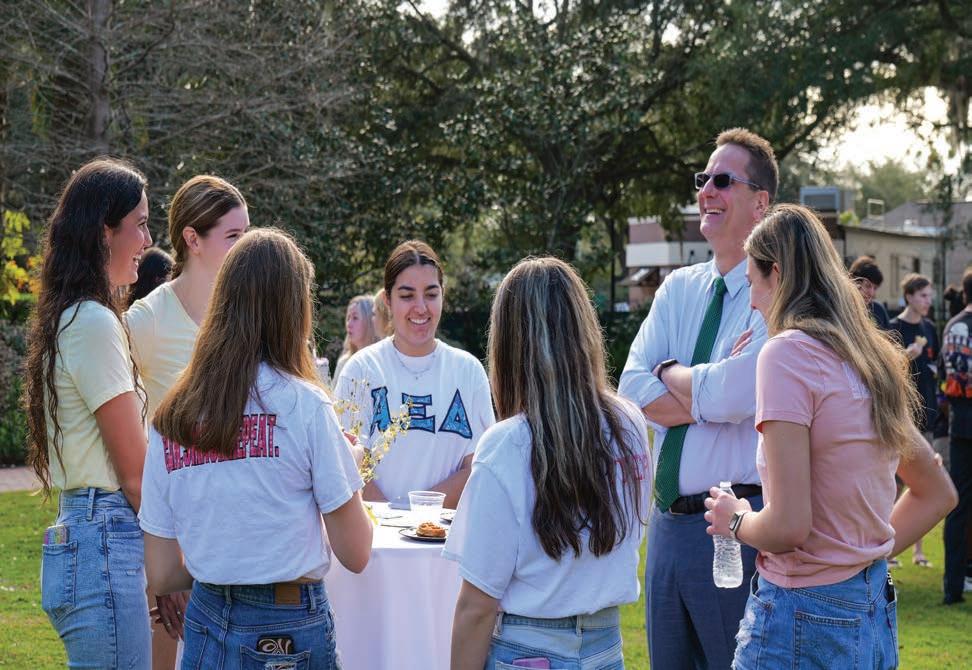
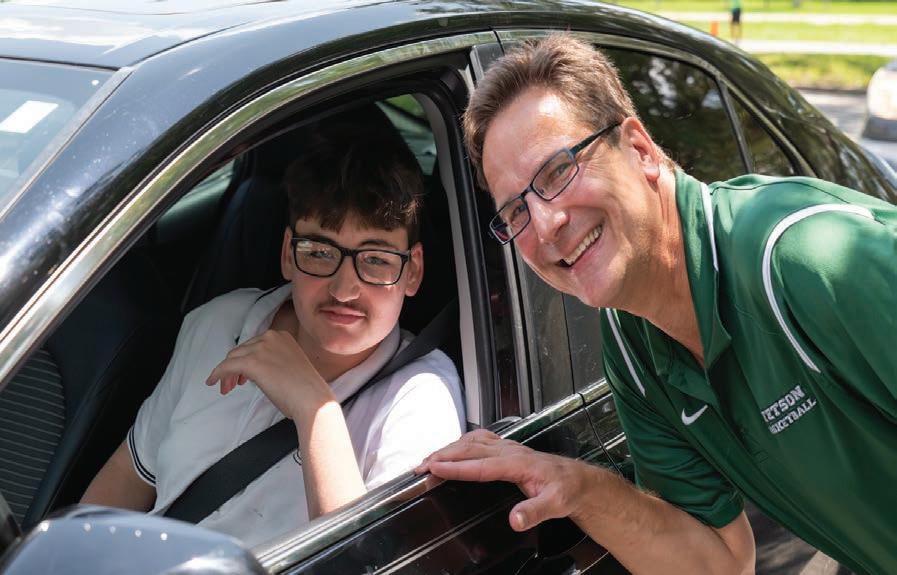
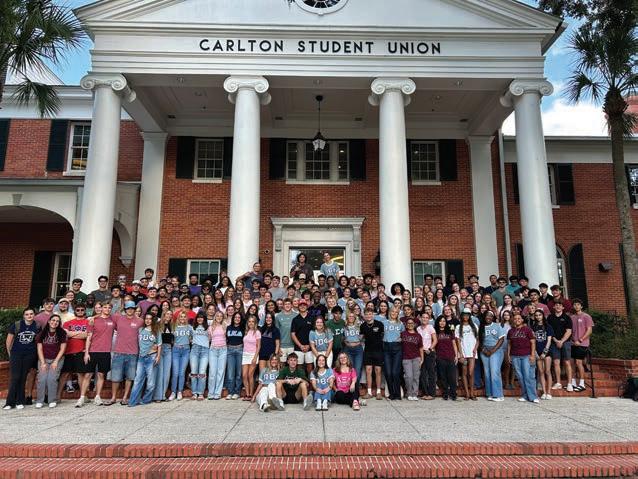
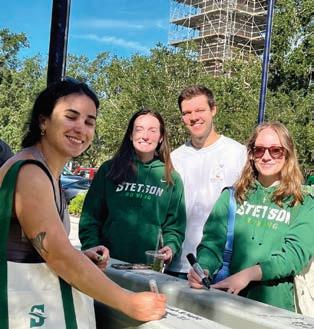
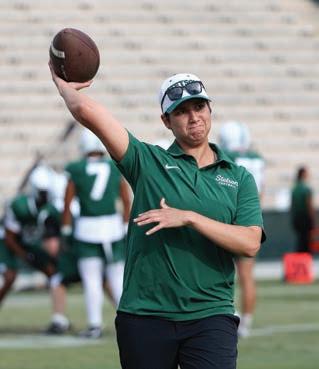
Move-In Day on Saturday, Aug. 16, was big for hundreds of new Hatters in the Class of 2029 — their first day on campus.
“It was energizing seeing students transform their room from blank canvas into warm second homes away from home,” described Jessica Day, executive director of Residential Living and Learning. “Families, from just a few blocks away to thousands of miles across the country, shared how eager they were for their students to find their place at Stetson.”
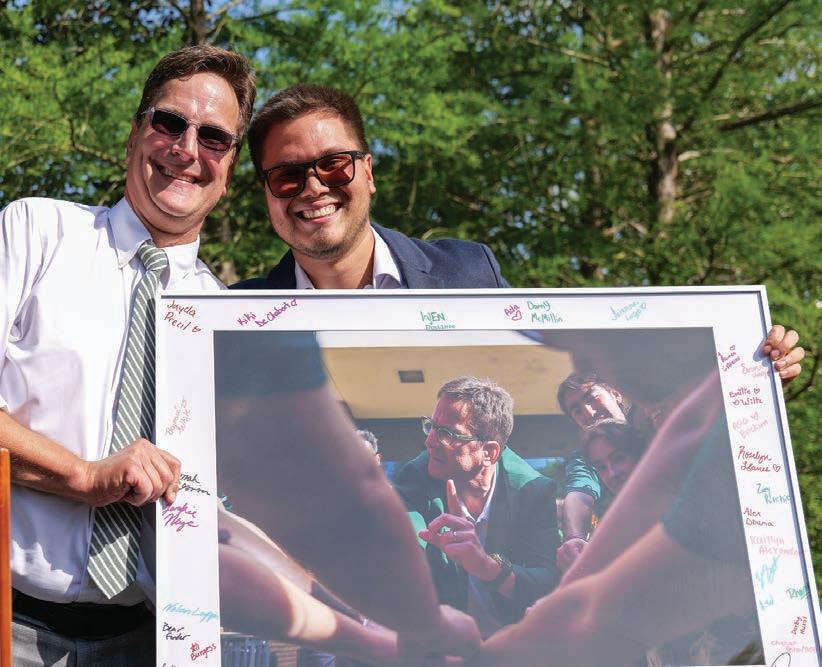
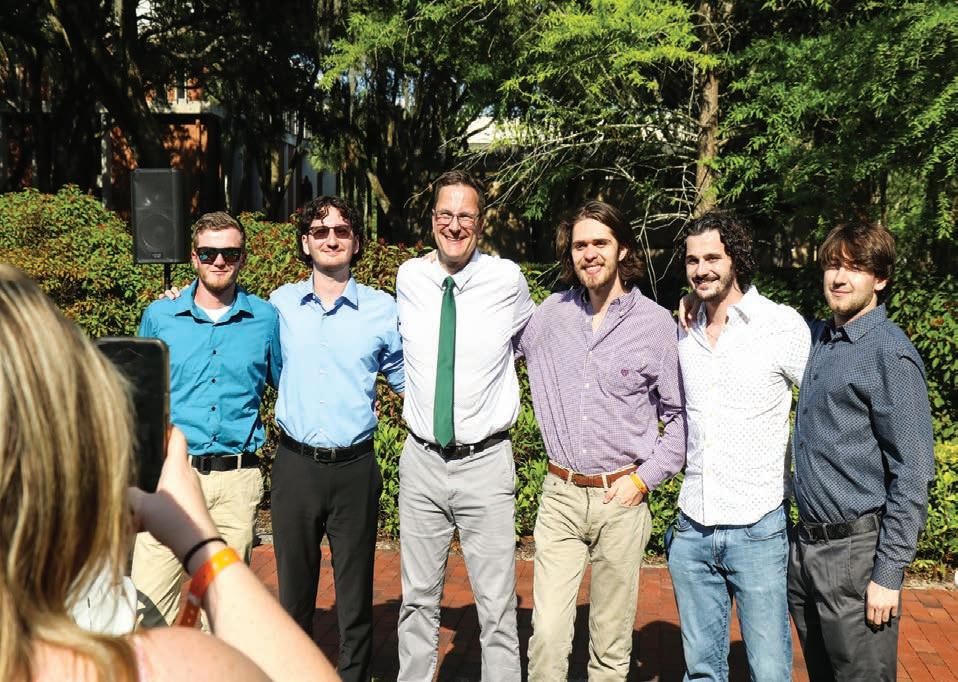
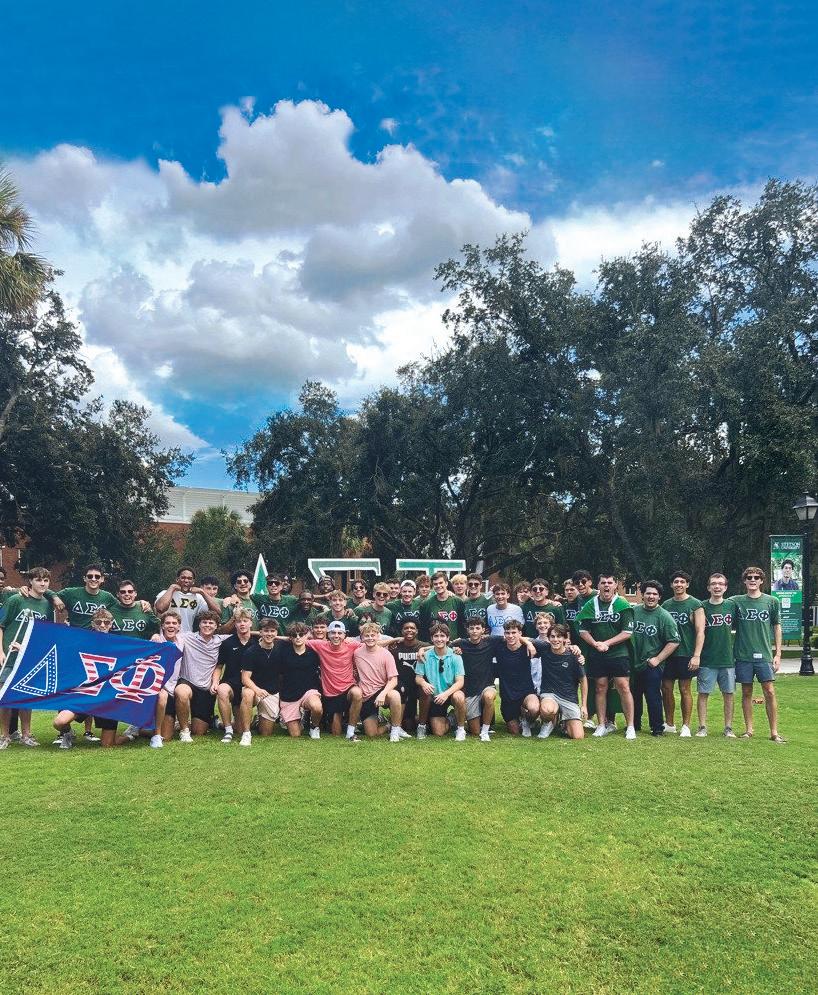
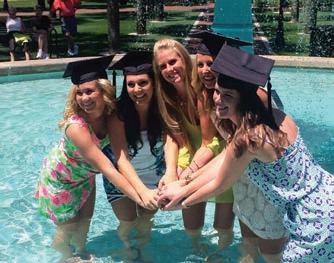
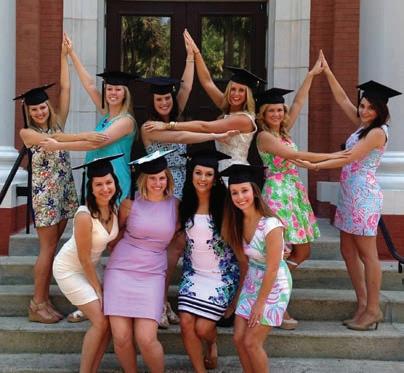
Then, as is tradition, it was time for all to gather on the Stetson Green for their first official class photo.
Smile, click and their journeys began.
18 Harnessing Alumni Talent and Passion
Laying the groundwork for an Atlanta alumni chapter — with a plan for others to come.
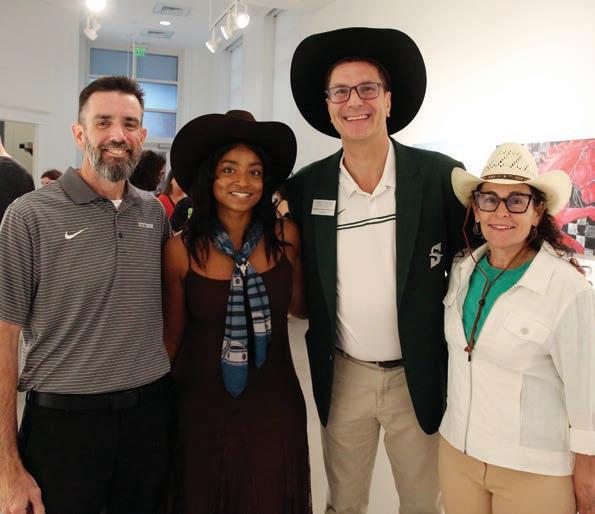
20 Style, Substance and Stetson Hats
Celebrating the 160-year legacy of the John B. Stetson Company, exhibits on campus explore themes that resonate with its founder, his famous hats and his namesake university.
24 A S.U.R.E. Summer
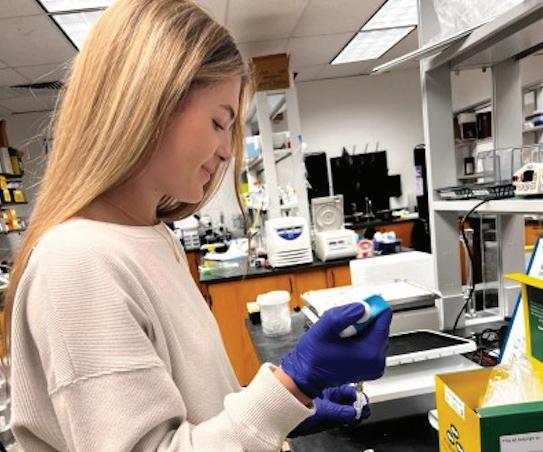
The ambitious work — and personal sacrifice — of four students exemplify the “amazing” and “incredible” Stetson Undergraduate Research Experience.
FALL-WINTER 2025 VOLUME 41 ISSUE 2
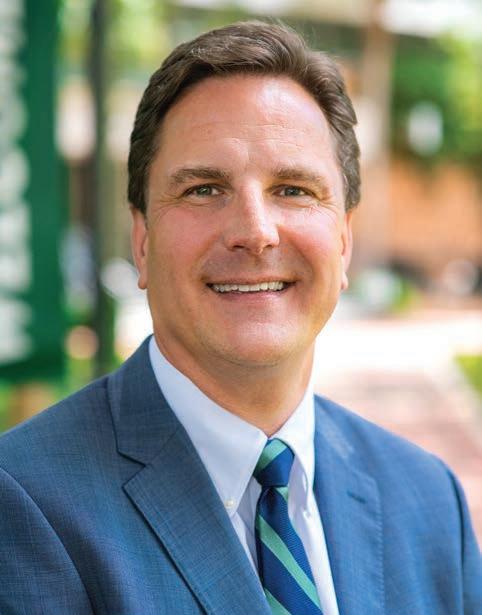
President
Christopher F. Roellke, PhD
Editor
Michael Candelaria
Designer Kris Winters
Art and Photography
Jodi Cothron ’19
Writers
Renee Garrison, Amy Gipson, Travis Hill ’16, Pamela A. Keene ’74, Patricia Letakis, Elizabeth Maycumber, Andrea Mujica, Becky O’Mara ’03, Christopher F. Roellke, PhD, Jack Roth
Class Notes Editor Amy Dedes ’04
STETSON UNIVERSITY MAGAZINE is published by Stetson University, DeLand, FL 32723, and is distributed to its alumni, families, friends, faculty and staff. The magazine is printed on FSCcertified paper.
STETSON UNIVERSITY: The College of Arts and Sciences, School of Business Administration and School of Music are at the historic main campus in DeLand. The College of Law is in Gulfport/St. Petersburg. The university also has one satellite center: the Tampa Law Center. The mission at Stetson is to provide an excellent education in a creative community where learning and values meet, and to foster in students the qualities of mind and heart that will prepare them to reach their full potential as informed citizens of local communities and the world.
To add, remove or change your magazine subscription, email universitymagazine@stetson.edu.
28 The Remarkable Ascent of Devin Hernandez
Here’s how one transfer student turned a 2024 senior thesis on methadone into full-ride doctoral study at Johns Hopkins University.
30 Snapshots of Student Impact
The 2025-2026 academic year marks Year 6 of the President’s Stetson tenure — and his laser focus on students.
34 ‘Revolution in Education’
Celebrating its 25th anniversary, the Nina B. Hollis Institute for Educational Reform continues to impact K–12 school administrators, teachers and students.
38 Resilience of An Educator
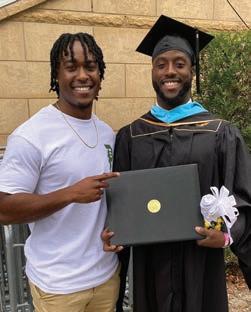
From sleeping on couches to shaping young lives, alumnus Jackie Johnson’s journey is a testament to faith, grit and the power of education.
40 100 Years and Counting
Stetson’s Delta Sigma Phi chapter celebrates its centennial of changing lives through brotherhood, philanthropy and leadership.
44 Stand Up Hulley
Galvanizing alumni everywhere, the historical reconstruction of Hulley Tower has revealed many finds — including the Soul of Stetson.
45 Remembering Stetson
Alumni share lasting memories about their alma mater.
48 Portrait of Coming Full Circle
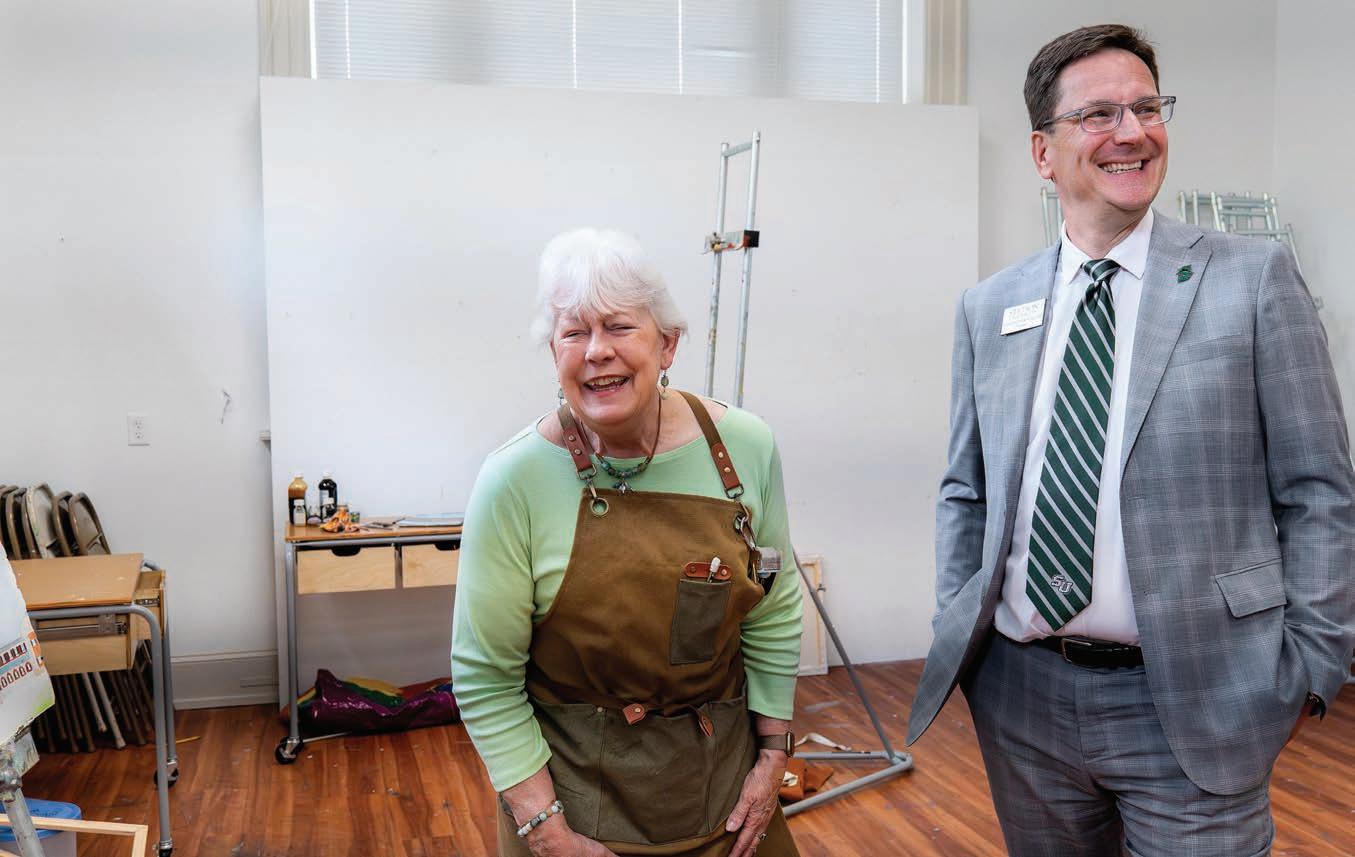
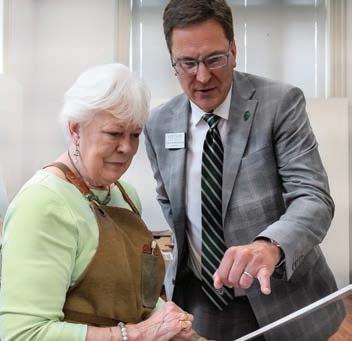
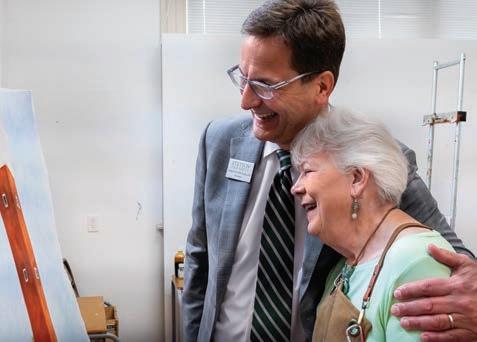
Diane Erickson ’74 draws on a lifetime bond to capture Stetson in art, including a watercolor painting of the new Hulley Tower.
50 Hopeful Journeys
Student Dan Hedrick and alumnus Bruce Rogers ’84 prove Stetson connections are strong, even if they happen by chance.
ON THE COVER:
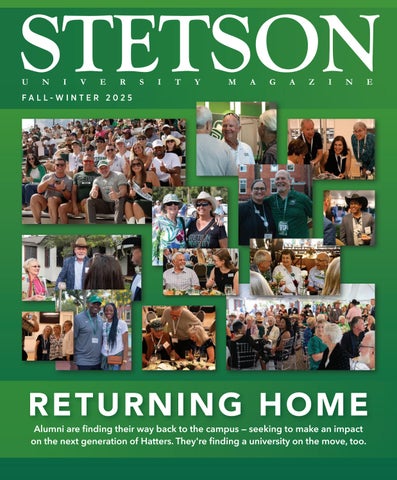
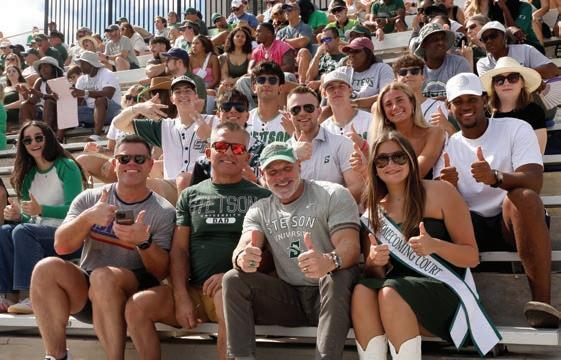
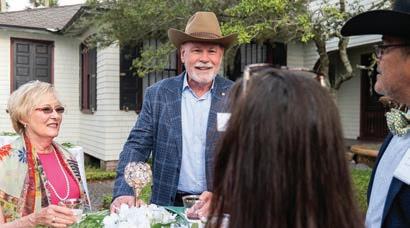
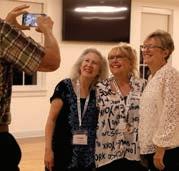
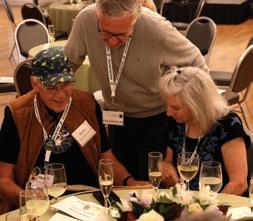
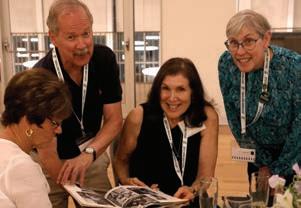
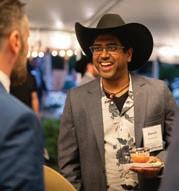
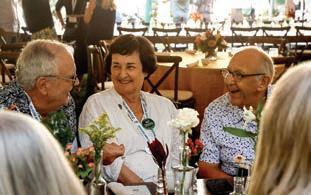
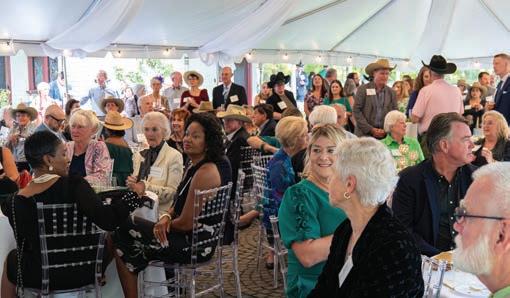
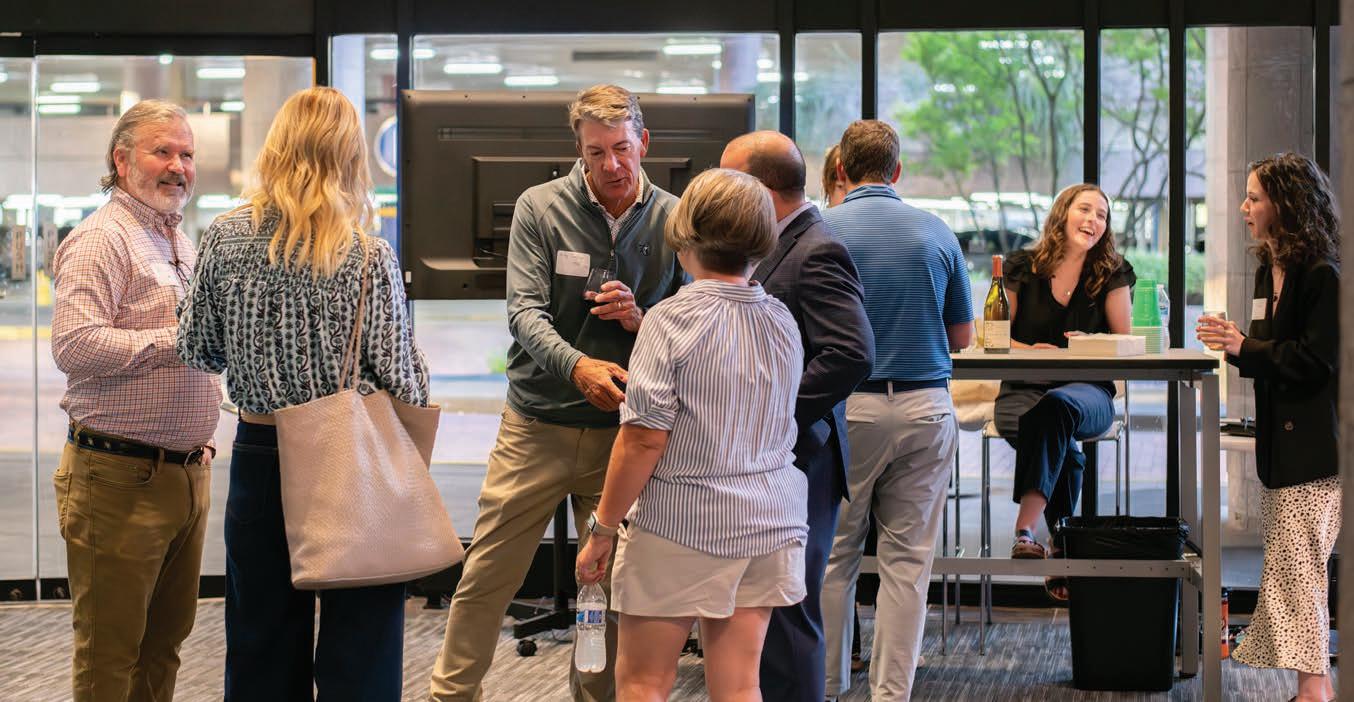
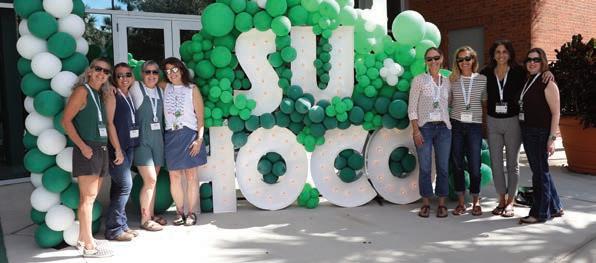
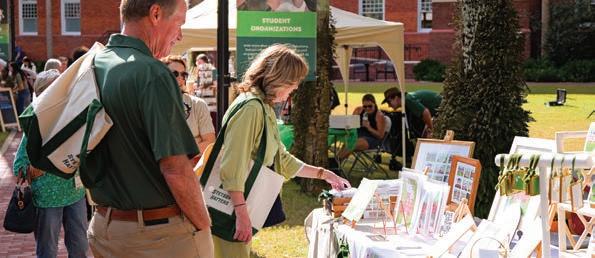
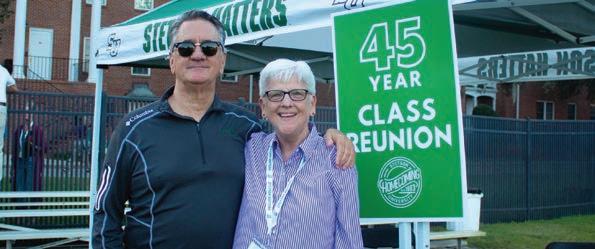
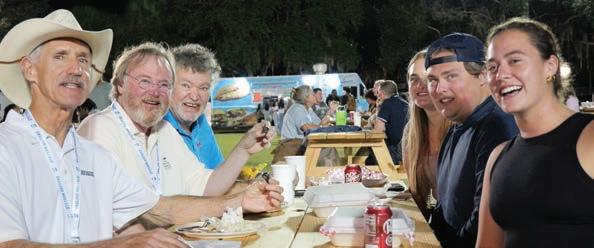
During an event-filled Homecoming Week in October, alumni from near and far descended on the Stetson campus to reconnect, reminisce and re-engage. Alumni arrived on campus from as far away as Brazil and the United Kingdom.
THANK YOU!
What a time to have a Homecoming. We have such good news to report.
Stetson has a top-10 regional ranking by U.S. News & World Report in areas like Best Value, Most Innovative and Best for Undergraduate Teaching. We’re a “Best” college, according to The Wall Street Journal. We’re a national College of Distinction, too. Our College of Law is again No. 1 in Trial Advocacy and No. 3 in Legal Writing. And we’re Central Florida’s “favorite” college, as voted by the readers of the Orlando Sentinel That’s ahead of 28 other colleges — including the University of Florida, the University of Central Florida and Rollins College! I didn’t say it; Central Florida did.
These are truly powerful independent validations!
In addition, as you’ll read in this issue of the magazine, our university-wide Hatter Ready initiative is in full bloom — from study abroad and internships to student research, such as in the Stetson Undergraduate Research Experience program. Over the summer, that research occurred on campus and in other parts of the world.
Plus, this fall, our student research was bolstered by two federal awards, one from the National Science Foundation and a second from the National Institutes of Health.
This innovative, hands-on learning is especially important because of workforce needs in the future. By 2032, approximately 4.5 million additional U.S. workers with at least a bachelor’s degree will be needed, according to a September report from Georgetown University’s Center on Education and the Workforce.
Is a college education needed in today’s world? You bet it is.
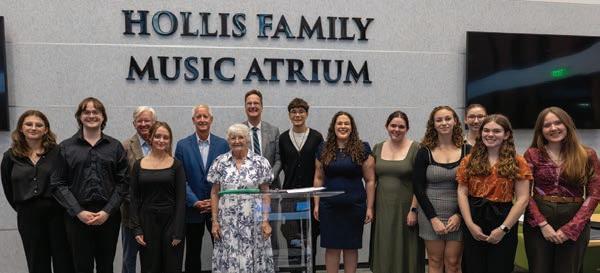
Meanwhile, we continue to invest in new and upgraded facilities. Lynn Hall, our new 305-bed residence hall, will open in January. The outdoor center courtyard of Presser Hall has been converted into the Hollis Family Music Atrium. On Feb. 7, Hulley Tower will be dedicated. The Edmunds Center, with all work completed by January, will become ADA-compliant, with an elevator as well as a renovated lobby, lounge and coaches offices. The Edmunds Center is the largest gathering space on campus for events like Convocation, Commencement and Hatter Saturday. Also, the Edmunds Center is home to Hatters basketball and indoor volleyball, which brings this to mind: More than 40 of our current student-athletes recently achieved perfect 4.0 GPAs!
Throughout our campus, the additions and enhancements are all part of our quest to provide the best educational and collegiate experience for our students.
Despite the challenges of higher education’s current environment, our students are showing unity at a time when that is not common across the country. One example is a recent joint interview for Central Florida Public Media involving the presidents of Stetson Democrats and College
Republicans. The two students talked about their strong friendship and the importance of civil, non-violent conversation and action. Then, a few weeks later, all of our Greek fraternities and sororities came together to sign The Central Florida Pledge, a community-driven regional initiative to combat all forms of hate and discrimination.
Alumni, I say be proud of these accomplishments! Also, I say, thank you.
As you’ll read, our alumni are doing great things, too. That includes new alumni such as Devin Hernandez and Jackie Johnson, along with alumni like Diane Erickson from past decades.
Even more impactfully for Stetson, alumni are helping their alma mater around the country. I have always believed that being connected through a robust alumni network is a win-win for our alumni and our students, who look to that network for career advice and a foot in the door for internships and jobs.
WE ARE A COMMUNITY DEFINED BY OUR VALUES AND OUR CARE AND SUPPORT FOR EACH OTHER — WHAT WE CALL THE SOUL OF STETSON.
Not long ago in Atlanta, 12 of our students visited Delta Air Lines, accompanied by staff from our Office of Career Success. They spent a day at Delta meeting with other alumni. And that’s just one example. Also in Atlanta, more alumni are working earnestly to establish an alumni chapter.
On campus, our Alumni Engagement and Annual Giving office is developing new ways to engage alumni — to support student recruitment, retention and career outcomes. We are also restructuring committees to focus more closely on university priorities and identify alumni volunteers. Alumni are becoming regional recruiters; they are guest speakers who also engage in our student organizations; and they are helping to inform the university about emerging employer needs.
It’s no surprise that Stetson’s strength is its people. We are
a community defined by our values and our care and support for each other — what we call the Soul of Stetson. We place in high regard the values of intellectual exploration, being an inclusive and global community, honoring the dignity of all, and creating a transformative environment that leads to personal growth. Indeed, Stetson’s people personify “relationship-rich,” which is the guiding theme that anchors our Strategic Plan. And, during our Values Day on campus Nov. 13, we unveiled a revised set of university values: Intellectual Exploration, Inclusive Community, Human Dignity and Personal Growth. The aim was to make our values applicable to all community members and reflective of collective commitments.
With the 2025-2026 academic year marking my sixth as president at Stetson, I humbly say to everyone, THANK YOU.
Christopher F. Roellke, PhD President, Stetson University
INTELLIGENTSIA
A ‘Best’ College in the South
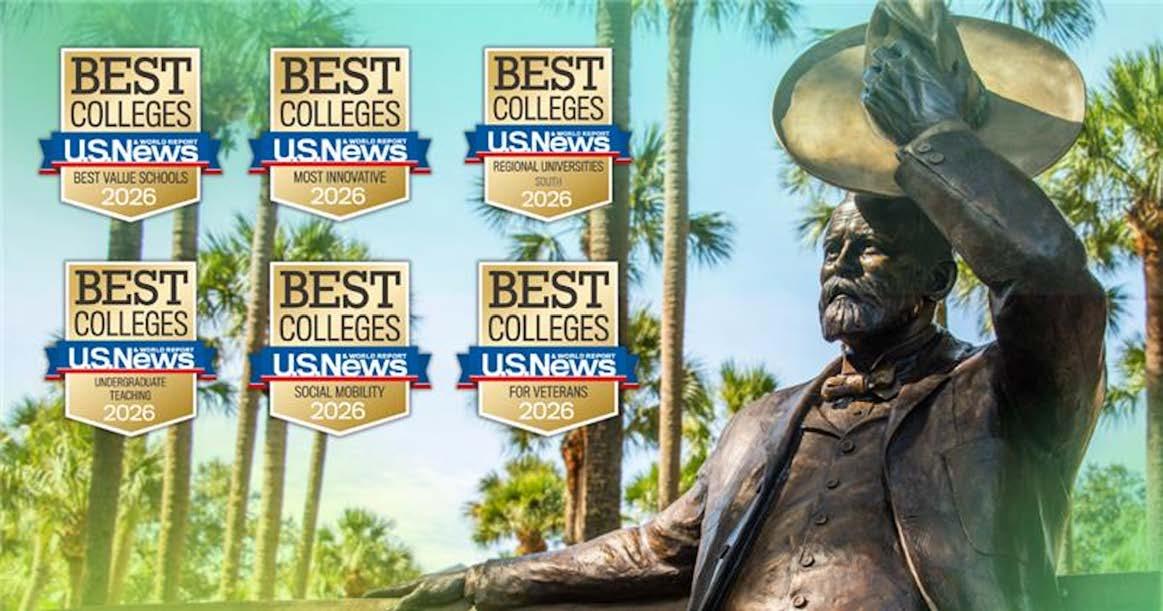
Stetson was ranked as one of the Best Colleges in the South for 2026 by U.S. News & World Report and also was recognized among Best Value Schools, Most Innovative, Best for Undergraduate Teaching and Best for Veterans.
The 2026 Best Colleges rankings by U.S. News evaluated more than 1,700 U.S. colleges and universities, using up to 17 factors to measure academic quality and graduate success.
Stetson was ranked again as the No. 7 Best Regional University in the South, No. 7 Best Value School and No. 7 Most Innovative in the South. In addition, Stetson was ranked No. 9 Best for Undergraduate Teaching, No. 20 Best College for Veterans and a Top Performer on Social Mobility in the South.
The college rankings focus on undergraduate programs and provide prospective students and their families with valuable information to compare America’s colleges and universities, according to LaMont Jones, EdD, U.S. News managing editor for Education.
“U.S. News’ Best Colleges remains a reliable resource for prospective students and their families as they navigate the college selection process,” Jones said. “With over half of the ranking factors dedicated to student outcomes, the rankings and editorial content provide vital data, college advice and informed reporting to every student pursuing higher education.”
NEWS AND NOTES ABOUT KNOWLEDGE
One of America’s ‘Best Colleges’
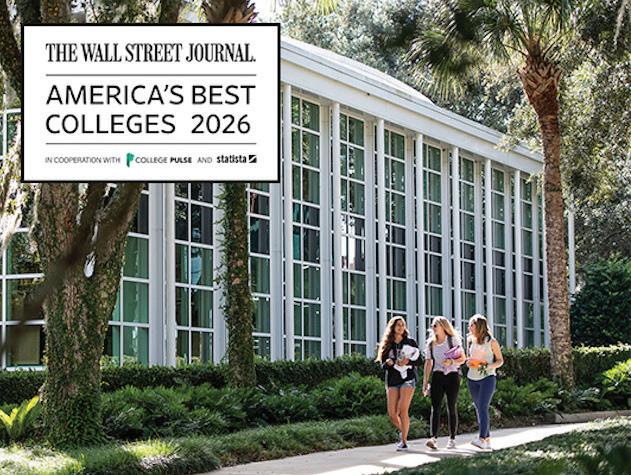
The Wall Street Journal has selected Stetson as part of its 2026 Best Colleges nationwide, a ranking of how well schools do in preparing their graduates for financial success. Stetson also placed in the Top 10 of Florida colleges for providing a “great experience” for students.
The Wall Street Journal/College Pulse rankings are based on factors such as student outcomes, graduates’ salaries and the quality of the learning environment. More than 1,500 U.S. colleges met the eligibility criteria, and 584 schools were included in the 2026 rankings.
“This latest ranking validates the work we do every day!” said Jeffery T. Gates, senior vice president for Enrollment and Marketing. “It also reflects Stetson’s strategic priorities to emphasize and foster the student experience.”
At Stetson, students experience a vibrant campus with more than 130 clubs and organizations, including Greek life, club and intramural sports, and robust NCAA Division I Athletics. The DeLand campus has been named one of the Most Beautiful College Campuses in the South and one of the most pet-friendly campuses in America. Further, through Stetson’s Hatter Ready program, students apply what they learn in the classroom to real-world settings, such as internships, research and study abroad.
In addition, The Princeton Review selected Stetson as one of the Best Colleges in America for 2026, honoring the university for the 11th straight year for its “outstanding academic programs.”
The Princeton Review analyzed institutional survey data and student surveys to determine the Best 391 Colleges for its annual college guide. Only about 15% of America’s 2,400 four-year colleges are included in the guide.
Again a College of Distinction
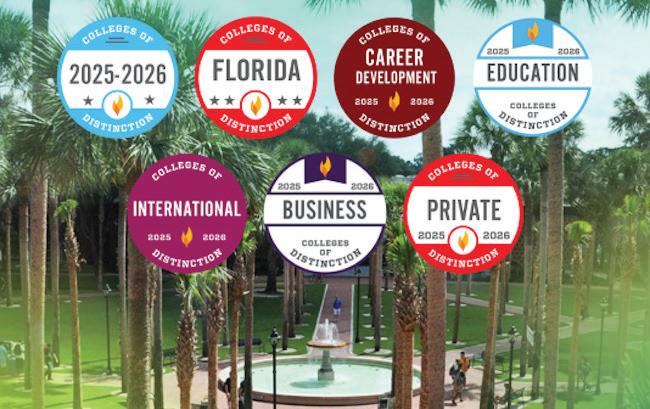
For the third consecutive year, Stetson has been named a national College of Distinction, making it one of the “best private colleges” and a “top school in Florida.”
Colleges of Distinction is an independent national guide. Through extensive research and interviews, it evaluates schools in four key areas: engaged students, successful outcomes, great teaching and vibrant campus communities. Aside from the overall distinction, special recognition was given to Stetson for Business programs, Career Development and exceptional support for international students, as well as for Education programs.
Among the highlights: Stetson provides a transformative undergraduate experience with small classes and a student-to-faculty ratio of 10-to-1, allowing students to work closely with world-class faculty. Also, outside the classroom, students are immersed in hands-on learning, such as internships, research and study abroad, through the Hatter Ready program. The program features experiences that prepare students for successful careers, with 93% of graduates already gaining employment or admission to many top graduate schools.
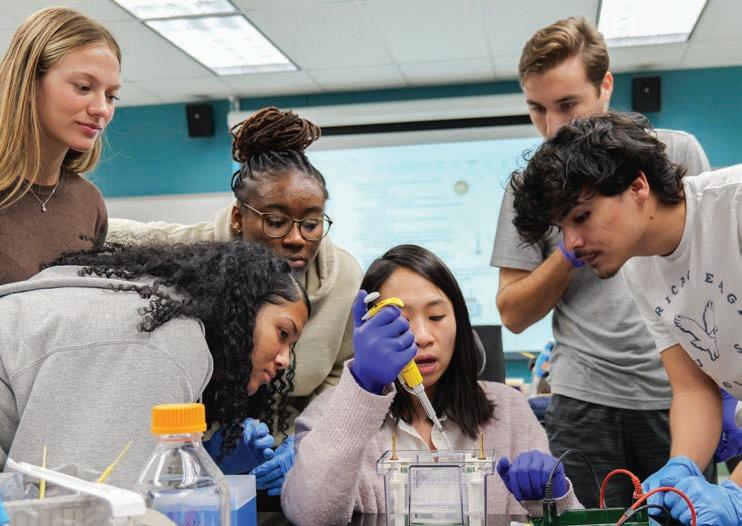
Associate Professor Lynn Kee, PhD, is surrounded by eager learners in a Biology class. The new S-STEM award will bolster efforts to teach such students, beginning next fall.
Stetson Wins $2 Million Science Award
Overcoming long odds, Stetson received a National Science Foundation S-STEM Award that totals $1,999,991 over six years to support 24 STEM scholars across two cohorts of 12 students, beginning in the Fall 2026 semester.
The award includes support for academically talented students with financial need (up to $15,000 per year, with an expected average award of $12,500 for each student). Ultimately, the program is designed to retain, graduate and prepare those students for careers in STEM through evidence-based practices such as summer research, a discovery-focused and cohort-based curriculum, a summer bridge program, a themed colloquium each semester, and enhanced advising.
Courses will be available in four tracks: Life Sciences, Field Sciences, Mathematics/Computer Science and Biophysical/Chemistry.
The award is especially impressive, given the current environment where awards have dwindled. Stetson had received a similar award in 2021.
“I think NSF and the folks who reviewed this really believe in us as a team and believe in Stetson,” said Matthew Shannon, PhD, assistant professor of Biochemistry, who will serve as the Principal Investigator. “I think we’ve demonstrated enough success with our current grant … That’s what makes another grant like this a great opportunity for our students.”
Shannon will be joined by a team of other faculty co-Principal Investigators.
“The NSF S-Stem grant is a seminal program in Stetson fulfilling its mission and commitment to providing experiential, contemporary and integrative learning for all students,” said Kyle Longest, PhD, dean of the College of Arts and Sciences.
Stetson Receives Substantial Research Grant
In October, Assistant Professor Kristine Dye, PhD, and Stetson were granted $547,875, following her first Research Enhancement Awards proposal to the National Institutes of Health. The accomplishment is considered rare for a first-time effort, especially at a time when government funding for such grants is limited. Research Enhancement Awards, dubbed R15, support research projects at educational institutions that provide baccalaureate or advanced degrees for a significant number of the nation’s research scientists but that have not been major recipients of NIH funding. In particular, the awards are intended to support meritorious research, expose students to research and strengthen the research environment of the institution.
In recent years on campus, Dye has led students in the exploration of viruses responsible for cancer and infectious diseases such as Merkel Cell Carcinoma and COVID-19. This latest award bolsters her efforts to continue high-impact biomedical research on campus among undergraduates, another rare occurrence nationwide.
Free Inquiry Series Continues to Enable Open Dialogue
Stetson’s Free Inquiry & Expression and the Future of Democracy Series, established last January, continued during the fall semester. The series is intended to enable open dialogue about a wide variety of timely topics through national speakers, panel discussions and civil discourse.
Among the September highlights were presentations by voting rights advocate Desmond Meade, president of the Florida Rights Restoration Coalition; and Steven David, PhD, professor of international relations at Johns Hopkins University.
In October, Tony Banout, executive director of the Chicago Forum on Free Inquiry and Expression, led an in-depth exploration of free inquiry and expression and the future of democracy. In November, William B. Taylor, former U.S. ambassador to Ukraine, spoke about the changing American policy toward Russia, as well as the threats posed by Russia to the free world and democracy since the Soviet Union’s fall.
Historically, Stetson has been committed to free expression, and recent affirmations of a formal commitment can be traced back to spring 2019, when faculty and staff in DeLand and at the College of Law in Gulfport drafted a statement of principles of free expression, which was approved by the university’s Board of Trustees.
More recently, College of Arts and Sciences
Dean Kyle Longest, PhD, and David Hill, PhD, professor of Political Science, were in Chicago for the second Academic Freedom Institute. There, they joined representatives from a broad spectrum of colleges and universities — from Harvard and Dartmouth to Virginia Tech and Baylor to Ball State and the College of Charleston — and engaged in discussions regarding the “current challenges around this idea of academic freedom, freedom of expression and institutional neutrality,” Longest stated.
The new MBA ranking adds prestige for graduates.
MBA Program Earns ‘On-Campus’ Acclaim and Adds HR Concentration
Stetson’s School of Business Administration has been recognized as having one of the nation’s Best On-Campus MBA Programs for 2025 by The Princeton Review. The ranking is based on career outcomes, admissions selectivity and academic rigor, as well as feedback from students.
Stetson’s Master of Business Administration program offers four concentrations: Accounting, Data Analytics, Finance and a new track for Human Resource Management.
Stetson undergraduate students also have the option to participate in the Accelerated Bachelor's to MBA, a program that allows them to take two classes as electives while they are undergraduates. When they are admitted into the graduate program, the requirement to take the graduate-equivalent classes is waived.
Additionally, in response to fierce competition for talent, as well as rapid advances in artificial intelligence and persistent labor shortages, the School of Business Administration has launched a human resources management concentration within its MBA program.
The new concentration, in keeping with Stetson’s emphasis on experiential learning, uses applied projects, employerinformed cases and focused labs that mirror real HR decision-making. Those practice-based components help graduates demonstrate job-ready skills and strategic judgment — an advantage in a competitive HR and people-operations job market.
Students will learn to align HR strategy with hiring and onboarding to achieve organizational goals. They also will practice job analysis and role design, training and performance management, compensation and benefits, and leading a culture change within an organization.
Young Sound Seekers Featured in Documentary
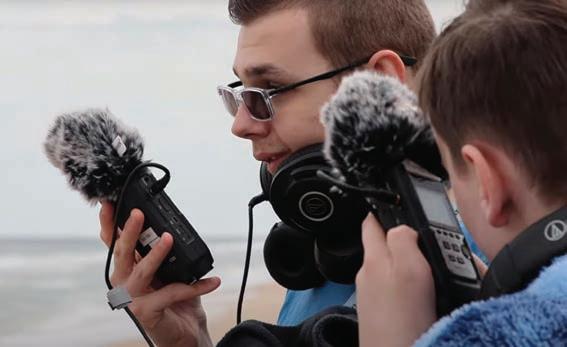
Undergraduate students took part in a one-of-akind learning experience that was featured in the documentary Postcards From Canaveral, which premiered in late September.
“Postcards From Canaveral” tells the story of the Young Sound Seekers program, a five-year collaboration among Stetson, the Conklin Davis Center for the Visually Impaired in Daytona Beach and Atlantic Center for the Arts. The program was supported by a $300,000 grant from the National Park Service’s Natural Sounds and Night Skies Division to promote accessibility and conservation nationwide.
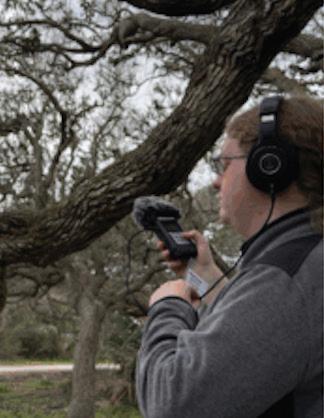
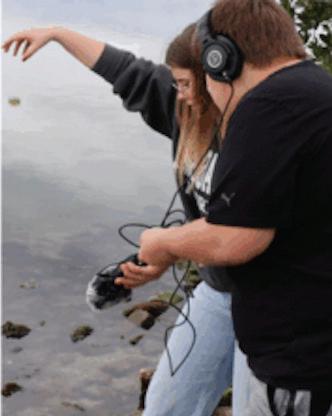
Led by Stetson Professor Nathan Wolek, PhD, the students partnered with blind and partially sighted youth to create audio tours for the National Park Service at Canaveral National Seashore and Merritt Island National Wildlife Refuge. Alongside Wolek, students captured audio recordings of natural sounds as an archive of the park’s ecosystem, providing a sensory tour that shares greater understanding of wildlife communication and the health benefits of time spent outdoors.
The experience is a demonstration of Hatter Ready, an innovative universitywide approach to specialized learning that enhances student engagement through immersive experiences — internships, research, study abroad and more
The innovative media arts project is a one-of-a-kind learning experience.
— to prepare students for successful careers after graduation.
While on the excursions, mentorship between the Stetson students and Conklin Davis youth included writing the audio tour script and recording voice-over narration, further strengthening community partnership and bolstering confidence for those with visual impairment.
“When we started Young Sound Seekers, I knew there would be new opportunities for both community engagement and research,” said Wolek, a professor of Digital Arts and Music Technology at Stetson and a two-time Fulbright scholar. “What I did not expect was the variety of ways it would shape our learning.”
Through the project, the Young Sound Seekers group designed innovative media arts, such as an audio-described version of the visitor brochure for Canaveral National Seashore and Merritt Island National Wildlife Refuge. The group also provided consultation to the National Park Service to increase the accessibility of its website content, produced accessible audio tours for the park’s mobile app, and pioneered a curriculum of educational activities on active listening and natural sounds that was published by the park service’s Interpretation and Education Division.
The new department blends existing programs with promising enhancements for the campus.
New Department of Cultural, Civic and Community Engagement
In early 2024, as part of its newly introduced Strategic Priorities Framework, Stetson announced that its value proposition would revolve around offering a distinctive, relationship-rich learning experience — one that draws from “traditional strengths and integrates modern approaches.”
As the Fall 2025 semester began, that commitment continued to evolve and strengthen with the creation of a new student-focused entity that blends existing programs with promising enhancements: the Department of Cultural, Civic and Community Engagement.
The new department reinforces the well-established pillars of the Cross-Cultural Center and the Center for Community Engagement, while also adding the emerging Center for Dialogue and Civic Action.
With the reorganization, Erin Doggette, PhD, who arrived at Stetson in spring 2024, was named the executive director.
The overarching goal, according to Doggette, mirrors what is outlined in the university’s Strategic Priorities Framework, specifically: investing in student spaces that foster a strong sense of community; creating a robust undergraduate first-year experience that delivers on the promise of a relationship-rich education on campus; and contributing to a culture of career preparation throughout a student’s journey.
Hats Off to Stetson® Gameday Collection
In late September, Stetson® — as in the world-famous hat manufacturer — introduced a uniquely designed, officially licensed headwear collection for seven universities, including Stetson. The collection was offered in partnership with CLC, the nation’s leading collegiate brand licensing agency, and L2 Brands, a leading collegiate licensee.
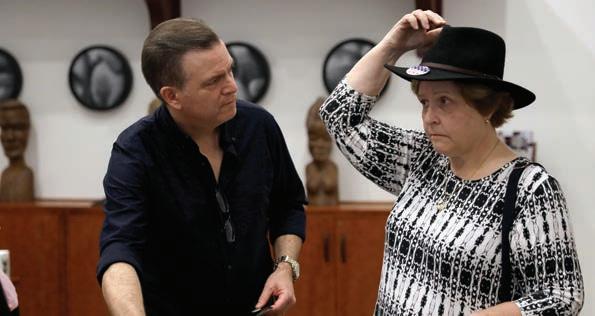
The hats, of course, were a big hit on campus.
Along with Stetson, the collection was exclusively available at Texas A&M University, University of Texas at Austin, University of Oklahoma, Texas Christian University, Texas Tech University and Oklahoma State University.
Link to the Stetson University Bookstore: https://www.bkstr.com/stetsonstore/home
Stetson was one of only seven universities to receive the collection.
Students Perform with Opera Orlando
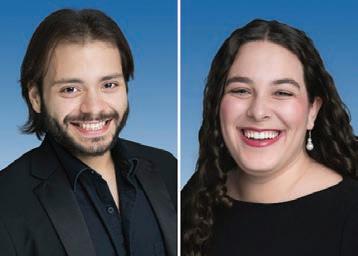
As part of its Apprentice Artists, Opera Orlando selected soprano Alyssa Pimentel and tenor Evan Martinez to the program. The voice majors in the School of Music were featured on stage in Opera Orlando's October MainStage production of La Bohème — another example of the university’s Hatter Ready initiative.
The Apprentice Artists program is specifically designed for undergraduate voice majors, providing them with the chance to earn college credit, receive professional experience and get paid for performing roles with a professional opera company.
Also featured in La Bohème and throughout the season is a Stetson trio in Opera Orlando's Studio
Artists program: soprano Alexandra Kzeski, mezzosoprano Ruoxi Bian and baritone Logan Tarwater. Studio Artists are in residence for the season and engage with the Central Florida community through in-school programs, retirement center concerts and other outreach events.
Said Opera Orlando Education Director Sarah Purser: “The Apprentice and Studio Artists programs are at the heart of what we do at Opera Orlando. These young singers are not just gaining on-stage experience, they are bringing artistry, energy and spirit into the community.”
Carnegie Hall Concert Named in Honor of Alumna
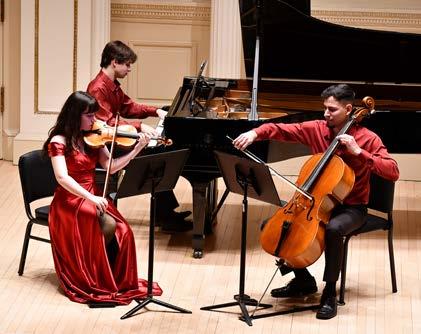
On campus Sept. 28, student auditions among Stetson’s talented soloists and chamber ensembles took place, with performers evaluated by a panel of independent judges. Those selected received the chance to perform on stage next spring at one of the world’s most celebrated concert venues: Weill Recital Hall at Carnegie Hall in New York City.
This year, and for the next five years, both events have been made possible by the charitable spirit of alumna M. Jean Greenlaw, who received her bachelor’s degree in 1962 and master’s in 1965. (She earned a doctorate at Michigan State.)
By virtue of her philanthropy, the School of Music’s big NYC evening has been aptly named the Dr. M. Jean Greenlaw Stetson University Concert, to be held on Friday, March 6, 2026, at 8 p.m. Greenlaw also has joined the School of Music’s Board of Advisors.
Students have been taking the Carnegie stage in this chamber music and solo competition since March 2023.
Following her time at Stetson, Greenlaw taught in public schools and was an active member of the University of North Texas faculty from 1978 until her retirement in 2005. She is a recognized expert and author in children’s literature and reading. In 1992, the International Reading Association honored her as an outstanding university teacher of children’s and young adults’ literature.
Over the years, Greenlaw’s college experience at Stetson stayed with her because of the impact of mentors, who remained helpful throughout her career, long after she had left as a student. In turn, as a lover of music, Greenlaw is helping to shape students at Stetson today.
Alumna M. Jean Greenlaw’s charitable spirit will help music students perform in New York City.
Tenor Evan Martinez (left) and soprano Alyssa Pimentel are voice majors.
Library’s Soundproof Addition
Creating a Buzz
When Katy Webb, dean of the duPont-Ball Library and Learning Technologies, came to Stetson in July 2024, she talked about bringing new innovation to the library and making it a “central place for students to come together to learn and grow.”
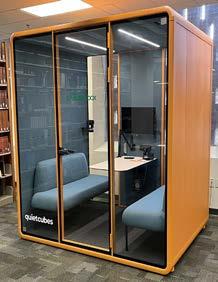
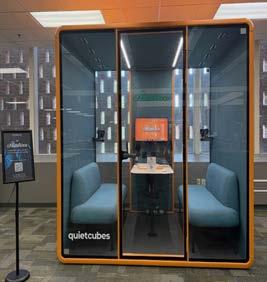
Arriving in August, the cHatter Box is the newest result.
Housed in a bright orange soundproof Quietcube at the back of the library’s main floor, the cHatter Box is a comfortable space that seats four people and contains audio and video equipment — giving students, faculty, archivists and community members (free of charge) a location to create audio recordings, streaming video podcasts, radio plays, oral histories and more.
And it made an instant impact in classrooms.
One example: Before the fall semester began and after hearing about the cHatter Box’s arrival on campus, Professor Michael Denner, PhD, rewrote the syllabus for his Freshman Seminar class. This fall, with an eye toward innovative learning, Denner is requiring his students to produce several short podcast clips that ultimately will be combined into an hourlong podcast by the end of the course, with students collaborating with one another.
“The goal is to engage students in a more interactive and hands-on learning experience, rather than just writing papers,” said Denner, who aside from the FSEM teaches within Russian, East European and Eurasian Studies. “They’ll continue to write papers, but in addition to writing papers, they make podcasts on topics in the class.”
Ongoing Construction
Reshapes Campus
Almost unprecedented construction activity continued through the summer and into the fall — with four projects on campus requiring cranes at the same time, thanks in part to generous donor support.
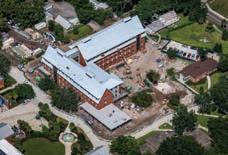
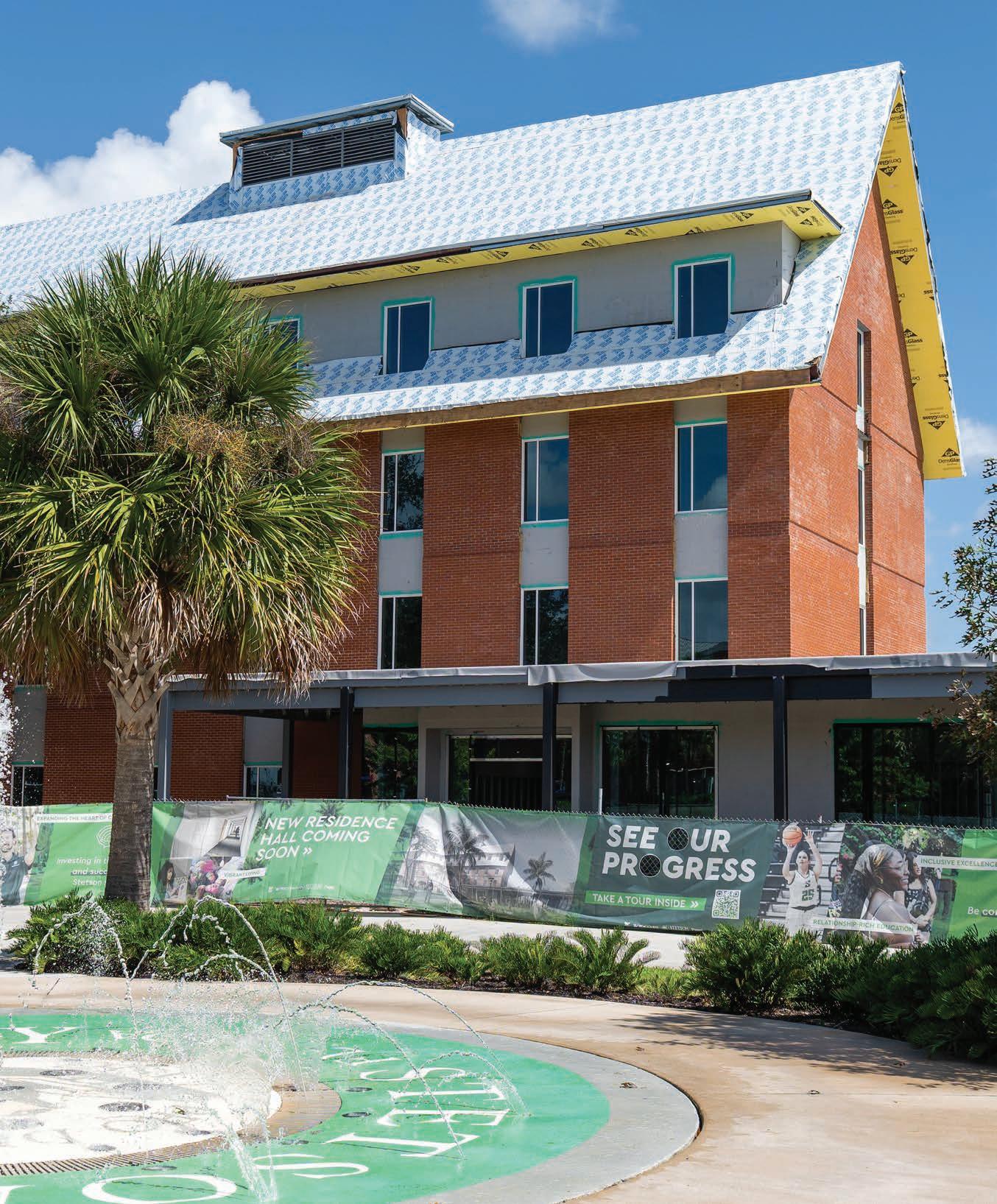
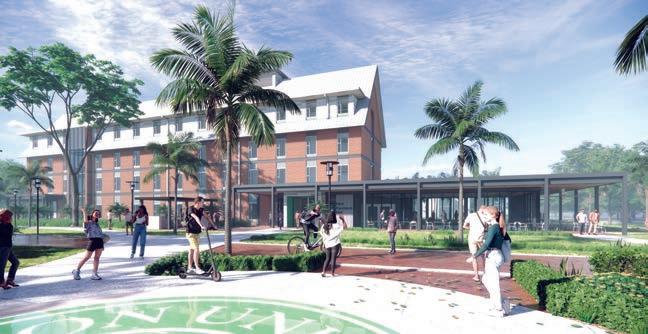
The new 305-bed Lynn Hall is on schedule to open in January 2026, enhancing the residential experience for students. Located in the heart of campus, the four-story residence hall also will provide places for students to gather and study, including a great room, courtyard and amphitheater.
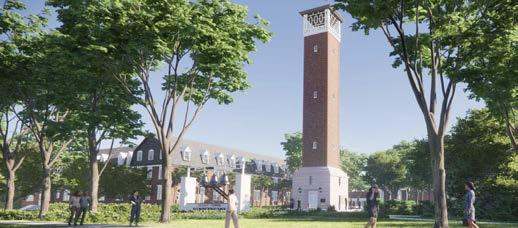
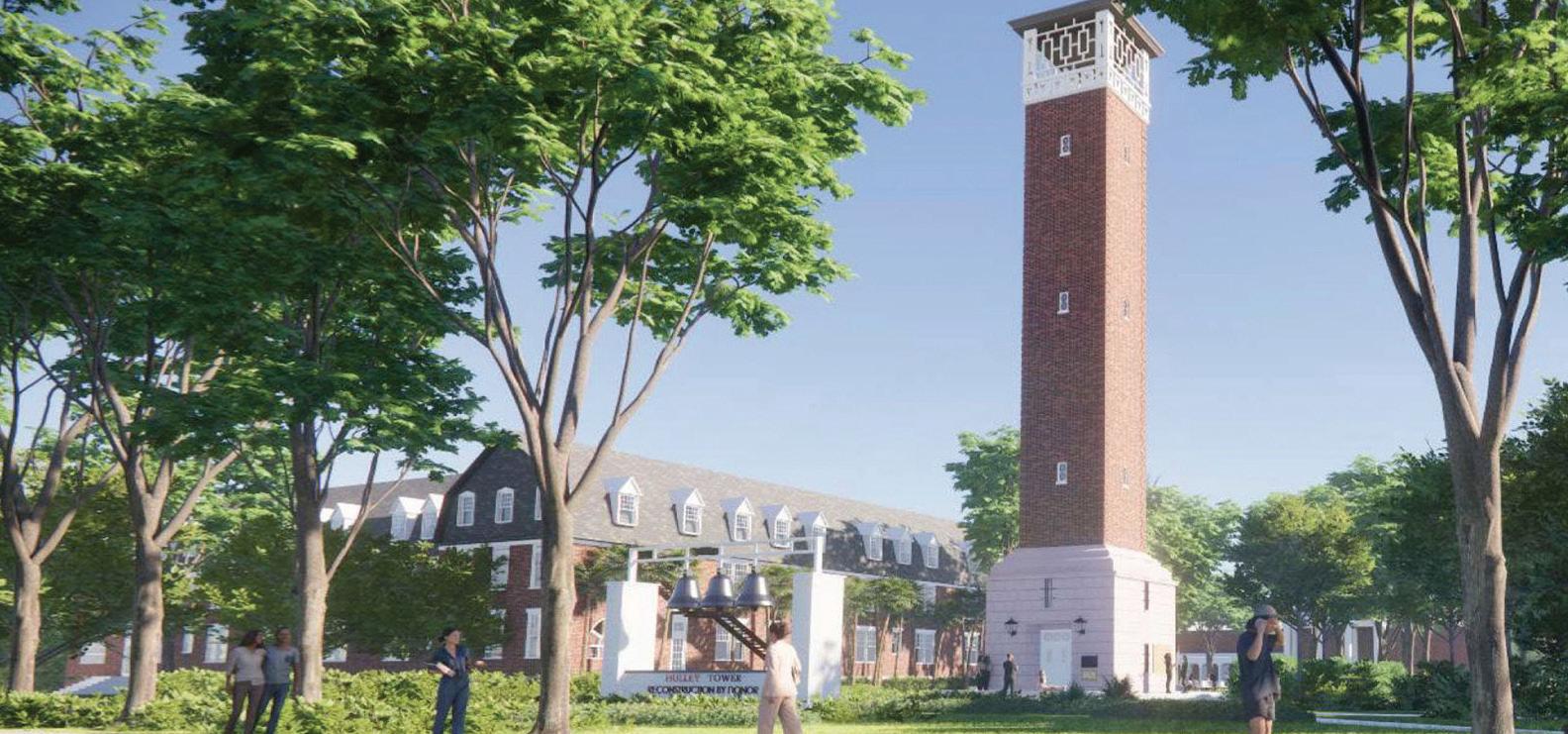
A short distance away, work continued on the historical reconstruction of Hulley Tower, scheduled for completion in early 2026. Originally built in 1934 and rising 116 feet, the tower was damaged by consecutive hurricanes and had to be taken down to its base in 2005.
In 2023, Stetson alumni launched an effort to rebuild the tower and add a new 52-bell carillon in remembrance of three Stetson students who lost their lives in an avalanche in Innsbruck, Austria, during a study abroad trip in 1979. The project quickly grew beyond rebuilding a historical landmark and has come to symbolize the Soul of Stetson, embodying the values, experiences, people and connections within the Stetson community. (See Page 44.)
Renovations moved forward on the Edmunds Center, the largest venue on campus used for Hatter sporting events, such as men’s and women’s basketball, and for large university events. The Phase II renovations will be finished this academic year and include a new lobby, offices and elevator.
Additionally, the School of Music’s Presser Hall outdoor atrium has been enclosed to become an indoor part of the building. The expansive space — the Hollis Family Music Atrium — remains popular for studying and relaxation. The new atrium was dedicated in October.
The aptly named cHatter Box brings new innovation.
Rendering of Hulley Tower
Rising Lynn Hall
Work on Edmunds Center Phase II
Candlelight Conductor’s Stetson Farewell
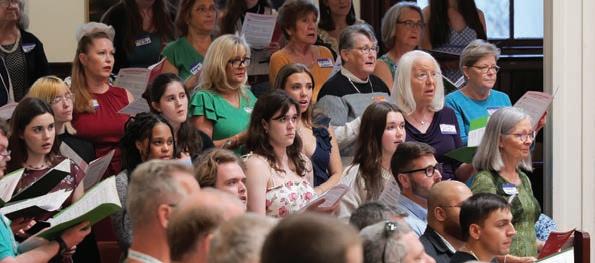
This year’s ever-popular Candlelight Christmas Concerts in early December certainly didn’t need any extra emotion. Floor to ceiling, the settings and songs have always been filled with spirited sentiment.
Yet, this year, the nostalgia rose multiple octaves.
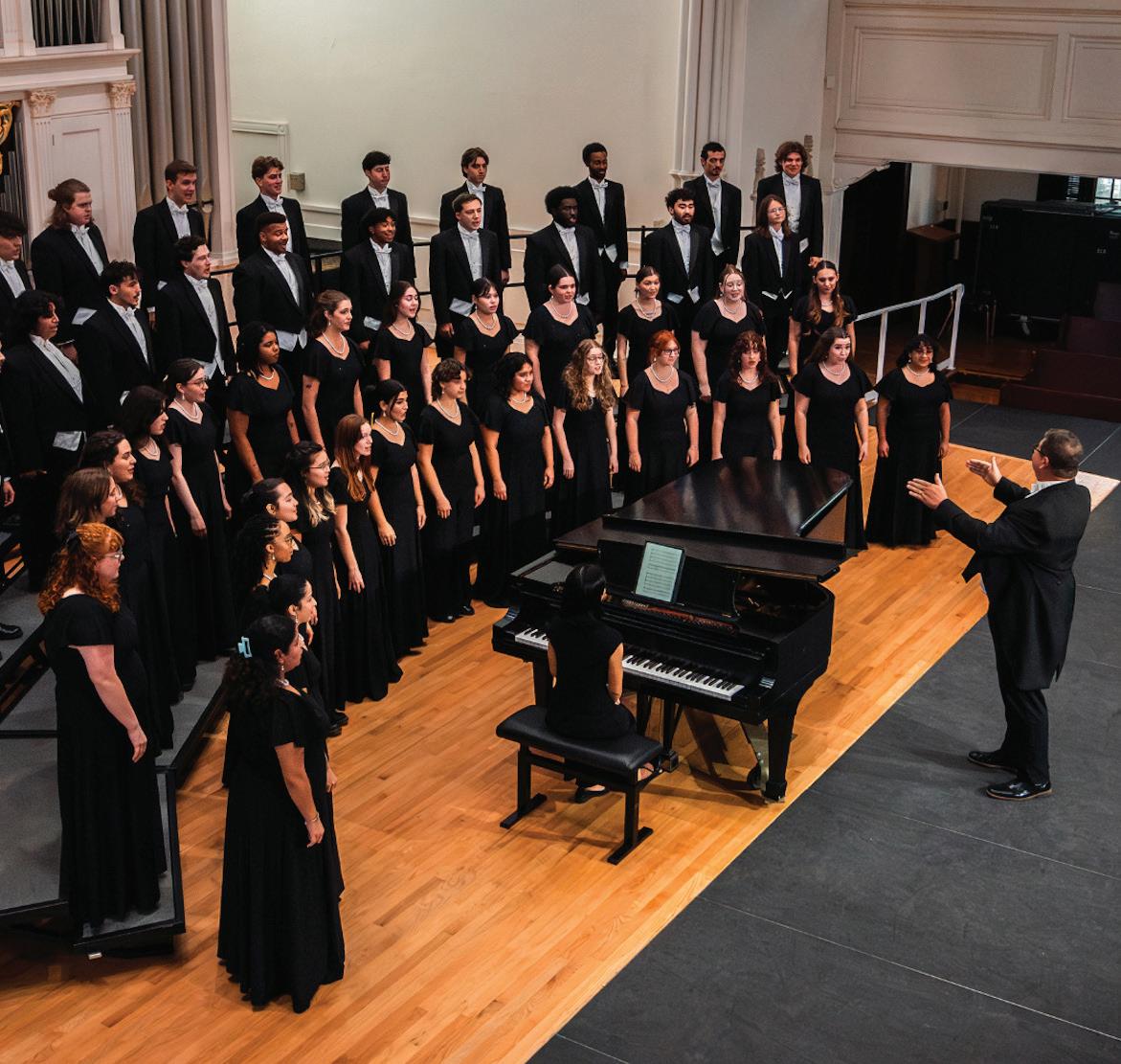
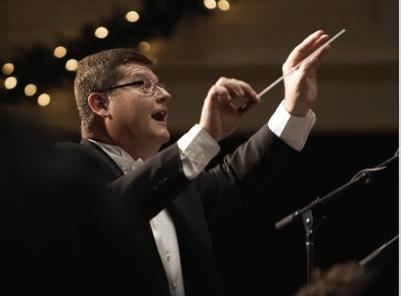
Stetson’s beloved concert conductor, Timothy Peter, DMA, raised his Candlelight baton one last time as Director of Choral Activities. After beginning his Stetson tenure in August 2012, Peter announced his retirement, effective in May 2026.
The concerts were held at Elizabeth Hall’s Lee Chapel and at First United Methodist Church of Orlando.
“I wouldn't have ever been able to tell you when I was starting out as a new choral conductor that 40 years later I would have been able to get to do the things I've done. And that truly is because of the generosity of people around me,” Peter said. “I’m grateful for the experiences, even as small as
Concert conductor Timothy Peter, DMA, has left an indelible mark on the holidays at Stetson.
meetings with students in my office, talking about their lives, their challenges, goals and their successes. … Wherever I have taught, my mission is always building confidence in students so they can go out and do anything.”
Peter was a public high-school teacher before spending 35 years in higher education.
And, indeed, he made an impact, as captured by the words of Nicholas Dieux, a baritone Voice major who graduated last May. As a recruiter, Peter had convinced Dieux to reconsider a commitment elsewhere and attend Stetson. Then, as a professor, Peter helped to ensure that decision was correct. “If it weren't for Dr. Peter,” Dieux says, “I wouldn't be an ounce of the person I am today.”
Junior Eloisy Mendonca Goncalves, a mezzo-soprano, described Peter as the “warmest soul” and an “inspiration for many.” Her words: “When I got to Stetson, he already welcomed me and showed me what a beautiful place Stetson is by one smile. Dr. Peter unifies and is a fearless leader always leading with kindness. His impact and legacy are deeply rooted.”
As is longtime tradition, the concerts conclude with a stirring rendition of “Silent Night.” Each year, the song, complete with an elaborate lighting of candles, represents a signature moment. This year, that moment carried even greater weight.
“I will certainly allow myself to be vulnerable and open as to what my emotions are,” Peter commented about those final minutes. “That's who I am as a personality. It will be in a moment to reflect. … So, in those last eight or 10 minutes, I know I'm just going to be grateful.”
Greek Life Takes the Pledge
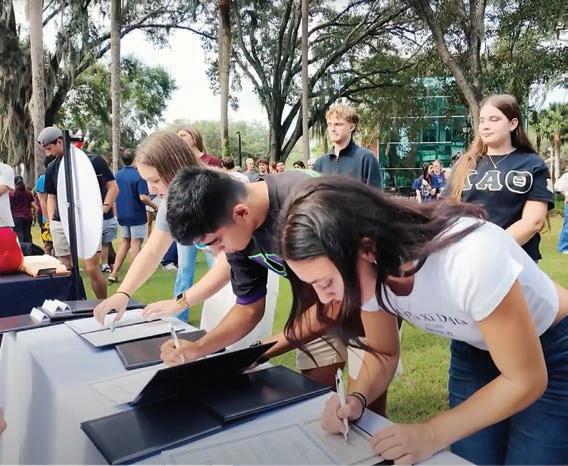
In October, Stetson’s Greek Life community came together for a powerful show of unity on campus — standing for respect, kindness and unity across Central Florida. They signed The Central Florida Pledge.
The Central Florida Pledge is a call to action, a communitydriven regional initiative to combat all forms of hate and discrimination across the region. The pledge asks residents to commit to treating all people with kindness and respect, especially those with whom they disagree.
The pledge’s underlying belief is that Central Florida has long been a community of inclusion for all, and the initiative was conceived to continue ensuring a “safe and welcoming environment for everyone who calls Central Florida home.”
Stetson President Christopher F. Roellke, PhD, was among the founding signers of The Central Florida Pledge in 2024.
“I enthusiastically signed The Central Florida Pledge because kindness matters — it not only matters, it enables us to listen, to engage with others unlike ourselves, and to consider paths we forge together to make our community, in fact the world, a better place,” Roellke said.
Greek students signed The Central Florida Pledge to combat all forms of hate and discrimination.
TALENT AND PASSION HARNESSING ALUMNI
Laying the groundwork for an Atlanta alumni chapter — with a plan for others to come
BY BECKY O’MARA ’03 AND TRAVIS HILL ’16
In 2003, I rolled into Atlanta with my life packed into a 2001 Ford Focus, a fresh Stetson graduate eager to dive into graduate school at Emory University. The promise of big-city vibrancy and crisp, changing seasons fueled my excitement.
“Through my nonprofit work, I met someone who shared my passion for serving southwest Atlanta. As we bonded over our love for the community, we discovered we were both Stetson alumni — separated by decades but united by our Hatter identity. That shared experience forged an instant kinship, proving the enduring power of our Stetson connection.”
Through mutual friends, I connected with a fellow Hatter who’d graduated the year before and had just finished his first year at Emory. Early in my Atlanta adventure, he invited me and a friend to dinner at the iconic Flying Biscuit in Candler Park. I was charmed by the quirky, in-town eatery and impressed by his insider knowledge of the city’s hidden gems. Over dinner, he shared a year’s worth of Atlanta wisdom — tips, tricks and must-do’s.
I absorbed every word, mentally cataloging his advice. Though we only crossed paths occasionally after that, his warm welcome and shared Stetson bond made a sprawling new city feel like home.
Years later, another serendipitous Hatter connection sparked. Through my nonprofit work, I met someone who shared my passion for serving southwest Atlanta. As we bonded over our love for the community, we discovered we were both Stetson alumni — separated by decades but united by our Hatter identity. That shared experience forged an instant kinship, proving the enduring power of our Stetson connection.
-
Becky O’Mara ’03
“Ever since being the beneficiary of our amazing Stetson community — the very same one I was so enthusiastic about as a student — I’ve wanted to lend a hand. As a member of the Alumni Association Board of Directors, my aim is to help turn the magic of Stetson in Atlanta into something we can help grow and replicate across other regions.”
During my time at Stetson, I worked as a Student Ambassador, giving tours and sharing my Stetson experience. I ended all my tours not with a scripted message about academics or campus involvement, but instead a simple, personal reflection on the Stetson community.
Stetson was different, I would say. It is not just a school or academic center; it was a community as close as a devoted family. When you run into another Hatter, you’re not just finding someone who went to the same school; you’re finding someone willing to lend a hand based only on a shared experience.
Like Becky, my Atlanta story is intertwined with my Stetson experience. I have wanted to work for an airline since my dad read me a story about Pedro the Airplane flying over the Andes Mountains, and it is this love of aviation that brough me to Atlanta. As I began looking for career opportunities in my senior year, the Stetson network and community came to my aid, helping make a connection that would allow me to land my dream job at Delta Air Lines.
Ever since being the beneficiary of our amazing Stetson community — the very same one I was so enthusiastic about as a student — I’ve wanted to lend a hand. As a member of the Alumni Association Board of Directors, my aim is to help turn the magic of Stetson in Atlanta into something we can help grow and replicate across other regions. I want to help create alumni chapters.
What we’re trying to do isn’t an exact science of ingredients; it’s an alchemy of community, connections and Hatters. As you look back to the last time you entered the library, walked down the steps of Elizabeth or rocked in a chair in front of the CUB, I’m sure you’ll remember not just the building and grounds, but also the friends and memories you made. These moments of connection aren’t just happy accidents — they’re the foundation of something greater.
Over the past three years, I’ve re-engaged with Stetson through volunteer opportunities, first supporting the Stand Up Hulley initiative and now leading efforts to build a vibrant alumni chapter in metro Atlanta.
- Travis Hill ’16
BUILDING AN ATLANTA ALUMNI CHAPTER
We cannot rely on chance encounters to foster community among the Stetson alumni community. So, how do we create a network that warmly welcomes new graduates to our cities, supports professional growth and sparks meaningful collaborations? With a dedicated group of volunteers, we’re laying the groundwork for an Atlanta alumni chapter while partnering with Stetson’s Alumni Association Board of Directors to craft a model for engagement.
Our goal is to harness the talent and passion of our alumni to boost student recruitment, retention and career success.
We are building in Atlanta through four strategic initiatives:
Connection and Camaraderie. It all starts with bringing Hatters together. By fostering social bonds rooted in our shared Stetson experience, we’re creating a supportive, dynamic community where alumni uplift and inspire one another.
(re)Cruitment. We’re passionate about elevating Stetson’s presence in Atlanta, sharing its story as a transformative destination for higher education. Through relationship-driven outreach, we’re ensuring Stetson is top of mind for the next generation of Hatters.
Career. We’re building a robust network of alumni and corporate partners in Atlanta to open doors for Stetson students and graduates, connecting them to meaningful career opportunities in our thriving city.
Capacity. Our university thrives when its alumni step up. We’re building ways to encourage Hatters to engage with Stetson through leadership, giving and active participation — strengthening the university we love.
The energy is building, and the possibilities are endless. We invite you to watch this exciting journey unfold and engage with us as we grow this vibrant Atlanta alumni community, as well as additional chapters, starting in Tampa, Jacksonville, Miami, Orlando and Washington, D.C.
Stay connected, share your ideas and be part of the Hatter legacy taking shape. Together, we’ll celebrate our shared past and build a brighter future for Stetson!
Note: Contact the Office of Alumni Engagement and Annual Giving if you are interested in either joining or helping build an alumni chapter at alumni@stetson.edu.
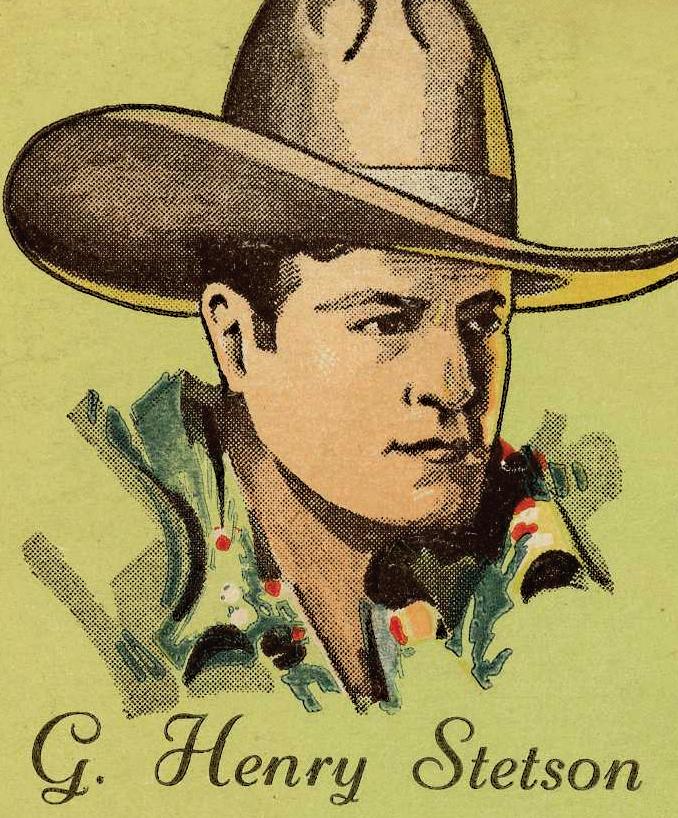
Book of matches from Rancho Sombrero in California, the property where G. Henry Stetson, son of John B. Stetson, lived. Donated by alumnus Robert Jordon ’69, whose father, Irwin B. Jordon Jr., worked for the John B. Stetson Company and visited G. Henry Stetson at his ranch.
Celebrating the 160-year legacy of the John B. Stetson Company, exhibits on campus explore themes that resonate with its founder, his famous hats and his namesake university.
BY ELIZABETH MAYCUMBER
Images are by Jodi Cothron or courtesy of the duPont-Ball Library Archives and Special Collections.
STYLE, SUBSTANCE AND STETSON HATS
Style and substance — the Stetson name perfectly embodies both concepts. When John B. Stetson designed the now legendary Western hat the Boss of the Plains in 1865, he laid a strong foundation for his fledgling namesake company to build on, growing it from a single-room workshop in Philadelphia to the global phenomenon it is today.
Indeed, a Stetson hat is an icon of Americana, the very symbol of the American West.
Yet, Stetson hat designs developed into a dazzling array of forms that appealed not just to cowboys, but also to cosmopolitan city dwellers and cozy suburbanites. From its origins, the Stetson brand quickly became renowned for its sophisticated range of styles and its bespoke craftsmanship, a legacy that continues to resonate worldwide.
John B. Stetson should be remembered for his astute business sense and stylish, high-quality products, and also for his emphasis on family and philanthropy, personal tenets expressed in the very backbone of his company. To work for the John B. Stetson Company was to be a part of the family, with the belief that families take care of one another.
Stetson understood firsthand how physically hard it was to be a worker in the hat industry, and how devastating an illness or death could be for a family. After all, he learned all there was to know about the hat manufacturing trade by working in his father’s business from the ground up. And it was his own poor
health as a young man that originally compelled him to head West to strike out for new adventures. As he grew his business throughout the second half of the 19th century until his death in 1906, Stetson enacted company policies that were firsts for the hat industry (and sometimes for any industry), genuinely improving the lives of his employees and garnering deep company loyalty from those workers in return.
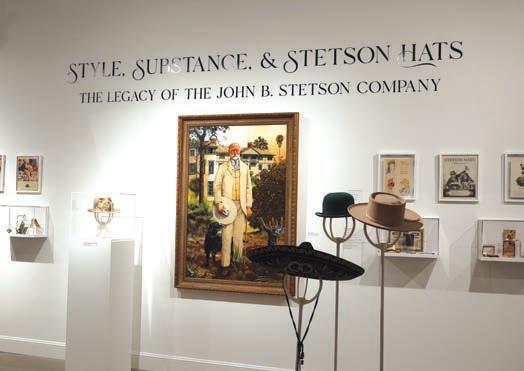
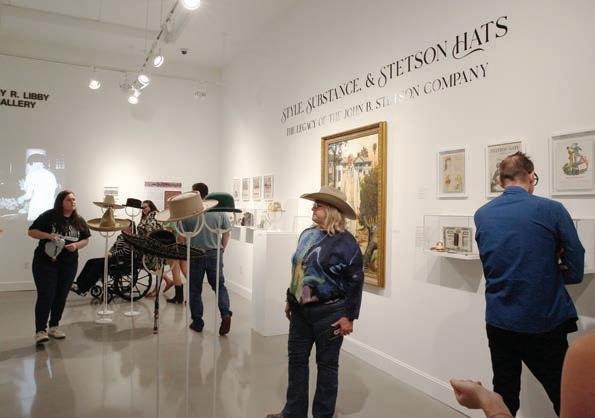
Those themes are explored in-depth using objects from Stetson University’s Archives in the exhibit “Style, Substance and Stetson Hats: The Legacy of the John B. Stetson Company” at the Homer and Dolly Hand Art Center (Oct. 21-Dec. 6). The exhibit is in celebration of the 160th anniversary of the John B. Stetson Company. A second adjacent exhibit in the Gallery DuPont, a museum space on the top floor of the duPont-Ball Library, features contemporary items on loan from the company.
RARE CHANCE TO SEE TREASURES
The exhibit is borne from treasures found in the duPont-Ball Library Archives and Special Collections at Stetson University — yet another place
John B. Stetson’s philanthropy left an indelible mark. Reflecting the nature of this archival collection, the selection on display primarily highlights the company’s historical roots in the 19th and 20th centuries, when the fashion for men’s and women’s hats was in its heyday.
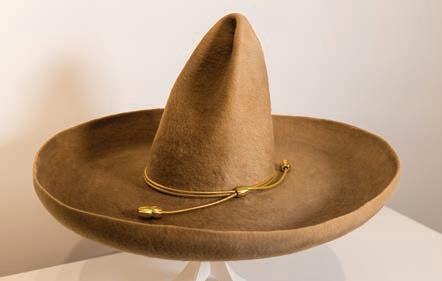
Some of the most unique hats in the collection belonged to Stetson family members, especially those of G. Henry Stetson, the youngest son, including sombreros, bowler hats and the Westernstyle hat that artist Erik Blome used as a model for his larger-than-life sculpture of John B. on the DeLand campus. In addition, the provenance of many of the collection’s other hats for men, women and children springs from alumni donors, some with personal connections to the John B. Stetson Company. They include Robert Jordon, whose father, Irwin B. Jordon Jr., worked for the company and visited Henry Stetson at his California ranch Rancho Sombrero; and Thomas F. Toscani, whose father, Francis D. Toscani, was a Pennsylvaniabased menswear designer who used hats gifted to him by the Stetson Company as accessories in design shows.
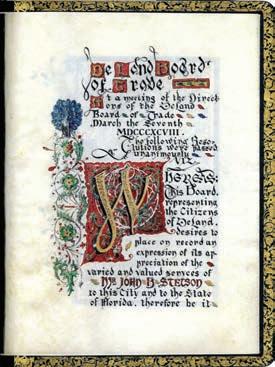
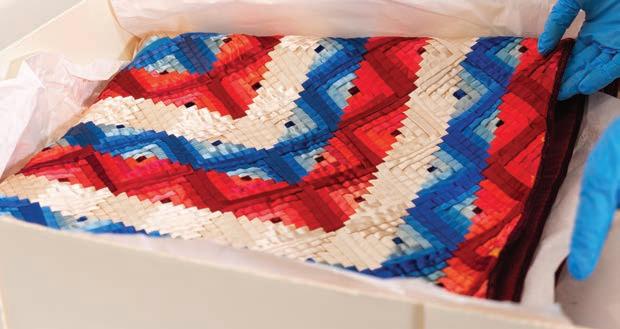
Along with the stunning variety of hats on exhibit, this museum installation also examines John B. Stetson’s company vision and philanthropic ties. From vintage film reels of company production and historical indenture contracts for apprentices to Union-Mission Sunday School cards and Stetson Hospital memorabilia, visitors to the Hand Art Center are able to witness the extraordinary influence of the university’s namesake in both business and community goodwill. Some of the rare and remarkable objects showcased include a red, white and blue silk quilt sewn by company employees, and presented to Mr. Stetson on May 5, 1880, in honor of his 50th birthday; a hand-lettered and illuminated 1898 resolution to Mr. Stetson from the DeLand Board of Trade, expressing their appreciation to him; and a variety of personal effects belonging to the Stetson family.
Finally, the main exhibit also includes a few surprises on loan from the John B. Stetson Company and the Museum of Art – DeLand.
Although the era of wearing a hat every day may be in the past, the power of Stetson remains a force to be reckoned with today. A full 160 years after its founding, the John B. Stetson Company continues to thrive, simultaneously honoring its historical legacy while constantly innovating through new designs and
Far left: The Hand Art Center exhibit opened just in time for Homecoming in October.
Left: This hand-lettered and illuminated resolution to John B. Stetson from the DeLand Board of Trade expresses the board's appreciation to Mr. Stetson for all he had done for DeLand and the state of Florida, dated March 7, 1898.
product lines and through collaborations with major artists, such as Beyoncé, Post Malone and Bruno Mars.
This continuum of style is evident in contemporary items on exhibition at the Hand Art Center, as well as in the accompanying exhibit at the Gallery DuPont.
The seed to curate this exhibit was planted nearly two years ago, when the Archives was asked to assist the Stetson Company in gathering information from the university’s collections in preparation for a new book it planned to publish. The request happened to coincide with a project already underway in the Archives to make Stetson materials more visible and accessible to researchers, and to treat the objects in the university’s care to higher archival standards to ensure their long-term preservation. This meant transferring Stetson family and company-related items out from their hiding place in the Archives’ Memorabilia Collection, which are materials telling the story of the people and places that make up the university. In turn, two new, distinct but related collections were created: the Stetson Hat Collection and the Stetson Family Collection.
The project also has included repacking and rehousing papers, photographs and objects into safer archival enclosures, creating proper documentation of the collections that will ultimately be diffused into the creation of Finding Aids to assist researchers, and making the collections viewable online in the duPont-Ball Library’s Digital Collections.
The resulting exhibition represents a rare chance to see so much of the two collections at once in the beautiful setting the Hand Art Center provides.
The opportunity to showcase the university’s vast and extraordinary Stetson holdings on campus during the same time the company celebrates its 160th anniversary and the book launch for Stetson: American Icon was extraordinarily fortunate.
Published through Rizzoli New York, the book includes an introduction by Laird Borrelli-Persson, with contributions by Douglas Brinkley, Jay Fielden, Glenn Kenny, Lyle Lovett and Mark McKinnon. In conjunction with the exhibition’s opening, representatives from the Stetson Company hosted a 160th-anniversary party on campus in Palm Court, with books and hats available for purchase.
All was almost too good to be true, but it’s real and authentic — adding to a history of a hat manufacturer and a university that’s clearly fashioned in style and substance.
Elizabeth Maycumber is the archivist of the duPont-Ball Library Archives and Special Collections, and the curator of “Style, Substance, and Stetson Hats: The Legacy of the John B. Stetson Company.”
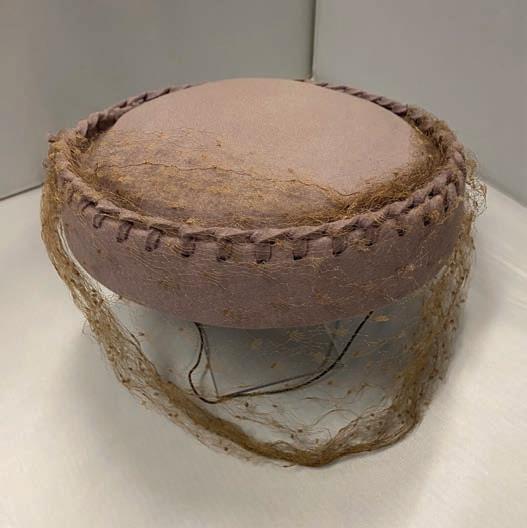
1 Ladies' lavender wool felt pillbox Stetson hat with intricate stitching along the crown, and adorned with a champagne-colored face net, circa 1940s.
2 Archivist Elizabeth Maycumber gently holds a red, white and blue silk quilt sewn by employees of the John B. Stetson Company in 1880 and presented to Mr. Stetson on his 50th birthday.
3 Green bowler hat belonged to G. Henry Stetson, youngest son of university namesake John B. Stetson.
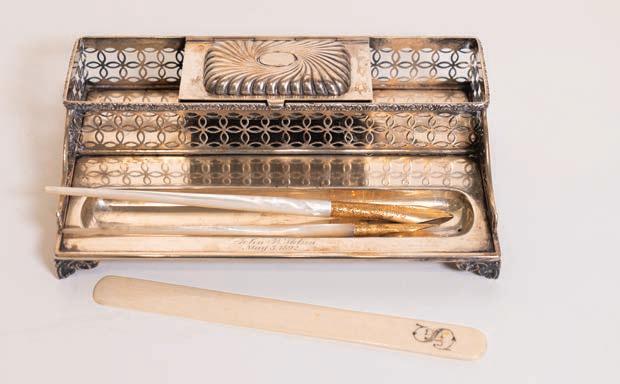
4 Silver, gold, mother-of-pearl and ivory desk set gifted to John B. Stetson on May 5, 1892, his 62nd birthday.
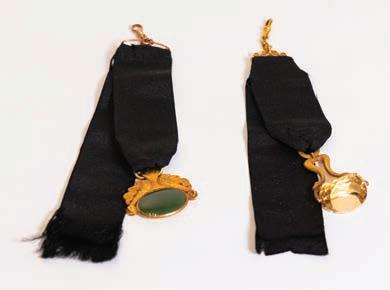
5 Jade and citrine watch fobs owned by John B. Stetson.
6 Fur sombrero that belonged to son G. Henry Stetson.
7 Collapsible Opera (top hat-style) Stetson hat with black fabric hatband.
A S.U.R.E.
SUMMER
The ambitious work — and personal sacrifice — of four students exemplify the “amazing” and “incredible” Stetson Undergraduate Research Experience.
BY MICHAEL CANDELARIA
Last summer, while most students were taking a break from their studies, Pilar Astigarraga Harper was on campus in Sage Hall, experimenting with the use of rapamycin on caterpillars and butterflies to determine possible impacts on life longevity.
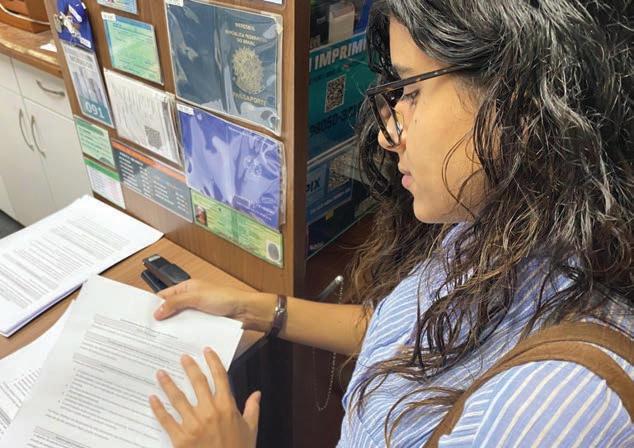
Júllya Lopes Machado was in her native Brazil near the beach but far from relaxing. She was investigating theories in religion for her project called “How Biblical Narratives Aid Coping in Brazilian Pentecostalism.”
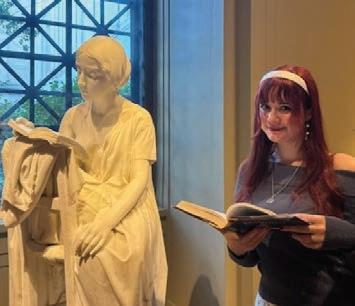
Reagan Swayze was close to shorelines, too, in Pensacola Beach, St. Augustine and Miami Beach. Yet, she was exploring the intersections of memory, immigration and visual expression in Florida Jewish art and architecture at three historical synagogues.
Kevin Cartagena, meanwhile, was doing lab work centered on using yeast to determine the function of the Fus1 transmembrane domain for cell fusion. He put cellular functions under the microscope.
Each student was participating in a Stetson Undergraduate Research Experience (S.U.R.E.) by virtue of university grant funding. Also, there were several other students — 18 to be exact. All were driven to research topics of interest in hopes of discovering pathways to careers.
The Stetson Undergraduate Research Experience is a signature program that fosters excellence in research and creative activity. The centerpiece of the program is an eight-week
research-intensive experience, where students work on an individual project under the mentorship of a Stetson faculty member. In addition to the summer experience, students present their research findings and outcomes at various venues throughout the subsequent year, such as April’s annual Stetson Showcase. The overarching goal of the program is to develop informed graduates equipped with skills and dispositions to tackle complex challenges.
The undergraduate scholars are selected through a universitywide competition, with the program providing a $2,000 grant for research initiated over the summer session, which began last May. In addition, S.U.R.E. grant recipients receive up to $500 to support travel to an appropriate professional meeting to present research results.
Of course, S.U.R.E. is a quintessential example of Stetson’s Hatter Ready initiative. Hatter Ready is an innovative approach to specialized learning that enhances student engagement through immersive experiences. Hatter Ready allows students to engage on a deeper level with their studies, gain hands-on experiences and benefit from smaller, more tight-knit learning groups.
PILAR ASTIGARRAGA HARPER
For Astigarraga, the summer research was another chance to explore biology. The senior had arrived at Stetson from Spain (originally from Argentina) as a tennis player with a curiosity in the subject, which broadened on campus.
“I saw the different classes that were offered in the biology department, and the lab course molecular biology and biotechnology really interested me — like how everything functions at the molecular level. It just fascinated me,” said Astigarraga, now a Molecular and Cellular Biology major who is on a full tennis scholarship.
For her project, “Rapamycin-induced Inhibition of TOR Signaling Pathway and Vanessa cardui Butterflies,” Astigarraga spent every day in the lab, Monday through Sunday, May through early August, starting at about 8 a.m. Rapamycin is a chemical that extends the lifespans of various genetic model organisms (such as flies, worms and mice), and is currently used in humans for organ transplant rejection and certain types of cancer.
Mentored by Associate Professor Lynn Kee, PhD, Astigarraga investigated this chemical’s development impact on
“I saw the different classes that were offered in the biology department, and the lab course molecular biology and biotechnology really interested me — like how everything functions at the molecular level. It just fascinated me.”
caterpillars and butterflies — starting with 120 caterpillars. After treating them with rapamycin, she would measure and record developmental and molecular changes, as compared to a control group, to assess the impacts. The work was long and arduous but proved worthwhile.
“This is something that no one has done in butterflies. So that's why it's very exciting,” said Astigarraga, who was scheduled to present her work in November at the national Annual Biomedical Research Conference for Minoritized Scientists conference in San Antonio — a “wonderful experience,” she describes.
Following Stetson, Astigarraga hopes to attend graduate school and pursue a doctorate degree in molecular biology.
“This summer research experience was not only amazing because I really liked it and I'm super interested in it, but this also helps me achieve my post-Stetson plans,” she cited.
“Undergraduate research experience is a crucial component for graduate school application, as it demonstrates my aptitude for critical thinking, problem-solving and dedication to pursue a research-focused career.”
JÚLLYA LOPES MACHADO
Machado, from Rio de Janeiro, Brazil, heard about Stetson from a YouTube video created by a former Stetson student. Machado was struck by a campus she thought was “gorgeous,” “sunny” and “wonderful.” Now a senior majoring in Computer Science and Religious Studies, she sought a research project that could examine religion while also employing her skills in data analysis.
“I actually grew up in a Pentecostal household, so I was always immersed in that culture. And I'm basically just looking into specific biblical narratives, and what people who are in Pentecostal communities use more often when they're going through difficult situations,” she explained. “I chose a community that is about 40 minutes away from downtown Rio [de Janeiro]. In this area, there are a lot of socioeconomic differences. Some people struggle with access to water; other people struggle with finding jobs. And then there are some people who don’t look very worried at all.”
Mentored by Assistant Professor Carmen Palmer, PhD, Machado surveyed approximately 80 local residents to explore the “whys.” She also explored the Bible passages residents used in each situation — in essence, biblical narratives as forms of coping. Then she looked to “find common themes among these passages.”
Work involved the detailed gathering and analysis of data, as well as understanding the nuances of religion. “I'm actually using some of my computer science background in this research … trying to figure out, through the use of artificial intelligence, what are the most common biblical narratives for specific situations,” Machado said.
Ultimately, the findings will be revealed in a full research paper, which will serve as her senior research before, hopefully, continuing on to graduate school.
“I'm actually using some of my computer science background in this research … trying to figure out, through the use of artificial intelligence, what are the most common biblical narratives for specific situations.”
“I have learned that symbols like the Star of David are not just symbols for the Jews of today, but they also connect us to our past ... .”
REAGAN SWAYZE
A senior from nearby Melbourne, Swayze majors in History with a minor in Jewish Studies. Continuing research she started two years ago, her “Art and Identity in Floridian Synagogues” project encompassed studying synagogue architecture in Pensacola Beach, St. Augustine and Miami Beach, and then tying that research to theory on how Judaism expresses itself through imagery.
“There isn't one sole Jewish architecture, but instead it is symbolism. … So, I’ve been researching into that part of it, and then how immigration in Florida specifically ties into it,” said Swayze, who also traveled to Poland over the summer as part of her research — an experience she called “incredible.”
The research included history, art, architecture, religion and more — “so many different disciplines coming together,” she noted.
And her work was expansive, as an example putting her in contact with Marcia Jo Zerivitz, founding executive director of the Jewish Museum of Florida at Florida International University. Zerivitz started a project decades ago that has been tracking Florida's Jewish history from the first recorded Jewish immigration in 1763 to today.
Mentored by Katya Kudryavtseva, PhD, associate professor of Art History, Swayze’s summer research is serving as the foundation for her senior project in History. Also, it gave her insight into museum curatorial studies. Swayze had taken a global century art course taught by Kudryavtseva, sparking new interest.
Swayze has now connected with her Jewish identity in ways previously unknown.
“I have learned that symbols like the Star of David are not just symbols for the Jews of today, but they also connect us to our past and all the way back to Roman Judaea (63 BCE/ Before Common Era).”
KEVIN CARTAGENA
A junior majoring in Molecular and Cellular Biology, Cartagena was in a quandary last spring. He was in ROTC and wanted to get “a feel for how the lab environment works,” as well as gain research skills, prior to conducting his senior research project. However, he knew summer 2026, just before his senior year, would be consumed with cadet training obligations.
After consulting with his faculty adviser Lynn Kee, PhD, about lab opportunities, he started an immersive experience as an undergraduate research student for Jean Smith, PhD, assistant professor of Biology.
His project is called “Determining the Function of the Fus1 Transmembrane Domain for Cell Fusion.”
Fus1 is a protein that promotes cell fusion in yeast. It localizes to the fusion site, but its exact function once there is not known. Fus1 has a transmembrane domain that anchors the protein to the plasma membrane, allowing it to stay at the fusion site. Features of this domain suggest it may have other functions as well. Cartagena’s project involves changing the building blocks of the transmembrane domain to determine its other function.
So, what began last spring as an independent study with Smith, learning basic lab techniques — such as how to use a Bunsen burner and handling petri dishes — turned into cell fusion with yeast as the model organism.
“What we find in the cellular processes can be related in some kind of way to humans or other organisms, given the similar DNA or proteins or genes found,” Cartagena cited.
As part of the summer work, Cartagena read research papers and presented the information to other students, as well as provided weekly updates on his own research.
Initially, he wanted lab experience. Now, while military duty remains in view, he is “in the process of discovering what my options are.”
“Hopefully, I can have a career outside of the Army when I'm not activated,” he said. “That way, I can continue that research path and be more involved in the lab.”
“What we find in the cellular processes can be related in some kind of way to humans or other organisms ... .”
THE REMARKABLE ASCENT OF DEVIN HERNANDEZ
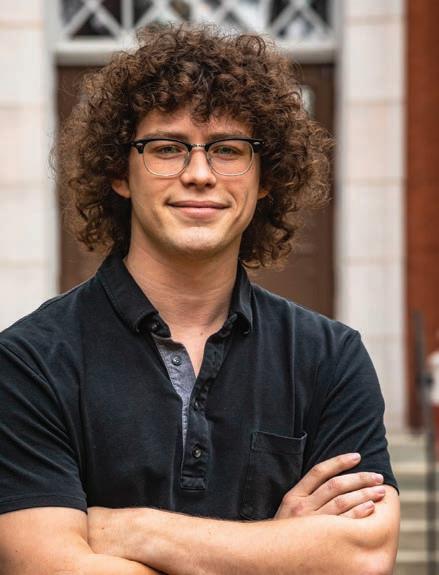
In the spring of 2024, Devin Hernandez walked across the commencement stage at Stetson with a History degree in one hand and rare research insight in the other. And it marked the continuation of a journey that began not in the halls of academia, but in a community college classroom and with a deep curiosity about the world’s most pressing medical crisis: the opioid epidemic.
Here’s how one transfer student turned a 2024 senior thesis on methadone into full-ride doctoral study at Johns Hopkins University.
BY JACK ROTH
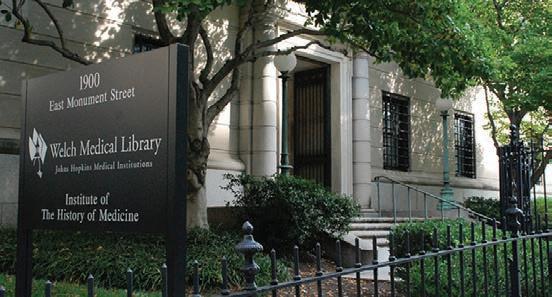
Today, Hernandez is a first-year doctoral student at the prestigious History of Medicine doctoral program at Johns Hopkins University — the first department of its kind in North America and widely regarded as the best in the world. There, he is pursuing research that began at Stetson and has already captured the attention of top scholars and former Nixon administration officials.
However, the road to Baltimore and “America’s first research university” was neither linear nor easy.
“In 2019, I started taking liberal arts courses at Harper College in Illinois,” Hernandez recounts. “When the hammer of COVID dropped in 2020, I went through a pretty dark and isolated time. It was really my humanities coursework that got me through it.”
By 2021, he had moved back to Sanford, Florida, and transferred to Stetson. Having fallen headlong into the humanities, he knew Stetson would be a place to continue that pursuit. As a transfer student, he brought with him a perspective forged not only through academic rigor but lived experience. He was born in 2000, just as the first wave of the opioid crisis surged through American communities.
“I watched addiction cause problems in the lives of friends and family," he says. “When I close my eyes, I see the faces of art teachers, childhood babysitters, bookstore managers who lost their lives prematurely to this problem.”
THE METHADONE PROJECT
At Stetson, Hernandez found a home in the Department of History, where his relentless curiosity quickly set him apart. From the beginning, professors
Devin Hernandez '24
were impressed by his intellect, curiosity and ability to make connections across time periods and space.
Student awards and grants recognition followed. He was co-winner of the 2024 Gilbert L. Lycan History Award for Outstanding Senior, won the 2023 Doyle Elam Carlton Distinguished Service Leadership Award, received a Stetson Undergraduate Research Experience (S.U.R.E.) grant and an Evans Johnson Research Grant from Stetson’s history department.
In his senior year, he began work on what would become an award-winning thesis, titled “Two Steps Forward, One Step Back: The History of Methadone in America, 1947-1974.” Methadone is a treatment drug introduced in the 1960s. His thesis examined how U.S. policy has vacillated between medical and punitive responses.
Funded by multiple grants, his research pulled together archival materials from the Federal Depository Library at Stetson, the National Archives and the personal papers of Harry Anslinger at Penn State University. He left few stones unturned.
“His thesis represents the culmination of Devin’s yearslong interest in the history of drug policy in the United States, a topic he explored from different angles in several courses,” says Associate Professor Emily Mieras, PhD, director of Stetson’s American Studies Program and Hernandez’s honors thesis adviser. “His
project explored the attitude toward drug uses and addiction treatment in this era, culminating in a focused analysis of Richard Nixon’s administration’s drug treatment policies.”
Yet, what truly distinguished his work was the history component as told by experts. It was David Courtwright, presidential professor emeritus at the University of North Florida and author of several books on drugs and addiction, who initially connected Hernandez to Jerome Jaffe (Nixon’s first drug adviser), who then connected him to Robert DuPont (Nixon’s second drug adviser). Today, DuPont is president of the Institute for Behavior and Health.
The thesis interviews he conducted with those Nixon-era drug policy architects provided insight and access rarely granted even to seasoned historians.
“Devin established working relationships with members of the Nixon administration and incorporated their perspectives into his final project,” comments Eric Kurlander, PhD, Hernandez’s senior thesis adviser and Stetson’s William R. Kenan Jr. Professor of History and history department chair. “The sophistication of his work is what we would expect from a graduate student, not an undergrad.”
ROAD TO JOHNS HOPKINS
“During my gap year, when I was applying to graduate school, he employed me as a research assistant. It was a great year — working side by side with one of the top scholars in my field,” says Hernandez.
In January 2025, Hernandez received his acceptance to Johns Hopkins, complete with full funding — a $50,000-per-year package.
For the Stetson community, it was a proud and unprecedented moment.
“To be accepted into that program, with that level of funding, is extraordinary," says Kurlander. “It speaks to the quality of his research, but also to his character.”
REAL-WORLD IMPLICATIONS
While at Johns Hopkins, Hernandez plans to expand his research into what he calls a “bottom-up” history of the opioid epidemic.
“I want to tell the stories of those impacted by this crisis — the addicts, the families, the communities,” he says.
LEGACY AT STETSON
To receive full PhD funding to Johns Hopkins in any field already is an incredible achievement. For a History major with no substantial training in natural science to receive admission and such funding is an even more rare achievement.
As a leading drug historian, Courtwright is one of Hernandez’s intellectual heroes. Eventually, Hernandez worked up the nerve to email him, and that message led to a mentorship, a research assistantship at the University of North Florida and a front-row seat to Courtwright's latest work on the modern opioid crisis.
“Hopkins is arguably the medical school that did the most to shape modern medical training in the United States and, along with Harvard and Cornell universities, the fields of the history of science and medicine,” Kurlander affirms. “It’s hard to think of a better place to study a project like Devin’s.”
As Hernandez settles into his new academic home at Johns Hopkins, he carries with him the lessons, relationships and resilience cultivated at Stetson.
“Every day I’m here, I’m reminded of how thankful I am for Stetson,” he says. “It’s where I became a historian.”
Hernandez now is making his mark in the hallowed halls of Johns Hopkins.
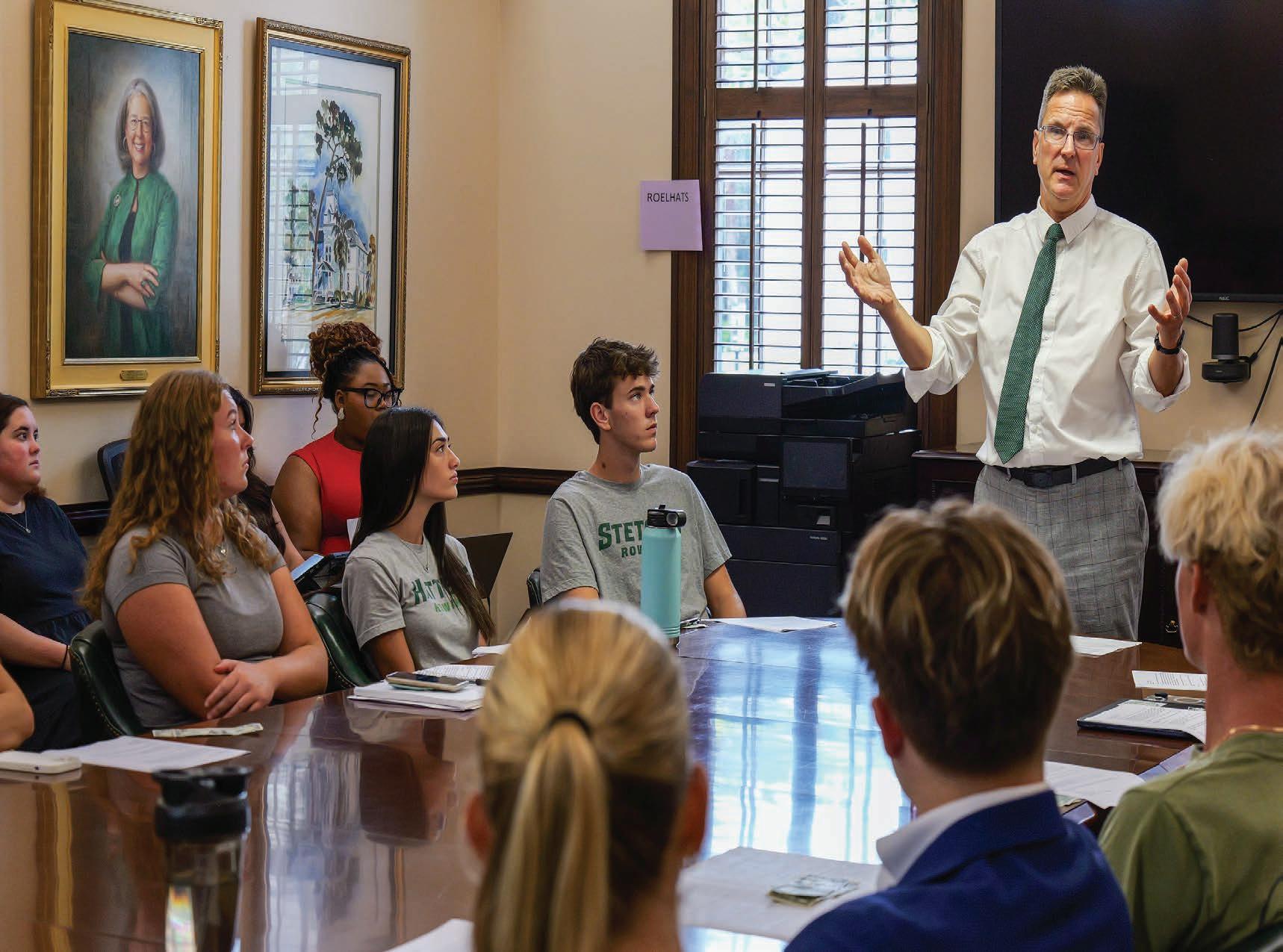
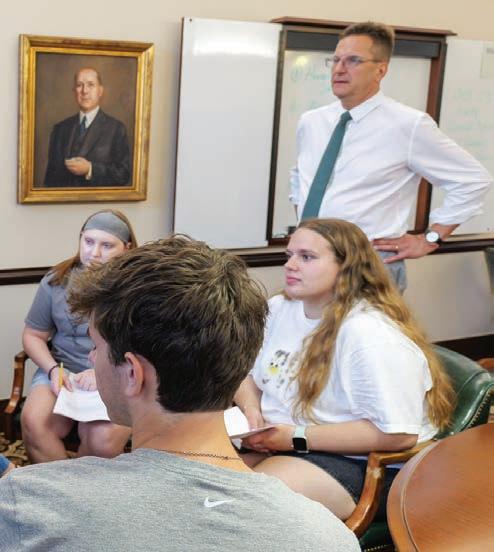
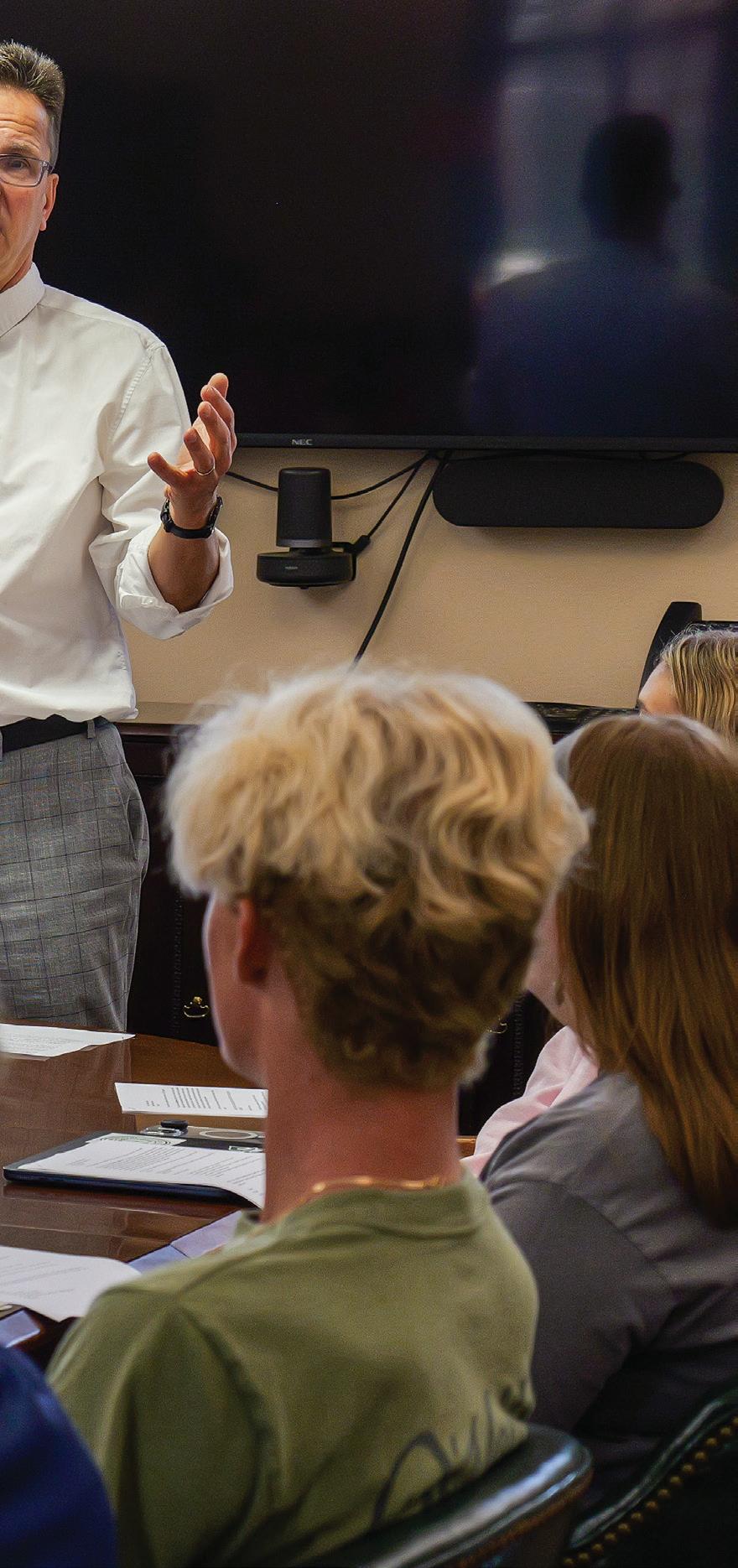
A staunch advocate for experiential learning, President Christopher F. Roellke, PhD, teaches a firstsemester class as part of Stetson’s Presidential Fellows Program, with a focus on cultivating leadership.
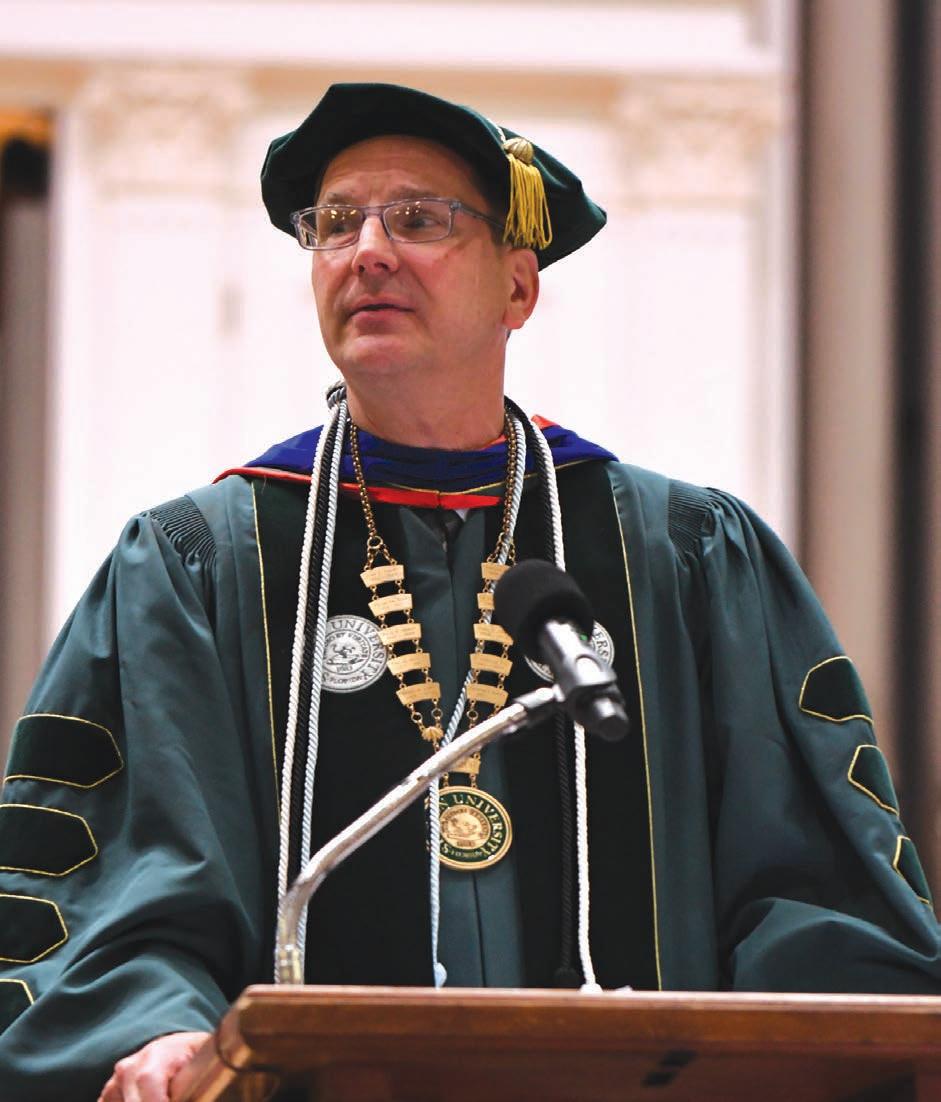
Each spring, Roellke presides over the Academic Awards and Recognition ceremony. His words last May: "We honor the students who have committed themselves to their studies, to their intellectual passions, and their community of classmates and colleagues.”
OF STUDENT IMPACT SNAPSHOTS
The 2025-2026 academic year marks Year 6 of the President’s Stetson tenure — and his laser focus on students
When Christopher F. Roellke, PhD, stepped onto the Stetson campus on July 1, 2020, the scene wasn’t exactly picturesque. As the university’s 10th president, he assumed leadership in the midst of a global pandemic.
Nonetheless, over the next five-plus years, Roellke has been able to establish a clear, student-first vision for Stetson that aims to preserve the historical smallcollege setting on campus while broadening the university’s reach. He labels the mission “moving Florida gem to national treasure.”
To help chart the course, Roellke oversaw the launch of Forward Together, the university’s strategic priorities framework for 2023-2030. Essentially, it’s a plan that combines Stetson’s long-standing identity — small classes, hands-on learning and liberal-arts approach — with contemporary priorities, such as experi ential and integrative learning, student success and wellness, lifelong relationships, sustainability, and more.
Already, much movement is hap pening, even in the wake of “unprece dented transformation” across higher education, as Roellke has described.
With the 2025-2026 academic year marking No. 6 of his tenure at Stetson, here are snapshots of some of the President’s most recent impacts on his No. 1 university commitment: its students.
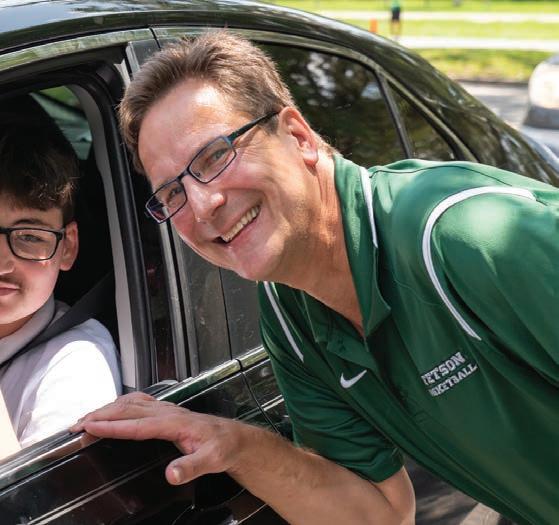
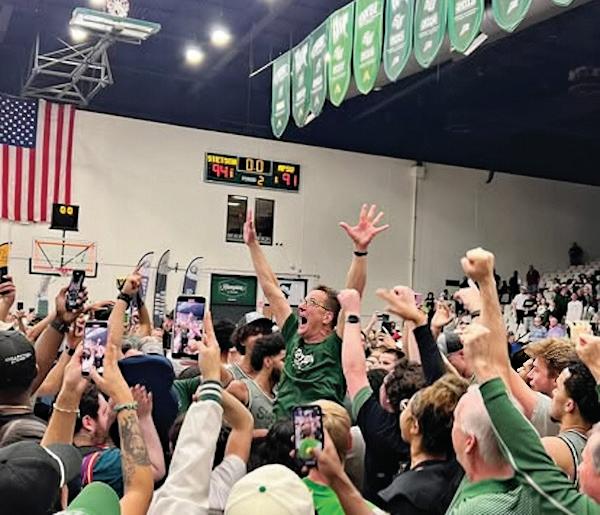
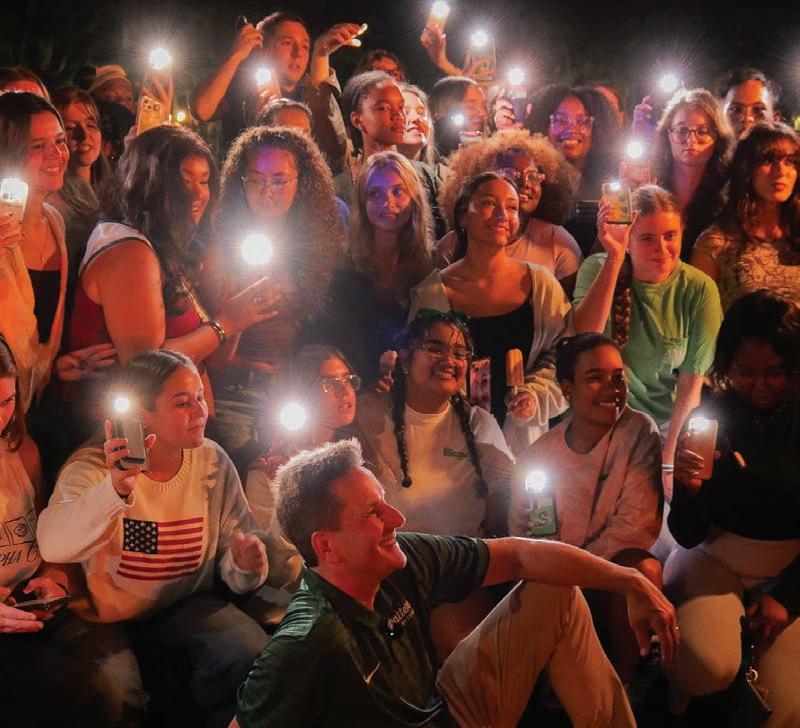
Above and below/right: A former college athlete in baseball and basketball, Roellke is perhaps the university’s biggest cheerleader and fan.
Above and far right: Roellke takes the university’s laser focus on students personally. “The guiding theme that anchors all of our strategy is relationship-rich education — inside and outside the classroom,” he says.
On Move-In Day in August, the president was part of the university’s welcome committee. “Move-In Day is one of my favorite moments of the year,” he said that day. “It marks the beginning of an incredible journey for our newest Hatters and the families who support them.”
‘REVOLUTION IN EDUCATION’
Celebrating its 25th anniversary, the Nina B. Hollis Institute for Educational Reform continues to impact K–12 school administrators, teachers and students.
BY MICHAEL CANDELARIA
When Mark Hollis endowed the Nina B. Hollis Institute for Educational Reform in 2000, he gave Stetson more than a named institute. Hollis gave it a mandate: to be a laboratory for practical, research-informed change in K–12 schools.
For a quarter century, that mandate has translated into grant-backed experiments, educator training programs, a peer-reviewed journal and an expanding network of community partnerships that turn research into classroom practice.
In official wording, the Hollis Institute is a comprehensive learning community. In collaboration with local community leaders, district personnel, educational agencies and Stetson faculty, the Institute has created a model for reform that supports education. Through research and pedagogical assistance, the Institute provides support in developing research-based best practice in-service workshops and events to educators, families, businesses, universities and policymakers for the advancement of teaching and learning.
Benefactor Mark Hollis with Bette Heins, PhD, the Nina B. Hollis Chair of Educational Reform
Much of that work isn’t flashy. After all, the word reform won’t win awards for flamboyant appeal. Nor will restorative. Yet, in the accumulation of small, evidence-based victories, it has quietly reshaped how local districts conceive of teacher preparation, leadership and school culture.
Described another way, the Institute funds careful research that respects teacher expertise and provides the human support — coaching, mentorship, professional development — necessary to translate findings into classroom outcomes. Perhaps the Institute’s greatest accomplishment is treating reform as relational work, not solely a policy mandate. By investing in leaders and teachers, documenting what works and sharing those lessons publicly, the Institute has helped make Stetson a partner in community schooling rather than a distant critic.
THE EARLY DAYS
The Hollis Institute’s story begins in philanthropy and a clear, pragmatic vision. Endowed by Mark (and Lynn) Hollis in memory of Nina B. Hollis, his mother, a devoted reader and supporter of education, the Institute was created to incubate projects that address systemic inequities and practical barriers in schooling — especially for marginalized children.
“He wanted a ‘revolution in education.’ That’s a direct quote, ‘revolution in education,’ remembers Bette Heins, PhD, senior Stetson professor of Education who holds the Nina B. Hollis Chair of Educational Reform. “He didn't want the status quo. And this is a touchpoint. He did not want us giving money to schools for things that the district should provide. And he did not want us supporting things that Stetson should provide. It had to be something. It had to be something that couldn't be done without this money.”
Also, from its earliest grant cycles, the Institute declared itself a direct partner to districts and teachers, far from a remote ivorytower perspective. That stance — local, collaborative and focused on implementation — remains the guiding principle three decades later, as the Institute’s impact depends on the buy-in of local school districts and civic partners.
As described by Heins, who has been there since Day 1: “It really is all about the relationships. You have to have that trust.”
Early projects were intentionally small, such as seed grants for classroom innovations, curriculum pilots and community literacy
Educator workshops are a big part of the Institute’s efforts to advance teaching and learning.
initiatives. Over time, formal research awards were added, as well as leadership support for school administrators, and the launch of Voices of Reform, an annual journal publishing practitioner-research aimed at influencing policy and practice.
When the Institute was founded, there were three education faculty involved: Heins, along with professors of Education Kathy Jo Piechura-Couture, PhD; and Mercedes Tichenor, EdD.
Heins and Tichenor had attended a conference in Louisville to learn more about how to build effective partnership schools. “We were eager to learn but a bit unsure of exactly how to begin,” Tichenor remembers. “Over time, through collaboration, persistence and mutual trust, we developed strong, sustainable partnerships that continue to benefit both the schools and our teacher preparation program.”
Today, eight Stetson faculty members across four schools are involved in the work.
LEARNING ECOSYSTEM
Interdisciplinary in nature, the Hollis Institute operates like a professional-learning ecosystem, with multiple entry points for educators, researchers and community partners. Among the chief programs is the Nina B. Hollis Research Impact Awards, which provides planning grants and full-impact awards to faculty and school partners who test interventions aimed at improving academic progress, social-emotional outcomes and school climate.
Top: Hollis family members (from left) Clayton Hollis, Lynn Hollis and Stetson trustee Dean Hollis ’82. Above: (from left) project manager Colleen Cooper ’04, MBA '07; and Education faculty members Kathy Jo Piechura-Couture, PhD; Heins; and Mercedes Tichenor, EdD.
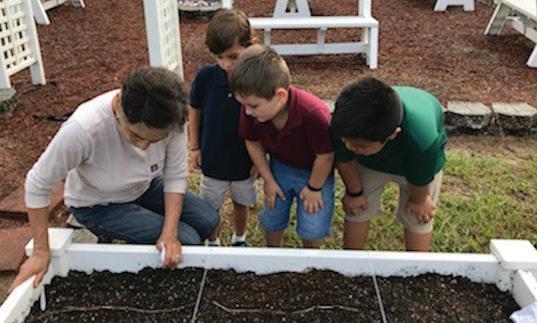
The program’s structure — small planning awards followed by competitive impact grants — is designed to encourage careful piloting, iterative redesign and scalable documentation. Projects funded under these research impact awards have ranged from garden-based learning pilots to restorative-practice coaching and programs for gifted students.
Piechura-Couture explains: “Our role has always been to vet ideas first — because realistically, what teacher has the time to conduct extensive research? If an idea seemed promising, we’d support a pilot program, collect data, analyze the results, and determine how best to sustain and scale the effort. We never imposed solutions. Instead, we asked, ‘What ideas do you think will improve education?’ and then partnered with educators to bring those ideas to life.”
Responding to the well-documented link between school leadership and outcomes, the Hollis Leadership Center was founded in 2016 to offer customized professional development for district and school leaders. The emphasis is on school climate and restorative approaches to discipline, aiming to equip principals and instructional leaders to create conditions where teachers can teach and students can learn in increasingly complex education environments. Over recent years, the center expanded training
2000
Conversations/ideas begin with former Stetson President Doug Lee, Mark Hollis and Bette Heins, PhD.
The Institute initially focuses on professional development for teachers and principals, as well as supporting innovative projects.
2002
Mini-grants for district teachers are introduced.
cohorts and added trauma-informed coaching models that have been piloted in local districts.
The center now is a self-funded and self-sustaining enterprise working with hundreds of education leaders and thousands of teachers across Florida, providing a comprehensive training series around teacher empowerment and retention to approximately 70 schools a year.
FLEXIBLE APPROACHES
Also notably, nimbleness is a defining feature, highlighted by the funding of high-need projects that address local gaps. What’s called garden-based learning, for example, has been a repeated focus, with researchers and educators collaborating. Garden-based learning is an educational approach that uses an actual garden as a living laboratory for hands-on learning. It involves integrating the garden into various subjects like science, math and language arts to make lessons more meaningful and engaging for students.
Gardenbased learning is an approach that uses an actual garden for hands-on learning.
This method has been shown to increase physical activity and fruit and vegetable consumption, improve student attitudes toward school, decrease problematic behaviors or behaviors associated with attention deficit disorder, and effectively engage students of diverse backgrounds and learning styles. Despite these benefits, however, many traditionally prepared classroom teachers aren’t equipped with the skills necessary to successfully integrate garden-based learning into their pedagogy.
Regarding language development, a partnership was created between Stetson and the United Cerebral Palsy - Seminole Preschool Units in nearby Lake Mary. The project is called Language Development Through Focused Play, with the purpose of increasing social language (in preschool students) while interacting with baby dolls in a structured circle routine.
This inclusive activity works at all levels of preschool development, and is being used in the full continuum of classrooms,
2004
Cats and the Hatters summer reading program begins with Volusia County.
A Technology Teacher Training Grant (T-3 grant) brings the first projectors to Stetson classrooms.
2007
Stetson develops a single-gender classroom teaching conference, with Woodward Avenue Elementary hosting schools nationwide to observe single-gender classes.
2013
Stetson receives the Florida Campus Compact’s Campus-Community Partnership Award.
2014
Volusia County Public Schools establishes the first elementary-school single-gender classes.
2017
The Nina B. Hollis Institute Conference Room is dedicated.
Impact Grants, a three-year, $10,000 grant is introduced to faculty members.
THROUGH THE YEARS: NINA B. HOLLIS INSTITUTE FOR EDUCATIONAL REFORM
general education, mixed and self-contained. Since the start of school in August 2024, teachers, paraprofessionals, administrators and parents have received small group trainings.
Another example is outreach such as prison-education partnerships that bring faculty into correctional facilities to deliver creditbearing instruction. That work is aimed at both expanding educational opportunity and civic reintegration, while also serving professional development experiences for instructors and a service pathway for undergraduates.
Local STEM (Science, Technology, Engineering, Math) camps for gifted students represent another outreach effort, extending enrichment opportunities to children who might otherwise lack access to advanced STEM and arts programming. Further, they build early pipelines to college readiness.
To help focus on topics in educational reform occurring nationwide and globally, Voices of Reform: Educational Research to Inform and Reform was founded in 2018 and is now published as an annual journal that showcases work by scholar-practitioners. Also, it serves as an outlet for lessons learned in real classrooms, allowing small-scale pilots to influence broader conversations about policy and practice. In essence, the journal reinforces the Institute’s belief that impact must be documented and disseminated. The journal has broadened in size and scope, with increases in both article submissions and readership.
Over the past quarter-century, such growth also has marked the Hollis Institute.
Colleen Cooper '04, MBA '07, project manager, who joined the staff in October 2017, is grateful.
“I feel truly blessed to be associated with a project supported by the Hollis family and a team of experts in their field,” she says. “Our community is so fortunate to have access to the resources we provide, all in an effort to help students and teaching professionals excel.”
2018
First Voices of Reform Journal is published.
Leadership Center is created and restorative-practices training begins in Volusia County Public Schools.
Stetson’s restorative-practices training is featured in Restorative Works magazine.
2019
First Leadership Center symposium is held, with former Justice James E.C. Perry as the keynote speaker.
Restorative-practices training is held for Stetson juniors and seniors.
A summer reading program has been a success since 2004.
Tichenor points to widespread impact.
Mini-grants for grade-school teachers were introduced in 2002.
“What stands out the most to me are the countless teachers and K-12 students we’ve impacted over the years through the work of the Institute,” she says. “From our Leadership Center and Professional Development School partnerships to Impact Grants, special programs and conference presentations, the reach and influence of our efforts have been both wide and meaningful.”
Piechura-Couture looks back with pride.
“Two things stand out: first, our commitment to supporting the ideas of others; and second, our insistence that data must lead the way,” she comments. “We don’t continue to fund research unless the data supports it — even when the findings challenge societal norms.”
Indeed, the impact of the Hollis Center has been, and continues to be, substantial, asserts Heins. And, going into the future, there is no time to stop.
“All of these programs are needed more today than ever,” she concludes, repeating a message from 25 years ago: “We need programs that are innovative and creative.”
2020
Stetson is selected as the recipient of a community-based Research Project of the Year.
2021
Stetson mini-grants, a S1,500 award, is created for faculty with smaller requests.
2023
Leadership Center secures a $210,000 external gift for leadership training focused on teacher retention.
2025
To date, the institute has provided $536,088.50 in funding for 55 projects. Grant projects include Community Education (prison project), Language Development through Focused Play, LIFE Teaching Advocacy for the Hard of Hearing, Volusia Implements Bilingual Education, The Leadership Center, Young Sound Seekers, Garden-Based Learning and more.
RESILIENCE OF AN EDUCATOR
From sleeping on couches to shaping young lives, alumnus Jackie Johnson’s journey is a testament to faith, grit and the power of education.
BY JACK ROTH
Jackie Jay Johnson
’19 never set out to become a symbol of resilience at Stetson. As a student-athlete on campus, he simply kept his head down, showed up for class, battled on the football field and quietly endured more than most people realized.
“I’ve always lived life with a sense of gratitude,” he says. “If I had a place to sleep and food at the end of a long day, I felt thankful.”
Behind that gratitude, though, was a struggle. Financial instability meant he spent much of his college career “sofa surfing,” without a home of his own. Yet, he showed up — every day — for practice, for class and for his future.
Now, six years after graduating with a degree in History (and a minor in Education), Johnson is the assistant principal at Deltona High School, not far from his alma mater. He was named to that post in June. Also, he is a former Teacher of the Year and a motivational speaker who inspires the next generation to overcome their own battles.
THE EARLY YEARS: GRIT AND GRATITUDE
Balancing football and academics is no easy feat — he played all four years on campus as a cornerback. Add financial insecurity to the mix, and the pressure becomes intense. He worked year-round in the Hollis Center gym as a fitness coach, and as a Stetson paint crew worker in the summer, to make ends meet. Much of his money went toward education, such as for books.
Yet, looking back, Johnson says he “wouldn’t change a thing.”
“Experiencing that adversity made me tougher,” he describes. “It gave me a no-excuses mentality — even when we have a good one.”
Jackie Johnson '19 played for the Hatters all four years.
Johnson credits his survival during that trying period not to individual strength alone, but to the teammates who opened their homes and hearts.
His words: “Teammates would often give me ‘buddy swipes’ so I could eat in the cafeteria with them, knowing I didn’t always have money to buy food. … They helped me when they didn’t have to. They never made me feel ashamed of crashing on their couch. They reminded me what was waiting on the other side of the struggle.”
That sense of brotherhood helped him stay focused on his dream: to work in special education and support students the way his community once supported him.
A CALLING DELAYED, NOT DENIED
Johnson arrived on campus from neighboring DeLand High School, and his passion for special education was clear early on. But financial limitations kept him from taking the necessary state-certification exams during college. Still, he pushed forward.
“My only answer for that is faith,” he says. “God had already taken me further than I ever thought I’d go — with football and with my degree. I knew the rest would come in time.”
And it did.
After graduation, he returned to DeLand High and approached the same assistant principal he had once told, “I’m coming back here to work someday.”
As a student, Johnson knew him as Mr. Degirolmo, as in Michael Degirolmo, now the school’s principal. And, true to his word, Johnson walked in with his certification paperwork — and walked out with a job.
As a first-year Exceptional Student Education (ESE) teacher and football coach, Johnson threw himself into his work with the same intensity he once gave to the football field. His passion was quickly recognized: Following his first year in the classroom, he was named DeLand High’s New Teacher of the Year.
“The recognition confirmed that the work and dedication I gave to each student hadn’t gone unnoticed,” Johnson says, simply. “All those nights I was sleeping on couches — that struggle was preparing me to be an example for students who face similar hardships.”
Today, Johnson leads not only from the assistant principal’s office at Deltona High, but also from a stage — through motivational speaking, mentorship programs and community engagement.
“Some people have jobs,” he says. “Others have callings. This is mine.”
LASTING IMPRESSION
Stetson Professor of Education Bette Heins, PhD, remembers Johnson as a standout student in her Educational Psychology class.
“My first impression was the huge smile on his face. He was always happy, always engaged, sitting in the front row,” recalls Heins, who also directs Stetson’s Nina B. Hollis Institute, which focuses on reform initiatives in schools and communities. “He couldn’t afford the certification exams, but he took every education class he could.”
Years later, Johnson surprised her with a visit. Heins: “He walked into my office and said, ‘Do you remember me?’ And I said, ‘JJ, how could I ever forget you!’”
His story left such an impression on Stetson’s Department of Education that it sparked the creation of a new fund to help students pay for teacher certification exams.
Right: Johnson and “Mr. Degirolmo” speaking to youth at DeLand’s Chisholm Community Center.
Far right: Johnson received his master’s degree with college teammate Ervin Charles in attendance.
“We realized there may be many other JJs out there,” says Heins. “Jackie has impacted so many lives — and mine is one of them.”
MESSAGE TO THE NEXT GENERATION
Johnson works with students every day who face their own uphill battles. When asked what he would say to someone in the same shoes he once wore, he doesn’t hesitate.
“First, I’d ask them what they want out of life, and have them write it down,” he answers. “Then I’d ask them to write down their ‘why.’ That’s the reason you do what you do. Once you have clarity in your vision and your why, everything changes.”
He continues: “A lot of young people struggle because they don’t know what they’re fighting for. But when you know what’s on the other side of struggle — everything you want — it gives you power.”
From sleeping on couches to guiding an entire student body of high schoolers, Johnson is living proof that obstacles don’t define us; but how we respond to them does. With faith, friendship and unshakable drive, he has turned struggle into purpose.
“I want to help young people take their lives to the next level,” he asserts. “Not in spite of their shortcomings — but because of them.”
So, for those who might wonder if they are strong enough to keep going, Johnson offers an answer: Yes, you are.
100 YEARS
and Counting
Stetson’s Delta Sigma Phi chapter celebrates its centennial of changing lives through brotherhood, philanthropy and leadership.
BY PATRICIA LETAKIS
Since its beginning 126 years ago, the national Delta Sigma Phi fraternity has focused on three core values: culture, harmony and friendship.
In more recent times, the motto “Better Men. Better Lives.” has defined the mission and guided young men who joined as members.
Now, as Stetson’s chapter celebrates 100 years of success on the DeLand campus, Delta Sig brothers, both past and present, have stories to share — how those values made a difference in their lives from college to career and beyond, and how today those same values are more important than ever as part of the university experience.
On campus, Delta Sigma Phi’s 100year celebration was held during Homecoming weekend, Oct. 24-26.
Brian Ray ’91 joined Delta Sig because of a speech given by student body President John Moore at a kickoff event during his first year on campus. “I was impressed by his confidence, by the way he carried himself. It was a very motivating speech,” Ray recalls.
The speech was so motivating that despite being very introverted at the time, Ray was propelled to walk up to Moore, and say, “Hi, John, my name is Brian. I’m just starting out here at Stetson University, and I think I might want to get involved with student government.”
That introduction earned him a lunch invitation, where Ray learned that Moore was a member of Delta Sigma Phi, prompting him to realize “I want to meet some more people like this.”
As an undergraduate, Ray, now a professor at the University of Florida, recognized the importance of finding people who do things you want to do, who motivate you, who help you overcome inhibitions and who give you words of encouragement. Ray found such people when he joined the fraternity in 1987.
With his brothers’ support, he became a student senator in his sophomore year, vice president his junior year and student body president as a senior. Some of his brothers were seniors in Army ROTC and, in their role of big brother, convinced him to give it a try.
“Little did I know that I’d be in the Army for the next 35 years,” Ray says with a chuckle, adding, “I’m confident none of that maturation and professional development would have happened if I had not had my fraternity brothers as mentors and role models.”
Today, as a college professor, Ray believes the Delta Sig mission is even more important than it was, say, 10 years ago. He sees students who are age 18 chronologically, but not 18 developmentally, which he attributes to the COVID years that brought less-personal, electronically delivered education. By contrast, authentic interpersonal relationships are critical to the development of college students, Ray cites, which is where fraternities can help turbocharge maturation.
Delta Sigma Phi brothers gather for Homecoming in 2024. Milt Douglass is third from the top of the stairs; Brian Ray is at the top of the stairs.
Photo courtesy of Milt Douglass
Milt Douglass ’82 had a different reason for pledging Delta Sig. He was attracted by the opportunity to join a small group in all things collegiate, from sports and academics to partying and social networking.
“Most of my experiences were social in nature, which is exactly what I needed, and I think most students would benefit from,” Douglass comments, quietly admitting that academics were probably a distant third when he was going to school.
Douglass’ career took him into the world of technology, specifically semiconductors, and today he is managing director of Douglass Holdings. He’s still active at Stetson, serving on the university’s Board of Trustees and as one of the founders of the Hatter Angel Network, an investment-oriented program within the School of Business Administration.
Douglass remembers his chapter having 25 members and the best collective fraternity GPA. He likes to boast about the fraternity’s influential alumni, including J. Ollie Edmunds, PhD, who was a Delta Sig during his years at Stetson, 1921-25, and later became the only Stetson alumnus to serve as the university’s president.
Douglass also points to resilience. During the mid-1970s, the chapter was hanging on by a thread with about five guys. “Somewhere in the ’80s it started to grow,” he notes. “It blossomed in the ’90s, and now it’s the ‘frat of the year.’”
Since his university days, Douglass has stayed in touch with quite a few of his brothers, whom he considers lifelong friends. He recently reconnected with some 22 others through the Hulley Tower initiative, which has effectively banded alumni together to reconstruct the historic tower and its 52-bell carillon. His goal was to raise $50,000 for a Delta Sigma Phi Hulley Tower bell in memory of fraternity brother Dennis Long, one of the three students who perished during that fateful study-abroad trip to Innsbruck, Austria, in 1979.
Despite challenges, the fraternity has persevered on the strength of its motto: “Better Men. Better Lives.”
Bronson Sessa, a senior at Stetson, made his decision to join Delta Sigma when he witnessed the transformation of his own brother, Roman Sessa.
“The fraternity’s motto is ‘Better Men. Better Lives.’ And I was able to see this truly be applied to my brother when he joined three years before I even attended Stetson,” Bronson explains. “Seeing the person my brother was when he came to Stetson as a freshman versus who he was as a senior when I came onto campus, told me everything I needed to know.”
Even when Bronson Sessa went through fraternity rush to see what other options were available, he remained convinced about Delta Sig. “To this day, it’s one of the best decisions I have ever made in my life,” he says, adding that he’s made friends who have been at his side during the highs and lows of college life and who will be by his side at his wedding.
When Sessa joined in fall 2022, his fraternity brothers encouraged him to run for vice president of recruitment, which he did and won. His goal was to bring in the biggest rush class any active brother had ever seen. The energetic first-year student kept true to his word, and by spring the chapter had seven new members. That was just the beginning for Sessa. With the support of chapter President Logan Flynn; his fraternity big brother,
Bronson Sessa
Cade Freeman; and older brother Roman, Sessa ran for the chapter presidency and ultimately served two terms. Under his leadership, the brothers rebuilt the chapter, taking it from 15 members to 35 and racking up awards in the process. In 2024, Delta Sigma Phi was named Fraternity of the Year by Stetson’s office of Fraternity & Sorority Life. Also, the chapter won the annual Pearl of Great Price Award from Delta Sigma’s national council for most improved. Sessa,
meanwhile, was named the Interfraternity Council’s Fraternity President of the Year after his first term.
Further, as exciting as winning awards was, one of Sessa’s most memorable experiences involved philanthropy weeks, when he and his brothers ran in the ME STRONG 5K to help raise $25,000 over three years for the cancer patient-support charity.
Says Sessa: “I have grown as a person more than I could’ve imagined, for the better!”
Junior Robbie Scapicchio became the chapter president in fall 2024, with his term running through November 2025. Before enrolling at Stetson, he toured several schools with his father, who would always ask him if he wanted to see fraternity row. But Scapicchio had absolutely no interest in Greek life. That was until he made friends with Bronson Sessa. The friendship changed his mind.
Once he pledged Delta Sigma, Sessa put him to work. He handled the fraternity’s paperwork, helped with recruitment and worked on philanthropic projects. “I ended up becoming president because all the brothers saw how involved I was, how hard I was working with the fraternity and school,” Scapicchio says. “They thought that I’d be a good leader and voted for me.”
In his two years as a Delta Sig, Scapicchio says one of his best experiences was attending the national convention this past summer, where he was able to network with brothers, both alumni and active members, from across the country. He made contacts who were eager to help him in the professional world following graduation.
Asked how the chapter made it to 100 years, Scapicchio is quick to answer: Great leadership!
He explains how strong leadership helped steady the ship and maintain the fraternity’s good standing with the school, as well as with the DeLand community through philanthropic projects.
GREEK
LIFE ON THE RISE
Her energy is contagious.
Renee DuBois, director of Fraternity & Sorority Life, is the powerhouse behind Greek life on campus. Talk to her for five minutes, and you’ll understand why membership is up 2% in 2025, representing 20% of the undergraduate population. The goal is to reach 30% by 2030.
“Within this past year, we even became our own fraternity/sorority department, which shows the university truly wants to put an emphasis on our Greek community. And we are so excited to see what’s ahead,” says DuBois.
In 2025, her department took over Greek housing from Stetson Residential Living and Learning, and helped establish a new sorority chapter: Lambda Theta Alpha, part of the nation's first Latina sorority.
Today, with eight fraternities and nine sororities on campus, DuBois points out that together they have raised more than $80,000 for charitable organizations this past year.
Another bit of information DuBois likes to share: Statistics show that students who join a fraternity or sorority are more likely to continue their education and graduate from Stetson because of their connections to the Greek organizations.
“I think our involvement both on campus and in DeLand is how we made it to 100 years on campus,” Scapicchio concludes with pride.
goal for Greek life membership is 30% of the undergraduate population by 2030.
Robert Scapicchio
Stetson’s
HULLEY STAND UP
Galvanizing alumni everywhere, the historical reconstruction of Hulley Tower has revealed many finds — including the Soul of Stetson.
BY AMY GIPSON
After 20 years, Hulley Tower stands tall once again, thanks to a grassroots, alumni-led campaign to raise the $6.7 million needed to historically reconstruct Stetson’s iconic belltower.
The historical reconstruction of the 1934 tower is well underway. Careful dismantling of the stone of the tower base began just after the groundbreaking on Feb. 24, 2025.
For campus visitors and those driving past on Woodland Boulevard, a scrim on the construction fencing surrounding the site tells the story of the tower, the Innsbruck avalanche that inspired its reconstruction, and the people who have brought the story and the tower back to life.
Some of the interesting finds as the structure was taken down — with stones, plaques and more set aside within the fencing to be incorporated again later — include about 50 books of poetry and plays from the early 20th century written by
former Stetson President Lincoln Hulley that were tucked into metal ductwork — perhaps they fell in by accident? Copies exist in good condition in our duPont-Ball Library archives, and so these more weathered books will be put back appropriately into Hulley Tower during construction.
Another find was a discarded, cracked stone crypt cover that noted the birth but not the death of Eloise Hulley — perhaps the original cover that was installed when the tower was built and Lincoln Hulley was interred in January 1934 upon his death, before Eloise passed and was interred in 1959?
One longtime mystery that has been solved: The Hulley’s family dog was not buried with them. But the other surprises uncovered during demolition lead us to more mystery: How did those volumes of poetry and plays by Lincoln Hulley get stuffed into the metal ductwork — exactly who stashed them there? The Hulley Tower mysteries continue!
There was one more find through-
out this historical process: the Soul of Stetson. Our alumni heartfully came together in an alumnidriven and administration-supported movement that embodies values, experiences, people and connections.
At Homecoming in late October, alumni helped “top off Hulley” by signing two beams that will form part of the belfry. In November, the carillon structure (belfry) was sat atop the tower, and in December, the 52 carillon bells arrive from The Verdin Company in Ohio, having made their way from the Grassmayr Bell Foundry in Innsbruck, Austria, in two shipments earlier this summer.
The bells will be added, one by one, to the carillon structure. And in February, the Stetson community will dedicate Hulley Tower and hear the carillon ring!
Amy Gipson is senior associate vice president for Brand Development, Strategy and External Affairs at Stetson.
Alumni helped “top off Hulley” by signing two of the tower’s beams.
A tower remnant
An inscribed carillon bell
REMEMBERING
STETSON
Alumni share lasting memories about their alma mater.
TONY BIANCAROSA ’90
How would you describe your time at Stetson?
“Enlightening.
Meeting different people from different walks of life and different countries. Challenging — professors who challenged you to rise to your potential.”
What is your favorite memory as a student?
“Most of my memories center around my time at Chi chapter of Li Kappa Phi. I’m still getting together with brothers 35 years later. The one memory outside of fraternity is having met my wife [Georgeanne ’89 MS ’94, formerly Anderson] at Stetson.”
Why do you continue to support Stetson in your way?
“I believe Stetson could be so much more than it is.
Dr. Chris Roellke [university president] captures it best:
‘From Florida gem to national treasure.’ If it were not for the Accounting program, I would not have known about Stetson. If I had not attended, I would not have known about RGIP [Roland George Investments Program]. There are so many positive and notable programs at the center of Stetson.”
SCOTT BOORE ’76
How would you describe your time at Stetson?
“Often chaotic, but what a ride.”
What is your favorite memory from Stetson?
“I have many, but one that stands out is streaking (yes, butt-naked) with one of my fraternity brothers through the middle of campus as classes let out for the 10 a.m. break.”
Why do you continue to support Stetson in your way?
“I believe that it is incumbent on all of us to not just take, but to give back to programs that have provided us with so much, ensuring that others have access to the same opportunities.”
HAROLD VELEZ ’13, JD ’16
How would you describe your time at Stetson?
“I would describe my time at Stetson as transformative. Filled with core memories of the connections I’ve made, the friendships I’ve built and, most importantly, the skills and tools I’ve developed by Stetson’s unique hands-on learning approach and experience that not only completely changed, but accelerated the trajectory of my life.”
BETSY JOYNER ’89
How would you describe your time at Stetson?
What is your favorite memory from Stetson?
“My favorite memories from Stetson would be Greek Life ‘rush’ experience, both as a freshman and as an initiated member of the Sigma Phi Epsilon fraternity. The bonding and connections made during that time are core memories I still think about today.” Was there a particular faculty member, staffer or program that especially impacted you?
“Amy Dedes [’04, now executive director of Alumni Engagement and Annual Giving, shown in photo] was the first person who took a chance on me and hired me on as a Work Study [student]. I’ve grown up a lot since I first took that job and learned the importance of resilience, and to keep going even when the work became difficult or monotonous. An incredibly important life lesson! As far as faculty, I would say Dr. [David] Hill [Political Science professor] and Dr. Eugene Huskey [Professor Emeritus, Political Science], who first introduced the critical thinking skills and tools that would later serve me well in law school [Stetson College of Law], and as a practicing trial attorney managing my own law firm. Thanks, professors!”
“It sounds cliché, but my four years at Stetson truly shaped the person I am today in the very best ways! From the minute I walked into my tiny triple [room] on First North of Chaudoin [Hall], to joining a sorority, to helping start the Rowing team my senior year, my future was already profoundly impacted. The friends I made were lifelong and still carry me through life's ups and downs. Being a small college allowed me the opportunity to test my leadership skills through sorority jobs, and the encouragement I received from the Student Life office (specifically from Jayne Marlow) gave me the courage to start the Rowing team with Katherine Bryan. I didn't realize at the time that Stetson really set me up for success!
What is your favorite memory from Stetson?
“Back in the day [1985], Stetson had a monthlong Winter Term. My freshman year, Greek Life held a Greek singing competition in Elizabeth Hall among all sororities and fraternities. My sorority won that year to the tune of Jimmy Buffett’s “Margaritaville.” I'll spare you the words, but it was a big hit!”
Was there a particular faculty member, staffer or program that especially impacted you?
“Easily my most useful two courses at Stetson were Interpersonal Relations, which was a Winter Term course, and Behavioral Management in the business school with Nick Maddox [Management professor]. Both were experiential learning-style focused on how to best communicate with others.”
JENNIFER LONG ’92
How would you describe your time at Stetson?
“My time at Stetson was full. I felt that I was in the right community and found my people so fast freshman year. I am still friends with my hall mates, and even though we live far apart we stay connected and involved in each other’s lives.”
What is your favorite memory from Stetson?
“Poetry at an Uncouth Hour was one of my favorite things to go to. I also loved creating the big banners for the AXO [Alpha Chi Omega women’s fraternity] socials. Working on them in the hallway of Chaudoin always became a fun gathering.”
Why do you continue to support Stetson in your way?
“I am on the alumni board and try to attend local events in South Florida because I believe in the vision and mission of Stetson. It is a place that offers space to grow and encourages students to strive for more. I believe in liberal arts education and feel Stetson is blending that with the current need for technical and skills in a seamless way.”
ALAYNA BURTON MINES ’14
How would you describe your time at Stetson?
“I think so fondly about my time at Stetson. When I look back, I truly see some of the most fun and profound years of my life — years that built a solid foundation for my leadership growth and introduced me to connections that transformed my life. Stetson gave me this incredible sense of determination — that I could accomplish anything. Whether it was joining a club or starting something new, there was always so much support and encouragement to pursue what inspired you. That kind of belief became ingrained in me. I often find myself thinking, ‘If I could do it at Stetson, I can do it anywhere.’”
What is your favorite memory from Stetson?
“It’s hard to choose just one. My time there feels like a mosaic of moments that together form a beautiful picture: Greek life, Greenfeather events, late nights preparing dances and cheering for Tri Delta [Delta Delta Delta sorority], Hatter Productions meetings and the joy of building something meaningful for the campus community. Each memory became a stepping stone in my journey as a leader. I still remember my first day at move-in and the people I met; many of them remain some of my closest friends today.”
Why do you continue to support Stetson in your way?
“It’s something I think about often. I met my husband there. I met my best friends there. I can still walk onto campus and feel completely at home. Stetson isn’t the kind of place you leave behind; it’s the kind of place that welcomes you back with open arms. That sense of belonging, of community, of home — that’s what draws me back. Supporting Stetson now is my way of helping foster that same environment for future generations, ensuring they too can experience the magic of this incredible place. There’s truly nowhere else like it.”
Diane Erickson ’74 draws on a lifetime bond to capture Stetson in art, including a watercolor painting of the new Hulley Tower.
BY PAMELA A. KEENE ’74
In October, the alumna met on campus with the president.
PORTRAIT OF COMING FULL CIRCLE
Diane Erickson’s relationship with Stetson began when she was a youngster. Summer vacations in DeLand to see her uncle Richard W. Pearce ’55, JD ’55, MA ’57 often included trips to campus, where he taught Western Civilization and Business Law.
“I loved getting to see my cousins [Pearce’s children], but it was also a treat to go to ‘college’ with Uncle Dick, my mother’s brother,” says Erickson ’74. “We’d come to DeLand from our home in Cranbury, New Jersey, near Princeton, but at that time I wasn’t thinking about my life as an adult. We were just having fun vacations.” (Pearce was the recipient of a Distinguished Alumni Award in 2001.)
Those summer trips were a preview of sorts for Erickson’s lifelong relationship with DeLand and Stetson, one that today has taken quite an unexpected art form — a watercolor painting of Hulley Tower, completed in time for late-October’s
Homecoming and to be displayed on campus. In many ways, the painting could be titled “Coming Full Circle.”
The Stetson connection formalized when she arrived on campus as a junior in 1973 to major in Marketing. She had spent two years at Hollins College in Roanoke, Virginia, studying physics and chemistry, before transferring, ultimately calling the move “one of the best life decisions I ever made.”
Armed with her Business degree and a strong background in science, she spent the majority of her career in sales and marketing for Fortune 100 and Fortune 500 companies. She earned a master’s
degree in marketing while living in Louisville, Kentucky. Then, when her daughter Jessica was born in 1987, her focus changed to being a mom.
All along, Erickson kept feeling a pull.
“I remembered my time at Stetson, plus my friends and family in DeLand,” she describes. “My sister Pam [MacConnell, nee Erickson ’72] had settled there after earning her degree at Stetson. So, when I divorced, it just made sense to come back to those happy memories. It was like coming home.”
She moved back to DeLand in 2000 and managed a technology program for a private school before joining Oxford
University Press in sales for its higher education department, where she worked for 10 years.
Erickson quickly connected with the community, both in town and on campus, through friendships and volunteering for various area organizations and opportunities at Stetson. “One of the things I loved most was speaking with prospective students and their families about the Stetson experience — the close-knit sense of belonging, the high academic standards, the support of faculty and all that DeLand offered,” she says.
Also, her daughter, Jessica Seagle ’08, MBA ’09, earned both her bachelor’s degree and master’s at Stetson.
Erickson looked for ways to further build her life as a permanent resident of DeLand. One day, a walk past a downtown art gallery inspired her to challenge her creativity and take painting lessons. She decided to create her own art. In 2004, she signed up for four art classes, and after a couple of weeks “I knew I’d found my passion for painting. I was in my 50s.”
Weekly classes and independent work led her from colored pencil works to watercolors, acrylic and oil media. She painted still life, botanicals, street scenes, baby portraits and local historic buildings.
In August 2014, Erickson accepted a position on the Stetson faculty as an adjunct instructor for the Stetson Summer Abroad Program, teaching Marketing in Innsbruck, Austria. It was there that she photographed and later painted the iconic scene of pastel-colored homes along the
Inn River. It was her first opportunity to create a painting with a strong Stetson connection.
“The colors, the current of the river and the connection to Stetson’s long relationship with Innsbruck inspired me,”
Erickson says. “When I learned about the tragic accident on the mountain that claimed the lives of three Stetson students in 1979, the painting became even more significant.”
She painted the watercolor scene in 2015. In essence, the art reflected Erickson’s first embrace with the Soul of Stetson.
Erickson taught in Innsbruck for two years and was soon thereafter invited by Professor John Tichenor, PhD, who manages the Innsbruck summer program, to continue teaching on the DeLand campus in the School of Business. She taught both Marketing and Professional Business Communication until 2024.
Erickson continued her paintings featuring Stetson and DeLand icons, including a streetscape of Woodland Boulevard in 2021, Volusia County’s Historic Courthouse in 2022 and Holler Fountain in front of Elizabeth Hall, called “Palm Court” in 2023.
“For me, it’s about the details in my works,” she says in describing her Palm Court art. “Twenty-four palm trees along the front of Elizabeth Hall with 36 distinct and slightly different windows in Elizabeth Hall, but that’s what keeps it interesting and challenging for me.”
For the past 14 months, Erickson has
been planning her Hulley Tower watercolor, doing sketches and examining historic photographs and contemporary architectural renderings.
“In some ways, it’s like flying without a net, envisioning what Hulley Tower will look like when it’s complete [in early 2026],” she explains. “The grillwork that surrounds the 52-bell carillon may seem like the most challenging part of the painting, but remember that there are details in the brickwork, the mausoleum, plus Chaudoin Hall and the Carlton Union Building in the background. I want to deliver an accurate painting, but the challenge is to combine all the elements available to do so.
“People think painting is spontaneous, but each and every detail must be accurate.”
For Erickson, this newest work, along with every other work of art, is a labor of love, the result of hundreds of hours of planning, researching and putting brush to canvas.
In particular, her Hulley Tower painting represents a full-circle moment.
“I’ve always loved and appreciated art, and now I have the opportunity to share the passion and love I feel for Stetson and DeLand in a way that’s strictly my own,” says Erickson. “And to think it all started with those childhood memories visiting with my Uncle Dick. This is home. I’ve been back in DeLand for 25 years, and I truly wouldn’t trade my life’s path back here for anything. It’s where I’ve always belonged.”
Says Erickson: “I’ve always loved and appreciated art, and now I have the opportunity to share the passion and love I feel for Stetson and DeLand in a way that’s strictly my own.”
HOPEFUL JOURNEYS
Student
Dan
Hedrick
and alumnus
Bruce Rogers ’84 prove Stetson connections are strong, even if they happen by chance.
BY RENEE GARRISON
The ties that bind alumni and students aren’t always easily visible. They may, in fact, be tethered almost coincidentally, but their impacts nonetheless go a long way.
Such is the case with Stetson senior Dan Hedrick and alumnus Bruce Rogers, Class of 1984. Since 1997, more than 500 Pi Kappa Phi men have participated in Gear Up Florida, an annual cycling event circumnavigating the state. Each year, the team raises more than $80,000 to benefit people with disabilities. The event was created with one mission in mind: to reach out to as many people as possible across Florida and spread a message of acceptance and understanding on behalf of people with disabilities.
Most recently, that’s where the stories of Hedrick and Rogers intertwine.
Hedrick, a Communications major, was one of 36 cyclists who began a 950-mile journey in Miami on May 10 and ended it on May 24 in Tallahassee. The trip began off the shores of Miami, went through Florida orange fields and up the Gulf Coast before passing through Orlando and Jacksonville then ultimately concluding at the State Capitol.
The event is an offshoot of a larger effort, The Journey of Hope, established by Rogers in 1987. And, all these years later, Rogers had a direct hand in Hedrick making his trip.
Last October, after a chance meeting at Homecoming 2024, Hedrick was inspired to participate in Gear Up Florida. Rogers was a member of the same Pi Kappa Phi fraternity, returning to campus for the big weekend.
“Our chapter hadn’t had anyone participate in Gear Up Florida for a few years,” Hedrick explains. “But Bruce and his wife [Sally] are really passionate about it. I hope my participation makes the event more of a tradition for our members.”
Participation wasn’t easy.
“We traveled with eight crew members who were stationed every 10 miles to support us with water, snacks and whatever else we needed,” notes Hedrick.
The 2025 Gear Up Florida team (on left) — with inspired Stetson student Dan Hedrick (above, first in line) participating in the 950-mile trip.
Although Hedrick owned a Trek Road bike, “it started giving me problems, so I ended up riding a backup Ozark Trail Explorer, which was double the weight, which made it a little tougher getting up hills. The good news was I only had one flat while some guys had four a day. By the end of the trip, everyone knew how to change a tire quickly.”
For Hedrick, cycling for 13 days (the group had two days off to rest), at an average of 75 miles a day, obviously was an accomplishment. Yet, stops along the way at partner organizations for “Friendship Visits” turned out to be even more rewarding. The cyclists worked on arts and crafts projects, enjoyed dinners and dance parties, and played highly competitive wheelchair basketball games with disabled individuals of all ages, among other activities.
“I would not have believed that I’d have the energy after all the herculean miles cycling in such hot weather,” adds Hedrick, originally from Connecticut. “But when we asked people what their favorite day of the year was, they would say Christmas — followed by the day we came to see them. That makes you feel special and really appreciated.”
Many years earlier, Rogers felt similar satisfaction. He was initiated into the Chi Chapter of Pi Kappa Phi Fraternity at Stetson in 1982. Following graduation, he attended law school at Duke University, where the idea of cycling across the country came to him. After much consideration, Rogers decided that if he was going to spend the time cycling nationwide, he should make the ride for a cause greater than himself. At the start, his fundraising consisted solely of a letter-writing campaign to family and friends. Rogers raised more than $1,500.
Rogers describes that summer of 1987 as the “summer off before I was going to start my job with a law firm in Colorado.” He was the first student to ride his bike across the country to raise money as part of his fraternity’s philanthropic efforts.
Little did he know then that his idea would quickly, and permanently, ignite the largest fundraising and student participation project in Pi Kappa Phi’s history.
Bruce and Sally Rogers with Durward Owen, former CEO of the Pi Kappa Phi fraternity
As part of the bike journey, Hedrick (far right) went on rewarding “Friendship Visits.”
On a national level, Pi Kappa Phi has its own philanthropy, The Ability Experience, with a goal of providing servant leadership opportunities to work with and alongside people with disabilities and the organizations that serve them. In addition, there are Ability Camps, where students give up their spring breaks to spend a week at a facility doing building projects and interacting with people
with disabilities. Today, the marquee event is The Journey of Hope — founded by Rogers all those years ago.
Back in his day, Rogers remembers The Ability Experience as P.U.S.H. “A lot of people in my vintage at Stetson would remember Pi Kappa Phi being involved with P.U.S.H., which stood for Play Units for the Severely Handicapped. And the organization became much more than that,” he recalls. “And maybe 15 years ago, it was rebranded as The Ability Experience.”
Today, Mountaingate Capital in Denver, with Rogers as its managing director, is The Journey of Hope’s lead corporate sponsor.
Subsequently, the Pi Kappa Phi philanthropy had started two other shorter rides, Gear Up Florida and Gear Up New York. In turn, Rogers and his wife set up a scholarship for chapter members at Stetson who participate in one of The Ability Experience events. Hedrick is one of the recipients, using the scholarship to attend classes during Stetson’s summer session.
Undergraduate chapters across the country continue to establish volunteer relationships with local facilities that serve people with disabilities. Members of Pi Kappa Phi have donated millions of man-hours to renovate facilities that serve the disabled nationwide. To date, The Ability Experience has raised more than $30 million. In addition, every year The Ability Experience trains 200-plus leaders of Pi Kappa Phi on disability awareness issues, and how they can spread the message of acceptance and understanding in their local communities.
Happy to be a part of that fundraising history, Rogers says “there's a lot of people who made it what it is today.”
And he’s still involved, each summer riding several hundred miles with college students, which “gets harder and harder at my age.”
Rogers is in it for the long haul because of college students like Hedrick.
“The guys in the fraternity now know the history better than the older guys,” he says. “So, whatever I can do to help the Stetson chapter in terms of recruiting and things like that, I do. That's why I went back at Homecoming last year — to meet the guys and encourage them.”
Rogers’ mission and all the journeys are quite intentional, and the results are vastly quantifiable — just ask Hedrick.
In pursuit of a lifelong passion, coach Sophia Lewin is helping to rebuild Hatters Football.
BY ANDREA MUJICA
‘FULLY BOUGHT IN’
Sophia Lewin grew up playing sports.
So, it’s
no surprise that a passion for sports was ignited early in life.
“I’ve loved sports every day of my life,” Lewin says. “I played baseball; I played basketball, street hockey, anything with a ball other than soccer. Football was always in the picture. I watched it and became a big fan of it.”
Growing up in New Jersey, home of two NFL teams — the New York Giants and the New York Jets — Lewin realized coaching football was a life calling while attending Wayne Hills High School.
“I said to my guidance counselor that I wanted to coach football when we were putting my schedule together, and he helped set a meeting with the football coach at the time,” Lewin recalls.
That meeting was the start of a career that now has Lewin on the sidelines
for Hatters Football — coaching.
Being a part of the high school marching band helped Lewin evolve into a coach because it allowed for seeing football through a different lens.
“I get it; it’s band. But to me football is very similar,” Lewin says. “You’re trying to get a large number of people to play their role and make a great sound at the end of the day. But you have to buy into whatever part you are given in whatever role you are given in order for the whole thing to work. I saw and experienced how a successful marching band works, and I realized that it was exactly what the
football team did, because I worked for our football team too.”
Lewin began coaching football at the high school prior to moving on to a three-year student assistant role at Monmouth University in New Jersey, where Lewin earned a bachelor’s degree in sociology in 2019.
During the 2021 NFL season, Lewin served as an offensive assistant with the Buffalo Bills, where the connection with Stetson’s head football coach Mike Jasper was formed.
Prior to arriving to Stetson for the Fall 2025 semester to fill the role of wide receivers coach, Lewin coached at the FCS level with Princeton University, including as the senior assistant to the head coach in 2022. Lewin also held the same position at Kutztown University of Pennsylvania for two seasons.
In 2025, Lewin was selected for the Bill Walsh Diversity Coaching Fellowship with the Chicago Bears to work with the tight
Head coach Mike Jasper: "I knew Soph and I would work extremely well together."
ends. That marked a second NFL fellowship experience, with Lewin having participated with the Dallas Cowboys in 2024. From 2023 to 2025, Lewin coached tight ends and special teams at the Tropical Bowl, a premier FBS Division I college football all-star game played annually in Orlando.
When Lewin was offered the position of wide receivers coach at Stetson under Jasper’s leadership, accepting to become part of Hatter Nation was a no-brainer.
“My why was coach Jasper,” Lewin says. “ I’m fully bought in, and I’m here to supplement and help his vision.
“His support of me as a person and as a football coach has been awesome. He knows what it takes because he’s been at the NFL level as a player. He’s led a very successful program before, so I trust him in that regard of what he wants to do and how he wants to do it. So, as much as I can lend any of my professional experience to the program, I’m happy to do so.”
Although Lewin’s time at Stetson has been short, Jasper said the contributions being made to a rebuilding program have been vital.
“Coach [Lewin], like others on the staff, has had success working with some of the best coaches in the game,” Jasper comments. “Soph and I meet all the time on different strategies to grow the program from a schematic standpoint, analytical standpoint and player development. We both share a passion for providing opportunities to improve our athletes’ mental health.”
Rebuilding a football program has many phases, including putting together a good coaching staff. By adding Lewin to his coaching staff, Jasper knew the fit was perfect to instill the culture he is envisioning for the team.
“I have tried to connect with Soph for a few years now,” he says. “After watching coach grow in this profession and seeing all the places Soph has gone and the barriers coach has broken down, I knew Soph and I would work extremely well together. Like myself, outside expectations will never exceed Soph’s own expectations. That’s a quality I appreciate and know will lead to great success.”
There are five pillars Jasper and his coaching staff are building as the new foundation of Hatters Football: Toughness. Discipline. Execution. Respect. Commitment.
“All those have to be guarantees in order to build something that’s sustainable,” Lewin says. “And that’s what I’m here to help build, a sustainable winning program. I think to build the right foundation you must bring in the right kind of people who believe in those pillars at their core and enact them on a daily basis.”
Lewin points back to the head coach.
“Jasper is a positive force, and so is his wife, Allison,” Lewin adds. “And I think because of that, we are spearheaded in the right direction. He lives by those values.”
As for being the first female position coach in Stetson Football history, Lewin sees it as another opportunity to follow a life passion.
“I love football,” Lewin concludes. “I love the room that I am in and the receiver group is a really good group of guys; they are super eager to learn. I’ve never been part of a rebuild before, but I’m excited to be here and watch the program grow.”
Sophia Lewin: “I played baseball; I played basketball, street hockey, anything with a ball other than soccer. Football was always in the picture. I watched it and became a big fan of it.”
HONORING DISTINGUISHED
DURING HOMECOMING,
THE OFFICE
OF
ALUMNI
ENGAGEMENT
PRESENTED ITS FIVE ANNUAL AWARDS — WITH EACH RECIPIENT PERSONIFYING THE UNIVERSITY’S MISSION OF EDUCATION WHERE LEARNING AND VALUES MEET.
DISTINGUISHED ALUMNI AWARD
(Presented to up to two alumni who have brought honorable distinction and special recognition to Stetson. This award is the highest honor Stetson Alumni bestows on a graduate of the university.)
MILT C. DOUGLASS ’82, MBA ’83
Milt Douglass graduated from Stetson in 1982 with a BBA after starting as a music major. He was a member and officer of Delta Sigma Phi (see Page 40) and later earned his MBA in 1983.
Following graduation, Douglass began his career in the technology field of semiconductors, joining Harris Semiconductor in Melbourne, Florida. After working in various marketing, engineering and sales capacities for Intel Corp., ST Micro and Harris, he joined Cavium Inc., a provider of microprocessors, serving as executive vice president of worldwide sales, in what would be his final position in high tech. He retired from Cavium in 2018 after it was acquired by Marvell Technologies. Since that time, as managing director of Douglass Holdings, he has provided executive consulting services to several Silicon Valley-based startups while serving on the boards of several private companies.
Upon retirement from Cavium, Douglass returned to
PATRICK ZALUPSKI ’03
Patrick Zalupski is the founder, president and chief executive officer of Dream Finders Homes in Jacksonville, and has served as chair of the board of directors since January 2021. He also has served as CEO of the primary operating subsidiary, Dream Finders Homes LLC, since forming the company in December 2008, and he has been CEO of DFH LLC since its formation in 2014.
Under Zalupski’s leadership, DFH has grown from closing 27 homes in Jacksonville during its inaugural year in 2009 to establishing operations in 23 markets across 10 states and closing 42,200-plus homes through June 2025. Dream Finders Homes was named the 2025 National Home Builder of the Year by Zonda, recognizing the company’s exceptional growth, innovation and commitment to delivering high-quality homes nationwide.
Florida, where he lives with his wife, Lisa Douglass.
Douglass joined the School of Business Administration’s Board of Advisors in 2016. In 2020, striving to help the School of Business Administration accelerate its market differentiation, he co-founded the Hatter Angel Network and the Hatter Angel Investment Program. In support of this experiential learning program, he also became an adjunct professor.
The program now is in its 10th cohort and has been attended by approximately 200 Stetson students, while generating investments of more than $1.5 million from Hatter Angels, who have pledged to return half of all profits to Stetson in support of the program. Douglass was elected to the university’s Board of Trustees in February 2025, and he has generously provided gifts to the School of Music, Men's Tennis, Football, the School of Business Administration, Hulley Tower and Stetson’s 1883 Society. He is a member of Stetson's 1883 Society.
In addition, since April 2018 Zalupski has served on the investment committee of DF Capital Management LLC, an investment manager focused on investments in land banks and land-development joint ventures.
Prior to founding DFH LLC, Zalupski was a financial auditor for FedEx Corp.’s Internal Audit Department in Memphis, and worked in the real estate sales and construction industry as managing partner of Bay Street Condominiums LLC from 2006 to 2008.
Zalupski was appointed to the University of Florida’s Board of Trustees in 2023, where he continues to serve as a member of the board and Compensation Committee.
Most recently, in October, Zalupski became the principal shareholder of the group that now owns Major League Baseball’s Tampa Bay Rays, where he serves as the team’s managing partner.
DISTINGUISHED ALUMNI
OUTSTANDING YOUNG ALUMNI AWARD
(Presented to a graduate or friend of the university. This award recognizes their personal commitment to the values and goals of Stetson, and dedicated service in the areas of personal growth, intellectual development and global citizenship.)
Eryn McCoy Wagnon graduated with degrees in sociology and Spanish. During her time as a student, she was a FOCUS leader, member of the Delta Delta Delta sorority and a leader on the Panhellenic Council. She also met her husband, Ethan ’13, at Stetson. They've been married for 10 years and have a son.
A lifelong learner, Wagnon holds a master’s degree in sociology from Georgia Southern University, a certificate in legislative studies from Georgetown University and, most recently, she completed Air War College - Distance Learning.
Wagnon's career has been dedicated to supporting military families. She currently serves in the Department of Defense as the chief of staff for the Office of the Deputy Assistant Secretary of Defense for Military Community and Family Policy. In this capacity, she supports the daily operations of a broad portfolio of worldwide programs and policies.
Wagnon began her federal service in 2021, serving in roles on the Joint Staff and the Department of the Air Force, where she advised senior defense leadership on military family policy and supported the larger human capital portfolio. From 2023 to 2024, she completed a special assignment at the White House, serving as senior adviser for Joining Forces in the Office of the First Lady.
Before entering civil service, Wagnon was director of Government Relations for Military Family Policy and Spouse Programs at the Military Officers Association of America. Also, she taught sociology at the University of South Carolina - Aiken and Georgia Southern University.
Editor’s note: The views expressed here reflect Wagnon's personal capacity and do not represent the views of the Department of Defense.
DISTINGUISHED SERVICE AWARD
(Presented to a graduate or friend of the university. This award recognizes their personal commitment to the values and goals of Stetson, and dedicated service in the areas of personal growth, intellectual development and global citizenship.)
Born in Vero Beach, Julie Marie Tingley was a proud graduate of Vero Beach High School and Stetson. She began her professional journey in pharmaceutical sales and later became a dynamic force in Tampa Bay as a businesswoman, philanthropist, writer and nonprofit founder.
Tingley was a member of Christ the King Catholic Church and a guiding light in her community. She helped launch KNOW Women in both Tampa and St. Petersburg — an initiative dedicated to empowering and elevating female entrepreneurs. Also, she was the visionary behind Wee Macree, a give-back collective designed to support families and children in need. Her entrepreneurial spirit was matched only by her compassion and tireless dedication to making a difference.
Known for her love of health, fitness and wellness, she embraced life with energy and grace. She was a true “supermom” to her two daughters, a loyal friend and a mentor to many. Her generosity was unwavering, and she gave from the heart, always without expectation.
NOV. 28, 1980-APRIL 6, 2025
Tingley’s impact will live on through the countless lives she touched. She will be deeply missed and forever remembered as a beacon of strength, kindness and inspiration.
INTRODUCING STETSON’S NEW ‘10 OF THE LAST 10’ YOUNG ALUMNI AWARDS PROGRAM
The “10 of the Last 10” awards are presented annually to 10 Stetson alumni who graduated between 2015 to 2025 and show exemplary contributions to their communities, professions or alma mater.
To be nominated, a young alumna or alumnus must demonstrate outstanding commitment to the four Ts: Time, Talent, Treasure and Ties. This includes investing their time through service or mentoring, utilizing their talents to create meaningful impact, contributing resources to support important causes, and maintaining strong connections with Stetson to foster its growth and community.
This prestigious award highlights the achievements of young alumni and celebrates their ongoing influence and dedication to the university.
Sally Ancheva ’20
Evans Asuboah ’24
Rachel Hoppen ’21
Setyo Laksono ’18, JD ’24
August Maulfair ’22
Max Perez-Duel ’20
Leia Schwartz ’18
Billie Ventimiglia ’15
Mark Williams, Jr. ’16, MS ’23
Honor Woodward ’18
JULIE BRESSETT TINGLEY '03
ERYN MCCOY WAGNON ’15
GEORGE AND MARY HOOD AWARD
(Presented to a member or friend of the Stetson community in recognition of passion for, and commitment and contributions to, Stetson and its core values)
Susan Perry Brockway worked professionally with PwC Coopers & Lybrand in West Palm Beach as a Certified Public Accountant in the audit area and was the financial controller for a real estate/golf course developer in Boca Raton. She married alumnus Peter Brockway ’78, and they live in Boca Raton, where Peter enjoyed a 35-year career in private equity. They are the parents of two adult daughters and have five grandchildren.
As a community volunteer, Brockway serves on the board of directors of the Kravis Center for the Performing Arts, the Leadership Advisory Council for the Place of Hope Rinker Campus and the Advisory Council for Impact 100 Palm Beach County. Also, she is a founding member of the Pi Beta Phi Alumnae Club of Boca Raton and a member of the Angel Moms for Place of Hope, a non-
profit organization supporting children and youth who are in foster care, aging out of the system and facing other crises.
Additionally, as a volunteer, Brockway has supported educational endeavors throughout her adult life. Activities have included serving as a director of the Community Foundation for Palm Beach and Martin Counties; chairing the Saint Andrew's School Board of Trustees; being a member of the College Board of Visitors at Wake Forest University and a member of the University of Virginia Parents' Fund Committee; and serving as a director of Big Brothers Big Sisters of Palm Beach County. In 2017, she was elected to the Stetson University Board of Trustees.
Jill Jinks is a research fellow in the Generative Learning and Complexity Lab in the College of Education at the University of Georgia. Her research focuses on informal and incidental learning. The University of Georgia recently received a patent for the methodology developed in Jinks’ dissertation to measure adult learning using fractals. This method allows human learning to be extracted and assessed to determine the complexity of the learning context and the need for intervention to support the learning effort. The ability to directly extract human adult learning and measure it is important in the further development of generative artificial intelligence applications.
After graduating from Stetson, Jinks received an MBA from New York University and an MS from Georgia State University in computer information
systems. After stepping aside from her role as CEO of a family insurance and technology business, Jinks continued her formal education. In 2018, she received an MEd from the University of Georgia in instructional design. She was awarded a Doctor of Philosophy in 2022 from UGA’s Mary Frances Early College of Education. (Her words: “Yes, you can teach an old DAWG new tricks!”)
In addition, Jinks spends time working with the volunteer-driven Atlanta Boxer Rescue, and she recently supported the establishment of Stetson Sailing Club to invite and inspire others to explore sailing. She is a lifelong sailor and holds a U.S. Coast Guard Merchant Mariner credential as a 100-Ton Master Captain.
JILL JINKS ’79
SUSAN PERRY BROCKWAY ’79
In 2025, Karen S. Roberts is celebrating her 40th year as a human-resource professional, with experience in the private, public and not-for-profit sectors. Aside from earning her bachelor’s degree in Finance at Stetson, she received an MBA from Florida Atlantic University and holds a certificate in HR Management from Capella University. Also, she received credentialing from the Human Resources Certification Institute, which sets the global standard. She has been a Senior Certified Professional since 2015.
Roberts began her career in the aerospace industry, where she worked in various HR capacities for 15 years, attaining the position of manager, Workforce Diversity. In 2002, she found her calling — working in the not-forprofit sector, where she has remained. Currently, she is the HR manager/volunteer coordinator at the Els for Autism Foundation, based in Jupiter, Florida.
Roberts has been a member of her local HR association since the late 1990s,
serving as president in 2004-2005 and being honored with a lifetime achievement award from that organization in 2016. In addition, the Palm Beach County Society for Human Resource Management honored her with its HR Professional of the Year Award twice (1998 and 2011), as well as HR Volunteer of the Year in 2018, HR Mentor of the Year Award in 2021, and Diversity & Inclusion Champion in 2024.
Aside from human resources, Roberts’ passion is Stetson, where activities include supporting both students as a mentor and the university as an ambassador. She has participated in Hatter Chats, endowed the Karen Schmitt Roberts Internship Impact Fund and served as co-chair of the Soul of Stetson effort. Additionally, she is a member of Stetson’s Board of Trustees.
When not working, supporting Stetson or spending time with husband Mark, Roberts enjoys volunteering for numerous organizations.
DOYLE E. CARLTON AWARD
(Presented to a graduate or friend of Stetson in recognition of devotion to Christian higher education and in appreciation for his/her extraordinary contribution to the life and development of Stetson, the city of DeLand and the state of Florida.)
Blane McCarthy served on the Stetson University Alumni Association Board of Directors for nine years and is proud to support and represent his alma mater as a double-Hatter.
McCarthy is a statewide mediator and board-certified civil trial lawyer. He was the 2023-2024 president of the 2,000-member Jacksonville Bar Association. During his 2000-2002 presidency of the Christian Legal Society's Jacksonville chapter, he helped launch a legal aid ministry for the residents of the City Rescue Mission, which he continues to lead. He received The Florida Bar President's Pro Bono Service Award in 2015.
McCarthy is an ordained deacon who frequently teaches adult Bible studies at a local Baptist church. Since 2004, he also has served as the church's director of Adult Ministries.
Above all else, McCarthy is a family man. He and fellow Hatter Jennifer McCarthy (Meier) ’92 have been married for 31 years and have three sons, the youngest of which is James Stetson McCarthy.
BLANE MCCARTHY ’92, JD ’95
KAREN SCHMITT ROBERTS ’80
HATTERS MAKE HISTORY
Clayton Hollis, Dean Hollis ‘82 and Lynn Hollis pose with President Roellke and School of Music students at the Hollis Family Music Atrium Dedication.
Alumni enjoy President Roellke’s State of the University Address on Stetson Green, celebrating Stetson’s achievements and vision for the future.
Left to right: Trustees Cici and Hyatt Brown, student Carlos Mateo Conde, Alumni Board President JJ Payette ’06, Kim Roellke, President Roellke, Board of Trustees Chair Steve Alexander ’85 and Lee Alexander, at the Alumni Awards Dinner
Alumni, students, faculty and staff enjoy the Multicultural Homecoming Connections and Community BBQ at the Cross-Cultural Center.
Alumni Awards 2025 Dinner, from left to right, five of this year’s awardees: Blane McCarthy ’92, JD ’95; Susan Perry Brockway ’79; Karen Schmitt Roberts ’80; Jill Jinks ’79; and Milton Douglass ’82, MBA ’83
Alumni and visitors enjoy shopping with students, faculty, staff and local vendors at the first-ever Homecoming Hatter Market in Palm Court.
Members of the Class of 1995 gather at the Homecoming sign outside the Rinker Welcome Center for their 30-year reunion.
Alumni from the Class of 1975 gather in the Warren and Barbara Carr Stetson Room for their 50th Reunion Celebration, reconnecting with classmates and receiving their 50-year diplomas and pins.
Stetson’s theme for Homecoming 2025 was Hatters Make History and, without a doubt, that’s exactly what Hatters did.
From the energy of Hatter Howl and the tailgates to the laughter at Hatter Market, Palm Fest, the President’s Brunch and the John B. Stetson Company event, the DeLand campus was alive with pride, joy and connection. Hatters from across generations came together to celebrate milestones, share stories and create new memories.
As alumni and friends gathered, they also witnessed history in the making — the swiftly rising Hulley Tower, the nearly completed new residence hall and the beautifully renovated Edmunds Center, each symbolizing Stetson’s forward momentum and enduring spirit.
Save the date for Homecoming 2026: October 16–18!
Mark Cobb ‘80 and Michelle Blank ’80 gather at Hatter Howl to celebrate their 45th Reunion.
Family and friends of Julie Tingley ‘03, including Vanessa Nedvins '05, who nominated Julie, pose with President Chris Roellke as they accept her posthumous Distinguished Service Award.
Eryn McCoy Wagnon ’15, Outstanding Young Alumni Award recipient, with her husband, Ethan Wagnon ’13, Amanda Williams ’17 and Dereck Williams ’17.
Legacy Hatter Family Jayne ‘87 and Brian Hill ‘85, with their daughter Sarah Hill ‘21 at the President’s Champagne Brunch
Sigma Nu brothers, alumni and friends gather at the fraternity house to rededicate the Scotty Fenlon Memorial, honoring a cherished brother and lasting bonds of brotherhood.
Alumni and Stetson students enjoy Hatter Howl on Rinker Field, an outdoor celebration featuring live music, food trucks and classic Stetson tradition.
Members of Stetson’s Black Law Student Association join alumni, students and faculty at the 2025 Pre-Law Homecoming event, celebrating Stetson’s award-winning Pre-Law programs with live demos and networking.
The Homecoming tailgates were alive with energy as alumni, students, families and fans filled the grounds with laughter, music and Stetson pride. Green and white tents stretched across the lot, the smell of barbecue filled the air, and chants echoed long before kickoff. Friends reunited, generations of Hatters swapped stories and the excitement carried into the stands, where the crowd cheered loudly for every play. Although the Hatters fell to St. Thomas, the spirit, camaraderie and pride of Stetson’s Homecoming weekend shone brighter than ever.
Hatter fans gather at the Stetson tailgate.
Football alumni gather to reconnect and enjoy the Homecoming tailgate.
Stetson fans are excited to cheer on their Hatters at the Homecoming game!
Alumni Dave Buck ’83, Billy Bitting ’83, Paul Nick ‘81 and others reconnect at the football game.
Current Alpha Tau Omega students enjoy the vibrant Homecoming tailgate. Brothers of the Lambda Chi Alpha fraternity gather at Homecoming tailgate.
Alumni and Pi Kappa Alpha brothers gather with Stetson friends wearing their 2025 Alumni Weekend T-shirts.
Steve Weimer ’77, Harper Hill ’03 and fellow Hatters cheer on the team from the crowded stands.
style, substance & stetson hats
THE LEGACY OF THE JOHN B STETSON COMPANY
Showcased during Homecoming weekend, the exhibit celebrated 160 years of craftsmanship and the enduring legacy of the iconic hatmaker. Curated by University Archivist Elizabeth Maycumber, it offered a rare glimpse into John B. Stetson’s personal history and entrepreneurial vision through artifacts, vintage photos and elegant hat designs. Alumni and guests admired the craftsmanship and legacy that connect Stetson University to its namesake before enjoying a festive evening reception.
Scan the QR codes to see all Homecoming 2025 photos and videos, or visit qrco.de/HOCO25PHOTOS and qrco.de/HOCO25VIDEOS.
DeLand Mayor Chris Cloudman ’12, Jillian Borde (John B. Stetson Global Brand Marketing Strategist), President Roellke and his wife, Kim Roellke, pose at the Hand Art Center exhibit.
Alumni, students and members of the community visit the Hand Art Center to explore the exhibit during Stetson’s Homecoming.
Stetson alumni raise their voices in song as part of the Alumni Choir during the Alumni Chapel Service in Lee Chapel at Elizabeth Hall.
Susan P. Glenn ‘71, Kirk Glenn ‘71, Kee Fortes Strong ‘78 and Cynthia Hansen ‘79 enjoy a wonderful evening at the John B. Stetson Company’s 160th Anniversary Party.
Alumni browse and purchase Stetson hats during the 160th anniversary celebration of the John B. Stetson Company.
THE CLASSES
Send Us Your Class Note
STETSON UNIVERSITY is proud of its alumni and their accomplishments. We would love to hear about your achievements. If you are a graduate from the DeLand campus, please send your class note to Stetson University, Office of Alumni Engagement, 421 N. Woodland Blvd., Unit 8257, DeLand, FL 32723, or email your news to alumni@ stetson.edu
If you are a graduate of the College of Law, send your class note to Stetson University College of Law, Office of Development and Alumni Engagement, 1401 61st St. South, Gulfport, FL 33707, or email your class note to alumni@law.stetson. edu. College of Law graduates also can fill out the online form at Stetson.edu/ lawalumninews
We can only use photos that are high-resolution, and because of space limitations, we cannot guarantee use of all photographs.
1950s
Marilyn (Talton) Johnston ’53 celebrated her 75th year as a member of the Pi Beta Phi fraternity for women.
1960s
Adrian Bambini ’65 was honored with the Spirit Award from the Kentucky Veterans Hall of Fame in September for his exceptional service and continued dedication to veterans. A 2021 Hall of Fame inductee, Bambini was recognized for his leadership in fundraising and spearheading the installation of more than 670 veteran reserved parking signs throughout Kentucky.
Tony Tussing ’65 has retired from his volunteer writing role at The West Volusia Beacon after more than 30 years of covering local schools, students and athletes in West Volusia.
Dr. Bingham Vick ’66 was honored by the Stetson School of Music with the Alumni Award for Exemplary Music Education Achievement in April, in recognition of his distinguished career and contributions to music education. He served as director of Choral Activities at Furman University, where he earned national acclaim as a conductor, educator and performer. He continues to serve as artistic director and conductor of the Greenville Chorale, and as founder and director of the Chorale Chamber Ensemble.
David E. Sumner ’69 has published The Rise, Fall, and Future of Florida's Citrus Industry, which is his
11th book. He gave the keynote speech at the Florida Citrus Industry Annual Conference in Bonita Springs on June 12. He also gave talks about the book at the Bartow Rotary Club and Pioneer Florida Museum and Village in Dade City.
1970s
Timothy Olagbemiro ’71 was recognized for his outstanding leadership in higher education, serving as president of Bowen University from 2003 to 2013 and Edwin Clark University from 2014 to 2023 — making him the longest-serving university president in Nigeria. A Stetson Hall of Famer and Distinguished Alumnus, he remains the university’s all-time single-season leading scorer in men’s soccer.
Russ DeJulio ’76 is enjoying a second career in acting for TV, films and commercials after a 36-year career in the financial services industry. He currently has a role in The Devil Wears Prada 2
Kimberly Sheeter ’77 published her second novel, Scandal Sisters, in June.
1980s
Derrick Williams ’86 completed his third season as head coach at Cardinal Ritter High School, leading the team to a school-record
18-7 season and back-toback conference championships. He has guided the team to two sectional championship appearances in three years and is now the third all-time winningest coach in school history, and the only one with an overall winning record.
Lori Brown ’87, JD ’89 was announced as Littler’s new chief operating officer. Littler is the world’s largest employment and labor law practice representing management.
Suzanne Forbes ’87, MAcc ’87, CEO of James Moore, was named to Forbes’ Best-In-State CPAs list, one of only 42 Florida CPAs recognized throughout the United States.
1990s
Rick Covert ’90 served as executive producer for the film The Summer Book, released nationwide this fall.
Kayla Liechty ’90, a former School of Music faculty member, received an invitation to serve as pianist for the 2026 New Mexico Music Educators Association All-State Mixed Chorus. At the invitation of Omar Herrera, great-grandnephew of the renowned Mexican composer Manuel Ponce, she was named music editor for a soon-tobe-published vocal art song anthology of Ponce’s music.
Phil Thurman ’90 was promoted to chief quality officer at Quality Manufacturing Services Inc. Kevin Brevik ’91 finished his 30th year of teaching in Hillsborough County and entered the Florida Deferred Retirement Option Program.
Kelly (Cook) Dowling ’91 joined Embry-Riddle Aeronautical University as senior vice president for Philanthropy and Alumni Engagement.
Jennifer (Bellomy) Bonenfant ’93, MBA ’94 was named a trustee of the Alpha Chi Omega Foundation Board of Trustees, beginning a three-year term that started in August.
Dr. Stephanie (Bressan) Haridopolos ’94 was appointed by the current administration as acting chief of staff and senior adviser in the Office of the U.S. Surgeon General. In this role, she brings more than two decades of medical experience to advancing key initiatives focused on preventative care, chronic disease and health equity.
JoAnn (Collette) Andrews ’95, founder and CEO of Ascendant Healthcare Partners, a
strategic consulting firm, has led the organization to receive the Healthy People 2030 designation from the U.S. Department of Health and Human Services.
Jennifer JohnsGrasso ’95 celebrated 20 years of her New York company, Broadway Artists Alliance. She is now a Tony Award–nominated and Olivier Award–winning Broadway producer (The Hills of California, 2025, and Cabaret at the Kit Kat Club, 2024), and will open a new Broadway show, The Lost Boys (The Musical), in the spring. This fall, she is producing The Hunger Games – On Stage in London’s West End while also teaching at Pace University in New York.
Jane Kleeb ’95 was elected president of the Association of State Democratic Committees, a leadership role within the Democratic National Committee, while also serving as a DNC vice chair for the next four years. Kleeb will continue to lead the Nebraska Democratic Party, where she is currently serving as chair through 2026.
Jennifer Mitchell ’95 was featured in the Spring 2025 issue of the Alpha Chi Omega Magazine, which highlighted her recent journey as a storm chaser across the United States. You can see her storm photography — follow along on her chases online.
Andy Dehnart ’99 was elected president of the Television Critics Association, which represents 230 journalists and critics from across the United States and Canada.
2000s
Kevin Christopher Snipes ’00 had his second novel, Don’t Let Me Go, published by HarperCollins.
Jessica Meinhofer ’00 is the creator of Walk and Paddle, a Florida-based blog and digital platform that encourages approachable outdoor adventures. She developed the Florida State Park Activity Book to help families and nature lovers make the most of park visits. She partners with Visit West Volusia to promote accessible outdoor recreation and serves on the Communications Advisory Board for the Florida Springs Council and the board of the Friends of the Florida Black Bear Scenic Byway.
Matt Zirkelbach ’01 and Gaida (Gomez) Zirkelbach ’00, MBA ’03, JD ’03 formed SustainaBase, a software that tracks company greenhouse gas emissions and data, in 2020. SustainaBase has now been acquired by ISS-Corporate, which will use the platform to deliver holistic carbon accounting solutions to their clients.
Samantha Castellano-Dzembo ’02 was promoted to executive director of Enterprise Solutions at PartSource.
Royce Horak MBA ’02 was accepted into the
English Language Fellowship Program, sponsored by the U.S. State Department. Horak will be placed in Kochi, India, for 10 months, teaching academic writing and research at Cochin University of Science and Technology.
Shanti Simon ’02 and Catherine “Cathy” (Jenkins-Sack) Reaves ’76 recently shared the stage with the Oklahoma City Philharmonic, with Simon on the podium as the conductor for the Pops concert.
Eric Larson ’03 was named the new president of the Florida Pharmacy Association. Larson brings “passion, experience and a bold vision” for what’s next in Florida Pharmacy.
Cedric Leiba Jr ’03 is a co-producer of the 13-time-nominated and Tony Award-winning Hell’s Kitchen. In February 2025, the original cast recording was awarded a Grammy for Best Musical Theatre Album.
Amanda (Carter) Sienkiewicz ’03 was awarded Civilian of the Quarter (fourth-quarter 2024) and Civilian of the Year 2024 by the Lee County Sheriff's Office. As an analyst in the homicide
unit, Sienkiewicz’s investigative skills led to a crucial discovery that enabled law enforcement to make an arrest.
Allison J. Foster ’04 assumed the role of chief development officer for the Alpha Chi Omega Foundation in August. She has been part of the Foundation team since 2017, holding various key roles.
Sidney P. Jackson Jr. ’04, MBA ’05 was named president and CEO of the Chicago Sinfonietta, following a global search that drew nearly 200 applicants. He brings almost 20 years of experience and a strong commitment to equity, innovation and community impact. He previously served as vice president for Development at New Jersey Symphony, where he led a recordbreaking fundraising campaign and centennial celebration.
Kerry (Couch) Waldo ’04 was honored with the prestigious Oliver Hobbs Award by the Florida Bandmasters Association for her excellence in music education and dedication to her students.
Matthew Foreman ’05, JD ’13, a partner at Carter Foreman PLLC, was reappointed to the Florida Fifth Judicial Circuit Judicial Nominating Commission for a term ending July 1, 2027. Joseph Percopo ’06, a Dean Mead estate planning attorney, received the 2025 Robert E. Fox Volunteer Award from the National Association of Estate Planners & Councils. He was recognized at the 62nd Annual NAEPC Conference in October in Washington, D.C.
Justyna Mueller ’07, MAcc ’09, partner at James Moore, was named to Forbes’ Best-In-State CPAs list, one of only 42 Florida CPAs recognized nationwide.
Clint Bentley ’08 received a nomination for Best Adapted Screenplay at the 2025 Oscars for his work on Sing Sing Dr. Andréa “Dre” Caloiaro ’08 earned the 2024 Exemplary Online Teaching Award for Quality Course Materials at the University of Florida for his course “Professional Communication for Engineers.”
Shane Hagan ’08, MBA ’08 co-wrote the latest Twenty One Pilots album Breach, which debuted at No. 1 on the Billboard Top 200. Hagan earned nominations for Song of the Year and Album of the Year at the upcoming Grammy Awards and signed a publishing deal with Warner Chappell.
Ryan Rapolti ’09, current Alumni Board member, was once again
THE CLASSES
named to Orlando Business Journal’s 2025 40 Under 40 list.
2010s
Chantel Wonder ’07, JD ’10 was named a “member of the firm” for McGlinchey Stafford. A Florida litigator, Wonder joined McGlinchey as Of Counsel in 2023, bringing extensive experience in financial services litigation, debt collection, insurance defense and employment law.
Derek Jansante ’11 successfully defended his dissertation, The Relationship Between Undergraduate Student Marketplace Identities and Satisfaction in Higher Education: An Action Research Study. In January 2025, he became director of Student Affairs in the Psychology Department at the University of California – San Diego.
Chris Cloudman MBA ’12, mayor of DeLand, was named Volusia County Elected Official of the Year by the Volusia League of Cities, and honored as a Home Rule
BIRTHS
Hero (for a fifth consecutive year) by the Florida League of Cities. The Florida League of Cities also appointed Cloudman as chair of the 2025–2026 Intergovernmental Relations, Mobility and Emergency Management Committee.
Courtney (Williams) Edgcomb ’12, current Alumni Board member, was an honoree of The Daytona Beach News-Journal’s 40 Under Forty for 2025, as well as a 2025 DeLand Woman of the Year nominee.
Sandra (Perry) Shafer ’12 conducted the Kentucky Junior High Treble All-State Choir, showcasing her passion for choral music on a statewide stage.
1 Alayna (Burton) Mines ’14 and Matthew Mines ’16, a son, Ericson “Eric” Mines, February 2025.
2 Andrea (Newhouse) Reynolds ’07 and Greg Reynolds, a daughter, Lily Reynolds.
3 Danielle (Sanderson) Edwards ’14 and David Edwards ’14, a son, Thomas Avery Edwards, March 2025.
4 Michelle DuCharme ’11 and Mark Kisch Jr. ’12, a daughter, Madelyn Kisch.
5 Keegan Tanner ’16 and Jessica Rose Tanner, a daughter, Blakely Rose Tanner, due December 2025.
Kayla Johnson ’13 is the director of Fatherless No More, a documentary that premiered in April 2025 and has earned multiple honors. Accolades include Official Selection at the International Black Film Festival, Audience Award for Best Documentary Feature at the Florida Film Festival, Official Selection at the American Black Film Festival, Official Selection at the Summer League Film Festival, Official Nominee for Most Inspirational Documentary and Official Selection at the XL Film Festival.
Alexandrina “Drina” Andre ’14 is a rising director, actress and educator whose award-winning documentary One Life to Blossom is now stream-
ing on Prime Video. The film earned a Telly Award and holds a 98% rating on Rotten Tomatoes. She has been featured in Deadline, The New York Times and BuzzFeed as a powerful new voice in independent film.
Samantha Tribble ’14 published her first book, Small Steps to Becoming Authentically You, and has two more books in the works.
Jonathan Anderson ’15 founded Titonix A Cappella at Volusia County’s University High School, which placed third in the International Competition for High School A Cappella (ICHSA). Inspired by his experience performing with Stetson’s Hattrick ensemble, Anderson created Titonix as a nontraditional vocal group to give students a creative outlet.
Alexis Skopos ’15, MS ’19 was recognized for
her and her partner’s contributions to mental health accessibility with Be Kind to Mind Counseling. Their commitment to community engagement and trauma-informed care earned them a grant for mental health activism.
Skopos specializes in working with the LGBTQIA+ community, domestic violence survivors and body acceptance advocacy.
Michael Allan Galvez ’16 was promoted to marketing director of Creative and Digital Media at BFV Theatrical Management in New York City.
Thomas Ingui ’17 earned third prize at the 12th International Organ Competition of Saint-Maurice in Switzerland.
Junior Nyong’o ’17 was featured in Vanity Fair for his role in Twelfth Night, part of the Shakespeare in the Park series at New York City’s Delacorte Theater.
MARRIAGES AND ENGAGEMENTS
1 Marissa Thomas ’19 to Matthew Babikow ’19, February 2025.
2 Frank DiMarco ’17 to Lauren Huss, February 2025.
3 Kayla Yodzis ’19 to Jim McCammon ’19, November 2024.
4 Rebecca DeJesus ’15 to Tyler Castillo, November 2024.
5 Madison Jones ’17 to Ricky Vallejo Calzada ’16, December 2023.
6 Moriah Luallen ’20 to Peter Fiore ’18, September 2024.
7 Erin Tischer ’17 to Zach Beil, March 2025. (no photo)
Justin Corriss ’18 wrote Skazki: A Spell of Ice and Snow, a musical based on Russian mythology, which premiered in April 2025 in Boston and was produced by Mystic Evidence Productions.
Abigail Hassett ’19 received a doctorate in political science from the University of South Carolina.
Zoë Weaver-Lee ’19 is an adjunct fellow at the Global Taiwan Institute, focusing on Taiwan’s foreign assistance policy, and has participated in the TaiwanUS Policy Program. She presented her research at
the North American Taiwan Studies Association conference and has co-authored a book chapter on Taiwan’s aid programs.
2020s
Lola Jin ’19, MBA ’21 competed on the Chinese Pro Volleyball League for the 2024-2025 season and helped the team secure a gold medal.
Dakota Figueroa ’20 graduated with a JD from the University of NebraskaLincoln, concentrating in Space, Cyber and National Security Law. He earned a Pro Bono Certificate from
the Nebraska Supreme Court for completing more than 50 pro bono hours. Also, he was recognized with the Rise Award from the Nebraska Lawyers Foundation and an Honorable Mention for the 2025 Student Award for Outstanding Impact through Pro Bono Service at UNL Law.
Christina Nikolai ’20, MBA ’22, head coach of Embry-Riddle's women’s lacrosse team, was named Sunshine State Conference Women’s Lacrosse Coach of the Year after an impressive first season.
Shane Norton ’22 was awarded the 2025 Embark Award at the American Advertising Federation Daytona Beach Awards Gala.
Tyler Bartkowiak ’22 was named soccer Teammate of the Month for both Orlando Pride and Orlando City SC.
Payten Ford ’22 was named Manatee Cove Elementary School’s 2025-2026 Teacher of the Year.
Dona Mayoora MFA ’23 has a forthcoming book containing a selection of visual poems from Insightpublica. Mayoora is a visual poet and artist, creating in Malayalam and English. Her work has been exhibited in nine countries. She received
a WTPLive Literary Award for her poetry collection, Neela Monga
Connor Jensen ’23 contributed to Security and Society in the Information Age (Volume 7), with his article “Heading Right Off the Cliff: How the Rise of Far-Right Policies Could Lead to the Fall of Western Alliances.” It was his first published academic work.
Angelina Barbosa ’25 was appointed cello instructor at Music & Arts and The Bach Academy.
THE CLASSES In Memoriam
1940s
James Y. Arnold ’48
Earl Cochran ’48
Joseph F. Garrott ’49
1950s
Clara Hendry Grigsby ’50
Barbara F. Keeling ’50
Jeanne S. Willis ’50
George F. Black ’51
William I. McClatchey ’51
Louise T. Shepherd ’51
Bernard H. Cochran ’52
Myrna P. Dance ’52
Edna A. Dates ’52
John DeYoung ’52
Lavonne T. Edwards ’52
Gloria C. Kline ’52
Mary Boone McIntosh ’52
Jennie B. Rowe ’52
June D. Bower-Marks ’53
Shirley R. Kester ’53
Tom W. Mahaffey ’53
Stephen C. Berry ’54
Carl A. Bloesing ’54
Caroline M. Bramley ’56
Betty A. Colantuono ’56
Harold L. McNeill ’56
Marlene J. Midgett ’56
Ernest T. Owen ’56
Jerlene C. Darnell ’57
Connie G. Harden ’57
Terrell H. Hollingsworth ’57
Richard K. Hopkins ’57
Irving G. Lawrence ’57
Charles N. Prather ’57
David G. Hewett ’58
Marvin L. McMaster ’58
Mary A. Scoggins ’58
Fred D. Slaughter ’58
Connie D. Andrews ’59
Ann S. Gill ’59
Betty F. Kruhm ’59
Mark L. Hoffard
1960s
Joanne S. Caldwell ’60
Barbara M. Gammon ’60
Joan B. Hendrickson ’60
Myra H. Jones ’60
Gayle J. Koan ’60
Patricia L. Mahone ’60
Sara B. Scaggs ’60
William A. Speck ’60
James W. Wingate ’60
Judith A. Auger ’61
Joy T. Belcher ’61
Peggy R. Curlin ’61
Richard A. Hogarth ’61
James P. Morgan ’61
William H. Sorensen ’61
Judith W. York ’61
Rebekah M. Bostic ’62
Gerard C. Buchan ’62
Lynn S. Evans ’62
Anne Quarles ’62
Barbara H. Thomas ’62
Russell S. Gregory ’63
Mary B. Lawrence ’63
Walter C. Bailey ’64
Katey S. Burchette ’64
Joanne F. Garner ’64
Ned N. Julian ’64
Gayle G. King ’64
Carolyn C. Littlejohn ’64
Katherine Menefee-Price ’64
Wayne B. Rothery ’64
Edwinna M. Spivey ’64
Carolyn S. Bedell ’65
Alan A. Dickey ’65
Sara A. Eames ’65
J. B. Foust ’65
William M. Hester ’65
Louis M. Pasetti ’65
Thomas J. Tucker ’65
Randal J. Williams ’65
Nancy W. Hastings ’66
Peggie A. Long ’66
William N. McCloskey ’66
Ian T. Patterson ’66
Ann L. Smith ’66
Robert L. McCauley ’67
Gwendolyn Pozdena ’67
Paula F. Drady ’68
Joseph T. Faircloth ’68
William K. Grimsley ’68
Grace N. Kirkpatrick ’68
Ronald L. Peters ’68
Barbara G. Teisinger ’68
David M. Falkins ’69
JoAnne Marrs Royer ’69
Nancy D. Simpson ’69
1970s
Janice F. Church ’70
James R. Gasser ’70
Nancy S. Hull ’70
Joan B. Maguire ’70
Rhea D. McGaughey ’70
Churchill C. Smith ’70
Richard H. Wilson ’70
Jon W. George ’71
Susan H. Leoni ’71
Bruce C. Rudolph ’71
Edward S. Schroeder ’71
Steven H. Woods ’71
Ethelle S. Bean ’72
Kay K. Bunton ’72
Kevin Clarke ’72
J. W. Dreggors ’72
Richard S. Lennon ’72
Neil W. Loomis ’72
Joseph C. Reed ’72
Beverly S. Swart ’72
Elizabeth L. Swope ’72
Donald S. Tutt ’72
Susan M. Yentz ’72
Donald F. Halsema ’73
Peter G. Kuchar ’73
James L. Smith ’73
Patricia A. Turner ’73
Lou A. King ’74
Danilo V. Sarmiento ’74
George T. Cason ’75
Rhonda F. Williams ’75
Lawrence T. Barnett ’76
Jean F. Becker ’76
Paul E. Dykstra ’76
Jean W. Lagor ’76
William A. Mutch ’76
Mary J. Palmer-Browning ’77
Jim Shore ’77
Joseph W. Taylor ’77
Steven C. Luke ’78
Glenda M. Taylor ’78
Ann H. Crockett ’79
R. C. Daganhardt ’79
1980s
Russell Cheatham ’81 JD ’83
Mary C. Deeley ’81
Constance R. Kouchalakos ’81
David K. Brooks ’82
Steven R. Buckner ’82
Jacquelyn A. Carkhuff ’84
Susan G. Dye ’84
Sebron E. Kay ’84
Jim Clark ’86 MA
Michael E. Bitter ’87
1990s
Peter S. Elliott ’91
Gregory S. Warren ’92
Mary E. McBride ’94
2000s
Maggie G. Dobson ’00
Mary V. Atkins ’01
Alyson C. Malavich ’01
Jennifer L. Mendez ’01
Julie M. Tingley ’03
Joshua N. Prybyla ’04
John W. Martz ’05
Peter John A. Curcio ’06
Ann P. Lyons ’06
Dawn M. McDonough ’06
2010s
Jennifer L. Smith ’14
2020s
Carrie L. Pennington ’22
Coming to Life
Scheduled to welcome students in January 2026, 305-room Lynn Hall is Stetson’s newest residence facility — Stetson is grateful for the generous support of the Lynn family. The hall features a vibrant mix of traditional double-occupancy rooms and individual rooms with both suite-style and fully enclosed private community “pod”-style bathrooms, complemented by dynamic communal areas such as a great room, courtyard, amphitheater, study lounges on each wing, and other inviting gathering spaces designed to foster academic success and meaningful connections among Hatters. The building’s modern design and prime location near Templeton Fountain and the Carlton Union Building promise to make it a pivotal hub for communitybuilding on campus.