



JONATHAN STERTZBACH
Owner / Agent
770-525-7906
jonathan@suncoastlegacyadvisors.com
Jonathan grew up in the tiny state of Vermont, and moved to the South for college and graduate school. He is a veteran of both the Air Force and the Army, serving combat tours as a chaplain in Iraq and Afghanistan. Jonathan is also an ordained minister and served as a Pastor and counselor for nearly 20 years before becoming an insurance agent. Jonathan’s passion is helping veterans navigate the VA and Medicare, and he loves praying with people who request it. Jonathan loves the outdoors, raising and training Labrador Retrievers, fishing, construction and renovation projects, and working their hobby farm near Athens, GA.

MANDY STERTZBACH Owner / Agent 770-758-2075
mandy@suncoastlegacyadvisors.com
Mandy grew up in Lilburn, GA attending Greater Atlanta Christian School. She later attended the University of Georgia. She went on to work in the corporate finance field for over 20 years serving multi-billion-dollar worldwide corporations such as Lucent Technologies. Mandy is very personable and loves to make sure each client has the resources they need regarding their health insurance. She is an expert in navigating tricky medicines and understanding Medicaid and Medicare. Mandy loves the beach, gardening, raising chickens, and loves to cook on their hobby farm near Athens, GA.
YOU ARE GETTING READY TO TURN 65 AND START MEDICARE! You may feel overwhelmed, as you will get more mail and phone calls about Medicare and your coverage options. People may even knock on your door.
You may ask yourself, “How do I know which coverage option is the right one for me? What are my choices?”
Let’s start with the basics. Original Medicare Parts A and B are the two parts that come from the Federal Government. This coverage has gaps in its coverage. There is no drug coverage, and you will have no annual maximum out of pocket. This may leave you looking for additional coverage — we can help.
There are two different options to increase your coverage beyond original Medicare coverage. You can choose between a Medicare Supplement or a Medicare Advantage Plan.

Turning 65 can be simple and easy. Things to think about are:
• Monthly cost
• Your doctors
• Your prescription drug
One day at a church near Athens, a widow came to Jonathan and told him that her Medicare insurance was problematic and she did not understand Medicare. Her husband had recently died and an agent was giving her terrible advice—she had no idea where to turn. Jonathan began to research Medicare, and realized that there are so many working parts and facets to Medicare and Medicaid, that there was an immense need in this area. When Jonathan left full-time church ministry, this seemed to be a perfect fit for him because helping others and making a great difference in people’s lives is his calling. Mandy soon joined him in the family business, and they partnered with a family friend in Florida to become the Georgia branch of SunCoast Legacy Advisors. They are licensed in numerous states in the Southeast and absolutely love helping people with their Medicare needs.
Choosing the right plan for the right reasons is what Jonathan and Mandy do.
This magazine is designed to help answer questions that you might have as you get ready to turn 65. We will first go over the differences between a Medicare Supplement Plan and Medicare Advantage Plan, and then we’ll cover what you should think about when making your decision.
Picking the plan that is right for you will go a long way in making sure you have a smooth transition onto Medicare. We often help clients that picked the plan their spouse had or their neighbor had, but it was not the right plan for them.
• Your current health
• Your lifestyle
Stertzbach Advisors is here to help you through the process. Email or Call to schedule your appointment today.

Medicare is a fee-for-service health care program in which the government pays health care providers directly for services that fall under Parts A and B, also known as Original Medicare. It is available to people on social security disability and the blind. If you are in need of coverage Original Medicare cannot provide, you can purchase a Medicare Supplement Plan, Part D Prescription Drug Plan or a Medicare Advantage Plan.
Medicare is divided into four categories. This allows you to customize your personal coverage when shopping for a more comprehensive policy.

• Part A (Hospital Insurance):
Covers hospital care, emergency services, nursing home care, home health services and hospice.
• Part B (Medical Insurance):
Covers medically necessary services and supplies used for diagnosing and treating medical conditions, and preventative services for illness prevention and/or early detection. Examples include ambulance services, mental health care, outpatient procedures and clinical research.
• Part C (Medicare Advantage):
Combines Parts A and B and often part D as well (offered by private companies and approved by Medicare).
• Part D (Prescription Drug Plans):
Stand alone prescription drug coverage (offered by private companies and approved by Medicare).
Did you know you can be penalized for failure to enroll? If you do not enroll in Medicare Part B when you are first eligible, your monthly premium may go up 10% for each 12 month period you could have had Part B, but did not sign up – unless you have had creditable coverage during this period.
The Part D late enrollment penalty is an amount that is permanently added to your Medicare drug coverage premium. The cost of the late enrollment penalty depends on how long you went without Part D or creditable prescription drug coverage. Medicare calculates the penalty by multiplying 1% of the national base beneficiary premium by the number of months that you were without coverage.
For high income Medicare beneficiaries, Part B and Part D premiums include an additional
charge based on your modified adjusted gross income. Yes, that is right – Medicare can cost more if your income is above $105,000 a year. IRMAA is determined by income from your prior two years’ income tax returns. This means, that for your 2025 Medicare premiums, your 2023 income tax return is used. This amount is to be recalculated annually.
You will receive a notice from the Social Security Administration to inform you if you have been assessed IRMAA. You can appeal the IRMAA adjustment if you have had a change of life event such as loss of income or divorce.
Receiving a late enrollment penalty or being charged IRMAA does not have to be a surprise. Give us a call today to discuss your Medicare coverage options and what they may cost.
The mail and advertisements start coming soon after you turn 64. At this point it is really too early to start to pay attention to any of the material.
Lets start out with, “When does your Medicare start?” Your Medicare coverage will start the first day of the month you turn 65. If you happen to be born on the first day of the month, your Medicare coverage will start the month before you were born, or age 64 and 11 months.
So now that we know when our Medicare coverage is set to begin, let’s talk about your enrollment period.
This is a seven month-long window when you can enroll in Medicare Supplements, Medicare Part D stand alone prescription drug plans, and Medicare Advantage plans. This window opens three months before your coverage is set to start. So if you turn 65 in December, your enrollment window begins September first. Your enrollment
window also includes your birth month and three additional months, making the enrollment window seven months long.
Your coverage starts the first day of the month after you enroll.
If you are getting ready to turn 65, you should start to look into your coverage options about four to five months away from turning 65. One of our agents would be glad to schedule an appointment with you so you can understand what Medicare is going to look like for you and which plan will best suit your needs and wants. Meeting with one of our agents is FREE. The only thing it will cost you is your time. We make all our recommendations based off your needs and wants, so you get the coverage that is best for you. We will continue to maintain this relationship from year to year. As you change and the plans change, we can adjust your coverage annually to make sure your needs are still being met.
Whether you need to enroll in Medicare or not is one of the top questions we get asked about as agents. We have been working with people turning 65 and going onto Medicare for the first time since 2008. People ask us agents most often about enrollment: how to enroll, and what it entails.
Medicare has two main parts called original Medicare or Parts A and B. They are funded by two different methods. One is voluntary and one is an earned benefit.
Medicare Part A is an earned benefit to those of us in the United States that have worked and paid our FICA tax for 40 quarters. Once you have your 40 quarters, Medicare Part A is a benefit to you. You do not have to enroll or sign up for Part A benefits if you are collecting your Social Security Benefit or planning to enroll in Original Medicare if you are not collecting. You do need to sign up for Part A if you are still working. We can help you with this; give us a call and we can walk you through the process.
Medicare Part B is voluntary. You are either conditionally enrolled or you will need to sign up. Medicare Part B is paid through a monthly premium, which in 2025 is $185.00 per month. This can either be billed to you by Social Security if you are not collecting your monthly Social Security Benefit or if you are collecting your Social Security Benefit, they will conditionally enroll you in Medicare Part B and deduct the $185.00 a month from your Social Security check.
So this leaves us three groups of people that are turning 65. Those collecting their monthly benefit, those that are not collecting but planning to go onto Medicare, and those that are going to continue to work.
If you are collecting your monthly Social Security Benefit then you will be conditionally enrolled
and your Medicare card will automatically show up at your address on file with Social Security. You have to do nothing. The card will arrive three and half months before your Medicare is set to begin. So let’s use the example if you’re turning 65 in December, your coverage will begin on December first. Your enrollment period will begin on September first. Which means your Medicare card should arrive in the mail around August 15th. At this point most people are up to their eyeballs in Medicare advertisements coming in the mail. More people than not end up throwing their Medicare card away because it does look like junk mail, which we have witnessed since our founding in 2010. Your Medicare card comes from Health and Human Services, not Social Security or Medicare.
If you are not collecting your monthly Social Security Benefit, you will need to enroll in Medicare Part B which will also enroll you in Part A. Yes, this means you have to do something to make it happen. You can enroll online at medicare.gov, dropdown ‘Basics’, or SSA.gov. You can also call Social Security at 1-(800)-7721213 or go into your local Social Security office. Signing up online by far is the fastest and easiest. You can not enroll in Medicare Part B until your enrollment period begins. Again, this is three months before your coverage is set to begin.
Enrolling in Medicare is all dependent on whether or not you are collecting your Social Security Benefit or planning to continue to work.
1. PRIMARY – Medicare
• Any Doctor who takes Medicare
• Any Hospital who takes Medicare
• No Network
• No Referrals
2. SECONDARY – Medicare Supplement / Medigap
• Standardized coverage
• Only difference is the price
• Coverage from company to company is the same
PLANS A-N: $57-$265/mo.
PLAN G
• Pay only your Part B Deductible
• No Co-pays
FITNESS MEMBERSHIP
3. PART D - RX DRUG COVERAGE
• Plan Premiums: $35-$130/mo.
• Drug Co-pays
• Formularies differ from plan to plan
• Yearly Deductible up to $590
PPO - No Referrals
Doctor and Hospital Co-pays
H Part D - Drug Coverage may be Included Additional Benefits May Include One or More of the Following:
• Fitness Membership • Dental and Vision
• Over the Counter Benefits
Medicare Part B has a monthly premium that is charged by the federal government; in 2025 the Medicare Part B premium is $185.00 per month.
Your Medicare Part B premium is either withheld directly from your social security check or Social Security will send you a quarterly invoice for payment.
One of your two coverage options for Medicare is to choose to receive care through a Medicare Advantage Plan, also know as Medicare Part C. If you decide to receive care through a Medicare Advantage Plan, Medicare become your secondary insurer, with your Advantage Plan being your primary insurer.
There are many Advantage Plans that now offer a reduction in your Medicare Part B premium as part of the benefits that they provide. So yes, it is possible for Medicare to cost you less than the standard rate of $185.00 per month.
Oftentimes, Medicare Advantage Plans offer Part B reduction starting at $1 and as high as $105 per
month, reducing your Medicare monthly cost by half to two-thirds of the standard rate charged by the federal government.
Is this right for you? That is the question. Everyone is always looking for the same thing in their insurance coverage. We all want the best insurance for the least amount of money.
Things to think about before enrolling in a Medicare Part B reduction Medicare Advantage Plan.
• Does the plan include my doctors?
• What is the Out-of-Pocket Maximum of the plan?
• What are my prescription co-pays on the plan?
• What type of plan is it – HMO vs. PPO?
• What are the co-pays for doctors and hospitals?
Let one of our agents see if a Medicare Advantage Plan with a Part B reduction is right for you. We can show you how this plan may differ from the plan that you are currently enrolled in.
Medicare Part D is the part of Medicare that covers prescription drugs. It can either be a stand-alone plan that you would couple with a Medicare Supplemental Plan or integrated inside of your Medicare Advantage Plan, also known as Medicare Part C.
A stand-alone drug plan will have a monthly premium to pay for the plan. A Medicare Advantage plan may have a monthly premium.
A stand-alone Part D plan or Medicare Advantage plan follows the same rules and regulations.
Medicare Part D has three phases:
Annual Deductible – The enrollee pays 100% of the cost of the covered prescription drug until the Deductible is met. Depending on the plan this may be up to $590. The deductibles and cost sharing varies depending on the plan.
Initial Coverage – The enrollee pays a percentage for covered Part D drugs. This phase ends when the enrollee has reached the annual out-of-pocket threshold of $2,000 for 2025. The deductibles and cost sharing varies depending on the plan.
Catastrophic – The enrollee pays no cost share for covered Part D drugs.
Enrollees now have the option to smooth out-ofpocket prescription drug costs in monthly installments. This program is called the Medicare Prescription Payment Plan (MPPP)
Amortization allows you to spread the cost of your prescription out over 12 months or whenever you trigger the smoothing provision. To trigger this, contact your Part D prescription drug provider and express your interest in the Medicare Prescription Payment Plan (MPPP). Once you have opted in, you will be billed monthly for your prescription drug cost. The Part D carrier will use a Bank Identification Number (BIN) or Processor Control Number (PCN) to ensure the participants are charged $0 at the pharmacy.
For example, if your RX cost is $2,000 for 2025, you can opt-in in January. When we take $2,000 and divide it by 12 months, the monthly cost comes to $166.67. Yes, this means that you can fill all of your drugs for a maximum of $166.67 per month. To qualify for the MPPP, you must meet a threshold of $600 out-of-pocket costs at the point of sale on a single drug. This approach identifies Part D enrollees for whom the program may benefit most.
The Part B Giveback Benefit pays part or all of your Part B premium and the amount may change based on the amount you pay for Part B. The standard Part B premium for 2025 is $185.00. Monthly savings varies and may be subject to processing delays and may not be immediate. Not available with all plans. Availability varies by carrier and location. Enrollment in the described plan type may be limited to certain times of the year unless you qualify for a Special Enrollment Period.
You’ll pay 100% of your prescription costs until you hit the deductible amount. Depending on the plan this may be up to $590.
After you’ve met the deductible, you’ll pay a percentage of your prescription costs. This phase lasts until out-of-pocket costs are reached, which vary depending on the plan.
Once you’ve hit that $2,000 mark, you won’t have to pay anything more for your covered drugs for the rest of the year.
People often ask us why they would need additional coverage if they are getting Medicare from the government. This is a question that we as agents try to answer for the people with whom we help.
Medicare is an insurance program that comes from the federal government. However, Original Medicare (Parts A and B) does not cover everything, leaving some gaps in coverage.
Original Medicare does not cover any prescription drugs that you would fill at your local pharmacy. However, if you do not pick up drug coverage when you are first eligible for Medicare Part B, there is a penalty for not having coverage. You will be asked to either buy a stand alone Medicare Part D prescription drug plan or enroll in a Medicare Advantage plan that includes Part D prescription drug coverage. If you do not pick up drug coverage and are assessed a penalty, then you will pay a higher premium for the rest of your life. Don’t get stuck with a penalty when you could have picked up coverage for no additional cost if you would have enrolled in one of the many Medicare Advantage plans in the area.

The second hole in Original Medicare is that Medicare leaves people responsible for 20%. Medicare only reduces your risk to 20%. Medicare also limits costs through “allowed amounts”. Medicare does not cap your risk. This is the only major type of insurance that I know of that leaves you with open ended risk.
The great thing about Medicare and turning 65 is that you have two choices for coverage. It may seem like more due to the mail and advertisements that you will receive as you get ready to turn 65. You can either choose to go with a Medicare Supplement Plan, also known as Medigap, or you can choose to go with a Medicare Advantage plan. We will go into why you would choose one plan over another. You must make sure that if you go with a Medicare Supplement that you also choose a Medicare Prescription Drug plan, also known as Part D. If you choose a Medicare Advantage you must make sure that it includes drug coverage because there are some that only cover medical.
Original Medicare is just a starting point. I would recommend that everyone add a supplement or an advantage plan to their coverage so you reduce risk and make sure that you have drug coverage, even if you don’t feel that you need drug coverage at this point.
he differences between a Medicare Supplement and a Medicare Advantage plan is often a topic of conversation when approaching the choice between the two. Occasionally, it is not really a choice and after a quick conversation with a broker, you will understand why you will be better off with one or the other depending on your specific circumstances. Here are a few questions to ask yourself before meeting with one of our brokers:
• What will your budget allow your monthly premium to be?
• Does working within a network bother you?
• Do you have doctors you want to keep if your network changes?
• How often do you go to the doctor?
• Do you have any major surgeries on the horizon?
A Medicare Supplement or Medigap policy covers the cost left over by original Medicare. These plans are secondary to Medicare. Medicare is your primary insurer. Having Medicare as your Primary insurer allows you freedom of choice. You can see any doctor that takes Medicare, go to any hospital, no networks and no referrals. Medicare Supplements follow federal and state laws designed to protect you. For that reason, the coverage from company to company providing supplements are the same; the only difference is price. Plan G from one company to the next is exactly the same plan but at a different cost. You will need to add Part D, a stand-alone prescription drug plan. With a Medicare Supplement and Drug plan, you will carry around three different cards: your Medicare card, your supplement card and your Part D card. Your supplement and part D do not have to come from the same company.
A Medicare Advantage Plan, also known as “Part C” or “MAPD Plan.” is an option available where a private company is paid by Medicare to manage
your health care. This does not mean you lose Medicare. Medicare health plans are another way to get your Part A (Hospital Insurance) and Part B (Medical Insurance) benefits instead of Original Medicare.
Going with a Medicare Advantage plan does not mean that you are settling for less. There is no degradation in coverage; all Medicare Advantage plans have to cover what Medicare A and B cover. An Advantage plan requires that you have to work within a network. Most often there are HMO and PPO style plans. On an Advantage plan you only incur cost if you incurred care. Meaning, if you go to the doctor or hospital, then you will have a co-payment, co-insurance, or deductible. The advantage of an Advantage plan is that it provides you with an Out-of-Pocket Maximum. Thus, giving you a cap to your liability. Oftentimes, Part D prescription drug coverage is included in many of these plans. So your doctor, hospital, and drug coverage is all inclusive within one plan.
An Advantage plan requires you to keep your Medicare Part B (Medical) premium current, but has either zero or a low monthly premium. Part B reduction is also available on some plans to reduce the cost of Medicare.
The main difference between a Supplement and Advantage Plan is form and function. Supplements have no network where advantage plans do. Supplements have the cost frontloaded in the form of a monthly premium. You are going to pay for coverage every month regardless if you need it or not, but when you do you may pay very little. An Advantage plan has its cost backloaded in the form of cost sharing. This is a variable cost system where your cost will vary from month to month as you manage your health.
Choosing the right plan depends on your needs and wants. Let us help you in making the right decision.
I am still working and have insurance coverage through my employer or spouse’s employer. What do I need to do about Medicare when I am getting ready to turn 65?
This question has a lot of moving parts.
The best thing for us to do is to do a cost benefit analysis as everyone always wants the same thing: the best insurance for the least amount of money.
Let’s start with a few things that are going to determine what you end up doing about your Medicare.
• Cost of your current coverage per month. Not only do we need to know your monthly cost of the plan, but we would also need to know your annual deductible and out of pocket maximum so that we can calculate your cost and risk.
• Are you insuring a spouse or is a spouse insuring you?
Maybe both you and your spouse are eligible to go onto Medicare. You might be covered un-

der your spouse’s coverage where you are making up the bulk of the monthly cost through the employer. What would their cost be if we removed you from the coverage?
• What is your prescription drug load? Not only do we want to look at the monthly cost of the plan but we would need to figure in drug cost. On Medicare your drug cost does not go toward your out of pocket maximum. So if you are currently meeting your max out of pocket on your current plan due to drug cost, we might be able to get you a cheaper plan per month, but might end up overpaying for drugs on Medicare compared to your current plan.
• Size of your current employer?
If you work for an employer of 20 or fewer employees you will want to really make sure we look at this in depth. If you happen to stay on a small employer plan you may be penalized for not enrolling in Medicare when you where first eligible.
• Are you collecting your Social Security benefits?
If you are collecting your Social Security, the SSA will conditionally enroll you into Medicare Part B. What you do not want to do is to stay on your current employer plan and also have Medicare start. You would want to delay Medicare Part B from starting if you are going to stay on your current employer plan.
Again, what it comes down to is that doing a full cost benefit analysis is the best thing to do. To look at all the moving parts we will help you understand the best way to move forward with Medicare.
Give us a call today so we can help you decide if staying on your current coverage or going onto Medicare would be best for you.
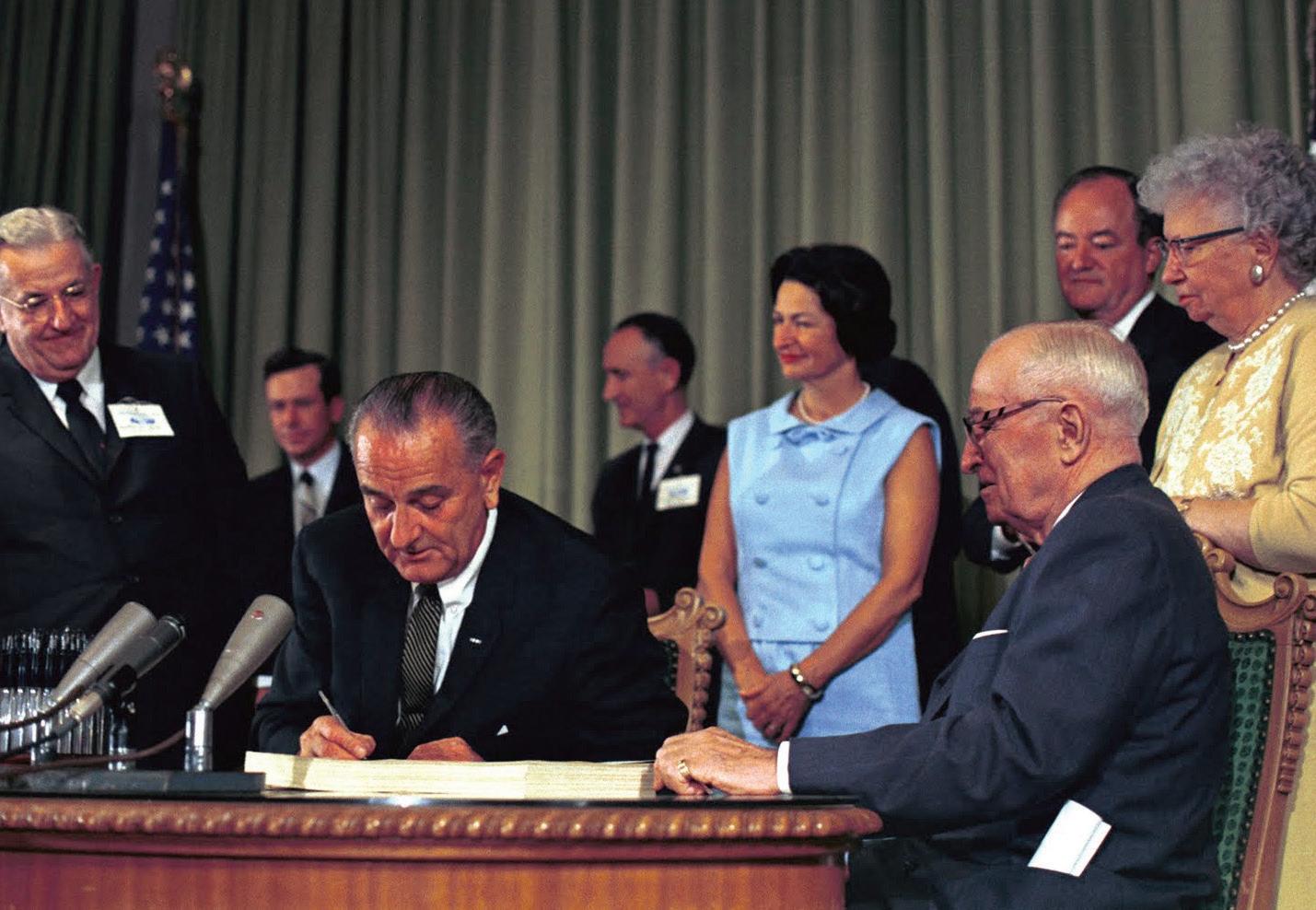
Medicare was passed into law on July 30th 1965 at a public ceremony in Independence, Missouri by President Lyndon B. Johnson. President Harry S. Truman was presented with the nations first Medicare Card. Truman was known as the “Daddy of Medicare.” Medicare services started one year later in July of 1966, covering more than 19 million Americans. In 1972, President Nixon extended coverage to the long term disabled. Medicare Advantage, or Medicare Part C was started in 1997 bringing private insurance plans into the market place. Medicare Part D prescription drug coverage was signed into law in 2003 and took effect in 2006. In 2020 there were over 62 million people on Medicare.
Here is a timeline of several Medicare and insurance-related milestones:
1945: President Truman calls for a national health insurance program for all. Legislators on Capitol Hill don’t act. He asks again in 1947 and 1949. Bills are introduced but die in Congress.
1961: A task force convened by President John F. Kennedy recommends creating a national health insurance program specifically for those over 65. In May 1962, Kennedy gives a televised speech about the need for Medicare.
1964: President Johnson calls on Congress to create Medicare.
1965: Legislation creating Medicare as well as Medicaid (health care services for certain low-income people and others) passes both houses of Congress by a vote of 70-24 in the Senate and 307-116 in the House. President Johnson signs the Medicare bill into law on July 30 as part of the Social Security Amendments of 1965.
1966: When Medicare services actually begin on July 1, more than 19 million Americans age 65 and older enroll in the program.
1972: President Richard M. Nixon extends Medicare eligibility to individuals under age 65 who have long-term disabilities or end-stage renal disease.
1997: Private insurance plans — originally called Medicare+Choice or Part C, later renamed Medicare Advantage — begin, giving beneficiaries the option of choosing an HMO-style Medicare plan instead of the traditional fee-for-service Medicare program.
2003: On Dec. 8, President George W. Bush greatly expands Medicare by signing the Medicare Modernization Act, which establishes a prescription drug benefit. This optional coverage, for which beneficiaries pay an additional premium, is called Medicare Part D.
2006: On Jan. 1, Medicare Part D goes into effect and enrolled beneficiaries begin receiving subsidized prescription drug coverage.
• Our services are FREE.
• We offer numerous options in Georgia.
• Our recommendations are based on YOUR needs and wants, not the insurance carrier, as they all pay the same commission.
• We maintain our relationship with you year over year.
• As your needs and wants change, or if the plans change, our recommendations may change.
• Companies offered:
• Humana
• Cigna Healthcare
• Transamerica
• Western United
• SilverScript
• Guarantee Trust Life
• WellCare • Aetna
• Clover Health Plans • Mutual of Omaha
Manhattan Life
Anthem (Blue Cross Blue Shield)
UnitedHealthcare®