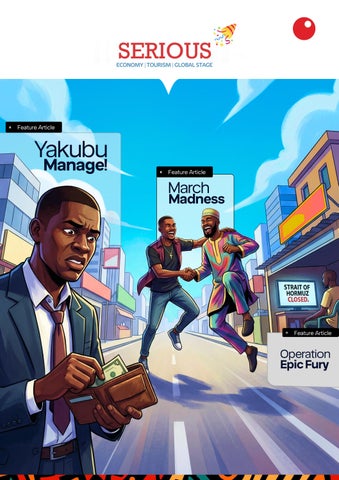
Serious - April 2026

Page 1


EDITOR’s NOTE!

When you’re speaking in 30/40 years, you can tell the young ones then that your eyes saw shege in the world. Was it last year, we were debating whether there’ll be world war 3. Then Iran came this year and said “you think you’re crazy abi, I will show you crazy”. Walahi, there’s no reason Nigeria or any part of africa is even discussing the topic cos Yakubu here Dey manage.

Alas, globalization means that e go touch everybody. Imagine my shock when they said strait of hormuz abi what is the reason there was an increase in the price of some goods. On the bright side if not for Alhaji and BYD/Qoray, it’s leg we’ll be using.

The dangote refinery and emergence of electric vehicles cushioned the real effect of the war on fuel prices in Nigeria. I don’t know about Tanzania and how they’re faring but things go hard.

Anyway, the only thing we should talk about during crisis is the economy and reflections on why one must enjoy life irrespective.

Happy new month.

SPOT 10 differences

Yakubu Manage!

The Good Ol' Days

There was a time, not even long ago, when seeing the late Chief Awolowo on a currency meant that breakfast was sorted.

A cold bottle of La Casera and Gala in traffic was enough to solve the butterflies in the tummy.

Money behaved the way money should. It bought things. This is not nostalgia. This is recent history, 2015, 2018, even 2020 in some cases. Close enough to remember clearly, far enough that it feels like a different country entirely.

Between January 2015 and January 2025, Nigeria's inflation rate moved from 8.0% to 34.8%.

But that number, sterile and statistical, does not capture what actually happened. Inflation did not just make things expensive. It restructured how we live, eat, move, dream, and survive.

The Realm of Small Things

Of all the lifestyle adjustments we have made, the most painful one is suya. There was a time, criminally recent, when suya was not an event. You did not need a reason. You did not need to check your account balance. You did not need to have suya money specifically allocated in your budget spreadsheet under Miscellaneous Pleasures. You simply wanted suya, and you got suya. With ₦500, the Mallam would hail me and give me a special seat by his side.

Today he will not even answer me. Based on price per kilogram, the average price of beef has risen from ₦1,450 to ₦8,500 per kg. That is more than a 400% increase.

A respectable suya order now costs ₦3,500 to ₦4,000. For something that used to be casual street food.

For something that was supposed to be democratic, available to everyone and affordable to all. These were not necessities, but they were not extravagances either. They existed in a sacred middle space, the realm of small things, where Nigerians of every class could participate. Now we have lost our ability to be spontaneous, to treat ourselves, to do something small without conducting a financial audit first.

The Meat Pie Situation

Yes, we like food. Sue us but this is another problem. Meat pies used to be ₦100 to ₦150. Standard. Reliable. Meaty and shiny. Our parents bought them for ₦50 and the famous Mr. Biggs allowed you to spend ₦500 on your favorite snacks.

Now air pie has replaced the meat simply because flour and butter have refused to cooperate. Flour alone has increased by more than 360% and butter by 971%. Today, a good meat pie is by connection.

Today, a good meat pie is by connection.

The mental gymnastics of being hungry in Nigeria today is exhausting. And we are not talking about fancy restaurants. We are talking about the most basic street food pleasures. Puff puff. Akara. Suya. Roasted corn. The foods that were supposed to be democratic/street have been gentrified. And in doing so, it took away one of the few things that made being Nigerian fun, the ability to eat something delicious without planning a budget meeting first.

The Tokunbo Dream

Let us talk about cars because this is where the middle class aspiration officially died. In 2015, a decent Tokunbo car was the signature of middle class arrival. You worked hard, you saved, and in two to three years you could afford a reliable Camry. ₦1.8 million to ₦2.5 million. Manageable. Achievable. Real. Today, that same Camry costs ₦10 million to ₦15 million. That is a 400% to 500% increase. For the same car. The same model. Just now, several years older.

But wait. You saved up. You finally bought the car. Now you need to fuel it. Petrol has increased from ₦87 per liter in 2015 to ₦900 to ₦1,100 per liter in 2025. That is more than a 1,000% increase. A car that used to cost ₦5,000 to fill up now costs ₦50,000 to ₦70,000. Weekly fuel expenses that were once ₦20,000 monthly now push ₦200,000 and above. The average Tayo, who used to save for three years now has to save for ten years. Thank God for Altdrive, this is where innovation meets necessity. You don’t have to wait to have all the money, you can get vehicles including electric options. Smart economics, not stinginess.

The Invisible Cost

Beyond food and car, what does not show up in inflation statistics is the cognitive burden of being poor in an expensive country where every emergency triggers panic. Nigerians are perpetually tired not just from work, but from the constant mathematics of survival. Every outing demands a budget because inflation has shortened our planning horizon. Young Nigerians stopped setting five year goals because five months felt uncertain. The future, once a space for ambition, became a space for anxiety. This is just the rant of someone who wants to buy crate of egg for ₦1000 again.

The Final Word

Inflation stole our small enjoyments. But it did not steal our ability to find new ones. The ₦100 that used to buy breakfast is gone. The spontaneous suya runs are memories. The casual meat pies are extinct. The affordable Tokunbo dream is fading. But we are still here. Still eating. Still moving. Still finding reasons to laugh, even when the mathematics of survival says we should not have the energy.

That is not resilience. That is defiance.

The good ol' days are gone. But good new days? Those we can still build.

One small enjoyment at a time.

March Madness

Spending

Nobody warns you about March and April and that is because December is the big boy of oblee. The parties, the fun and the traffic that somehow has become our ritual. That's why nobody is looking at the bad boys; March and April. Two weekends of celebration and one salary so you know there is no way to escape. According to NIBSS, Nigerians spent ₦158.3 trillion across these two months in 2024 alone, the second highest tally after November and December. I mean almost

90% of the population are either Muslim or Christian,

so the math makes beautiful sense. Whether Eid and Easter land in the same week or days apart, the result never changes. Everybody is celebrating, everybody is travelling, and everybody is quietly, professionally broke by the time May arrives. This is the Nigerian celebration economy. It has never joked with you. It will not start now.

The Big Leagues

The spending usually comes like a thief in the night. You have not gone anywhere, bought anything, or fed a single soul, and the season has already reached into your pocket. Easter Sunday and Monday means the full outfits. Eid means at least three, one for each prayer, and one for when people come visiting and you need to look like things are going well.

The fashion industry understands this better than your accountant does. From Balogun to Ariaria to every Instagram vendor who has ever opened a voice note with “Aunty, na only you I dey give this price,” this season is their Champions League final and get ready for some disappointments. Lace, ankara, agbada, senator, three piece suits, gele that needs it’s own seat in the taxi. The entire industry is lined up and waiting. And trust Naija, we no dey carry last.

₦40,000 ₦80,000 average Nigerian household spends on clothing per major religious festival

92% of Nigerian Muslims bought new clothes during Ramadan and Eid 20% increase in food market prices in the week before Eid and Easter 35%

₦27,000 ₦60,000 Lagos out by road, per person, up 78% from 2023

Road Trip

We have seen a significant decline in road travel for obvious reasons but

nothing moves a Nigerian like a long weekend and the thought of smokey jollof and ram meat.

Easter gives you Friday and Monday, a four day stretch of blessed freedom from the 9 to 5. The Eids give you back to back days built entirely around eating, visiting, and remembering what it felt like to breathe. You will pay 78% more for transport but you will go anyway.

Travelling during the festive season is a logistics operation that deserves a project manager, a security expert, and a therapist, in that order. The project manager because nothing in Nigeria is as beautifully chaotic as holiday travel. The security expert because obviously………… and the therapist because of the shege your family will give you the moment you arrive. Aunties will tell you that you have added and remind you of your singleness. This one is just Nigeria and we have made our peace with it.

Go Hard or Go Home

What is a celebration without food? In Nigeria that is a non existent event. The ram must come. The cow and the chicken must show face and the jollof must be made in quantities that suggest you are catering a wedding, because in many ways you are catering a wedding, just without the aso ebi invoice.

The goats have heard about inflation and priced themselves accordingly. The chicken has always been expensive and now simply owns it. You cannot go small.

You cannot make a small pot of jollof for Eid if your compound has thirty people coming and twelve more are already on their way. Nigeria does not celebrate in portions. It celebrates in large pots, open compounds, and the kind of abundance that quietly empties your account.

The cost of firewood, gas, seasoning, tomatoes, still not fully recovered from their own personal crisis, palm oil, cooking oil. We could go on but we will spare you. The full gist would take another edition.

Season Greetings

While black tax persists, season tax will still never run out of fashion. Let us not pretend otherwise. We are a generous people and the season gives us full permission to express it. The happy Eid transfer to a friend in another city. The God bless your celebration you drop for your security man, your blue collar staff and random people. None of these amounts are large on their own but collectively, they are a subscription service you signed up for the day you became a Nigerian adult. Nigeria has an informal economy of celebratory giving that no economist has properly mapped because it runs entirely on social memory and goodwill.

The Point

The celebration economy has been running since before you were born and it will run long after. It is bigger than any budget, any inflation rate, any wallet’s limit. It is the sound of a country that, no matter what it is going through, still finds a reason to dress up, cook a full pot, and show up for each other. But here is our advice. You can honor the tradition without sacrificing your future. The same culture that taught us to give generously also taught us to be resourceful. To make magic out of little. To turn one bag of rice into a feast for twenty. To find joy in a shared plate, not just in abundance. These are survival skills dressed as celebrations, and they have carried us through worse than inflation.

This season, celebrate like a Nigerian but budget like your future depends on it because it does. May your jollof be plentiful, your travel be safe, your family drama be minimal, and your bank account survive to see June.

Operation Epic Fury:

How Middle East Drama Became Our Problem

Fire and Brimstone

The Middle East is heating up again, and whenever that region gets dramatic, the rest of the world starts checking the price of fuel. This time the war came for the two things we love most about the Middle East, apart from the shawarma and kebabs: oil and tourism.

When something happening 8,600km away starts affecting fuel prices and flight tickets, it immediately becomes everybody’s business.

Interestingly, while global markets are shaking, Nigeria’s economy has been relatively steady. Our case is like a marriage that went through tough times and decided quietly to recalibrate rather than collapse. It's also the year before elections, so as history reminds us, this is truly the year of fire and brimstone.

Oil Is Still King

I know it’s weird to admit when Imperium and Qoray are blazing the trail, but unfortunately oil still reminds us of who the real landlord of the global economy is. Since tensions escalated, oil prices have climbed sharply, and history tells us that once oil moves, everything else follows. But it's not just transportation costs we have to worry about. A small path called the Strait of Hormuz that Iran technically controls accounts for 35% of global oil exports and 11% of total global trade. As we saw in the early stages of the Russia-Ukraine war, we might have to brace up for another shege time due to supply disruptions. If Trump doesn't end this war, we might be reviewing prices, manufacturing costs, and service delivery for months to come. Also pay attention to FX and cooking gas. Don't say I didn't warn you.

Tourism Takes a Hit

Think of vacations, work travel, and transit. That is a billion-dollar economy. Tourism is huge in the Middle East. In 2025 alone, Dubai welcomed more than 19 million overnight visitors, and tourism contributed over 12% of total GDP. Dubai’s airport is also the second busiest airport in the world, and for many countries around Iran, tourism is a major economic pillar alongside oil. Tourism has one weakness though: people prefer their vacations without missile alerts. That one is mostly for people who travel abroad. We locals will continue to use Torrista to plan travels across Nigeria and West Africa. No Iran and US fight here, just enjoyment galore at reasonable prices.

Local Champion

On paper, Nigeria’s economic indicators have recently been moving in the right direction. We're not shegeless, but things are gradually improving. Inflation, that once looked like the main homewrecker rising with impatience, has now declined for ten consecutive months.

The naira has continued to maintain composure, reserves have gone up, and the stock market has remained stable.

Sha, try and use Altinvest to tap into these gains. While things look rosy, the big issue is that a good economy does not automatically mean emotional ease and improved daily welfare. While headline indicators show progress, food prices, employment, wages, and affordable credit remain the true measures of progress.

This is why, as we edge closer to the elections, there is a need to pay more attention to our country. Election years in Nigeria often come with a familiar pattern: increased government spending and a sudden rush of completed projects. However, the ripple effect is that old inflation pressures can quietly resurface just as households had begun to enjoy some calm. Government spending not supported by infrastructure growth directly increases inflation, as seen in 2015, 2019, and 2023. I know we drag Nigeria every time, but in recent times the economy has found it’s balance, just in time for an election year to test whether we've learned anything.

The test is open book. And the book is every Nigerian election year since 1999.

Turn static files into dynamic content formats.

Create a flipbook