Robotics Classes for Kids Dubai: Best Age to Start and What to Expect at Each Level "Is my child too young?" is the question I hear most often, usually followed by its mirror image: "Is it too late?" Parents looking into Robotics Classes for Kids Dubai families can enrol in tend to assume there's one correct age, and that missing it costs something. There isn't, and it doesn't. What matters is matching the class to where the child actually is, because robotics at six and robotics at fourteen are close to different activities that happen to share a name. I've watched children start at five and at twelve, and both can do well. The difference is in what the class should look like at each stage. Let me walk through it level by level, so you know what's reasonable to expect and what's a sign the program has misjudged your child's age.
Ages 5 to 7: Play With a Purpose At this stage, robotics barely looks like robotics. Children work with simple, often screen-free robots, pressing directional buttons or placing instruction cards to move a small machine across a mat. The goal is cause and effect: I did this, so that happened. Don't expect technical skill, and don't judge the class by whether your child can explain how a motor works. What you want to see is a child who's curious, who laughs when the robot goes the wrong way, and who wants to try again. Attention spans are short, so good classes keep activities brief and physical. If a program has five-year-olds sitting through long explanations or staring at a screen for most of the session, it's mismatched to the age.
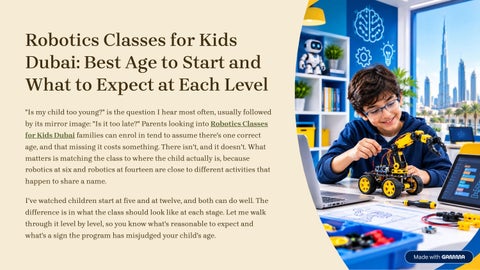
Ages 8 to 10: Building and Block Coding This is often the sweet spot for a first real robotics experience. Children can now handle small parts, follow multi-step instructions, and start thinking in sequences. They build simple robots, such as a wheeled vehicle, and control them using blockbased coding, where commands snap together visually instead of being typed. Expect plenty of trial and error. A robot that doesn't go straight, a sensor that triggers too early, a loop that never ends. These aren't signs the class is going badly. They're the actual curriculum. This is also the stage where Coding Classes for Kids Dubai and robotics blend together naturally, because the robot gives the code a physical result children can see. A child who writes a command and watches a wheel turn understands cause and effect in a way a screen-only exercise rarely delivers.
Ages 11 to 13: Sensors, Logic and Real Debugging Around this age, children can handle more demanding work. They wire sensors, calibrate readings, and begin moving from block-based coding toward text-based languages. Projects get more ambitious: a robot that follows a line, avoids obstacles, or completes a timed course. The real shift here is in debugging. A missing character in text code can stop everything, and a loose wire can produce baffling behavior. Students learn to isolate problems methodically instead of guessing. I've seen twelve-year-olds develop real patience at this stage, working through a stubborn issue for an entire session. That persistence is the most valuable thing the class builds, and it carries into school subjects and beyond. Older beginners can start here too. A twelve-year-old with no prior experience is not behind in any meaningful sense, though they'll usually benefit from a short ramp-up with simpler builds before tackling sensor work.
Ages 14 and Up: Independent and Ambitious Projects Teenagers can take on open-ended projects with real ambiguity: design a robot to solve a problem you choose, manage your own timeline, and figure out how to get unstuck without asking for the answer. The work looks much closer to genuine engineering. This is also where competition becomes an attractive goal. Events like the Robotics Olympiad UAE give older students a concrete target, a deadline, and a chance to see how their work compares with other teams. Competition isn't for everyone, and it shouldn't be forced, but for students who enjoy it, preparation builds teamwork, time management and resilience under pressure in a way ordinary classes rarely do.
So What Is the Best Age to Start? If I had to name one, I'd say somewhere between seven and nine suits most children for a first structured class. They're old enough to follow instructions and handle parts, young enough to enjoy the process without self-consciousness, and early enough to build skills gradually. But "best" depends on the child. A curious five-year-old in a play-based class can get plenty out of it. A shy twelve-year-old who's never tried anything technical can thrive in a well-designed beginner group. The age matters far less than whether the class is built for it. Starting early gives more runway, but starting later with the right class works too. Why Starting Level Matters More Than Starting Age A common mistake is putting a child into a class that doesn't match their level because of their age. A ten-year-old with no experience dropped into an advanced group will feel lost and quietly decide they're "not a robotics person." The same child in a beginner group usually does fine. Good programs assess where a child is and place them accordingly. If a program places every nine-year-old in the same group regardless of experience, that's worth questioning. Progress should be measured by growth, not by how a child compares with classmates.
How Robotics Fits the Bigger Educational Picture Robotics isn't a standalone hobby. It sits within a broader move toward practical learning that runs through STEM Education UAE, where schools and families increasingly value skills like problem-solving and teamwork over memorization. A child who learns to troubleshoot a robot is practicing the same habits they'll need for almost any future career. A well-designed K-12 STEM Education UAE pathway connects the early years to later coding, data and AI work, so robotics at nine feeds into more advanced projects at fourteen. When parents ask where a program leads, they're asking the right question. Early classes that have no clear next step can leave a child enthusiastic but stuck. What to Look For at Any Age Regardless of level, a few signs point to a good class. Children spend most of the session building and testing, not listening. The instructor asks questions instead of handing over answers. Mistakes are treated as normal. And there's some form of showing or explaining work at the end, because describing what you built cements what you learned. Red flags are equally consistent: instructors doing the building, finished robots that children can't explain, and sessions where kids spend more time waiting than doing.
Practical Takeaway There's no single perfect age for Robotics Classes for Kids Dubai parents can book. Younger children need play and curiosity, middle-grade children need building and block coding, and older students need real debugging and open-ended projects. Pick the class that suits your child's level, not just their age. Stem-Xpert UAE designs its programs in clear levels, so a five-year-old and a fourteen-year-old each get an experience built for them, with a visible path into Coding Classes for Kids Dubai and beyond. For families working toward Future-Ready Education UAE goals, the best time to start is whenever your child is curious enough to try.
FAQs What is the best age to start robotics classes for kids in Dubai? Most children do well starting between ages seven and nine, but classes exist for children as young as five using simple, screenfree robots. The right start depends more on the class matching the child's level than on a specific age. Can a 5-year-old join robotics classes? Yes, if the class is play-based and uses simple tools like button-controlled robots or instruction cards. Five-year-olds should not be expected to code or build complex machines. Is 12 too late to start robotics? No. A twelve-year-old can start successfully in a beginner-level group and often progresses quickly, though a short ramp-up with simpler builds helps before moving to sensors and text-based coding. What will my child learn at each age level? Younger children learn cause and effect through play, children around eight to ten build robots with block coding, and older students work with sensors, text-based coding and open-ended projects. Do kids need coding knowledge before robotics classes? No. Beginner robotics classes introduce coding as part of building, so no prior experience is needed. Should my child join a robotics competition? Only if they enjoy it. Competitions like the Robotics Olympiad suit students who like a goal and a deadline, but they're optional and shouldn't be forced.