Year 11 | 2026 Assessment Handbook

Year 11 | 2026 Assessment Handbook
1
4 Outdoor Rec VET AT1
Outdoor Rec VET AT4
Outdoor Rec VET AT5
Outdoor Rec VET AT6
Outdoor Rec VET AT7
Engineering Studies AT1
Geography AT1 PVDI AT2
English Extension 1 AT1
Financial Services VET AT1
Industrial Technology AT1
5 Economics AT2
HMS AT1
Outdoor Rec VET AT8
6
7 Business Studies AT1
Entertainment VET AT1
Investigating Science AT1
Maths Standard AT1
Maths in Trade AT1
Outdoor Rec VET AT1
8 Biology AT1
Economics AT1
English Advanced AT1
History Ancient AT1
SLR AT1
St of Catholic Thought AT1
9 Chemistry AT1
Drama AT1
Earth & Environmental AT1
Food Tech AT1
French Continuers AT1
History Modern AT1
Hospitality VET AT1
Maths Advanced AT1
Outdoor Rec VET AT2
Outdoor Rec VET AT3
PVDI AT1
Earth & Environmental AT2
Legal Studies AT2
St of Catholic Thought AT2
English Extension 1 AT2
HMS AT2
Software Engineering AT2
Visual Arts AT1 Entertainment VET AT3
English Advanced AT2
Entertainment VET AT2
Maths Standard AT2
Business Studies AT2
Maths in Trade AT2
Maths Extension 1 AT2
Outdoor Rec VET AT9
St of Religion 1 AT2
St of Religion 2 AT2
Engineering Studies AT2
Financial Services VET AT2
Food Tech AT2
French Continuers AT2
Hospitality VET AT2
Maths Advanced AT2
Music 1 AT2
Biology AT2
Drama AT2
English Standard AT2
English Studies AT2
English Studies (N/ATAR) AT2
History Ancient AT2
History Modern AT2
Marine Studies AT2
PVDI AT4
St of Catholic Thought AT3
Construction VET AT3
Financial Services VET AT3
Hospitality VET AT3
Marine Studies AT3
SLR AT3
Visual Arts AT2
English Studies AT3
English Studies (N/ATAR) AT3
Industrial Technology AT2
Manufacture & Eng VET AT1
Maths in Trade AT3
Preliminary Exams
10
St of Religion 1 AT1
St of Religion 2 AT1
Construction VET AT1
English Standard AT1
English Studies (ATAR) AT1
English Studies (N/ATAR) AT1
Legal Studies AT1
Marine Studies AT1
Maths Extension 1 AT1
Music 1 AT1
Physics AT1
Chemistry AT2
Construction VET AT2
Investigating Science AT2
PVDI AT3
* NOTE: Scheduling of tasks in this handbook may change due to unforeseen circumstances. In this event, students will be given a minimum of two weeks’ notice of a change in due date.
During the school year teachers will give students feedback on their progress in the courses that are being studied. This feedback will take many forms, for example, a comment in class, a written comment on a piece of work corrected by the teacher, the result of a topic test, a mark or grade given for a piece of work or a discussion about a practical task. This type of assessment and its results help students form an impression about how they are progressing in each course.
However, at various times during Years 11-12 teachers are required by NESA (NSW Education Standards Authority) to formalise their assessment of students’ progress. To do this, teachers administer what are referred to as ‘assessment tasks’. Performance on these assessment tasks is one of the factors that determine whether a student satisfactorily completes the requirements for the ROSA or HSC courses. The results of the assessment tasks administered during the HSC course are reported on the Higher School Certificate with the HSC Examination Mark
This booklet provides details of the formal assessment tasks that will be administered in the various subjects and of the procedures that teachers and students will be asked to follow in the administration of these assessment tasks. The assessment tasks are based on the guidelines issued to schools by NESA. Each school must follow the components contained in the guidelines, although schools will differ in how they assess the components.
Assessment tasks assist teachers in measuring student achievement in a course as well as informing teaching practice Many tasks assess aspects of the course that cannot be measured in a formal examination, for example, practical skills, oral skills and performance on fieldwork.
A variety of assessment tasks lessen the pressure of examinations and increase the accuracy of the final ROSA or HSC result by reporting on a number of outcomes of the course. Students who do not always do well in examinations have other means of demonstrating success and may acquire more confidence in their ability to achieve outcomes.
To cope with assessment tasks, students are encouraged to be organised in their study routine and to work consistently throughout the year.
Year 11 assessment begins in Term 1. HSC Course assessment begins during Term 4 of Year 11 and ends towards the end of Term 3 of Year 12. HSC Course assessment will only commence if the Preliminary Course has been completed.
NESA says that schools are to set sufficient assessment tasks to obtain a reliable indication of the relative achievement of each student. They ask that schools do not over-assess and thereby overwhelm students with assessment tasks.
Students should be aware of the assessment requirements in each course that they undertake. Students are not told the assessment mark that is submitted to NESA by the College at the end of Year 12. However, details of the position a student has obtained in a course (the rank order) are available at the time of the HSC.
Each school has a responsibility to tell the student the following information about each course:
• the general nature of each assessment task
• a schedule of when assessment tasks are planned to take place
• the importance or weight of each task
• details of administrative arrangements associated with each task (e.g. absence, late submission)
• details of the school’s policy on malpractice
• details of the procedures for dealing with student appeals arising from assessment tasks
The information that follows outlines the College’s policies and procedures in relation to assessment in Years 11-12. It is the student’s responsibility to familiarise themselves with the detail of these procedures. Ignorance is no excuse for not correctly following these procedures.
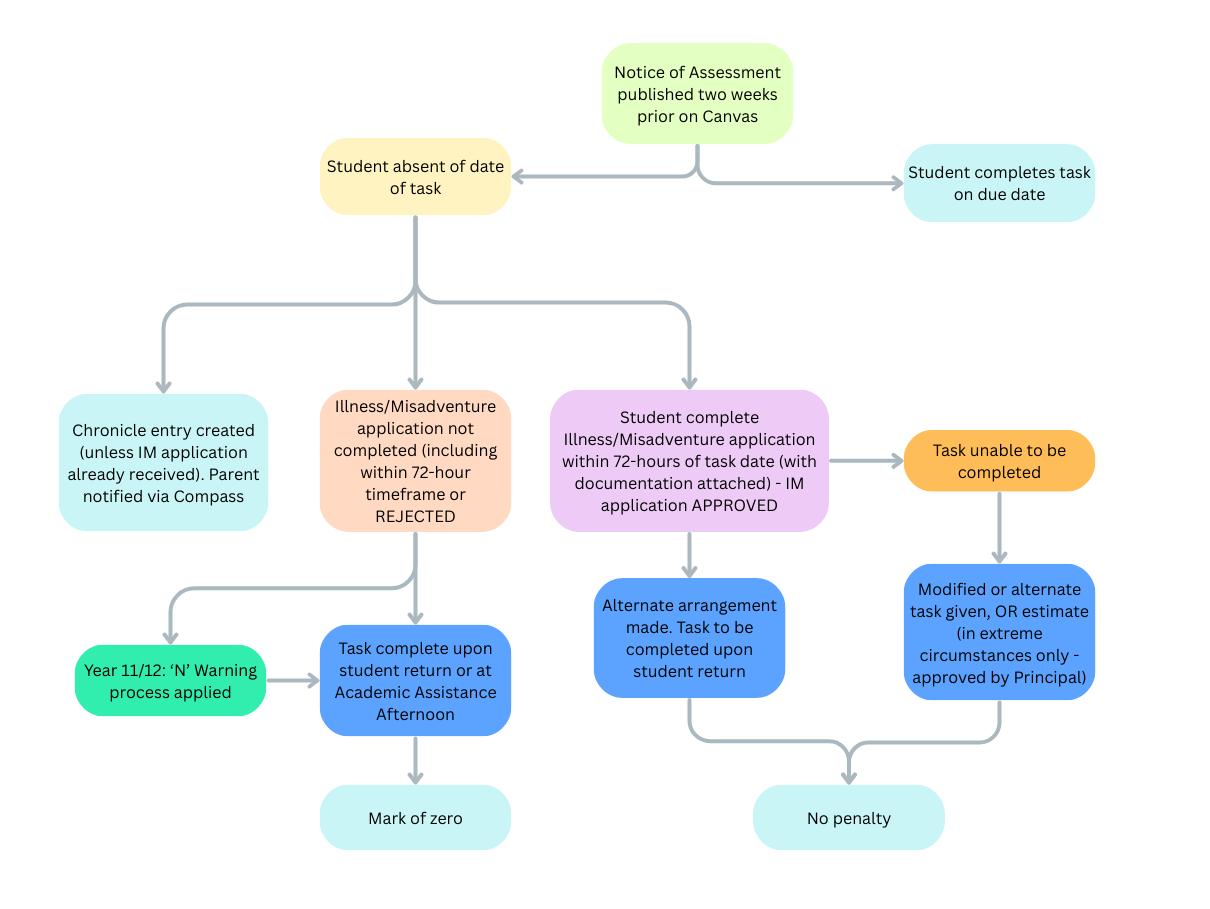
Prior to commencement of assessment in any given term, assessment task notification will be published to Canvas at least two weeks prior to when each task is due.
At this time, the class teacher will go through the notice of assessment with their class. It is the responsibility of any student who is absent from school when assessment information is given out to check the portal information for the class they missed and to obtain the appropriate details from their teacher upon their return to school.
Tasks such as major works, research projects and assignments are to be entirely the student’s own work or students will be considered guilty of malpractice and may be given a mark of zero (see the St Edward’s College Malpractice Policy for more details).
Tasks are to be submitted per the instructions given on the assessment task notification. Students who are completing assessment tasks using technology, are encouraged to make regular backup copies of their work. Problems with technology will not be accepted as an excuse for non-submission, substandard or incomplete work. If there is a problem with technology, students must be able to show evidence of their progress on a task.
If a teacher is absent on the day an assessment task is due and the task is a hardcopy hand-in, students will be expected to submit their work either by arrangement with the teacher beforehand or via the Leader of Learning for that subject. Assessment tasks are not to be given to clerical or ancillary staff or to visiting teachers. If a student is absent or on a school event on the day an assessment task is due, it is the student’s responsibility to make arrangements for the task to be submitted on time or prior to the due date.
All students studying VET courses are to ensure that they meet with the class teacher to make arrangements for the submission of a task that is due while the student is on work placement. It is also the responsibility of VET students to ensure that they find out any information about an assessment task that may have been set while the student is on work placement.
A student who has been suspended from school for disciplinary reasons will still be required to submit the task on the due date. If the task is an examination, the student will be required to attend the College in school uniform only for the duration of the examination. It is also the responsibility of a student who has been suspended to ensure that he finds out any information about an assessment task that may have been set while the student is suspended from school.
Where there is no valid reason to explain why a student was unable to complete an examination or performance on or by the due date, a mark of zero will be awarded for that task. Where there is no valid reason to explain why a student was unable to hand in an assessment task within 5 days of the due date, a mark of zero will be awarded for that task.
If a student fails to sit an examination or submit an assessment task, parents of the student will be informed via Compass, overseen by the course Leader of Learning and Director of Curriculum, outlining the consequences and procedure to be followed, (for example, a ‘N’ determination, Illness/Misadventure). Where a student misses an examination or in-class task, they will be required to sit the task at the first available opportunity upon their return.
Students undertaking subjects which require the physical submission of a task are required to submit their work by the due date. Failure to submit HSC major works by the due date will mean that students do not meet the course requirements and therefore will not qualify for the HSC in that subject.
If a student takes unjustified leave during the term, it is the student’s responsibility to make arrangements for the task to be submitted on time or prior to the due date. For assessments submitted late due to unjustified leave, the penalty is a deduction of 20% of the initially available marks per day or part thereof. If a student is absent due to unjustified leave during an examination period or in-class task, the student will receive a mark of zero for this assessment. Note, students are still required to complete the task despite receiving a mark of zero. The completion of a late submission may be required to be undertaken during an Academic Assistance Afternoon at the discretion of the Leader of Learning Where a student misses an examination or in-class task, they will be required to sit the task at the first available opportunity upon their return.
Assessment tasks must be submitted/completed by the due date and time on the assessment notification. For assessments submitted late, the penalty is a deduction of 20% of the initially available marks per day or part thereof. Weekends count as two days.
If a student sits for an assessment task on a given day but has not attended a class or classes in other subjects on that day, the student will receive a mark of zero
Illness means any sickness or medical condition for which there is valid documentation. Claiming to have a cold without a doctor’s certificate is not valid grounds for illness.
Misadventure refers to any event, outside of the control of the student that prevents them from completing or sitting a task, for which there is valid evidence. Waking up late and missing a bus is not valid grounds for misadventure. A car accident with police report and/or photos would be considered valid evidence.
All Illness/Misadventure applications must be made within 72 hours of the original assessment due date. This must be completed via the St Edward’s College Illness/Misadventure Application form, which can be found on the College website, or by clicking the following link: Assessment Handbooks Years 7 to 12 - St Edward's College
Students who miss a task due to sport organised by St Edward’s are required to submit an Illness/Misadventure form which will be approved. If a student misses a task due to representative sport organised outside of the College, an application for Illness/Misadventure will only be approved in the event that the student is selected to represent the state or the nation. Supporting evidence from the sporting body must be submitted with the Illness/Misadventure form.
If a student is unable to sit, submit or complete an assessment task for any reason, the following procedures will apply:
1. The student must outline the circumstances on the Illness/Misadventure form provided for this purpose (Assessment Handbooks Years 7 to 12 - St Edward's College). It is the student’s responsibility to submit this form within 72 hours of the original due date of the assessment task
2. In the event of illness, a medical certificate must be attached to the form. This should cover the impact of the illness on the student’s ability to complete the task on the due date. If the absence or late submission does not result from illness, other evidence documenting the reasons for absence or late submission must be provided when submitting the form (e.g., police report in the event of a car accident).
3. The Director of Curriculum will determine the validity of the Illness/Misadventure application. If it is determined that the inability to submit the task or absence was not for a legitimate reason, a zero mark or relevant penalties of 20% per day, or part thereof, will be awarded for the task.
4. For a valid absence or valid non-submission, the Leader of Learning may select an alternate task. In extreme circumstances, e.g. where the completion of a substitute task is not feasible or reasonable, or where the missed task is difficult to duplicate, the Principal may authorise the use of an estimate based on other appropriate evidence.
Appropriate documentation must be a legitimate original or an authentic copy satisfying the following:
1. Medical certificates must contain the specific dates for which the illness applied as well as the how the illness prevents the student from sitting the assessment task.
2. Medical certificates cannot cover a broad period of time in general terms. For example, “X is unfit for schoolwork during Term 2” or “X is unfit to sit examinations” are not adequate.
3. Medical certificates during the HSC Examination period can only cover the day of the missed examination. Certificates covering multiple examinations over multiple days will not be accepted.
4. Medical certificates will not cover an assessment task held outside the dates to which it refers.
5. Medical certificates must be written by a qualified medical practitioner and will not be accepted if written by medical practitioners who are family members of the student.
6. A student who becomes unwell during an examination in the HSC must ensure that they notify the Examination Supervisor and the Director of Curriculum. They should follow this up, on the day, with an Illness/Misadventure form and medical certificate.
7. An appropriate agent’s report (e.g. police report) must include the reason for inability to sit the assessment task as well as the date, time and location of any incident that caused the student to miss the assessment task.
Note that for Stage 6, NESA instructs schools that the final school Assessment Mark is not able to be used to compensate for factors such as extended illness, misadventure or domestic difficulties which may have affected a student’s overall achievement in the course.
NESA defines a non-serious attempt as including frivolous or objectionable material in an answer.
NESA defines a non-attempt in an HSC examination as including only completing multiple-choice questions.
Teachers/markers who consider a student’s answer in an assessment task to be either a non-serious or non-attempt should consult with their Leader of Learning. The Leader of Learning may then refer the issue to the Director of Curriculum.
Students must make a genuine attempt at all assessment tasks that, taken together, contribute in excess of 50 per cent of the available assessment marks for the HSC Course If an attempt at a particular task in the HSC scores zero, it is a matter for the teacher’s professional judgement whether the attempt is a genuine one.
Students who do not comply with the assessment requirements in any HSC Course will have neither a moderated Assessment Mark nor an Examination Mark awarded for that course. In the case of extension courses, students who fail to meet the assessment requirements for the common part of the course will not receive a result in the course at all.
Students requiring provisions for assessment tasks are documented and overseen by Diverse Learning. Provisions should be registered with the Diverse Learning team in conjunction with relevant Leaders of Learning and teachers. Students and parents have a responsibility to ensure that any changes to provisions are communicated to the Diverse Learning team at least one week prior to assessment tasks.
For formal exams, students will be sent an email regarding provisions prior to the examination date. Students have a responsibility to check the provisions listed on the email and to consult with the Diverse Learning team if there are any concerns.
For in-class assessment tasks, students eligible for provisions have a responsibility to check their student portal to ensure that a change of room has been listed at least one day prior to the task. Students should see their teacher or the Diverse Learning team if they have any concerns.
When designing assessment tasks every effort will be made to ensure they produce valid and reliable results. However, if a task is not valid (for example, it does not give a broad enough range of marks) an additional task or questions will be set and combined with the original marks in such a way as to improve the validity of the original task.
Students will only be able to change courses in Year 11 in consultation with the Director of Curriculum. Students will only be allowed to change courses in the HSC year if they are able to:
1. demonstrate that they have satisfactorily completed the relevant Preliminary Course prior to transferring to an HSC Course,
2. complete all HSC Course requirements, including all relevant assessment.
Students who transfer into the school after the commencement of the HSC assessment program will:
1. sit for the remaining assessment tasks with the school group,
2. have their position in the group determined by comparison with the school group on these common tasks,
3. be given a mark in the assessment task(s) that they missed consistent with their ranking for the completed common tasks.
Results of assessment tasks are to be given to students as a mark or grade. The rank in the course for that task is also to be given to the student in Years 11 and 12. At formal report times Year 11 and 12 students will be given their current cumulative rank based on performance in assessment tasks in each course.
In VET courses, students will be informed of their progress in achieving units of competency by the system, ‘competent’ or ‘not yet competent’. The student’s logbook will be completed when competencies are achieved. An estimated mark will be submitted to NESA at the completion of the course. This mark will be obtained from students’ performance in the Trial HSC Examination This mark will only be used in the event of illness or misadventure on the day of the HSC Examination
If it appears that a student is at risk of not meeting the assessment requirements of a course, a warning must be given. This warning will be given by the class teacher or Leader of Learning and will be approved by the Director of Curriculum It involves advising the student and parent in writing and alerting them to the possible consequences of an ‘N’ determination. In Years 11 and 12, if a student is to be given an ‘N’ determination because of failure to complete assessment tasks totalling more than 50% of the final course assessment marks, the Principal must advise the student of the determination, its consequences and the student’s right to a school review and subsequent appeal to NESA.
Note that an “N” determination may be made in a course for reasons other than not meeting assessment requirements, e.g. students who do not attend work placement at the scheduled time and students who do not apply themselves with diligence and sustained effort to the set tasks and experiences provided in the course by the teacher. A warning letter as described above will be issued in these cases.
“The teacher must assess the student’s actual performance, not potential performance. Assessment marks must not be modified to take into account possible effects of illness or domestic situations.”
(ACE Manual, https://ace.nesa.nsw.edu.au/ace-8072)
Once a student sits a task, an appeal cannot be made on the basis of illness or other similar issues as outlined in the quote above.
Students may only appeal the result awarded in an assessment task within three (3) school days of the task being returned. Students may not appeal the results of multiple-choice or short answer questions once the assessment task has been returned to the student permanently (e.g. taken home).
The student immediately informs the class teacher, who consults with the marker or marking team. They may make an adjustment if necessary, based on the specific criteria of the assessment task.
Should the student not be satisfied with the result of the Level 1 Appeal then they may appeal, but within three (3) school days of the decision of the Level 1 Appeal, to the Leader of Learning of that subject.
Should the student not be satisfied with the ruling made by the Leader of Learning, then they can appeal to the Director of Curriculum. Such appeals must be made within three (3) school days of the delivery of the Leader of Learning’s decision. The Director of Curriculum will only check that due process has been followed and will not be concerned with specific aspects of content or specialised subject information. The Director of Curriculum will not question a teacher’s judgement of the student’s performance.
Students can request from the College, after their last timetabled HSC Examination, their Assessment Rank order in each subject (i.e., position in each course). If students consider their position in the school’s order of merit for a particular course is not consistent with the feedback from their performance during the assessment tasks throughout the course, they are entitled, within two weeks after the last HSC Examination, to seek a review.
NESA specifically states that a teacher’s judgement of the worth of individual assessment tasks, as reflected in the mark awarded, will not be subject to review as part of this process.
This review checks that:
1. the school has complied with the weighting specified in the Assessment Handbook for each subject,
2. clerical and computational errors have not been made.
The student will be informed of the outcome following the review If the student is not satisfied with the outcome of the review the student may appeal to NESA which will check to ensure that the school review was carried out correctly.
Please see the College Malpractice Policy: Assessment Handbooks Years 7 to 12 - St Edward's College
NOTE: Scheduling of tasks in this handbook may change due to unforeseen circumstances. In this event, students will be given a minimum of two weeks’ notice of a change in due date.
Type: I = In-class task; H = hand in assignment; E = examination
Task
and Name
AT1: Model & Quiz
AT2: Depth Study
Model and Quiz on structure and function of the cell membrane
Plan, design and conduct an experiment to investigate factors affecting enzymes
Analyse data and draw conclusions AT3: Preliminary Examination
Formal Examination on Modules 1-4
Task # and Name
AT1: MCQ & SAQ
AT2: Business Plan
AT3: Preliminary Examination
In-class task reviewing the topic
Construction of a detailed business plan
Examination that reviews the topics studied
Task # and Name
AT1: Firsthand Investi gation (Unit 1) H T1/W9
AT2: Depth Study (Unit 1 and 2) H T2/W10
Firsthand Investigation and Scientific Report
Firsthand Investigation and Scientific Report
AT3: Preliminary Examination E T3/W9&10 40% Preliminary Examination on Modules 1-4
Task
and Name
AT1: Toolbox I T1/W10 N/A
AT2: Oilstone I T2/W10 N/A
AT3: Timber Floor & Framing I T3/W7 N/A
Part A – OnGuard Safety
Part B – Workplace Safety
Part C - Toolbox
Part A – Plan & Organise
Part B – Tools & Equipment
Part C - Oilstone
Part A – Workplace scenario
Part B – Workplace documentation
Part C – Construct timber floor and wall frame
Task # and Name
AT1: Group Performance I/H T1/W9 30%
AT2: Element of Production I/H T2/W9 30%
AT3: Performance and Written Examination I/H T3/W9&10
Task # and Name
Part A - Performance 20%
Part B - Written reflection 10%
Part A - Individual Element of Production 20%
Part B – Essay 10%
Part A – Performance Presentation 20%
Part B – Written Exam 20%
AT1: In Class Practical Task I T1/W9 30% In-class practical task
AT2: Depth Study H T3/W1 30% Depth Study
AT3: Preliminary Examination E T3/W9&10 40% Preliminary course examination (Modules 1, 2, 3 & 4)
Task # and Name
AT1: In-class task I T1/W8 30% MCQ and essay response
AT2: Research task H T2/W5 30% Researched task and in-class extended response – nature, role & operation of the labour market in the Australian economy
AT3: Preliminary Examination E T3/W9&10 40% Examination that reviews the topics studied
Task # and Name
AT1: Electricity Engineers Report H T2/W3 30% Take home research task - Engineering Report
AT2: Brakes Engineers Report H T2/W8 30% Take home research task - Engineering Report
AT3: Preliminary Examination E T3/W9&10 40% Preliminary Examination
Task # and Name
AT1: Creative Response and Reflection
T1/W10 30% Imaginative Response and reflection
AT2: Multimodal Speech H T2/W9 30% Speech and visual representation about the module ‘Contemporary Possibilities’
AT3: Preliminary Examination E T3/W9&10 40% Yearly Examination: Reading Paper Extended Response- Close study of Texts Discursive Response
Task # and Name
AT1: Imaginative Response + Justification
AT2: Extended Response
Part A Imaginative Response & Justification ‘Reading to Write’
Module B: Extended Response
AT3: Preliminary Examination E T3/W9&10 40% Examination: Reading Paper Extended Response- Module A Discursive Response
Task # and Name
AT1: Extended Response: Texts, Culture and Value
I T2/W4 30%
Comparative essay which demonstrates an understanding of the texts and ideas studied in ‘Texts, Culture and Value’
AT2: Independent Research Project H T3/W4 30% Independent Research Project, which can be presented in a variety of formats.
AT3: Preliminary Examination
E T3/W9&10 40%
Task # and Name
Examination will assess students’ knowledge and skills in:
-Imaginative Writing -Discursive Writing -Literary Theory
AT1: Portfolio of writing and justification H T1/W10 30% Students submit a portfolio of work completed during the term. Students select and edit a piece of writing to be assessed. Students write a justification explaining their choice
AT2: Voices of Australia
AT3: On the Road Examination
H T2/W9 30%
Extended response on Voices of Australia
H T3/W8 40% Short answer questions Extended response on travel
Task # and Name
AT1: Portfolio of writing and justification H T1/W10 30%
AT2: Workplace Presentation H T2/W9 40%
AT3: Digital Brochure
Task # and Name
AT1: Industry research task H T1/W7 N/A
Students submit a portfolio of work completed during the term. Students select and edit a piece of writing to be assessed. Students write a justification explaining their choice
Workplace presentation. Students submit to Canvas a resume and cover letter. In class, students present a resume pitch
Digital travel brochure and itinerary
AT2: Radio program & PA set up I/H T2/W6 N/A
Part A - Competency based research task on the Entertainment Industry practices.
Part B - Competency based written & practical task: Applying WH&S
Competency based task with scripting and live show delivery, including set up of PA and audio mixing.
AT3: Staging simulation I/H T3/W5 N/A Competency based including practical staging task
Preliminary Examination
T3/ W9&10 100% Formal examination on topics studied
Task # and Name
AT1: Working effectively with others & contribute to the health and safety of self and others
I/H T2/W4 0
Description
Students will complete short answer questions, Case Study, Workplace Simulation - Policy and Procedure Induction
AT2: Perform financial calculations I/H T2/W8 0
AT3: Process financial transactions and extract interim reports I/H T3/W7 0
Students will complete short answer questions and structured tasks such as financial calculations and spreadsheets
Students will answer research questions, complete basic accounting applications along with creating reports
Preliminary Examination E T3W/9&10 100% Formal examination on topics studied
Task # and Name Type Term/Week Weighting Description
AT1: Nutrition Task I, H T1/W9 30% Nutrition Research Task and Meal Design Practical dates TBA
AT2: Food Quality Task I, H T2/W8 30% Written Task and Food Styling Practical Practical dates TBA
AT3: Preliminary Examination E T3/W9&10 40% Formal Examination on Topics studied
Task # and Name
AT1: Speaking and Listening I T1/W9 30%
AT2: Reading Part A and Writing I T2/W8 30%
Students exchange information, opinions and experiences in French about their personal world in Speaking
Students analyse, process and respond to texts that are in French in Listening
Students analyse, process and respond to texts that are in French in Reading. Students answer a question in Writing in French, addressing a specific text type
AT3: Preliminary Examination E T3/W9&10 40% A formal examination which models the HSC Examination covering all work from the HSC course to date: Speaking, Listening, Reading and Responding, and Writing
Task # and Name Type
Description
AT1: In class task I T2/W3 25% Natural systems TED Talk poster presentation
AT2: Geographical Investigation H T3/W2 40% Major project based on student choice of geographic issue – fieldwork based
AT3: Preliminary Examination E T3/W9&10 35% Examination with multiple choice, short and midrange questions on all modules covered
Task # and Name
AT1: Depth Study - The body and mind in motion I/H T2/W5 20% Depth study – The Body and Mind in Motion
AT2: Collaborative Investigation Presentation I/H T3/W4 40% Collaborative investigation Presentation – Health for Individuals & Communities OR The Body & Mind in Motion
AT3: Preliminary Examination E T3/W9&10 40%
Task # and Name
Preliminary examination – multiple choice & extended response
AT1: Source Analysis Task I T1/W8 30% Sourced based in-class task
AT2: Historical Investigation H T2/W9 30% Research project on an aspect of Ancient History
AT3: Preliminary Examination E T3/W9&10 40%
Task
and Name
Examination on the topics studied
AT1: Constructing History Project H T1/W9 30% Online Discussion Forum – historiographical debate
AT2: Historical Investigation H T2/W9 30% Historical Investigation Project
AT3: Preliminary Examination E T3/W9&10 40% Examination on the topics studied
Task # and Name
AT1 I, H T1/W9
AT2 I, H T2W8
AT3 I, H T3/W7
Competency Based Task – Hygiene and Safe Food Handling Equipment
Competency Based Task – Work Health and Safety and Food Preparation
Competency Based Task – Simple Dishes and Clean Kitchen Premises
Preliminary Examination E T3/W9&10 100% Preliminary Examination
Task # and Name
AT1: Industry Study I T2/W4 40% Excursion and Report Based on Focus Area Business
AT2: Preliminary Project & Folio I T3/W8 40% Practical Project and Folio
AT3: Preliminary Examination E T3/W9&10 20% Preliminary Examination
Task # and Name
AT1: Firsthand investigation
T1/W7 30% Firsthand investigation on Module 1
AT2: Depth Study H T2/W10 40% Planning, conducting, and analysing a firsthand investigation and examination
AT3: Preliminary Examination E T3/W9&10 30% Formal Examination on Modules 1-4
Task # and Name
AT1: Case Study Media File I T1/W10 30% Respond and review perspectives on Case Study Media File
AT2: Research Task
AT3: Preliminary Examination
T3/W1 30% Research project on the individual and the law
T3/W9&10 40% Examination on the topics studied
Task # and Name
AT1: Bench Vice I T3/W8 N/A Theory, Fabrication and Machining
Task # and Name Type
AT1: First Aid I T1/W10 30% Competency Course and Practical Modules
AT2: Estuarine Ecology H/I T2/W9
AT3: Survival at Sea H/I
Task # and Name
Research Task and Presentation
Research Task and Investigation
AT1: In class exam I T1/W9 30% In class exam
AT2: In class exam I T2/W8 30% In class exam AT3: Preliminary Examination E T3/W9&10 40% Formal Examination
Task # and Name Type
AT1: In Class Test I T1/W7 25% In-class Test
AT2: In-class Task I T2/W6 35% In-class Test
AT3: Preliminary Examination E T3/W9&10 40% Formal Examination
Task # and Name
AT1: Portfolio H T1/W7 25% Hand-in Portfolio
AT2: In-class Test I T2/W7 35% In-class Test
AT3: In-class Test I T3/W8 40% Formal Examination
Task # and Name
AT1: In-class Task I T1/W10 30% In-class test
AT2: In-class Task I T2/W7 30% In-class test
AT3: Preliminary Examination E T3/W9&10 40% Formal Examination
Task # and Name
AT1 Viva Voce & Aural analysis I T1/W10 25% Viva voce including aural response analysis task
AT2 Composition Task & aural task H T2/W8 40% Composition including process diary and aural task
AT3 Performance & Viva Preliminary Examination E T3/W9&10 35% Performance of piece representative of one topic studied with accompanying Viva Voce based on performance piece. Completed during Preliminary Examination period
Task # and Name
AT1: Work placement Year 7 Camp I T1/W4 N/A
AT1: Work placement Year 9 Camp I T1/W7 N/A
Work placement Year 7 Camp
Work placement Year 9 Camp
AT2: Paddle a craft I T1/W9 N/A Paddle a craft
AT3: First Aid practical assessment I T1/W9 N/A First Aid practical assessment
AT4: Camp I T2/W1 N/A Camp
AT5: Surfing I T2/W1 N/A Surfing
AT6: Bike riding I T2/W1 N/A Bike riding
AT7: Abseiling I T2/W1 N/A Abseiling fundamental skills
AT8: Bushwalking I T2/W5 N/A Bushwalking
AT9: Student workbook due I T3/W7 N/A Student workbook due
Task
AT1: Case Study I T1/W9 15% Case Study on Political/Historical/Social/Street Photographers
AT2: Portfolio & Journal I T2/W3 35% Submission of Portfolio practical tasks completed in class
AT3: Portfolio & Journal I T2/W10 35% Submission of Portfolio practical tasks completed in class
AT4: Case Study I T3/W6 15% Case Study on Environmental Photographers
Task # and Name
AT1: Review of T1 HWK Sheets
AT2: Depth Study
AT3: Preliminary Examination
Task # and Name
AT1: Programming portfolio & Research Task
AT2: Mechatronic Programming Task
AT3: Preliminary Examination
Task # and Name
AT1: Sport Coaching & Training task
AT2: Athletics Presentation & Practical Participation
AT3: Online Netball/Hockey Quiz & Practical Participation
Review of Homework Sheets completed during Term 1
Firsthand Investigation and Scientific Report
A portfolio of OOP tasks completed
Hand in Project. Mechatronic object and programming component
End of Year Examination
netball/hockey quiz & practical participation
Task # and Name
AT1: Research Task H T1/W9 30% Research Task on the Nature and Beliefs of religion and Aboriginal Spirituality
AT2: Extended response/quotes E T2/W7 40% Extended Response on Judaism
AT3: Preliminary Examination E T3/W9&10 30% Preliminary Exam; based on all course modules throughout the year.
Task
and Name
AT1: Research Task H T1/W9 30% Research Task on the Nature and Beliefs of religion and Aboriginal Spirituality
AT2: SA response & quotes E T2/W7 30% SA Response on Judaism
AT3: Preliminary Examination E T3/W9&10 40% Preliminary Exam; based on all course modules throughout the year
Task # and Name
AT1: Written response
AT2: Project I/H T3/W1
Written task: on the Human Person. Students will use their skills and knowledge to develop a written response on the module “The Human Person”
Project: students will develop a report on their knowledge and skills from the module The trinitarian God and the Human Person and their experiences from their retreat.
AT3: In class response I/E T3/W6 30% Response on all modules studied throughout the preliminary year
Task
and Name
AT1: Extended Response & BOW E/I T2/W5 30% Submission of Body of Work completed in class. Extended Response 20% BOW 15%
Extended Response on two artists from Case Study
AT2: BOW/VAPD I T3/W7 35% Submission of Body of Work and VAPD completed in class
AT3: Preliminary Exam E T3/W9&10 30%
Extended Essay style responses based on case studies of art and artists