Year 11 &Year 12
Year 11 &Year 12
There are two pathways offered at St Edward’s College:
HSC + University Pathway
Students who want an ATAR, enabling direct entry to Australian Universities.
HSC + Vocational Pathway
Students who do not want an ATAR but want a recognised school credential.
Students who want an HSC that includes nationally recognised qualifications through Vocational Education and Training (VET) and TAFE courses. Note: Some eligible VET courses can count towards an ATAR. Students on a Vocational Pathway may wish to pursue an apprenticeship, traineeship, employment, or alternative pathway to Newcastle University.
Boys should discuss possible subject choices with teachers, subject Leaders of Learning, the Director of Curriculum or their Pastoral Leader to ensure they have the skills and capacity to fulfill course requirements.
Please note: In some cases, students will not be able to complete their chosen combination of subjects:
• Some subjects will have insufficient numbers of students for us to be able to run a class.
• Some combinations of subjects will clash on the school timetable.
• Students in this position will be supported to find alternative patterns of study for Year 11/12.
Look at your Year 9 and 10 grades. Which group are you in?
Group 1: Mostly A and B grades
Group 2: Mostly C grades, with a few B or D grades
Group 3: Mostly C, D, or E grades
What this means for you:
Group 1:
You are on track for a strong ATAR. You may be considering university. Choose subjects that match your future career or university requirements. Speak to careers staff or universities for advice.
Group 2:
Most students are in this group. The best strategy is to choose subjects you enjoy and can do well in. Avoid picking subjects just because they are needed for a course if you find them too difficult, as this may lower your results.
Group 3:
Direct university entry may not be the best option right now. Focus on your strengths and interests. Consider practical or vocational courses that can lead to TAFE pathways or future study options.
When choosing your subjects, think carefully about:
Interest: Pick subjects you enjoy. If you’re not interested, it will be hard to stay motivated during the HSC.
Ability: Choose subjects you’ve done well in before. You’re more likely to succeed in areas where you already have strength.
Balance: Try to include a mix of subjects, such as creative, practical, and academic (e.g. Photography, VET, Maths, Science).
Assessment style: Some subjects have major tasks completed before the final exams. This can help reduce pressure later. VET courses may not require an exam unless you want them counted towards your ATAR.
Future plans: Some university or TAFE courses require certain subjects. If unsure, check with careers staff or the institution.
Do NOT choose subjects because:
• you think they will scale well, doing well in a subject matters more.
• your friends are choosing them, you’ll still have time to see friends.
• you want a certain teacher, teachers can change.
• you think they are “easy”, all HSC courses require effort.
When choosing subjects, it is important to understand the rules about completing the HSC and getting an Australian Tertiary Admission Rank (ATAR)
To receive a HSC and be eligible for an ATAR, you must satisfactorily complete a preliminary (Year 11) pattern of study that includes at least 12 units.
To be eligible for an ATAR in NSW from 2025, you must satisfactorily complete at least:
• 10 units of Board Developed courses.
• 2 units of a Board Developed course in English.
• 3 Board Developed Courses of 2 units or greater.
• 4 subject areas.
Your ATAR is then calculated from your:
• best 2 units in English
• best 8 units from your remaining units
Find out everything you need to know about the ATAR (Australian Tertiary Admission Rank) on the Universities Admissions Centre (UAC) calculation page: ATAR Compass Calculation
HSC marks show how well you performed in each subject.
ATAR shows your rank compared to other students in NSW and is used for university entry.
HSC Marks:
• Given as a mark out of 100 (2-unit) or 50 (1-unit)
• Show your achievement based on set standards
• Only compare you to students in the same course
• Issued by NESA
ATAR:
• A rank, not a mark or percentage
• Shows your position compared to all students
• Allows comparison across different subject combinations
• Issued by UAC
To be eligible for the Higher School Certificate, candidates must meet the following requirements:
• Satisfactorily complete Years 9 and 10 or gain other qualifications that satisfy NESA requirements.
• Complete HSC All My Own Work before submitting any work for Preliminary or HSC course.
• The HSC All My Own Work program is designed to help Preliminary/HSC students to follow the principles and practices of good scholarship. This includes understanding and valuing ethical practices when locating and using information as part of their HSC studies, enabling students to understand their HSC assessment obligations.
• Meet the HSC Minimum Standards of Literacy and Numeracy within five years of starting the HSC course.
• Satisfactorily completion of the course requirements that meet the pattern of study required by the NSW Education Standards Authority (NESA). This includes the completion of the practical, oral and/or project works required for specific courses and the assessment requirements for each course.
• Sit for and make a serious attempt at the required HSC exams.
• Satisfactory attendance and application.
You will successfully complete a course if your principal is satisfied that you have:
• followed the course requirements set by NESA
• made a consistent effort in class tasks and learning activities
• achieved some of the course outcomes
• made a genuine attempt at assessment tasks worth more than 50% of the total marks
• you must also make a serious attempt at any HSC exam.
Important:
If you do not complete a course satisfactorily, it will not count towards your HSC requirements.
If it is a 2-unit course with an extension, neither course will count if the 2-unit course is not completed.
HSC courses are worth 1, 2, or 3 units. Each unit = 60 hours of study.
Most courses:
• are 2 units (120 hours in Year 11 and 120 hours in Year 12)
• worth 100 marks in the HSC
• have about 7 class periods per fortnight 1-unit courses:
• Worth 50 marks
• Have about 4 class periods per fortnight
Extension Courses:
• Add an extra 1 unit to a 2-unit course
• Require a higher level of study
• Available in English, Mathematics, Science, and History
Important:
• For English and Maths, you must take Extension in Year 11 before continuing to Year 12
• Science and History Extension are only taken in Year 12
• Entry into Extension courses depends on your ability and performance
Board Developed Courses (BDC)
• Count towards an ATAR
• Developed and examined by NESA
• Required if you want an ATAR
• Include both academic and some VET courses
Board Endorsed Courses (BEC)
• Do not count towards an ATAR
• No external HSC exam
• Often more practical and skills-based
VET (Vocational Education & Training) Courses
• Focus on industry skills and career pathways
• Provide both HSC credit and industry qualifications
Important:
Board Developed VET courses can count towards an ATAR if you sit the HSC exam
Board Endorsed VET courses do not count towards an ATAR
Special Note: A Certificate III VET qualification can provide an alternative pathway into the University of Newcastle, with or without an ATAR.
English: You must complete at least 2 units of English. You can choose one of the following options:
• English Studies (2 units)
• English Standard (2 units)
• English Advanced (2 units)
• English Advanced + English Extension 1 (3 units)
• English Advanced + English Extension 1 + English Extension 2 (4 units) – HSC only
Mathematics: You can choose one of the following options:
• Mathematics Standard – Preliminary only (will choose Standard 1 or Standard 2 in the HSC)
• Mathematics Standard 1 (2 units) – HSC only
• Mathematics Standard 2 (2 units) – HSC only
• Mathematics Advanced (2 units)
• Mathematics Advanced + Mathematics Extension 1 (3 units)
• Mathematics Extension 1 + Mathematics Extension 2 (4 units) – HSC only
Languages: You can choose a Beginners course or a Continuers course in a particular language, but not both.
To meet subject area requirements, you need to study at least four different subject areas
• Taking multiple courses in the same area still counts as one subject area only
• Extension courses do not count as extra subject areas.
Examples:
• Maths Extension + English Extension + Biology = only 3 subject areas (Maths, English, Science)
• English Advanced + Extensions + Maths Extensions + Modern History + History Extension = only 3 subject areas (English, Maths, History)
Important:
• History Extension and Science Extension do not count as additional subject areas.
When you complete your HSC, you will receive a portfolio that shows your achievements. It includes:
• HSC Testamur: Official certificate confirming you have completed the HSC
• Record of Achievement: Lists your courses and final marks/bands
• Course Reports: Show your marks and performance levels for most subjects
How HSC Marks Are Calculated
In most courses:
• 50% from school assessments (your tasks and ranking)
• 50% from the HSC exam
In VET courses, 100% from the HSC exam
Marks and Bands
• 2-unit courses are marked out of 100
• A mark of 50 is the minimum standard
• Results are grouped into bands, showing levels of achievement
• Band 6 (90–100) is the highest level
All courses listed are not guaranteed to run in Year 11/12. This is dependent on the number of students selecting to study them. Should a course not run, affected students will be asked to choose again. Reminder: HSC + University Pathway (ATAR) for those students wanting to go to university and HSC + Vocational Pathway for those students wishing to pursue an apprenticeship, traineeship, employment, or alternative pathway to Newcastle University.
Courses
English MANDATORY
Board DEVELOPED Courses
University Pathway (ATAR)
English Standard
English Advanced
English Extension 1
English Extension 2 (Yr 12 only)
Mathematics Mathematics Standard (ATAR)
Mathematics Advanced
Mathematics Extension 1
Mathematics Extension 2 (Yr 12)
To qualify for an ATAR students must complete the Optional HSC Examination
University Pathway (ATAR) if students sit the HSC Exam OR Vocational Pathway
English Studies
Mathematics Standard (Optional ATAR)
Board Endorsed Courses (BEC) Or Content Endorsed Courses (CEC)
These courses CAN NOT be used in the calculation of an ATAR
Vocational Pathway
Science
Biology
Chemistry
Physics
Investigating Science
Science Extension (Yr 12 only)
Technological and Applied Studies (TAS)
Performing Arts
Human Society and Its Environment
Engineering Studies
Industrial Technology (Timber)
Industrial Technology (Metal)
Industrial Technology (Multimedia)
Food Technology
Drama
Music 1
Legal Studies
Business Studies
Modern History
Ancient History
Geography
Economics
History Extension (Yr 12 only)
Construction - VET
Hospitality – Kitchen Operations & Cookery - VET
Entertainment Industry- VET
Financial Services - VET
Manufacturing & Engineering
Introduction - VET (BEC)
Board DEVELOPED Courses
COMPULSORY HSC Examination
University Pathway (ATAR)
Visual Arts Visual Arts
Information
NESA Board Endorsed Courses (BEC) Or Content Endorsed Courses (CEC)
OPTIONAL HSC Examination NO HSC Examination
To qualify for an ATAR students must complete the Optional HSC Examination
University Pathway (ATAR) if students sit the HSC Exam OR Vocational Pathway
These courses CAN NOT be used in the calculation of an ATAR
Vocational Pathway
Photography, Video & Digital Imaging (CEC)
Technology Enterprise Computing
Software Engineering
PDHPE Health and Movement Science
Languages French Beginners French Continuers
Religious Studies Studies of Religion 1 Studies of Religion 2
Other Subjects Available Courses that can be studied at St Joseph’s Catholic College (next door). Earth and Environmental Science
Some of the other VET Courses that have been studied at TAFE
Automotive
Electrotechnology
Real Estate Practice
Tourism, Travel & Events
Link to: NESA VET Board
Endorsed Courses
For additional information, visit the NESA website: NESA Subject Selection Information
Fitness – VET
Sport, Lifestyle & Recreation Studies (CEC)
Outdoor Recreation – VET (Yr 11 only) (BEC)
Studies of Catholic Thought (CEC)
UNITS: 1
PATHWAY: UNIVERSITY
COURSE OVERVIEW
Develops understanding of religion, belief systems, and religious traditions. Examines the influence of religion on individuals and society.
Strong focus on Australian religious history and culture.
Includes study of Aboriginal Spirituality.
Encourages critical awareness and analysis of religious beliefs and practices.
Explores core beliefs, doctrines, and authoritative teachings of selected religions.
Identifies and examines sources of religious authority.
Promotes respectful and accurate understanding of different religious traditions.
COURSE CONTENT
Year 11:
• Nature of Religion and Beliefs.
• Two Religious Tradition Studies: Christianity and one other selected from Buddhism, Hinduism, Islam, Judaism. Each Tradition Study covers: Origins, Principal Beliefs, Sacred Texts and Writings, Core Ethical teachings, Personal Devotion.
Year 12:


• Religion and Belief Systems in Australia post1945.
• Two Religious Tradition Depth Studies: Christianity and one other selected from Buddhism, Hinduism, Islam, and Judaism. Each Depth Study covers: Significant People and Ideas, Ethics, Significant Practices in the Lives of Adherents.
Students achieving a Grade C or above in Year 10.
A formal written examination and completion of various assessment tasks throughout the course.
UNITS: 2
PATHWAY: UNIVERSITY
COURSE OVERVIEW
Studies of Religion II promotes an awareness, understanding and application of the nature of religion and the influence of religious traditions, beliefs and practices on individuals and society, with an emphasis on the Australian context
COURSE CONTENT
Year 11:
• Nature of Religion and Beliefs.
• Three Religious Tradition Studies: Christianity and two others selected from Buddhism, Hinduism, Islam, Judaism. Each Tradition Study covers: Origins, Principal Beliefs, Sacred Texts and Writings, Core Ethical teachings, Personal Devotion.
• Religions of Ancient Origin.
• Religion in Australia pre-1945.
Year 12:
• Religion and Belief Systems in Australia post1945.
• Three Religious Tradition Depth Studies: Christianity and two others selected from Buddhism, Hinduism, Islam, and Judaism. Each Depth Study covers: Significant People and Ideas, Ethics, Significant Practices in the Lives of Adherents.
• Religion and Peace.
• Religion and non-religion.


Students achieving a minimum Grade B in English and Religion. Ability to write structured answers and essays.
A formal written examination and completion of various assessment tasks throughout the course.
UNITS: 1
PATHWAY: VOCATIONAL
Studies in Catholic Thought develops students’ knowledge and understanding of the Catholic faith and its place within Christianity. The course deepens insight into the Church’s social teachings and ascetic tradition, helping students engage with the broader Catholic tradition.
Students also strengthen their inquiry, reasoning, and critical thinking skills through engagement with Catholic teachings and literature. The course focuses on one religion that has made a significant spiritual, ethical, political, and social contribution to the world.
Through studying the theological, philosophical, ethical, and aesthetic traditions of the Catholic Church, students explore the richness and ongoing influence of this faith. Drawing on a liberal arts approach, the course challenges students to think analytically and engage with the depth and complexity of Catholic tradition in both historical and contemporary contexts.
• Who is a Human Person?
• The Trinitarian God and Humanity
The Re-imagining of Creation
• Virtue, Vice, Salvation
The Good Works
• The Common Good

RECOMMENDED FOR
Students achieving a Grade C or above in Year 10. This is a Non-ATAR Content Endorsed Course that does not have a HSC exam and does not contribute towards an ATAR.
Students with poor performance in Preliminary Studies of Religion 1 or 2 may be recommended to move to this course for the HSC.
Research, oral presentation, essays and exam
NOTE
Students are excluded from also studying Studies of Religion I or II.
UNITS: 2
PATHWAY: UNIVERSITY or VOCATIONAL
COURSE OVERVIEW
This course is designed to meet the specific needs of students who wish to refine their skills and knowledge in English and consolidate their literacy skills. The English Studies course provides students with opportunities to become competent, confident and engaged communicators and to study and enjoy a breadth and variety of texts. Students explore the ideas, values, language forms, features and structures of texts in a range of personal, social, cultural, academic, community and workplace contexts.
Through responding to and composing texts students strengthen their ability to access and comprehend information, assess its reliability, and synthesise the knowledge gained from a range of sources for a variety of purposes.
Year 11:
Mandatory module:
• Reading to Write: Transition to Senior English Elective modules:
• Voice of Australia (ATAR course)
• Achieving through English – English and the World of Education, careers and community (Non-ATAR course)
• On the Road English and the experience of Travel (both courses)
Year 12:
• Narratives and Human Experiences (Mandatory HSC Module)
• Playing the Game – English in Sport
• The Big Screen – English in film –making.
• Lyrical Voices– English through the world of Music
RECOMMENDED FOR
Students not achieving a Grade C in Year 10.
Texts studied will include a selection of short stories, documentaries, poetry and song lyrics, films and websites. Confidence in communication is the main objective. Other objectives include the development of critical thinking skills.
UNITS: 2
PATHWAY: UNIVERSITY
This course supports students with a wide range of literacy abilities, offering opportunities to analyse, study and enjoy diverse English texts while developing confidence as effective communicators.
English Standard provides a rich language experience through integrated reading, writing, speaking, listening, viewing and representing. Students build their ability to analyse and refine meaning, while reflecting on their own learning and composing processes.
Year 11:
• one complex multimodal or digital text in Module A, Contemporary Possibilities. This may include the study of film.
• one substantial literary print text in Module B, for example prose fiction, drama or a poetry text, which may constitute a selection of poems from the work of one poet.
• a range of types of texts drawn from prose fiction, drama, poetry, nonfiction, film, media and digital texts
• a wide range of additional texts and textual forms.
Year 12:
• at least three types of prescribed text, one drawn from each of the following categories: prose fiction; poetry or drama; film or media or nonfiction texts.
• at least two additional prescribed texts from the list provided in Module C: The Craft of Writing
• at least one related text in the Common module: Texts and Human Experiences.

Students achieving a Grade C or above in Year 10.
Students are required to study three types of texts drawn from prose fiction, poetry, drama and film/ media/ nonfiction. Students are expected to complete assessments in their own study time and must complete all set reading and homework. This is an academic course.
UNITS: 2
PATHWAY: UNIVERSITY
Students explore complex ideas in challenging texts and develop creative and effective ways to use language. They are encouraged to enjoy literature while strengthening their communication skills.
They deepen their understanding of how language, texts and meaning are connected through critical study and purposeful writing. Students also continue to develop their ability to question, refine ideas, and reflect on their learning and writing processes.
Year 11:
Study a range of texts drawn from prose fiction, drama, poetry, nonfiction, film, media and digital texts across 3 modules:
• Common module – Reading to Write: Transition to Senior English
• Module A: Narratives that Shape our World.
• Module B: Critical Study of Literature
Year 12:
Study four types of texts drawn from Shakespearean drama, prose fiction, poetry, drama or film/ media/ nonfiction.
The course has two sections:
• One common module to the HSC Studies, HSC Standard and the HSC Advanced courses, Texts and Human Experiences.
• Modules that provide elective choices, which emphasise aspects of shaping meaning and demonstration of the effectiveness of texts for different audiences and purposes.
Students achieving a Grade A or B in Year 10 and have demonstrated persistent application and achievement.
Students will complete weekly reading and writing tasks as homework. During the holiday breaks students will have set reading. Students will be assessed on a range of skills including:
• speaking
• prepared and unseen writing tasks
• collation of research materials
• multimodal task
• examination tasks
UNITS: 1 Each
PATHWAY: UNIVERSITY
The English Extension courses are designed for students studying Advanced English who demonstrate strong skills and a genuine interest in literature. They provide opportunities to extend language use and selfexpression in both creative and critical ways through the study of increasingly complex texts from a range of contexts. Students deepen their understanding of how literature reflects and shapes the world.
English Extension II further develops these skills by enabling students to refine their personal voice and craft an original Major Work. Through independent investigation and the creative process, students build advanced composition skills, explore areas of personal interest, and create sustained, sophisticated works. The course also strengthens independent learning, collaboration, and higher-order critical thinking skills essential for tertiary study and the workplace.
The course has one mandatory module: Texts, Culture and Value and students also undertake a related research project. The course requires students to examine a key text from the past and its manifestations in one or more popular cultures. Students also explore, analyse and critically evaluate different examples of such appropriations in a range of contexts and media.
HSC Extension I -The course has one common module: Literary Worlds with one elective option. Students must study at least three texts selected from a prescribed list for the module study including at least two extended print texts. Students are also required to study at least two related texts.
HSC Extension II - This course requires students to undertake extensive independent investigation involving a range of complex texts during the composition process of a Major Work. They must document this process in the Major Work Journal and Reflective Statement.
This course is highly demanding and only suitable for students performing to the top end of the cohort as determined by the Leader of Learning.
Students undertake extensive reading assignments in Year 11 and demonstrate an ability to respond to sophisticated texts in an insightful and mature manner. These responses are both written and spoken. Assessment tasks include creative writing, essay work, seminar presentations and examination tasks.
Students must be studying English Advanced to enrol in English Ext 1. English Standard & English Studies cannot also be studied. Students must be studying English Ext I to enrol in English Ext II
Core / Standard Pathway 10MAS1 to 10MAS2 and 10MAC1
Advanced Pathway 10MAA1 to 10MAA2
Grades ‘A’ to ‘E’ ‘C’ grade or less ‘B’ grade minimum required to study Adv ‘A’ grade required to study Ext 1
Mathematics Standard:
Students who are working towards a HSC and/or ATAR
Drop Mathematics:
No Mathematics studies.
OR
Students who studied Year 11 Mathematics Standard can choose from:
Mathematics Standard 1:
Students who struggle with the Mathematics Standard content.
Students who are not looking at going to University should do this course.
You can study this course and receive a HSC.
If wanting an ATAR, you can study this course and sit the optional HSC exam to qualify.
1
1
OR
Mathematics Standard 2:
choose this subject if you need an ATAR to go to University
2
1 (continue)
UNITS: 2
PATHWAY: UNIVERSITY or VOCATIONAL
Mathematics Standard helps students use maths to make informed decisions in everyday life. They build skills and understanding by applying maths to realworld situations, which can also support their learning in other HSC subjects.
Mathematics Standard 1 focuses on improving numeracy and building confidence. It helps students use maths to solve problems at home, at work, or in further study.
This is a 2-unit ATAR course with an optional HSC exam. Students who want an ATAR must sit the exam, while those who don’t, can still study the course without completing the exam. The course focuses on practical mathematical skills used in everyday life.
Year 11:
• Algebra – Linear Relationships, Formulae and Equations
• Measurement – Applications of Measurement and Working with Time
• Financial Mathematics – Money Matters
• Statistical Analysis – Data Analysis, Relative Frequency and Probability
Year 12:
• Algebra – Types of Relationships
• Measurement – Right Angled Triangles, Rates and Scale Drawings
• Financial Mathematics – Investments, Depreciation and Loans
• Statistical Analysis – Further Statistical Analysis
• Networks- Networks and Paths

Completion of Mathematics Advanced Pathway, Standard Pathway, Core or Maths in Trade. Students completing Mathematics Core that are achieving less than a C grade should enrol in Mathematics Standard in Year 11, thus preparing them for the Mathematics Standard 1 course in Year 12 or no further study of Mathematics
Assessment will be a range of types of tasks including topic tests, exams, formal and informal oral and written submitted assessment.
However, where possible tasks will be practical based tasks that are trade related. An example would be constructing a backyard landscape and providing measurements and calculating materials needed. This could include bricks, fence panels, bags of cement, soil/compost etc. needed to complete specific tasks.
Students can elect to complete the HSC exam for Mathematics Standard 1 to be included in the ATAR calculation.
In Year 11 - Mathematics Standard is the only 2-unit standard course offered (no Standard 1 and 2).
In Year 12 - Students who study Mathematics Standard have the option of following the Standard 1 or Standard 2 pathway.
UNITS: 2
PATHWAY: UNIVERSITY
Mathematics Advanced is a calculus-based course that helps students understand how maths can be used to explore patterns, relationships and real-world problems. Students develop problem-solving skills through observing, thinking and reasoning. The Year 11 Extension 1 course includes the Mathematics Advanced content, and this continues in Year 12.
This course builds on Year 10 (5.3) mathematics and introduces new topics such as calculus, exponential and logarithmic functions.
It is a recommended course for students who plan to study careers like engineering, architecture, or other fields that require higher-level mathematics.
Year 11:
• Functions - Working with Functions
• Trigonometric Functions - Trigonometry & Measure of Angles & Trigonometric Functions & Identities
• Calculus - Introduction to Differentiation
• Exponential and Logarithmic FunctionsLogarithms and Exponentials
• Statistical Analysis - Probability and Discrete Probability Distributions
Year 12:
• Functions - Graphing Techniques
• Trigonometric Functions -Trigonometric Functions and Graphs
• Calculus -Differential Calculus, The Second Derivative and Integral Calculus
• Financial Mathematics - Modelling Financial Situations
• Statistical Analysis - Descriptive Statistics and Bivariate Data Analysis and Random Variables
RECOMMENDED FOR Minimum B grade and completion of Advanced Pathway Mathematics in Year 10.
The Mathematics Advanced Year 11 course has been developed on the assumption that students have studied the content & achieved the outcomes of the Mathematics Years 7–10 Syllabus and in particular, the content and outcomes of all substrands of Stage 5 Core and Stage 5 Standard Pathway, and all content of Stage 5 Advanced Pathway.
Assessment will be a range of types of tasks including in class tests, exams, investigation tasks and informal in class assessment.
UNITS: 1
PATHWAY: UNIVERSITY
This course develops a deeper understanding of mathematics and build strong problem-solving skills. Students learn to write clear mathematical explanations and use models to solve more complex problems.
The Year 11 Extension 1 course includes Mathematics Advanced, and this continues into Year 12. Extension 2 in Year 12 builds further on Extension 1 and Advanced. This course extends the content from Mathematics Advanced, especially in calculus, and helps students apply maths to real-world situations.
Four lessons per fortnight outside regular school hours. Students who perform strongly and show a strong work ethic may choose Mathematics Extension 2 starting in Term 4.
Year 11:
• Functions - Further Work with Functions and Polynomials
• Trigonometric Functions - Inverse Trigonometric Functions & Further Trigonometric Identities
• Calculus - Rates of Change
• Combinatorics - Working with Combinatorics
Year 12:
• Proof - Proof by Mathematical Induction
• Vectors - Introduction to Vectors
• Trigonometric Functions - Trigonometric Equations
• Calculus - Further Calculus Skills and Applications of Calculus
• Statistical Analysis - The Binomial Distribution
Students eligible for this course are those currently excelling in the Advanced Pathway course, achieving a grade ‘A’ (over the whole of Year 10.)
Assessment will be a range of types of tasks including in class tests, exams, investigation tasks and informal in class assessment.
UNITS: 2
PATHWAY: UNIVERSITY
Mathematics Extension 2 provides students with the opportunity to develop strong mathematical manipulative skills and a deep understanding of the fundamental ideas of algebra and calculus, as well as an appreciation of mathematics as an activity with its own intrinsic value, involving invention, intuition and exploration. Mathematics Extension 2 extends students’ conceptual knowledge and understanding through exploration of new areas of mathematics not previously seen.
The Mathematics Extension 2 Year 12 course includes the Mathematics Extension 1 Year 12 course and the Mathematics Advanced Year 12 course.
The Mathematics Advanced, Mathematics Extension 1 and Mathematics Extension 2 Stage 6 courses form a continuum.
Year 12:
• Proof - The Nature of Proof and Further Proof by Mathematical Induction
• Vectors - Further Work with Vectors
• Complex Numbers - Introduction to Complex Numbers and Using Complex Numbers
• Calculus - Further Integration
• Mechanics - Applications of Calculus to Mechanic
The Mathematics Extension 2 Year 12 course has been developed on the assumption that students have studied the content and achieved the outcomes of the Mathematics Advanced Year 11 course and the Mathematics Extension 1 Year 11 course. The Mathematics Extension 2 Year 12 course has also been constructed on the assumption that students are concurrently studying the Mathematics Advanced Year 12 course and the Mathematics Extension 1 Year 12 course.
Assessment will be a range of types of tasks including in class tests, exams, investigation tasks and informal in class assessment.
UNITS: 2
PATHWAY: UNIVERSITY
COURSE OVERVIEW
Biology 11–12 enables students to understand the living world. Building on Science 7–10, students investigate health, sustainability and biotechnology, developing skills in analysing data and making ethical, evidence-based decisions.
Through Biology 11–12, students:
• understand interactions between living things and the impact of human activity on the environment
• apply biological knowledge to real-world problems
• recognise how Aboriginal and Torres Strait Islander perspectives enrich the study of biology
• develop critical thinking, problem-solving and ethical decision-making skills
COURSE CONTENT
Year 11:
• Cells as the basis of life
• Cells to systems
• Evolution and ecosystems
Year 12:
• Heredity
• Diseases
• Biodiversity
• Biotechnology
Working scientifically
Students develop skills in investigating, analysing data, problem-solving and communicating. These are embedded across all topics
Scientific investigations
• Includes practical and research-based investigations
• May involve experiments, simulations, fieldwork and data analysis
• Completed individually or collaboratively
Fieldwork
• Minimum of one fieldwork activity Year 11
• Linked to core topics
• May be combined with a depth study
Depth studies
• 10 hours across the course
• At least one in Year 11 and one in Year 12
• Focused investigations to deepen understanding
• Completed individually or collaboratively
RECOMMENDED FOR
Year 10 results should be a grade A, B or a (high) grade C. Students can study a maximum of 6 units of Science in Preliminary, and 7 units in the HSC course, with the introduction of Extension Science (1 unit).
Year 11: Three formal assessment tasks (one of which must be a Depth Study).
Year 12: Maximum of four formal assessment tasks (one of which must be a Depth Study). Practical work must be completed satisfactorily. You will be required to take notes and make summaries as part of your homework.
UNITS: 2
PATHWAY: UNIVERSITY
This course explores the structure, composition and reactions of and between all elements, compounds and mixtures that exist in the Universe. The discovery and synthesis of new compounds, the monitoring of elements and compounds in the environment, and an understanding of industrial processes and their applications to life processes are central to human progress and our ability to develop future industries and sustainability.
This course provides the foundation knowledge and skills required to study chemistry after completing school and supports participation in a range of careers in chemistry and related interdisciplinary industries. It is an essential discipline that currently addresses and will continue to address our energy needs and uses, the development of new materials, and sustainability issues as they arise.
Year 11:
Module 1 Properties and Structure of Matter
Module 2 Introduction to Quantitative Chemistry
Module 3 Reactive Chemistry
Module 4 Drivers of Reactions
Year12:
Module 5 Equilibrium and Acid Reactions
Module 6 Acid/base Reactions
Module 7 Organic Chemistry
Module 8 Applying Chemical Ideas
This course is designed for those students who are independent, inquisitive learners who are looking at undertaking a Science Degree post school.
Year 10 results should be a grade A or B in BOTH Science and Mathematics.
For further information regarding career opportunities in STEM, please visit:
https://careerswithstem.com.au/
Year 11: Three formal assessment tasks (one of which must be a Depth Study).
HSC: Maximum of four formal assessment tasks (one of which must be a Depth Study).
UNITS: 2
PATHWAY: UNIVERSITY
Investigating Science Stage 6 allows students to engage with scientific processes and apply them to real-world personal, community and global issues. The course complements other science subjects by deepening understanding of scientific concepts, their applications and their impact on society.
Students explore interdisciplinary STEM topics, developing skills to navigate a rapidly changing technological world. The course supports ongoing engagement with science and provides a foundation for further study and STEM-related pathways.
Investigating Science also complements Biology, Chemistry and Physics by strengthening shared Working Scientifically skills.
Year 11:
Module 1 Cause and Effect – Observing
Module 2 Cause and Effect – Inferences & Generalisations
Module 3 Scientific Models
Module 4 Theories & Laws
Year12:
Module 5 Scientific Investigations
Module 6 Technologies
Module 7 Fact or Fallacy
Module 8 Science & Society
Students should be inquisitive, passionate and enjoy working both independently and as part of a group. Students should be achieving at a C level (or higher) in Year 10 Science.
For further information regarding career opportunities in STEM, please visit:
https://careerswithstem.com.au/
Year 11: Three formal assessment tasks (one of which must be a Depth Study).
HSC: Maximum of four formal assessment tasks (one of which must be a Depth Study). 30 hours of the total 120 indicative course hours in both the Preliminary and HSC Investigating Science course will be allocated to depth studies. A depth study may be a single investigation/activity or series of investigations/activities. The depth study may be designed for the course cohort or a single class or be determined by individual students.
UNITS: 2
PATHWAY: UNIVERSITY
The Physics 11–12 course gives students the opportunity to understand and explore the physical world. Building on Science 7–10, students investigate phenomena, make predictions, and solve problems related to energy, emerging technologies, and scientific innovation. They analyse data and evaluate evidence to make informed, ethical decisions as scientifically literate citizens. Through Physics 11–12, students will learn to:
• develop an understanding of the physical world and the Universe
• recognise how Aboriginal and Torres Strait Islander Peoples’ perspectives enrich the study of physics
• apply physics concepts to real-world problems and consider their impact on society
• build skills in critical thinking, ethical decisionmaking and problem-solving
Year 11:
Study of three focus areas:
• Fundamentals of mechanics (50 hours)
• Waves (35 hours)
• Electricity and magnetism (35 hours)
• Working scientifically skills are integrated throughout
Year 12:
Study of four focus areas:
• Advanced mechanics (30 hours)
• Electromagnetism (30 hours)
• Nature of light (30 hours)
• Matter, energy and the cosmos (30 hours)
• Working scientifically skills are integrated throughout
Students should have achieved at least a grade B in Year 10 Science (especially the Physics module) and studied Mathematics Advanced Pathway in Year 10.
For further information regarding career opportunities in STEM, please visit:
https://careerswithstem.com.au/
Scientific investigations
Students complete both practical and secondarysource investigations, including:
• laboratory experiments, simulations and fieldwork
• analysing and presenting data using graphs, tables and digital tools
• using existing models to support understanding
Investigations may be completed individually or collaboratively. Adjustments may be made to support students with disability.
• 10 hours completed across the course
• At least one in Year 11 and one in Year 12
• Focused investigations that deepen understanding of course content
• Include Working scientifically skills (questioning and predicting, plus at least one other area)
• May be completed individually or collaboratively
UNITS: 2
PATHWAY: UNIVERSITY
The study of Earth and Environmental Science in Stage 6 enables students to develop an appreciation and understanding of geological and environmental concepts that help explain the changing face of the Earth over time. Through applying Working Scientifically skills processes, the course aims to examine how earth and environmental science models and practices are used and developed.
Earth and Environmental Science uses Working Scientifically processes to develop scientific investigative skills. It focuses on developing problemsolving and critical thinking skills in order to understand and support the natural environment.
Year 11:
Working Scientifically Core Modules
• Earth’s Resources
• Plate Tectonics
• Energy Transformations
• Human Impacts
Year 12:
Working Scientifically Core Modules
• Earth’s Processes
• Hazards
• Climate Science
• Resource Management
For further information regarding career opportunities in STEM, please visit:
https://careerswithstem.com.au/
Scientific investigations include both practical investigations and secondary-sourced investigations. Practical investigations are an essential part of the Year 11 course and must occupy a minimum of 35 hours of course time, including time allocated to practical investigations in depth studies.
Practical investigations include:
• undertaking laboratory experiments, including the use of appropriate digital technologies
• fieldwork
Secondary-sourced investigations include:
• locating and accessing a wide range of secondary data and/or information
• using and reorganising secondary data and/or information
One fieldwork exercise must be completed in Year 12.
UNITS: 2
PATHWAY: UNIVERSITY
Science Extension is designed for students with an interest in scientific research. The course lays a foundation for students planning to pursue further study in Science, Technology, Engineering or Mathematics (STEM) based courses offered at the tertiary level, and to engage in new and emerging industries.
The Science Extension Stage 6 Syllabus focuses on the nature, development and processes of science. The course requires students to engage with complex concepts and theories and to critically evaluate new ideas, discoveries and contemporary scientific research. Students are challenged to examine a scientific research question influenced by their study of one or more of the scientific disciplines. In doing this, students extend their knowledge of the discipline(s), conduct authentic scientific investigations, undertake rigorous analysis of the collected data, and, uniquely for this course, produce a detailed scientific research report that reflects the standards generally required for publication in a scientific journal. Students interrogate and refine their ideas of and about science through analysing historic and cultural observations and significant scientific research within the relevant ethical frameworks and philosophical arguments of the time.
• Module 1 The Foundations of Scientific Thinking
• Module 2 The Scientific Research Proposal
• Module 3 The Data, Evidence & Decisions
• Module 4 The Scientific Research Report
Students must be undertaking at least ONE of the offered Science courses through to the HSC, be independent, inquisitive and solution focused, with an aim to study a science or STEM based degree at university.
Three (3) mandatory assessment tasks, with the final task being a Scientific Research Report with a 40% weighting.
You can study this course concurrently with Chemistry, Physics or Biology in the HSC year ONLY Students can study a maximum of 7 units of Science in the HSC course.
The HSC Examination for Science Extension is ONLINE, the only course that has an online exam
UNITS: 2
PATHWAY: UNIVERSITY
Our society is regulated by a complex system of laws and rules that help maintain stability while protecting the rights of individuals and the community. Legal Studies aims to develop students’ knowledge, understanding and skills in evaluating the legal system and its effectiveness in promoting a just and fair society. In this course, students study the structures and processes of law within the context of modern Australia. They also examine contemporary legal issues, exploring what the law says, how it is changing and how effectively it responds to society’s needs.
Year 11:
Explores the foundations of the Australian legal system and the important role law plays in society. Students study how laws are made, interpreted and enforced, including the roles of parliament and the courts. They examine different types of law, the process of law reform, individual rights and responsibilities and contemporary legal issues affecting society. Students also investigate a real-world legal issue in The Law in Practice, while developing valuable skills in research, critical thinking, case study analysis and evaluating the effectiveness of the law.

Year 12:
Focuses on how the law responds to issues in society and the effectiveness of legal and non-legal measures in achieving justice. Students study the core topics:
Crime and Human Rights, examining the criminal justice system, human rights protection and the role of domestic and international law. They also complete two optional topics, such as Family and Consumers. Throughout the course, students analyse legislation, cases and contemporary legal issues while developing skills in research, critical thinking, source analysis and evaluating legal effectiveness.
Students with skills such as nuanced and critical thinking, organisational ability, and writing skills are better able to achieve positive academic results in this course. Interest in Law and high level literacy skills recommended.
May include research assignments, presentations, online discussion forums as well as the standard examination style tasks. Both the Preliminary Examination and the HSC are made up of multiple choice, short answer and long response questions.
UNITS: 2
PATHWAY: UNIVERSITY
Aims to develop students’ knowledge, understanding, skills and values to enable them to make informed judgements about the performance of businesses in a dynamic and changing environment. Business activity is an essential part of everyday life and the course reflects this by exploring both the theoretical and practical aspects of business that students will encounter beyond school. It covers a range of business functions, from planning and establishing small businesses through to managing operations, marketing, finance and human resources in larger organisations. Contemporary business issues and realworld case studies are embedded throughout the course, providing a relevant framework for analysing business challenges. Business Studies also promotes intellectual, social and moral development by encouraging students to think critically about the role of business in society and its ethical responsibilities.
Year 11:
Introduces students to the foundations of business and how organisations operate in Australia and globally.
Students study the nature of business, business planning and management, including an introduction to marketing, operations, human resources and finance. They investigate how businesses make decisions, respond to change and meet the needs of consumers and stakeholders. Throughout the course, students develop skills in research, communication, problem-solving and analysing contemporary business issues and case studies.
Year 12:
Examines how businesses operate in dynamic and complex environments. Students study core topics including operations, marketing, finance and human resources, along with the role of business in managing change, globalisation and strategic decision-making. They investigate how businesses respond to internal and external influences to achieve objectives such as efficiency, profitability and growth. The course also includes case studies of real businesses. Students develop skills in analysis, research, problem-solving and applying business knowledge to real-world situations.
For further information regarding career opportunities in Business Studies visit: https://myfuture.edu.au/bullseyes/details/4 businessstudies
Research, oral presentations, research essays, business investigation into a business venture, report construction, and examinations. Students will need to follow business media reports. In Year 11 students have to construct a major business plan on their own business idea.
UNITS: 2
PATHWAY: UNIVERSITY
The subject of Economics is an excellent method in preparing students for a variety of global career paths in business, government agencies, welfare and travel. Economics offers the opportunity for high achieving students to excel in an academic and challenging environment.
Year 11:
Covers microeconomics. It examines the behaviour of consumers, business and governments. In this course students will be expected to follow government economic policies and the role played in managing business cycles as well as global economic challenges.
Year 12:
Focuses on the management of the economy and examines the management and action taken by government organisations such as Reserve Bank of Australia and International Monetary Fund in both the Australian and global economies. The course enables the students to take a more active role in economic management. Students will be able to justify the use of various strategies adopted to improve the state of the economy, reallocate resources, reduce inequality and encourage the development of sustainable economic environmental policies. It includes study into the current use of fiscal and budget policy, monetary policy and microeconomic reform.
Minimum B grade in Mathematics and English. An ability to write high order extended responses and confidently perform calculations using economic data is highly important.
There will be variety of oral and written presentations, research tasks, tests, assignments, stimulus tasks and group work.
Students will be expected to engage regularly with contemporary economic and business issues through a range of media sources, including digital news platforms, podcasts, market updates, and current affairs reporting. Students should be prepared to critically analyse and discuss emerging economic trends and events, communicate their findings effectively, and apply their understanding to current economic policies, strategies, and real-world business contexts.
UNITS: 2
PATHWAY: UNIVERSITY
Geography helps us to explore and understand space and place - recognising the great differences in cultures, political systems, economies, landscapes and environments across the world, and exploring the links between them. Geography also provides an ideal framework for connecting and bringing together other fields of knowledge. Many of them connecting other HSIE subject and the sciences and mathematics. With real world issues like climate change, the rate of urbanisation and food security at student’s doorstep, this is a worthwhile subject.
Year 11:
Students learn about earth’s natural systems. This includes an examination of the four spheres of earth: the atmosphere, the biosphere, the lithosphere, and the hydrosphere. This is the core topic for Year 11. Other topics include human interactions with the environment and challenges to global population and resources. The focal point of Year 11 Geography is the Geography Investigation (GI), where students select a geographical issue that is important to them and develop their own research project around it
Year 12:
Includes a study of ecosystems and its biodiversity, such as the Great Barrier Reef, understanding urban places as well as the role NGO’s play in promoting global sustainability. Furthermore, students will master a range of key geography skills. They will be able to synthesise and analyse information from a range of maps, graphs, photographs, and statistics to apply when investigating contemporary issues.
Essential to becoming a successful Geographer is to be curious and have a desire to explore the world we live in. During the Geographical Investigation it is expected that students complete their own fieldwork to support their project. Geography is an incredibly rich and rewarding subject that complements other areas of study in the Sciences and Humanities.
For further information regarding career opportunities in Geography visit:
https://myfuture.edu.au/bullseyes/details/15 geography
Types of assessment tasks are diverse and flexible to best meet the needs of the student and the cohort. This could include a TED Talk style presentation, an online forum submission, traditional examinations and a Geographical Investigation (GI) submission, which allows the student to choose their own form of submission.
Additional cost for Geography Field Trip will be approximately $900.
UNITS: 2
PATHWAY: UNIVERSITY
The study of Ancient History engages students in an investigation of life in early societies based on the analysis and interpretation of physical and written remains. It offers students the opportunity to investigate the possible motivations and actions of individuals and groups, and how they shaped the political, social, economic and cultural landscapes of the ancient world. Ancient History stimulates students’ curiosity and imagination and enriches their appreciation of humanity by introducing them to a range of cultures and beliefs as well as to the origins and influences of ideas, values and behaviours that are still relevant in the modern world. In all industries, there is a need for employees, leaders and decisionmakers to hold exactly the kind of creative, communication, and emotional and cultural intelligence skills that are the crux of the Ancient History program
Year 11:
Comprises three case studies in additional to the core topic, The Nature of Ancient History. The case studies currently taught in Year 11 are Palmyra and the Silk Road, Tutankhamun’s Tomb and Women in Ancient Greece and Rome. In addition, students undertake a Historical Investigation, which promotes each student’s unique interest in the ancient world and allows them to develop an investigation based on a chosen area. Collectively, these topics focus on developing and refining key historical skills to effectively prepare students for the demands of the HSC course.
Begins with the core topic Pompeii and Herculaneum
This is a source-based study of the sites and an investigation into what the archaeological remains reveal about daily life prior to the eruption of Mount Vesuvius. Students then undertake the study of Sparta, with a strong emphasis on the development of source analysis and interpretation skills. This is followed by the study of the Augustan Age, focusing on the establishment and development of the principate, which provides important contextual understanding for the final unit of study, a personality study of Agrippina the Younger.
For further information regarding career opportunities in Ancient History, please visit:
https://myfuture.edu.au/bullseyes/details/17 history
• essay tasks
• source-based examinations and poster tasks
• historical Investigation
• academic blog posts
UNITS: 2
PATHWAY: UNIVERSITY
The study of Modern History engages students in an investigation of the forces that have shaped the world, based on the analysis and interpretation of sources. It offers students the opportunity to investigate the possible motivations and actions of individuals and groups, and how they have shaped the world politically, culturally, economically and socially. Modern History stimulates students’ curiosity, imagination and enriches their appreciation of humanity by introducing them to a range of historical developments and experiences that have defined the modern world.
Year 11:
Consists of three case studies and the Core topic, the Shaping of the Modern World, the focus being the events and impacts of World War 1. The case studies currently taught are:
• The decline and fall of the Romanov Dynasty
• The Meiji Restoration and the Representation and Commemoration of the past, specifically focusing on how historical films enable a modern audience to engage in history.
Each topic plays a significant role in building an understanding of the narrative needed to better tackle the HSC course components.

Begins with the rise of dictatorships and authoritarian governments in the inter-war period. This Core topic, which focuses largely on the rise of the Nazi Party in Germany, is what all students will study across NSW. The National Study offers a wonderful opportunity for students to develop an understanding of Russia and the Soviet Union in the aftermath of the war and in leading to the outbreak of WWII, also allowing a comparative study between Adolf Hitler and Joseph Stalin. There is also a shift of focus away from Europe and into a conflict that had a direct impact on Australia, the conflicts in Indochina, where students will investigate the role of American influence in the region and the events leading to the North’s victory. Finally, students will follow the path of one of history’s greatest leaders, Martin Luther King Jr., learning about the bravery and sacrifice of many during America’s Civil Rights Movement and then drawing parallels with the events within Australia and the fight for more rights by the Aboriginal and Torres Strait Islander Peoples.
For further information regarding career opportunities in Modern History, please visit: https://myfuture.edu.au/bullseyes/details/17 history
• research-based essay
• source analysis tasks
• historical Investigation (student choice of topic)
• academic blog posts.
UNITS: 1
PATHWAY: UNIVERSITY
History Extension provides students with opportunities to examine the way history is constructed and the role of historians through an exploration of Historiography Rather than focusing on and/or extending students’ knowledge of a particular period or event in history, students investigate the nature of history and changing approaches to its construction over time through sampling the works of various writers, historians and others involved in the practice of history. Students apply their understanding to undertake an individual investigative project, focusing on an area of changing historical interpretation.
Students develop their understanding of how a piece of history has been constructed, analysing the role of context, author, and other factors that have influenced what was included in the history. They will develop their critical thinking skills, building capacity to analyse the motivations behind points of view and pieces of information. Additionally, students will focus on key debates within history, deconstructing why there can be different histories or perspectives written on the one event or time period.
From Herodotus to 21st century depictions of history in film and on social media, the History Extension course covers a range of topics and time periods, focusing on how history is constructed over time.
Year 12:
Comprises two sections: Constructing History
Key questions:
• Who are historians?
• What are the purposes of history?
• How has history been constructed, recorded and presented over time?
• Why have approaches to history changed over time?
Case studies:
Students develop their understanding of significant historiographical ideas and methodologies by exploring one case study, with reference to three identified areas of debate and the key questions.
History Project:
Students will undertake an individual investigative project, focusing on an area of changing historical interpretation.
There are three assessments within the History Extension course, two of which relate directly to the individual research project (History Project).
Students must study either Ancient History or Modern History as a co-requisite for Extension History
UNITS: 2
PATHWAY: UNIVERSITY
Interested in AI, cybersecurity, apps, or the latest technology? Enterprise Computing gives students hands-on experience with the digital tools and technologies shaping the future. Through practical projects, students explore areas such as networking, data visualisation, user experience design, and intelligent systems while building valuable problemsolving, creative, and teamwork skills for future study and careers.
Year 11:
Interactive Media and User Experience - Explore how apps, websites, games, and social media are designed and created. Students work with digital media, design interactive experiences, and create their own multimedia projects.
Networking Systems and Social Computing - Learn how devices and networks keep people connected. Students investigate how networks operate, set up network systems, and explore how technology supports communication and collaboration.
Principles of Cybersecurity - Discover how to stay safe online by learning about privacy, cyber threats, ethical hacking, and digital security. Students explore how individuals and businesses protect data and systems in a connected world.
Year 12:
Data Science - Learn how data is collected, stored, and analysed to solve real-world problems. Students work with data sets to identify trends, test ideas, and present meaningful insights.
Data Visualisation - Discover how data can be turned into engaging visuals and interactive stories. Students learn to interpret data, design for user experience, and create effective data visualisations.
Intelligent Systems - Explore how technologies such as AI and intelligent systems are used in everyday life. Students investigate how these systems use data to make decisions and create their own intelligent solutions.
Enterprise Project - Apply knowledge and skills to a major project that solves a real-world problem. Students design, develop, and present an innovative computing solution using the concepts explored throughout the course.
Even for students who do not pursue technology careers, digital skills are increasingly important across all industries and future workplaces.
In Year 11 there will be 3 assessment tasks: an assignment, a major project and a yearly examination.
In Year 12 there will be 4 assessment tasks: a research assignment, a major enterprise project, a written examination and the Trial HSC examination.
The HSC examination will be 2 hours and 30 minutes undertaken using a computer.
UNITS: 2
PATHWAY: UNIVERSITY
Software Engineering is designed for students interested in coding, technology, problem-solving, and creating digital solutions. Using programming languages such as Python, students learn how software is designed, developed, tested, and improved to solve real-world problems. Through practical projects, students explore areas including app development, databases, web technologies, operating systems, and the interaction between hardware and software. Students develop skills in logical thinking, creativity, collaboration, and project design while using industrystandard development processes. Software Engineering provides strong preparation for further study and careers in computer science, software development, cybersecurity, engineering, game design, and emerging technology industries.
Year 11:
Programming Fundamentals - Learn the foundations of coding and software development using programming languages such as Python. Students design algorithms, work with data, and develop software solutions to solve real-world problems.
Object-Oriented Programming (OOP) - Explore how modern software and apps are built using objectoriented programming. Students create programs using classes, objects, and reusable code to develop more advanced digital solutions.
Programming Mechatronics - Combine coding with hardware to design and build interactive systems. Students program and test mechatronic devices using sensors, control systems, and automation technologies.
Secure Software Architecture - Learn how secure and reliable software systems are designed and developed. Students explore strategies used to protect software and data while creating programs that are efficient, scalable, and secure.
Programming for the Web - Develop the skills to create interactive websites and web applications. Students work with web technologies to design, code, and test engaging online experiences.
Software Automation - Explore how automation is used to improve efficiency in software development and digital systems. Students investigate automated processes, testing, and tools used in modern software engineering.
Software Engineering Project - Apply coding and design skills to a major project that solves a real-world problem. Students plan, develop, test, and present a complete software solution using industry-style processes.
Year 11: 3 assessment tasks: a research assignment, a major project and a formal written examination.
Year 12: 4 assessment tasks: a research assignment, a major enterprise project, a written examination or programming task and the trial HSC examination.
HSC examination - 2 hours and 30 minutes undertaken using a computer.
Practical examinations, written assignments, formal examinations, computer-based assessment, project work, Python projects and use of Linux based components.
UNITS: 2
PATHWAY: UNIVERSITY
French Beginners is a practical and engaging course that develops students’ ability to communicate in French while exploring the cultures of the Frenchspeaking world. Students build confidence in listening, speaking, reading and writing through meaningful communication activities and develop an understanding of how language works in different cultural contexts.
Throughout the course, students explore a range of topics related to everyday life and contemporary youth culture. Topics may include personal identity, relationships, school life, travel, leisure, food, technology and communication in French-speaking communities.
Students engage with a variety of spoken, written and multimodal texts and learn to interpret, respond to and create texts in French. They develop vocabulary, pronunciation and grammatical knowledge and apply these skills in practical and real-world contexts. Learning experiences may include conversations, roleplays, presentations, listening activities, reading authentic texts and collaborative projects.
The aims of the course are to:
• Develop the ability to communicate confidently and effectively in French.
• Gain an understanding of language as a system and how the French language works.
• Explore and appreciate the cultures and perspectives of French-speaking countries.
• Build skills that can be applied to future study, work, travel and leisure opportunities.
Students who have completed the 100-hour course of French (in Years 7 – 10) are eligible for French Beginners.
Speaking, Listening and Responding, Reading and Responding, Writing in French.
Students can also select any outside courses offered at the NSW School of Languages.
Students choosing to study a language through the NSW School of Languages will be required to cover the cost of this course. The average cost of a Language Course through the NSW School of Languages is $800.
For further information please visit the NSW School of Languages.
https://nswschoollang.schools.nsw.gov.au/
UNITS: 2
PATHWAY: UNIVERSITY
French Continuers is a dynamic course that enables students to communicate with increasing fluency, accuracy and independence in French. Students engage with authentic texts, contemporary issues and intercultural perspectives from across the Frenchspeaking world while developing their ability to analyse information, exchange ideas and respond effectively in a variety of contexts.
Students study a broad range of topics connected to youth identity, relationships, travel, technology, education, social issues, lifestyles and the changing world. Through the study of authentic spoken, written and multimodal texts, students learn to interpret meaning, analyse perspectives and justify opinions using increasingly sophisticated language. The course develops students’ ability to sustain conversations, present and support ideas, and structure detailed responses in French with clarity and accuracy. Students refine their grammatical knowledge, pronunciation and vocabulary and apply these skills in discussions, interviews, presentations, text analysis and extended writing tasks. The aims of this course are:
• Communicate confidently and effectively in French in a range of real-life situations.
• Explore and appreciate the cultures and perspectives of the French-speaking world.
• Develop a deeper understanding of how language works and how people communicate.
• Build valuable skills that can support future study, career opportunities, travel and leisure.
It is recommended that a student who chooses this course would have achieved an A or B at the end of the Year 10 French Course.
French Continuers requires continuous work and is suited to motivated students and who enjoy learning another language.
Speaking, Listening and Responding, Reading and Responding, Writing in French.
NSW School of Languages (Year 11 & 12)
S tudents can also select any outside courses offered at the NSW School of Languages.
Students choosing to study a language through the NSW School of Languages will be required to cover the cost of this course. The average cost of a Language Course through the NSW School of Languages is $800.
For further information please visit the NSW School of Languages.
https://nswschoollang.schools.nsw.gov.au/
UNITS: 2
PATHWAY: UNIVERSITY
The HSC Drama course is designed for students who have an interest in the Performing Arts and will be challenged through a choice of stimulating activities such as: improvisation, video production, set and lighting design, scriptwriting and directing. These activities will foster the development of 21st Century work skills which employers seek, including creativity and innovation, collaboration, critical thinking and problem solving.
Year 11:
Content comprises an interaction between the components of:
• Improvisation, play building and acting.
• Elements of Production in Performance.
• Theatrical Traditions and Performance Styles
Learning comes from practical experiences in each of these areas.
Year 12:
Content involves the practical and theoretical exploration of:
• Australian Drama and Theatre
• Approaches to Drama and Theatre (Ensemble Performance)
• An Individual Project
Each of these activities involve the use of different forms of technology.

This is an extremely flexible Course designed to cater for the performance strengths of each individual student.
The course builds on the experience of the Year 9 and 10 Drama Course and caters for students with established drama skills as well as those with no experience in Drama.
• Performance (individual and ensemble)
• Technical demonstrations.
• Improvised performances.
• Set or costume designs.
• Scriptwriting or film making.
• Performance analysis and essay writing.
The Assessment mark for the HSC is made up of 60% from performance work and 40% from written work.
HSC Examination
Students in the HSC course will complete the following in the HSC Exam:
• Ensemble Performance 8-12-minute group performance with 3-6 students
• Individual Project. Students elect ONE of the following options: Performance 6-8-minutes, Design (costume, promotion or set), Director’s Folio, Short Film, Scriptwriting
• A one and a half hour written examination comprising Australian Drama and Theatre and Approaches to Drama and Theatre, as well as the College’s internal assessment program for Drama.
UNITS: 2
PATHWAY: UNIVERSITY
This is an engaging and flexible course where students explore the Elements of Music through the interconnected areas of Music in Context and Music Language. Learning is hands-on and creative, with students developing their skills in performance, composition, musicology and aural activities across a wide range of styles, periods and genres. Students can personalise their studies by selecting one elective focus in the HSC Course performance, composition and/or musicology aligned with the three topic areas of the HSC course. Designed to support students with diverse musical backgrounds, interests and levels of experience, Music 1 encourages creativity, builds confidence, and fosters a lifelong appreciation of music. It therefore attracts students with a formal musical background as well as those with only minimal experience.
The Music 1 course builds on students’ understanding of the Elements of Music duration, pitch, dynamics and expression, performing media & timbre, texture and structure. Students develop their knowledge and skills through the study of Music in Context and Music Language. (Historical and Cultural perspectives and Elements of Music)
Throughout the course, these concepts are explored across a diverse range of cultural and historical settings. Students engage in practical and theoretical learning experiences, including performing, composing and listening activities. They investigate a variety of musical genres and styles, examining music from historical, sociological, analytical and notational perspectives. This approach supports students in developing both musical literacy and a deeper appreciation of music as a creative and cultural practice.

This is a flexible course that enables students through the Elective choice in Yr 12 to tailor their pattern of study to their strengths. Students undertaking this course must be capable of playing an instrument or able to sing, although specific levels are not prescribed.
Some students may need to take private tuition to attain these skills. Music 1 assumes no prior knowledge of musical notation beyond the basic introduction in Years 7 and 8. It is advantageous to have also completed the Year 9 and 10 music electives. The Music Department recognises that students who have had no further involvement in music beyond their introduction in the Mandatory Course will need to revisit elementary musical skills.
Performance: classroom-based activities in both solo and group performances on your chosen instrument or voice.
Composition: original compositions, arrangements, song writing utilising industry standard computer software (including composition portfolios/diaries providing insight into the compositional process).
Musicology: viva voce (discussions with an examiner based on your selected topic areas), oral responses, written responses and research tasks.
Aural: written responses demonstrating recognition of the concepts of music in a variety of musical excerpts.
Listening: 40 marks (1 hour only)
Core Performance: 20 Marks (Max 5 mins)
Core Composition: 20 Marks (Max 3 mins- recording only, no notation submitted)
Elective 1: 20 Marks (Your choice! )- Performance, Composition or a Viva Voce
UNITS: 2
PATHWAY: UNIVERSITY
Health and Movement Science draws on a multitude of fields and the application of scientific concepts to actively engage students in learning about the factors that influence health and movement. In this syllabus, students investigate the health status of Australians and the interrelated factors that affect the health of individuals and communities. Students explore the factors that influence movement and performance and develop the skills to enhance movement for themselves and others throughout their lifetime.
Health and Movement Science builds on the foundational knowledge, understanding and skills developed in the PDHPE K–10 course.
The course provides opportunities to explore areas of interest in greater depth and apply health and movement concepts to various contexts and groups.
The Health and Movement Science Years 11–12 syllabus is underpinned by five key propositions: focusing on educative purpose, adopting a strengthsbased approach, valuing movement, developing health literacy, and applying a critical inquiry approach.
Year 11: students engage with two focus areas: Health for Individuals and Communities and The Body and Mind in Motion
Year 12: the focus areas are Health in an Australian and Global Context and Training for Improved Performance. Depth studies are embedded across both years, with a Collaborative Investigation completed in Year 11.
The course develops essential skills in collaboration, analysis, communication, creative thinking, problemsolving, and research, which are integrated throughout all areas of study.
This is a rigorous, 100% theory based, academic subject suited best for students with critical thinking, organisational ability, and writing skills.
Completion of research assignments, depth studies, collaborative investigation (Year 11), application of skills tasks, in-class examinations and major examinations.
UNITS: 2
PATHWAY: VOCATIONAL
Students learn about the importance of a healthy and active lifestyle and recognise the need to be responsible and informed decision-makers.
This course enables students to further develop their understanding of and competence in a range of sport and recreational pursuits. They are encouraged to establish a lifelong commitment to being physically active and to achieving movement potential.
This course develops the knowledge, understanding and skills needed for further education, work and to adopt active and health-promoting lifestyles.
The following key competencies are embedded in SLR: collecting, analysing and organising information; communication; planning and organising activities; working in teams; using mathematical ideas; using technology and solving problems.
Students will cover topics that include aquatics, athletics, sports coaching and training, individual/team games and sports applications.
Students who do not wish to pursue an ATAR and who prefer more practical activities and less rigorous extended response style assessments.
Students will complete a range of class-based practical and theoretical assessments as well as the submission of online courses.
Students are required to wear a school sports shirt for the practical component of their course. This can be purchased via our uniform supplier and is an additional cost to the course.
This is a Non-ATAR Content Endorsed Course that does not have a HSC exam and does not contribute towards an ATAR.
UNITS: 2
PATHWAY: UNIVERSITY or VOCATIONAL
Industrial Technology allows students to study one of three focus areas, chosen for their relevance and accessibility:
1. Timber Products and Furniture Technologies
2. Multimedia Technologies
3. Metal and Engineering Technologies
The course explores current and emerging technologies, focusing on the relationship between materials, tools, equipment and industry practices. Students develop skills in design, planning, management and production through practical experiences.
The syllabus also strengthens links between school learning, vocational pathways and the workplace. Through analysing industry practices and engaging in hands-on projects, students build practical skills, knowledge and positive attitudes towards technology and industry.
Both the Preliminary and HSC courses are organised around four sections:
• Industry Study - Study of the organisation & management of the industry related to the focus area.
• Design, Management and Communicationapplication of design principles in the production of the Major Project & application of management & communication skills to produce a related folio.
• Production - applying knowledge and skills through the construction of a Major Project.
• Industry Related Manufacturing Technologydemonstrates knowledge and understanding of a range of materials, processes, tools, equipment, machinery and technologies related to the focus area industry through practical experiences, including the development of the Major Project.
Internal Assessment and Weightings (assessed at school) The Board requires schools to submit an assessment mark for each HSC candidate in Industrial Technology.
• Design and Planning Folio 30%
• Management and Communication 40%
• Industry Study 20%
• Trial HSC 10%
External Assessment and Weightings (assessed externally by the Board of Studies). The Major Project and Major Folio will be submitted on the due date determined by the Board of Studies to external markers that visit the school and conduct marking on site.
UNITS: 2
PATHWAY: UNIVERSITY
Engineering Studies is an academic course that develops students’ mathematical, scientific and technological skills, and how these connect with business and management.
Students gain knowledge and understanding of engineering practices, methods and real-world applications. The course also builds skills in problemsolving, communication, teamwork, research and the effective use of technology, while promoting environmental, economic and global awareness.
Both Preliminary and HSC courses explore key areas such as engineering communication, mechanics, materials, electricity/electronics, and the role of engineering in society. Students learn by investigating a range of engineering fields and applications.
This course is theory-based rather than practical, and is structured around four key disciplines: Mechanics, Materials Science, Engineering Drawing, and Engineering Report Writing.
Year 11:
• Engineering Fundamentals (A)
• Engineered Products (A)
• Braking Systems (A)
• Biomedical Engineering (F)
Year 12:
• Civil Structures (A)
• Personal and Public Transport (A)
• Aeronautical Engineering (F)
• Telecommunications (F)
There are Application modules (A) and Focus modules (F). Application modules are base on engineering products or systems. While focus modules are based on the scope of the engineering profession. An engineering report is to be prepared for each of the course modules.
Minimum B grade in Year 10 Mathematics. Recommend studying the Mathematics Advanced course in Year 11.
For more information visit: https://issuu.com/refractionmedia/docs/cws_engineer ing_2023
Examinations, engineering reports, experiment and oral presentations.
UNITS: 2
PATHWAY: UNIVERSITY
Students will develop knowledge and understanding about the production, processing and consumption of food, the nature of food and human nutrition and an appreciation of the importance of food to health and its impact on the individual and society. Skills will be developed in researching, analysing and the communication of food issues, food preparation, and the design, implementation and evaluation of solutions to various food situations.
The factors that influence Food Availability and Selection will be examined and current food consumption patterns in Australia investigated. Food handling is addressed with emphasis on ensuring safety and managing the sensory characteristics and functional properties of food to produce a quality product. The role of Nutrition in contributing to the health of the individual and the social and economic future of Australia is also explored. The structure of the Australian Food Industry is outlined and the operations of one organisation investigated. Production and processing practices are examined and their impact on the individual, society and the environment evaluated. The activities that support Food Product Development are identified and the process discussed in the development of a food product from prototype to launch.
In order to meet the course requirements, students will undertake the following units in the Preliminary Course- Nutrition, Food Quality and Food Availability and Selection. In the HSC Course- Contemporary Nutrition Issues, The Australian Food Industry, Food Manufacture and Food Product Development.
Minimum C grade in Year 10 English. It is not a prerequisite to have studied Food Technology in Stage 5. This course is recommended for those students interested in Nutrition, Dietetics, Nursing, Sports Nutrition, Exercise and Sports Science and Food Science.
Assessment tasks, written reports, practical activities, experiments and examinations. Many of the scheduled assessment tasks will include a practical component, where students will modify and produce their own recipes, to satisfy the design brief.
Students will also have the opportunity to obtain the RSA (Responsible Service of Alcohol) training as part of their studies.
UNITS: 2
PATHWAY: UNIVERSITY
Visual Arts involves students in artmaking, art criticism and art history. Students critically and historically investigate artworks, critics, historians and artists from Australia as well as those from other cultures, traditions and times. Students develop their own artworks, culminating in a 'body of work' in the HSC course.
You will learn to:
• build your skills and abilities in the production of your own artworks culminating in a "Body of Work" for either the Preliminary or HSC Courses.
• Work in a variety of media, including Drawing, Painting, Printmaking, Photography, Sculpture, Ceramics, Digital Media, Resin Art, 3D Printing, Installations and Site - Specific Artworks.
• Employment skills such as time management, risk taking, problem solving and idea resolution.
• Know about artistic practice and how to use it in your artmaking and in your art criticism and art history.
• Develop meaning and focus on your work and stick to a goal over a long period of time.
• Curate and edit your work for display and the resolution of an idea.
• Know how to critically investigate works, critics, historians and artists from Australia and other cultures.
• Know how to share your thoughts and opinions in small and large groups through critical discussion.
While this Board Developed HSC Course builds on the Visual Arts courses in Years 7 to 10 it also caters for students who have not studied Visual Arts in Years 9 or 10.
The making of artworks, the use of your Visual Arts Process Diary, the study of art criticism & art history.
Your Preliminary mark is made up of equal contributions from: 50% Art making - Body of Work AND 50% Art Criticism and Historical Studies – Internal Assessment.
Your HSC mark is made up of equal contributions from: 50% Art making - Body of Work AND 50% Art Criticism and Historical Studies – External Exam.
All materials for Year 11 Visual Arts are provided by the College. Most of the materials for the HSC “Body of Work" will be provided by the College, although, if material costs prove to be excessive, students will incur an extra cost. Students will sit a HSC exam for this course.
Year 11 and 12 students will attend various Art Excursions both in Sydney and on the Central Coast. This will greatly assist them in the study component of the course.
UNITS: 2
PATHWAY: VOCATIONAL
Photography, Video and Digital Imaging allows students to explore contemporary artistic practices using photography, video and digital media. These forms are highly relevant to how students interpret and engage with the world.
Students investigate one or more areas while developing practical skills and critical understanding. The course builds independence in creating and representing ideas, while recognising that artworks can be interpreted in different ways.
Through making images and media works, students develop both technical and conceptual skills. They also build knowledge through critical and historical study of photography, video and digital imaging practices.
You will learn how to:
• Use the pinhole camera, 35mm DSLR camera with various lenses, digital and underwater cameras, Film and Video cameras. Use studio lighting and flash.
• Develop film negatives and produce artistic and technically precise prints of a high quality.
• Use safe and professional Darkroom procedures such as using enlargers, filters, and chemicals.
• Photograph images with a particular focus, e.g., Portraits, Sport, Still Life, Landscapes, Long Exposure, Bokeh, Food and Social Media Photography.
• Develop and manipulate images using Adobe Photoshop and Lightroom software.
• Interpret and develop an informed point of view about photographs and photographers
• Present photographs for exhibition, curate and edit photos, enter photographic competitions, create works for display and print using various media.
• Create professional quality Videos using musical backing and editing techniques such as crop, exponential fade, transitions, adding text and rendering through Adobe Premier Pro.
• You will learn to work with Professional photographers with many years’ experience in the business.
This is a Non-ATAR Content Endorsed Course that does not have a HSC exam and does not contribute towards an ATAR.
Your mark will be determined by a 60/40% between Photography Practical and Theoretical components, which includes the presentation of photographic images and the study of photographs and photographers.
Costs are covered by the College for Darkroom practice and materials, Photographic printing, Digital/Film SLR cameras, GoPros, Video cameras and all computer software. Any student who wishes to produce a Body of Work with an excessive budget will negotiate this with the teachers and parents.
Students in Years 11 and 12 will attend photographic location shoots in Sydney and the Central Coast. Visits to exhibitions and the Art Gallery of New South Wales will be offered throughout the course.
• Provides practical, industry-based skills.
• Leads to nationally recognised qualifications (e.g. Certificate II or III).
• Offers pathways to employment, apprenticeships, or further study.
• Helps students explore career interests early.
Ideal for students who prefer hands-on learning or have a clear career goal.
• Counts towards the HSC.
• Only some VET courses contribute to the ATAR.
• To be included in the ATAR, students must sit the optional HSC exam. Without the exam, the course counts for HSC but not ATAR.
Workload, Commitment and Work Placement
• Includes competency-based assessments
• Requires strong time management and catching up on missed class work.
• Work placement is mandatory, unpaid, and essential for course completion (approx. 70 hours).
Assessment
• Based on demonstrated skills: “Competent” or “Not Yet Competent.” Students can reattempt tasks.
• All competencies must be met for the full VET qualification.
• Students can still achieve the HSC without completing all competencies but will not achieve the full VET qualification.
Industry Requirements
May include:
• White Card, RSA, or other certifications
• Uniforms or safety equipment
• Workplace health and safety compliance
Suitability
Best suited to students who:
• Enjoy practical learning
• Are motivated by real-world tasks
• Can behave professionally
Not suited to students who:
• Prefer purely academic learning
• Struggle with attendance or commitment
UNITS: 2
PATHWAY: VOCATIONAL or UNIVERSITY (with HSC Exam)
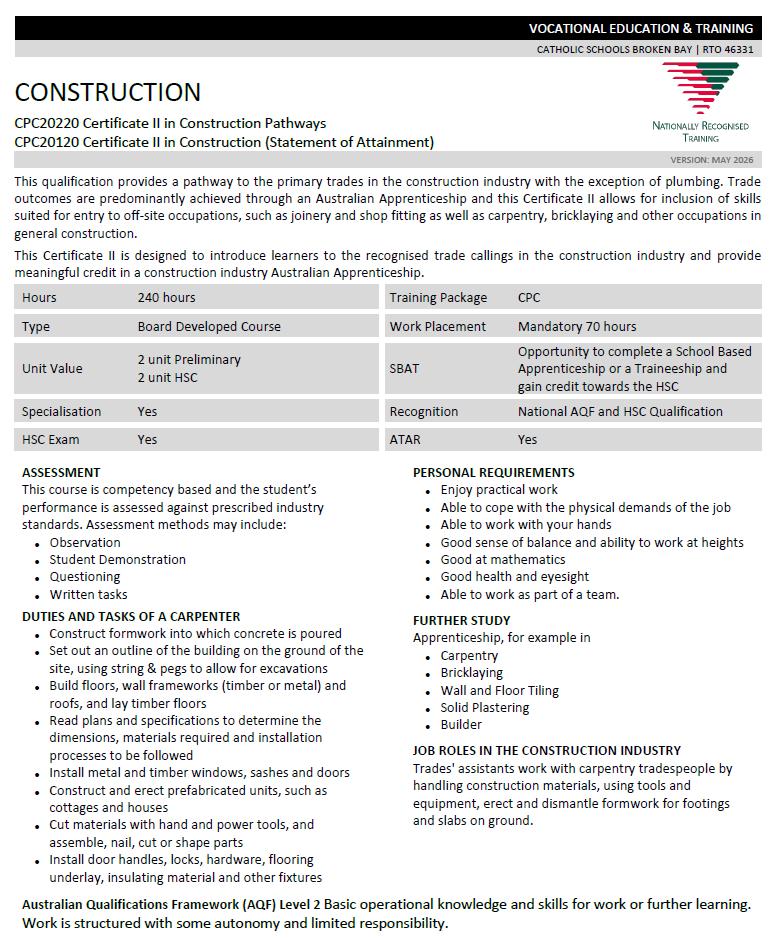
UNITS: 2
PATHWAY: VOCATIONAL or UNIVERSITY (with HSC Exam)
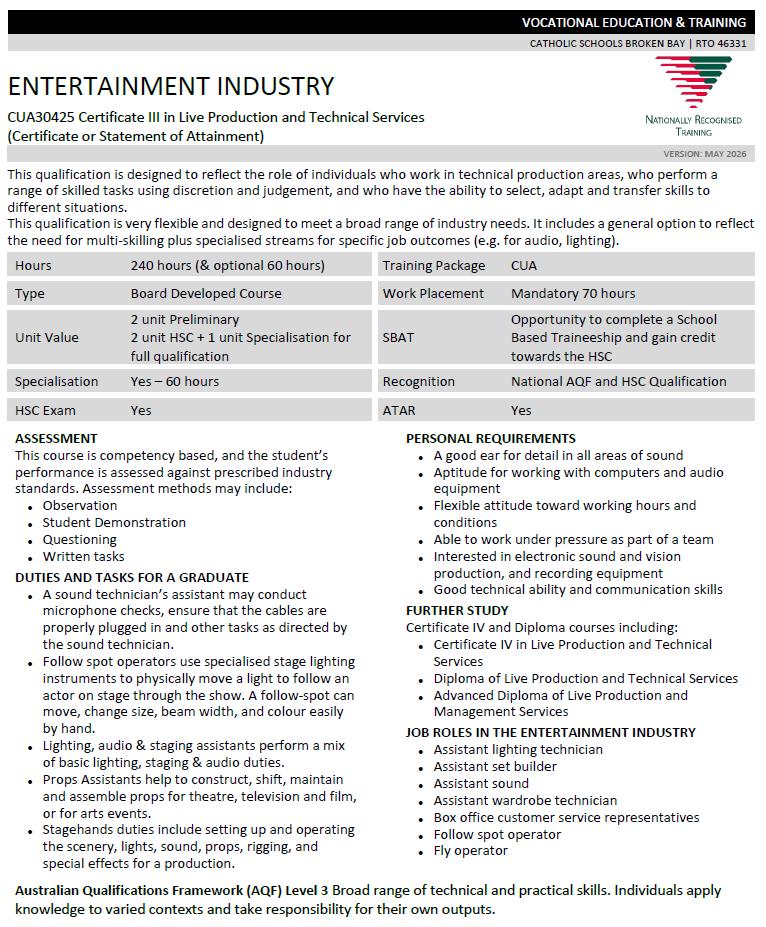
UNITS: 2
PATHWAY: VOCATIONAL or UNIVERSITY (with HSC Exam)
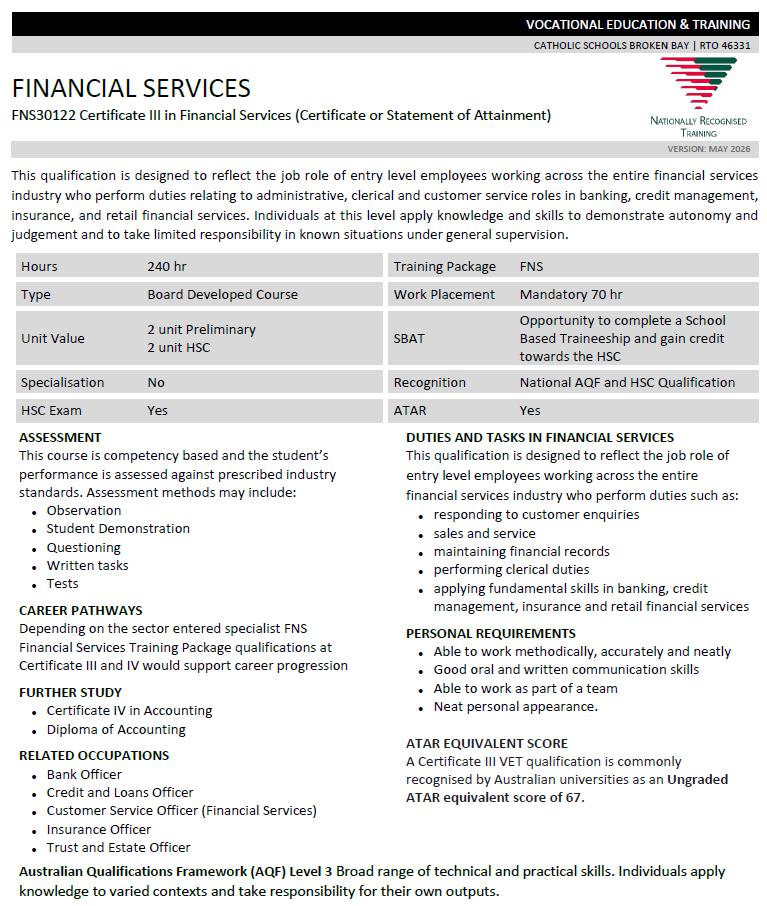
UNITS: 2
PATHWAY: VOCATIONAL
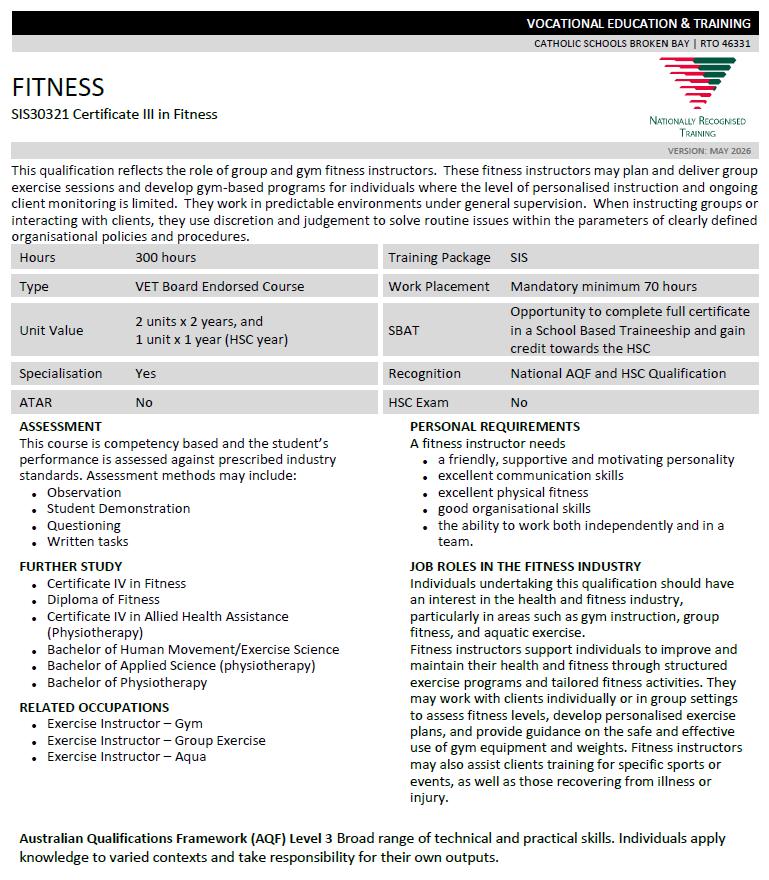
UNITS: 2
PATHWAY: VOCATIONAL or UNIVERSITY (with HSC Exam)
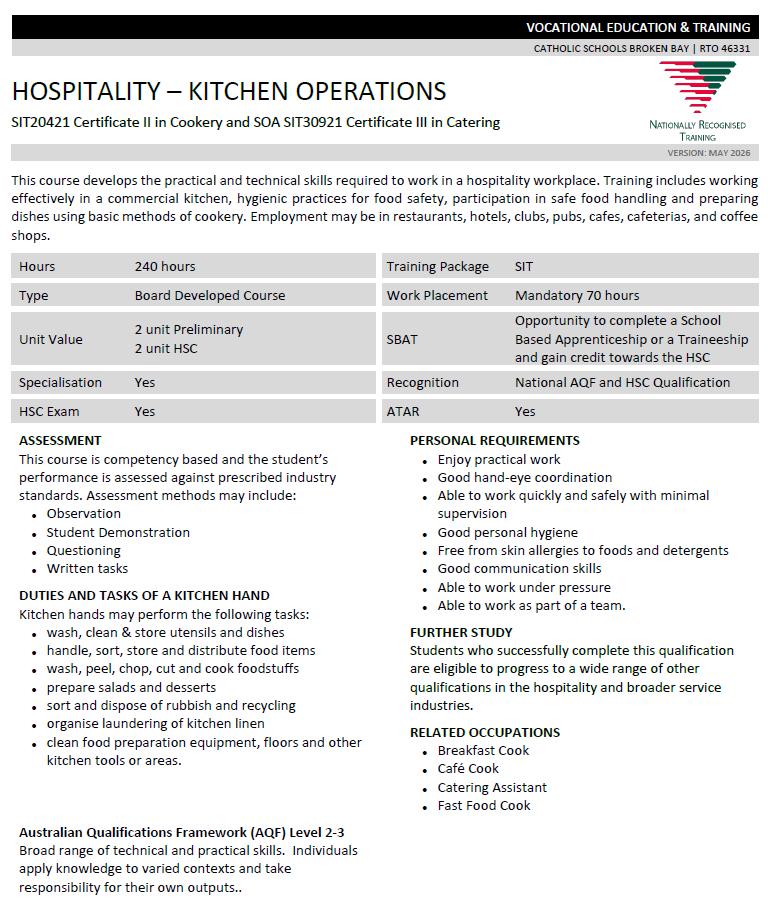
UNITS: 2
PATHWAY: VOCATIONAL
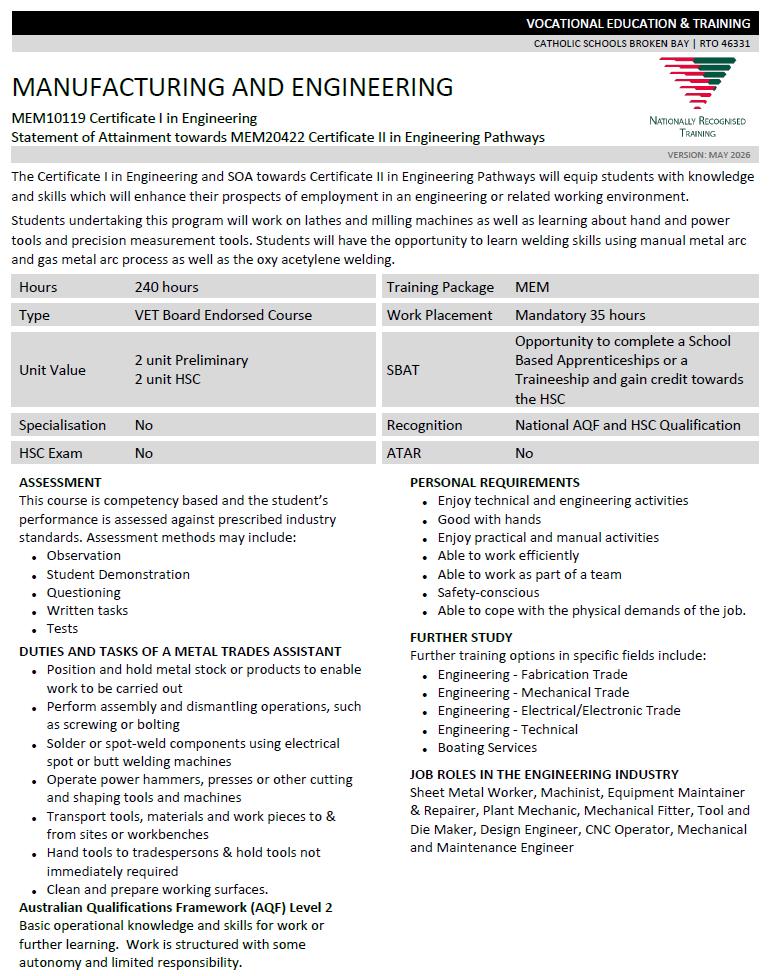
UNITS: 3
PATHWAY: VOCATIONAL
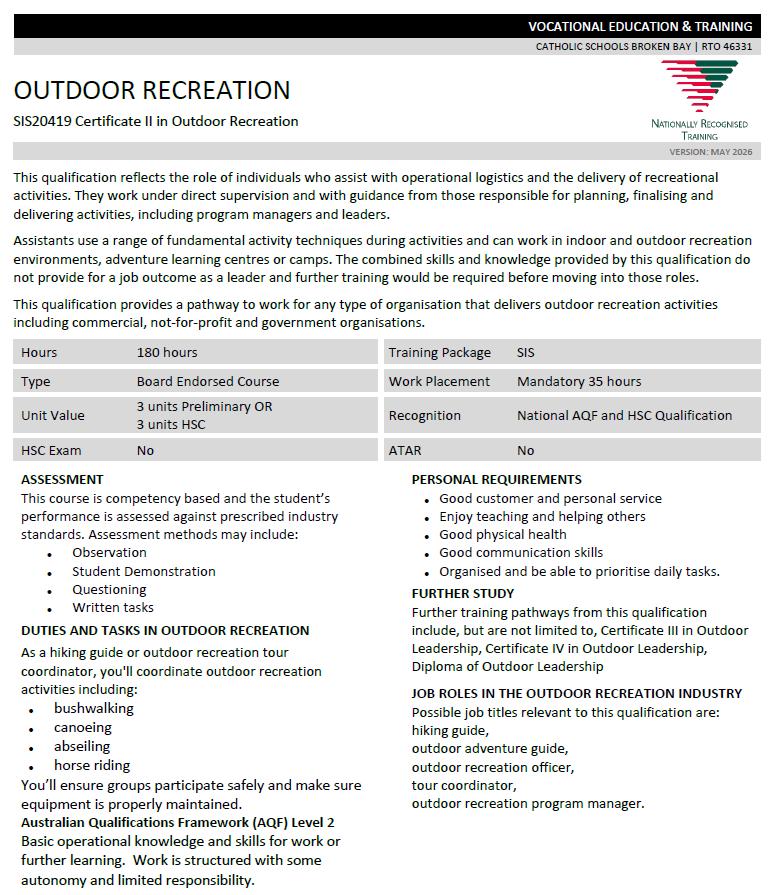
COURSES
Construction
Financial Services
Hospitality - Cookery
Entertainment
Engineering & Engineering Pathways
White Card
Hi Viz Shirt
Steel Capped Boots
Barista Course
Uniform
Toolkit
Hospitality Polo Shirt
RAS Course (optional)
White Card
Entertainment Polo Shirt
Long Sleeve Work Shirt
White Card
$100
$24
Cost at student’s discretion
$80
$90
$100
$30
$70
$100
$30
$30
$100
All VET Clothing, except Cookery uniform, can be purchase through our uniform supplier. Students are expected to have their shirts by week 2 of term 1, therefore ordering mid-December 2026 is highly recommended.
The cost of studying TVET Courses is shared between the College and families. Parents are required to cover approximately one quarter of the cost of any TVET Course. The amounts listed below are the yearly total cost of some of the courses offered and are an indicative amount based on the 2026 Course costs. These costs generally increase each year. (Remembering that each course is for two years)
Visit https://www.tafensw.edu.au/courses/tvet for more information
St Edward’s Careers Website
https://careers.stedwards.nsw.edu.au/ My future https://myfuture.edu.au/
Your career
Careers NSW
https://www.yourcareer.gov.au/
https://careers.nsw.gov.au/
Academy of Film, Theatre & Television https://www.aftt.edu.au/
ACS Foundation | BiG Day In
Advance OHS
http://thebigdayin.com.au
https://www.advanceohs.com.au
AFL SportsReady https://aflsportsready.com.au/
Au Pair in America (Australia)
https://www.aifs.com.au/aupair-america/
Austrain Academy https://www.austrainacademy.com.au/
Australian Apprenticeships & Traineeships Information Service
Australian Apprenticeships and Traineeships Information Service
https://www.aapathways.com.au/
https://www.aapathways.com.au
Australian Careers Business College https://acbc.nsw.edu.au/
Australian Catholic University https://www.acu.edu.au/
Australian College of Applied Psychology https://www.acap.edu.au
Australian Institute of Quantity Surveyors
http://www.qscareers.com.au
Australian College of Physical Education https//acpe.edu.au/ Avondale University College https://www.avondale.edu.au
BarMax Australia https://www.barmax.com.au
Bond University https://bond.edu.au
Camp America
https://campamerica.com.au/
Career Analysts https://www.careeranalysts.com.au/
CareerHQ http://www.careerhq.pages.ontraport.net/introduc tion
Central Coast Group Training https://ccgt.com.au/
Charles Sturt University https://www.study.csu.edu.au
College of Therapy Yoga & Zen Shiatsu Pty Ltd
Cotton Australia
https://www.teachyoga.nsw.edu.au/
https://cottonaustralia.com.au/
CQUniversity Australia
https://www.cqu.edu.au/
Education Services Australia (myfuture) https://myfuture.edu.au/
EducationUSA
Engineers Australia
Financial Planning Association of Australia (FPA)
https://educationusa.state.gov/
https://www.engineersaustralia.org.au/ForStudents-And-Educators
http://www.fpa.com.au/
Harness Racing NSW https://www.hrnsw.com.au
iCanMed
InspirED
International Freight, Transport & Logistcis
Internationally Educated
Kenvale College of Hospitality, Cookery & Events
Le Cordon Bleu Australia
Life Business Consultancy
https://www.icanmed.com.au/
https://inspired.edu.au
https://www.mymv.org/
https://www.internationallyeducated.com.au/
https://kenvale.edu.au
https://www.cordonbleu.edu/sydney/home/en
https://www.coachingyoungpeopleforsuccess.com
Macarthur Tourism, Travel and Events College https://mttec.com.au/ Macleay College http://www.macleay.edu.au
Macquarie University https://www.mq.edu.au/ meriSTEM http://meristem.anu.edu.au/
Mid Coast Connect https://midcoastconnect.com.au
MIT Sydney https://www.mit.edu.au/
MyCareerMatch https://mycareermatch.com.au/
National Institute of Dramatic Art (NIDA) https://www.nida.edu.au/
NSW Agrifood Industry Training Advisory Body Ltd
http://www.nswagrifooditab.com.au
NSW Department of Education http://www.teach.nsw.edu.au
NSW Department of Primary Industries School program https://www.tocal.nsw.edu.au/schools
NSW Transport Sydney Trains https://www.transport.nsw.gov.au/sydneytrains/ca reers/sydney-trains-apprentices
NSW Utilities and Electrotechnology ITAB http://www.uensw.com.au/ Orana Fashion Business College http://oranacollege.com.au/
Patrick Careers Academy (St Patrick's Business College)
https://www.pca.edu.au/
| 59
Paul Wade Life Skills http://www.paulwade.com.au
Professional Cadetships Australia
Projects Abroad
Real World Education Group
RuralBiz Training
SEDA College NSW
Southern Cross University
Study Medicine
http://www.professionalcadets.com.au
https://www.projects-abroad.com.au/tripformat/high-school-specials/
http://rweg.com.au/
http://www.ruralbiztraining.com.au/
https://www.sedacollege.nsw.edu.au/
https://www.scu.edu.au/
https://www.studymedicine.com.au/
Study Work Grow https://studyworkgrow.com.au/
Sydney Actors School https://www.sydneyactorsschool.edu.au
Sydney Film School https://sydneyfilmschool.edu.au
Sydney Flight College https://www.sfcaero.com.au
TAFE NSW https://www.tafensw.edu.au
The Academy of Interactive Entertainment https://aie.edu.au/
The Australian National University https://www.anu.edu.au/
The Careers Guy https://www.thecareersguy.com
The Hotel School Sydney, Melbourne, Brisbane https://hotelschool.scu.edu.au/
The University of Queensland https://www.uq.edu.au
The University of Sydney https://www.sydney.edu.au/
The Women's College within The University of Sydney https://www.thewomenscollege.com.au/
Torrens University Australia
https://www.torrens.edu.au/
Training Services NSW https://www.training.nsw.gov.au/
Try Surveying https://www.alifewithoutlimits.com.au
Turning Point Consulting Pty Ltd http://www.turningpointconsulting.com.au
UCAT MedEntry https://www.medentry.edu.au/
UNIVERSITIES ADMISSIONS CENTRE (UAC)
https://www.uac.edu.au/
University of New England (UNE) http://www.une.edu.au
University of Tasmania https://utas.edu.au
University of Technology Sydney
https://www.uts.edu.au/futurestudents/undergraduate
| 60
UNSW Sydney
UOW College Australia
UOW College Australia
WEP Australia
Western Sydney University
Whitehouse Institute of Design, Australia
William Angliss Institute - Sydney campus
https://www.futurestudents.unsw.edu.au/
https://www.uowcollege.edu.au/
https://www.uowcollege.edu.au/
https://wep.org.au/
http://www.westernsydney.edu.au/future
https://www.whitehouse-design.edu.au
http://angliss.edu.au