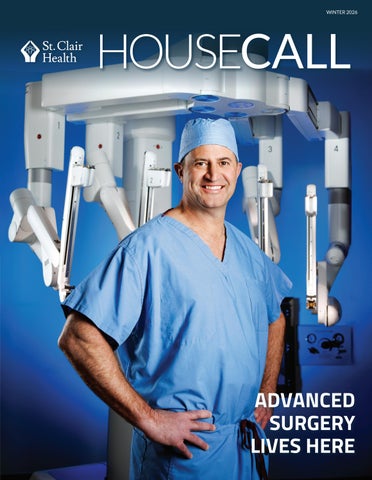
HOUSECALL HOUSECALL
WINTER 2026
ADVANCED SURGERY LIVES HERE
This is Home to Total Heart Care. Whether you want to prevent heart disease, or access the latest in cardiovascular care. Whether the problem is with a valve, or an irregular heart beat. Whether you need help managing a chronic heart condition or surviving a heart emergency. St. Clair is where you come to find the help you need.
Healing Lives Here. stclair.org/heart
inside
SINCE 1954, St. Clair Health has been dedicated to quality, innovation, responsiveness to community needs, and the humanity of the physicians, nurses, and caregiving staff.
ARTICLES
6
GRANDMA’S GOT THIS Minimally invasive urologic procedure takes back control.
ION BRONCHOSCOPY 10 Lung cancer screening to advanced robotics: “St. Clair saved my life."
ANYTHING BUT ROUTINE 14 Emergency appendectomy reveals something even more serious.
SCOPE OF PRECISION 18 Multidisciplinary care team delivers colorectal cancer cure.
10
NEW TWO THE TEAM 22 Experts in Cardiac and Colorectal Surgery join St. Clair’s mission.
GRADUATE MEDICAL EDUCATION 26 Deep community connections shape next generation of care.
14
26
HOUSECALL HOUSECALL A publication of St. Clair Health
Articles in this publication are for informational purposes and are not intended to serve as medical advice. Please consult your personal physician.
Please visit providers.stclair.org to find a doctor near you.
ST. CLAIR HEALTH I HOUSECALL I 3
Focal One i Robotic HIFU System ®
Catching cancer early provides a wider range of potential treatments—that’s why preventive screening is so important. This new, image-guided minimally invasive technique is for patients with low- to intermediate-risk prostate cancer. I truly believe it’s the future of treatment for prostate cancer when it can be discovered early. KEVIN P. BORDEAU, MD Urologic Surgeon
St. Clair is the first healthcare system in Pittsburgh with Focal One i technology
New features & enhanced capabilities • Utilize PET scan for precise targeting of tumors in addition to MRI images
• Enhanced ability to collaborate with your extended care team
• Improved treatment workflow allows for shorter treatment times
• Ability to share best practices nationwide, including Mayo Clinic Care Network
4 I ST. CLAIR HEALTH I HOUSECALL
Richard H. Maley, Jr., MD Chair of the Department of Surgery & Chief of Thoracic Surgery
FIRSTCALL
ST. CLAIR HEALTH SURGICAL SERVICES HEALING LIVES HERE
S
t. Clair has been the fabric of my professional life for 25 years, and throughout my time here in progressive surgical and leadership capacities, one thing has been abundantly clear:
You’ll meet new Cardiac and Colorectal surgeons excited to unite and enhance our mission to deliver personalized care to improve the health and well-being of the communities we serve.
This institution has maintained a relentless focus on continuous improvement, from enhancing patient experience to delivering advanced care at every stage of life.
And you’ll learn right alongside a pair of residents as we embark on a new era of Graduate Medical Education (GME)—showcasing their expert training in a truly dynamic environment that crystalizes our unique opportunity to meet the challenges of modern healthcare with the St. Clair EDU LAB.
Today, we are state-of-the-art. Smoother. Safer. Never satisfied with the status quo. Operating at the modern edge of surgical intervention means more than maintaining the highest level of technology and innovation—it demands equal attitude toward and appetite for education and applied technique. Surgical growth at St. Clair Health is shaped by the depth and breadth of our clinical expertise, which works hand-in-glove with a system-wide commitment to our multidisciplinary approach. In this edition of HouseCall, you’ll find patient success stories spanning Urology, Thoracic, General, and Colorectal Surgery. You’ll see our continued cross-functional dedication displayed across the integrated services of Dunlap Family Outpatient Center and our excellence through collaboration personified by the St. Clair Hospital Cancer Center affiliated with UPMC Hillman Cancer Center. A few highlights to note as you turn the pages include the BioProtect balloon spacer, which lifts you to the apex of prostate cancer care while protecting quality of life. Ion Bronchoscopy, a minimally invasive robotic procedure used to examine the airways in your lungs. And the da Vinci Surgical System, a robotic surgical platform that delivers greater precision through smaller incisions.
Talent is far from the only thing that makes St. Clair special—it’s how those experts help other experts in our teambased approach to everything we do. And it’s supported every step of the way, including critical care components ranging from our comprehensive Interventional Radiology (IR) suites to the always-on, 24/7 coverage within our Intensive Care Unit (ICU) by a Board-Certified Critical Care Intensivist. At St. Clair Health, technical expertise extends far beyond surgery. One shining example? Pathology. We conduct labs, tissue samples, and diagnostics in-house and maintain quality goals that exceed industry standards. Your satisfaction at—and our understanding of—every step of the healthcare journey is a profound pride point shared across all St. Clair Health settings. We are driven by our care teams and their relentless commitment to ensuring that personalized care to meet your unique needs. Like so many of my peers, I grew up right here. Our intimate connection to this community paired with actively seeking opportunities to raise the bar is how we lead the region forward. St. Clair Health Surgical Services. Healing Lives Here. n
RICHARD H. MALEY, JR., MD
Dr. Maley is Chair of the Department of Surgery and Chief of Thoracic Surgery at St. Clair Health. He earned his medical degree at Hahnemann University Medical School and completed residencies in general surgery at the University of Kentucky and cardiothoracic surgery at UPMC. Dr. Maley then completed fellowships in trauma/critical care at the University of Kentucky and thoracic surgery at Memorial Sloan Kettering Cancer Center, New York City. He is boardcertified by the American Board of Surgery and the American Board of Thoracic Surgery. Dr. Maley was named a Top Doctor by Pittsburgh Magazine in 2025. To contact Dr. Maley, please call 412.942.5710. ST. CLAIR HEALTH I HOUSECALL I 5
6 I ST. CLAIR HEALTH I HOUSECALL
UROLOGY SURGERY
TAKING BACK CONTROL One 75-minute drive gives grandmother complete peace of mind.
K
athleen Rose, 69, of Indiana, PA, is a lifelong resident of Western Pennsylvania. The middle of nine children, she has a pair of her own—plus the blessing of three granddaughters to keep up with. A combination of factors had been keeping Kathleen from reveling in the joy. “I’d been having issues with my bladder for about two years,” she says. “It wasn’t really a control thing, but more one of having to run off to the bathroom frequently.” Kathleen, semi-retired, simply found herself caught up in the general business of day-to-day life. Caring for aging in-laws. Helping her brother in an administrative capacity with his real estate franchise. And doting on that delightful trio of granddaughters. “When you live out in the country you wake up in the middle of the night for any number of reasons,” she says. “But this was no longer being woken up by an animal out there in the woods—I was getting up four times a night just to go to the bathroom.” Finally ready to take back control, Kathleen Rose was taken aback by her initial diagnosis. “I experienced a lot of change with my gynecologist in Indiana, with doctors leaving the practice for different reasons,” she says. “Everything felt very rushed, because they immediately recommended a complete hysterectomy—and that just didn’t feel right to me.” Further complicating the news: a protracted waiting period to see someone new. “Frankly, I was having a hard time. I felt discouraged because I was relatively young and in good health—I really
needed a fresh set of expert eyes,” she says. “And I was seeking a more pleasant patient experience.” Kathleen’s oldest sister, Trish, a longtime resident of Mt. Lebanon who since retired to McDonald, raved about the care she received at St. Clair Health for a similar health challenge. That was all Kathleen needed to hear. Paul M. Zubritzky, MD, who practices with St. Clair Medical Group OB/GYN, took a closer look. “He never even brought up the idea of a hysterectomy,” Rose says. “What I really appreciate about my experience at St. Clair is having my total health taken into account, and then Dr. Zubritzky working with me to identify the specific problem with my bladder.” Rose had considered both her family and personal history when seeking Dr. Zubritzky’s second opinion. “My mother was 92 when she passed, and I remembered taking her to the doctor when she was around 70 and learning that her bladder had dropped—which they attributed to having nine children,” she says. “I thought, ‘That’s probably what’s happening to me,’ because my son was breeched during childbirth and there was a lot of extra pushing involved.” Dr. Zubritzky notes that St. Clair has always taken great pride in personalizing patient care to the unique needs of the communities it serves. “Our goal is to meet you where you are on your healthcare journey,” he says. “We want you to feel heard regarding specific health concerns, cared for on an individual level, and safe every step of the way. In Kathleen’s case, her updated diagnosis provided a more minimally invasive path forward.” Continued on Page 8
ST. CLAIR HEALTH I HOUSECALL I 7
Continued from Page 7
Same-day procedure delivers all-day confidence.
Prolapse occurs when the pelvic floor weakens and pushes on the vagina. The fundamental issue at hand for Kathleen revolved around the muscle and tissue that support her bladder and how they had weakened over time. Dr. Zubritzky referred Rose to David O. Hepps, MD, a surgeon with St. Clair Medical Group Urology. “When most people think of urology, they tend to associate it with prostate, kidney, and men’s health issues. But a large percentage of women across all age groups encounter urinary function challenges,” he says. “The main message is this: you don’t have to live with it.” Dr. Hepps builds on Dr. Zubritzky’s nod to personalizing your care. “St. Clair Urology operates with a collaborative team approach to provide our patients with a comprehensive solution to their problem,” Hepps says. “Dr. Zubritzky is a truly caring, exceptionally experienced clinician. We’ve worked together for many years, creating an expert level of trust that extends directly to you.” Here, Kathleen notes St. Clair’s attention to detail between her care team. “From diagnosis to procedure, everything was explained in intimate detail,” she says. “And not only did they take their time with me, but everything also went exactly as they said—like clockwork.”
8 I ST. CLAIR HEALTH I HOUSECALL
"Our goal is to meet you where you are on your healthcare journey. We want you to feel heard regarding specific health concerns, cared for on an individual level, and safe every step of the way. In Kathleen’s case, her updated diagnosis provided a more minimally invasive path forward." PAUL M. ZUBRITZKY, MD St. Clair Medical Group OB/GYN
At St. Clair Health, the integrated system delivers surgical, non-surgical, medical, and physical therapy services all located under one roof courtesy of Dunlap Family Outpatient Center. “St. Clair is a much bigger campus than I’m used to,” Rose says. “But any time I even had a look on my face like I needed help getting where I was going, someone popped right over to show me the way. Everything is right there, and I was impressed by how easy the people of St. Clair made everything for me.” From the world-class facilities to the innovative techniques implemented by expert urologic surgeons, Dr. Hepps adds that the tailoring of your treatment starts with the least invasive approach. “Whatever your age or activity level, we can provide solutions for all aspects of urinary and urologic challenges you may be facing—and almost everything can be achieved with a same-day outpatient procedure,” he says. “Comprehensive female reconstruction for prolapse specifically helps women improve their quality of life. In this case, we used a minimally invasive vaginal approach for prolapse repair.”
DAVID O. HEPPS, MD
Dr. Hepps specializes in urology. He earned his medical degree at Jefferson Medical College, Philadelphia. Dr. Hepps completed residency at University of Illinois at Chicago and fellowship at the University of Miami. He is board-certified by the American Board of Urology. Dr. Hepps practices with St. Clair Medical Group. To contact Dr. Hepps, please call 412.942.4100.
Kathleen, after years of futile efforts to try and time her water intake against those pesky woodland creatures of the night, is back to being a night owl on her terms. Echoing the message from Dr. Hepps—you don’t have to live with it—Rose adds that she had surgery in the morning and went home that afternoon. “I felt great coming home, too, with no pain or discomfort. It’s been wonderful being able to focus solely on hydration, staying healthy by exercising, and playing with the grandkids,” she says. “Now I don’t have to wonder when I’m going to have to run off to the bathroom next. I truly should have done this years ago!” n
PAUL M. ZUBRITZKY, MD
Dr. Zubritzky specializes in obstetrics and gynecology. He earned his medical degree at Temple University and completed residency at Western Pennsylvania Hospital, where he served as Chief Resident. Soon after, Dr. Zubritzky took over his father’s practice, maintaining a commitment to personal care for every woman while growing the practice into what it is today. He has been caring for patients in Western Pennsylvania for more than 35 years. Dr. Zubritzky is board-certified by the American Board of Obstetrics and Gynecology. He practices with St. Clair Medical Group. To contact Dr. Zubritzky, please call 412.942.5380.
ST. CLAIR HEALTH I HOUSECALL I 9
BREATHING IT ALL IN
Turning to the next chapter starts with lung cancer screening.
10 I ST. CLAIR HEALTH I HOUSECALL
THORACIC SURGERY
S
usan Landers-Simon, 68, grew up in Western Massachusetts. She moved to Pittsburgh with her husband-to-be, Phillip, in 1983. The couple wed in 1991 on the same day the Penguins won their first Stanley Cup, growing together to raise a daughter and a son in Mt. Lebanon. Fast forwarding to 2025 brought blessings big and small. Each evening Susan would walk their French Bulldog, Nelson, keeping both physical and mental wellbeing in check. And she had wonderful news to stroll through the neighborhood with as wedding wonder loomed on the horizon for both children. In February, Susan met with her primary care physician (PCP), Mai Yousef, MD, who practices with Preferred Primary Care Physicians (PPCP). “I had been experiencing mild shortness of breath with exertion,” Landers-Simon says. “Dr. Yousef ordered some tests, and because I was a former smoker, that included a screening for lung cancer.” Further testing in the form of Positron Emission Tomography, more commonly called a PET scan, revealed a suspicious result. Dr. Youseff referred Susan to Richard H. Maley, Jr., MD, Chief of Thoracic Surgery, who also serves as Chair of the Department of Surgery at St. Clair Health. “As a former smoker with a PET-positive lesion, the key here is catching lung cancer early,” he says. “Many earlystage cancers are asymptomatic, and a surgical biopsy allows us to see what’s really going on.” Dr. Maley performed an Ion Robotic Bronchoscopy— an integrated imaging and shape-sensing technology platform—which showed invasive lung cancer. Surgery was scheduled forthwith. “If you have cancer and it’s still small, then we can use minimally invasive surgery to remove it,” he says. “At St. Clair, we’re comprehensive in our approach. The evaluation of your lung nodules includes thoracic surgical experts and experts in pulmonary medicine—all the way through pulmonary rehabilitation services—and stillmore experts in medical oncology. And should you need chemotherapy or radiation, we have those services under one roof, too.” The latter is due to the collaborative power of the St. Clair Hospital Cancer Center affiliated with UPMC Hillman Cancer Center, conveniently located right on the main campus. Susan’s full battery of tests had delivered a diagnosis of non-small cell lung cancer. Non-small cell lung cancer is most often treated surgically, while small cell lung cancer is treated medically. For Landers-Simon, Dr. Maley’s attention to detail matched her own one-step-at-a-time mindset.
Pulmonary rehab helped Susan take it back outside.
“He’s very thorough—really takes his time with you,” she says. “That put me at ease—I was able to take a deep breath in that moment—because he was adamant that we caught this early as he explained exactly what the surgery would entail.” Using state-of-the-art da Vinci robotics, Dr. Maley performed a lung resection and lobectomy. “The lesion was centrally located in the left upper lobe, and we removed it,” he says. “The da Vinci system is a tremendous asset at St. Clair because it helps deliver greater precision through smaller incisions. That leads to less pain and helps improve every stage of the recovery process.” Landers-Simon is adamant that she had no pain following her procedure. “He really did a great job,” she says. “And the tests of my lymph nodes came back negative, which meant no chemo or radiation was needed.” Dr. Maley adds that patients can typically expect to feel good around three months after surgery, with a goal to be back to their pre-surgery baseline at six months. “St. Clair’s advanced robotics are minimally invasive tools, but this is still major surgery,” he says. Landers-Simon did experience a bout of wheezing ahead of her planned path to pulmonary rehab. “I was very fortunate to have an excellent care team with me every step of the way,” she says. Here, Landers-Simon specifically cites the efforts of Christina McFarland King, CRNP. “She saw me every day in the hospital,” Landers-Simon says. “As a medical Continued on Page 12 ST. CLAIR HEALTH I HOUSECALL I 11
Continued from Page 11
Nelson is back in stride.
"That put me at ease—I was able to take a deep breath in that moment—because he was adamant that we caught this early as he explained exactly what the surgery would entail.” SUSAN LANDERS-SIMON Patient
12 I ST. CLAIR HEALTH I HOUSECALL
professional myself, I understand the difference someone like her makes— sometimes those little things go the longest way.” Dr. Maley, building on King’s all-encompassing role: “Christina allows me to lose myself in my work because she serves as the glue for every thoracic patient throughout the St. Clair system, from pathology results to referrals and cross-functional coordination of any critical care needed within the Cancer Center.” Additionally, Laurie A. Kilkenny, MD, FCCP, Chief of Pulmonary Medicine, was there to ensure a smooth transition after surgery. “We follow post-operative patients for expected and unexpected outcomes after every procedure. The respective functions within your care team are intertwined to assure you on the way back home,” she says. “From follow-ups to personalized care plans, you leave with a clear path to wellness.” For Landers-Simon, those first steps were almost literally measured in oxygen.
“When you’re used to walking the dog as far as he’ll sort of let you go, it’s hard at first to think that a little six-minute walk test could be a big deal,” she says. “I’ve always been a big gardener, and at first, I didn’t have the endurance to get out and start that Fall cleanup on the yard. You take things for granted, like not knowing how long you can shop for groceries with a portable oxygen tank.” By October, Susan’s work with the Pulmonary Rehab team at St. Clair Health had paid off. Their daughter, Rachel, got married. Their son, Ian, welcomed his bride down the aisle in November. Nelson, the stubborn little bulldog, had skipped past the stop sign at the end of the block. And Susan Landers-Simon got back to helping make patients’ lives safer through her efforts as a Physical Therapist with Merakey Allegheny Valley School. “I have no plans on retiring any time soon,” she says. Landers-Simon remains effusive in her praise of the total team effort at St. Clair Health. “Dr. Yousef called me the night before my surgery just to wish me well—it brought tears to my eyes,” she says. “Everyone who’s helped me through this ordeal has been so wonderful and caring. It’s been a good year.”
RICHARD H. MALEY, JR., MD
Dr. Maley is Chief of Thoracic Surgery at St. Clair Health. He earned his medical degree at Hahnemann University Medical School and completed residencies in general surgery at the University of Kentucky and cardiothoracic surgery at UPMC. Dr. Maley then completed fellowships in trauma/critical care at the University of Kentucky and thoracic surgery at Memorial Sloan Kettering Cancer Center, New York City. He is board-certified by the American Board of Surgery and the American Board of Thoracic Surgery. Dr. Maley was named a Top Doctor by Pittsburgh Magazine in 2025. To contact Dr. Maley, please call 412.942.5710.
MAI YOUSEF, MD
Her most important message? “If you are a former smoker, get your lung cancer screening,” LandersSimon says. “Number one: it saved my life. Number two: because we caught it early, I didn’t need radiation or chemotherapy.” For Dr. Maley, the facts of cases like these are undisputed. “When I first meet someone that’s had a lung cancer screening and they have an abnormality that leads to their PCP saying, ‘You need to see a surgeon,’ I know no one wants to get that news,” he says. “We focus on you—from your diagnosis to your treatment plan and where you want to be in two, five, or ten years. That’s how hope becomes healing.” Landers-Simon agrees wholeheartedly. “I got to see my kids get married, and now I want to remain active so I can help in the upbring of grandchildren—and just enjoy them,” she says. “St. Clair has given me that chance.” n
Dr. Yousef specializes in family medicine. She earned her medical degree at Damascus University and completed residencies in family practice at UPMC Mercy and McKeesport Hospital. She is board-certified by the American Board of Family Medicine. Dr. Yousef practices with Preferred Primary Care Physicians, Inc. To contact Dr. Yousef, please call 412.276.3050.
LAURIE A. KILKENNY, MD, FCCP
Dr. Kilkenny specializes in critical care medicine and pulmonary disease. She earned her medical degree at New York University and completed residencies in internal medicine and oncology at New York University Medical Center and Memorial Sloan Kettering Cancer Center. Dr. Kilkenny then completed a fellowship in pulmonary and critical care medicine at UPMC Presbyterian. She is board-certified by the American Board of Internal Medicine. Dr. Kilkenny practices with St. Clair Medical Group. To contact Dr. Kilkenny, please call 412.942.5620.
ST. CLAIR HEALTH I HOUSECALL I 13
A BLESSING IN DISGUISE How a ruptured appendix led to the life-saving removal of a tumor.
W
hen 76-year-old Karen Anderson woke up feeling ill one Saturday morning, she assumed it was nothing serious. Maybe the stomach flu or something she ate didn’t agree with her. “I didn’t have pain, just vomiting and diarrhea,” she recalled. While her right side felt a bit tender, it wasn’t painful enough for the retired kindergarten teacher from Burgettstown to seek care right away. When the symptoms didn’t pass by Monday morning, however, she made the short drive to the nearest emergency department (ED) at the urging of her family. She said, “It just wasn’t stopping. Something felt off.” Karen was expecting to be sent home with antibiotics or fluids from the ED. Instead, that visit set in motion a series of events that not only saved her life but also introduced her to an advanced surgical approach that changed the way she thinks about modern medicine. 14 I ST. CLAIR HEALTH I HOUSECALL
Initial tests revealed a ruptured appendix—a medical emergency at any age, but particularly risky for someone in her seventies. “The doctor came in and said, ‘Ruptured appendix,’” Karen remembered. “I said, ‘You’ve got to be kidding me!’” But that was just the first of several surprises that day. The on-call surgeon, as it turned out, was someone she already had a family connection with. That physician was Brent E. Angott, DO, a board-certified general surgeon who had once operated on her daughter years before. “It was a total coincidence,” Karen said. “My daughter had hernia surgery with him, so when he walked in, I said, ‘You’ve got to be kidding me!’ again.” As fate—or faith—would have it, that coincidence may have saved her life. Because Dr. Angott saw more than just the inflamed appendix that needed immediate attention when reviewing Karen’s CT scan.
GENERAL SURGERY “She had a ruptured appendix, which is always an urgent situation,” he said. “But we also saw a large mass on her stomach that she didn’t know existed. It was about 10 centimeters, roughly the size of a softball.” When Dr. Angott inquired if anyone had ever told Karen about the mass, she responded, “‘No! I never had a CT scan before because I never had stomach issues.’” She added, “It didn’t hurt, didn’t bother me, nothing. If it hadn’t been for the appendix, we never would have known.” According to Dr. Angott, “You could see her anxiety. Karen was very nervous, so we focused on what needed to be done right away.” When Dr. Angott explained that he would take care of the appendix first and address the tumor later, Karen said, “That was fine by me. I just wanted to get it over with.” A self-proclaimed nervous Nelly, Karen really wanted to know as little information as possible. While the emergency appendectomy went smoothly, Karen’s relief quickly turned to disbelief when she learned more about the tumor seen on her scan. What Dr. Angott had seen was a gastrointestinal stromal tumor, or GIST, a rare growth found in less than one person per 100,000. “They account for only about two percent of all gastrointestinal malignancies,” he explained. “Most are found by accident, like Karen’s, as they don’t cause symptoms until they’re quite large.” Though Karen wasn’t experiencing symptoms, Dr. Angott knew the GIST still needed to come out. “It wasn’t something to ignore, so I told her we’d revisit it after she recovered from the appendectomy,” said Dr. Angott. As she recovered, life returned to normal for Karen. She spent her days volunteering at church, playing cards and Mahjong with friends, and visiting with her seven grandchildren. But in the background, a much larger decision loomed. When she was ready to schedule her tumor removal, Dr. Angott was transitioning his medical practice to St. Clair Health. The move, while temporarily delaying Karen’s procedure, ultimately became a blessing. “I referred her to another provider at first because I wasn’t yet set up at St. Clair. But when the referral didn’t go through, Karen called me back to ask if I could do the procedure,” recalled Dr. Angott. “By that point, I had access to the da Vinci Surgical System at St. Clair. I knew I had the right equipment and support team to do it safely, so we scheduled her procedure.” For Karen, that reassurance meant everything. “I had complete faith in him,” she said. “If Dr. Angott didn’t think he could do it, he would have told me.” The tumor’s particular location made the operation far from routine. “It was on the inside curve of the stomach, the lesser curvature. That area is surrounded by major blood vessels and important nerves, so you have to be careful not to injure them,” explained Dr. Angott. He added, “The tumor also had a large blood supply around its surface, which made it delicate. You don’t want to grab the vessel and cause bleeding.” Ordinarily, removing such a tumor might require a major open incision across the upper abdomen, resulting in significant pain and a longer recovery. But Dr. Angott believed robotic-assisted surgery would offer a faster recovery, less pain, and fewer risks in Karen’s case.
Perspective made Karen’s care plan clear.
“The da Vinci Surgical System gives me enhanced dexterity,” he said. “Its instruments have wrists that move just like my own hands, so I can maneuver with more precision in tight spaces. That was critical in Karen’s case because the tumor’s location made it difficult to reach using traditional laparoscopic tools.” In the operating room, Dr. Angott used four robotic arms—each controlled from a console where he viewed the surgical field in 3D high definition. He explained, “One arm was lifting the liver out of the way, one holding the mass, and the others were dissecting around it,” adding that “The robot doesn’t perform the surgery, it’s completely surgeon-driven, but it extends my reach and steadiness.” Once the tumor was detached, the next challenge was closing the stomach safely. “Because of where the tumor was located, I couldn’t use a stapler. I had to sew it by hand, and the precision of the robot made that possible,” he said. Dr. Angott continued, “For a case like hers, traditional surgery could mean an incision from the breastbone to the belly button and a week in the hospital. With robotics, Karen was up walking the next day and home in just a few days.” Karen remembers that recovery vividly, especially the restricted post-op diet. “I told Dr. Angott that the surgery didn’t bother me, but the diet really did!” she joked. Still, Karen admits it was a small price to pay. She added, “I didn’t have pain. I healed quickly. The only thing I had to do was be patient.”
Continued on Page 16 ST. CLAIR HEALTH I HOUSECALL I 15
Continued from Page 15
Cured by St. Clair expertise, back to winning with ease.
“Karen was a trooper. She did everything right. Her recovery was as smooth as we could hope for,” shared Dr. Angott. And when she returned for her follow-up visit, he delivered the best possible news: the tumor had been completely removed and showed no signs of spreading. Looking back, Karen calls the whole experience a blessing in disguise. “I think it was God’s plan. If my appendix hadn’t ruptured, we never would have known about the tumor. Everything happened exactly the way it was supposed to,” she said. For Dr. Angott, that perspective is part of what makes her story so memorable. He said, “Sometimes the body has a way of revealing things we wouldn’t otherwise find. In Karen’s case, that emergency led us to something that could’ve become life-threatening if left alone.” Originally from southwestern Pennsylvania, Dr. Angott has been practicing general surgery for more than two decades. He first began using robotic-assisted techniques in 2010, long before the technology became commonplace. “It’s come a long way,” said Dr. Angott. “Early systems were limited. You had to do part of the surgery manually and part robotically. Now, the technology is so refined that we can perform complex procedures with smaller incisions, less bleeding, and shorter hospital stays.” The benefits, he added, extend beyond comfort and convenience. “Minimally invasive surgery reduces the risk of infection and postoperative hernias,” he said. “For upper abdominal procedures like Karen’s, it also helps with breathing and mobility. Patients can take deeper breaths, avoid pneumonia, and walk sooner after surgery, all of which lead to better outcomes.” At St. Clair Health, Dr. Angott performs a range of general surgical procedures, including gallbladder and hernia repairs, appendectomies, 16 I ST. CLAIR HEALTH I HOUSECALL
and tumor resections. He uses both traditional and robotic methods, depending on each patient’s needs. “It’s about matching the right approach to the right person,” he said. “The robot is one tool in our toolbox, but what really matters is experience, judgment, and teamwork.” That teamwork, he noted, is what allows St. Clair Health to deliver such high-quality outcomes. He said, “The OR staff, nurses, and anesthesiologists here are phenomenal, and we all share the same goal. To make sure patients feel cared for, informed, and confident every step of the way.”
BRENT E. ANGOTT, DO
Dr. Angott specializes in general surgery and is board-certified by the American Board of Surgery. He earned his medical degree at Philadelphia College of Osteopathic Medicine. Dr. Angott completed a residency at Pinnacle Health in Harrisburg. He practices with St. Clair Medical Group. To contact Dr. Angott, please call 724.222.9500.
"The da Vinci Surgical System gives me enhanced dexterity. Its instruments have wrists that move just like my own hands, so I can maneuver with more precision in tight spaces. That was critical in Karen’s case because the tumor’s location made it difficult to reach using traditional laparoscopic tools.” BRENT E. ANGOTT, DO St. Clair Medical Group General Surgery
Karen felt all of that and more from the beginning with Dr. Angott. She said, “He’s calm, kind, and explains just enough so you understand what’s happening. But not so much that it scares you.” Dr. Angott smiled when reminded of that exchange. “Some patients want every detail, while others prefer not to know too much. My job is to meet them where they are,” he said. “It’s always a team approach. I educate them, but we make the decision together based on their needs, their lifestyle, and their goals. That’s what personalized, patient-centered care looks like.” Looking back, he considers Karen’s case one of the most rewarding examples of how far general surgery has come. “We took what used to be a six-day hospital stay and turned it into a three-day recovery,” he said. “We avoided a large incision, protected critical nerves and blood vessels, and helped a patient go home quickly, pain-free, and back to her normal life.” For Karen, that’s exactly what mattered most. “I’ve got my husband, my kids, my grandkids, my church, and my friends,” she said. “I’m busy again, taking care of the bingo money on Fridays and playing cards twice a week. I just thank God everything happened the way it did.” She added, “I’d recommend Dr. Angott to anyone. He’s the best there is. But I hope I don’t have to see him again. Maybe socially somewhere, but not in the hospital.” n
About The da Vinci Surgical System The da Vinci Surgical System is a state-of-the-art robotic-assisted platform that allows St. Clair Health surgeons to perform complex operations through just a few tiny openings instead of a large incision. The system uses multiple robotic arms equipped with surgical tools and a high-definition 3-D camera, all controlled in real time by the surgeon seated at a console, while assistants handle the bedside tasks. Every action is under the surgeon’s control; the machine does not act on its own. The system enhances what surgeons can do by providing better visualization, greater dexterity (thanks to wrist-like instrument movement), and more precise access in tight spaces inside the body. This often means less pain, fewer complications, and smaller scars—enabling patients to recover faster and get back to what matters most. Robotic-assisted surgery is not standard for every patient or every condition. The surgeon must assess each case, including factors such as anatomy, prior surgeries, the disease process, and overall health. This technology is a tool—one among many—and care teams at St. Clair Health take a personalized approach to each case. Scan the QR code or visit stclair.org/davinci to learn more about the da Vinci® Surgical System.
ST. CLAIR HEALTH I HOUSECALL I 17
STRENGTH IN NUMBERS Strong-willed octogenarian. World-class care team. Rectal cancer cure.
18 I ST. CLAIR HEALTH I HOUSECALL
COLORECTAL SURGERY
J
udy Conroy, 85, is a lifelong Pittsburgher. Born and raised in Crafton, she married and moved to Greentree in 1962. A homemaker until her children were almost through high school, Conroy became an administrative assistant with Erie Insurance for many years. “In between I did all of the things that you do,” she says. “I was a member of the Greentree Junior Women’s Club—of which I became President—and secretary of the Greentree Athletic Association,” she says. “All the things you do to be involved in your community— Greentree is a great place.” The Conroys were married for 58 years. Sadly, her husband lost his battle with cancer during the pandemic. Their children had grown up and grown into careers in Texas and New Hampshire, respectively. Judy leaned into the connective tissue of the Greentree community. “Swimming is a big deal for me. I just love the pool and water aerobics classes with my little support group,” she says. “It’s a wonderful routine, five or six days a week in the Summer—and then we do regular aerobics at the borough building when the pool closes for the Winter.” Don’t move. Remembering the words that set her healthcare journey in motion brings a glint to Judy Conroy’s eyes. That’s what Frank A. Civitarese, DO, said back in August of 2023, after a troubling bowel movement brought Judy to the guiding hand of her primary care physician (PCP). “Look I was 83 years old at the time, and I knew something wasn’t right,” Conroy says. “He’s been my family doctor for many years, and I attribute him to saving my life. I love that man.” A black toilet. A bleak moment. The beacon of a plan. “Frank had a list ready for me, and it was comprehensive,” Conroy says. “These are your doctors, these are your appointment times, and we’re all in this together.” Nicholas A. Bellicini, DO, is a gastroenterologist who practices with Pittsburgh Gastroenterology Associates. “When we perform a colonoscopy and find what looks like cancer, we make a concerted effort to put those data points together for you across the system,” he says. “That way after your colonoscopy, your plan is already being put in motion. We’re all focused on setting you up for the next level of care.” Preliminary testing. Pre-authorized scans. Surgical and medical consults. “There’s no wondering what or wandering to what’s next,” Dr. Bellicini says. St. Clair Health is one of the region’s high-volume centers for treating rectal cancer. Leigh H. Nadler, MD, FACS, FASCRS, Chief of Colorectal Surgery, takes great pride in the multidisciplinary approach of the care team spanning surgeons, gastroenterologists, medical oncologists, radiation oncologists, radiologists, pathologists, and more.
"There’s nothing in the treatment of rectal cancer that we aren’t doing right here in the South Hills. St. Clair gives you access to the most advanced tools and the best care teams." LEIGH H. NADLER, MD, FACS, FASCRS Chief of Colorectal Surgery
“We’re extremely collaborative, always synching to find the best treatment path to success,” Dr. Nadler says. “We huddle up and prepare a gameplan that’s personalized to your needs.” Often, that includes radiation and/or chemotherapy first, to shrink the tumor, followed by a robotic operation. “Our primary focus is how do you go from step one to cancer-free? And we outline exactly what those steps will be,” he says. “The rectum is an enclosed, confined space in the pelvis where it’s more likely for cancer to spread to the lateral wall. Radiation decreases the chance of recurrence outside the rectal wall.” Shrinking the tumor before surgery, reducing the risk of local recurrence, preserving organ function, and improving overall survival. In conjunction with Felicia E. Snead, MD, FASTRO, Chief of Radiation Oncology and Gaurav Goel, MD, a hematologist and medical oncologist at the St. Clair Hospital Cancer Center affiliated with UPMC Hillman Cancer Center, Judy’s care plan began with Total Neoadjuvant Therapy (TNT). “Chemotherapy and radiation ahead of surgery—it was quite the journey,” Conroy says. “Dr. Snead was fantastic, just wonderful. And Dr. Goel always took the time to make sure I knew exactly what they were doing, every step of the way. It was so obvious how much they both cared.” With the team aligned that Judy was ready for surgery, she underwent a robotic resection of mid rectal cancer with Dr. Nadler at the controls of St. Clair Health’s state-of-the-art da Vinci Surgical System. “The instruments move like your hands move, you can see everything in 3D, and you can bring the lens right up to the intersection of nerves, blood vessels, and the disease,” he says. “Surgical robotics provide greater precision and smaller incisions, but it’s still always your surgeon controlling the robot. Due to the combined efforts of the care team, her surgery went very well.”
Continued on Page 20 ST. CLAIR HEALTH I HOUSECALL I 19
Continued from Page 19
Reminiscing through her treatment, Conroy notes that many people remarked that her attitude remained positive throughout. “Could I have stood in the corner and cried? Absolutely. But when the tears stop, I still have cancer,” she says. “I wanted to fight as best and as hard as I could.” Conroy credits her care team, their collaborative plan, and their collective confidence that became a shared feeling—one that grew through each interaction. “My son flew home to meet every one of the doctors, and he was there for the first chemo, the first radiation, all of it,” she says. “I remember distinctly walking out of Dr. Nadler’s office with my son after we discussed the path to surgery, and he looked at me and said, ‘Mom, you’re going to be okay.’ That was something we came back to at every step—this is the plan, it’s working, and it’s why I’m here today.” Dr. Nadler remained confident throughout that enough tissue could be spared to reverse the resection, a follow-up surgery (temporary ileostomy) achieved in late 2024. Conroy remains grateful for the technical expertise that helped keep her hopeful, propelling her back into the water aerobics classes she loves so much. “My goal was always to be able to continue to remain active coming through all this,” she says. “And thanks to the trust I placed in St. Clair’s hands, I’ve met that goal.” Dr. Bellicini notes that Judy is proof that age is just a number. “If you have symptoms like she experienced or a prior diagnosis of polyps, then getting screened is another critical element to help keep you going,” he says. Whatever your care team encounters, the experts at St. Clair Health have a shared history of inspiration and innovation across the field of rectal cancer care. “There’s nothing in the treatment of rectal cancer that we aren’t doing right here in the South Hills. St. Clair gives you access to the most advanced tools and the best care teams,” Dr. Nadler says. “I’ve been fortunate to serve this community for 35 years, and I love what I do. I take great pride in assuring that St. Clair remains at the forefront of all state-of-the-art surgical treatments for colorectal cancer. And the thing that makes St. Clair special is the whole team working together to come through for you.” n
20 I ST. CLAIR HEALTH I HOUSECALL
LEIGH H. NADLER, MD, FACS, FASCRS
Dr. Nadler is Chief of Colorectal Surgery at St. Clair Health. He specializes in colon and rectal surgery. Dr. Nadler earned his medical degree at Chicago Medical School and completed residency in Beth Isreal Medical Center. He completed fellowship at University of Illinois, Carle Foundation Hospital. Dr. Nadler is board-certified by the American Board of Colon and Rectal Surgery, and the American Board of Surgery. He practies with St. Clair Medical Group and was named a Top Doctor by Pittsburgh Magazine in 2025. To contact Dr. Nadler, please call 412.572.6192.
FELICIA E. SNEAD, MD, FASTRO
Dr. Snead is Chief of Radiation Oncology at St. Clair Hospital Cancer Center affiliated with UPMC Hillman Cancer Center. She earned her medical degree at Albert Einstein College of Medicine in New York City and completed radiation oncology residency at New York Presbyterian-Columbia University. Dr. Snead is a member of the American Society of Radiation Oncology and the American Society of Clinical Oncology. She is board-certified by the American Board of Radiation Oncology and was named a Top Doctor by Pittsburgh Magazine in 2025. Dr. Snead practices with Integrated Cancer Services, which is in-network for all major insurers. To contact Dr. Snead, please call 412.942.7001.
FRANK A. CIVITARESE, DO
Dr. Civitarese specializes in geriatric medicine and family medicine. He earned his medical degree at the Chicago College of Osteopathic Medicine and completed residency in family practice at Latrobe Area Hospital. Dr. Civitarese is board-certified by the American Board of Family Medicine and holds a certificate of Added Qualifications in Geriatrics. He practices with Preferred Primary Care Physicians, Inc., and was named a Top Doctor by Pittsburgh Magazine in 2025. To contact Dr. Civitarese, please call 412.276.1560.
NICHOLAS A. BELLICINI, DO
Dr. Bellicini specializes in gastroenterology. He earned his medical degree at the Philadelphia College of Osteopathic Medicine and completed graduate training in gastroenterology at AHN West Penn Hospital. Dr. Bellicini is board-certified by the American Board of Internal MedicineGastroenterology. He practices with Pittsburgh Gastroenterology Associates and was named a Top Doctor by Pittsburgh Magazine in 2025. To contact Dr. Bellicini, please call 412.838.0400.
GAURAV GOEL, MD
Dr. Goel specializes in hematology and medical oncology. He earned his medical degree from the University College of Medical Sciences in Delhi, India. Dr. Goel completed his internal medicine residency at Montefiore Medical Center and a hematology/oncology fellowship at UPMC. He is a member of the American Society of Clinical Oncology, American Society of Hematology, American Association of Cancer Research, and the European Social of Medical Oncology. Dr. Goel is board-certified by the American Board of Internal Medicine-Hematology and the American Board of Internal MedicineMedical Oncology and was named a Top Doctor by Pittsburgh Magazine in 2025. He practices with Integrated Cancer Services at St. Clair Hospital, which is in-network for all major insurers. To contact Dr. Goel, please call 412.942.8701.
ST. CLAIR HEALTH I HOUSECALL I 21
A SURGEON WITH Heart
Success is measured in lives restored for newest cardiothoracic surgeon.
F
or as long as she can remember, Perel Baral, DO, has wanted to be a doctor. “My mom is a physician, so medicine was always around me," she explains. “Even before I could read, I’d look at the pictures in her copies of the Journal of the American Medical Association she left lying on the table.” Growing up on Chicago’s north side, Dr. Baral would also tag along to the biology class her mother taught at a local school. She would sit quietly in the back of the room, looking at the same textbook as the college students. She said, smiling, “I think I knew even then. It was just part of who I was.” That early fascination never faded. It simply evolved, leading Dr. Baral to a field of medicine that perfectly combines her love of science, precision, and human connection. Today, as the newest member of St. Clair Health’s growing team of cardiothoracic surgeons, she brings not only remarkable skill and training but also humility, compassion, and a deep respect for the art of healing. “I’ve always wanted to take care of people. Surgery lets me do that in a way that’s immediate and transformative. You can truly change a person’s life in a matter of hours,” she said. “I didn’t know it would be heart surgery, but once I experienced it, I knew it was where I belonged.” Her path to cardiothoracic surgery was anything but traditional. After completing her first year of college in New York City, Dr. Baral chose to spend a year in Israel learning Arabic. When she returned to Chicago to complete her degree at Northeastern Illinois University, she already spoke several languages and had a worldly perspective that continues to shape how she connects with patients. “I also left high school early to live in Panama and learn Spanish. It was one of the best decisions I ever made,” she shared. “Speaking with patients in their own language completely changes the dynamic. It builds trust instantly.” Her appreciation for connection, whether through language or shared experiences, became a cornerstone of
22 I ST. CLAIR HEALTH I HOUSECALL
NEW SURGEONS Dr. Baral’s medical training. It was further strengthened by teachers who nurtured her growing passion for cardiothoracic surgery. Dr. Baral’s career path would take her from the Midwest to the heart of Texas before finally settling in Pittsburgh. After earning her medical degree in Chicago, she found both mentorship and inspiration while completing a general surgery residency at the University of Kansas Medical Center. “The cardiothoracic surgeons there were the nicest, most supportive people,” she recalled. “From the time I was a second-year resident, they encouraged me to join them in the operating room for any case. Seeing their extraordinary skill, matched by such kindness and openness, really helped to solidify my decision to pursue cardiac surgery.” One moment during residency stands out vividly in her memory. She recalled, “We were retrieving a heart for transplant. Watching all these teams from different hospitals working side by side felt like witnessing something bigger than any one person. It made me realize that surgery is the ultimate team sport.” That particularly formative night taught her a lesson she carries into every operation today. She explained, “You’re like the conductor of an orchestra. You have to be aware of everything going on in the room, and you have to respect every single person there. It’s the only way to get the best outcomes for patients.” Following residency, she continued her training with a fellowship at the Texas Heart Institute at Baylor College of Medicine in Houston—renowned for playing a foundational role in the evolution of modern heart surgery. There, she had the privilege of training under some of the field’s greatest names, while also learning just as much from the staff quietly teaching day after day. Her time in Houston taught her not only surgical precision but also perspective. As she considered the next chapter of her career, Dr. Baral knew she wanted to bring her skills to a place where excellence was matched by empathy, and where the culture valued both professional and personal fulfillment. “I love heart surgery, but I also love my husband and my kids. I wanted to be in a place that valued both patient care and family life,” she said with a smile. And she knew she’d find that balance at St. Clair Health after meeting Andy Kiser, MD, Physician-in-Chief of Cardiovascular Services. “From the very first conversation, he wanted to know about me as a person. About my family, how I grew up, what mattered to me,” she said. “Dr. Kiser even made sure that our families met to see if we’d all be a good fit. That told me everything I needed to know about the kind of culture they have here.” Since joining the team, Dr. Baral has felt right at home. “This is a place where people work incredibly hard, and they also take pride in supporting one another. That’s rare in cardiac surgery,” she revealed. “At. St. Clair Health, we care for patients with the same intensity we bring to caring for our families.” As an observant Jewish family, Dr. Baral, her husband, and their young children have settled in Pittsburgh’s Squirrel Hill neighborhood. It was important to live close to their synagogue, as faith plays a central role in her life and her work.
“Before every case, I remind myself that I’m a vessel for a gift that God has given me. It keeps me grounded and humble,” she shared. Dr. Baral added, “Even though I do this every day, I never forget that my patients don’t. I take time to explain things simply and clearly. I want them to feel safe, to know that they can hand their fear to me and I’ll carry it for them.” That same mindset carries into her relationships with patients and their families long after the final stitch is placed. Because for Dr. Baral, success isn’t measured only in operating room outcomes. It’s seen in the small victories that follow, when patients begin to feel like themselves again. “My favorite part of the day is rounding when families are visiting. You see patients sitting up, smiling, and getting stronger. That’s when you realize the impact of what we do,” she said. “Seeing a patient breathe easily again after valve surgery is indescribable. It’s why we all do what we do.” And when those same patients return to clinic weeks later, fully recovered, she finds satisfaction in their absence. “I always tell people, my goal is for you to forget about me,” Dr. Baral said, laughing. “If you never need to see me again, that means you’re healthy. And that’s the best outcome I could hope for.” n
PEREL BARAL, DO
Dr. Baral specializes in cardiothoracic surgery and is board-certified by the American Board of Surgery. She earned her medical degree at the Chicago College of Osteopathic Medicine of Midwestern University. Dr. Baral completed a residency in general surgery at the University of Kansas Medical Center and a fellowship in cardiothoracic surgery at Baylor College of Medicine. She practices with St. Clair Medical Group. To contact Dr. Baral, please call 412.942.5728.
ST. CLAIR HEALTH I HOUSECALL I 23
THE ART OF SURGERY It’s as much about trust and teamwork as it is technique for newest colorectal surgeon.
O
n Sunday mornings in Pittsburgh’s Allegheny West neighborhood, Andrew Kostiuk, MD, and his wife, Katherine, can often be found walking their English Springer Spaniel, Max, near Acrisure Stadium. He laughs as he describes how game day energy fills the air. “You can hear the crowd cheering from our house. It’s incredible,” he says. “This city has such a pulse, and now I get to be part of it.” It’s an enthusiasm for Pittsburgh that runs deeper than sound and skyline. While raised in nearby Canton, Ohio, Dr. Kostiuk grew up with Pittsburgh roots and Steelers pride. So, coming here to build his career in medicine feels like a homecoming. He explains, “My family is from the Pittsburgh region originally. It’s special to now live here, work here, and care for this community.” Today, as a fellowship-trained colorectal surgeon at St. Clair Health, Dr. Kostiuk brings both technical precision and a personal touch to his practice. “I want patients to know I’m human, too,” he says. “I live life the same way they do. And because I love living it, I want them to be able to get back to living theirs.” That philosophy shows in every interaction. Whether he’s performing a complex colon cancer resection or helping a patient navigate a chronic condition, Dr. Kostiuk’s focus never wavers from one simple goal—making people feel better. “It’s incredibly rewarding to see the relief on a patient’s face when you can tell them, ‘We solved your problem.’ That moment never gets old,” he shares.
24 I ST. CLAIR HEALTH I HOUSECALL
NEW SURGEONS Becoming a surgeon wasn’t always part of his plan, though the drive to become a doctor has been with him nearly his entire life. “I knew I wanted to be a physician since I was nine,” he recalls. “My grandfather was my inspiration. He wanted to go into medicine but couldn’t because of family circumstances. For me, it became a promise I wanted to keep. For him and for myself.” He followed that conviction to the University of Toledo College of Medicine, where he earned his medical degree. He then completed a residency in general surgery at UPMC Mercy and later a fellowship in colorectal surgery at Grant Medical Center in Columbus, Ohio. While he experimented with orthopedic and cardiac surgery, Dr. Kostiuk found a specialty that demanded equal parts intellect, dexterity, and empathy. “The great thing about colorectal surgery is that it gives you the opportunity to wear so many different hats,” he says. “You can operate on cancers, treat chronic lifelong diseases, or do small procedures that ease people’s minds. It’s rewarding to help people feel better, sometimes immediately.” Recent advances in colorectal surgery have transformed what’s possible for patients. According to Dr. Kostiuk, “Twenty years ago, a colon cancer operation meant a large incision and a long recovery. Today, we can perform the same surgery through a few small incisions using high-definition cameras and robotic technology that provide unmatched precision and control.” For Dr. Kostiuk, the operating room feels a lot like the soccer field where he spent much of his youth. In fact, he approaches surgery with the same discipline and drive that once fueled him on the soccer field. It’s that athlete mindset—focused, resilient, and team-oriented—that shapes his approach to patient care. “You train, you prepare, you push yourself to be better every day. And you rely on your team, because surgery is a team sport,” he explains. “Whether working with gastroenterology, urology, or another specialty during a procedure, you can’t be afraid to ask for help. And you should always be willing to offer it. The best care happens when everyone works together.” That collaborative mindset extends naturally to his relationships with patients. Dr. Kostiuk says, “When I meet patients, I want them to know I’m on their team. It’s us versus the problem, and we work together to figure out the best way to tackle it.”
He continues, “I don’t ever want someone to feel intimidated when they walk into my office. Medicine can be stressful enough. I want people to feel comfortable and confident that I’m going to take good care of them.” This mentality no doubt stems from Dr. Kostiuk’s belief that being a surgeon isn’t just a career—it’s a calling. He says, “You have to care about the work, and you have to care about people.” It’s the same combination of technical skill and humanity exhibited by his colleagues that ultimately drew him to St. Clair Health. “I saw a team of surgeons who are not only excellent at what they do, but who genuinely care about their patients and each other,” he says. “I’ve also found mentors here who genuinely want to help me grow into the surgeon I want to be. That kind of support makes all the difference.” The same qualities that make Dr. Kostiuk a trusted surgeon carry seamlessly into his life beyond the hospital. When he is off the clock, he channels his energy into pursuits that demand the same focus and creativity as surgery—including cooking. “I love the process of cooking. You start with a plan, but you adapt as you go. It’s a lot like surgery that way,” he shares. “There’s a technical aspect and an art to it. Both require precision, timing, and calm under pressure.” Whether he’s perfecting his red sauce recipe or performing a delicate surgery, Dr. Kostiuk’s focus remains the same: to make things better. “At the end of the day,” he says, “if even one person feels better because I was here, that’s success.” n
ANDREW JOSEPH KOSTIUK, MD
Dr. Kostiuk specializes in colorectal surgery and is board-certified by the American Board of Surgery. He earned his medical degree at The University of Toledo College of Medicine. Dr. Kostiuk completed his residency in general surgery at UPMC Mercy and a fellowship in colon and rectal surgery at OhioHealth. He practices with St. Clair Medical Group. To contact Dr. Kostiuk, please call 412.572.6192.
ST. CLAIR HEALTH I HOUSECALL I 25
LASTCALL
THE NEXT GENERATION OF CARE
Residents with local ties are helping to shape the future at St. Clair Health.
F
or transitional year resident David Painter, MD, and internal medicine resident Wendy Weaver, DO, the “boomerang effect” meant more than returning to familiar streets and regular family gatherings. It meant stepping into the future of medicine in the hometown where their dreams first took shape. Both Pittsburgh natives, Drs. Painter and Weaver represent an exciting new chapter at St. Clair Health as members of our inaugural class of resident physicians. While their journeys into medicine followed different paths, their shared experience as locals who returned home for training tells a story of purpose, community, and the next generation of expert care.
26 I ST. CLAIR HEALTH I HOUSECALL
“It feels full circle,” says Dr. Painter, who grew up in Upper St. Clair. “I volunteered at St. Clair Hospital during a summer break from the University of Richmond, helping with patient transport and sterile processing. So, to return now as a resident is a remarkable experience.” After years away, Dr. Painter says it feels good to be home. Especially since his sister and her young family still live in Upper St. Clair, giving him the joy of being “Uncle Dave” to one toddler and a pair of six-month-old twins. “It’s great to be close to them during this chapter,” he says. Dr. Weaver feels the same deep connection to her family and hometown. She says, “I’m a big Pittsburgh girl. I’ve been north, south, and everywhere in between. But this city, the people, the spirit. It’s home.”
A North Allegheny graduate, Dr. Weaver currently resides with her parents in Wexford just minutes from where she went to school. Plus, her brother lives close enough that the siblings can see each other almost daily. She shares, “It’s been such a blessing. They make my life so much better. Having that support while I go through training means everything.” While their chosen paths differ—hers in internal medicine, his in radiology—both physicians were drawn to St. Clair Health’s Graduate Medical Education (GME) programs for similar reasons. They were attracted not only by the opportunity to train at a high-quality, advanced suburban hospital but also by the chance to shape a program designed to prepare physicians for the real-world practice of medicine.
“I knew St. Clair had a reputation for excellent care. I also knew the culture here. It’s a place that takes both expertise and the patient connection seriously,” says Dr. Painter. Dr. Weaver agrees. “I wanted a hospital where I could really get to know my patients and my attending physicians,” she says. “At St. Clair Health, you don’t feel like a number. Everybody genuinely wants to get to know you and help you learn. That’s what makes this place special.” St. Clair Health offers resident physicians the perfect balance of rigorous, expert training within a community that genuinely cares about them as people. Finding that compassion extends far beyond professional support at St. Clair Health has reinforced Dr. Weaver’s belief that connection is central to good medicine. “My faith is a big part of why I became a doctor,” she explains. “I wanted to serve people in their most vulnerable moments. When a patient opens up to me, it reminds me that caring isn’t just about treating symptoms. It’s about listening and creating space for people to feel seen.” Dr. Weaver adds, “I always thought I’d be a teacher like my mom, but then I fell in love with science. Medicine became the perfect way to help people, while also challenging myself intellectually.” The broad scope of internal medicine, along with its emphasis on relationships, was the ideal fit for Dr. Weaver. She explains, “I’ve had patients who I cared for in the hospital and then see later in our outpatient clinic. Seeing their progress and knowing I was part of that journey is the best feeling.”
Dr. Painter concurs that medicine brings together intellectual precision, problemsolving, and human compassion—the exact blend of everything he loves. Which is why he approaches medicine now with the same thoughtful curiosity that first inspired him to pursue the field.
That shared sense of belonging and purpose exemplifies the resident experience at St. Clair Health. It speaks to the larger vision of our GME programs: to cultivate not only clinical excellence, but the kind of empathy and leadership that will shape health care for generations to come.
His path to medicine began unexpectedly in high school, after a sports injury led to shoulder surgery. “Before that, I never would have thought I’d go into medicine,” he recalls. “But my surgeon saw how curious I was and invited me to observe the same procedure I was about to have. Watching that surgery changed everything.”
“From the state-of-the-art resident hub to the structured rotations, everything is designed to help us grow,” says Dr. Painter. “And as part of the first class, we get to help shape what this program becomes.”
That same curiosity drew him to radiology, the field he’ll enter next year at the University of Pennsylvania. “Radiology is this fascinating intersection of medicine, anatomy, physics, and technology,” he explains. “You’re helping diagnose and guide care for patients across every specialty.” For now, though, Dr. Painter is fully engaged in his transitional year at St. Clair Health. One particular highlight for both he and Dr. Weaver has been the culture at St. Clair Health. The faculty don’t just teach medicine. They’re teaching what it means to be a good physician and are genuinely invested in their growth. According to Dr. Weaver, “After every rotation, my attending physicians ask how they can teach me better. That kind of mentorship is rare.” Dr. Painter echoes her experience, saying “The faculty here have created an environment where you’re constantly learning but always supported. You feel like you belong.”
The Internal Medicine Residency Program is a three-year training program that focuses on developing well-rounded physicians with expertise in primary care and the management of complex, chronic conditions.
Dr. Weaver adds, “To be part of this first group of residents, it feels like we’re helping to build something lasting. The connections we’re making here will carry into every stage of our careers.” Medicine, of course, is more than a career for Drs. Weaver and Painter. It’s a calling rooted in community. Dr. Painter clarifies, “I think what stands out to me most is the gratitude I feel. To come home and train in the community that raised me has been such an incredible experience.” Dr. Weaver echoes this sentiment, sharing, “We’re both from here. We both grew up in this area. And now we’re getting to give back.” In their own ways, both residents embody the next generation of care that St. Clair Health envisioned when it first began planning for the introduction of GME programs years ago. Health care built on compassion, connection, and continuous growth, provided by physicians who listen, who learn, and who lead with heart. n
The Transitional Year Program is a one-year training opportunity that will provide a strong clinical foundation in primary care medicine for physicians pursuing advanced training in specialties including anesthesiology, dermatology, physical medicine and rehabilitation, radiation oncology, and radiology.
ST. CLAIR HEALTH I HOUSECALL I 27
ST. CLAIR HEALTH
ST. CLAIR HEALTH
Heartbeats & Haybales
Heartbeats & Haybales
27TH ANNUAL SUMMER SWING
27TH ANNUAL SUMMER SWING
— presents —
1000 BOWER HILL ROAD PITTSBURGH, PA 15243 STCLAIR.ORG
@StClairHealth
— presents —
Please visit providers.stclair.org to find a doctor near you.
ST. CLAIR HEALTH — presents —
Heartbeats & Haybales 27TH ANNUAL SUMMER SWING
Save the Date July 17, 2026
St. Clair Country Club giddy up and give
For more information, please contact Christy Rowing at christine.rowing@stclair.org or 412.942.2616