St Chris 7-Minute Safeguarding Briefing 7. Legal Implications: These networks are now being included in the umbrella term ‘Com Networks’ which are defined as virtual networks which engage in a variety of illegal acts or coerce others to do so in furtherance of their own personal gain, development of their infamy, or furtherance of their ideologies. I have included a release from the police that explains more about com networks.
6. Terms to be alert for: • Hunter eyes — online slang describing a particular perceived eye shape, often associated with attractiveness in looksmaxing communities. • PSL — a ranking system/slang used to discuss perceived attractiveness and facial features. • Blackpill — an online worldview associated with the belief that physical appearance, genetics and perceived social status largely determine romantic and social outcomes. • Redpill — a broader online ideology/community label associated with claims about gender, relationships and masculinity. • Chad" / "Stacy" — stereotyped male and female archetypes used in some manosphere and incel communities to represent supposedly highly desirable people. • Ascension — terminology sometimes used for the supposed process of improving one's appearance/status through looksmaxing.
1.
What is it?
These terms are part of a growing online trend shared through social media sites such as TikTok, X (formerly twitter) and Instagram. Hardmaxing and looksmaxing are used to describe extreme or invasive attempts to change one’s appearance. Depending on the online community, this can include cosmetic procedures, extreme dieting, excessive exercise, steroid us or other drugs. Whereas ‘softmaxing’ is often used to describe more passive actions such as using moisturisers, wearing make-up, changing haircuts etc… Looksmaxing and hardmaxing are very much on the other end of the spectrum and represent a safeguarding concern. Extreme cases of looksmaxing can include attempting to change one’s bone structure by using a hammer to strike the face, especially cheekbones and eyebrow ridges.
excessive mirror checking, photographing or rating of appearance; • constantly comparing themselves with influencers or other pupils; • increasing anxiety about facial features, height, weight or body shape; • restrictive eating or sudden changes in eating habits; • excessive or compulsive exercise; • persistent requests for cosmetic procedures; • spending large amounts of money on appearance-related products; • withdrawal from friends or activities; • increasingly negative comments about themselves or other people's appearance; • exposure to increasingly extreme online content; • sexist, dehumanising or hostile language appearing alongside appearance-related beliefs. • Unexplained bruising, especially to the face. None of these signs, on their own, proves that a young person is involved in harmful looksmaxing. The safeguarding principle is notice, explore and respond — rather than diagnose. •
7
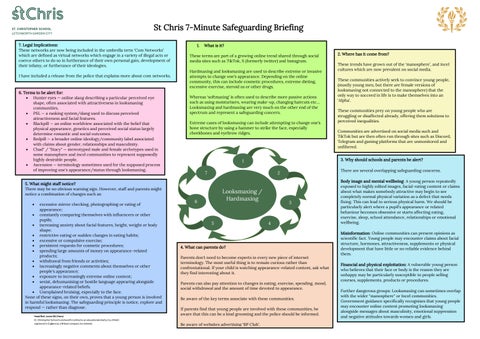
Looksmaxing / Hardmaxing
5
3
4
4. What can parents do? Parents don't need to become experts in every new piece of internet terminology. The most useful thing is to remain curious rather than confrontational. If your child is watching appearance-related content, ask what they find interesting about it. Parents can also pay attention to changes in eating, exercise, spending, mood, social withdrawal and the amount of time devoted to appearance. Be aware of the key terms associate with these communities. If parents find that young people are involved with these communities, be aware that this can be a kind grooming and the police should be informed. Be aware of websites advertising ‘BP Club’.
These communities actively seek to convince young people, (mostly young men, but there are female versions of looksmaxing not connected to the manosphere) that the only way to succeed in life is to make themselves into an ‘Alpha’. These communities prey on young people who are struggling or disaffected already, offering them solutions to perceived inequalities. Communities are advertised on social media such and TikTok but are then often run through sites such as Discord, Telegram and gaming platforms that are unmonitored and unfiltered.
There are several overlapping safeguarding concerns.
2
6
These trends have grown out of the ‘manosphere’, and incel cultures which are now prevalent on social media.
3. Why should schools and parents be alert?
1
5. What might staff notice? There may be no obvious warning sign. However, staff and parents might notice a combination of changes such as:
2. Where has it come from?
Body image and mental wellbeing: A young person repeatedly exposed to highly edited images, facial-rating content or claims about what makes somebody attractive may begin to see completely normal physical variation as a defect that needs fixing. This can lead to serious physical harm. We should be particularly alert where a pupil's appearance or related behaviour becomes obsessive or starts affecting eating, exercise, sleep, school attendance, relationships or emotional wellbeing. Misinformation: Online communities can present opinions as scientific fact. Young people may encounter claims about facial structure, hormones, attractiveness, supplements or physical development that have little or no reliable evidence behind them. Financial and physical exploitation: A vulnerable young person who believes that their face or body is the reason they are unhappy may be particularly susceptible to people selling courses, supplements, products or procedures. Further dangerous groups: Looksmaxing can sometimes overlap with the wider "manosphere" or Incel communities. Government guidance specifically recognises that young people may encounter online content promoting looksmaxing alongside messages about masculinity, emotional suppression and negative attitudes towards women and girls.