Impact Report

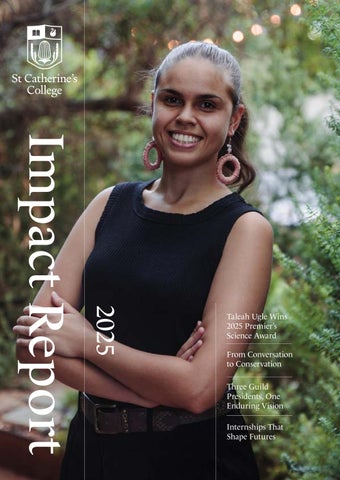
Taleah Ugle Wins 2025 Premier’s Science Award
From Conversation to Conservation
Three Guild Presidents, One Enduring Vision
Internships That Shape Futures
![]()

Taleah Ugle Wins 2025 Premier’s Science Award
From Conversation to Conservation
Three Guild Presidents, One Enduring Vision
Internships That Shape Futures

In 2025, St Catherine’s College continued to demonstrate the strength of a community guided by clarity of purpose and a deep commitment to
Across both campuses, we have seen academic distinction, meaningful engagement and innovation that extends well beyond the College. From research advancing global understanding in health and science to national recognition for our residents, the achievements of this year reflect a culture that values rigour, integrity and ambition.
The Board remains focused on responsible stewardship. Our role is to ensure that the College’s foundations remain strong and that opportunity continues to be accessible to talented students from diverse backgrounds. We are committed to safeguarding the financial and strategic sustainability of the College while enabling it to evolve with confidence.
St Catherine’s College acknowledges the Whadjuk people of the Noongar nation as the traditional custodians of this country we are situated on. We pay our respects to Elders past and present and acknowledge their wisdom and advice in our teaching and cultural knowledge activities.
This publication is printed utilising
and the paper mill are
This report captures more than individual successes. It reflects a model of residential life in which academic excellence, leadership and community are woven together. That integration is what distinguishes St Catherine’s College and positions it for continued impact.
On behalf of the Board, I extend my gratitude to our residents, staff, Fellows, alumni and partners. Your contribution sustains a College that is both grounded in tradition and focused firmly on the future.
Margie Tannock Chair of the Board

At St Catherine’s College, service and excellence underpin everything we do. In 2025, we strengthened and extended the impact of our academic and community initiatives, building on strong foundations and a clear sense of purpose. Our commitment to developing capable and ethical leaders continues to guide our direction and decision-making.
Across both UWA and Curtin campuses, College life strengthened connections and leadership. Scholarship programs broadened access for regional and remote students, student leadership strengthened campus culture and community initiatives reinforced our shared values.
Bloom stands as Western Australia’s leading Centre for Youth Innovation, empowering young people to translate ideas into enterprise and leadership. In 2025, Bloom engaged thousands of students and founders, accelerating ventures and contributing to Western Australia’s innovation ecosystem.
Over the past decade, more than 400 Aboriginal and Torres Strait Islander residents have been part of Dandjoo Darbalung. Their academic achievement and cultural leadership continue to shape the College. As our Centre for Aboriginal and Torres Strait Islander Excellence, Dandjoo Darbalung remains central to our mission and to the experience of students across both campuses.
Professional engagement deepened throughout the year. Faculty and Industry Dinners connected residents with senior leaders across academia, government and industry, creating clear pathways into careers and research. Internship opportunities expanded across disciplines, enabling residents to apply their studies in professional settings.
Academic distinction remained a hallmark of the year. From nationally recognised research and prestigious scholarships to student achievement at the Premier’s Science Awards, our residents demonstrated intellectual depth and commitment.
Leadership was also evident across campus life and national representation, including strong participation at the Australian Indigenous Nationals and across student-led initiatives.
As we look ahead, our focus remains clear: to cultivate intellectual ambition, support innovation and sustain a community where residents are challenged and supported as they prepare to lead.
Fiona Crowe CEO

Informed debate at St Catherine’s encourages students to think deeply and engage with purpose. Through Faculty and Industry Dinners, internships and conversations on emerging technologies, residents connect their knowledge with realworld insight. These experiences cultivate thoughtful graduates ready to navigate complexity with integrity.

“I absolutely loved hearing about Professor Wood’s journey through medicine. It was one of the most inspiring events I have had the pleasure of attending.”
CHARLI WINDBERG | BACHELOR OF MEDICINE, CURTIN
Conversation. Access. Action.
In 2025, the Faculty and Industry Dinners continued to offer meaningful forums for St Catherine’s residents to engage with senior leaders across academia, government, industry and the non-profit sector.
Designed as structured, small-group conversations, the series created opportunities for residents to connect with those influencing research, policy and professional practice across diverse fields.
Each year, these events spark tangible outcomes. Residents have gone on to pursue research, internships and employment opportunities first explored in these settings. Many have formed professional connections that continue well beyond the events. For others, the experience has offered clarity and motivation at pivotal moments in their academic journey.
Among the most popular events was the Regenerative Medicine dinner featuring Professor Fiona Wood AM. Her candid reflections on surgical innovation, public health and medical ethics left a lasting impression on many in the room.
For Charli Windberg, a Bachelor of Medicine student at Curtin University, the evening proved formative. Hearing Professor Fiona Wood speak strengthened her commitment to medicine and clarified her direction as she begins her degree.
The Faculty and Industry Dinners remain a distinctive part of the St Catherine’s experience. They continue to open doors, broaden horizons and shape what comes next.
429
RESIDENT SEATS FILLED ACROSS SEVEN DINNERS
313
INDIVIDUAL RESIDENTS ENGAGED
100
SENIOR LEADERS ACROSS ACADEMIA, GOVERNMENT AND INDUSTRY
6
CAREER OR RESEARCH OPPORTUNITIES SECURED


Participation in 2025 reflected deliberate initiative. Seventy per cent of residents who attended a dinner chose just one, typically the event most aligned with their degree. Nearly one in three returned for two or more. Five residents attended four or more times across the year.
Nearly one in three residents chose to return, reflecting targeted engagement aligned to academic interests.
Residents prepared questions, initiated discussion and followed up beyond the evening. Engagement did not end when the formal program concluded.
POLITICS AND DIPLOMACY
CYBERSECURITY
REGENERATIVE MEDICINE
CIRCULAR ECONOMIES
RURAL HEALTH
FUTURE OF ENERGY
LEADERSHIP INSIGHTS
HEALTH ECONOMICS
HEALTH SCIENCES
The series explored a wide range of fields, from Politics and Diplomacy and Cybersecurity to Regenerative Medicine, Circular Economies, Rural Health and the Future of Energy, alongside discussions on Leadership Insights, Health Economics and Health Sciences.
Guests included senior academic s, policymakers, clinicians and industry leaders shaping research, policy and professional practice at state and national levels.
Through these exchanges, residents strengthened professional confidence and expanded networks that will influence their academic and career pathways.
In 2025, Faculty and Industry Dinners reinforced a culture of informed dialogue and professional ambition at St Catherine’s College.
In 2025, more than 120 residents translated their academic studies into real-world experience, undertaking internships, placements and research projects across Australia and beyond. From national research agencies to global technology firms, their contributions spanned disciplines including law, engineering, biomedical science and environmental management.
Each placement offered a chance to test ideas in practice and take on meaningful challenges in professional settings. Many were secured through College communications, scholarships and partnerships that open pathways to employers and organisations of influence.
Here is a snapshot of residents learning by doing and shaping their futures in the process.

“I built a website from the ground up for a community legal centre, designing, coding and launching it myself. When I saw the opportunity in the College Bulletin, I applied immediately. That one post changed everything.”
TATUM BOTHA MASTER OF PROFESSIONAL ENGINEERING (BIOMEDICAL)
UWA
CORAMETIX
MEDICAL
DEVICES

KELE READHEAD BACHELOR OF PHILOSOPHY (HONS) AND BACHELOR OF ENGINEERING (HONS) UWA PEEL COMMUNITY LEGAL SERVICES
“Working on 3D-printed heart valves reminded me why I chose engineering with purpose. My College scholarship meant I could commit long-term to the internship.”
“As a Project Engineer on a billion-dollar satellite program, I learned what innovation looks like on a global scale. Leadership roles at College gave me the communication and teamwork skills I used every day.”
LOC NGO
BACHELOR OF ENGINEERING (HONS) (ELECTRICAL & ELECTRONIC)
UWA
SINGTEL (SINGAPORE)


“At CSIRO I explored how microbes capture carbon and contribute to Australia’s net-zero goals. Because College gave me space to focus and connect with industry, I took opportunities I once thought out of reach.”
AHMED ABDELMUNIEM
MASTER OF PREDICTIVE ANALYTICS
CURTIN
MINERAL RESOURCES

BRODIE O’BREZA
BACHELOR OF COASTAL & MARINE SCIENCE / ENVIRONMENTAL MANAGEMENT CURTIN
CSIRO CARBONLOCK PROJECT
“Developing computervision tools for industry taught me that perseverance and clear communication build trust. My time as an Resident Assistant at College shaped the way I collaborate and lead.”
“The future we were promised is already knocking at the door. The challenge is not to wait for it, but to shape how it unfolds.”
DR
MARK VAN RIJMENAM | STRATEGIC FUTURIST
At the 2025 Scholars’ Dinner, curiosity met foresight in a timely conversation about artificial intelligence and the future of work. Faculty leaders, industry partners and our highest achieving residents gathered for the College’s most anticipated annual event, which examined how technology can amplify human potential and deepen our sense of purpose.
Dr Mark van Rijmenam, an awardwinning keynote speaker recognised by Salesforce as one of 16 global AI influencers and ranked the world’s leading futurist, opened the evening with a bold invitation.
“I’m going to take you on a journey into our super fast-changing world and show how we can ride the tsunami of change,” he said.
Dr van Rijmenam explored how technologies such as AI, robotics and blockchain are shaping what he describes as the Intelligence Age. This is a period defined not just by innovation and data, but by the ethical choices that come with them. Introducing his ‘WAVE’ framework of ‘Watch, Adapt, Verify, Empower,’ he challenged scholars to engage with technology critically and conscientiously.
For Salena Yadav, a Doctor of Dental Medicine student at UWA, the discussion resonated deeply. “AI is constantly evolving, and it gives me hope for the future. As a medical student, I want software that can diagnose and prescribe medication in a safer manner,” she said.

Dr Mark van Rijmenam’s WAVE Framework | A model for thriving in the Intelligence Age
Recognise change early and respond with curiosity.
Agility is the defining skill of future leaders.
Integrity and trust are vital in the age of AI.
Technology should amplify, not replace, human potential.
“The Scholars’ Dinner brings people from all walks of life to debate the world’s biggest challenges. We have to learn from each other’s perspectives.”
JIARANAI KEATNUXSUO (FR 2016) | SOLUTION ARCHITECT, MICROSOFT


“Tonight, the students asked questions that allowed them to steer the conversation to an optimistic AI future. Which makes me really excited.”
JEROEN VAN DALEN | FOUNDER AND DIRECTOR, AUSTRALIAN INSTITUTE FOR TRANSFORMATION AND AI


Practical enlightenment at St Catherine’s is growth through experience. Residents apply what they learn through leadership, creativity and community engagement. In doing so, they develop confidence, resilience and a strong sense of responsibility.
Sam Bloom Inspires Emerging Leaders
Full Circle Creative Futures
No Stepping Back Dancing into Community Bloom Achievers

Bloom was founded at St Catherine’s College in 2013 and has grown into Western Australia’s leading Centre for Youth Innovation. Through its flagship programs, Bloom continues to cultivate the next generation of entrepreneurial thinkers, guiding young people from early validation to global impact. Hear from the next generation of changemakers, where curiosity meets action.
“Entrepreneurship is about finding clarity in the chaos and building something that lasts.”
Founder of Amalfi Media and current resident, Rohan is studying for a Bachelor of Psychology at UWA and has turned his passion for storytelling into a thriving creative agency while still at university. What began as a small project in Launchpad quickly grew into a business generating $23,000 in 12 weeks.
Now part of Orbit, Bloom’s accelerator for scaling startups, Rohan is expanding operations, hiring his first team and developing growth strategies. Delivered in partnership with the College, the program helped him quadruple his revenue over the past year. It is a clear example of how structured mentorship and collaboration can fast-track real progress.
“Launchpad helped me turn possibility into practice.”
Markus, a final-year Bachelor of Business student at UWA and current resident, once trained as an Olympic-level swimmer before an injury changed his path.
Through Bloom’s Launchpad program, he developed a boat-maintenance startup, combining his business skills with a longstanding connection to the water. Over 12 weeks, he refined his idea, practised pitching and received support from mentors and peers.
In his first month, Markus secured 25 boats and generated $4,000 in revenue. Sometimes what makes the difference is confidence, and a program such as Launchpad to provide the structure and support to get started.
3,117
STUDENTS ENGAGED
354
TEACHERS INVOLVED
2,800
TERTIARY PARTICIPANTS
16 STARTUP PROTOTYPES BUILT IN 6 WEEKS
$1.5M IN B2B PIPELINE
“Technology empowers ordinary people to achieve the extraordinary.”

College alumna and Solution Architect at Microsoft, Jia (Fr 2016) exemplifies how technical expertise, education and purpose can drive meaningful change. In 2025, she helped lead LaunchLAB AI, Australia’s first AI startup incubator, developed in collaboration with Bloom and Curtin University.
Across a six-week sprint, the program guided 14 founders through every stage of venture validation. They conducted 300 structured customer interviews, built 16 MVPs and launched 10 revenue-ready startups with a projected $1.5 million business-to-business pipeline. The intensive model compressed a year of progress into weeks, demonstrating how focused mentorship and collaboration deliver real-world outcomes.
For Jia, the experience was deeply rewarding. “Technology empowers ordinary people to achieve the extraordinary,” she says. “Seeing students apply AI ethically and creatively shows the potential of innovation when purpose leads progress.”
Her continued involvement with Bloom helps connect industry expertise with emerging talent, strengthening Western Australia’s growing tech ecosystem.
“Self pity is more debilitating than any injury. Even in pain, there is always a way forward.”

Four-time world champion adaptive surfer, author and Paralympian Sam Bloom delivered a moving keynote at the 2025 Boyd Dinner for Emerging Leaders, sharing her story of trauma, recovery and perseverance. Her message was clear: resilience often begins at our lowest points.
The Boyd Dinner is held annually to honour distinguished alumna Dr Sue Boyd AM (Fr 1966), a former resident of the College and a trailblazer in education, diplomacy and gender equality. The first female Student Guild President at UWA, Dr Boyd dedicated her career to international service and advancing women’s rights.
That spirit of resilience echoed through Sam Bloom’s story. A fall from a balcony while travelling in Thailand left her paralysed from the chest down, reshaping her life. With the support of her family and a rescued magpie named Penguin, she gradually rebuilt her sense of purpose. Her experience became the bestselling memoir Penguin Bloom, later adapted into a feature film starring Naomi Watts. She has since represented Australia at two Paralympic Games and won four world titles in adaptive surfing.
Guests and student leaders described the evening as both thoughtful and encouraging.
“Sam spoke bravely and vulnerably about monumental life changes, but also made it personal,” said Aliza Chopping, Student Council Captain at Perth College. “She reminded us it’s okay to struggle, especially in a year that’s so intense for us as student leaders. What I’ll take with me is that no matter how low life can seem, there is always a way forward.”
Perth College School Captain Lauren Rasheed also reflected on the opportunity to connect with other young leaders. “It was incredible to come together with like-minded leaders and share the experience,” she said. “It really showed what’s possible when people support each other.”
The Boyd Dinner provided a valuable opportunity for reflection and conversation, bringing together young leaders to consider the challenges and responsibilities that come with leadership.


Jaimee Whirledge returns to direct this year’s student production of Almost, Maine.
Alumna Jaimee Whirledge (Fr 2021) knows the St Catherine’s stage well. A WAAPA graduate and former College Co-President, she has returned several times to direct the annual College Play, bringing the same enthusiasm and curiosity that defined her time as a resident.
This year’s production, Almost, Maine, brought together students from across disciplines in a warm, funny and thoughtful exploration of love, connection and belonging. For Jaimee, directing at the College is more than a creative outlet. It is also a way to build confidence and community through performance.
“Directing here always feels special. It is where I first discovered how storytelling can bring people together.”
JAIMEE
WHIRLEDGE | PAST COLLEGE CO-PRESIDENT
What makes directing at St Catherine’s meaningful for you?
There is something unique about the energy here. The students are open, curious and fearless. Each year feels different because the group brings its own ideas and spirit.
How has your perspective shifted from being on stage to leading from behind the scenes?
As a student I was focused on performing. Now it is about helping others find their voice. Seeing that growth in the cast is the most rewarding part.
What stands out to you about working with residents in a creative setting? Their creativity. They throw themselves into every rehearsal and support each other so naturally. The community vibe makes everything possible.
Was there a defining moment in this year’s production?
The first full run-through when everything clicked. You could feel the joy and teamwork in the room. It was magic.
Where is your career taking you at the moment?
I am touring across Western Australia with Spare Parts Puppet Theatre, performing and leading workshops. I hope to keep coming back to St Cat’s. It is a place that continues to inspire me.
sold - out PERFORMANCES
GROWTH IN CAST PARTICIPATION YOY TWO
33%


“Being part of Almost, Maine reminded me how much I love performing. It was one of the best experiences I’ve had at College.”
BRYONY PETERS | MASTER OF TEACHING (PRIMARY), UWA

WAAPA Bachelor of Dance student and St Catherine’s College resident Conway Chunnery brought pride and cultural connection to the stage in a powerful opening performance for the 2025 UWA Fresher Dance at Matilda Bay. Collaborating with Dandjoo Darbalung scholars, he choreographed a one-minute piece set to music by acclaimed Yolŋu singer and Indigenous artist, Gurrumul.
What inspired the piece you performed for the Fresher Dance?
I choreographed a one-minute cultural piece for the Dandjoo mob to open the event. It was about being strong and proud of who we are. I spoke to the freshers beforehand about the meaning behind the movements, the music and why the style carries so much story.
How did you reflect that meaning through the choreography?
The men’s section was powerful and strong. The women were reconnecting to the land and waking up the spirit. Even though the piece was short, it held a great deal of depth.
What does dance mean to you beyond performance?
In dance you need to focus on your role, your section and what you are bringing to the performance. Traditional movement can live in a contemporary space. You take what you learn on Country, bring it into the studio and then share it with the audience.
How do you see the role of the performer?
Being a performer means having confidence on any surface and in any setting. It is how we represent ourselves and how we tell our stories.
The annual Fresher Dance is a long-standing tradition at UWA and the first Inter-College event of the year. Each year, new residents have just one week to learn and rehearse a routine before performing alongside other residential colleges. In 2025, their efforts earned St Catherine’s a second consecutive victory.
The performance was guided by Resident Assistant Eva Matyear, who is studying a Bachelor of Music at WAAPA, alongside fellow resident Conway Chunnery, a WAAPA Bachelor of Dance student. Together they helped shape a routine that combined storytelling, rhythm and movement.
For many participants, the experience was about more than the performance itself. Early morning practices and late-night rehearsals became opportunities to form friendships, build confidence and settle into life at the College. When St Catherine’s was announced as the winner, the cheers reflected the energy and teamwork that had built throughout the week.


“When we nailed the full routine for the first time, it felt like everything had finally come together. All the effort and laughter in rehearsals built such strong friendships.”
AMALI BURCH | BACHELOR OF PSYCHOLOGY AND ARTS, UWA
“The night before the performance was when it truly clicked. The excitement set in and seeing our hard work pay off for everyone involved was incredible.”
ZANE HOUSTON | BACHELOR OF ENVIRONMENTAL DESIGN (ARCHITECTURE), UWA
“Watching the other colleges perform had us on the edge of our seats, but when they announced our name the energy was unreal. It brought everyone closer together.”
RENÉE RINZING | BACHELOR OF FINE ARTS (FILMMAKING), UWA
“Even after long days, the freshers kept cheering each other on. Seeing them perform with such confidence and pride was amazing. It felt like the whole College came alive.”
EVA MATYEAR | BACHELOR OF MUSIC, WAAPA

Extraordinary learning at St Catherine’s is marked by inquiry and achievement. Residents undertake meaningful research, earn scholarships and contribute thoughtfully to their disciplines. Guided by a strong academic community, they develop depth of knowledge, confidence and purpose.

Shirley McLeod Scholars
Unravelling the Hidden Story of a Protein
Leading from Within
Taleah Ugle Wins Premier’s Science Award
Transforming Liver Health
Family Traditions
Walls that Speak
“To me, leadership means lifting others as you climb, creating spaces where everyone can thrive.”
AMALI BURCH | BACHELOR OF PSYCHOLOGY & ARTS, UWA

A legacy of leadership
Established in memory of Shirley McLeod (Fr 1962), a spirited St Catherine’s resident whose determination and love of learning continue to inspire, the Shirley McLeod Scholarship recognises young women who embody excellence, integrity and leadership.
Created by the McLeod family in 2010, the scholarship reflects Shirley’s optimism and drive, supporting students as they overcome barriers and thrive in their chosen fields. Since its establishment, seventeen scholars have carried Shirley’s legacy forward through leadership, innovation and meaningful community impact.

BACHELOR OF PSYCHOLOGY & ARTS (CRIMINOLOGY), UWA
Amali’s academic excellence and community involvement exemplify the scholarship. A Queensland Curriculum and Assessment Authority Academic Commendation recipient, she achieved A grades across six ATAR subjects while leading her school as Prefect and Dance Captain. Passionate about wellbeing and human behaviour, Amali hopes to become a clinical psychologist.


BIOMEDICAL SCIENCE STUDENT AIMING TO JOIN THE ROYAL FLYING DOCTOR SERVICE


JUNIOR DOCTOR PURSUING SURGICAL TRAINING AND RURAL


DATA SCIENCE GRADUATE USING ANALYTICS TO INFORM SOCIAL POLICY

MEDICAL GRADUATE COMMITTED TO EQUITABLE REGIONAL HEALTHCARE

PHD BIOCHEMIST RESEARCHING PLANT HORMONES FOR SUSTAINABLE


POPULATION HEALTH GRADUATE EXPLORING CREATIVE THERAPIES FOR MENTAL WELLBEING

NEUROSCIENCE GRADUATE FOCUSED ON ABORIGINAL HEALTH AND COMMUNICATION

SPORT SCIENTIST ADVANCING ELITE PERFORMANCE AT THE AUSTRALIAN INSTITUTE OF SPORT

PSYCHIATRIST
When people think of scientific breakthroughs, they often imagine dramatic medical advances or futuristic technology. Yet many of the most meaningful discoveries begin with simple curiosity and a question that seems almost too ordinary to matter. For Associate Dean and St Catherine’s College alum Dr Samuel Nonis (Fr 2014), one such question emerged from a tiny protein that had been sitting quietly in laboratory freezers for more than a century.
The protein is concanavalin A, commonly known as conA. Found in jack bean seeds, it is prized for its ability to bind sugars, making it a staple in laboratories around the world. Scientists use conA to capture molecules, study cell surfaces and explore how sugars decorate proteins. Because of this, conA has become one of the most widely used plant proteins in modern biology.
In the mid-1980s, researchers made an unexpected discovery. The sequence of the conA protein did not match what its gene predicted. Somewhere in the plant, after the protein was produced, its order of amino acids changed. The middle became the ends and the ends became the middle. The rearrangement was so unusual that scientists jokingly referred to it as ‘protein carpentry’. Although this type of modification, known as circular permutation, later became a tool for protein engineering, conA remained the only known natural example.
For nearly forty years, no one knew why this rearrangement occurred or whether it served a purpose. The scientific community also knew little about what conA looked like before this change occurred. That lingering question became the focus of Sam’s doctoral research.
While completing his PhD in structural biology at The University of Western Australia, Sam worked with collaborators to study both the unmodified protein, known as pro-conA, and the enzyme responsible for reshaping it. The project demanded patience, precision and a suite of complementary scientific techniques.
Sam and his team solved the atomic structure of pro-conA, along with the structure of the jack bean enzyme thought to drive the transformation. With these insights, they recreated the entire process in the laboratory and confirmed that a single enzyme could cut the protein, reorder its sequence and form the bonds needed to complete the change.
The results revealed something remarkable. Pro-conA, the original form of the protein, is far less stable than the mature version. After circular permutation, conA becomes significantly more resistant to heat and acidity. The transformation does not alter how it binds sugars, but it does improve how well the protein holds its shape under stress. What once seemed a biological curiosity now appears to give the protein a distinct functional advantage.
Sam’s research was published in The Plant Cell, one of the most respected journals in plant science. It has since been featured in scientific summaries, author interviews and an independent commentary. The publication represents a significant achievement and sheds new light on a protein that has intrigued researchers for decades.
Sam’s academic journey reflects a deep interest in how genes and proteins shape life. During his Honours year with Professor Ryan Lister, he investigated targeted epigenetic modifications in the human genome. He later worked at Singapore’s Agency for Science, Technology and Research, applying molecular techniques to explore protein evolution. This experience deepened his interest in how structure determines function and ultimately led him to structural biology and crystallography during his PhD.
Today Sam is the Associate Dean at St Catherine’s College Curtin. His connection to St Catherine’s began years earlier as a resident and Residential Advisor at our UWA campus, giving him a strong understanding of College life and the experiences of the students he now supports. He brings the same quiet curiosity and care to College life as he does to science, reminding us that meaningful change often begins by noticing what others overlook.
“When I look back on my years as a resident at the College, I’m reminded how the environment shaped the choices that set me on my path today. Working with residents now, it’s deeply rewarding to support them and spark those same transformative moments as they find their way.”

HOW TO MAKE A POSITIVE IMPACT AS ALUMNI
BECOME A MENTOR
Supercharge potential futures by mentoring residents as they navigate university life.
ATTEND A FACULTY AND INDUSTRY EVENT
Join one of our networking events to engage with university faculty members, industry professionals and residents.
EMPLOY GRADUATES
Build on your pool of talent and start connecting with St Catherine’s residents and graduates.
Email alumni@stcats.com.au to find out more

In 2025, St Catherine’s College welcomed three distinguished academics as Resident Fellows and Academic in Residence across UWA and Curtin. Recognised for research excellence and leadership, they strengthen College life through mentorship, intellectual engagement and visible scholarly presence.
Their expertise spans environmental engineering, health economics and molecular sciences, disciplines shaping global conversations in sustainability, healthcare and clean energy. Through formal and informal engagement, they contribute to a culture where academic ambition is encouraged and excellence is lived.
Professor Carlo Marra is an internationally recognised health economist and Pro Vice Chancellor for Health Sciences at Curtin University. His leadership career spans Canada, New Zealand and Australia, including Dean of Pharmacy roles at the University of Otago and Memorial University of Newfoundland.
His research focuses on patient-centred care, health economics and improving healthcare efficiency. As Academic in Residence, he mentors residents pursuing careers in health and allied disciplines, strengthening intellectual life within the College.

Dr Michele Trevisson
RESIDENT FELLOW
UWA School of Earth Sciences & UWA Oceans Institute
A specialist in environmental fluid mechanics, Dr Trevisson’s research investigates sediment transport and pollution dispersion in river systems. His work advances understanding of sustainable water systems and environmental resilience. His presence in residence offers students insight into environmental research addressing real-world challenges in water systems and climate resilience.

Dr Jinqiang Zhang
RESIDENT FELLOW
UWA School of Molecular Sciences
Recipient of an Australian Research Council DECRA Fellowship, Dr Zhang develops nanostructured catalysts for clean energy production, including hydrogen generation and carbon dioxide conversion. His research contributes to sustainable energy innovation at an international level. As a DECRA Fellow and lecturer, he brings cutting-edge clean energy research into everyday academic conversation within the College.

Josh Snow, St Catherine’s College resident and Fogarty Scholar, has been awarded the 2026 Geoff Gallop John Monash Scholarship, one of Australia’s highest postgraduate honours. A graduate of Frontier Physics (Advanced) at UWA, Josh will undertake a Master of Computational and Mathematical Engineering at Stanford University.
“The John Monash Scholarship has long been a source of inspiration for me, so being selected as a recipient is both a privilege and a humbling milestone”
Josh’s research focuses on developing efficient quantum state preparation methods to enable practical quantum computing applications that advance Australia’s priorities in secure communications, advanced sensing and critical technologies. Through his studies in the United States, he aims to access world-class expertise and experimental platforms before returning home to contribute to Australia’s growing role as a global leader in quantum innovation.

Taleah Ugle, a proud Menang–Ballardong Noongar woman was named Aboriginal and Torres Strait Islander STEM Student of the Year at the 2025 Premier’s Science Awards.
Recognised for her dedication to Aboriginal health and community leadership, Taleah shares the journey that led her from regional WA to national recognition.
What inspired your interest in Aboriginal health?
I grew up in the regional town of Albany and saw the barriers that Aboriginal people faced, especially within my own mob, when entering the health system and the fears they felt when trying to find help. I wanted to be that safe place our people can turn to.
How did that shape your study and career path?
When I started university, I knew I wanted to pursue a career in medicine, but I also wanted to make sure Aboriginal people felt heard within that system. I have always been passionate about science and human rights, and working in Aboriginal health allows me to bring both worlds together and create change that lasts.
What leadership experiences shaped your time at university?
While completing my Bachelor of Science at UWA, I took on several leadership roles, including Women’s Officer for the UWA Student Guild and Co-Chair of the Referendum Working Group. These experiences taught me how powerful advocacy and collaboration can be in shaping better outcomes for our communities.
Can you tell us about your research work?
After completing two Aurora Foundation internships, I joined The Kids Research Institute as an Aboriginal Research Assistant with the Healthy Skin and Acute Rheumatic Fever Prevention Team. Through the Moorditj Marp (Strong Skin) project, I have helped strengthen culturally relevant health resources that support Aboriginal families and improve care outcomes.
What did winning the Premier’s Science Award mean to you?
Winning the Aboriginal and Torres Strait Islander STEM Student of the Year at the 2025 Premier’s Science Awards was an incredible honour. It recognised not just my studies but also the communities and mentors who have guided me.
How has the College supported your journey?
Being part of St Catherine’s College and the Dandjoo Darbalung community gave me a strong network of peers who share similar paths. Those friendships and shared experiences will become lifelong connections and, I hope, a network of future Aboriginal leaders.
What role has sport played in your journey? Sport has also been an important part of my journey. As co-captain of UWA Maaliwah, the university’s Indigenous Nationals team named after the black swan, I’ve experienced the power of culture and connection through competition.
What did it mean to also receive the bp Australia Indigenous Nationals Scholarship? In 2025, I received the bp Australia Indigenous Nationals Scholarship for leadership and athletic achievement. It was an honour that recognised the same values I hold in my research and studies: teamwork, confidence and cultural pride.
Any advice for other young Aboriginal students thinking about university?
Getting to university is the hardest part, but once you begin, doors open in ways you could never imagine.

Emeritus Professor George Yeoh (UWA), Fellow of the College, leads pioneering research into liver regeneration and disease at the Harry Perkins Institute of Medical Research. His current project, funded by the Future Health Research and Innovation (FHRI) Fund, Cystic Fibrosis WA and Conquer Cystic Fibrosis, seeks to develop a simple blood test for the early detection of liver disease.
A National Health and Medical Research Council Fellow for two decades and former President of Cancer Council WA, Professor Yeoh’s career is defined by persistence, collaboration and a belief in science as a service to humanity.
What drew you to focus your research on the liver?
The liver is extraordinary. It regulates metabolism, converts nutrients into energy and has the rare ability to regenerate. When it fails, survival depends on transplantation.
During development, the liver’s metabolism shifts dramatically from fetus to adult. It begins producing enzymes needed to process food after birth. I became fascinated by how genes are switched on to produce these enzymes, and how precisely that process is controlled. Understanding gene regulation became the foundation of my research. How could your new blood test transform care for patients with cystic fibrosis?
Between 10 and 20 percent of cystic fibrosis patients develop liver disease. Current diagnostic methods are unreliable and invasive. A biopsy samples only a small part of the liver and may miss early signs of disease.
A simple blood test would allow ongoing monitoring and early intervention. Treatments such as dietary changes or drug therapies are most effective when introduced early. This kind of test could help prevent irreversible liver damage and reduce the need for transplantation.
You have worked extensively with liver stem cells. What excites you most about this field?
Liver stem cells offer the potential to regenerate damaged tissue and restore essential liver functions. Gene therapy is also promising.
The liver is a good target because it responds well to viral delivery, and some genetic disorders are already being treated with approved therapies.
Looking ahead, the goal is to generate patient-specific liver cells from reprogrammed stem cells, avoiding immune rejection. We can already produce liver organoids, but they are limited in function. The next challenge is replicating the liver’s structure and circulation to create a fully functional mini-organ for future transplantation.
Collaboration seems central to your work. Why is it so critical in medical research?
Successful medical research depends on collaboration across disciplines and institutions. Our work requires expertise in cell and molecular biology, chemistry, genetics, bioinformatics and clinical medicine, as well as access to sophisticated technology.
The Harry Perkins Institute is a melting pot where these specialists come together. Funding from multiple partners, including Telethon, has been vital in helping us establish and advance this work. Collaboration is how real progress happens.
What advice would you give to aspiring researchers?
A career in medical research demands passion and persistence. It requires organisation, logic and a deep respect for detail. The body is a complex system of organs, tissues, cells and molecules that all interact. Understanding those interactions takes time and imagination.
I often tell students that there may be a cosmos beyond us to explore, but there is also one within our own bodies that is equally vast and largely unknown. Professor Yeoh’s work continues to expand the boundaries of liver health research. His leadership and dedication exemplify the values of the College: excellence, courage and knowledge in service of the community.
“This research has moved beyond the purely academic. It is about creating something that makes a tangible difference in people’s lives.”

Leaders in their fields, our Fellows bring expertise, mentorship and energy to College life. Through public talks, mentoring and academic engagement, they help residents think critically, connect meaningfully and contribute to a culture of excellence, curiosity and community.
Through the Fellows Program, St Catherine’s honours individuals who embody the College’s values of excellence, diversity, courage, leadership and integrity. Fellowship recognises those whose professional and personal achievements make a lasting impact on the College and the wider community.
To find out more about our Fellows, scan the QR code below.

The strongest endorsement comes when family members choose to follow in each other’s footsteps. There’s something special about College life at St Catherine’s, with its vibrant community, lively calendar of events, lifelong friendships and the once-in-a-lifetime experience of living on campus.
“It’s been really special having Liam at St Cat’s, sharing the same place, but making it our own in different ways.”
HAYLEY MILLS | BACHELOR OF HEALTH SCIENCE | CURTIN
LIAM MILLS | BACHELOR OF BIOMEDICAL SCIENCE (LABORATORY MEDICINE) |
DEBALEENA HAMMOND (FR 1978) | BACHELOR OF PSYCHOLOGY | UWA
ROHAN HAMMOND | BACHELOR OF PSYCHOLOGY | UWA
“I
hope Rohan looks back on this time the way I do, with warmth, purpose and lifelong friends.”


“From living on campus to the friendships I’ve made, it has been special from day one. I’m so glad my sister now has the opportunity to create her own memories at St Cat’s.”
MILAN URBANI | BACHELOR OF CHEMICAL ENGINEERING & FINANCE | UWA
SOLEIL URBANI | OCCUPATIONAL THERAPY | CURTIN
CAROLINE ZEITLER (FR 1984) | BACHELOR OF ECONOMICS | UWA
MITCHELL ZEITLER | BACHELOR OF SCIENCE (EXERCISE AND HEALTH) | UWA
ZACH ZEITLER | BACHELOR OF ENGINEERING | CURTIN
“I never imagined I’d be back at the College as a parent. Watching my sons Mitchell and Zach experience the same sense of community I found here has been incredibly special.”

St Catherine’s College partnered with historians Michelle Campbell and Eddie Marcus, the team behind Dodgy Perth, for an evening of history and conversation that explored how architecture tells the story of a community. Together, they guided alumni, staff and residents through the College’s evolution, from its beginnings as a vision for women’s education to its place today as an inclusive and connected College.
Through archival plans, photographs and personal recollections, the evening showed how each generation built on the aspirations of those before them. It also revealed how the College’s physical spaces mirror broader social change, from early ideas of order and protection to today’s expressions of openness and belonging.
“The walls of St Catherine’s College carry more than bricks and mortar; they hold memories,” said Farnam Namvar, a current resident studying a Master of Renewable and Future Energy at UWA, reflecting on how the College’s architecture captures the lived experience of its community.
The campaign to create a residential college for women began in earnest in 1928, with the formation of the Women’s College Fund Committee. Its stated aim was clear: to establish a residence for women at the University of Western Australia. This goal was both practical and visionary, recognising that access to higher education depended not only on opportunity, but on place.

In 1934, a design for a Women’s Hall of Residence imagined cloistered courtyards, arched walkways and a central tower above landscaped grounds. The plans were completed in full detail and construction was ready to begin when government funding was withdrawn. The drawings reflected the ideals of the time, shaped as much by social expectation as by educational aspiration.
Women across Western Australia took action, organising bake sales, fetes and garden parties to raise the money needed to build a residence for women students. Led by Dr Roberta Jull, Lady Mitchell and the Furphy family, their determination laid the foundations for what would become St Catherine’s College.
Although the 1934 plans never progressed beyond paper, they captured the conviction that women deserved equal access to higher education. When the first St Catherine’s building officially opened in 1960, its modernist form, replacing arches with open walkways, light and space, signalled a new confidence in women’s learning and leadership.
Over time, the architecture of St Catherine’s has moved from containment to connection. Corridors once used for supervision became places of conversation, and gardens that once marked boundaries opened to the street. The College’s form began to reflect shared purpose.
In 2014, St Catherine’s became co-educational, a shift that shaped both the community and its physical spaces. In 2019, the Banksia Building and Cultural Centre were added, informed by programs such as Dandjoo Darbalung, which strengthen cultural understanding.
Design has become a way to foster belonging. The buildings no longer simply house residents; they reflect evolving ideas of community and learning. In this way, the College’s architecture continues to tell the story of the people who live and learn within it.


“Foundation can mean a building, or it can mean an idea. From the beginning, St Catherine’s College has been about both.”
MICHELLE CAMPBELL | HISTORIAN

Purposeful contribution is embedded in life at St Catherine’s. Through conservation, cultural engagement and everyday acts of service, residents strengthen their community. Across generations, shared leadership and enduring traditions sustain a place that feels like home.

Co-Presidents Celebrate Unity Standing Strong Together
From Conversation to Conservation Small Gifts Lasting Comfort
The Community We Create Leading Across Generations Behind the Scenes of College Dining
Home Away from Home

Lily Murphy and Phumulo Elias Mpofu reflect on the year
The Valedictory Dinner at St Catherine’s Curtin brought residents together to mark the close of the academic year and recognise those completing their studies. Addressing the cohort, Lily Murphy and Phumulo Elias Mpofu spoke to the character and commitment that shaped campus life.
“Leadership is not about being in charge. It is about lifting others and creating space for everyone to shine.”
PHUMULO ELIAS MPOFU | BACHELOR OF ENGINEERING (HONOURS)
From the inaugural Freshers v Returners footy series to Koolark Wing’s comeback at the Faction Carnival, the year was marked by teamwork and momentum. Residents raised funds for Carnaby’s black cockatoo conservation, volunteered in local schools, ran to advance spinal cord research and claimed victory in the Housing Cup for the fourth consecutive year.
They highlighted initiatives that strengthened campus culture, including Girls on the Run, a growing network of clubs, cultural nights and open mic singalongs that brought residents together.
Beyond their roles as Co-Presidents, their leadership extended across Curtin. The Civil Engineering Association, led by Phumulo, was named 2025 Club of the Year. Lily, a founding member of Girls on the Run, helped grow the initiative into a welcoming, student-led community.
In their closing remarks, Lily and Phumulo acknowledged the residents, volunteers and staff who shaped the year, noting that lasting impact comes from the commitment of a community working together.
“With all our differences, this is a space for everyone, a place to pursue whatever success means to you.”
LILY MURPHY | BACHELOR OF PHARMACY
ST CATHERINE’S COLLEGE
2025 CURTIN UNIVERSITY HOUSING CUP CHAMPIONS
TOPPED ALL RESIDENTIAL COLLEGES IN SPORT
RECOGNISED FOR TEAMWORK, PARTICIPATION AND COLLEGE SPIRIT


“We set out to bridge the gap between students and industry and ended up building a stronger community.”
PHUMULO ELIAS MPOFU PRESIDENT, CURTIN CIVIL ENGINEERING ASSOCIATION
2025 CURTIN UNIVERSITY CLUB OF THE YEAR
EXPANDED TO 300 MEMBERS
BUILT 11 INDUSTRY PARTNERSHIPS
HOSTED NETWORKING EVENTS ENGAGING 20 ENGINEERING FIRMS
CURTIN MARKETING ASSOCIATION & CURTIN CONSULTING GROUP
2025 CURTIN UNIVERSITY BEST EVENT OF THE YEAR
DELIVERED CURTIN’S LARGEST NETWORKING EVENT 325 PARTICIPANTS | 30 FIRMS 70 REPRESENTATIVES
BUILT STRONGER LINKS BETWEEN STUDENTS AND INDUSTRY
“When students and professionals come together, the real learning begins.”


The 29th Australian Indigenous Nationals brought together more than 500 First Nation student-athletes from 32 universities across Australia to compete and celebrate Cultures.
Both St Catherine’s College campuses were proudly represented on Whadjuk Noongar Boodjar. Six of Curtin Kardas’ 15 players were College residents, while 11 of the 29 UWA Maaliwah team also called St Catherine’s home.
“Playing with teammates from different mobs is very special to us. Getting to compete with them and against them, and meeting new people, is really meaningful.”
TAJ O’DONAHUE | ABORIGINAL ORIENTATION COURSE, UWA
Among the standout participants was Taleah Ugle, a Bachelor of Science student at UWA. As co-captain of UWA Maaliwah, Taleah demonstrated the leadership and cultural connection at the heart of the event. “Being part of the Indigenous Nationals is about more than competition,” she said. “It’s about pride, culture and representing our people with strength.” Her contribution on and off the field was recognised with the bp Australia Indigenous Nationals Scholarship for 2025.
Read more about Taleah’s journey on page 30.
“I love asking who people’s mob are. Sometimes you find family.”
CHARLEE BRAHIM | BACHELOR OF CRIMINOLOGY AND CRIMINAL JUSTICE, UWA

Joe Noble met Professor Kingsley Dixon AO at a conservation-themed Formal Hall. Their discussion led to Joe joining the Carnaby’s Crusaders project, which supports research into Western Australia’s endangered Carnaby’s black cockatoo. Joe, a Bachelor of Arts student at UWA, became the inaugural recipient of the Kingsley Dixon Conservation Scholarship in 2025.
What motivated you to join Professor Dixon’s conservation work?
I felt driven by my conservation experience in Kenya to help with research on a dwindling native bird species. That motivation only grew when I discovered how endangered the Carnaby’s black cockatoo had become. Working with Professor Dixon has given me practical insight into protecting these birds.
How has being a resident connected you with opportunities like this?
St Cat’s was vital in connecting me to Kingsley. Whether through Faculty and Industry Dinners, guest speakers at Formal Hall, or club dinners hosted by the College, the number of opportunities here feels endless.
It’s a community that encourages you to take opportunities when they arise.
At this year’s Conservation Formal Hall, Professor Dixon was the guest of honour. Was there a moment in his talk that really resonated with you?
Kingsley described a recent spike in
starving birds and contrasted this with the meal we were sharing. That moment brought a clear emotional weight to the situation for Carnaby’s black cockatoos.
What have you learned so far from the Carnaby’s Crusaders project?
Two things stand out. First, just how rare these birds are, Baudin’s cockatoo, an almost identical species also native to South West WA, has only about 3,000 left in the wild.
Second, I’ve been blown away by the community response. Volunteers have spent countless hours installing nesting boxes and distributing food sources. Looking ahead, what’s your hope for conservation and for future residents? I hope the regional government steps in with stronger conservation support. These birds are endemic to WA and we should be doing more to protect them. I would love to see future residents embracing conservation work across all fields of study.

Professor Kingsley Dixon AO was named the 2026 Western Australian Senior Australian of the Year in recognition of his longstanding contribution to conservation science and environmental education.
As Foundation Director of Science at Kings Park and Botanic Garden, he helped build one of the world’s leading botanic gardenbased research centres. His discovery that smoke triggers seed germination after bushfires transformed ecological restoration in Australia.
In 2025, he played a key role in a Western Australian orchid exhibit that won gold at the Chelsea Flower Show, bringing native plant conservation to the global stage.
“I do what I love, for the plants, the animals and the people. To know it’s appreciated is truly humbling.”
At St Catherine’s College, Professor Dixon’s influence endures through his mentorship of students and the Kingsley Dixon Conservation Scholarship, which supports emerging leaders to connect research with practical conservation outcomes and care for Country.

Falak Dadlani, a Mining Engineering and Commerce (Management) student at Curtin University, is helping shape climate literacy across campus.
“In my culture, we worship trees. That tradition instilled in me a deep respect for nature from a young age and continues to guide my commitment to environmental stewardship,” she said.
“Seeing people connect with the science and act on it is incredibly rewarding.”
That commitment now drives her work as Western Australia’s only active facilitator with Climate Fresk, an international organisation translating climate science into collaborative learning. Falak leads workshops grounded in the latest findings of the Intergovernmental Panel on Climate Change, using interactive, visual tools to help participants grasp the complexity of climate systems and the impact of individual and collective action.
As a Senior Residential Assistant at our Curtin campus, she extends this ethos into daily life, building a community shaped by curiosity, care and practical engagement. For Falak, science and dialogue are not just tools for learning; they are catalysts for meaningful change.

Purposeful contribution often begins with a simple act. Residents recognise a need and respond together to make a difference.
This year, residents collected more than $1,500 worth of toys, books, games and essentials for the Paediatric Palliative Care and Hospice Service at Perth Children’s Hospital.
The initiative was led by Thomas Lenette, College RA and Bachelor of Philosophy, Politics and Economics student at UWA. It helped replenish supplies that bring warmth, play and comfort to children and their families. “Come this time of year, their cupboards are quite bare,” Thomas said. “We wanted to restock them with storybooks, games, toiletries and small treasures that spark joy.”
Dr Lisa Curridford, Head of the Paediatric Palliative Care and Hospice Service, described how the donations directly support the team’s work. “They allow us to create moments of connection, handprints, footprints, heartbeat bears,” she explained. “Each one becomes a cherished memory that families can hold onto.”
For Thomas, seeing that impact was deeply personal. “People don’t just want to give money,” he said. “They want to roll up their sleeves, give their time and be part of something bigger. That is where the real connection happens.”

“Your
donations allow us to create moments of connection, handprints, footprints, heartbeat bears, memories that families can hold onto.”
DR LISA CURRIDFORD | HEAD OF PAEDIATRIC PALLIATIVE CARE AND HOSPICE SERVICE, PERTH CHILDREN’S HOSPITAL


St Catherine’s College offers residents the opportunity to get formal accreditation for their volunteering endeavours. In partnership with UWA, residents who complete 40 hours of verified community engagement each year have this noted on their supplementary transcript.
This initiative recognises not only the hours contributed, but also the leadership and social responsibility developed through sustained service.
Residents contribute hundreds of hours annually across a range of causes, including Ronald McDonald House Charities (RMHC), Perth Children’s Hospital, the Perth Homeless Support Group and the Swan Estuary Reserves Action Group.
Among the first residents to receive formal recognition was Stanley Alim Santoso, a College RA and Bachelor of Science student at UWA, for his volunteering with RMHC.

“After my first shift at Ronald McDonald House, I knew I’d be back. Everyone there is going through something serious, but a simple chat and a smile can make a small difference in their day.”
“Communication and camaraderie are at the heart of our kitchen, and seeing residents enjoy our food is incredibly rewarding.”
KATE STRANG | HEAD CHEF, ST CATHERINE’S COLLEGE

Meet Kate Strang, Head Chef at St Catherine’s College. With a passion for food and creativity, Kate leads a team that prepares hundreds of thousands of meals each year. From daily service to formal dinners, her kitchen transforms local produce into meals that nourish both body and community.
For Kate, the kitchen is more than a place to cook. It is where traditions are shared and connections formed, one meal at a time.
What is your food philosophy?
All food is good. It is about tradition, culture and passion for the product. We use local produce, respect what we cook with and always do our best.
How does dining shape College life?
I believe dining connects people. Food brings our residents together to enjoy their meals and the Dining Hall is where friendships and memories begin.
How many meals are served annually? Across both campuses, approximately 336,000 meals are served annually.
What types of dining do you provide at the College?
We cater across a full spectrum. That includes buffet-style service three times a day, as well as three-course plated dinners for Formal Halls, Commencement, Valedictory and other special events. Each setting has its own rhythm and expectations. Buffets are about choice, balance and consistency. Formal dinners are about precision, presentation and celebrating milestones. Both require planning, teamwork and care to create something memorable.
How do you use produce from the College’s Urban Food Forest?
We use it every day, even if just a handful of herbs or greens. It brings freshness to the plate and reminds us where food begins. The garden connects us to the seasons and adds variety. Whether it is rosemary in the roast, citrus in a salad dressing or mint for dessert, it adds something special. It is also a great conversation starter. Residents love seeing what is growing and where their food comes from.
How do you design meals for such a diverse community?
It takes care and collaboration. We listen to residents, co-design menus for special occasions and make sure every dish is clearly labelled. Our kitchen team brings a wide range of cultural knowledge, and we balance nutrition, variety and comfort while limiting waste. It is about being inclusive and responsive, while staying true to flavour and seasonality.
How does sustainability guide kitchen operations?
We use biodegradable containers, reusable dishware and compost organic waste. Most suppliers are
local WA businesses, keeping produce seasonal and our footprint small. Planning around what is available and using everything, from herbs in the garden to bread crusts turned into crumbs, reduces waste and energy.
How do you balance nutrition, health and comfort in your meals?
Comfort food isn’t unhealthy; it’s cultural. I use lighter ingredients to keep the flavour and the feeling. Fresh produce, colour and balance are key.

Our practical approach to responsible sourcing and waste reduction.
Local WA suppliers
Seasonally driven menus
Produce from our Urban Food Forest
Composting orga nic waste
Careful use of surplus ingredients
Repurposing suitable bakery and produce i tems
“You don’t have to get everything done. But you do have to open the door for the next person.”

When three generations of student leaders from St Catherine’s and the UWA Guild met for afternoon tea at the College, the conversation moved easily between stories, questions and shared experiences. Dr Sue Boyd AM (Fr 1966), Geemal Jayawickrama (Fr 2021) and Oliver Barrett (Fr 2022) brought a powerful mix of perspective to the table, sharing stories that traced the evolution of campus life, student politics and the enduring influence of the Guild.
Sue, the first woman to serve as UWA Guild President in 1969, recalled a time when simply being heard as a student required strategic effort and conviction. Her legacy includes
UWA’s first underpass and the longcontested Tavern liquor licence. But what she reflects on most is the shift she helped seed: students being taken seriously as partners in the university’s future. “So much of what we started was about giving students a stronger voice,” she said. And while the causes have changed, the ethos has not. Sue’s reflections also touched on the challenge of navigating power structures, winning trust and pushing through systemic resistance, a theme familiar to her successors.
For Geemal, Guild President in 2023, it was clear how seeds planted in one term grow across years. He spoke about passing the redevelopment plan
for Guild Village and digital initiatives whose benefits students are only now beginning to see. “Sometimes the work you do doesn’t bear fruit immediately, but you can feel its legacy in the hands of those who follow,” he said.
One of those hands now belongs to Oliver, who was just days into his 2026 Guild Presidency when the three met. Amid the conversation, Oliver reflected on the weight of the role and the rare privilege of stepping into a legacy. “It’s surreal sitting between people who changed things I’ve taken for granted,” he said. With Senate meetings on his calendar and a 713-page agenda already in hand, he is entering a year focused on accessibility, academic equity and improving the student experience. He spoke particularly about the need to expand access to practice exams, noting that transparency in assessment is a small but significant form of justice for students.
What unfolded around the table was not a formal discussion, but a lively exchange across generations. Stories moved easily from student activism in the 70s to the logistical puzzles of planning an O-Day party, from safeguarding club spaces to the stubborn challenge of making heritage buildings accessible. There were memories of missing cutlery, hidden Guild safes, abandoned goldfish in common rooms and, in Sue’s case, the promise and delivery of soft toilet paper in every campus bathroom.
Amid the humour and history, a clear pattern emerged. Good ideas often take longer than a single term to take hold. Whether it was Sue securing Guild representation on Senate, Geemal advancing the Guild masterplan, or Oliver continuing the fight for a lift in Cameron Hall, each president inherited unfinished business, shaped it further and left something behind for others to build upon.
This continuity is what makes the Guild’s work not just political, but personal. As Sue reminded the group, leadership is not about perfection but persistence. “You don’t have to get everything done. But you do have to open the door for the next person.”
The conversation ranged widely, from AI in higher education to potential university mergers and the realities of student life in an era shaped by apps, surveillance and algorithms. But through it all, some things held steady: the camaraderie of College and the pride of representing one’s peers.
Bringing three Guild Presidents together was more than symbolic. It was a reminder that leadership is not simply about holding office. It is about showing up and making space for those who come next.


1 (L-R) Dr Sue Boyd AM, Ashleigh Benadretti (Head of College), Geemal Jayawickrama, Fiona Crowe (CEO), Oliver Barrett
2 Oliver Barrett
3 Geemal Jayawickrama
4 (Front row, centre) Dr Sue Boyd AM

This reflection by Lorna MacGregor (Fr 1980), Chief Executive Officer of Lifeline WA, was adapted from her address at the 2025 College Reunion.
For many alumni, memories of St Cat’s are alive with laughter and friendship, with shared meals, midnight whispers and the easy camaraderie of life together.
I arrived from the Wheatbelt town of Narembeen, a shy country girl stepping into a bigger world. I carried the weight of others’ expectations, my parents’ conservative hopes and the small-town label of bookish redhead. Within days, Blondie’s “Call Me” was echoing through the corridor and I was no longer the newcomer. I was part of something greater.
St Catherine’s wasn’t simply a place to live; it was an environment that invited us to grow. Through canteen shifts, College Ball planning and late-night debates, I learned that belonging is built through participation, curiosity and care.
Those early experiences shaped my understanding of leadership and connection. They taught me that community is not passive; it is something we create together, moment by moment. That belief has guided my life ever since.
In my work today, I see how the strength of a community can change lives. When people feel seen, valued and understood, extraordinary things happen. That is what St Catherine’s gave me first, a model of belonging that continues to shape how I lead, live and connect.
Returning for the 2025 Reunion reminded me that the bonds formed here endure, woven through shared memories and mutual care. St Catherine’s taught me that community can hold us through challenge, lift us in joy and remind us, always, that we belong. The generosity of our alumni and partners ensures this spirit of belonging continues for generations to come.
Held in November, the annual College Reunion gathered alumni and community members from across Australia and overseas, with guests travelling from London, Sydney, Melbourne, Hobart and Bunbury. Guest speakers also included Dr Theodore Kenworthy-Groen (Fr 2018).

“Community isn’t something we join. It’s something we create moment by moment, act by act, laugh by laugh.”


In 2019, Gareth Shanthikumar pitched an idea at Bloom’s Launchpad Showcase that would grow into a national movement. His initiative, Man Up, is a non-profit education service teaching boys that strength can also mean vulnerability.
“Man Up began with one conversation about what it means to be strong. I never imagined it would spark thousands more.”
GARETH SHANTHIKUMAR | FOUNDER, MAN UP
Developed through Bloom: Centre for Youth Innovation, powered by St Catherine’s College, Man Up has evolved into a platform for cultural change. The organisation has now engaged more than 24,000 young men, delivered over 540 workshops, and partnered with 130 schools across Western Australia, from Perth to Kalgoorlie and the Pilbara.

In recognition of his leadership and impact, Gareth was named the 2026 WA Young Australian of the Year, celebrated at Government House alongside Premier Roger Cook.
His work continues to inspire a healthier, more emotionally connected generation of young men, building on the foundations laid at Bloom’s Launchpad.
Curtin University’s Home Away from Home Scholarship helps regional students make the move to Perth with confidence. It offers more than financial relief, providing a genuine home at St Catherine’s Curtin, where belonging and balance help them thrive. For Charli, Charlotte, Kai and Monique, it has been life-changing, turning a significant transition into a period of growth and achievement.
The scholarship continues to remove barriers for regional students pursuing high-demand professions critical to Western Australia’s future.

“I’ve always been fascinated by how food affects the body and mind. St Cat’s gives me balance and belonging, the scholarship means I can focus on study. It’s been a dream come true for me and my family.”
CHARLOTTE TOGNELLA | MARGARET RIVER
BACHELOR OF NUTRITION AND DIETETICS | CURTIN

“My teachers encouraged me to pursue medicine. The Home Away from Home Scholarship let me move to Perth without financial worry. It has given me focus, stability and a true sense of belonging.”
KAI PRENDERGAST | MARGARET RIVER
BACHELOR OF MEDICINE | CURTIN

“Moving to the city was a big step, but St Cat’s felt like home from day one. The Home Away from Home Scholarship made studying medicine possible, and my dream a reality.”
CHARLI WINDBERG | PEMBERTON BACHELOR OF MEDICINE | CURTIN

“After a sports injury, working with physios sparked my passion for exercise science. At St Cat’s, I’m surrounded by people who motivate me. The scholarship has been life changing.”
MONIQUE DELAPORTE | KARRATHA
BACHELOR OF EXERCISE AND SPORT SCIENCE | CURTIN


In 2026, we mark 80 Years of Extraordinary, eight decades since St Catherine’s first welcomed residents in 1946. It is a moment to honour the community that has shaped the College across generations.
Please save the date for a special College Reunion on Saturday 28 November under the St Catherine’s night sky. Alumni, Fellows and friends of the College are warmly invited to join us.