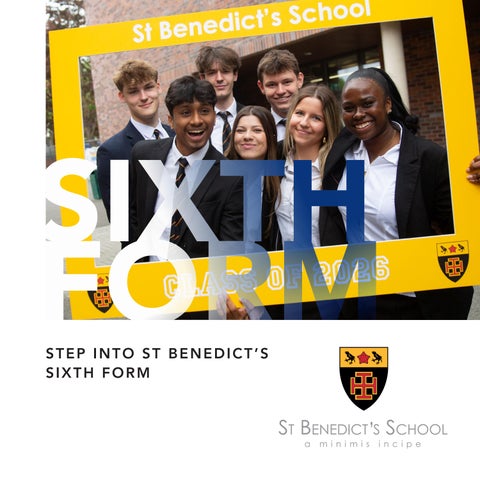
SIXTH FORM STEP INTO ST BENEDICT’S SIXTH FORM
ST BENEDICT’S SCHOOL a
minimis
inc ipe
INSIDE... WELCOME AND STEP INTO ST BENEDICT’S SIXTH FORM ........................... 1 ST BENEDICT’S UNIVERSITY DESTINATIONS .................................................... 2 ACADEMIC EXCELLENCE ................................. 4 ACADEMIC EXTENSION ................................... 6
DRAMA & THEATRE STUDIES ................... 36 ECONOMICS ................................................. 38 ENGLISH LITERATURE ................................ 40 FRENCH ......................................................... 42 GEOGRAPHY ................................................ 44 GERMAN ....................................................... 46 HISTORY ........................................................ 48 LATIN .............................................................. 50
PERSONALISED SUPPORT ................................ 9
MATHEMATICS ............................................. 52
LEADERSHIP IN SIXTH FORM ....................... 10
MUSIC ............................................................ 56
SCHOLARSHIPS & BURSARIES ...................... 13 CREATIVE... ....................................................... 16
FURTHER MATHEMATICS .......................... 54 PHILOSOPHY, ETHICS & RELIGION .................................................. 58 PHYSICAL EDUCATION .............................. 60 PHYSICS ......................................................... 62
ADVENTUROUS... ............................................ 20
POLITICS ........................................................ 64
A LEVEL & BTEC SUBJECTS 2027–29 .......... 22
SOCIOLOGY .................................................. 68
ART & DESIGN ............................................. 24 BIOLOGY ....................................................... 26 BUSINESS ...................................................... 28 CHEMISTRY ................................................... 30 CLASSICAL CIVILISATION .......................... 32 COMPUTER SCIENCE ................................. 34
PSYCHOLOGY .............................................. 66 SPANISH ........................................................ 70 SPORT & EXERCISE SCIENCE (BTEC) ...... 72 EPQ ..................................................................... 74 CORE RELIGIOUS EDUCATION ..................... 76
WELCOME
AND STEP INTO ST BENEDICT’S SIXTH FORM Choosing the right Sixth Form is one of the most important decisions you will make. At St Benedict’s, you will receive an outstanding A level education, preparing you for success at university, in the workplace and beyond. Through inspiring teaching in small seminarstyle classes, expert guidance from our Futures department and exceptional pastoral care, you will leave here with strong grades and exciting pathways, always supported to achieve your very best. Our Sixth Form is about far more than academic success. It is an opportunity to develop your independence, confidence and leadership, while becoming part of a vibrant and welcoming community. You will have extensive avenues for independent academic extension beyond A level. Whether making the most of a wide range of opportunities for mentorship, initiative and project management via our Decan leadership system, completing an EPQ, competing in Robotics, Debate or Investment teams, performing in music and drama, representing the School in sport, or taking part in CCF or the Duke of Edinburgh’s Award.
You will build new and lasting friendships and develop great working relationships with your teachers, within a community founded on our Benedictine ethos of service and hospitality, which you will remain part of long after you have left school. Your Sixth Form years will fly by. They are the most stimulating years of your education, years in which you study what really interests you, discover new aptitudes and passions, and stretch yourself to achieve beyond what you had ever thought you were capable of. It’s an exciting journey. Take it with us.
Alex Heald Assistant Head – Director of Sixth Form
Sarah-Jane Sorohan Deputy Director of Sixth Form
1
MEDICINE ECONOMICS BIOLOGY ST BENEDICT’S UNIVERSITY DESTINATIONS
BUSI NESS HISTORY PSYCHOLOGY St Benedict’s Top 10 University Destinations* University of Leeds
25
University of Exeter
21
University of Bristol
20
Durham University
19
University of Nottingham
18
King’s College London
16
UCL (University College London)
13
University of Bath
13
University of Loughborough
12
The University of Liverpool
10
St Andrews
University of Edinburgh
University of Glasgow
Newcastle University
Durham University
GEOGRAPHY * last 3 years
Lancaster University
University of Leeds
University of York
Manchester University
The University of Liverpool
University of Sheffield
University of Nottingham
University of Loughborough Leicester University University of Cambridge University of Warwick
University of Birmingham/ Aston University
University of Oxford
Cardiff University
ENGINEERING University of Bristol
MATHEMATICS ENGLISH University of Bath
University of Exeter
2
University of Southampton
University of Sussex
UCL King’s College London Queen Mary Imperial College London Royal Holloway LSE
“
I’m so pleased with my A level results and even more excited to be going to Bristol to study Law. A huge thank you to all my teachers for their constant support and guidance. I’m so grateful to have joined St Benedict’s at Sixth Form, surrounded by people that have helped me grow and achieve so much. Sienna S-P (Upper Sixth student)
”
3
ACADEMIC EXCELLENCE
At St Benedict’s Sixth Form academic excellence is about far more than achieving outstanding grades. We believe every student has the potential to succeed. Our students consistently achieve exceptional A level results, with an average grade of A and outcomes that place us well above both national averages and many local selective schools. With accessible entry requirements, we focus on the potential of every individual, providing the guidance and encouragement needed to achieve outstanding outcomes, whatever their starting point. With an average of just seven students per class, every lesson is interactive, engaging and tailored to individual needs. Students benefit from close relationships with expert teachers who know them well, provide regular feedback and inspire intellectual curiosity through discussion, debate and independent thinking. Beyond the classroom, specialist subject support, university preparation, academic extension opportunities and personalised guidance help students develop the knowledge, confidence and skills to thrive at university and beyond. At St Benedict’s, every student is known, challenged and supported. It is this combination of exceptional teaching, personalised support and ambitious expectations that enables our students to achieve more than they ever thought possible.
4
2026 Headline Outcomes 84% A*/B 53% A*/A 18% A*
A Average A level grade:
• Five students achieved three A*s • One in three students achieved A*–A across three A levels • Two in three students gained A*–B across three A levels • 87% of students achieved A*–C across three A levels
Academic Scholarships Academic Scholarships are awarded in Year 11 to high-achieving students who demonstrate exceptional academic ability, intellectual curiosity and a strong record of excellence through references, assessments and interviews. Scholars
receive a £500 academic development grant, specialist mentoring through the Academic Challenge programme, priority access to supercurricular opportunities and academic extension activities across London, as well as opportunities to lead, present and mentor younger students.
Personalised Teaching In contrast to many larger Sixth Forms, where class sizes can exceed 15–20, our average class size is around seven students, and is almost never more than twelve. We believe these ratios represent the optimal conditions for learning: • Consistent high quality individual feedback • Strong teacher–student relationships • High levels of participation in every lesson • Tailored teaching that adapts to each student • Every student is known, challenged and supported
5
4 ACADEMIC EXTENSION
Your fourth strand of Sixth Form independent learning
Alongside three A levels, all Sixth Form students benefit from our distinctive Independent Academic Extension – a fourth strand designed to build academic stretch, essential skills, and distinctive profiles for university applications.
This programme is designed so that every student builds a competitive personal profile alongside their academic results. Students are expected to use this fourth option for independent, mentored work and engagement in one or more of the following: 1. Highly Competitive Maths
• Further Maths A level • Challenges and Olympiads • HCP test preparation for TMUA, TARA and ESAT • Small team problem-solving
2. EPQ
• Extended Project Qualification • Independent research project • Mentored and structured • Depth or Breadth • Graded for A level and UCAS points
6
3. Investment Team
• Wharton Global Youth Investment Competition • Investing club • FT/Economics competitions 4. Highly Competitive Essays
• Cross-Disciplinary and subject specific essay competitions • History, English, Classics, Languages, RE, Sociology, Geography, Psychology • Oxbridge approaches • Practice essay plus two entries • University standard research, reading, writing, referencing 5. Creative Showcase
• Extended Portfolio development for Art, Graphic Design, and Architecture • Drama showreels • Music technology, composition • Music grades and studio practice • Editorial and writing: Creative Writing magazine, School Newspaper • French and German plays with Language department
4 6. Speak Out!
• British Parliamentary Debating • Model United Nations • LawSoc and Moots
7. STEM Projects
• MedSoc • Vex Robotics • Challenges and Olympiads – Bebras, Crest, Cambridge • The Earth Prize 8. Open Book
• All subject reading club • Sell your book – explain and critique what you’re reading • 100 book classic reading list • 12 in 12 in 12 (12 books, 12 months in Year 12) • Short text analysis seminars for History, English, Philosophy, Language, Sociology
7
SUP PORT ED “
I joined St Benedict’s as a new student in Sixth Form and immediately felt very supported. Throughout the entire process of applying to study medicine at university I was supported and encouraged to persevere at every stage by all my teachers and the careers department. I will now be going on to study Medicine at Cardiff University. Dana N (Upper Sixth student)
8
”
PERSONALISED SUPPORT With around 100 students in each Sixth Form year group, our Sixth Form offers the ideal balance: a vibrant, diverse community where every student is known, valued and supported as an individual. Small class sizes, expert teaching and personalised guidance ensure every student is challenged to achieve their full potential. Futures Our dedicated Futures team provides personalised careers and higher education guidance throughout your time in the Sixth Form. From choosing the right university course or degree apprenticeship to preparing personal statements, CVs and interview skills, they will help you make informed decisions about the right pathway for your future. Our ‘open door’ policy applies to students and parents alike, and we use coaching and facilitation, one-to-one and in groups, to develop the core transferable skills required to succeed in the constantly shifting workplace. Through our extensive network of alumni, parents and industry contacts, you will also benefit from valuable mentoring, insight and real-world opportunities. Your Personal Tutor From your first day, you will belong to a tutor group of Year 12 and Year 13 students with shared academic interests. Led by an experienced senior teacher or Head of Department, your personal tutor will provide day-to-day academic stretch and
“
The careers guidance arrangements are a significant strength of the school. A well thought out strategy plan covers all year groups, tailoring advice and opportunity. It encourages high levels of ambition, provides knowledge and experience of work, and links consistently with a wide range of external opportunities and resources. ISI Inspection Report 2024
”
pastoral support, helping you make the most of Sixth Form life while guiding you through every stage of your university or future career journey.
A Team Around You Your wellbeing is just as important as your academic success. Alongside the Heads of Sixth Form and your personal tutor, you will have access to a dedicated Sixth Form SEND teacher, teacher mentors and a school counsellor. Whatever challenges or ambitions you may have, there is always someone to listen, support and encourage you. Every student is different, and we are committed to helping each individual find their own path to success.
9
LEADERSHIP IN SIXTH FORM
Leadership is an integral part of Sixth Form life at St Benedict’s. As you grow in confidence and independence, you will be encouraged to take on responsibility, inspire others and make a meaningful contribution to the School community. Whether leading a team, mentoring younger pupils or launching a new initiative, you will develop the confidence, communication and organisational skills that will prepare you for life beyond school. St Benedict’s Decans At the heart of our leadership programme is the Decan system, a distinctive tradition rooted in our Benedictine heritage. As the senior student leaders of the School, they interact with and lead every part of our community. Decans work in five key areas: • Benedictine Ethos • Academic • Co-Curricular • Wellbeing • Community Each of these groups identify opportunities for improvement, lead projects they are passionate about and work collaboratively with staff and students to create lasting, positive change across the School.
As our school leaders they interact with and lead every part of our community. Leadership opportunities extend far beyond the Decan team. Sixth Form students play a vital role across the School as House Captains, Sports Captains, Subject Ambassadors, CCF leaders, Chaplaincy leaders, School Council representatives, Music Ensemble leaders, Duke of Edinburgh Gold Award participants, mentors to younger pupils, open event tour guides and panel speakers, and volunteers within the local community. Wherever your interests lie, Sixth Form at St Benedict’s offers countless opportunities to lead with purpose, develop new skills and leave a lasting legacy.
10
11
EN COUR AGED Personal Development This really matters to us. St Benedict’s will enable you to develop your unique talents and find new ones; to gain confidence in who you are; to acquire the resilience and determination you’ll need to see you through life’s challenges; and to show leadership and compassion to others.
12
SCHOLARSHIPS & BURSARIES
SCHOLARSHIPS
At St Benedict’s, scholarships recognise exceptional talent, commitment and potential. More than simply an award, a scholarship offers a programme of enrichment, mentoring and specialist development designed to help students excel in their chosen field. In return, scholars are expected to demonstrate leadership, contribute actively to school life and act as role models for younger pupils. All scholars benefit from enhanced enrichment opportunities, specialist coaching or mentoring, access to highlevel experiences, and opportunities to lead and support others within the school community.
BURSARIES (FEE-ASSISTANCE)
St Benedict’s is committed to widening access to our education by offering means-tested bursaries to eligible families. Our bursaries are designed to support gifted young people who would benefit from the opportunities at our school, but whose families may not otherwise be able to afford the fees. Who Can Apply? Bursaries are available to students who demonstrate exceptional talent and would contribute positively to our community. These students would usually have been awarded a scholarship. All bursary applications are means-tested.
EXCEPTIONAL TALENT HUMANITIES PATHWAY
The Exceptional Talent Humanities Pathway is designed for academically ambitious students with a passion for the humanities, offering academic stretch, super-curricular enrichment and preparation for competitive university courses. Students study A levels drawn from disciplines including English Literature, History, Languages, Music, Philosophy and Latin, while benefiting from seminars, visiting speakers, academic events and structured university preparation, including support for applications to highly selective institutions. The pathway brings together intellectually curious students who enjoy reading, discussion and independent thought, and is supported by means-tested bursaries of up to 100% of fees for eligible families.
13
SPORT
Sport is an integral part of Sixth Form life at St Benedict’s, offering students the opportunity to pursue their sporting ambitions while developing leadership, resilience and teamwork. With a proud tradition of regional and national success, many of our students progress to professional, international, Paralympic and Olympic pathways, supported by outstanding coaching, facilities and performance opportunities.
Sport for All All Sixth Form students participate in at least one of our Main Sports across two terms, engaging in Athletics, Cricket, Fencing, Football, Hockey, Netball and Rugby within a culture that values both excellence and inclusion. Alongside these, a range of recreational and minor sports, including circuit training, golf and tennis, broaden participation and promote physical wellbeing.
14
Coaching, Performance & Partnerships Students are coached by experienced staff, international athletes and elite performance specialists, with strong partnerships including Saracens Academy, Ealing Trailfinders and London Mavericks, providing clear pathways into county, regional and national performance programmes. Facilities & Athlete Support Our provision is underpinned by outstanding facilities, including extensive playing fields, a Performance Centre and Fitness Suite, and specialist sports spaces support every aspect of athletic development, from strength and conditioning to performance analysis and rehabilitation. A LongTerm Athlete Development model ensures structured physical development, individual performance planning and targeted support for elite athletes. Competition, Success & Legacy Representing St Benedict’s means competing in regular midweek and weekend fixtures, national competitions and domestic and international tours while becoming part of a sporting tradition that continues long after leaving school. Our alumni include professional athletes, England internationals, Olympians and Paralympians, demonstrating the exceptional sporting pathways available to our students.
Recent successes include national rugby top-three finishes, fencing championship honours, The Cricketer Top 100 Schools recognition, inclusion for two Sixth Formers in Wisden Cricketers’ Almanack in addition to strong national results across hockey, netball and athletics with many students progressing into county, national and international pathways.
Sports Scholarships at Sixth Form The Sports Scholarship supports talented studentathletes competing on elite performance pathways. Scholars benefit from an individualised athlete development programme, and guidance from the High Performance Programme. All Sports Scholars are expected to be fully committed to sport at St Benedict’s and to exercise leadership, teamwork and sportsmanship skills and will be excellent role models for all students. Talented young athletes should have experience within representative squads, performance pathways or high-level club competition associated with the School’s ‘Main’ sports. Boys: Athletics, Cricket, Fencing, Football and Rugby Girls: Athletics, Cricket, Hockey, Netball and Fencing* (minor sport for girls) Shortlisted candidates will have to participate in a full day of athletic testing, interviews and sports trials.
15
CRE ATI VE CREATIVE...
“
The arts are incredibly strong here. The drama productions involve hundreds of people, not just performing on stage but behind the scenes. And if you’re a musician there’s something for everyone. Isabella (Upper Sixth student)
16
”
MUSIC
Music is an integral part of the St Benedict’s experience. Through specialist teaching, outstanding facilities and an ambitious programme of concerts and performances, you will be encouraged to grow as a musician while building confidence, creativity and collaboration.
Join one of our many ensembles, including Orchestra, Big Band, Jazz Group, Concert Choir and A Cappella Choir, and perform in regular concerts, major choral and orchestral works and international concert tours. Many of our students also perform with prestigious regional and national ensembles, including the National Youth Choir of Great Britain, London Children’s Choir and Ealing Youth Orchestra.
Our Music department benefits from a recording studio, music technology suite, practice rooms, a Yamaha Grand Piano, Rushworth Pipe Organ and access to the exceptional acoustics of Ealing Abbey. A Level Music students also have access to the department’s facilities throughout the school day, providing dedicated space to rehearse, compose and prepare for examinations.
Music Scholarships at Sixth Form The Music Scholarship supports students who demonstrate exceptional musical ability and commitment. Scholars benefit from specialist tuition and mentoring, masterclasses with professional musicians, solo and ensemble performance opportunities, competition entry and concert visits. Music Scholars take a leading role in the musical life of the school through active participation in ensembles, concerts and other performances, both within and beyond the school day. Applicants would typically have achieved Grade 7 (ABRSM or equivalent) on their principal instrument. Scholarship auditions include the performance of two contrasting pieces, together with aural and sight-reading tests and a short interview with the Director of Music.
17
DRAMA
Drama is a dynamic and exciting part of Sixth Form life at St Benedict’s.Through an ambitious programme of productions, specialist teaching and outstanding facilities, you will be encouraged to challenge yourself, collaborate with others and bring stories to life. Recent productions, including Little Shop of Horrors and Our House, reflect the department’s commitment to high-quality theatre, with opportunities to perform in contemporary plays, classic drama and largescale musicals. Students can also gain invaluable experience behind the scenes through stage management, lighting, sound and technical theatre, using professional-standard equipment in our Drama Studio and Orchard Hall theatre. For those considering further study or a career in the performing arts, LAMDA lessons and specialist support with auditions, showreels and applications provide excellent preparation. Sixth Form students also play a key leadership role within the department, directing House Drama productions, mentoring younger performers and helping to shape the creative life of the School.
Sixth Form Drama Scholarships The Drama Scholarship is aimed at students with outstanding potential in performance, technical theatre or creative leadership. Scholars receive specialist acting tuition, including LAMDA preparation, opportunities to take leading roles in productions, theatre visits and the chance to direct and mentor younger students. As ambassadors for the department, they are expected to contribute fully to productions and performances while inspiring others through their enthusiasm, creativity and commitment. Applicants should prepare two contrasting monologues, each lasting 2–3 minutes, from a published play, and be ready to discuss a production they have seen that has inspired them. Shortlisted candidates will also take part in a short interview with the Director of Drama. Students awarded a Drama Scholarship at Sixth Form entry would be expected to study Drama and Theatre Studies at A Level.
18
ART & DESIGN
Based in our purpose-built Art & Design Centre within the Sixth Form Building, the department offers outstanding facilities, including dedicated Sixth Form studios, a Design Studio equipped with PCs, 3D printers, a laser cutter and darkroom facilities, an Art & Design Library, and workshop spaces for large-scale three-dimensional work. Students also benefit from our staffed after-school Sixth Form Art Club, providing additional time and expert guidance to develop coursework, personal projects and creative exploration. Working across disciplines including drawing, painting, printmaking, sculpture, graphic design and three-dimensional design, you will be encouraged to experiment with traditional techniques alongside cutting-edge technologies.
Sixth Form Art & Design Scholarships Art & Design scholars enjoy access to specialist skills workshops, dedicated studio space, enhanced materials, gallery visits and opportunities to exhibit work and enter competitions. Applicants should demonstrate outstanding ability in drawing, painting, sculpture, design and modelling skills together with strong observational and creative skills and an understanding of how ideas and meaning are communicated through visual art. Sixth Form candidates should submit a portfolio of GCSE coursework alongside independent creative work and would typically be predicted at least a Grade 7 in a relevant Art & Design subject. Shortlisted candidates will also attend a short interview with the Head of Art.
19
ADV ENT URO US ADVENTUROUS...
“
There is a really nice balance of everything – academic stretch, opportunities and activities. This produces well-rounded people; not just students with top grades but individuals with unique interests and passions. St Benedict’s helps you to find those passions. Harry (Upper Sixth student)
20
”
The Duke of Edinburgh’s Award scheme
Students benefit from a wide range of co-curricular activities and opportunities to develop their leadership skills all within the framework of an inclusive, diverse and friendly community.
Co-curricular opportunities
30+
ACTIVITIES ON OFFER 21
A
A LEVEL & BTEC SUBJECTS 2027–29
A LEVEL
Students take three A level courses. We strongly advise students to study three A levels as this is the required entry criterion for most universities. Academically very able students who wish to study four A levels should contact the school for discussion. Students opting for Further Mathematics should take four A levels, including Mathematics and Further Mathematics. Entry criteria For A level, you must achieve a minimum of 30 points from your five highest GCSE/IGCSE results if you are an internal candidate, and a minimum of 35 points from your five highest GCSE/IGCSEs if you are an external candidate. To study Biology, Physics or Chemistry A level, you must also achieve at least a grade 7 in Mathematics GCSE/IGCSE and a grade 7 in the chosen subject. To study Mathematics A level, you must achieve at least a grade 7 in Mathematics GCSE/IGCSE, although we strongly advise that you only pursue this course if you achieve a grade 8. To study Further Mathematics A level you must achieve at least a grade 8 in Mathematics GCSE/ IGCSE, although we strongly advise that you only pursue this course if you achieve a grade 9.
22
BTEC
For the BTEC Sports Science pathway, you must achieve a minimum of 30 points from your five highest GCSE/IGCSEs. This must include at least a grade 6 in GCSE PE. We also ask that you attend an interview to assess your suitability for this course.
“
After 15 years at St Benedict’s, I am delighted to have obtained high results in my four A levels which has enabled me to gain a place at Warwick University to read Computer Science. I will miss St Benedict’s dearly and all the wonderful support but I am very excited for the next adventure. Alfie S (Upper Sixth student)
”
23
ART& DES IGN ART & DESIGN
Specification title & Examination Board: A level Art & Design: Edexcel/Pearson
Recommended GCSE grades/Course entry requirements The Art Pathway is suitable for students having completed a GCSE Art, Craft & Design or Fine Art course and achieved at least a Grade 6.
The Design Pathway is suitable for students having completed a GCSE Graphic Communication or 3D Design course, or GCSE Design Technology and achieved at least a Grade 6.
Course content The A level Art & Design course is delivered through two separate pathways to build upon the students’ skills and understanding gained at GCSE: Art Pathway Fine Art: painting and drawing, printmaking, sculpture.
Design Pathway Three-Dimensional Design: product design, furniture design, jewellery and interior design. Graphic Design: advertising, illustration, packaging, typography and multimedia. Course outline Art Pathway Term 1: The Figure This project concentrates on expanding the breadth of the students’ practical skills in Oil Painting and Sculpture. The project culminates in the realisation of a high-quality final response for each technique presented for assessment.
24
Term 2: Still Life In this project students explore the theme of Identity through the genre of still life by exploring techniques learned in the Michaelmas Term, before committing to a final idea to develop towards a final outcome. The focus of this project is to develop the students’ ability to analyse and engage with concepts that underpin contemporary Art practice. Design Pathway Term 1: Function & Form This project concentrates on expanding the students’ understanding of the interplay between function and form in two projects: one focusing on typography and contemporary graphic design, and the other on furniture design.
Term 2: CAD into CAM Students explore how to develop ideas from CAD (Computer Aided Design) to realise 3D models and prototypes using CAM (Computer Aided Manufacture) using a Laser Cutter and 3D Printer.
Both Art & Design Pathways Term 3 & 4: Coursework Project Students choose their own theme to explore for the main coursework project, producing a written Personal Study (1000 –3000 words) alongside their studio practice. Term 5 & 6: Externally Set Assignment Students use the preparatory period to work through ideas with support from the teacher, culminating in the creation of a final response in 15 hours under examination conditions.
How Art will be examined • 60% Coursework • 40% Externally Set Assignment Careers & HE An A level in Art & Design opens a wealth of opportunities to follow a creative pathway at university and move into creative careers. Popular degree courses our students move onto include architecture, design engineering, product design, graphic design, advertising, illustration, animation, game design and multimedia.
25
BIOLOGY Specification title & Examination Board: A level Biology 7402 – AQA Recommended GCSE grades/Course entry requirements To ensure you are well-prepared for the challenges of A level Biology, you must have a minimum of: • Mathematics: Grade 7 • Biology: Grade 7
BIO LOGY Course content The A level Biology course offers an in-depth exploration of key biological concepts and processes. Over two years, students will study various topics, develop practical skills, and engage in fieldwork to gain a comprehensive understanding of the biological sciences. Course outline Year 1 Topics: 1. Biological Molecules: • Structure and function of carbohydrates, lipids, proteins, and nucleic acids. • Enzyme activity and biochemical pathways.
2. Cells: • Cell structure and function, cell division, and cell specialisation. • Transport mechanisms in cells and across cell membranes. 3. Organisms Exchange Substances with Their Environment: • Gas exchange in plants and animals. • Transport systems in plants and animals.
26
4. Genetic Information, Variation, and Relationships Between Organisms: • DNA, RNA, and protein synthesis. • Genetic diversity and natural selection.
Year 2 Topics: 1. Energy Transfers in and Between Organisms: • Photosynthesis and respiration. • Energy flow through ecosystems and nutrient cycles. 2. How Organisms Respond to Changes in Their External Environments: • Nervous and hormonal coordination. • Homeostasis and feedback mechanisms. 3. Genetics, Populations, Evolution, and Ecosystems: • Inheritance patterns, population genetics, and speciation. • Conservation biology and the impact of human activity on ecosystems.
4. The Control of Gene Expression: • Gene regulation, mutation, and the role of oncogenes in cancer.
How Biology will be examined A level Biology is assessed through three written examinations at the end of the two-year course: • Paper 1: Topics 1–4, including relevant practical skills (35% of A level). • Paper 2: Topics 5–8, including relevant practical skills (35% of A level). • Paper 3: Comprehensive assessment covering topics 1–8, including a 25-mark essay (30% of A level). In addition to written exams, students must
complete a series of practical assessments, which are reported separately and do not contribute to the final grade. Careers & HE A level Biology opens doors to numerous career paths and higher education opportunities. Students can pursue degrees in fields such as medicine, veterinary science, biomedical research, environmental science, and biotechnology. The analytical and practical skills gained from this course are highly valued in scientific research, healthcare and environmental management sectors.
27
BUSINESS Specification title & Examination Board: A level Business (7138) – AQA Recommended GCSE grades/Course entry requirements No previous study of business is required. Students should achieve at least a grade 6 in Mathematics to study Business.
28
Course overview The Business A level revolves around decision making. How do leaders make decisions? Should they consult subordinates or inform them of their decisions? What are the influences on how leaders make decisions? What information do they consider? By the end of the A level, students are expected to make fully justified decisions based on the information provided and supported by the business theorists they study. They need to identify the best strategy to achieve the business objectives. The course includes 10% maths, which revolves around adding, subtracting, dividing, and multiplying. Graphs and other data also need to be interpreted.
Course content The course considers business objectives and how they can be achieved. It considers the four functional areas within a business – marketing, human resources, finance, and operations – and how leaders’ decision making can improve the performance of each functional area. It also considers internal and external influences on the functional areas. Strategy – a medium to long term plan to achieve the businesses objectives – is a central to the course and students also study strategic drift, which is how and why strategies go wrong. Throughout the course students need to support their answers with examples of real businesses and business theory.
Brexit and the impact of health and regulation. The students also consider how to compete – low cost or differentiation – and which market to compete in. Other topics include the importance of innovation and a more in-depth look at human resources. This includes industrial relations and HR flow. Students also consider economic influences on business and international trade. They assess how businesses grow, and why they may or may not wish to grow as well as internal and external pressures for change. The course is supported throughout by business theorist and mathematical calculations, and there is an emphasis on the role and the value of leadership.
BUSI NESS Course outline The Lower Sixth starts with ‘what is a business?’ and goes on to consider different types of business structures and the advantages and disadvantages of each type. Business finance includes cash flow, breakeven, sources of finance, financial ratios, and types of profit. Operations – how to produce a product or a service – covers, amongst other things, lean production, quality, productivity, capacity, and supply chains. Automation and robotics are also assessed. Human resources includes how to motivate employees, leadership styles, recruitment, retention and remuneration (pay and non-financial benefits). The value of primary and secondary market research, quantitative and qualitative information and advertising are all considered as are price and income elasticity of demand.
How Business will be examined
• There are 3 two-hour exams at the end of the Upper Sixth.
• There is no coursework and we do not take any external public exams in the Lower Sixth.
Careers & HE A level business students go on to study business and related subjects at university. These include international business and management science, and joint degrees, such as business and marketing, are also popular. Alumni graduates have secured careers ranging from employment at L’Oréal to brokerage in the City of London.
The Upper Sixth focuses on decision making through objectives and strategy. The students consider influences on strategy, including social and technological change, such as migration, urbanisation and AI, and legal and political influences, such as
29
CHEMISTRY Specification title & Examination Board: A level Chemistry (7405) – AQA Recommended GCSE grades/Course entry requirements To enrol in A level Chemistry, students are expected to have achieved at least a grade 7 in GCSE Chemistry and a grade 7 in GCSE Mathematics.
30
Course content A level Chemistry provides an in-depth understanding of the principles that underpin chemical reactions and processes. The course covers a range of topics including physical chemistry, inorganic chemistry, and organic chemistry. Students will explore atomic structure, chemical bonding, energetics, kinetics, equilibrium, redox reactions, and more. Practical experiments and investigative skills are integral parts of the curriculum, helping students apply theoretical knowledge in real-world contexts.
Throughout the course, practical skills are developed through hands-on experiments. Students will learn to design experiments, collect and analyze data and draw conclusions. These skills are assessed through both coursework and written exams. How Chemistry will be examined The A level Chemistry course is assessed through three written exams at the end of the second year. These exams cover the entire course content, including practical skills:
Course outline A level Chemistry is divided into three main sections: physical chemistry, inorganic chemistry, and organic chemistry. Physical chemistry involves studying atomic structure, the periodic table, and chemical bonding. Students will delve into energetics, kinetics, and the principles of chemical equilibria, including Le Chatelier’s principle and the equilibrium constant. Thermodynamics and electrochemical cells are also key areas of focus. Inorganic chemistry examines the periodic table in greater detail, exploring the properties and reactions of elements in different groups, such as Group 2 and the transition metals. Students will also study the chemistry of various ions in aqueous solution. Organic chemistry focuses on the structure, properties, and reactions of carbon-based compounds. Topics include alkanes, alkenes, alcohols and organic synthesis. Analytical techniques such as infrared spectroscopy, mass spectrometry, and nuclear magnetic resonance (NMR) spectroscopy are also covered.
• Paper 1: This paper covers physical chemistry topics, inorganic chemistry, and relevant practical skills. It is a two-hour examination worth 105 marks, and it accounts for 35% of the A level. • Paper 2: This paper covers organic chemistry topics and relevant practical skills. It is a two-hour examination worth 105 marks, and it accounts for 35% of the A level. • Paper 3: This paper assesses practical skills and data analysis across the entire syllabus. It includes questions on practical techniques, data analysis and synoptic questions that integrate topics from across the course. It is a two-hour examination worth 90 marks, and it accounts for 30% of the A level. Careers & HE A level Chemistry is highly regarded by universities and employers. It provides a strong foundation for further study in fields such as chemistry, medicine, pharmacology, environmental science, and chemical engineering. The analytical, problemsolving and practical skills gained are valuable in a wide range of careers.
31
Specification title & Examination Board: A level Classical Civilisation – OCR Recommended GCSE grades/Course entry requirements No previous study of Classical Civilisation is required. A grade 6 in any subject which requires essay writing is required to access this course. Course content Studying Classical Civilisation at A level offers a unique and enriching exploration of ancient cultures that have significantly shaped modern society. It provides a deep understanding of the literature, history and culture of ancient Greece and Rome, fostering critical thinking and analytical skills. The course is incredibly interdisciplinary, combining elements of literature, history, art, and archaeology, making it ideal for students with diverse interests. No knowledge of Latin or Greek is required: all sources are read in translation. Course outline 1. The World of the Hero An in-depth study of Homer’s Odyssey and Virgil’s Aeneid. This component is solely focused on the study of literature in translation. These poems are some of the greatest works of western literature, and tell the story of two journeys from Troy: the Greek Odysseus’ attempt to get back to Ithaca after the Trojan War, and the Trojan Aeneas’ struggle to find a new home in Italy after the destruction of all he holds dear.
32
2. Culture and the Arts – Greek Theatre This involves the study of visual and material culture, combined with the study of literature in translation. The Athenians invented drama and their comedies and tragedies still resonate today. This module explores the cultural and physical context, as well as three great plays: Euripides’ Bacchae, Aristophanes’ Frogs, and Sophocles’ Oedipus the King. 3. Beliefs & Ideas – Politics of the Late Republic The First Century BC is the best documented in Roman history, and saw the fall of the Republican system of government (elected officials serving for fixed terms) and the emergence of a sole ruler (an emperor). We examine how this came about, as greed, ambition and class tensions tore Rome apart. How Classical Civilisation will be examined • Three written examinations at the end of the Upper Sixth. • There is no coursework. Careers & HE Studying Classical Civilisation equips you with transferable skills such as critical analysis, research, writing and a deep understanding of cultural contexts. These skills are highly valued in many fields, enhancing your employability in a diverse job market.
Photograph by Mike Peel
CLASSICAL CIVILISATION
Careers & HE Studying Classical Civilisation equips you with transferable skills such as critical analysis, research, writing and a deep understanding of cultural contexts. These skills are highly valued in many fields, enhancing your employability in a diverse job market.
33
COMPUTER SCIENCE Specification title & Examination Board: A level Computer Science (7517) – AQA Recommended GCSE grades/Course entry requirements Recommend Grade 6 or above at GCSE in Computer Science. Course content The Computer Science A level covers fundamental computer science concepts, including data representation, computer organisation and architecture, communication and networking, and algorithms and programming. Students learn about the hardware and software components of computer systems, how data is stored and processed and the principles of computer programming. The course also explores topics like cybersecurity, legal and ethical issues in computing and the impact of digital technologies on society. Through a practical programming project, students develop skills in designing, implementing and testing software solutions. The curriculum provides a strong foundation for further studies in computer science or related fields. Course outline The Computer Science A level is a program of learning that covers a wide range of fundamental computer science concepts and principles. The curriculum includes the following core elements: Fundamentals of Programming: Students learn the basics of computer programming, including control structures, data types, functions, objectoriented programming techniques and functional programming techniques.
34
Data Structures and Algorithms: The course delves into the theory and implementation of data structures, such as arrays, lists, and trees, as well as the design and analysis of algorithms for solving complex problems. Computer Systems and Architecture: Students explore the inner workings of computer hardware and software, including data representation, computer organization and the role of operating systems. Communication and Networking: The curriculum examines the principles of computer networks, communication protocols and the fundamentals of databases and big data. Theory of Computation: Students study the theoretical foundations of computer science, including the limitations and capabilities of computing systems. Consequences of Computing: The course also covers the social, ethical, and legal implications of technology, encouraging students to consider the broader impact of computing on society. Practical Project: A significant component of the course (20%) is the non-examined assessment, in which students apply their programming and problem-solving skills to design, develop and evaluate a software solution to a real-world problem. Throughout the program, students cultivate a range of essential skills, including computational thinking, algorithm design, data analysis and a systematic approach to problem-solving.
How Computer Science will be examined • One on-computer examination – a skeleton program is provided in September of the Upper Sixth. • One written examination • A software project on a theme chosen by the candidate
Careers & HE An A level in Computer Science opens the door to a wide range of careers in the tech & engineering industries, including software engineering, web development, data analysis, cybersecurity and IT management. It also provides a strong foundation for further study at the university level, with opportunities to pursue degrees in computer science, information technology, digital media, engineering and related fields.
35
DRAMA & THEATRE STUDIES Specification title & Examination Board: Drama and Theatre Studies – Edexcel Recommended GCSE grades/Course entry requirements No previous study of drama at GCSE is required, but we require either at least a grade 6 in GCSE Drama or some substantial evidence of drama performance experience (such as LAMDA). Course content Studying A level Drama offers an immersive exploration of theatre, fostering creativity, teamwork and critical thinking. This course enhances practical skills through devised and scripted performances, as well as design elements, including lighting, stage design and sound. By engaging with texts such as Equus and Woyzeck and studying practitioners like Artaud, Berkoff, and Stanislavski, students gain insights into both contemporary and classic theatre. The programme cultivates essential skills such as communication, collaboration and creative problem-solving, making it ideal for students passionate about the arts and those seeking versatile, transferable skills. Course outline Component 1: Devising Theatre In the first term, students will create their own devised performances based on a stimulus text and a practitioner of their choice, such as Artaud, Berkoff, or Stanislavski. This initial phase includes exploring various theatre practitioners and conducting research on relevant issues and themes to inspire their work.
36
As they develop their performances, students will compile a written Portfolio of evidence, evaluating their creative process and success. Component 2: Text in Performance Students will study a complete play text and perform a key extract. This performance will be presented to a visiting examiner and a live audience, showcasing their understanding and interpretation of the text. Component 3: Theatre Makers in Practice This component is the written examination, divided into three sections: Section A: Live Theatre Students will write an extended response analysing and evaluating a live theatre performance they have seen, based on a given statement.
Section B: Page to Stage This section involves answering two questions on an extract from the play ‘Equus’, focusing on scene analysis from both an actor’s and a designer’s perspective.
How Drama and Theatre Studies will be examined
Section C: Interpreting a Performance Text Students will present their own director’s concept for the play ‘Woyzeck’, influenced by the practitioner Brecht.
Careers & HE Studying drama opens career opportunities in acting, directing, playwriting, and stage management. It also develops valuable skills such as public speaking, teamwork, creative thinking, emotional intelligence and adaptability. These skills are transferable to fields such as education, therapy and the arts.
• A Devised performance with a written Portfolio. • A scripted performance with a visiting examiner. • One written examination.
37
Specification title & Examination Board: A level Economics A (2015) – Edexcel GCSE grades/Course entry requirements There is no need to have studied this subject before. A GCSE grade of at least a 6 in Mathematics is required for entry to this course. Course content The course has two equal halves: macroeconomics and microeconomics. In the Lower Sixth, macroeconomics is the study of how the UK economy works on a national scale. For example, it considers the impact of interest rates on the firms and consumers across the economy. In the Upper Sixth macroeconomics considers global economic issues such as international trade.
Microeconomics is the study of economic impacts on individual consumers and individual firms. It is taught via graphs and requires students to be able to manipulate the graphs. Both halves of the course require students to be able to interpret data and to do calculations. Course outline Lower Sixth macroeconomics involves studying what the governments objectives are and how the government aims to achieve them using monetary, fiscal and supply side policy. Students learn about GDP statistics and alternatives to GDP as a measure of income, such as the Happiness Index or the Human Development Index. They also study topics such as inflation, economic growth, and unemployment. Lower Sixth Microeconomics aims to provide a model about how individual firms and individual consumers behave.
ECON “ OMICS ” I’m incredibly proud to see all of my hard work these past two years pay off in my results. The support and encouragement from my teachers and the wider St Benedict’s community have been invaluable, and I’m so excited to take everything I’ve learnt here into the next chapter studying Economics at the University of Warwick. Evie S (Upper Sixth student)
38
United Nations Development Programme – Human Development Index 08/26
ECONOMICS
It considers different types of economy, the role of market forces, indirect taxes, subsidies, price elasticity of demand, income elasticity of demand and cross elasticity of demand. A significant part of Upper Sixth macroeconomics relates to economic development. Reasons for lack of development and policies to encourage development are considered. Students also study the financial sector, inequality between countries and within countries, exchange rates, competitiveness, the World Trade Organisation, comparative advantage, and international trade. Upper Sixth microeconomics revolves around the Theory of the Firm. Students study different types of business structure, such as perfect competition, oligopoly, and monopoly. This is represented through graphs, which means students need to understand
the cost and revenue curves before they can progress to studying the Theory of the Firm. How Economics will be examined • There are 3 two-hour exams at the end of the Upper Sixth. • There is no coursework. Careers & HE Economics is a highly competitive university course and Mathematics A level is a prerequisite to studying economics at university. The career options for economics graduates include accountancy, statistics, finance, insurance or any career for which a degree is an entry requirement.
39
ENGLISH LITERATURE Specification title & Examination Board: A level English Literature – Edexcel Recommended GCSE grades/Course entry requirements A minimum of at least a grade 6 in GCSE English Literature is required for entry to this course.
40
Course content As scholars of literature, we understand that no text exists in isolation but is the product of the time in which it was produced. Edexcel’s course encourages students to explore the relationships that exist between texts and the contexts within which they are written, received and understood. Studying texts within a shared context enables students to investigate and connect them, drawing out patterns of similarity and difference using a variety of reading strategies and perspectives.
Literature allows students to engage with voices from across ages, cultures, geographies and historical landscapes but is also the study of the human psyche. Through the study of our texts (and indeed beyond) we develop insight into and understanding of the key events, trends and ideologies which have shaped both our past and present society. Course outline 1. Drama: Tragedy An in-depth study of William Shakespeare’s King Lear and Tennessee Williams’ A Streetcar Named Desire Students will need to explore the use of literary and dramatic devices and the shaping of meanings in their chosen plays. Teaching and wider reading should address the significance and influence of contextual factors and engage with different interpretations of the chosen Shakespeare play. Students’ study of Shakespeare should be enhanced by engagement with critical writing. 2. Prose Texts: The Supernatural An in-depth study of Bram Stoker’s Dracula and Oscar Wilde’s The Picture of Dorian Gray Students should show knowledge and understanding of how genre features and conventions operate in prose fiction texts as well as explore the context in detail. Students will also be required to show knowledge and understanding of a range of ways to read texts, including reading for detail, and of how writers use and adapt language, form and structure in texts, responding critically and creatively. 3. Poetry: Post 2000 and Pre 1900 An in-depth study of the following: • Poems of the Decade: An Anthology of the Forward Books of Poetry 2002–2011
• The Wife of Bath’s Prologue and Tale, editor James Winny (Cambridge, 1994) Students will consider the concerns and choices of modern-day poets in a selection of contemporary poems. Students will apply their knowledge of poetic form, content and meaning, and develop their skills in comparing an unseen poem with an example of studied poetry. Students will also develop depth of knowledge about poetic style by studying a selection from the work of a single named poet, or a selection from within a literary period or movement. Literary study of the chosen set poems should be enhanced by study of the contexts in which they were written and received. 4. Non-examination assessment: Coursework This will be assessed via two texts. The selected texts may be linked by theme, movement, author or period. Literary study of both texts will be enhanced by study of the links and connections between them, different interpretations and the contexts in which they were written and received. How English Literature will be examined • Three written examinations at the end of the Upper Sixth. • A piece of coursework. Careers & HE It is widely recognised by universities that the skills developed through the study of English literature are among the most transferable, preparing students for a wide range of degrees. English graduates go on to develop the widest range of careers – among the most popular are publishing, broadcasting, marketing and PR, journalism, law, teaching and politics.
41
FRENCH Specification title & Examination Board: A level French – Eduqas Recommended GCSE grades/Course entry requirements A minimum of a grade 6 in French is required to study A level French. Course content Choosing A level French is a really good move if you want an engaging and exciting subject which builds on your previous study, is enjoyable and also enhances your job prospects. Through social, intellectual, historical and political cultural themes you will be able to develop your linguistic knowledge and cultural understanding of the countries/communities where French is spoken around the globe – in Europe, French-speaking areas of the Americas, Africa and Asia. Studying literature and film will allow you to undertake a deeper analysis of language structures and increase cultural awareness. A strong focus is placed on building confidence and fluency in spoken French and you will have an additional individual or small group lesson each week with our French Language Speaking assistant. The skills you gain from studying French at A level are incredibly important tools to acquire and the passion towards the French language is one we hope will remain with you throughout your life. Course outline • Being a young person in French-speaking society. Families & Citizenship, Youth trends & personal identity, Education and Employment opportunities).
42
• Understanding the French speaking world. Regional culture & heritage in France, Frenchspeaking countries & communities, Francophone Media, Art, Film & Music. • Diversity and Difference. Migration & Integration, Cultural identity & marginalisation, Cultural enrichment & celebrating difference. • France 1940–1950: The Occupation and postwar years. June 1940–May 1945, the cultural dimension in occupied France, 1945–50. • Independent Research Project section of the Speaking examination. Past choices have included: Didier Drogba & the Ivorian civil war, “Médecins Sans Frontières” in the Democratic Republic of Congo and Paris Fashion houses. 2. Linguistic knowledge You will continue your study of grammar to hone your linguistic skills of listening, speaking, reading, writing and translation to be able to interact effectively. You will make regular use of technology and the most up-to-date online materials. 3. Literature & Film This area of the course encourages critical and intellectual thinking and a deep appreciation of the works studied. Key areas for study will be characterisation, form and technique of presentation (including effect of camera work in film) and social and cultural setting. This is a particularly enjoyable component and the sense of achievement it brings to have read and understood your first play/novel or watched and understood your first film in French is enormous. The department also arranges visits and trips to complement your studies.
How French will be examined Three papers: 1. Listening, Reading & Translation into English and into French – 50% 2. Written response to text/film – 20% 3. Speaking – a topic card and a discussion on your IRP (Individual Research Project) – 30%
Careers & HE Employers value the key skills developed by language learners: communication; teamwork; interpersonal, presentation and problem-solving. Indeed, graduates who want to gain a cutting edge in the employment market are advised to learn a foreign language, as languages are still key to the exciting multinational world in which we live.
43
GEOGRAPHY Recommended GCSE grades/Course entry requirements A minimum of at least a grade 6 in GCSE Geography is required for entry to this course.
Component 3: Geography Fieldwork Investigation (20% of the A level) All students are required to undertake fieldwork relating to processes in both physical and human geography. Students must complete four days of fieldwork during their A level course. This includes a residential course at the Blencathra Field Studies Centre in the Northern Lake District. Currently, the cost of this trip is just under £600.
Course content A true geographer appreciates the interlinked nature of the world around them and the unique ability we have to analyse and interpret these relationships. Geography is a constantly evolving subject, shaped by the contemporary challenges in the world around us.
This is an opportunity to practise university-style data collection, which is less directed and tailored to each student’s interests and strengths. Students will design an enquiry question of their choice, investigating a geographical problem in London. They will then collect primary data and write up their fieldwork findings in a written report.
Specification title & Examination Board: A level Geography – AQA
As a geography student you will study a range of physical geography topics such as coastal landscapes, ecosystems under stress and water and carbon cycles. In human geography you will study globalisation and global governance, contemporary urban environments and gather an understanding of how places are shaped and change over time. Course outline Paper 1: Physical Geography (40% of the A level) • Water and carbon cycles • Coastal systems and landscapes • Hazards Component 2: Human Geography (40% of the A level) • Global systems and global governance • Changing places • Contemporary urban environments
44
How Geography will be examined • Two exams sat at the end of the Upper Sixth year. • One piece of coursework based on fieldwork students conduct in the Lower Sixth and written up in the Michaelmas term of the Upper Sixth.
Careers & HE Geography equips students with multiple transferable skills in research methodologies, primary and secondary data collection, ArcGIS mapping, ICT skills, statistical analysis and the ability to analyse various types of qualitative and quantitative data. Geography develops intellectual skills, such as critically evaluating theories, judging evidence and essay writing. Approximately 1/3 of our geographers go on to study BA or BSc geography or a closely related discipline at top universities, including Environmental Science, Sustainable Global Development and Geographical Information Systems.
45
GERMAN Specification title & Examination Board: A level German – Eduqas Recommended GCSE grades/Course entry requirements A minimum of at least a grade 6 in GCSE German is required for entry to this course.
• Diversity and Difference. Migration & Integration, Cultural identity & marginalisation, Cultural enrichment & celebrating difference. • The making of modern Germany: 1989 onwards. Initial & subsequent process of reunification, social cohesion in present day Germany, the economic impact of a united Germany.
GER MAN
Course content Choosing A level German is a really good move if you want an engaging and exciting subject which builds on your previous study, is enjoyable and also enhances your job prospects. Through social, intellectual, historical and political cultural themes you will be able to develop your linguistic knowledge and cultural understanding of the countries/ communities where German is spoken around the globe – in Europe and German-speaking areas of the Americas, Africa and Australia. Studying literature and film will allow you to undertake a deeper analysis of language structures and increase cultural awareness. A strong focus is placed on building confidence and fluency in spoken German and you will have an additional individual or small group lesson each week with our German Language Speaking assistant. The skills you gain from studying German at A level are incredibly important tools to acquire and the passion towards the German language is one we hope will remain with you throughout your life. Course outline • Being a young person in German-speaking society. Families & Citizenship, Youth trends & personal identity, Education and Employment opportunities).
46
• Understanding the German speaking world. Regional culture & heritage in Germany, Germanspeaking countries & communities, Germanic Media, Art, Film & Music.
• Independent Research Project section of the Speaking examination. Past choices have included: the impact of covid on the German car industry, The Red Bull era of FC Leipzig and Grimms’ fairy tales.
2. Linguistic knowledge You will continue your study of grammar to hone your linguistic skills of listening, speaking, reading, writing and translation to be able to interact effectively. You will make regular use of technology and the most up-to-date online materials
3. Literature & Film This area of the course encourages critical and intellectual thinking and a deep appreciation of the works studied. Key areas for study will be characterisation, form and technique of presentation (including effect of camera work in film) and social and cultural setting. This is a particularly enjoyable component and the sense of achievement it brings to have read and understood your first play/novel or watched and understood your first film in German is enormous. The department also arranges visits and trips to complement your studies.
How German will be examined Three papers: 1. Listening, Reading & Translation into English and into German – 50% 2. Written response to text/film – 20% 3. Speaking – a topic card and a discussion on your IRP (Individual Research Project) – 30%
Careers & HE Employers value the key skills developed by language learners: communication; teamwork; interpersonal, presentation and problem-solving skills. Indeed, graduates who want to gain a cutting edge in the employment market are advised to learn a foreign language. Languages are key to the exciting multinational world in which we live!
47
HISTORY Specification title & Examination Board: A level History – OCR Recommended GCSE grades/Course entry requirements A grade 6 or above in GCSE History is required for this course. Course content This course is perfect for you if: • You have a curiosity about recent world history and its impact on the present. • You enjoy debating historical interpretations and forming your own informed opinions. • You want to develop critical thinking and communication skills relevant to university study and beyond. Develop valuable skills: Source analysis: Hone your ability to identify bias and evaluate historical evidence. Evaluative and analytical thinking: Develop your skills in analysing historical events and forming wellsupported arguments. Debate and discussion: Sharpen your communication skills by actively participating in class discussions and debates. Coursework: The course features a unique coursework opportunity, allowing you to explore a specific aspect of modern history that piques your interest.
48
Course outline Explore the world-defining events that shaped the past! History A level will take you on a thrilling journey through the past, examining significant events and transformations. You’ll explore: • Unit 1: England 1547–1603 – the Later Tudors: Investigate religious changes, rebellion and unrest and Elizabethan England. • Unit 2: The Cold War in Asia: Analyse the power struggles, ideological clashes, and proxy wars that defined this period. • Unit 3: Russia and its Rulers: Examine the Tsars, the rise of Communism, and the Soviet Union’s impact on the world stage. How History will be examined The course is assessed through three separate examinations in the June series and a coursework piece, submitted before Christmas in your Upper Sixth year. Careers & HE History is a springboard to a variety of university programs and future careers. In-depth research and analysis of historical events, hones critical thinking and problem-solving skills. The ability to evaluate evidence and construct persuasive arguments is highly sought after in universities and workplaces. Moreover, studying history fosters a global perspective and an understanding of the complexities of the modern world, making you a well-rounded and adaptable candidate for a multitude of careers, including law, international relations, and journalism.
49
LATIN Specification title & Examination Board: A level Latin – OCR Recommended GCSE grades/Course entry requirements A minimum of a grade 6 in GCSE Latin.
2. Prose composition or comprehension Students develop and demonstrate their detailed understanding of Latin vocabulary and linguistic structures through either: • Translating unseen material from English into Latin; or
LAT IN
Course content Latin, for two thousand years the language of many of the greatest thinkers and writers of the western world, remains a living and intellectually stimulating language which is the key to understanding many central aspects of western thought and culture. If we are to understand and use to best effect our own language, we must also understand the influences which have shaped and developed English. The study of Latin also complements other subjects, such as Classical Civilisation, English, History, and the romance languages (French, Spanish, Italian and Portuguese). The logical approach also sees Latin combining well with Maths and the sciences. Through the study of the language and literature of the Romans, you can equip yourself with cultural and intellectual skills, fire your imagination and deepen and develop experience by considering a wide range of aesthetic, ethical, linguistic, political, religious and social questions. Course outline The OCR A level Latin course is divided into four main components: 1. Unseen translation Students build their knowledge of the Latin
50
language to become familiar with the vocabulary and linguistic structures used by Livy and Ovid (both hexameters and elegiacs).
• Demonstrating their understanding of an unseen prose text through comprehension, translation and questions on syntax and accidence.
3: Prose literature You will study Cicero’s Pro Caelio, an elaborate trial, blending clever legal arguments with humour and personal attacks. 4: Verse literature You will prepare selections from Virgil’s Aeneid II, looking at the events leading to the Troy’s tragic downfall and destruction. How Latin will be examined
• Four written examinations at the end of the Upper Sixth. • There is no coursework.
Careers & HE The transferable skills gained from the study of Latin makes it an excellent choice for a wide range of degree and career options. A small selection of typical pathways including law, politics, accountancy, marketing and advertising, computer programming and banking.
“
… we know that those who have studied the ancient languages are never, in fact, short of job-offers. A top asset-manager recently told me that his firm always employed classicists: they sold more. If Richard Dawkins is right, that is because ‘what Classics has always done is just teach people how to think.’ (Peter Jones, Taking The Long View)
”
51
MATHEMATICS Specification title & Examination Board: A level Mathematics – Edexcel Recommended GCSE grades/Course entry requirements The key requirements are enthusiasm for problem solving, perseverance and good ability in algebra.
Course outline Pure Content overview • Topic 1 – Proof • Topic 2 – Algebra and functions • Topic 3 – Coordinate geometry in the (x, y) plane • Topic 4 – Sequences and series • Topic 5 – Trigonometry • Topic 6 – Exponentials and logarithms • Topic 7 – Differentiation • Topic 8 – Integration • Topic 9 – Numerical methods • Topic 10 – Vectors
MAT HS
A minimum of at least a grade 7 in GCSE Mathematics is required for entry to this course although grade 8 and above is strongly recommended.
Course content Mathematics combines well with many other A level subjects, especially the sciences and Economics. While studying A level Mathematics you will learn how to:
1. use mathematical skills and knowledge to solve problems 2. solve quite complicated problems by using mathematical arguments and logic
3. simplify real life situations so that you can use mathematics to show what is happening and what might happen in different circumstances 4. use mathematics to solve problems that are given to you in a real-life context
5. use calculator technology and other resources (such as formulae booklets or statistical tables) effectively and appropriately; understand when not to use such technology, and its limitations
Applied Content Overview Section A: Statistics • Topic 1 – Statistical sampling • Topic 2 – Data presentation and interpretation • Topic 3 – Probability • Topic 4 – Statistical distributions • Topic 5 – Statistical hypothesis testing Section B: Mechanics • Topic 6 – Quantities and units in mechanics • Topic 7 – Kinematics • Topic 8 – Forces and Newton’s laws • Topic 9 – Moments
How Maths will be examined The Pearson Edexcel Level 3 Advanced GCE in Mathematics consists of three externally-examined papers. Students must complete all assessment in May/June in any single year. Paper 1: Pure Mathematics 1 (9MA0/01) Paper 2: Pure Mathematics 2 (9MA0/02)
Paper 3: Statistics and Mechanics (9MA0/03)
Each paper is: 2-hour written examination 33.33% of the qualification 100 marks
52
Assessment overview • Paper 1 and Paper 2 may contain questions on any topics from the Pure Mathematics content. Calculators can be used in the assessment. • Paper 3 will contain questions on topics from the Statistics content in Section A and Mechanics content in Section B. Calculators can be used in the assessment.
Careers & HE Maths is a fundamental skill that underpins a variety of specialist skills. Certain degree subjects, such as Engineering, Physics, Statistics, and Economics, require A level mathematics. Taking an A level in Maths is also often the first step into a rewarding career within fields such as science, computing, business & finance, and even within the healthcare field.
53
FURTHER MATHEMATICS Specification title & Examination Board: A level Further Mathematics – Edexcel Recommended GCSE grades/Course entry requirements The key requirements are enthusiasm for problem solving, perseverance and good ability in algebra. A minimum of at least a grade 8 in GCSE Mathematics is required for entry to this course although grade 9 is strongly recommended. Please note this option can only be taken alongside A level Mathematics. It cannot be taken as a single option.
54
Course content Further Mathematics combines well with many other A level subjects, especially the sciences and Economics. The aims and objectives of this qualification are to enable students to: • understand mathematics and mathematical processes in ways that promote confidence, foster enjoyment and provide a strong foundation for progress to further study • extend their range of mathematical skills and techniques • understand coherence and progression in mathematics and how different areas of mathematics are connected
MAT HS • apply mathematics in other fields of study and be aware of the relevance of mathematics to the world of work and to situations in society in general
Each paper is: a 1 hour and 30 minutes written examination 25% of the qualification 75 marks
• use their mathematical knowledge to make logical and reasoned decisions in solving problems both within pure mathematics and in a variety of contexts, and communicate the mathematical rationale for these decisions clearly
Assessment overview • Paper 1 and Paper 2 may contain questions on any topics from Core Pure Mathematics
• reason logically and recognise incorrect reasoning
• Paper 4 will contain questions on topics from the Further Mechanics 1 content
• generalise mathematically
• construct mathematical proofs
Course outline Core Pure Content overview Proof, Complex numbers, Matrices, Further algebra and functions, Further calculus, Further vectors, Polar coordinates, Hyperbolic functions, Differential equations Applied Content overview Further Statistics 1 – Discrete probability distributions, Geometric and negative binomial distributions, Hypothesis testing, Central limit theorem, Chi Squared Test, Probability generating functions, Quality of tests
Further Mechanics 1 – Momentum and Impulse, Elastic strings and springs and elastic energy, Elastic collisions in one and two dimensions How Further Maths will be examined The Pearson Edexcel Level 3 Advanced GCE in Further Mathematics consists of four externallyexamined papers. Students must complete all assessments in May/June in any single year.
• Paper 3 will contain questions on topics from the Further Statistics 1 content
• Students must answer all questions on the exam paper. • Calculators can be used in all of the assessments.
Careers & HE If you are planning to take a degree such as engineering, sciences, computing, finance/economics, or perhaps mathematics itself, you will benefit enormously from taking Further Mathematics. It is a challenging qualification, which both extends and deepens your knowledge and understanding beyond the standard A level Mathematics. Further Mathematics qualifications are highly regarded and are warmly welcomed by many universities. Students who take Further Mathematics are demonstrating a strong commitment to their studies, as well as learning higher level mathematics useful for any mathematically rich degree.
Paper 1: Core Pure Mathematics 1 (9FM0/01) Paper 2: Core Pure Mathematics 2 (9FM0/02) Paper 3: Further Statistics 1 (9FMA0/3B) Paper 4: Further Mechanics (9FM0/3C)
55
MUSIC
MU SIC
Specification title & Examination Board: A level Music – Eduqas
Course entry requirements Grade 6 or higher for GCSE Music (students who have not studied GCSE Music may also be considered if they have passed Grade 5 Music Theory and have a broad practical experience of performing and composing music). We also recommend: • Grade 6 or higher on at least one instrument
• A keen interest in performing, composing and analysing music in a range of different styles
Course content You will develop knowledge and understanding of music through three areas of study: • Performance • Composition
• Musical Understanding – The Western Classical Tradition – Rock and Pop, or Musical Theatre, or Jazz – Into the Twentieth Century Course outline Performance Externally assessed by a visiting examiner
A performance consisting of a minimum of three pieces. At least one of these pieces must be as a soloist. The other pieces may be either as a soloist or as part of an ensemble or a combination of both. One piece must reflect the musical characteristics of one area of study. At least one other piece must reflect the musical characteristics of one other, different area of study.
56
Composition Two compositions, one of which must reflect the musical techniques and conventions associated with the Western Classical Tradition and be in response to a brief set by WJEC. Learners will have a choice of four set briefs, released during the first week of September in the academic year in which the assessment is to be taken. The second composition is a free composition. Musical Understanding Three areas of study:
Area of study A: The Western Classical Tradition (The Development of the Symphony 1750–1900) which includes two set works. Choose one set work for detailed analysis and the other for general study. • Symphony No. 100 in G: Haydn • Symphony No. 5 in B flat: Schubert
A choice of one area of study from: Area of study B: Rock and Pop Area of study C: Musical Theatre Area of study D: Jazz
A choice of one area of study from: Area of study E: Into the Twentieth Century including two set works: • Trio for Oboe, Bassoon and Piano, Movement 1: Poulenc • ‘Fêtes’ from Trois Nocturnes: Claude Debussy Area of study F: Into the Twenty-first Century including two set works: • Asyla, Movement 3, Ecstasio: Thomas Adès • String Quartet No. 2 (Opus California) Movements 1 (Boardwalk) and 4 (Natural Bridges): Sally Beamish How Music will be examined Performance • One performance between February–April of Upper 6th for a visiting examiner lasting 10–12 minutes (35%)
Composition • Two compositions; one which is ‘free’ and one completed to a set brief from a choice of four (25%) Musical Understanding • One written examination at the end of the course (40%) Careers & HE A level Music can open diverse pathways, be it in a more academic or more technology-based direction. Some skills can lead to music-related roles, including: singing teacher, musician, performer, music teacher and music therapist. Other skills can lead to work in the publishing, media and performing arts sectors, as well as within the fields of education, health and information services.
57
PHILOSOPHY, ETHICS & RELIGION
Course outline The course is divided into three sections. Some key topics in each section include:
Specification title & Examination Board: A level Philosophy, Ethics & Religion – OCR
Philosophy of Religion • Ancient philosophical influences
Recommended GCSE grades/Course entry requirements No previous study of RE is required, however it is advantageous. At least a Grade 6 in GCSE RE is required if this has been studied. If RE has not been studied, at least a Grade 6 in any subject with a substantial written component is required. Course content This course enables you to address some of the fundamental issues affecting humanity from a philosophical, ethical, and theological perspective. This A level equips with the tools of critical inquiry needed to approach questions related to how we come to know things (epistemology), what can be known or said about God (theology) and how human beings should live their lives (ethics). The subject is also an excellent preparation for dealing with matters of faith and morals in a world that is becoming increasingly secular. Philosophy, Ethics & Religion does not always lead to a single conclusive answer to the questions it raises. However, as a discipline it does develop valuable thinking skills, equipping people with a greater ability to make judgements, to be more precise in their thoughts and the language they use, to be less willing to accept views of others without challenging them, and to develop their own ideas, which will be more robust and capable of being defended.
58
• Arguments about the existence or nonexistence of God • The challenge for religious belief of the problem of evil • Ideas about the nature of God Religion and Ethics • The application of ethical theory to two contemporary issues • Debates surrounding the role of conscience • Metaethics • Sexual ethics Developments in Christian Thought • Eschatology • Religious pluralism and society • Gender and theology • Liberation theology and Marx
How Philosophy, Ethics & Religion will be examined • Three written examinations at the end of the Upper Sixth. • There is no coursework. Careers & HE Studying A level Philosophy, Ethics & Religion is an excellent preparation for career routes where careful critical analysis, appraisal of ethical issues, and formation of logical arguments are key. As such, this is an ideal A level for students who wish to progress to law, studying PPE, or careers in policy making.
59
PHYSICAL EDUCATION Specification title & Examination Board: A level Physical Education (7582) – AQA Recommended GCSE grades/Course entry requirements A Grade 6 or above in GCSE PE or Grade 6 in a science (preferably Biology and Physics) is required for entry to this course.
60
Course content PAPER 1 Section A: Applied anatomy and physiology (cardiovascular; respiratory; neuro-muscular; musculo-skeletal; energy systems) Section B: Skill acquisition (stages of learning; leadership; guidance; information processing; skill development) Section C: Sport and society (Pre 1870, post 1870 and Post second world war sports development, sociological theories and equal opportunities)
how physiological and psychological states affect performance and the key socio-cultural factors that influence people’s involvement in physical activity and sport. We study the role of modern technology in physical activity and sport to refine ability to perform effectively by developing skills and techniques and selecting and using tactics, strategies and/or compositional ideas. Students develop their ability to analyse and evaluate to improve performance and understand the contribution which physical activity makes to health and fitness. PAPER 2 Section A: Exercise physiology and biomechanics (nutrition and injury, biomechanical movement; projectile motion and fluid dynamics) Section B: Sport psychology (personality; attitudes; arousal; anxiety; aggression; motivation and goal setting; stress management) Section C: Sport and society and technology in sport (concepts of physical activity; elite sport development; funding; media; technology; sport and the law; ethics including drugs and violence) Course outline The A level specification in physical education is aimed to equip students with both a depth and breadth of knowledge, understanding and skills relating to scientific, socio-cultural and practical aspects of physical education. It develops theoretical knowledge and understanding of the factors that underpin physical activity and sport and uses this knowledge to improve performance. It builds understanding of
A level PE develops students into effective and independent learners and as critical and reflective thinkers with curious and enquiring minds. How Physical Education will be examined • Paper 1 and Paper 2 are written exams: 2 hours each paper • NEA coursework • Practical performance or coach in one sport – 15% of A level • Analysis and Evaluation coursework project – 15% of A level Careers & HE The course opens opportunities to study sports science, exercise and health, physiotherapy, sports coaching and sports therapy at university. The subject also offers a breadth of study which can lead to apprenticeships or direct entry into the sports and leisure industry. All the Russell Group universities accept A level PE as an academic subject.
61
PHYSICS Specification title & Examination Board: A level Physics 7407 – AQA Recommended GCSE Grades/Course Entry Requirements: At least a Grade 7 is required in GCSE Mathematics and Physics for entry to this course. Course content A level Physics provides a comprehensive understanding of the fundamental principles that govern the natural world. The course extends familiar topics from GCSE, such as forces, motion energy and electricity, as well as introducing brand new concepts, such as particle physics, the world of and quantum mechanics. The course concludes with an in-depth study of astrophysics, including some of the latest understanding of exoplanets and dark energy. It also draws on many of the topics covered in the rest of the course. Course outline Lower Sixth • Particles and radiation – sub-atomic particles and quantum physics • Waves & optics – refraction, polarisation, diffraction and interference • Mechanics and materials – forces, motion, energy, momentum, stress and strain • Electricity – resistivity, superconductors, internal resistance and circuits • Further mechanics – circular motion and oscillations
62
Upper Sixth • Thermal physics – specific heat capacity and kinetic theory of gases • Fields – gravitational, electric and magnetic fields, capacitors and EM induction. • Nuclear physics – radioactivity decay, applications, fission and fusion • Astrophysics – telescopes, stars and the universe Throughout the course, practical skills are honed through hands-on experiments. Students will design experiments, collect and analyse data, and draw conclusions, which are essential for understanding the theoretical concepts.
How Physics will be examined: Three written papers at the end of Upper Sixth (graded A to E)
There is no coursework component; however, there will be compulsory experiments throughout the course, during which experimental skills will be assessed.
• Paper 1 – Lower Sixth material (structured questions and multiple-choice questions)
Careers & HE A level Physics is highly regarded by universities and employers. It provides a strong foundation for further study in fields such as physics, engineering, astronomy and computer science. The analytical, problem-solving and practical skills gained are valuable in a wide range of careers.
• Paper 2 – Upper Sixth material (structured questions and multiple-choice questions) • Paper 3 – Astrophysics and experimental skills and data analysis. A level practical endorsement (graded pass or fail)
63
POLITICS Specification title & Examination Board: A level Politics – Pearson Edexcel Recommended GCSE grades/Course entry requirements A grade 6 at GCSE in any subject with a substantial written component.
64
Course content Studying A level Politics is to study arguably the most important influence upon our lives at a local, national and international level. It is often a matter of life and death and it is little wonder that Aristotle called it the ‘master science’. This course illuminates Britain’s current political landscape, international relations and the ideologies sculpting modern societies worldwide. You’ll acquire critical thinking skills and emerge a confident, globally conscious citizen, questioning norms and reimagining how society could be.
Course outline 1. Paper 1 (UK Politics and core political ideas) Students will investigate in detail how people and politics interact. You will study UK Politics: • Democracy and participation • Political parties • Electoral systems • Voting behaviour and the media
3. Paper 3 (Global politics) We live in a complex world with significant challenges, including global terrorism, poverty, economic instability, weapons proliferation, failing states and environmental degradation. The Global Politics course is essentially an introduction to international relations.
POLI TICS
and core political ideas: • Liberalism • Conservatism • Socialism
You will study:
• The principal theories underpinning international relations: realism and liberalism • Global governance, including in the areas of conflict, poverty, human rights and the environment. You will assess institutions such as the United Nations and NATO.
2. Paper 2 (UK Government and non-core political ideas) This component is fundamental to understanding the nature of UK government, since it enables students to understand where, how and by whom political decisions are made.
• Power distribution and systems of government including democratic, authoritarian, failed and rogue states.
You will study UK Government: • Parliament
How Politics will be examined • Three written examinations at the end of the Upper Sixth.
• Prime Minister and the executive
• There is no coursework.
• The constitution
• Relations between the branches – with particular focus on the Supreme Court and human rights law
and one non-core political idea from: • Anarchism
• Ecologism • Feminism
• Multiculturalism
• Regionalism including a consideration of organisations such as the European Union and African Union.
Careers & HE You will acquire highly-prized transferable skills enabling you to analyse and evaluate information, form arguments and convey them confidently in writing and verbally whilst learning a subject that can set you on a path to a vast range of some of the most exciting careers in the fields of diplomacy, the media or the law to name just a few.
• Nationalism
65
PSYCHOLOGY Specification title & Examination Board: A level Psychology – OCR Recommended GCSE grades/Course entry requirements A Grade 6 or above in GCSE Mathematics or a Grade 6 in a science is required for entry to this course. No previous study of Psychology is required. Course content Psychology is often seen as a ‘bridge’ between the sciences and humanities. This far-reaching and interesting course offers insight into the normal and abnormal aspects of the human mind. As a science, it is based on research and empirical evidence, and requires skills in analysing, reviewing and critiquing theories and research papers, as well as carrying out original research. The emphasis on research methods prepares you for pursuing research at university and beyond. If you are hoping to study psychology at university it is useful (but not essential) also to study Biology, English or Maths at A level. Course outline 1. Research Methods This includes planning, conducting, analysing and reporting psychological research across a range of experimental and non-experimental methodologies and techniques. Students are expected to carry out their own small-scale practical activities and reflect on their experiences.
66
2. Core Studies in Psychology Students learn about the key pieces of research in psychology; methodological issues relating to the core studies and discuss debates in psychology. This is done through the context of psychological areas, perspectives, issues and debates. 3. Applied Psychology This paper covers mental health and criminal psychology, with one further option from a choice of three: child psychology, environmental psychology and sport & exercise psychology. This paper encourages students to apply their psychological knowledge to assess debates and practical applications of key research. How Psychology will be examined Three written examinations at the end of the Upper Sixth: • Paper 1: Research Methods (2 hours) • Paper 2: Core Studies in Psychology (2 hours) • Paper 3: Applied Psychology (2 hours) There is no coursework. Careers & HE The knowledge gained from taking Psychology as an A level is highly favoured by employers across multiple industries, as are the transferable skills such as critical thinking, analysis and decision making. Psychology lends itself to a wide variety of jobs and many people who study psychology at a higher level go into a medical, therapy or education-related job sector.
67
SOCIOLOGY Specification title & Examination Board: A level Sociology – AQA Recommended GCSE grades / Course entry requirements Level 6 in English GCSE (Language or Literature). No previous study of Sociology is required. Course content Sociology is the study of society and people, and their behaviour; it attempts to understand how society works. The course explores theories (functionalism, Marxism, feminism, interactionism and postmodernism) created to explain patterns in society such as crime and deviance, relationships in families and households and educational achievement. As an evidence-based subject, the course also studies the methods used to collect data to support sociologists’ theories; these will be useful for you if pursuing research at university. Studying sociology will enable you to discuss social issues in an informed and systematic way, as well as making sense of your own and other people’s experiences. Course outline Education This involves exploring why some pupils do better than others. Sociologists have studied processes in schools, as well as factors in society, to try and explain why middle-class pupils perform better than working-class, why girls do better than boys and why there are ethnic patterns of achievement. The role of education in society is explored from different theoretical perspectives such as Marxism, functionalism and neo-liberalism. The experiences of pupils in schools, such as sexism and racism, are also studied, as well as policies that affect education.
68
Crime and Deviance This is the study of rules and rule breaking. The major theories are used to explore why some people are more likely to be rule-breakers – or are more likely to be seen as rule-breakers – and who makes and enforces rules. We study a range of issues in relation to crime and deviance such as class, gender and ethnicity, the media, globalisation, the environment, control and victimology. Families and Households We study the relationship of the family to society, changing patterns of families and households, gender roles and power in relationships, and theories on the nature and status of childhood. Beliefs in Society The role of religion and ideology is explored: how they can maintain the status quo as well as being a force for change. We study how beliefs are changing from traditional religion to more personal spirituality, and the rise of religious and secular fundamentalism. Research Methods We study quantitative and qualitative methods of research and research design. We explore the relationship between positivism, interpretivism and sociological methods. How Sociology will be examined Three written examinations at the end of Upper Sixth. • Paper 1: Education with Theory and Methods (2 hours) • Paper 2: Topics in Sociology: Families & Households, Beliefs in Society (2 hours) • Paper 3: Crime and Deviance with Theory and Methods (2 hours)
Careers & HE A level Sociology is an excellent basis for a wide range of social science and humanities courses at university including law, criminology, psychology, anthropology and human geography; one of our recent sociology students is at Cambridge reading Anglo-Saxon, Norse and Celtic studies! Many of
our sociology students choose to study sociology at university, and have embarked on careers in law, marketing, media and politics. Sociology develops intellectual skills such as forming arguments, critical analysis, evaluating theories and research methods; these are key transferable skills which are invaluable for university.
69
SPANISH Specification title & Examination Board: A level Spanish – Eduqas Recommended GCSE grades/Course entry requirements A minimum of a grade 6 in Spanish is necessary for entry to this course. Course content Choosing A level Spanish is a really good move if you want an engaging and exciting subject which builds on your previous study, is enjoyable and also enhances your job prospects. Through social, intellectual, historical and political cultural themes you will be able to develop your linguistic knowledge and cultural understanding of the countries/communities where Spanish is spoken around the globe – in Europe and Latin America. Studying literature and film will allow you to undertake a deeper analysis of language structures and increase cultural awareness. A strong focus is placed on building confidence and fluency in spoken Spanish and you will have an additional individual or small group lesson each week with our Spanish Language Speaking assistant. The skills you gain from studying Spanish at A level are incredibly important tools to acquire and the passion towards the Spanish language is one we hope will remain with you throughout your life. Course outline • Being a young person in Spanish-speaking society. Families & Citizenship, Youth trends & personal identity, Education and Employment opportunities)
70
• Understanding the Spanish speaking world. Regional culture & heritage in Spain, Spanish-speaking countries & communities, Hispanic Media, Art, Film & Music. • Diversity and Difference. Migration & Integration, Cultural identity & marginalisation, Cultural enrichment & celebrating difference. • The two Spains: 1936 onwards. Franco’s dictatorship, Post-civil war Spain – historical and political repercussions, Spain – coming to terms with the past. • Independent Research Project section of the Speaking examination. Past choices have included: The life and works of Pablo Picasso, El Chapo & the Sinaloan Drugs Cartels in Mexico and the emerging popularity of rugby in Spain. 2. Linguistic knowledge You will continue your study of grammar to hone your linguistic skills of listening, speaking, reading, writing and translation to be able to interact effectively. You will make regular use of technology and the most up-to-date online materials 3. Literature & Film This area of the course encourages critical and intellectual thinking and a deep appreciation of the works studied. Key areas for study will be characterisation, form and technique of presentation (including effect of camera work in film) and social and cultural setting. This is a particularly enjoyable component and the sense of achievement it brings to have read your first play/novel or watched your first film in Spanish is enormous. The Department also arranges trips/visits where possible.
How Spanish will be examined Three papers: 1. Listening, Reading & Translation into English and into Spanish – 50% 2. Written response to text/film – 20% 3. Speaking – a topic card and a discussion on your IRP (Individual Research Project) – 30%
Careers & HE Employers value the key skills developed by language learners: communication; teamwork; interpersonal, presentation and problem-solving skills. Indeed, graduates who want to gain a cutting edge in the employment market are advised to learn a foreign language. Languages are key to the exciting multinational world in which we live.
71
SPORT & EXERCISE SCIENCE Specification title & Examination Board: Pearson BTEC Level 3 National Diploma in Sport and Exercise Science (equivalent to 2 A levels – 720 guided learning hours). Students would normally take the BTEC with one other A level. Recommended GCSE grades/Course entry requirements A minimum of a grade 6 in GCSE PE is necessary for entry to this course. We will also require you to attend an interview to assess your suitability for this course. Course content This course is centred around how the body and mind work during sport and exercise. There are opportunities to apply this knowledge and understanding practically, as well as research opportunities which help develop skills applicable to higher education. 8 units of which 6 are mandatory and 2 optional centre assessed units. Taken alongside a further qualification related to their chosen field, e.g. A level Biology, Mathematics, Psychology, or Business Studies.
72
Mandatory Units Unit 1 – Sport and Exercise Physiology 120 GLH Unit 2 – Functional Anatomy 90 GLH Unit 3 – Applied Sport and Exercise Psychology 120 GLH Unit 4 – Field and Laboratory-based Fitness Testing 90 GLH Unit 5 – Applied Research Methods in Sport and Exercise Science 90 GLH Unit 6 – Coaching for Performance and Fitness 90 GLH Two Centre Assessed Units Specialised Fitness Training 60 GLH Socio-Cultural Issues in Sport 60 GLH
BTEC How Sport & Excercise Science will be assessed You will be assessed through external and internal vocational and academic assessments. Just over 46% of the course will be assessed externally, 54% internally assessed. You will take part in both practical and theory-based sessions, gaining both the knowledge and hands-on skills to progress into any number of careers within sport.
Careers & HE This qualification is for learners who are intending to study towards a degree in sport, a career in the exercise sector, or pursue a Degree Apprenticeship. BTECs are welcomed as A level equivalents at the D and D* level by universities, including Russell Group.
73
THE EXTENDED PROJECT QUALIFICATION (EPQ) The Extended Project Qualification Level 3 is not about what to learn, but about how to learn. It is a research journey which develops and extends from your areas of study or from an area of personal passion. The EPQ is completed in the Lower 6th year. As an AS qualification it is worth UCAS points (70 for an A*, 60 for an A grade and so on). It is highly valued by universities as a means of identifying able students and those who will be able to cope with the rigours of undergraduate level study. Increasingly, universities are making alternative offers to students who secure an A*/A in their EPQ.
“ 74
Students are required to: • Choose an area of interest • Draft a title and aims of the project • Plan, research and carry out the project: either a 5000-word written report or a created artefact supported by a 2000-word written report • Deliver a presentation to a specified audience • Provide evidence of all the stages of project development and production for assessment You will be allocated a supervisor, who acts as a guide and mentor rather than a teacher. Examples of project titles include:
With the EPQ you don’t just settle for the answers you are given: you read more, ask questions and challenge what you are told. Ultimately, I believe that the EPQ is a process unique to every individual.
(Lower Sixth student)
How is the EPQ assessed? There is no formal exam, and you will be assessed on your project and on the research process itself.
”
• An analysis into the lives of Roman women: at home, in marriage and in law. • An investigation into the Human Genome Project and its potential for developing specialised cancer treatments.
75
CORE RELIGIOUS EDUCATION Through an active, engaging and energetic weekly lesson of Theology and RE, everyone in the Sixth Form takes part in the core religious education course, debating and exploring some of life’s big
76
questions such as “Does God exist?”, “Why is there evil and suffering in the world?” and “What is the nature of religious experience?”.
“
I have had the best time here at St Benedict’s. Thank you to all the wonderful teachers who have supported me and friends I have made along the way. Aiden T (Upper Sixth student)
”
ST BENEDICT’S SCHOOL a
min imis
in c ipe
ST BENEDICT’S SCHOOL a
Ealing •
m inim is
London •
in c ipe
W5 2ES
• V 020 8862 2000
M seniorschool @stbenedicts.org.uk F St Benedicts School, Ealing stbenedictsschool