ELITE UNIVERSITIES, COURSES AND DEGREE APPRENTICESHIPS
ST BENEDICT’S SCHOOL
a m i n i m is i nc ip e
A MESSAGE FROM THE DIRECTOR OF SIXTH FORM
The UK boasts some of the world’s top universities, many ranked among the best globally. This booklet serves as an introduction to some of the Highly Competitive Pathways available to our pupils and how to access them – pathways that offer the highest academic and professional opportunities in prestigious institutions.
The Russell Group of universities require an excellent academic record, but within this category, there are even more competitive routes. These include the ancient institutions of Oxford and Cambridge, the renowned colleges of London, the historic Scottish universities, and certain highly sought-after courses such as Medicine, Economics, Computer Science, Psychology, and Law.
To succeed, these applications must be pupil-led, driven by ambitious young people who take ownership of their journey. Such applications require hard work, critical thinking, and a commitment to deepening knowledge and skills through practice and perseverance. We hope you will embrace this challenge, demonstrating intellectual confidence and demanding high standards of yourself as you aim for these prestigious opportunities.
Alex Heald Director of Sixth Form
HIGHLY COMPETITIVE PATHWAYS
HIGHLY COMPETITIVE INSTITUTIONS
How do applications to the University of Oxford and University of Cambridge (Oxbridge) and Imperial College London differ from other prestigious Russell Group universities?
To apply to Oxford, Cambridge, and Imperial College, candidates must undergo a rigorous process requiring initiative and a commitment to thinking deeply about the course and the university environment. This process includes academic preparation, testing, and interview performance.
Key Requirements for Oxbridge & Imperial Applications:
1. Grades
• Successful Oxbridge and Imperial applicants typically have exceptional GCSE results (usually Grade 9) and A level predictions of A*.
• For these universities, strong performance in the Lower 6th summer exams is critical, as predicted A* grades depend on your summer exam results.
2. Tests
• Oxford: Many courses require subject-specific tests such as the PAT (Physics Aptitude Test). Requirements change from year to year, so pupils must be responsible for fully exploring the entrance requirements for their subject. Tests must be booked at a test centre directly by the pupil.
• Cambridge Some courses require entrance tests: for example, the ESAT for Engineering and Natural Sciences. Cambridge may also set additional college specific short tests during interviews, so thorough preparation is key.
• Imperial College London: Many applicants will need to sit the same tests for entrance as Oxford and Cambridge: for instance the ESAT and the TMUA (Test of Mathematics for University Admission).
• Developing automaticity in problem-solving and speed and accuracy in these tests is key to success. Using the Sixth Form Scriptorium, open until 8pm after school, to do test practice in a silent, supervised environment, is strongly advised.
King’s College, University of Cambridge
3. Submitted Work
• Candidates applying for Humanities courses at Oxford and Cambridge are usually required to submit essays from their A level courses. These essays must be original, high-quality work and should be on topics that the candidate feels comfortable discussing during interviews.
• Essays must be marked by teachers and cannot be rewritten as part of the application process. This underscores the importance of precision, intellectual confidence, risk taking and critical thinking in every aspect of your academic work. You must submit work that reflects your own thinking and academic maturity.
4. Personal Statement
• The Personal Statement is a crucial part of your application. At Oxford and Cambridge, it will be carefully reviewed and often used as a basis for interviews. At other highly competitive universities, such as St Andrews and UCL, it is a critical element of the application.
• The statement should reflect academic work, wide reading, super-curricular work, and participation in competitions and Olympiads. It should show that you are thinking critically, creating connections, and have a genuine interest in your subject. This is where you must demonstrate your intellectual confidence and your commitment to linking ideas in a thoughtful and evaluative manner.
• Whether in Engineering or English, Geography or Languages, an interest in its applications in society beyond what you are studying in your A levels is essential. The statement must be your own; you are the traveller on your academic journey.
5. Interviews
• Oxford and Cambridge interview a shortlist of candidates for every course, while Imperial also likes to interview for many courses
• Interviews can include solving a problem in realtime, discussion of submitted essays, a piece of text, concepts and ideas, or topics mentioned in the personal statement (e.g. an EPQ project). The interview is designed to mirror the tutorial approach for your course.
• Preparation for interviews includes having regular conversations with subject experts, discussing your subject with classmates who share your academic interests, and practising high-level analysis and structured thinking. Risk-taking is encouraged in interviews, where you’ll be asked to explore unfamiliar topics or solve problems under pressure.
HIGHLY COMPETITIVE COURSES
Certain courses, such as Medicine, Veterinary Science, Dentistry, Law, Economics, Computer Science, and Engineering, are especially competitive due to high demand and rigorous entry requirements.
Medicine, Veterinary Science & Dentistry (MVD)
The application process for MVD courses is as competitive as Oxbridge and Imperial, involving multiple stages:
Grades
• A strong academic record is essential, with Chemistry and Biology required at A level (and in some cases, Physics).
• Triple Science (Physics, Chemistry, Biology) is often required at GCSE.
Tests
• Applicants need to sit the UCAT (University Clinical Aptitude Test).
Interviews
• Candidates undergo Multiple Mini Interviews (MMIs), which consist of several short, timed interview slots, each focusing on a different topic. The ability to think quickly and approach questions with precision is paramount.
Work Experience
• Volunteering in healthcare settings is essential, with experiences such as working in a care home or participating in projects like the St Benedict’s HCPT Lourdes trip highly relevant.
Economics at top universities requires strong Mathematics skills. Many universities will also strongly prefer Further Maths at A level, and at LSE and Cambridge, Further Maths is essential.
Mathematics applicants at universities like Imperial and Warwick are required to take MAT, STEP, or TMUA, which assess deep mathematical reasoning and problem-solving abilities. Again, Further Maths A level will be required.
Computer Science and Engineering at Oxbridge, UCL and Imperial also have subject-specific tests, such as the TMUA at Imperial and the ESAT for Engineering. Further Maths A level is a requirement for these courses, and candidates will also need to be completing regular test practice; perhaps undertaking a technical MOOC; and developing or collaborating on a project.
Law
In addition to excellent A level grades, particularly in writing subjects such as History, English, or Classics, pupils should engage in debate and negotiation supercurricular activities such as our Debating Society or MUN programme.
Completing MOOCs such as Introduction to International Law or The Science of Negotiation will support the application. Wide reading, and any experience related to the field – such as attending courts, work placements at law firms or internships at legal institutions – will be valuable.
The most competitive law courses also require candidates to take the LNAT (National Admissions Test for Law), which assesses logical reasoning, critical thinking, and reading comprehension.
OXFORD AND CAMBRIDGE APPLICATIONS:
THE ST BENEDICT’S PATHWAY
Is Oxbridge right for me?
Review GCSE grade profile, early L6 tracking, teacher recommendation, evidence of commitment
Visits to Oxford and Cambridge, meetings with alumni If YES
Specialised tutorial sessions with senior teachers, mirroring Oxford tutorial and Cambridge supervision system
Extensive support with personal statements: direction to extra reading, essay competitions, Olympiads
Focused preparation for specific entrance exams/tests, including TSA, HAT and ESAT system.
Exams/tests Michaelmas Y13
Interview practice with teachers, alumni, parents, Michaelmas Y13
UNIVERSITY APPLICATION TIMELINE, ALIGNED WITH HIGHLY COMPETITIVE PATHWAYS
ALL SIXTH FORM
Y12
UCAS/Oxbridge/Apprenticeship breakfast
1:1 external careers interview
1:1 internal guidance
EPQ
MOOCs
UCAS information evening, parents and pupils
End of year exams, predicted grades
Interview training session
Summer courses/reading/experiences for UCAS/Applications
All UCAS submissions by December
A level study leave and exams
HIGHLY COMPETITIVE INSTITUTIONS
Pupil declares interest
Regular mentoring meetings with teachers, tutorial style
Personal extension – Trethowan Society, MOOCs, test practice, lectures
Trips to Oxford and Cambridge
1st round in school practice interviews
Summer programme of work
Register for test, book test dates
Take test
Submit UCAS by Oct 15 Y13
Interviews (if called)
MVD
Pupil declares interest
MVD Society weekly meeting: UCAT prep, NHS insight, interview skills
1st round in school practice interviews
Register for UCAT test, book test dates
Take test
Work experience (if not already secured)
Submit UCAS by Oct 15 Y13
Interviews (if called)
Y12
Y13
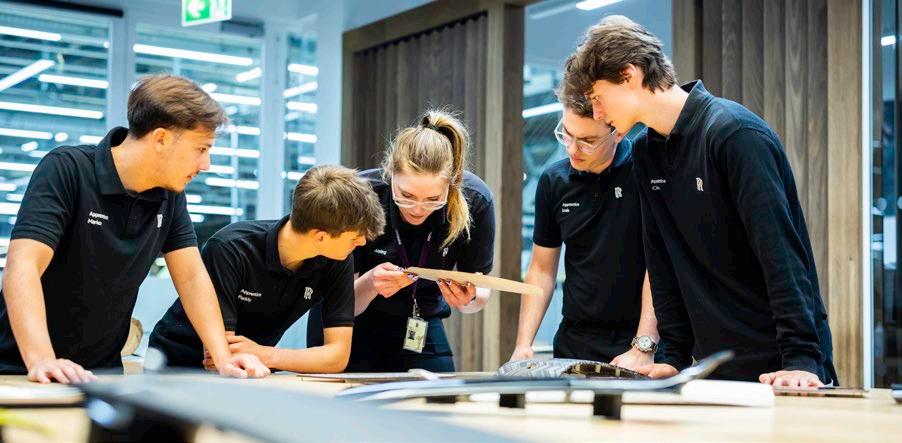
DEGREE APPRENTICESHIPS
The most sought after degree apprenticeships – Jaguar Land Rover, Amazon, JP Morgan – are more competitive than Oxbridge and often partner with major Russell Group brands, such as Warwick (JLR) and Exeter (JP Morgan). Only one provider – PwC – offers Degree Apprenticeships within the UCAS structure of university applications; so for the most part, applying for a degree apprenticeship is like applying for a job.
Most degree apprenticeships are secured by applying to the organisation offering the programme, and the application works like a typical job application: preinterview screening with online tests and interviews, and then final stage assessment centres and face to face interviews.
The majority of degree apprenticeships open from autumn of Y13 and considerable self-motivation, personal organisation and time is required from the pupil to manage the process as well as A level study.
The school provides one-to-one support to pupils making degree apprenticeship applications with Mrs Hopgood, Head of Futures, who leads degree apprenticeships. Support covers identifying potential degree apprenticeships, making the online application, presentation skills and practise for online and face-toface interviews.
ADDITIONAL RESOURCES & SUPPORT AT ST BENEDICT’S
To ensure success in these Highly Competitive Pathways, students should take full advantage of our resources
• The Helikon Centre provides a dynamic and comprehensive approach to preparing students for Highly Competitive Pathways. From Year 7 to Year 13, we offer a range of resources and activities designed to broaden and deepen your academic profile and intellectual interests. Through weekly talks and opportunities to explore subjects beyond the curriculum, we aim to develop your critical thinking, problem-solving skills, and intellectual curiosity. In Sixth Form, our Trethowan Society meets every Tuesday for focused discussion, student presentations, and teacher led seminars. We also organise trips to Oxford and Cambridge in February of Year 12 for interested students.
• Library:
Our extensive physical and virtual library is stocked with a wide range of books and academic journals, including The Economist, the London Review of Books, New York Review of Books, Financial Times, New Scientist, and more. These journals, as well as quality newspaper subscriptions, are available for independent study, offering invaluable insights into current debates in history, science, literature, politics, and economics.
As part of our commitment to academic excellence, students have access to JSTOR for research articles and Massolit – for video lectures from top professors. Incorporating these resources into your academic routine will help you stay at the forefront of your subject, enabling you to think critically,
make connections between ideas, and link different concepts to deepen your understanding and strengthen your application.
• Academic Clubs and Societies:
For potential Medicine, Veterinary or Dentistry applications, attendance at the weekly MVD society is required. We also offer a weekly Law Society, the Vex Robotics Club, the Debating Society and Model United Nations, with the last three particularly engaging in regular competitions, events and conferences; and these are just a few of the societies and clubs available for academic enrichment and preparation for competitive pathways.
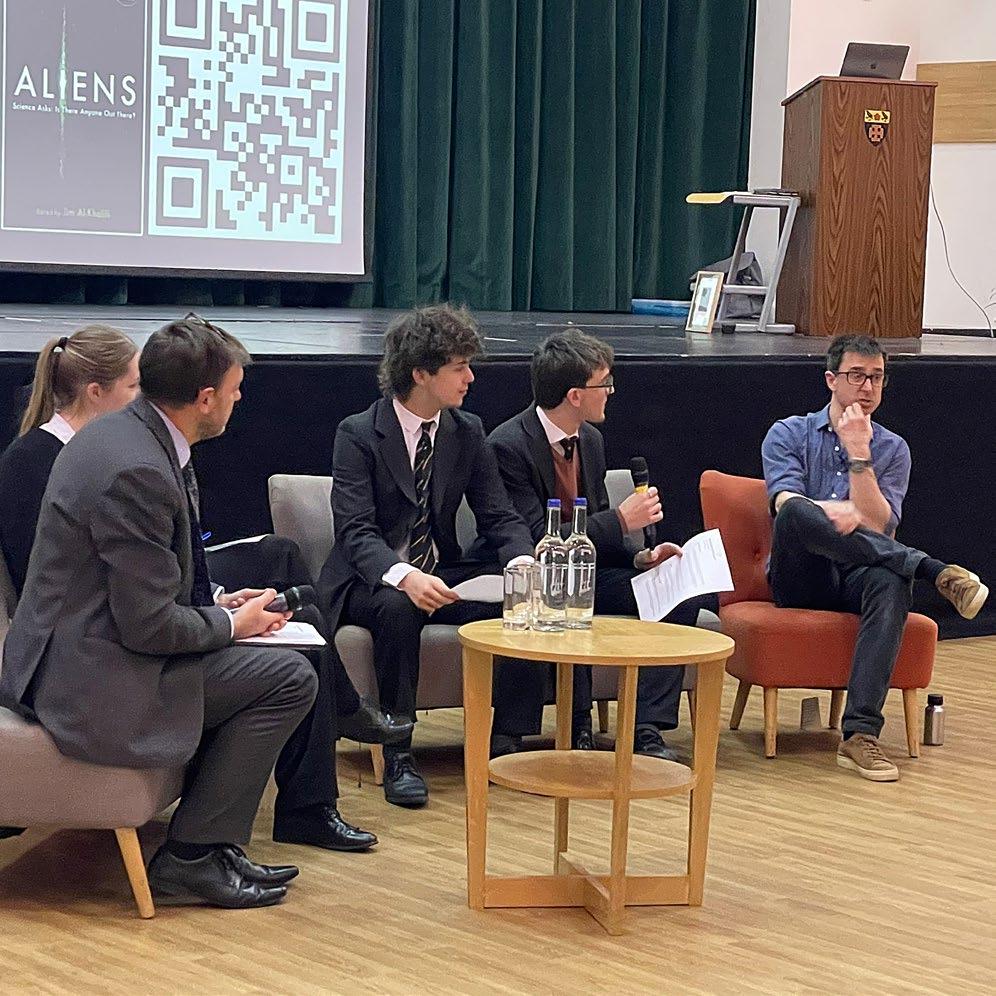
• St Benedict’s Lecture Series – particular highlights are the annual Robin Nonhebel Lecture for History and the Richard Baker Lecture for Science, with speakers such as David Olusogha and Lewis Dartnell regularly representing their fields.
THE EXTENDED PROJECT QUALIFICATION (EPQ)
The Extended Project Qualification (EPQ) is an excellent way to demonstrate intellectual curiosity and academic initiative. An EPQ can be particularly valuable for applications to Oxford, Cambridge, and other highly competitive universities. For instance:
• Medicine applicants could choose to write an EPQ on a relevant scientific topic, such as bioethics, the advancements in medical research, or global health. This shows the university that you are not only interested in medicine but that you are thinking about it from a critical, reflective, and analytical perspective.
• History applicants might undertake an EPQ on an area of historical debate, demonstrating their ability to engage with complex ideas and make original contributions to the field.
• Economics applicants could undertake a project exploring economic theory, market behaviour, or global financial systems, showcasing their problemsolving skills and critical analysis of real-world issues.
MASSIVE OPEN ONLINE COURSES (MOOCS)
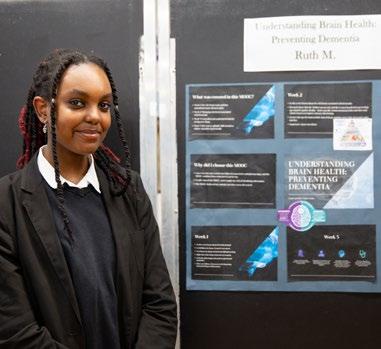
MOOCs are open online courses, designed by universities and supplied through e-learning expert platforms, such as Coursera, EdX AND Udacity. They are flexible learning opportunities, providing windows into course content and research from universities and institutions around the world, and so are an excellent way for students to demonstrate their intellectual curiosity, commitment to learning, and willingness to go beyond the standard curriculum.
Examples of MOOCs:
• A pupil applying to Law may complete a MOOC on International Human Rights to show interest in global legal systems.
• An applicant for Psychology could take an online course on Neuropsychology or Cognitive Psychology to deepen their understanding of brain function and behaviour.
• Pupils pursuing Engineering can benefit from MOOCs in Robotics, Artificial Intelligence, or Mechanical Engineering,
• A pupil planning to study Economics should look at a MOOC on development economics (such as Oxford’s From Poverty to Prosperity) and another on the more technical side of economics, such as Game Theory.
HIGH PERFORMANCE LEARNING (HPL)
At the heart of our approach to academic excellence is the High Performance Learning (HPL) programme, which fosters intellectual confidence, critical thinking, and resilience. HPL is designed to help pupils develop the key skills needed to thrive in highly competitive environments like Oxford, Cambridge, and top degree apprenticeship programmes.
HPL focuses on analysing, linking, creating, and metathinking – critical attributes for ambitious students aiming for top-tier institutions. Our emphasis on automaticity in key skills like problem-solving and analysis, coupled with the ability to work with speed and accuracy, prepares pupils to excel in highly competitive university courses and tests.
Key aspects of HPL that align perfectly with these highly competitive applications include:
1. Critical Thinking and Problem Solving:
• Oxbridge and top university applications demand pupils who are not only knowledgeable but can also think independently and approach problems creatively. The HPL framework nurtures problemsolving abilities through a structured process of reflective thinking and rigorous analysis.
2. Perseverance and Resilience:
• The highly competitive nature of Oxbridge, Medicine, Engineering, and other top-tier courses requires perseverance. In these environments, pupils are challenged to stretch their intellectual boundaries, and HPL prepares them to persevere through academic rigour and uncertainty.
3. Intellectual Risk-Taking:
• Applications to these universities require pupils to engage with complex ideas, tackle unfamiliar problems, and challenge existing perspectives.
Through HPL, pupils learn how to take intellectual risks, explore new ideas, and push boundaries –key skills for thriving in interviews and academic settings.
4. Meta-Thinking and Self-Regulation:
• At the core of HPL is the ability to monitor and regulate one’s own thinking and learning. This ability is essential in the self-directed, pupil-led process of applying to top universities and degree apprenticeships. Meta-thinking encourages pupils to be reflective about their progress and to develop strategies to improve their academic performance.
5. Intellectual Confidence:
• The HPL programme fosters intellectual confidence, which is vital when facing the challenges posed by applications for highly competitive courses. Whether writing an EPQ, preparing for interviews, or tackling challenging tests, pupils with high intellectual confidence are more likely to take initiative, engage with challenging material, and push themselves further.
Through HPL, our pupils develop the intellectual resilience, self-regulation, and critical thinking that allow them to excel in the competitive world of top-tier universities and degree apprenticeships, where the bar is set high and success requires perseverance, hard work, and a commitment to continual improvement.