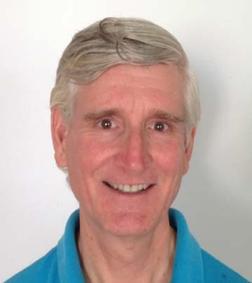
Allan Knight is one of the science curriculum consultants with School
Curriculum and Standards He has taught science, including senior
school chemistry and physics, at high school and been a university
chemistry lecturer He has co-authored a number of senior secondary chemistry textbooks and written teacher resources for senior
secondary physics for WA and other Australian states
Welcome to the May issue of SCIOS – Secondary
In this issue we feature two articles from teachers at Willetton Senior High School Leon Harris together with a student share their
experience of developing a micrometeorite treasure hunt relevant
to the Earth science strand of the curriculum, and Heather
Vallentine provides guidance based on research-based
assessment design principles on writing extended answer
questions.
We hope you find these articles of interest and, as always, we welcome contributions from teachers and laboratory staff.
Thank you.
Allan Knight
(SCIOS - Secondary Editor)
Designing Effective Extended Answer Questions in
Research-informed principles for assessment design
Heather Valentine
Author Biography:
Heather has been teaching lower school Science, Physics and Chemistry for twenty years Along the way, she has developed a particular interest in Teaching and Learning, literacy and numeracy and research based best practice
Abstract
Extended answer questions are commonly included in secondary science assessments, yet
they are often a source of frustration for both teachers and students Poorly structured questions, low student confidence, and equitable marking concerns can reduce their effectiveness as tools for assessing higher-order thinking In this article, I have integrated research-based assessment design principles with classroom practice to clarify the purpose of extended answer questions I have applied strategies that align with Bloom’s taxonomy, explicitly modelled responses, structured command verbs, and pre-designed marking keys I have included worked examples to illustrate how an extended answer question can be used to elicit deep understanding, critical thinking, and coherent scientific communication This latest instalment of my series on assessment design provides a practical framework for designing, teaching, and assessing extended answer questions in science
Introduction
Assessment in science education serves a purpose beyond assigning grades At its best, it should reveal how students connect concepts, apply knowledge to unfamiliar contexts, and communicate scientifically Extended answer questions are uniquely positioned to assess these capabilities. However, their potential is often undermined by uncertainty in design and implementation
Common teacher concerns include:
• How to structure open-ended questions effectively
• How to scaffold students toward higher-order thinking
• How to mark extended answers fairly and consistently
Extended answer questions can be employed as a deliberate and teachable assessment tool rather than an implicit expectation Drawing on educational research and classroom practice, I outline principles for designing extended answer questions that are accessible, cognitively demanding, and aligned with Australian curriculum expectations
What Is an Extended Answer Question?
An extended answer question provides students with a stimulus and poses an open-ended
question that requires them to construct a written response Unlike short-answer questions, extended answer questions require students to organise ideas, justify reasoning, and
integrate multiple concepts
Extended answer tasks typically assess higher levels of Bloom’s taxonomy, including:
Application
Analysis
Synthesis
Evaluation
In science, this may involve explaining mechanisms, linking prior knowledge to new contexts, interpreting data, or evaluating scientific claims
Barriers to Successful Extended Answer Questions
Despite their value, extended answer questions are not always implemented successfully
Common barriers observed in secondary science classrooms include:
Teaching concepts as isolated, discrete topics
Limited emphasis on linking prior knowledge to new learning
Insufficient in-class practice with open-ended tasks
Student reluctance or inability to think critically
Low expectations of students’ scientific writing
Teacher uncertainty about question structure
Concerns about marking consistency and fairness
When these barriers are unaddressed, extended answer questions can become exercises in recall or language proficiency rather than assessments of scientific understanding
Bridging the Gap: Research-Based Design Principles
Effective extended answer questions do not rely on student intuition alone Research and classroom experience point to several strategies that bridge the gap between teacher
expectations and student performance
1. Model the Process Explicitly
Students benefit from seeing what a quality response looks like Teachers should:
Deconstruct exemplar responses
Model how marks are allocated
Explain why certain statements earn credit
Providing annotated exemplars helps students understand both content expectations and response structure.
2. Provide Regular Practice with Feedback
Extended answer skills develop gradually Low-stakes formative tasks, accompanied by explicit feedback, allow students to practise constructing responses without the pressure of summative assessment
3. Link New Content to Prior Knowledge
Well-designed questions deliberately activate prior learning. Framing questions that require students to apply earlier concepts to a new context supports deeper understanding and retention
4. Make Expectations Explicit
Extended answer questions should include:
A clearly defined context
Precise command verbs
Guidance on content scope
Access to relevant resources (e g data sheets)
The structure of the question can follow the following template:
command verb the description of the context
Using Bloom’s Taxonomy to Scaffold Extended Answers
Bloom’s taxonomy provides a useful framework for differentiating and scaffolding extended answer questions Teachers can adjust cognitive demand by varying the command verb while
maintaining a consistent scientific context
Common command verbs in science extended answer questions include:
Describe – provide detailed observations or features
Explain – outline mechanisms or underlying reasons
Compare and contrast – identify similarities and differences using evidence
Reflect – consider implications or evaluate outcomes
Aligning command verbs with intended cognitive demand allows teachers to target a range of achievement levels while maintaining clarity for students
Fair and Consistent Marking: Designing the Marking Key First
One of the strongest predictors of equitable marking is the practice of writing the marking key
before reading student responses A clear marking rubric:
Clarifies expectations
Reduces subjective judgement
Supports consistency across classes and teachers
A sample marking key for a 10-mark extended answer may include the following criteria:
• Content accuracy
• Structure and organisation
• Application of knowledge
• Evidence of critical thinking
• Creativity or originality
Mark allocations should reflect the relative importance of scientific understanding over presentation alone, while still valuing clarity and organisation
A Worked Example: Chemistry Extended Answer Question
Sample Question (10 marks)
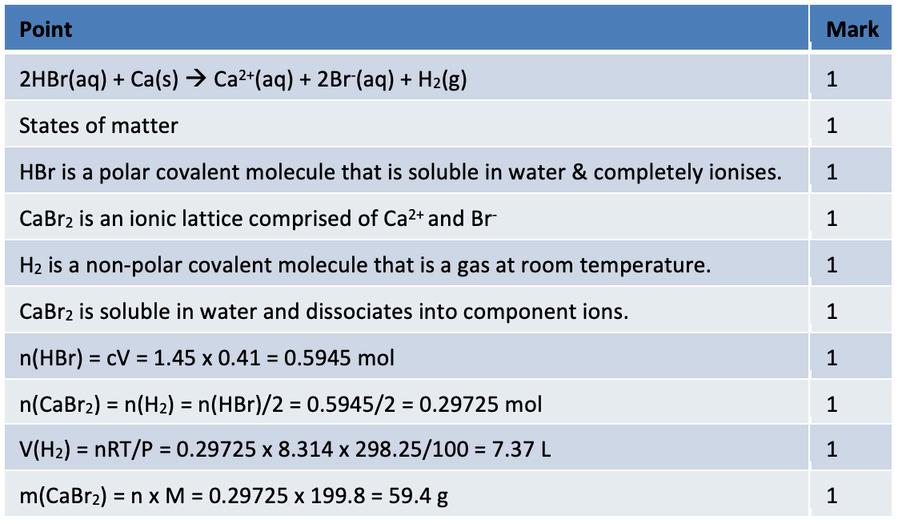
1 45 L of 0 41 M hydrobromic acid was reacted with excess calcium metal at standard laboratory conditions Describe the states of matter, structure, bonding, solubility, and stoichiometry involved in this reaction Refer to the data sheet for relevant information
This question intentionally:
Provides a clear scientific context
Specifies the command verb
Signals the required content domains
Encourages integration of multiple concepts
A high-quality response integrates prior chemical knowledge, including balanced equations, bonding and structure descriptions, and quantitative stoichiometric calculations Importantly,
students are rewarded for linking concepts rather than listing isolated facts
Teaching Students How to Respond
Students benefit from a structured approach to responding to extended answer questions
One effective strategy is the RTQ (Read the Question) flowchart:
1 Read the question carefully
2. Identify the command verb, content, and context
3 Plan the response using an outline
4. Write using clear headings and scientific language
5 Check against the marking key
Explicitly teaching this process demystifies extended answer questions and increases
student confidence
Common Pitfalls and How to Avoid Them
Typical weaknesses in student responses include:
Superficial explanations
Lack of supporting evidence Poor organisation
Teachers can address these through planning templates, peer review, and regular exposure to success criteria Gradually releasing responsibility from teacher-led modelling to independent student construction is key
Conclusion
Extended answer questions are a powerful assessment tool when designed and implemented deliberately. By aligning questions with cognitive intent, modelling expectations, and prioritising fair marking practices, science teachers can use extended answers to assess not only what students know, but how they think. When students are taught how to respond, extended answer tasks become an opportunity rather than an obstacle supporting deeper learning, improved scientific literacy, and more meaningful assessment
References
Gilewski, A , Mallory, E , Sandoval, M , Litvak, M , & Ye, L (2019) Does linking help? Effects and student perceptions of a learner-centred assessment implemented in introductory chemistry California State University
Jacobs, L C (2004) How to write better tests: A handbook for improving test construction skills Indiana University
Lewis, S E , Shaw, J L , & Freeman, K A (2011) Establishing open-ended assessments: Investigating the validity of creative exercises Chemistry Education Research and Practice, 12(2), 158–166
McComas, W F , & Abraham, L (2004) Asking more effective questions Rossier School of Education
Vogler, K E (2008) Asking good questions Educational Leadership, 65(9), 1–9
NEW STAWA SOCIALS ARE OFFICIALLY
LIVE
WE ARE PROUD TO ANNOUNCE OUR BRAND NEW INSTAGRAM AND TIKTOK PAGES !
CLICK THE ICONS AND MAKE SURE YOU’RE FOLLOWING US TO STAY UP TO DATE
ConSTAWA 43 Roundup
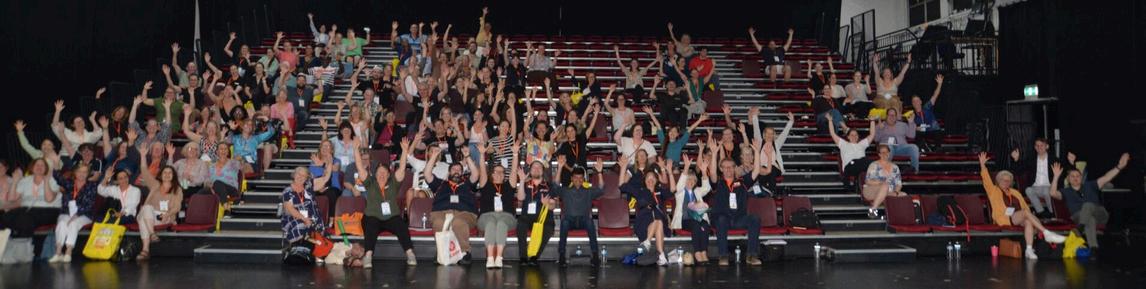
‘A picture paints a thousand words’ – so check out these photos!
What a brilliant day with so many amazing workshops and inspirational events Lyn Beazley, our wonderful
Patron, shared ideas regarding various Science roles that are part of the new era of space exploration She also celebrated our 2 pre-service scholarship recipients
Congratulations to Melissa Den Boer and Jamie King –both from Curtin University – we were excited to have you join us
Our Chief Scientist of WA, Sharath Sriram, shared insights about his current responsibilities and how he
came to be in this exciting and often challenging role He then took questions from the floor and clearly indicated he is keen support teachers as we work to improve all levels of Science education
A sincere thank you to Willetton Senior High School and in particular Nathan Curnow for all his behind-the-scenes work
We were also delighted to have the year 11 Catering Group
serving us a delicious morning tea and lunch
We really appreciate the variety of trades representatives that supported us at ConSTAWA as they bring us in contact with interesting and new Science resources
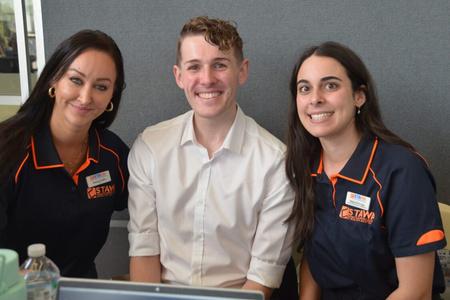
Special thanks to Jo (our CEO), Mikayla (our Events and Engagement Coordinator), Tullulah (our new Professional Learning and Engagement Officer) and Matt (our new Admin staff) for all their hard work both before and on the day Their commitment to creating a wonderful learning experience for us is amazing Finally, the ConSTAWA Working Group also put in many hours to make ConSTAWA the great day it is – thank you
If you missed ConSTAWA 43 – then why not join us next year for ConSTAWA 44!
Bringing Space Down To Earth – A Year 7 Micrometeorite Treasure
Hunt
By Sara Abdel-jawad and Leon Harris* , Willetton Senior High School
Astronomy Club, Pinetree Gully Rd, Willetton.
Author Biographies:
Leon Harris is a teacher at Willetton Senior High School Sara Abdel-jawad is a former student of Willetton Senior High School and together with other students in the schools Astronomy club developed this activity
* To whom correspondence should be addressed, leon harris@education wa edu au
Introduction
Teaching the Earth and Space strand of the Australian National Curriculum in high schools presents challenges related to the inaccessibility of space to high schools in the hours where students are at school Traditionally, lab activities involve models or simulations, such as investigating the effect of an object’s velocity on the size of the impact crater it leaves (Rickard, 2016) or modelling day and night with a light source such as an increasingly rare overhead projector to represent the sun and two balls to represent the earth and the moon (Linstead et al, 2006) Students have little interaction with space objects – the sun prevents observations in daylight hours
Educational outcomes in the physical sciences are known to improve with well-chosen handson minds-on activities (Freeman et al, (2014); Ateş & Eryılmaz, (2011) Furthermore, activities that involve exploring the school environment to collect data increase student engagement (Mann et al, 2022) We (the Willetton Senior High School Astronomy Club) have observed the tremendous amount of excitement and enthusiasm that students experience when they hunt the school grounds for extraterrestrial objects
With this in mind, the teacher coordinating the astronomy club (Dr Harris) commissioned the club’s members to write a lab activity that could bring some of the excitement and engagement which they had experienced to the Year 7 classroom
Meteorites from outer space have been found very often on Earth However, as meteorites travel within Earth’s gravitational field, they lose a large percentage of their mass through ablation, meaning that once they land, it’s likely that they will look like little more than grains of sand These micrometeorites are incredibly common; NASA has estimated that 44 metric tons of meteoritic material fall onto earth every day (NASA, n d ) Collecting these for study and curiosity can prove to be a useful method for teaching on the characteristics of micrometeorites and other space debris as well as how matter is affected by its gravitational attraction to a larger body.
This paper presents a method to find micrometeorites in one’s school environment (which
unfortunately may also attract other debris) and how to discriminate them from terrestrial
iron-rich materials
Methods
Students from Willetton Senior High School Astronomy Club developed the following set of methods to find and isolate micrometeorites They are written in the format of a Pearson
Science (Rickard, 2016) lab activity so that it can be photocopied and directly used in class
“Finding Micrometeorites” lab activity
Purpose
To discover as many micrometeorites in one’s surroundings as possible and distinguish them
from other debris for further study
Timing - 45 minutes (approx.)
Materials
Metre-long ruler or long stick
Sticky Tape
Strong neodymium magnet
Glove (to protect the magnet from
debris)
Procedure
A sheet of paper (preferably A4 or A3)
Petri dish
Dissecting microscope or magnifying
glass
1 mm graph paper or grid
1 Choose a 2 m x 2 m area of ground to sample
2. Place a magnet inside a glove Make sure the glove is intact/the magnet is fully covered
3 Tape the glove to one end of the metre-long ruler Use the tape to seal the open part of the glove shut
4 Hover the metre-long ruler along your selected area of ground outdoors, with the glove side touching the ground Dirt, debris and micrometeorites will be attracted to the magnet in the glove
5. Pinch the glove and move the magnet towards the palm away from the magnetic debris Shake the debris onto the A4 paper
6. Search through the debris for anything that might seem like a micrometeorite To do this, place all debris attracted to the glove onto a sheet of paper on a flat surface and tap, shake or manoeuvre the paper slightly Observe whether the pieces of debris rolls or not Micrometeorites roll easily
7 If any of the debris rolls, place it onto a petri dish with a small grid of graph paper and study it under a microscope Estimate the diameter against the graph paper and check the colour of the debris (it should be a storm grey if it is a micrometeorite) and search for miniature holes or “pits” Repeat for all potential micrometeorites
8 (Optional): Repeat and replicate this experiment in different selected areas and compare results
Results
Construct the following table and add your results Adjust the number of rows for however many micrometeorites you manage to find.
Micrometeorite no. Diameter of micrometeorite
Number of pits visible Colour Additional comments
1 0.5 4 Storm grey Very round shape
2 3
Review
1. Calculate the average diameter of all micrometeorites you found
2 Calculate how many micrometeorites you sampled per square meter of the earth's surface (Micrometeorites per metre = total found / 4 m2)
3
a. Meteorites lose a large percentage of their mass while entering Earth’s atmosphere
Propose why this may be
b. b) Discuss how this might also affect the colour of the micrometeorites and the appearance of pits on its surface
4. Measure the diameter of any pits found on the surface of a suspected micrometeorite and state its diameter as a percentage of the diameter of the entire micrometeorite
5. Ancient civilisations used meteorites to make weapons and sacred objects (e g Tutankhamun’s knife) If you collected 1 g of micrometeorites per 10 m2, how many metres of ground would you have to sample with your magnet to get enough to make a 50 g knife?
Results/Discussion
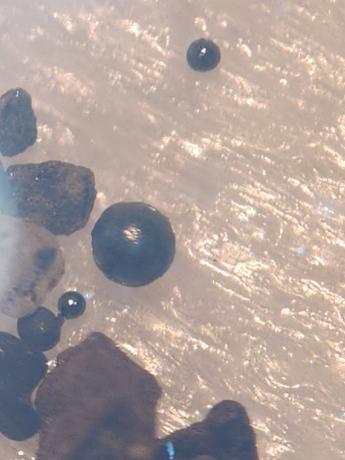
Figure 1: Typical spherical micrometeorites together with terrestrial magnetic material The large micrometeorite is 250 μm across.
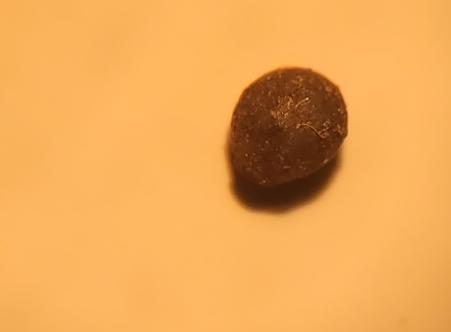
Figure 2: Micrometeorite (200 μm across) found on the roof of a school building, showing signs of weathering This makes it likely that this micrometeorite is quite old The narrow side of the micrometeorite seems to show more signs of pitting than its opposite side, which could be demonstrating its path/angle of flight
*Scale: 4 5 cm = 1 mm, or 1 cm = 0 222 mm
Magnification: 1500x
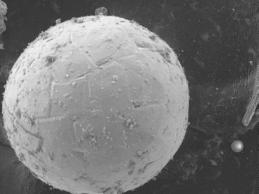
Figure 3: Scanning Electron Micrograph (SEM) of a micrometeorite Note the crystalline cubic appearance of the surface, and the smaller micrometeorite in the bottom right corner
Conclusion
In conclusion, the technique we were able to create in order to run this experiment and
separate micrometeorites from other debris, though not completely accurate, is incredibly simple and still very effective despite some false positives and false negatives. Because this experiment was designed with the idea of Yr 7 students in mind as its target audience, perfect accuracy is not necessarily needed to create an engaging experiment that would allow one to teach students about scientific notation and other Earth and Space Science related concepts
It is possible that this experiment could be used as a scientific investigation instead of just a lab or practical For example:
Measuring the rate of micrometeorite debris falling to Earth by clearing off a particular area and measuring during regular intervals later
Continuing the previously described experiment over the course of a year to determine whether micrometeorites are affected by seasonal changes
Collecting a certain amount of micrometeorites to demonstrate the size and mass distribution and discussing whether this demonstrates something about the forces acting on said micrometeorites
Drawing up an either teardrop-shaped or spherical micrometeorite to demonstrate where pitting is most likely to be as found in micrometeorites of the same/similar shape to discuss whether this provides evidence on how and in which angle the micrometeorite was travelling
Therefore, the results for this experiment demonstrate that our approach to bring celestial objects to the classroom is successful and easy to implement This allows students to find and study micrometeorites effectively and would be a valuable method of attracting attention and engagement from students whilst teaching Earth and Space sciences in the classroom
Acknowledgements
We would like to thank the WSHS lab technicians, particularly Kian Targhagh for their support and assistance with the Astronomy club and these activities.
We thank Inspire STEM Education Australia for the loan of their electron microscope
References
Ateş, Ö., & Eryılmaz, A. (2011). Effectiveness of hands-on and minds-on activities on students’
achievement and attitudes towards physics Asia-Pacific Forum on Science Learning and Teaching, 12(1), Article 6, 1–22. Retrieved from
https://www eduhk hk/apfslt/download/v12 issue1 files/ates pdf
Freeman, S , Eddy, S L , McDonough, M , Smith, M K , Okoroafor, N , Jordt, H , & Wenderoth, M P (2014) Active learning increases student performance in science, engineering, and mathematics Proceedings of the National Academy of Sciences, 111(23), 8410–8415
https://doi org/10 1073/pnas 1319030111
Linstead, G , Goyder, O , Przywolnik, G , Salfinger, L , & Herbert, T (2006) Science Aspects 1: An outcomes approach Pearson Education Australia
Mann, J , Gray, T , Truong, S , Brymer, E , Passy, R , Ho, S , Sahlberg, P , Ward, K , Bentsen, P , Curry, C , & Cowper, R (2022) Getting out of the classroom and into nature: A systematic review of nature-specific outdoor learning on school children’s learning and development Frontiers in Public Health, 10, Article 877058 https://doi org/10 3389/fpubh 2022 877058
NASA (n d ) Meteors and Meteorites: Facts NASA Solar System Exploration Retrieved
December 9, 2025, from https://science nasa gov/solar-system/meteors-meteorites/facts/ Rickard, G (Ed ), Linstead, G , Wood, R , Madden, D , Parsons, M , Salfinger, L , Spenceley, M , Bliss, C , Lennard, L , Tilley, C , & Williams, J (2016) Pearson science 7: Australian curriculum (2nd ed ) Pearson Australia
Statement of Authorship
Both authors contributed equally to this paper SA contributed parts of the introduction, the method section and the discussion, and with members of the astronomy club, tested the experimental methods to generate results LH contributed to the introduction, the discussion and the papers editing, as well as providing the optical microscope images
It has been yet again, another successful year for the Synergy
Solar Car Challenge in 2026
After a busy term of preparation, construction, and strategic planning, Year 6 and Year 8 students from Bunbury, Collie, Albany, Geraldton, Kalgoorlie, North Metro and South Metro competitions arrived for the Grand Final, taking place at Murdoch University
The day was filled with excitement as speed, innovation and serious STEM skills were all on display
We would like to give a big congratulations to the following Grand Final winners:
Year 6 Competition
1 Place st Burrendah Primary School
2 Place nd St Francis of Assisi Catholic Primary School
3 Place rd St Brigid’s School - Collie A
Year 8 Competition
1 Place st Hope Christian College
You can now register your interest for the 2027 competition by clicking the link We cannot wait for next years competition !
STAWA INVITES EXPERIENCED TEACHERS AND MENTORS TO BE PART OF THE INAUGURAL EARLY CAREER & PRE-SERVICE TEACHERS STEM CONFERENCE SUPPORTING, GUIDING, AND CONNECTING WITH THE NEXT GENERATION OF EDUCATORS.
SECONDARY SCIENCE TEACHERS COFFEE CATCH-UPS
STAWA invites you for a relaxed afternoon of connection, conversation and collaboration with fellow secondary teachers.
North of the River South of the River
�� June 11th
⏰ 3:30pm onwards
��Dome Café Warwick
�� June 24th
⏰ 3:30pm onwards
��Dome Café Gosnells
SCIOS Primary (STAWA online journal)
Teaching Science (ASTA journal),
Membership Information
Information about Science activities for students and teachers
Professional Development & Conference programs
MEMBER DISCOUNTS
Members receive discounts for STAWA Professional Development Workshop range of services and attractions, plus attendance at STAWA Conferences a events, including ConSTAWA and ConASTA.
How To Contribute ?
Longer articles - should not normally exceed 3000 words plus figures, tables and references Please use headings and sub-headings to give your article struc
Shorter articles - We also welcome shorter articles of approximately 500-1000 w plus figures, tables and any references Again, use of headings and subheadings assist to give your article structure
Send the following to the editor:
1 Please send your document as a word file with photographs and other images embedded where you need them to be.
2. Photographs and other images (e.g. diagrams) should be sent as separate files.
3. Photographs often increase the clarity and interest level of your work. Send your photographs as high-quality JPEG files (300 dpi or higher). TIFF files are also accepted. Digital permission for students in photographs must be confirmed by the submitting teacher (email acceptable)
4. Copyright for any part of your contribution that is copyright of a third party needs to be obtained in writing (email acceptable)
COPYRIGHT
No other publisher should have published your manuscript, nor should you submit for publication elsewhere. If SCIOS Primary publishes your manuscript then your text and graphics will become copyright of STAWA. STAWA will, however, agree to your use of the contents of your paper for most reasonable non-commercial purposes.