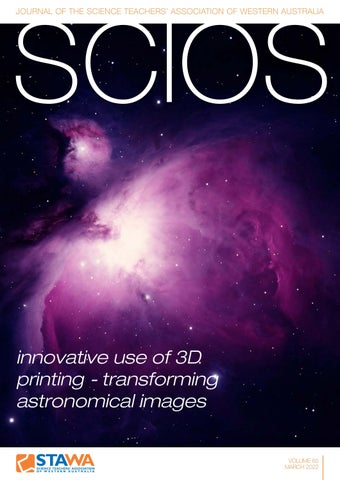
SCIOS JOURNAL OF THE SCIENCE TEACHERS’ ASSOCIATION OF WESTERN AUSTRALIA
innovative use of 3D printing - transforming astronomical images VOLUME 65 MARCH 2022
SCIOS: To Know This journal aims to promote the teaching of science with a focus on classroom practice. It provides a means of communication between teachers, consultants and other science educators. Opinions expressed in this publication are those of the various authors and do not necessarily represent those of The Science Teachers’ Association of Western Australia (STAWA), the editorial committee or the publisher. STAWA Office Unit 6, 10 Mallard Way, Cannington WA 6107 Contact Tel +61 (0) 8 9244 1987 Fax +61 (0) 8 9244 2601 Email info@stawa.net.au Web www.stawa.net.au
Editorial Committee Susan Doncon Christine Howitt John Clarke - STAWA Siew Fong Yap Lyndon Smith Editorial Correspondence info@stawa.net.au
Graphic Designer Kattie Muir - Digital Crayon
Advertising Enquiries Tel +61 (0) 8 9244 1987 Fax +61 (0) 8 9244 2601 Email info@stawa.net © 2022 The Science Teachers’ Association of Western Australia (STAWA). All rights reserved. No part of this publication may be reproduced or copied in any form or by any means without the written permission of STAWA. Unsolicited material is welcomed by the Editor but no responsibility is taken for the return of copy or photographs unless special arrangements are made.
CONTENTS Editorial
3
From the President
5
Chief Executive’s Report
7
From the Archives
9
The Marine and Maritime Teachers Forum
12
Professional Learning for Primary School Science Specialists
14
3D Printing the Universe
16
Cognitive Load Optimisation (CLO) Learning Theory
19
Book Review
28
STAWA Membership
29
How to Contribute
30
ISSN 0157-6488 Cover Image by WikiImages from Pixabay
VOLUME 65 | MARCH 2022 JOURNAL OF THE SCIENCE TEACHERS’ ASSOCIATION OF WESTERN AUSTRALIA
PAGE 2
EDITORIAL Siew Fong Yap As I write, alarming concerns about the emerging threat of escalating warfare in Ukraine reverberate across the globe augmenting the already-harsh reality of a world grappling with another ongoing war (of a different nevertheless insidious nature) against a mutating virus, it may well appear 2022 is a year that could change us more than anyone predicted. I echo the words of Kate and her team (including Fiona Stanley, UWA) that “young people were already struggling before the pandemic. We need to help them navigate a changed world”. The indirect effects of the pandemic – social, emotional, educational and economic – will far outweigh the physical effects on physical health.
Our role as science educators is to provide students with the opportunity to go to the far reaches of their curiosity... As science educators, we remain hopeful we can help facilitate positive changes by addressing these three key impacts - emotional, educational and economic. Science and technology education for this generation and future generations will continue to play a vital role in the advancement of medicine (including mental health), environmental and global sustainability.
Our March issue carries a nostalgic flavour as we have recovered the very first issue published by STAWA from the archives, which brings us back to the reason we do what we do as science educators. Our contributors to this issue, John Clarke and Mady Colquhoun have drawn our attention to the recent professional learning opportunities in the Marine and Maritime Teachers Forum and Primary School Science workshops respectively, highlighting the importance of engaging our students in contexts beyond the classroom settings as well as in effective practical activities conducted within the science classrooms. Teresa Slaven-Blair’s 3D printing technology captures the imagination of our young minds in exploring the world on a full spectrum from micro to macro scale for the Year 10 Earth Science curriculum. Paul’s Cognitive Load Theory offers a refreshing look at how STEM education can continue to enrich and empower our young people to think deep and critically as well as develop creative solutions. Yes, our role as science educators is to provide students with the opportunity to go to the far reaches of their curiosity and to explore areas that they are inherently interested in within the realm of our subject matter. It is inexplicable joy when students’ face light up upon discovering an innovation comes to life and compare that to those who finish some sort of a mindless worksheet
VOLUME 65 | MARCH 2022 JOURNAL OF THE SCIENCE TEACHERS’ ASSOCIATION OF WESTERN AUSTRALIA
PAGE 3
designed to supposedly enhance standardised test score. There is no comparison indeed. Let us continue to ignite imagination and inspire innovation, curiosity and perseverance in our young people to be possibilities thinkers and problem solvers in a world in increasing need of world-changers and game-changers.
Dr Siew Fong Yap
About the editor Dr Siew Fong Yap is the Head of Science at Perth’s Kingsway Christian College, a sessional teaching academic at Curtin University and Honorary Teaching Fellow of University of Western Australia. She is also part of the Oxford Science Curriculum Publishing team.
Reference Lycett, K., Olsson, C., Stanley, F., Woolcock, G. & Struthers, K. (2020). “Young people were already struggling before the pandemic. We need to help them navigate a changed world.” in 2020 The Year That Changed Us – The Conversation’s Digital Editor. Port Melbourne, Victoria: Thames and Hudson Australia.
VOLUME 65 | MARCH 2022 JOURNAL OF THE SCIENCE TEACHERS’ ASSOCIATION OF WESTERN AUSTRALIA
PAGE 4
from the president Annabel Kanakis Welcome to the March Issue of SCIOS. I hope you all had a restful holiday and have returned to the term recharged! It has been an interesting three months for me. I have been the victim of the various rules and regulations Australia wide regarding the pandemic. I have been stranded in Brisbane and managed to succumb to COVID. This has prevented my scheduled arrival home to commence teaching in late January. Thank goodness for the technology that we all enjoy; that is, of course, thanks to scientists and engineers. I have been able to continue life almost as normal using online teaching and learning and have not missed a single lesson or meeting the entire time! I am also very grateful for the vaccinations I received as, without them, I may not have been able to travel at all for a long while. The extra immunity that I acquired enabled me to fight the virus more effectively without experiencing the severe symptoms that many people have had to endure prior to the vaccination program being introduced and now made available to everyone in the community. The incredible technology and science behind the socalled RAT tests have also enabled people to take a little more control of their lives as they can test themselves if they have symptoms or believe that they have been in contact with someone who has COVID.
It is this amazing science and technology that we must continue to highlight to our students such that we encourage them to be able to problem solve and continue this work into the future. It is also an ideal opportunity for us to highlight the many and varied careers that have resulted or come to the fore during these past 3 years. The organisation of CONSTAWA 2022 has been ongoing, with the Primary Committee, Geoff Quinton, Lance Taylor and John Clarke meeting regularly to ensure the success of our annual conference. Unfortunately, due the COVID situation in WA, the conference has been rescheduled and will no longer be held in April. A new date of Wednesday 13 July has been set, the second week of the July holidays when, hopefully, more teachers, presenters and exhibitors can be available in a safe environment. STAWA will be progressing to enable the filming and online access to conference keynotes and workshops that will also enable more teachers to be able to take part in these very worthwhile events. Graham Johnson continues to produce the Newsletter, Spotlight on STAWA, sent to our members to inform everyone of upcoming events and providing links to resources. I encourage everyone to keep informed of what is happening in our association so that members get the most out of their membership.
VOLUME 65 | MARCH 2022 JOURNAL OF THE SCIENCE TEACHERS’ ASSOCIATION OF WESTERN AUSTRALIA
PAGE 5
As we move further into the semester, the universities will be seeking mentors for their pre-service science teachers. I encourage anyone who is able, to support these teachers and to encourage them to present engaging lessons that stimulate interest in our students such that they want to study science in upper school and beyond!
Annabel Kanakis
STAWA publications Year 11 and 12 ATAR Resources: The STAWA Exploring Chemistry, Physics and Human Biology series support the Western Australian Curriculum ATAR Courses. The Year 12 publications Exploring Human Biology Stage 3 and Revising Physics: A Study Guide with Investigations are also available. Human Biology General Course Resources: The STAWA Exploring Human Biology Stage 1 and Stage 2 resources are available and together cover both the Year 11 and the Year 12 General Course. Answers and Worked Solutions: http://stawa.net/stawa-textbook-solutions/ Member Discount: Members receive a 10% discount on all purchases through STAWA.
VOLUME 65 | MARCH 2022 JOURNAL OF THE SCIENCE TEACHERS’ ASSOCIATION OF WESTERN AUSTRALIA
PAGE 6
CHIEF EXECUTIVE’S REPORT John Clarke Welcome back to a chaotic start to the 2022 school year.
COVID continues to wreak havoc over all that we do. Our term 1 events and activities have been affected but we move forward with a positive attitude and change what needs to be changed.
The 2022 Marine and Maritime Teachers Forum took place on Tuesday 22 Feb at the Esplanade Hotel Fremantle including a tour of the Leeuwin at B Shed and a sundowner refreshment at Gauge Roads Brewery A Shed. To view the program and see what you missed or to remind yourself of what a great day it was, you can visit the website: https://www.stawa.net/conferences/ marine-and-maritime-teachers-forum/.
CONSTAWA - Our Primary and Secondary Science Teachers Conference has been moved from April to Wednesday 13 July, the second week of the July school holidays. The conference will be hosted by Lance Taylor, HOLA and STAWA Life member and his team at Willetton Senior High. We are planning for a face-to-face event but will have an online contingency in place if forced offline. Visit the website for preliminary and progressive information: https://www.stawa.net/ conferences/constawa/. The Synergy School Solar Challenge events have been cancelled but we do encourage everyone to continue with their school program and in house race events. Synergy and STAWA would love you to provide a photo or video of students at work on or racing the solar car kits. Information will be coming through the Synergy Schools Solar Challenge portal, and we aim to provide rewards for your students in action contributions. Keep up the hard work and continue to excite our future STEM competent community members.
VOLUME 65 | MARCH 2022 JOURNAL OF THE SCIENCE TEACHERS’ ASSOCIATION OF WESTERN AUSTRALIA
PAGE 7
The 2021 Psychology Teachers Convention will take place on Thursday 18 August and will be totally online this year. The program and details as they become available will be updated on the website: https://www.stawa.net/conferences/psychologyteachers-convention/. The Convention program is developed by the STAWA Psychology Committee.
If you have not yet renewed your membership, I encourage you to do so. Member numbers improve our capacity to advocate on science education issues affecting science teachers when talking with Government and Industry. Membership often offers opportunities to develop leadership, curriculum development and presentation skills. STAWA is embarking on several projects this year that require fresh ideas and provide new opportunities for members, including the delivery of online learning to teachers, revision of STAWA resources and the development of new resources. Please contact the office to express your interest in becoming involved. Please encourage your peers, particularly early career teachers to take up STAWA membership, to take advantage of the events and learning opportunities that STAWA provides and to actively seek to contribute to the goals of the association. Share your thoughts and ideas to help STAWA grow into the future. The strategic plan can be viewed at: https://www.stawa.net/aboutus/constitution-and-strategic-plan/. Have a safe and enjoyable remainder of the term.
Your Chief Executive Officer, John Clarke
VOLUME 65 | MARCH 2022 JOURNAL OF THE SCIENCE TEACHERS’ ASSOCIATION OF WESTERN AUSTRALIA
PAGE 8
from the archives John Clarke “From the Archives” aims to build a brief chronological history of STAWA. Welcome to the first of a series of articles putting a spotlight on the history of STAWA, its people and science education of the time. Pat and Pam Garnet inspired the creation of “From the Archives”. Decluttering and tidying one’s home leads to some amazing discoveries. The historical documents provided by Pat and Pam form the basis of this article - Article number one. Following editions will use SCIOS as the primary source of information. In the Beginning Our website (https://www.stawa.net/about-us/about_ agm/) states: The Science Teachers’ Association of Western Australia, known as STAWA, was established in 1946. STAWA is an independent association of Science Educators dedicated to promoting science and science teaching in Western Australia. The Faulding Company Science Notes suggest that STAWA was first established in 1944, two years earlier than 1946 as first thought. The Science Notes were described as the Official Organ of the Science Teachers Association of Western Australia, the precursor to SCIOS. Enjoy the following images and brief account of the early years of the association as described.
VOLUME 65 | MARCH 2022 JOURNAL OF THE SCIENCE TEACHERS’ ASSOCIATION OF WESTERN AUSTRALIA
PAGE 9
VOLUME 65 | MARCH 2022 JOURNAL OF THE SCIENCE TEACHERS’ ASSOCIATION OF WESTERN AUSTRALIA
PAGE 10
VOLUME 65 | MARCH 2022 JOURNAL OF THE SCIENCE TEACHERS’ ASSOCIATION OF WESTERN AUSTRALIA
PAGE 11
The Marine and Maritime Teachers Forum John Clarke On Tuesday 22 February, a crusty group of Mariners meet to reminisce the trials and tribulations of training future seafarers. Instead of cursing the new scurvy, they cursed the current COVID. Drinking rum was delayed to the end of the day and replaced by a selection of boutique beers – very posh and un-seaman like.
The Esplanade Hotel Fremantle played host to the keynote and workshop parts of the program. We had a great room and were spoilt at morning tea and lunch with a great selection of quality food. Rebecca Seage of the Naval Shipbuilding College introduced the keynote panel of speakers and provided an overview of the functions of the college. Sam Abbott,
VOLUME 65 | MARCH 2022 JOURNAL OF THE SCIENCE TEACHERS’ ASSOCIATION OF WESTERN AUSTRALIA
PAGE 12
our first keynote speaker, shared his knowledge about shipbuilding, with particular emphasis on hull design. Jon Emonson followed with his presentation on ship stability. Both speakers were well received and provided considerable value to the support of teachers in the delivery of the curriculum. Matt Moran wrapped up the keynote session providing an overview of the shipbuilding industry in WA, highlighting the projects underway and job opportunities for young people. Following the morning tea, Pauline Charman highlighted curriculum links and opportunities to include BioBarcoding in the marine and maritime classroom and field activities. This valuable session was followed by Lydon Smith who shared some great insights into examinations, with emphasis on what makes a good question and the importance of the syllabus in the writing of questions and informing grading. His hints and tips were insightful and created a great deal of discussion, renewed confidence in assessment preparation and grading and an excitement and desire to have a go. Following lunch, we divided into 4 groups to examine the Year 11 and 12 General and ATAR courses. This was a great networking and sharing session concluding a where-to-from-here plan. The team left the Esplanade and we made our way to B Shed for a tour of the STS Leeuwin II. Carol Shannon, CEO of the Leeuwin Adventure Foundation led the tour, beginning with an overview of the purpose of the foundation and concluding with the opportunities for teachers and their students.
•
• We concluded the day with a networking sundowner and debriefing at A Shed, Gauge Roads Brewery. In conclusion, I would like to thank the following people who has made such a wonderful forum possible. • our volunteer presenters for sharing their time and expertise • Sally Jonasson, Education Manager, Leeuwin Adventure Foundation for organising the STS Leeuwin II tour,
•
Carolyn Boyd, Corporate Responsibility Manager, Naval Shipbuilding College for helping to source our panel of keynote speakers John Ryan (Sacred Heart College) for the evaluation and John and Alex Wood (Scotch College) members of the organising committee for their help with the planning, development and delivery of the forum.
VOLUME 65 | MARCH 2022 JOURNAL OF THE SCIENCE TEACHERS’ ASSOCIATION OF WESTERN AUSTRALIA
PAGE 13
Professional Learning for Primary School Science Specialists Mady Colquhoun Two well attended sessions were held at STAWA in January to support primary school science specialists. Both STAWA members and non-members are welcome to attend any Professional learning organised by the Primary Science Committee.
Science Inquiry Skills (SIS) Process A full day was devoted to helping teachers develop their understanding of the SIS process; specifically Fair Test investigations as well as provide strategies for teaching it successfully to their students. Many teachers take on the role of primary Science specialist without a strong Science background and thus, the opportunity to develop their own understanding on planning and carrying out Fair Test investigations was welcomed. Planning was tackled first - using a ‘backwards planning’ process to ensure the desired outcomes are embedded into the Fair Test (FT) investigation. After morning tea we explored data collection in tables, how to relate it to the plan and how to consistently construct tables. This can be a challenge for many students. After a lunch break, we looked at the different types of graphs students are expected to construct and how to relate the data collected to the type of graph. Strategies for consistent graph construction were shared and
ways to analyse the data were also discussed. All steps were consistently related back the original plan. Attendees designed and planned the investigation levelled at what a Year 5/6 student would do in class when planning and carrying out a FT investigation although we used ‘fake’ data! Lots of questions were asked and (hopefully) answered.
Beginning in the Science Specialist Role A half-day session to support teachers who are starting in the Science Specialist role, or perhaps have completed a short time in the role already, was held on Thursday 20 January amidst the searing heat and the Covid requirement for masks. We had a range of early career teachers including those who were experienced but tackling the Science role for the first time. For primary teachers, this role is vastly different to being a Science teacher in a high school. Most teachers will see their classes for just one hour per week. Some teachers will: • walk from room to room, and block to block, carrying all their gear on a trolley. • have a random classroom or wet area to use. • have a purpose-built science room/ laboratory
VOLUME 65 | MARCH 2022 JOURNAL OF THE SCIENCE TEACHERS’ ASSOCIATION OF WESTERN AUSTRALIA
PAGE 14
• • • • • • •
have a shared space (e.g. with an art room ) have a regular classroom which has been upgraded to a laboratory have no water in the room have no storage need to walk students to and from classes thus eating into teaching times have great resources already need to build up science resources
More workshops will be offered in 2022 but this is contigent on the development of the Covid situation. STAWA will comply with DoE Covid requirements and appreciates your understanding if events need to be rescheduled or cancelled.
About the Author Mady Colquhoun is the chairperson of the Primary Science Committee.
No teachers will have a laboratory assistant, and many will have equipment for 400 – 600 students per week to prepare and clean up! With such a diversity of ways this role is delivered in schools, you can see there is no ‘one size fits all’ approach. We tackled how to: • begin to organise your whole school program (where do you even start!) • look at your budget and what to (or not) purchase • set up a science storeroom according to safety protocols • safely plan and assess practical activities • consider setting up your timetable to suit science (for next year – too late for this year) • think about teaching with split classes • work towards appropriate and realistic assessment and reporting requirements • set up a laboratory particularly with dispensing and collecting books and equipment • work with word walls • engage students • involve parents and • run a welcoming class, among other things. The purpose of such workshops is to provide a variety of ideas and possible solutions which allow the teachers to adopt or adapt those tips that will assist in their unique situation. As always, the attendees had many great ideas to assist each other, and an email network has been set up to keep the sharing going.
VOLUME 65 | MARCH 2022 JOURNAL OF THE SCIENCE TEACHERS’ ASSOCIATION OF WESTERN AUSTRALIA
PAGE 15
3D Printing the Universe Teresa Slaven-Blair Innovative use of 3D printing for secondary science classes. Space has awed and inspired the sighted, almost exclusively, for tens of thousands of years. In 2017, a couple of UK astrophysicists launched a program to change that. They named it “Tactile Universe” and it transforms astronomical images into 3D prints, using free and open-source software.
create a file ready for printing (a .stl file). While using the software can be a little tricky to set up, there are easy-to-follow instructions on how to do that by following the links at the end of this article. Arguably, the most important and creative aspect of the whole process is choosing a suitable image.
Dr. Coleman Krawczyk and Dr. Nic Bonne at the Institute of Cosmology and Gravitation created a plugin for the popular open-source 3D graphics software, Blender. They hoped to bring the wonders of space to those who, like Dr Nic Bonne himself, cannot see.
Choosing an Image As the teacher or science communicator, it is your job to decide what information you want any activity to convey. An image of the Crab Nebula may be incredibly colourful and beautiful, but the “height” axis of the print cannot distinguish between all those colours!
At the 2021 Future Science workshop, the Curtin University node of ASTRO 3D ran a tutorial on how to choose an appropriate image, edit it so that it can be imported into Blender/TU and then imported into TU to
The fully saturated red is going to feel exactly the same as fully saturated blue or green, because the Tactile Universe plugin will base the “height” of the print on how bright the pixel is, regardless of colour. In fact, it
VOLUME 65 | MARCH 2022 JOURNAL OF THE SCIENCE TEACHERS’ ASSOCIATION OF WESTERN AUSTRALIA
PAGE 16
that sees in a very limited range of colours, splitting the gecko’s image into its component colours is unlikely to portray the information you want it to.
Figure 1 - Some of the component images that make up the Crab Nebula in various wavelengths. is best to work in black and white, so you can more easily see the effect for yourself, before committing to the print. All is not lost however, as many images can be easily split into their component colours. The Crab Nebula image, for instance, is itself made up of multiple images of single wavelengths. You can find these component images fairly easily online. Most astronomical images will be a combination of multiple, single colour images, as astronomers like to filter out all but one wavelength (colour). For images where it’s a bit trickier, you can also split the colours in the image yourself. If you have an image of an adorable little gecko in full colour (Figure 3), perhaps you would be better to find a full 3D model of the gecko. Unless it has a predator
In the Classroom The use of 3D printed space images is of particular use for the Year 10 Earth and space sciences curriculum. Various features of interest can be printed, including galaxies, star constellations, nebula and even the Cosmic Microwave Background – one of the most compelling pieces of evidence for the Big Bang model of the Universe. Solar system objects would be better to be printed as full 3D objects, as there is sufficient data of them from all angles, but for more distant objects where all we have is a 2D image, the Tactile Universe package is a fantastic tool. Beyond the astronomy itself, the 3D prints can also be used in other areas of the Year 10 science curriculum as a technological advancement. Both “development of science” and “use and influence of science” can be tied to the process of printing the images. A class can look at how the prints can be applied to astronomy as well as other fields of science. Take for example, in biology, the image of a cell could also be printed. Finally, a class can explore technology that allows people of various backgrounds and abilities to engage equally in science, removing the boundaries that have traditionally kept some people out of the field.
Figure 3 - An adorable little gecko. Things like geckos have a known 3D shape to them, so maybe a print of a full gecko would be more useful than, for instance, picking just the red colours (right) and losing all its little white spots against its red skin. VOLUME 65 | MARCH 2022 JOURNAL OF THE SCIENCE TEACHERS’ ASSOCIATION OF WESTERN AUSTRALIA
PAGE 17
Participants of the 2021 Future Science Tactile Universe workshop. Left - is working on editing an image suitable for printing using the GIMP photo editing software. Right - is using Blender and the Tactile Universe plug in to create a .stl file ready for printing. Useful Information and Links All the instructions for Tactile Universe are available on the Tactile Universe website (https://tactileuniverse. org/2020/02/25/tactile-universe-add-on-v4-0/), and the workshop overview for choosing and editing appropriate images is available on the website of ASTRO 3D’s outreach coordinator, Teresa SlavenBlair (https://slaven-blair.com/tactile-universe/). For the technically inclined, they should contain everything you need to get started. If you would like ASTRO 3D to run a workshop on using the software for your high school students or a group of teachers/technicians, please contact out outreach coordinator Teresa, who developed and runs these workshops, at teresa.slavenblair@curtin.edu.au. ASTRO 3D, Curtin University and Teresa are not affiliated with the Tactile Universe group or with the Institute of Cosmology and Gravitation. We are simply fans of their ingenuity and social generosity.
About the Author Teresa Slaven-Blair is a science communicator and astrophysicist. Teresa works for ASTRO 3D at their Curtin University node, where she creates and organises activities for her fellow researchers to communicate their science to the wider public. She is also a PhD student with OzGrav at UWA where she is studying the statistical relationships between gravitational waves and electromagnetic radiation from space. She has a Bachelor of Science in physics with honours from Curtin University.
Reference Crab Nebula (Figures 1 & 2) Image Credit: NASA, ESA, G. Dubner (IAFE, CONICET-University of Buenos Aires) et al.; A. Loll et al.; T. Temim et al.; F. Seward et al.; VLA/ NRAO/AUI/NSF; Chandra/CXC; Spitzer/JPL-Caltech; XMM-Newton/ESA; Hubble/STScI
VOLUME 65 | MARCH 2022 JOURNAL OF THE SCIENCE TEACHERS’ ASSOCIATION OF WESTERN AUSTRALIA
PAGE 18
Cognitive Load Optimisation (CLO) Learning Theory Stanislaw Paul Maj Can the decline in Australian international educational ranking be reversed? Introducing the Cognitive Load Optimisation (CLO) Learning Theory.
Abstract Constructivism is a widely used qualitative learning theory that guides students to construct their own knowledge. However, there appears to be some deficiencies in this model (learning by trial and error) as the guidelines are subjective and therefore open to interpretation that can result in a wide range of learning outcomes. Cognitive Load Optimization is a new quantitative learning theory that maps knowledge as an optimized schema (mental pattern of knowledge) that represents the simplest possible learning path and is the basis of instructional design and teaching. Essentially, the schema is given to students and during the teaching process, it is internalized by students. This learning
theory has been extensively evaluated and results in significant improvements in STEM learning outcomes in all educational sectors and delivery modes. As a potential paradigm shift for many educators, this new learning theory is considered unorthodox and hence challenging to the status quo, but the foundations have been established as the basis of more extensive evaluations with the potential to significantly improve school-based learning in Australia.
Overview of Concerns in Australian Education Issue 1: Global Ranking of Australian Education In 2017, it was reported that Australia has been ranked 39 out of 41 high- and middle-income countries in achieving quality education, in the latest international report to find the country is falling behind in basic measures of teaching and learning [1]. This was also reported in 2019 that Australian students have recorded
VOLUME 65 | MARCH 2022 JOURNAL OF THE SCIENCE TEACHERS’ ASSOCIATION OF WESTERN AUSTRALIA
PAGE 19
their worst results in international tests, failing for the first time to exceed the OECD average in maths while also tumbling down global rankings in reading and science [2]. There are certainly different factors that impact on ranking, but in the final analysis, there appears to be an overall continuing decline. Issue 2: eLearning Technologies Technologies exist to facilitate the learning process. The 2021 Horizon report identified technologies that include: digital equity, learning analytics and digital transformation with greater engagement using augmented reality and gamification; efficient use of class time with redesigned learning spaces and customised experiences with personal learning [3]. Some technologies are essential for example: chat, Voice over IP, email, forum etc. others are ephemeral. An analysis of the use of innovative learning technologies in exemplar schools found the following that is noteworthy: We know that after nearly five decades of computers in education there is still confusion about the use of technology in classrooms and widespread reluctance to move beyond tokenistic use. There is not a universal, shared vision regarding the use of technology in the classroom and teachers are confronted with an eclectic array of theories and instructional designs and bombarded with confusing, even romantic views of what the technology is capable of delivering. We also know that is it not possible to definitely establish a direct link between learning with technology and improved outcomes [4]. The case can be made that eLearning technologies are tools not educational solutions. As such, they cannot of themselves assure improved teaching and learning outcomes. Issue 3: Remote Learning Regarding remote learning it was found that indication, in spite of the overall positive response and appreciation by students of effort made to transition to remote learning, a very large proportion of respondents in the
various surveys commented that they did not like the experience of online learning and did not wish to ever experience it again. In many cases, these proportions of disaffected students were between 33 per cent and 50 per cent of respondents [5]. Whilst there are advantages to remote learning there are clearly, as yet, disadvantages unaddressed by current learning theories. Issue 4: 20th Century Learning Theories Based on a detailed analysis of six exemplar schools, it was concluded that there is also a need for more ‘scientific’ evidence of ‘what works in classrooms rather than more qualitative studies. Furthermore, as a consequence, there is much criticism of educational research including that it lacks rigor, fails to produce cumulative findings, is theoretically incoherent, ideologically biased, irrelevant to schools, lacks the involvement of teachers, and is poorly communicated and expensive [4]. Current educational learning theories are typically qualitatively based. Hence, it is argued that there is a need for a more rigorous, quantitative learning theory.
Some Concerns about Qualitative Methods Qualitative methods are based on soft science principles. The use of the term “soft” is not pejorative because this type of science is concerned with human behaviour which is complex. A soft science approach is useful for evaluating systems that are difficult to measure and hence is used in disciplines such as sociology, psychology, etc. Soft science is qualitative and based on guidelines that can be subjectively interpreted which may result in wide variations in both learning standards and outcomes. Learning outcomes are evaluated by a learning taxonomy. Bloom is a widely used learning taxonomy; however, a useful alternative is the Structure of Observed Learning Outcome (SOLO) with the advantage of its simplicity [18]. This taxonomy consists of five levels with associated verbs as evaluation metrics:
VOLUME 65 | MARCH 2022 JOURNAL OF THE SCIENCE TEACHERS’ ASSOCIATION OF WESTERN AUSTRALIA
PAGE 20
Superficial learning 1. Pre-structural 2. Uni-structural: One relevant element 3. Multi-structural: Several relevant elements. Evaluation metrics - list, define
expected. The acceptance of low pass rates arguably places learning responsibility on students rather than how the teacher can facilitate better results without compromising quality learning outcomes.
Deep learning 4. Relational: Many interdependent elements. Evaluation metrics - explain, calculate, etc. 5. Extended abstract: Generalize to a new domain
20th Century Learning Theories Learning theories inform and guide teaching principles and practices for instructional design, integration and use of eLearning tools, delivery in different teaching modes, etc. There are different learning paradigms in use today. Behaviourism is based on operant conditioning; i.e., positive responses that are reinforced are strengthened and are likely to occur again [7].
The goal of learning is deep learning, i.e., relational knowledge (SOLO level 4 and above) which confers the ability to explain cause and effect. In a ten-year period, over thirty units in a wide range of subjects offered by seven nationally accredited institutions (two colleges, five universities, including a five-star teaching university) were evaluated [6]. Benchmarked against the 2010 IEEE global award for academics, pedagogical quality was evaluated based on the Structure of the Observed Learning Outcome (SOLO) taxonomy. An analysis of a unit taught at university level found that pass rates were typically circa 100% but the unit lacked both content scope and depth. Basic topics were taught, but more difficult topics which would arguably be expected at university level were not. Furthermore, the final exam was open book based on multiple choice questions, simple calculations and short questions all at a superficial level i.e., SOLO level 2. Significantly, to benchmark the pedagogical level of the exam, the unit materials (lecture power points and textbook) were given to a schoolboy (14-year-old) and with no preparation time was asked to attempt the exam within a 3-hour limit. The child passed the exam with a distinction [6]. In effect, high pass rates are not an assurance of quality learning outcomes. Others units had a higher pedagogical standard (SOLO level 3) but in one case pass rates were less than 30%. The expectation was for students to invest between 10 to 12 hours a week of self-study as needed in order to achieve the standard
Cognitivism is concerned with how information is received, organized, and stored [8]. Constructivism is considered the dominant learning theory in Australia. In this learning theory knowledge is not independent of the learner, rather, what is central to constructivism is the notion that learners play an active role in ‘constructing’ their own meaning. Knowledge is not seen as fixed and existing independently outside the learner. [9] This paper submits this is inefficient as this is in effect learning by trial and error. Furthermore, misconceptions acquired during the learning process hinder learning and may be hard to correct [10]. In addition to these and other theories of learning there exist a wide range of methods and approaches designed to facilitate the educational process such as variation theory [11] etc. However, all of these methods and techniques were developed in the 20th Century and are based on soft science principles. Arguably, what is needed is quantitative, hard science learning theory because as noted in Thomson (1889): I often say that when you can measure what you are speaking about, and express it in numbers, you know something about it; but when you cannot measure it, when you cannot express it in numbers, your knowledge is of a meagre
VOLUME 65 | MARCH 2022 JOURNAL OF THE SCIENCE TEACHERS’ ASSOCIATION OF WESTERN AUSTRALIA
PAGE 21
and unsatisfactory kind; it may be the beginning of knowledge, but you have scarcely, in your thoughts, advanced to the stage of science, whatever the matter may be [12]. Science of Learning The American National Science Foundation (NSF), Division of Behavioural and Cognitive Sciences established the Science of Learning (SoL) research agenda with the goals of transformative basic research to advance the SoL with the goal of optimized learning for all but concluded much needed to be learnt [13]. The Deans for Impact defined six key questions with the associated cognitive principles and practical implications for the classroom [14]. For example, research question #2, How do students learn and retain information? This is based on cognitive principles such as: Information is often withdrawn from memory just as it went in. Practical implications for the classroom include: Teachers can help students learn to impose meaning on hard-to-remember content. Within Australia the Science of Learning Research Centre [15] developed twelve qualitative PEN principles i.e., Psychology, Education, Neuroscience. For example, PEN principle #2: Visual Images and Spoken Word Mix Well. The Science of Learning Network of Schools (SoLNoS) modelled complexity of learning and learner ability along with training recommendations, however it is entirely qualitative [16]. Knowledge of how the brain works has been used to identify learning strategies such as spaced practice, interleaving, retrieval practice etc., that can potentially optimize knowledge construction in the learning process [17]. For example, learning strategy #3, Retrieval practice – bringing learned information to mind from long term memory. These approaches to improving learning outcomes, based on psychology and neuroscience, whilst of value, are all qualitative. The NSF goal of SoL is optimized learning for all. Optimization can only be achieved if learning theory is quantitatively defined.
Acquiring Knowledge - Cognitive Load Theory Cognitive Load Theory (CLT) is based on well-defined on principles that include: Short-Term Memory (STM), Long-Term Memory (LTM), schemas and importantly, various measures for cognitive load [18] [19]. STM (aka working memory) is of limited capacity and duration; by contrast LTM has unlimited capacity and duration. Knowledge is represented by a schema i.e., a mental pattern that is resident in LTM. Learning is the process of acquiring complex relational knowledge (SOLO level 3) schemas resident in LTM. However, all learning is mediated by STM. A schema consists of inter-related elements the complexity of which is defined by the Intrinsic Cognitive Load (ICL). The main point is that complex relational knowledge (SOLO level 3) has a high ICL that overloads STM thereby handicapping learning. CLT has been used to provide strategies and guidelines for instructional design and teaching. Within the Australian NSW school sector, CLT has been promulgated by teaching strategies that optimize the load on students’ working memory. Strategies include: #1: Tailor lessons according to students’ existing knowledge and skill i.e., element interactivity effect #2 Use worked examples to teach students new content or skills i.e., worked example effect.[20] However, all these strategies and steps are subjective guidelines that are open to interpretation because they are qualitatively based. CLT has different measures for assessing cognitive load however, the efficacy of these metrics has been questioned as noted in T de Jong (2010): Many studies in cognitive load theory make rather speculative interpretations of what happened with cognitive load during learning on the basis of learning performance. Of course, what would help to make these interpretations valid is a suitable measure of cognitive load. So far cognitive load research has lacked such a measure [21]. The main disadvantage of CLT is that it is qualitative.
VOLUME 65 | MARCH 2022 JOURNAL OF THE SCIENCE TEACHERS’ ASSOCIATION OF WESTERN AUSTRALIA
PAGE 22
A solution - Cognitive Load Optimization (CLO) - a new 21st Century learning theory Cognitive load optimization (CLO) solves the problems associated with CLT by mapping complex relational knowledge as a diagrammatic schema of interconnected and progressively more complex elements i.e., a tree structure. Furthermore, CLO has a simple, quantitative metric for measuring ICL, hence this schema can be quantitatively optimized for the minimum element interactivity (i.e., minimum ICL). In effect, elements with high interactivity that, according to CLT must be processed simultaneously, can be converted to the simplest possible linear learning sequence that has no cognitive gaps and does not overload STM. Furthermore, there is no loss of relational understanding. This optimized linear, sequential schema represents deep learning (SOLO level 3) and is the basis of instructional design, development of eLearning tools and teaching. Importantly, it is given to students. By contrast, in constructivism, students are guided to construct their own knowledge. Extensive trials of CLO in a wide range of STEM disciplines at different educational levels (college certificate and diploma; university undergraduate and also primary and secondary schools) indicate significant improvements in learning outcomes at all educational levels in all delivery modes (face to face, blended and remote online only) [22-25].
Secondary Schools - Evaluations A textbook in digital technologies (years 7 and 8) was analysed to assess the section on hubs and switches [26]. Illustratively, according to this textbook: When a hub receives a message, it transmits it to all the linked computers. Hubs also act as repeaters. A repeater strengthens signals travelling over large distances. The problem with a hub is that it is likely to cause even more collisions between data than direct connections because all the computers can transmit at the same time.
A switch can look at an address being send to it and identify the correct destination port or computer, rather than transmitting it to all connected computers as a hub does. Cognitive gaps include: What is a large distance? What is a collision? Address of what? Why do you need an address? How does a switch use this address to identify the correct port? What is the difference between a port and a computer? After reading this material it is unlikely students would be able to answer these questions. This is arguably representative of superficial learning. The CLO schema of hub and switch technologies represents the easiest learning sequence, i.e., a logical and linear progression from the simplest to more complex attributes and concepts which confers the ability to ‘explain’ (Figure 1), i.e., deep learning. This optimized schema represents relational knowledge as a coherent whole that can be processed in working memory (STM). The CLO schema appropriate for teaching at school level is a sub-set of a more advanced schema (Figure 1). Even though it is a subset it is still deep learning because it represents the fundamentals of device operation which underpins more advanced learning. College and university students are also taught this subset, but at a faster pace and also are taught more advanced attributes. Hence, the same optimized schema for a hub and switch can be used for all educational levels. This is important because relational knowledge can then be taught as a coherent whole. The schemas not only define the easiest learning path but also the expected learning outcomes. Students internalized the schemas into LTM by means of teaching, questions & answers, worked examples, practical exercises, set problems etc. Illustratively, the CLO sub-set schema for a hub and switch along with a partial contextualized teaching scenario, at secondary school level, is as follows: 1.
PCs are all connected to a hub using Ethernet cables i.e., a shared communication medium. A classroom is a shared medium.
VOLUME 65 | MARCH 2022 JOURNAL OF THE SCIENCE TEACHERS’ ASSOCIATION OF WESTERN AUSTRALIA
PAGE 23
2.
Because it is a shared medium any PC can transmit, receive and broadcast (1 to all). In a classroom, students and teachers can speak and listen. Teacher typically broadcasts.
With this CLO schema internalized, school students should be able to answer questions such as: how does a hub work? What is a limitation of a hub? How does a switch work and hence address the limitations of a hub?
3.
Because any PC can transmit or broadcast at the same time collisions can occur. In classroom, two people attempting to speak at same time is a collision.
4.
Because collisions can occur, there needs to be a protocol to determine which PC transmits and when, that is, Medium Access Control
5.
A hub uses the CSMA/CD Medium Access Control method. Carrier Sense (CS i.e., listen and do not transmit if the medium is busy), Multiple Access (MA i.e., shared medium), Collision detection (CD i.e., PC will stop transmitting when after starting to transmit another PC also starts to transmit resulting in a collision.
This CLO schema subset was evaluated by teaching a cohort of 21 school children (12- to 14-year-old) that attended a one-day session. Each pair of students was allocated two PC’s, one hub and one switch. This experiment was monitored by a member of the university education department who deemed students were fully engaged throughout the exercise; learning occurred and all learning objectives were met [24]. A cohort of twenty 14–15-year-old students over nine one-day sessions were taught, based on CLO material, a wide range of internet technologies that included: hubs, switches, routers, wireless access etc. Questions to evaluate their relational knowledge found that for five out of six questions all students scored 100% [27].
Figure 1 - Optimized schema VOLUME 65 | MARCH 2022 JOURNAL OF THE SCIENCE TEACHERS’ ASSOCIATION OF WESTERN AUSTRALIA
PAGE 24
Teaching Year 7 content to a Year 2 Student There are different types of energy but they have some common characteristics. This type of knowledge can be classified as extended abstract which is the highest SOLO level (i.e., 4) and represents learning that goes beyond the immediate concept making links to other concepts. According to Hattie (2004), in his “From relational to extended” abstract, “This process requires dedicated hard work to master abstract concepts and relationships which allows the student to derive more generalized principles and transfer understanding to new tasks and situations [28].” Given that in constructivism, students are guided to construct their own schema, the implication is that achieving the standard of extended abstract knowledge is challenging for students. A range of Australian textbooks (years 7, 8, 9 and 10) were analysed for the topic of energy [29-31]. Based on the CLO method, a single optimized, extended abstract schema was created for the science of energy that encompassed all these topics. Key features of this extended abstract schema: • Represents the easiest possible learning path • Is applicable to all forms of energy i.e., represents a coherent whole • Learnt once but applied to all types of energy • Represents a coherent whole, with subsets taught at lower educational levels • Contextualizes new concepts • Reinforces previously acquired knowledge The CLO extended abstract schema is applicable to all types of energy, their characteristics and their interconversions. Importantly, this schema incorporates other units such as volts, amps, irradiance, etc. Hence, as students’ progress, they do not have to learn a new conceptual model; rather they can build upon and extend their existing knowledge.
A subset of this extended abstract schema was used to teach science of energy concepts normally taught to 12–14-year-old students to an 8-year-old student. In this initial proof of concept experiment the 8-yearold was given labelled packets of different types of food (Potential Energy in Joules) and a table of energy consumption (Kinetic Energy, Joules per second, i.e., watts) for different types of activity. With this data, the student was able to calculate how long a given quantity and type of food would last for a given activity [32]. In a subsequent experiment based on an expanded CLO extended abstract schema, the following 12V devices were used: eight AA alkaline and eight rechargeable batteries connected in series i.e.,12V bank, a solar panel (5W), lights (300mA), small fan (120mA) and a Peltier block (4A, 30W) (Photograph 1). The rating of all devices was converted to either Joules or Joules per second (watts) or both as appropriate. Different circuits were provided such as: batteries and lights; batteries and fan; batteries and Peltier block, solar panel etc. The 8-year-old student was able to contextualize their prior learning, understand how it was applicable to other forms of energy, calculate approximately how long the alkaline batteries would last when powering each of these devices, calculate charge time for the rechargeable batteries using the solar panel etc.
VOLUME 65 | MARCH 2022 JOURNAL OF THE SCIENCE TEACHERS’ ASSOCIATION OF WESTERN AUSTRALIA
PAGE 25
Conclusion Cognitive Load Optimization (CLO) is a new 21st Century, quantitative learning theory that represents a paradigm shift in education. Using this method which is complex relational knowledge (deep learning), the objective of learning is mapped as a diagrammatic schema (mental pattern of knowledge). This schema is optimized to the simplest possible learning sequence. Importantly, this schema is not only the basis of instructional design and teaching but it is also given to students. By contrast, in constructivism, students are guided to construct their own knowledge which is arguably not only inefficient but may also result in knowledge that is incomplete or wrong, thereby handicapping further learning. Extensive trials of CLO in a wide range of STEM disciplines at different educational levels (college certificate and diploma; university undergraduate; primary and secondary schools) indicate significant improvements in learning outcomes at all educational levels in all delivery modes. Further work is needed, but CLO represents an alternative approach to teaching and learning with the potential to significantly improve learning outcomes in the WA school sector. Research results not presented in this paper indicate that CLO can also be used to create a quantitative learning taxonomy.
6.
7.
8.
9.
10.
11.
URL https://www.youtube.com/watch?v=cPn8dKmv9Do
12.
References 1. Singhal, “UN agency ranks Australia 39 out of 41 countries for quality education,” in The Sydney Morning Herald, ed, 2017. 2. Baker, “’Alarm bells’: Australian students record worst result in global tests,” in The Sydney Morning Herald, ed, 2019. 3. EDUCAUSE, “The 2021 EDUCAUSE Horizon Report | Teaching and Learning Edition,” 2021. 4. B. Holkner, Romeo, G., Henderson, M., Auld, G., Russell, G., Seah, W. T., Fernando, A., “Exemplar schools using innovative learning technologies,” Centre for Educational Multimedia 2008. 5. L. Martin, “Foundations for good practice:
13.
14. 15. 16.
17.
The student experience of online learning in Australian higher education during the COVID-19 pandemic,” 2020. S. P. Maj, “Benchmarking educational quality - an independent analysis and alternative approach,” presented at the 38th International Conference on Innovation, Practice & Research in the use of Educational Technologies in Tertiary Education, On line, 2021. B. F. Skinner, “Are theories of learning necessary,” Psychological Review, vol. 57, pp. 193-216, 1950. J. C. Happs, “Cognitive learning theory and classroom complexity,” Research in Science and Technology Education, vol. 3, pp. 159-174, 1985. J. Peters, Le Cornu, R., Collins, J., “Towards Constructivist Teaching and Learning,” The South Australian Learning to Learn Initiative2003. M. B. Nakhleh, “Why some students don’t learn chemistry,” Journal of Chemical Education, vol. 69, pp. 193-196, 1992. E. W. L. Cheng, “Learning through variation theory: a case study,” international Journal of Teaching and Learning in Higher Education, vol. 28, pp. 283-292, 2016. W. Thomson, “Electrical Units of Measurements,” in Popular Lectures and Adresses, ed London, 1889, pp. 73-136. NSF. (2017, January 1, 2019). Science of Learning. Available: https://www.nsf.gov/ funding/pgm_summ.jsp?pims_id=5567 D. f. Impact, “The Science of Learning,” Austin, TX: Deans for Impact,2015. S. o. L. R. Centre. (2020). Available: https:// www.slrc.org.au A. Jones, Vetere, F., “Science of Learning Network of Schools: The science of communities of practice.,” presented at the Research Conference, 2017. Y. Weinstein, Madan, C.R., Sumeracki, M.A., “Teaching the Science of Learning,” Cognitive Research: Principles and Implications, vol. 3, 2018.
VOLUME 65 | MARCH 2022 JOURNAL OF THE SCIENCE TEACHERS’ ASSOCIATION OF WESTERN AUSTRALIA
PAGE 26
18.
19.
20. 21.
22.
23.
24.
25.
26.
27.
28.
M. Bannert, “Managing cognitive load - recent trends in cognitive load theory,” Learning and Instruction, vol. 12, pp. 139-146, 2002. M. Valcke, “Cognitive load: updating the theory,” Learning and Instruction, vol. 12, pp. 147-154, 2002. S. E. Centre for Education, “Cognitive load theory in practice,” 2021. T. de Jong, “Cognitive load theory, educational research, and instructional design: some food for thought,” Instructional Science, vol. 38, pp. 105-134, 2010. S. P. Maj, “Cognitive Load Optimization - A New, Practical, Easy-to-Use Method for Enhancing STEM Educational Outcomes Based on the Science of Learning,” presented at the 2018 IEEE International Conference on Teaching, Assessment, and Learning for Engineering (TALE), Wollongong, Australia, 2018. S. P. Maj, “Cognitive Load Optimization - a Statistical Evaluation for three STEM disciplines,” in IEEE International Conference on Teaching, Assessment, and Learning for Engineering (TALE), Takamatsu, Japan, 2020. S. P. Maj, “A New 21st Century Quantitative learning Theory for Improving STEM Education in Both Face to Face and online modes,” in STEM 2021, Vancouver, Canada, 2021. C. Nuangjamnong, Maj, S. P., “Students Behaviour Intention to Adopt Cognitive Load Optimization to Teach STEM in Graduate Studies,” Journal of Education Naresan University, vol. 24, 2022. D. Grover, Winton, S., Digital Technologies for the Australan Curriculum. A projectbased approach for years 7 and 8. Melbourne, Australia: Cengage, 2017. S. P. Maj, “World Class STEM – Benchmarking and Delivering based on Evidence Based Cognitive Science,” in IEEE Teaching, Assessment, and Learning for Engineering (TALE) Online. Wuhan, China, 2021. J. A. C. Hattie, “Cognitive Processes in asTTle:
29.
30. 31.
32.
The SOLO taxonomy,” University of Auckland, New Zealand2004. G. Thickett, Stamell, J., Science study guide year 8. Get the results you want.: Pascal Press, 2012. K. Williamson, Garton, A., Science Essentials 8: MacMillan, 2011. K. Williamson, Garton, A., Science Essentials 8, Australian Curriculum ed.: Colin McNeil, 2020. S. P. Maj, “A Practical New 21st Century Learning Theory for Significantly Improving STEM Learning Outcomes at all Educational Levels,” Eurasian Journal of Mathematics, Science and Technology Education, vol. 18, 2022.
About the Author Dr Stanislaw Paul Kaj (Ph.D.) is an award-winning academic who has taught STEM subjects as a science and technology teacher in the United Kingdom. He is Adjunct Professor in Engineering in Denmark and Associate Professor in Information Technology in Australia. He was a reviewer for the American National Science Foundation Course and Curriculum Improvement Program and a judge for the IEEE International Student Competitions. He has collaborated with the Computing Research Association, an association of US departments of computing science and leading IT companies. Dr S P Maj Email: smaj@au.edu spaulmaj@gmail.com
VOLUME 65 | MARCH 2022 JOURNAL OF THE SCIENCE TEACHERS’ ASSOCIATION OF WESTERN AUSTRALIA
PAGE 27
BOOK REVIEW BOOK TITLE: One Potoroo – A story of Survival PUBLISHER: CSIRO publishing, Australia. 2021 AUTHORS: Penny Jaye & Alicia Rogerson
The 2015 bushfire that devastated the southwest habitat of the Gilbert’s Potoroo in Two Peoples Bay, caused a dramatic reduction of their population. Only 7 potoroos survived the fire. The Gilbert’s Potoroo is the world’s most endangered mammal and scientists had been preparing for the possibility of such a disaster by developing satellite populations in suitable alternate areas. Potoroos require specific foods and environment conditions, so they knew these separate habitats would be crucial for this mammal’s survival if fire destroyed their main habitat. The story of this book is how one potoroo survived the fire and was rescued, treated for its injuries, then safely transferred to begin a new life in one of the alternate conservation areas. The handling of this event is sensitively done with relatively simple text and poignant artwork. The potoroo is treated with respect and not given a ‘human’ personality – it is simply a frightened animal thrust into a situation that is beyond his control. This is important in engaging the reader as one can immediately empathise with this animal and its plight.
apparent. This would lend easily to lively discussions after reading this story. Teachers’ notes are also provided. On initial reading, there may be some ideas that seem too complex for younger students, but these are provided to support teachers using the book with older primary students and to give teachers a stronger background of the issues involved. There is a useful information section about the Gilbert’s Potoroo in the back of the book and it would be helpful for teachers to read this prior to sharing the book in class. I recommend this book as a local conservation story that can be read at many levels with primary students. If you have a keen reader at home – if would be a lovely addition to their personal library. If you live near Two Peoples Bay, then this story will bring back memories of the fire but with an optimistic outlook for this young potoroo.
Mady Colquhoun I really enjoyed the artwork which depicted the effects of the fire, the rescue, and the welcoming environment of the new habitat with some accuracy and a gentle realism to engage younger children. The story is written for younger children (6–9-year-olds) but certainly could be used with other age groups. I would recommend this for a kindy teacher to read this with the younger students. Life cycles, habitat interactions, adaptations, and the effect of changes in environment on the potoroo are other curriculum links that would be supported. The use of science to make decisions and the role model of female scientists are
VOLUME 65 | MARCH 2022 JOURNAL OF THE SCIENCE TEACHERS’ ASSOCIATION OF WESTERN AUSTRALIA
PAGE 28
STAWA MEMBERSHIP Become a STAWA Member or Renew Your Membership by visiting; http://stawa.net/teachers/membership/ or by calling the STAWA office on (08) 9244 1987.
STAWA SERVICES AND SUPPORT Catalist and Primary Science Chat STAWA’s lists server (All teachers) Catalist reaches over 800 Science Educators and together with Primary Science Chat and social media such as twitter (@SciTeachersWA) are used to share information, ask questions and discuss current issues. To subscribe click here or follow the link from our website homepage. Teachers’ Survival Kit (Members Only) Found on the web at www.stawa.net, For Teachers. Members can upload and downloaded resources (exams, tests, course outlines, etc). Australian Science Teachers’ Association, ASTA, Affiliation All full fee paying members enjoy the benefits of affiliated membership to the national body. Members receive the following publications 1. Teaching Science (ASTA journal) – Four issues 2. PRISCI PIN-UPS (Primary Science) – Four issues 3. SCIOS (STAWA online journal) – Three issues. 4. E-Newsletters and Print Newsletters 5. National Science Week Activity Book (ASTA publication) 6. Professional Development & Conference Programs 7. Science Talent Search Booklet 8. Science iQ online science quizzes Information
Professional support Including information and professional advice on employment and teaching, curriculum, government policy, science equipment and professional development. STAWA offers teaching and learning enrichment opportunities such as, Physics Day @ Adventure World, Science Talent Search and ScienceIQ Online Quizzes. Professional recognition of the achievements and service of science teachers through annual awards such as the de Laeter Medal, the STAWA Primary Science Award and Jeff Cahill Early Career Teacher Award. STAWA also recognizes student achievements through Science Talent Search and the ScienceIQ Online Quizzes. STAWA provides an independent voice and with representation on many bodies and committees can express the needs and concerns of its members and help to shape the profession. Call for Nominations for STAWA Life Membership STAWA Council calls for nominations for Life Membership. Each nomination for Life Membership is considered on its individual merits. Nomination must be forwarded to the President of the Association, in writing, by 11th August, accompanied by written evidence supporting the case for Life membership. (email: admin@stawa.net or mail: STAWA President, PO Box 7310, Karawara, WA, 6152).
Members receive discounts on STAWA Professional Development Workshops and Conferences, and STAWA resources and publications.
VOLUME 65 | MARCH 2022 JOURNAL OF THE SCIENCE TEACHERS’ ASSOCIATION OF WESTERN AUSTRALIA
PAGE 29
HOW TO CONTRIBUTE CAN YOU CONTRIBUTE? YES, of course you can. So can lab technicians and students... your Year 7 or Year 8 class could write a half page article with a photo that we would love to publish. We are keen to increase the number and variety of types of articles published in SCIOS. SO if the answer is YES to any of the following questions, we want to hear from you. • Have you recently conducted a new experiment that worked really well? • Is there a great demonstration that always gets your students’ attention? • Have you tried a new teaching technique that was fun? • Do you have some helpful hints for new teachers (and not-so-new ones)? • Are there some safety hints and tips that you’d like to pass on? • Have you used computers or some other technology really effectively? • What successes have your students had in science? • Are your students involved in science project outside of school? • Anything else science-related you would like to share with others? Email your contributions to info@stawa.net GUIDELINES FOR AUTHORS These notes are a brief guide to contributors. Contributors should also refer to recent issues of the Journal. Refereed articles are peer reviewed by the Editor and anonymously by at least two reviewers. Feature Articles Feature articles should not normally exceed 3000 words plus figures, tables and references. Short, concisely written articles are very welcome. Please use headings and sub-headings to give your article structure. WE also welcome any other type if contribution. Reviewed articles are subject to peer review.
Send the following to the Editor If you cannot send your contribution in the following recommended form, please send it to the Editor in any reasonable form. Please send your document as a word file. 1. Photographs and other images (e.g. diagrams) 2. should be sent as separate files. Photographs often increase the clarity 3. and interest level of your work. Send your photographs as .tiff or highest quality .jpeg files with a resolution of at least 300 dots per inch (dpi). Note to teachers: Parent permission (signed permission slip) must be obtained for any photographs to be included in SCIOS 4. Copyright clearance for any part of your contribution that is copyright of a third party needs to be obtained in writing (email acceptable). Innovations in the classroom The editorial; board members are keen to increase the number of articles on this topic. We are always keen to review your ideas about experiments, demonstrations, teaching techniques, hints, safety notes, computer applications and anything else that could help classroom science teachers, especially beginning teachers. Reference style SCIOS reference style is based on the most recent edition of the Publication Manual of the American Psychological Association. Copyright No other publisher should have already published our manuscript, nor should you submit it for publication elsewhere. If SCIOS publishes your manuscript then your text and graphics will become copyright of STAWA. STAWA will, however, allow you to use the contents of your paper for most reasonable non-commercial purposes. Contact John Clarke, STAWA email john@stawa.net
VOLUME 65 | MARCH 2022 JOURNAL OF THE SCIENCE TEACHERS’ ASSOCIATION OF WESTERN AUSTRALIA
PAGE 30