
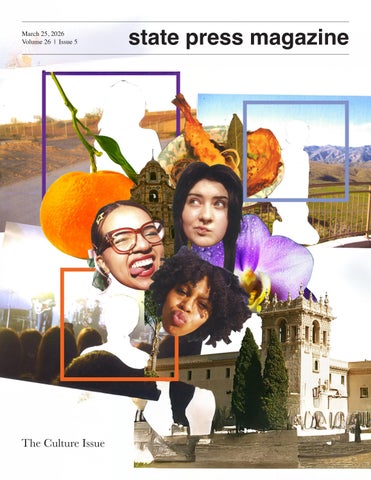
The Culture Issue

Page 1


March

state press magazine

EXECUTIVE EDITOR

Katrina Michalak

EDITOR-IN-CHIEF

Leah Mesquita

MANAGING EDITORS

Abigail Wilt

Natalia Jarrett

DESIGN EDITORS

Lavanya Paliwal

Paulina Soto

ENGAGEMENT EDITOR

Wendy Maddox

WRITERS

Jude Banihani

Paige Moore

Aleisha Paulick

Evan Silverberg

Aleah Steinle

Kasturi Tale

Keyanee Walls

Lucia Zettler

ILLUSTRATOR

Kormac Moore

PHOTOGRAPHER

Liam Gigsy Gajotan

COVER BY: Liam Gigsy Gajotan

Editor’s letter

As we continue to measure the passage of time based on change — whether that’d be our classes, our relationships or our attitudes — the cultural climate is the one thing we can count on to transform each year. The first three months of 2026 have already defined this significance. We are living in a time where uncertainty is leading, and many of us at ASU are simply looking for any stability we can find. We hope that cementing the tradition of The Culture Issue for another year achieves that.

In this issue, reporters reached into all corners of the community to define the current culture’s pressing matters. Some gravitated toward the budding concerns surrounding cryptocurrency, while others explored on-campus traditions rooted in culture. One reporter navigated the student work force, and an SPM e-board member ventured into the video game community. Others chose to look inward, sharing their personal experiences with their ethnicity and the overarching transitions around them. Our feature story investigates the validity of ASU’s relationship with artificial intelligence.
‘We come to this place for magic’

Preserving cinema culture in the digital age

Ihave Nicole Kidman’s entire AMC theater pre-show advertisement committed to memory. If you’ve been to this theater in the past five years, chances are you’re familiar too. There are few words to describe the feeling that washes over me in the theater when this ad begins to play. I genuinely feel the spirit of Kidman enter the room — silver pinstripe suit and all.

As Kidman steps through a puddle — with AMC’s logo glowing red in the water’s reflection — she enters the theater and takes a seat as her uplifting monologue continues, a love letter to cinema.

“Somehow heartbreak feels good in a place like this.” And she is completely right! This ad perfectly encapsulates what makes movie theaters so special.

The theater gives its patrons a temporary escape, operating as a center for community and unique experiences. Yet, movie theaters around the world have continued to struggle in the aftermath of the pandemic. To many, movie-going has become obsolete in the streaming age.

But for me and so many others, the theater will always be an important space, and I believe our generation will be the one to keep cinema culture alive.

I don’t think I know anyone who loves going to the movies more than my grandma. And this appreciation is something I’m sure I learned from her. As a kid, I remember a handful of days where she was supposed to take me to school, but we ended up at the theater instead.

These dates are some of my favorite memories with her, and we have continued this tradition today. Birthdays, Christmas Eve and any time I’m back home, my visits with her almost always involve a big silver screen.

Quality time hasn’t always been a strong suit

of mine. Especially as a busy and generally irritated teenager, most of the free time I had I preferred to spend alone in my room. “Let’s watch a movie!” was my mom’s most frequent suggestion in her attempts to drag me out of isolation. The movie was typically “The Sister Act 2,” and my answer was typically “No.”

In time, though, we found a happy medium — catching the newest movies at the theater down the street. On the weekends we were free, my mom, little sister and I would make a day out of going to the movies. My sister and I would beeline for the concession stand, reciting our ritual order: A large popcorn with extra butter, two ICEEs and a bag of mini Kit Kats.

With hometown friends, trips to The Loft Cinema — an iconic, small arthouse theater in the heart of Tucson — were always a fun venture. The Loft is a unique community hub in the city, with over 50 years of history.

Coming to ASU, I was so excited to have a theater just walking distance from my dorm. The Arizona Center AMC became a sanctuary for my friends and me. Amid stressful spells, we’d go to the theater for a breath of fresh air. For a couple of hours, we had nothing to worry about, and as we left, all we could concentrate on was decoding the film we’d just seen.

The movie theater has always been a place I felt excited to go to, and sharing the experience with people I love makes it that much more special.

Recent revival

The pandemic drastically impacted theaters around the world, as many were forced to close their doors, unable to fill seats. A local example that comes to mind is the Valley Art Theatre on Mill Avenue, which opened its doors in 1940 and closed temporarily over five years ago.

As the third established Harkins Theater, this venue has a rich and important history. Valley Art was the only theater constructed in Tempe during the Great Depression, making it a symbol for the persistence and success of arts and entertainment amid economic and social hardship.

For half a decade, some variation of “See you soon” has been written on the marquee, and despite community pressure, the doors have remained closed.

There are several threads on Reddit consisting of user inquiries about the fate of this landmark, with many describing the various possible uses of the theater as a community hub for

film lovers around the city. One user even suggested a possible student film festival in partnership with ASU’s Sidney Poitier New American Film School.

In general, I’ve witnessed a common craving for a space like Valley Art in the city, and this longing reflects a much greater movement emerging within our generation.

motivated this revival. Users on Letterboxd can rate, review and list films through journal-esque logging and tracking. I hopped on the bandwagon in 2021. For me, much of the app’s appeal is its ability to make moviegoing feel productive. When I go see a movie and fully immerse myself in it, I get excited to write about that experience in my review after the fact — or even just to read other people’s

Theaters as third spaces

When I say memory, I am referring to the impression of a movie-going experience on oneself. There is a certain rarity to this practice that I have come to appreciate. You can watch pretty much any movie you want from the comfort of your own home, but there is something so special in the experience of seeing a film as it was meant

Schemes, scams and stocks

The fast moving world of crypto currency

It’s early 2009. You’re on your old Mac desktop. You know… the one with the big white keys that click loudly when you type? On one of the anonymous discussion forums you follow, you see someone has posted a link to a whitepaper — “Bitcoin: A Peer-to-Peer Electronic Cash System.” You read it, find it interesting, but brush it off. Little do you know, you’re about to witness the start of a technological revolution.

Since the release of Bitcoin’s whitepaper, 29 million different cryptocurrencies have been created, including Ethereum and Dogecoin. Though the cryptocurrency industry has only been around for about 30 years, it’s left its mark on the technological space. Scams and scandals have shaken the crypto world, and what was once a niche alternative investment has now captured the minds of many young investors. But what, exactly, is the value in this newage digital currency?

Cryptocurrency, for dummies

Gail-Joon Ahn is a pro-

fessor specializing in computer science and engineering at the School of Computing and Augmented Intelligence. He is also the founding director of the Center for Cybersecurity and Trusted Foundations and the Security Engineering for Future Computing Laboratory. Ahn has extensive experience researching blockchain technology in relation to cybersecurity.

Think about your MyASU account, for example. Every account is connected to a centralized server that stores the information located within the accounts. So, in order for you to use your MyASU account from your laptop, you have to tap into this centralized network belonging to ASU. Blockchain works differently. Rather than tapping every account into a centralized server, each individual account is part of a blockchain that acts as its own server. So, in other words, everyone’s computer or phone can be its own centralized system that makes up one small piece of the puzzle.

Cryptocurrencies, like Bitcoin, utilize this block-

chain technology. You can think of crypto as digital cash. When you use your debit card at a store, the retailer, your bank and the third party that processed the transaction have it all on record. However, if you pay in cash, there isn’t the same “paper trail” left behind. Therefore, crypto is pseudonymous because it doesn’t need a third party, acting as a centralized system, to process transactions. At the end of the day, there is always a way for your transactions to be traced back to you, unless you take extra measures to conceal your online identity.

“Back in the ‘90s, people were thinking, ‘Can you use a mathematical format as cash?’” Ahn said. Bitcoin brought this idea to life. A mathematical encryption essentially means a message is created and hidden behind a mathematical problem, which acts as a key. In order for you to unlock this key, you need to solve the equation. This is how “mining” Bitcoin works. You, or a group of data servers, must work together to solve math equations to collect the Bitcoin locked behind them.

The U.S. dollar is a fiat currency, which means that it holds a value because we have decided it does. When you hold a $20 bill, you are technically holding a piece of paper, but the government guarantees that this paper is worth something — it’s currency. Bitcoin holds its value because of how limited it is due to the mining process.

“Once you solve the problem, you will get the coin,” Ahn said. “Whenever you keep generating this coin, eventually you’re getting harder to solve problems. So that’s why you have a limited number of coins.”

Young investors

“I feel like the idea I had when I got into crypto was ‘I’m going to become ‘fuck you’ rich in three months,’” Haidar Alasaif, a junior mechanical engineering systems student from Saudi Arabia, said. “I don’t know if you’d call it ambitious or delusional.”

He became interested in cryptocurrency when he was 15 years old. During the crypto boom in 2020, he began day trading cryptocurrencies with his older brother. Their strategy involved buying as soon as the market opened at 9 a.m. and selling at “peak hours” between noon and 3 p.m.

They saw an increase

of 3 to 4% on their penny stocks, which are stakes in small companies that trade for less than $5. Often thought to be “low risk” due to their low price, some young investors find them enticing. Alasaif noted that his day trading was very time-intensive, making it unsustainable in the long term.

During the peak of his trading, Alasaif lived in Saudi Arabia, where the crypto industry was highly regulated. “What you had to do if you wanted to trade crypto in Saudi Arabia is have an international bank account in your name because you could not sell crypto and keep

the capital gains in your Saudi Arabian bank account,” he said.

Today, regulations in the country have changed, and investors can place their capital gains directly into their Saudi bank accounts.

Where do you begin?

Unlike traditional investments such as stocks, bonds, real estate or commodities, the crypto community is smaller and elusive.

Alasaif utilized various social media apps to learn about different cryptocurrencies and how he could go about investing. “We had this Discord group. It was $15 to get into the group, but they’d give you tips on what stocks [were] going to bloom that day,” he said.

With traditional investments, many people read financial journals like the Financial Times or Wall Street Journal, look at companies’ financial statements on the Securities and Exchange Commission or consult a wealth advisor to build an investment strategy. However, when it comes to cryptocurrency, especially smaller and newer ones, it’s not as easy to find public information. Penny stocks are not listed in major stock exchanges such as the NASDAQ, meaning they don’t have to go through a rigorous vetting process to be sold publicly. Due to this lack of transparency and available information, investors consult forums like Reddit and Discord for investing advice.

“I feel like Reddit and Discord are where, quote on quote, ‘geeks’ are and they know their stuff. They’re the ones I feel like, put in the research and then there’s a reason why you pay money to get into these group chats because that’s how they make their money as well,” Alasaif said.

He even compares the group moderators to “stockbrokers” in the crypto world.

Alasaif also believes the crypto community utilizes social media more than other investors because they tend to be younger in age.

Matthew Jurenka is a graduate student pursuing his master’s degree in computer science. Jurenka has been working with blockchain technology since he was an undergrad. One of his projects utilized blockchain

technology without a relation to cryptocurrency. The project involved prepaid phone data that often goes to waste. If you buy a prepaid SIM card with 10 gigabytes of data on it, you likely won’t use all 10.

“The other 5 are just gonna go to waste, right? So the idea is with blockchain, you’re able to use the amount that you need and take the amount that you don’t actually use and then sell it back to the market,” Jurenka said.

While Jurenka is not heavily interested in the investment side of cryptocurrency, his extensive experience with the engineering aspect has given him an in-depth insight into the industry. He believes that the overvaluation of crypto stocks happens quite often because the industry revolves around “hype.” This, combined with the illusions many young people have that they can “beat the market,” can lead to large financial losses.

“It’s a lot of the marketing behind it. If you look at Robinhood, if you look at the marketing, they try to encourage you, they try to make you think that you’re smarter,” Jurenka said.

He believes that stock exchanges want people to make as many trades as possible because they can make money on the fees. “They just want people to make trades. They want as much money going through the system as possible. And so, they kind of feed into this narrative that, ‘You’re smarter than everybody else,’” he said.

Not so above board

Alasaif said there are so many scams in the crypto world because regulations have not yet caught up to the industry’s growth. It’s difficult to form a fake company, go public on the stock market and sell shares without being busted along the way due to intense regulations.

Crypto, on the other hand, hasn’t yet been regulated the way traditional investments have. For example, pump and dump schemes have become prevalent in the crypto world. Since

many small cryptocurrencies trade over-the-counter, meaning they are not listed on a major stock exchange, they are not vetted by any financial institutions. As a result, investors don’t have a lot to judge the company by other than “hype.”

Fraudulent companies can then inflate the price of their crypto company by creating fake hype using social media. If enough investors purchase the stocks — leading to an inflated price — the fraudulent investors sell off their stock, pocket the cash and watch as the value crashes.

Another problematic occurrence in the crypto world is companies that don’t actually have a product. Take, for example, OneCoin — a fraudulent company founded by Ruja Ignatova, a con artist who has been missing since 2019. Ignatova told investors that investing in OneCoin was their chance to get rich and break into crypto while they still could. After raising billions of dollars and disappearing, it became apparent that OneCoin was a fake company, with zero technological backing.

“Don’t trust everything you see on the face, always look deeper,” Alasaif said.

Ahn said there are many cryptocurrency scams that involve the sale of stocks for a company without any real blockchain technology. “There is no guarantee that those coins are really leveraging the blockchain technology,” he said.

He also explained that researchers can do trustworthiness tests to determine how legitimate a cryptocurrency is. With most cryptocurrencies, the blockchain should have some of its solutions as open source. Open source allows the users to be sure that the coin they are investing in is actually using blockchain. It also allows you to understand the mining process and verify its legitimacy. Think of this as open source AI, which allows us to understand that we are using a real LLM chatbot and not just typing to a human on the other side.

“If you’re familiar with blockchain, you can easily identify it [scams] because ‘Oh it seems they are not using a well-known blockchain open source library’ then you can easily say ‘Oh there ‘s some red flags,’” Ahn said.

So if researchers can identify a fraudulent cryptocurrency, how did OneCoin get away with its scam for so long? Ahn said that even if a website claims to use well-known blockchain algorithms, it still isn’t easy for the average person to verify the claims.

“These are my booting algorithms, these are my mining algorithms, but eventually you don’t know exactly whether or not they are leveraging

these algorithms in their real implementation,” he said. Researchers would eventually figure out that the coin is fraudulent because of the different tests they can run, but the average investor has a harder time doing so.

Thinking beyond crypto

Dragan Boscovic is a clinical professor at the W.P. Carey School of Business. He is also the director of the Blockchain Research Lab at ASU where he conducts research on blockchain technology outside of just cryptocurrency.

Boscovic said there are three main features of blockchain technology: a unique identity, verifiable ownership

and the ability to record every transaction in an immutable way.

“And on top of that, you can add that everything is auditable [in] real time, because everything is on blockchain,” he said. “If you make those records public, then anyone, anytime, anywhere, can audit what was done.”

The blockchain technology backing cryptocurrency represents something far larger than just penny stocks and scandals that have shaken the industry. It represents a revolutionary technology that has the potential to create new industries and systems.

“Students are very much into cryptocurrency, I think they see that as liberating in some sense,” he said.

Photo by Stella Zettler

Burning out, clocking in

A look into ASU’s working students and their frustrations

Every weekend, Kennady Reading, a sophomore studying criminology, is on her feet hustling to serve the long queue of customers lined up inside the In-N-Out at Desert Ridge Marketplace. The constant yelling of food orders, the volume of the crowd’s conversations and the smell of musky grease become what she describes as a “busy beehive.”

For six hours a day — sometimes more — Reading pours fries into an oil bin, drains it, coats the fries with salt, portions them and places the finished product into individual fry boats. This constant cycle typically ends around 2:30 a.m. after the restaurant closes, but sometimes, she won’t get home until 3 a.m.

When she finally settles in, she is often so exhausted at the end of her shifts that she avoids her academic her academic

responsibilities. Other times, rather than taking the time to thoroughly learn material from her classes — like reading an assigned text — she’ll briefly skim through it instead.

“It’s frustrating, especially because I love my academics,” Reading said. “I love what I’m majoring in and I love school but that love has kind of shifted into something else because I’ve had to work and have to sustain myself.”

As of the 2026-2027 school year, in-state ASU undergraduate students living on the Tempe campus are expected to pay $12,177 for base tuition, while non-residents and international students pay over $35,000. However, this does not include other costs like housing or food.

Photo

Although ASU offers financial resources like scholarships, they aren’t the easiest to acquire, as some hold distinct requirements. And even if a scholarship is obtained, not many offer full reimbursement opportunities.

As a result, students like Reading have pursued jobs to support their academic endeavors. Although she works off campus, ASU does offer on-campus employment like federal work-study programs to help students who cannot obtain those opportunities. While these jobs seem accessible, students still experience obstacles in securing these positions.

Finding employment

Rahma Alifia, an international graduate student studying biomedical informatics and data science, is a Fulbright Scholar and receives some financial support from the program. Because the scholarship does not cover all costs, Alifia needed a job to offset some of her expenses, which led to her applying for roughly 20 to 30 on-campus opportunities. However, her applications were either pending for long periods of time — up to 2 months — or were rejected entirely.

“It’s better to disclose what’s the problem, what’s the reason behind the rejections, especially when it comes to international students because [we] keep asking why,” Alifia said.

After working unpaid for six months at 10 hours per week for ASU’s Substance use HeAlth REcord Sharing research program (SHARES), they were able to pay her. Through this role, Alifia is currently working with faculty members to conduct research on a substance use disorder-related project. Her work consists of literature reviews, data analysis and collection, programming and writing manuscripts for journal or paper publications.

“My professor told me that if she was satisfied with my work, she would try to find funding support,” Alifia said. “So the reason why she didn’t pay me at first was because she didn’t know me and she wouldn’t put any money first.”

Although balancing voluntary work while managing academics can be taxing, Alifia said she did not feel overworked due to the job. Instead, the multiple failed attempts at finding a job with a sustainable wage left her more anxious.

Despite eventually receiving compensation, Alifia said it was initially strenuous because the amount of hours she worked increased to 20 per week. She also took 13 credits each semester of her first year rather than the minimum of nine for full-time international graduate students.

“My class schedule was pretty dense, with the courses also [being] pretty hard,” Rahma said. “I needed to work on weekends and I don’t think I had enough time for social events.”

Student workers under ASU are only permitted to work a certain number of hours per week. International students are prohibited from working

more than 20 hours per week, while U.S. citizens or eligible non-citizens are able to work up to 25 hours per week. This is also the maximum amount for multiple jobs combined.

Since Alifia took more credits during the first year of her master’s program, her tuition cost was reduced during the 2025-2026 school year. Even so, Alifia continued working at SHARES because she wanted to keep developing her career skills.

“The job is pretty aligned with my studies,” Rahma said. “I want to apply what I learned in the class to the job. I also find that I love the research job, so I just continue working.”

Natanael Payan, a sophomore studying criminology, also experienced frequent application pending — two pending for about four months — or rejected job applications. After five attempts, Payan shifted his focus to off-campus employment and worked at McDonald’s to save up for a car, eventually starting work at an Amazon warehouse in October 2025.

“I was getting tired of it,” Payan said. “I was thinking of dropping everything, just going to work and then build myself from there, maybe go to school later on. But at the same time, I’m already here, so might as well endure it.”

Payan said that while he received scholarships, they only covered tuition and housing, so he began working to pay for additional expenses such as groceries and textbooks. At $19.35 an hour, along with receiving benefits like health insurance, it sustained his college endeavors, but his lack of sleep became the cost of that compensation, as he works Sunday through Wednesday from 6:30 p.m. to 5 a.m.

“It took me about a month to be able to know when to wake up, when to sleep,” Payan said. “We’d clock out at five a.m., I’d get back to the dorm and because of traffic, sometimes around 6 [a.m.] and I wasn’t able to go to sleep until eight.”

Finding balance

Consequently, while Payan’s academic performance was not affected by the long work nights, he said he still felt that he was falling behind because he was often too exhausted to participate or build connections with his professors. Later, due to being overwhelmed with his class schedule and working 60 hours a week during the holiday season, he took a break from Amazon in early January.

“I was pretty much not having any sleep, I barely managed to do anything,” Payan said. “It was just work, come home, maybe take a nap for like an hour, and then wake up, get ready for classes, have lunch and then go back to work.”

During that break, Payan temporarily worked at Chocolate Bash, located in the Arizona Center. While the shifts weren’t overnight and the expectations were simpler compared to Amazon, the wage wasn’t sustainable due to an insufficient amount of hours. After two months, Payan continued working at Amazon again in early March.

After unsuccessful attempts seeking employment through ASU, if the opportunity arose, Payan said he would immediately take it, as an on-campus job would be more manageable alongside his classes. In addition, some positions offer benefits like paid housing, and even with ASU’s 20-25 hour maximum, this would still relieve some financial burdens.

“Compared to an off-campus [job], where you have a firm schedule, it doesn’t matter whether you have school or not; you have to show up to work,” Payan said. “It’s also like the distance, traffic, gas and all those little things you have to spend just to go to work.”

Elise Quan, a second year masters’ graduate student studying biomimicry, said she enjoys her

role as a library aid at Naturespace — located in the Hayden Library — as it allows her to apply knowledge from her major. Quan said that this space allows students to have a hands-on learning experience.

Having had this position for two years, Quan said she prefers this environment over her past waitressing jobs. At approximately $15.62 an hour at 21 hours a week, Quan said she’s able to earn the same amount in a relaxed, yet professional work setting.

“It [her previous jobs] was a lot more stressful and I would have to deal with unpleasant people sometimes,” Quan said. “At Naturespace, I get to help students and all the staff members that come in, people who tour, they’re all very respectful.”

Even though Briana Alfaro also looked for jobs at ASU before her current position at the Arizona Center’s BoSa Donuts, she said that if an on-campus working opportunity arose, she is unsure if she’d take it.

The junior studying animation said she would prefer to find an internship to gain industry experience instead. She revealed that this opportunity did occur; however, she was forced to reject it due to it being unpaid, as she is self-supported

“It was literally perfect,” Alfaro said. “But it was just a rough time in my life where I knew I couldn’t give up the financial stability to go and pursue that internship.”

Alfaro described declining this intern-

ship due to maintaining financial stability as demoralizing. However, she’s also had moments of wanting to resign from her job for reasons such as needing industry experience, focusing on classes and simply wanting to take a break. Alfaro currently works 31 hours a week while attending three days of class, but she has previously worked 28 hours alongside only two days of class, giving her a day off from both her job and school.

“I miss it because I could sleep in for once,” Alfaro said. “I just had the whole entire day of not worrying or stressing about being late for something.”

Similar to Alfaro, Reading auditioned for the Pre-Law Society at ASU club, but she said that due to her long hours at In-N-Out, it affected her preparation and she failed to receive a spot.

“I think I had a week to [prepare], so I was pulling out my hair and I was so stressed,” Reading said. “Even while I was at work, all my managers were like, ‘What’s going on? You’re so out of it right now.’”

Despite Reading’s plan to re-audition for the club her junior year, she’s still concerned about whether she’ll be able to receive a spot since the Pre-Law Society prefers freshmen and sophomores, according to her. In addition, the minimum requirement to be in this organization is to attend its meetings. But due to her night shifts and the club being located in Tempe, it demands both money and time.

“That means I have to go home, work

for two days, come back to Tempe to do the meeting and go back on Sunday to work and then come back downtown,” Reading said.

Although Reading’s part-time job is purely to finance her education and other expenses, she said she’s encountered instances where she becomes too dedicated. She explained she became so preoccupied with achieving perfection during the spring semester of her freshman year that it left her burnt out. To ensure this did not repeat while balancing her financial and academic obligations, Reading said she learned to refuse additional work, such as being asked to cover a shift.

“This job is not for me to excel at my work or to become manager eventually, it’s for me to literally come in, get my money [and] leave,” Reading said. “As transactional as that sounds, that’s how it has to be.”

Similar to Reading, Payan also developed a schedule to manage a demanding job and classes after two months of rushing assignments and being late to work. Despite now being able to balance both responsibilities, he said it’s still often frustrating to see students who don’t have to be concerned with bills while maintaining an adequate academic performance.

“I had to force myself to be able to stay up, manage my time so I didn’t have to rush anymore, because the bills have to be paid,” Payan said. “I have to do everything and I have to manage it one way or another, so I peer-pressure myself to be able to handle everything and be okay with it.”

Spreading ashes

A reflection on family and my visits to Puerto Rico

Click Click. Dominoes sprawl across the wooden table. My feet dangle off the ground, and I carefully trace my fingers along a deep crack in the table’s surface. My sister places her chubby hands on the table, hoisting herself up with her face tied in an angry little knot. Paco is cheating again. Against a 7-year-old.

This is how nights in Puerto Rico usually go — loud and chaotic, with the consistent squeak of the coqui floating through the air. As the night winds down, my grandparents’ house feels ominous and quiet, as if waiting to erupt into its natural state. My feet cling to the tile floors as I roam the house, and the coquis’ gentle chirps swallow the sound of my footsteps. My sister and I’s room lacks air conditioning, and I can never sleep when it’s so hot. The sheets tangle between my legs like an angry snake, so I often abandon sleep to sneak into the kitchen to steal a moment.

The mornings are often quieter; everyone expended their arguing energy the night before. Paco is all dressed up to go nowhere, with a perfectly ironed black suit and glistening loafers. His cologne is strong, almost overbearing. He smells like citrus and sandalwood.

Growing up, his family lived on a plot of land owned by someone else. He had 12 siblings, so his parents eventually sent him to work for a family that could afford to care for him. He grew up with very little. My mom used to say he dressed carefully because it made him feel valuable — like he was worth something.

His favorite spot was a dirt parking lot next to a golf course. He didn’t play golf. He would just sit in the car alone for hours and stare. I imagined the dust rising and settling around their old grey Civic as he sat. I always

wondered what he was looking at. Lela argued that we should spread his ashes there because it was “his favorite place.”

So, we gathered around the golf course. On one side is arguably the least beautiful location in Puerto Rico, looking out on a dirt field and an airport. The other is a view of the coastline. The wind is hot and unforgiving, assaulting my eyes with fine dust. My mom sighs, and her bushy eyebrows fold into each other.

Lela opens the urn, her little paper hands trembling with exasperation. She flings the ashes from the urn clumsily, and the wind swiftly lifts them. The ashes come blowing back at us, pale fragments of bone landing at our feet. I snort, stifling a laugh. Lela’s cries intensify, and an unassuming golfer shoots us a glare.

Grandma Ada cried like a baby when Paco died, but I’m not sure why. Now, she often rambles that he visits her in her dreams, promising to meet her in heaven. In private, I joke to my sister that hell seems more likely.

Their marriage was short and tumultuous. I’ve never witnessed them together, but apart, my blood grandparents reminded me of a burning flame. Together, I imagine Grandma Ada like a yellow gallon of gasoline, dripping along the flame until Paco grew contorted with hot rage.

Both of them valued their pride and would go to great lengths to avoid feeling small — a trait I often recognize in myself. The story is malleable depending on who’s telling it, but it’s clear to me that Grandma Ada wasn’t the type to ever let a man win.

Paco moved on to marry Lela, an Argentinian woman who radiates joy.

She could never have kids of her own, so she treated my mother like her own.

They met while Lela was working at an Argentine restaurant she used to own. Paco and Grandma Ada frequented the restaurant during their marriage — a detail that Ada presses into my ear, her broken Jersey accent animated with old gossip.

Now, Lela lives without Paco, and she shows me countless movies of love. She giggles at the TV when the boy gets the girl, and the lines of a full life light up her smile. She wears coral lipstick, and her lips cling together as she chatters, promising me she will get a boyfriend who’s 50 — the perfect age.

Lela cries every time we leave the island, blubbering about how each time we see her will be the last. It makes me nervous, and my insides twist into an uncomfortable knot. We only visit once or twice a year, but these memories provide an anchor I often return to.

Before we leave, my mother wants to visit family at the cemetery. I feel pretty stupid. We’re pacing through a maze of graves placed in a seemingly random configuration, like strewn dominoes mid-collapse. We’re searching for the names of my mother’s grandparents — Ada forgot where they were buried. The graves sit above ground, so families can stack on top of each other and pay less for a plot. It’s a tradition born out of necessity, but the idea of bodies hovering beside me makes me squirm.

After about an hour, we find the graves — they are placed in a different, more organized cemetery. The remnants of an angel lie scattered on the graves’ stone surface. My mom looks like she’s going to be sick. They haven’t been visited in a long time.

My dad uses water and a crowbar to soften the flower holders, as the soil has solidified. After much trouble, we place the flowers in their holders. They’re plastic, which means they’ll last longer, and their blue hue stands out in a field of gray. I linger at the grave for a moment, frozen. For once, my family has nothing to say

Carmelo died three months after I was born, and my mother’s eyes glisten as she tells me just how excited he was to meet me. She used to spend summers in Puerto Rico with her cousins, and he would often slice a piece of sugar cane straight from the stalk for her — a delicious gift.

As we leave the cemetery, I don’t feel the wet heat anymore. Although I am only a visitor here, my family grounds me. In their stubbornness, intensity and refusal to go quietly, I recognize Puerto Rico — and myself.

‘The great equalizer’

ASU is determined to place itself at the center of AI innovation, prompting both excitement and concern from its community

As the academic world weighs the pros, cons and ethical implications of AI, ASU — eager to maintain its innovation reputation — has immersed itself in the industry in the form of over 500 projects costing hundreds of millions of dollars.

ASU President Michael Crow’s administration has also attempted to raise excitement for AI on campus, hiring Black Eyed Peas frontman will.i.am to teach a course on the topic, as well as declaring an “AI Day at ASU” on Sept. 15, 2025. Last year, the University granted all students free access to GPT-5, the most updated version of ChatGPT. Starting in Fall 2026, this will be added to student expenses in the form of a mandatory $100 fee for full-time students and a $50 fee for part-time students.

Last year, Crow called AI “the great equalizer” and has been a strong advocate for increasing investment in research in the field. He has also advocated for the incorporation of AI into aspects of student life, such as academic advising.

Crow also has significant personal stakes in AI projects, having served as chairman of In-Q-Tel — a venture capitalist firm that funds research for government agencies like the CIA, the National Security Agency, the Department of Homeland Security and the FBI — for the past 26 years.

In one case, In-Q-Tel paid $2 million in 2005 to save a little-known software company from imminent failure. Over two decades later, Palantir, led by Peter Thiel, Alex Karp and Stephen Cohen, has evolved into a $300 billion AI-driven surveillance giant with deep connections to both In-Q-Tel and the federal government.

As ASU’s engagement with AI continues to shape the student experience, many are divided on whether or not the new technology is actually beneficial to the University and its students.

AI in the classroom

“I have been using ChatGPT since my freshman year,” Darsh Chaurasia, a

senior studying computer science, said.

Chaurasia is co-president of the AI Society at ASU, an organization boasting over 1,800 members on Sun Devil Central. He said AI helps him with his classes by making long pieces of text more easily digestible and evaluating sources for validity.

“When you’re talking about something, the authenticity of the source is very important,” he said. “AI helps you look at these sources. Obviously human mind review is required, because you need to verify these resources, but if you use it wisely, you can verify and cross-check all these kinds of information.”

“Students are doing a research paper, and I allow them to use AI,” Regents and Foundation Professor of Law Gary Marchant said. “They have to disclose it at the beginning of the paper, and any text that’s directly generated by AI has to be put in quotes and cited just like a book or article.”

Chaurasia said there is enthusiasm surrounding the potential of AI among students in STEM departments. According to Liz Cunningham, a junior studying animation, this is not a sentiment that’s shared by many in the liberal arts and sciences community.

“The general conversation [around AI] is usually pretty negative, because the way generative AI has been presented is it makes art faster than people and cheaper than people,” Cunningham said. “Students have just been not using it. One of my friends’ sisters dropped a class because the teacher was requiring them to use AI.”

At the opposite end of those refusing to use any AI are those developing an over-reliance on the technology, which Chaurasia acknowledged is a relevant problem among many of his classmates.

“I personally know so many students at ASU that are heavily relying on AI to even complete their degree,” he said. “I know people who are in their final year at ASU doing a computer science degree and they don’t know how to

even write a single line of code because they have been using AI.”

Chaurasia emphasized the importance of balance. “[Students] are getting good at putting in prompts,” he said. “That is a good thing, because this is something that you would require in the near future. But AI gives you the entire output by itself, all you need to do is control-c, control-v; copy and paste … I’m not saying everyone does this, I’m just talking about most people.”

“I recommend they use it for things like editing, brainstorming, research, things like that, rather than necessarily generating me a text,” Marchant said.

Marchant, who is also the faculty director for ASU’s Center for Law, Science and Innovation, said the proliferation of AI in the classroom has had both positive and negative results. While the highest grades on his papers did not increase, the lowest grades rose dramatically. “I don’t get any bad papers anymore,” he said. “Last year, I had one bad paper and that student said they didn’t use AI.”

Marchant also explained how this can be an issue. “It’s actually a problem for me, because we have a grading curve,” he said. “I’m required to give a certain number of low grades and it’s very hard when they’re all fairly well-written.”

Some issues are driven less by an increase in assignment quality. “You do see some papers where it’s pretty clear they’re using AI to do almost all the writing, they’re not doing their own critical thinking,” he said. “I’ve had my first example of a student handing in a paper with a hallucinated case that didn’t actually exist, which is a huge problem.”

In both computer science and animation, students said AI guidelines are often unclear. Siddharth Mehta, a graduate student studying computer science and the vice president of AI Society, described a “polarity” in how his professors approach AI, where most are either strictly against it in all forms or willing to accept any level of AI use as long as assignments are turned in.

Cunningham experienced a different problem. “The syllabus has not been updated since 2020, so it doesn’t even say anything about not using AI,” he said of one of his art classes. “I would like to think if somebody turned in a product that was entirely AI, they would get a zero.”

Marchant said faculty at the Sandra Day O’Connor School of Law are each allowed to have their own AI policies. He said that while many professors of introductory classes ban it, those teaching upper-level classes are more lenient.

“Most lawyers today are using AI in practice, and so we want to train our students to be ready to practice in the real world,” he said. “Time is a huge issue in legal practice. To be able to do things more quickly and better will be an important skill.”

human artists would generally get fired for,” Cunningham said. “That’s been frustrating to watch, because the pressure is way higher on us, and a machine can do whatever it wants because it’s essentially free for studios and companies.”

AI surveillance technology is one of the most controversial aspects of recent AI advancement. While touted by some as a massive development in solving crime, others have criticized its role in tracking personal information and data.

AI outside the classroom

The fear of job loss is a persistent concern regarding the development of AI. Last November, Coca-Cola released a one-minute advertisement made from over 70,000 AI prompts.

“The quality put out by artificial intelligence is making mistakes that

Chaurasia and Mehta expressed a different point of view, arguing that while AI will replace much of the labor involved in many jobs, it will also create new labor.

“As much as we try to rely on AI, it is true that we cannot put 100% of our faith on it without having an eye on it, without giving our own input,” Mehta said. “I don’t think AI by itself could be as effective as an AI and human working at the same time.”

“We’re being watched now by all these different technologies, all of which were around before AI, but are now integrating with AI to make them much more powerful,” Marchant said. “Cities like Chicago have some 45,000 AI cameras around the city that are tracking people and identifying people.”

Perhaps the most wellknown AI surveillance corporation is Palantir, a company that uses AI to analyze and interpret data collected by its customers — primarily the United States government — and is now worth over $300 billion. When it risked failure in 2005, the company was saved from collapse in large part due to Crow, who encouraged his fellow executives at In-Q-Tel to bail the company out in the form of investments totaling more than $2 million.

Marchant said ASU’s Faculty Ethics Committee on AI Technology is currently weighing the degree to which the University should monitor its students.

Marchant said legislation and regulation have been slow to keep up with developments in AI surveillance, and that court decisions are often made on a case-by-case basis. “We have no federal comprehensive privacy law in the U.S., unlike most countries, but now we have 19 different state laws,” he said. “That’s creating a lot of confusion, and then states like Arizona don’t even have one of those.”

He said many still rely on the Electronic Communications Privacy Act of 1986 to regulate AI surveillance, despite the law predating even the World Wide Web.

“I would like to see [issues] being resolved by faster-moving types of governance, and I don’t think legislation and regulation are up to the task,” he said. “A lot of my work is what’s called ‘soft law’ — finding other ways to do things like industry standards, best practices.”

“Evolve or die”

AI-themed courses. “We have all kinds of seminars, we have conferences, we have workshops, we have all kinds of research projects, so I really think we are full service to our students in terms of AI education,” he said.

Crow has approached the AI revolution with an “evolve or die” attitude, in his own words. Chaurasia and Mehta embrace the technology with a

“Everything is changing, and if you choose not to use AI consistently, everyone who’s using AI — who’s leveraging AI to make their decisions more efficiently — is going to have an edge over you,” Mehta said.

Cunningham acknowledged there is potential for AI to do good, citing its use in detecting cancer cells, but argued this is currently overshadowed by the issues it is creating. “People are literally being replaced by machines now, and it’s very frustrating to try to navigate that while also trying to navigate an already difficult industry,” he said.

similar attitude.

“I had a conversation with President Michael Crow, and it’s really nice to see that there is a lot of positive input about AI coming in from [him],” Mehta said. “There’s a lot of money being put in from the executives and it’s really nice to see.”

Marchant said that in Fall 2026, ASU’s law school will have eight or nine

“When something new comes in, which has a huge impact that affects the job market, some of the traditional roles in the job market get affected, and people who don’t adapt to the change might get left behind,” Chaurasia said. “They might lose their jobs and they might not be able to find the same level of job that they are looking for.”

Marchant stressed the nuance of the issue while urging those in the legal profession to take a more active approach in ensuring the technology is used ethically.

“The benefits to things like biology and medicine are going to be absolutely enormous, but also it comes at a lot of cost for things like privacy and issues about ownership of your data and who can use that data,” he said. “There’s a lot of longer-term concerns about the impact on not only the legal profession but on democracy, on government. And those kinds of concerns are ones that lawyers can help address.”

Pressing start

As more women break into the gaming community, efforts toward inclusion continue to be challenged

Tasha Romero has felt the same thing almost every day for over 10 years. A tingling, consuming desire to escape the world around her and forget about the responsibilities her daily life demands. This safe haven involves a headset, a screen and a keen focus on her hands as she bounces between some of her favorite sanctuaries: League of Legends. Teamfight Tactics. Marvel Rivals.

One day, the ASU alum was set up to play a round of Overwatch; all she had to do was turn on her mic and speak.

But as soon as her high-pitched, bubbly voice cut the air, a much deeper, abrasive one tried to squash Romero’s enthusiasm with a single response:

“Start barking for me.”

The comment, however, was nothing new. In fact, it never even pierced the thick skin she’s been building since her childhood days of Halo when she’d get mistaken for a “squeaker” instead of a 14-year-old girl — something she used to her advantage.

“[The term] is used for really young boys online, and so I would tell them I’m a girl, or I’d tell them I’m a squeaker,” she said. “I’d [say] ‘Oh yeah, I’m a squeaker. I’m just an 8-year-old boy playing this game. Don’t harass me, please.”

As she got older, hiding behind the guise of a child was no longer an option. Wanting to be treated as an equal and freely enjoy playing, Romero often found it easier to stay silent.

“Overwatch was a big one where I

couldn’t speak, because if I spoke, they’d [male players] get mad at me,” she said. “I would experience that a lot, especially these role-specific games where [male players] will basically throw a game because I spoke … That’s just people being weird.”

While this happened a few years ago and Romero no longer plays Overwatch, this interaction is only one of many strange exchanges scattered across her decades-long relationship with video games.

“No one would ever really speak up for me at the time,” she said. “Even when I played Halo, those spaces [for women] didn’t exist; women in gaming were there, but they weren’t really there.”

For female players like Romero, unwanted comments are a regular part of playing. According to the Women in Games & Bryter survey, 59% of female gamers reported experiencing some form of online harassment, toxicity or gender-based discrimination in 2023. While these issues have always been tethered to web-based communities, women who game face unique challenges as their behaviors and autonomy are restrained online.

The root of the problem

Christine Tomlinson, an assistant professor of Games and Esports in the School of Games, Arts, Media and Engineering, said that because the gaming community has been predominantly led by “straight, white, cis-gendered men,” anyone who did not fit into this demographic was immediately cast out. Today, she said

the opposite is happening.

“Historically, a lot of those marginalized groups — and that includes people marginalized in categories of race and ethnicity as well — have not felt comfortable claiming that identity for themselves. They don’t feel comfortable calling themselves gamers,” Tomlinson said.

“Now [it’s] a situation where people are reclaiming this identity and reclaiming this title for themselves, which is really cool.”

Tomlinson refers to this as “fractured gaming culture,” which she defines further in her book “Fractured Gaming Cultures: Marginalized Gamers and New Identities.” While these alternative communities are flourishing, she acknowledged that first-person shooter games like Call of Duty, Halo and Valorant are more likely to draw malice toward female gamers.

“All of the toxicity [becomes] too much to deal with, and people will just quit a specific game to try to get away from it,” she said. “It’s not even necessarily that women aren’t interested in these types of games, it’s that they don’t feel welcome.”

According to a study from The Entertainment Software Associate published in 2024, 46% of the global video game population is female. Despite their prominence, Tomlinson said an “open hostility” against female gamers persists due to male homosociality — same-sex, non-romantic social bonds between men.

This division, she said, can be traced

back to the video game crash of the early ‘80s, when an oversaturation of poor-quality games led to a largescale recession in the United States video game industry. When Nintendo wanted to revive gaming with a family console a few years later, they decided to market it as a toy instead.

“At that point, toy aisles were gendered, so they had to pick, ‘Are we going to market this as a girl’s toy or a boy’s toy?’” she said. “They went with boys, and that impacted decades of marketing and decades of ‘Who [are] we making this for?’ which comes along with a lot of cultural stereotypes about gender.”

While this separation was originally contained to major department stores, by the early days of online internet communities in the late ‘90s, a new space for gender isolation was already emerging.

In 2015, a group of anonymous gamers launched a harassment campaign against women in the video game industry, later known as Gamergate. Coordinated across the social media platforms 4chan and Reddit, the movement gained traction after a 24-year-old programmer falsely accused game developer Zoë Quinn of sleeping with a journalist in exchange for a positive game review. As a result, Quinn — along with feminist gaming critic Anita Sarkeesian and developer Brianna Wu — were

subjected to intense online vitriol.

Some have marked Gamergate as a cultural shift in the video game community, one women are still reeling from.

Jonelle Gregorio, a senior studying biological sciences and forensic science, said that women are still not super present in competitive eSports spaces, let alone mainstream entertainment. As of 2026, women

ence. Twitch streamer xocheergurlox — who has amassed a platform of over 32,000 followers — often posts clips of men insulting her over voicechat during gameplay. Some have told her to “go back to the kitchen,” while others express homophobic and racist insults.

But the way female players are treated can go beyond voice chat. Curious about the differences in gameplay across male and female skins, Gregorio decided to conduct an experiment using one of her favorite horror games, Dead by Daylight. Using the female character Yui Kimura and the male character Leon S. Kennedy, she played 15 rounds as each skin to see who would be killed faster. Yui was consistently eliminated at a quicker pace.

account for 35% of Twitch streamers, and in 2023, only 10% of the top 1,000 streamers were women.

“I was asked to go on a live stream with a video game YouTuber, and I noticed that I got a little bit of harassment because, one, I’m a female, and two, I only played as female characters, which is the normal stereotype,” she said. Gregorio is not alone in this experi-

“With Leon, I was left to stay alive. I couldn’t really pinpoint a conclusion, besides saying people just wanted to kill the girl [character] faster because the guy is likely to get a better score or something like that,” she said.

The new age of streaming

In 2019, Romero was active on Twitch — an interactive livestreaming service for content, most notably gaming, sports and other forms of entertainment. Eager to finesse her skills as a gamer, she entered a Teamfight Tactics competition at a local

LAN center in Phoenix, winning first place as the only female contestant. Sometime later, her livestream went viral.

Scarra, an American Twitch streamer and former professional League of Legends gamer, posted on X that he was looking for small creators to “raid,” which involves large creators dropping their viewers off at another channel.

“He came into my channel and raided me, and that really set the tempo for my career when it came to content creating at the time,” she said. “[Scarra] had 300 plus viewers, and I was sitting there with like 10 … And so then I got 300 viewers overnight, and then I got 500 followers overnight because of that.”

Romero attributes these events to her securing her position in the reality competition show “Making the Squad,” that same year. Hosted by European organization G2 Esports, the YouTube-based show took Romero on an all-expenses paid trip to Berlin two weeks before graduation. She took home $10,000.

and so they ended up choosing me.”

With the COVID-19 pandemic on the rise, Romero balanced her winnings between content creation and making ends meet after her job was furloughed. Her Twitch channel, MadhatterxX3, climbed over 1,000 followers; but even as the 27-year-old streamer built a solid, positive fanbase, she still experienced negativity.

After a friend said something in the

According to Tomlinson, when it comes to services like Twitch, streamers are only able to take action against online abuse after it’s happened, saying that it’s up to the streamer to protect themselves through moderators, banned words and cultivating a specific community.

“It’s [streaming] still getting better, but we’re still kind of in this moment of flux where there are these really strong, enduring perceptions that women shouldn’t be streaming or shouldn’t be playing specific video games,” she said.

chat that certain viewers did not like during a particular stream, Romero said she experienced significant levels of toxicity.

“The very last [competition] was an interview, and then a talent display … that’s where I say it was more my personality and how well I answered the questions,” she said. “I think they [the judges] just liked my personality,

“They kept trying to friend me on different accounts on Discord and they found all of that out through my stream. Just because I was gaming and they found me streaming, they were able to find out a lot,” she said. “[It was] a privacy concern.”

Although experiencing an invasion of privacy bothered Romero, she said the incident was out of character for her otherwise inclusive audience.

“I feel very blessed and fortunate about that fanbase and being able to create that kind of environment,” she said. “I got an influx of all these followers and I didn’t know how to handle it or what to do … I made sure to create a welcoming space, because as soon as negative comments were said, it got shut down immediately.”

ASU gamers

Despite facing difficulties in the general gaming world, on-campus Esport clubs are providing a space for women to engage with gaming more freely. The National Association of Collegiate Esports estimates that

over 200 United States colleges and universities currently operate varsity esports programs, and as of 2022, ASU’s Esports Association has over 2,000 active members.

Gregorio is a member of the Society of Wondrous Adventurous Gamers club, based on ASU’s West Campus. She served as the club’s president for a period of time, saying she wanted to help the community become more accepting and open to everyone, regardless of their video game experience.

“Even if they didn’t want to play games, they could just hang out and do their homework in the corner,” she said. “I wanted to provide some place for everyone to have something.”

The club currently hosts weekly meetings where students not only play video games together, but participate in board games, card games and other competitive pastimes.

Gregorio said one of the biggest obstacles surrounding women’s inclusivity in the gamer community is belittlement from male players, even during baseline dialogue. On-campus clubs are an opportunity to change that.

“It’s too bad as a female gamer, you’re

still in that zone where, if you try to talk to a guy about it, they’re gonna either knock you down or don’t even start the conversation,” she said. “The last time I tried to talk to a guy about video games, they would just retaliate, or they would just shoot me down and be like, ‘You shouldn’t be talking about this. Just go to your own conversation.’”

Anna Fiore, a senior studying media arts and sciences, grew up playing LEGO Star Wars with her brother on their PlayStation 2. Today, her favorite game is Fortnite, which she often plays with members of ASU’s Friends of Esports club.

“We’ve seen a big increase in attendance for all our gaming events, which has been really cool to see,” she said. “I don’t know if it has anything to do with the lounge being in a new spot, [or because] it’s triple the size of the old place, and just the technology is newer.”

As a self-proclaimed “tomboy,” Fiore admitted she’s never felt directly excluded as a female gamer.

“Personally, I’ve not, you know, really experienced anything blatantly sexist or whatever,” she said. “I

would honestly quite say the opposite of that [female exclusion] is true with the eSports Lounge, which is why I really enjoy it.”

Sydney Begin, a senior studying biomedical engineering, shared a similar sentiment about ASU’s Video Game Completionist Club.

“We’re very much a casual gaming club. We don’t design games. We’re more focused on playing games,” she said.

“The community is fairly welcoming and inclusive. It’s still very much male leaning, but not [because] they encourage a more male audience.”

She said that because the club is new and was originally started by all male students, female players have been slower to trickle in — although their demographic has increased over the years.

“From what I’ve seen, I haven’t seen much of any of that inequality [on-campus]. Obviously, everyone in the club’s friends tease and joke with each other, but it’s never ‘Oh, you’re a girl. You can’t play these games,’” Begin said.

“For the most part, a lot of that inequality and separation [of the] wider gaming community hasn’t really been here in college.”

Language in pieces

A look at the quiet disappearance of heritage languages

Growing up, I was embarrassed of the things that were the most familiar to me.

The bright, maximalist patterns across bedsheets, curtains and towels that fought to catch your eye, my parents’ unbelievably large CD collection that played an unmistakable role in my morning routine, and the screenings of movies and plays that I was forced to sit through every weekend — no matter how bored I was.

All my childhood, I was raised surrounded by media in my first language, Marathi. My affinity for music began with nursery rhymes from Jingle Toons, and I hoped for friends like the ones from my favorite TV shows. The familiar tune of “Ekati Ekati” gently ushered me to sleep on nights when it failed me most.

While I clutched these rituals close to my heart at home, I was always ashamed to admit their role in shaping who I was. All I knew was that it was not a part of the world I wanted to belong to.

My father bought us a family computer when I was in the third grade. To me, this computer was the epitome of coolness. It carried the blueprint of everything my friends and I wanted to be.

English was the third language I learned, but I worked the hardest I ever have to be fluent in it. My familiarity with English opened a number of online avenues for me, paths that were not available to anyone

in my family for generations before.

The internet showed me a number of truly essential things: The lyrics to Disney’s “Let it Go,” the simulation game “Barbie Fashion Show” and role models in LaurDIY and Rclbeauty101 — cultural touchstones for kids growing up in the 2010s.

I caught myself proudly admitting to liking everything the internet had to offer. I would sit on the steps at school with my friends and duplicate DIY tutorials that never turned out like the videos.

On the bus back home, we would sing lyrics to American pop music. I’d put Taylor Swift posters on my wall and watch “Adventure Time.” Finally, I would feel as if I had nothing to be embarrassed about.

Marathi is a language spoken predominantly in the Western region of India and is the official language of Maharashtra, the state I am from. The language is spoken by over 97 million people across the country and is the medium for some of the greatest film and music I have been exposed to in my life.

Language, after all, carries more than meaning. It carries humor, emotion and sentiment that is often blurred by translation.

Marathi theater, with its quick-witted dialogue and relevant themes, was one of the first places I noticed the power of language as a medium. The

actors on stage executed their parts with the same intense detail that echoed in every other aspect of the play.

You didn’t even need to speak the language to understand the performance.

One of my favorite movies in Marathi is called “Elizabeth Ekadashi.” The movie captures the textures of childhood with striking authenticity. The story brings everyday childhood experiences to the screen, highlighting how the things that feel monumental to kids are often brushed off by adults.

I felt represented in these movies beyond just seeing characters that looked like me; the world they inhabited felt deeply familiar. From the rhythms of their neighborhoods, the cadences of their voices, to even the way they navigated the world around them. Their priorities, worries and small triumphs mirrored my world as a kid.

The familiarity of this language and its connection to the concept of home is not something everyone in my family shares anymore. My cousin, who grew up in India and the United States surrounded by the same songs and movies, can’t really speak Marathi anymore.

What I took for granted for so long — a medium that connected me to one of the most important parts of our culture — is slowly turning into a shameful inconvenience yet again, but for someone else this time.

When our extended family visits, jokes don’t land, conversation halts. Words are repeated and translated until the pun doesn’t make sense anymore. Phrases that came so naturally before now require effort — or stop entirely. The gap between generations deepens.

Linguists warn that this loss is not limited to Marathi, or even Indian languages. This is a loss seen universally, across the globe. I’ve witnessed several conversations within the community about how our language is dying. In fact, it is my grandfather’s favorite dinner-table conversation topic.

Even though regional languages are parts of the curriculum in schools across the country, when students are given the opportunity to learn a second language, they are often strongly encouraged to do so by their families.

According to the World Economic Forum, almost 1,500 known languages may no longer be spoken by the end of this century.

This realization is only amplified when I visit India every summer and find myself reaching for the English version of a word that I used to know in Marathi. In those small pauses — in the split second when the right word refuses to occur to me — I am reminded of how much has changed in the last year.

At the same time, though, I have found myself shedding the shame that was attached so intrinsically to language. I have learned to make peace with the messy, complicated reality that is my identity.

In some ways, then, I try to further my connection to my language.

From forcing my American friends into a culture exchange movie night, to trying to stick to one language when I talk, the shame is slowly getting replaced with an unfamiliar pride.

This is my new favorite part of growing up. I have learned that the colorful bedsheets and loud, old music is as much a part of who I am as “Barbie Fashion Show” is. Just like it is for my cousin.

More than a dance

Exploring the significance of strolling as a unique art form within the Black cultural tradition

The glass breaks. “Everybody pay attention.” The crowd around you begins to part and soon enough, a line of men wearing Greek letters filters through the clearing. You’ve found yourself in the front row of a performance, and the audience is buzzing with energy.

“This right here is my pretty boy swag,” onlookers rally, hyping up the dancers as they travel across the floor. Their movements are clean and sharp, and they dance completely in unison. The choreography is almost hypnotic and everyone in the room is captivated.

The song you’re hearing is Soulja Boy’s “Pretty Boy Swag,” and the performance you’re watching is a stroll — a synchronized, traditional dance performed within historically Black sororities and fraternities. Members line up, with a “stroll master” on the front end, leading the line forward as they perform their organization’s distinct choreography.

You’d likely witness these performances on campus at yard shows, probates (new member presentations) or other events

organized by “Divine 9” fraternities and sororities. D9 refers to the nine historically Black organizations that make up the National Pan-Hellenic Council.

Strolling is just one of many significant traditions and practices carried out by Black Greek- letter organizations. It is unique, however, for its deep historical roots and, further, the space it holds as a form of resistance and expression within the African American cultural tradition.

Emergence of a vernacular dance

Long before this tradition began in 1920 among Black Greek-letter organizations, gold miners in Apartheid-era South Africa were developing a way to communicate through movement.

Gumboot dancing, named for the Wellington rainboots distributed to workers to protect their feet, was developed from restrictions on speaking traditional languages within the mines. As a result, miners would communicate undetected through the rhythmic stomping of their gumboots.

Down the line, this practice became less about communication and evolved to be more recreational. Workers would hold performances with groups of miners joining in to participate. In cities like Johannesburg, where the ethnic makeup of the miners was incredibly varied, the dance became an amalgamation of several tribal influences.

This dance was passed along through different communities and continued to absorb every dancer’s unique additions. Because gumboot dancing was learned through oral transmission, its style continued to evolve and change through each distinct performance of it.

By the early 1900s, the first Black sororities and fraternities began to pop

up predominantly in historically Black colleges and universities in the U.S. Soon thereafter, the tradition of stepping began across these organizations.

Power in performance

Within Black Greek-letter organizations, strolling has been a distinct form of expression among various fraternities and sororities, each creating and passing down their own versions and additions to the dance.

“We have different signs, different calls, steps and strolls, all of that encompasses how we represent ourselves and showcase our own identity,” James Thorpe, a junior studying justice studies and Phi Beta Sigma’s Lambda

Xi chapter vice president, said.

Phi Beta Sigma has a handful of distinct strolls to popular songs, like Meek Mill’s “Dreams and Nightmares.” The Sigma Walk is also a dance unique to the fraternity.

“Even in some places where you may see the same move, you might see them do it differently. For Phi Beta Sigma, one of the most famous moves is the Sigma Walk. And some chapters might not even do it. Some chapters, they’ll use both legs. Some chapters, they’ll use one,”

The processes in learning these strolls as a new member are different across every chapter and organization. Accor-

-ding to Serenity Reynolds, a senior studying journalism and a member of Alpha Kappa Alpha Sorority, Inc., many of the strolls in her chapter are passed down from prophytes to neophytes (older members to newer members). For newer strolls, the chapter president, the song and dance chair and the co-chairs facilitate practices for members to learn and rehearse.

Donovan Drummer, a senior studying sports business and a member of Alpha Phi Alpha Fraternity, Inc. described the learning process within his chapter as a great opportunity for bonding among his brothers.

Rehearsing the strolls in private is only the first step in this process. Taking the dances public and performing in front of an audience is an important milestone for many new members, and some view it as a rite of passage.

Thorpe shared the story behind his first time leading a new stroll, taught to him by one of his older brothers.

“We all rushed to the floor to do the stroll, [and it] made me feel good, not only because he let me lead the stroll, but because I was confident enough [to do it],” Thorpe said. “And he also had that confidence and pride in me, that I could not only lead it, [but] teach it to other people as well.”

Within D9, strolling symbolizes unity among members of individual organizations and throughout the entire NPHC as well. Alana Lynch, a junior studying

journalism and a member of Parliamentarian of Zeta Phi Beta’s Sorority Inc.’s Kappa Iota chapter, said strolling makes her feel a part of something, and having her sisters surrounding her further solidifies this feeling.

“Especially when we’re strolling with our grad chapter as well, it just shows [that this is] a generational thing, [that] it’s a tradition, and it’s our history,” Lynch said.

Thorpe resonated with this feeling. “I feel as though, when I’m strolling with my brothers, that this chapter feels like, ‘This is us,’ this is our mark that we’re putting on not only the yard at ASU, but just how we represent Sigma,” he said.

Continuing a legacy

The cultural and historical roots that strolling has made are an important part of the identities of these organizations, further reflecting their individual beliefs and values. D9 organizations as a whole were born out of resistance to exclusion. The traditions they carry reflect and honor this past.

“We didn’t even have that space [or] the opportunity to represent ourselves in the way that the [Infraternity Council] fraternities and [NPHC] sororities had — we couldn’t join them. We couldn’t represent ourselves. D9 exists as a way for Black people to not only showcase [both] their excellence and culture,” Thorpe said.

For centuries, Black Americans have pioneered pop cultural trends in arts, music and entertainment. Strolling fits into this history in a unique protected space. As an art form that only exists within the D9 umbrella, it has been preserved singularly within Black culture, which is a rare occurrence for Black art.

“The reasons our organizations were founded were because there wasn’t a space for us. We had to make our own space,” Reynolds said.

The protection and continuation of this tradition is incredibly important to D9 organizations, especially in the world of social media, when increased visibility online can give way to misrepresentation.

A major fear in the perception of strolling online is a lack of understanding about its deep-rooted meanings. “Most importantly, it needs to be respected. I know there’s a lot of people, especially now, in the age of social media, where a lot of things can be showcased just for clicks and likes. It’s really easy to get lost in that … Strolling itself needs to be respected in the sense that it is a cultural identity,” Thorpe said.

Popular videos depicting the dance on platforms like TikTok have turned this tradition into a sort of spectacle. Members have expressed the importance of reminding audiences that while the dance is entertaining, it still holds deep cultural significance that those outside of the organizations should not attempt

to recreate.

Members also stressed the importance of understanding that strolling is just one of many traditions and services that D9 organizations devote themselves to.

“That’s not all we do. And we do showcase our principles in other ways [like] through community service, scholarship [and] sisterhood. But in the same breath, strolling has its significance historically and to just respect that,” Lynch said.

Because D9 organizations have carried this tradition on for over 100 years, current members now hold the responsibility of continuing and preserving the practice, while honoring its longstanding and weighted legacy.

Reynolds expressed her thoughts on this responsibility as a member of the organization accredited with beginning the tradition. “Coming out here, learning more about D9 [and] specifically, wanting to be an AKA, and going through the process and then finally getting on the other side, it means a lot to me to represent a legacy that’s been for so many years before me,” Reynolds said.

“When I stroll, or even when I’m just wearing pink and green with the letters, it’s nothing small. For lack of better words, it’s something that’s huge and much larger than me. And I know whenever I am representing my organization, to represent it well, [and to] represent it with pride.”

I love you like mint in my tea

How diaspora communities reinforce struggles back home

Growing up, my grandmother would always read me the old Arabic folklore story “I Love You Like Salt.”

A king summoned his three daughters and asked each of them how much they loved him. When the third responded, “I love you as much as I love salt on my food,” the king ousted her from the kingdom, believing that comparing her love for her father to loving salt on food was insignificant. Years went by and one day, the king was unknowingly served saltless food by his estranged daughter. As he tasted the bland, unappetizing meal, he broke down in tears, having realized only then how much his daughter loved him.

The story may seem silly at face value, but there are many lessons to be learned from it. Some people say, “You don’t know what you have ‘til it’s gone.” Others may say, “Everyone loves differently.” One might also say it’s important to “ask questions before you rush to conclusions.” For me, I would say we need to open our minds and be a little bit more creative. Maybe this is what my culture needs more of.

I have always wondered why the king didn’t ask for an explanation. Why did he so hastily banish his daughter from the kingdom? In the years that went by between exiling his daughter and trying unsalted food, he didn’t once think to understand how much salt does for food? While this is just folklore, I think it can be used to analyze Arab culture in a deeper way.

Whenever I am asked where I’m from,

I always feel proud to call myself a Jordanian and an Arab. I feel proud of my identity, my family and my roots. But, I’m far from patriotic about everything. In fact, a deep sense of pride would probably be a fault in our culture. I often hear Arabs claim that we come from a “perfect” culture, one that has contributed to the world through algebra, algorithms and geometry. And while yes, it is true we’ve given so much to the world and we had a golden age, I still think we’re far from perfect today.

A lack of acknowledgment

Today, our economies are, for the most part, worn out and the youth are left with little opportunity back home. Every year, migrants leave the Middle East due to war, poverty, lack of opportunity and even religious or ethnic persecution. I certainly wouldn’t call our region of the world “perfect.”

I’ll start with one of the first detriments — our pride. I find that many diaspora communities tend to feel a deep sense of it for their homeland, and we are no different. Many of us proudly claim our Arab heritage and identity, but why do we claim it’s the best?

But if we are the best, why have millions of us left our home countries and sought to build new lives abroad? I think we may struggle to admit that pride has gotten in the way of progress. Why change your culture or progress when you feel it’s perfect?

I’ve found it increasingly difficult to travel back home each year and face the growing poverty and difficulty

many go through. I am often reminded that even the smallest of delights is a privilege compared to what many have back home. Even my home country, Jordan, which is considered to be a “safe haven” and a point of regional stability, has been greatly affected by the ongoing wars in neighboring countries, a refugee crisis and a desperate tourism industry.

When we sit in our homes in the diaspora comfortably and call our homelands perfect, we erase the struggles our people go through. I would compare our pride to that of the king. By calling our countries “perfect,” we do what he did to his daughter — jump to a conclusion without interpreting what we’ve actually seen or heard.

When you travel home and deny the reality of what you are seeing, there will eventually come a summer when you go home and feel shocked at how bad it’s gotten overnight. The king had years to try saltless food, and we had years to see the growing issues surrounding our community, but we didn’t intervene until it came knocking on our doors.

Rules for she but not for he

Our culture also insists on clinging to old age gender stereotypes, resulting in a deep level of gender inequality. I see many Arabs grapple with this idea by saying our culture “just likes to protect women” or “it’s just our family values.”

Being conservative and being misogynistic are not the same thing. If our culture was interested in protecting

women, we would work to end domestic violence, preserve autonomy in marriage and bring awareness to breast cancer — which is heavily stigmatized in the Arab world. All of these things deeply affect the lives of women, but instead, we claim that preventing women from traveling alone or leaving the house past 8 p.m. is “protection.”

As an only child, I never experienced first-hand gender inequality in my family, but I have witnessed it with my friends and cousins. I have friends who need to abide by one set of rules, while there is a different set of rules for their brothers. While her curfew is 8 p.m., her brother is out past midnight playing cards with his friends. This reflects a deep distrust in women because the belief is, “If she’s out past 8 p.m., she must be doing something wrong or bad.” Men, on the other hand, are either trusted to do the right thing or they are allowed, and even encouraged, to do the wrong thing.

This misogynistic attitude seeps into so many aspects of Arab life, especially marriage. No matter how far removed they are from the motherland, Arabs often desire to marry young. In fact, we’re told it should be the main goal and ultimate purpose of our lives. And just like with everything else, women are expected to sacrifice the most for it.

But how can Arab women feel so comfortable marrying young when we are not even guaranteed the right to pass our citizenships to

our children? Or be ensured proper custody rights in the case of divorce? In most Arab countries, women can not pass down their citizenship to their children because citizenship is tied to the child’s paternity. I have heard countless stories of custody battles in Jordan that resulted in a father taking the children to live overseas without the mother’s consent.

In my experience, I’ve found Arab women to feel intrigued by the idea of “princess treatment” from a husband. While I don’t hear much of this talk back home, I do hear a lot of it in the diaspora community. I recall a friend a few years back telling me that her dad paid her college tuition because “it was expected in our culture” and “he loved her, unlike other people’s dads.” While yes, our culture does play into the heteronormative gender roles where men are responsible for

meeting their family’s financial needs, this doesn’t mean all families live in such luxury.

Do the fathers in Syria who lost their livelihoods to a civil war not love their kids because they can not pay private university tuition? Do fathers in Lebanon who lost their life savings in the currency crisis not love their wives because they can not afford to enjoy lavish restaurants? Obviously, the answer is no. And just because a man can provide, in a financial sense, doesn’t mean he really loves his family. I have heard countless stories about emotionally and physically abusive husbands. And just like all cultures, our culture is filled with love, toxicity, joy, heartbreak and all the other emotions that come with relationships. When we make blanket statements like “men in my culture always provide for the women,” we are, again, erasing the

very real problems women experience.

What if?

What if our society was more creative? What if we stopped and reflected before we jumped to conclusions? Let’s say the king heard his daughter’s remark, paused and ordered his chef to make him a saltless meal. He could have understood right then how much his daughter loved him, avoiding a long exile and having to face this pain years later.

What if we faced our culture and said, “Yes, we do have problems, and we must work together to give the next generation a brighter future.” The first step to solving our problems would be to accept their existence. Our culture has excelled in countless aspects. From our preservation of language, art, food and history, I could go on forever about my love for the Arab world. But it’s hard to express my love for it when I feel rejected by it.

I often feel alone in my critiques of Arab culture. I’m often met with remarks that I’ve become westernized or that this is just the way things are and I must accept it. But, I know this to be false because our culture, and all others, have changed with time and by internal and external forces.

Us Arabs often drink tea at family gatherings. Tea often comes with discussion, reflection and hospitality. I’ve had some of my most intense discussions surrounding cultural norms, politics and religion over a cup of tea. We always drink tea made in a traditional kettle. It’s not a fancy glass kettle, but a stainless steel kettle. First, you bring the water to a near boil and add it to a spoonful of sugar. Once it’s boiled, you turn off the stove and add your tea bag. But, the one step that makes or breaks the tea, in my eyes, is the mint. Without it,

the tea tastes bland to me. It’s good, but it’s not great. The mint is what adds all the flavor that sugar and a tea bag can’t give you.

I’d say this is similar to our culture, which is amazing in so many ways, but it is missing something. Maybe the mint could be our acknowledgment of the very real problems we have instead of ignoring them.

Turn static files into dynamic content formats.

Create a flipbook
The Culture Issue by State Press Magazine - Issuu