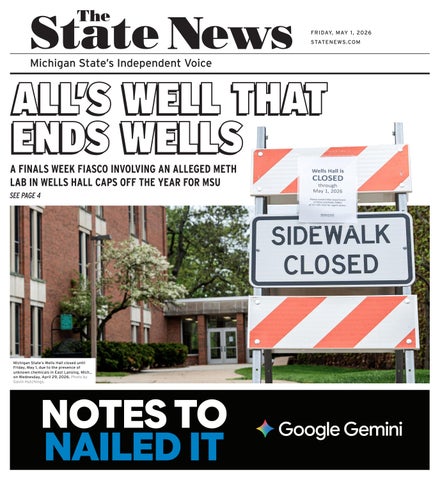
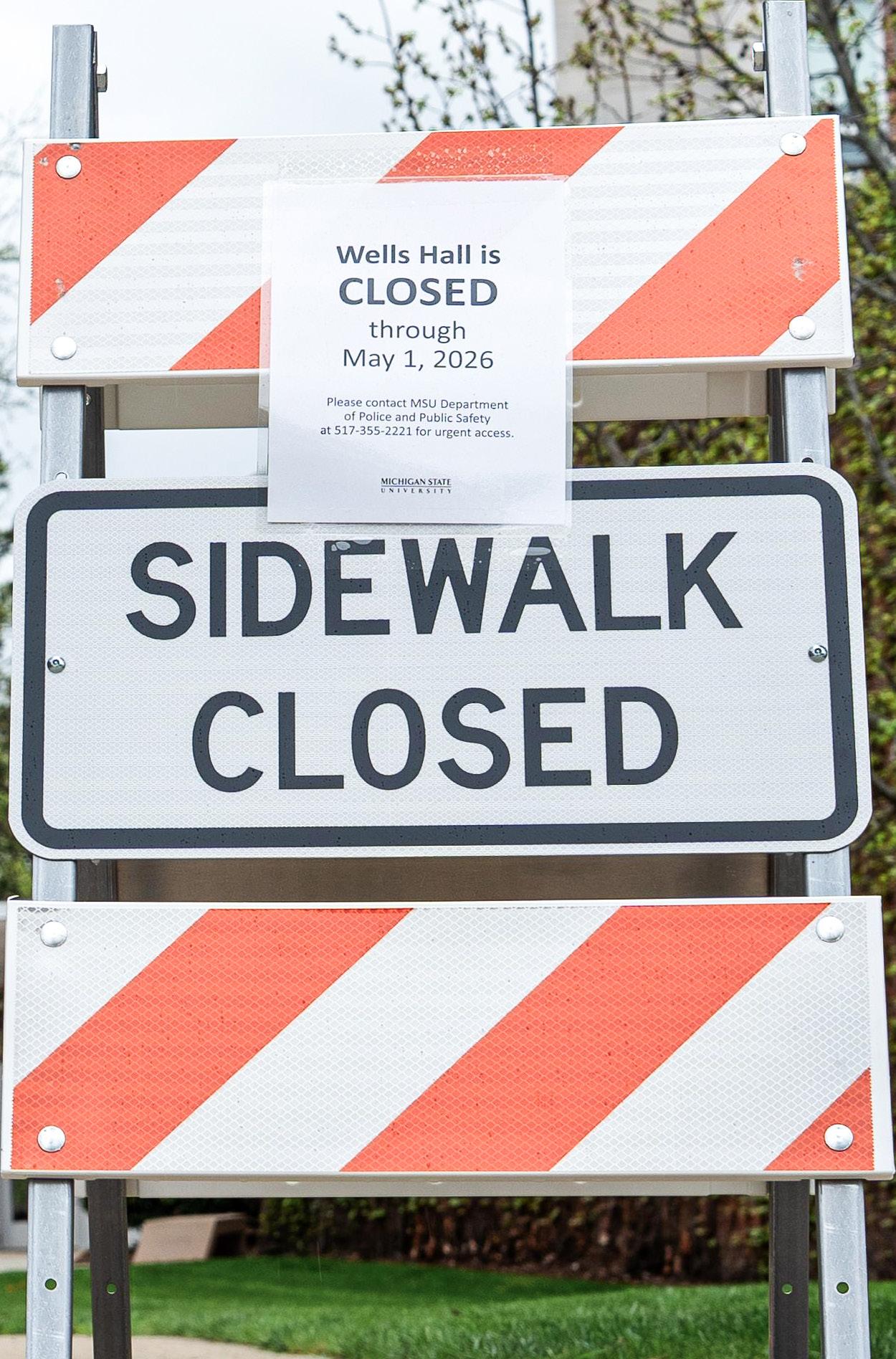
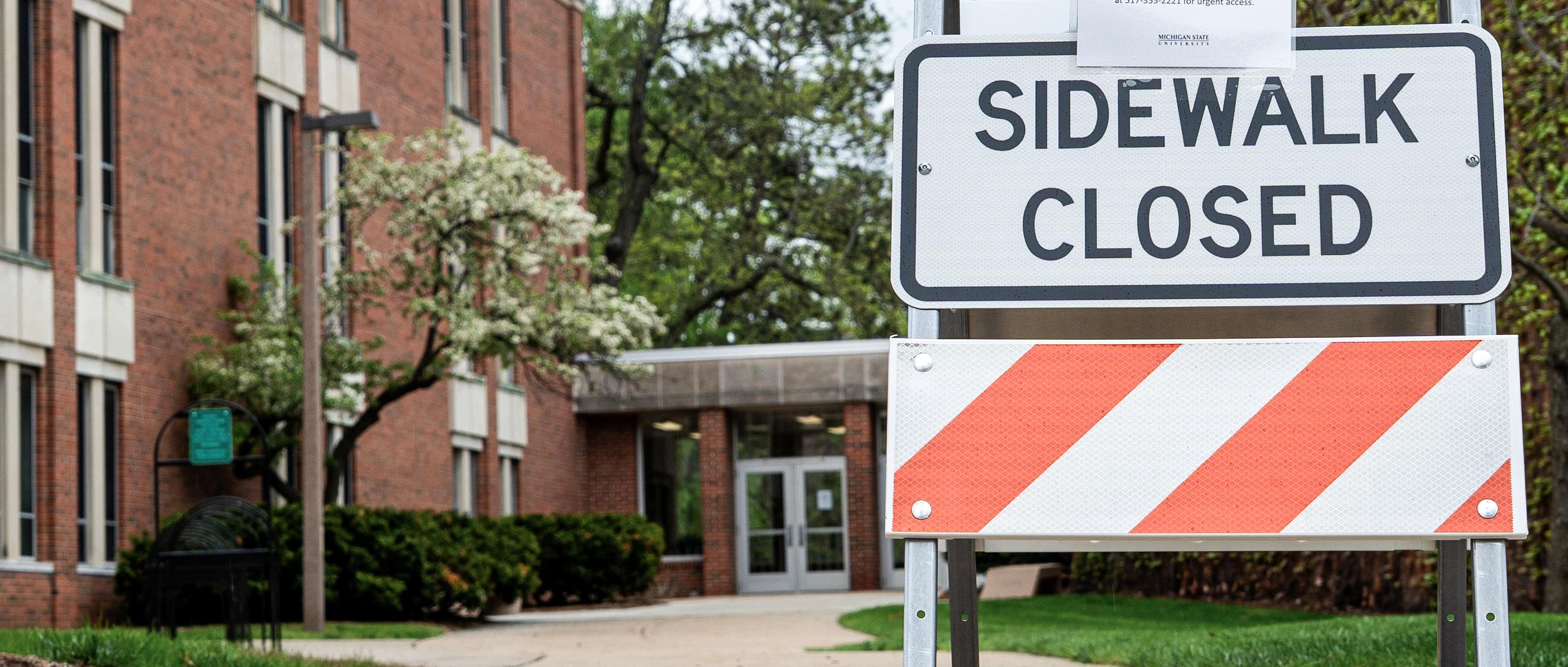
Michigan State’s Wells Hall closed until Friday, May 1, due to the presence of unknown chemicals in East Lansing, Mich., on Wednesday, April 29, 2026. Photo by Gavin Hutchings.
EDITORIAL TEAM
EDITOR-IN-CHIEF
Satvik Shubham
MANAGING EDITOR
Saanvi Seth
DEVELOPMENT MANAGING EDITOR
Thomas Cobb
DESIGN EDITOR
Tate Rudisill
MULTIMEDIA EDITOR
Gavin Hutchings
SPORTS EDITOR
Jason Benedek
ARTS & CULTURE EDITOR
Amelia Fraser
NEWS EDITORS
Emilio Perez Ibarguen
Ellen Young
OPINION COORDINATOR
Jack O’Brien
COPY CHIEF
Emma Stuckey
SOCIAL MEDIA COORDINATOR
Edvige Spizzirri
DESIGN
Grace Montgomery
Hanah Khan
CONTACT THE STATE NEWS
(517) 295-1680
NEWSROOM/CORRECTIONS
(517) 295-5149
feedback@statenews.com
GENERAL MANAGER
Christopher Richert
ADVERTISING
M-F, 9 a.m. to 5 p.m.
The State News is published by the students of Michigan State University every other Tuesday during the academic year. News is updated seven days a week at statenews.com.
State News Inc. is a private, nonprofit corporation. Its current 990 tax form is available for review upon request at 435 E. Grand River Ave. during business hours.
One copy of this newspaper is available free of charge to any member of the MSU community. Additional copies available at The State News office for a fee.
As this semester comes to a close, so does a chapter that has meant more to me than I could have imagined.
Serving this newsroom and publication has been one of the greatest privileges of my life. I was able to witness my own growth, whilst having the opportunity to facilitate that of others. This job was exceptionally rewarding, and it has given me everything - every future aspiration, goal, has stemmed from my time with this organization.
The State News is a living record of this campus, a place where truths are pursued and students prove every single day that journalism matters. To have been a part of that mission, and to help shape it, has been an honor I will carry with me forever.
To our writers, photographers, designers, editors, social media team, copy staff, business team and advisors: thank you. Thank you for your trust, I have been in a state of constant appreciate for the unequivocal collaboration foreseen this past year.
And to our readers: thank you for allowing us into your conversations and your lives. This may be the final print copy of the 2025-26 year, but there will be many more to come - this is just my last one.
Thank you for making this year unforgettable. Thank you for the lessons and the memories. Most of all, thank you for proving that student journalism is necessary.
Thank you,
Sincerely,
Satvik Shubham Editor-in-Chief The State News
THE LESSONS JAMES MITZELFELD LEFT BEHIND
By Satvik Shubham sshubham@statenews.com
As my time as Editor-in-Chief of The State News begins to come to a close, I have found myself thinking more often about what this title actually leaves behind.
And it is not the budget meetings.
Nor is it the decisions that feel larger-thanlife in the moment.
Not the edits on difficult stories.
While all important, the position begs a deeper question: When this role concludes, what parts of it are supposed to stay with me?
In learning about James Allan Mitzelfeld, I found an answer.
Before he became a Pulitzer Prize-winning journalist for exposing public corruption in Michigan, before he became a federal prosecutor and senior counsel in the U.S. Department of Justice’s Office of the Inspector General, Jim Mitzelfeld was Editor-in-Chief of The State News. And according to those who knew him best, he
never stopped carrying that experience.
“Being editor of The State News held a very, very special place in his heart,” said his wife, Lisa Mitzelfeld. “Always.”
Of all the accomplishments Mitzelfeld would go on to earn - and there were many - that detail is the one that has stayed with me most.
It reaffirms something I have always known to be true, something I perhaps have not even completely understood yet - The State News has directly shaped how I operate and navigate the world.
“Of all of his accomplishments, being editor of The State News was one of those he was most proud of.” said his daughter, Paris Shrestha.
Mitzelfeld’s life was extraordinary. As a reporter at The Detroit News, he helped uncover public corruption and won journalism’s highest honor. He later built a distinguished legal career investigating wrongdoing at the highest levels of government. But aside from the accolades and the institutional power was something more consistent. Truth.
“He always fought for uncovering the truth, both as a journalist and then later as a lawyer,” said Shrestha. “That was at the core of everything he did.”
That line feels particularly impactful from this chair, and even more powerful knowing I will be getting off it soon.
Being in this role has meant coexistence amongst often encapsulating tension and
high-stakes dilemmas, quick decision making, thinking about people beyond their title, the art of accuracy. It means acknowledging how the loudest voice in the room is not always correct.
How titles, by themselves, do not grant integrity.
Mitzelfeld seemed to understand that early.
His family described a man guided not by prestige or wealth, but by principle. Someone who believed power should be constantly challenged. Someone who valued ethics over résumé lines. Someone who cared less about recognition than about whether his work actually made the world better.
That served as an important reminder for me, and it should for any future Editor-in-Chief, especially one nearing the conclusion of their tenure.
Eventually, every editor leaves. Uncertainty becomes something akin to reality.
Another person takes the title. Another staff inherits the newsroom. Another set of hands shapes the destiny of the organization.
When that happens, the role becomes something you did, but what remains is not how long you held the role, but what the role taught you to hold onto.
For Mitzelfeld, it appears The State News gave him more than leadership experience. It sharpened a moral compass. It reinforced the importance of asking questions, pursuing truth
relentlessly and never giving up.
That way of thinking stuck with him for all his life - success might be relative, but appreciation and nature of capitalization is catered person-by-person.
As I learned of his passing on April 25, my mind first went to his legacy, his awards, his recognitions and the stories that defined his career. But the more I came to understand Jim Mitzelfeld, the more I felt he may have been disappointed if that was the extent of my reflection.
His story was significant because of the person he was, not because of what he did, and that is why it is so important to me now.
Visible accomplishments do not tell much of a story - they are glamorous - permanent transformations, however, are far more telling: how this position teaches you to think, to be a leader in a sense that will help you for the rest of your life.
Jim Mitzelfeld kept The State News with him because what he learned here was never meant to stay here.
Paris Shrestha, Mitzelfeld’s daughter, described a man, and a father, whose life was guided by principles.
She put it best: “Just because someone’s in power … doesn’t mean they’re always right.
“He wasn’t proud of the award. He was proud that he never gave up.” Shrestha said.
Principles are important, especially when they appear first on the moral pecking order for the entirety of someone’s life.
I hope that is true for me, too.
Because if this role has taught me anything, it is that being Editor-in-Chief is not about leading the newsroom for a period of time, or about being the face of the organization.
It is about deciding what kind of person that responsibility forces you to become after you are gone. So thank you, Jim Mitzelfeld, for helping me realize that. I will carry it with me forever.
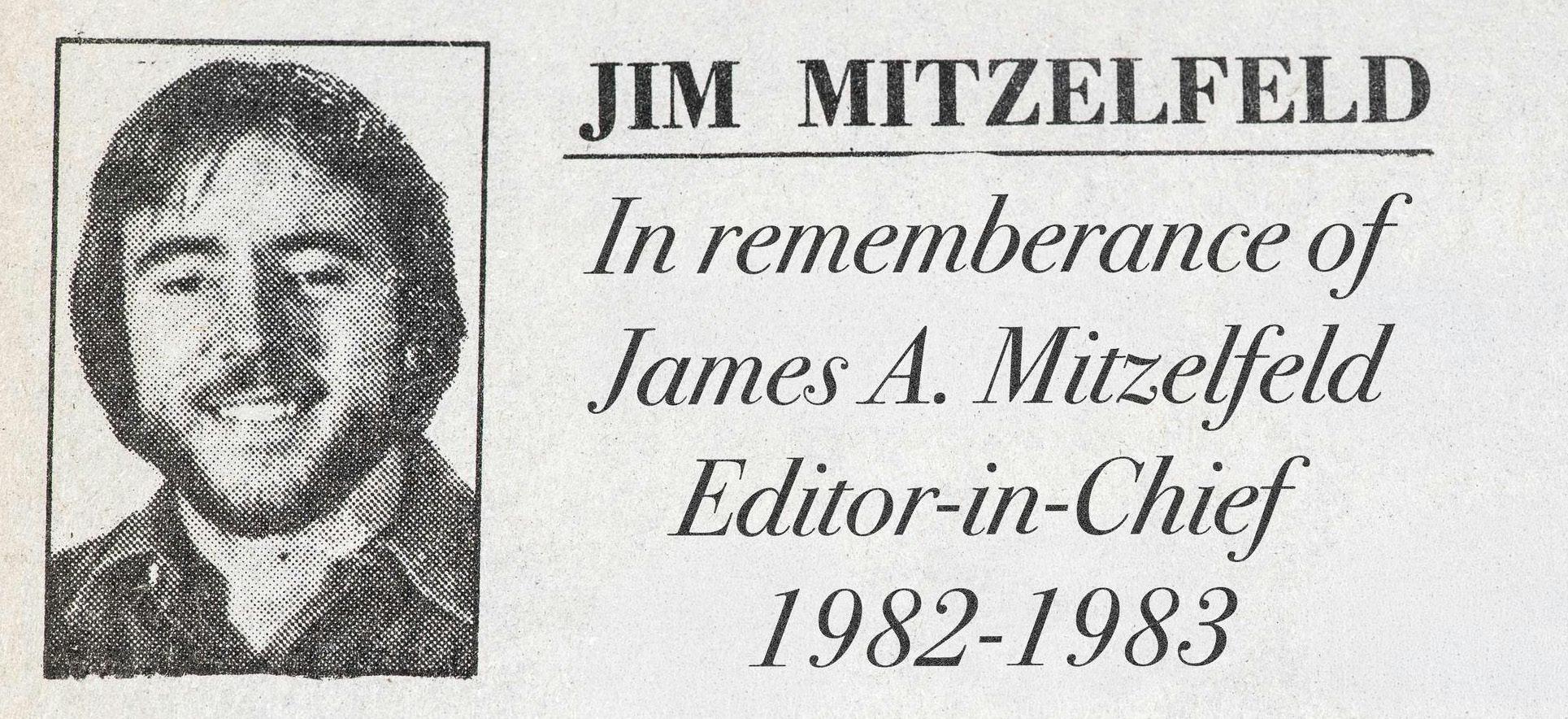
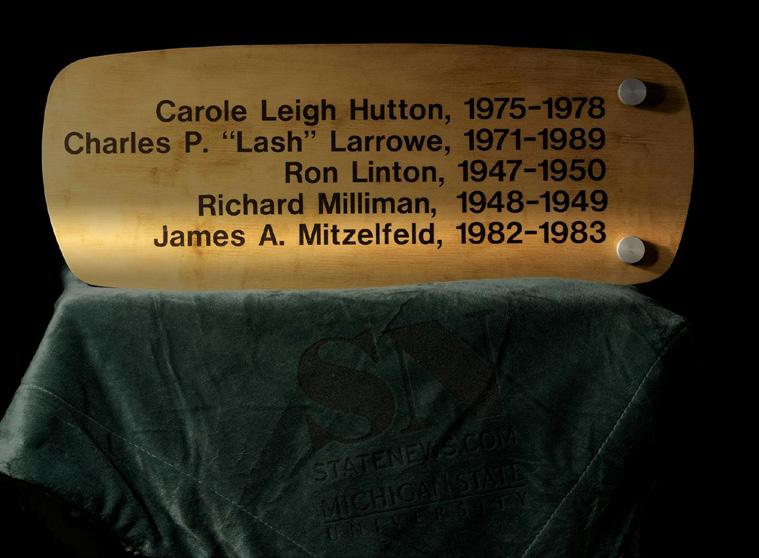
Photo illustration . The State News Alumni Association Hall of Fame 2006 plaque.
Courtesy of Paris Shrestha and Lisa Mitzelfeld.
Courtesy of Paris Shrestha and Lisa Mitzelfeld.
Photo illustration.
MAN ARRESTED FOR ALLEGEDLY RUNNING METH LAB IN WELLS HALL
By Anish Topiwala and Julia Roeder atopiwala@statenews.com jroeder@statenews.com
Michigan State University Police announced Wednesday evening that a 31-year-old man was arrested at Wells Hall for possessing chemicals used in the manufacturing of methamphetamine.
Campus police said that suspect Xin Tong was arrested and faces felony criminal charges for malicious destruction of a building over $20,000 and “felony controlled substanceoperate/maintain lab involving methamphetamine.”
Tong was arraigned earlier today and is being held at the Ingham County Jail on a $500,000 cash or surety bond.
MSU Police Chief Mike Yankowski, in a press conference Wednesday evening, said he could not comment on if Tong was a student or faculty member due to student privacy laws.
Despite charges that appeared to suggest a methamphetamine lab was operating inside Wells Hall, campus police said Thursday that officers
did not locate a lab in the building, but instead found chemicals “and/ or” equipment used to manufacture methamphetamine on the suspect’s person.
During this past week the campus police responded to reports of property damage inside Wells Hall, which was “directly related to alleged criminal activity.”
MSU Police made contact with Tong Sunday night on the fifth floor of Wells Hall after being dispatched for a trespassing complaint. MSU announced that the building would be closed on Monday morning.
Police said Tong was in possession of “of multiple substances that can be legally purchased in retail stores or online” including sodium hydroxide pellets, hydrochloric acid, methanol, isopropyl alcohol, acetone, and butane.
Yankowski said these substances were found in several bags in Tong’s possession when MSU Police made contact with him on Sunday. After getting a search warrant early Monday morning, police searched the bags and found “several labeled and unlabeled
containers of an unknown liquid substance inside.”
“Due to the fact that they were unsure what those substances were, (officers) requested some additional public safety resources,” he added.
MSU then made the decision to shut down Wells Hall for the remainder of the day Monday to conduct a full search of the building and better assess the situation.
Once campus police developed probable cause to arrest Tong from their ongoing investigation the case was presented to the Ingham County Prosecutor’s Office earlier today, with felony charges issued shortly after.
According to Ingham County Jail Records the Department of Homeland Security has placed a hold on Tong’s bond.
Yankowski said this hold is “not part of our investigation.”
“We don’t get into the immigration status of individuals,” he added. “Our focus is the criminal investigation.”
Yankowski, in a campus-wide email Wednesday evening, wrote that multiple tests performed by the Office of Environmental Health and Safety
(EHS) confirmed “the environment in Wells Hall does not pose a risk to our community.”
After first indicating that Wells would reopen on Tuesday, officials decided to close the building for the remainder of the week.
The decision was made to provide DPPS time to gather evidence and allow EHS to “inspect the building, clean and assess damage to flooring, fixtures and other surfaces, and work with Infrastructure Planning and Facilities (IPF) to remediate and ultimately restore the impacted spaces. “
Although Yankowski said MSU is still evaluating the exact cost to repair Wells Hall facilities, he said “it’s a significant amount, well above $20,000.”
Wells Hall will remain closed through Friday, May 1, as the building is evaluated to ensure its safety for occupants.
University Spokesperson Emily Guerrant said 469 exams that were planned to take place in Wells Hall have been rescheduled in alternate locations.
Mike Yankowski, Michigan State University police chief, speaks during a press conference at the Michigan State University Department of Police and Public Safety headquarters in East Lansing, Mich., on Wednesday, April 29, 2026. Photo by Ari Saperstein.
HIGH RENTS, SUMMER BREAK A PAIN FOR EAST LANSING BUSINESSES
By Caden Hofmann chofmann@statenews.com
Each year at Michigan State University seems to bring new businesses that crop up along Grand River Avenue, just across the street from north campus.
However, the heavily trafficked throughway that composes the center of campus nightlife is also dotted with a handful of vacant storefronts and boarded up windows.
Some business owners in East Lansing say that’s partly thanks to high rents making the notion of opening up a business close to campus a risky one.
Since downtown East Lansing is such a densely populated area, leasing out commercial buildings is more expensive than if you were to lease out a building on the outskirts of the city or a neighboring city like Okemos.
Tarek Chawich, who owns Chateau Coffee Co., said he experienced the difference in pricing when opening up his third shop on M.A.C. Avenue in downtown East Lansing. He attributes the higher rent to scaring away business owners from the central location, even if it provides a steady stream of customers during the school year.
“One of the big fear factors that I think people have when going in on Grand River and downtown Michigan State is that the rent is a higher price per square foot just because of it being in East Lansing,” Chawich said. “There are a lot of students, and the area is super busy, but they still have to think about how the rent is inflated for that reason.”
Rent prices in East Lansing vary depending on the type of structure, when it was built, the location and the size. Most commonly, leasing a building near campus will cost between $20-$35 per square foot as opposed to buildings outside of downtown that have seen rates around $12 per square foot.
“Most landlords are pretty firm on the rent here as well due to the location,” Chawich said.
“With our East Lansing location, we pretty much just had to take the price that we were given.”
Another major challenge that some business owners have run into has been the parking situation in East Lansing. Street parking is extremely limited, and the vast majority of people are required to pay for parking in parking garages. Carson Patten, the vice president and retail advisor at Martin Commercial Properties, cites the parking as a reason some may choose to go elsewhere.
“Parking is always a challenge you have to work through in East Lansing,” Patten said. “If there is not a nearby parking garage, that can be a deterrent, and some of these groups that want to be in the heart of East Lansing understand that.”
With the East Lansing consumer base primarily being students, business owners have to keep the demographic they are attracting in mind. Students often leave school and return to their hometowns for breaks and also may not have as much spending money as older shoppers.
Better aged vintage owner, Austyn Daggett, took this into account when opening his store on Grand River Avenue.
“College students only have so much money,” Daggett said. “You have to take into account that they will pick and choose what they spend their money on. The slower season also plays a big part in everything, in general East Lansing is not a spot you are going to visit for vacation or frequent if you don’t live here or aren’t associated with the school. It’s a college town, and other than that, there is not really much going on. It is something that we think about.”
Even with the struggles that an East Lansing summer can bring to a business, Chawich says that it is something he is prepared for.
“I think that businesses have to plan for the summer months, and you can assume that would be a loss for them anyway,” Chawich said. “We would be cutting down on labor and hours in the summer to adjust for there not being many students here in the summer.”
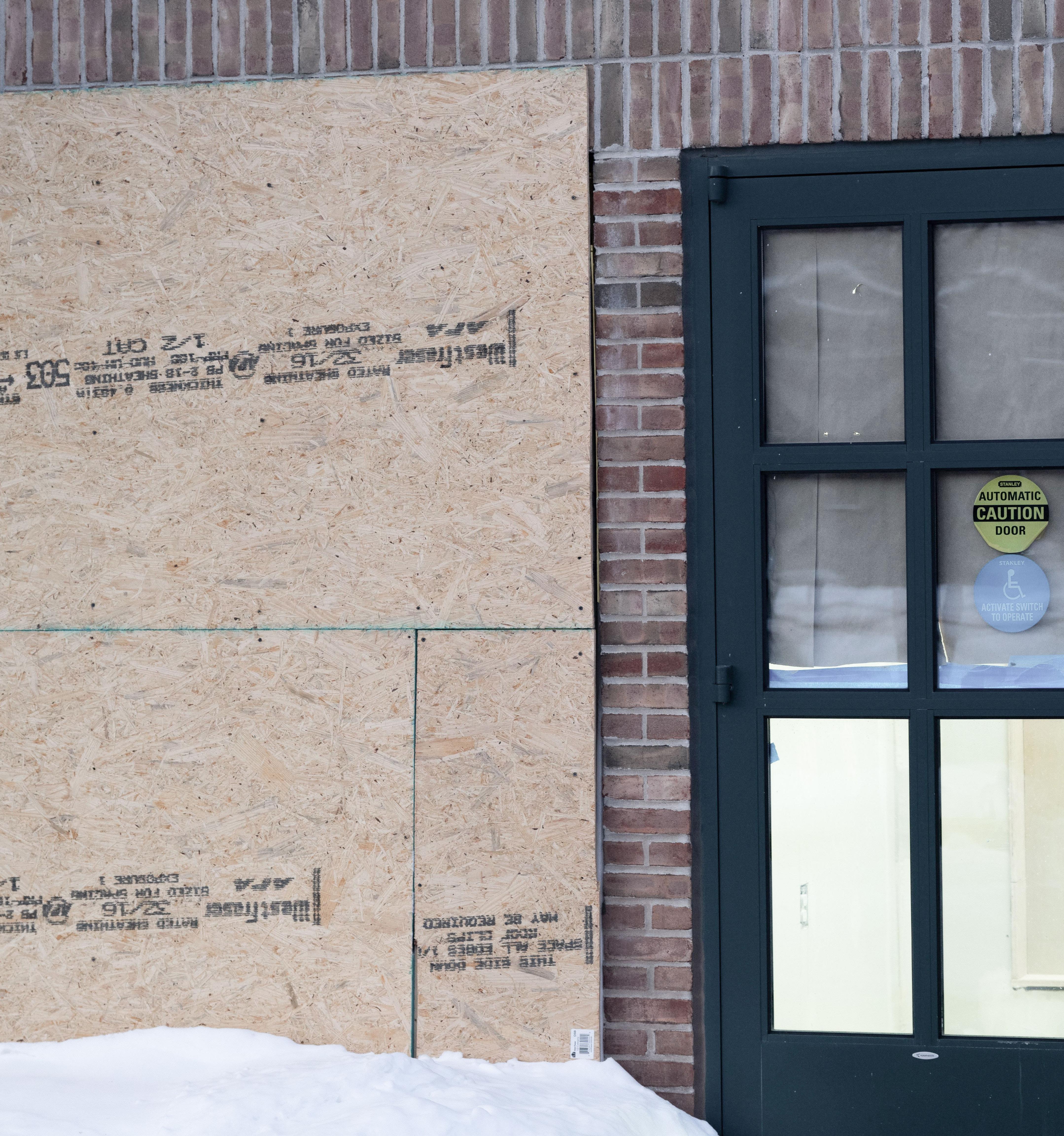
A closed building next to Peanut Barrel in East Lansing, Mich., on Friday, Jan. 30, 2026. Photo by Fatih Gorkem Imamoglu.
‘DAMNED IF YOU DO, DAMNED IF YOU DON’T’:
MSU PRESIDENT FACED FREE SPEECH TEST AHEAD OF HASAN PIKER VISIT
By Anish Topiwala atopiwala@statenews.com
Michigan State University President Kevin Guskiewicz had a problem.
Emails had been pouring into his inbox in the days after U.S. Senate candidate Abdul El-Sayed announced that popular and contentious leftist commentator Hasan Piker would join him for a rally on campus.
The messages urged Guskiewicz to bar Piker from MSU’s campus. Piker, they claimed, has promoted “extremism” and amplified “antisemitic rhetoric” in the past; Allowing him on campus would risk making Jewish students, families and faculty feel unsafe. Other senders even seemed to believe that Guskiewicz had personally invited Piker, rather than the two student groups that had invited the El-Sayed campaign.
To boot, one of the most prominent Jewish student groups on campus had released a statement dubbing Piker a “known antisemite” whose presence would create a “hostile environment” for Jewish students on campus. Keeping him off campus isn’t be so simple, however.
Public universities like MSU must walk a fine line between protecting First Amendment rights on their campuses while ensuring that their constituents aren’t threatened by provocative speakers. They must also assess whether an event poses a tangible public safety concern.
As such, university leaders are often placed in a lose-lose situation. As highly visible figureheads they must make aggrieved parties feel heard while also preserving a key principle of American academia. Complicating things further is the watchful eye of the current federal administration, hypersensitive to antisemitism, an expert said, whose interests universities now must factor into decision making.
Weighing these considerations, Guskiewicz and the Board of Trustees ultimately opted to release a statement that walked that thin line. It expressed the need to uphold free speech and “diversity of thought” on campus while also acknowledging how recent comments made by Piker, “who the university did not invite, have caused pain and concern, particularly among members of our Jewish community.”
“Antisemitism and discrimination of any kind is unacceptable and inconsistent with our institutional values and has no place in a community grounded in respect, inclusion and dignity,” the statement continued.
The statement had become necessary, Guskiewicz said at a press conference days after
the rally, because “there was a lot of information suggesting that I personally had invited him to speak here, that the administration had invited him to speak here. We wanted to clear the record and make sure that we were offering support to our community.”
NOT THE FIRST
MSU is no stranger to controversial speakers. Appearances by conservative activists, for example, like Candace Owens in 2022 and Charlie Kirk in 2025, have drawn backlash and student protest. And last fall, MSU’s own student government tried to prohibit an Israeli playwright from speaking on campus.
Regardless of how people feel about certain visitors, however, the First Amendment makes it fairly clear that public universities cannot deprive anyone of speech unless it becomes a threat to the wellbeing of any group on campus.
Only when a speaker’s language crosses the threshold into targeted harassment or creates a hostile environment for vulnerable groups can a university finally step in.
MSU faced this very dilemma in 2017 when
white supremacist Richard Spencer attempted to book a campus space for a talk. MSU at first denied the request, pointing to a potential public safety risk in the wake of violence at the “Unite the Right” rally in Charlottesville, N.C., where Spencer was a speaker.
Spencer’s organization challenged this denial with a lawsuit that was ultimately settled between the two parties. The settlement terms allowed for him to deliver his speech, albeit on the first day of spring break. Those very public safety concerns MSU had were seemingly warranted after all, as a brawl between protestors and supporters of the white supremacist resulted in 25 arrests, 13 of which were for felony charges.
‘THAT USUALLY GETS EVERYBODY UPSET’
“I urge you to take prompt action and to not allow Hasan Piker on your campus,” read 19 nearly identical messages addressed to Guskiewicz, in addition to the president of the University of Michigan, where Piker was also expected to speak.
“Your administration should evaluate whether hosting this speaker aligns with your stated
commitments to inclusion, student safety and respectful dialogue, and whether sufficient safeguards are in place to prevent harm to the campus climate and community,” continued the messages, which were included in a batch of more than two dozen correspondences received by MSU in the six days after the rally was announced, and obtained by The State News through a public records request.
When faced with grievances of this nature most universities undergo a review process to assess whether a particular individual or event is an actual threat to the public, said Jim Finkelstein, a George Mason University professor emeritus who studies higher education. But no matter what a university president does, “you’re damned if you do, damned if you don’t.” The situation then becomes even more complex when looking specifically at political rallies. Finkelstein said it’s hard for universities to justify interfering with them; unless the university policy is to prohibit all rallies on campus, it becomes a “pretty slippery slope.” Universities can also adopt a strategy of trying to strike a balance of competing ideas, but,
Photo illustration by Hanah Khan.
Finkelstein said, “That usually gets everybody upset, it rarely works out.”
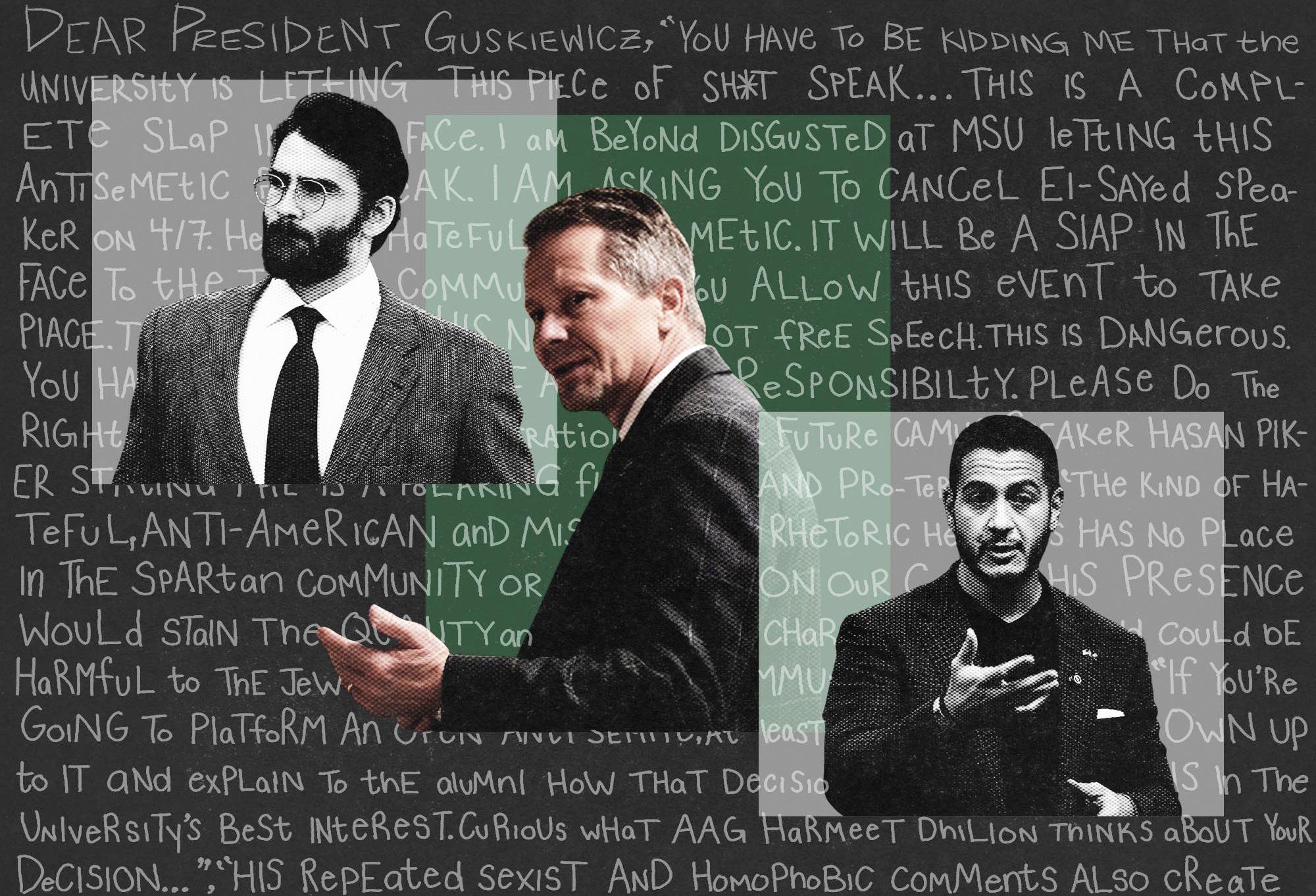
A ‘COMPLETE SLAP IN THE FACE’
The 19 uniform emails Guskiewicz received declared Piker a “highly controversial online personality”, and outlined several statements and actions which Piker has made in the past that “promote extremism, excuse violence and amplify antisemitic rhetoric.”
Those include publicly stating the United States “deserved” the September 11 attacks, his commentary following the Oct. 7, 2023, Hamas terrorist attacks that “disputed and downplayed report of atrocities,” promoting a conspiracy theory that suggests “Christians visit Israel to serve the Jewish people” and platforming Rashid Al Haddad, “someone who identifies as a terrorist soldier fighting for the Houthi rebels, further glorifying US-designated terror groups.”
“Hosting Hasan Piker sends a message, intended or not, about what kinds of discourse your institutions are willing to legitimize,” the messages read. “At a time of heightened tension for Jewish students on campuses nationwide, this decision warrants immediate reconsideration.”
Some of the remaining personally written messages slammed Guskiewicz and MSU for its inaction regarding Piker. One accused the university of paying Piker to come to campus, while another simply stated “I was with you until the Hasan Piker story. Sad.”
One particularly aggrieved emailer wrote
that Piker’s presence on campus was a “complete slap in the face.”
“I am beyond disgusted at MSU letting this antisemitic (sic) POS speak,” the same individual wrote.
Prior to the current federal administration universities would typically err on the side of free speech when faced with these situations, Finkelstein said, however this approach has shifted. Now, universities must consider the potential funding at risk if they don’t appeal to the values of the federal government, or donors.
The federal government has been especially sensitive to the issue of antisemitism, he added, something which most university presidents are very aware of.
One message alluded to the wrath MSU may incur if they were to learn the university willingly allowed a figure like Piker on campus.
“Curious what AAG Harmeet Dhillon thinks about your decision...,” the message read, invoking the assistant attorney general for civil rights at the Department of Justice.
Finkelstein said Guskiewicz’s decision to release a statement ahead of the rally may have been intended to dodge potential scrutiny from the federal government.
“If you have a speaker or politician on campus who regularly would express antisemitic views, and a president is silent on that, the president may think, ‘well, I’m inviting an investigation from the government if we don’t condemn that hate speech,’” Finkelstein said.