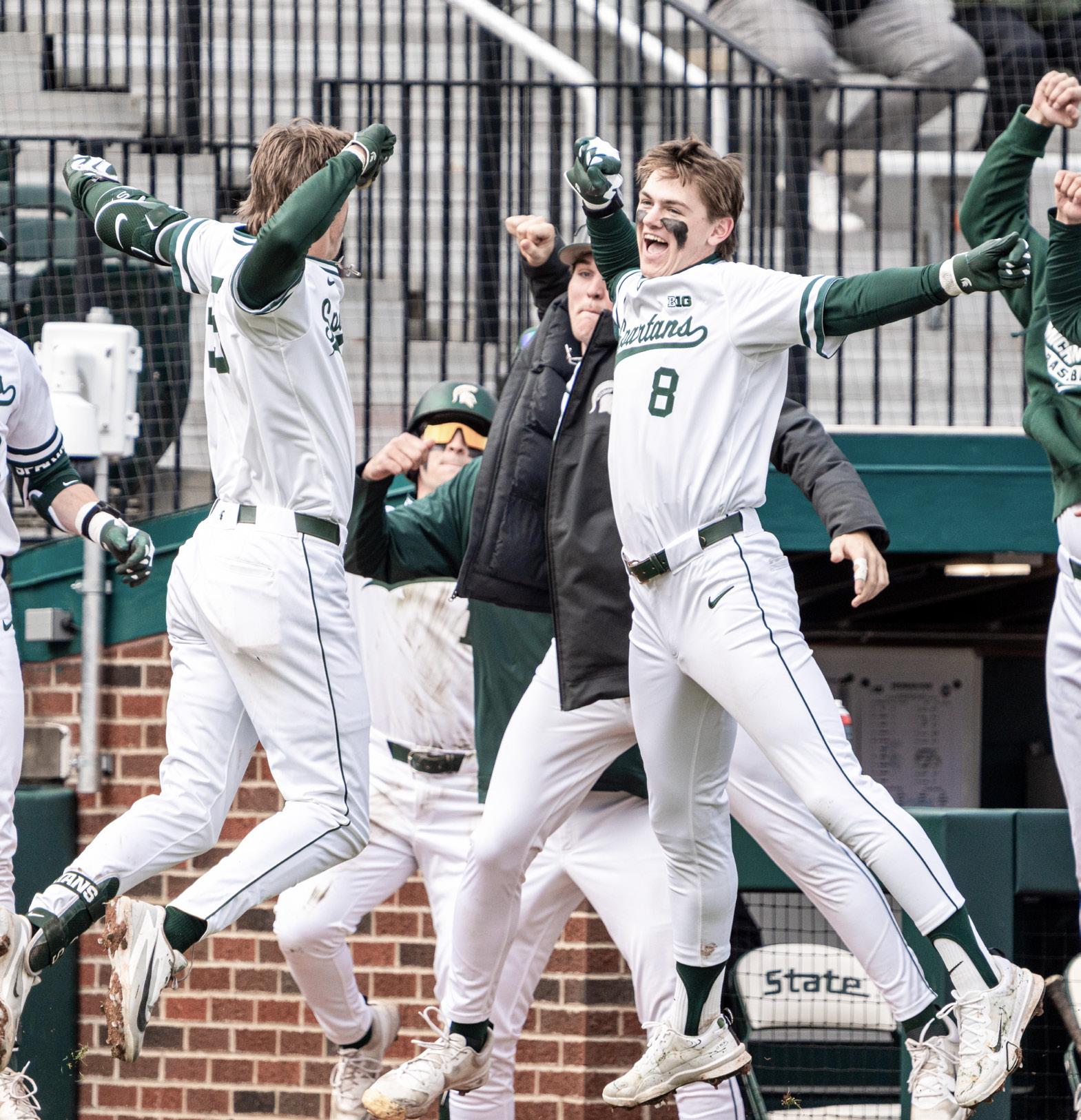
MSU sophomore infielder Randy Seymour (35) celebrates with his teammates after hitting a home run in the Jeff Ishbia Field in McLane Stadium in East Lansing, MI on March 21, 2026. MSU baseball won a key home series against Iowa, winning the series opener 2-0. Photo by Cooper Schwartz.
KOHLER HELPS MSU DANCE TO THE SWEET 16
By Kaspar Haehnle khaehnle@statenews.com
The moment Michigan State Men’s Basketball pulled away from Louisville was the moment Jaxon Kohler arrived. The senior forward desired to advance in the NCAA tournament, and following a fve point swing that he orchestrated, his desires were fulflled.
In MSU’s 77-69 victory over Louisville on Saturday, Kohler struggled to make an impact. He was bumped and double-teamed on offense, failed to convert shots and struggled to obtain a rebound.
It was a formula to Louisville’s game plan, and a formula that worked – attack Kohler, limit post penetration and crash the glass. Only in the waning minutes of the game did this formula fail, and with it, the hopes of Louisville advancing.
The moment came with 7:42 left in the second half. Leading 58-50, MSU had yet to pull away from a persistent, physical Cardinal team. On a frontcourt possession, Jeremy Fears Jr. brought the ball up, initiated the Spartan offense and fed Kohler in the post. With the ball, Kohler backed down Cardinal forward Evangelos Zougris before going up for a shot. During the attempt, Zougris came down hard on Kohler’s head, knocking him to the foor. Although Kohler missed the shot, he was awarded a foul and two free throws. After a review, offcials determined Zougris committed unnecessary contact. The personal foul was upgraded to a fagrant, giving Kohler two free throws and returning possession to MSU.
Kohler would make both shots, extending the lead to 60-50. Following the free throws and with the ball, Coen Carr found Kohler open and at the top of the key, where he attempted and converted a three point shot that extended MSU’s lead to 13. It was a fve point swing that sucked all life out of Louisville. It was the moment MSU won the game. It was the moment the Spartans advanced to the Sweet 16.
“It was big for a season to deliver at the moment,” MSU head coach Tom Izzo said. “I think he did a good job. He and Carson Cooper struggled a little bit early, but both came back [to play] pretty good.”
Fast paced basketball. It’s how the game began, and it’s how the game continued, with MSU pushing the length of the foor to take advantage of the Cardinals moderate defense. In the early going of the frst half, it became the only way MSU found success in scoring; it would obtain a rebound, run, fnd the basket and convert.
It was a speed that made Louisville look uncomfortable, and it helped MSU go on an 8-0 to extend its lead to 22-14 with 9:33 left in the frst half. It was a lead that would not be lost.
This opened opportunities for Spartans
sprinting the foor. If Cam Ward, Coen Carr or Carson Cooper beat a Louisville defender downcourt, Jeremy Fears Jr. found them in stride for fnishes at the basket. The up-tempo play also created opportunities from beyond the arc. When the Cardinals recovered to protect the rim, Fears often located an open teammate on the perimeter, leading to 3-pointers. MSU fnished 11-for-26 (42%) from 3-point range, with senior guard Trey Fort leading the way with three 3s and 12 points.
It’s not to say that MSU was perfect when running the foor. At times it would run too fast even for itself, converting errant passes that lead to turnovers. By the end of the frst half, MSU racked up nine turnovers – the most in a Spartan frst half since its 11 frst half turnovers to Michigan on Jan. 31. By the end of the game, MSU would turn the ball over 15 times.
What this created were offensive opportunities that kept Louisville in the game. Every time the Spartans had a chance to pull away, an errant pass would be committed or the ball would be fumbled and lost, leading to a Cardinal offensive possession that resulted in points. Louisville scored 20 points off of turnovers. Fears would lead the Spartans category in turnovers committed with fve in the game, which would lead the team.
Fears also led the category in assists with 16, which sets the Spartan record for most assists in an NCAA Tournament game. He would also add 12 points on a 3-for-13 shooting display.
“We turned the ball over too much, and that’s on all of us, including me,” Izzo said. “But Jeremy Fears deserves a lot of credit. He’s just getting better right now, and he’s getting better every week.”
While Louisville struggled in transition, it was effective defending the post. Similar to the start of the NDSU game, the Cardinals attacked inside, using dribble penetration and entry passes to their big men. Defensively and on the boards, Louisville was strong, double-teaming Kohler and Cooper and crashing the paint after each shot. MSU was outscored 26-24 in the paint and allowed Louisville to grab 11 offensive rebounds, leading to 10 second-chance points.
It was this post performance by Louisville that limited Kohler for the majority of the game.
“I struggled to get the ball in the hoop today,” Kohler said. “But a shooter’s mentality is to just keep getting those shots up. To see the free throws go in and to get that three pointer, it just really helped me with confdence.”
Kohler would fnish the game shooting 3-for-9 from the feld with ten points and six rebounds. Alongside him was Cooper, who only scored nine points on a 4-for-6 shooting display while obtaining fve rebounds.
The struggles to control the paint opened up pressure for MSU’s guards to perform. In a win or go home game, they answered the call through converting shots and playing perimeter defense
that limited Louisville in what it was best at: making shots.
The sharp-shooting team that regularly relies on its three point conversion abilities had diffculties getting shots to fall. From beyond the arc, the Cardinals were held to a 13-for37 (35%) shooting display. It wasn’t their worst performance, but in a game of such signifcance, it was a statistic that left them breathless in struggle.
It seemed to be a fair tradeoff: MSU loses the battle in the post while Louisville loses the battle from beyond the arc. A rare battle to lose for either team, but a trade that benefted both for a majority of the game. Only when Kohler contributed to the fve point swing did the trade become uneven.
“Our guys battled all year and bound together all year,” Izzo said. “And we get to go to Washington, DC again to play in the Sweet 16 where this program belongs.
The weekend is complete. Another challenge awaits. There’s nothing sweeter than the Sweet 16.
Next Friday, March 27, the Spartans will travel to Capital One Arena in Washington, D.C., to face the winner of No. 2 seed Connecticut and No. 7 seed UCLA.
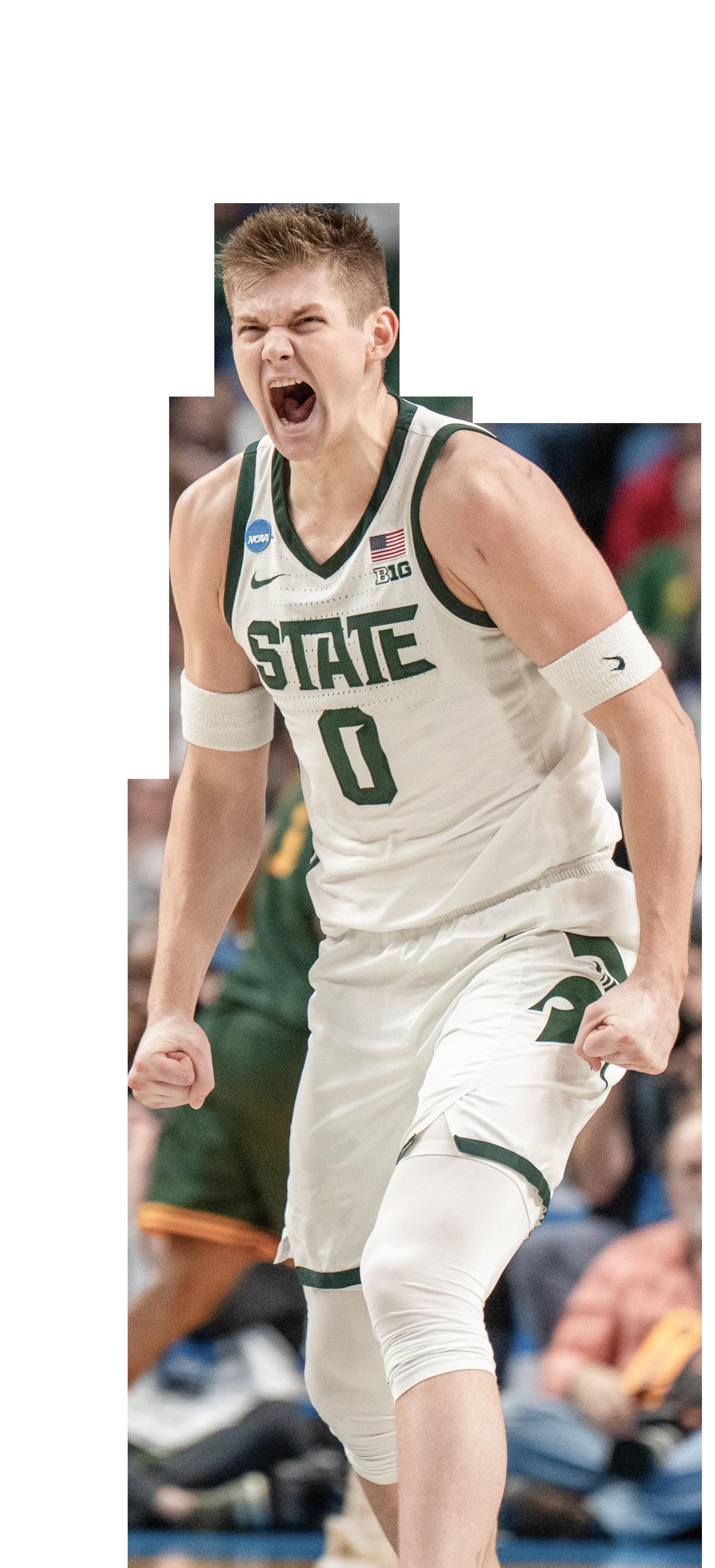
Senior forward Jaxon Kohler (0) celebrates a basket during the March Madness matchup.
Photo by Zari Dixson.
CAMPUS RALLIES AROUND MSU’S MARCH RUN TO SWEET 16
By Nandini Jaithalia njaithalia@statenews.com
As Michigan State men’s basketball advances to the Sweet 16 with a win over Louisville Cardinals men’s basketball on Saturday, students across campus refected on the victory with a sense of unity that defnes March Madness in East Lansing.
For public relations sophomore Alex Coe, the moment refected the unity that defnes Michigan State in March.
“Fantastic. I mean, we’re moving on. Yeah. That’s what we want to see,” she said. “It’s like, that’s what makes Michigan State so great. Everybody can get behind the same thing… it’s the best month of the year, ‘cause everyone gets united… everyone’s supporting one team. It is the best thing ever. It just feels like the whole campus is connected through this.”
Much of that excitement centered around junior forward Coen Carr, whose performance stood out to multiple students.
“Coen Carr… he’s not usually very good at shooting, and he hit two three-point shots,” Alex said. “I think through the empowerment of this… he’s able to do things that he can’t
normally do… relying on your teammates and community… that makes you the best version of yourself. You could really see that confdence build during the game.”
Nursing senior Mallory Reynolds pointed to both individual performances and the overall rhythm of the team.
“I loved it. I think we played super well. It was super fun to watch,” Reynolds said. “I liked Coen today. He was able to make some threes, and his dunks are always fun. And Kohler was impressive as well. It felt like everything was just clicking for us.”
There was also a very strong sense of pride in how the team carried itself throughout the game.
“I’m really proud of our team. I know we’re making it to the next round,” said Cameron, a sophomore biochemistry major. “It just shows how much work they’ve put in, and it’s exciting to see that pay off right now.”
For others, the atmosphere surrounding the game elevated the experience.
“I thought the game went great. I was out at the bar, you know, the energy was fantastic,” said junior Grant Bennett, a communication leadership and strategy major. “All the fans seemed super supportive,
and I was really just proud of students watching our team go out there and make it to the Sweet 16. It felt like everyone was locked in together.”
Bennett also highlighted Carr’s impact on the crowd.
“He’s electric. Anytime he dunks the ball, everybody goes crazy… he’s super electric, and everybody likes watching him. He brings a different kind of energy that really gets people going.”
Finance and economics freshman Grace Busad emphasized the team’s cohesion as a key takeaway.
“I thought it was pretty good. Coen Carr did amazing, as he always does with his dunks, but I feel like we really came together more as a team, shared the ball, and it was just freaking fun to watch. It felt a lot more connected compared to some earlier games.”
Bennett also pointed to Carr’s development as a defning part of the performance.
“It was pretty good. It was probably Coen Carr’s best game of the year,” he said. “Our frst points were him hitting a three… we had a couple threes, which he doesn’t usually do… he’s only, I think, a 12% three-point
shooter. Seeing that kind of growth this late in the season is huge.”
After the disappointment of the Big Ten tournament, the win felt like a turning point for some students.
“I’m really happy that we won, because after the Big Ten disappointment, everyone was kind of low,” Busad said. “With an effort today, I feel like everyone had that ‘Go Green’ energy again. It felt like we got our confdence back as a fanbase too.”
Now, with Michigan State heading into the Sweet 16, the excitement across campus continues to build.
“Pretty great. I mean, it’s a wonderful thing to be in the Sweet 16,” Alex said. “We just gotta make the most of it… I think everyone on campus is gonna be pretty excited. It’s something everyone is looking forward to now.”
“I’m so excited,” Reynolds added. “It’s gonna be a tough game, but we’ll follow them through the tournament. Everyone’s ready to keep this run going.”
As the Spartans move deeper into March Madness, the sense of unity and belief around campus remains just as strong as the team’s performance on the court.
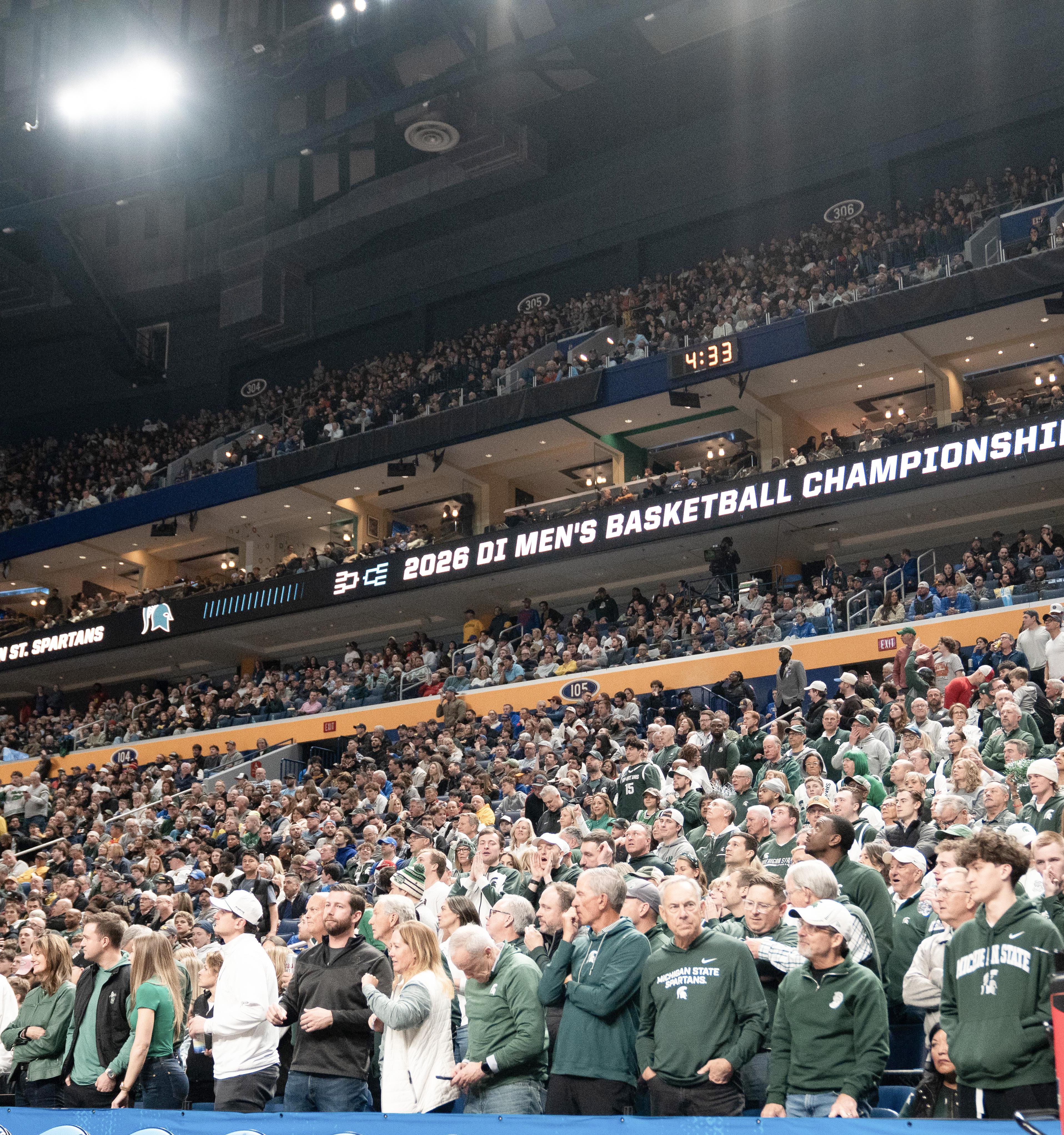
MSU fans cheer on the men’s basketball team during the March Madness matchup against University of Louisville at the KeyBank Center in Buffalo, New York on March 21, 2026. Photo by Zari Dixson.
By Genevieve Henry ghenry@statenews.com
No. 11 MSU gymnastics competed in the Big Ten Championships in Champaign, Illinois, earning a 197.475 to fnish second overall.
The Spartans entered as the No. 4 seed, competing in the top session for the ffth straight year. They faced off against No. 1 seed UCLA who won the Championships with a 198.100, and outperformed No. 2 seed Minnesota who earned a 196.900 for third and No. 3 seed Michigan who earned a 196.800 for fourth.
In the other sessions, the remaining Big Ten teams competed, but none topped the scores from the fnal session.
MSU gymnastics finishes second as UCLA dominates Big Ten Championships
MSU opened the meet on bars, scoring a 49.400 and sitting in third place with ground to make up after the frst rotation. Senior Sage Kellerman anchored the rotation with a 9.950, tying her career high. Junior Kendall Abney scored a 9.900, senior Nikki Smith added a 9.875, junior MaKayla Tucker posted a 9.850 and freshman Lilia Cosman earned a 9.825.
MSU came out offensively, constructing routines on each element with the highest possible start values. On the bars, this meant aggressive handstands from both senior Naya Howard and Smith.
That approach set the tone for a meet defned by high standards and clean execution.
Minimizing landing deductions was critical as the Spartans moved to beam, an event that often proves make-or-break, where every gymnast either stuck their landing or showed only slight movement. Sophomore Cady Duplissis, Cosman and Smith all scored 9.900s to elevate the team to a season-high 49.375 on beam.
Although the Spartans had to lead out on their two weakest elements, bars and beam, they impressed with above-average scores and put themselves in second place with the higher scoring elements yet to come. Ranked 13th on bars and 14th on beam, MSU outperformed itself to stay in contention for the title. While MSU typically excels on higher-scoring events, its frst two rotations kept it frmly in the meet.
MSU then moved to foor exercise, where it ranks ninth nationally. Senior Stephanie Lebster and freshman Korynne Marquart earned 9.850s. Duplissis earned her second 9.900 of the night and Tucker earned her frst.
All eyes were on Smith, who posted a perfect 10.00 on foor in the Spartan’s latest meet. Smith delivered with height and style, scoring a 9.950 to push MSU’s total to 49.450.
MSU closed on vault, its strongest event of the season.
This time, it produced a 49.250, the team’s lowest rotation score of the meet. But it was enough to secure second place. Kellerman anchored with a 9.925 in her fnal Big Ten vault routine. Tucker impressed with a 9.875 and kept herself in contention for the all-around title.
Smith brought home a 9.850, while Marquart and Trostel both pulled off 9.800s.
Although the Spartans performed well to fnish second, they were no match for UCLA. The Bruins entered as heavy favorites, led by Olympian Jordan Chiles. Chiles earned her seventh perfect 10 of the season, her ffth on foor, and won the all-around title with a 39.825. She also won foor and beam titles and tied for frst on bars, alongside Big Ten Gymnast of the Year honors.
Smith fnished with a 39.575 in the all-around, tying for second in a three-way tie, while Tucker posted a 39.450.
MSU entered the championship with a national qualifying score of 197.056, ranking 11th nationally. The top 16 teams earn seeds for the NCAA tournament, keeping the Spartans in strong position for Regionals. NQS is calculated by taking a team’s top six scores, three of which must be away, dropping the high and averaging the remaining fve. This performance should boost MSU’s NQS and maintain its seeded position.
Individually, three Spartans are in strong contention for NCAA tournament qualifcation. The top 12 all-around gymnasts and top 16 for each element qualify. Smith is ranked seventh on the foor and 10th all-around. Tucker is 20th on the foor and 11th all-around. Kellerman is eighth on the vault and 25th on bars. Spartan fans are likely to see at least one gymnast competing individually at Regionals.
MSU WOMEN’S BASKETBALL SEASON ENDS IN ROUND OF 32
By Tyler Gaylord tgaylord@statenews.com
It was a half of basketball Michigan State fans had been waiting for, as the women’s basketball team ended its streak of slow starts. As the No. 5 seed, the Spartans led No. 4 Oklahoma 42-37 at halftime after 20 minutes of effcient offense. A fve-point lead that felt like a sign of change — an indication that the team that brought a 19-2 record into February had returned — lasted until the third quarter. Offensive struggles reemerged, and Oklahoma took advantage, fghting back and holding the lead for the fnal 11:53 of the game en route to a 77-71 victory and a trip to the Sweet 16.
After three straight opening halves of shooting under 37% from the feld, MSU had fnally broken its streak of slow starts. The Spartans shot 47% from the feld while adding an impressive 56% from three, allowing them to score 42 points in the frst half.
An inspiring performance, the team had only lost one game when leading at halftime all season, but the third quarter was a different story.
The Spartans shot just 33% from the feld and failed to make a single 3-pointer, a struggle that continued for the remainder of the game as they made just one in the second half. The inability to sustain the offensive success from the frst half led to a 10-2 Sooners run in the frst 3:19 of the quarter, creating a 47-44 Oklahoma lead.
Stretches of offensive struggles have been apparent in the second half of the season for MSU, but it hurts even more after playing such an effcient offensive half and holding a lead 20 minutes away from a Sweet 16 berth.
JONES SPARKED OFFENSE IN FIRST HALF
Junior guard Rashunda Jones has been the calm, steady presence alongside redshirt sophomore guard Kennedy Blair all season, but after a lower leg injury on Feb. 15, it was unclear what the rest of her season had in store.
Since then, she has battled back and, due to the injury, taken on different roles, including switching in and out of the starting lineup. Against OU, she came off the bench, but it didn’t matter. She arguably had the biggest impact on the game.
In the opening half, Jones scored 16 points on an effcient 7-of-9 shooting from the feld while adding three rebounds and two steals — all in
just 16 minutes — accounting for 16 of MSU’s 42 frst-half points.
The same can’t be said about the second half, as she had just four points on 2-of-8 shooting and ultimately fouled out. But without her impressive first half, who knows what the scoreboard would’ve looked like.
Blair left her mark alongside Jones as she has all season, fnishing with 14 points, nine rebounds and six steals, though she did have six turnovers — a fitting conclusion to a breakout season.
FRALICK STILL TRYING TO GET SPARTANS TO “NEXT LEVEL”
Nobody can question the impact MSU head coach Robyn Fralick has had on the program in just three years. She has led the Spartans to 20 wins every season and is the only coach in program history to lead MSU to three straight NCAA Tournament appearances in her frst three seasons.
This season was her most impactful yet. She guided the program to its best start ever at 17-1 and a ranking as high as No. 12 in the AP Poll — the Spartans’ highest ranking in 15 seasons.
She has improved year after year, earning a No. 9 seed in 2023-24, followed by a No. 7 seed
last year and a No. 5 seed this season — just a win or two away from a top four seed. But there is still a “next level” that has yet to be reached. That level is competing for championships — a level MSU was close to achieving this season.
On Feb. 1, the Spartans stood at 19-2 with just two Big Ten losses, but just 10 days later, they were eliminated from regular-season title contention after an 86-63 loss to UCLA. The bigger message is that this season, the Spartans took a step toward playing in meaningful games — the next step is winning them. They went 4-6 in ranked matchups, six of which came against higher-ranked opponents. MSU won just one of those six, going 1-5 as beating “better” teams remained a struggle.
A win over No. 4 Oklahoma in its home arena, securing a trip to the Sweet 16 for the frst time since 2009, would have been that ‘next level’ moment, but the Spartans came up just short. With senior forward Grace VanSlooten the only starter defnitively gone next season — and senior guards Jalyn Brown and Theryn Hallock possibly able to gain additional eligibility — MSU will bring back an experienced core while adding a McDonald’s All-American freshman and potential transfer portal additions, giving the program every reason to believe more strides are ahead.
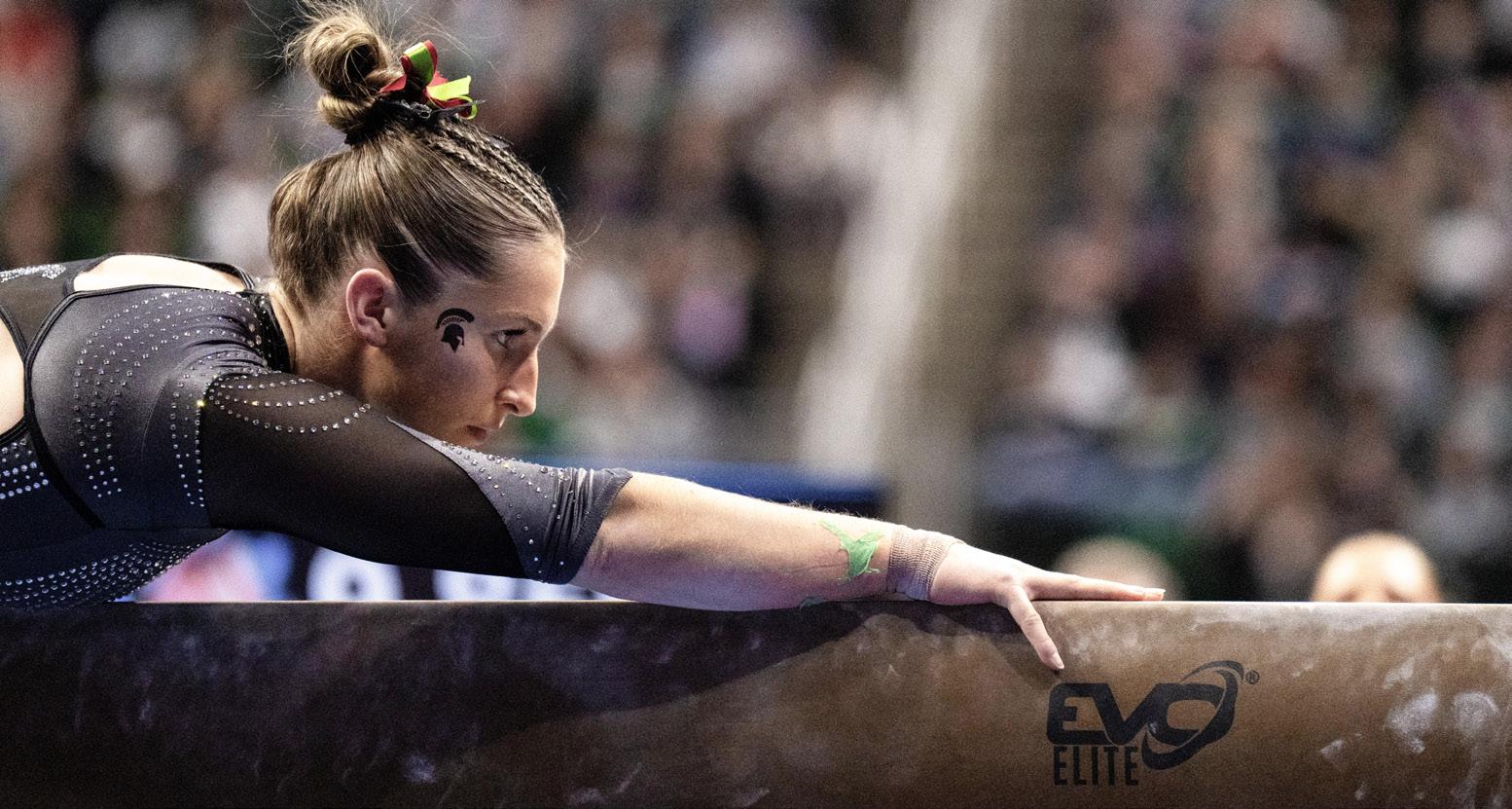
Michigan State junior Kendall Abney on high beam during the MSU vs. UCLA gymnastics meet at the Breslin Center in East Lansing, Michigan, on Sunday, Jan. 25, 2026. Photo by Ari Saperstein.
ADAM NIGHTINGALE TO COACH TEAM USA AT 2027 WORLD JUNIORS
By Audrey Dayton adayton@statenews.com
Michigan State hockey coach Adam Nightingale will be named head coach of the 2027 U.S. National Junior Team, Nightingale confrmed today.
Hockey reporter Frank Seravalli announced that Nightingale will coach the team on Tuesday, March 17, and Nightingale confirmed the information after the NCAA Tournament’s Sunday Selection Show.
“There’s so many good coaches that they could take, to be able to represent our country on that stage,” Nightingale said. “The talent, you look at all the good coaching they have at a young level, and volunteers that kind of get these guys in a position to make this team. It’s our staff’s job at that point to try to take the best care of what we can, but (there’s) a lot of work behind the scenes that goes into these guys making it. It’s a huge, huge honor. And looking forward to it.”
Nightingale will coach the team at the 2027 IIHF World Junior Championships, held in Edmonton and Red Deer, Alberta, Canada, from Dec. 26, 2026, to Jan. 5, 2027.
Nightingale has spent four seasons as head coach of MSU, bringing the Spartans back to Big Ten titles and NCAA tournament appearances for the past three seasons.
This will be Nightingale’s frst time as head coach of the World Juniors’ team, although his experience in USA Hockey is extensive.
COACHING ON THE WORLD STAGE
Nightingale spent two years coaching the U.S. National Development Team Program (NDTP) before he became MSU’s head coach in May 2022. He coached that team to a silver medal in the 2022 IIHF U-18 Men’s World Championship, held in Germany.
Nightingale served as assistant coach to the 2025 U.S. Men’s National Team last season, which former forward Isaac Howard competed on. The team won its frst gold medal in 93 years.
Nightingale has also been a part of the U.S. Men’s National Team coaching staff fve times. He was an assistant coach when the team won bronze in 2021, and a video coach when it won bronze in 2018. Nightingale spent three seasons as the team’s video coach (2017-19).
Nightingale has previously coached 15 of the 25 players on Team USA’s 2026 Olympic goldmedal roster, dating back to his time as a video coach for the U.S. 2015 IIHF World Junior Team. He worked as a video coach for 2026 Olympic gold medalists Jack Eichel, Auston Matthews, Dylan Larkin and Zach Werenski on that team.
NHL AND JUNIOR HOCKEY
Nightingale’s coaching experience began at Shattuck-St. Mary’s School (SSM), where he was head coach of the Midget AA team from 2008 to 2010. He then served as a video coach and worked in hockey operations at Michigan State University from 2010 to 2014 before returning to SSM as head coach of the Bantam team from 2014 to 2016.
Nightingale then became a video coach for the NHL’s Buffalo Sabres (2016-17) and Detroit Red Wings (2017-19). He served as an assistant coach to the Red Wings (2019-20) before his stint with the NTDP.
PLAYING EXPERIENCE
Nightingale was a member of the MSU hockey team from 2003-05 after transferring from Lake Superior State where he spent two seasons prior. He played four seasons of professional hockey in the ECHL before working as a construction superintendent. He left his position in 2008 to start his coaching career.
SPARTANS IN WORLD JUNIORS
Nightingale will likely have the chance to coach Spartan commit Chase Reid on the World Juniors’ team. Reid played every game in the 2026 IIHF World Junior Championship and is committed to MSU for the 2026-27 season.
Several Spartans that have played under Nightingale have also competed for Team USA at World Juniors.
Sophomore forward Shane Vansaghi and freshman forward Ryker Lee were on the 2026 team, and goaltender Trey Augustine was on the 2023-25 teams.
MSU HOCKEY HEADS TO NCAA TOURNAMENT AS A NO. 1 SEED, NO. 3 OVERALL
By Audrey Dayton adayton@statenews.com
Michigan State hockey is headed to the NCAA Tournament for the third straight season.
MSU earned the No. 3 overall seed and a No. 1 regional seed following its regularseason performance. The Spartans won their third consecutive Big Ten regular-season title and fnished third in the NPI Rankings with a 25-8-2 overall record.
MSU is the No. 1 seed in the Worcester, Massachusetts, region, held at DCU Center.
The Spartans are set to compete against No. 4 seed UConn on Thursday, March 26, at 1:30 p.m. ET. UConn lost 2-1 to Merrimack in the Hockey East Tournament fnal but also secured its NCAA spot based on the NPI.
No. 2 seed Dartmouth and No. 3 seed Wisconsin will also compete in the Worcester regional. The winners of the first regional contest will face each other on Saturday, March 28.
MSU is one of 16 teams competing in the single-elimination tournament, consisting of four regions and two regional rounds before the semifnals — better known as the Frozen Four.
The matchup marks MSU’s third straight tournament appearance. Head coach Adam Nightingale led the team to its frst one in 12 years during the 2023-24 season.
The Spartans won the Big Ten Tournament in
2024 and 2025, securing automatic bids to the NCAA Tournament. Their path to the NCAAs differed this year, as the team was eliminated by Ohio State in the Big Ten Tournament semifnals.
Despite the loss, MSU was guaranteed a spot in the NCAA Tournament this season due to its presence in the NPI Rankings.
This will be the frst time under Nightingale that MSU enters the NCAA Tournament following a loss.
MSU’S RECENT APPEARANCES
The Spartans’ most recent NCAA Tournament was a heartbreaker.
MSU was upset by Cornell in the frst round of regionals after taking a late penalty. Cornell scored a goal with 10 seconds left in the game, sending the Spartans home with a 4-3 loss.
The Spartans advanced a little further in the 2024 tournament, defeating Western Michigan 5-4 in overtime, but fell short of the Frozen Four with a 5-2 loss to Michigan in the next round.
OTHER CONTENDERS
Michigan, North Dakota and Western Michigan are the No. 1, 2 and 4 overall seeds in sequential order.
Six teams won their conference tournaments and earned automatic bids to the NCAAs. The other 10 teams were selected based on NPI Rankings, like MSU and UConn. Michigan, Denver, Dartmouth, Minnesota State, Merrimack and Bentley earned automatic bids, although many of them would have made the NCAA Tournament regardless due to the NPI.
The Big Ten represents a fourth of the NCAA Tournament with MSU, Michigan, Penn State and Wisconsin competing. MSU leads the tournament in frst-round draft picks (4) and overall draft picks (15).
FROZEN FOUR FACTS
With regional matchups set, MSU is now on the frst step to the Frozen Four.
The Frozen Four will take place from April 9-11 at T-Mobile Arena in Las Vegas. The semifnals will be held on Thursday, April 9, with game times TBA.
The championship game is on Saturday, April 11, at 7:30 p.m. ET. All Frozen Four games will be broadcast on ESPN2.
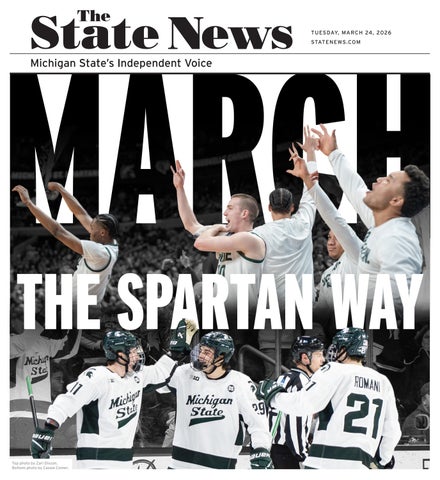
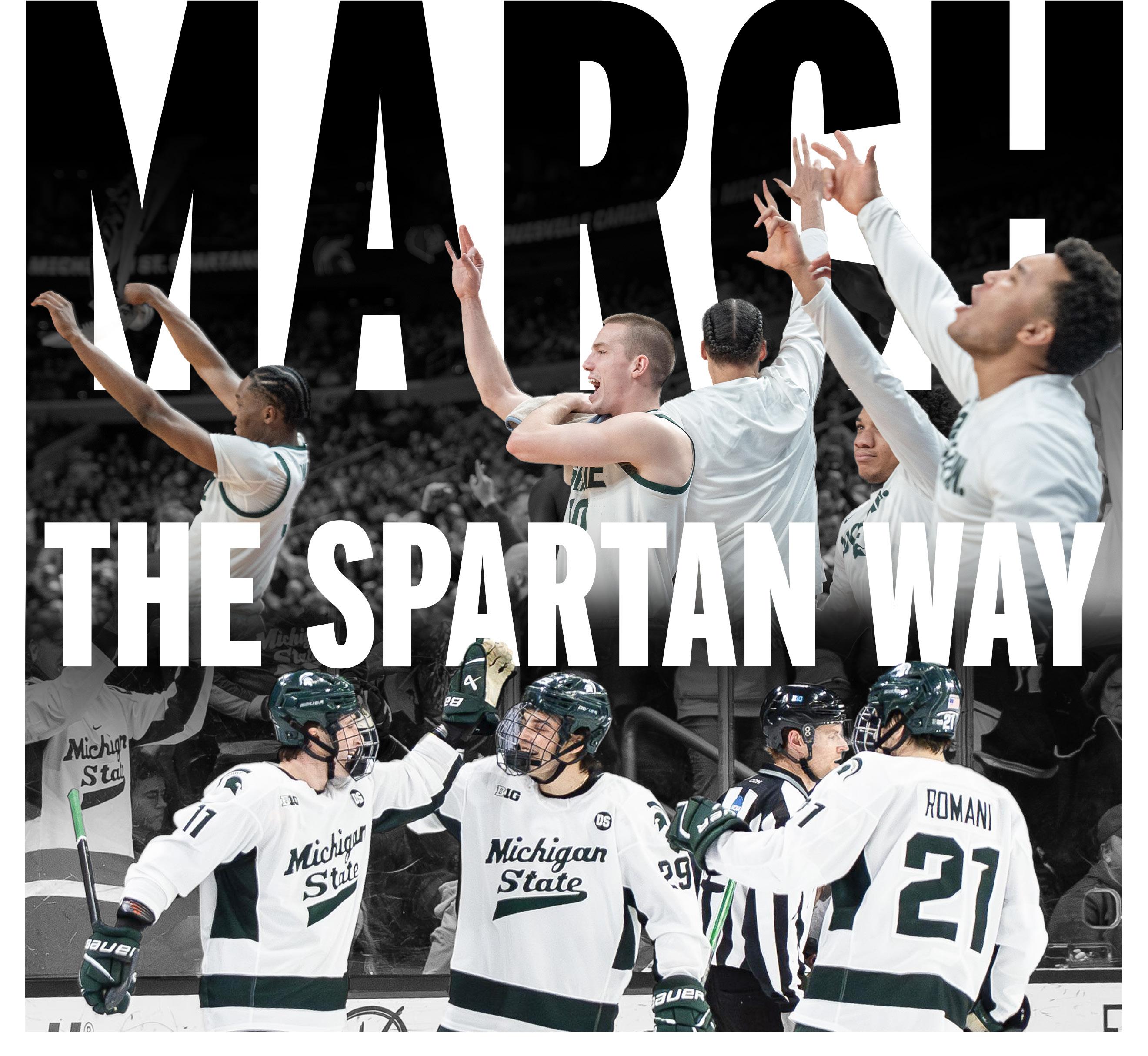
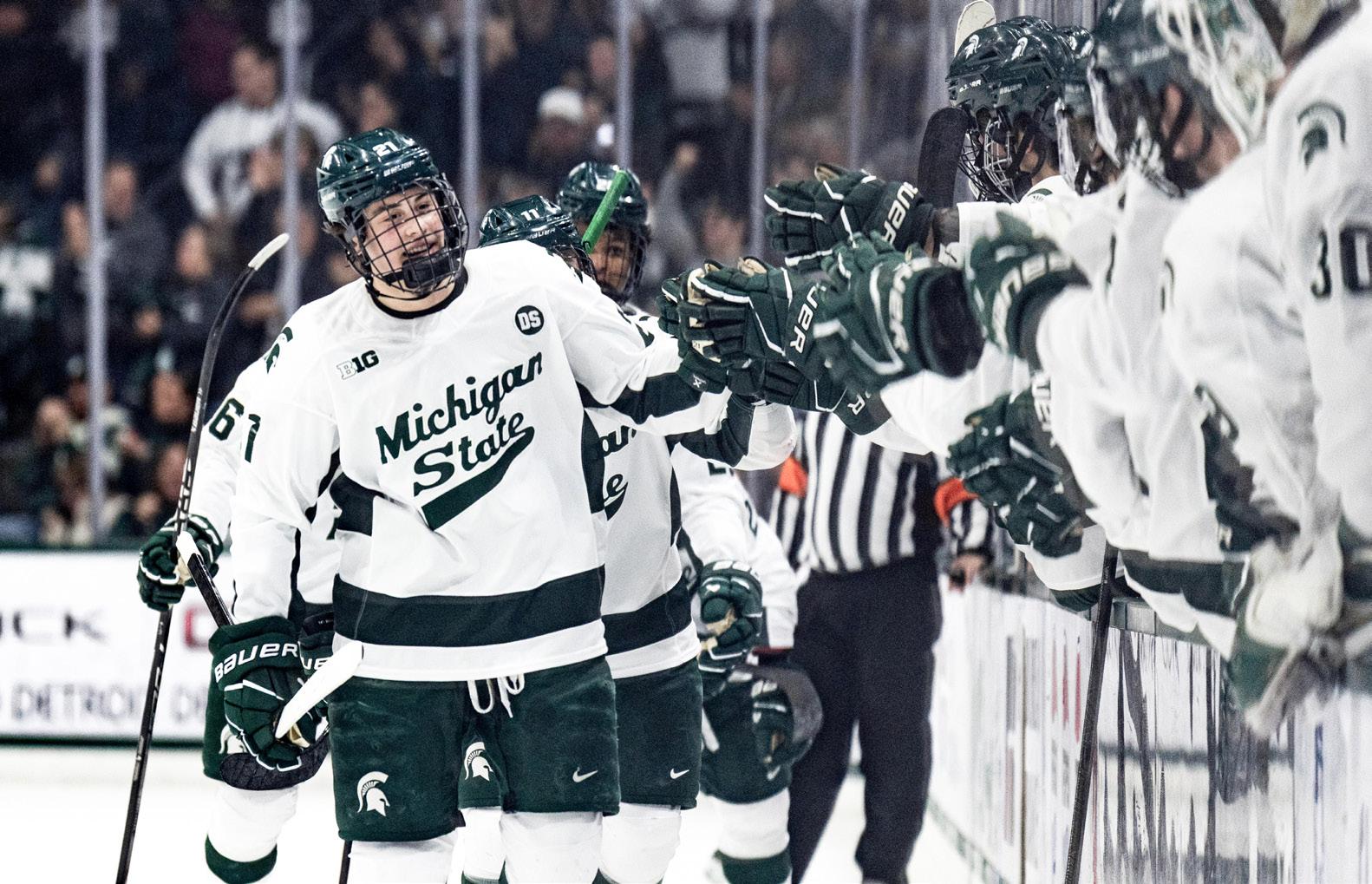
MSU Fr. F, Anthony Romani (21), high fives the bench after scoring a game-tying goal in Munn Ice Arena in East Lansing, MI on Feb. 28, 2026. Photo by Cooper Schwartz.