The State News is published by the students of Michigan State University every other Tuesday during the academic year. News is updated seven days a week at statenews.com. State News Inc. is a private, nonprofit corporation. Its current 990 tax form is available for review upon request at 435 E. Grand River Ave. during business hours.
One copy of this newspaper is available free of charge to any member of the MSU community. Additional copies available at The State News office for a fee.
Squirrel pictured on Michigan State University’s campus on Monday, January 26, 2026. Photo by Ari Saperstein.
WINTER THROUGHOUT THE YEARS A LOOK BACK:
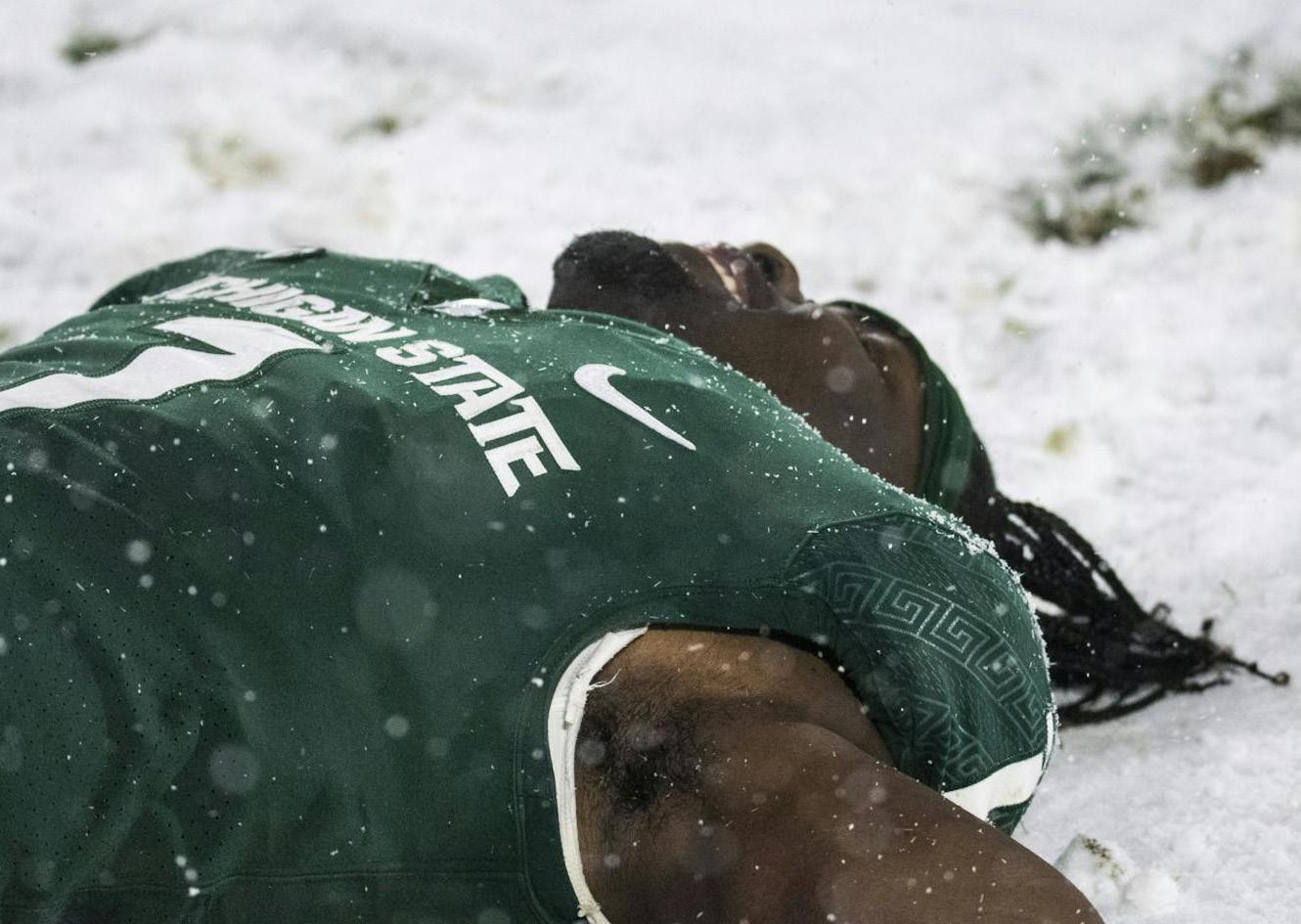
Jayden Reed celebrates the win against the Penn State Nittany Lions with snow angels at Spartan Stadium on Saturday, Nov. 27, 2021. State News file photo.
Students drive down Albert Ave. waving a Michigan State flag and pulling their friend on a sled celebrating the snow day on Wednesday morning. Classes were canceled on Wednesday, February 2, 2011, for the first time since 1994 because of a winter storm. State News file photo.
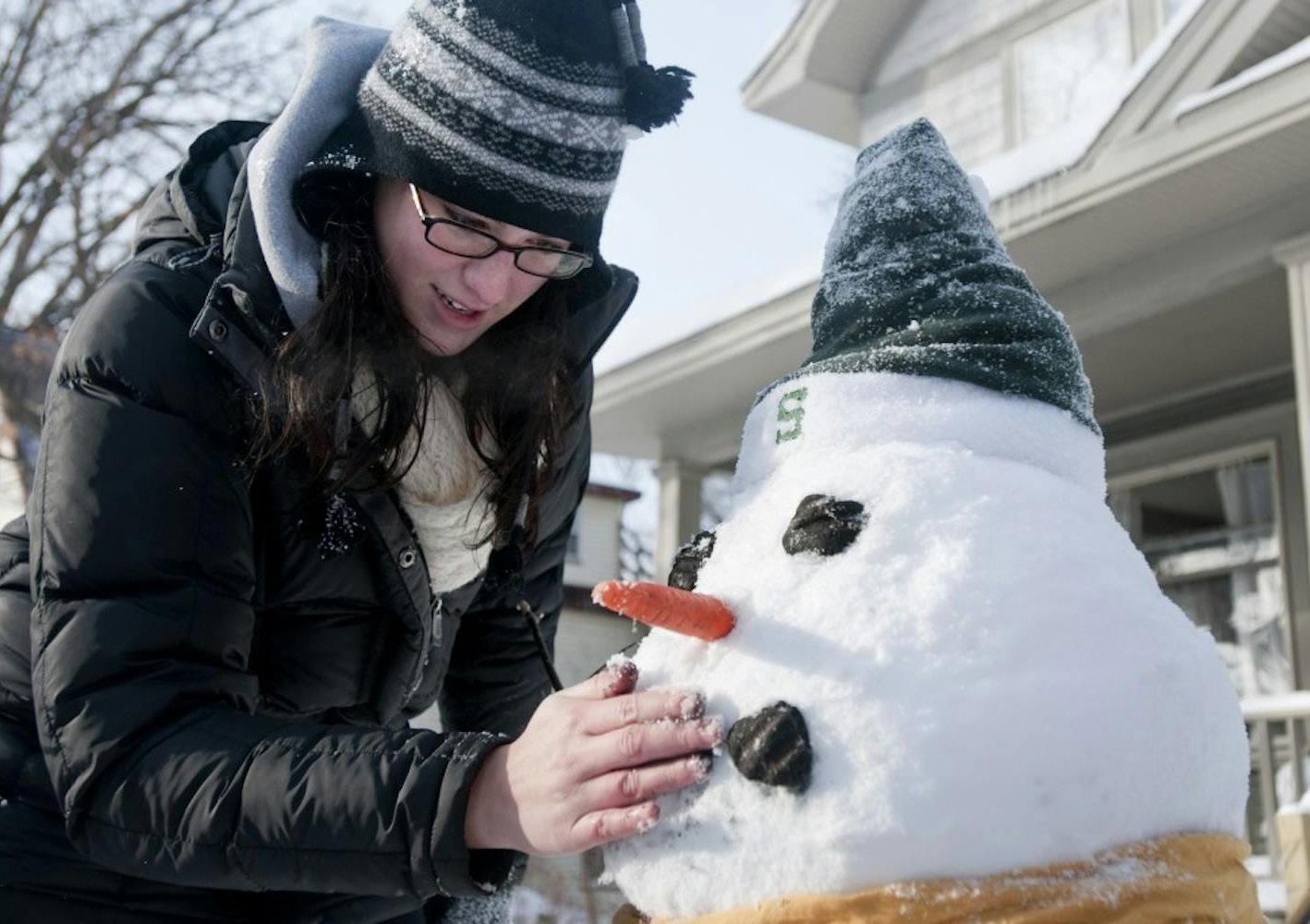
Senior Angel Sojda puts the finishing touches onto her MSU snowman on Wednesday, February 2, 2011. The snow man was the first one Sojda had ever made. State News file photo.
Freshman Hannah Cregg is hit with snow while making a snowball Jan. 6, 2014, behind the rock on Farm Lane. Cregg and friends gathered for a small snowball fight during the university snow day. State News file photo.
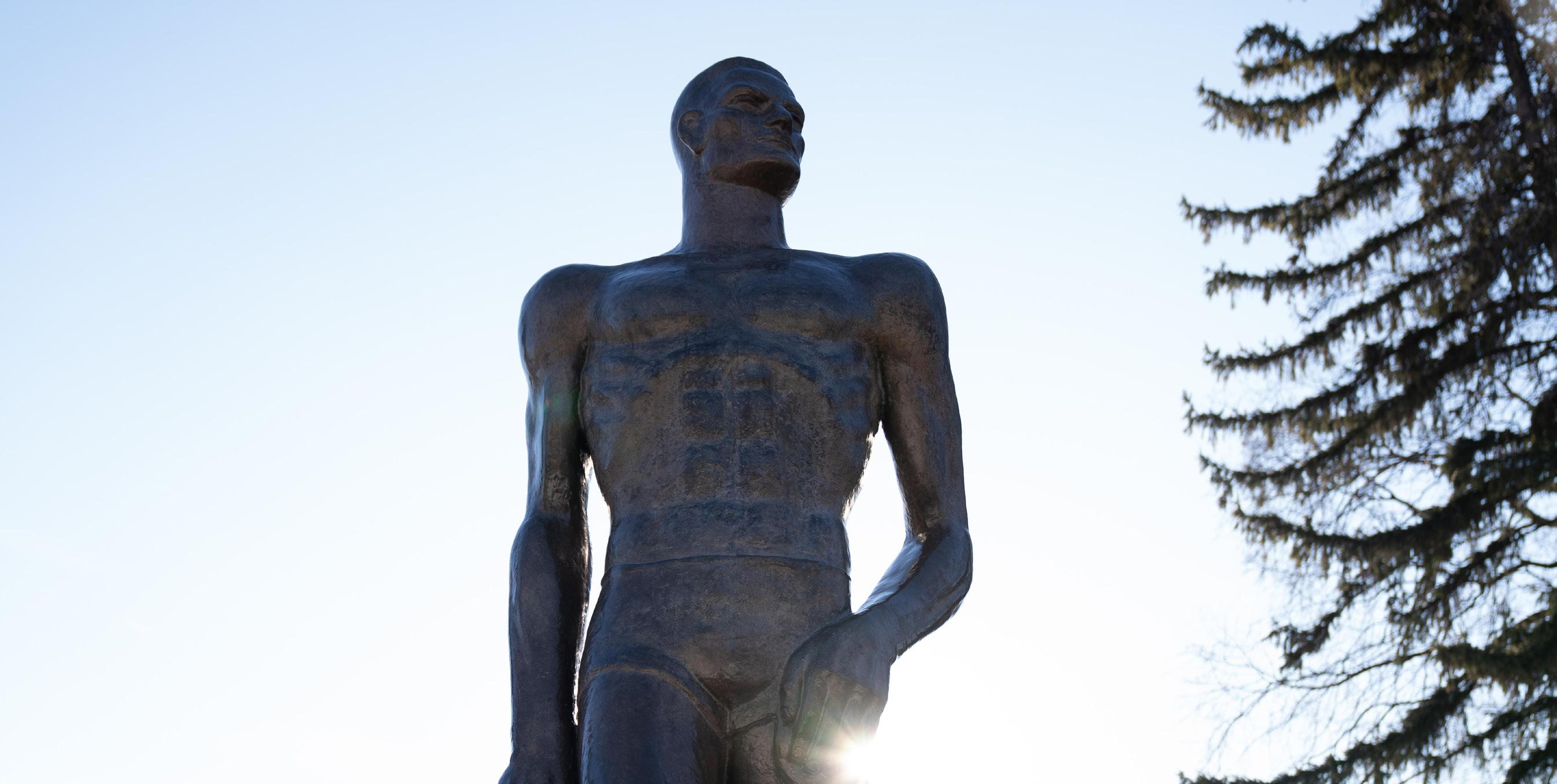
Magic Johnson Statue is pictured on a snowy day on Michigan State University’s Campus in East Lansing, Michigan, on Thursday, Jan. 22, 2026. Photo by Ari Saperstein.
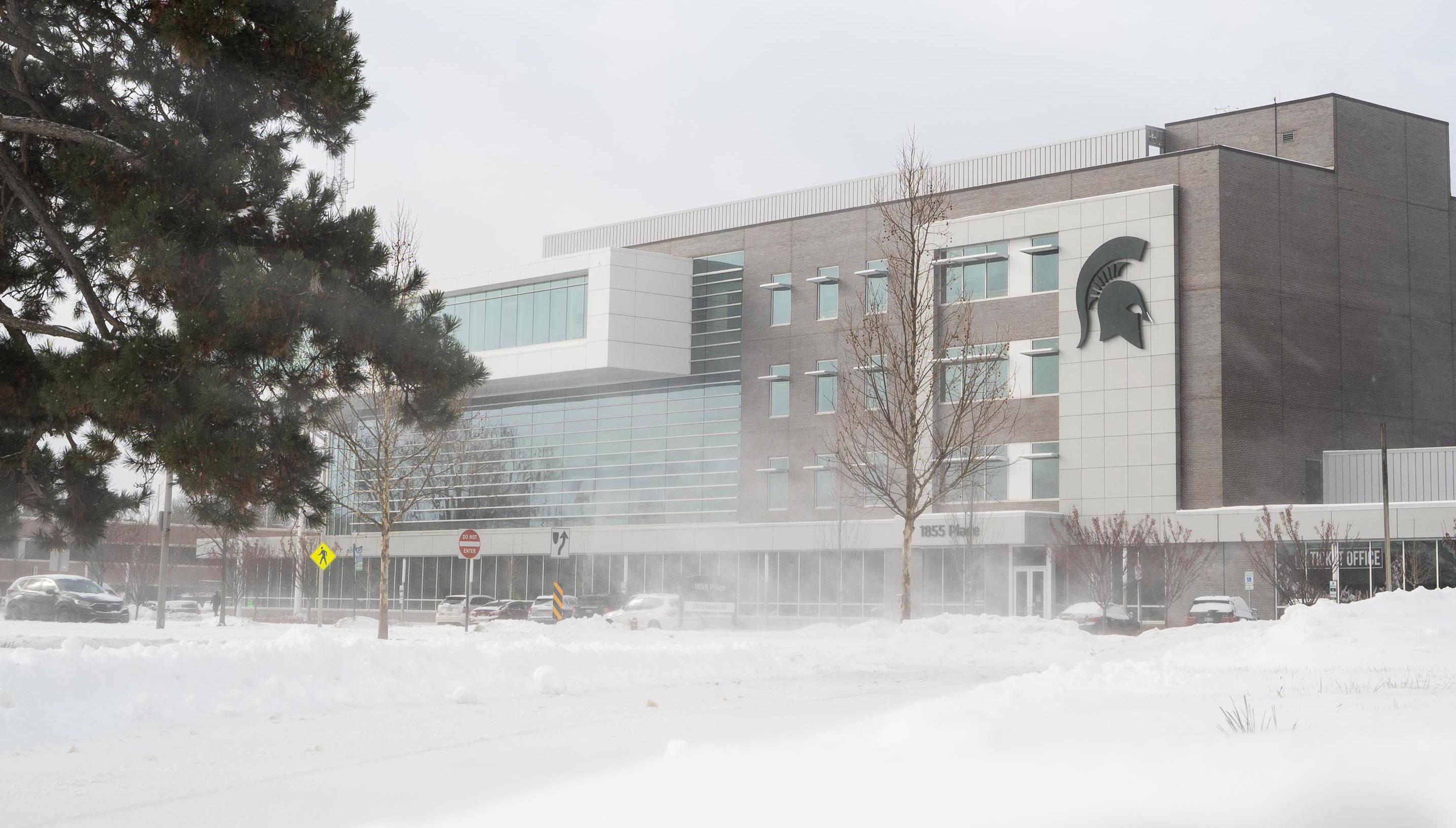
Michigan State University’s 1855 Place, pictured on a snowy day on Michigan State University’s campus in East Lansing, Michigan, on Thursday, January 22, 2026.
STUDENTS MARCH TO CLASS DESPITE FRIGID TEMPERATURES
Georgia Hill ghill@statenews.com
As sub-zero temperatures which prompted a warning from the National Weather Service enveloped campus Friday morning, Michigan State University students solemnly marched to their morning classes — which they were expected to attend despite the frigid conditions.
“I have to walk over a mile to get to class,” said digital storytelling sophomore Bryce Mattison. “Even if I bundle up, I’m still freezing by the time I get there, and walking on the sidewalks is awful because they’re always slippery.”
Temperatures Friday have hovered around -5 degrees, with windchill
reaching down into the negative twenties. Those conditions are expected to continue throughout the weekend, according to the U.S. National Weather Service.
Students expected to attend men’s hockey and basketball games this weekend were also told to not line up outside the venues before 15 minutes prior to doors opening.
Despite the inclement weather, MSU announced Thursday evening that classes would not be cancelled the following day.
The announcement immediately prompted outcry from the students, who claimed keeping classes open would put students who walk to class at risk of frostbite and force drivers onto unsafe roads.
Biochemistry and molecular biology freshman Siena Murphy, who was walking to class around 1 p.m. Friday, noted that the frigid conditions also made it harder to find a spot on CATA buses — the only free and reliably warm form of transportation on campus.
“I try my best to take the bus, but it’s always packed,” Murphy said. “I have colder, and the roads and sidewalks are awful in the early morning.”
Despite snowplows frequently servicing sidewalks and roads on campus, students said a thin sheet of compacted snow and ice on most sidewalks turned walking anywhere into a daunting task.
“I walk here from McDonnel, which
isn’t too bad all things considered, but this kind of cold makes it take twice as long,” psychology freshman Madison TenBroeke, who works in Snyder Hall, said.
Since its founding in 1855, MSU has only closed its campus seven times due to severe weather conditions. The most recent instance was in 2019, when cold temperatures in January closed the university for two days.
“Cold weather, by itself, does not warrant class cancellations or operational changes,” according to an MSU website.
Deans and college leaders were told by Provost Laura Lee McIntyre on Thursday evening, a few hours before classes would not be cancelled for the
next day.
McIntyre made the decision after her regular meeting with MSU’s deans Thursday, president Kevin Guskiewicz said in an interview with The State News. She told them to instruct their faculty to “be accommodating and
moving classes to Zoom if necessary.
“I haven’t had any complaints from students hit my door today yet,” he said just after noon on Friday, knocking on the wooden arm of his chair.
During the coldest temperatures Friday morning, about 500 classes were scheduled to meet, according to a university spokesperson. With a laugh, Guskiewicz said, “we wanted those students to get their money’s worth.”
Photo by Ari Saperstein.
MSU AND BUSINESS LEADERS RECOMMEND
NEW AI-CENTERED COURSES AMID FACULTY DISSENT
By Anish Topiwala atopiwala @statenews.com
A council of Michigan State University administrators and business leaders unveiled Wednesday three initiatives its members say will better prepare students and researchers to contribute to Michigan’s economy and workforce.
To meet the needs of tomorrow’s economy, the council argues, the university should ensure intelligence tools, namely by creating a foundational elective course centered AI competency. Its recommendations also include creating new programs to promote work experiences and internships during college and further interweaving MSU’s research efforts with industry.
Some faculty, however, are balking at the idea of business leaders from outside the university having a say in its curriculum, a responsibility usually delegated to a handful of internal administrative bodies. Ahead of the announcement, the university faculty senate passed a resolution expressing displeasure at MSU for not going through the proper academic governance channels to propose the initiatives.
“New curricular proposal should come from the faculty because Academic Governance Bylaws spell out
that faculty have the right to ‘establish and maintain the intellectual authority of the university,’” Faculty Senate Chair John Aerni-Flessner wrote in an email to The State News. “The faculty at MSU do not take this responsibility lightly and therefore we look forward to more productive partnership with the President and the Green and White Council as we all worked toward the shared goal of ensuring MSU remains a global leader in faculty-led teaching and research.”
MSU, meanwhile, has maintained that the initiatives proposed by the council are still nothing but recommendations.
“In no way do those recommendations supersede the university process around implementation for any changes around curriculum or any of the other initiatives themselves,” university spokesperson Amber McCann told The State News.
The controversy regarding the announcement began the day before its initiatives were set to be unveiled, during a Tuesday meeting of the university faculty senate.
There, some faculty members who had received a draft of the press initiative proposed by the council, the creation of AI-centric courses and economy.”
“I think it could be reasonably read that there might be an idea to introduce curriculum by outside business leaders, perhaps circumventing the policies and procedures we have in place and circumventing faculty input,” Associate Professor of Pharmacology Jamie Alan said during the meeting.
MSU President Kevin Guskiewicz, also present at the meeting, responded by saying that the language in the press release would be tweaked, and emphasized that faculty do hold the power to establish curriculum. He added that some of the proposals within the “AI-Ready Spartans” initiative are already in motion, with a number of courses related to AI being developed by faculty across campus.
Another issue raised by faculty was the inability to share the draft press release with faculty who aren’t part of the senate.
“We have bylaw processes by which we look at this curriculum, we examine it, we have the expertise to do so, and then we discuss it, we debate it, and we have a process through which curriculum is designed and approved,” James Madison Associate Professor Andaluna Borcila said. “And while my understanding is that faculty have been involved in this process, I also see this as a bypassing of our university bylaws, our academic governance bylaws, the role and expertise of the faculty in this process.”
Guskiewicz responded by saying that “nothing is etched in stone” regarding these initiatives and that the purpose of a discussion with the senate was to gather feedback from faculty leaders.
Assistant Professor of Spanish Victor Rodriguez-Pereira said during the meeting that making a public announcement of the three recommended initiatives — which included a press release sent to the media — could create unnecessary limitations to future discussions about the initiatives.
“It still sets the agenda, as if this is being placed forward as something that is somewhat set in stone, or at least in semi dry clay,” RodriguezPereira said. “And I worry about that, because then we are defining the parameters and the boundaries of our discussion, as opposed to perhaps incorporating broader ideas.”
In the final act of the meeting, Alan, the pharmacology professor, introduced a resolution expressing displeasure with the administration not adhering to academic governance procedure, arguing that the initiatives were developed without the “requisite legislative approval of the University Committee on Curriculum (UCC), the University Committee on Undergraduate Education (UCUE) or the Faculty Senate.”
The resolution also asserted that no “foundational AI course,” “AI
certificate” or “Career-Connected” degree requirement be implemented or listed in the University Catalog until it has been “proposed by an academic unit and approved through the established faculty governance.”
upon Guskiewicz to “immediately pause” the implementation of these initiatives and submit them to the proper channels for review.
Some faculty, like Associate Professor of Counseling, Educational Psychology and Special Education Matthew Brodhead, were apprehensive to the resolution, saying that university leadership seemed receptive to feedback and that the senate should wait until the recommendations become public to act.
Associate Professor of Engineering Rebecca Anthony added that although she supported pausing the announcement, she didn’t think that the resolution was necessary, since the language does not explicitly state “a rejection of the stated protocols for curriculum revision and that being a faculty driven process.”
The resolution passed 27-17. The other two initiatives announced by the council, titled “Career-Connected Spartans” and “Spartan Catalyst,” respectively aim to strengthen career prospects for students and to connect MSU researcher with business and industry in the state.
By Theo Scheer tscheer@statenews.com
Spotting a silver Ford decaled with the words “Parking Services” strikes dread in the hearts of many at Michigan State University. For some, however, fear of an imminent parking ticket is coupled with an even stronger emotion — a thirst for revenge.
On a recent Thursday in a GroupMe of over 2,600 disgruntled campus drivers, members of the latter camp imagined what it might be like to take their vengeance on this harbinger of doom.
One student suggested polluting the intake vents of the iconic campus parking enforcement vehicle with “fart spray.” Or, another proposed, they could pour milk in the backseat and let it spoil.
Others weighed in with darker pranks. What if, one GroupMe gas tank with sugar? Loosened the car’s lug nuts? Put “jizz in the A/C?”
The comments were par for the course in the massively popular “Pace Spottings” GroupMe, where the student body’s animosity for parking enforcement is on full display, from playful quips to gruesome threats.
In theory, the GroupMe is a way vehicle owners can warn each other when parking enforcement is nearby. But the chat can quickly devolve into ruthless harassment of the MSU employees that issue tickets, all current and recently graduated students themselves.
MSU’s parking enforcers tell The State News they’ve taken notice. Knowing angry drivers will post pictures of them online, they go to lengths to conceal their faces while out on the job. Some have secretly joined the chat to keep a closer eye on who they’re up against.
The online harassment mirrors in-person abuse. “I want them to feel unsafe,” wrote one GroupMe member, admitting that she’s screamed at parking enforcers “many times” from her car window. Verbal abuse is routine, some employees say, and more than once, parking lot spats have required police intervention.
THE PLIGHT OF THE
Even amid the online insults and occasional physical intimidation, some parking enforcers said they understand why their fellow students are upset by what they do. They, too,
campus frustrating.
But must they bite the hand that tickets?
A NOVEL WAY TO AVOID TICKETS
Anger over campus parking is nothing new. Decades ago, the late, long-time higher education administrator Clark Kerr described the American university as a “series of individual faculty entrepreneurs held together by a common grievance over parking.” It’s a uniquely uniting cause on college campuses, often treated as a righteous pursuit — a matter of access to education, not just convenience.
Considering the size of MSU’s parking operation, it’s no wonder drivers see themselves as underdogs
university’s current fiscal year, from July 1 to Dec. 31, 2025, MSU issued 41,635 tickets, raising a total of $1.426 million to cover transportation-related expenses on campus, according to a spokesperson for the campus police department.
The consequences of ignoring
range from $20 for meter violations to $115 for disabled parking violations — are many. If a ticket goes up $10. After four weeks, it goes up another $10. If a ticket isn’t paid in over 70 days, students risk a hold on their account, said Parking Services Manager Kathleen Bissett, and after 150 days, the matter is taken to district court. Rack up six unpaid tickets, and MSU can tow your vehicle. Students can’t receive their diploma until all such debts are paid.
Students have attempted creative solutions to these burdens for years, with varying levels of success. Where bureaucracy has failed, drivers have tried to leverage everything they’ve got to avoid parking tickets: technological innovation, personal
complaint with the campus police department, claiming a parking enforcer was “harassing” and “targeting” them with relentless ticketing. (An internal investigation found that each of the person’s seven tickets was issued by a different parking enforcer.)
Of course, many have also gone
parking tickets: Submit an appeal. In 2024, 11% of the total tickets issued were appealed, and of those, nearly half led to reduced or withdrawn tickets. But to be successful, vehicle owners must prove that the parking enforcer was wrong. And no, “I only parked in that space for a few minutes” doesn’t cut it.
That’s why, to many students with vehicles on campus, the GroupMe is a game-changer. Members report in real time wherever they see enforcers, so that others parked in the area can move their cars before it’s too late. The chat’s title, “Pace Spottings,” refers to the popular but incorrect name for parking enforcers that work for MSU (“PACE” is the acronym for the city of East Lansing’s parking department).
The thread was created two and a half years ago by a student with a third year law student, who got the idea when she was in undergrad from a post on the anonymous social app YikYak.
As of writing, the GroupMe has 2,659 members — as far as Parker
out about it from word of mouth and social media. Until recently, anyone with the link could join, but after an
settings so that each new member requires her approval. (Messages from the GroupMe were viewed by The State News when the chat was public.)
Students in the GroupMe, some of whom count the number of tickets they’ve gotten in the double
“saved me quite a few times,” said Mason Fielding, an agriculture business senior.
MSU officials don’t seem to mind, either.
“If users pay a parking meter, purchase a parking permit, or move their vehicle out of a restricted parking area because of a GroupMe chat, we’re glad to see them following the rules and regulations to make parking better for everyone,” wrote John Prush, director of MSU’s Public Safety Bureau, in a statement.
‘REMORSELESS PEOPLE’ OR INNOCENT STUDENT EMPLOYEES?
scorned drivers in one place, it’s no surprise that the GroupMe can sometimes stray from its utilitarian purpose.
When it isn’t helping avoid tickets, the chat is a place for drivers to commiserate about the people who hand them out. The chatter can often be cruel, sometimes outright violent. According to comments made in the GroupMe, being a parking enforcer makes you a “rat,” a “b-tch,” a “mutt,” a “f-cker” and a “c-cksucker.” They are “soul-less (sic), remorseless people” who would “crawl over 1000 miles of glass to give
PARKING ENFORCER
one broke college kid a ticket.” They are “low-IQ,” “ugly” and “ill adjusted.” They deserve “sleep deprivation,” “no friends,” and “pain and suffering.”
For these disgruntled parkers, there’s no such thing as a low blow. Sometimes, members of the GroupMe pass around pictures of enforcers and make fun of their weight and posture. They speculate what might drive someone to take the job: Maybe, one once wrote, “if everyone hated me.” Another would do it “If I had no friends and my family disowned me.” (Prush wrote in a statement that the “Safety of student employees is paramount,” and reports of unlawful activity or policy violations will be “taken seriously” and investigated.)
enforcers — around 15-25 at any given time, according to Prush — are all current or recently graduated students, paid $14 an hour, who took the job because the hours are good or so they can add an impressive line on their resume. Some have cars on campus. Some have even gotten ticketed.
“We have to follow the same rules as everyone else,” said one current parking enforcer who recently graduated from MSU.
The parking enforcer, who spoke to The State News on the condition of anonymity to protect her safety, said she’s “been yelled at too many times to count” on the job. Once, an angry driver even followed her car back to the police department. The driver and parking enforcer circled the lot for thirty seconds before employees came out and told him to leave.
Confrontation with parking enforcers isn’t uncommon and can be intense.
In September 2025, a parking enforcer requested police come to a parking lot. Someone was recording them, and “they felt uncomfortable,” Chris Rozman, deputy chief of the campus police department’s Staff Services Bureau, wrote in a that a crime hadn’t occurred, and
A similar story happened in 2003, when former Spartan wide receiver Charles Rogers allegedly pushed a parking enforcer, and in 2008, a law student was heavily disciplined under a strict university ordinance for yelling at a parking enforcer. The law student sued, and the case made it to the Michigan Supreme Court, which ultimately struck down the ordinance.
“There were plenty of times where I was verbally berated or threatened while on the job,” recalled Nick Doyle, an MSU alumnus who worked for the department from November 2019 to May 2022 as a parking enforcer and later a student supervisor.
For Doyle, deescalating confrontations with frustrated drivers “could be mentally draining,” calm down after he explained the restrictions of the particular lot and they “realized their mistake.”
Not everyone can take the heat.
out of the job, the anonymous parking enforcer said.
Those that remain must be vigilant. Parking enforcers are
required to take a picture of every ticket they issue, and multiple enforcers said they angle their camera to avoid catching their
recipient can’t use it to track them down. Some also wear baseball caps and masks to conceal their faces on the job.
As an additional measure, the anonymous parking enforcer discreetly joined the GroupMe last year. That way, if its members “say that they want to do something bad” to her while she’s out ticketing, she knows when to leave.
Members of the GroupMe suspect that this is the case, and the idea that undercover agents are attempting to thwart their efforts is a prevalent concern in the chat. Members are scolded when they ask for or recommend less-ticketed lots, fearing they’ve given the “pace rats” lurking in the chat new places to target.
But the recently graduated parking enforcer said she “really couldn’t care less” about the methods the GroupMe discusses to evade tickets. She can without needing to consult the chat, the parking enforcer said.
In fact, there’s not much incentive to go above and beyond when issuing tickets. Contrary to popular assumption, parking enforcers don’t make a commission off of tickets, she said.
Another misconception: That parking enforcers ticket campus in a trackable pattern. In the past, ticket-evasion projects tried using spreadsheets and artificial intelligence to predict which parking lots and structures are ticketed and when. But parking enforcers are assigned to general zones on campus,
parking enforcer said.
The parking enforcer understands where the members of the GroupMe are coming from. But parking enforcement is a necessary evil, she said.
“If we made all parking free, then all 50,000 students would have a car,” she said. “Then there would be absolutely no place to park, ever.”
That sentiment is shared by
another parking enforcer, who spoke to The State News anonymously to protect their employment with the university. While this parking enforcer was upset by some of the more extreme comments in the GroupMe — they recalled when someone allegedly wrote “#RapePace” in the threat — they’re generally unbothered by the online activity and haven’t run into much
Though the parking enforcer worries about accidentally sending a to angry drivers after issuing a ticket, they say it’s students’ right if they want to take pictures of public the enforcer did join the GroupMe, it was mostly out of curiosity — and “to see if they got my good angle,” they said.
Parker, the creator of the GroupMe, acknowledged that the online banter has sometimes “gotten out of hand.” She removes the worst offenders from the chat herself. Recently, she said she kicked someone who sent a message threatening sexual violence against parking enforcers.
“Like, yes, I get that we all dislike (parking enforcers),” Parker said. “But that doesn’t mean that you need to threaten their lives.”
The point of the GroupMe isn’t to “foster hate towards anyone,” Parker said. “It’s supposed to help people.” Though playful ribbing should be expected online, some people take it “way too far” in the GroupMe, said physiology junior James Dubin.
enforcers might want to keep an eye online. Besides, Dubin said, parking enforcers aren’t so horrible. They’re “like the least bad cop there is,” he said.
GroupMe tell a different story. Once, responding to a picture of a parking enforcer, he wrote, “Jump him.”
Asked about it, Dubin said he sees how his messages, while intended to be a joke, might cause worry.
from that in the future,” he said. Photo illustration by Gavin Hutchings.
DAN STURGES LEAVES LASTING MARK ON MSU HOCKEY
By Audrey Dayton adayton @statenews.com
Before every Michigan State hockey game, Dan Sturges told head coach Adam Nightingale he wanted to see 60 minutes of KBH: kneesbent hockey.
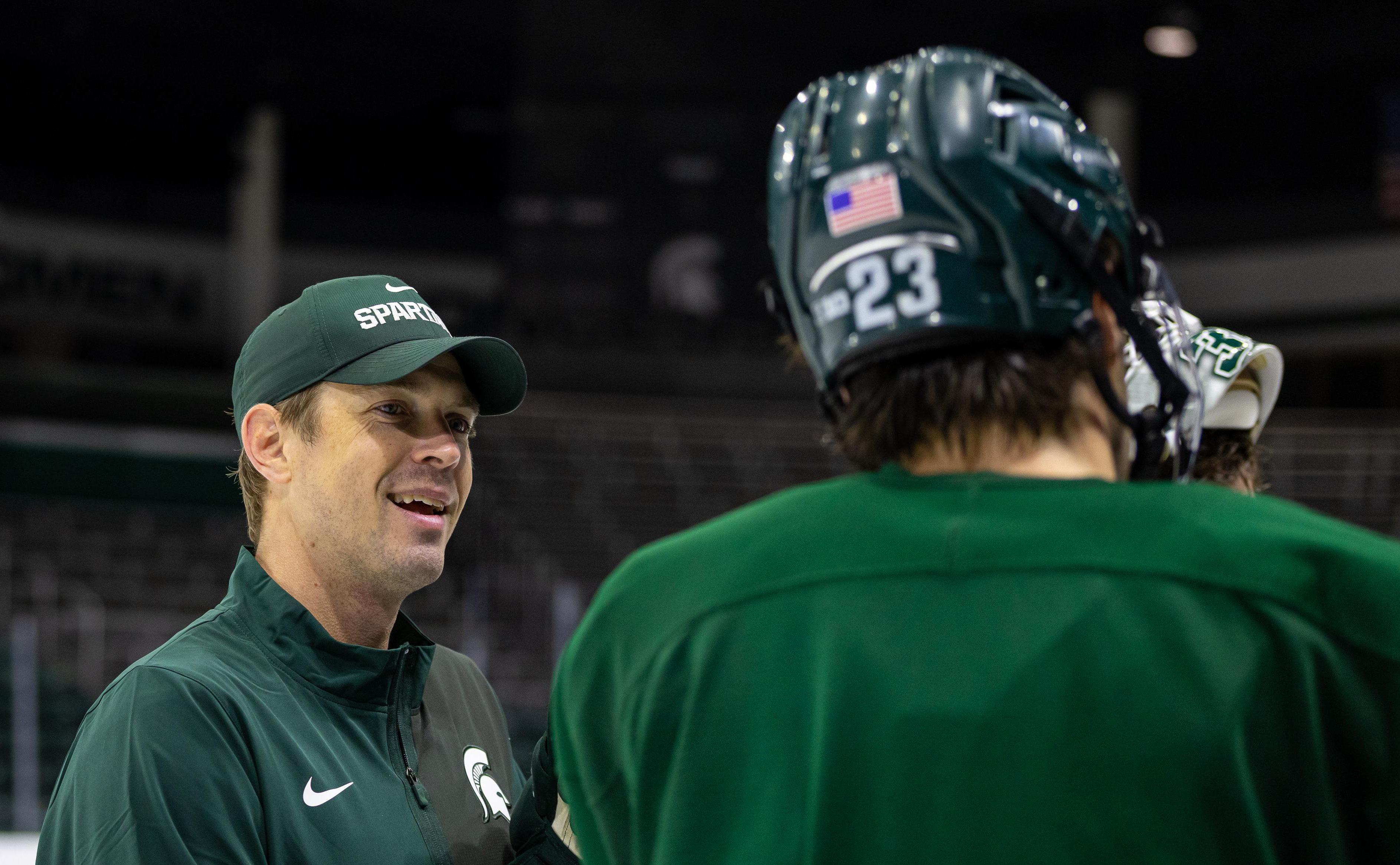
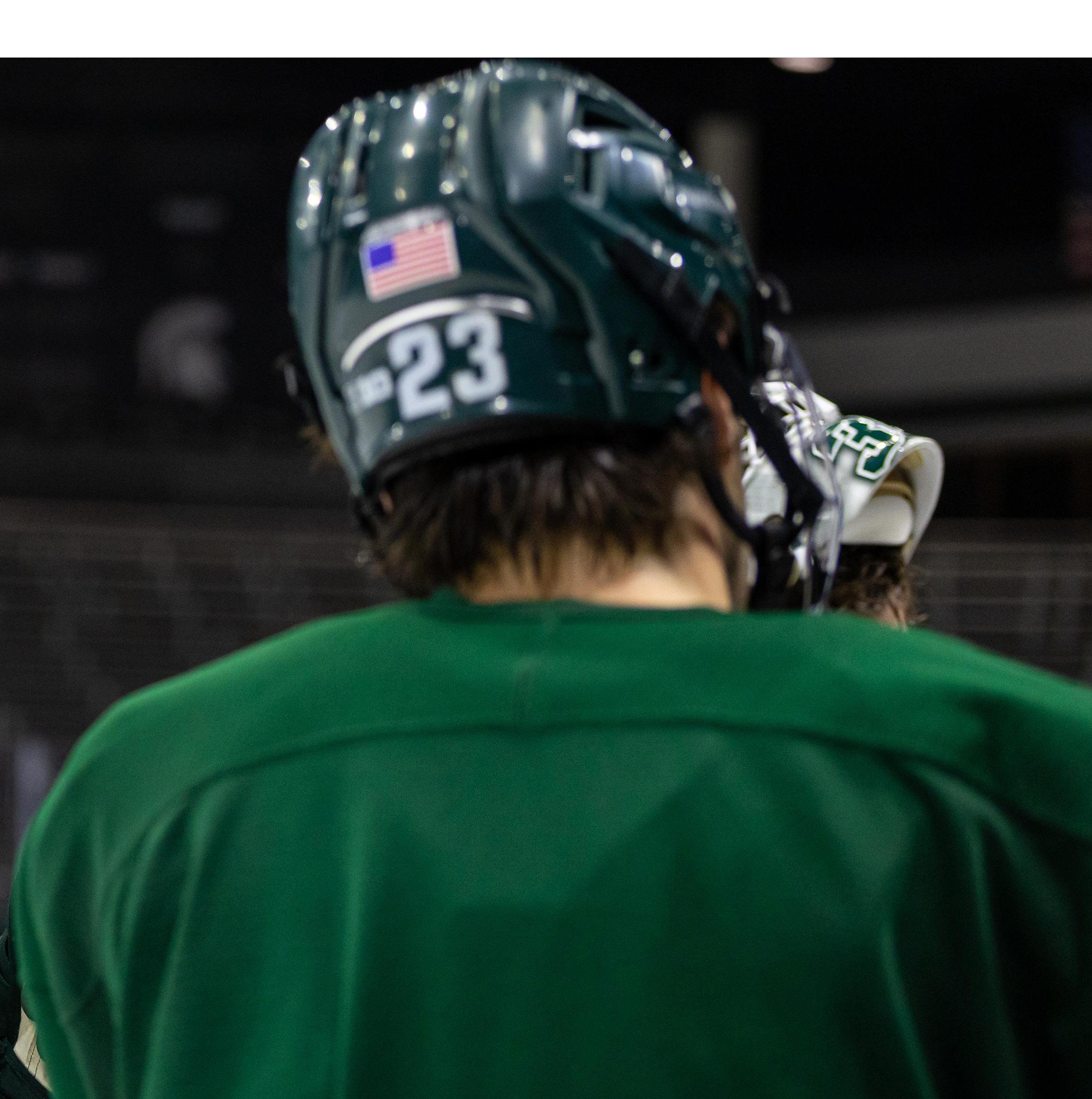
Starting last Friday night, the Spartans enacted a tradition to sport jersey patches with Sturges’ initials, honoring their director of hockey operations who died unexpectedly last Monday. Their series opener against Minnesota had a moment of silence, and Minnesota wore helmet stickers for the competitions.
“We talked as a group, right? One thing Dan for sure would want us to do is practice. And want us to play.” Nightingale said. “Knees-bent hockey. That’s what he loved, team play and hard work. I told our guys that maybe we’re gonna win some, we’re gonna lose some, but for sure, we are gonna honor him and play how he dreamed of us playing.”
Sturges was the glue of the team, Nightingale said. His character embodied what the Spartans strive to be: team players, competitors and students of the game.
Sturges was a forward on the MSU hockey team from 2005-09, spending half of a season with then-senior Nightingale. He was a great teammate with a great attitude, Nightingale said.
Sturges went on to win a national championship with the Spartans in 2007. He kept in contact with Nightingale and returned to MSU hockey in August of 2019, becoming director of hockey operations, under former head coach Danton Cole.
Sturges wasn’t trying to become a head coach or to move to the NHL, but to be the best at his
job, right where he was.
He had an ability to connect with players who weren’t consistently in the lineup, and to lift up guys who were struggling, Nightingale said.
Sturges would do extra work with the players after practice, not because he was asked to, but because he was passionate about it. He often did puck protection drills with junior forward
“Knees-bent hockey. That’s what he loved, team play and hard work. I told our guys that maybe we’re gonna win some, we’re gonna lose some, but for sure, we are gonna honor him and play how he dreamed of us playing.”
Adam Nightingale Head Coach
Sturges’ goal was to be the best video coach in the country, Nightingale said. The team noticed Sturges wasn’t looking for the next opportunity, he was trying to be better for them.
His legacy illustrates what the Spartans try to do each time they hit the ice: focus on the team rather than themselves.
“Super simple concepts, but I think it’s the hardest thing to do in sports,” Nightingale said.
“Play for the team. It’s not about you. And make
sure when that end of the game comes, you got nothing left in the tank.”
Sturges loved to compete, Nightingale said. Whether it was tossing paper clips at a coffee cup and seeing who landed the closest, playing football with the other coaches or trying to win
He was also inquisitive. In 2023, Sturges said “every day is a learning experience” adding that he learned a lot from Brad Fast, director of player development. When Sturges was just starting out as a coach, he sought insight from Nightingale, who then served as video coach for the Detroit Red Wings.
Sturges went on to coach ACHA hockey at the University of Colorado from 2016-19, working simultaneously as an assistant coach at Valor Christian High School. Even then, he was keeping up with MSU hockey scores.
He loved being part of the MSU community —
up in Wisconsin, it was his childhood dream to attend MSU and play hockey, as his father had followed in his footsteps.
During his time as a student-athlete, Sturges team’s “Shoot for a Cure” campaign.
“He is what Michigan State’s all about, a team guy,” Nightingale said. “We would always tease him when the Powerball was up, ‘If you won the Powerball, what are you gonna do?’ And he said he was just gonna keep his job here and donate it all back to the program, and we would laugh, but that’s, that’s the truth.”
Sturges met his wife, Becky, at MSU; she was two sons, Kellan and Cooper. While raising them, Sturges coached youth hockey and baseball in Lansing.
While the hockey season will continue, Nightingale said there is no playbook for how the team handles grief, and that everyone will process it in their own way. He added that he is needs and that the players will take it one day at a time.
“We got to do what he would want us to do and that’s going to help us all heal. I think that it takes time.” Nightingale said. “Our guys 100% knew how he wanted us to play, 100% respected how he wanted us to play, and we’re going to play that way.”
Photo courtesy of MSU Athletics.
No. 2 MSU hockey sweeps opponent for second-straight week, defeats Minnesota
By Audrey Dayton adayton @statenews.com
the Spartans an opportunity to respond — and they did.
No. 2 Michigan State hockey closed out its home weekend against Minnesota, sweeping the series with a 3-2 win powered by consistency across zones.
“I thought we played a great game, full 60 last night, and kind of brought that into tonight as well,” senior forward Charlie Stramel said. “We were good at managing pucks at times and getting pucks to the net, you know, 40 shots both games, and just looking to continue to grow each weekend.”
Seven Spartans tallied points in the win, moving them to 19-5-0 overall and 10-4-0 in the Big Ten with 30 points. Their next series
played outdoors at Beaver Stadium.
Unlike yesterday, the game opened with both
after it. Lahey’s pass into the neutral zone was a shot past junior goaltender Trey Augustine’s right shoulder for a 1-0 Minnesota lead. MSU does not often play from behind and is 17-2 when
However, Augustine gave the Spartans an opportunity to respond, making multiple one-
advantage. The Spartans remained patient on from the slot, rebounded and buried by senior forward Daniel Russell to tie the game 1-1.
“Give them (Minnesota) credit, they defended hard,” coach Adam Nightingale said. “I thought they were heavier on their sticks tonight than the night before. And we didn’t win as many battles early, so I think that we got a little better at that throughout the game.”
The Spartans outshot the Gophers 17-13 in the opportunities being snuffed by goaltender Luca Di Pasquo.
several scoring opportunities both set up and in transition. The team got to its game in the second, Nightingale said. Despite a narrow 27-25 shot advantage and 2-1 lead entering
The Spartans maintained their edge with pass disruptions, a successful penalty kill and a rock-solid performance from Augustine. The
a .935 save percentage.
Männistö added insurance to MSU’s lead
Patrick Geary was set up in the slot and Männistö attacked, faking out Di Pasquo before sinking his ninth goal of the season for a 3-1 advantage.
aggressive checking, the Spartans outshot the Gophers 14-0 for nearly 11 minutes of the third period, Lamb ending the dry spell.
“A lot of guys are mature, and our game’s getting a lot more reliant and dependable,”
Stramel said. “Up and down the lineup, we have a lot of strength in our depth, and just trying to lean on that every night.”
While MSU’s penalty kill was strong for the
winger Brodie Ziemer scored a power-play goal for a 3-2 score, keeping Minnesota in the game.
However, the Spartans’ Saturday night performance mirrored their effort on Friday,
puck and sticks that prevented passes before a transition could even develop.
“When we play on our toes, I think we got a chance to be a pretty good team,” Nightingale said. “I thought we saw that for good chunks of the game tonight.”
With regulation nearing an end, two Spartans missed long empty-net shots that would have iced the game, but Augustine secured the 3-2 seconds of the game.
“Trey (Augustine) had to make some saves to keep us in that thing,” Nightingale said. “Late you give up a goal, it would have been pretty easy, a lot of emotion to fall apart. And I thought we really dug in and got the job done.”
The victory marks the Spartans’ second consecutive sweep, including a road sweep against Wisconsin before the wins at Munn Ice Arena. Saturday’s game was “Star Wars”
with a lightsaber and a Millennium-Falcon tie worn by Nightingale.
While the theme was planned at the start of the season, the tie was a tribute to Dan Sturges, MSU hockey’s director of hockey operations who died on Monday. Nightingale pointed out his tie after the game, adding that Sturges was fond of Star Wars.
STUDENTS PROTEST TRUMP ADMINISTRATION AND ICE OUTSIDE MSU LIBRARY
By Katherine Baligian kbaligian@statenews.com
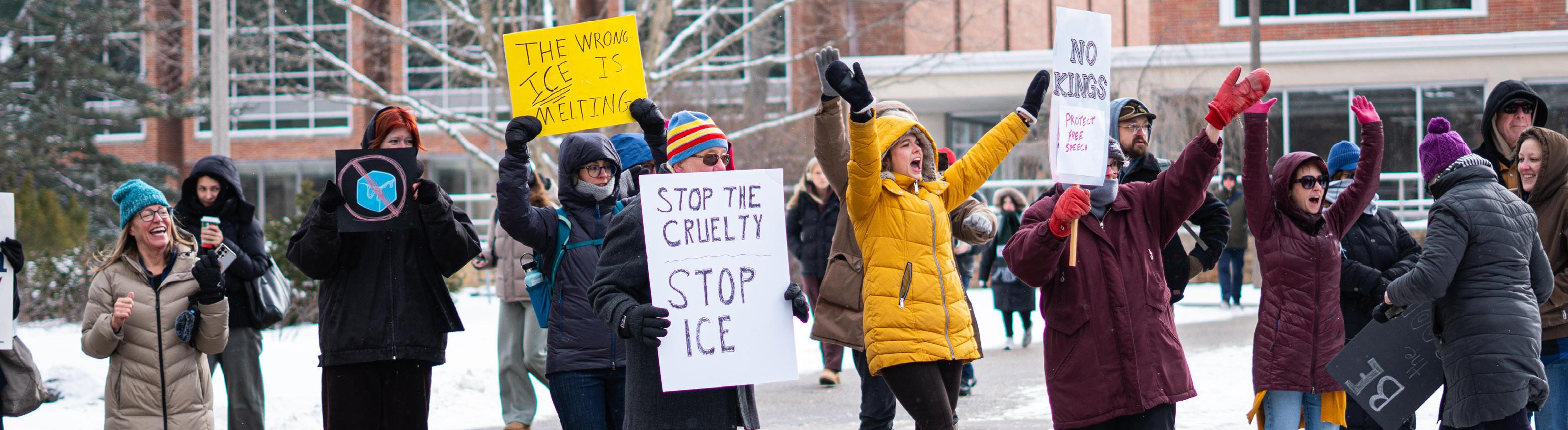
Michigan State University students and staff, along with local residents, protested the increasing intensity of immigration enforcement and aired other grievances with the federal government on Tuesday outside the Main Library.
The protest, which garnered a crowd of around 25 people in the frigid cold, coincided Trump’s second inauguration.
Similar protests branded as ‘walkouts’ were held at high schools and universities across the country on Tuesday, including at the University of Michigan.
Kaitlyn Andary, a digital marketing coordinator for the MSU Library, said she had heard about the protest two hours ahead of its
“Because the amount of data centers that are being built, and excuses being made for all kinds of ‘clean’ energy, is just money for these big tech companies that are absolutely ruining the environment.”
Braxton Makuda, a sophomore majoring in political theory and constitutional democracy as well as social relations and policy, who is also the vice president of the MSU College
lack of affordability facing college students. Grocery costs have risen 2.4% and electricity
according to the Bureau of Labor Statistics. The average tuition cost for four-year public universities has more than doubled over the
Environmental studies and sustainability sophomore Kathlyn Kraut, along with her friend, entomology sophomore Amelia Hawk, criticized the increasing presence of ICE in major cities and the administration’s treatment
East Lansing resident Anne Marston, who attended the protest with members of her neighborhood group, expressed concern about the kind of future the current administration would leave for future generations.
“I’ve got a granddaughter that I’m very worried about,” Marston said. “What are we leaving her?”
sophomore Nate Zerbonia said MSU needs to take action to protect its students. In the year since to balance advocating for their students while avoiding the ire of Trump, who has used federal research cuts, visa cancellations and restrictive
executive orders to put pressure on institutions of higher education.
“I think they need to listen to the students more. Students have been out, students have been protesting, it’s getting talked about, it’s getting written about, but nothing actually is getting done about it,” Zerbonia said.
Kraut, the sophomore, said she hopes the protest heightened her fellow students’ awareness of these issues.
“Maybe someone will walk by and see and talk people have it on their mind and are concerned about it.”
off the streets with no legal due process, and deported with no information of where they’re being
“They aren’t treating human beings like human beings,”
Protesters gather outside the Michigan State University Main Library along West Circle Drive during a demonstration in East Lansing, Michigan on Tuesday, Jan. 20, 2026. Photo by Quinn Shell.