
Illustration by Addison Ogburn.

EDITORIAL TEAM

Senior Alex Edson (49) prepares to throw the ball against Grand Valley State University during the 2026 Michigan Dodgeball Cup at Demonstration Hall on Feb. 21, 2026. Photo by Zari Dixson.
By Isabella Cucchetti icucchetti@statenews.com
Imagine: you’re a college freshman, it’s October, and you’re hearing much commotion amongst your friends about getting an apartment for next year. Already? You think. The good ones fill up quick, we need to sign a lease now, your friends tell you. You agree, and sign for a four-bedroom with your three best friends.
Fast forward to March. You’ve had a falling out with this group, and you are not on good terms. There’s no way you can live with them. Now, you have to deal with the stress of getting out of your lease and finding a new place to live. You’re really wishing you could go back in time and tell yourself to not sign that lease.
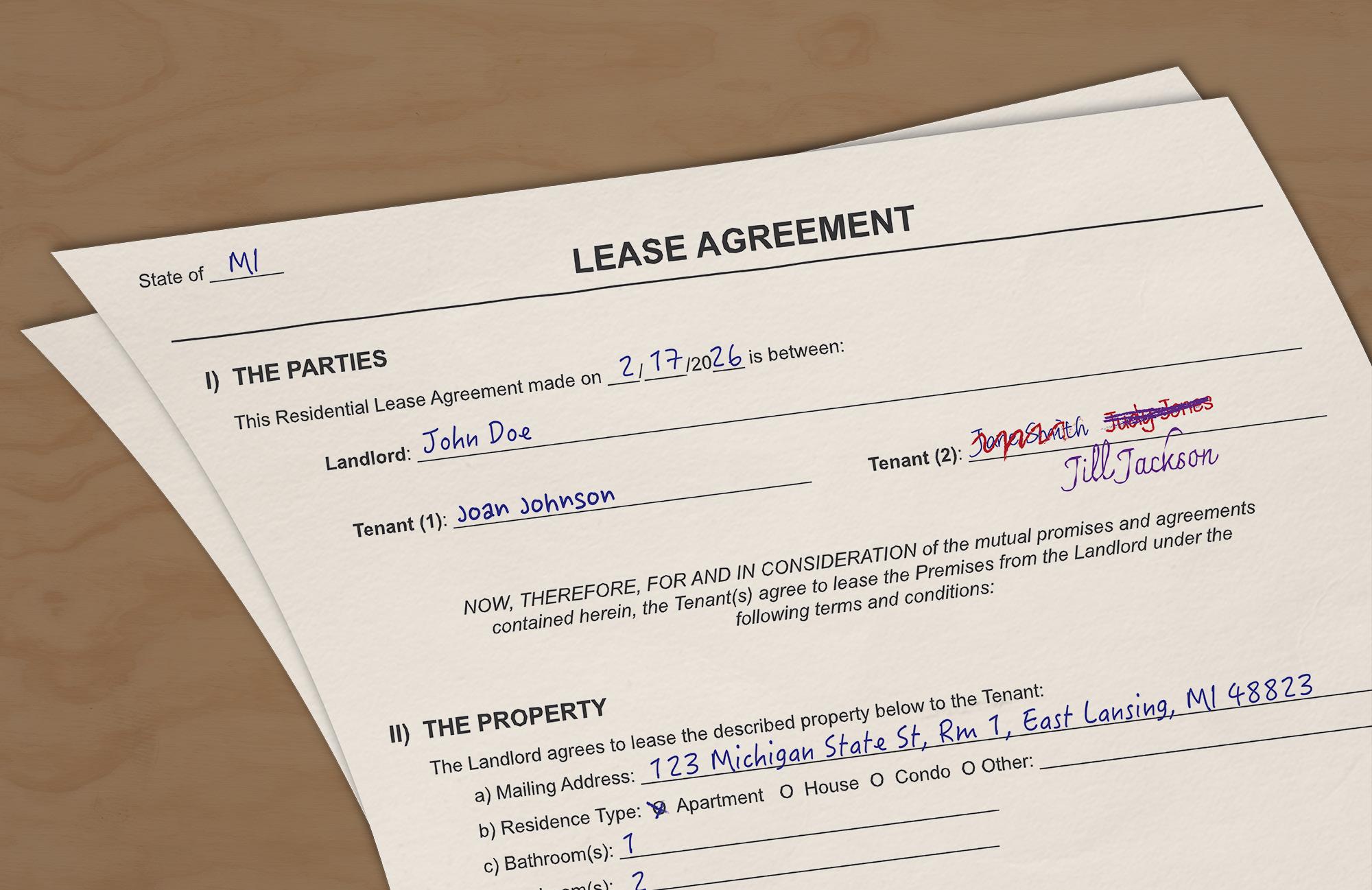
Many Michigan State University students, like junior Josie Callendar, have experienced a similar situation. She signed a lease in October 2024, but by January, she had started to reconsider. She lost her security deposit, which in East Lansing can legally be up to 1.5 times one month’s rent, and her landlord insisted she find someone to take over the lease, or else she would be obligated to pay out the year’s worth of rent. Friendship fallouts happen like this all the time, especially early on in college, but they’re more cumbersome when there’s such a costly agreement attached. Maybe if students like Josie didn’t feel pressured to make such an important decision so early, they would be less likely to end up paying for a broken lease.
It’s no secret that the date when many students are asked to sign a lease for the following year is remarkably early, often eight to nine months in advance. The rental market in the greater Lansing-Ann Arbor area is among the most competitive in the country, with around nine prospective renters for every unit and 95.3% of units occupied. High demand for housing off-campus leads landlords to open leasing agreements early and fill their openings quickly. As a result, students are rushed to sign and secure their spot for the following year.
The sheer amount of unknowns so early in one’s college career mean this decision will inevitably lead to friction between potential roommates. For example, if a student is considering transferring, they might not hear back about their acceptance decision until late spring. Or, if a student is applying to be a Resident Assistant, they won’t hear back until March. Even study abroad plans might not be confirmed until a few months prior. If your roommate might not live with you next year, you’re going to start searching for others, or else you might not get a place to stay. All
of these factors up in the air make students terrified of being left without housing, which leads students to make rash decisions. Not only that, but this anxiety can seriously harm relationships between roommates and friends.
In reality, there are many apartments that have availability in the spring, and not all students sign so early in the year. But the rushed timeline being pushed onto students puts so much undue pressure on fledgling relationships, making them feel forced to make a very important decision rashly.
Maybe this pressure is a good kind: you become more willing to make it work and resolve conflicts with your friends because you’ll be living together. But oftentimes it can be a bad kind of pressure. The more your relationship develops, you start seeing more flaws, and you begin to panic when they annoy you because you feel trapped. Their shortcomings seem more significant because you made a binding, year-long agreement to live with them.
I have personal experience with this. My roommate and I were very close but went through a bit of a rough patch in the fall of 2025, in our third semester living together. It wasn’t a friendship-ending disagreement, but out of fear that maybe it wouldn’t resolve completely, we chose not to live together the
following year. Even though we later worked out our conflicts, that pressure to make such a premature decision ended up harming our relationship, in a kind of self-fulfilling prophecy. It was neither of our faults, just an unfortunate symptom of a hectic rental market. If there wasn’t such a rush nor the fear of having to break a lease later on, maybe this wouldn’t have happened.
If students didn’t feel like they had to sign a lease so early on in the fall, not only would they be less likely to end up in difficult leasebreaking situations, but their friendships wouldn’t be hurt in the process. Evidently, landlords are reluctant to change their practices. In 2021, East Lansing passed an ordinance to prohibit landlords from showing their rentals before 150 days into the current lease. Landlords pushed back strongly against this provision, one of their main arguments being that it would merely compress the rush into a shorter period of time. It’s not hard to imagine a springtime rental-search frenzy, with students lining up outside of leasing offices and websites crashing due to overwhelming traffic spikes. But the ordinance, while passed, was rescinded because nearby local governments didn’t pass similar measures.
On the one hand, if students realized that this rush is partially exaggerated, and usually
only applies to the few highest-demand apartments, this issue might be significantly improved. On the other hand, landlords’ practice of pushing renters into making hasty decisions is predatory. Not only does it grant landlords the security of contracted tenants, but if students break their lease, the landlords get paid, and afterwards have no issue filling their spot due to the sheer amount of prospective tenants. Landlords are heavily incentivized to force renters to sign early, because security deposits and high demand make it so they’ll profit either way. But this pressure to commit prematurely is damaging to students and their relationships.
The city of East Lansing should impose an ordinance like the one proposed five years ago, and actually follow through this time, getting nearby local governments on board. While it might compact the lease-signing frenzy, the rush will take place when students know their friends better, and are more likely to make responsible rental decisions they will stick to.
Isabella Cucchetti is a sophomore studying Political Theory and Constitutional Democracy and is a columnist at The State News. The views in this article are her own and independent of The State News.
By Abigail Hosler ahosler@statenews.com
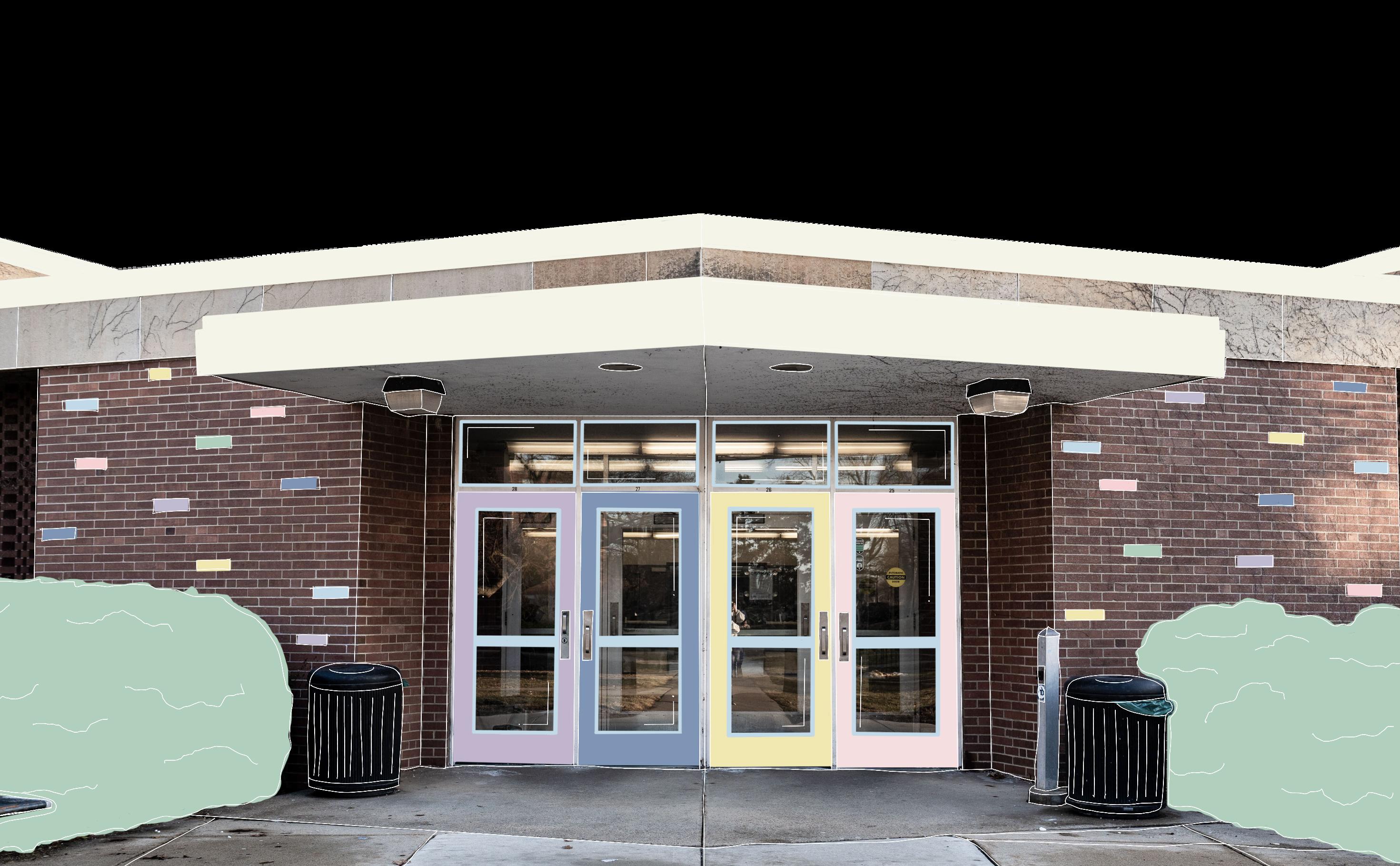
The Michigan State University Board of Trustees approved a nearly $35 million Wilson Hall renovation proposal on Feb. 6. Since then, past and present residents of the hall have taken to social media to express their disapproval of the plans, with some stating that they should have been included in the decision-making process.
The renovation plans for Wilson Hall include converting the second-floor dining hall, which has been closed since 2020, into more learning spaces for the engineering program. According to LiveOn, Wilson Hall is a core engineering living-learning community, much like Case Hall is a living-learning community for the James Madison College.
According to Associate Director for Communications and Outreach of LiveOn Bethany Balks, the renovations will also cover life safety updates funded by the RHS, including a new fire suppression system, a fire alarm system replacement and emergency lighting.
Political science freshman Jonah Kibin said he is not happy with the new renovation plans and their focus on Wilson Hall as an LLC rather than a residence hall.
To raise awareness, Kibin turned to Reddit to spread the word. In his post, Kibin wrote that
“Wilson Hall as it exists today only functions as a unit of the engineering department … where we’re basically just the decrepit janitor’s closet of South Neighborhood.”
Kibin said he noticed differences between Wilson Hall and other residence halls almost immediately. He pointed to the lack of amenities such as a Sparty’s Express, Grubhub pickup, common rooms and facilities like the cardio room and movie theater. Kibin also mentioned the building’s generally rundown condition, particularly on the first floor, where he noted broken signage and peeling paneling.
Freshman mechanical engineer Gavin Tuskal agreed that Wilson was rundown on the first floor, and also noticed the lack of a Sparty’s, adding that if you’re in any of the engineering programs, you’re almost guaranteed to live in Wilson as a first year.
“It’s a good place to meet people. Other than that, actually living here, I would rather live in Wonders or Holden, I don’t think (Wilson) holds up to the standards of other halls on campus,” said Tuskal.
With 27 residence halls across five neighborhoods, RHS said they look at services and amenities at the neighborhood level to ensure consistency. For Wilson Hall, Balks said RHS points to Case Hall’s dining options and the multiple retail and
recreational facilities available in the other South Neighborhood halls.
“I’ve always found Wilson to be lackluster compared to every other dorm,” said freshman Mechanical engineer Nicholas Piyawattanametha. “Especially since they closed that middle room in the intersection. Nobody ever talks about anything or whatnot; there’s nothing here.”
The “middle room” Piyawattanametha described is The Center, which MSU LiveOn describes as a dynamic “idea laboratory” classroom. However, the space now often sits dark and locked, preventing
“ I don’t think (Wilson) holds up to the standards of other halls on campus.”
Gavin Tuskal Freshman Mechanical Engineer
engineering students and other Wilson Hall residents from using it.
Because many aspects of Wilson Hall fall under the College of Engineering rather than RHS,
communication can fall through. Kibin said he spoke with the vice president of the Residence and Housing Society and an Eat at State communications manager, who he said sympathized with his concerns but told him there was little they could do.
“I feel like the engineering department has kind of been taking away from the residential experience, the problem is they oversee most of the building and all its facilities,” said Kibin.
When asked for a comment on the matter, John Papaolymerou, the interim dean of the College of Engineering, said, “The College of Engineering looks forward to working handin-hand with RHS to convert the former Wilson Hall dining space into Technology Engineering Learning Labs. Bringing life and vibrancy back into a space that has been closed since August 2020.”
But students like Kibin said they want more collaboration between residence facilities and the LLC, and he hopes students have a voice in future discussions, particularly as he works to revive the student government in Wilson Hall.
“I mean it doesn’t have to be Case Hall level, but it has to be to a certain standard where someone can walk in this building [as a whole] and say ‘Hey, this building is on standard with all the other three buildings in South Campus,” said Kibin.
By Alyssa Perera aperera@statenews.com
Dormify. Decorate. Design.
Most of the moving fun comes when moving into a new place. But, what happens when it’s time to move out? The immediate reaction for some may be the dorm dumpsters and disposal of the items they will no longer need.
The Michigan State Surplus Store and Recycling Center begs to differ. They stand between move-out waste and landfills with a program called Pack Up Pitch In. This collaboration with the MSU Sustainability Department, MSU Live On and the residence halls may be familiar to students by the large white bins found in lobbies of residence halls during move in and move out.
These bins collect items students can’t or don’t want to take back home and they resell them at a discounted price. Last year the store collected an estimated 100,000 pounds on move-out day alone, according to Surplus Store Operations Coordinator Chris Hewitt.
“We get a lot of stuff. We try to make it available to the public and for students,” Hewitt said. “That’s in our slogan, ‘Managing waste as a resource.’ That’s kind of how we see everything that gets left behind by students or by departments. That stuff still has value, and we just want to do our part to lessen the university’s impact on local landfills and environment while also providing resources to the community at a discounted price.”
These boxes collect clothing, large pieces of furniture, home goods, reusable goods, textiles, electronics and more. Hewitt finds that rugs, refrigerators, futons, storage containers and Squishmallows (stuffed animals) have been very popular sale items.
During move-out weekend, after gathering

donations, all items are processed through the MSU Recycling Center. The trucks are unloaded and items are wiped down and tested to make sure they still work. Items are then either resold, placed in the free area or tossed if they are beyond salvaging.
The free area is located under the awning next to the entrance of the store. It is replenished each week for items that are slightly beat up but still useable. It is open any time the store’s gate is open, typically weekdays from 7 a.m. to 4 p.m.
“If stuff isn’t selling in a couple weeks, we’ll move it out there with the hopes that someone could repurpose it at no cost to them but also keeps it out of the landfill,” Hewitt said. “That idea behind the free area was trying to give things a last chance at a second life before it gets thrown away.”
The store is open for sale on Fridays from
By Katherine Baligian kbaligian@statenews.com
On Tuesday, March 10, from 11 a.m. to 7 p.m at the Breslin Center, Michigan State University will host Rock the Block, an event geared towards freshmen looking to reserve their dorms for next year.
Groups ranging in size from six to 16 people are able to reserve several adjacent rooms across 16 residence halls, as long as they sign up before March 6.
Groups of less than six students can reserve space during the standard room selection window later in March.
To register, one student can log into the MyHousing page and select “Sign-Up for Rock the Block and Manage Roommate Group.” The group leader will need each members’ name and MSU email to invite them
Gapinski found that using large blue Aldi bags for clothes pack up was much easier than the bins she used her freshman year. She also found that handing off clothes to her parents as they visited her throughout the year helped to make the official move-out less difficult.
Gapinski finds that communication is key for moving out when having roommates. She notes that issues can often come from shared items and who is responsible for what. To combat that, her and her current roommates have a list of what everyone brought to help them when they do move out.
8 a.m. to 3:30 p.m. To aide with students’ needs, the store offers extra sales days in August before move-in. Announcements about sales are typically made on the store’s Instagram. An estimated 40% of the store’s inventory is also available for purchase online. Items sold on the website can be picked up from the store anytime during the week or can be shipped.
When not looking to get rid of items, moving out can be a bit trickier. For out-ofstate communications and journalism junior Sydney Gapinski, a storage unit was her method of choice for holding items over the summer. She noted the unit was convenient for not having to take everything back to her hometown but was not ideal for everyday use, as she oftentimes found herself wanting items that were stuck in storage.
With a year of experience under her belt,
into the roommate group.
Once all group members have accepted the invitation, the group leader will be able to select a time to arrive at the Breslin Center to make the selection. Only the group leader is required to attend.
Students are able to reserve space in Bailey, Butterfield, Emmons, Rather, Abbot, Gilchrist, Mason, Phillips, Snyder, Williams, McDonel, Shaw, Van Hoosen, Holden and Wonders Halls. Space is also available for the three-person dorms in Akers Hall.
Due to high demand for space in Landon Hall, groups will be asked to enter into a digital raffle if they choose Landon as their preference. Groups will be notified on March 9 whether they’ll be able to reserve space in the North Neighborhood residence hall.
Bethany Balks, the associate director of communications for MSU’s Residence
“Be mindful of what you are contributing and what other people are contributing, because you guys will not live together forever,” Gapinski said. “Also, not moving out at the same time as your roommates, because that can get really stressful. Me and my roommate moved out like a day apart, which made it so much easier, because it’s not like we’re all trying to get out of the same time.”
Journalism major with a focus in media design junior Julia Bugar’s first year moveout was comprised of duffle bags and loading items into cars, while the next year she used portable storage units to store her large items for a month in the summer.
She discovered that keeping storage items, keeping organized, labeling boxes and packing away what she could before move-out week helped to make the process easier.
“Moving out for me is always more stressful,” Bugar said. “You don’t really know when you can pack things up because you need to use them until you move out. But, especially leading up to moving out, I think packing away as much as possible and staying organized, makes it a lot easier, especially if you’re taking something from one home to another to have a smooth transition.”
Education and Housing Services, said the raffle is meant to discourage groups from arriving early or camping outside the Breslin, in the hopes of securing space in Landon.
“We’ve just seen a sense of urgency that we didn’t like to see — people feeling they needed to arrive at the event so early because they wanted to make sure they got Landon, and I think it’s just a lot of pressure,” Balks said. “It’s March, people are just coming back from spring break and we don’t want to add any more pressure.”
Not to mention, Balks added, “this is a weekday where there’s a lot of classes. We’re very focused on student success, and we think that spending your morning camping out is really not supportive for that.”
By Nikolas Szpotek nszpotek@statenews.com
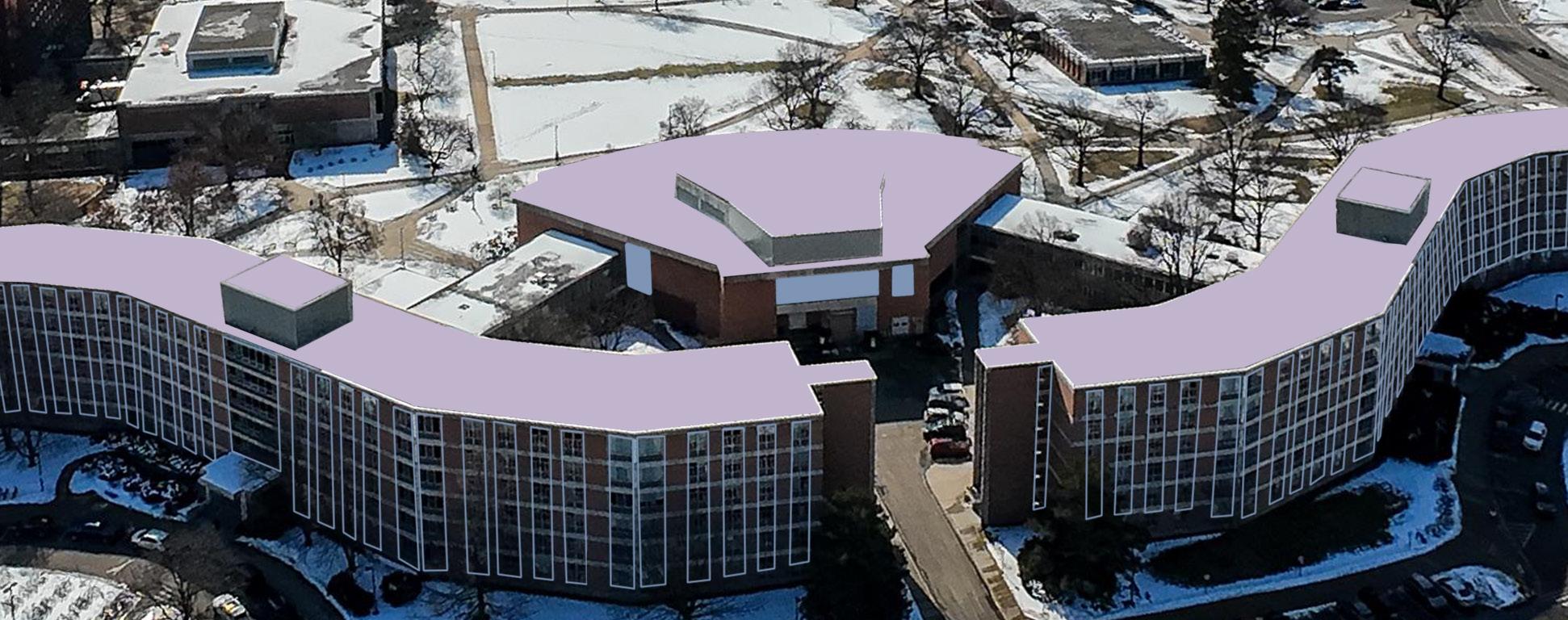
Sometime during the 1981-1982 academic year, nursing sophomore Theresa Clancy was on a routine trip to the dining hall from her dorm in West Akers Hall.
As she left her dorm and walked down the hall past the third floor’s study lounge, however, she saw something that made her do a double take: A fully grown pig lounging around in the study area.
“He was rooting by the window, snuffling for any crumbs he could find,” said Clancy.
The pig’s appearance, Clancy said, was likely the most recent exploit of the ‘Barnyard Bandits,’ a group of Michigan State University students who would clandestinely take animals from the school-owned farms south of the main campus and deliver them to odd spots around campus.
The loose pig wasn’t the only mischief Clancy was privy to in her time living on campus from 1980 to 1982 either.
Ahead of an anxiety-inducing biology final, which involved identifying organs and muscles in dissected lab rats, a fellow student volunteered to dissect a specimen outside of class to allow for last-minute note taking, so long as someone could get him a rat.
“I was the one who stole the rat,” Clancy admitted.
Clancy was adamant enough about
facilitating the dissection that she had wrapped the rat specimen in a paper towel after taking it from a campus lab and kept it in her fridge for a few days until it was time for the dissection.
“It was just like when you see those pictures of old school operating theaters, with the people looking down. So, he was sitting on the floor with the rat, and we were all standing around him looking down,” said Clancy.
For Clancy, the bizarre and comedic moments that dotted her time living on campus have an element of nostalgia to them. They represent a version of dorm life, and of MSU, that no longer exists — marked by constant face-to-face interaction with strangers and a lack of instant entertainment. It’s a feeling other alumni describe having too.
Matthew Haugh, who attended MSU from 1997 to 2001 and lived in North Hubbard Hall as a freshman, recalled playing tackle football games against other floors on Sundays in the fall.
“My floor would always play the ninth floor, but each week we would pick a different floor, and we would battle them and play tackle football to the point where, in three consecutive weeks, an ambulance had to come out,” Haugh said.
One student broke their femur, another their ankle and one person broke their arm, Haugh said. After the consecutive injuries, he said, the football season was officially cancelled by
their floor’s resident assistant.
Haugh also shared that he and his friends once hosted an event called “the pot Olympics.”
“We had a triathlon of different events of you know, bong hits and or steamrollers or whatever. We did like a triathlon of it (…) which turned out to be a terrible idea, but was really fun,” Haugh said.
One thing that Clancy said made dorm living so conducive to social interactions and shenanigans was that most students would keep their doors open whenever they were home.
“You kinda just wandered down the hall if you were bored, see who’s there and hang in and you know, check it out,” said Clancy.
Nowadays, most students keep their doors shut save for the first few days of the semester.
“I have my nieces and nephews currently attend MSU right now and they’re in the dorms, they’re like ‘Dorm life is so boring,’ and I’m like, ‘What do you mean? Go out and explore the world’ (…) there’s nothing boring about it,” Haugh said.
“I think generally people are disconnected now,” Haugh said, adding that he thinks “there’s a lack of sincerity or closeness involved in that.”
Despite the changing times, there are still people making efforts to foster community among students living in the dorms.
Ty Beeman, a horticulture freshman and the treasurer for Hubbard Hall government, said
“I
have my nieces and nephews currently attend MSU right now and they’re in the dorms, they’re like ‘Dorm life is so boring,’ and I’m like, ‘What do you mean? Go out and explore the world’ (…) there’s nothing boring about it”
1997-2001
the organization tries to encourage socializing through regularly scheduled events.
“For us, the most important thing is to just get people talking. So, the main point of any of our events is we just bring people together. Whether it’s around crafts or watching games, they’re brought together among common interests,” said Beeman. “That can spark conversations and allow people to form a relationship within the dorm.”
By Emma Bowman ebowman@statenews.com
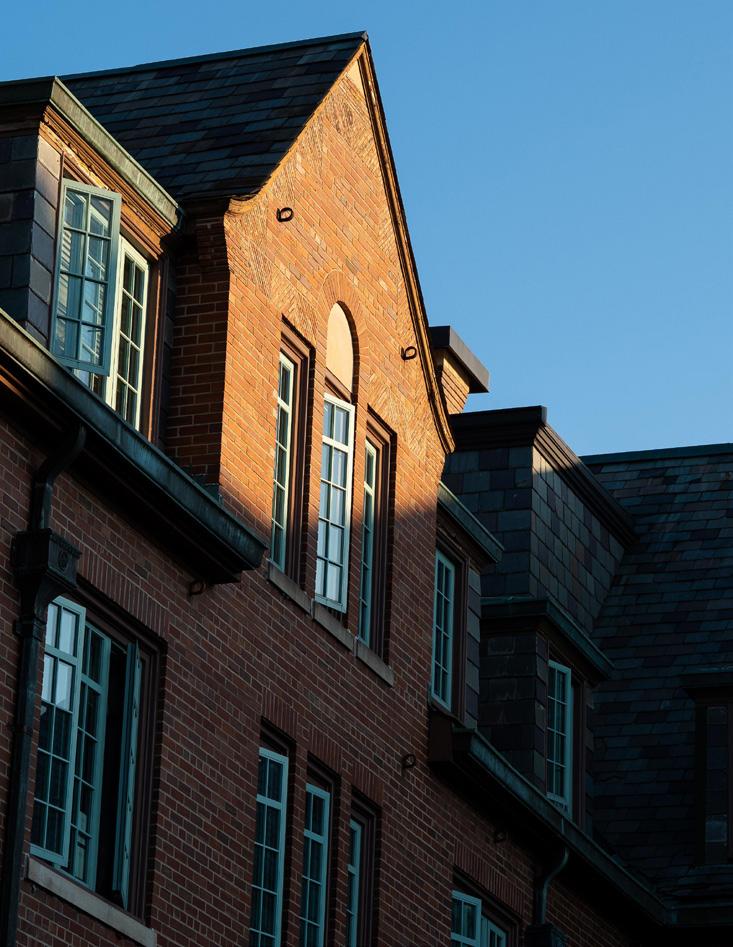
The living environment for many first-year students across the country can shape their college experience, Michigan State University’s campus is no exception. Housing assignments are officially randomized for incoming freshmen, which year after year has shown
trends of certain majors ending up in the same neighborhood or residence hall.
MSU has over 10 residence halls that are dedicated to being living-learning communities, academic colleges and special interest programs, which allows students who share similar goals connect better. Through this program, three residential colleges that call home to certain dorms across campus. Holmes Hall houses the Lyman Briggs College, Case Hall houses the James Madison College and Snyder Hall houses the Residential College for the Arts and Humanities.
With these dorm buildings being home to primarily only students inside these colleges, it can make campus feel a bit smaller. Outside of these programs, there still seems to be a pattern of placing certain students that are studying similar materials in the same buildings.
“There actually are a lot of girls with the same major as me and similar majors in my dorm hall,” biomedical laboratory sciences freshman and Yakeley Hall resident Jordan Machesky said. “North Neighborhood seems to have a lot of STEM majors, which is nice because we are in pretty close proximity to the STEM building and library.”
“There is not a specific major focus in my dorm,” hospitality business freshman and Akers

Hall resident Claire Rosenberry said. “Although I know there are a lot of people in my dorm that are business and/or exploratory majors, but I think that is pretty common.”
Most assume this randomization is based on how close the residence hall is to the major’s main faculties that hold the majority of its classes. The common stereotype idea behind this theory is that the River Trail Neighborhood has all business majors, South Neighborhood has the engineering majors, North Neighborhood has the STEM majors and East Neighborhood is a mixture of all.
“I feel as if River Trail and East Neighborhood have a lot of business and marketing majors because it’s very close to the business college,” Machesky said.
This has been theorized by many students, given the proximity of these residence halls to the buildings that are utilized most by its inhabitants. It doesn’t just stop at areas of study either, it seems like most athletes are placed either in Brody Neighborhood or the 1855 Place apartments directly west of campus and adjacent to the training facilities.
“I associate Brody with a lot of athletes, I lived there as a freshman and the baseball team was across the hall from me,” packaging sophomore and Williams Hall resident Anna
Safford said. “North Neighborhood is very academic to me, maybe because of the more old-school, original academia styled buildings.”
The idea of assigning all majors to a certain dorm building was not very popular with students. They shared the thought that it would alter the experience of having something to talk about when first meeting someone who lived in the same dorm.
“As a freshman, I thrived meeting new people with different interests than my own,” Safford said. “I appreciated the diversity among majors, classes and career paths that my friends and I had … When it comes to the dorms, I find the variety exciting.”
“I don’t think MSU would benefit from separating freshmen into dorms specified by their major because that’s how you get to know people,” Machesky said. “Learning about different majors helps you learn more about others and the other programs that state offers.”
Regardless of if these patterns are intentional because of proximity or a simple coincidence, housing at MSU has proven to be more than just a place to sleep. The very first connections formed for students are within the wall of the dormitory halls, making them the heart as well as the starting point of the freshmen experience.

By Demonte Thomas dthomas@statenews.com
For many Michigan State University students, dorm life is an essential part of their passage through college, providing a space to create lasting relationships with friends and partners and a convenient segue into independent life away from home.
University policy requires most students to live on campus for their first two years, funneling sophomores through the same dining halls and floor meetings they navigated as freshmen. But scattered among the move-in carts and name tags each fall are upperclassmen who never left.
For some juniors and seniors, staying in the dorms is less about nostalgia and more about necessity. Rising rent, tight housing availability and the convenience of bundled costs make on-campus living an appealing or unavoidable option. Others cite proximity to classrooms, campus jobs and community as reasons to remain in university housing, even as many of their peers trade keycards for apartment leases.
For computer science senior Orlando Flounory, who has worked as a resident assistant for three years, the decision to stay on campus past his second year was born purely out of convenience.
“Being older in age, as well as my status as an upperclassman, it kind of rubs down on them and their behaviors and the vibe they come in (with),” Flounory said. “Freshmen come in fresh; they are coming from different environments. They kind of don’t know what to expect to this point, so they start to pick up on the environment around them and try to replicate it just a bit.”
Since RAs receive free housing as part of the gig, Flounory said living in a dorm has been easier than alternatives like renting an apartment or house.
“Once you’re out there in apartment living and you get into the finances of it, it just becomes so much more difficult because that’s when you really start experiencing those real struggles as an adult,” Flounory said.
Approximately 2,200 spaces are held for juniors and seniors in halls and apartments, with 2,335 living in those spaces, said Bethany Balks, the associate director for communications and outreach for MSU’s Residence Education and Housing Services, citing data from Fall 2025.
For neuroscience sophomore Shrinidhi Pola, a resident of Holmes Hall, her positive experience with dorm life, from having a good roommate to a dining plan she’s satisfied with, has led her to choose to stay on campus next year.
“Me and my roommate actually wanted to stay in Holmes Hall next year, but they didn’t have any more spaces left, so we kind of had to choose Owen Hall, which kind of worked out because it’s a single,” Pola said.
“The fact that it’s a little bit more expensive than living in a double was something that we had to kind of deal with because there just weren’t enough spots.”
As advice for incoming and current students who are thinking about sticking to the dorms, Pola said they should plan ahead of time.
“Know what all your options,” Pola said. “If you do want to have a roommate — this applies for all year — I think it’s really important to know what your plan is ahead of time because if you decide not to stay on campus, being off campus is a whole other level of planning.”
Zoology sophomore Ann Joseph described her experience living on campus at MSU as “very positive,” emphasizing the convenience of on-campus housing. It was particularly helpful as an out-of-state student from New York who was unfamiliar with both Michigan and the East Lansing area when she arrived, Joseph said, which was a factor in deciding whether

to continue living on campus or not.
“One of the main kinds of reasons for that really just comes down to convenience for me,” Joseph said, adding that she doesn’t have easy access to a car.
Joseph said students who are thinking about staying on campus their next academic year should plan ahead of time, among other things.
“Because MSU does require you to stay on campus for your first two years, I do think you should take it really seriously in terms of where you want to live, who you want to live with,” Joseph said. “I think when you’re living in a double dorm, it can really make or break your experience.”