The State News is published by the students of Michigan State University every other Tuesday during the academic year. News is updated seven days a week at statenews.com.
State News Inc. is a private, nonprofit corporation. Its current 990 tax form is available for review upon request at 435 E. Grand River Ave. during business hours.
One copy of this newspaper is available free of charge to any member of the MSU community. Additional copies available at The State News office for a fee.
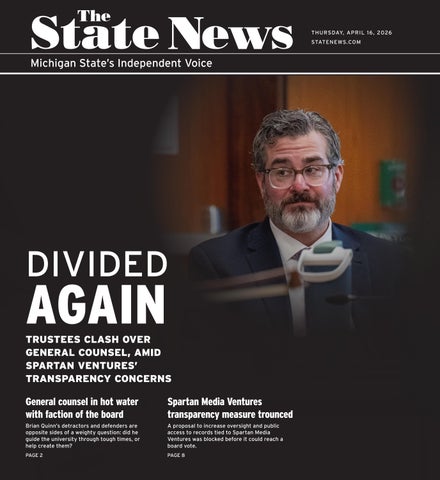
COVER PHOTO: Michigan State University Vice President for Legal Affairs and General Counsel Brian Quinn on Friday, Dec. 12, 2025. Photo by Ari Saperstein.
TRUSTEES HAVE ‘SERIOUS CONCERNS’ ABOUT QUINN
By Alex Walters and Owen McCarthy awalters@statenews.com omccarthy@statenews.com
A faction of Michigan State University’s Board of Trustees is displeased with the performance of the institution’s top lawyer.
Elected board members have long endeavored against General Counsel Brian Quinn, sources tell The State News. Now, his critics have assembled a dossier addressed to the university president that details their allegations.
“There are serious concerns with the MSU Office of General Counsel (OGC),” says a draft copy of the document, which was obtained by The State News. “The concerns are both about overreach and also about decisions made by the OGC that have seriously injured MSU.”
Their campaign comes as Quinn passes a decade with the university — a period that has been one of the most tumultuous in its history. As trustees and administrators have gathered to deliberate on one controversy and feud after another, the career attorney has consistently been in the room.
In the dossier, Quinn’s critics take issue with his handling of a host of high-profile sagas: the withholding of the so-called “Nassar documents,” a faculty members’ lawsuit against trustees who conspired to attack him, university lawyers’ interference in independent Title IX investigations, and a new revenue-generating initiative by the athletics department that has been shrouded in secrecy.
The conflict pits Quinn’s detractors and defenders on opposite sides of a weighty question: did he guide the university through those tough times, or help create them?
To his critics on the board, Quinn’s advice has served to fan the flames and spur new troubles for the university. Meanwhile, his allies in and around MSU say the institution has been lucky to have Quinn in its corner through all the scandals. They describe him as a skilled, levelheaded attorney who knows his proper place; a legal advisor, rather than an ultimate arbiter.
To be sure, the job of top lawyer at a major public university today is not simple. An expert on university general counsels noted the perpetual dilemma that comes with having to advise both the institution’s president and board, given their capacities to disagree — a tension that MSU knows uniquely well.
And that’s to say nothing of the challenges presented to general counsels by the rapidly shifting legal landscape of higher education under President Donald Trump, who has sought to dramatically change how the country’s universities function.
The stakes, then, of Quinn’s work are certainly
high. And yet, understanding his thinking is a true challenge. His office is among the university’s most opaque, often employing the sacrosanct legal principle of attorney-client privilege to shield its work from public discussion and records requests.
Still, interviews with many of his associates and scores of university documents do shed some light on how Quinn came to be, what he’s done at MSU, and how he landed in hot water with the trustees.
Quinn did not respond to requests for comment. A university spokesperson said he cannot speak freely about his work because it involves ongoing and contentious legal issues.
“Too many times, (Quinn) has made unilateral decisions without discussion and sharing of information and too many times (Quinn) played politics in order to protect allies and/or damage the reputation of perceived enemies.”
Dossier assembled by a faction of trustees and addressed to the university president
‘A LEGAL ONE’
The dossier opens with a firm description of the role of a general counsel, as its authors see it:
“To be clear, the OGC provides legal advice and represents the university in litigation. PERIOD.”
“The (OGC) is just a humble servant of the university,” it says.
It then argues that the incidents detailed therein prove Quinn has led the office astray from that mission.
“Too many times, (Quinn) has made unilateral decisions without discussion and sharing of information and too many times (Quinn) played politics in order to protect allies and/or damage the reputation of perceived enemies,” it says.
The version obtained by The State News is an undated draft, shared by a person who declined to be identified. The dossier says it is being submitted to MSU president Kevin Guskiewicz “for your review prior to requesting a group discussion for action.” It is titled: “Formal complaint against MSU General Counsel Brian Quinn and request for board investigation.”
“I am not (yet) submitting this to MSU’s Office
of Audit, Risk, and Compliance (OARC) because of the obvious conflict of interest that office would have in investigating these issues, due to the Office of General Counsel’s direct influence on OARC,” the dossier says.
Though it is written in a singular, first-person voice, people familiar with the document told The State News that it was assembled by Trustees Mike Balow and Dennis Denno. Also supportive of their efforts, the people said, is Trustee Rema Vassar.
It’s unclear when they plan to share the dossier with Guskiewicz or other board members.
The written summary of their grievances is the latest escalation in a longstanding campaign against Quinn. Two people close to the board said that efforts to oust Quinn took shape as Guskiewicz prepared to start as president in 2024, with critics hoping MSU’s new leader would be willing to eliminate a longtime member of the C-Suite as he built his own administration. In recent months, signs of the discord have emerged publicly, with members of the board tussling with the administration over an ambitious plan to overhaul the university’s athletics department.
Details on the plans are scarce. What’s known is that MSU entered into a brand management agreement with a nonprofit called Spartan Ventures, from which a for-profit entity called Spartan Media Ventures was then spun-off. It is meant to maximize revenue generation within the athletics department and support name, image and likeness deals for student athletes — which proponents say is essential for MSU to remain competitive in a watershed moment for college athletics.
At the board’s public meeting Friday, Balow said that he, Vassar, and Denno had attempted to introduce a resolution requiring Spartan Media Ventures to be subject to Michigan’s Freedom of Information Act law and allow trustees to view organizational documents without signing nondisclosure agreements. But, Balow said the rest of the board was unsupportive of the measures.
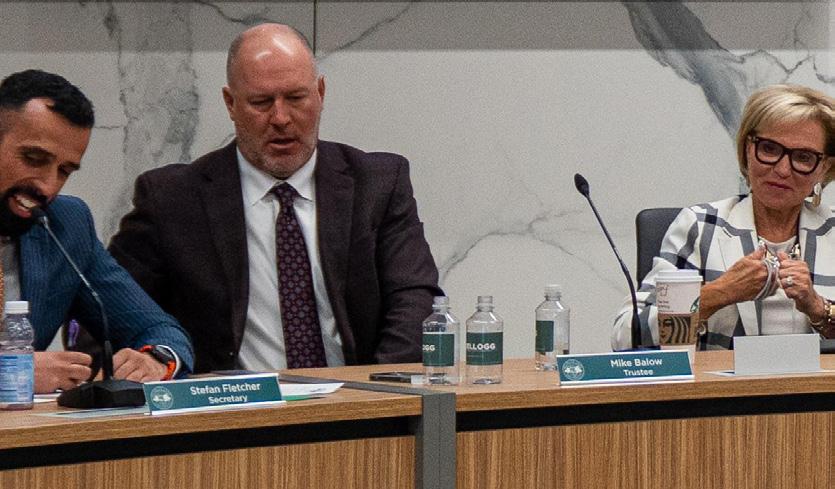
He implied that his suspicions of the plans stem from Quinn’s involvement, not others who have pushed for the changes. Balow complemented his fellow board members, as well as the president and athletics director. Balow said his issue is instead “legal,” as Quinn sat straight-faced to his right.
The dossier further details his concerns.
It says that Quinn declined to provide trustees with documents related to the plans, despite the board being “his client in this case.”
Quinn then convened a privileged discussion between the board and a private practice attorney representing the new entities, according to the
dossier. That lawyer was Clay Grayson, who is based in South Carolina and, according to his professional biography, specializes in advising “foundations that support universities, colleges, and schools.”
The dossier says that Quinn and Grayson told the trustees that they would need to sign nondisclosure agreements if they wanted to view any of the documents. (Grayson did not respond to a request for comment at time of publication.)
‘WHAT RIGHT DOES HE HAVE’
The draft complaint points to another episode where Quinn supposedly had outsized sway.
As scrutiny mounted against Ohio State University in the fallout of a sexual abuse scandal involving one of its doctors, a judge ruled that the statute of limitations for bringing Title IX lawsuits against institutions in the state should be extended. The ruling would have allowed scores more plaintiffs to sue. When OSU pushed back, MSU helped, signing onto an amicus brief that challenged the ruling.
The optics were awkward: the longtime employer of sexual abuser Larry Nassar was, essentially, endorsing another university’s efforts to stifle lawsuits from abuse survivors.
The dossier suggests there was finger pointing in MSU’s leadership about just who made the thorny decision to sign onto the amicus brief.
“Initially, (Quinn) said it was never done, afterwards (Quinn) threw MSU President Sam Stanley under the bus, stating that President Stanley made him do it,” the dossier says. “Trustees said President Stanley NEVER stated that he ordered MSU to join the lawsuit, and in front of the entire board President Stanley stated that this was (Quinn’s) decision and his alone.”
That idea was communicated publicly by MSU, too, the dossier notes, pointing to a State News report from the time, in which university spokesperson Emily Guerrant said the decision to join the amicus brief was that of the Office of the General Counsel.
Balow confronted MSU about Quinn’s unilateral move while he campaigned for trustee in 2024.
“Of all the schools in the USA, MSU is probably the one that should have stayed as far away from this as it could,” Balow wrote in a June 2024 email to the board and president, which he forwarded to a State News reporter at the time. “Besides, WHAT RIGHT DOES HE HAVE TO MAKE THAT CALL?”
The then-prospective trustee added, “I think removal from the general counsel position is warranted.”
‘COMPLICATIONS’
The dossier also takes issue with Quinn’s handling of a faculty member’s lawsuit against the university that itself stemmed from intense discord on the board.
In October 2024, simmering internal tensions among the trustees burst into public view when a letter by Trustee Brianna Scott, alleging widespread misconduct by Vassar, who was then the board chair, leaked to The State News.
The letter subsequently prompted MSU to hire an outside law firm — Washington, D.C.based Miller and Chevalier — to investigate the allegations.
It ultimately corroborated many of Scott’s claims, including that Vassar overstepped her authority in negotiating a settlement to a lawsuit against MSU, and that she improperly accepted flights on a donor’s private jet.
But the investigation also found something that Scott hadn’t raised: Following the release of Scott’s letter, Vassar and her ally on the board, Denno, had been using students to orchestrate attacks on their opponents at the university.
Chief among those opponents was Jack Lipton, then the chair of the faculty senate.
The finding dismayed Lipton, who had long before distrusted Vassar and Denno. So, he filed a lawsuit against the Board of Trustees and Vassar and Denno in their individual and official capacities, arguing that their use of students to orchestrate attacks against him amounted to a smear campaign that damaged his reputation and cost him professionally.
How Quinn handled the litigation is criticized
by the dossier.
MSU ultimately retained a law firm to represent all of the board members except Vassar and Denno, who were eventually dismissed as defendants. Vassar and Denno then retained their own separate counsel. They and MSU ultimately settled Lipton’s suit earlier this year.
The dossier says that Quinn “did not inform the board that his course of action would lead to conflicts and the requirement of separate counsel for individual trustees, thus driving up legal costs and complications in this lawsuit.”
The dossier also takes issue with the general counsel’s office’s decision that MSU would not provide legal representation for a student who became wrapped up in Lipton’s litigation.
In Lipton’s efforts to convince a judge to rule in his favor that Vassar and Denno conspired with students to smear him, his attorneys tried to subpoena Missy Chola, one of the students that the law firm found to have been encouraged to attack him. In turn, she issued a statement through the Black Students Alliance, of which she sat on the executive board, rebuking Lipton, as well as MSU for supposedly failing to adequately defend her against his subpoena.
“On December 14, 2024, I received an email from Michigan State University’s General Counsel informing me that Dr. Lipton was attempting to subpoena me,” the statement said. “He wanted
access to my private messages, my academic records, and more — because he believed I was ‘manipulated’ into calling him a racist.”
She continued that she subsequently stopped attending board meetings: “Not because I didn’t care — but because I felt watched. Hunted. Unsafe… Michigan State, you had the power to protect me. You were told. You were warned. And you chose silence.”
The dossier implicitly echoes that concern, faulting MSU for not providing legal representation — technically known as indemnification — for Chola in relation to the subpoena. (Chola could not be reached for comment at time of publication.)
The decision not to “conflicts” with the university’s approach to indemnification in another case, the dossier says.
In 2022, the university ousted its business school dean for failing to report sexual misconduct by a subordinate to the university’s Title IX office. The board, in turn, commissioned an outside investigation of the matter. Stanley, who was president at the time, subsequently issued guidance to MSU employees, according to the dossier: they did not need to cooperate with that investigation, and if they did, the university would offer legal counsel to them.
CONTINUED ON PAGE 4
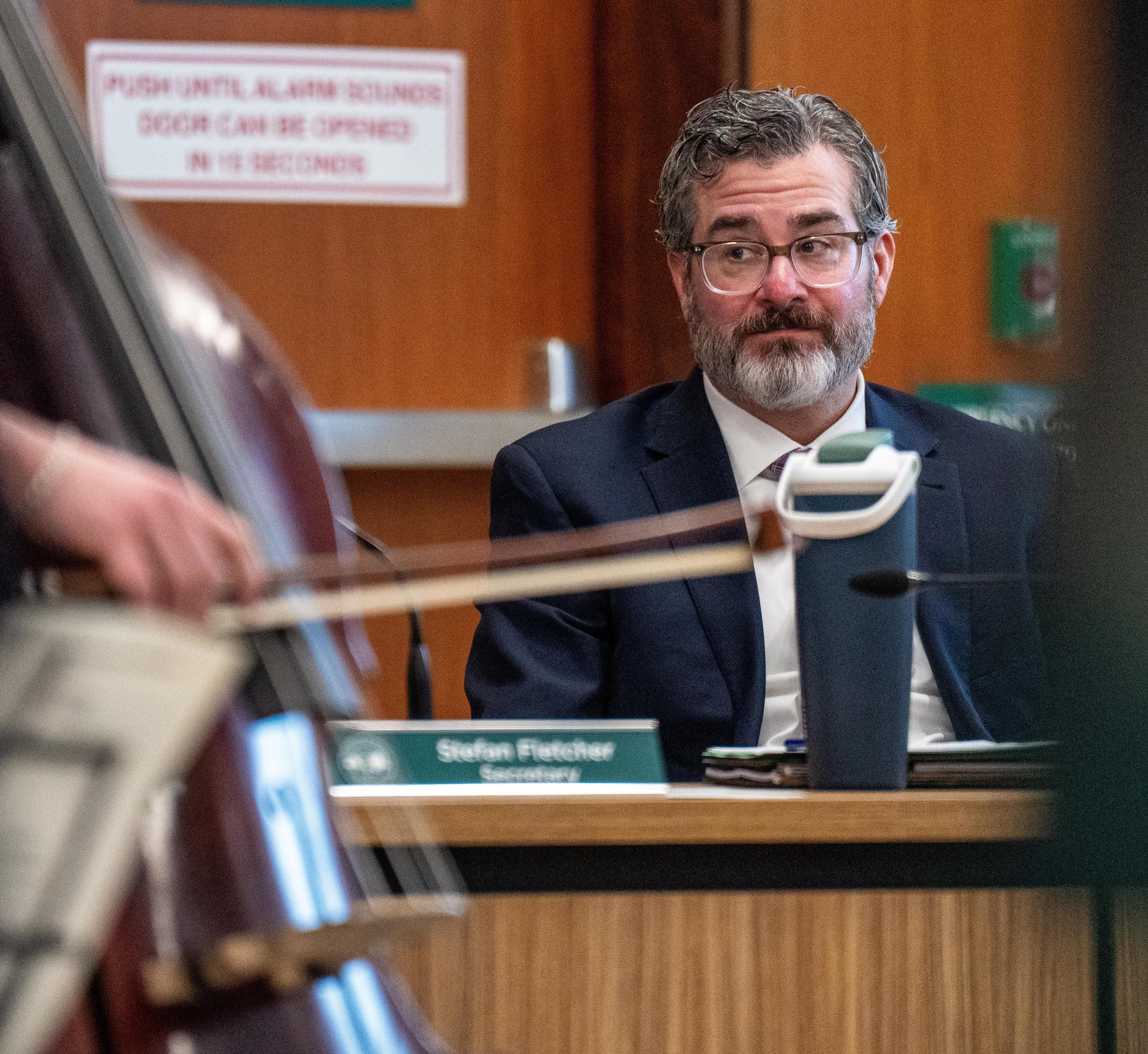
Michigan State Board Vice President for Legal Affairs and General Counsel Brian Quinn before the Board of Trustees meeting at Hannah Administration Building in East Lansing, Michigan on April 10, 2026.
Photo by Gavin Hutchings.
TRUSTEES HAVE ‘SERIOUS CONCERNS’ ABOUT QUINN
The dossier raised the question of why MSU would choose to provide legal services in that instance, but not to Chola as Lipton sought to subpoena her.
“This conflicts with what (Quinn) said recently: referring to the Missy Chola subpoena, MSU does not provide legal assistance to employees or students.”
It’s unclear when, or if, Quinn made such a statement. (In a Lansing State Journal article on the subpoena of Chola, Guerrant said the university was not indemnifying her.)
MSU’s indemnification policy says it applies to trustees, officers, faculty, staff, volunteers and students, but that the final decision on whether to indemnify rests with the President. If the indemnification involves the president or individual trustees, the decision is up to the board.
‘BASIC PRINCIPLE’
The dossier uses the findings of the outside investigation into the business dean’s ouster to make another criticism against Quinn — that his office has interfered in sexual misconduct investigations, which are supposed to be conducted independently by MSU’s Title IX office. The firm’s probe found that the Title IX office had sought to close an investigation into the underlying misconduct that the dean failed to report. But, they were instructed to reverse course by the general counsel’s office after the dean’s resignation.
University lawyers also meddled in a decision
not to amend the formal complaint in the case, the firm found. That interference was “at odds with the independent authority (the Title IX office) was given,” the firm wrote.
“There are further concerns related to other Title IX investigations that similar behavior occurred,” the dossier says, citing State News reports that detail blatant inference in a Nassarrelated case in 2017, as well as questions about continued interference in the years since. “These need to be thoroughly investigated.”
The dossier then criticizes the 2024 hiring of attorney Rob Kent — who previously worked in the general counsel’s office — as interim head of investigations in the Title IX office.
“This places a direct link of someone who was formally part of the OGC into the Title IX process, which is supposed to be independent,” it says. “Because of the previous allegations of tampering, and because it is believed that (Kent) hired (Quinn) to come to MSU in the first place, this is something that needs to be looked at closely.” (Kent was on the search committee that hired Quinn in 2016, according to his personnel file.)
The dossier also criticizes Quinn for his handling of the so-called “Nassar documents,” a set of thousands of pages of privileged internal MSU records that were turned over to the state Attorney General in 2024, following years of advocacy.
The board long withheld the documents from investigators, arguing that it had to wait until the university resolved lawsuits with its
insurers. That litigation was brought after insurers claimed they weren’t on the hook for the massive settlement MSU paid to survivors.
The dossier criticizes that strategy, and says it emanated from Quinn. His argument, as explained by the dossier, was that waiving privilege over the documents could hurt MSU’s case in those lawsuits or lead to the “reopening of previously negotiated settlements.” The dossier says that the strategy of waiting caused “huge reputational damage to MSU and even more harm to survivors.”
It cites statements from Michigan’s attorney general, which said that many of the documents weren’t subject to attorney-client privilege in the first place.
The dossier also claims that the majority of the insurance lawsuits were settled by early 2021, despite the board using that justification to withhold the documents until 2024. Attached is a list of cases and settlements, which includes only one case settled after 2021: It came in 2023 and was worth only $7 million of the around $130 million in settlements overall, according to the list. (It’s unclear how the list was compiled or if it is comprehensive.)
The dossier also alleges that there are “approximately 130 documents that were completely excluded from the batch sent to the Michigan Attorney General,” which trustees apparently requested from Quinn.
It also claims that Quinn failed to inform “his client,” MSU, of potential conflicts of interest in providing legal advice to the board in relation to
lawsuits in which he was also personally listed as a defendant.
“This is a basic principle of legal representation. (Quinn) never did this, which is a major issue for the university. One can rightly question, then, whether decisions and counsel made by (the general counsel’s office) are in the best interests of the university, or the best interests of themselves.”
And, the dossier takes issue with the role of the general counsel’s office in redacting public records requests, saying there is a “high degree of skepticism among many that the (general counsel’s office) heavily redacts FOIA request fulfillments far beyond what is normally allowed by law.”
It’s unclear which skeptics the dossier is referring to, though judges in three cases in recent years have found MSU illegally applied redactions in responding to public records requests.
‘I DON’T LOVE THAT’
Quinn’s role has become especially important in the last year, three administrators said, as the university has been forced to navigate the Trump Administration’s aggressive attempts to reshape higher education.
One of his key efforts has been designing requirements that units across the university adopt so-called “inclusive language” to comply with new interpretations of civil rights laws. The university has said such changes are necessary amid threats to federal funding of
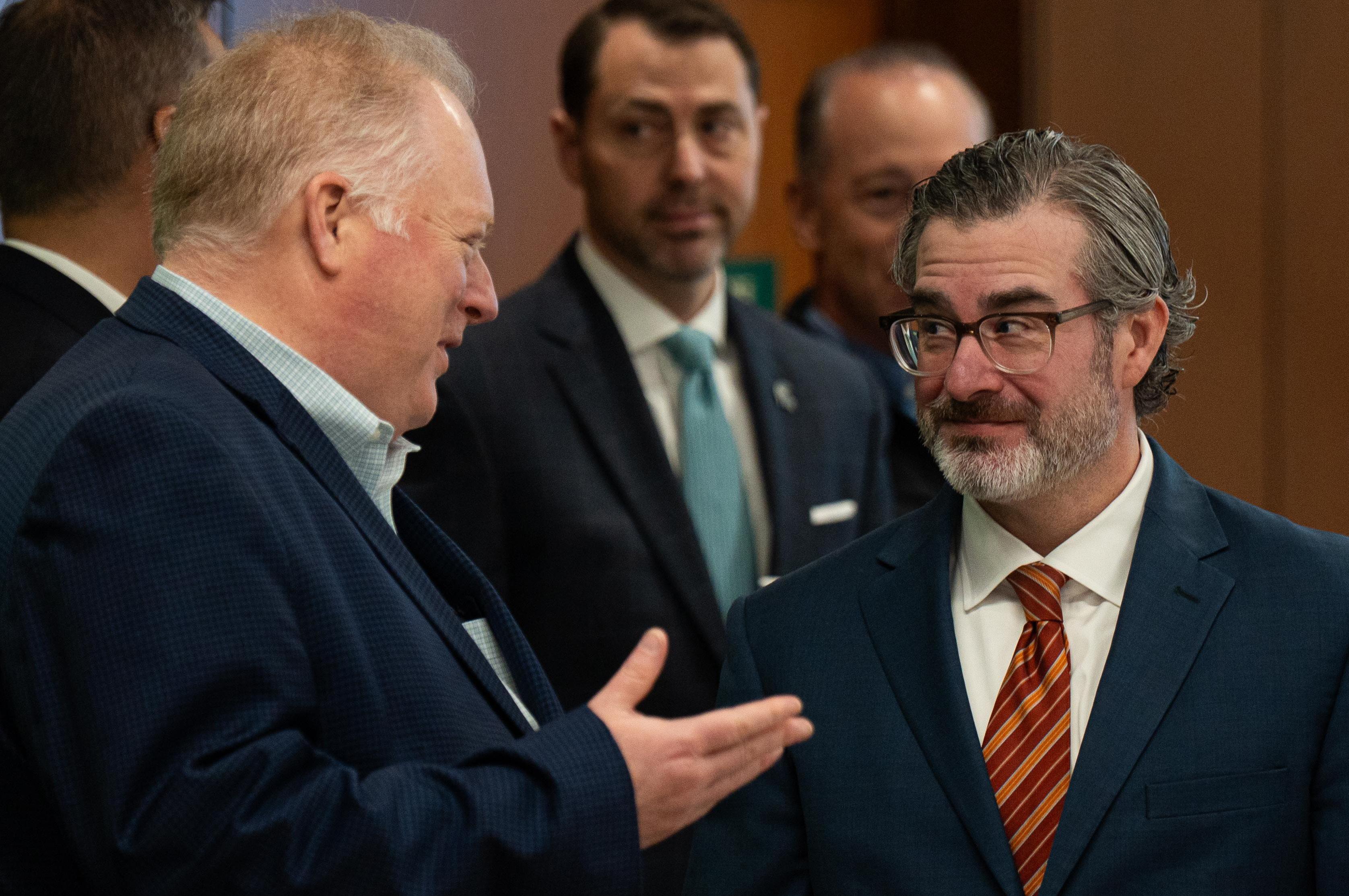
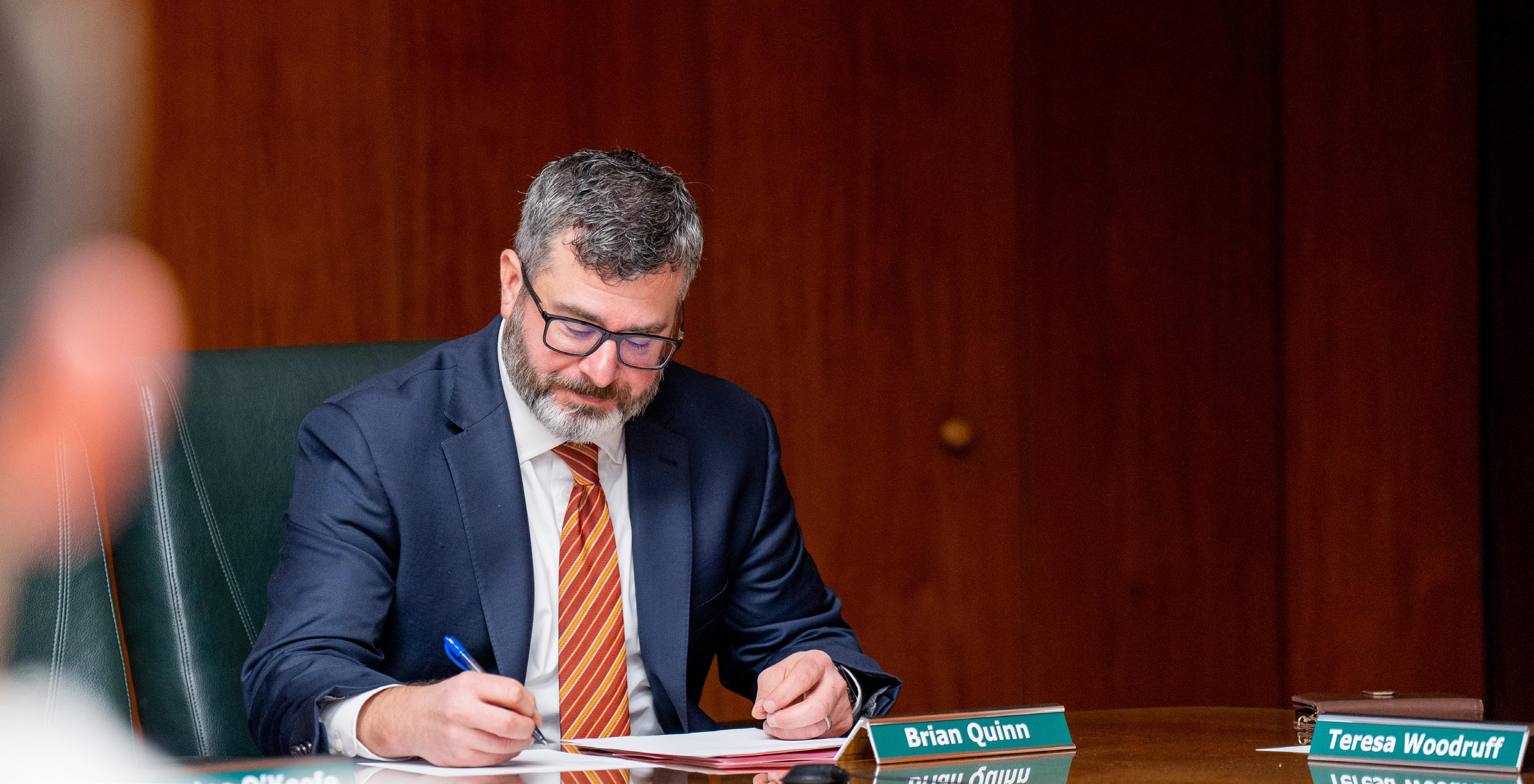
Vice President for Legal Affairs and General Counsel Brian Quinn at the Board of Trustees special meeting on Oct. 31, 2022. State News File Photo.
universities over their diversity, equity and inclusion programs. The Trump Administration has argued that such programs — which are often designed specifically for members of a certain marginalized group — are inherently discriminatory and, therefore, illegal.
At Friday’s meeting of the Board of Trustees, Quinn’s efforts were criticized by the student body president, political science senior Kathryn Harding. She said that her organization, the Associated Students of MSU (ASMSU), was “strongarmed” into amending its constitution by the general counsel.
“We deserve so much better than what we got from administration this year,” Harding said. “Our racial, ethnic, marginalized students, who we claim to be so proud to have on this campus, deserve so much better.”
Reached by phone Friday evening, Harding explained that the issue started last year, when student affairs administrators began “liaising” between the student government and the general counsel’s office. They told her that Quinn’s staff had gone through their governing documents to look for areas that would conflict with the Trump Administration’s new rules. “They would say, ‘OGC flagged this, OGC flagged that’,” Harding said.
Eventually, Harding said she was told to amend a part of ASMSU’s constitution that refered to “racial, ethnic and marginalized” student organizations.
But she couldn’t simply change the governing document. A resolution would first need to be passed by two thirds of the body’s members, then changes would go to a general election of all undergrads.
Harding said she pushed back on the request, but administrators told her that not complying could lead MSU to reevaluate ASMSU’s system of funding — which draws on a tax paid by the student body — and “reassess how ASMSU operates.”
ASMSU eventually passed a resolution recommending the suggested change. Harding said, “I had tears in my eyes” as they voted, and tried to be “very transparent” about how she “felt extremely backed into a corner.”
This month, it went to the full student body. The ballot said the change was to “ensure compliance with new interpretations of civil rights laws.” It passed with 77.8% of the vote.
The change is to a line in the constitution that proceeds a list of student groups with representative seats on the body. Among them are the Black Student Alliance, Council of Students with Disabilities and Jewish Student Union.
It previously read: “The following racial, ethnic, and marginalized student groups shall be represented.” The new version reads: “The following community-based organizations shall be represented.”
It may seem small, Harding said, but “words have power and have meaning … to change the name, call it something else, I don’t love that.”
The name-change has not actually affected any
of the work of ASMSU or the roles of the groups in question, Harding said. No one at MSU had explained it quite so literally, but Harding said it was understood that changing terms while leaving practices unaffected was the strategy of the general counsel’s office.
At the meeting Friday, a board member explicitly put it that way.
“I’m so sorry that you’re required to change names, but I’m so proud that you haven’t changed the work,” Trustee Sandy Pierce said to Harding. “Thank you for that.”
“We deserve so much better than what we got from administration this year... Our racial, ethnic, marginalized students, who we claim to be so proud to have on this campus, deserve so much better.”
Kathryn Harding ASMSU Student Body President
‘ACTING’
After earning his bachelor’s degree in business administration from Wayne State University in 2000, Quinn went to law school at MSU on a full merit scholarship. He wrote for the law review and played on a recreational hockey team with fellow students.
It was on the ice where he first met John Bolton, now a trial lawyer at the Taft Law Firm, who played goalie on a team of Wayne State law students. (Quinn was a deft forward, Bolton recalled.)
The two worked together a few years later, as summer associates at the Detroit law firm Clark Hill. They were “about as junior as you could get,” but Quinn earned favor with the firm’s veteran partners regardless, Bolton said.
Whether working on mundane employee dispute case work, or chipping in on a high-profile racketeering case, Quinn was enthusiastic and hard-working, Bolton said. Despite his smarts, he was never “self-aggrandizing,” never “had an ego.”
“To nobody’s surprise, he’s had a great career,” he said.
After Clark Hill, Quinn completed a prestigious clerkship at the Michigan Supreme Court. Then, in September 2006, he started a job at the Honigman Business Law Firm, where he worked until leaving for MSU.
Frederick Lucas, an attorney at Castleberry & Lucas, served as Quinn’s co-counsel in a 2012 case defending a southern Michigan manufacturing company against pollution claims. While they were swiftly resolved, Lucas said, he himself can’t take too much of the credit. His job was to “carry the water” for Quinn and the
other attorneys at the “silk-stocking” Honigman law firm.
“He knew what he was doing,” Lucas said of Quinn.
Quinn left Honigman in 2016 to work for MSU. He was hired as an assistant general counsel, under then-General Counsel Robert Noto.
Working as in-house counsel for a university was seen, at the time, as markedly less strenuous than working in private practice. According to a person familiar with his thinking, that was part of the appeal for Quinn, who, by 2016, had three children.
It’s unclear if that plan panned out. Just a few months after Quinn started, news broke of sexual assault allegations against MSU’s longtime doctor, Nassar, thrusting the university into an era-defining scandal with colossal legal and reputational ramifications. Quinn was eventually awarded a $20,000 bonus for “all the excess hours worked above and beyond on the Nassar case,” according to emails obtained through public records requests.
As the fallout of the scandal swelled, MSU’s administration saw swift turnover and an avalanche of “interim” and “acting” appointments. Quinn rose amid the chaos.
In 2018, interim general counsel Robert Young — who was hired by interim president John Engler and then fired shortly thereafter by interim president Satish Udpa — made Quinn his interim deputy general counsel.
They had met years before, when Young was the chief justice of the Supreme Court and Quinn was clerking there, according to an internal email about the promotion. In his role as acting number-two, Quinn would “focus on risk management and litigation,” the email said.
A few months after the promotion, Young asked that the board remove “acting” from Quinn’s title. Then, when Udpa fired Young early the next year, he asked that Quinn replace him as acting general counsel. In the offer letter, Udpa welcomed Quinn to apply for the permanent post. Quinn did, and was selected in January 2020. By then, Udpa had been replaced by President Samuel Stanley. In the offer letter, Stanley wrote: “You have provided steady leadership as Acting General Counsel … and I look forward to your continued service.”
In September 2022, Quinn was tapped for another interim post. In addition to his work as general counsel, he served as interim secretary to the Board of Trustees until a sudden vacancy in the position was filled in early 2023.
In that acting role, he ran meetings for the board during a tumultuous period, as they received votes of no confidence from every major academic governance group on campus. Stanley, too, expressed a lack of confidence in the board, and eventually resigned over his frustrations.
‘ESSENTIAL CONTINUITY’
For Quinn’s critics, his advising of MSU through so many scandals has underscored their concerns about him. But others see it the opposite way.
Vice President for Government Relations
Rebecca DeVooght said that Quinn’s experience with all the tumult and tension uniquely prepares him to navigate difficult times for higher education.
“Brian Quinn’s leadership has been shaped by navigating some of the most challenging moments in MSU’s history, and that experience now informs policy decisions not only for our university, but for institutions across the state,” she said in a statement.
DeVooght continued, “His steadiness, judgment, and deep understanding of governance provide essential continuity for current as well as future boards and presidents.”
In general, being a college’s top lawyer today is no easy task, according to Joyce Jacobsen, a professor of economics at Hobart and William Smith Colleges who recently co-authored a book on university general counsels.
One challenge is how to navigate tensions between winning legal fights and preserving evermore-scrutinized institutions’ reputations. Often, she said, there’s a push and pull between winning in a court of law and winning in the court of public opinion.
Another challenge, Jacobsen said, is that opinions are often split among the multiple constituencies served by university lawyers. She explained that they must answer to two parties: the board and the president. But doing so can quickly make for a “weird situation,” she said, especially if the board and administration find themselves at odds.
Jacobsen said there are also interpersonal dynamics that can lead to university lawyers appearing particularly powerful.
Those who comprise university leadership are often academics, she said, and academics are often “afraid of the legal world” for its technicality and depth. While administrators may become more savvy on legal matters over time spent at an institution, their timidness can make them overly deferential to university lawyers.
The dossier argues that Quinn has exploited his position to make decisions unilaterally amid dissent. But some long-time colleagues say Quinn is no steamroller, framing him as one measured voice in a room of many. One, who spoke on condition of anonymity, said Quinn’s style in that regard bears a resemblance to Noto, the former general counsel who Quinn worked under in his early years at MSU.
“By their personality, they weren’t people who tried to control a room, either overtly or covertly,” that person said. Another said that, compared to Noto, Quinn was more communicative with the board and willing to help trustees understand legal issues.
Quinn is described as a cordial colleague, but one who takes his work deeply seriously. Though the name Brian Quinn may be better known as one of four comedians who star in TBS’ hit hidden camera prank show “Impractical Jokers,” three people who’ve worked closely with MSU’s Quinn say he’s a down-to-business lawyer, who’s not prone to jokes.
BOARD SPLIT OVER QUINN DOSSIER
By Owen McCarthy and Alex Walters omccarthy@statenews.com/ awalters@statenews.com
Michigan State University’s Board of Trustees is again divided, after a State News report revealed that a faction of its members has “serious concerns” with the institution’s top lawyer.
In a statement Sunday, five members of the board voiced support for General Counsel Brian Quinn and criticized efforts against him.
“We have the highest confidence in our President and his Leadership Team, including the General Counsel,” the statement said. It was signed by Board Chair Brianna Scott, in addition to trustees Renee Knake-Jefferson, Sandy Pierce, Kelly Tebay-Zemke, and Rebecca Bahar-Cook. The statement says the trustees that signed are “compelled to condemn the conduct of those who chose to publicly ridicule and evaluate the performance of a university administrator.”
“Such actions are inappropriate, undermine the norms of governance, and erode the mutual respect required to effectively serve (MSU),” says the statement, which was sent just after 11 a.m. Sunday morning.
Missing from the signatories are trustees Mike Balow, Dennis Denno, and Rema Vassar. They are the three board members involved in the
efforts against Quinn, according to the State News report.
A previous version of the statement, sent just after 11 p.m. Saturday night, began with a more pointed accusation against those trustees, specifically condemning “our colleagues.”
It said that the signatories “are compelled to condemn the conduct of our colleagues who chose to publicly ridicule and evaluate the performance of a university administrator.”
The State News report, published Saturday evening, detailed a dossier addressed to the university president, which was compiled by Quinn’s critics. The document argues that he has mishandled a host of high-profile sagas.
The State News did not identify who provided reporters with the document, because the person did so on condition of anonymity. The report did say that, according to people familiar with the document, it was assembled by trustees Balow and Denno, and that the broader effort was supported by Vassar.
Scott told The State News that she and the four other trustees changed their initial statement because “your article cites no proof of the Board members you name actually giving you the document.”
In his own statements Sunday morning,
Balow took credit for signing the dossier and said that he shared it with the board and president on Saturday but pushed back on the suggestion that he or other board members made their grievances public.
While “many people on campus and beyond have provided me with information over the last several months,” the statement said, “the words in my complaint are mine, and I signed it.”
The statement says that this is the second time Balow has compiled a document for the president and board summarizing his concerns about Quinn. It says that he first prepared such a document in February 2025, but “over one year later, it has still not been resolved.”
Balow “cannot join trustees that are willing to give a blanket vote of confidence to the general counsel,” the statement says. “I’m not sure how any trustee could, since the board has not even begun to investigate my complaint yet.”
“This is indicative of a problem that has plagued MSU for years: The desire to quickly ‘turn the page,’ lest an uncomfortable truth become known,” the statement says.
In an earlier version of his statement, Balow addressed the more pointed allegations in the first version of the statement issued by Scott.
“I have certainly not ever ‘publicly ridiculed
or evaluated’ any MSU employee and don’t see any trustee doing that in the story referred to,” the first version of Balow’s statement said. “So, I’m not sure what colleagues the board chair is referring to, as the article refers to non-attributed comments that are not made publicly.”
Those remarks were removed from an updated version of Balow’s statement, sent after Scott clarified the rest of the board’s statement.
Reached on Sunday, Trustee Knake-Jefferson declined to comment. Other board members did not respond at time of publication.
Through a spokesperson, President Kevin Guskiewicz declined to comment.
“Trustees have issued a statement,” spokesperson Amber McCann said in a statement. “The President is not going to weigh in further.” With the schism, the board diverges from two years of ostensive unity following a sustained period of public infighting. Since Guskiewicz took office in March 2024, the board has seemingly heeded his demand that they buck their streak of public division and meddling in the administration.
Dating back to 2018, MSU’s board, composed of eight members chosen by Michigan voters in statewide elections, has grappled with how to strike a delicate balance inherent to university
RIGHT: The Michigan State University Board of Trustees wrap up their meeting at Hannah Administration Building in East Lansing, Michigan on Friday, April 10, 2026. Photo by Gavin Hutchings.
BOTTOM OF PAGE: Photo illustration by Tate Rudisill. Photos of Renee Knake Jefferson, Kelly Tebay-Zemke and Rebecca Bahar-Cook by Ari Saperstein. All other photos by Gavin Hutchings.
BRIANNA SCOTT RENEE KNAKE-JEFFERSON SANDY PIERCE KELLY TEBAY-ZEMKE REBECCA BAHAR-COOK
governance: giving presidents the needed space to do their job unobstructed, while sufficiently keeping them in check.
At the time, the stakes in finding such an equilibrium were particularly high, as international outrage mounted over revelations of sexual abuse by longtime MSU doctor Larry Nassar. As the university was accused of letting it go unchecked for too long, some board members were eager to assert their independence from the administration. They did not want to appear on the same team as an administration under such intense scrutiny.
That inclination prompted some board members to push for an outside investigation into who at MSU knew about Nassar’s abuse and for how long — though a board vote to order one ultimately failed with less than half of the members supporting the measure.
The following years saw a rapid turnover rate in MSU leadership, sustained public criticism of the board for declining to release documents related to the handling of the Nassar crisis, and a global pandemic that left the East Lansing campus all but empty.
With students and faculty back in-person in 2022, the woes continued.
Then-President Samuel Stanley resigned in mid-October of that year, issuing a tearyeyed video to campus in which he cited an irreconcilably fractured relationship with his board, which had been pressuring him over a range of Title IX issues.
But the most intense of the board and administration’s discord was still yet to come.
The next October, Scott — now the chair of the board, but then a trustee — wrote a letter alleging widespread misconduct by Vassar, who was then the chair.
One accusation hit at a particular sore point for MSU, given its history at that point of misalignment among leadership: Vassar, the board chair, had been “bullying” Interim President Teresa Woodruff and unduly interfering in her administration, Scott’s letter said.
The years of tension would then spill over in a highly public fashion at the first board meeting following the publicization of the bombshell letter. In the packed boardroom on the fourth floor of the Hannah Administration Building, trustees and their factions of supporters traded insults, sometimes in tears.
The board opted to retain an outside firm to investigate the allegations raised in Scott’s letter. The firm’s eventual report corroborated many of them and found evidence of additional widespread misconduct by Denno.
All the while, MSU was searching for a permanent president to replace Woodruff. But as it did so, the university had to contend with the reputation it had garnered: not exactly a place where the board leaves presidents be.
In November 2024, University of Texas at San Antonio President Taylor Eighmy dropped out of the running after it was leaked to The State News that he was one of two finalists. That left one finalist, Kevin Guskiewicz, a concussion
researcher with an impressive academic pedigree who then-served as chancellor of the University of North Carolina at Chapel Hill.
As he weighed his decision, the board’s supposed penchant for interference was evidently on his mind. Guskiewicz wrote to faculty at the time that he’d only take the job at MSU if he’d be able to lead “without undue interference.”
Months later he accepted the presidency, at which point he devised a plan to formalize his condition: the board would sign pledges sealing their commitment not to overstep their authority by meddling in his administration. The board signed them before he took office.
For some time, the pact seemed to hold.
Much of Guskiewicz’ early presidency was marked by effusive words of support by board members at meetings — including from the faction now pushing him to consider their criticisms of Quinn — and fanfare about a bold new era for a university that had just churned through six presidents in as many years.
Guskiewicz reinforced the cohesion himself during an interview with The State News following the release of the so-called “Nassar documents.”
Though the board during the fallout of the Nassar scandal wanted separation from the administration, today, he said at the time, the entities were on “one team.”
“Our board and our administration is aligned on this,” Guskiewicz said, referencing MSU’s efforts to move forward from the Nassar scandal and improve its handling of sexual violence.
“Not just on this particular issue, but I feel really good about how we’re working closely together… we are one team, as I’ve been saying, and I’m confident that we’ll move together.”
There seemed to be relative alignment among the trustees, too. Whereas they had previously staked out, for example, divergent positions on the issue of divestment — student demands that MSU’s endowment sever ties from an Israeli bond and portfolios advocates tied to weapons manufacturers — the board members fell behind a united front as activists made a renewed push in late 2024.
Amid the apparent cohesion, Gov. Gretchen Whitmer opted to decline a request by the board to consider removing Vassar and Denno from office, following the revelations in the outside investigation. In the more than a year Whitmer spent weighing the request, trustees and administrators said that the board’s scuffle was behind them.
Still, as MSU’s leadership projected public harmony, some tensions simmered behind closed doors — namely, over Quinn.
Two people close to the board told The State News that efforts to oust Quinn took shape as Guskiewicz prepared to start as president in 2024. The lawyer’s critics hoped MSU’s new leader would be willing to eliminate a longtime member of the C-Suite as he built his own administration. And, according to two people familiar with her thinking, Vassar has remained aggrieved by the university’s handling of the outside investigation
into Scott’s allegations against her.
The discord has started to publicly emerge more recently, with trustees tussling with the administration over an ambitious plan to overhaul the university’s athletics department.
Details on the plans are scarce, but what’s known is that MSU entered into a brand management agreement with a nonprofit called Spartan Ventures, from which a for-profit entity called Spartan Media Ventures was then spun off. It is meant to maximize revenue generation within the athletics department and support name, image and likeness deals for student athletes — which proponents say is essential for MSU to remain competitive in a watershed moment for college athletics.
At a board meeting on Friday, Balow said that he, Vassar, and Denno had attempted to introduce a resolution requiring Spartan Media Ventures to be subject to Michigan’s Freedom of Information Act law and allow trustees to view organizational documents without signing nondisclosure agreements. But, Balow said the rest of the board was unsupportive of the measures.
He implied that his suspicions of the plans stem from Quinn’s involvement, not others who have pushed for the changes. Balow complimented his fellow board members, as well as the president and athletics director. Balow said his issue is instead “legal,” as Quinn sat
straight-faced to his right.
Then, on Saturday night, The State News published the report on the dossier, which further detailed those concerns, and several others.
Among other complaints in the dossier, Quinn’s critics take issue with his handling of a host of high-profile sagas, including the withholding of the so-called “Nassar documents,” a faculty members’ lawsuit against trustees who conspired to attack him and university lawyers’ interference in independent Title IX investigations.
“There are serious concerns with the MSU Office of General Counsel (OGC),” says a draft copy of the document, which was obtained by The State News. “The concerns are both about overreach and also about decisions made by the OGC that have seriously injured MSU.”
The swift condemnation by a majority of the board signals an unclear path forward for Quinn’s critics. In his statement, Balow said the concerns raised in the dossier should be “investigated thoroughly and resolved professionally and appropriately, as soon as possible.”
“I believe that it is one of our core duties as trustees to bring such issues to the attention of the president and board, and to avoid doing so is an abandonment of the public trust that this office demands,” his statement says. “We are not just here for tickets to football games and to enjoy the good times. If we don’t conduct oversight, no one else will.”
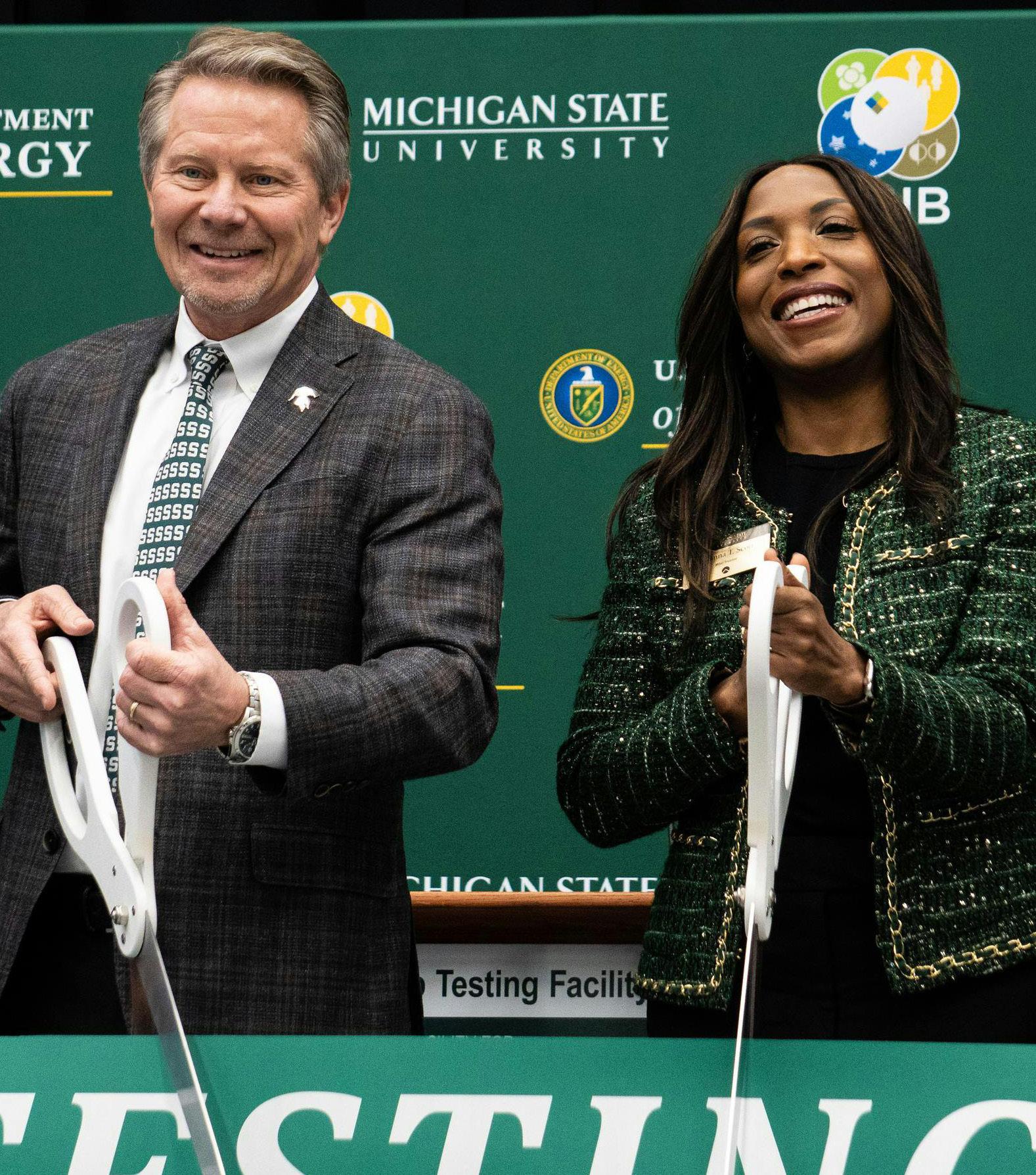
MSU president Kevin Guskiewicz (left) and MSU board trustee Brianna Scott (right) cut the banner to symbolize the opening ceremony of the Michigan State University K500 Chip Testing Facility which was held in the Facility for Rare Isotope Beams in East Lansing, Michigan on Feb. 19, 2026. Photo by Quinn Shell.
SPARTAN MEDIA VENTURES
TRANSPARENCY MEASURE
TROUNCED AHEAD OF
BOARD MEETING, TRUSTEE SAYS
By Julia Roeder jroeder@statenews.com
Michigan State University trustees discussed potentially voting on increasing transparency for the for-profit athletics enterprise Spartan Media Ventures, but the proposal was shot down by a majority of the body, Trustee Mike Balow said during Friday’s board meeting.
The proposal, Balow said, would have dictated that Spartan Media Ventures be subject to Michigan’s Freedom of Information Act law and allowed trustees to view organizational documents without signing nondisclosure agreements. In February, Balow told The State News that he and Trustee Dennis Denno could only view those documents if they signed such agreements, which they both declined.
In his 11-minute closing statement to the board, Balow said he, Denno and Trustee Rema Vassar advocated for the vote to be added to the meeting agenda the day before the meeting, but the other five trustees refused to hold vote.
Public disagreements within the university’s governing body have become common since the board voted in December to allow MSU to enter into a brand management agreement with the nonprofit Spartan Ventures, which subsequently spun off the forprofit Spartan Media Ventures. The for-
profit company is meant to maximize revenue generation within the athletics department and support Name, Image and Likeness (NIL) deals for student athletes.
Despite his concerns over transparency, Balow described both the initiatives as “huge watershed, innovative change” that will “forever change our athletic department” and reiterated his trust in Athletics Director J Batt Friday.
Board Chair Brianna Scott addressed Balow’s concerns in her own closing comments, noting that Spartan Media Ventures is not the first instance of the board not having oversight of for-profit entities. She pointed to the MSU Research Foundation, a non-profit entity that administers grants and supports startups, as being founded the same principles as Spartan Media Ventures.
“We are not doing anything unethical,” Scott said. “We are doing things within the confines of the law. And more than 50 years ago, as I have stated, the research foundation was established within a similar affiliation agreement.”
In January, Spartan Ventures’ board was announced to include Guskiewicz, Scott and Vice President and Director of Athletics J Batt.
Guskiewicz has said that Spartan Ventures is aiming for a July 1, 2026 launch.
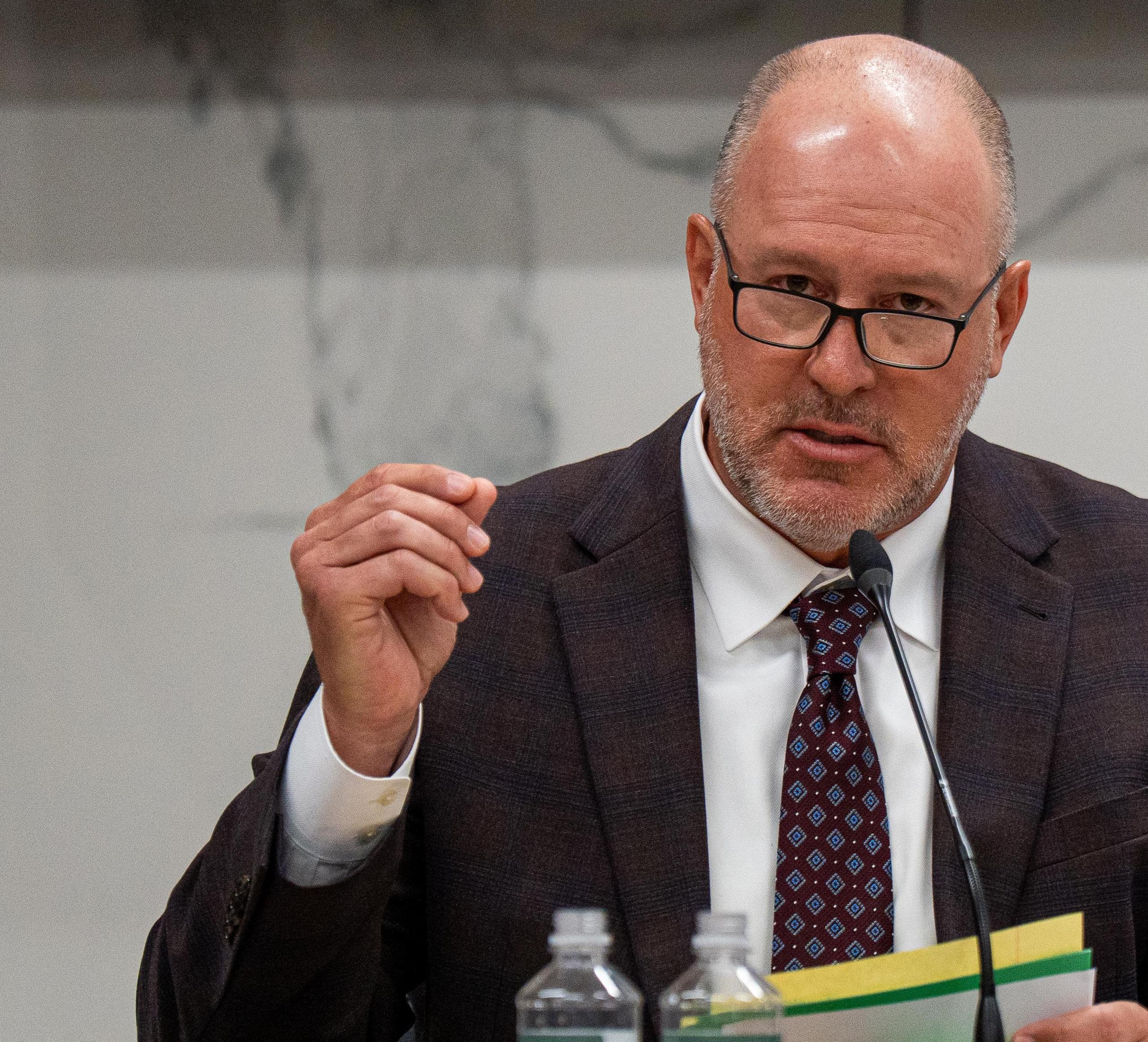
Michigan State University Trustee Mike Balow addresses the board at Hannah Administration Building in East Lansing, Michigan on Friday, April 10, 2026. Photo by Gavin Hutchings.