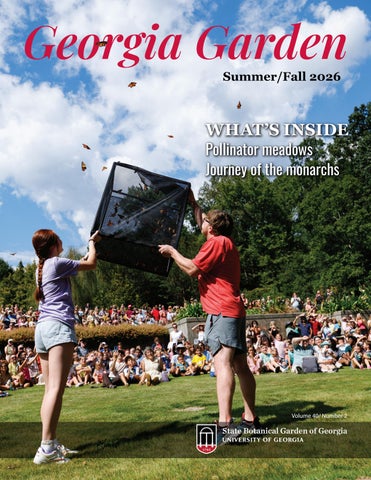
Georgia Garden Summer/Fall 2026
WHAT’S INSIDE Pollinator meadows Journey of the monarchs
Volume 40/ Number 2
Georgia Garden is published three times per year by the State Botanical Garden of Georgia and the Friends of the Garden. The State Botanical Garden of Georgia is a public nonprofit educational organization within the Office of Public Service & Outreach at the University of Georgia.
DIRECTOR
Jennifer Cruse-Sanders
ADMINISTRATIVE SERVICES Susana Alvarado
Tina Christie
Laurel Clark
Jennifer Denson
Sheri Dorn
Kimberly Futrell
Chris Humble
Jessie Penouilh
Heather Schwartz
Adam Stewart
Shené Stroud
Sara Zerkel
DEVELOPMENT Eric Schmidt
Kathy Adams
EDUCATION Cora Keber Audrey Mitchell Emory Perry
HORTICULTURE Jason Young Alex Ankirskiy Emily James Katie McCollum
Summer/Fall 2026 CONTENTS
3 FROM THE DIRECTOR 4 EMPLOYEE OF THE YEAR 6 SCIENCE AND CONSERVATION 8 EDUCATION 10 HORTICULTURE 13 CALENDAR & EVENTS 22 FRIENDS 26 THE QUEST FOR CAMELLIA JAPONICA 30 GATEWAY GROUNDBREAKING 32 FINDING HEALING IN NATURE 36 MUSEUM 38 POSTCARDS FROM THE GARDEN
Ken Duffey Sheldon Jones Carol Dyer McKeen
Eli McKinney
Jim Moneyhun
Zoë Prince
Brian Santos
ON THE COVER
Samantha Simmons
SCIENCE & CONSERVATION Emma Neigel Heather Alley
Jennifer Ceska
Erin Gorman
Emily Laske
Shanna Lee
Emory Moser
Will Rogers
Rachel Smith
Stacey Swann
Zachary Wood
VISITOR SERVICES & FACILITIES Daun Fest Tripp Dukes Noel Fortunato Adam Lowe
2
Andrea Fischer Oliver Hirt Grace Moorman
STATE BOTANICAL GARDEN OF GEORGIA
Learn more about protecting pollinators on page 6
From the Director Summer is such an exciting time at the State Botanical Garden of Georgia. We love seeing our summer campers exploring the garden and trails while learning about the environment. Our Sunflower Concert Series is always something I look forward to, and we invite you to join us for a concert, bring a picnic, and watch the sun set over the Flower Garden. We are especially excited to introduce our Garden Nights series this summer. These after-hours events offer a unique chance to explore different areas of the garden, and our staff have planned engaging activities. Check our calendar for dates and consider bringing a friend to enjoy these special evenings. The garden is continually growing! We expect the new entrance and parking lot to be completed by the end of this year, allowing us to welcome even more visitors to experience the garden and attend our events and programs. We’re also pleased to introduce new team members: Dr. Emma Neigel, Director of Science and Conservation, and Eric Schmidt, Director of Development. Please join us in welcoming them to the State Botanical Garden!
Fall will be here before we know it, and we’re looking forward to our fall events, including the Native Plant Sale, Insectival, Yoga Celebration, adult education classes and more. Then comes Athens’ favorite local event, Winter WonderLights, ushering in the winter season with bright lights illuminating the garden. Thank you for your continued support of the garden through Friends membership. We would not be able to offer these wonderful events and educational opportunities without our Friends members, donors, volunteers, staff and everyone who continues to make this garden a welcoming space for our community. In October, you will receive our Georgia Garden Magazine Year in Review edition, which will highlight the incredible work taking place across the garden and the state over the past year. We look forward to sharing those stories with you, and I hope to see you in the garden soon.
Jennifer Cruse-Sanders, director
SUMMER/FALL 2026
3
Employee of the Year
Adam Lowe
Congratulations to Employee of the Year, Visitor Services Manager, Adam Lowe! In his role as Visitor Services Manager, Adam manages a team of student event staff, works with rental clients to ensure their events run smoothly and assists with garden special events, such as the Sunflower Concert Series, Winter WonderLights and more. Adam’s nominator wrote about him: “It is no secret that Adam is a beloved member of the garden team by coworkers, volunteers, students and guests. His sunny personality, collaborative work ethic and welcoming nature make the garden a better place to work and to visit.”
4
STATE BOTANICAL GARDEN OF GEORGIA
New Garden Staff Dr. Emma Neigel has recently joined the State Botanical Garden of Georgia staff as the Director of Science and Conservation. Neigel recently completed a PhD in biosystems and biodiversity, majoring in ecology, at the University of Lethbridge in Alberta, Canada. Previously, she worked as the safeguarding nursery coordinator and conservation horticulturist at the Atlanta Botanical Garden in Gainesville, Georgia. Her favorite part of the garden is the trails, where she enjoys running.
Emma Neigel
Eric Schmidt recently joined the State Botanical Garden team as the Director of Development. Originally from Monroe, Georgia, Schmidt holds a master's in Public Administration from Georgia College. He has worked at UGA since 2019, and his most recent role was associate director of parent giving in the Office of Development and Alumni Relations. Schmidt’s favorite part of the garden is the Children’s Garden, where he and his wife, Candace, like to bring their sons, Will and Miller. They frequently attend sporting events with their sons and enjoy spending time outdoors by visiting the garden and riding bikes.
Eric Schmidt
SUMMER/FALL 2026
5
Science & Conservation
What is a pollinator meadow?
Creating a pollinator meadow By Heather Alley, conservation horticulturist One of the most common yet difficult questions we get regularly is “How do I create a wildflower meadow on my property?” People are seeking to create spaces that support pollinators, birds and other wildlife by reducing the footprint of their lawns. One of the most rewarding ways to do that is by creating a native pollinator meadow. At the State Botanical Garden of Georgia, we’ve been working on that idea for the past seven years through an ongoing grassland restoration project beneath our large powerline. Our restored right-of-way, once a vast expanse of turf, has become an evolving native grass meadow that hosts a plethora of pollinators and birds. The lessons from that work have been translated into a free guide, “Landowners’ Guide to Establishing and Managing Pollinator Meadows,” designed to help landowners do the same.
6
STATE BOTANICAL GARDEN OF GEORGIA
A pollinator meadow is a planted community of native grasses and wildflowers, often created by converting a lawn or old field. These spaces are intentionally managed to stay sunny and open, providing food and habitat for insects, birds and other wildlife. In the Southeast, this kind of habitat is more important than ever. We’ve lost more than 90% of our native grasslands, and many of the species that depend on them are declining. Reintroducing even small patches can help rebuild those connections across the landscape. And here’s the good news: you don’t need acres
Powerline prairie at the State Botanical Garden before restoration
to make a difference. The same principles used to create large meadows can be scaled down into smaller areas, or “pocket prairies,” that fit into a backyard, along a driveway or in place of a hard-to-mow section of lawn.
Meadows do need maintenance
Start by reading your site
Instead of weekly mowing, you might mow occasionally, manage invasive plants, or (in some settings) use prescribed fire to keep the area open and diverse. Over time, many gardeners find this rhythm more rewarding than maintaining a traditional lawn, and eventually it requires less work.
It’s tempting to jump straight to planting, but the most successful meadow projects start with observation. Take time to notice: • How much sun the area gets • Whether the soil stays wet or drains quickly • What’s already growing there These features will guide your decisions and save you time (and frustration) down the road.
The not-so-fun step: preparation If meadow-making has a secret, this is it: preparation is everything. Before you plant, you’ll need to reduce the existing vegetation, whether that’s turfgrass or a mix of weeds. Depending on your site, that might involve mowing, smothering (solarization), careful herbicide use or a combination of methods. It’s not the most glamorous part of the process, and it can take a full growing season, but it is the most important, setting the stage for everything that follows. From our experience, investing time here makes the difference between a thriving meadow and an uphill battle.
Planting (Finally!)
A meadow isn’t maintenance-free, but it’s a different kind of maintenance from traditional landscapes.
Ready to dig in? If you’re thinking about trying this at any scale, the guide will walk you through the process. It’s based on what we’ve learned through years of hands-on restoration, along with regional best practices. The guide covers everything from site preparation and plant selection to seeding methods and long-term care, with practical advice for real-world Landowners’ Guide conditions in the Southeast. to Establishing It also includes a table of and Managing Pollinator Meadows recommended plants. You can download it from our website and start planning your own meadow that brings more life, movement and seasonal change to your landscape.
Once your site is ready, planting is the fun part. Most pollinator meadows use a mix of native grasses and wildflowers suited to our region. You don’t need fancy equipment. Many successful plantings are done by hand. Timing, seed selection and good contact with the soil are all that matter. Choosing regionally appropriate, responsibly sourced seed helps ensure your meadow functions as a real habitat, not just decoration. Powerline prairie at the State Botanical Garden during restoration
SUMMER/FALL 2026
7
Education
A journey to the monarchs’ winter home By Cora Keber, director of education For centuries, the monarch butterfly has made its incredible journey between Canada and Mexico, but it was not until the August 1976 issue of National Geographic that the full story of this migration truly captured the public’s imagination. Communities along the monarchs’ path share their own stories about this butterfly, and in Mexico, the arrival of monarchs near Día de los Muertos is especially meaningful as many
8
STATE BOTANICAL GARDEN OF GEORGIA
believe the flutter of their wings carries the spirits of loved ones returning home. Spanning nearly 3,000 miles, the monarch migration is part science, part culture and entirely wonder. The 1976 article “Discovered: The Monarchs’ Mexican Haven” put a spotlight on millions of monarchs clustered in the Sierra Madre mountains, solving a mystery that had puzzled scientists for decades. That discovery was the result of nearly 40 years of dedication by Canadian zoologist Dr. Fred Urquhart and his wife, Norah, who began monarch research in 1937. Their innovative method of rearing monarchs, affixing tiny tags and inviting citizens to help, slowly revealed clues about where the butterflies disappeared each fall.
As sightings in Texas dipped in fall and rose again in spring, the couple suspected the monarchs were traveling far beyond the U.S. border. With the help of naturalists Kenneth C. Brugger and Catalina Aguado Trail, the overwintering sites were finally located on Jan. 2, 1975, deep in the Oyamel fir forests of Cerro Pelón. The Urquharts traveled there the following year, closing a chapter of scientific curiosity built on patience, community and a bit of luck. My own journey to see the monarchs in their overwintering forests was less scientific but still took 19 years. When I started working at the garden in May 2007, monarchs seemed to be everywhere: in lesson plans, in conversations and most vividly in our Insectival butterfly releases. Around that time, I met Susan Meyers through her work with the Environmental Education Alliance of Georgia. She was helping us expand statewide access to our Garden Earth Naturalist and Our Shared Forest Science Nights Kits. It was during these early connections that I first learned about her travels to Mexico to see the monarchs in their winter home. I didn’t know it then, but it instantly earned a place on my “living list.” And this year, 19 years later, I finally went. It was my graduation gift to myself, supported in part by the people who cheer me on.
guide lifted the rope and waved only our group through, we stepped closer until we were nearly sitting beneath branches heavy with monarchs. We fell completely silent, 45 minutes of awe. Later, in the sunlit clearing, thousands of butterflies lifted into the warm air. The forest seemed alive, breathing around us. This experience was a true gift, one I carry lightly and gratefully. I hope many others will someday stand where I stood and feel that same sense of wonder, curiosity and connection inspired by the monarchs, our ambassadors for environmental education and conservation. To learn more about monarchs, see our upcoming educational class calendar, which starts on page 13.
We visited three sanctuaries, including Sierra Chincua, El Rosario and Cerro Pelón. Each was different: some had shops and restaurants, others required dusty offroad treks and held no promise of running water. Yet every site offered its own version of the same magic: trees draped in orange wings. In my journal at El Rosario, I wrote: As we climbed, we kept asking, “Is this it?” Every turn revealed more butterflies. When our
SUMMER/FALL 2026
9
Horticulture
10
STATE BOTANICAL GARDEN OF GEORGIA
Annuals in the garden By Jason Young, director of horticulture and grounds We all deal with weeds in the garden. They appear uninvited, seemingly overnight, filling every bare patch of soil with stubborn, relentless life. But before we reach for the hoe, it’s worth asking — what exactly is a weed, and why does it keep showing up? The simple answer is disturbance. Gardening, at its core, is an act of tearing open the soil — digging, dividing, planting, amending. And the moment that soil is exposed, nature sends in its first responders. I like to think of weeds the way I think of a scab on human skin: when the surface is broken, the body rushes to cover it, stabilize it, and begin healing. Weeds do the same thing for the earth. They are not the enemy. They are the ground’s own repair crew. This idea was beautifully articulated decades ago in a book I return to often — an early work by Joseph Cocannouer that argued, against the conventional wisdom of his time, that weeds are in fact guardians of the soil. They break up compacted ground with deep roots, draw up minerals from below, feed soil organisms and protect bare earth from erosion and the sun. The plant world, it turns out, does not tolerate nakedness. Ecologists have formalized this thinking over the years. The botanist J.P. Grime, in his landmark plant strategy theory, broadly known as CSR (Competitors, Stress-tolerators and Ruderals), identified a whole category of plants perfectly adapted to disturbed ground. He called them ruderals: fast-growing, freeseeding, opportunistic plants that thrive precisely where the soil has been opened up. Annuals, with their rapid life cycles and prolific seed production, are ruderals by nature. They are built to move in fast, do their work, and scatter their seed before the season is done. So here is the idea I want to leave with you: choose your weeds wisely. At the State Botanical Garden of Georgia, we put this philosophy to work in what we call the Hillside Garden — a steeply sloped space that, over the course of last year, became one of the
most talked-about installations on our grounds. The project unfolded in three waves of color. First came 32,000 daffodils, blanketing the hill in yellow and white through late winter and early spring. As the daffodil foliage began its slow, necessary decline, we moved in with California poppies (Eschscholzia californica), seeding them across the slope in a warm wash of orange, a monoculture that held the eye and held the ground while we prepared for what came next. That next phase was the permanent framework: Mexican sage (Salvia leucantha) and White Cloud muhly grass (Muhlenbergia capillaris ‘White Cloud’), installed across the slope and secured with jute mesh to stabilize the steep, newly disturbed soil. Between those young perennials, spaced to allow for years of growth, lay exactly the kind of open, bare ground that nature loves to reclaim. We decided to reclaim it ourselves, on our own terms, by seeding cosmos (Cosmos bipinnatus) throughout. The cosmos did what good ruderals do: they filled every gap with enthusiasm. Their feathery foliage softened the slope while their blooms, shades of pink, rose and white, wove beautifully into the purple and white palette of the maturing salvias and muhly grasses. The result was a monochromatic composition, punctuated by that warm bloom of pink, that stopped guests in their tracks all season long. The “flower power” that cosmos brought to the hillside gave the garden an immediacy and vitality that young perennials alone simply cannot deliver. The caution I will offer is this: annuals like cosmos and California poppies can persist around your garden with the same stubborn loyalty as any weed, reseeding freely and appearing year after year where you may not want them. That persistence is part of their charm — and part of their ecological role. But it means you should choose them as deliberately as you would any permanent planting. Pick colors that serve your palette. Pick plants whose seedlings you won’t mind seeing (or pulling) for years to come. When you choose your weeds well, they stop being a problem and start being a plan.
SUMMER/FALL 2026
11
Volunteer Spotlight
Merry Anderson – A volunteer for all seasons By Andrea Fischer, volunteer and tours coordinator I first met Merry when she took the Master Gardener class in 2005. At the time, the 12-week program was hosted and facilitated by the State Botanical Garden. From the beginning, she was enthusiastic, friendly and positive, and she hasn’t changed. Over the years, Merry has cheerfully jumped into everything from the Insect Olympics to the Friends Flea Market. But why is Merry a volunteer for all seasons? Let me share. Winter: Merry oversees a s’mores station during Winter WonderLights. Spring: Merry directs traffic at the Spring Plant Sale. Summer: Merry was a key member of the team that made the Friends Flea Market happen each August. Fall: Merry keeps parking for the Native Plant Sale running smoothly with her orange vest and flags. Throughout the year, Merry teams up with Barbara Turner to make sure the hospitality aspect of Friends events is well covered and that we are well fed! If you want any event or season to be brighter and friendlier, Merry must be part of it! Volunteer opportunities are available for many positions. Please contact Andrea Fischer for more information at 706-542-6195 or afischer@uga.edu.
12
STATE BOTANICAL GARDEN OF GEORGIA
Classes & Events SUMMER/FALL 2026
Adult Programs Think Like an Arborist: Tree Care Prescription in Practice Would you like to learn how to better care for your trees? In this informative indoor and outdoor session, you’ll learn a simple five-step framework to help preserve and manage your trees. We will explore the tools and practices that arborists use to protect urban forests, as well as practical techniques accessible to homeowners. Key topics include how to assess a tree and determine when it should be retained, pruned, treated, supported or removed. Class time will be divided between guided instruction and a
• Wednesday, June 24, 6-8 p.m. • Edward Morrow, ISA Certified Arborist, Tree S.T.A.R.S. • State Botanical Garden Visitor Center, Adult Classroom • Fee: $30 • https://t.uga.edu/9yf hands-on tree walk.
Learning by Leading™ Fall Informational Session • Thursday, Aug. 27, 5:30-7:30 p.m. • State Botanical Garden Visitor Center, Gardenside Room
14
Are you a student interested in working at the botanical garden alongside other students and staff to address important environmental issues? The State Botanical Garden of Georgia Learning by Leading™ (LxL@UGA) program provides students a combination of leadership skills and real-world experience with education, conservation and horticulture through hands-on experiential projects. Interested students are welcome to learn how to get involved in this student engagement program and receive experiential learning credits. RSVP at uga.givepulse.com.
STATE BOTANICAL GARDEN OF GEORGIA
Certificate in Native Plants The Certificate in Native Plants offers committed individuals a comprehensive series of short courses in the identification, cultivation, propagation, ecology and conservation of native Georgia plants. With an emphasis on participatory learning, the short courses are designed to provide a supportive and challenging learning atmosphere. Participants will gain a greater appreciation and understanding of native plants in a broad context.
REQUIREMENTS
Four core courses (8 hours each): 32 hours Six electives (4+ hours each): 24 hours Two field trips (4+ hours each): 8 hours Volunteer service: 16 hours Total 80 hours
The certificate program is appropriate for home gardeners, garden club members, native plant enthusiasts, green industry professionals, conservationists and others interested in the study of native plants. The program is also designed to appeal to professionals working in land, resource and park management, including natural resource agencies and private conservation programs. Knowledge and skills gained can be applied to both volunteer and professional services in conservation, horticulture, landscape design, land management and environmental education. One of the goals of the program is to have certified students participate in ongoing public and private efforts to preserve and restore Georgia’s flora and natural habitats. For a complete course listing, visit botgarden.uga.edu.
Our Native Pollinators This class will explore the be(e)autiful world of our native bees, butterflies, wasps, flies and other insect pollinators. We will dive into the biology of why these insects are so important in our ecosystem with hands-on activities. We will end our time together with a tour of the Ethnobotanical Garden to see the insects in action. Please note that this course is located outside of the Athens area.
• Friday, June 5, 9 a.m.-1 p.m. • Becky Griffin, UGA pollinator health associate • Georgia Mountain Research and Education Center, Blairsville, GA • https://t.uga.edu/7vG
Carnivorous Plants of the Southeast U.S. If you are amazed by carnivorous plants, you’re in legendary company; Charles Darwin shared your passion and enthusiasm for them as well. This course will be a dynamic, hands-on experience getting to know various native carnivorous species, as well as a few others from across the world. Learn about various prey capture techniques, unexpected symbiotic relationships, growing requirements, and genetic work conducted here at UGA. There will also be a feeding tutorial, since some lucky participants will be going home with a carnivorous plant of their own!
• Saturday, June 6, 9 a.m.-1 p.m. • Will Rogers, research professional II • State Botanical Garden Visitor Center, Adult Classroom • https://t.uga.edu/6Pb
Insect Pollinators in Our Gardens • Tuesday, June 16, 9 a.m.-1 p.m. • Paola Barriga, faculty, academic professional, UGA Department of Plant Biology • Virtual program • https://t.uga.edu/6Pd
This course is designed to allow participants to evaluate plant-insect interactions in gardens from an ecological perspective. For instance, we will focus on the importance of maintaining plant and insect pollinator diversity and the ecological factors that may influence this outcome. Among the factors that will be discussed in this course are the roles of disease and pesticides in pollinators’ survival and how these factors could interact with
plant species to produce certain outcomes. Please note that this course also provides credit for the Plants & Pollinators Specialization.
Summer Tree Identification About 200 tree species occur in Georgia’s Piedmont forests and woodlands. In this class, students learn to identify some of the most common of these by their leaves, bark, branching patterns and tree form. Students will learn to use a hand lens and a simple dichotomous key for woody plants to identify species. Class time will be divided between classroom exercises and a field trip to the woods at the State Botanical Garden. Please note the earlier start time of this course.
• Saturday, June 27, 8 a.m.-noon • Zach Wood, Georgia Native Seed Network manager • State Botanical Garden Visitor Center, Adult Classroom • https://t.uga.edu/7vC
Certificate in Native Plants (continued) Connect to Protect Leadership Workshop Join our conservation horticulturist, Heather Alley, and director of horticulture and grounds, Jason Young, for a training workshop on the specialized native plant garden program, Connect to Protect (CtoP). In this class, you will learn the Connect to Protect philosophy and master both the educational goals and the gardening for biodiversity methods of this program. Educational outcomes of this course will include choosing appropriate native plant species, essential maintenance and dynamic curricula to create gorgeous, biodiversity-supporting gardens. Learn the steps it takes to become a CtoP leader and an ambassador of gardening for wildlife! Class time will be spent both indoors and outside hiking in the garden. Dress for outdoor conditions and a walk around the garden. Please note that this course also provides credit for the Plants & Pollinators Specialization.
Friday, Aug. 14, 9 a.m.-1 p.m. Heather Alley, conservation horticulturist Jason Young, director of horticulture and grounds State Botanical Garden Visitor Center, Adult Classroom • https://t.uga.edu/6wj • • • •
Ethnobotany of Native Plants: Through the Eyes of Native Americans This workshop will provide an ethnobotanical journey through a Southern Appalachian forest and field site to discover the gifts of nature that enabled Native American societies to flourish in this region. To understand that the forest offered everything the Native Americans needed is to grasp the essence of precontact Native American life and truly appreciate the individual parts of nature. Participants will explore the crafts and lore of Native American life, including their use of wild plants for food, medicine, repellents and everyday tools. These resources and cultural practices still exist today and remain useful to those who follow in the footsteps of the first inhabitants of Katuah, the land we now call Southern Appalachia. Class time will be spent mostly outdoors, so come prepared for the weather that day. Please note that this course is located outside of the Athens area.
• Thursday, Sept. 3, 9 a.m.-1 p.m. • Mark Warren, author and owner, Medicine Bow Wilderness School • Medicine Bow Wilderness School, Dahlonega, GA • https://t.uga.edu/8wz
Fall Wildflowers of the Georgia Piedmont • Saturday, Sept. 12, 9 a.m.-1 p.m. • Linda Chafin, botanist • State Botanical Garden Visitor Center, Adult Classroom • https://t.uga.edu/79Z
Our gardens, roadsides and meadows are aglow with color in the fall. In this class, students will learn to recognize the most common fall-blooming wildflowers in the Georgia Piedmont and be introduced to basic botanical terminology for identifying and describing fall-flowering plants, with an emphasis on plants in the Aster (composite) family. We will then apply that knowledge to plants in the field, learning to recognize families, genera and species based on characteristics readily observable in the field.
Fall Wildflowers of the Granite Outcrops of Georgia Georgia is home to 90% of the Southeastern Piedmont’s granite outcrops, one
• Friday, Sept. 18, 9 a.m.-1 p.m. of the most endangered and botanically interesting natural communities • Robby Astrove, preserve manager, Davidson-Arabia in the U.S. Students will be introduced to the ecology, habitats and plant Mountain Nature Preserve communities of the granite outcrop ecosystem during an interpretive • Davidson-Arabia Mountain Nature Preserve, hike. Yellow daisies and fall wildflowers dominate the outcrops in Stonecrest, GA September, and we’ll take in the grand showing as we celebrate fall’s wildflowers on the outcrop. We will discuss and observe much about their • https://t.uga.edu/9AV
life histories, adaptations and resilience to survive on the rocks. This will be an entirely field-based course on a multi-hour hike. Please note that this course is located outside of the Athens area.
Monarchs & Beyond: Pollinator Stewardship • Saturday, Sept. 19, 9 a.m.-1 p.m. • Susan Meyers, monarch watch conservation specialist, Monarchs Across Georgia, Environmental Education Alliance • State Botanical Garden Visitor Center, Adult Classroom • https://t.uga.edu/6g4
16
This class will take an in-depth look at the biology and ecology of the monarch butterfly in North America, its migration, species status assessment and conservation efforts. With an overall 90% population decline over the past 20 years, the monarch has become the poster child for pollinators and the subject of extensive research, monitoring and educational efforts. Participants will utilize habitat assessment tools, practice a variety of community science projects and plan their own pollinator enhancement activities to become pollinator stewards. Class time will be spent both indoors and outside hiking in the garden. Please note that this course also provides credit for the Plants & Pollinators Specialization.
Between the Tides: Salt Marsh Plant Ecology This course introduces participants to the plants that define the salt • Saturday, Sept. 26, 9 a.m.-1 p.m. marsh, their unique adaptations and the ecological forces that shape • Shannon Matzke, marine educator & public program this productive habitat. After a classroom overview of salt marsh coordinator, UGA Marine Extension and Georgia Sea Grant formation, zonation, species diversity and conservation challenges, we • UGA Marine Education Center and Aquarium, Savannah, GA will walk through the maritime forest to the salt marsh to observe plant • https://tinyurl.com/2sh78n8w communities up close. Along the way, we’ll practice plant identification, investigate ecological relationships and discover how coastal plants have supported both wildlife and human communities over time. Please note that this course is located outside of the Athens area.
Plants We Love to Hate: Identifying and Controlling Non-native Invasive Pest Plants • • • •
This workshop is an introduction to identifying and controlling invasive, Saturday, Oct. 3, 9 a.m.-3 p.m. non-native pest plants. Students will learn about the major “offenders” Gary Crider, invasive plant control specialist in the Georgia Piedmont and how these plants harm native plant State Botanical Garden Visitor Center, Adult Classroom communities and wildlife. The class will also focus on habitat restoration https://t.uga.edu/6g5 through the management and control of invasive plants. A variety of
control methods will be outlined, including descriptions of tools, techniques and detailed strategies for some of the high-priority species. The lecture portion of this course will last until 12:30 p.m., followed by a break and an optional outdoor field study.
Fungal Ecology and Diversity: The Fascinating World of Fungi • • • • •
Fungi are an essential yet often overlooked part of our natural world. In this Saturday, Oct. 10, 9 a.m.-1 p.m. class, participants will explore the fascinating diversity of fungi and learn Sam Landes, treasurer, Mushroom Club of Georgia about their structures, identification and many uses. The course will Cornelia Cho, president, Mushroom Club of Georgia introduce key aspects of fungal biology and ecology while highlighting State Botanical Garden Visitor Center, Adult Classroom the important roles fungi play in natural systems. We will also touch on https://t.uga.edu/8Cn the culinary side of fungi and their value to people. Through discussion and hands-on examples, participants will gain a deeper appreciation for the remarkable world of fungi.
Warm-Season Grasses of the Georgia Piedmont • • • •
Grasses are the most economically and ecologically important plant family, Saturday, Oct. 17, 9 a.m.-1 p.m. but most of us know very little about them, and fewer still know how to Zach Wood, Georgia Native Seed Network manager identify grasses. In this class, we will learn to recognize common fallState Botanical Garden Visitor Center, Adult Classroom flowering grass species of the Georgia Piedmont. During the first half of https://t.uga.edu/7a1 the class, we will dissect grass plants to learn the basic structures useful for field identification. The last two hours of the class will be spent in the field examining a variety of native and exotic grasses. Be sure to bring a hand lens if you have one.
Grow Your Own Prairie in North Georgia Prairies, meadows, savannas and woodlands were once integral parts of Georgia’s piedmont and mountain ecoregions. These habitats have nearly disappeared, but are now being restored and re-created by gardeners, ecologists and landscapers. This class will teach you the basics of creating a prairie on your property, including site analysis, species selection and habitat management. Class time will be divided between classroom lecture and a field trip to the prairie at the State Botanical Garden. Hicks will share her experience cultivating and managing 10 acres of meadow, forest and natural garden in North Georgia, where she encourages wildlife to come and live. Please note that this course also provides credit for the Plants & Pollinators Specialization.
• Saturday, Oct. 24, 9 a.m.-1 p.m. • Karin Hicks, Georgia master gardener and master naturalist • State Botanical Garden Visitor Center, Adult Classroom • https://t.uga.edu/6gf
Invasive Plant Control Strategies, Techniques, Tips, Tricks and Tools! • • • •
This class will detail safe, practical and effective control methods for three critical species: Japanese Stiltgrass, English Ivy and Chinese Privet. With the right strategies, tools and techniques, these invasive plants can be brought under control, reducing their impacts and improving the ecological function of affected sites. Other problematic species will also be discussed, including Japanese Knotweed, Callery Pear, Kudzu and Japanese Chaff Flower.
Saturday, Nov. 14, 9 a.m.-1 p.m. Gary Crider, invasive plant control specialist Virtual program https://t.uga.edu/9B4
17
Children & Family Programs Great Southeast Pollinator Census
The State Botanical Garden of Georgia is one of many partners working with University of Georgia Extension • Friday, Aug. 21 - Saturday, Aug. 22 to gather a snapshot look of pollinators across the Southeastern U.S. The Great Southeast Pollinator Census is a historical initiative where citizens will record the numbers and types of pollinators that populate our state during late summer. Not an entomologist? No worries! The census was designed for everyone to successfully participate and make a difference for our pollinator populations. Visit https://GSePC.org for details on how to participate!
Field Trips at the Garden • • • • •
Tuesdays-Fridays, 9:30-11:30 a.m. State Botanical Garden education staff Children’s classroom, gardens and trails Fee: Varies with program, $5-$8 per student Ages: Varies with program, preK-grade 12
Bring your students to the garden to learn about natural ecosystems near and far. Each field trip program includes hands-on learning through our gardens and trails, and a chance to connect with nature. For more information, please contact sbgeduc@uga.edu.
Adventure Packs • • • •
Available times between 9 a.m.-3 p.m. Self-guided Fee: $20 for materials for up to 20 participants Ages: Pre-K–grade 12
Explore the State Botanical Garden and its trails on a self-guided adventure. Each pack contains maps and supplies for handson science activities, plant hunts and forest explorations to be completed throughout different areas of the garden. Bring your family or students to enjoy activities and games that introduce you to our shared earth at your own pace. For more information, contact sbgeduc@uga.edu.
Birthday Parties at the Garden Are you looking for a memorable and magical kid-friendly birthday? Look no further! The State Botanical Garden of Georgia offers a variety of birthday programs from September through May. You can choose from Animal Encounters, Critter Catchin’, Forest Treasure Hunt and more. Each party includes one hour of guided activities in our conservatory or forest trails and use of the children’s classroom for a total of three hours. Parents or chaperones must accompany all children for the duration of the program and are included in the participant numbers. For more information, contact sbgeduc@uga.edu.
• • • • •
Saturdays & Sundays, 9 a.m.-noon or 1-4 p.m. State Botanical Garden education staff Visitor Center, children’s classroom Fee: $350 for up to 40 guests Ages: 5-10
Insectival Join us for one of our largest and most well-known festivals, Insectival! Participants will meet and interact with a variety of entomological experts and their buggy friends. Activities include presenter booths, a puppet show and the popular butterfly release on the Flower Garden lawn. Join garden staff and partners as we celebrate our beloved six-legged neighbors. Insectival is sponsored by the State Botanical Garden of Georgia, the UGA Lund Club, the UGA Department of Entomology and the Georgia Museum of Natural History.
• Sunday, Sept. 27, 11:30 a.m.- 3:30 p.m. • State Botanical Garden education staff and partners • Fee: $5 per individual, $20 per family and children two and under are free
18
STATE BOTANICAL GARDEN OF GEORGIA
Alice H. Richards Children’s Garden Performance Series Every third Saturday of the month, April through August, enjoy a variety of engaging shows taking place on the Theater-in-the-Woods stage in the Alice H. Richards Children’s Garden. Experience music, laughter and connection in nature as our artists bring excitement to your weekend. All performances will take place at 9:30 a.m. with a second showing at 11 a.m.
• Every third Saturday of the month, April through August, 9:30 and 11 a.m. show times • Theater-in-the-Woods • Free and open to children of all ages
Sweet Pea Club The State Botanical Garden of Georgia education team offers Sweet Pea Club at the Alice H. Richards Children’s Garden on Thursday mornings from 10:15 to 11 a.m. Families join one another for a program of engaging activities in the garden, including songs, puppets, stories, hikes and games. Each week focuses on a different theme, such as busy bees, pollination, decomposers, all about animals, plants we eat and more. The Sweet Pea Club program is an informal way to help young naturalists better understand the importance of our shared earth. This program is geared towards ages 3-5. Please note this program typically takes place outdoors, and the location may change depending on the weather. Registration is required for each participating child and is available on our website.
• • • •
Every Thursday through Oct. 29, 10:15-11 a.m. Theater-in-the-Woods Fee: $3 per child per class Ages: geared toward ages 3-5
Rambles Nature Ramblers Join the Nature Ramblers to learn more about the natural areas, flora and fauna of the State Botanical Garden while making new friends and enjoying the fresh air. Rambles start with an inspirational reading by a nature writer such as Annie Dillard, John Muir or Janisse Ray. Ramblers are encouraged to bring their own nature writings, favorite poems or essays to share with the group. This is a ramble, not a hike; stopping to view interesting plants, insects, butterflies and mushrooms, etc., along the way is part of the experience each week. You can join for just one or all sessions. These informal rambles are free, but donations are accepted in the garden’s donation box in the lobby of the visitor’s center. To get a feel for what these rambles are like, visit https://naturerambling.org/.
• Thursdays through Nov. 19 • 9 a.m. (each ramble lasts about 90 minutes) • Leaders rotate among a group of local naturalists and biologists, featuring guest guides • Meet at the children’s garden arbor
Fall Bird Rambles • • • • •
Join the Oconee Rivers Audubon Society for a 8 a.m. morning bird walk at the garden. Look and See State Botanical Garden of Georgia website for dates listen for our fall migrants. First time birding? Oconee Rivers Audubon Society No problem. ORAS members will help you Upper Parking Lot spot and identify the feathery creatures. All Free and open to the public birding levels are welcome. Bring binoculars if you have them. For more information, visit www. oconeeriversaudubon.org.
SUMMER/FALL 2026
19
108 Sun Salutations Yoga Celebration Sunday, Oct. 4 5:30 p.m., set up at 5:15 p.m. Tickets are $15, plus taxes and fees
Join the Athens yoga community for 108 Sun Salutations in the Flower Garden. From beginners to seasoned practitioners, all ages and all levels of practice are welcome! Modifications will be presented and encouraged. Please bring a yoga mat, water bottle, towel and friends.
15TH ANNUAL NATIVE PLANT SALE
Join garden professionals at the Mimsie Lanier Center for on-site plant shopping. Experts will answer questions about incorporating native plants into every space, from large gardens to pots. See details and a plant list at botgarden.uga.edu.
Thursday, Oct. 8, 2-6 p.m. (Friends of the Garden Preview Sale) Friday, Oct. 9, 2-6 p.m. Saturday, Oct. 10, 9 a.m.-noon Thursday, Oct. 8, is the preview sale for Friends of the Garden members only. Members of the Friends of the Garden will receive a 10% discount and get to shop early.
20
STATE BOTANICAL GARDEN OF GEORGIA
Art Exhibits Featured Artists in the Conservatory Amanda Burk Amanda Burk is a printmaker in Athens, Georgia. She uses traditional forms of printmaking (intaglio, relief, screen printing & lithography) in her artwork, often alongside hand-drawn or painted elements. Burk teaches printmaking at the college level and has also taught print classes at Flat File Print Shop, which she owned and operated before its closure in November 2024. Her work has a divided focus, sometimes depicting natural elements like florals and sometimes focusing on objects from her past.
May 10 - June 14
Leigh Ellis
Leigh Ellis is a professional painter and teacher based in Athens, Georgia. Currently, she teaches July 5 - Aug. 9 watercolor classes across the Southeast and workshops with the Oconee Arts Foundation. She held an 8-year position teaching painting and drawing, printmaking and photography with Athens Academy in the Fine Arts Department. She currently exhibits her paintings in fine art shows in the spring and fall.
Judy Jarrett After 21 years in the English classrooms of South
Carolina and Alabama, Judy Jarrett returned to one of her first loves: art. Jarrett is happiest when she has a paintbrush in hand, working out a new design or having a fine time with a different medium. Jarrett runs ArtCan Studio Gallery in Chapin, North Carolina, where she explores various mediums, including watercolors, acrylics and innovative collages featuring moving parts.
Aug. 16 - Oct. 4
Chuck Murphy Chuck Murphy started taking pictures in
high school and has been fascinated with photography ever since. Murphy’s primary interest has always been nature photography, particularly “birds, bugs and blooms.” He received first prize in a bird photography contest in Popular Photography magazine and a full-page spread in Outdoor Photographer. Besides making photos, he also enjoys teaching photography at UGA’s Center for Continuing Education, the State Botanical Garden of Georgia, the local learning-in-retirement association, “OLLI @ UGA,” and several other venues.
Oct. 11 - Nov. 15
SUMMER/FALL 2026
21
Friends First Friday First Friday each month • 9-10:30 a.m. • Fee: $12 general admission, $10 for members • Pre-registration is required
June 5 - Lessons from the Alice H. Richards Children’s Garden Since opening in 2019, the Alice H. Richards Children’s Garden has served as a space for garden visitors of all ages to learn, grow and explore our natural world. While caring for this garden, Katie McCollum, Children’s Garden curator, has learned some lessons she will share with us about keeping it beautiful and educational for all visitors.
July 10 - Jennifer Berry In this Friends First Friday, Jennifer Berry will explain the reasons behind the decline of pollinators and actionable steps we can take to slow it. Pollinators are responsible for a significant portion of the nutritious foods we eat, including delicious fruits, vegetables and nuts. Yet the very species that make this abundance possible are now disappearing. Please join us as we explore how even small actions can make a meaningful difference.
Aug. 7 - How does your garden grow? Join us for a look at the State Botanical Garden of Georgia: where we have been and where we’re going. From the bold meadow that replaced an aging orchard to the canopy work that’s letting light back in, the garden’s director of horticulture and grounds, Jason Young, will walk you through the transformations that are reshaping the State Botanical Garden and discuss what the future may hold.
Sept. 4 - 35 Natural Wonders of Georgia to See before You Die Based on noted science journalist Charles Seabrook’s personal bucket list and Ann Litrel’s insightful watercolors and sketches, “35 Natural Wonders of Georgia to See Before You Die” offers a fresh take on Georgia’s natural beauty in the tradition of naturalists such as John James Audubon and William Bartram. Such wonders include the Altamaha River, Providence Canyon, Brasstown Bald and Okefenokee Swamp.
Oct. 2 - Horticultural therapy at public gardens: Reimaging our pathway to health Join us to learn from Dr. Sheri Dorn, an assistant professor of sociohorticulture and horticultural therapy jointly appointed with UGA’s Department of Horticulture and the State Botanical Garden. Dorn will share the science of horticultural therapy and therapeutic horticulture, insights from a national study of programming delivered at public garden sites in the U.S., and UGA’s plans to train a new generation of professionals who can use horticulture to address health and well-being.
Nov. 6 - Grow up! Using vines and climbers in your garden Whether you’re planning an expansive suburban landscape or looking for that special patio plant, there’s a place for vines in your garden. The use of vines and climbers in formal and natural garden settings will be discussed with an emphasis on clematis. Join us as Dan Long shares an amazing array of vines, both classic and new, suited to a wide variety of growing conditions in all colors of the rainbow.
Dec. 4 - Who is Oconee Joe? Are you curious about the natural and cultural history of the Oconee River? Join us as we welcome David Titshaw of Oconee Joe Paddle Co. Titshaw is well known for leading kayaking tours throughout the Upper Oconee watershed, from Athens downstream to Lake Oconee. He also has a vast knowledge of the history of Native American communities along the Oconee River. Come and learn more about the river that flows through the State Botanical Garden.
22
STATE BOTANICAL GARDEN OF GEORGIA
Dear Friends, It is a privilege to serve as president of the Friends of the State Botanical Garden of Georgia, and it brings me great joy to lead this organization. I look forward to getting to know you better as I have more opportunities to connect with you throughout the year. This is my second time serving on the Friends Board, having previously served from 2006 to 2012. I work at UGA’s Center for Continuing Education & Hotel as the senior development and special initiatives manager, and I discovered the garden when I moved to Athens 27 years ago. I quickly came to appreciate the many weekend opportunities to walk the trails, attend classes, volunteer and explore the wide variety of gardens. My involvement with the Friends has enabled me to participate in many of the State Botanical Garden’s events and programs. The remainder of the year at the garden has many wonderful experiences, including Friends First Fridays, Children’s Garden Performances, the Sunflower Concert Series, Insectival, Yoga Celebration, Native Plant Sale and much more. I truly believe there is a unique event or program for every Friend to enjoy. As you read this, the cheerful spring blooms throughout the garden will have given way to vibrant summer flowers, and no summer is complete without a visit to the State Botanical Garden. The season will kick off with the first Sunflower Concert in June, setting the tone for lively evenings surrounded by nature. When you need a break from the sun, the Shade Garden, the Porcelain and Decorative Arts Museum and the Conservatory offer welcoming spaces to cool off and linger. As the weather cools and leaves turn from green to hues of red and gold, the garden will begin preparing for Winter WonderLights and Disco Nights. Trees will soon sparkle with lights, and before long, the air will be filled with the sounds of holiday cheer. There is truly never a bad time to visit the garden, and I hope to see you here often. Pamela Bracken, president, Friends of the Garden
President Pamela Bracken Vice President Merry C. Anderson Secretary Beth Campbell Treasurer Gayle Burnham Immediate Past President Karen Radde Endowment Trustees Mercer Brockenbrough James L. LaBoon III John V. Quackenbush Ellen Wilkins Wiley Members at Large Shirley Berry Nancy Black Ann Davis Betsy Ellison Juli Fields Celia Fowler Susie Haggard Taylor Jenkins Teresa Morrison Shelly Prescott John V. Quackenbush Rosemary Stancil Gary Wade Anne Walker William A. “Bill” Walker
SUMMER/FALL 2026
23
Garden Nights Garden Nights at the State Botanical Garden of Georgia invites you to explore the garden intimately and learn from our staff while enjoying a relaxed, lively atmosphere. Garden Nights provides the setting for a unique date night for couples, a fun night out for friends, or a memorable experience for visitors. Each event features a garden staff member highlighting their area of the garden, followed by a special activity. Your ticket includes light snacks and two beverages. Designed for guests 18+, Garden Nights is where the growing is just for adults!
• Ticket Prices: $10 – for Friends of the Garden, $25 – Non-members • Dates: Garden Nights will be offered once a month, June-October • Time: 6:30-8 p.m.
Scan the QR code for more information and to purchase tickets
June 10 - Bubbles & Blooms
Join Flower Garden Curator Jim Moneyhun as he talks about what is currently blooming and the pollinators our summer blooms attract. We’ll bring out the bubbly while you enjoy classic lawn games as the sun begins to set. In case of inclement weather, this event will be relocated to the Visitor Center and Conservatory.
July 8 - Night at the Porcelain Museum
Explore how our exhibits come to life after hours with Grace Moorman, curator of the Porcelain and Decorative Arts Museum. After a brief presentation on our extensive collection, guests will embark on a scavenger hunt.
Aug. 12 - Butterflies & Bingo
Learn about Joe Pye Weed, which attracts hundreds of butterflies to the garden, with Emily James, horticulture manager, and play bingo in the Heritage Garden. Prizes will be awarded to the 1st-, 2nd-, and 3rd-place winners. In case of inclement weather, this event will be relocated to the Visitor Center and Conservatory.
Sept. 2 - Adult Recess
Embrace your inner child and enjoy Adult Recess with Katie McCollum, Children’s Garden curator. After a brief overview of the Children’s Garden, guests will roam as they fill out a Garden Nights edition of the popular Children’s Garden Passport. In case of inclement weather, this event will be relocated to the Visitor Center and Conservatory.
Oct. 13 - Sip n’ Paint
Join Jason Young, director of Horticulture and Grounds, as he leads you in a painting of fall plants. Young will provide information about the plants as you paint. Supplies are provided for each guest.
24
STATE BOTANICAL GARDEN OF GEORGIA
Sunflower Concert Series The Sunflower Concert Series at the State Botanical Garden of Georgia invites the community to enjoy live music amid the beauty of the garden. Held in the picturesque Flower Garden, these concerts provide an unforgettable experience. Guests are encouraged to bring blankets, chairs and picnic dinners to savor while enjoying the music. Each ticket includes snacks and beverages. This year, concerts will feature one band with no opening act. In case of inclement weather, concerts will be relocated to the Visitor Center and Conservatory. Season passes, which include tickets to all four concerts, are $80 for adults and $40 for children ages 5-16. Ticket prices for single concerts are $24 for adults and $12 for children ages 5-16. Children under 5 are admitted free of charge. Adult tickets purchased at the gate will be $26. Friends of the Garden Members receive a 10% discount. All ticket purchases are subject to additional fees. Formed in Athens, Georgia, The Broken String Band draws inspiration from the region's rich musical heritage. This talented group of musicians breathes new life into the folk music tradition, blending old-time folk, bluegrass and country influences to create a sound that is uniquely their own. Led by their two frontmen, Sean Stephansen and Taylor Thompson, whose voices together carry a timeless allure, the band’s sound is both gripping and authentic.
June 16 - The Brokenstring Band
A mix of classic Motown sound, part 1970’s funk and disco flavor, with a dash of old-school and contemporary R&B, The Original Splitz Band guarantees a good time! Known for their high-energy performances, they mix classic acts including The Temptations, Marvin Gaye and Stevie Wonder.
July 21 - The Original Splitz
Since 2002, Abbey Road LIVE! has been rocking the music of the Beatles. Initially a tribute to the “Abbey Road” album, the band has expanded its scope to include nearly 150 Beatles tunes from all eras of the Fab Four’s career. The band specializes in complete, start-to-finish album performances of masterpieces such as “Abbey Road,” “Magical Mystery Tour,” “Rubber Soul,” “Revolver” and “Sgt. Pepper’s Lonely Hearts Club Band.”
Aug. 18 - Abbey Road LIVE!
Classic City Jukebox is a party band covering your favorite hits from the 60s to the 2000s. Based in Athens, Georgia, the members of CCJ have collectively spent decades working and playing at various music venues around the Southeast and beyond.
Sept. 15 - Classic City Jukebox
The quest for Camellia japonica ‘Virginia Rich’ By Penny Scarpucci, contributing writer For more than a decade, the camellia known as Camellia japonica ‘Virginia Rich’ existed as little more than a name, a few photographs and a lingering question. Once promoted widely in the Atlanta area and beyond, the cultivar had seemingly vanished. What followed was a 10-year effort to trace its history, confirm its identity and ultimately rediscover the living plant.
Origins of the search The search began years ago following an American Camellia Society convention in Norfolk, Virginia. While visiting the Elizabethan Gardens there, long-time North Georgia Camellia Society member Jim Prucker encountered a locally grown camellia named ‘Virginia Dare.’ Its bloom bore a striking resemblance to well-known cultivars such as ‘Pink Perfection’ and ‘Otome.’ Nearby was another Norfolk-area camellia, unregistered at the time, that he regretfully passed up the chance to acquire. That plant was later registered with the ACS in 2012 — a missed opportunity that sharpened Prucker’s awareness of how easily camellias can slip into obscurity. That experience sparked a broader interest in unregistered or locally known camellias and eventually led him to the name ‘Virginia Rich’— a cultivar with deep Atlanta connections and a surprisingly elusive trail.
Early clues and dead ends
Prucker’s early research found an ACS historical photograph from the 1960s, confirming that ‘Virginia Rich’ did indeed exist and had been documented. The logical first stop was Wheeler’s Nursery, the originator of the camellia. He had visited years ago, before the nursery closed permanently, only to learn that they were no longer propagating their own introductions. No living plants could be found there. Another possible lead came from members of the Middle Georgia Camellia Society, who suggested that many Wheeler introductions had been planted in the Dr. William Green Lee Garden in Macon, Georgia.
26
STATE BOTANICAL GARDEN OF GEORGIA
Unfortunately, all plant labels in the garden had been lost over time. One camellia there looked promising, but there was insufficient evidence to confirm it as ‘Virginia Rich.’
Following the paper trail As is so often the case, the internet provided new momentum. An online search turned up a photograph from a nursery in Victoria Province, Australia — evidence that ‘Virginia Rich’ had traveled far beyond Georgia. Even more importantly, the search led to the Richard H. Rich Collection at Emory University’s Rose Special Collections Library. The Emory archive contains more than 75 boxes of personal and family papers, including extensive materials related to ‘Virginia Rich’ and camellias. Among the most significant discoveries was a 1958 article in The Camellian magazine, written by Mrs. Gary Payne of Rich’s Garden Center and Dorothy Lavine, Richard Rich’s long-time secretary. The September 1958 issue, along with a Wheeler’s Nursery advertisement from the same year, provided contemporary documentation of the cultivar’s introduction and promotion.
Who was Virginia Rich?
Virginia Lazarus Rich, for whom the camellia was named, was born in New Orleans in 1908 and died in Atlanta on Jan. 8, 1957. She was the wife of Richard H. Rich, CEO and Chair of Rich’s Department
Stores, and an active figure in Atlanta civic and cultural life. An editorial published after her death in The Atlanta Constitution noted that Mrs. Rich “made a definite civic contribution, but she was also one of those rare individuals whose vibrant personality and conversational brilliance set her apart as a person.” She had a deep love of flowers, growing camellias and prize orchids in the greenhouse at their West Andrews residence. At one time, she even operated her own flower shop, aptly named Virginia’s Garden.
Why the name ‘Virginia Rich’
A cultivar lost
Richard H. Rich began working for the family retail business while still in school in Savannah, becoming a full-time employee in 1923. By 1924, he was on the board, and he eventually rose to Chair of the Executive Committee, a position he held through 1975. Under his leadership, Rich’s expanded dramatically, and he became one of Atlanta’s most influential civic leaders.
Despite this strong launch, ‘Virginia Rich’ gradually disappeared. The flower was known to be variable; both the official Rich’s photograph and early articles noted that bloom color changed as the flower aged. The cultivar was sold and promoted locally from about 1960 through the late 1970s, grown in Charlotte, North Carolina, during the 1960s, and even made its way to Australia.
It appears that Mrs. Rich’s interest in camellias brought Carl Wheeler to the attention of both Virginia Rich and Rich’s Garden Center. After her death, Mr. Rich’s long-time secretary and the head of the Garden Center approached Wheeler with the idea of naming a new seedling, one he had been developing for eight years, in her memory.
Yet after years of searching gardens, giving presentations and following leads across the Southeast and beyond, no confirmed living plants were found.
In 1958, Richard Rich purchased the initial plants Wheeler had available and gave them to family and friends. Several were placed in the Rich greenhouse to obtain grafting material and blooms. As additional plants became available, Rich’s Garden Center sold and promoted ‘Virginia Rich’ locally. The cultivar was featured in Rich’s promotional calendars, appeared on a North Georgia Camellia Society cover, and was highlighted in the American Camellia Society Yearbook in 1961.
Richard H. Rich
Until 2020, during a presentation titled “Lost Loves” to the Dunwoody Garden Club, an audience member, Mrs. Norma Jones, announced that she believed she had this camellia growing in her garden. She later showed John Scarpucci, NGCS President, a photograph taken while the plant was in bloom. The resemblance was unmistakable. Prucker and Scarpucci visited her garden the next day. The bloom matched the historical descriptions and photographs, confirming that ‘Virginia Rich’ had survived — quietly and unrecognized — for decades. For added provenance, Mrs. Jones confirmed that her husband had bought the plant from Rich’s Department Store in 1976. Cuttings were taken, and air layers were made. Today, ‘Virginia Rich’ has been introduced into several gardens in the Southeast, including Massee Lane Gardens, the home of the American Camellia Society, and Magnolia Gardens in South Carolina. While not quite a formal double, the bloom stands as a living link to Atlanta’s horticultural and civic history — and as proof that even “lost” camellias may still be found. To continue ‘Virginia Rich’ further into the future, a specimen of the plant was provided to the State Botanical Garden of Georgia in Athens in November 2025.
SUMMER/FALL 2026
27
Orchid Madness 2026 Thank You to Our Sponsors! Diamond Sponsor The Fickling Family Foundation Platinum Sponsors
Bronze Sponsor
Patron Sponsors Rose and Dahlia Garden Club
28
STATE BOTANICAL GARDEN OF GEORGIA
Student Spotlight Olivia Terrell Olivia Terrell has been part of the education team at the State Botanical Garden of Georgia for four years. She is currently in her final semester as an undergraduate student at the University of Georgia, where she is studying environmental economics and management. As she finishes her degree, she is also working towards completing her master’s degree in environmental economics. Terrell first joined the garden as a member of the Environmental Education Learning by Leading™ team in the fall of 2022. During her freshman year as an out-of-state student, she sought out a community of like-minded individuals who would encourage her to pursue her goals. The garden provided her with the opportunity to connect with others while strengthening her professional skills. Terrell became more involved with the garden through her roles as a summer camp counselor, an environmental educator and a student co-leader for the Environmental Education team. In these roles, she assisted with educational programming, planned weekly meetings, and attended professional development events. Terrell contributed to developing programs for homeschool groups in partnership with the Athens Community Council on Aging. Some of her favorite moments include working with other educators to help children form personal connections with nature during summer camp programs. She was honored to have these involvements recognized when she was selected as one of the university’s top 100 student employees for 2026.
See Olivia featured on the front cover
Terrell’s time at the garden has provided her with the most rewarding experiences and a supportive community. She is thankful for the guidance of her entire team, who have encouraged her to become a better communicator, embrace curiosity and be confident in leadership positions. She is excited to develop these skills as she continues to work at the State Botanical Garden of Georgia and in her future career in environmental consulting. SUMMER/FALL 2026
29
State Botanical Garden breaks ground on new entrance By Laurel Clark, communications manager On Jan. 23, the State Botanical Garden of Georgia at the University of Georgia broke ground on the Gateway to the Garden entrance project, with state legislators, UGA administrators, donors and garden staff in attendance. The project will relocate and expand the entranceway to accommodate the increased number of visitors and provide additional parking and trail access. When the State Botanical Garden of Georgia was founded in 1968, its entrance was built to serve 50,000 visitors a year. This past year, more than 470,000 people explored its curated garden spaces and trails — nearly 10 times the original projection. “The Gateway to the Garden project represents a tremendous milestone for the State Botanical Garden of Georgia as it continues to expand its offerings to visitors from across the state and beyond,” said UGA President Jere W. Morehead. “The garden is a perfect representation of the significant impact the University of Georgia can have through its teaching, research and service missions, and I am incredibly grateful to everyone who continues to elevate this special place on campus.”
30
STATE BOTANICAL GARDEN OF GEORGIA
The relocated and enlarged entrance will better accommodate larger vehicles, such as school buses bringing more than 4,000 children annually to the garden for field trips. In addition, the project includes a new parking area, improved trail access and greater pedestrian infrastructure to improve visitors’ experiences at the botanical garden. “We are thrilled to be breaking ground on the Gateway to the Garden project, which will provide necessary improvements to our entrance, providing greater accessibility for the thousands of visitors we welcome each year,” said Jenny Cruse-Sanders, the garden’s director. “We could not have reached this milestone without the support of many individuals, organizations and especially our board of advisors for helping us bring this project to fruition.” Funding for the multiphase $5 million project has been raised from private support and a state appropriation of $2.35 million. “The State Botanical Garden of Georgia plays an essential role in the university’s
land-grant mission, serving as a living laboratory for research, conservation and hands-on learning,” said Benjamin C. Ayers, senior vice president for academic affairs and provost. “This project will allow even more people to visit and learn in the garden, and it will bring more people to participate in programs and conservation activities that help to preserve natural resources across the state.” Before the groundbreaking, donors were honored at the Giving Tree tribute, a ceremony the garden hosts to show appreciation to its most ardent supporters. Individuals and organizations recognized include Nancy and Glenn Black, Ed Grenvicz, Paula and Mark Hennessy, Sally and David Tyndall, Friends of the State Botanical Garden, Jimmy and Rosalind Jeter, Farolyn and Patrick Mobley, Tom Wight and Jim Miller.
through horticulture, conservation, sciencebased programs and lasting partnerships. The expansion of the entrance and additional parking will ensure that everyone who wants to experience the garden and its impactful programs will be able to do so.”
State Rep. Houston Gaines and state Sen. Bill Cowsert and his wife, Amy, were also recognized for additional state funding that supported the project.
Local firm Koons Environmental Design is designing the project in partnership with the Office of University Architects, and Grahl Construction is overseeing construction.
“We sincerely appreciate everyone who has supported the Gateway to the Garden project,” said Stacy Jones, vice president for public service and outreach. “As part of the university’s outreach division, the State Botanical Garden provides an environment for learning, inspiration and engagement
Construction of the new entrance is expected to be completed in late 2026. Visitors to the garden should not be impacted by construction. To contribute to the Gateway to the Garden project, visit https://tinyurl.com/4s8bvux5.
SUMMER/FALL 2026
31
Finding healing in nature
State Botanical Garden introduces horticultural therapy partnership with CAES By Laurel Clark, communications manager At the heart of the State Botanical Garden of Georgia’s mission is providing an accessible space for people to experience the healing powers of nature. With the addition of a joint position with the College of Agricultural and Environmental Sciences (CAES) at UGA, the garden plans to expand opportunities for horticultural therapy and therapeutic horticulture (HT/TH) programming and train the next generation of professionals to offer these services. Horticultural therapy (HT) uses plants and gardening activities to help individuals improve physical, cognitive, social or mental health outcomes. It is facilitated by a trained professional who works with clients to achieve specific therapeutic goals. Therapeutic horticulture (TH), by contrast, is a broader approach that uses plant-based activities to
32
STATE BOTANICAL GARDEN OF GEORGIA
enhance overall well-being or social connection, often in group settings, without formal goal tracking and sometimes without a trained therapist. Sheri Dorn is an assistant professor of sociohorticulture and horticultural therapy in CAES and is splitting her position between the Department of Horticulture and the State Botanical Garden to provide HT/TH programming in the garden and offer servicelearning opportunities to students. According to Dorn, horticultural therapy is the use of horticulture, including plants and gardening, to reach a therapeutic goal. Horticultural therapy can be used in conjunction with other therapies for patients recovering from major injuries or illnesses. For example, horticulture activities such as lifting a watering can to water plants can help stroke patients regain strength during their recovery.
Working in horticulture can provide individuals with an intellectual disability opportunities to learn skills specific to horticulture, such as greenhouse work, as well as general workplace skills, such as interacting with coworkers and completing a timesheet. Another benefit of horticultural therapy is its social aspect, which helps individuals experiencing grief or isolation find community in public garden spaces through programs that enable them to interact with others while gardening. The State Botanical Garden has been offering therapeutic horticulture programming in its collaboration with UGA’s Cognitive Aging Research & Education (CARE) Center through the Meet Me at the Garden program. Launched in the spring of 2023, the program provides interactive education and sensory activities in a garden setting to people with dementia and their caregivers. The program has been held at the State Botanical Garden and the UGA CARE Center as a pilot to explore how it can operate beyond a garden setting. The State Botanical Garden recently received a Teaming for Interdisciplinary Research PreSeed grant from UGA for its project “Cultivating Care: Advanced Therapeutic Horticulture for Georgia’s Well-being and Resilience.”
With this grant, the garden hosted a leadership summit in March, bringing together local and regional partners with expertise in academic research, applied practice and community outreach to explore how therapeutic horticulture can support people living with Alzheimer’s disease and other related dementias. A goal of the therapeutic horticulture program and its collaboration with other UGA units, such as the Archway Partnership, is to provide rural communities across the state with the knowledge and resources to host their own Meet Me at the Garden programming for the more than 188,000 Georgians who live with Alzheimer’s. “Our mission at the State Botanical Garden is to create an environment for learning, inspiration and engagement, and the Meet Me at the Garden program has demonstrated that by allowing persons with dementia and their care partners to experience the healing power of nature,” said the director of the State Botanical Garden, Jenny Cruse-Sanders. “We look forward to continuing to work with our internal partners at UGA and our external partners to deliver this programming to Georgians across the state.” To learn more about the Meet Me at the Garden pilot program, scan the QR code below.
SUMMER/FALL 2026
33
Sponsors Presenting Gold
Jim Miller
Blossoms Wholesale Natalie and Tom Coghill Susan Braselton Fant Ann and Joe Frierson Georgia Trend Brenda and Ham Magill Marianne McConnel
Betsy Barge Pat and Tom Carlock Betsy and Mark Ellison Truett Jarrard Jimmy Jeter
Silver
Sally Jobe Dori and Rand Jones Sally and Bill Jones Farolyn and Patrick Mobley Caroline and Will Morris
Louise Terrell Adams Gus Arrendale & Springer Mountain Farms Lisa and Holmes Bell Malinda and Fred Bergen Sherri and Ken Callaway Jeff Cole and Mary Bess Jarrard Geri and Wade Coleman Amy and Bill Cowsert Andrew and Leah Crawford Martha Deméré Betty and Mike DeVore Evelyn and David Dukes Cindy and Joe Edwards Melissa and George Fontaine
34
Parties to Die For Doreen and Alec Poitevint Jane and Dan Skinner Joel and Lyndy Wernick Tom Wight Cynthia Willett
STATE BOTANICAL GARDEN OF GEORGIA
Bronze
Deen Day Sanders Elizabeth and Tony Townley Sally and David Tyndall Ruth and Charles Wellborn
Kelly and Parker Grow Northeast Sales Catherine and Lam Distributing, Inc. Hardman Colleen and Sam Nunn Francie and Shannon Sandra and Trey Paris Hargrove Alex and Janet Patterson Paula and Mark Hennessy Hart and Jeff Payne Melba and William Hill Loulie and Frank Reese Maudie and Bill Huff Georgia Schley Ritchie and Karen and Jim Hull Diff Ritchie JP and Mary James Hart and Owen Roberts Gena and Davis Knox Henrietta Singletary Merry Jo and Tom Kurrie Victoria and John Simms Kathy and Bernie Lanigan Eileen and Jeffrey Small Carrie and Matthew Lovein David Smith Polly and Ken Mattox Nancy and Lindsay Thomas Tavia and Doug McCuean Robert and Carol Winthrop
Select nights November 2026-January 2027 Visit wonderlights.uga.edu for more information. Tickets will go sale in September SUMMER/FALL 2026
35
Museum A brief history of teapots By Grace Moorman, Porcelain and Decorative Arts Museum curator
Tea has been consumed for thousands of years — first by the Chinese, who invented the beverage, and then eventually by nearly everyone in the world. At one time, tea was more highly valued than gold, and billions of cups of tea are still brewed every day. But what about the vessels used to brew the tea? Were teapots always used to make tea, or did one necessitate the invention of the other? Hot tea made with the tea plant (Camellia sinensis) was consumed in China possibly as early as the 3rd century BCE. According to legend, the Chinese emperor Shen Nung was sitting beneath a tree, drinking freshly boiled water — a recently passed edict required that all people boil water before consumption. The wind blew some leaves from a nearby tree or bush into the emperor’s cup. With a curiosity for herbalism and natural medicine, Shen Nung decided to try the beverage. Historically, tea has been highly valued by the Chinese at least since the Tang Dynasty (618-907 CE), when a tax on the plant indicated its popularity. Before loose-leaf tea was popularized, tea leaves were ground up, combined with water in a large cauldron, and then whipped into a frothy beverage. It was not until the Ming Dynasty (1368-1644 CE) that the increased use of loose-leaf tea inspired the invention of the modern teapot. The first teapots were small and made of purple-brown Yixing clay. Also known as zisha hu (Chinese, purple sand pots), these traditional teapots are still prized for their 36
STATE BOTANICAL GARDEN OF GEORGIA
Example of a Yixing teapot
excellent brewing properties. Because the teapot is not entirely vitreous, small amounts of tea seep into the clay with each use. Over time, this seasons the teapot and gives cups of tea a unique flavor. While porcelain teapots were likely also produced (China invented porcelain around 2,000 years ago) they became more common once Europeans made contact with the region in the 17th century.
Because Yixing teapots were not impervious to liquid, they could become inundated with seawater when transported to Europe below decks on large ships. Porcelain, on the other hand, is entirely vitreous. By happenstance, the introduction of tea in Europe coincided with the European fervor for Chinese porcelain. Ships would pack bricks of tea in the drier parts of their hulls, while filling the lower layers with porcelain.
A teapot decorated with the floral Printemps pattern. Made by Herend in the 1920s.
Because Europeans did not consume tea in the same way as the Chinese, they preferred larger teapots with long spouts, which differed from traditional Yixing teapots. The short, stout shape of the teapot emerged during the same period and remains common throughout the world. The wide, rounded “belly” of the pot was designed to allow loose tea leaves to bloom and become fragrant in hot water. Sometimes, strainers were incorporated into the interior base of the spout to prevent leaves from ending up in someone’s cup of tea.
At the Porcelain and Decorative Arts Museum, we have many variations of teapots and tea services. Pots from the 17th to 21st centuries, produced by porcelain manufactories worldwide, underscore the significance of these vessels throughout history and in our daily lives. Many of the museum’s teapots are sumptuously or delicately decorated, and each contains hundreds of years of history related to plants, global connection and porcelain. Next time you are at the garden, visit the museum to explore our exciting array of tea services.
A 7-piece Jasperware tea service by Lady Templeton. Made by Wedgwood in 2023.
SUMMER/FALL 2026
37
Postcards from the Garden @botgarden
38
@botanicalgarden_ga
STATE BOTANICAL GARDEN OF GEORGIA
@BotGardenGA
SUMMER/FALL 2026
39
706.542.1244 . botgarden.uga.edu . garden@uga.edu
Garden Gift Shop In the height of summer, the garden is vibrant and abundant, overflowing with sun-loving blooms and excited visitors. In the gift shop, you’ll find practical items like whimsical watering cans, durable gardening gloves, bright ceramic planters, colorful suncatchers and UV-protecting sunhats that offer cheerful ways to enjoy the outdoors. As the first cool breezes sweep in, the garden shifts from the exuberance of summer to the harvest of fall. Gardeners prepping for next spring will find cold-weather vegetable seeds and durable garden tools designed for end-of-season cleanup. The fall also reminds us of the season of gathering together and gifting. With each season, the gift shop renews itself — much like the gardens it supports — keeping visitors inspired year-round. Whether you’re shopping for a perfect addition to your own garden or a thoughtful gift, we hope you’ll stop by on your next visit! Gift shop hours: Tuesday-Saturday 9 a.m.-4:30 p.m. • Sunday 11:30 a.m.-4:30 p.m. • MONDAY CLOSED