![]()


MID NORTH’S CONDEMNED


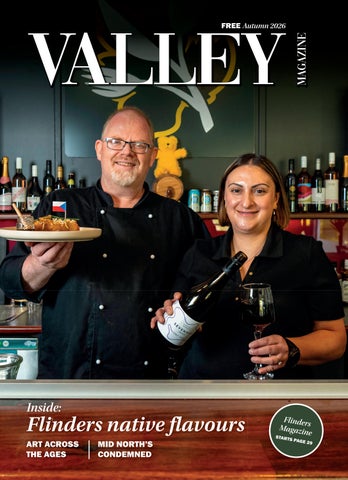
Valley Magazine Autumn 2026 Volume 6, Edition 1
Project Manager Renee Bennett
Editor Jarrad Delaney
Contributors
Jarrad Delaney
Kalli Batzavalis
Harry Mead
Gabrielle Hall
David Sly
Jennifer Johnston
Photographers
John Kruger
Lisa Schulz
Jarrad Delaney
Design
Illyse Mendoza
Lisa Schulz
James Manuel
Sanya Anand
Aaron Walker
Cassie Mower
Advertising
Leanne Mashford
Chloe Oakley
Maddison Weil
Bronwyn Helgeson
08 8842 1427
08 8862 1977
sales@plainsproducer.com.au
Published by SA Today Pty Ltd
274 Main North Road, Clare SA 5453
Phone: 08 8842 1427
Our regions provide plenty to delight our senses. The sights and sounds bring people here, and the smells and tastes keep people coming back.
As can be seen in this edition, the Clare Valley and even the Flinders Ranges offer a lot to whet appetites, building a reputation for some great cuisine and proving you do not have to live in Adelaide to enjoy high quality dishes.

This edition we shine a spotlight on venues including Antidote Kitchen in Clare, with co-owners Sunny Mehrok and Rupesh Agrawal showcasing a fusion of styles such as Middle Eastern, Indian and western classics which reflect their origins and provide a combination of flavours.
We also feature in this edition UPPside European Restaurant and Wine Bar, with the Uppills utilising local producers, as well as homegrown produce, to take customers on a culinary journey across Europe, right in the middle of the Clare Valley.
Bridging the regional divide between the Clare Valley and Flinders regions is Flinders Food Co., which has now set up on the main street of Clare and bringing a taste of the Flinders Ranges to the valley.
Not to be left out, the Flinders Ranges also offers some culinary destinations. Aussies love a good bakery, and Heather Champion has turned her passion for cooking into operating the Stone Hut Bakery, which has been a hit for travellers.
As you can see, there is plenty to sink your teeth into when coming to a region like the Clare Valley, or the Flinders Ranges. And you can always pair your meal with one of the ‘Hot Drops’ we had displayed in this latest edition.
There is a lot more to discover that we could never fully cover in the pages of one edition alone, and usually it is up to people to go discover for themselves the delicious delights that are out there.
So why not take this latest edition with you to your next lunch date and enjoy a good read, along with a good feed?
Happy travels, and bon appétit.

Jarrad Delaney Editor


HARRY MEAD


Recently stepping into the role of chief executive officer of the Mid North and Yorke Tourism Zone, Mim continues to uncover the hidden gems of the Valley and beyond, highlighting them to the wider public in a role she is relishing.
Mim has become a synonymous advocate for tourism in the region through various roles, but now more than ever she is a familiar face in the Valley and beyond.
Two Wells area, the International Bird Sanctuary is along there and although there were not a lot of birds on that day, you’re looking forward to the moment where they might come through, which is amazing. There’s plenty to find in the region.

The people. There are amazing people who work in tourism, and they’re really passionate about their product, their visitors and passionate about sharing that with other people. For me it’s always been the people.
I think the beauty of the Clare valley is its location. Within a small area, you’ve got all these mainly small to medium sized wineries, all dotted along the Valley. The real gift is that at these wineries you’ll meet the winemaker, or the winemaker’s family, so they’re very personal. Then we’ve got all these beautiful little villages, each area has its own identity, and each town now has a really good food and drink offering as well. And then of course the diversity of landscape as well, which is just beautiful.
The house drew us but it was the area as well. I remember when we were driving up here and we thought maybe it would be too flat. I like to have a hill, but as we were driving along you can see the hills coming and think yeah, that’s okay. I love it.
do love the ocean. But I find as I’m getting older, I’m sort of becoming a winter girl. I just love that feeling of the open fires and bundling yourself up and that sort of thing. I must say I have never been colder than I have been in Spalding!
The trail network in the Southern Flingers is amazing, you’ve got the Mount Remarkable trail, Alligator Gorge, Hidden Gorge. One of my favorites up there is the Bundaleer Forest Maple Walk, it’s only around 3km but it’s got beautiful trees. The Beetaloo Reservoir is another one, which you wouldn’t think this great expanse of water is there so close to Port Pirie. Out east, the Dares Hill circuit is an amazing drive. The coastline near the


My husband, Bruce and I used to own the William Creek Hotel. We were away somewhere and were going back up to the hotel, when we were at my sister’s house, and she had the paper open on the real estate. There was this Andrews house on the market, so we came and had a look, put an offer in and bought it.
Wine, a good book, and a hat because I burn easily.
I’ve always been a summer girl, I love the coast and used to spend my childhood going down to the Fleurieu so I

I wish I was one of those people who could say they get up and do lots of exercise! It’s very calm for me though, I’ll get up and have a cup of tea, chat with Bruce when he’s not on the Coober Pedy mail run, and then get our 15-year-old dog ready for the day. Then it’s just about working out what I’ve got on for the day, so often it’ll be that I need to get in the car and drive two and a half hours somewhere.

Couldn’t be Kate Winslet, she speaks a lot better than I do. Probably Toni Collette from Muriel’s Wedding.
Just checking out another place you haven’t been to before. I really enjoy going for drives and visiting friends, I love just catching up with people.
I’ve caught up with Jordan Martin, who took over from me in a previous role at Skillogalee a few times, at the Barrel Hall which was lovely. But then Dougal and Louise, who’ve just moved into the Clare Main Street at Flinders Food Co. is another favourite at the moment. Funnily enough, I’m most definitely not a chef, but I have ended up working in kitchens at hotels. Dougal and I worked together at the Prairie Hotel at Parachilna so that’s been like going to catch up with your old friends.
I’ve got a Ruddenklau Lone Kiwi cabernet sauvignon, there would be some Matriarch and Rogue. Nick Ryan sometimes has so much wine at his house, he’ll give you a party pack to take home, a little surprise box, so there’s a couple of those in there as well.
I recently saw David Byrne from Talking Heads a few weeks ago, that was brilliant. I like most music really, David Gray, Leonard Cohen, Patti Smith, even Taylor Swift and Pink.
‘Slow Horses’ , the series on Apple TV, I think is fantastic. My siblings and I are in a book club and our recent read was ‘Wild, Dark Shore’ by Charlotte McConaghy, which was interesting and fast moving.
Well, not a chef. Not that I’m very good at doing things like arranging flowers, but there’s Rachel at Main St Blooms. I’m always fascinated about how people can put a bouquet together, that’s something I’d like to learn.


Hop, skip, jump – cycle, walk, run, play – our region is family friendly for all ages with so much to do you’ll need more than a day.
Local playgrounds in the Clare and Gilbert Valleys attract youngsters who are keen to explore exciting play experiences. For those looking for climbing and problem-solving adventures – call in to the Sevenhill Playspace at Richardson Park.
This community-owned and operated playspace has plenty to enjoy with new equipment added late last year thanks to a Federal Government grant supported by the Clare & Gilbert Valleys Council. The equipment focuses on sensory items as well as developing basic skills such as balancing and stepping.
Other great playgrounds are dotted through the district in Auburn’s Centenary Park, Riverton’s Recreation Ground and throughout the township of Clare. There are also many smaller playgrounds located throughout our smaller communities for children to enjoy.
There are many great picnicking spots – wander along to the Gleeson Wetlands in Clare, another successful community collaboration between the Lions Club of Clare District and the Council.
Enjoy the beautifully maintained setting of native plantings and birdlife. Explore the bird hide and Japanese Torii friendship gate. There is a map at the
entrance to the Wetlands showing the pathway through Melrose Park which links to the Riesling Trail.
Melrose Park is home to the Clare Valley Model Engineers. Their model railway complex is adjacent to Inchiquin Lake and the newly redeveloped Clare BMX Park.
The Lakeside Railway is run by enthusiastic volunteers who have built, maintain, and run more than 1km of miniature railway track, offering rides on alternate weekends and public holidays.
For cycling enthusiasts there are great riding opportunities along the Riesling and Rattler Trails which span the district from south to north and have additional trail loops to enjoy, as riders meander through impressive scenery ranging from vineyards to rural vistas.
The trails link with the 900km Mawson Cycling Trail, the 300km Lavender Cycling Trail which runs from Murray Bridge to Clare and the 20km Clare Valley Wine and Wilderness Trail, with interesting rest stops along the way and detours to cafes, restaurants, bakeries and wineries.
For a different sort of bike experience drop in to the Tarlee BMX and Pump track – another collaborative community youth project which saw an existing facility upgraded through the help of Australian government funding. The track, with its polymer surface, includes a small internal track for very young riders,
making it suitable for all age groups, including adults.
Green town ovals, many with adjacent playspaces, make great spots for picnics or a break while enjoying the region, while our series of Clare Valley Short Walks offer more healthy outdoor activities.
A family friendly region, we look forward to welcoming you. t


From pickled quandongs to lemon myrtle, chef Doogal Hannagan and his wife Louise are showing native ingredients are far more than foodthey are stories, memories, and a reason to stay longer in the Clare Valley.
A sharp crackle bursts out of a hot pan, chased by a curl of smoke as a kangaroo fillet sears, and chef Doogal Hannagan is in command, intent on showcasing this premium cut of meat.
On the bench nearby sits pickled quandong, native succulents and pepperberry, each with their own story stretching far beyond the kitchen where the flavours of the Australian Outback have their own centre stage.
At the front of house, Doogal’s wife, Louise, is greeting customers with an experienced flair, her staff ably following suit.
It is the steady pace of the evening trade in Clare’s newest restaurant, Flinders Food Co.
Opened in mid-January in the former Seed Clare Valley building, the restaurant is bringing a distinctly native lens to the town’s already strong food, wine and tourism offering.


For owners Doogal and Louise, it is about honouring what grows on the land, with many of their ingredients harvested around their childhood home in the Flinders Ranges, and their aim is to make the ingredients familiar, “approachable” and worth celebrating.
The Clare restaurant is a second Flinders Food Co venue for the couple, and they bring with it a philosophy of showcasing regional produce, leading with kindness, and creating an experience that makes people want to “linger longer”
Flinders Food Co began in Hawker in the Flinders Ranges in 2018.
Having travelled and worked in Scotland – Doogal as a chef, and the nurse-trained Louise working as a whiskey ambassador for the Scotch Malt Whiskey Society – the pull of the Flinders Ranges was almost irresistible on their return.
“Doogal grew up in Hawker, and I grew up in Leigh Creek,” Louise said.
“When we came back from overseas, we were driving and saw the ranges, and we both got this overwhelming feeling it was time to come home.”
They bought a long-standing café in the tourist town and re-named and re-badged it, before doing a full building renovation in 2020.
Doogal and Louise had fallen in love with the food and coffee culture on their visits to Europe while working in Scotland, and decided to emulate some of it in their own restaurant.
“We especially fell in love with the places that were proud to showcase what grew there,” Louise said.
“That was the philosophy we wanted to bring back.
“The ethos of Flinders Food Co is to support local business, to have a sustainable business, but also show what grows on our land.
“I think we do this really well through our menu creation, showcasing native food, and we hand harvest a lot of our own natives as well.”
Louise and Doogal have recently bought a quandong orchard in the Flinders Ranges, but they also harvest ingredients from friend’s properties and wild harvest with permission from the land owners.
Almost all other ingredients are sourced from within SA. While Doogal began his cheffing career as an apprentice at Wilpena Pound before moving to Adelaide and beyond, his early years shaped his appreciation for native produce.
“I grew up with indigenous Australian ingredients,” Doogal said.
“We grew quandongs since we were kids, and we used to hunt kangaroos and cook them in ashes and inside and outside the house.
“When I first started as a chef, wattle seed was really the only native ingredient that people were using, but I really love showcasing a range of ingredients on my menu.
“I love to explain them to people and pass on my knowledge, and maybe they’ll start cooking with these ingredients at home.”
Some of Doogal’s signature Flinders Food Co dishes include the Flinders Food Co burger – a staple that caused a backlash when it was once temporarily removed from the menu – as well as the kangaroo fillet with ice plant, housepickled quandong and pepperberry.
“It showcases all these amazing things that we forage for, as well as locally-


sourced, really high-quality red kangaroo that makes it a super special dish,” Louise said.
There are pizzas and saltbush lamb tacos, and pork belly, native inspired breakfasts and of course quandong desserts, enticing diners through their doors.
Louise and Doogal have two young children, Herbie, 4, and Fern, 1, and have relocated to Clare while still overseeing the Hawker flagship restaurant and their well-established Flinders Ranges team.
With the Hawker Flinders Food Co closed for three months over the quieter (and much hotter) summer period (now re-opened for the 2026 season), it gave them a chance to establish the new Clare location.
While their plate might seem full, the
couple have not ruled out more restaurant locations in the future, and already have plans to launch a new consultancy business, Hospo, in the new financial year.
The aim is to share their success story with others keen to create something similar to the Flinders Food Co experience.
“It’s a hospitality consulting business where we will teach other business owners the tips and tricks of how to do this, and how to do it successfully,” Louise said.
“We have probably made every single mistake there is to make in hospitality business, and we have learned from that.
“We are self-taught in what we do and we’re living proof that you can actually create this if you’ve got the tools, skills


and know-how.
“We’ve got so much to share, we do believe we’ve found the perfect scenario and we are ready to share those secrets.”
For now though, Doogal and Louise are enjoying sharing their new Clare restaurant and say they are “humbled” by the welcome they have received into the Mid North, and for the special space they are now custodians of.
“We’re just so grateful to be in this space and be able to bring something more to Clare because there’s so many amazing places here already,” Louise said.
“It’s been great to be able to share more of Flinders Food Co, because we think it’s pretty special.


WORDS: Kalli Batzavalis
PHOTOS: John Kruger
Meet Phill Bartley, the 67-year-old artist who spent a decade restoring a ruined 1850s cottage, at the same time reversing the effects of Parkinson’s disease.
Diagnosed 17 years ago, Phill was told the condition would gradually take his independence.
For an artist whose life revolved around his hands, the loss of function in his dominant right hand could have marked the end of his life’s purpose.
Instead, it became the beginning of something else.
“I refused to let the disease beat me,” he said.
“Parkinson’s would’ve made a mess of me by now, I would have been bed ridden after 17 years of it but I’m just too busy, I haven’t got time for a disease.”
Phill taught himself to be left-handed and through determination, creativity, and his own research into neuroplasticity, gradually regained the use of his right hand, rebuilding his ability alongside the home he was restoring.
With an artist’s hands, Phill has resurrected one of Burra’s oldest cottages, imprinting its history and beauty through a magnificent display of stained glass windows, each breathing life into an architectural rebirth.
When Phill purchased the cottage in 2013, it was in pieces.
“It was a destitute ruin, it hadn’t been lived in for about 70 years,” he said.
“The roof was collapsing, there were no back walls, it was advertised as suitable for rocks for the garden, effectively.”
For seven out of 10 years, Phill worked on the home part-time, travelling from Adelaide every weekend.
“I’d leave Thursday night after work, sleep here, wake up at 5am Friday and work until midnight,” he said.
Hidden in the town of Burra lies a story that refuses to fade, through a 10 year restoration project an artist has defied the odds, building a house resurrected through a living canvas of glass art.

“Then do the same all weekend before heading back Monday morning. For 10 years, I didn’t have a weekend.
“I had to spend nights doing the glasswork, because I still love doing my art, and if you’re an artist… it’s a drug”
The remaining three years became full-time as he committed himself entirely to bringing the cottage back to life.
Today, the home feels less like a restoration and more like a living piece of art.
A burrow-style, labyrinthine space with low ceilings, handmade Tudor-style


I refused to let the disease beat me
doors, and vibrant stained glass windows, the cottage glows with colour when sunlight pours through in the morning.
Inside, nature lives in glass.
A blue-tongue lizard sits in a window next to the kitchen, inspired by the real reptile living beneath the house.
Rainbow lorikeets burst with colour in the bathroom, and horses stand immortalised in the restored stables.
But Phill doesn’t create leadlight in the traditional way, he works with a painter’s approach.
Most leadlight artists work from strict patterns, cutting each piece before assembling the final design.
“Because I’m an artist I do it the way painters do things, I just do it as I build,” he said.
Phill begins with a sketch, paints a true to size watercolour to understand the colours, and then constructs the piece intuitively, assembling colour and shape as if building a canvas.
“None of this is usually done by glass artists,” he said.
One of his windows, titled You Can’t

the house apart again, every original part of the stretch is still in the house it’s just been clad and built over.”
The cottage originally had hessian ceilings, which Phill replaced with timber.
“Potato sacks basically,” he said.
The house was originally owned by the Voumard family, Swiss watchmakers who lived on the border of France.
“Robert Voumard was quite entrepreneurial, he built the stables because he was a driver for Henry Ayers, who owned a copper mine and was Premier of South Australia… back in the 1860s,” Phill said.
The House of Life also holds treasures of history uncovered during restoration.
Within its treasure chest lies a fully functioning stone toilet from around 1880, the original property title from 1940, a piece of pure copper coated in malachite, and a rare full-colour comic of The Flash from the 1930s, discovered buried beneath inches of dirt in a window frame.
“Artists, generally speaking, like to build things from the worst possible materials sometimes,” Phill said.
“But the fun of it is the observation… I can picture three dimensional views of everything, it’s just a big jigsaw puzzle and it’s good fun.
“It tests your brain - every corner you turn there’s another problem you’ve gotta solve, and they don’t have to be expensive solutions, they just have to be creative.”
The cottage has become a story of legend, with its inhabitants the characters.
Phill now lives in the restored property with his wife Angelina, son Miguel, and cherished family cat, Picatsso.
As the family dwells inside a living canvas, light filters through glass depictions of native animals and local history, casting colour across timber and stone.
No longer a ruin, but a home, what was once lost to time has been reborn into a new life, one of colour, creativity and resilience.
A living reminder that the same hands to rebuild the cottage, also rebuilt themselves.
See the Forest, contains an estimated 5000 individual pieces of glass.
Through windows which serve as a lens, Phill has created a visual fairytale to pair with the story of the cottage itself.
Images of the site’s history and nature come alive through a surreal explosion of colour and light.
Beyond its artistry, the home is also a carefully preserved time capsule.
Phill restored the structure around a single surviving wall and ensured every salvageable element remained part of the rebuild.
In a visual contrast, Phill has honoured the restoration of the cottage by showcasing photos of the original site on the finished walls of his home, with the former stables turned into a dwelling of their own.
“I had labourers do certain tasks, but virtually all of it I did myself,” he said.
“I’ve leveraged everything I know about the property… and if I pulled all of

Just 30 minutes from the heart of Clare, Burra offers an easy and rewarding escape into one of the region’s most historic towns. Entirely National Heritage-listed and now on Australia’s Tentative List for UNESCO World Heritage, this is a place where every street and stone building has a story to tell.
Begin at the Burra & Goyder Visitor Information Centre and collect the key to the town. The Burra Heritage Passport Tour unlocks 11 heritage sites, from the cool depths of the Unicorn Brewery Cellars to the vastness of the Monster Mine. Best of all, it’s entirely self-paced, with 48 hours to explore. It’s immersive, hands-on and engaging for all ages.
Along the way, step into the beautifully restored Burra Railway Station, where the entire family can dress up in old-world attire and slip easily into the stories of another time. At the Bon Accord Mine Museum, discover historic fire engines and working life from Burra’s mining

past, thoughtfully preserved and hugely fascinating.
Then settle into the rhythm of the main street, with its wide verandas and original shopfronts.
Coffee is taken seriously here. Choose from a handful of welcoming cafés, each with its own personality, and pair your brew with something warm from the

HIGHLIGHTS & FEATURES
UNLOCK THE SECRETS OF BURRA'S HERITAGE WITH THE UNIQUE PASSPORT KEY

Purchase the key from the Burra & Goyder Visitor Information Centre located in Market Square and set off on an adventure at your own pace and in your own time. The passport allows you access to eleven locked sites, including the Monster Mine area, Redruth Gaol, the underground Unicorn Brewery Cellars and the Dugouts.
town’s beloved bakery where the Cornish pasty remains a local rite of passage.
Burra’s collection of antique stores is alone reason enough to visit. Spend an hour or an afternoon wandering through rooms of vintage furniture, rare finds and beautiful curiosities. It’s the kind of browsing that turns into treasure hunting.
Layered through it all is a quiet sense
of creativity. The Burra Regional Art Gallery offers a contemporary counterpoint, while local boutiques such as Iris and Wool and Bullrush showcase thoughtfully designed fashion with regional character.
Burra is more than meets the eye. Take your time here, you’ll be glad you did.

Contact the Burra Visitor Information Centre for bookings and more info (08) 8892 2154

The Paxton Function Centre is a unique heritage building with contemporary and modern furnishings. The centre is perfect for all types of events from weddings to corporate conferences. With outdoor and indoor spaces available, it’s the perfect venue for your next event.

Need accommodations for your guests or wedding party? Choose from 32 stylishly appointed, selfcontained cottages at Paxton Cottages. Located just steps away from the Function Centre, everything you need for your event is conveniently in one location, ensuring a seamless experience from start to finish.


Explore Burra’s history on brand-new e-bikes, available for hire at the Burra Caravan
in


Chef Christian Uppill can only see an up-side to creative hospitality endeavours.
Words: David Sly
In the aftermath of COVID disruptions in 2020, having survived the pressure-cooker environment of keeping his own suburban Adelaide restaurant afloat, Christian decided to return to Clare, where he grew up, and built a new restaurant vision with his wife Caity that takes full advantage of local produce.


Having bought the former Mocandunda Wines Cellar Door at Penwortham, the Upphills opened UPPside European Restaurant & Wine Bar during 2023.
They saw this as an opportunity to pursue a more seasonable and sustainable type of restaurant dining experience, with a view to use local produce in the best way possible.
This includes supporting a long list of local food producers, listed on the UPPside side menu: Wunderbar FreePasture Lamb, Corumbeena Orchard, Greenslade Poultry, Rhodes eggs, Clare Valley Meats, and vegetables from Christian’s parents’ farm in Clare, a 16-hectare plot located near Armagh.
Now, Christian and Caity are also growing some produce in vegetable beds
that flank the restaurant car park.
“It’s clear signal of what our restaurant and menu is all about. From the moment they arrive, people can see what’s in season, and what they’ll receive on their plate. I also make a point of coming out to talk with customers at the end of a night, to fully inform them of what they’ve been eating and to reiterate the food philosophy we are pursuing.”
Their hands-on food production philosophy extends to a strong focus on sustainability and eco-friendly practices, including bio-dynamic soil management, raw and cooked food composting and worm farming, plus the use of solar energy and enviro-cycle systems to recycle grey water.
Feeding into ethical food philosophies has also seen Christian and Caity become


strong advocates of the international Slow Food movement, which began in Italy during 1986 with a charter to uphold traditional food production methods and cooking, and the appreciation of healthful, quality food.
The Uppills become Slow Food members in 2017 when they owned Il Toro pasta and espresso bar at Hampstead Gardens in Adelaide, and now UPPside European Restaurant has earned a Slow Food snail of approval, a symbol that verifies their restaurant’s adherence to Slow Food principles and practices.
The restaurant has also presented chef Christian with an opportunity to present a more diverse spread of European cuisines, covering Italian, Spanish, Czech, Portuguese, French,
Ukrainian and German inspiration, but also embracing his wife’s Polish heritage (which ironically mirrors the historical origins of many pioneer Clare residents from the 1850s). Notably, the most popular dish on the menu is the pierogi (Polish potato and cheese dumplings, served with sauerkraut).
“We must be getting it right, because we’ve had quite a few Polish people drive up from Adelaide, and they’ve come back several times,” Christian said.
“It’s now unusual for a restaurant to have a menu that explores the whole continent of Europe, but our customers are loving the variety.”


The name of Antidote Kitchen reflects coowner Sunny Mehrok’s desire to provide something valuable for customers.


“If they are hungry, if they are thirsty, then we have the antidote. If they want to enjoy hospitality, we provide the antidote. We have what will make them feel better.”
To uphold such a philosophy, the Antidote Kitchen menu is deliberately diverse – a fusion of cultural styles, from Middle Eastern, to Australian favourites and western classics, and an array of Indian dishes, reflecting the origins of chef and co-owner Rupesh Agrawal.
“We didn’t want to present only Indian food. It’s more exciting to offer a fusion of ideas and flavours, to give customers more than what they are expecting,” Rupesh said.
Sunny and Rupesh both came to Clare from Melbourne more than a decade ago, looking to escape the escalating busyness of living a big city. As Rupesh explained, he wanted to his wife and children to “taste the good life”
They initially both worked at the popular Indi of Clare Restaurant for many years, but after Sunny left in in 2020 and Rupesh left in 2023, they decided to work together in a different type of hospitality venture.
They started Antidote as a popup kitchen, catering for functions and events at wineries. It proved popular, but limiting and difficult for them both to maintain a reliable wage. They decided to take the leap and open a restaurant, using a disused part of the Chaff Mill complex in Main North Road at Clare.
“It was space that we were already using as a preparation kitchen for our event catering, and we decided to

transform the remaining space into a permanent restaurant,” Sunny explained.
They developed the restaurant around a concept of building a community-based facility, ahead of a purely commercial venture.
“The tourist trade is an obvious target, but we believe the roots of a restaurant must be strong in the local community, which is why we rely on providing what our local customers want,” Sunny said.
“It means keeping prices modest, so that locals can afford to dine with us a few times a week, if they please. The food is generous, kids are welcome, there’s no dress code – and we support local community groups.”
Keeping the locals happy includes a diverse wine list that features mostly Clare wineries but embraces varieties and styles that reach beyond the obvious.
“The wines we choose are contemporary, and continually changing. I have learned so much about wine from being in Clare, and that translates to giving our customers exciting choices,” Sunny said.
The Antidote partners will soon be expanding their business, taking over the former technology shop within the large Chaff Mill building, to create a space focused on their own Antidote Wines (a project Sunny conceived in 2012 but finally resulted in wine produced from the 2024 vintage), along with Antidote gin (to complement a large range of gins stocked in the Antidote Kitchen bar) and Antidote beer. They will also stock unusual new-era drinks, including coffee


in a can and matcha in a can.
As for the star attractions on the Antidote Kitchen menu, Rupesh points to the goat curry, a recipe of his mother’s that combines both northern and western Indian spices and flavour marriages in a unique way.
However, the dish Rupesh goes to most often is his breakfast favourite – smashed avocado. “I can’t go past it. It’s irresistible.”
■ Antidote Restaurant is at 308b Main North Road, Clare – 0494 146 666. It is open for breakfast and lunch daily, and for evening meals on Sundays and Mondays.


a stay in
Spend a night or two at one of the great caravan parks in our council region.


Alchemy, for thousands of years, has been a practice attempted by many to transform ordinary metals into gold and uncover hidden laws of nature.


The pursuit of transforming the ordinary into extraordinary, no easy feat for even the most expert craftsmen who across centuries have worked and welded metal in an attempt to merge fire with vision.
But 13 year old Axel Klem has done just that. With a craftsman’s hands and an artist’s mind, Axel has spent the last four years growing alongside his skill - welding metal into art sculptures.
Alchemy in its own right, Axel takes whatever recycled metal and materials he can find, to forge the ideas that come to him into physical form.
Amongst his collection of molten art are over one hundred small sculptures of animals and characters, which with the practice of his craft have turned into life size masterpieces.
More notable sculptures within the collection are native inspired animals, the cockatoo and kangaroo which Axel has titled the Scrapatoo and Scraparoo.
Born and bred in Burra Axel now looks up to two figures; his father who taught him how to weld, and the 6 ’2 Cornish Miner he has now sculptured for the Burra Mine Site, his biggest creation yet.
“My dad taught me how to weld when I was younger and I just started making little animals and just kept making better and bigger things,” he said.
“Since I was nine… I think of the idea in my head, then I draw it out, and then I just start bit-sing pieces together and then weld it.
“Usually most of my big sculptures go to competitions and they sell or if they don’t sell I try to sell them somewhere else and if they don’t, mum keeps them.”
Axel’s latest competition entry, Snowflake the dolphin, travelled from the regions to the coast to sit by the sea for the Brighton Jetty sculpture competition.
A personal win, not through proclamation but by public interest, Axel’s Snowflake the dolphin was sold to an admirer of his work.
“I felt really excited that it sold,


because I didn’t win so I was just hoping that it would sell,” he said.
Each piece varies in time to make, from the minute the idea is born in Axel’s mind to the hours he spends building it into creation, Axel dedicates his free time to the forgery.
“It depends on size and shapes, if it’s a hard shape it’ll take longer,” he said.
“I do it after school and on the weekends but I get most of it done in the holidays… it’s mostly animals, whatever comes to mind really.
Axel described a piece the size of an A4 sheet of paper would take three to five hours to complete, with bigger pieces like Snowflake the dolphin taking about 20 hours.
But Axel donates more than just his time to the craft, he has made pieces to auction for charity organisations, with one small sculpture raising $600 for the Royal Flying Doctors Service.
And if Axel’s friends asked super nicely… he would probably give them one of his small creations too.
“My friends think it’s pretty cool that I do it,” he said.
“I’ll try to make a living out of it… I just like welding, I just like making stuff.”
Turning skill into business, vision into creation, and generosity into impact, Axel succeeds at an ancient practice many craftsmen failed: alchemising metal into the soul’s gold - art.


GOURMET BUS TRAIL
$97 + booking fee
Visiting Mitchell, Sevenhill & Eldredge wineries
GOURMET BUS TRAIL
$97
+ booking fee
Visiting Knappstein, Paulett & Sevenhill wineries
$10 + booking fee
Gets you to and from the Clare Valley Visitor Centre


GOURMET BUS TRAIL
$97 + booking fee
Visiting Clare Valley Distillery, Knappstein & Greg Cooley Wines
TASTING AUSTRALIA EXPERIENCE
$147
+ booking fee
Visiting Taylors, Claymore & Kilikanoon wineries
$57
+ booking fee
Adelaide Bus Transfer Perfect for Day-Trippers!
$67 + booking fee
One ticket - three loops - Covering 14 different venues!
LOOP WESTERN LOOPEASTERN LOOP
Interchange - Clare Valley Food, Wine Tourism Centre
Clare Valley Distillery Watervale Hotel Taylors
Wines by KT
Kilikanoon Eldredge
Mitchell
Jim Barry Knappstein
Mr Micks Sevenhill Paulett Pikes Greg Cooley

CLARE VALLEY DISTILLERY
23 May - 24 May A Gin and Wine Experience - Live music & gourmet fare (10am - 5pm)
CLARE VALLEY WINE FOOD & TOURISM
CENTRE
22 May Gateway to Gourmet - Tumbler collection, wine & food (4pm - 8pm)
18 May Twilight Tasting - Wines by KT, Matriarch & Rogue and Pinto (5.30pm - 8pm) Ticket: $80 per person
CLAYMORE WINES
22 May OTT Friday Arvo Session - Oysters, Terrines, Tasty Dogs & Live Music (4pm - 7pm) Ticket: $12 per person
23 May - 24 May French “Pique Nique” (Picnic) - French themed picnic & Live Music (11am - 5pm) Group booking recommended
ELDREDGE WINES
23 May 30 years of Gourmet! - 90s music, original recipes & museum wines (12pm - 6pm) Bus bookings preferred.
24 May Gourmet Family Funday - Nature play, face painting & petting zoo (10:30am - 5pm)
GREG COOLEY WINES
22 May KickAss Cowgirls Gourmet Festival Opening Night - Cocktails, live music & tacos (6:30pm - 10:30pm) Tickets: $40 per person
23 May - 24 May GCW + Vivu Vietnamese Kitchen - Vietnamese food, tacos & live music (10am - 5pm)
Bus bookings recommended
23 May Dumplings and Daiquiris with Dejavu - Dumplings, cocktails & 4-piece party band (6:30pm - 10:30pm) Bookings Essential. Tickets: $40 per person
GROSSET WINES
23 May Museum Cellar Experience - Intimate tasting hosted by Jeffrey Grosset (10am, 11:30am & 2pm) Bookings Essential. Ticket: $30 per person
22 May - 24 May Tasting ExperienceCurrent and back vintage wines (10am - 5pm) Ticket: $20 per person
JEANNERET WINES
22 May Jeanneret Road Gourmet Festival Launch Day - Wine, gin, beer & pizza (10am - 9pm)
23 May The Ultimate Gourmet Festival Experience - Live music, cocktails, beer & pizza (10am - 9pm)
24 May A Relaxed Gourmet Festival Finale
- Relaxed tasting, pizza, burgers & paella (10am - 5pm)
JIM BARRY WINES
22 May - 25 May Vertical Elegance: A Tasting Journey - Flagship wine vertical tasting (10am - 4pm) Tickets: $50 per person
KILIKANOON WINES
23 May - 24 May Fire & Wine Festival - Live fire stations, live music & artisan markets (10am - 5pm)
23 May Oracle Shiraz Vertical Tasting - Rare vertical tasting with Travis Fuller (11am - 2pm) Limited spaces, bookings essential.
23 May Flavour of Fire Degustation - Firedriven fine dining menu (6:30pm to late)
KNAPPSTEIN WINES
22 May Vino Vibe Fest - Live music by Sax Man Troy Stevens, party food (5pm - 9pm)
Group bookings recommended.
23 May - 24 May Bubbles & Burgers
Breakfast - Gourmet burgers & sparkling wine (9am - 11am)
Group bookings recommended.
23 May - 24 May Beats & Bites - Tapas, dumplings, oysters & live music (11am4pm Sa, 11am - 3pm Su)
Group bookings recommended.
23 May Twilight Session - Relaxed tunes by Sax Man Troy Stevens & grazing bites (5pm - 8pm) Group bookings recommended.
MATRIARCH AND ROGUE
23 May One day Fiesta - Winemaker Marnie Roberts, live music and Mexican eats (11am - 6pm)
MITCHELL WINES
23 May Feast over Fire: Mitchell Wines x The Filipino Project - Filipino street food & live soulful tunes (10am - 5pm)
MOUNT HORROCKS WINES
23 May - 24 May Meet the Maker TastingCabernet Sauvignon Vertical Tasting with Stephanie Toole (10am - 5pm) Tickets: $15 per person
NAKED RUN & RIESLINGFREAK
22 May Naked Run and Rieslingfreak at the Sevenhill Hotel - Four-course dinner paired with wine (6pm - 10pm)
Ticket: $140 per person
O’LEARY WALKER WINES
23 May Savour the Season - An Autumn
Long Lunch - Autumn long table lunch & live music (11:30am - 5pm)
Ticket: $125 ($115 for members) per person

PAULETT WINES
23 May - 24 May Clare Valley Gourmet Breakfast - Savoury or sweet breakfast overlooking Polish Hill River (9am - 4pm) Until sold out.
23 May - 24 May Clare Valley Gourmet Festival - Native-inspired street food, music & golf (9am - 4pm) No bookings needed.
23 May - 24 May Pauletts Degustation Experience - Six-course dining experience with native-inspired dishes and live music (11am - 4pm) Tickets: from $135 per person
PIKES WINES & SLATE RESTAURANT
22 May - Pikes Against The World!Wine dinner with Pikes vs international counterparts and modern European dishes (6:30pm - 10:30pm) Tickets: $160 per person
24 May Pikes x Olive Long LunchMediterranean flavours by Callum Hann and Pikes Wines (12pm - 4pm)
Tickets: $180 per person
PIKES WINES & PIKES BEER CO.
23 May - 24 May Gourmet Garden Party at Pikes! - Wines, craft beer, seafood and live music (11am - 5pm)
REILLYS WINES
22 May - 25 May Reillys Gourmet Tasting Platter - Light gourmet lunch platter with a glass of wine (11am - 4pm)
Taking bookings for Monday only. Walk-ins Fri-Sun. Tickets: $30 per person.
23 May - 24 May Reillys Gourmet Shiraz Long Lunch - 5 gourmet courses paired with premium Shiraz (12pm - 4pm) Tickets: $150 per person
SEVENHILL CELLARS
23 May - 24 May Spiced Notes of the Vines - Fusion eats, estate wines and live acoustic melodies (10am - 5pm)
Bookings essential for groups over 15 people.
SHUT THE GATE WINES
23 May - 24 May TING TING - Modern Asian culinary sensation, museum wines and live tunes (10am - 4:30pm)
Bookings recommended for larger groups.
SKILLOGALEE ESTATE
22 May - 24 May Experience Skillogalee Estate - Private guided tour, hosted tasting and chef-curated lunch (10:30am - 3pm)
Tickets: $280 per person
TAYLORS WINES
23 May - 24 May Taylors Wines Gourmet Festival Home of Award Winning Wines -

Live tunes, cocktails and local food favorites (10am - 5pm)
Group bookings are recommended.
THREE LITTLE BIRDS DISTILLERY
22 May A Bloody Feast @ Jeanneret Rd - Fire cooked, long-table dinner with slowroasted spit meats (5pm - 9pm)
Tickets: $150 per person. Booking essential. 23 May Speakeasy Gin Bar Experience @ Jeanneret Rd - Hidden speakeasy with handcrafted cocktails and curated nibbles (6pm - 11:30pm)
Tickets: $50 per person. Book early.
ULSTER PARK WINES
22 May Meet the Vignerons - Chat with the owners and enjoy wine tastings and specials (12pm - 4pm)
22 May Gourmet Festival Opening NightWood-fired pizzas, premium wines and live music (4pm - 9pm)
23 May Gourmet Fusion – Wine, Food and Live Music! - Frosé, wood-fired pizzas and Indian influenced side dishes (12pm - 9pm)
24 May Serene Sunday - Live music by Annie Wheare, pizzas and Ulster Park Premium wines (12pm - 5pm)
VELVET & WILLOW
23 May - 24 May Auburn Bliss - Breakfast, artisan coffee, local musicians and wine (8am - 5pm)
WATERVALE HOTEL
22 May Cellars without Doors Degustation Dinner - Five-course dinner by Nicola Palmer matched with boutique wines (6pm - 10pm) Tickets: $160 per person including wine match. 23 May Fiesta del Fuego - Feed Me dinner using flames and smoke with Asado BBQ and Latin music (6pm - 9pm) Tickets: $85 per person (food only).
24 May - 25 May Penobscot Farm Tour and Degustation Dinner - Educational farm tour followed by degustation at the Chef’s Table (4pm - 9pm) Tickets: $250 per person (food), $350 including wine match.
WINES BY KT
22 May - 24 May KT Cellardoor celebrates 10 years - Tasting curated selection of Single Vineyard wines (11am - 5pm) Usual tasting fees apply.


WORDS AND PHOTOS: Jarrad Delaney


Historical photos courtesy of Department of Environment and Water
A look back at the people and events of our region is not pleasant. Sometimes we are drawn into the darker elements of our history, and it does not get any darker than when death is involved, especially when it was unnatural.
The Adelaide Gaol operated from 1841 until 1988, and throughout its 147 years of operation it had seen about 300,000 prisoners housed within its walls, with people from across the state imprisoned for a number of different crimes. Some would never leave.
A total of 45 people were hanged either either inside the walls of, or out front of the gaol. Of these, four were men executed for murders committed in the Mid North.
On 5 September, 1850, James Yates was hanged in front of the gaol for the murder of shepherd John Mansforth at Skillagolee Creek on 24 July, 1850.
Forty five years later, George Horace Lynch was hanged at the gaol on 6
November, 1895 for the murder of Donald McPhee Ross in Balaklava on 26 August, 1895.
On 24 April, 1919, Percival William Budd was hanged for the murder of Harold Jacques at Crystal Brook.
Finally, Alexander Newland Lee was hanged on 15 July, 1920 for the murder of his wife and children via poisoning at Rhynie in April of that year.
The only woman ever executed at the gaol, Elizabeth Woolcock, was born in Burra in 1848 and was executed on 30 December, 1873 for the murder of her husband Thomas Woolcock at North Yelta, near Moonta.
All these, and others never left the Adelaide Gaol, they were interred on the gaol grounds where they remain to this day.
One person who knows these stories well is Madeline Zweck, an Education Officer at the gaol who hails from the Mid


From 1838 until 1964, 66 people were executed in South Australia via hanging, 45 of those took place at the Adelaide Gaol. The days of capital punishment, and of the Adelaide Gaol are long gone, but the stories of those who lived, and died there remain, as well as the crimes some were put to death for.


North herself.
While any element of history involving death can be uncomfortable for some, it can be fascinating for others. Something Miss Zweck certainly shares, especially with the aforementioned cases.
Previously studying archaeology, Miss Zweck said it was fascinating to learn of these stories, with connections to places she was familiar with.
“I think it keeps me interested, reading about places I know, some of this is quite sad and confronting, but I’m interested in people and human behaviour,” she said.
“People like gaols, they like death for some reason, especially when it’s not directly connected with them, you don’t have that trauma.
Once a prisoner had received a death sentence, they would be placed in a condemned cell, separate from other inmates and under constant guard.
Early executions were open to view for the public, including that of James Yates in 1850 which took place in front of the gaol. This continued until a Parliament Act passed in 1861 abolished public


hangings.
From 1861 a portable gallows was erected, which executed 14 people in the north west laneway inside the gaol. It was on these gallows Elizabeth Woolcock met her fate in 1873.
A more permanent gallows was set up on the upper level of A wing in the ‘New Building’ in 1888. It was here that George Lynch (1895), Percival Budd (1919) and Alexander Lee (1920) were executed.
These gallows were disassembled in 1954 when the “hanging tower” came into use on the gaol grounds, where the last four executions in South Australia took place. The last execution was of Glen Valance in 1964, with capitol punishment abolished in 1976.
The location of the condemned cell had changed over time, it has included the last cell in the eastern cellblock in Number Five yard, in the original 1841 cellblock and within the New Building, eight paces from the trapdoor on the upper level of A wing.

Complete your ultimate Clare Valley experience by staying in beautiful, quality accommodation with stunning views.
1, 2 or 3 Bedroom Villas compromise of:
• Ensuites: Includes a large bath
• Accessible bathroom available
• Free wifi
• Foxtel
• Air-conditioning and gas log fire
• Wheelchair access available
On the morning of an execution, the condemned was offered breakfast and preparations were made while official witnesses assembled. The prisoner was escorted from their cell, arms secured as they stand on the trapdoor.
After a moment for any final prayers or statements, their ankles are secured and a white hood was put over their head and the noose was placed around their neck.
After the hangman pulled the lever, the prisoner was no more. The body was left for an hour before being taken down.
Those executed on the grounds of the gaol still remain there, as the law required burial to take place within the precinct of the institution where the execution took place.
There is much about this history on display in the Adelaide Gaol today. People can view displays, including those about capitol punishment.
Miss Zweck said it was great to take people through the gaol grounds to inform on its history, with people often taking a great fascination in all on display.
“What I love about the gaol is teaching kids about history, I get a lot of schools coming through and I love teaching them about the past,” she said.
“You might look at a picture, read about it, but when you come to a site you see it first hand and it sinks in a bit more.”
Some elements of our history is unpleasant, and it does not get much more unpleasant than a gaol as it housed some of the worst society had to offer. Some stories are horrific, some are tragic, some are inspirational, some are full of woe.
However, this is part of our history and sometimes it is worth looking back at where we come from to get an appreciation of where we are and where we are going. This is also a feeling Miss Zweck shares.
“You can’t learn from the past if you don’t know about it, knowledge is power,” she said.
“You don’t know what people have gone through unless you learn about it.”
People can find out more about these and other stories by visiting the Adelaide Gaol, located at 18 Gaol Road in Adelaide.
THE CONDEMNED
-Based on information compiled by Jeff Fausch
■James Yates (executed 5 September, 1850)
James Yates was arrested for the murder of shepherd John ‘Old Sergeant’ Mansforth at Skillogalee Creek on 24 July, 1850. Mansforth died via repeated blows to the head. While Yates had originally


professed his innocence during the court trial, he later changed his story stating he acted in self defence as Mansforth had been drunk and came at him first. Yates was found guilty of wilful murder and sentenced to death. Yates would write a poem to his lawyer, G.M. Stephens, for his efforts to save him from the gallows. He was executed in front of the Adelaide Gaol on 5 September on a stormy weather day in front of a crowd of more than 600 people.
■Elizabeth Woolcock (executed 30 December, 1873)
- Information courtesy of Adelaide Gaol website
Elizabeth Woolcock, the only woman executed in South Australia, was born in Burra and after surviving a traumatic childhood, married miner Thomas Woolcock when she was 20. Mr Woolcock was seen as violent alcoholic, and Elizabeth had tried to leave several times. When news broke of her husband’s death, rumours of foul play emerged, despite three different doctors administering different medication, including arsenic in the weeks before his death. Medical evidence was presented at trial to show how Elizabeth could have poisoned her husband over a period of time and testimonies were given of Elizabeth’s reputation for unruly behaviour and her unfortunate marriage. The circumstances of the trial are seen as controversial as an inarticulate Elizabeth had little chance of success. The jury found her guilty in less than half an hour and despite a recommendation of mercy, she was
sentenced to death. At 25, Elizabeth was executed and buried inside the prison walls.
■George Horace Lynch (executed 6 November, 1895)
George Horace Lynch was a man of mystery, his name was an alias as he was a deserter from the British Royal Navy and birth details are also unknown. He became a sailor on merchant vessels and eventually made his way to Australia. Lynch would cross paths with Donald McPhee Ross in Victoria, a youth who was believed to be a runaway, and made him a companion as they travelled across the country working. They eventually came to Balaklava to do masonry of a house. Lynch had openly quarrelled with Ross and it was in Balaklava that he would shoot Ross dead with a revolver he had carried on 26 August, 1895. He was found guilty of murder at the end of a two-day trial and sentenced to death. He was executed in the New Building on 6 November.
■Percival William Budd (executed 24 April, 1919)
Harold Sydney Jacques, a chauffer from Adelaide, disappeared on 25 November, 1918 after departing Port Pirie for Crystal Brook where he was pick up a passenger who was going to Adelaide. The passenger never saw him. An investigation led to the arrest of William Percival Budd, a New Zealand man formerly living in New South Wales and living at Port Pirie at the time, where he worked as an iron worker at BHAS Works.

Reports from the time reveal a Talbot motor car was in his possession in a shed Budd had erected, where a pit had also been dug. A body would be exhumed from the site at Second Street and family would identify it as Jacques. It was believed Budd had murdered Jacques on the way to Crystal Brook to steal his vehicle. Budd would be found guilty of murder and sentenced to death. He would declare his innocence to the very end, and was executed in the New Building on 24 April, 1919.
■Alexander Newland Lee (executed 15 July, 1920)
Alexander Lee lived with his family at Rhynie. A shearer, Lee was forced to abandon his work after a shearing accident disabled his right hand. During his stay at the Willows Hospital at Nuriootpa, he became infatuated with a young woman working there and had a romantic relationship with, even asking if she would marry him if his wife happened to die. Within 24 hours his wife, and three of their children were dead. In the home, the bodies of Muriel Estella Lee and children Ray, Walter and Ina Lee were found in the family home. Lee declared he did not know it happened and mentioned they all had milk before going to bed. An investigation revealed Lee had tried to get a hold of strychnine while in the north of the state. Lee would be charged with their murders and after a sensational trial, he was found guilty and was sentenced to death. He was hanged inside the New Building.


WORDS: Gabrielle Hall
Ever since she was 15, Meg Rasheed dreamed of travelling Australia.

“I remember being at boarding school, sitting in my home ec class, and my teacher Jess Kuerschner from Orroroo, was telling me about a friend of hers who had driven dump trucks in the mines, worked on a cattle station and travelled Australia,” Meg said.


“And I was like, I’m going to do that.”
Fast forward more than a decade and Meg has achieved all of that and more, and now she and partner Izaac Boylan are living that dream together, and making a career from it.
The couple are heading into their third year of ‘full-time’ life on the road, with 80,000 kilometres under their belt, countless campfires, amazing adventures, and a growing creative content business funding the journey.
“This idea to travel just stuck with me, it’s what I wanted to do and I knew I wasn’t dying not having done it,” Meg said.
“It was a burning desire, something I thought about every day.”


It took her several years to convince Izaac to follow the dream, but the turning point came on a camping trip to Yorke Peninsula, sitting on the beach enjoying a beer.
“Eventually he said, yeah, I could do this full time,” Meg said.
Izaac was born and bred in Wudinna on Eyre Peninsula, and Meg in Roxby Downs with very close ties to the Flinders Ranges, the Rasheed name synonymous with Wilpena Pound where she spent many of her school holidays with family. Before van life, they had set themselves up in the Clare Valley, with Izaac working as an exercise physiologist and Meg, whose parents had moved to the Valley, was working a variety of jobs in hospitality, agriculture, administration and care service.
“I’m a versatility is the spice of life kind of girl,” she laughed.
They enjoyed being part of the community, playing footy and netball and getting involved where they could, but the pull to travel remained and they made the decision to give it a crack.
The pair saved some money and set off on their first big trip in February 2024, towing a 14-foot Jayco Crosstrak caravan. Victoria was the destination for a month-long trial before they headed west
with a loose plan to travel for 18 months.
“We burnt through the money we had saved quicker than we thought,” Meg said.
“We picked up work on a station in WA just to keep our travels going, but it wasn’t really the way we wanted to travel, it never would have really enabled us to travel or have the freedom that we wanted.
“And that’s when we started to see what opportunities there were in the social media world and decided to sink our teeth into that.”
They pair launched a creative content business, Come See With Us, sharing their travel experiences online.
“We started a freelancing content creation business that focusses on our travels,” Izaac said.
It has been quite the turnaround, particularly for Izaac.
“Izaac didn’t even used to like smiling for a photo, now he’s making YouTube videos,” Meg laughed.
The couple now create content for their own platforms and have about 25,000 followers across four social media channels, promoting camping products, experiences and equipment for other businesses.
“For a brand to create content for

social media, it’s a massive task, so we have also been able to provide an option for businesses to outsource that to us,” Izaac said.
“We really like to show the realities of travelling Australia, the truths behind it, whether it’s good, bad or hard to hear, and just be valuable to someone – hoping they learn something out of it rather than just being another piece of content out there.”
Meg and Izaac officially launched the business in April last year, and by November, it was fully-funding their travels.
In between, Izaac and Meg have worked at camping and four-wheel-drive shows around the country, flying out from wherever the van was parked to capital cities for the events.
“We’d set up, do the show, pack up and fly back to wherever the van was and keep travelling,” Izaac said.
That also paid dividends in other ways, the pair now partnered with Jayco to use their caravans on a 12-month rotation.
“I guess we’re test dummies for their caravans, and it’s great to show the lifestyle you can live in one of these vans,” Meg said.
“We have a 16-foot Jayco Crosstrak on
its way to us for our travels this year, and we’ll be also buying a new vehicle to tow it with, sadly saying goodbye to our Prado which we’ve just loved travelling in.”
Ask Meg and Izaac the best part of life on the road and the answer comes easily.
“The people you meet along the way,” Izaac said.
“And seeing the countryside, things you wouldn’t normally see.”
Meg is quick to add it is the lifestyle.
“The freedom of it, I love that,” she said.
But it is not all beer and skittles on the road.
“The worst? We miss the people at home, our friends and family, and sport – I really miss sport,” Meg said.
Sometimes it is also the dust, sand in the bed after beach camping, and the constant decision-making.
“Decision fatigue is a real thing,” Meg said.
“You have to make a lot of decisions, things you just don’t have to think about at home.”
But the benefits far outweigh any negatives for this couple. Highlights of their travels so far have included


the Northern Territory, and WA’s Gibb River Road.
And for Meg, flying over Lake Eyre as it filled with water has been a standout.
“That was insane, just amazing,” she said.
Meg and Izaac are great ambassadors for SA, and say they constantly encourage fellow travellers not to skip this state, and particularly the Flinders Ranges and Clare Valley.
“SA is one of the most underrated states to travel,” Izaac said.
“We always brag about the Flinders Ranges and Clare Valley,” Meg added.
The pair say they are definitely living the dream, but do have plans to one day buy a few hectares in the Clare Valley as a base. And with the groundwork they’ve done, they hope their creative business will continue to fund this new life they have created.
“It’s literally the life I dreamt of for so long - to get paid to travel Australia,” Meg said.
“It makes me feel emotional talking about it, but we work hard for it and we continue to work hard to keep the dream alive.
“We still have commitments and deadlines like everyone else.
“People look at us and say we’re on holiday, but this is actually our life now.”
Cape York is next on the travel map for 2026, while the couple will continue their involvement in camping and travel exhibitions.
And for anyone on the sidelines thinking travelling Australia is something they would love to do too,
Meg and Izaac say you definitely can.
“Don’t feel like you have to have it all before you do it,” Meg said.
“You don’t have to have the biggest and best gear and don’t forget you can go half an hour from your house in Clare, or your house in Melrose, and find a beautiful creek to camp along.
“Just keep it simple and you can still enjoy being outdoors.”
Meg and Izaac’s top spots to visit in our region
Flinders Ranges
• Parachilna Gorge – camping amongst the huge river red gums.
• Prairie Hotel – great food, impressive backdrop.
• St Mary’s Peak – take in the view to fully appreciate the ruggedness of the Flinders Ranges.
• Broughton River, Spalding – quiet camping spots so close to home.
• Razorback Lookout – iconic Flinders scene.
Clare Valley
• Jeanneret Wines – beautiful location, wine and beer.
• Sevenhill Hotel – for a great feed.
• 1871 Café, Clare – for delicious coffee, breakfast and light meals.
• Spring Gully Conservation Park –spectacular views across to Yorke Peninsula.
• Riesling Trail – perfect place to take visitors for a bike ride and cellar door stops.


A family run business on the RM Williams Way (route B80) is the beating heart and the community centre of town.


You should like your own company if you are running a hotel in the small regional south Australian town of Cradock, with a population of 13. Because that number includes the six members of the Wallis family, Mum Amy and Dad Dave, and their four children (one adult son lives and works in Adelaide).
Dave and Amy are the current owners of the Cradock Hotel. An aerial view of the town shows a few buildings, the Cradock Hotel the only business in town.
Two churches are still standing, and the old police station, which was the school until the weatherboard building became too run down. Apart from the scattered buildings, there is plenty of open space.
Dave and Amy met while working pubs in Adelaide. Amy was duty manager and Dave was her security guard.
Two souls who met, kind of like Whitney Houston and Kevin Costner from the Bodyguard movie. Except Dave and Amy deviate from the Hollywood story by going on to marry and raise five children.
“We bought the pub ownership in 2021 during a sh*#s and giggles conversation,” explained Amy Wallis, one of the publicans.
“It was the pipe dream that we never thought would happen,” she said.
“We didn’t want to reach retirement age and wonder if we should have or probably shouldn’t have.”
Six weeks after the purchase, the borders closed because of Covid. They were probably thinking they shouldn’t have!
“During Covid we didn’t lose any
money, made just enough to keep the lights on and keep things turning over, which I’m extremely thankful for, given the amount of country pubs that have had to shut their doors in the last few years.”
The hotel was built in 1881 and has gone through a few transformations.
Previous owner, Richard Anderson (Dickie as he is known) with money from a grant, added a dining room and an outside playground giving the visitor’s kids somewhere safe to play, given the hotel’s proximity to the highway.
When the couple took over they installed a reverse osmosis system. The hotel draws on bore water and rain water.
The region has been in drought for the last eight years, so the bore water has been a lifeline for the hotel.
“Bore water does not taste the best without the purification process,” Amy explained.
”We’ve also added a veranda out the front with a bullnose roof, for people to sit outside in summer, rather than getting completely roasted during the day.”
One of the many challenges dealing with old buildings is the complexities that go with how it was built.
“The building is 145 years old, nothing is square, nothing seals but she is doing well for an old girl,” Amy said.
Cradock Hotel has become the place
to pull into for a meal and a chat.
It helps that the hotel is on the Main Street becoming an essential stopping point for tourists heading to the popular destination, Wilpena.
Six rooms are available at the hotel with 10 beds in total.
“We can accommodate 16,” explained Amy.
“We tell people we’re not five star, but we do three and a half stars, really, really well, and hope they have a five star experience.”
With mobile reception hard to find in the region, the Cradock Hotel, thanks to Starlink, has Wifi and a phone.
A camping area, a flat open dirt space, is behind the hotel. There is no water or power but they have installed an amenities block, with toilets and coin operated showers. Buying a beer is all they ask to access the camp site.
“We know as a large family how expensive it can be travelling around the country, so we are giving back to help families and couples on a budget,” she said.
“We have people passing by who haven’t had a shower for a week and they ask if they can have a shower and we say of course.”
Hawker is the closest town, 29kms away. Maccas is quite the journey, 150kms for a fast food fix.
Cradock Hotel offers basic pub fare, like schnitzels, steak, barramundi and whiting. Food deliveries are received once a week, with produce coming from
Port Pirie and Adelaide.
“We try and get as much local stuff as we can. I would rather have a smaller menu and do it very well than have a big menu and not do it so well.”
They serve icy cold Coopers beer on tap.
Amy is chief in the kitchen most days with one of her sons helping out when he can. Amy’s husband Dave has a job with the Country Fire Service and is often on the road during the week.
“My eldest son James and youngest son Joel are here. And we hire workers from the nearby town of Hawker,” she said.
Daughters Emily and Alice attend school in Hawker, the bus collects them in town. But when they are home they will help out in the hotel.
“Its a family business,” Amy explained.
Their kids will jump in and help, cleaning rooms, collecting plates and running meals and help stock fridges. “They’re learning some great life skills.”
If someone rings the hotel after hours to let them know they are coming through, they will keep the kitchen open.
“We do that for the truck drivers. Because we’re on the highway along the main route to Moomba, if they call us at Orroroo we know they’re around 45 minutes away. These people getting here safe is more important than me burning a little bit extra gas.”
Last year over the four day Easter break they served 900 meals at the Cradock.
“I don’t know where they came from and I don’t know where everyone sat, but somehow we served 308 chicken schnitzels in three days.


At 6pm you can receive 40 dockets because everyone orders at once. Our kitchen is not big, but once you explain that to the customers they are understanding.”
They have seen their fair share of travellers with issues.
“We have had motorbike riders out here whose bikes have broken down. We offer to put them on the truck and take them to Whyalla or Port Augusta. It’s what we do, because while you’re out here you’re part of our family.”
As a teenager Amy admits she practically lived in Rundle Mall. She loved the hustle and bustle of the city.
“When I moved here the only mains thing we are on is the power. I would not change it for the world. Year round we are privileged with the views and sunsets. You can look out one way, where the sky is pink, orange and yellow, and on the other side its purple and a rainbow. To


Email:


watch the Milky Way turn around in the sky throughout the year is just magical. It’s hard to describe, and photos will never do it justice.”
Every year, they shut the doors to the hotel around 20 December for a much needed break. They re-open as needed in the months before April.
Businesses use the Cradock Hotel as a lunch stop. The New South Wales Variety Bash passes through, with five coach buses in two days.
“Dave and I appreciate that we’re part of the Bashes and we donate our time to help their fundraising. We love it, the kids love it, the atmosphere is amazing,” Amy said.
Dave and Amy want to bring more to their community. They have a list.
“Without the community we wouldn’t be here. We want people to come and have a good time and experience the region. We work hard and in season we might feel exhausted a lot, but we love it,” Amy said.


Standing at the front gate are operators Paddy and Shane Rowe, donning infectious smiles and a genuine commitment to sharing the experience and values of Australian outback living.
It is a rugged entry onto the property but as Paddy proudly exclaimed, the guests wouldn’t have it any other way. While COVID-19 times brought about plenty of negatives, it presented an opportunity for many to embrace a mantra Almerta has been championing for years: “reconnect with each other and nature”
The Rowes were one of many tourism operators to benefit from the influx of travellers opting to explore their backyard as the infamous virus ran rampant. An opportunity to get away from the hustle and bustle of daily life was capitalised on, and for many, they found Almerta to be the most ideal pilgrimage, thanks largely to the Rowe’s country hospitality.
The Rowe family have watched over the land for five generations, their story beginning in 1902 with a shift to country east of Cradock before Paddy’s grandparents stepped onto Almerta in the 1920s.
Almerta is a sheep grazing property, just less than 20km north of Carrieton, and in 2010 it became a joint venture, as the Rowes decided to open their gate and diversify their income stream.
The shearing contract remained vital to the business as the Rowes worked to diversify.
They set small, steady goals and built
their tourism profile alongside the sheep property, improving infrastructure over time. The aim was to create another solid income stream so Paddy could come home.
In 2021, that plan became reality. The family was delighted to have him home.
The Rowes got to work building accommodation, and before the kitchen was even complete, the family had their first booking.
“The word got out, and that was off the back of Warren and Jane Luckcraft from Bendleby Ranges and Ian and Sue Ellery,” Shane said.
“Those four people really encouraged us that the tourism industry was a good place to be.”
Those four influential people even managed to rope the Rowes into a television appearance to showcase the new accommodation, despite its unfinished state.
“We had to make out the kitchen was set up and ready, even though there were no tiles on the floor, the dining room wasn’t finished, so we hovered around and to make sure we kept the cameras looking above the floors,” Paddy said.
“That was really good, we got a massive amount of bookings off that and it sort of snowballed from there.”
Paddy said it was strange in those early days, welcoming complete strangers to their family home, and hosting after several challenging visitors he wondered if perhaps they had made a mistake.
Situated on the doorstep of the Flinders Ranges, Almerta Station has acted as the warm welcome to the Ranges so many have sought in recent years.


Since those early doubts, the couple has not looked back, and both agreed those interactions with visitors were what they had come to value most.
“I have been caught out a few times by the bigger groups of campers,” Paddy said.
“I’ll just go to check in on them, and all of a sudden, everyone wants to offer you a beer. I’ve learnt my lesson after a few late nights!”
Paddy said it was special to welcome returning visitors to the property, coming to know the families and watching the kids grow up.
“Now those kids are bringing all their friends and partners, and soon they’ll start bringing their kids as well,” he said.

But not all the guests see the vision of the outback escape immediately. Paddy recalled one set of hysterical kids, who were adamant they “hated this place” and would have much preferred a retreat to the snow or a beach.
“We walked past and asked if they’ve ever seen pups, so we took them down to the dog who had just given birth and showed them the pups,” he said.
“Then the next morning, they got up to have breakfast and heard this noise outside. One of the old pigs got out of their yard, and was knocking on the back door for some food. These kids open the door, and there’s this pig there! I don’t think they’ll ever forget that.
“It was then time for them to leave, and the kids were all crying again because they didn’t want to go home. The poor parents, you can’t ever seem to win!”
Shane said much of their learnings and now refined model had developed from trial and error, reminiscing about the time they lost a set of toilets down the creek, but said above all, the most important lesson was communication with visitors.
“That is the most important aspect because it allows them to have fun without worrying,” she said.
“People stress, especially post-COVID, there were a lot of people that had never been camping before.
“We just have to assure the husband and wife that, ’hey, the argument you had in the car, no one really knows about it!’ And also, before you set up, just have a beer.”
Shane said that element of education was an integral part of Almerta’s mission.
“When we first started tourism, the main motto was trying to get families back to being families, doing the stuff we did as kids,” she said.
“It was about igniting that little spark in a family’s mind, of engaging all your senses, watching your kids be kids, and letting adults reconnect.
“We encourage the guests to watch the stars, go pick up a rock or throw a stick, just reconnect.”


Everyday we empower our students through excellent education to become curious, independent learners and just, compassionate global citizens
Start your journey at St Mark’s College with our nuturing staff and education rich in opportunity.
Enrolments open for 2027 & 2028
Join us for a tour of our Secondary Campus and Boarding House:
> Monday 18 May, 5.00pm
> Wednesday 17 June, 5.00pm
> Monday 17 August, 5.00pm
Whe W
When you drive around our property, there’s ruins everywhere, and we just felt that there was a story about this one. ne.


The most recent development at Almerta has literally risen from the ruins, but also metaphorically from the depths of a relentless drought. Henders House was opened for accommodation in late 2024 after years of restoration works, offering a premium off-grid retreat, built from the rubble of an old, forgotten stone building.
It was a project that rose out of the anguish of a five-year drought. Prior to the project, Paddy was working interstate as a shearing contractor, where conditions were dire.
“It was bad enough here, but going to some of those places in New South Wales, that was getting me down big time, it was so dry up there, it was horrendous,” he said.
“Paddy needed a change,” Shane said.
“He needed to keep his mind active, and I said, what do you love doing? And that was stonemasonry.”
“Having the cash flow to be able to make this happen was quite tight and stressful, but we knew that this was a

special project.
“When you drive around our property, there’s ruins everywhere, and we just felt that there was a story about this one.”
The land was originally acquired to run sheep, but the ruins caught Shane’s eye, while Paddy admitted it took him a while to see the vision.

A Brush with Ar t features a series of exhibitions and hands- on workshops along an Ar t Trail that winds through the majestic Flinders and Southern Flinders Ranges
5 September - 11 October 2026
Facebook & Instagram flindersrangesabrushwithar t info@abrushwithar t com au w w w abrushwithar t com au

“She said we could do that up — I said, ’Really?’”
Since then, Henders House has received multiple award nods and has become an outback gem for the Rowes.
The project itself was the result of sheer determination and persistence — ever-present values that drive the unwavering Rowes.

“There’s a generational story that we want to continue,” Shane said.
“And in a tourism sense, people want to hear that story and understand what it’s like to live out here.”
The pair say their three kids have already expressed their desire to return home. It seems the Almerta story will live on, as rich and as healthy as ever.


“My mum is a good cook and my nana was a good cook,” Heather explained of her family influence.
Turning 60 this year, Heather has undertaken a new challenge, running the Stone Hut Bakery on Horrocks Way, just outside of Laura.
“Its a good age to take on a bakery,” she explained.
“Its the final thing I am going to do before I retire and travel around the country.”
She has hit the ground running, from the moment she took over on the 18thww December.
“For the first couple of weeks I didn’t want to let anyone down and there not be any pies available. I was making too many pies. I’ve now learned if we run out, we run out. Those customers who miss out will realise its their fault, they should have come to the bakery earlier.”
The process and keeping it local
Heather cooks and bakes every day. When the bakery is busy she will start at 5.30am closing the doors at 4pm.
At night time if she is not cooking she does bookwork, usually with a tray of biscuits baking in the oven to accompany the coffee they serve at the bakery’s outdoor tables.
“I like it when customers sit at the tables down the side, they are not rushing to eat.”
Her daily routine includes making pies, pasties, sausage rolls, salmon and dill tarts and gluten free frittatas. Its a labour intensive process with everything made by hand.


“I make the fillings the day before. I don’t freeze the fillings because I don’t have the time. I limit myself to how much I make because I can’t be making pies until 11pm at night and I have a very small fridge to store things.”
On most days Heather stocks about 30 fresh pies inside the glass cabinet: satay chicken; ragu beef; pepper and beef, and chicken with mushroom. She also creates calamari and garlic seafood pies.
“I trialled a breakfast pie, playing around with steak and mushrooms, a layer of tomatoes, egg and cheese with hash browns on top. A bloke came in with a couple of his sons and took a few. I
asked him to let me know what he thought. He came back and bought what was left, so now I don’t know how I made them,” she added laughing.
The bakery has long had a reputation for its vanilla slice. Heather admits she didn’t like the previous owner’s vanilla slice recipe so she has tweaked it a little.
“Its my favourite dessert and I want to be able to eat it.”
Heather is adding various desserts to the menu, but only ones that she likes: carrot cake; pavlova with parfait; cheesecake, and something that she has named “Sweet Mess” , a combination of a caramel brownie, pavlova and


strawberries.
Ingredients are sourced locally where possible. The meat for the pie fillings comes from the Laura Meat Store, butchers on the main street.
“They help me out a lot,” she said.
“Sometimes they will drop off the meat on the way to their farm.”
She also picks up essential ingredients from the Wirrabarra IGA. And the peaches from the Taralee Orchards in the Wirrabarra forest she considers are the best she has come across.


For many years the Stone Hut Bakery exterior has displayed the sign, “best pies in the universe.” That’s a pretty big claim and one I scoffed at when I visited the bakery some years ago.
Heather intends to remove and replace the signage, rebranding with a new logo to reflect her business. “We are the best we can be,” she added smiling.
The large bird aviary remains, but as someone who stepped inside that aviary a few years ago, I provide a warning: enter at your own risk.
A sulphur crested cockatoo took a liking to my ankle and a galah took a chunk out of my hand as I was exiting. I’m not sure why I was being picked on, but my friend thought it was hilarious!
Heather has plans to change the front counter and lower some of the glass cabinets.
“I’m such a short ass people don’t know I’m here half the time.”
She hopes by March to have a bigger cold room so customers can take home her fresh pies to heat up for dinner, or pop them in the freezer.
Artwork by local artists are displayed on the walls. In the future, Heather wants
to stock locally made items so the community can use the bakery to sell produce.
In winter she hopes to add a Thai red curry or lasagna to the menu. And apply for a liquor license to serve mulled wine with a stew.
Heather loves her new role as chief pie maker at Stone Hut Bakery.
“I love talking to the people that drop by to enjoy eating a nice pie, and have a coffee. It doesn’t feel like work.”
Harry Mead
Orroroo is the ideal first step on any Flinders Ranges journey, the town spoiling travellers for choice for boutique eateries, a pair of reliable pubs, and a handful of trails and parks mixing Mid North charm with outback serenity.

But before you even get to Orroroo, it would be remiss of you to bypass one of the most iconic local legends in the Upper North, Magnetic Hill.
Nestled amongst the rolling hills, just east of the hamlet Black Rock, lies a fascinating and certainly jarring natural phenomenon that has etched itself into local folklore.
Before driving through the quaint Black Rock, a town from a by-gone burgeoning railway era, you will have to hit the dirt and follow a winding road, all the while keeping your anticipation in check.
The dirt road dips and swerves, running shoulder-to-shoulder alongside creeks as you bypass paddocks, scattered with livestock, a joey and the odd emu.
After a couple of gut-dropping undulations, you arrive at an unassuming, slight kink in the road, with a slight curve forming at the peak of what seems like a modest hill.
The hill of interest is not large in scale, but the aura oozing from it is. It’s like you can feel the chuckles, excitement and memories made from previous trips.
Greeting you at the top of this slight

rise, is a red magnet donning silvered tips. It’s a magnet that does not appear to be in the best of shape, with a few defections likely from the beating heat it battles each day.
Best not to drive too close to it, just in case it snatches car the from thin air onto its tips.
Heading down the hill, you will notice a plethora of tyre tracks, encroaching on the side of the road, further exaggerating the fact this is not a road untravelled; it is in fact the stuff of legends.
Towards the base of what seems to be the hill is a sign, providing some history on the curious discovery of Magnetic Hill.
It details a 1930s account where a local farmer’s acquaintance was mid-change after sustaining a tyre puncture, before the secrets of the hill were unravelled.
Putting his car in neutral, he stepped out to jack up the car, placing stones in front of the tyres to prevent downhill rolling, only to find the car had other ideas.
It was time to do just the same as those before me, and with my excitement now beyond measurement, I pulled up at what looked to be the hills base, and placed the


gearstick in neutral.
The car jolted ever so slightly, and initially my excitement turned to disappointment. Perhaps it was a tourism con after all.
Then the jolt became a crawl. The
ABOVE: The famed peak of Magnetic Hill, or what seems to be the peak.
LEFT: A sign gives instructions and one of the many circulating tales of the Hill’s origins.
crawl became a roll. And all of a sudden I was picking up some momentum, heading towards the hill’s summit.
The hands quickly reassumed the ten and two position as I braced myself for a collision with that magnet which looked to be doing itself justice.
Before I knew it I was at the peak of the hill, and what a triumphant feeling that was. With haste, I backed down the hill and gave it another go, just to confirm my sanity. Sure enough the marvel worked again.
Some say the magnet is not a magnet at all, and that maybe it is an optical illusion. I say you should give Magnetic Hill a whirl and decide for yourselves. After all it might just be one of the seven natural wonders of the Upper North.

Serves 6–8
Equipment: Slow cooker, Dutch oven, or tagine; blender
Ingredients:
■ 1 kg boneless kangaroo leg, diced (5 cm)
■ 2 large brown onions, diced
■ 1 head garlic, sliced
■ 4 tomatoes, roughly chopped
■ 2 long red chillies, minced (optional: adjust to taste)
■ 1 thumb-sized piece ginger, peeled & minced
■ 1/2 cup honey
■ 100 ml red wine vinegar
■ 1/2 g saffron
■ 1 L brown beef stock
■ 1 heaped tbsp native lemongrass + kunzea marsala spice mix
■ 1 cinnamon quill
■ 3 star anise
■ 1 tbsp smoked paprika
■ 1 bunch coriander (stems and leaves)
■ 1 lemongrass stalk, chopped
■ 3 shallots, chopped
■ 100 g warrigal greens, picked and washed
■ 1 bunch mint, torn
■ 8 medjool dates, stoned & chopped
■ 1/2 cup quandong halves
■ 200 ml extra virgin olive oil
■ 100 g almonds, roasted and roughly chopped
■ Sea salt
1. Blend coriander (stems and leaves), 3 garlic cloves, shallots, lemongrass, 1/2 ginger, smoked paprika, and olive oil until smooth.
2. Season with salt and refrigerate until needed.
Method
1. Brown the kangaroo: Preheat a Dutch oven or heavy pan. Season kangaroo with salt. In batches, brown on all sides; set aside.
2. Sweat the aromatics: In the same pan, sauté onions, star anise, and cinnamon quill over medium-high heat for 5 min, scraping up any browned bits. Add chillies, remaining garlic and ginger, and cook another 5–10 min.
3. Add honey: Stir in honey and toast until it caramelises and coats the vegetables evenly. Reduce heat slightly.
4. Toast the spices: Add native lemongrass + kunzea marsala spice mix and gently toast until aromatic, being careful it doesn’t stick or burn.
5. Deglaze: Increase heat slightly, add tomatoes and vinegar, stirring until


tomatoes break down and the sauce thickens.
6. Simmer: Add stock and saffron, bring to a gentle simmer. Return kangaroo to the pot.
7. Cook slowly:
Slow cooker: 8–10 hours on low
Oven: 2 hours at 120 °C
8. Finish the tagine: Stir in chopped dates and chermoula; heat briefly to bring the sauce back to a gentle simmer. Add warrigal greens and wilt through. Taste and adjust seasoning with lemon juice or
honey if needed.
9. Serve: Spoon into bowls with sauce and kangaroo. Top with torn mint, quandongs, and almonds. Serve with couscous or your favourite grain salad.
Tips:
If kangaroo is unavailable, lamb shoulder or goat works beautifully.
Chermoula can be made a week ahead and stored under olive oil.
Omit chilli for a milder dish, or add extra at the end for heat.


At Skillogalee Estate, we use Mayura Station Wagyu, but at home feel free to use the best quality beef rump cap you can source. We smoke the snook in house, but most quality seafood outlets will have a variety of smoked fish should you wish to skip this step. Smoked Tommies are a great substitute. Serve the tartare with crusty bread, melba toast, your favourite crackers or potato chips. Enjoy!
■400g Mayura Wagyu Rump Cap, Finely
■15ml Extra virgin olive oil
■10ml Lemon Juice
■10ml Worcestershire Sauce
Combine all ingredients in a bowl and mix well, Season liberally with sea salt flakes & cracked white pepper. Taste the mixture to ensure all flavours are in balance and adjust accordingly if required.
■40g Finley Sliced Chives
■20g Finley Diced Shallot
■20g Finely Chopped Baby Capers
■20g Finely Diced Cornichons

Combine all garnish ingredients in a mixing bowl just before plating.
■3 Egg Yolks
■10g Dijon Mustard
■60g Lemon Juice
■500ml Rapeseed Oil
■150g Smoked Snook Meat
Combine eggs, mustard, lemon juice and smoked snook into a high-powered blender, and blend on a high speed to make a smooth mixture. Reduce the speed and slowly add oil to emulsify. Season with salt and white pepper and place in a squeezy bottle.
Pick a large and a medium sized cookie cutter and place the medium inside the large to create an empty ring between the two. Place 100g of tartare mix in between the two cutters and press down to remove gaps. Ensure the centre of the medium ring is kept clean and free of any mix to hold the effect.
In an even thin layer, cover the top of the tartare ring with your garnish ingredients, and lightly press them into the tartare ring.
Remove the cookie cutters gently and finish the tartare with even amounts of smoked snook mayo from the squeezy bottle.


■ Hand picked from The Alexander Vineyard in Watervale. This wine is certified 100% Organic and Biodynamic, 18% of the fruit is whole bunch foot crushed in open fermenters. Maturation for 18 months in 100% French oak barriques, 38% new the remainder one and two year old.
■Vibrant dark red-purple. Generous aromas of lush red berry, spice and tobacco leaf carry through to the mouth. Deceptive in that it is more elegant than the rich aromatics might suggest, this is reminiscent of a cooler climate style, with supple, elegant structure, displaying lovely concen
Price: $58.00
Mount Horrocks www.mounthorrocks.com

■Taylor Made Shiraz 2024 reveals deep crimson hues with aromas of violet, plum and spice. The mediumbodied palate delivers ripe berries, subtle oak and fine tannins, finishing smooth, balanced and lingering. Perfect for elevating both everyday moments and special occasions.
Price: RRP $28
Taylors Wines www.taylorswines.com.au


■ Mysterious dark berries intertwined with hints of forbidden spices give this wine an intense flavour and elegant finish. Structurally regarded as one of our finest Malbec vintages to date, the 2020 release showcases both power and poise - a decadent wine that is big, plump, and juicy.
■ A wine worth cracking now or cellaring for a further 8-10 years.


Price: $32.00
Eldredge Wines www.eldredge.com.au
■Clare Valley Distillery’s limited edition Cactus Flower Gin blends ginger and pineapple with delicate cactus flower for a bright yet refined profile. Inspired by the fleeting desert bloom, this small batch release celebrates beauty in imperfection.
Price: $95
Clare Valley Distillery www.clarevalleydistillery.com.au
■Bright, zesty and unmistakably Australian, Outback Lemon Lime Gin captures the freshness of native lemongrass and desert lime with a clean, balanced finish. Distilled in Quorn, it’s vibrant, refreshing and equally at home in a classic G&T or summer cocktail.
Price: $69 (500ml)
(Also available in 200ml (gift packs) and 250ml ready-to-drink cans) Flinders Gin www.flindersgin.com.au


ACROSS
1 Pub tally (3)
3 Animal welfare organisation (abbr) (5)
6 Russell Coight’s – Aussie Adventures (3)
9 Neighbouring body of water, Tasman – (3)
11 Cricket format (1,1,1)
12 Guy Pearce’s fictional detective, Jack – (5)
13 ‘That’s okay’ (2,7)
14 Red wine, – noir (5)
15 Cricket scores (4)
17 Deadpan singer, – Barnett (8)
19 Labor PM, Anthony – (8)
21 Mystery author, – Harper (4)
22 Northern Territory town, – Springs (5)
24 Rugby score (3)
26 Really long trip (7)
27 Old name for a pub (3)
29 Wild dog (5)
31 Sheepskin boot (3)
32 Kindle purchase (1-4)
35 ‘You are what you –!’ (3)
36 Melbourne forward, Kysaiah – (7)
39 Swimming length (3)
41 Free library app (5)
42 Internationally successful competitive eater, James – (4)
43 Rainforest mimic (8)
45 Southern state (8)
47 Hire-car (4)
50 Classic army colour (5)
52 Location of ANZAC Cove (9)
53 First name of The Crocodile Hunter (5)
54 Speck (3)
55 Tennis champ, – Barty (3)
56 Comedian seen on Taskmaster – Campbell (3)
57 Rabbit-Proof Fence director, Phillip – (5)
58 To eat heartily, – in (3)
1 Waratah genus (7)
2 Site of James Cook’s first landing (6,3)
3 Phone sounds (9)
4 Port Adelaide’s AFL team (5)
5 Fisk and Guy Mont Spelling Bee regular, – Chen (5)
6 Security agency (abbr) (4)
7 City in NSW (7)
8 Outfit who released the hit Reminiscing, Little – – (5,4)
9 Picture book artist, – Tan (5)
10 Assess (7)
16 Employer (4)
18 Traditional custodians of Sydney (7)
20 Fashion taste (5)
23 Gold medallist, – Thorpe (3)
25 Popular video site (7)
26 Pauline Hanson’s political party, – Nation (3)
28 Brisk (5)
30 Uncle Toby’s grain, maybe (3)
33 Type of spider, garden – weaver (3)
34 Sailor who circumnavigated the world in 1988 (3,6)
37 Ball-bending footy kick (9)
38 Long-term queen (9)
40 Tennis player, – de Minaur (4)
41 TV presenter, – Nixon (7)
42 Complains (7)
44 Spittle (7)
46 Battle (5)
48 Foreign (5)
49 Piano key (coll) (5)
51 Stone fruit (4)