FROM BEER TO A BOOM TRADE PAGE 8
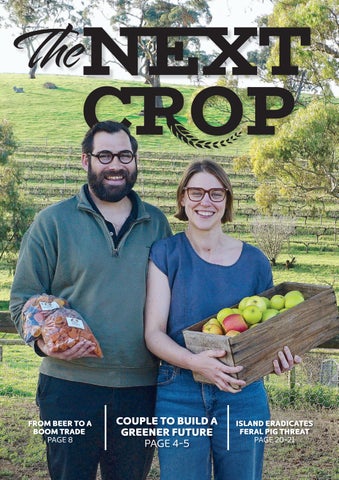
COUPLE TO BUILD A GREENER FUTURE PAGE 4-5
ISLAND ERADICATES FERAL PIG THREAT PAGE 20-21
12870179-VP36-26
2 THE NEXT CROP | ISSUE 4
INSIDE Videos tackle health 13 stigma
Growers secure top 42 honour
Push to fix food 14 origin labels
whistle on bad 43 Blow roads
quality 16 Crafting artisan food
4
Couple build a greener future
6
Rural project cuts bush blues
Program eradicates 20 feral pigs
Farmers may skip trust 36 tax to tackle buffel 37 Panel weed milk empire 38 Regional expands
beer to a boom 8 From trade Action plan to beat 9 locusts
site drives farm 44 Hart research
forestry centre 22 New opens
building local 48 Farmers links
technology grades 23 AI pulses
hay cut above 50 Mintaro rest
helps boost 32 Research pulses
cattle stars 51 Young build skills
work builds 10 Hard success
34
for perfect 12 Passion lamb
trades yachts for 35 TJ camels
Oyster farms get smarter
for farm fire 40 Funds fighters
advocate drives 52 Rural change
for wine 41 Water remains vital
55 Clover’s kids page
FRONT PAGE: Owen Agnew and Ellie Neindorf Agnew on their 32-acre slice of Angaston. (Mahala Gainer: 571796)
Spring 2026 Issue 4 21,000 copies distributed across regional SA in our publications: • The Port Lincoln Times • Eyre Peninsula Advocate • The Transcontinental • The Recorder • Plains Producer • Murray Valley Standard • The Islander • Fleurieu Sun • The Times • The Bunyip • Limestone Coast Today • Border Chronicle • Border Watch • Penola Pennant
• South Eastern Times • Would you like to be featured in our • Autumn 2027 edition? • Advertising enquiries: • Tony Swan
Phone: 08 7819 5313 Email: special.publications@satoday.au Editorial Enquiries: Email: special.publications@satoday.au Published by: SA Today Pty Ltd 9 Howe Street, Balaklava SA 5461 Phone: 8842 1427
FEATURE LIFTOUT Education & Boarding
ISSUE 4 | THE NEXT CROP 3
Couple revives historic site BY MAHALA GAINER SURROUNDED by some of the oldest peach trees in the region, proud Gully Gardens Barossa custodians Ellie Neindorf Agnew and Owen Agnew are beginning a new sustainable farming chapter. Rolling across green grassy paddocks, the 32-acre property features one of the few remaining commercial orchards in Angaston. Nestled among more than 1500 apricot, peach, prune, pear, apple and nectarine trees sit 120-year-old peach trees, some of the Barossa Valley’s oldest. “We want to really protect the trees because it’s that beautiful historical element,” Ms Neindorf Agnew said. “We sort of feel like we’re the next custodians looking after the land for our chunk of time, and we want to do the best that we can do.” In the early 1900s, the Barossa Valley was filled with fruit orchards. By the mid-20th century, tree numbers were declining, largely driven by market competition and disease. With most of the older trees now long gone, the responsibility of caring for the historical orchard is not one the couple takes lightly. “It feels like a lot of responsibility,” Ms Neindorf Agnew said. “But then it’s a good thing at the same time, because you’re always striving to be the best you can be.”
Owen Agnew and Ellie Neindorf Agnew out the front of their Gully Gardens farm shop. (Photo: Mahala Gainer: 571796)
Two years ago, the couple took over the Angaston property, comprising 10 acres of fruit trees, 10 acres of vines, grazing land and the Gully Gardens farm shop, with a vision of a more sustainable future. Finding the right property was a slow process.
EXPERTS IN OUR FIELD NORWELD.COM.AU | 1300 302 889 12845328-RV12-26
4 THE NEXT CROP | ISSUE 4
Mr Agnew, who studied viticulture and oenology at Adelaide University and works in RTD production development, spent years searching for a Barossa property with established vines in budget. Ms Neindorf Agnew brings a background in science, food manufacturing and business
management through her role as operations coordinator. Balancing off-farm jobs, Mr Agnew fulltime and Ms Neindorf Agnew as part time, with the demands of 32 acres, requires careful coordination.
Get A QUOTE
to build sustainable future
Dried fruit is the flagship product of the farm shop. (571796)
Balancing off-farm jobs, Mr Agnew fulltime and Ms Neindorf Agnew as part time, with the demands of 32 acres, requires careful coordination. “We still have to keep working our other jobs, so that on top of the farm shop and additional fruit income is what allows us to follow the dream,” Ms Neindorf Agnew said. “Our dream is to go forward with a more regenerative farming style and move away
from that conventional, synthetic, high-input style ... which comes with its challenges, but we’re very much learning a lot along the way,” Ms Neindorf Agnew said. The couple is taking small steps toward creating a holistic ecosystem, with a goal of improving overall soil and environmental health. “We don’t want to be a monoculture,” she said.
“We want to have good quality biodiversity across the whole land, whether that’s soil, fungi, or general insect biodiversity. “That’s quite important to us.” While the move toward regenerative farming is a gradual process, the couple has already ceased spraying glyphosate under the trees and vines, utilising sheep grazing and mechanical slashing instead. However, reducing chemical inputs brings its own set of hurdles. “We’ve had an explosion of earwigs ... when you pull back on sprays, you’ve got this explosion of their habitat and there’s no longer a control without the natural biodiversity there to keep them in check,” Mr Agnew said. In moderation, earwigs are beneficial to an orchard, preying on other pests. Eventually, the couple aims to restore the natural balance of the property to rely on its own internal nutrients and beneficial species. “Synthetic inputs are a finite resource,” Mr Agnew said. “We’re not going to run out tomorrow, but we will run out one day if we continue using them at the rate we do.” Self-reliance also buffers the farm against global supply disruptions, such as recent price surges in commercial fertilisers. Stepping into orchard management without prior fruit-growing experience meant leaning on local mentors. Neighbouring growers have offered crucial guidance, including a nearby property where the crops mature a few weeks ahead of Gully Gardens.
“We get these constant reminders ... they tell us, ‘We’re starting to spray now, you should be checking your fruit,’” Mr Agnew said. “It’s like a built-in heads-up.” The support extends to the wider community and family. The farm’s founding flock of sheep was a housewarming gift from Mr Agnew’s family, while local youth regularly lend a hand on busy weekends. “We’ve been blown away by the support we’ve received from family, friends, and the local community,” Ms Neindorf Agnew said. As the custodians restore balance to the land, managing weeds and booming insect populations, they are selling the fruits of their labor directly to consumers. The Barossa Gully Gardens farm shop allows customers to purchase fresh produce, signature dried fruit and weekend coffee and home-baked scones. On Saturday mornings, their fresh fruit and products are also available at the Barossa Farmers Market. “We’ve been blown away by the support we’ve received from family, friends, and the local community,” Ms Neindorf Agnew said. Over the next five to 10 years, Mr Agnew hopes to bring another goal to life, establishing their own estate wine label. For now, the orchard stands bare in late winter against the green hills, but come late spring and summer, the trees will bear a fresh canopy of colourful fruit.
12892300-JV37-26
ISSUE 4 | THE NEXT CROP 5
Creative craft cuts bush blues A community-led arts project in the Murray Mallee has delivered more than creative opportunities, with new research finding every dollar invested generated $2.30 in returns for the community. The findings come from an evaluation of The Pinnaroo Project, published in the international journal Rural and Remote Health, which examined the project’s health and economic impacts over three years. Flinders University partnered on the evaluation, which found the project delivered significant benefits for community wellbeing while also generating economic activity and employment. Matthew Flinders Emeritus Professor Robyn Clark said the findings demonstrated the value of community-led approaches in rural areas. “This research shows that arts-in-health programs are not an optional extra for rural communities,” she said. “They are a practical and effective way to support both health and economic resilience.” Between 2021 and 2023, The Pinnaroo Project delivered more than 57 creative experiences through 110 workshops, with 90 per cent of participants reporting high satisfaction. The project also completed 564 health screenings during the three-year period, while most participants reported engaging in arts activities. Children had particularly strong participation, with 91pc of local kids taking part. Adults involved in arts activities reported significantly lower levels of depression than
One of the many workshops held in Pinnaroo as part of a unique project. (supplied: 574979)
non-participants, alongside healthier behaviours including better diets, higher fruit and vegetable intake and lower smoking rates. Participants also reported a better quality of life, with Professor Clark highlighting the broader social benefits created by the project. “These programs create spaces where people can connect, express themselves and feel supported,” she said. “Those social and emotional benefits flow through to better health outcomes, which is especially
important in communities with limited access to services.” The economic evaluation, led by health economist Professor Barry Burgan, assessed both immediate spending and longer-term benefits associated with improved health and productivity. In the short term, the project generated about $63,000 in local economic activity and created 605 hours of direct community employment. Longer-term benefits were conservatively
projected over five years, including savings to health services, reduced sick leave for local businesses, improved workforce skills and wider productivity and quality-of-life gains. The evaluation estimated total benefits at approximately $652,000 against a program cost of $283,516, producing a net benefit of $368,000. Professor Clark said the results challenged the perception that arts programs were merely an optional addition to rural communities. “This is clear evidence that investing in arts-in-health is a smart use of public and community funds,” she said. “The returns are real, they are local, and they extend well beyond health into the social and economic fabric of rural communities.” The researchers said rural and remote communities often faced limited access to health services alongside social and economic pressures affecting wellbeing. The World Health Organisation recognises the arts as a non-invasive way to support health, particularly where traditional services are limited. Researchers are now seeking partnerships with more communities across Australia to investigate the health, wellbeing and economic benefits of arts-based programs. The paper is called ‘The Pinnaroo Project: a longitudinal 3-year cross-sectional study of the impact of a community-based arts-inhealth program on the health and wellbeing of a remote Australian community’.
Smart harvesting adapts to changing crops ADVERTORIAL WHEN conditions change, CASE IH AFS Harvest Command is already one step ahead. Even within a single paddock, crop moisture, soil types, yields and terrain can constantly change. Harvest Command gets operators started with factory settings, then works in the background to maximise capacity, protect grain quality and reduce losses. According to CNH Broadacre Specialist Scott Jericho, a local dealer is key to optimising Harvest Command for your conditions. Once calibrated, Harvest Command monitors the Case IH 260 Series and Next Gen AF Series combines, automatically ad-
justing seven key machine functions as often as every 20 seconds to suit the operator’s harvesting strategy and maintain targets for threshing loss, broken grain, material other than grain, tailings volume and sieve loss. Across South Australia, self-levelling systems maintain an even crop mat across the sieves to help minimise grain losses on rolling country, sandy rises and side slopes. Grain quality is monitored throughout harvest. A camera in the clean grain elevator images the crop as it moves into the tank, checking for cracked grain and foreign material. Operators can set acceptable limits, allowing the combine to maintain the desired grain sample automatically.
The system also adjusts cage vanes to optimise crop flow and machine loading while reducing rotor losses. It monitors sieve loading and airflow to minimise grain loss from the cleaning shoe. Harvest Command also reduces operator workload, letting operators focus on the crop. “A good operator is still key to setting up the combine, but once Harvest Command has been calibrated, it makes its own adjustments, giving you confidence a second operator can achieve the same grain quality and performance,” Scott said. Harvest Command works best with FieldOps. Talk to your Ramsey Bros team about getting both set up before harvest.
Harvest Command can be a valuable tool for farmers this harvest. (Supplied)
Fleet solutions for Primary Producers Need One Vehicle or a Full Fleet? At Victor Harbor Motor Co., we specialise in fleet solutions for primary producers. Whether it’s one vehicle or one hundred, we’ll help you get what you need – without the hassle.
Not Sure What You Need? Our experienced team will guide you through the process and make sure your Fleet solution is the right fit.
Flexible Fleet Solutions with Country Service You Can Count On
Call us today on (08) 8552 7033 or visit vhmotorco.com.au for an obligation-free review. 12841209-FR12-26
6 THE NEXT CROP | ISSUE 4
Looking for a telehandler that works as hard as you do? The upgraded Manitou MLT-X 738 brings a 3.8-tonne lift capacity, protected hydraulics, and superior cab comfort for tough Aussie conditions. Whether you are loading grain tippers, shifting bulk fertiliser, feeding out stock, or handling heavy round bales, it is built to thrive across broadacre, livestock, and mixed farming operations. Backed by multi-award-winning dealer WSB Distributors, contact your local branch today to discover what the upgraded Manitou can do for your farm.
Dealer contact details here.
12842375-VP36-26
ISSUE 4 | THE NEXT CROP 7
From beer to a boom trade BY BEVAN JONES
ZZZ DQILF FRP DX
Paul Blacket and his brother Jason, continue to build a business which started with a carton of beer. (Supplied: 570469)
The business sources goats from pastoral stations across South Australia, where landholders either trap or muster feral goats before contacting River Light Goats. “Sometimes we’ll organise helicopters or motorbikes to help with larger musters, but most station owners handle the mustering themselves,” Mr Blacket said. The goats are purchased on live weight before being transported to the Mallala depot, where they are sorted according to customer specifications. Mr Blacket said restaurants often want different-sized animals compared to butchers, so they sort everything before processing and then send the orders where they are needed. Like any successful agricultural business, Mr Blacket said River Light Goats has been built on constant learning. “My first ute and trailer load of goats cost me a carton of beer because they were worth virtually nothing back then,” he said. “Everything was a learning curve - from feed rations, handling, processing and understanding how the market worked.” Mr Blacket said there was a misconception regarding goats. “People see goats as feral pests, but they don’t realise goat is actually the most consumed meat in the world,” he said. “In many countries, your wealth is measured by how many goats you own. “It’s an incredibly lean, healthy red meat and I would describe the flavour as a sweeter
version of lamb.” Recognising changing consumer tastes has also helped River Light Goats become more diverse. As more customers began requesting specialty meats, Riverlight Goats has now expanded into other animals. “We kept getting asked whether we could source buffalo and camel,” Mr Blacket said. “The same people who were mustering goats often had access to camels, and through our contacts around Australia we were introduced to buffalo producers.” Mr Blacket said adding buffalo to the business required significant changes. “They’re very different to goats,” he said. “We had to learn about trucking, handling, safety and build much stronger steel yards because buffalo are incredibly powerful animals.” Like every new venture, it came with challenges, but the couple invested time learning from suppliers and industry experts. “Once we educated ourselves and understood how to handle them properly, the business continued to grow.” Today buffalo and camel have become valuable additions to the River Light Goats product range, helping satisfy demand from butchers and restaurants looking for premium alternative proteins. Despite the company’s success, Mr Blacket said one of the biggest challenges was not the livestock, rather it was changing perceptions.
/2#(!2$).' &/2 4(% &5452% #/--%2#)!,)3!4)/. )0 02/4%#4)/. 02/0!'!4)/.
Έ! ŎƀŹĺăƛ 8 THE NEXT CROP | ISSUE 4
nŎƀŅŹ ÂĤăƕ {ŬõĠØŬûŰ ØŹĺŎƕ
“We had to educate suppliers that these animals weren’t just pests,” he said. “They needed to be looked after properly because our customers expected high-quality meat and good animal welfare.” Another unexpected lesson has been learning to work with customers from different cultural backgrounds. “Every culture communicates differently and has different ways of doing business,” he said. “Building those relationships, understanding how people like to work and earning their trust has probably been one of the biggest lessons throughout the journey.” Looking back, Mr Blacket is the first to acknowledge he could not have done it without the support of his loved ones. “I was incredibly fortunate that Mum and Dad backed me when I was young and were prepared to let me have a go,” he said. “My grandparents were also very supportive and encouraged me to try something different. “And today, having Claire, our daughter and our team involved means it’s become a genuine family business.” River Light Goats now employs seven staff and has grown far beyond anything Paul imagined when he loaded that first trailer more than 30 years ago. “It’s been a surreal journey,” he said. “You’ve got to stop sometimes and appreciate what we’ve built because it’s so much bigger than I ever expected.”
! q §{ e1 q n{ 1
12842797-JO11-26
AT just 17 years of age, fourth-generation farmer Paul Blacket wasn’t looking to overhaul South Australia’s goat industry. Growing up on his family’s 6,000 acre farm at Mallala, he simply knew there was not enough land to provide for another fulltime farmer, so he began searching for opportunities that could complement the family business. Mr Blacket said that opportunity arrived in an unlikely form. “One of our neighbours mentioned all these young feral goats that were being put down because they didn’t meet export standards,” he said. “I remember thinking, surely there’s got to be a market for them.” Thinking he had nothing to lose, he loaded a one-tonne ute and trailer with his first consignment of undersized goats and took them back to the family farm. The next challenge was working out what to do with the animals. “I started knocking on the doors of butchers and restaurants and asking if they’d be willing to give goat meat a try,” he said. “It was slow at first. “We’d sell six to 15 goats a week, but gradually people started putting goat on the menu and things began to grow.” What began as a side project suddenly started to gain momentum. Sales increased to 50 or 60 goats each week before another major turning point arrived when River Light Goats achieved halal accreditation. “When we moved into the halal market, our sales pretty much doubled from around 500 goats a week to 1,000 almost straight away,” Mr Blacket said. “Once we built those relationships and word spread through the community, it just took off.” Today, Mr Blacket and his wife Claire operate River Light Goats, supplying close to 3,000 goats every week to butchers, wholesalers and restaurants throughout South Australia, with additional customers in Victoria and New South Wales. Mr Blacket said the business has grown steadily over the past three decades, built on long-term relationships and a reputation for quality. “We’re very fortunate that we’ve been supplying some of the same butcher shops for nearly 30 years,” he said. “They trust us because they know the quality they’ll receive every time.”
Action plan to beat locusts SOUTH Australian farmers are being given a $6.5 million preparedness boost as the State Government moves to protect the state’s record grain crop from a potential locust outbreak this spring and summer. The government has announced significant chemical rebates for primary producers alongside increased surveillance and planning, following warnings from the SA Locust Commissioner that a damaging outbreak could be a real possibility. Above average autumn and winter rainfall has helped establish grain crops across more than 4.2 million hectares, the largest area of sown crops on record in the state. Increased adult locust activity has been reported across the Mallee, Riverland, Flinders Ranges and Eyre Peninsula during autumn, raising concerns eggs may have been laid across multiple regions. If the eggs hatch during spring, they could produce concentrated bands of juvenile locusts, known as hopper bands, which can cause significant damage to crops and pastures before developing into highly mobile adult swarms. The Department of Primary Industries and Regions (PIRSA) will receive $1.9 million for planning, procurement and surveillance, including up to six weeks of targeted spring surveillance in areas considered most at risk. A further $4.9 million will fund a Chemical Rebate Scheme for landholders, with eligible producers able to receive up to $35 per hectare for chemicals purchased to control locusts and applied between September 1 and December 31. The rebate scheme will run from September 1 through the high-risk season until February 14. Control methods will vary according to
landscape, land use, locust density and the level of risk to agriculture, communities and sensitive sites. Primary Industries Minister Clare Scriven said the investment would help ensure action at the right time and in the right places. “Early reports of increased locust activity across many parts of our state are a timely reminder that it is essential our farmers are well prepared to manage potential impacts to their crops,” she said. “Our targeted and coordinated surveillance program and chemical rebate scheme will give landholders both the information and the practical support they need to re-
spond quickly and effectively if hopper bands emerge this spring.” Grain Producers SA chief executive Brad Perry said producers need to be vigilant and report sightings promptly. “Grain producers have been reporting increased locust activity to GPSA for several months, and we have worked closely with the government through its locust community reference group,” Mr Perry said. “The rebate of up to $35 per hectare will help growers meet the cost of controlling locusts on their properties. “With one of South Australia’s most promising grain crops in years now growing strong,
grain producers should remain vigilant, report sightings promptly and act early if hopper bands emerge.” The juvenile hopper stage is considered the best opportunity for effective control because the pests remain concentrated before becoming roaming adults. The Government will continue working with landholders, industry, local government and the Australian Plague Locust Commission. Locust sightings can be reported to the Exotic Plant Pest Hotline on 1800 084 881 or through PIRSA’s online reporting form.
A proudly South Australian family owned company, supplying Custom Transport Equipment to the Heavy Vehicle Transport Industry for over 45 years. LOCALLY MANUFACTURED ROAD TRANSPORT EQUIPMENT:
Prime mover fit-ups , including; • Hydraulic installations • 5th wheels & tow bars • Walk plates • Toolboxes & cab racks • Drive mudguards, including: • Plastic • Stainless steel & aluminium • Spring-type flexi guards • HD conveyor type
Aluweld bullbars to suit; • Kenworth • Mack • Volvo • Scania • & more
Extensive range of truck & trailer accessories
• 2-axle, 3-axle, 4-axle, 5-axle & 6-axle tipping Dog trailers • Tipping pig trailers • Single-axle, 2-axle & 3-axle plant trailers • 2 & 3-axle tipping semi-trailers • B-Double tippers, including fixed A-Trailers, rollback body A-Trailers, sliding suspension A-Trailers & Jackknife B-Doubles • 2-axle & 3-axle converter dollies • Complete multi-trailer combinations, including B-Doubles, A-Doubles & A-B-Triples • Custom built drop-decks& low loaders • Specialised transport equipment
32-34 Tikalara St, Regency Park | 5 Wirriga St, Regency Park | 136 Ryans Rd, Green Fields | Phone: 1800 640 547
12888821-EB36-26
ISSUE 4 | THE NEXT CROP 9
Hard work builds success BY BEVAN JONES
12887316-RV36-26
THE hard work and vision behind one of regional South Australia’s most innovative businesses has been recognised with two prestigious honours. Sundrop Farms co-owner and chief executive officer Steve Marafiote was recently awarded an Order of Australia Medal (OAM) in the King’s Birthday Honours List. Adding to the list of accomplishments, he was named Grower of the Year at the National Horticulture Awards for Excellence, a major recognition within Australia’s horticulture industry. For Mr Marafiote, the two awards were very special,but carried very different meanings. “Both awards are excellent in different ways,” he said. “The Grower of the Year is really more a testament to the whole farm and the whole business. “We are very lucky to have a great team of very high quality, smart and dedicated people. “It is a nice moment to recognise the effort and reward for the effort and hard work.” The OAM, he said, was a far more personal honour. “That is more about the morals and foundations of how I was brought up,” he said. “My parents have been incredible role models and also a great demonstration to my kids that ethics, care for others and hard work matter. “It is something you don’t plan for, but you hope for at best, so it is very meaningful. “My wish is that my children will copy what we do well as parents and this honour will open doors for their future. “Plus, also being proud of the fact they come from a family that stands for the greater good.” Despite the accolades, Mr Marafiote said receiving awards was never his motivation. “It never really crossed my mind,” he said. “Horticulture is like most industries, you focus on doing things well everyday,” he said. “What I love about this industry is that we produce things that people need and are healthy for them, not just today but for generations to come. “It is about leaving the place better than when we found it and producing great products that you can put your name next to.” Sundrop Farms, based near Port Augusta, has become internationally recognised for producing premium tomatoes using seawater desalination, renewable energy and advanced greenhouse technology. Mr Marafiote joined the business in 2015/16 and said the early years were
10 THE NEXT CROP | ISSUE 4
Sundrop Farms co-owner and chief executive officer Steve Marafiote with some of the produce grown on the farm. (Supplied: 570459)
filled with challenges. “Everything was built from scratch, the technology, the team and the culture,” he said. “There is always a risk that it takes a long time to get up to speed, but starting from scratch also meant we could build our own team, our own culture and our own standard of excellence. “In the early days there were plant disease impacts and operational systems that needed constant attention, and of course keeping customers happy was always front of mind. “There have been many challenges, but that is part of life.” The decision to establish the operation near Port Augusta was a bold one, but he believes it was the right choice. “The location was selected because of the high concentration of winter sunlight,” he said. “We don’t get the humidity, and we can draw water from the ocean. “Port Augusta is actually a very good location in terms of being close to things. “It has a strong population, local shops, housing and the conveniences people need.” The business remains heavily dependent on both the environment and its people.
“We are an industry that relies on the environment and on people,” he said. “We draw water from the ocean, and by using concentrated solar power we can keep costs down. “We also need to continue using robotics appropriately, without taking jobs away from people.” Mr Marafiote said the key to Sundrop Farms’ success was more about culture. “Leadership starts with empathy,” he said. “If you help people and motivate them in both their personal and work lives, they will hopefully love the business and feel rewarded, valued and part of the team. “People need clear expectations. “They need to know what good looks like and what bad looks like, so they can come to work feeling clear, valued and driven to achieve good results for themselves and for the business.” Teamwork at Sundrop, he said, is non-negotiable. “We are relentless about teamwork and caring for each other … no business succeeds without it,” Mr Marafiote said. “Operating as a team is so important. “It comes down to team respect and living
WWW.COMMANDERAG.AU
1800 655 033
up to every word you say.” Mr Marafiote believes the company’s achievements are the result of both long-term investment and the culture that has been built over the past decade. “The investment made 11 years ago and the assets we use are important, but culture is the most important thing,” he said. “If you have both, you can do great things.” Not resting on previous achievements, Sundrop Farms is planning for further growth. Mr Marafiote said the company has lodged an application with the local council to expand its Port Augusta facility and is exploring opportunities to acquire other businesses and develop new international markets and products. “It is a natural expansion and there is opportunity in the market,” he said. “At the same time, we want to respect the relationships we have with our clients.” He is also passionate about encouraging the next generation into agriculture. “I would strongly encourage young people to come into the industry, we need talented people in agriculture,” he said. “Producing high quality, healthy food that you can be proud of is incredibly important and always has a future.”
VR4878896
12765108-CV20-25
ISSUE 4 | THE NEXT CROP 11
Henry Beal’s family owned farm is home to almost 500 sheep. (Dee Elferink: 566134)
Henry with wife Chelsea, their two-year-old daughter Piper, and working farm dogs, Zap and Blitz. (Henry Beal)
Passion for perfect lamb BY DEE ELFERINK AT the Adelaide city launch of the Fleurieu Food Festival in August, a few of the local Fleurieu producers jumped on a microphone to speak about the amazing paddock-toplate food we had just devoured. When McLaren Vale sheep farmer, Henry Beal started talking - he had my attention from the get go. Not only because I had just sampled the most mouth-watering piece of lamb ever to grace my lips, but more so because I had never heard anyone speak so passionately and enthusiastically about a piece of meat. After convincing Henry to let me spend an afternoon with him on his family farm, Monapilla Estate - situated halfway between McLaren Vale and Willunga, sitting on a range high enough to offer sweeping views of neighbouring farms, lush vineyards and the ocean - I discovered the young third generation farmer’s passion for sheep farming and creating the most perfectly marbled lamb cuts runs deep. Monapilla, meaning land between two creeks, began in the 1830s as a wheat, sheep and cattle farm, along with 33 acres of shiraz vines. Henry’s grandparents bought Monapilla Farm more than 40 years ago, and over time the Beal family has acquired more of the sur-
rounding land, with the estate now a 600 acre mixed farm. While Henry’s grandfather and uncle have since passed, his grandmother, Pam, his parents, Fiona and Simon and his own family with wife, Chelsea and their two-yearold daughter Piper, all live in homes on the estate. Henry looks after the sheep and wine grapes while his parents run the Monapilla Escape luxury, off-the-grid accommodation side of the business which includes two solar-powered villas, with outdoor bath and access to an organic herb and veggies garden and fresh chook eggs, as well as a full helicopter landing site for those wanting to travel in style. The long history of the farm’s old grape vines produces some of the highest quality and most consistent fruit, with the grapes being sought after and included in the famous Penfold’s Grange Hermitage and St Henri collections, as well as Wolf Blass Black Label. Henry thinks his Monapilla Estate Premium Shiraz is also “pretty decent”. Having sampled a glass or two following my afternoon on the farm, I found it to be a fabulous full bodied shiraz with just the kick I needed to perk me up after opening and closing what felt like about 100 paddock gates for the day! When Henry took over the business 13 years ago, it was predominantly a cattle farm.
He and his father, Simon, decided to sell the cattle and run sheep, initially just to graze the vineyards. It wasn’t long before the two farmers saw an opportunity to do more with the sheep. “For us, we could see a gap in the lamb market,” Henry said. “There were established beef brands out there, but not many lamb brands and I was naturally curious about all aspects of sheep farming all the way up to the genetics. “It was a progression of gathering information where we could and using the expertise of other sheep farmers to get to the point of starting our own lamb brand.” Once they decided they wanted to breed the highest eating quality lamb they could, it was about research. “I did as much research as I could and I talked to every sheep farmer who would take my call,” he said. “Plenty of farmers gave me advice and talked about what worked and what didn’t work for them, which gave me and Dad so much information to work with when making decisions.” The advice and learnings from other farmers, including Nick Lienert from Oakfarms Merino and Poll Merino Stud and Telpara Suffolk stud farmer Anthony Pearce, led Henry to where he is today, running close on 400 Merino ewes, which, in August, pro-
duced more than 450 first cross lambs. Henry believes ram selection and a wellconsidered feeding regime is key to improving intra-muscular fat for better marbled and more tender lamb. “Feed is so important, once you have the breed right,” he said. “After weaning, our lambs are put onto a really high protein, grain blend which they stay on until they get slaughtered between five and 12 months of age. “Because we use a limiter in the feed, we can feed the lambs for longer without them getting too fat, and then the marbling is the last fat they’ll put down.” Henry said to get the perfect marbling is a balancing act. “It’s about making sure they don’t get too fat, and it has taken a bit of trial and error to gain the experience to get that right,” he said. “Having systems in place so they are fed correctly and don’t get stressed is key. “It is my absolute passion to breed the best lamb possible, and build a reputation for consistent high quality product every time you buy our lamb.” Monapilla Estate lambs are processed regularly at Kangarilla Meat and, along with being available in plenty of restaurants around the Fleurieu and beyond, the public can purchase the lamb in a variety of different cuts at Ellis Butchers in McLaren Vale.
SERIOUS SHEDS FOR LESS
418239
Open Front
Drive Through
Roof Only
EXTRAS
\ \ \ \ \ \ \ \ \ \
âƁƑØljljlj âŀĊØljljlj âŏƗĊØljljlj âŏƗljØljljlj âŏŀîØljljlj
âƆŀØljljlj âŀŏØljljlj âŏƗŏØljljlj âŏŏƆØljljlj âƗljƗØljljlj
âăƗØljljlj âƁƑØljljlj âŏljŏØljljlj âŏljĊØljljlj âŏƅƆØljljlj
• P.A. Doors • Roller Doors • Sliding Doors • Awnings • Mezzanine Floors • Skylight Panels • Insulation • Snow Loading
All Prices Include GST • Competitive Freight Aus Wide • Hot Dipped Galvanised Columns & Trusses 12 THE NEXT CROP | ISSUE 4
ƽ (YWXSQ LIHW &ZEMPEFPI ƽ -SVWI &VIREW XEFPIW ƽ -E] LIHW • Bulk Grain Sheds • Dairy Buildings ƽ +IIHPSXW ƽ TERW Q XS Q
CLICK TO SEE THE RANGE PHONE 1300 992 905
12882619-GS36-26
Size
www.ǽWLIHW GSQ EY
Videos to tackle health stigma
Rural GP rural GP Dr Justin Gladman. (575022)
but for generations, talking about their own mental health has been difficult to do,” Ms Ottens said. “Traditional mental health campaigns often fail to connect with farmers because they can feel too clinical or disconnected from life on the land. “But through Weather It Together and the new video series, thanks to the help of four generous farmers, we’ve been able to put farmers’ own voices and lived experiences at the centre of the conversation, helping deliver messages that are credible, practical and relatable.” South East farmer Ashley Schmidt features in the series, sharing how recognising he needed help and seeking support helped him regain perspective after several difficult years involving personal loss, workplace
challenges and ongoing farming pressures. “I was wondering what the point of everything was – why was I farming? And I was thinking ‘there’s got to be a better way of life’,” Schmidt said. “I was trying to help everyone else to be happy and who they needed to be, but I wasn’t who I wanted to be. “By taking the step to invest in myself and spend the time looking after myself, I’ve come out a better person, someone who’s able to be there for everyone around me.” Dr Gladman, a Mount Gambier doctor who grew up in a rural area, said mental health discussions were more common in rural medical practices than many farmers might expect. “Over the course of a day, I’d have three or four farmers mention mental health con-
cerns or that they’re struggling,” Dr Gladman said. “You don’t have to walk in with a clear idea of what you want in terms of treatment options. “Even just saying, ‘I’m struggling’ is enough to start. “Ninety per cent of the work is simply starting the conversation.” Ms Ottens said suicide prevention remained a key focus. “More than ever, farmers are reaching out for professional mental health support, and we’re incredibly grateful to those who have been willing to share their stories to help others,” she said. “We believe sharing these stories has the power to save lives.”
%XLOW IRU WKH ZRUN 'HVLJQHG IRU WKH ORQJ KDXO
SHEDS THAT WORK AS HARD AS YOU DO At ShedEx Fleurieu, we design and construct custom steel sheds for South Australian primary producers. From machinery and header storage to grain, livestock, and workshops, every shed is engineered for real farm use. We handle design, approvals, engineering, and construction using Australian BlueScope and COLORBOND steel. 1R VKRUWFXWV Just sheds built once, built right.
7/65, 2 LINCOLN PARK DRIVE, VICTOR HARBOR 12892139-CV36-26
FARMERS across South Australia are being encouraged to speak up about mental health as a video series puts lived experience at the centre of conversations about seeking support. The five-part series, developed by Adelaide University’s ifarmwell team and funded by the CMV Group Foundation, aims to reduce stigma around help-seeking and remind rural communities that reaching out is a sign of strength. The videos feature farmers from Peterborough, Coonalpyn, Kulpara and the State’s far north, adding to a growing library of livedexperience stories supporting farmer wellbeing and suicide prevention. The farmers share experiences of postnatal depression, grief, relationship breakdown, isolation and the cumulative pressures of life on the land while practical advice from rural GP Dr Justin Gladman also helps explain how people can access support and what they can expect when taking the first step. The project forms part of the broader ifarmwell Weather It Together campaign, funded through the State Government Drought Response Support Package. Led by Associate Professor Kate Gunn, founder/director of ifarmwell, the campaign encourages farmers to protect their wellbeing by staying connected, focusing on what they can control, keeping active and speaking up when support is needed. Campaign coordinator Annabelle Ottens, who grew up on the land and is based in the Clare Valley, said the new series delivered mental health messages in a way designed to connect with farmers. “Farmers love helping other farmers,
WWW.SHEDEX-3,<90,<.COM.AU ŌúĐÚÞĽŁ UúÕÞėÕÞ U" źŻžżŽŻ
12854739-JO12-26
ISSUE 4 | THE NEXT CROP 13
Push to fix food origin labels CONCERNS over the origin and testing of imported vegetable products have intensified following claims of Chinese tomatoes being detected in processed food labelled as coming from Italy, according to AUSVEG. The national peak industry body said the allegations raised in a recent Four Corners episode exposes wider questions about Australia’s country of origin food labelling requirements and testing of imported vegetable products. AUSVEG said the claims warranted further investigation, while warning uncertainty around imported products could undermine confidence in Australia’s food system and place growers at a disadvantage. The organisation said a recent scan of imported frozen and canned vegetable products available at Australian retailers found multiple examples of packaging bearing ‘Packed in ‘country’ from multiple origins/imported produce’ labelling. AUSVEG said products carrying such labelling were increasingly competing for shelf space with fresh, frozen and canned Australian-grown vegetables, while shortcomings in labelling requirements could leave consumers without an indication of where produce originated. AUSVEG chief executive Michael Coote said growers were already facing a raft of pressures. “Australian vegetable growers are already dealing with serious and escalating challenges to their viability due to surging production costs and compliance burden, difficulties securing viable returns, declining vegetable consumption and a consumer cost-of-living crisis,” he said. Mr Coote said the challenges facing growers were compounded by imported products entering retail markets.
“
This isn’t just an economic issue for Australian vegetable growers, but a food quality, safety and security issue for Australian consumers”
“The many operating challenges facing growers mean Australian vegetable producers are increasingly at risk from the flow of imported frozen, canned and processed vegetable products steadily making its way onto retailers’ shelves,” he said. “It is bad enough that imported frozen and canned vegetable products are seriously undermining Australian vegetable growers, but what makes it even worse is that Australian consumers often have no real indication about what they are getting when they chose imported product.”
Mr Coote said current labelling could identify where an imported product was packed or manufactured without identifying the origin of the produce itself. “This isn’t just an economic issue for Australian vegetable growers, but a food quality, safety and security issue for Australian consumers,” he said. Mr Coote said Australian vegetables were produced under high quality, safety, ethical and sustainability standards, while calling for stronger protections.
“Australia’s country of origin labelling requirements need to be strengthened to clearly tell consumers exactly where the frozen or canned vegetables they are buying are actually from, and imported vegetable products need to be subject to more stringent testing so consumers know exactly what they are eating,”he said. AUSVEG urged consumers to choose Australian-grown vegetables, saying it was the way to ensure confidence in the safety and sustainability of their food.
Protecting agricultural farmland for the future ADVERTORIAL HERE in regional South Australia, we know the value of productive agricultural land. Our farmers work some of the most important land in the country. That is why the controversy surrounding the sale of Rushy Lagoon in Tasmania should concern us all. Rushy Lagoon is one of Australia’s largest agricultural properties, sitting at 21,745 hectares. Its sale for almost $70 million has raised serious questions about the future use of productive farmland, foreign investment and government-backed funding. As part of the sale, the proponent re-
Tom Venning at work on the farm. (Supplied)
ceived $69m from taxpayer-owned Clean Energy Finance Corporation, funded by the Commonwealth. The Tasmanian Government also chipped in $8.8m through Agriculture Minister Julie
Collins to “help farmers to convert”. That’s around $78m of taxpayer money competing against farmers, crowding them out, and locking up productive farming land to non-productive assets. Forever. The purchaser is a foreign company, Gresham House. They plan to plant 12 million radiata pine seedlings on the farm. What angered Tasmanian farmers most is that government money is competing with local farmers for their own land. The Tasmanian Government has now called for a parliamentary inquiry into the sale. I welcome that scrutiny. Australian Bureau of Agricultural and Resource Economics and Sciences research shows that 18 million hectares of agricultural land will need to be transitioned to or com-
bined with carbon farming projects to meet Australia’s 2050 Net Zero targets. We will see more of this in regional SA if this path continues. That’s why a Coalition Government will scrap Net Zero and end policies that work against farmers and farm productivity. Our farmers are already facing rising costs and more red tape. The last thing they need is to compete against government-backed schemes that push up the price and shrink the supply of agricultural land. Rushy Lagoon may be in Tasmania, but it raises serious questions right here in regional SA. Tom Venning, Federal Grey MP
ROLLER MILLS
Vertical Feed-mixers 10 to 40 cubic metre capacity. Single or Twin Augers.
12”, 24”, 36” & 48” models
Efficient large curved, carbide-insert knives. Model FS1000D Side doors with Elevator Side Doors with Elevator or Front / Rear Door Feed-out.
DEGELMAN
BIO SPREADERS See us at the Henty and Elmore Field Days
Heavy Duty Everything
Save time and money year after year by rolling more grain per hour with less horsepower.
Eastern States Distributor for MARSHALL MULTISPREAD Fertilizer Spreaders — 2.5 to 16 tonne
EASTERN SPREADERS PTY LTD 9508 Murray Valley Highway, KERANG, Vic Ph: 03 5450 3077 easternspreaders.com.au
Mobile: 0409 691 226
or
0429 480 337 12894033-CV36-26
14 THE NEXT CROP | ISSUE 4
YOUR HOME FOR TRACTORS, HARVESTERS, FARM EQUIPMENT & MACHINERY Backed by Landpower’s nationwide support network, we offer equipment solutions designed to meet the needs of today’s farmers — along with the local knowledge, service, and care you expect from a team that’s part of your community. LEXION
AXION 800
ARION 600
SCORPION
DISCO
LINER
AXION 900
XERION 12 Series
ZA-TS
12843099-RV36-26
Talk to us about your machinery needs today
Bascombe Auto Ag 2-8 Railway Terrace, Cummins (08) 8676 2980 office@bascombeautoag.com.au
26-052
4–8 Goldsworthy Street, Kadina (08) 8821 1603 sales@gjeast.com.au
26-052_DLER_G&J East_Brand-Advert_377x261mm.indd 1
ISSUE 4 | THE NEXT CROP 15 23/02/2026 10:19:28 am
Crafting quality artisan food
“
BY IMOGEN EVANS KEEPING culture alive has been at the heart of Barossa Valley Cheese Company founder Victoria McClurg’s journey, with the cheesemaker putting the Barossa community first at every step of the process. Specialising in soft cheeses, with triple cream and smelly washed rinds among their customers’ favourites, the team at Barossa Valley Cheese Co said there is far more that goes into making cheese than just milk and time. Over 23 years, the process has been refined without losing the hands-on approach that has defined Barossa Valley Cheese Company from the beginning, with Ms McClurg still front and centre at the company’s Angaston retail shop, making sure every customer leaves with a taste of what the Barossa region has to offer. The cheese starts with fresh, local milk sourced from trusted farming families across South Australia. Since the very first batch, the team has partnered with the fifth-generation Barossan Nietschke farming family in Koonunga, who focus on sustainable farming and community development. The seasonal goat’s milk is crafted from dairy goats raised by Anders and Alison Oksbjerg, a Danish-South Australian farming family passionate about their craft. Their milk allows the team to create limited-run specialties, including the delicious, award-winning La Dame.
We know where our milk comes from … the cheese is made by real human beings and there’s that craft to it”
Barossa Valley Cheese Company founder Victoria McClurg said making products with local ingredients for local people is at the heart of what she does. (Imogen Evans: 571506)
“There is a lot of love and care and attention that goes into every cheese,” Ms McClurg said. “It is like we know them all by name.” Cheese was not always part of the plan for Ms McClurg, who began her journey in the
food and wine industry by studying winemaking. It was during a work trip to France that she fell in love with cheese, discovering just how complex, diverse and interesting it could be. Her mind was set, having convinced her-
self she would one day find her way to cheesemaking back home. “The opportunity came about a little sooner than I anticipated,” she said. “I decided before I turned 25 that I was going to make cheese instead of wine, because when you’re that age, you’re young and naive and you just give things a crack that you otherwise might hesitate at.” The journey began with the help of her semi-retired mum, who joined her in turning the dream into a reality. What is now known as the much-loved Barossa Valley Cheese Co began from a small storefront before growing to what it is today. “Now we have an awesome team on board who make the cheese,” Ms McClurg said. It is this journey and love for the craft that is reflected in the products she creates, with her passion for bringing different flavours to life that has kept her captivated by the craft for close to 30 years.
12834596-JV12-26
16 THE NEXT CROP | ISSUE 4
with trusted local producers “It’s a drive and passion to produce something that’s authentic,” she said. “There is a lot of food that we make, or food that comes into the country, that is not authentic. “We know where our milk comes from. “We touch it, we feel it, we connect with it, the cheese is made by real human beings and there’s that craft to it. “I love the magic of turning something that is this luxuriously silky, milky, smooth liquid into something that’s solid and has its own character, and then over weeks matures and changes again and produces another set of flavours, it’s pretty cool.” The team says picking up a cheese and biting into it should be a journey, not just a snack, and encourages food lovers to get curious, try something bold and discover the region. Keeping it local remains deeply important to Ms McClurg, even as the business has continued to grow. When asked why she does not look to cheaper alternatives or towards imported milk, her answer remains simple: supporting local producers is worth far more than saving a few dollars. “We want to keep the diversity of the region alive and keep offering something interesting,” she said. “There’s so many tourists that come through the Barossa and that’s a lot of people that we can share our story with, and a lot of people who can carry the message around the importance of having regions that have bigger players and smaller businesses, that
The team specialises in soft cheeses, with its halloumi and three cream brie being amongst top sellers. (Imogen Evans: 571506)
diversity of offering. “That is what makes a community thrive, that is what makes something stick around for another hundred years.” A vast variety of cheese is not the only thing offered in store, with the Angaston premises also lining its shelves with goods from neighbouring businesses. “Our catchphrase is ‘keeping cultures
alive’ with a focus on artistry and that handmade aspect of what we do here in the region and what has historically been done,” Ms McClurg said. “When people come and visit our shop, there is lots of bits and pieces from all over the place, big producers, small producers, people making their own chutney, jam, pastes, biscuits and creative things.”
It is this drive to support local producers while ensuring customers enjoy the very best cheese that has also led the team to being recognised at the Australian Grand Dairy Awards, and has continued to win at state competitions and receive high national recognition. “By this point we had only been in business for maybe four or five years, so to win that was pretty cool … we still make that product today,” Ms McClurg said. Looking to the future, the Barossa Valley Cheese Company is aiming to expand its offerings to an ever-growing community and northern region. “Food trends change, and different people are looking for different things now,” Ms McClurg said. “People are wanting to have more of an experience, and have more texture and touch, so we are playing around with the cheeses we produce and seeing what other things we can make. “Watch this space … we are very much going to be focused on the cellar door and the experience that people have there.” When asked if Ms McClurg is still crazy about cheese after all these years, one thing is certain: there is no turning back. “Cheese is like salt and pepper to me,” she said. “It is always going to be there.” The Barossa Valley Cheese Company can be found at 67B Murray Street at Angaston and is open Wednesday to Monday from 10am until 4pm, and also stocked at wineries and independent groceries across Australia.
architecture + interiors
Manufacturer of:
commercial residential
566 Waterloo Corner, Burton
PHONE 8280 6475
wine accommodation hospitality
12842456-AM36-26
• Road Train Equipment • Steel & Aluminium tippers • Flat Tops • Dollys • B Doubles • Tippers
discover more projects at jbgarchitects.com
Mobile: 0407 829 542 Website: freightmastertrailers.com.au 12844769-JO11-26
ISSUE 4 | THE NEXT CROP 17
Sheringa residents Jennifer and Michael Wandel and Sonya Wright enjoyed catching up with Durran and Huntley Pringle from Wangary. (Liam Wormald: 571872)
Rachel, Kara and Rusty McDonald travelled from Tumby Bay. (Liam Wormald: 571872)
Field days a smashing success EYRE Peninsula Field Days, hosted at Cleve from August 11-13 was a smash, with big crowds across the event and plenty on offer.
MORE PHOTOS - PAGE 24
Henry, Laura, Ashley, Maggie and Ellie Lines had a great family day out after travelling from Laura. (Liam Wormald: 571872)
Twins Tom and Jack Weiss from Cleve thoroughly enjoyed their time at the EP Field Days. (Liam Wormald: 571872)
Thomas Kammermann, Phil Kammermann and Michael Zacher from Lock. (Mitchell Paterson: 572403)
Tex and Janice bumped into fellow Arno Bay resident Tex Cummings. (Liam Wormald: 571872)
Karen Jean and Shaun Garrard travelled from Streaky Bay for the event. (Liam Wormald: 571872)
Ian Burton of Rudall catches up with Dennis Syvertsen, formerly of Cleve now Adelaide. (Mitchell Paterson: 572403)
McLaren VALE
Your Local Tyre & Wheel Specialist
SA TRUCK TARPS
ON-SITE SALES AND SERVICE
0428 572 146 WWW.SASTOCKTROUGHS.COM.AU SALES@SASTOCKTROUGHS.COM.AU
LAWN & GARDEN TYRE REPAIRS 12766445-AA20-25
0435 871 521
12871790-JM22-26
SOUTH AUSSIE STOCK TROUGHS
18 THE NEXT CROP | ISSUE 4
ALIGNMENT FOR ALL VEHICLES
Family owned and operated business specialising in wind back and pull out truck tarps, manufactured in SA.
JED@SATRUCKTARPS.COM.AU
PRECISION WHEEL
ATV & OFF-ROAD
PASSENGER & 4WD
WHEEL BALANCING & ROTATION
231 Main Road, McLaren Vale SA 5171
CLASSIC CARS WHEEL ALIGNMENT
RUBBER TRUCKS & MOTORCYCLES AGRICULTURAL EQUIPMENT LIGHT TRUCKS EXCAVATOR TRACKS
BRAKES & SUSPENSION
(08) 8323 8166
BATTERIES & INSTALLATION
AFTER-HOURS ON-SITE FITTING
mclarenvale@tyreplus.com.au
12890047-EB36-26
12873794-AF36-26
ISSUE 4 | THE NEXT CROP 19
Historic eradication program
“
BY DANI BROWN
KI is now a world leader in invasive species eradication, having successfully eradicated feral goats, deer, and now pigs”
PIRSA executive director of biosecurity Georgie Cornish presents a plaque celebrating the achievement to KILB chair Aphid Heinrich and the program staff. (Supplied)
The Kangaroo Island Feral Pig Eradication Program has been a collaborative effort since it was launched in 2020, after the Black Summer bushfires. A silver lining of sorts from the fires was that about 90 per cent of the island’s feral pig population was killed, which led to the opportunity to completely eradicate the species from the island through a targeted program. It was led by the Department of Primary Industries and Regions (PIRSA) in partnership with the Kangaroo Island Landscape Board (KILB), National Parks and Wildlife Service, AgKI, Livestock SA, and local farmers and landholders. Thermal-assisted aerial culling, detector
dogs, ground shooting, and ground baiting were used to eradicate the feral pigs, complemented by forensic analysis of feral pig DNA in creeks and rivers, and a network of 500-plus monitoring cameras assisted by artificial intelligence. The federal and state governments provided $7.5 million for the program to be undertaken and has been backed by the state’s livestock industry. The feral pigs’ eradication is important in environmental and agricultural management, as it means protection for both local native species and agricultural industries. Federal Minister for Environment and Water Murray Watt said it was another big
step forward in protecting Kangaroo Island’s biodiversity. “No more feral pigs means helping the recovery of native species, including threatened plants, and reducing the spread of dieback,” he said. “Kangaroo Island is now a world leader in invasive species eradication, having successfully eradicated feral goats, deer, and now pigs.” Since the program began, 878 feral pigs have been removed and the last of the known sows were eradicated in March 2024. It had to be subject to a two-year “proof of freedom” phase, during which surveillance was undertaken throughout high-risk areas and there were no detections or signs of feral pigs in that period, leading to a high degree of confidence there were no feral pigs on the island. Ms Scriven thanked all who contributed to the milestone over the past six years.
Chemical sheds you can rely on.
416523
KANGAROO Island is now officially ‘feral pig-free’ after a concerted effort to reach the historic goal. The achievement, announced in June, makes Kangaroo Island the largest island anywhere in the world where an established population of feral pigs has been eradicated. Feral pigs are considered a pest, and on the island it is estimated they cost $1 million or more every year in economic and environmental impacts. Agriculturally, feral pigs prey on newborn lambs, damage crops, and compete with livestock for pasture. Environmentally, they destroy natural habitats, impact threatened species, spread weeds, damage infrastructure, and carry parasites and diseases. State Minister for Primary Industries and Regional Development Clare Scriven said the achievement was great news for the island, its farmers, the environment, and South Australia as a whole. “Kangaroo Island is now the largest island anywhere in the world from which an established feral pig population has been eradicated,” she said. “That is an extraordinary result and everyone involved should be incredibly proud. “The success of this program cannot be underestimated. “It will deliver long-term benefits for agriculture, biodiversity, and the local community for generations to come.”
The complete Bunded Chemical Shed Kit features:
Proudly South Australian since 1965 Specialising in Heavy Duty All Steel Trays, Wood Floor Trays, Tipping Trays, Toolboxes, Underbody Slide Out Drawer & many more extra’s Standard Tray Features Include: • • • •
•
•
Trays specifically built to suit individual make and model Checkerplate floor sweep out floor Large colour coded mudgaurds & mudflaps Heavy duty steel sides (reinforced with RHS tube on the top edge & ends) Heavy Duty RHS rectangular front load rack is standard, other pipe and tapered options available Trays are sandblasted, zinc treated & coated to your preferred finish
•
• • • • • • •
Sides are 260mm high (310mm from floor), made from zincanneal sheet Welded frame, floor and dropsides One spare tyre bracket (LC79 only) Tie rails located along sides and rear of tray 2 x Aerial/Spot light mounts Bushed hinges Tail light protectors Dog tie
Engineering with premium materials and backed by our 25 year warranty. Precast bunded Ƿooring, reinforced concrete, in-built drain attachment Ƕttings & anchor points. Gable Roof Shed available in 3 heights and 2 standard sizes. The original and the best! Too many sheds cut corners. Garden Master sheds don’t. 08 8297 3666 gardenmaster.net.au sales@gardenmaster.net.au
AS 1940 12885409-AD37-26
Robert Roylance MP Member for Hammond
Cam and Will welcome all enquiries for your Motor Body Building needs. 44 First Street, Brompton Phone (08) 8346 6085 Email: info@dekker.net.au Website: www.dekker.net.au
Listening, working & committed to you 12875097-JO36-26
20 THE NEXT CROP | ISSUE 4
JP Services Monday - Friday | 9 am - 5 pm 20 Mannum Rd, Murray Bridge SA 5253 Hammond@parliament.sa.gov.au 08 8531 1676 12877778-JV25-26
clears feral pigs from Island “The project shows what can be achieved when governments, industry, and the community work together towards a common goal,” she said. “We also want to thank the Kangaroo Island community for their strong support throughout the project. “Without them, this achievement would not have been possible.” Mr Watt said the Federal Government was committed to improving the condition of Kangaroo Island through its Threatened Species Action Plan 2022-2032. This includes eradicating feral cats from the Dudley Peninsula, helping to further protect native species like Kangaroo Island dunnarts and echidnas. KILB chair Andrew Heinrich said Kangaroo Island had a “proud history of successful pest animal eradication”, including fallow deer and feral goats, and having strong biosecurity measures in place so high-risk species such as foxes, rabbits, and ferrets had not established on the island. “These achievements do not happen by accident,” he said. “They come from years of persistence, skilled people on the ground, strong partnerships, landholder support, good science, and smart technology. “Many of the tools, technologies, and field skills developed here have been shared with, and adopted by, pest animal programs on the mainland - and the Board is now laserfocused on completing the Dudley Peninsula Feral Cat Eradication Program, which will make the Dudley Peninsula the largest
A feral pig heads to a dam, as seen on a trail camera on Kangaroo Island. (Supplied)
human-inhabited, feral cat-free area in the world.” Threatened Species Commissioner Dr Fiona Fraser was one of the many people who attended the celebration on Wednesday, June 10. “Feral pigs are no longer threatening Kangaroo Island’s native plants and animals,” she said. “I am thrilled to be on the island ... to celebrate the eradication of feral pigs. “This is a nationally and internationally significant achievement as Kangaroo Island is the largest island anywhere in the world that has eradicated an established population of feral pigs. “Threatened species like Kangaroo Island dunnarts and echidnas now have a safer future.” Invasive Species Council senior advocate James Johnston said the result was a world-
6XSSRUWLQJ VXFFHVV DFURVV JHQHUDWLRQV P: 08 8414 3400 E: lawyers@molawyers.com.au PRODZ\HUV FRP DX Adelaide Barossa Valley Clare Valley Port Lincoln By appointment: Balaklava, Bordertown, Burra, Ceduna, Cleve, Cummins, Elliston, Kadina, Keith, Kimba, McLaren Vale, Riverton, Streaky Bay and Wudinna.
class conservation achievement. “Too often in Australia, we settle for managing invasive species when we should be aiming to eradicate them,” he said. “Kangaroo Island proves that, with the right investment, political will, and technology, eradication is possible. “The Black Summer bushfires were devastating, but they created a rare opportunity to remove feral pigs from the island for good.” He gave credit to the state government for “recognising that opportunity” and properly resourcing the job. “We commend Minister Clare Scriven for championing this cause and showing that it can be done with grit and determination to eradicate an invasive species like feral pigs on Kangaroo Island,” he said. “This achievement joins some of Australia’s most successful island conservation programs.
“Kangaroo Island has already eradicated feral deer and goats, and is now in the final stages of removing feral cats. “These programs are showing the world what can be achieved when governments back science-based action and stick with it.” He said governments across Australia should be following suit where similar opportunities exist, so invasive species did not being harder and more expensive to remove. “The lesson from Kangaroo Island is that islands give us some of our best opportunities to prevent extinctions and restore nature,” he said. “There are lessons here for the mainland too. “After major events like the Black Summer bushfires, governments should be looking for opportunities to dramatically reduce or eradicate invasive species while populations are low. “Those windows don’t stay open for long.” He said eradicating the Island of feral pigs was a “major win” for threatened species, farmers, and everyone who wants to see nature protected. “Species such as the Kangaroo Island dunnart and glossy black cockatoo will benefit from this achievement for decades to come,” he said. “Kangaroo Island is showing the rest of Australia what is possible. “If we are serious about ending extinctions, we need more governments willing to think this ambitiously and back invasive species eradication where it can be achieved.”
Mellor Olsson provides clear legal advice to familyજowned and ownerજmanaged businesses. We support individuals, families and family businesses at every stage, from establishment and growth to transition, succession and dispute resolution. We advise on: Succession planning and asset protection Governance and advisory services Business structuring and strategic advice Contracts and commercial agreements Mergers, acquisitions and business sales Property, leasing and conveyancing Employment and workplace relations Regulatory compliance and risk management Dispute resolution and litigation Mining & Native Title negotiations Family matters and estate planning
7UXVWHG OHJDO JXLGDQFH IRU IDPLO\ EXVLQHVVHV 12890541-KH35-26
ISSUE 4 | THE NEXT CROP 21
New forestry centre opens AUSTRALIA’S plantation forestry sector has received a $1.2 million boost with the opening of a new Tree Breeding Australia (TBA) research facility in Mount Gambier. Known locally as ‘The Shed’, the purpose-built facility will support national tree breeding and genetic improvement programs across hardwood and softwood plantation species. The State Government invested $450,000 towards the project, which can accommodate up to 12 staff, mostly technical specialists. It will provide improved capacity to store and manage genetic material used in seed and pollination programs, while DNA sequencing and analysis will progressively be undertaken on-site. The move is expected to reduce the need to send samples interstate or overseas, strengthening Australia’s capacity to develop faster-growing, higher-quality and more climate-resilient plantation trees.
The facility builds on the State Government’s investment in the $16 million Forestry Centre of Excellence and further strengthens South Australia’s position as a national leader in forestry research and innovation. TBA purchased the Kilsby Road site in 2005, and today the company is Aus-
tralia’s premier breeding organisation for plantation species. TBA chair Dr Andrew Jacobs said the investment would improve the future of Australian plantations. “The new research facility will enable us
to better protect and manage valuable genetic material, improve the efficiency of our breeding programs, and develop the skills and technology we need for the next generation of tree improvement,” Dr Jacobs said. “Our goal is to develop trees that grow faster, produce better-quality timber, and are increasingly resilient to the conditions in which they are grown, including adapting to more challenging environments.” Future plans include a purpose-built glasshouse to support quarantine measures and fast-track propagation of elite genetics. Minister for Primary Industries Clare Scriven said forestry research will help secure the future of the state’s plantation industry. “Tree breeding and genetic improvements are critical to developing productive and resilient plantations, and this facility will support the research, skills, and innovation required to meet the industry’s future challenges and opportunities,” she said.
Curtis expands support for regional farms ADVERTORIAL ESTABLISHED in 1949, Curtis has been supporting primary producers and rural businesses across Eyre Peninsula for more than 75 years, building a reputation for reliable machinery, quality service and long-term customer relationships. As a third-generation family-owned and operated business, Curtis continues to evolve while remaining committed
to the values that have underpinned the company since its beginnings. While Curtis’ commitment to customer service has remained constant, the business continues to invest in new partnerships, technology and facilities to better support the region’s agricultural industry. Through changes to its distribution, Curtis has aligned more closely with CNH brands Flexi-Coil, Horwood Bagshaw and Miller Curtis, strengthening its product offering alongside existing premium brands
including Croplands, Hansa, Gason and Schulte. This strengthened alignment with CNH allows Curtis to offer a complete finance and aftermarket service across the range. Curtis’ existing Cummins branch will soon relocate to larger, purpose-built premises, with the new dealership only months away from opening. The larger dealership will enable Curtis to display machinery in a purposebuilt showroom, employ additional staff
and support the company’s next phase of growth. The expansion will also strengthen the range of products and services Curtis offers customers across Eyre Peninsula. Curtis has long-standing ties to the Cummins district, with the strong support shown by the local community reinforcing the company’s decision to further invest in the area. A service outlet at Cleve is also underway with room for future growth.
Wireless shearing system gets safety nod ADVERTORIAL
keting its range of innovative products, including Magnetic Grinding Papers, U-beaut Oil Cans, “Rippa” Bale Hooks, BeerSaver Sweeps and Steel faces as a bonus for Aluminium Discs. The company is also trialling a titanium wireless control handpiece, which weighs at least 400 grams less than current handpieces and is designed to operate cooler. At Sheepvention in Hamilton, Victoria, SheerSpeed won the RF Stewart Innovation Award for its prototype titanium handpiece incorporating wireless control technology. SheerSpeed director Steven Hein said he was grateful and excited by the win. Mr Hein hopes the award will help hold SheerSpeed in good stead with a handpiece that is a practical common sense approach for shearing into the future.
SheerSpeed director Steven Hein celebrates the company’s latest win. (supplied: 575033)
12892452-JV36-26
THE long-awaited Woolmaster Wireless Control Handpiece and Electronic Counter have received final safety certification, marking a major milestone for SheerSpeed Shearing Products after more than eight years of development, trialling and certification testing. The proof of concept was completed in 2018 by Shannon Warnest, including the Magnetic Grinding Papers, followed by five years of development and trials and another 3.5 years of certification testing. The system combines a standard Heiniger handpiece, used with a normal overhead motor and downtube, with an on/off switch
and transmitter. The wireless control gives shearers control of the handpiece via a button near the thumb, replacing the traditional pull-cord, which remains available if needed. With one hand on the sheep, the handpiece can be switched off immediately if something goes wrong, providing an added safety benefit for learners and those shearing rams. Removing the need to use the pull-cord can also help shearers achieve higher tallies, particularly when crutching. The electronic counter works alongside the handpiece to automatically provide an accurate digital tally, with the company describing the wireless control system as the ultimate combination of safety and efficiency. SheerSpeed is now in its fourth year mar-
22 THE NEXT CROP | ISSUE 4
AI technology grades pulses ARTIFICIAL intelligence will grade Australian lentils and chickpeas commercially for the first time this harvest, marking a major shift for an industry that has relied on human assessment for generations. Every year, trained grain graders visually inspect lentil and chickpea samples for defects, contamination and quality, with those assessments determining the grain’s grade and ultimately how much growers are paid. Adelaide agtech company Cropify was founded to modernise the process by replacing subjective visual grading with artificial intelligence and computer vision. Its technology analyses samples in minutes, delivers fast and consistent grading and creates a digital record of every load. The platform has reached a significant industry milestone after Grain Trade Australia’s Trading Standards Committee endorsed Cropify’s technology as suitable for commercial consideration by relevant grain supply chain participants. Cropify chief executive and co-founder Anna Falkiner said the endorsement was an important step towards wider adoption of AI grading. “Every truckload of lentils or chickpeas delivered at harvest represents a season’s work and a year’s income for a grower,” Ms Falkiner said. “The grade it receives determines its value, so sellers need confidence that every assessment is accurate, consistent and objective. “The GTA Trading Standards Committee’s endorsement gives the industry confidence that AI is maturing and is a credible option for the grading of grain.
Cropify co-founders Andrew Hannon and Anna Falkiner operate their Opal AI grading system in South Australia’s Mid North. (Tracey Nearmy: 573626)
“Grain supply chain participants can consider the adoption of the technology, delivering the same consistent standard of
assessment every single time.” Cropify completed its first commercial lentil harvest in 2025 with GrainCorp,
Louis Dreyfus Company, ETG Wimpak and Shannon Bros. The company launched its chickpea grading solution this year and expects to deploy up to 25 of its Opal units during the current harvest as adoption grows across the Australian pulse industry. Export Grading Group Australia head of training Todd Krahe, said speed and consistency were critical during harvest. “Harvest moves incredibly quickly; delivery times and truck turn around efficiency are as important to us as they are to our grower clients,” he said. “At the same time, every grading decision needs to be consistent, objective and correct as mistakes here can cause logistical and financial issues in the future. “Cropify gives us fast, repeatable assessments that give us and our growers confidence of a fair and objective outcome when it comes to lentil grading.” Over the past 12 months, Cropify has expanded from South Australia and Victoria into northern New South Wales and Queensland, with plans to enter international markets including Canada and the United States. The company has also launched a realtime quality management dashboard giving grain businesses visibility of grading results across multiple sites and secured research support from the Grains Research and Development Corporation (GRDC) to further develop its AI grading technology. Cropify is currently undertaking a Seed Plus capital raise to accelerate commercial deployment, product development and international expansion.
New equipment elevates broadacre work Spend any time around modern broadacre machinery and one thing is clear: it is getting bigger. Combines with greater harvesting capacity, wider fronts, larger grain tanks, higher-horsepower tractors, bigger chaser bins. It is tempting to see the trend as agriculture’s ongoing pursuit of bigger machinery. But at harvest, size is not really the objective, time is. Every grower knows there are only so many hours when a crop is ready, conditions are right, and machinery can be
working productively. The ability to cover more hectares can be impactful on the outcome of harvest, which is why increasing machinery capacity matters. John Deere’s X9 combine is a good example. Its greater harvesting capacity is designed to help cover more hectares while maintaining grain quality and managing losses. The introduction of wider 60-foot HDR and HDF fronts allows more crop to enter the machine with each pass. Simply putting a wider front on a larger combine does not necessarily make harvest more productive, the whole system has to keep up.
Chaser bins, trucks, paddock logistics, grain storage, and the people operating them all become part of the productivity equation. Harvest automation can adjust machine performance as crop and paddock conditions change, while connected technology can provide greater visibility of machines and jobs across the operation. This becomes particularly important as machinery capacity increases. The aim is not simply to make machines bigger or more complicated. It’s to help operators use that capacity consistently throughout long harvest days. For the Emmetts team, that means con-
versations about new harvest machinery extend beyond horsepower, front width, or grain tank capacity. Understanding how a machine fits into the customer’s broader operation is equally important, because even the most productive combine can be limited by the system around it. The right capacity depends on hectares, crops, labour, logistics, existing machinery, and time available to get the job done. Perhaps that is the better way to think about the increasing size of harvest equipment. The goal is not to own a bigger machine, but to make better use of the harvest window available.
12892454-CV36-26
ADVERTORIAL
ISSUE 4 | THE NEXT CROP 23
Ella, Eliza, Liam and Levi Bury from Quorn. (Mitchell Paterson: 572403)
Julia Valentine and Debra Davies, of Whyalla, and Carol Cummings, of Wudinna, enjoyed a coffee at the field days. (Bev Story: 572579)
Port Lincoln residents Hamish Kelly, Amanda Cooper and Craig Kelly watch the sheep dog trials. (Bev Story: 572579)
Crowds enjoy EP Field Days
Zac Tiller and Skye Rowett from Cockaleechie. (Mitchell Paterson: 572403)
12885547-AF36-26
Kelsey Baldock, Dougie Evans, Jack Evans and Belle Evans, formerly of Wirrulla now Adelaide, enjoyed their day at the Eyre Peninsula Field Days on Thursday. (Mitchell Paterson: 572403)
24 THE NEXT CROP | ISSUE 4
EDUCATION & BOARDING
12892820-RV36-26
Discover education options for and from the regions
ISSUE 4 | THE NEXT CROP 25
EDUCATION & BOARDING
12848370-FR12-26
School farm program shines VICTOR Harbor–based Anglican school Investigator College (ELC–Year 12) has built a strong reputation as a leading place to learn for students involved in or interested in agriculture and farming. For the second consecutive year, a Year 12 student completing the College’s Stage 2 Agricultural Systems subject earned a SACE Merit. In 2025, that achievement went to William Marshall, who received the top result in the state. Agricultural learning at Investigator College begins early. Students of all ages — from as young as three — engage in hands-on learning through the college’s dedicated Agricultural Centre. Learning culminates in optional Stage 1 Agriculture and Stage 2 Agricultural Systems subjects, which combine theory with extensive practical experience. Key learning experiences include excursions to local farms, plant and poultry experiments, aquaponics and student-designed agricultural infrastructure projects that form part of assessment while enhancing facilities for future learners. Animal handling is a hallmark of the program, particularly the college’s lamb-mark-
Students at Investigator College have fun while learning about the agriculture industry.
ing excursion. Students separate lambs from ewes and undertake procedures including tagging, vaccination and tail-docking. Last year, students successfully processed 325 lambs, protecting them from flystrike, tetanus and other common health issues.
Additional excursions include visits to a robotic dairy to explore agricultural technology and biosecurity, as well as visual sheep assessments. Learning is reinforced through student-led experiments, with recent trials examining the effects of music on chicken weight gain, fertilis-
Animal handling is a hallmark of the program, particularly the College’s lamb-marking excursion. Students separate lambs from ewes and undertake procedures including tagging, vaccination and tail-docking.
ers and rooting hormones on plant growth and dry versus fermented feed on egg production. In 2026, the college also welcomed two miniature Herefords, Oakli and Otto, to its growing animal family. For more information or to book a tour, please visit investigator.sa.edu.au
Tips to find the best school for your child CHOOSING the right school can shape a child’s educational journey, making the decision one that requires more than simply comparing academic results or reputations. With public and private schools, specialised programs and alternative learning models available, parents and caregivers can face an overwhelming number of options. The best choice comes from understanding what each child needs to feel confident, supported and ready to learn. The first step is identifying the qualities that matter most. Teaching approaches, class sizes, curriculum emphasis, extracurricular activities and support for individual learning differences can all influence whether a school is a suitable fit. For some children, smaller classes and close relationships with teachers can help build confidence and engagement.
Others may thrive in larger schools, where a wider range of extracurricular activities and social opportunities can encourage participation and help them discover new interests. Visiting potential schools can provide valuable insight that cannot always be gained through brochures or websites. Observing classrooms, seeing how students interact and watching lessons in progress can help parents understand the atmosphere and teaching environment. It is also important to consider how schools approach student wellbeing, discipline and parental involvement. Academic opportunities are important, but policies that support children’s emotional and social development can have an equally significant role in creating a positive experience. Research can further help families narrow their options. Reviewing academic performance in-
dicators, program offerings and publicly available reports can provide information about a school’s strengths and areas of focus. Speaking with families who have experience with a particular school can also offer practical perspectives. Their experiences may highlight aspects of school life that are not immediately apparent during a formal visit. However, data, rankings and reputation should not be the only considerations. A school’s performance on paper does not necessarily determine whether it will suit an individual child. Every student has different interests, abilities, personality traits and learning preferences. A child who needs additional encouragement may benefit from a supportive environment with strong teacher relationships, while another may flourish when given greater opportunities to explore in-
terests through sport, arts or specialist programs. Ultimately, choosing a school is about finding an environment where a child can feel safe, supported and inspired to learn. The right setting should encourage curiosity, foster confidence and provide opportunities for both personal and academic growth. Balancing practical considerations with an understanding of a child’s individual needs can help parents make a well-informed decision. Taking time to research, visit and reflect on potential schools can ensure the choice is based on more than reputation alone. Finding the right educational environment can lay a strong foundation for future success, while helping children flourish academically, socially and emotionally throughout their schooling journey.
Fertile ground for the next generation of farmers Hands-on learning at school and at local farms, a growing animal family on campus, and a history of SACE Merits in Year 12 Agriculture await. ELC - Year 12 | Anglican 12836910-CV36-26
26 THE NEXT CROP | ISSUE 4 Print Ad 92 x 261.indd 2
30/01/2026 9:56:13 AM
EDUCATION & BOARDING
12848370-FR12-26
St Ann’s helps ease city move THERE is a distinct blend of excitement and trepidation that can accompany the process of readying a Year 12 student for tertiary study. One may experience feelings of relief, elation and anticipation when their child begins to take steps to pursue a university degree. However, given the current cost-of-living pressures, figuring out accommodation options whilst studying in the city can become a cause of apprehension. Some parents may also have concerns about sending their rural-based children to their capital city, or interstate, without any additional support. Founded in 1939 St Ann’s College is a co-ed university residential college which is home to nearly 200 students. It provides a place of living and learning for students whose home is a long way away from their place of study. Residential colleges offer parents the peace of mind of knowing students will receive guidance, care and academic support. At St Ann’s College in North Adelaide, our principal Wendy Fleming resides on site and a team of 12 residential advisors undergo extensive first aid and crisis training to provide pastoral care throughout the academic year. Included in college fees each student receives a heated/cooled individual bedroom, three meals each day, weekly room cleaning service, high speed internet and utilities – all for around $650 per week. On top of living essentials and emotional
St Ann’s provides a sound environment for students a long way from home. (Supplied)
support, St Ann’s College offers unlimited academic tutoring for students, fee inclusive. Our principal, dean and director of learning conduct two academic check-in appointments each year to assess each student’s university trajectory. Academic mentors provide guidance
within their chosen field of study, and a host of past students (collegians) can be called upon to give expert advice and career guidance. Students also find their friends for life! Social events are held regularly to encourage a fun and inclusive community, and regular
sporting competitions bring the community together. Colleges provide so much more than just a place to live. St Ann’s College gives regional students the tools to thrive, both academically and personally.
¢ ¢ Ès© ©jJÁ* J¢È Xs© j*È
,1 $'(/$,'( :,7+ 86 6W $QQȆV &ROOHJH LV D QRQ GHQRPLQDWLRQDO FR HG 5HVLGHQWLDO &ROOHJH ORFDWHG LQ 1RUWK $GHODLGH 6$ :H SURYLGH D SODFH RI OLYLQJ DQG OHDUQLQJ IRU VWXGHQWV ZKRVH KRPH LV D ORQJ ZD\ DZD\ IURP WKHLU SODFH RI VWXG\
$FDGHPLF 6XSSRUW :HOO EHLQJ &DUH 6FKRODUVKLSV 0HDOV 8WLOLWLHV DQG :L IL ,QFOXVLYH 0RGHUQ 6XSSRUWLYH )DFLOLWLHV $SSOLFDWLRQV IRU DUH QRZ RSHQ 9LVLW VWDQQVFROOHJH HGX DX WR DSSO\
12845014-JO11-26
%URXJKDP 3ODFH 1RUWK $GHODLGH 6$ 12875082-JO36-26
ISSUE 4 | THE NEXT CROP 27
EDUCATION & BOARDING
12848370-FR12-26
School pathways help youth FOR some South Australian students, success does not always come from spending every day in a traditional classroom, with vocational training, apprenticeships and tailored learning offering alternative routes towards education and employment. Students in Years 10 to 12 can combine their South Australian Certificate of Education with vocational education and training, allowing them to develop practical skills while working towards recognised qualifications. VET courses can contribute towards SACE completion and provide opportunities to explore industries including agriculture, health, hospitality, manufacturing and construction. School-based apprenticeships and traineeships provide another pathway, allowing students to work towards a qualification while completing their secondary education. Students can work part-time, train with an employer and earn a wage while continuing their SACE studies. Technical colleges also provide opportunities for students in Years 10 to 12 to combine SACE studies with VET in specialist facilities. The approach gives students access to practical learning and training connected to industry needs, helping them develop skills that can support future employment. For students who have disengaged from school or are struggling with attendance, Tailored Learning provides another option.
Programs can be adapted to individual circumstances and may involve learning at a dedicated school facility, an off-site location, community setting, TAFE SA, another registered training organisation or online. These options can be particularly valuable for students who learn more effectively through practical experiences, workplace environments or programs designed around their individual needs. VET can also help students explore potential careers before committing to further
study or employment. Short courses and introductory training can provide practical experience while contributing towards SACE requirements. For regional students, alternative pathways can also create stronger connections between education and local industries. Combining classroom learning with workplace training can help students understand how their skills may translate into future employment. Choosing an alternative pathway does not
mean lowering educational ambitions. Instead, it can provide students with another way to build confidence, develop practical skills and discover careers that match their interests and strengths. With options ranging from VET and apprenticeships to technical colleges and tailored learning, South Australian students can increasingly shape education pathways around their goals.
Live, learn and thrive
12875079-VP36-26
ST Mark’s College is more than a place to stay while you study in Adelaide. It’s a place to live, learn, and thrive. Nestled in a pocket of North Adelaide near the River Torrens, St Mark’s College is a world-class university residential college that provides students with a complete university experience in a safe, inclusive environment. Since its foundation in 1925, St Mark’s has supported successive generations of talented and motivated students to success in their studies and careers and has promoted the values of integrity and respect for others, academic excellence, and community service. At St Mark’s, students enjoy many opportunities to lead, be part of a team, contribute actively to the college and university life and do well in their studies. Lucas Cockshell, from Loxton, was elected the 2026 College Club president and shared that having lived at St Mark’s College for the past two years he can “confidently say that these have been the best
28 THE NEXT CROP | ISSUE 4
years of my life”. “It’s a life changing community to be apart of, and that’s why I’m so excited and honored to be the president of the College Club committee this year,” he said. This year, Lucas aims to help others enjoy their university journey just as much as he has. Along with the College Club committee, St Mark’s has academic and wellbeing support teams, to ensure students are supported during important life transitions – including from school to university, throughout university study, and from study to work or further academic opportunities. Applications for 2027 residency are limited, however we are now taking expressions of interest for 2028. We invite students who are planning to study an undergraduate or postgraduate degree at Flinders or Adelaide University to apply. For more information visit: www.stmarkscollege.com.au
St Mark’s students at the High Table Cup AFl competition. (Supplied)
EDUCATION & BOARDING
12848370-FR12-26
New courses to boost jobs
Ironwood Institute was SA’s Small Training Provider of the Year in 2025. (Supplied)
jobs and communities. It also helps employers retain skilled workers, strengthen workforce capability and develop future supervisors and industry leaders. For regional councils, nurseries, horticultural businesses and agribusiness enterprises, workplace-based training provides a practical way to invest in their people while developing the skills needed for plant production, land management, environmental care, food security and sustainable regional growth.
Recognised For Quality, Industry Impact Ironwood’s commitment to quality horticulture education is reflected in a growing record of industry recognition. In addition to being named 2025 South Australian Small Training Provider of the Year, Ironwood and its students have received multiple Nursery & Garden Industry South Australia Awards of Excellence, Global Footprints Scholarships and industry leadership recognition. In 2026, Ironwood was recognised as the NGISA Best Allied Service Provider, while Iron-
wood students were recognised across categories including Horticulture Student of the Year, Trainee of the Year and Emerging Leader of the Year. These achievements reflect the quality of Ironwood’s practical training, the commitment of its students and trainers and its strong relationships with employers and the broader horticulture industry. Growing Skills Where Needed Most Ironwood’s expansion into regional South Australia represents a long-term commitment to building a skilled and capable workforce for horticulture, nursery production, land management and agribusiness. By taking high-quality, government-subsidised training directly into regional workplaces, Ironwood is helping South Australians develop skills, progress their careers and contribute to stronger local businesses and communities. The model also supports broader priorities for South Australia, including regional workforce development, environmental sustainability, food security and resilient regional economies. For employers, it provides an opportunity to develop the capability of existing staff while strengthening their future workforce. For trainees, it means they can build nationally recognised skills and qualifications while gaining valuable practical experience in the industry. Learn where you work. Build skills where you live. Grow your career in regional South Australia.
12891164-RV36-26
REGIONAL South Australians are gaining greater access to high-quality, governmentsubsidised horticulture training without having to leave their communities. Ironwood Institute, South Australia’s 2025 Small Training Provider of the Year, is expanding its traineeship delivery across the state, helping people gain nationally recognised qualifications while continuing to work, earn and build their careers locally. Through Ironwood’s on-the-job training model, trainees develop practical skills in real workplaces, supported by experienced horticulture trainers who regularly visit worksites to provide guidance, assess competency and connect learning directly with everyday industry practice. The program currently supports the Certificate III in Horticulture or Certificate III in Nursery Operations and Diploma of Horticulture Management. Eligible participants may access government-subsidised training, making it easier for regional workers and employers to invest in nationally recognised horticulture qualifications and workforce development. Over the past 12 months, Ironwood has expanded its traineeship delivery into regional South Australia, including the Murraylands, Fleurieu Peninsula and South East, with trainees working in locations such as Murray Bridge, Carrickalinga, Mount Gambier and Naracoorte. This flexible approach enables regional employees to gain valuable qualifications while remaining in their
ISSUE 4 | THE NEXT CROP 29
A home for all Hearts. Sacred Heart is a place of welcome, belonging, family spirit and student achievement, both within and outside of the classroom.
UB
IQUE
V
IN
CIT
EG
E
R
LL
C D
E
Scan the QR code to learn more about boarding at Sacred Heart College.
US
SA
As a co-educational secondary college for girls and boys ǶɃύĝơĬʉʡύ͎Ϲ͂̈́·ύ̃ǶʭǧύƒɡĬʉƚǶɃǒύĬƓƓɡȽȽɡƚĬʭǶɡɃύĬɃƚύƓĬʉơύ ǐʉɡȽύĝơĬʉύ͒·ύύÔĬƓʉơƚύYơĬʉʭύ ɡȤȤơǒơύǶʡύĬύƓɡȽȽʽɃǶʭ̉ύ ƓɡɃɃơƓʭơƚύƒ̉ύĬύȤɡ̂ơύɡǐύȤơĬʉɃǶɃǒύĬɃƚύʡơʉ̂ǶƓơύʭɡύɡʭǧơʉʡ·ύύ ̃ǧơʉơύ̉ɡʽʉύʡɡɃʡύĬɃƚύƚĬʽǒǧʭơʉʡύ̃ǶȤȤύǒʉɡ̃ύ ɡʽʉĬǒơɡʽʡύYơĬʉʭʡΆ
VIRT
C
O
HEART
shc.sa.edu.au 12844337-KF11-26
30 THE NEXT CROP | ISSUE 4
EDUCATION & BOARDING
12848370-FR12-26
Regional scholarship opens WILLIAM Buck is pleased to announce expressions of interest are now open for the 2027 William Buck Regional Scholarship, an initiative designed to support students from regional South Australia who are pursuing tertiary education in accounting, finance or related fields. The scholarship provides financial assistance, industry exposure and professional mentoring to help regional students transition to university life and begin building a career in accounting or finance. Following the success of the 2026 scholarship, awarded to Jack Slattery from Armagh, William Buck is inviting eligible students to register their interest for the next intake. The program is aimed at students from regional South Australia who demonstrate academic potential, a strong interest in accounting, finance or commerce, and a commitment to contributing to their communities. The successful scholarship recipient will receive $15,000 to help alleviate the financial pressures associated with relocating for study, as well as access to an internship opportunity and ongoing guidance from William Buck professionals. William Buck Adelaide managing partner Adrian Chugg said the company was honoured to support students. “We are delighted to open expressions of interest for the 2027 William Buck Regional Scholarship and continue supporting talent-
(Unsplash)
ed students from regional South Australia,” Mr Chugg said. “This initiative reflects our commitment to giving back to the communities that have supported us and to helping create path-
ways into rewarding careers in accounting and finance. “The scholarship not only eases the financial pressures of relocating for study but also provides mentorship, networking
opportunities and practical industry experience. “We encourage eligible students and their families to register their interest and learn more about the opportunity.”
CHANGING schools can be a daunting experience for children and teenagers, particularly when it comes as part of a family move. New routines, unfamiliar classmates and different teachers can create uncertainty, making parental support important as students adjust to their new surroundings. For some, even simple tasks such as finding classrooms, meeting new teachers or navigating a different timetable can initially feel overwhelming. One of the first priorities after moving should be connecting with the new school community. Meeting the principal, teachers or year coordinator early can establish communication and ensure staff understand a child’s needs. A short review meeting within the first week or two can also give parents valuable insight into how their child is coping academically and socially. Preparation can help students feel more confident from the outset. Having the correct uniform, stationery and sports gear ready allows children to feel part of the group from their first day. Keeping a copy of the weekly timetable can also help the family stay organised, from knowing what is needed for homework to preparing for special activities. Learning about the school itself can further ease the transition. Understanding homework expectations, canteen options, library services and sporting facilities can help a student become familiar with their surroundings. Encouraging participation in extracurricular activities such as music, art or sport can also provide opportunities to make friends, discover shared interests and develop a sense of belonging. Parents can strengthen the adjustment by becoming involved in school life.
Attending events, taking part in activities and volunteering when possible demonstrate support, while relationships with teachers and other families can provide valuable insight into the school’s culture. It can also show children that their education and wellbeing are important priorities for the whole family. Maintaining familiar routines at home can provide another layer of stability. Regular meal times, homework schedules and after-school activities can help children feel secure while they adapt. Open conversations about their experiences, worries and small victories can also encourage confidence and emotional resilience, giving children an opportunity to share concerns before they become overwhelming. Patience is essential because every student responds differently to change. While some children settle quickly, others may need weeks or months to feel comfortable. Consistent encouragement, reassurance and communication with teachers can help identify when additional support may be needed. Ultimately, helping a child adjust to a new school is about preparation, engagement and understanding. By connecting with staff, supporting friendships, encouraging involvement and maintaining structure at home, families can build a strong foundation for learning and personal growth. With guidance, patience and care, students can gradually move beyond the uncertainty of change, develop confidence in their new surroundings and form positive relationships that help them embrace their new school life. For more information visit https:// raisingchildren.net.au/school-age/ school-learning/school-choosing-starting-moving/moving-schools
12890994-AD36-26
New School Success
ISSUE 4 | THE NEXT CROP 31
Research helps boost pulses SOUTH Australia’s pulse growers are gaining access to a growing body of local research as a major project works to close an estimated 40 per cent yield gap between average grain legume yields and water-limited yield potential. High grain prices, improved varieties and the agronomic benefits of pulses in farming systems have driven substantial expansion of pulse production across the southern region in recent years. The SA Grain Legume Project, delivered through a GRDC investment overseen by the South Australian Research and Development Institute (SARDI) and Adelaide University, aims to improve growers’ understanding of pulse agronomy across a wide range of farming systems. The project uses a ‘hub’ and ‘spoke’ model, with SARDI collaborating with EPAG Research, Field Applied Research (FAR) Australia, Frontier Farming Systems and Trengove Consulting to conduct trials across the state. Since beginning in 2021, more than 155 trials have been conducted across SA cropping regions, including replicated trials and demonstration plots designed to address local issues and refine agronomic strategies. SARDI senior research scientist and project lead Dr Jamal Khan said research was conducted across larger hub sites at Tooli-
Faba beans, pictured, and lentils are part of a study across South Australia.
gie/Lock, Hart and Loxton, alongside spoke sites at Millicent, Lameroo/Commandook, Melrose, Riverton, Kulpara/Bute, Maitland, Pinnaroo, Kimba, Cummins and Mt Hope. “The multi-year, multi-location research program has investigated various agronomic management options for grain legume crops, including diseases and weeds,” Dr Khan said. “Soil amelioration, including deep ripping and liming, have also been examined, as well as strategies to reduce pod loss. “Lentil and field pea variety trials were also included to see how these pulses are adapting to expansion on medium to lowrainfall environments.”
The project has also placed a strong focus on grower engagement, with partners delivering field days, crop walks and sticky beak days to provide opportunities for growers, advisers, researchers and technical experts to share knowledge. Findings have also been communicated through GRDC Updates, GRDC GroundCover, fact sheets and podcasts. MSF communication and extension manager Sarah Day said the hub and spoke sites had helped introduce best-practice principles while demonstrating the benefits and limitations of grain legumes at a local level. “High rates of engagement is a sign of how
keen growers are to see local research supporting adoption of grain legumes and learn about improved practices for closing the yield gap,” she said. Monitoring adoption has been another important part of the project, with Meaningful Social Research conducting grower focus groups in 2025 on five promising practices: deep ripping, liming, early sowing, improved fungicides for beans and metribuzin-tolerant lentils. The focus groups also examined barriers to adoption, including costs, erosion risks, frost concerns, rainfall uncertainty and questions about suitable varieties. “The focus groups help us understand where longer term or larger scale trials are needed to improve grower confidence in adopting improved practices,” Ms Day said. The project was extended for another year in 2026, with 18 trials focusing on pulse nutrition and the legacy effects of soil amelioration and amendments. The extension aims to develop improved nutrient management strategies for grain legumes across challenging soil types. Further project and pulse agronomy information can be found at SA Grain Legume project investment page and Grain Legume Production in South Australia - Mallee Sustainable Farming.
New water condition system improves soil ADVERTORIAL
12885399-RV36-26
ACROSS Australia’s farming regions, poorquality water and compacted soils continue to hold back productivity. From saline bores to scale-filled pipelines and irrigation that barely penetrates the topsoil, growers and livestock producers know too well the hidden cost of water that simply doesn’t perform. Hydrosmart - an Australian-made, chemical-free water conditioning system is emerging as a practical solution for both stock water and cropping operations. Using resonance frequencies to influence mineral behaviour in water, it helps reduce scale, improves water flow and infiltration, and enhances how soil and plants absorb moisture. For livestock, farmers often report cleaner troughs and improved water palatability. For croppers, better infiltration means deeper roots, healthier soils, and more efficient use of every megalitre. Victorian farmer Daniel Thomas recently demonstrated how transformative this
32 THE NEXT CROP | ISSUE 4
technology can be. Irrigating 250 acres with high-EC river water, his paddocks had long suffered from a hardpan just below the surface - restricting roots, trapping water, and leaving soils soupy for days. After installing Hydrosmart, the change was immediate. Within three waterings, the hardpan effectively disappeared. Moisture began reaching 250–400 mm depths, and wheat and barley roots followed. What was once waterlogged topsoil became firm, friable ground with consistent moisture throughout the profile. For Mr Thomas, the results were clear: stronger crops, deeper root systems, better soil structure, and water finally doing the job it was meant to do. As Australian farmers face rising input costs, harsher seasons, and increasing pressure on water resources, Hydrosmart offers a low-maintenance, proven tool to get more from existing water supplies - without chemicals, filters, or ongoing consumables.
The team at Hydrosmart Paul, Matt and Jai. (Photo: Supplied)
Country shows unite towns COUNTRY shows have long been part of South Australia’s agricultural landscape, providing a place for farmers, producers, businesses and rural communities to come together, showcase their industries and celebrate life on the land. Today, South Australia is home to more than 40 country shows, attracting around 160,000 people each year and supported by more than 2,000 volunteers. While many have evolved to include entertainment, trade displays and family attractions, agriculture remains at the centre of each event. One of those events is the Pinnaroo Show & Field Day, which will celebrate its 109th show on 7 October, with organisers already looking ahead to an even bigger celebration next year when the show reaches its 110th. Pinnaroo Agricultural Society secretary Lynne Summerton has been part of the organising committee for about 14 years after following in the footsteps of her husband’s family. “I’ve been on the committee for about 14 years,” she said. “I married into a show family. “My father-in-law and mother-in-law have been involved for many years and so I stepped into the committee when they needed a few extra numbers, and here I am now.” Like many country shows across South Australia, Pinnaroo has evolved over the decades while maintaining its agricultural focus. Mrs Summerton said reaching the 109th
show demonstrated the event’s ongoing importance to the district. “It means longevity,” she said. “It shows that it’s something that’s appreciated by the community and worthwhile. “It’s just a great time for community to be able to enjoy a bit of downtime and get some activities into the town to enjoy. “It shows that the region’s proud of what we are and proves its strength and resilience.” This year’s program includes more than 40 trade exhibitors, yard dog trials, speed shearing, horses in action, the Bushman’s Challenge, sheaf tossing and young judges competitions, alongside pavilion sections featuring grain and farm produce, wool, poultry, fruit and vegetables, floriculture, cookery, photography, arts and homecrafts. Live entertainment, family activities and a fireworks display ensure the event appeals to visitors of all ages. Mrs Summerton said for Pinnaroo, the field day component had become an important opportunity for businesses to connect directly with producers and the wider community. “For us, we’ve got the Show and Field Day and so the Field Day side of things will give an opportunity for businesses, and not just the ones in the town, but also ones that are related to industries,” Mrs Summerton said. “They’ll come and promote their goods and services that may be connected to farming, agriculture, but are not necessarily in the town. “It’s a good opportunity to be all in one place at one time.” The combination of a traditional country show and field day reflects the changing
face of agriculture, providing a platform for producers, agricultural suppliers, machinery dealers and local businesses to connect with farming communities while showcasing the industries that support modern agriculture. Mrs Summerton said although the show’s livestock competitions had changed over the years, agriculture remained central to the event. “We don’t have so much of the livestock, which I guess people will think of being an agricultural show, but that’s gone by the wayside a little bit for us at Pinnaroo,” Mrs Summerton said. “We still have a yard dog competition, speed shearing, poultry and pigeons are probably about the only livestock as far as competitions go. “But, for the field day side of things, we fill the south oval with about 40-odd traders. “They might be craft suppliers, clothing, knick-knacks and those sorts of things, but then there are the bigger machinery and other services that provide to farmers and other businesses in the district.” While the show has evolved over the years, one thing has remained unchanged – its reliance on volunteers. Behind every successful country show are months of planning, with volunteers coordinating everything from competitions and exhibits to entertainment, trade displays and preparing the grounds for show day. Mrs Summerton said no show would be possible without volunteers. “[Volunteers are] extremely important,” Mrs Summerton said. “Our committee of about 15 will do the main organising of events and attractions
Pinnaroo Show committee Kerry Heinicke, secretary Lynne Summerton, treasurer Paul Wurfel, Perry Sickerdick, president Nathan Atze, Tess Gum, Celeste Stander, Caroline Michell. Not pictured: Giles Oster, Mathew Cowley, Tom Wurfel, Joel Heinicke, Georgia Heinicke, Jessie Simon, Todd Niejalke and David Lawson. (Supplied)
and trades and setting up, clearing up everything involved there. “But then on show day, we’ve got volunteers for the exhibitions in the pavilion, whether it be cookery or floriculture, arts, hobbies, photography, the poultry, grains – they’re all volunteers. “We have judges come sometimes from out of town, sometimes local, and they’re all volunteers as well. “So without volunteers, it wouldn’t happen.” Beyond agriculture, country shows continue to provide an important social connection for regional communities. Mrs Summerton said the annual event was often the biggest day on Pinnaroo’s calendar, bringing together current residents and former locals who return home each year. “It’s an opportunity for the community to showcase what is available here, what we do and it just brings people together to showcase all of that,” she said. “It’s basically the biggest event on our calendar and it’s just that sense of pride and belonging to the community. “Particularly for our community, a lot of people who lived here in the past and still may have family here or connections, they’ll make it their one day of the year to return to Pinnaroo and catch up with family, friends. “So you’ll have a lot of people chatting and catching up with each other – that’s their once-a-year catch-up.” The 2026 Pinnaroo Show & Field Day will be held on Wednesday, October 7, at the Pinnaroo Showgrounds. Gates open from 7am, with the official opening at noon.
Crowds browse trade exhibits and displays during this year’s Pinnaroo Show & Field Day, showcasing businesses that support the region’s agricultural industry.
12875150-CV36-26
BY KAITLYN GIBBONS
ISSUE 4 | THE NEXT CROP 33
Oyster farms get smarter BY CHARLOTTE MARTIN
Product performance manager and marine biologist Stacey Duncan.
Angel Oysters’ chief executive officer Zac Halman says collaboration has lifted the standard across the oyster industry. (Supplied)
“Monitoring different environmental impacts such as winds, nutrient upwelling and algal events is important to deciphering how our oysters will be impacted in the near future.” Mrs Duncan said the team collected water samples to analyse algal species and perform counts internally. “In Haslam, we actually provide the samples to the state government for their continued monitoring of algae levels,” she said. Product performance is paired with a strong analytics capability. Data is processed, analysed and translated into insights that support real time decision-making across modern oyster farming operations. Performance analytics manager Megan Aird said Angel Oysters was integrating data from multiple sources to build a connected, data driven view of performance. This includes environmental monitoring data, automated grading and counting equipment outputs, and MiShell, the company’s core farm and stock management system. “MiShell was developed by the South Australian oyster industry to more effectively manage oyster farms and track inventory and production data,” she said. “Angel has worked closely with the MiShell team to enhance the system as our business has grown, ensuring it continues to meet both our operational needs and those of the broader industry. “This underpins our use of predictive modelling to identify patterns, anticipate environmental changes and guide more proactive, forward looking husbandry and farm management decisions.”
Through stronger data integration and predictive capability, Angel Oysters is working to anticipate relevant seasonal impacts and optimise farming decisions earlier across the multiple oyster farming sites it operates in. “Operating across multiple bays in the pristine waters of Eyre Peninsula, including Franklin Harbour at Cowell, Coffin Bay, Streaky Bay and Haslam, is fundamental to how we manage our farms,” she said. “It doesn’t just provide geographic diversity, it enables active management of stock in response to changing environmental conditions. Moving oysters between sites is a key part of this system.” This approach by oyster farmers is underpinned by science led risk management. Across aquaculture, the movement of stock between sites is used to manage environmental variability and support system performance. “While stock transfers are designed to mitigate risk, they can also be constrained by operational and regulatory factors, reinforcing the need for strong planning, monitoring and adaptive management,” Mrs Aird said. “Ultimately, operating across multiple bays with the ability to move stock means we can respond dynamically to conditions, providing resilience and flexibility in high risk periods.” Events such as the harmful algal bloom last year highlight both the importance and complexity of this capability, and the speed at which changing conditions can impact the industry and regional communities. In these situations, real time monitoring, rapid decision making and clear coordination between teams are critical.
From managing stock movements to adjusting harvesting plans, the company’s ability to respond quickly has been supported by strong data, effective communication and alignment across sites. Environmental monitoring and sensor networks across the South Australian oyster industry are supported through a combination of industry and government investment, reflecting a collaborative approach to improving environmental understanding and early warning capability. Mrs Aird said strengthening this level of responsiveness and collaboration would be essential in managing future events, particularly as environmental conditions become more variable. “Technology plays a key role in enabling this at Angel Oysters,” she said. Genetics is a key part of how Angel Oysters’ continue to improve performance across its operations, by working closely with the industry, including the Australian Seafood Industries breeding program. This helps to support the development of traits such as POMS resistance, strengthening stock resilience. Mrs Duncan said at the same time, Angel Oysters collaborates with hatcheries to identify breeding priorities using both quantitative data and qualitative insights from across its farms. “This creates a feedback loop between farm performance and breeding programs, ensuring ongoing gains in growth, survival and overall productivity,” she said. “Working closely with hatcheries and through detailed analysis of batch performance, we are able to inform broodstock selection to improve survivability and enhance desirable traits such as shape, colour, fattening and growth rates.” By linking environmental data, batch tracking and production information, Angel Oysters is strengthening its ability to track stock back through its lifecycle - supporting transparency and traceability across the supply chain.
12892458-JV36-26
AS the largest producer of Pacific oysters in South Australia, Angel Oysters operates across the waters of Eyre Peninsula, combining scale with an innovative, data and science-led approach to farming. Chief executive officer Zac Halman said innovation in the business was apparent through large-scale trials and the refinement of new systems. “The implementation of FlipFarm technology is a strong example, requiring extensive trials, data analysis and engineering adjustments to suit the highly variable conditions across the Eyre Peninsula,” he said. “FlipFarm is a semi-automated system using floating baskets that improves handling efficiency, reduces manual intervention and enables more consistent and scalable operations on the water. “Working closely with the FlipFarm team in New Zealand, we refined equipment and operating methods to get it right. Angel’s scale enables this level of experimentation, effectively turning our farms into a testing ground that not only improves our own operations but contributes to broader industry advancement.” A diverse and multi-disciplinary team underpins this advancement, including biologists, aquaculture scientists, data analysts and technical specialists, as well as experts in marketing and sales, management accounting, project management, engineering, information technology and people leadership. Mr Halman said the breadth of capability in his team reflected the reality that modern aquaculture was not a single discipline. At Angel Oysters, science, environment and data combine, creating operations where biologists continuously monitor environmental conditions such as temperature, wind direction and water quality. Product performance manager and marine biologist Stacey Duncan said the presence and quality of available food is the key driver of Angel Oysters’ stock performance. “Monitoring the species and densities of feed in the bay is critical to understanding how our stock is going to perform,” she said. “Feed includes certain algae species such as Skeletonema spp. and Chaetoceros spp. that can be high performing feeds and easily processed by oysters. Some species are good for fattening and conditioning, some are good for growth and unfortunately, some can be harmful to the oysters if in large densities.
34 THE NEXT CROP | ISSUE 4
TJ trades yachts for camels BY BEVAN JONES
Tara-Jae “TJ” Hill with some of the camels which reside at Humpalicious Camel Farm, near Robe (Supplied: 570491)
The farm now supplies milk products to customers across Australia, and demand has steadily grown as more consumers look for dairy alternatives. Ms Hill said many customers seek camel milk because they are lactose intolerant or have difficulties digesting cow’s milk proteins, and there have been positive results reported with autistic children as well. “We hear that some people may still react from the protein but others who would normally react to cow protein do well with the camel protein and I haven’t heard anyone having problems with the lactose from camel milk,” she said. “The autistic children thrive on camel milk due to it being hypoallergenic and feeding the beneficial gut flora as opposed to cow milk which for an autistic child can be quite inflammatory.” Producing camel milk, however, is far more labour-intensive than milking cows. “You can’t automate camels like you can cows,” Ms Hill said. “It’s one person with one camel, milking by hand. “A camel might give four or five litres once a day, so the volume is very low. “The labour and time involved are the biggest challenges, and that’s why camel milk is expensive.” The couple have learned the business cannot rely on milk production alone. Humpalicious combines three distinct en-
terprises: dairy products, camel meat products and tourism. “Dairy, meat and tourism all work together,” Ms Hill said. “If you focused only on milk, it would be very tough.” The tourism opportunity has become increasingly important, particularly during school holidays when Robe and the Limestone Coast attracts large numbers of visitors. “Tourism is crucial for us and for the whole Robe region,” she said. “When the holidays are on, the farm is buzzing.” One of the highlights for many guests is the Solar Camel Safari which is highly entertaining. “It’s hilarious,” she said. “The camels know the buggy means food, so they surround you and follow you around. “It’s about half an hour of fun and excitement.” The morning milking tour offers a gentler experience. Visitors learn where the milk comes from, meet the calves, and interact with the animals in a calm setting that reflects the farm’s emphasis on animal welfare. “Every camel has its own personality,” Ms Hill said. “We have about 60 on the property, and they’re all different.” That connection to the animals is central
to the farm’s philosophy. Humpalicious keeps its herd relatively small so the owners can maintain close oversight of their care and avoid the pressures of intensive production systems. The camels themselves carry a remarkable history. Many originated from South Australia’s Anangu Pitjantjatjara Yankunytjatjara Lands, and the Hills’ continue to work with Pitjantjatjara trackers and musterers involved in camel management. “Our camels have travelled a long way to be here,” Ms Hill said. “Australia is incredibly lucky to still have one of the world’s last remaining wild dromedary camel populations.” The business is continuing to evolve. Ms Hill has recently completed chocolatemaking courses in Melbourne and is working on a camel milk chocolate range after earlier challenges using freeze-dried camel milk. “It’s finally coming together,” she said. “We’re hoping to have camel milk chocolate available by spring, or by summer at the latest.” In the Limestone Coast which is well known for its wineries, seafood and picturesque coastlines, Humpalicious Camel Farm offers something delightfully unexpected. To find out more and to order any of their products go to https://www.humpalicious. com.au/
12892461-CV36-26
HAVE you ever wanted to taste fresh camel milk, meet camel babies, or watch a camel being milked by hand? Just a few kilometres from the seaside town of Robe, one South Australian farm is offering guests the chance to do all of that. Humpalicious Camel Farm, in Mount Benson, is South Australia’s only camel dairy. Owned by Tara-Jae “TJ” Hill and her husband Warwick Hill, the farm has become one of the region’s most unusual attractions, drawing visitors eager to encounter camels up close and learn about an industry few Australians have ever seen. The experience is unlike a typical farm visit. Guests can join a morning milking tour, hand-feed camel calves, taste fresh camel milk and camel milk gelato. There is also the option of heading out on another tour where up to 15 people can climb aboard an electric safari buggy,head out and get up close and personal with a herd of 40 or so camels. The farm operates entirely on renewable energy and prides itself on being a smallscale, chemical-free and ethical farming operation. Ms Hill said their journey to camel dairying began over four decades ago. “My husband Warwick used to live and work in the APY Lands and started mustering camels with Pitjantjatjara people back in the 1980s when he was a teenager,” she said. “Much later, after we met, we were both working on mega and super yachts. “Warwick was a Master Four skipper and I was a chef.” Working in the luxury yachting industry exposed the couple to people who could not tolerate cow’s milk. During a later trip to the desert, Mr Hill became involved in camel mustering again, and conversations with local people about missionaries milking camels sparked Ms Hill’s interest. “I started researching camel milk and was blown away by the health benefits that people were reporting,” she said. “Between Warwick’s skill with handling camels and my food background, it felt like a perfect fit. “We thought we would try it for a few years and see how it went, and here we are 10 years later.” Camel milk, she explains, surprises many that taste it for the first time. “It’s a mild, light milk, more like skim milk than full cream cow’s milk,” she said. “People are often surprised by how gentle it tastes.”
ISSUE 4 | THE NEXT CROP 35
Farmers may skip trust tax
Uncertainty remains for SA farmers. (File)
“Due to the high variability in taxable income from year to year in many primary production businesses, trust structures, and their inherent flexibility to distribute income amongst beneficiaries, have been very popular trading vehicles for many,” Mr Trengove said. “We are however seeing more agricultural
clients consider corporate trading entities. “These proposed tax changes may hasten that trend.” A key unresolved issue is how exempt primary production income will be defined. This will matter where trusts earn incidental income such as interest, or where farming groups use separate operating
and landholding trusts. Mr Trengove said rents paid to landholding trusts could be an issue for family groups, with different trusts potentially facing different tax outcomes. Questions may also arise where farm assets are used for both primary production and non-primary production activities, such as equipment used on farm and also used for the generation of contracting income. The Budget also flagged rollover relief for eligible taxpayers who wish to restructure, with further detail expected later in 2026. Advisers say this may help businesses considering companies or fixed trusts, however tax is only one factor. “Tax is only one consideration when choosing an appropriate business structure.,” Mr Trengove said. “There may be other compelling commercial reasons for a business to operate through a trust structure.”. A shift toward companies could also affect farm management deposits, requiring farmers to plan how deposits would be unwound and taxable income managed. Mr Trengove said businesses should use the period before legislation is finalised to understand their options rather than rush into a restructure. “If possible, we would encourage clients to defer a decision to restructure until more detail is known,” he said. “However, we would strongly encourage seeking advice early, understanding the options available, the proposed tax changes and what steps may be involved in any restructure.”
12841578-MS13-26
FARMING families may be spared the full impact of the Federal Government’s proposed minimum tax on discretionary trusts, but advisers say they should wait for legislative detail before changing business structures. The 2026–27 Federal Budget proposes a minimum 30 per cent tax on discretionary trust income from 1 July 2028, with primary production income excluded. The carve-out is significant for farm businesses that use trusts for succession planning, asset protection and flexibility in managing seasonal income. However, uncertainty remains around how the exemption will apply, how mixed income streams will be treated and whether existing primary production averaging rules will be used. Ben Trengove said the exemption appeared positive, but farmers needed the fine print. “Whilst an exemption from the proposed trust tax changes for primary production income appears positive for farmers, there will be a need to understand the detail and application once available,” Mr Trengove said. “Businesses that operate through a trust will need to consider this complexity, and the implications, at least annually when deciding trust distributions and completing their trust return.” For many farming families, the exclusion could preserve the value of trust structures, which help manage volatile income caused by seasonal conditions, commodity prices and input costs.
Locally owned and operated Friendly customer service Fast turn around time
INDUSTRIAL DYNAMIC BALANCING 1kg - 7 tonne Flail Rotors | Stators | Header Rotors | Auger Feeders | Pump Impellers Fans | Straw Thrashers
GENERAL MACHINING Lathe | Milling | Drilling | Welding | Robotic Plasma Cutting
12879435-RV36-26
36 THE NEXT CROP | ISSUE 4
Servicing all areas Phone 08 8262 4545 | Fax 08 8262 4453 Email: admin@litchfieldbalancing.com Dry Creek SA 5094 | ABN 83 613 360 099
12765609-RV21-25
TRUSTED NAME IN THE INDUSTRY FOR OVER 50 YEARS
Panel to tackle buffel weed
Natural Resources Committee chair Erin Thompson MP. (573620)
build on that work, hear directly from people dealing with buffel grass on the ground and consider what more can be done to protect South Australia into the future.” The committee will examine environmental, cultural, economic and infrastructure impacts, existing management approaches,
Plan family’s future ADVERTORIAL FOR many family businesses, success is measured not only by what has been built today, but by the opportunities created for future generations. It represents years of hard work, resilience and family commitment, with the shared goal of seeing the business continue to prosper for years to come. As businesses grow and evolve, so do the challenges they face. Increased asset values, greater operational complexity, changing market conditions and shifting family dynamics can create uncertainty if not carefully managed. Planning for the future is no longer something to be considered only as retirement approaches. It is an essential part of building a resilient and sustainable business. Succession planning is one of the most valuable investments a family business can make. While many people associate succession planning with deciding who will take over leadership of the business, it involves much more. Effective planning considers ownership structures, governance, decision making, estate planning and strategies to protect both the business and the family members connected to it. No two family businesses are the same. Some family members may be actively involved in day-to-day operations, while others may have careers and interests outside the business. The next generation may bring different skills, ambitions and ideas about the future.
Open communication and early planning can help families navigate these complexities with greater confidence and reduce the risk of misunderstandings or disputes later on. Importantly, succession planning is not just about preparing for a future transition. It provides a framework for business continuity, helps clarify roles and responsibilities, and creates certainty for employees, customers and other stakeholders. By addressing potential issues early, families can make informed decisions and position the business for long term success. Mellor Olsson has worked alongside South Australian family businesses for generations. Its team provides practical advice on succession planning, business structuring, governance, estate planning and dispute resolution, helping families make informed decisions that support both their business objectives and family relationships. With thoughtful planning and the right advice, family businesses can protect their legacy, support the next generation and create a clear path forward for years to come. Every family business is different, but the value of early planning remains the same. If you would like guidance on succession planning, estate planning or family business governance, contact the team at Mellor Olsson on (08) 8414 3400 or email lawyers@molawyers.com.au.
best-practice prevention and control, and South Australia’s legislative, policy and governance framework. It is seeking submissions from Aboriginal communities, landholders, pastoralists, scientists, conservation organisations and
regional communities, as well as anyone with knowledge or experience of buffel grass. Written submissions close Friday, October 9, 2026, with public hearings to follow. The Invasive Species Council has welcomed the inquiry, but council senior advocate James Johnston warned action cannot wait for its findings. “A parliamentary inquiry is a vital tool to shine a spotlight on the magnitude of the buffel grass threat and identify exactly what resources our regional communities, land managers, and First Nations rangers need,” Mr Johnston said. “However South Australia cannot afford to put action on hold while politicians deliberate. “With spring nearly upon us, buffel grass doesn’t pause its expansion for parliamentary schedules.” Mr Johnston said the government had already developed a State Buffel Grass Strategy in late 2024 and needed to provide funding for on-ground action. “The South Australian Government already has the roadmap it needs,” he said. The cross-agency State Buffel Grass Strategy was developed in late 2024. “Instead of leaving that strategy sitting on a shelf, the government could and should fund real, on-ground containment and eradication action right now.” The inquiry will provide an opportunity for affected communities and experts to contribute to the state’s future response while concerns remain over the weed’s continued spread.
Worried about the future of your business? ƆźĤIJƭźIJīɥćģƆljǁɥŊljIJůɪɥŊIJƭǁŗůŗƵIJƭɪɥĤćƵŒɥȟƆǢ ćźīɥŊćůůŗźŋɥģljƵŗźIJƵƵɥĤƆźȞīIJźĤIJɰ Do you have queries about resources exploration, mining, quarrying, ƆƭɥƭIJźIJǢćģůIJɥIJźIJƭŋǨɥƪƭƆũIJĤǁƵɰ
ÜIJɥƆșIJƭɥŊƭIJIJɪɥŗźīIJƪIJźīIJźǁɥćźī ĤƆźȞīIJźǁŗćůɥƵljƪƪƆƭǁɥƵIJƭǡŗĤIJƵɫ §ljƭćůɥFŗźćźĤŗćů ƆljźƵIJůůŗźŋɥ¯IJƭǡŗĤIJ Support for eligible farming families and rural ƭIJůćǁIJīɥģljƵŗźIJƵƵɥƆǢźIJƭƵɥǢŒƆɥćƭIJɥĤƆźĤIJƭźIJī ćģƆljǁɥǁŒIJŗƭɥȞźćźĤŗćůɥŊljǁljƭIJɩ
¯Ÿćůůɥ ljƵŗźIJƵƵɥɥ FŗźćźĤŗćůɥ ƆljźƵIJůůŗźŋ ¯ljƪƪƆƭǁɥŊƆƭɥIJůŗŋŗģůIJɥƵŸćůůɥćźīɥŊćŸŗůǨɾƆǢźIJīɥ ģljƵŗźIJƵƵIJƵɥǢŒƆɥćƭIJɥĤƆźĤIJƭźIJīɥćģƆljǁɥǁŒIJŗƭ ȞźćźĤŗćůɥŊljǁljƭIJɩ
Landowner SźŊƆƭŸćǁŗƆźɥ¯IJƭǡŗĤIJ ɥŊćĤǁljćůɥćźīɥŗŸƪćƭǁŗćůɥƵIJƭǡŗĤIJɥŊƆƭɥ¯ ɥůćźīƆǢźIJƭƵɥ ǢŒƆɥŒćǡIJɥƬljIJƭŗIJƵɥƆźɥƭIJƵƆljƭĤIJƵɥIJǧƪůƆƭćǁŗƆźɪɥŸŗźŗźŋɪɥ ƬljćƭƭǨŗźŋɪɥƆƭɥƭIJźIJǢćģůIJɥƪƭƆũIJĤǁƵɩ
12875090-AF36-26
SOUTH Australia’s growing buffel grass threat will come under a new parliamentary spotlight, with an inquiry set to examine the invasive weed’s impact on the environment, communities, cultural heritage and Country. The Parliament of South Australia’s bipartisan Natural Resources Committee unanimously resolved on Thursday, August 20, to establish the inquiry, which will investigate the current and projected spread of buffel grass and the effectiveness of measures being used for its management. Buffel grass is a highly invasive perennial grass capable of outcompeting native vegetation, transforming diverse landscapes and creating greater fuel loads that can contribute to hotter and more frequent fires. Committee Chair Erin Thompson MP said the inquiry would provide an opportunity to examine work already underway and consider how South Australia could strengthen its response. “Buffel grass is sometimes described as a ‘transformer weed’ because once it becomes established it can fundamentally change the landscape,” Ms Thompson said. “It can crowd out native plants, alter fire behaviour and impact biodiversity, Aboriginal cultural heritage and Country, remote communities and important infrastructure. “South Australia has been leading the nation on this issue, becoming the first Australian jurisdiction to declare buffel grass a weed in 2015, and significant work is already being undertaken by landscape boards, Aboriginal ranger groups, landholders and communities to control its spread. “This inquiry gives us an opportunity to
FƭIJIJɪɥŗźīIJƪIJźīIJźǁɥćźīɥĤƆźȞīIJźǁŗćů
FREECALL 1800 836 211 ǢǢǢɩƭljƭćůģljƵŗźIJƵƵƵljƪƪƆƭǁɩƆƭŋɩćlj
ISSUE 4 | THE NEXT CROP 37
Regional milk empire expands BY MICHAEL SIMMONS THERE is no doubt Myponga is the dairy capital of South Australia. The emergence of the Fleurieu Milk Company, located on Rowley Road, and its rise as one of the biggest employers on the Fleurieu Peninsula has reinforced this stand. Fleurieu Milk Company was founded in 2006 by three local farming families, the Clarke, Hutchinson and Royans families. Their vision was to process and bottle their own milk, creating a sustainable future for local dairy farming while delivering fresh, local milk to South Australians. In 2026, the company is celebrating 20 years of success and diversifying in the dairy industry. The motivation to start the company was simple according to the director and founder Geoff Hutchinson, “to keep dairy farming alive on the Fleurieu Peninsula”. “By processing and marketing their own milk, we as the founding families wanted to create a fairer and more sustainable future for local farmers while delivering real milk the way it used to taste to South Australians,” MR Hutchinson said. The dairy industry has had a tough time over the past 30 years, so the urge to set up their own factory was worth entertaining. The milk farm gate price had dropped and dairy farmers were being dictated to by milk companies. So Fleurieu Milk began with milk supplied from just two local dairy farms – Rosalyn Vale Jerseys and Windy Vale Holsteins –
Founders and directors of Fleurieu Milk Company - Barry and Merridie Clarke, Louise and Geoff Hutchinson and Chris and Karen Royans.
“
Supporting the local community has always been an important part of Fleurieu Milk”
owned and operated by the founding Clarke, Hutchinson and Royans families. Today, the company proudly works with
Your Bank Sees a Loan We See Your Legacy Team The O’Dea f 40 years o With over e the Financ in e c n ie r e ex p have the sector we to e and skill knowledg iness d your bus n ta s r e d n m u needed fro and what is uppor t you to s the Banks e and into th both now future.
nine South Australian dairy farms across the Fleurieu Peninsula. However, the early days were not easy as
the directors would work nearly 24 hours a day to make the business viable. What began with six directors has grown into a business currently employing 115 team members. From two small shipping containers, Fleurieu Milk has grown to a factory spanning over five acres. In July 2026, Fleurieu Milk Company sold more than 1 million products in a month for the first time, continuing the growth trend it has enjoyed for many years. The milk is supplied to more than 1500 cafes, supermarkets and retailers across South Australia. And it is not just milk it produces and sells to a huge state-wide client base that has bought into the buy local theme. Fleurieu Milk has grown from just six products to a range of more than 45 dairy products. The range includes fresh white milk, flavoured milk, lactose free milk, yoghurt, cream, sour cream and Milk on Tap. Most recently, the company expanded its lactose free range with the launch of Lactose Free Cream. “Throughout this growth, Fleurieu Milk has remained focused on quality, freshness and supporting local dairy farming,” Mr Hutchinson said. With the success, Fleurieu Milk has been generous in its support of community organisations. “Supporting the local community has always been an important part of Fleurieu Milk,” he said.
O’Dea Fin ance is now doin g Home a nd Commerc ial Loans , call us for a c hat – no fe e for pre-ap p service a roval or our s the Ba us and no nks pay t you.
Farm, Commercial & Home Loans Call: 0409 396 469 Email: hello@odeaff.com.au Post: PO Box 652, Clare SA 5453 12844096-KF36-26
38 THE NEXT CROP | ISSUE 4
as dairy group to mark era “Over the past 20 years, we have proudly partnered with and supported organisations including SIDS & Kids SA, the Breakthrough Mental Health Research Foundation, Catherine House, the Adelaide Thunderbirds and Little Heroes Foundation. “Through our long-standing partnership with Little Heroes Foundation, we’ve helped raise more than $1 million to support seriously ill children and their families. “We also proudly support many local schools, sporting clubs, community events, charities and fundraising initiatives across South Australia.” Fleurieu Milk proudly works with AFL legend Tony Modra and Adelaide Thunderbirds star Georgie Horjus as brand ambassadors. “Their strong connection to the South Australian community and shared values make them proud ambassadors for our brand,” Mr Hutchinson said. The vision for the company into the future is one of excitement and a journey the whole state can be proud of. “We plan to continue to grow over the next five years at Fleurieu Milk, as we are currently working through the design stage for new cold rooms and distribution centre to be built onsite at our Myponga site,” he said. “The new cold rooms are 500 per cent bigger than what we currently operate.
Barry Clarke with his Jersey dairy herd in the pastures of Myponga.
“This will free up internal space for additional equipment to increase our output, but also hopefully introduce some new products.” Fleurieu Milk currently processes close to 20,000,000 litres per annum and
it aims to have the ability to significantly increase production should the demand be there. “If we’re able to bring additional farmers into our supply network, it’ll be a positive outcome for dairy farming in South Austra-
lia,” Mr Hutchinson said. This is exactly what Fleurieu Milk has achieved over 20 years - the incentive for a farmer to get up in the morning and do the milking and give the dairy industry a profile it can be proud of.
12892268-AF36-26
ISSUE 4 | THE NEXT CROP 39
Funds for farm fire fighters FARMERS and landholders can access a share of $500,000 in grants to strengthen their firefighting capabilities ahead of South Australia’s upcoming fire danger season. The latest round of Farm Firefighting Unit (FFU) grants opened today, providing up to $5,000 for farm firefighting units and $1,000 for equipment including water pumps and hose reels, UHF/CB radios, first aid kits, fire blankets, heat shields and personal protective equipment. Round Five builds on the government’s $2 million commitment to reinstate the program. Minister for Emergency Services Rhiannon Pearce said the funding helps to provide farmers with the means to keep everyone safe. “Farm firefighting units are on scene quickly and equipping farmers to respond safely and coordinate with emergency services on the fireground is vital,” Ms Pearce said. “Practical support like pumps, radios and PPE makes a real difference and funding delivered this round will go directly to individuals battling a blaze to protect lives and property.” Since its return, the program has funded almost 1,500 pieces of equipment and supported about 850 recipients across four rounds. Changes to the 2026-27 round are designed to provide more targeted support, with strengthened criteria ensuring individuals, rather than groups, receive funding. Eligible applicants must have a currently registered FFU, have received no funding in
the past two years and apply for reimbursement in a single category. Previous rounds have recorded consistently high demand, with this year’s changes made in consultation with the Country Fire Service (CFS) to improve farm firefighting capability, safety and preparedness in more regional communities. Adelaide Hills farmer Jim Franklin-McEvoy has been a recipient of funding in a previous grant round.
“Receiving this support gives us a lot more protection when fighting a fire,” Mr FranklinMcEvoy said. “We used ours for a new 800-litre FFU and to get fire-resistant overalls, a mask, helmet and other safety gear. “It makes a big difference having all your equipment there with you so if you see a fire, you can get onto it straight away.” The government also provided an ad-
ditional $955,000 last summer to boost CFS capability, including new water storage tanks and improved fire refuges. Grant recipients are encouraged to purchase equipment from their region to support local communities and economies. Round Five closes on Friday, September 18. Program guidelines and application information are available at: cfs.sa.gov.au/grants/.
Equipment helps farmers work smarter ADVERTORIAL FOR more than three decades, Bromar Engineering has been proud to design and manufacture practical agricultural machinery that helps Australian farmers work smarter, more efficiently and with confidence. Established in 1990 by farmer and inventor Mark Liebich, Bromar Engineering began from humble beginnings in a machinery shed in Grenfell, NSW. What started as one farmer’s passion for developing better ways to get the job done has grown into a successful family-owned business, employing a dedicated team of local people. At the heart of Bromar is a simple philosophy: innovative equipment for farmers of the future. With strong farming backgrounds within the Liebich family, Bromar’s machinery is developed from real-world experience,
At the heart of Bromar is a simple philosophy: innovative equipment for farmers of the future. (Supplied)
tested in the paddock and continually refined to make everyday farming tasks easier. The Bromar range includes the renowned Super Duty Mother Bin, Multi Feeder, Sheep Lickfeeder, Loose Lickfeeder, Weaner Cattle Lickfeeder and Bandseeder.
Each product has been designed with productivity, durability and ease of use in mind. Innovation has always been an important part of the Bromar story. From the original ideas developed in a
machinery shed in Grenfell to the continual development of new and improved agricultural equipment, Bromar remains committed to finding practical solutions to the challenges faced by Australian farmers. While Bromar has continued to grow, the values behind the business remain the same. Being family-owned means Bromar can maintain a strong connection with its customers and the agricultural communities it serves. From the factory floor in Grenfell to farms right across Australia, the focus remains on producing quality equipment backed by genuine customer service and support. Bromar Engineering is proud to continue supporting Australian agriculture and the field days, shows and events that bring farmers, manufacturers and industry together. These events provide an opportunity to showcase new ideas, talk directly with farmers and, most importantly, listen to what the industry needs next.
Crop Consulting Services Independent Agronomy Services es
Agronomy Livestock Integration n P Precision Farming Personalised Farm Business Analysis & Planning i Plann ning Veris pH Mapping g So Soil Testing g Pl Plant Tissue Analysis Nutrition & Fertiliser Advice e In Integrated Pest Management Contact Craig ~ M: 0447 541 654 E: craig@cropconsulting.com.au lting.co om.au 40 THE NEXT CROP | ISSUE 4
12837399-CS05-26
Water for wine remains vital BY HARRY MEAD
Clare Valley Wine and Grape Association Chairperson Olivia Hoffmann-Barry said the association was optimistic about the future of the Clare Valley wine industry, despite the current challenges. (Harry Mead: 572155)
strong global demand, and we’re supported by resilient, multi-generational family businesses that have successfully adapted to challenges before,” she said. “Water security is about ensuring those businesses have the confidence to continue investing, growing and contributing to South Australia’s economy for decades to come.” More recently, a $450,000 investment towards a Clare and Gilbert Valleys Water Demand and Options Study was promised to Mid North communities by the State Government if re-elected. The study adopted less of an industry-specific approach, incorporating smaller neighbouring communities looking to strengthen water security across a range of sectors. Member for Grey Tom Venning recently hosted a roundtable with Clare Valley growers and winemakers, where he was told it was an incredibly difficult period for Australian wine. “One of our highest regional priorities is water security,” Mr Venning said. “When water is managed properly, it supports families, keeps farms productive and underpins regional economies.” In a speech to the Federal House of Representatives on 12 August, Mr Venning was critical of government intervention. “Grape production in the Clare Valley is worth around $30 to $40 million a year, and
given the issues we’re having, we’re actually at a 25-year low in both production and exports from this region,” he said. “Wine sales add another $150 million per year. “Tourism, built around that wine industry, brings a further $162 million to the sector. “That’s a staggering $300 million in a regional economy. “This is the reason that towns across the Clare Valley have a tourism trade at all.” Mr Venning criticised the government at the omission of new funding for the wine industry in the most recent budget given the climate of the industry. “Instead of backing the industry, the government has decided to phase out the $10 million Wine Tourism and Cellar Door Grant program,” he said. A CVWGA spokesperson said the association would continue to work closely with government and neighbouring wine regions to identify a climate-independent water solution. “Previous investigations have consistently identified recycled water as the preferred long-term option, and we’re now advocating for government to incorporate that opportunity into broader planning associated with growth in Adelaide’s northern corridor,” the spokesperson said.
Tom Venning MP with Senator Anne Ruston at a recent wine growers roundtable in the Clare Valley. (Supplied)
“Industry has done the planning and identified the preferred direction, but delivering a regional recycled water network is beyond the capacity of growers alone.”
12847238-JO11-26
A drastic change in consumer habits, oversupply, rising input costs and challenging seasonal conditions have certainly impacted the grape growing and wine industry, but a more localised, long-term hurdle continues to hinder the Clare Valley. A discussion with just about any grape grower in the Clare Valley on their most prevalent challenges will immediately highlight water security. The wider industry is in the midst of one of its most testing periods, as the quantity of wine consumers worldwide continues to diminish. Per Wine Australia’s Export Report, released 29 July, worldwide wine consumption fell to its lowest level since 1961, with Australian export volume falling below 600 million litres for the first time since 2004. Australian growers are still adjusting to the global oversupply of wine grapes and with many growers citing rising input costs across the supply chain, it has become a dire state for many. Numerous growers have transitioned away from the industry and pulled out vines, with the viability of grape growing under a cloud. Others are investing heavily to innovate their marketing approach. Meanwhile in the Clare Valley, growers and winemakers are continuing the fight to end their longest running grievance, developing water infrastructure. The widely preferred option is for investment into bringing recycled water from the fast-growing Northern stretches of Greater Adelaide. The Clare Valley Wine and Grape Association (CVWGA) has led advocacy for investment over the course of decades, driving critical feasibility studies and regional demand models to combat soaring irrigation costs. Key investments by the CVWGA delivered a series of landmark studies, including the 2019 Strategic Water Review, a 2020 PreFeasibility Study, and the 2022 Preliminary Business Case. Four infrastructure pathways for new water were identified as a result but in 2023 the state cabinet opted not to advance the project to a Detailed Business Case, instead renegotiating SA Water’s existing Clare Valley Water Supply Scheme. CVWGA chairperson Olivia HoffmannBarry said the association was optimistic about the future of the Clare Valley wine industry, despite the current challenges. “We produce premium wines, led by varieties like Riesling that continue to enjoy
ISSUE 4 | THE NEXT CROP 41
Growers secure top honour BY JARRAD DELANEY Two Virginia growers were recognised for their contributions to horticulture at the 2026 Horticulture Awards for Excellence held earlier this year.
The awards recognised achievements in horticulture, across production, research, innovation, community contribution, marketing and sustainability, as well as the importance of family businesses in the sector, the crucial contributions of women in horticulture and the next generation of young growers. Twelve awards were presented on 4 June, which included Luca Farmer, of Farmer Group, for Young Grower of the Year, and John Tselekidis of Mitolo Family Farms for the Community Stewardship Award. Mr Farmer, a fourth generation grower, has lived up to the family name being handson with every aspect of the business operation, from preparing land for planting to operating machinery and overseeing harvest. He has also been involved in various industry development activities in recent years, with the objective of driving the industry, and the Farmer Group’s business, forward into the future. Mr Farmer credited his knowledge and passion for agriculture to the generations before him, learning the fundamentals of farming first hand from his family. He said he felt honoured to have been named Young Grower of the Year.
“Growing up in a family that has been involved in horticulture for generations has given me a deep appreciation for the industry and the people who make it possible,” he said. “I’m grateful for the opportunities I’ve had to learn from my family, our staff and industry mentors, and I’m excited to continue building my knowledge and contributing to the future of Australian agriculture.” Farmer Group operates across the Adelaide Plains and South East regions, growing potatoes, onions and almonds as well as developing Black Angus cattle and Merino sheep. Mitolo Family Farms chief commercial officer John Tselekidis was recognised for his community stewardship through the business’ long-standing partnership with Foodbank. Since 2001, Mitolo Family Farms has provided a consistent supply of fresh potatoes and onions, donating nearly 2.5 million kilograms of produce last year alone. This has helped Foodbank source the equivalent of more than 4.4 million meals for communities across the country. AUSVEG chief executive officer Michael Coote congratulated all of the award winners, who had been selected from a full field of more than 100 nominees across 12 categories. “The depth and breadth of talent and inspiring contributions on display among all award winners and nominees deserves to be recognised and celebrated as another reminder of what makes our horticulture industry so great,” Mr Coote said.
MADE FOR ANY CONDITIONS.
Young Grower of the Year Award winner Luca Farmer from Farmer Group with Nicholas Koch from Corteva Agriscience, award partner. (AUSVEG)
EXPERIENCE NEXT LEVEL WITH FENDT. 2.99% finance 30% deposit 36 month payment terms
8536 3733
31-35 Milnes Road, Strathalbyn 42 THE NEXT CROP | ISSUE 4
12868501-MS37-26
Offer ends 30 September 2026
Blow the whistle on bad roads SOUTH Australia’s grain producers and freight operators are being urged to speak up about the state’s most dangerous and deteriorated grain routes, as the ‘Worst Grain Roads’ campaign returns. Grain Producers SA (GPSA) has relaunched the campaign, calling on grain producers, truck drivers, agricultural businesses and regional communities to nominate roads they believe are unsafe, inefficient or urgently require repair. GPSA will use the nominations to create a new list of South Australia’s Worst Grain Roads and advocate to Federal, State and local governments for funding to address the routes causing the greatest concern. The first campaign in 2022 attracted submissions for almost 60 roads, with Upper Yorke Road between Arthurton and Kulpara voted the state’s worst. Following sustained advocacy to State and Federal governments, the 35-kilometre stretch received funding for a major upgrade,
“
Poor roads increase travel times, vehicle maintenance and freight costs, but the most serious concern is safety”
announced in March 2024 and completed by May 2025. GPSA chief executive Brad Perry said the transformation showed what could be achieved when road users spoke up and advocacy was sustained. “When grain producers nominated Upper Yorke Road in 2022, they described a narrow
and badly deteriorated route that was damaging vehicles, reducing freight efficiency and putting lives at risk,” Mr Perry said. “GPSA took that evidence directly to the government, worked with the RAA to assess the road and brought the Regional Roads Minister, Primary Industries Minister and senior transport officials onto the route to experience the problem firsthand. “That advocacy helped secure a major reconstruction of the 35-kilometre section between Arthurton and Kulpara. “Much of the road had to be pulled up and rebuilt, with pavement rehabilitation, shoulder sealing and new safety barriers delivering a vastly safer and more efficient freight route.” Mr Perry said the grain industry depended on an extensive network of highways, arterial routes and local roads to transport grain, machinery, inputs and workers. “Every tonne of grain begins its journey to market on a road, but too many of those
roads are narrow, crumbling, or are simply not designed for the size and volume of modern agricultural freight,” he said. “Poor roads increase travel times, vehicle maintenance and freight costs, but the most serious concern is safety. “Grain producers and truck drivers should not have to choose between taking a lengthy detour and using a road they consider dangerous. “We now want road users to tell us what has changed since 2022, which roads remain neglected, and which routes have deteriorated to the point that urgent intervention is required. “We are looking for specific nominations supported by local knowledge, photographs and firsthand accounts. That evidence will allow GPSA to present governments with a clear and credible case for where future road investment should be directed.” Nominations can be made at www.worstgrainroadssa.com.au.
Agribusiness team supports farm growth ADVERTORIAL
The team at Bendigo Bank Agribusiness - Alison Edmonds-Wilson, Max Treloar, Sean Hickey, Chris Miller, Braden Gale and Alex Powell - are here to help. (Supplied)
Through Community Bank Cummins District, that commitment extends beyond banking. Over the past 25 years, more than $7.5 million has been invested back into Cum-
mins and surrounding districts - supporting local projects, community groups, sporting clubs and initiatives that help Eyre Peninsula thrive. When you bank locally, your business
helps grow our community. If you would like to connect with the agribusiness team, contact the Cummins branch on 8676 2997 and start the conversation today.
12875086-RV36-26
THE team at Bendigo Bank Agribusiness knows that strong regional communities are built on strong local businesses and on Eyre Peninsula, agriculture is at the heart of it all. Bendigo’s dedicated agribusiness relationship managers - Chris Miller, Alex Powell and Max Treloar - are proud to support the farming families and agricultural enterprises that drive the region forward. With a genuine understanding of local conditions, seasonal challenges and the opportunities unique to the EP landscape, they work alongside clients to provide tailored financial solutions that suit every stage of the agribusiness journey. Whether you are planning ahead for the next season, investing in new equipment, expanding your operation or simply wanting to have a conversation about your longterm goals, Chris, Alex and Max are here to help. Backed by the strength of Bendigo Bank and grounded in local knowledge, they are committed to building lasting relationships that support sustainable growth.
ISSUE 4 | THE NEXT CROP 43
Hart site drives farm research BY JARRAD DELANEY GROWERS across South Australia are always keen to learn the latest developments and research from on the ground studies, and one of the leaders has been a agricultural trial site located in a remote area of the Mid North. Hart Field Site, located between Blyth and Brinkworth, has become a premier field trial site for cropping in South Australia. Its origins go back to the early 1980s, with a demonstration site organised through the Mid North Small Seed Growers Association and the Department of Agriculture at Kevin Jaeschke’s farm at Hart demonstrating postemergent herbicides for medics. From this the site has grown to where it is today, with trials having been conducted on a number of different areas, such as crop varieties, herbicides, crop rotations, agronomic management decisions, disease, nitrogen and more. All of this is managed by the Hart Field Site Group, with a a board made up of volunteers who all have a passion for broadacre agriculture. The group has a mix of farmers and ag industry professionals, providing a range of experience and knowledge. The last couple of seasons has seen growers contend with dry conditions, which has also factored on trials conducted at Hart Field Site. Research Lead at Hart Field Site Kaidy Morgan said while the dry conditions had definitely come with challenges, there were
Research Lead at Hart Field Site Kaidy Morgan amongst one of the crops sown at the field site this season. (Jarrad Delaney: 567573)
always learnings to be pulled out based on seasonal conditions, even when experiencing extremes. “One of the things that has been a challenging is the variability that we noticed across our trial site, which we had to manage through the way we handled our statistical analysis,” she said.
NEW
“The extreme dry conditions really showed slight differences in soil type and water constraints across the trial site which are not usually as evident when water is less of a limiting factor.” This season has seen a significant change in the amount of rainfall received, with the Bureau of Meteorology recording, as of 12 August, 338.8mm at Snowtown since Febru-
ary, with 422.8mm recorded at Clare over the same period. Kaidy said everyone would have been happy to see some good rain this season, and everyone at Hart Field Site was no different. She said the rainfall was especially exciting as there were a number of disease trials at the field site which really benefitted from wet conditions.
Pty Ltd Multi-award-winning Shearing Products
The long-awaited Woolmaster Wireless Control Handpiece and Electronic Counter are now available! Wireless Control Handpieces and Counters • Put more control, safety and efficiency in your hands • Based on the superb Heiniger Icon Handpiece Magnetic Grinding Papers • No more gluing and wasted time • Now also available: 100 grit • Steel-faced Aluminium Discs now available • Bonus Retrofit Galvanised Steel Faces for Aluminium Grinding Discs! • Steel Discs (available at Field Days only) • Purchase online or at Field Days
PRICES: 5 COARSE OR 5 FINE: $80 MULTIPACK (3 COARSE & 2 FINE): $90
GLUE-ON ALSO AVAILABLE (10 COARSE OR 10 FINE): $120
See videos on our website: www.sheerspeed.com.au Managing Director: Steven Hein | Phone: 0428 682 120 | Email: Info@sheerspeed.com.au 44 THE NEXT CROP | ISSUE 4
12887708-EA36-26
Woolmaster Wireless Control Handpiece and Counter NOW AVAILABLE!
trials to boost regional crops “Low disease pressure has been experienced with dry seasons recently; so it has been a bit tricky to get good disease pressure where we actually do want it and that is in our disease trials,” she said. “We have several nitrogen trials this year which have also really benefitted from the good rainfall, as it has been difficult to pull out nitrogen responses in recent years due to the highly water limited yield potential overpowering any nitrogen limitations.” There was a strong relationship between Hart Field Site and growers, and input from the latter would help guide the research programs at Hart year after year. Kaidy said Hart Field Site Group encouraged direct feedback from growers when they had a problem which had no answers, or saw something interesting they wanted more information on. For Hart Field Site Group, one of the main ways it involves growers directly in its research program is through the research committee, which is made up of a dozen local growers and a couple of researchers and advisors. “This group meets twice a year for a strategic half-day meeting where we discuss current and future projects and opportunities,” Kaidy said. “This is a really valuable way for us to make sure what we are doing remains relevant and focussed to our target audience.” Updates on research findings are then shared with growers and agronomists who attend events held by the group. So far this year the group held its Getting The Crop In on 11 March, and recently held
Farmers and agronomists gather for the Hart Field Site Winter Crop Walk in July. (567572)
“
This group meets twice a year for a strategic half-day meeting where we discuss current and future projects and opportunities”
the Winter Crop Walk on 21 July, which provided attendees the first chance to inspect the field site post seeding, with guest speakers providing insight on current trials. “We really love being able to share updates and our research findings with people who attend our events each year, however when the crops are looking great and we have a lot of really visual trials it just makes us even more excited,” Kaidy said. One important factor for ensuring future research is securing funds.
For Hart Field Site a lot of its funding comes through collaborative research projects, which are supported by various partners including Grains Research and Development Corporation (GRDC), South Australian Grain Industry Trust (SAGIT), SA Drought Hub and/or the Future Drought Fund. Kaidy said while some of these organisations were government funded, grower levies also played a significant role in the amount of funding available to conduct research trials in SA each year. “Many of our trials are multiple year proj-
ects that assess longer term results, however there are a lot of projects where we apply for existing tenders or submit our own project applications year to year,” she said. “We are also really fortunate to be able to self-fund a small proportion of our work, which is really beneficial if there are any really specific areas or small trials that our growers want to cover which might not necessarily be industry funded.” As far as what would be an area of interest for future research, Kaidy said interactions with growers pointed to the potential shift in technology available and utilised on a daily basis. This technology includes spot spraying, robotic weed control, autonomous equipment and even the use of artificial intelligence, which has been emerging more and more in the agricultural field. Kaidy said there was also additional interest in the continued evolution of crop genetic and how farming resilience practices could be improved to things like drought, salt, frost and lodging among others. “Interest areas are always evolving and are really reactive to current pressures weather that be climate, seasonal, or political so it is important that we constantly review current interest areas to provide relevant and timely information to our growers,” she said. “We really try to make sure that we are providing relevant and useful information to our growers in a way that is informative and practical.” People can find out more about Hart Field Site and the latest research findings online at www.hartfieldsite.org.au
We are looking for hay & straw to buy! Balco Australia is contracting cereal hay and straw of all grades for the 2026 season from around South Australia. Oaten Hay | Awnless Barley Hay | Awnless Wheaten Hay | Cereal Straw All grades and quantities are welcome. Contact us for a chat: Felipe Duranona 0447 821 269 Nick Dawes 0448 598 157 ȐġşęʕđõşĒŸɘĒŸũɘõƼ Partner with a trusted name in export. Let’s make this season a success together! đõşĒŸɘõƼɥŸƼƟɭĺƟŸǕġƟƧɥ 12842273-VP36-26
ISSUE 4 | THE NEXT CROP 45
Katrina Hilton, Larissa Hilton and Lexi Hilton. (575390)
Kadi Watson and Remi Watson. (575390)
Having fun at Gawler Show Crowds flocked to the 2026 Gawler Show on Saturday, 29 August, and Sunday, 30 August, for a weekend of family fun. Attendees enjoyed plenty of entertainment including arena demonstrations, live music and fireworks.
Diane den Hartog, Lynton Carle and Peter den Hartog of the Prostate Cancer Support Group. (575390)
Taren Nelson and Shannon Nelson. (575390)
Jade Cutting and Brayden Thomson at the Gawler Show on Sunday, 30 August. (Mark Willoughby 575390)
Parker Frost, Mark Frost and Nikki Frost. (575390)
Paige Hubbard and Felicity Veldkamp. (575390)
Karina, Paddy, Summy Tahana and Joey Tahana. (575390)
Kane, Laura and Evie. (575390)
If you’re on the land, we’re in your corner. Agri finance that stands with you. Finance brokers for farmers since 2012. samuelfinance.com.au 1300 892 383
12840156-CB11-26
46 THE NEXT CROP | ISSUE 4
Fix farm pain ADVERTORIAL EVERY farmer knows the story of plowing around the stump. It seems easier to steer around an obstacle in the paddock than to stop and deal with it. Yet over time, that stump becomes a permanent hindrance. The same principle applies to the business side of your farm. From conversations with its farming clients, RSM has identified some common pain points that you might be tempted to ‘plow around’. • Single Touch Payroll: Ensure you have the right accounting or payroll software. • Payday Super: From 1 July 2026, employers must pay superannuation contributions at the time of each pay cycle. • Wage compliance: Farm operators must understand awards applicable to their employees. • Independent contractor versus employee: Ensure you are correctly distinguishing between employees working in the business vs contractors providing services to your business. • Business structure: Regularly evaluate asset ownership and structures to protect wealth and maintain flexibility. • - Superannuation: Plan ahead to minimise the impact of the new Division 296 tax commencing 1 July 2026. • Farm Household Allowance: Often considered only in the event of drought or extreme conditions, this government support
Sunflex is proud to be working alongside Australian producers to build for the future. (Supplied)
Clean energy boost ADVERTORIAL RSM can assist with your financial farming needs. (Supplied)
package is available to eligible farmers and their partners who are experiencing financial hardship with income fluctuating to low levels. • Family succession planning: Make sure you have a documented succession plan that has been clearly communicated to all relevant parties to ensure a smooth transition and protect family harmony. • Insurance and asset protection: Invest in comprehensive insurance and legal safeguards to protect your farm and assets. The stereotypical farmer is very accomplished at being a ‘jack of all trades’ when it comes to problem solving in their business. RSM’s role as farm advisers is to help remove the stumps. For more information, contact Jed Carson or Michael Tarin on (08) 8682 2077.
WHEN we first spoke to readers of The Next Crop, we discussed the growing challenge of powering modern agriculture as diesel costs, electricity prices and grid reliability continue to create uncertainty. Over the past year, we’ve been able to demonstrate what that future looks like in practice. At Peninsula Downs in Western Australia, three SunFlex All-in-One Power Containers are now helping power irrigation and water pumping on a large diary operation. Rather than relying solely on diesel generators, the systems combine solar generation, battery storage and intelligent energy management in a transportable, containerised package that can be deployed where it’s needed most. The results have been encouraging. Diesel consumption for the irrigation operation has been reduced dramatically, operating costs have fallen, and the farm
has gained greater energy security without sacrificing the flexibility that remote agricultural businesses depend on. Importantly, the project has shown that renewable energy doesn’t have to mean complex infrastructure or permanent installations. Systems can be deployed quickly, relocated as farming operations change, and continue operating independently of the electricity grid. Australian agriculture has always adapted to new technology when it delivers practical benefits. Energy is now becoming another area where innovation can improve productivity, reduce operating costs and strengthen resilience. As seasonal conditions, input costs and energy markets continue to evolve, we believe the farms that embrace flexible, reliable energy solutions today will be better positioned for tomorrow. At SunFlex Solar Systems, we’re proud to be working alongside Australian producers to build that future — one practical project at a time.
Stop burning money on diesel. Start harvesting sunlight. 80-90%
24/7
2–3 yrs
Cost Reduction
Reliable power, day and night
Full ROI
Power your farm 24/7 with reliable solar energy. Cut down costs by 80-90%, eliminate diesel logistics, and keep running when the grid can't. Built for Australia. Local service and support you can trust.
Container Systems
Read more on our website: www.sunflexsolarsystems.com.au 12843743-EA12-26
SitePower Pro™
Call for a site assessment: 1800 850 442 12889007-JO36-26
ISSUE 4 | THE NEXT CROP 47
Farmers building local links BY THEO DIMOU PROVIDING farmers with access to industry information, practical learning opportunities and a strong local support network, the Laura Ag Bureau continues to bring primary producers together across the region. Bureau secretary Lucas Woolford said the group gives farmers the chance to step away from the demands of daily farm work, connect with others and hear from people working in the agriculture industry. “It’s an outlet for local farmers to catch up with each other and a bit of a social outing,” Mr Woolford said. “Every farmer is carrying their own burden to some degree, whether it’s farming, family or something else.” While guest speakers and industry information have been important, Mr Woolford said the bureau’s social connection was one of the greatest benefits. “It’s a way for the older generation and younger generation of farmers to mix,” he said. “The social side is probably the best thing about it.” The bureau also provides farmers with a collective voice, which has allowed members to discuss concerns, and raise issues with government representatives and industry leaders. During the dry conditions in 2024, former Agriculture Minister Clare Scriven and thenOpposition Leader Vincent Tarzia visited the region and met with local farmers at Mr
A bus trip in October last year, where it was a day out for members to look at lentil trials and different crops (Supplied: 570038)
Woolford’s workshop. About eight to 10 farmers attended the meeting and discussed the financial pressures affecting the agricultural business, along with support which could assist producers across the region and state. “We voiced our concerns about what was happening in the agricultural industry, par-
ticularly around funding and what could be done to help farmers,” Mr Woolford said. “2024 was a pretty terrible dry year and a lot of money was lost. “Having an ag bureau meant we were able to call on members around here and people further north, and you got a mix of older and younger opinions.
“It allowed people to come out into the country and actually see what was happening.” The bureau assists members in responding to changing regulations, seasonal challenges, and issues impacting farm businesses through regular meetings and guest presentations.
Order now for Summer Delivery
RACEWELL LOW DEPOSIT OFFER
Make your sheep handling easier this season! Order a Racewell Auto Handler or Auto Drafter now for Summer delivery with a low deposit of just $7500+gst and get a free Te Pari Revolution Dosing Gun worth $1650+gst. Offer is valid on orders placed between 1st of August and 30th September 2026. T&Cs apply, see www.tepari.com for more information.
Scan the QR code for more information!
Free ee Revolution ution n Dosing Gu Gun un Plus a
(worth $1650+GST) ST)
Call us on 1800 650 682 or visit www.tepari.com 12889283-JV36-26
48 THE NEXT CROP | ISSUE 4
sharing knowledge, support Meetings are generally held every month or two, with many winter gatherings taking place at the North Laura Hotel. Members often share a meal before guest speakers begin, with the formal presentations followed by further discussion and socialising. Guest speakers have discussed changes to grain industry regulations, Country Fire Service requirements, heavy vehicle rules, workplace health and safety, seasonal conditions, crop pests and diseases. “It’s nice to have someone from outside who understands farmers and can explain things in farming terms,” Mr Woolford said. “It’s a night or a day where we can get off the farm, catch up with each other and see what everyone’s doing. “Everyone takes a snippet from it in whatever way they can.” In early July, about 55 farmers attended one of the bureau’s larger gatherings at the North Laura Hotel. The event featured a farmer from Western Australia, who spoke about the development of a large-scale farming operation, while local agronomists provided information about seasonal conditions and issues to monitor heading into spring. The bureau also holds workshops and barbecues at farms and sheds, with members providing venues for practical demonstrations and industry presentations. Bus trips are organised, giving members of the bureau the opportunity to visit agricultural businesses, inspect farming operations and view local trials.
“
It’s a way for the older generation and younger generation of farmers to mix … the social side is probably the best thing about it”
Emptying molasses into shuttles to be distributed to farmers after the 2024 drought (Supplied: 570038)
Last year, about 30 members travelled to Adelaide to visit agricultural businesses, including boom spray manufacturer Hardi Australia, fertiliser supplier Incitec Pivot, and a wool storage facility. Another trip attracted around 40 farmers, who travelled through the region to inspect lentil trials, crop varieties and new spraying
technologies. The group also visited a local farm to inspect a newly constructed grain shed and discuss alternative grain marketing opportunities. The bureau’s contribution extends beyond its own membership. Following the Bangor fires, members worked together to build attachments for front-end loaders that could be used to roll up damaged fencing wire. The equipment was used in the fire-affected area, before being distributed among local farms for members to share. The bureau has also supported communities outside the Laura district. During severe drought conditions around Orroroo, local farmers donated hay, straw, grain, transport and their time to assist producers, with about 30 trucks travelling north carrying donated supplies.
The Laura Ag Bureau has helped distribute donated molasses to local farmers during difficult seasons, with members working together to transfer the product into smaller containers for distribution. Mr Woolford said membership remained strong, with younger farmers continuing to become involved. While some long-serving members had retired or stepped away, he estimated there were around 20 to 25 younger members involved with the bureau. “I’d like to think it’s still growing,” he said. “We have a lot of young members. “I don’t think it’s a dying cause at all, there is still a lot of commitment and a lot of fun to be had. “We hold a lot of good days, good nights and good sessions.” The bureau promotes upcoming meetings and events through its Facebook group, group messages and word of mouth. “Just come along to one of our sessions and get involved,” Mr Woolford said. “Once you find out what’s happening, you can become part of it. “There’s always something going on, whether it’s guest speakers, workshops or bus trips. “The Laura Ag Bureau has a good group around it and hopefully it has a good future ahead.” Farmers interested in joining can contact Mr Woolford on 0428 304 470, bureau president Ashley Lines, or speak with existing members.
Edillilie Engineers 1-3 Main Street, Edillilie SA 5630 08 8676 4298 0428 901 663 sales@ediengineers.com.au www.ediengineers.com.au
12767025-FR20-25
“Proudly manufacturing quality agricultural equipment on the Eyre Peninsula since 1957—including field bins, silos, rollers, and fuel tanks—all built on-site for South Australian farmers and beyond.”
ISSUE 4 | THE NEXT CROP 49
Mintaro hay cut above rest BY HARRY MEAD A Mintaro grower has scooped a surprise award highlighting the quality of their feed. Robyn Faulkner was the recipient of a Feed Central National Hay Quality Award, earning the title of best visual cereal hay in the state. Ms Faulkner said it was certainly a surprise and she had very little knowledge of the award before finding out she was in the running for a national award. Representatives from Feed Central took a sample of Ms Faulkner’s awnless barley hay cut in 2025, with the variety yet to be named. Ms Faulkner said the new variety was introduced to diversify her rotation and give an additional option to address frost risks and weed control. “For us, it was just luck last year, it was an early season variety we were able to cut and bale just before the rains hit the Mid North,” she said. “The rest of our hay was on the ground and copped bad weather damage.” The hay was baled by long-time contractor Justin Michael of Balaklava and Ms Faulkner said Mr Michael had been an integral part of their operation. “They’ve always been very good in regards to being accessible for us, and making it all happen consistently,” she said. Ms Faulkner said the 2026 season was shaping up well so far, with recent rain greatly aiding the season. “We’ll see what it’s coming to in the coming weeks, but our major risk with regards to hay is the frost, and that was why we grew the (award-winning) paddock initially,” she said. “It is shaping up to be better than last season, but that is completely dependent on the next little stretch.”
Robyn Faulkner with husband Nathan and their kids. (Supplied)
Built tough for demanding farm workloads ADVERTORIAL FEW machines work as hard or adapt as quickly as a Manitou telehandler when it comes to maintaining a smooth farming operation. From moving heavy bales and loading grain tippers to shifting bulk fertiliser and managing feed, material handling serves as the daily backbone of every successful enterprise. WSB Distributors has been repeatedly recognised as Manitou Dealer of the Year, because it understands the machines inside and out. The team has years of practical knowledge and hands-on experience to help you
find the specific equipment tailored to your unique operation. The latest Manitou MLT-X 738 Evolution is a standout example of purpose-built engineering, bringing vital upgrades to deliver real, practical benefits. The machine delivers an impressive lift capacity of 3.8 tonnes and a maximum lift height of 6.91 metres. Powered by a responsive 129-horsepower Deutz engine paired with a smooth Powershift transmission and a high-flow 150 l/min hydraulic pump, it provides quick, seamless power needed when loading cycles must be fast and efficient during peak seasons. The machine shines in its rugged structural engineering, designed specifically for tough, dusty broadacre and stockyard
Pyro Ag®
Wood Vinegar
NEW
Cut down on your chemical costs with
PyroAg Liquid ®
Lower soil PH
50 THE NEXT CROP | ISSUE 4
A new, cost effective, versatile ag input, Pyro Ag® contains around 300 constituents, from acetic acid, methanol, phenol, ester, aminos, acetals, ketone, formic acid, growth hormones such as gibberelins, auxins, betaines, cytokinins and plant nutrients. All these elements work synergistically, for greater crop production. A CONCENTRATED, LOW-COST, NATURAL PLANT BIO-STIMULANT, SUITABLE FOR ALL CROPS
conditions. It features the newly designed Atlas boom, which incorporates an upgraded boom head, the isolation of the compensation cylinder, and the complete removal of the external hose reel for hydraulic options. This smart redesign keeps critical components protected from snagging and harsh daily wear. Outside, redesigned, larger mudguards provide superior protection to deflect mud and debris from the machine. Inside the cab, long shifts through summer are far more manageable thanks to the intelligent Mr. Freeze automatic air conditioning system. Machine operation is effortless thanks to
a larger seat-mounted floating armrest and Manitou’s signature JSM joystick, while the advanced standard ‘Vision’ digital display introduces a smart counting system that automatically tallies buckets or allows operators to set target weights. Choosing a Manitou from WSB Distributors is more than a purchase; it is a partnership backed by world-class machinery and unmatched local support. WSB Distributors maintain a comprehensive inventory of genuine parts to eliminate downtime, while its factory-trained technicians provide the specialised expertise required to keep your equipment performing at its peak season after season.
Exclusive to Bio-Tech Organics HUMUS, HUMATES, MICROBES, MINERALS AND MORE
Biological Farming Specialists
Phone 8380 8554 Shop 3 Geradis Building, Old Port Wakefield Rd Virginia SA 5120 email: admin@biotechorganics.com.au www.biotechorganics.com.au
12615607-JM26-23
Young cattle stars build skills YOUNG cattle enthusiasts from across Australia and New Zealand have gained more than showing experience at the SA Junior Heifer Expo, with industry funding helping build skills and leadership for the next generation of beef producers. Held during the July school holidays, the event provided participants with handson opportunities to develop livestock skills while learning about production systems, supply chains and future opportunities within the cattle industry. Livestock SA said support from the Cattle Industry Fund helped deliver practical education, industry awareness and leadership development opportunities for young people pursuing careers in the beef industry. Livestock SA chief executive Travis Tobin said the investment aligned with the fund’s objectives of building industry capability, developing leaders and supporting the sector’s long-term sustainability. “The SA Junior Heifer Expo provides young people with practical experience and industry knowledge while building the confidence, communication and leadership skills that will benefit both participants and the broader livestock industry into the future,” Mr Tobin said. The Expo’s education program covered cattle handling, judging, animal production, industry knowledge and emerging issues affecting the sector. A meat judging competition was also introduced this year, giving participants greater insight into the broader beef supply chain.
Olivia Hassell and representative of Cattle Industry Fund, Cathy McHugh, at the Expo. (supplied 575028)
Mr Tobin said the modern agricultural industry required young people to understand more than production. “Programs such as the SA Junior Heifer Expo provide valuable exposure to these issues and help ensure participants develop a well-rounded understanding of the industry they may one day lead.”
The event is delivered by a volunteer committee, with families, former participants and industry supporters contributing thousands of hours each year. Mr Tobin said their commitment had helped establish an event with a lasting impact on young people entering the cattle industry.
“The commitment of the Expo’s volunteers and supporters is outstanding and has created an event that has helped develop generations of young people involved in the cattle industry,” he said. The Expo’s focus on education and leadership reflects the industry’s need for future producers and leaders equipped to navigate changing expectations around modern cattle production. Mr Tobin said investment in young people would help maintain a strong and adaptable livestock sector. “Investing in skills, leadership and industry awareness today helps ensure South Australia’s livestock industry remains innovative, productive and resilient into the future,” he said. “The SA Junior Heifer Expo has a strong track record of developing capable young people.” Intermediate Marketing Award winner Olivia Hassell, from Beachport, said the Expo had contributed significantly to her development during five years of participation. “I have been part of this awesome event for five years and through the Expo I have gained so many friendships, memories and knowledge through a range of different lectures and hands-on opportunities,” Ms Hassell said. “Words cannot explain how grateful I am to the South Australian Cattle Industry Fund for its ongoing sponsorship and dedication to inspiring tomorrow’s leaders today.”
New sheep handler eases labour demands ADVERTORIAL WITH labour harder to find and sheep enterprises becoming increasingly datadriven, Australian producers are looking for ways to handle more sheep with less effort. The new Racewell Series 2 Sheep Handler has been designed to do exactly that. Built on decades of Racewell innovation, the Series 2 combines automated sheep handling, weighing, EID recording and drafting into a single system that helps streamline routine sheep work. One of its standout features is the ability to automatically draft up to 1000 sheep per hour, making it ideal for producers managing large mobs. As sheep move through the handler, they can be weighed, electronically iden-
The Racewell Series 2 Sheep Handler is built to handle more sheep with less effort.
tified and automatically drafted based on weight, EID data or management criteria. This helps reduce time in the yards while improving the accuracy of flock management decisions.
The Series 2 is also designed to improve operator comfort and animal welfare. It’s automatic catch-and-hold system safely restrains sheep, providing easy access for drenching, vaccination, backline treatments, tagging and inspections. The tilt function with access flaps further improves access for procedures such as crutching, helping reduce the physical strain often associated with sheep handling. For sheep farmer Owen Blake, who runs 3600 composite breeding ewes near Wagga Wagga, labour efficiency has been one of the biggest benefits of using Racewell. “Technology, if it’s there, use it. The efficiencies, the ease, and the productivity are well worth the purchase. With the Racewell, you’re not fighting to hold the sheep, so you can do a better job,” he said. Owen said the system allows him to draft large numbers of sheep quickly while reduc-
ing the need for additional labour. The Racewell Series 2 also integrates seamlessly with EID and livestock recording systems, making it easier for producers to collect and utilise flock performance data without adding extra handling steps. Whether it’s weighing lambs, drafting sale stock, recording EID information or carrying out routine animal health treatments, the Racewell Series 2 is designed to help producers work smarter, reduce labour demands and get more value from every trip through the yards. For sheep farmers looking to improve efficiency while making sheep handling easier, the Racewell Series 2 represents the next generation of automated sheep handling. To learn more about Racewell Sheep Handlers visit www.tepari.com.au or call 1800 650 682.
12842380-AF36-26
ISSUE 4 | THE NEXT CROP 51
Rural advocate drives change BY SOPHIE CONLON A South Australian woman who dedicated her career to bettering the lives of women in rural and remote areas has been honoured as a Member of the Order of Australia (AM) in the General Division in the King’s Birthday Honours. Dr Hamilton said she was shocked when the announcement was made and was still finding the honour difficult to believe. “Stunned, I had never, ever thought of this in my life,” she said. “I have actually written for several other people and they got it, but it never occurred to me. “I’ve always been content to be in the background.” Dr Hamilton said she does not know who nominated her, but was thankful for all the support she had received. “The phones started, the texts came, the emails came, then the next week all the letters came from the Governor, the Premier, the leader of the Opposition, the local member, federal member,” she said. “Then the four organisations I’d been with put it all out on LinkedIn and Facebook. “I’m one to send personal thank you notes and I just couldn’t do it, so I put a response back into each of the LinkedIn posts, which opened it again. “I was overwhelmed and absolutely thrilled to think I have made a difference.” Though she has spent a good part of her
life supporting women in the agricultural industry, it is not where Dr Hamilton’s story began. She grew up in West Beach with her “very intelligent mother” and “very progressive father”. “I had a very interesting life, being brought up as a girl in a very much a boy-centred environment,” Dr Hamilton said. “I got involved with agriculture because my father worked at the CSIRO, he was doing the experiments with cobalt, and I was allowed to go every weekend and help feed the sheep in their cages, so that drew me to my love of animals.” Dr Hamilton attended school in Adelaide, then went on to study teaching at Adelaide University. It was there she met her future husband. Once she was qualified Dr Hamilton taught maths and English at Heathfield High School. “When I was at Heathfield High I was selected as a secondary rep to author the Equal Opportunities for Women and Girls, which was very exciting, and from there I initiated that primary liaison program,” she said. Soon after marrying her husband, Dr Hamilton took a career break to raise their two children. “I stayed home for eight years rearing our kids, a boy and a girl, and [then] my husband got an appointment as deputy principal of Naracoorte High [school],” she said. So, a move to the South East was on the
cards as Dr Hamilton returned to teaching and became regional senior of the South East. “We just found our niche, it was just terrific, the community just absolutely welcomed us,” she said. Dr Hamilton said it was an interesting time, as it gave her a chance to revisit areas like Struan and Kybybolite where her father had performed cobalt testing. As her children were entering high school the family packed up and moved to Clarendon, where they had 14 acres of land, allowing them more freedom. “We just bred sheep and the kids had their horse and their motorbike and it was just a lovely life,” she said. With years of teaching experience under her belt, Dr Hamilton went on to become deputy principal at Christies Beach High School and principal at high schools including at Willunga and Strathalbyn. “At Christie’s Beach High we introduced a small agricultural course and we had a couple of sheep there and everything, just to expose kids down there to animals which was absolutely terrific,” she said. The couple continued teaching, but after the death of their 19-year-old daughter Dr Hamilton was inspired to become an advocate for young women in her honour. “It changed my life,” she said. “She was such a dynamic young woman, she had heart in everything she did and I thought I’m going to give everybody that opportunity if I can.
Patricia Hamilton received an AM in the King’s Birthday Honours for her service to women in rural and remote areas. (Supplied)
ORDER NOW IN TIME FOR HARVEST
GRAIN SILOS
FLAT BOTTOM SILOS
FIELD BINS
LIVESTOCK FEEDERS
BRANDT AUGERS
FERTILISER SILOS
ahrensrural.com.au 12877821-MS36-26
52 THE NEXT CROP | ISSUE 4
for women in agriculture “As a result of that, I really wanted to explore the under-representation of women as leaders and decision makers in the agriculture sector, and so it was really a gender analysis - I called my PhD From Farmer’s Wife to Business Partner.” Dr Hamilton was involved with the National Rural Women’s Coalition (NRWC) as a board member and president. “At that time, [NRWC was one of ] five big organisations that got huge funding from the Federal Government and I had a lot of access to politicians,” she said. “I could go to meetings and I could have discussions, I could ring them.” Dr Hamilton was invited to join the Australasia Pacific Extension Network, of which she is now a life member. “Of course now it was in a world of mainly men at that stage and it was really, really interesting,” she said. “I got on their board and you’re only like six years on the board and as soon as I had to step down from that, they asked me if I’d do their monthly newsletter, which I’m still doing.” With a growing resume, Dr Hamilton was invited to be an Australian representative for the United Nations’ 2018 Commission on the Status of Women. “So for two weeks I was there and it was quite an eye-opener with 193 nations,” she said. While she was away, a young woman approached her with an idea to build a small association into a company that supported
girls to build their leadership skills during visits to Canberra. The conversation led to Dr Hamilton becoming an inaugural director at Country to Canberra, where she was also the secretary for a time. Through the years she has also convened Thriving Women conferences and was a Regional Development Australia director. She was an ambassador for Women Influencing Agribusiness and Regions, Primary Industries and Regions SA; received the Commonwealth Bank of Australia’ s Women of Impact award; and was listed on the South Australian Women’s Honour Roll. Dr Hamilton’s aim at each organisation and with each project was around giving women a seat at the table. “It was important for women to be at the table in policy and decision making,” she said. “I think that it’s changing those social relations, looking at that organisation culture of agriculture industries, it’s looking at empowering women through access, education, training and giving them experience.” Dr Hamilton would have helped hundreds of women develop their leadership skills through the different organisations and programs she had been involved with. She said everything she has done was to give women an opportunity to connect, to learn and to be empowered.
“If you foster a culture that values the skill, the knowledge, the experience and wisdom of women, how can agriculture not flourish in their hands?” she said. “I’ve been very privileged to be recognised in both the fields of education and agriculture by state, national and international organisations, and it’s all to do with my passion for learning. “I love learning, I love being a collaborative teacher, I’m probably very courageous in tackling the unknown and [I] try to make a difference wherever I go, particularly with women and girls to achieve their potential.” With so much advocacy and support work under her belt, Dr Hamilton believes “it is her PhD that has had the biggest impact. “I did my PhD in rural sociology, and if you know GRDC, it’s always in scientific agriculture stuff,” she said. “I looked at the people and consequently, they didn’t know how to handle it. “So I contacted the federal minister of agriculture, and I walked in there with my PhD, and I said to him, these are my findings … you haven’t got women on your board, you haven’t got women’s voices there at the table, and he changed it, he opened the door. “So that was absolutely, I think, very, very important. “And for me, it was challenging, it was rewarding, it gave me confidence in making a difference.”
Tried and tested range of large rural built onsite Elix Liner Tanks
12835877-EB12-26
“I wanted them to be able to give time to reach their capacity and expand their capabilities.” The couple soon purchased acreage at Hope Forest to set up a Corriedale sheep stud and Dr Hamilton was quickly thrown into the deep end of being a woman in agriculture. “But having been on top of education and suddenly going back into agriculture, even as an owner and a manager of a sheep farm, there were lots of barriers to overcome,” Dr Hamilton said. “There was that whole balance between power and resistance in agriculture, so I thought, ‘well, I’ll go back to university, get some qualifications and I will join networks of women’. “And they were the catalyst, the pathway to widen my influence.” As part of her honours program, Dr Hamilton was invited to join the Australian Women in Agriculture (AWiA) network where she eventually held the position of president, vice president and secretary. Through her work with AWiA, she was asked by the Grains Research and Development Corporation (GRDC) to review its Partners in Grain program. To do this, GRDC offered Dr Hamilton a PhD scholarship, allowing her to publish her thesis From Farmer’s Wife to Business Partner. “For four years I went all around Australia interviewing women on farms and in rural communities,” she said.
ISSUE 4 | THE NEXT CROP 53
Climate-ready livestock project A new Eyre Peninsula project is underway to help livestock producers create stronger, more resilient farming systems to weather increasing challenges. AG Innovation & Research Eyre Peninsula (AIR EP) launched Climate-Ready Livestock: Building Resilient Farming Systems on Eyre Peninsula in February, with support from Eyre Peninsula Landscape Board and funding from the state government’s Landscape Priorities Fund. Livestock producers have been facing increasing pressure from dry seasons, declining water security, rising input costs and market volatility. AIR EP executive officer Naomi Scholz said the project, which runs until the end of June 2027, would help farmers make informed decisions and strengthen their farming systems for the future. “Livestock production is a highly valued part of the Eyre Peninsula’s agricultural sector, but it is also facing real challenges that have the potential to impact viability and farm productivity,” she said. “Climate pressures are affecting water security, and dry seasons are impacting feed supply and pasture management. Rising costs for key inputs like diesel and fertiliser, and variability in market pricing and demand, are also impacting farmers. “This project will give producers the knowledge, skills and practical tools to adapt, improve decision-making and strengthen their farming systems.” Eyre Peninsula Landscape Board operations manager Libby Hunt said it was great to
Eyre Peninsula livestock producers learn strategies for estimating the feed on offer during a Pastures ‘Walk n Talk’ held on 19 June as part of the Climate-Ready Livestock: Building Resilient Farming Systems on Eyre Peninsula project. (Supplied)
see the project get underway. “We could see there was a gap in programs for local livestock producers, especially during the last dry period,” she said. “Working with AIR EP, we’ve developed practical initiatives to support producers to make informed management decisions in response to challenges facing the sectors.” Project activities began with the appointment of livestock coordinator Hannah Gordon. Originally from Coonalpyn, Ms Gordon splits her time between farming with her father on the family farm and with her partner at Kyancutta. A producer-led steering committee, com-
prising 12 farmers and industry representatives from across Eyre Peninsula, has helped identify the primary topics and content needed to support livestock producers, and will provide ongoing feedback and direction during the project. Ms Gordon said the steering committee identified several challenges the project would aim to address. “The Eyre Peninsula is home to a wide range of mixed farming systems, each adapted to its unique regional challenges and opportunities,” she said. “All Eyre Peninsula mixed farming businesses share one thing in common: they are geographically isolated from livestock selling
centres and the buyers of red meat and wool products. “Additionally, recent seasons have brought highly variable climate and market conditions, highlighting the need for mixed farmers to be equipped with the tools to meet these challenges. Key challenges identified include increasingly variable rainfall, water security and quality, heat stress, animal health, variable pasture growth and pasture species to changing weather conditions.” Through small group workshops, case studies and practical resources, farmers will learn more about topics including feed base management under climate stress, water security and efficiency, animal health and nutrition in changing conditions, using farm data and technology for better decisions, and livestock marketing and profitability. “With Hannah’s technical knowledge, paired with the collective experience of the farmer-led steering committee, we’ve been able to develop a project that responds to the unique challenges EP livestock producers face,” Ms Scholz said. Farmers came together in the project’s early stages for Sticky Beak days supported by Australian Wool Innovation at Yallunda Flat and Yantanabie in February, and again in June for a Pasture ‘Walk n Talk’ event at White Flat. Ram health workshops were also held in July at Kyancutta and Charra, in partnership with Australian Wool Innovation and Zoetis Australia. More workshops and online resources will be delivered over the coming months and during the first half of 2027.
12883610-AD36-26
54 THE NEXT CROP | ISSUE 4
CLOVER’S PUZZLE PAGE JUST
JOKING Q: What do you call a cow that plays a musical instrument? A: A moo-sician. Q: Why did the horse chew with its mouth open? A: Because it had bad stable manners. Q: What do you call a sheep covered in chocolate? A: A candy baa. Q: Why did the duck become a detective? A: Because it always quacked the case. Q: What do you call a sleeping bull? A: A bulldozer.
WORD PUZZLE How many words can you make?
FARMHOUSE
ODD ONE OUT Cow, sheep, carrot,pig Tractor, harvester, plough, chicken Wheat, apple, barley, corn Supermarket, barn, silo, shed
Answers: 1. Carrot - the other are animals, 2. chicken - the others are farm equipment, 3. apple - the others are grain crops, 4. supermarket - the others are buildings found on a farm.
It’s not as easy as you think! Score 1-10...Not bad, 11-20...Good, 20-30...Excellent!
12897532-JO36-26
ISSUE 4 | THE NEXT CROP 55
THE TRUCK FACTORY SMASH REPAIR SPECIALIST
Truck Towing • Truck Repairs • Accident Recoveries • Paintwork
PHONE
AFTER
ANYTIME, ANYWHERE
12769840-MS20-25
BEFORE
8280 8231 24/7
Lot 6 Angle Vale Crescent, Burton www.thetruckfactory.com.au | reception@thetruckfactory.com.au 56 THE NEXT CROP | ISSUE 4