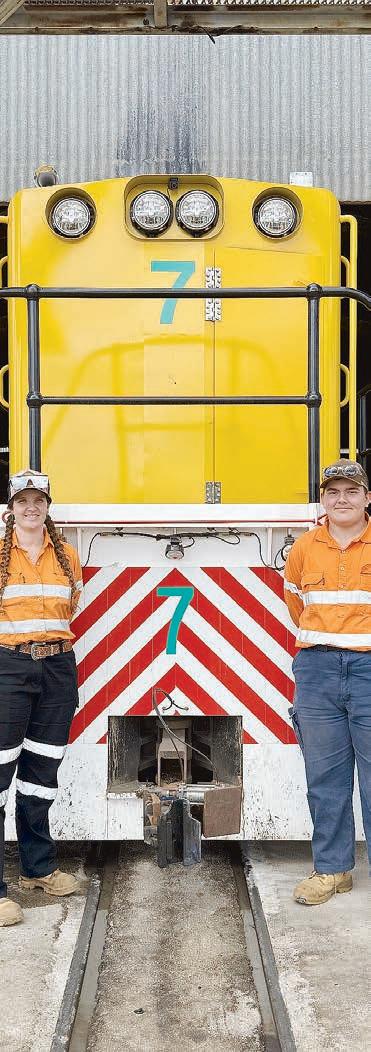
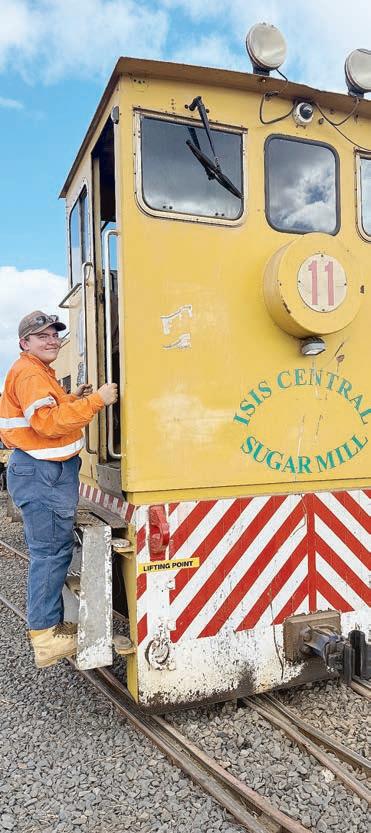
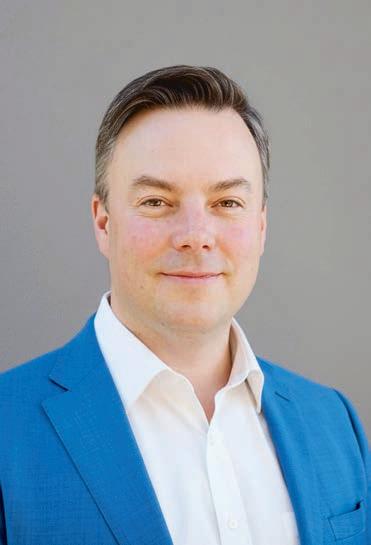
At the age of 18, Jake Archer is taking the next step in his life journey, taking on an apprenticeship at Isis Central Sugar Mill as a locomotive assistant.
Jake clearly remembers when he used to visit Bundaberg, his grandfather Kerry would tell him stories about the Isis Central Sugar Mill’s cane lines.
“I have welcomed the opportunity to get into a bigger industry like this and have the chance to progress higher and higher up to one day driving a cane train,” he said.
“My driver Riley Webb is really patient with me and she is always teaching me to do my role better.
“I love working with Riley and I appreciate the advice she gives me.”
One thing has always been clear to Jake in his teaching by Riley – that he always must be aware and remain safe when working on the cane line.
“She has also shared the importance of communication so nothing goes wrong and that means working with the driver.
“I also encourage the community during crushing season to stay vigilant and be aware around the cane railway and if you see a cane train coming, to always stop at the crossings.”
Although it is his first crush with Isis Central Sugar Mill, Jake is already building strong relationships and has appreciated being able to be a part of something bigger and such an integral industry to the Bundaberg region.
“I remember when my grandfather worked here, he would look forward to the crush as he would work with his brother as his driver and offsider.
“Working at the Isis Central Sugar Mill is a great job and I hope that I can be a driver one day like my grandfather and great uncle.”
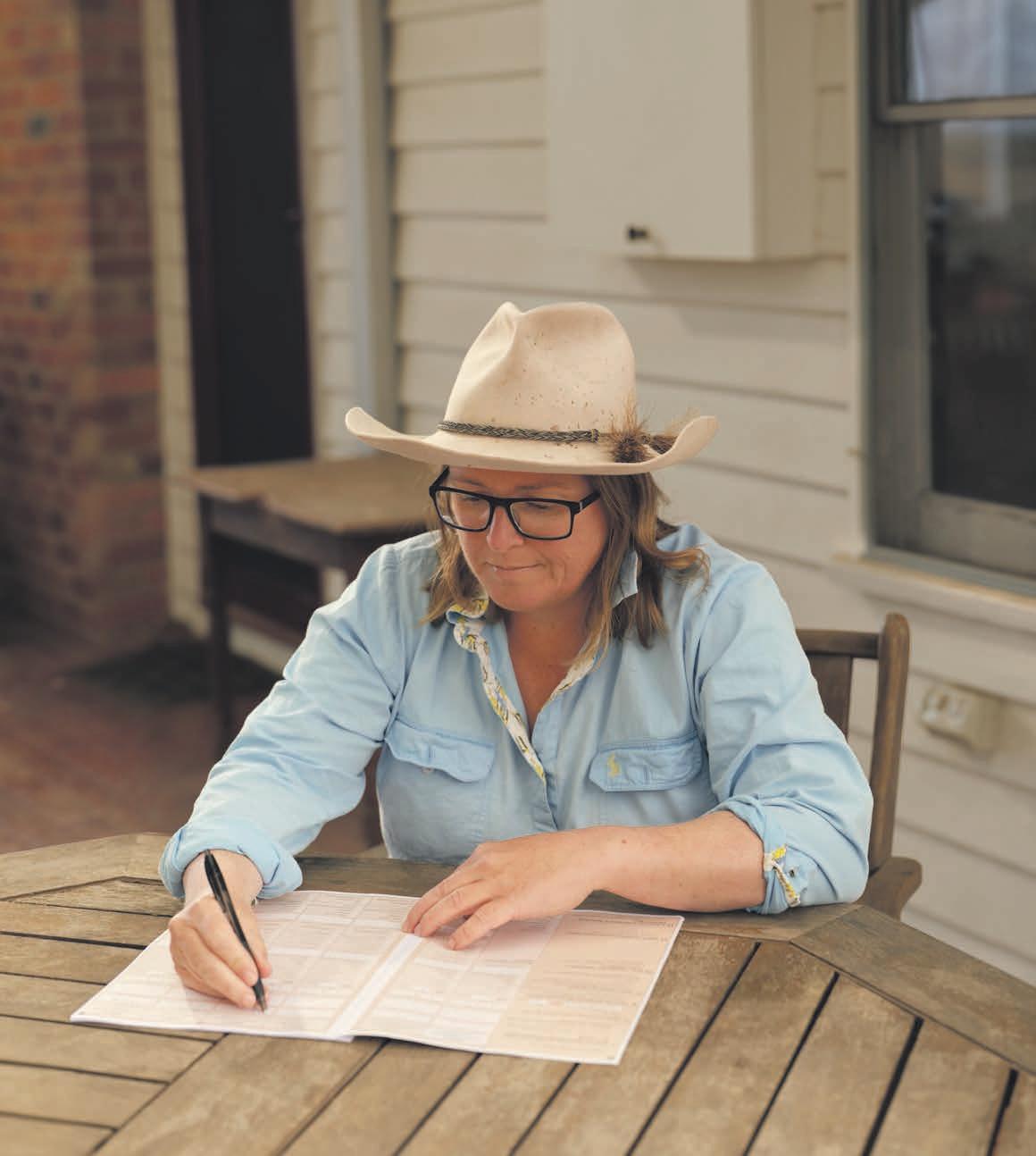
Every answer matters
If you know where you’ll be on Census night, Tuesday 11 August , you can complete the form for your household as soon as you get your instructions. Complete online, on paper or with help from us.
Isis Central Sugar Mill locomotive assistant Jake Archer is embracing his role and the opportunity to learn from driver Riley Webb. (Supplied)
Jake is continuing a family tradition through his being involved with Isis Central Sugar Mill.
Best beef stars on menu
By Fiona Gowers
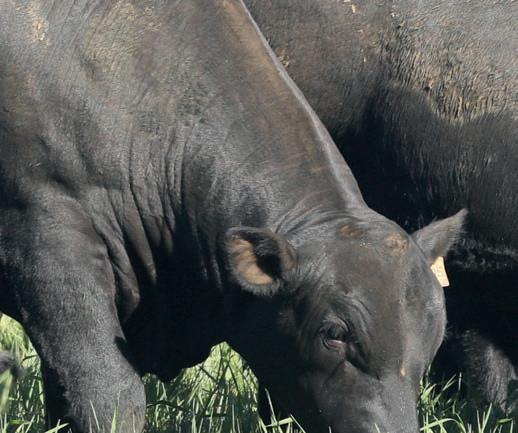
Award-winning local cattle from the Rockhampton Show are moving from the judging ring to the dining table, with two champion exhibits now being celebrated through a unique collaboration between Cocobrew and JBS Rockhampton.
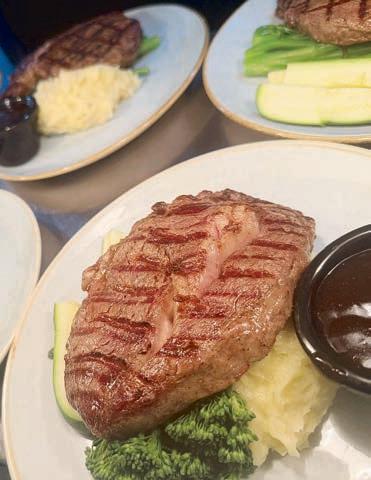
In a first for the region, Cocobrew bought the Rockhampton Show’s Grand Champion Exhibit and Grand Champion Pen after the June event, with the premium beef processed at JBS Rockhampton now featuring on a limited-time menu.
Cocobrew owner-manager Robin Adams said the initiative was about celebrating the region’s producers and giving the community the chance to experience the quality of beef produced locally.
“We saw this as a great opportunity to create genuine synergy supporting locals while show-
casing the very best our region has to offer,” Robin said.
“It’s a proud moment to see the producers, along with their friends and families, come in and enjoy the results of their hard work.”
The Grand Champion Exhibit was secured by fifth-generation Dingo producers Bill and Maxine Cragg, whose Droughtmaster bullock represented decades of family commitment to beef production.
“We are proud of our family’s agricultural legacy, which dates back to 1929 and remain committed to producing quality livestock while caring for the land for future generations,” Maxine said.
The Grand Champion Pen was awarded to Tom and Suzie Peacock, who run their Brahman cattle operation near Dululu, about 80km southwest of Rockhampton.
The win was a significant achievement for the producers, with the award-winning pen representing the final group of purebred Brahmans in their operation as they adapt to changing market conditions.
“Our award-winning pen represents the final group of purebred Brahmans in our operation, as changing market demands have led us to transition away from straight Brahman breeding,” Tom said.
“Winning this award was completely unexpected and we’re incredibly proud of what we’ve achieved. It’s rewarding to have our efforts recognised and it reinforces our commitment to continual improvement.”
For the producers, the collaboration has delivered a rare opportunity to enjoy the end result of years of breeding decisions, careful management
and hard work.
JBS Rockhampton Livestock Manager Don Tucker, who also judged at the Rockhampton Show, said the quality of the cattle was evident from the outset.
“I knew from the moment I saw these cattle that they were winners, their condition was impeccable. I am proud that local grass-fed cattle won up against grain-fed cattle that can typically grade more consistently,” Don said.
“As Presenting Partner of the Rockhampton Show, JBS is proud to support our local community. I encourage locals to get behind this initiative and experience the quality of this award-winning beef for themselves.”
The special Cocobrew menu launched in July, with bookings recommended via the Cocobrew website or by calling (07) 4837 3888.
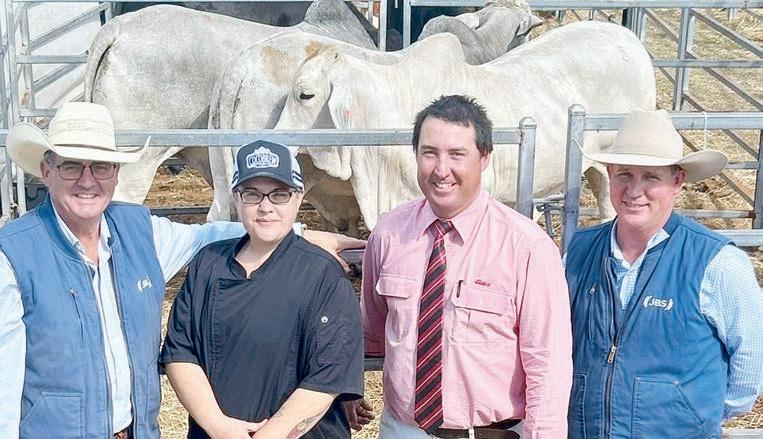
JBS Rockhampton livestock team Rick Kernke and Don Tucker with the chef from Cocobrew and Tom Peacock of Dululu, about 80km south-west of Rockhampton. They are pictured with the Peacock’s award-winning pen of Brahman Steers. (Supplied)
Don Tucker of JBS Livestock with Bill and Maxine Cragg and Suzie and Tom Peacock.
The Cocobrew menu special began in July.
Western Downs cleans up
By Fiona Gowers
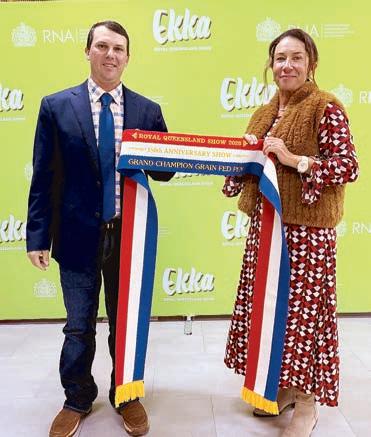
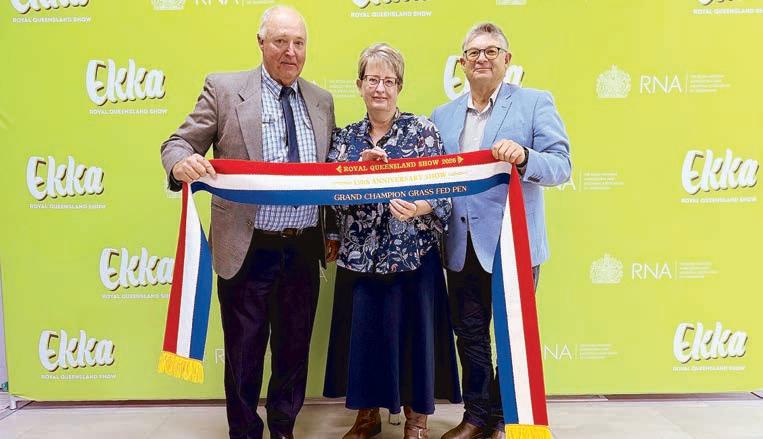
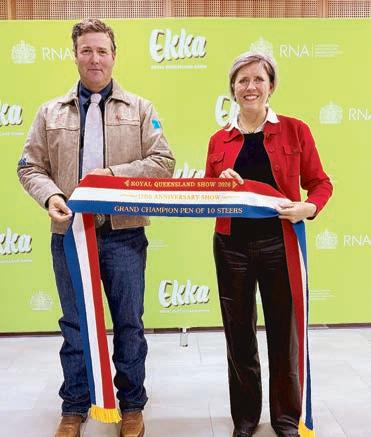
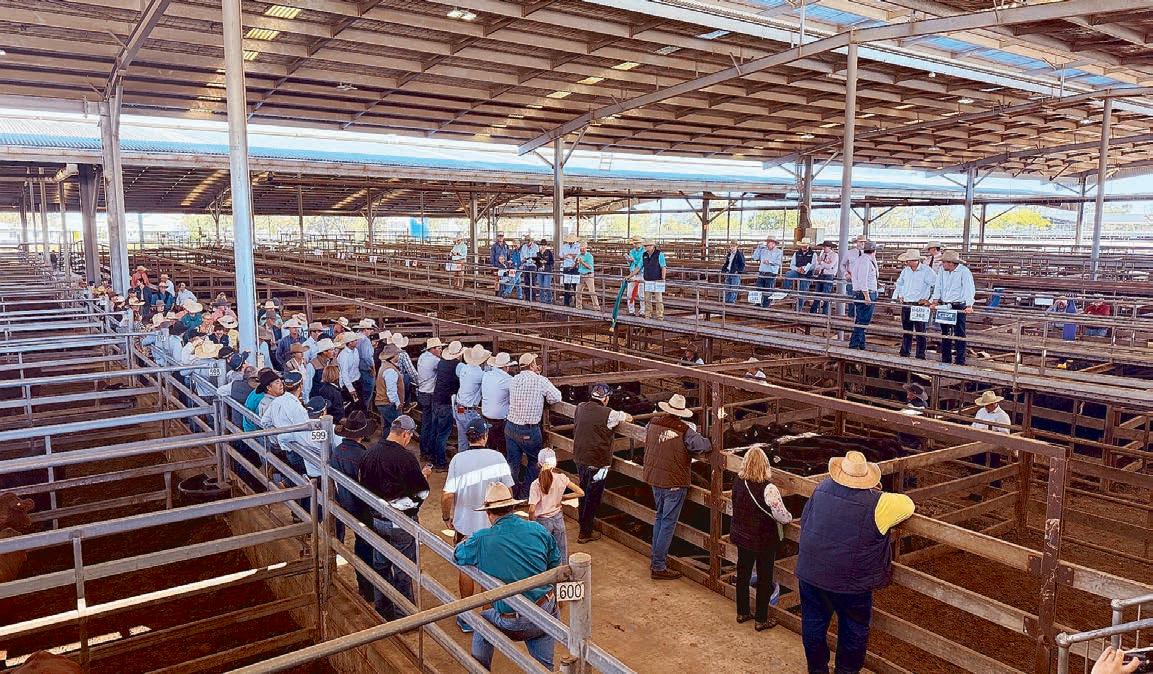
Western Downs beef producers have dominated the Royal Queensland Show’s (Ekka) Prime and Feeder cattle competitions, claiming all three Grand Champion titles at the Dalby Regional Saleyards.
More than $30,000 in prize money was awarded, with leading performances from Daryl McNamara (Tara), Talbingo Pastoral Company (Dalby) and KH & JC Knudsen (Chinchilla).
Daryl McNamara secured the Grand Champion Grass or Pasture Fed Pen with Angus cattle, while Talbingo Pastoral Company took out the Grand Champion Grain or Grain-Assisted Fed Pen with crossbred cattle.
In the newly introduced feeder classes, KH & JC Knudsen were awarded Grand Champion Pen of 10 for their Santa Gertrudis.
All three Grand Champion entries were sold through selling agent Grant Daniel Long.
The 2025 event marked a new chapter for the competition, relocating to Dalby for the first time following a one-year hiatus. The break allowed the RNA Beef Committee to redesign the competition to better reflect commercial industry practices.
The changes were met with strong industry support, with a record 907 head entered, up from 161 in 2024.
RNA Beef Committee Chair Gary Noller said the revamped format had strengthened the competition by better aligning it with commercial beef operations.
“The competition at Dalby Regional Saleyards is linked to a live sale, so the judging results have real commercial impact – strong performance can mean stronger prices for producers,” he said.
“The introduction of feeder classes has broadened the competition and made it more representative of the full beef supply chain.
“We’re also seeing more cattle entered in the competition coming from accredited feedlots, reflecting closer alignment with commercial beef production standards.
“The record number of entries this year shows the refreshed competition has been very well received by the beef industry.”
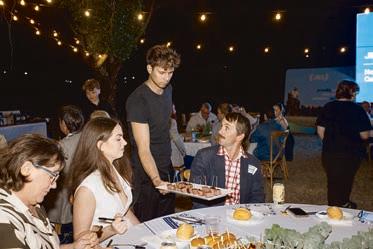
Winners will be celebrated at the Ekka’s inaugural Prime and Feeder Cattle Dinner in Dalby tonight, with more than 170 producers, feedlotters, processors, agents, exhibitors, sponsors and industry stakeholders expected to attend.
RESULTS
Grand Champions
• Grand Champion - Grass or Pasture Fed Pen: Daryl McNamara
• Grand Champion - Grain or Grain Assisted Fed Pen: Talbingo Pastoral Company
• Grand Champion - Pen of 10: KH & JC Knudsen Grass & Pasture Fed Pens of 3 Heifers presented by the Queensland Government, Department of Primary Industries
• Class 2 Pen of 3 Heifers – 431kg to 480kg
• 2nd: U8J Cattle Company
• 1st: The Robin Bruggeman Family Trust
• Reserve Champion - Pen of 3 Heifers Grass or Pasture fed: U8J Cattle Company
• Champion - Pen of 3 Heifers Grass or Pasture fed presented by the Queensland Government, Department of Primary Industries: The Robin Bruggeman Family Trust
Grass & Pasture Fed Pens of 3 Steers presented by the Queensland Government, Department of Primary Industries
• Class 5 Pen of 3 Steers – 431kg to 480kg
• 2nd: The Robin Bruggeman Family Trust
• 1st: The Robin Bruggeman Family Trust
• Class 6 Pen of 3 Steers – 481kg to 530kg
• 2nd: KH & JC Knudsen
• 1st: Daryl McNamara
• Reserve Champion - Pen of 3 Steers Grass or Pasture fed: Daryl McNamara
• Champion - Pen of 3 Steers Grass or Pasture fed presented by the Queensland Government, Department of Primary Industries: The Robin Bruggeman Family Trust
Grass & Pasture Fed Pens of 6 Steers
• Class 7 Pen of 6 Steers – 400kg to 530kg
• 1st: U8J Cattle Company
• Class 8 Pen of 6 Steers – 531kg to 620kg
• 3rd: KH & JC Knudsen
• 2nd: Mills Family
• 1st: Daryl McNamara
• Class 9 Pen of 6 Steers – 621kg to 740kg
• 3rd: KH & JC Knudsen
• 2nd: KH & JC Knudsen
• 1st: KH & JC Knudsen
• Reserve Champion - Pen of 6 Steers Grass or Pasture fed: KH & JC Knudsen
• Champion - Pen of 6 Steers Grass or Pasture fed: Daryl McNamara
Grain or Grain Assisted Fed Pens of 3 Heifers presented by the Queensland Government, Department of Primary Industries
• Class 10 Pen of 3 Heifers – 380kg to 430kg
• 3rd: Burke Group
• 2nd: Burke Group
• 1st: ANC Cattle Co
• Class 11 Pen of 3 Heifers – 431kg to 480kg
• 3rd: Waluca Farming
• 2nd : Waluca Farming
• 1st: ANC Cattle Co
• Class 12 Pen of 3 Heifers – 481kg to 530kg
• 3rd: TG & KR Apelt
• 2nd: Harvey Black Group
• 1st: JD & KL Wilkes
• Reserve Champion - Pen of 3 Heifers Grain or Grain Assisted Fed: ANC Cattle Co
• Champion - Pen of 3 Heifers Grain or Grain Assisted Fed: JD & KL Wilkes
Grain or Grain Assisted Fed Pens of 3 Steers presented by the Queensland Government, Department of Primary Industries
• Class 13 Pen of 3 Steers – 380kg to 430kg
• 3rd: G Morgan & Co
• 2nd: Ashley & Kellie & Kipp Shay Remy Barron
• 1st: Ben, Jess & Leo McMahon
• Class 14 Pen of 3 Steers – 431kg to 480kg
• 3rd: Darren Gunther
• 2nd: ANC Cattle Co
• 1st: Melanie Wellsteed
• Class 15 Pen of 3 Steers – 481kg to 530kg
• 3rd: Melanie Wellsteed
• 2nd: Harvey Black Group
• 1st: JD & KL Wilkes
• Reserve Champion - Pen of 3 Steers Grain or Grain Assisted Fed: Ben, Jess & Leo McMahon
• Champion - Pen of 3 Steers Grain or Grain Assisted Fed presented by the Queensland Government, Department of Primary Industries: JD & KL Wilkes
Grain or Grain Assisted Fed Pens of 6 Steers
• Class 17 Pen of 6 Steers – 531kg to 620kg
• 3rd: Harvey Black Group
• 2nd: Golden Pastoral Holdings
• 1st: G Morgan & Co
• Class 18 Pen of 6 Steers – 621kg to 740kg
• 3rd: Condabri Beef
• 2nd: Talbingo Pastoral Company
• 1st: Talbingo Pastoral Company
• Reserve Champion - Pen of 6 Steers Grain or Grain Assisted Fed: Talbingo Pastoral Company
• Champion - Pen of 6 Steers Grain or Grain Assisted Fed: Talbingo Pastoral Company Feeder Pens of 10 Heifers
• Class 19 Pen of 10 Heifers – 320kg to 400kg
• 3rd: Bidson Pastoral Company
• 2nd: Redford station - ACC
• 1st: C & J Varidel Trading
• Reserve Champion - Pen of 10 Heifers: Redford station – ACC
• Champion - Pen of 10 Heifers: C & J Varidel Trading Feeder Pens of 10 Steers
• Class 21 Pen of 10 Steers – 320kg to 400kg
• 3rd: Barb and Phil Neilley
• 2nd: C & J Varidel Trading
• 1st: Barb and Phil Neilley
• Class 22 Pen of 10 Steers – 401kg to 500kg
• 3rd: KH & JC Knudsen
• 2nd: RJ & FM Duff
• 1st: Merv Slack
• Reserve Champion - Pen of 10 Steers: Barb and Phil Neilley
• Champion - Pen of 10 Steers: KH & JC
Knudsen.
Anthony O’Dwyer and RNA Councillor Anna Ahern at the Royal Queensland Show’s (Ekka) Prime and Feeder cattle competitions.
Ken Knudsen and RNA Councillor Jane Onley at the Royal Queensland Show’s (Ekka) Prime and Feeder cattle competitions.
Daryl McNamara, Sharon McNamara and RNA Beef Committee Chair Gary Noller at the Royal Queensland Show’s (Ekka) Prime and Feeder cattle competitions.
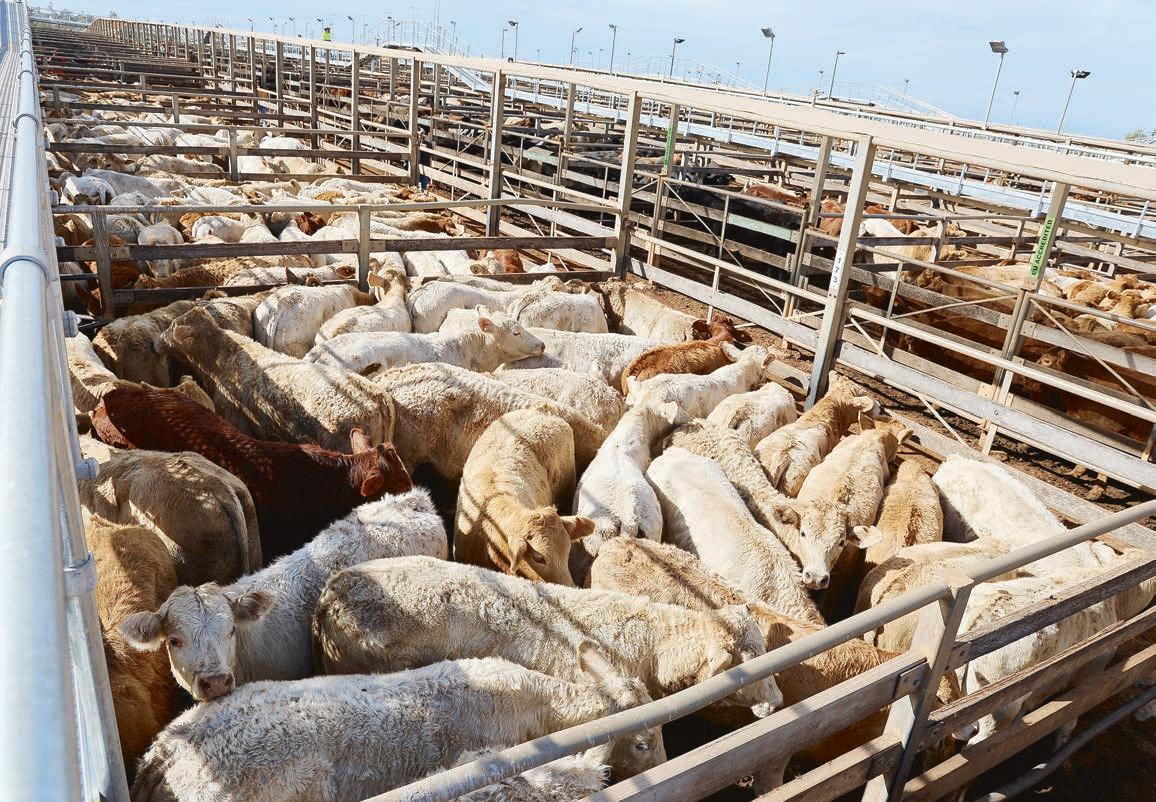
The Dalby Saleyards during the Royal Queensland Show’s (Ekka) Prime and Feeder cattle competitions. (Supplied)
The spread of Varroa mite in European honeybees is proving to be an ongoing concern for the bee industry, with the Barambah Beekeepers Association also battling the issue and trying to deal with it.
Department of Primary Industries (DPI) Appointed Bee Biosecurity Officer within the Barambah Beekeepers Association Steve Bliss said the problem was complex.
While the origin of two incursions of Varroa mite species in Australia remains unclear, Mr Bliss said he had been involved in the fight against it since August 2022.
His work has included volunteering in the Hunter Valley, and more recently as a DPI volunteer beekeeper with an Asian honeybee incursion at the Port of Brisbane.
Mr Bliss said there were two types of mites in the region, with one resistant to synthetic chemicals, while the other type wasn’t.
He said there were ongoing costs for treatments and surveillance, and there were synthetic and organic approved treatments that could be used.
“There are also other Integrated Pest Management non-chemical techniques like forced brood breaks, drone trapping and sticky mat screened bases,” he said.
Mr Bliss said the Barambah Beekeepers Association had four hives in its apiary, while there were around 10,500 registered recreational beekeepers in Queensland.
“In the Barambah Beekeepers’ training apiary, we have been forced to apply synthetic Bayvarol strips, to knock down high mite numbers,” he said.
“Then we could fall back to using organic products currently, such as Oxalic Acid strips and vaporisation, which are easier on the bees.
“All treatments – even organic – do affect bees however.”
Mr Bliss said Varroa mite management was increasing costs for recreational and commercial beekeepers.
“If you don’t get on top of mites you can lose
your hives, with knock-on effects like reduced pollination, as feral bees die out,” he said.
“Australia has large numbers of feral bees which reside in mature forest trees, and not managed by beekeepers.
“They’ll be most susceptible to mites.”
To support and assist the local beekeeping industry, Mr Bliss recommended buying honey from local beekeepers or ensuring the honey was marked 100 per cent Australian.
Asked if there was anything which people could do at home including in the garden, Mr Bliss suggested planting Australian flowering natives suited to local climatic conditions.
“Avoid use of insect or plant pest sprays if possible, as bees can be poisoned easily,” he said.
A few weeks ago the State Government partnered with the Australian Honey Bee Industry Council (AHBIC) and the Queensland Beekeepers Association (QBA) to host a honey bee industry roundtable, to discuss the impacts of Varroa mite and miticide resistance.
The discussion came in the wake of the rising impact of Varroa mite and the emerging resistance of the mites to chemical treatments on beekeepers, pollination services and pollination-dependent industries. Minister for Primary Industries Tony Perrett said it was an important opportunity to have all the key players together to work out a coordinated, practical approach.
“The Honey Bee Industry Emergency Roundtable was a chance to bring forward practical ideas, prioritise actions, and work collectively across industries and different levels of government towards one united goal: ensuring the resilience of the beekeeping sector and the essential pollination services it provides,” Mr Perrett said.
“The pressures of Varroa mite and rising miticide resistance are creating real uncertainty for beekeepers, and the Government is committed to supporting a strong future, for the industry that is vital for food security, by working closely with stakeholders to develop practical solutions.
“Noting this is a national issue, long-term success will depend on ongoing collaboration between
industry, jurisdictions and the Australian government.”
University of the Sunshine Coast School of Health Chair in Pathophysiology and Associate Dean (Research) Professor Robert Harvey said his research would potentially target Varroa mites without effects on honeybees.
“With Varroa mites becoming increasingly resistant to existing chemical pesticides, we are exploring alternative ways to combat them,” Dr Harvey said.
“One new technology is RNA-based technology that switch off specific genes that mites need to survive, without creating genetically modified organisms.
“Our research group is exploring a strategy that targets key genes required for the mite’s nervous system or muscles.
“These target the same receptors and ion channels affected by existing chemical miticides, but RNA-based treatments will provide greater specificity and will not harm honeybees and other beneficial insects.”
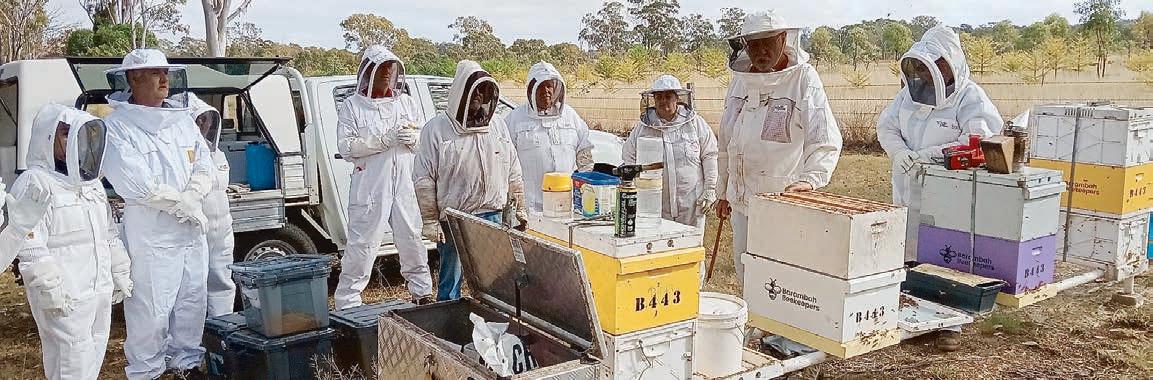
The Barambah Beekeepers Association held an ‘introduction to beekeeping course’ earlier this year, while issues persist regarding Varroa mite. (Supplied)
LifeFlight reveals Queensland’s most popular driving routes
Best spots to hit the road
Whether it’s a weekend escape or a bucket-list adventure, road trips remain one of the most popular ways for Australians to explore the country.
With Queensland offering everything from tropical coastlines and ancient rainforests to vast outback landscapes, travellers have no shortage of routes to choose from.
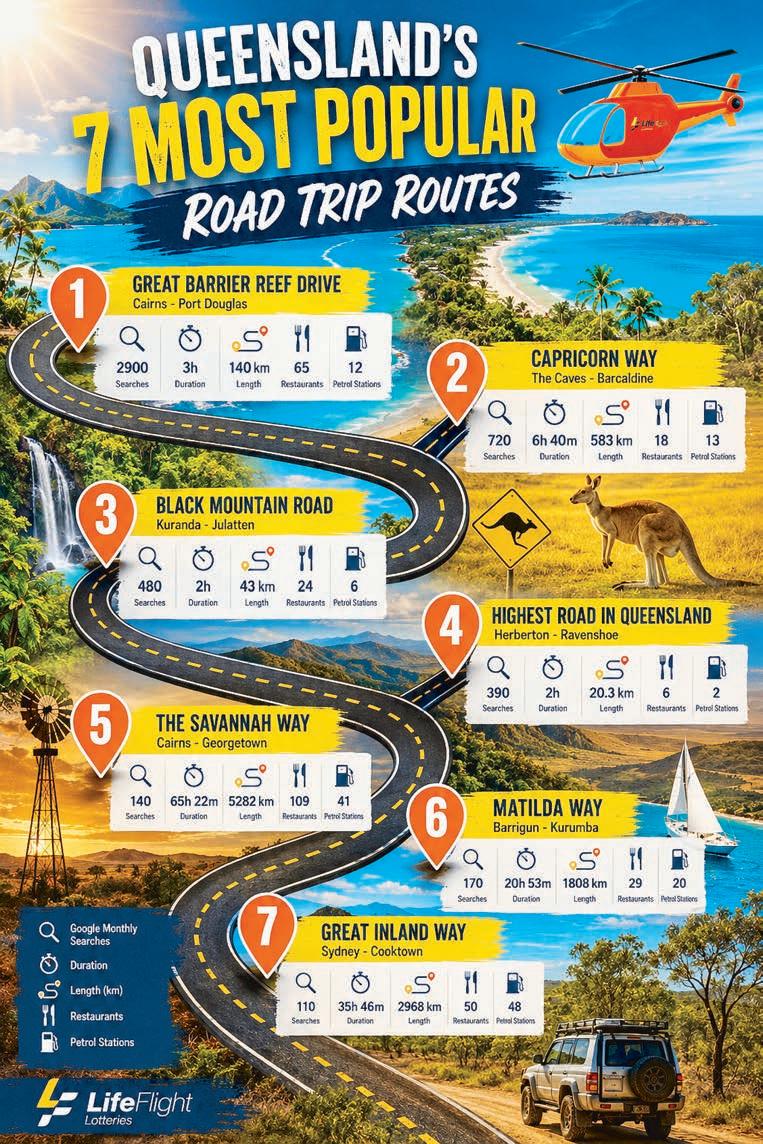
The study by LifeLight Lotteries ranked Queensland’s most popular road trips by analysing average monthly Google search volumes alongside route data.
The research also includes expert commentary on how to stay safe during a road trip so everyone can enjoy the experience to the fullest.
1. Great Barrier Reef Drive
Claiming the top spot as Queensland’s most popular road trip, the Great Barrier Reef Drive between Cairns and Port Douglas attracts an average of 2900 Google searches every month. The 140km route can be completed in around three hours and features 65 restaurants and 12 petrol stations along the way, making it one of the state’s most accessible and traveller-friendly drives.
Must See: Palm Cove, Ellis Beach, Rex Lookout, Mossman Gorge, Four Mile Beach, Daintree Rainforest and Cape Tribulation.
2. Capricorn Way
Securing second place in the ranking, Capricorn Way attracts an average of 720 Google searches each month from travellers eager to explore Queensland’s heartland. Stretching 583km between The Caves and Barcaldine, the route takes about six hours and 40 minutes to complete and features 18 restaurants and 13 petrol stations along the way. Capricorn Way offers a classic Queensland road trip experience beyond the state’s well-known coastline.
Must See: Capricorn Caves, Blackdown Tableland National Park, Emerald, Sapphire Gem-
fields, Lake Maraboon and the Tree of Knowledge in Barcaldine.
3. Black Mountain Road
Taking third place, Black Mountain Road attracts around 480 monthly Google searches despite being one of the shortest drives in the ranking. Covering just 43km between Kuranda and Julatten, the route can be completed in around two hours and features 24 restaurants and six petrol stations. Its popularity is driven by spectacular rainforest scenery, winding mountain roads and easy access to some of Tropical North Queensland’s most celebrated natural attractions.
Must See: Kuranda Village, Barron Falls, Skyrail Rainforest Cableway, Black Mountain National Park, Mount Molloy and Julatten.
4. Highest Road in Queensland
Ranking fourth overall, the Highest Road in Queensland generates an average of 390 Google searches every month. Although the route spans only 20.3km between Herberton and Ravenshoe, it offers a unique journey through Queensland’s highest sealed road and can be explored in around two hours. Along the way, travellers will find six restaurants and two petrol stations, as well as sweeping views across the Atherton Tablelands.
Must See: Herberton Historic Village, Millstream Falls, Windy Hill Wind Farm, Ravenshoe and Tully Falls National Park.
5. Matilda Way
Earning fifth place in the rankings, Matilda Way attracts about 170 monthly Google searches from travellers seeking an authentic outback adventure. Stretching 808km from Barrigun to Karumba, the route requires almost 21 hours of driving and is supported by 29 restaurants and 20 petrol stations. The route showcases the landscapes, stories and pioneering heritage that helped shape the Australian outback.
Must See: Charleville Cosmos Centre, Blackall Woolscour, Longreach, Australian Stockman’s Hall of Fame, Qantas Founders Museum, Winton and Karumba Sunset Point.
Medical Educator Shares Emergency Tips
With many of Queensland’s popular road trips taking travellers through regional, rural and remote areas, help may take longer to arrive. In those moments, simple actions taken by bystanders, friends or family members can make a real difference while emergency services are on the way.
LifeFlight First Minutes Matter regional medical educator Tim said preparation should include knowing how to respond in a medical or roadside emergency.
“Road trips are a great way to explore Queensland, but emergencies can happen anywhere — on the roadside, at a rest stop, at a campsite, or in an area with limited phone reception,” Tim said.
“The first few minutes after an incident can feel overwhelming, but simple actions matter.
“Knowing how to call Triple Zero (000), give your exact location, identifying and controlling serious bleeding and supporting a person’s airway who is unwell can make a real difference until help arrives.”
To help more Queenslanders build these skills, LifeFlight delivers the First Minutes Matter program — a practical, free education initiative that gives people the confidence to act in the moments that matter most, before emergency services arrive.
Fast Facts
• The Great Barrier Reef Drive is Queensland’s favourite road trip, attracting 2900 monthly Google searches, more than four times the search volume of second-placed Capricorn Way (720 searches).
• Travellers are searching for routes ranging from the 20.3-kilometre Highest Road in Queensland to the 5282km Savannah Way.
• The first minutes after an emergency matter, knowing how to call Triple Zero (000), give your exact location, carry basic first-aid supplies and support someone until help arrives can make a real difference.
Road trips remain one of the most popular ways for Australians to explore the country. (Oppidanus Digital Marketing)
Building on family legacy
By Fiona Gowers
Sixth generation graziers Luke and Jake Anning are carving their own path in the cattle industry while continuing the family legacy at Wongalee Station, north of Hughenden.
Located about 40 kilometres from town in North Queensland’s grazing country, Wongalee has been home to the Anning family for decades, with the brothers now balancing their own enterprises alongside the broader family operation.
Having grown up on the property, both Luke and Jake were immersed in livestock production from an early age, gradually taking on responsibility within the business.
“I was given the opportunity by my parents to run a few cows in a paddock here,” Luke said. Keen to expand beyond the family herd, the brothers explored ways to establish independent operations while remaining on the property, a step they say required both financial backing and careful planning.
Looking to establish independent enterprises, both brothers turned to the Queensland Rural and Industry Development Authority (QRIDA) for support.
“I heard about QRIDA through a friend, so I contacted them and they got me started on the First Start Loan to purchase a few cows,” he said. Jake followed a similar path, using the program to overcome the common hurdle of limited capital.
“I was asset poor and they were taking the existing cattle I had as security,” Jake said.
Through QRIDA’s First Start Loan program, the pair was able to build their own herds while continuing to contribute to the family business, a model increasingly adopted by young producers navigating succession and expansion.
QRIDA Regional Area Manager Sam Fryer worked closely with the brothers throughout the application process, including on-property visits to review cash flow projections and business plans.
“When it came to all the bookwork, Sam was pointing us in the right direction,” Jake said.
The brothers acknowledged the additional administrative demands involved but said the long-
term benefits outweighed the effort, particularly in building a viable business structure from the outset.
Mr Fryer said both brothers demonstrated strong business capability.
“Jake and Luke were able to access the concessional loan rate, which has greatly helped their businesses achieve success,” he said.
Luke said QRIDA’s support had been key to progressing their agricultural careers.
“I would definitely recommend QRIDA,“ he said. “You can approach them, you can talk to them.
“They’re at a lot of the events that are around, so you can always go up to them and pick their brains about what the interest rates are and what the process is like.”
Mr Fryer said the program was designed to support new entrants to agriculture.
“Whether you’re in a family operation, wheth-
er you’re going through succession or whether you’re looking to start out on your own, the First Start program is a great program for people looking to get into agriculture,” he said.
Luke said the organisation’s role extended beyond finance.
“QRIDA seems to be very encouraging to not just pay back their loans,“ he said.
“They want you to grow, they want you to prosper in this industry that we love.”
QRIDA’s Regional Area Manager for the North West and Gulf, Sam Fryer chats with Luke and Jake Anning.
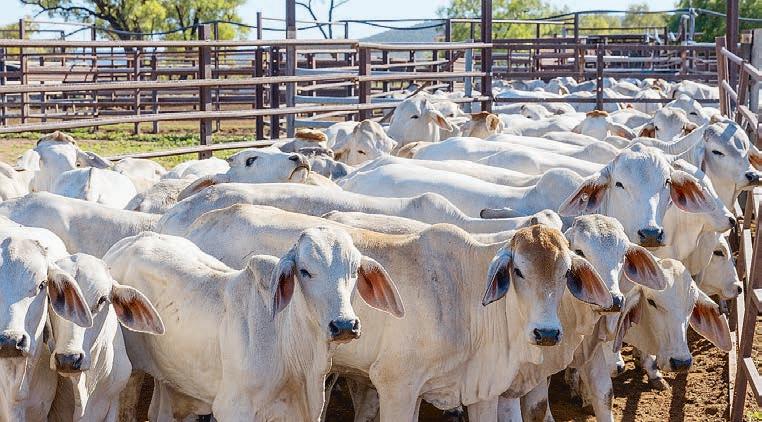
Young grey Brahmans in a cattle yard at Wongalee Station.
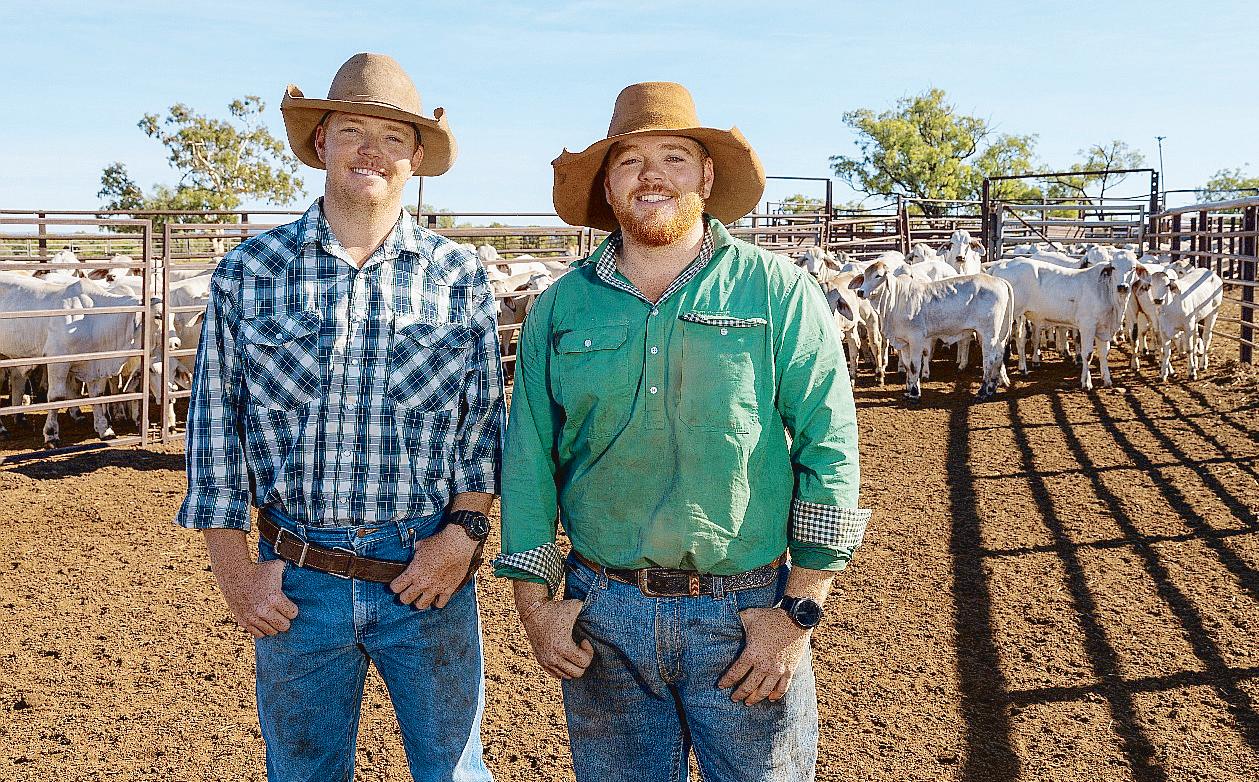
Luke and Jake Anning standing in a cattle yard on Wongalee Station. (Supplied)
BEN NEVIS
They’re Queensland-ready
Ben Nevis genetics have spread across Australia with repeat buyers from as far south as King Island and Tasmania, to Oodnadatta, Alice Springs and up into Queensland above the tick line as well as WA.
Established in 1947 the stud is a fourth generation family business that features regularly in Angus Australia’s top 10 sales as well as ACM’s top 10 Studs All Breeds (2024).
This year’s autumn in the New England led to a record sell-off of cows and rather than reduce bull numbers Ben Nevis have decided to meet the market which they maintain will create more opportunity for buyers.
When asked the key to their success Stu and Erica Halliday maintain that because they sell the bulls as yearlings (12mo-18mo), it helps them adapt better to whatever environment they go to. Their cows endure a harsh New England winter every year with bracing conditions and no grass growth and that’s a great testing ground for genetics that do better when the going gets tough. According to Stu ‘we simply multiple those genetics and put in over 150 embryos a year to do that”
While they set the bulls up with early weaning to promote rumen development for life, their de-
cision 20 years ago to actively select animals with a slick coat has paid dividends and has since been demanded by their QLD and outback clients. According to Erica ‘the added bonus of a slick coat is that those heifers clean up and breed first coming into the spring. Incidentally they tend to marble better too which makes sense as they were the ones the old timers said were good eating.”
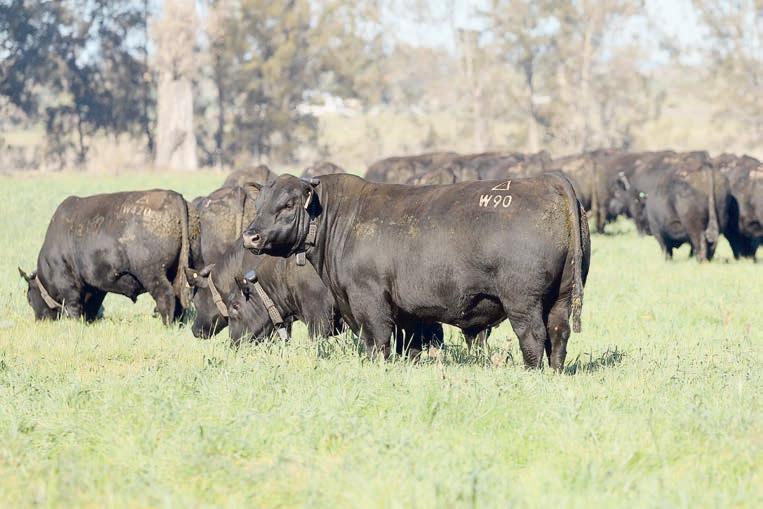
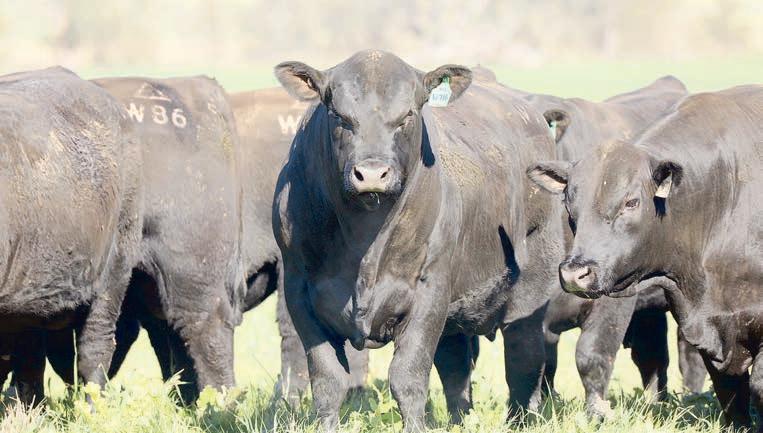
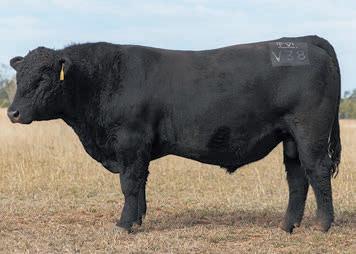
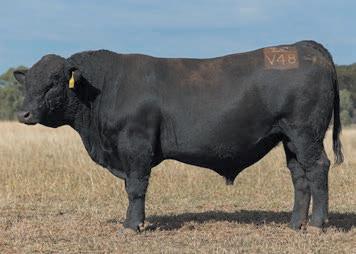
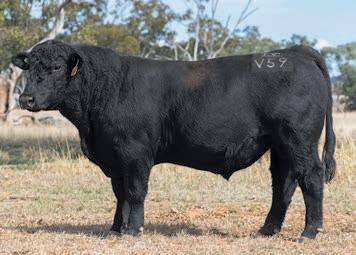
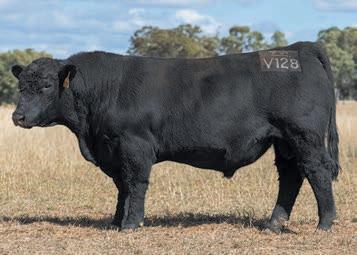
This years’ Ben Nevis lineup includes over 100 bulls at auction including sixty-five 18mo and fourty 12 mo bulls by industry heavyweights LVVF Tanker, Dunoon Sunstone, Ben Nevis Rambo and Millah Murrah Tiny Dancer.
The bulls are thick, well grown and QLD ready having already been blooded, vaccinated for 3 Day as well as Vibrio, Pesti and 5 in 1. They have passed semen testing including morphology (Chris Hallet BVSc MVSt). They have been independently assessed for Coat Type and Temperament as well as structure and ultrasound carcase scanning by Roger Evans (Accred No 1018).
Ninety seven percent of bulls in the sale have a temperament score of 1, the highest achievable for temperament and seventy six percent of the bulls have a Coat Score of 2 which is suitable for QLD. Delivery is free to major centres. Inspection are invited.
0N9A7982mktg.
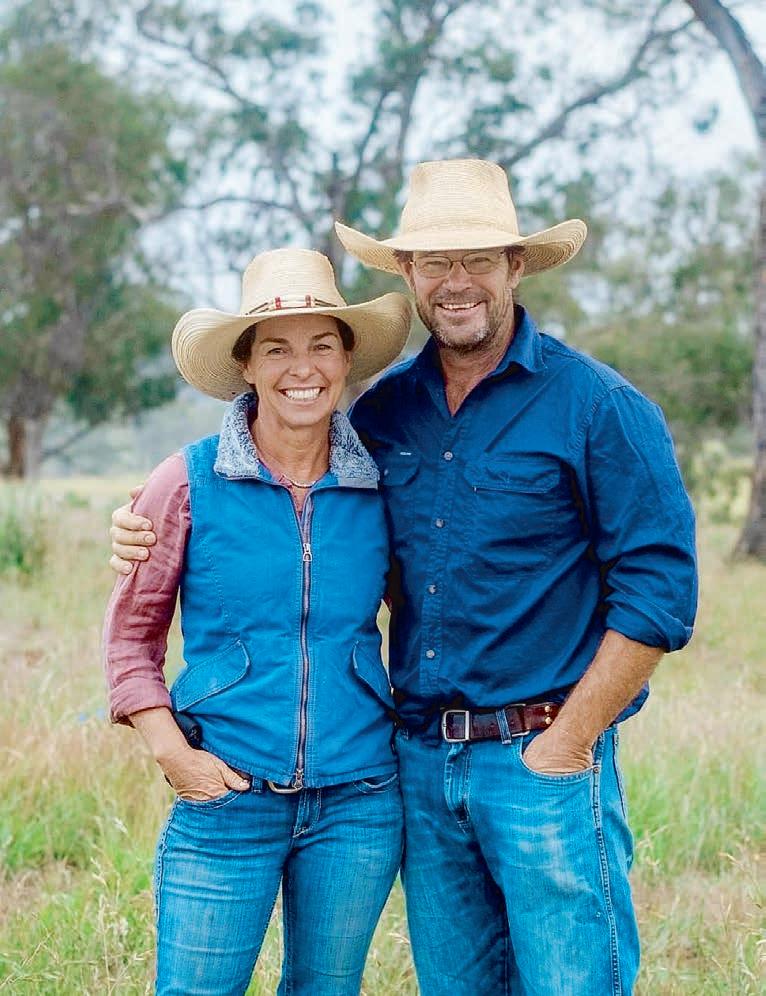
Stu and Erica Halliday, Ben Nevis Angus. (Supplied)
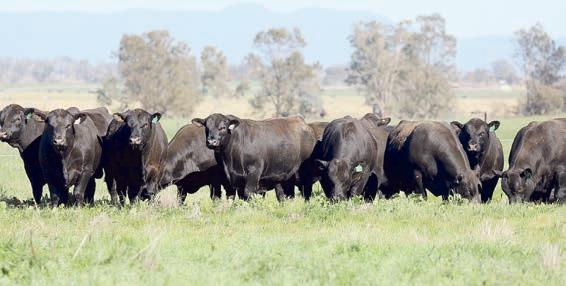
The bulls are thick, well grown and QLD ready having already been blooded, vaccinated for 3 Day as well as Vibrio, Pesti and 5 in 1.
NQ showcases beef quality
By Fiona Gowers
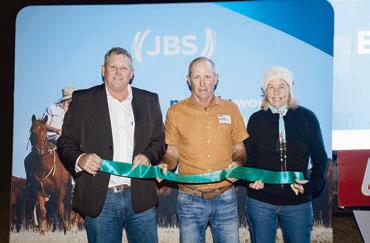
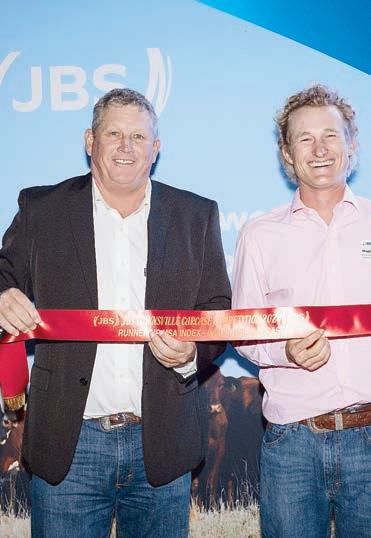
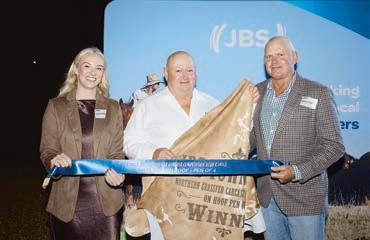
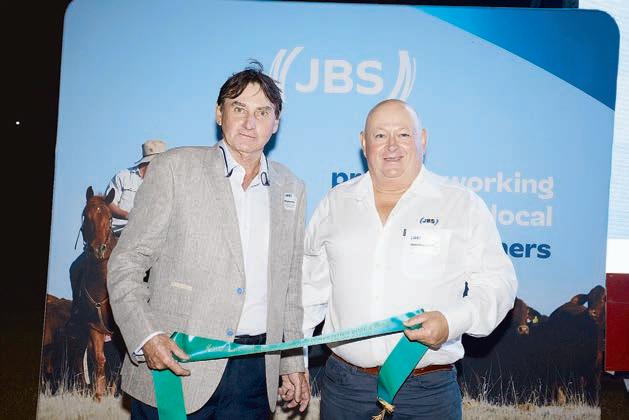
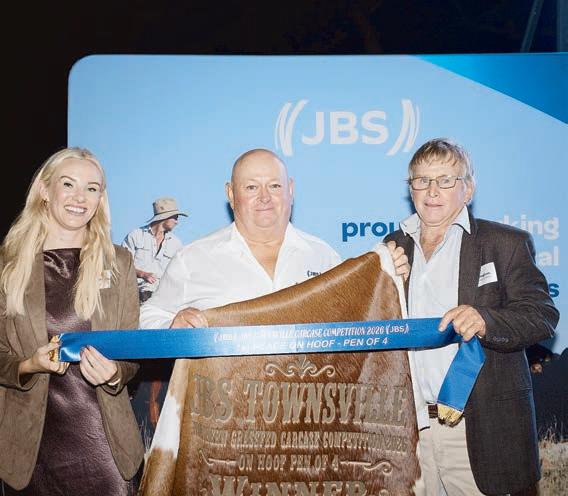
North Queensland producers have showcased the region’s beef quality at the annual JBS Townsville Carcase Competition, with top performers recognised across a range of classes.
Hosted by Australia’s largest beef processor, JBS, the competition allows producers to enter pens of cattle for carcase grading and benchmarking against regional peers, rewarding excellence in meat quality and compliance.
Now in its fourth year, the event has become a key fixture on the industry calendar, culminating in an awards night at the Townsville Turf Club.
Alongside recognising standout cattle, the competition provides valuable feedback to help producers refine their operations.
Judges noted the high standard of entries across all six classes, with only narrow margins separating placegetters.
Highest MSA Index | Individual Carcase | HGP Treated
• Champion: BINNIE JD & CM
• Reserve Champion: BALL TR & KE JBS Producer Compliance Order
• Champion: BALL TR & KE
• Reserve Champion: BETHEL AJ & CM
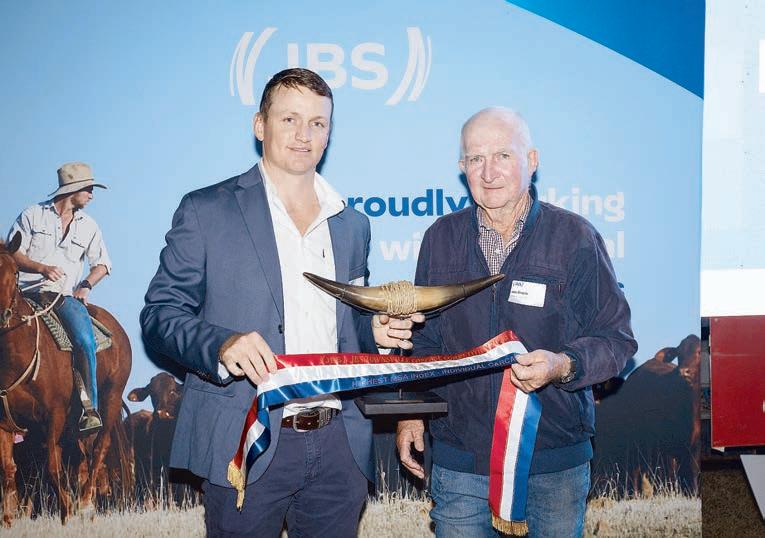
Hughenden producers Alan and Carmel Bethel were among the standout performers, securing multiple placings across categories, including champion for Highest MSA Index Individual Carcase (HGP Free).
22ND ANNIVERSARY SALE
SATURDAY 29TH AUGUST 2026
“We’ve supplied JBS for more than a decade, so it’s incredibly rewarding to see that consistency of our herd recognised across the different measures,” Carmel said.
JBS Townsville Livestock Manager Aaron Adcock said the competition continued to highlight the strength of the northern industry.
“This competition highlights the strength and consistency of livestock coming out of North Queensland, while also giving producers mean-
ingful data to support on-farm decision-making,” Mr Adcock said.
“It’s great to see such strong engagement from producers committed to delivering quality outcomes and I congratulate all entrants and placegetters on their achievements.”
A blind tasting of five breeds entered in the competition was also held, with Angus X named champion based on flavour, texture, taste, appearance and overall liking.
Breed sampling at the JBS Townsville Carcase Competition.
Highest MSA Index, Individual Carcase, HGP Free - Champion: Allen and Carmel Bethel (right) with Aaron Adcock of JBS.
The JBS team at the JBS Townsville Carcase Competition.
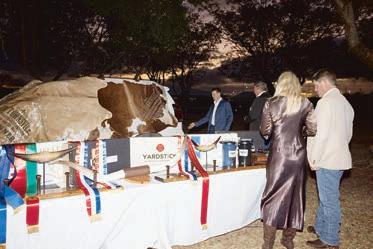
Prizes at the JBS Townsville Carcase Competition.
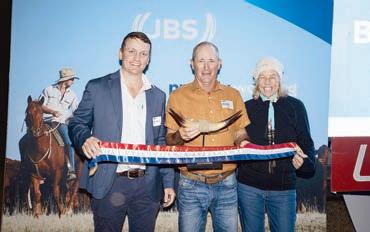
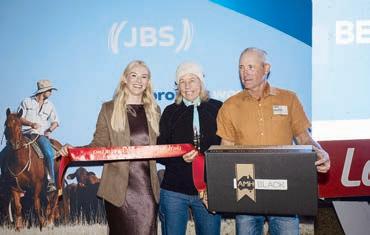
JBS Producer Compliance Order - Reserve Champion: Carmel and Allen Bethel with Cait Barton of JBS.
On Hook Carcase, Pen Of Three, HGP FreeRunner Up: Allen and Carmel Bethel with Simon Fraser of JBS.
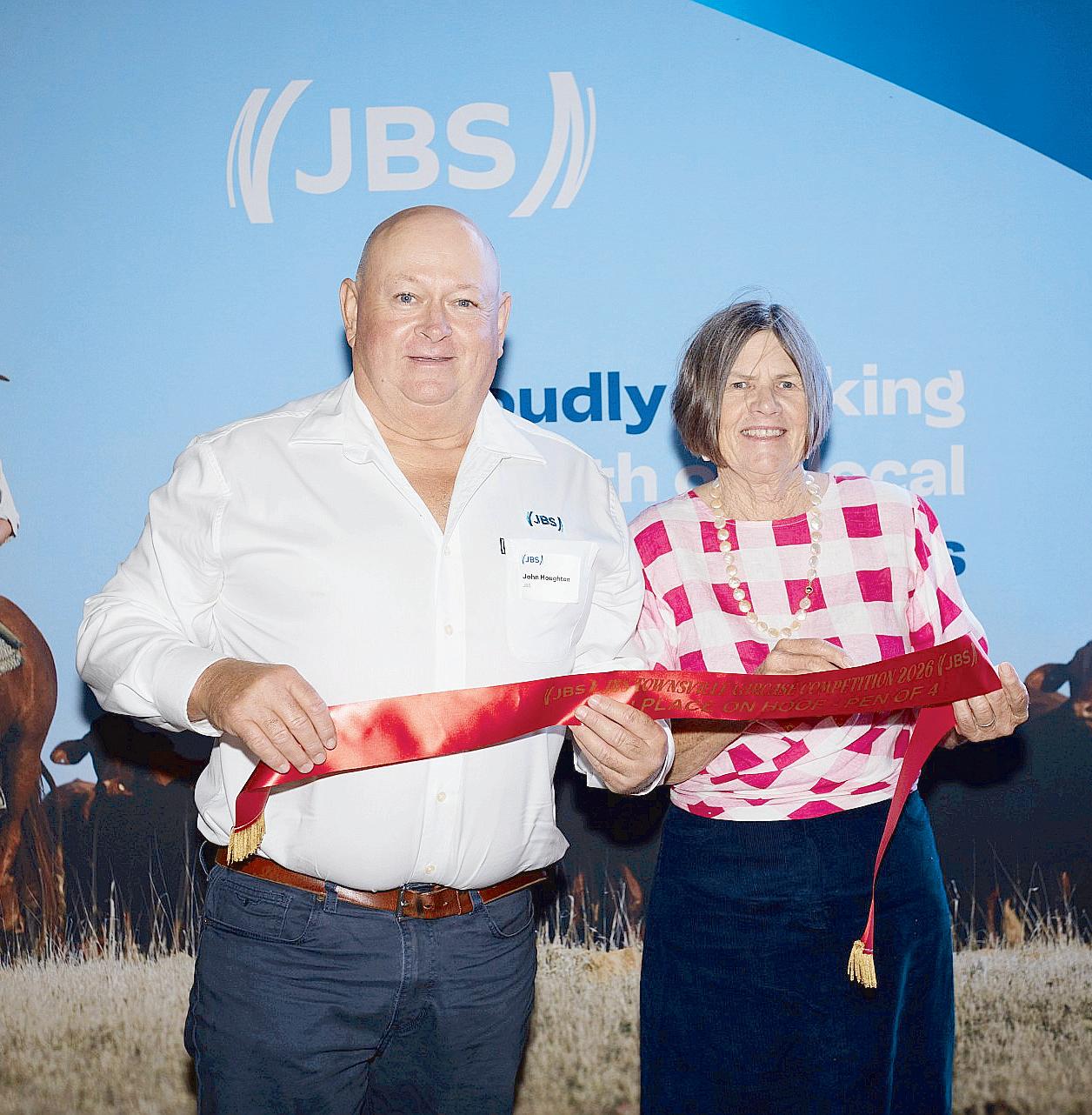
On The Hoof, Pen Of Four HGP Free - Champion: Stephen Smith (right) with Cait Barton and John Houghton of JBS.
On Hook Carcase, Pen Of Three, HGP FreeReserve Champion: Hugh Fernie with Simon Fraser of JBS. (Supplied)
Highest MSA Index, Individual Carcase, HGP Treated - Champion: Jim Binnie with Aaron Adcock of JBS. (Supplied)
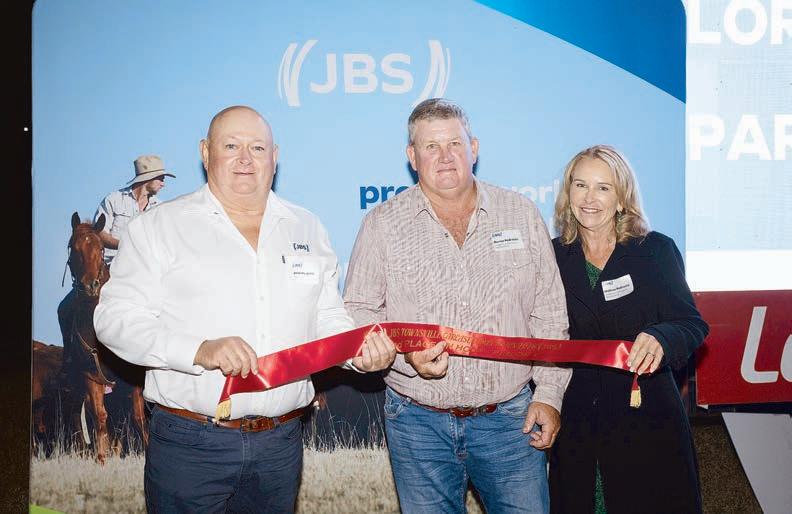
HGP Treated - Reserve Champion: Darren and Melissa Pedracini with John Houghton of JBS.
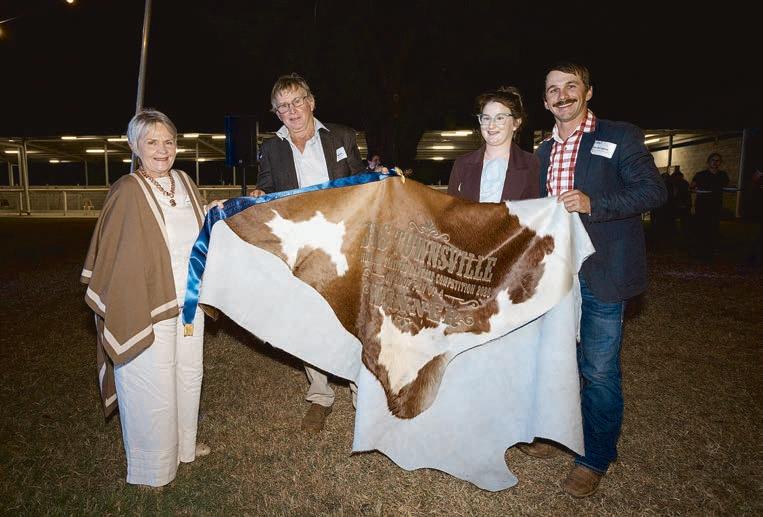
Sponsor Py Porter with class three champion, the Magee family.
On The Hoof, Pen Of Four, HGP Free - Reserve Champion: Alicia Magee with John Houghton of JBS. (Supplied)
On The Hoof, Pen Of Four, HGP Treated - Champion: Max Allingham (right) with Cait Barton and John Houghton of JBS.
On The Hoof, Pen Of Four, HGP Free - Runner Up: Peter Woollett with John Houghton of JBS.
Wattle Grove goes monthly
Long known as Wattle Grove Speckle Park, the Tamworth and Oberon-based operation has rebranded as Wattle Grove Cattle Company (WGCC) — reflecting a broader breeding program that now spans Speckle Park, Brangus and the proprietary Auspeck composite.
Alongside the new name comes a bigger change: from July 2026, WGCC is moving away from its traditional annual stud sale in favour of a monthly genetics offering, held every third Friday through the AuctionsPlus Weekly Cattle Stud and Genetics Sale. The shift responds to how buyers are actually operating in today’s market. With input costs still high and cash flow tighter than forecasts once suggested, committing an entire program to a single sale date has become an increasingly hard ask for many producers.
“Good genetics shouldn’t come with a oncea-year deadline,” say co-owners Dale and Bin Humphries. “We wanted buyers to be able to purchase when their budget allows and their program needs it — not when the calendar dictates.”
Each month’s offering will include stud bulls, stud females, semen packages and embryo packages. The July round marked the launch of the new format, with eleven more offerings to follow through June 2027.
Subscribers to the WGCC mailing list get first access to each month’s lots before they go live on AuctionsPlus. Subscribe at www.wattlegrovespecklepark.com.au
MONTHLY STUD CATTLE & GENETICS SALE BULLS
| FEMALES | SEMEN | EMBRYOS
Scholarship tackles ‘postcode penalty’
By Fiona Gowers
The Spirit of the Bush foundation has launched a new scholarship aimed at tackling the “postcode penalty” faced by rural families accessing education.
The foundation - a new charity established by the team behind the Boarding School Collective - has also announced its inaugural board, which will guide the organisation towards its official launch later this year.
has never felt realistic, as much as those already navigating it.
The evening featured Spirit of the Bush Foundation board members Bryce Camm AM (Camm Agricultural Group) and Oli Le Lievre (Humans of Agriculture) and was emceed by former Queensland chief entrepreneur and proud Goondiwindi champion, Julia Spicer.
Boarding School Collective director Amanda Ferrari said the (event) aimed to provide trusted information and support for families.
Friday 17 July 2026 Friday 21 August 2026 Friday 18 September 2026 Friday 16 October 2026
The board includes Grace Brennan (Buy From The Bush), Bryce Camm AM (Camm Agricultural Group), Oli Le Lievre (Humans of Agriculture), Moira Lanzarin (ICPA NT former president), Emily Harris (Cleveland Agriculture, Mungindi) and Lucy Thomas (W A Baxter & Co Lawyers).
The foundation’s inaugural scholarship differs from traditional models, recognising character, resilience, community involvement and a family’s demonstrated commitment to rural life, with financial need a key consideration.
It was established in response to the “postcode penalty“ — where the constraint of distance forces families to choose between their community and their child’s education — with the aim of removing that choice for bush families.
The newly appointed board made its first public appearance at a Future Room event in Goondiwindi on Wednesday, 22 July, that brought the initiative directly to southern Queensland families.
The Future Room unites 12 schools across three Q&A panels facilitated by The Boarding School Collective director Amanda Ferrari, designed for families for whom boarding school
“The Moree and Goondiwindi area is home to a diverse community with connections to agriculture, the land and rural life,” Amanda said.
“We understand that every family’s circumstances are different and that there’s no one-sizefits-all approach.
“By attending the expo, families are able to discuss the issues that matter most to them and leverage the wealth of knowledge all in one room.
“Our expos are a two-way conversation designed to take the pressure and uncertainty out of the decision-making process.
“(They’re) invaluable for families: free, open to all and completely entirely relaxed.”
The Boarding School Collective has been running expos since 2005, when the first event was held in Dubbo with just 15 schools and 60 families.
Today, events are held across multiple locations each year and have connected more than 17,000 children to their future boarding schools, supporting 7500 families through the process.
WGS V178finala. (Supplied)
WGS V251final.
Spirit of the Bush Foundation board member Bryce Camm of Camm Agricultural Group. (Supplied)
Coolabunia Classic sale
River Run
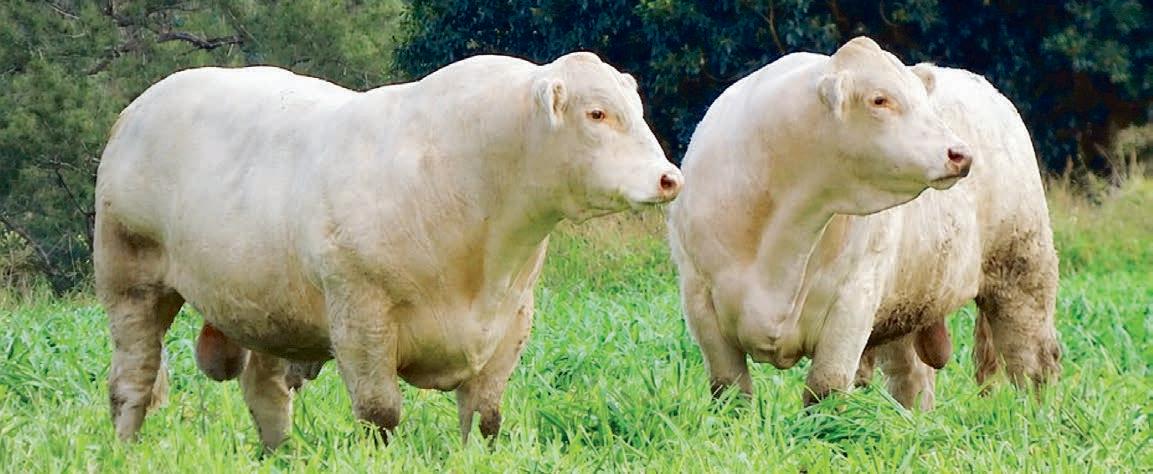
We are pleased to present 17 draft Charolais bulls at Lots 1–12 and 49–53. This line-up features 12 homozygous polled, 3 polled/scurred, and 2 horned bulls sired by Cassaglen Raptor (PP), Ascot Rafferty (P), Palgrove Sentosa (P), and new AI sires JMAR Jefferson (P) and LT Governor (P).
Progeny from these sires proved their commercial performance with recent wins in the Toogoolawah Prime Cattle show.
Bulls are prepared on oats and pellets, Breedplan and DNA recorded, fully vaccinated, semen/ morphology tested, and JBAS 7 certified. Tick and lantana exposed.
See videos on Facebook: River Run Charolais.
Diamond L
In 2026, we are pleased to offer eight bulls, four red factor and four white combining excellent phenotype, temperament, and performance.
The red factor bulls offer great softness and fat cover, while the white bulls deliver outstanding growth and weight-for-age. Five draft bulls are sired by Diamond L 2024 sale standouts Tax Return and Tabloid, with additional progeny by Black Duck Rough Justice and Cooranga All Blacks.
All bulls are oats-prepared, 100% sireverified, fully DNA tested (4 homozygous polled, 3 heterozygous, 1 dehorned), and free of MYO and BPA for complete genetic integrity.
Charnelle
Charnelle Charolais is proud to offer 16 industryfocused bulls (15 polled, 11 homozygous polled, 4 red factor). Backed by 34 years of breeding and Full French genetics, these bulls deliver muscle, power, and calving ease. All are DNA tested (100K profiled), parentage verified, BPA tested, and PI negative. Raised in large paddocks on pasture,
silage, hay, and pellets, they are presented fit and ready to work.
Silverwood offers 8 consistent, carcass-driven bulls (6 polled, 2 red factor) built to add weight for feedlot or grass-finished markets.
Pre-sale inspections and free post-sale agistment available.
LHU
We are pleased to offer five polled, Breedplanrecorded, and BPA-free Charolais bulls for 2026, featuring strong growth and feed conversion. Rib fat, P8, IMF, and 400-day data were scanned in
November 2025.
The draft offers five distinct styles to suit various operations. In stud news, new sire Palgrove Up It was secured at Palgrove’s 2025 sale, with his first progeny arriving mid-July. Weaned calves by OW Leadtime, ANC Laois, Sparrows Kingston, Venturon Maximum Impact, and ANC T884F show great promise.
Look out for our display team at the 2026 Brisbane Royal Charolais World Congress.
Clearview Clearview Charolais is thrilled to return to the
Coolabunia Classic with a strong draft of quiet, functional, and fertile bulls. Established in 2020, our family-run operation is built on top Trevlac and Palgrove foundation females.
This year’s line-up features sons of proved sire Brendale Ridley (Reserve Calf Champion, BEEF 2021) and new sire Yuranga Park Real Impact. Our genetic quality was highlighted in 2024 when home-bred females achieved Champion Charolais Female and Top 5 Interbreed honors at both BEEF and the EKKA.
We look forward to catching up with past supporters and buyers on sale day!
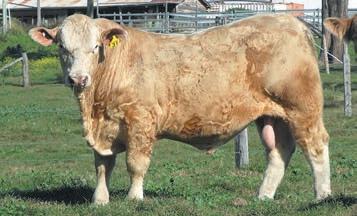
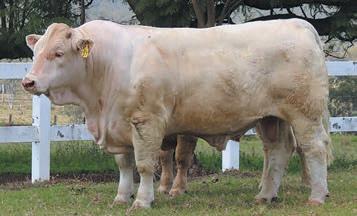
Charolais Bull Sale is thrilled to return to the Coolabunia Classic. (Supplied)
Safeguarding honey future
Research at The University of Queensland is determining whether the way honey is harvested and stored can affect the taste and quality of the product.
Queensland Alliance for Agriculture and Food Innovation PhD candidate James Yu Jun Lian said his work aimed to safeguard the future of premium Australian honeys.
“This is the first detailed look at how gentle extraction may preserve Australia’s unique botanical flavours,” Mr Lian said.
“It opens the door to defining what freshness means in honey, which is something the industry has never formally measured.”
The research compared honey from three locations across South East Queensland and Northern New South Wales using two extraction methods, the traditional Langstroth hive and the Australian made Flow Hive, followed by commercial processing.
“The processes used for the past century with the Langstroth hive expose honey to heat, oxygenation and vibrations,” Mr Lian said.
“Heating and spinning honey to extract it from the frames means different honeys can become similar in flavour, rather than distinctive.
“Those processes can damage the beautiful botanical notes that give Australian honeys a unique bouquet, thus reducing their intrinsic value.
“The Flow Hive minimises any disturbance to the hive while allowing the honey to flow naturally with no extra heat and minimal agitation.”
Mr Lian said honeys extracted from the Flow Hive had a lighter colour and lower levels of hydroxymethylfufural or HMF, a compound used to measure the quality of heat exposure of honey.
“Lower HMF and lighter colour signals reduced chemical damage to the honey,” Mr Lian said.
“We’ve also compared the aroma and flavour of heated and aged honeys, which became more caramelised and medicinal in taste, proving that
heat and oxygen detrimentally affected their flavour.”
Sensory scientist Professor Heather Smyth said work was underway to find ways to show and measure a honey had been damaged.
“There’s huge interest globally in understanding honey freshness and how different processing methods influence quality,” Professor Smyth said.
“Honey lacks the well developed freshness metrics found in industries like wine and coffee
and this work is helping establish those foundations.
“This includes things like the colour, texture and physical properties of the honey but also its composition in terms of sugar content and flavour.
“Odour compounds can tell us something has been bruised or damaged, like the acetaldehyde note of a bruised apple tells us something has been lost.”
The team plans to track how honey changes post-harvest, aiming to pinpoint when key quality shifts occur and how different extraction methods can influence flavour, aroma and texture.
“We want to take advantage of the varieties of boutique Australian honeys compared to other countries and open opportunities for high value gastronomic applications,” Mr Lian said.
“Our honeys should be valued for their unique aroma profiles and the flavour linked to our native plants.”
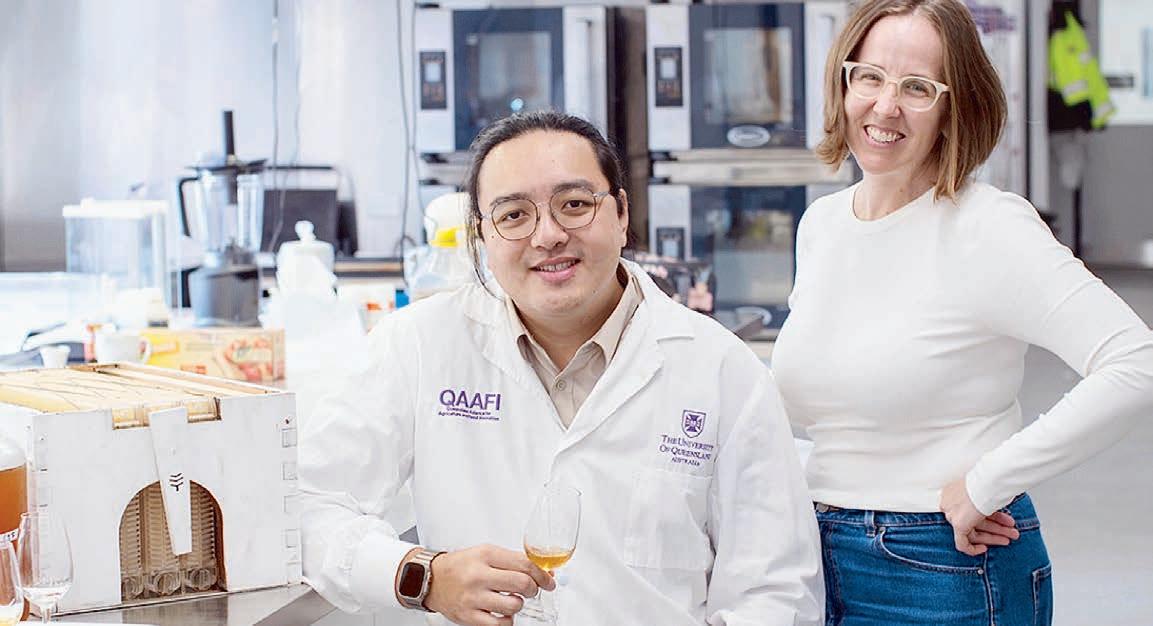
PhD candidate James Yu Jun Lian and Professor Heather Smyth. (The University of Queensland)
August 15, 2026 12PM
Plenty of options at sale
By Liam Hauser
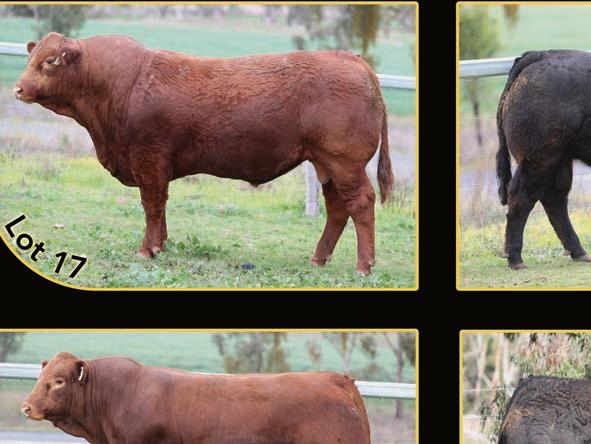
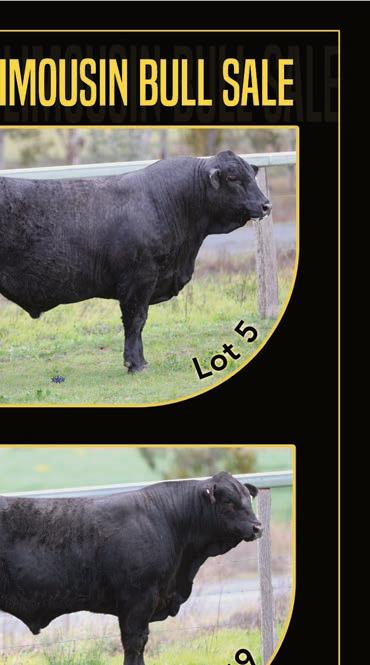
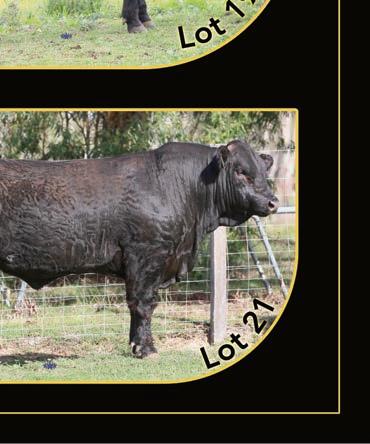
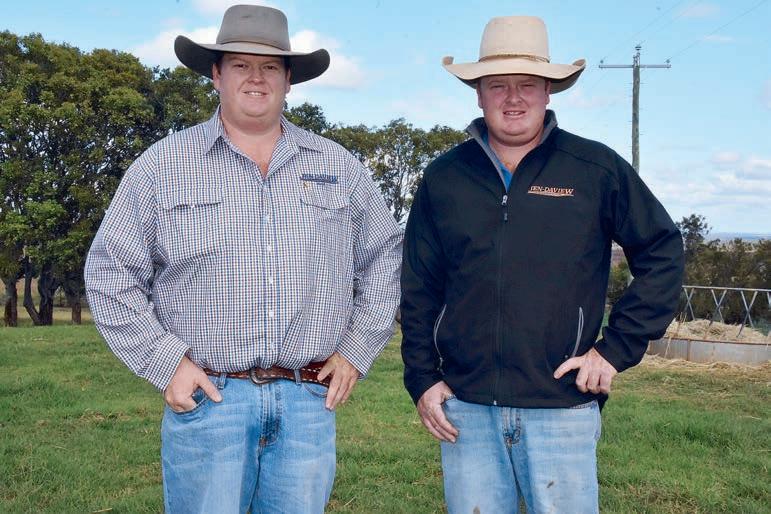
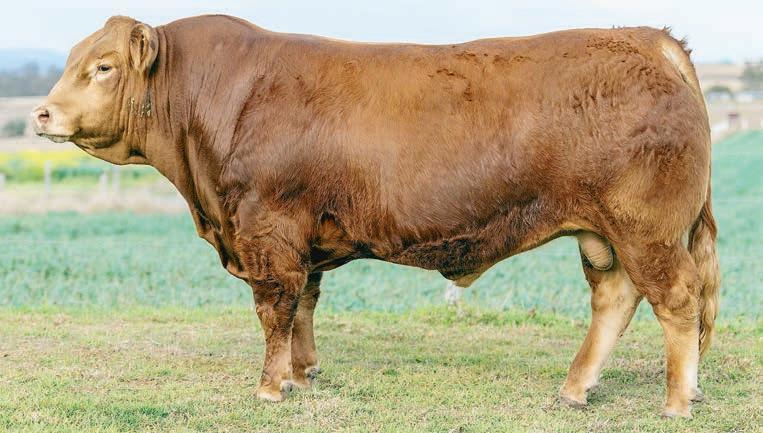
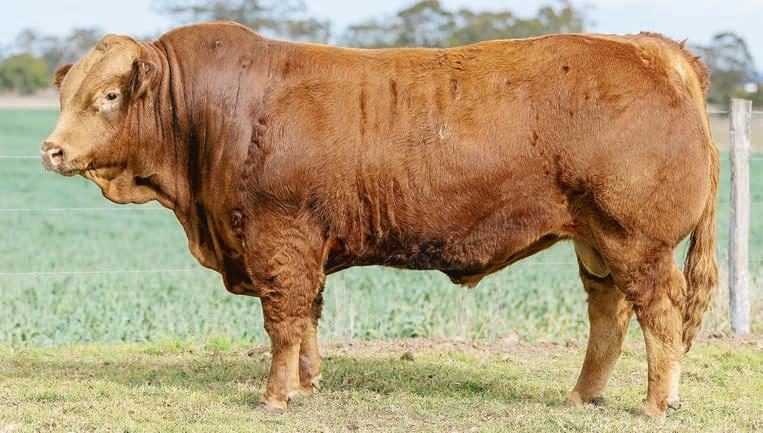
The Jen-Daview Livestock Invitational bull sale is back for its second annual sale, with 62 Limousin and Angus bulls on offer at the Coolabunia Saleyards on Saturday 15 August.
Local and visiting buyers will again have plenty of options to choose from, with bulls suited to numerous different markets.
Jen-Daview’s Brent Evans said the bulls were bred for buyers in the commercial and seedstock markets, and that the vendors were all like-minded while buyers could trust where the cattle came from.
The main breeding objective for Jen-Daview is “Beginning with the end in mind” , meaning breeding for the end producer and market requirements is key.
“Our main focus is breeding cattle and bulls that can go on and reproduce, and add profit to the purchaser’s pocket,” Mr Evans said.
“Progeny can be suited for the vealer, heavy feeder or grass fed market options, meeting the current market requirements.”
Buyers can purchase these bulls with confidence, knowing the vendors have done everything they can to present the bulls.
“The bulls are all fully vaccinated, fully semenand vet-checked, and fully carcass-scanned,” Mr Evans said.
Mr Evans said the Limousin bulls were renowned for their carcass and natural muscling.
“They’ve got more softness, longevity and ability to lay down fat,” he said.
“The modern Limousin bull is sought after by producers across vast parts of Queensland and southern states.”
As for the Angus bulls, Mr Evans said they were renowned for their carcass, softness, meateating quality and market suitability.
Mr Evans said the bulls were “prepared to go out and do a job and last a long time”
With Jen-Daview Livestock being a family-run business owned by the Evans family while Brent and his brother Corey work in the beef industry, Brent said they understood the market wants and needs as well as trends and what would make the most dollars for the end producer.
“The trade value that the cattle market has seen currently, is as good as it’s been, and the forecasts are all looking positive,” he said.
“The future of the Australian beef industry is strong.
“With the growing population, there are more red meat demands than ever before.”
‘A Bull for Everyone’ whether it is Apricot, Red, Black Limousin or Angus bulls you are chasing, the Jen-Daview Invitational sale will have a bull for you.
The sale will be conducted by the Grant Daniel and Long stud stock team and Kingaroy branch as well as being interfaced online with Stocklive.
The bulls will be available for viewing at the Coolabunia Saleyards from the afternoon of Thursday 13 August or prior by appointment with the vendors.
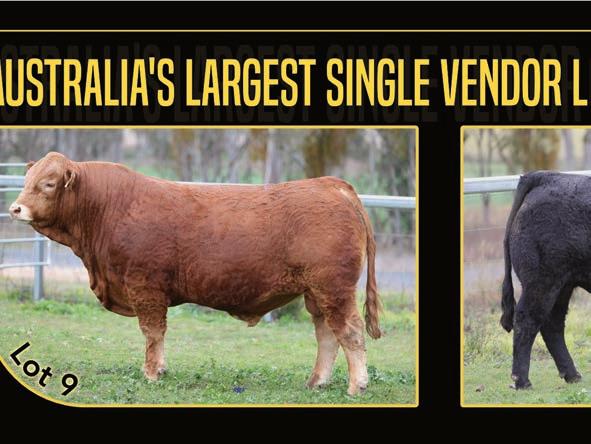
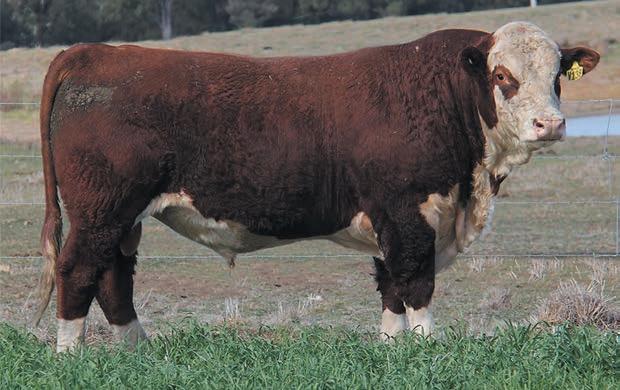
Lot 14 Mervale Vanilla Ice V24. Brent and Corey Evans from Jen-Daview are looking forward to next month’s invitational bull sale at the Coolabunia Saleyards.
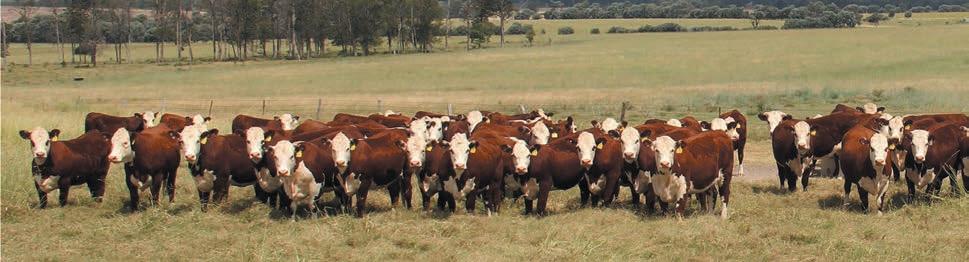
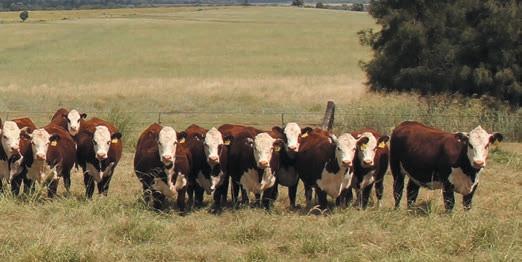
Jen-Daview full list of vendors 2026.
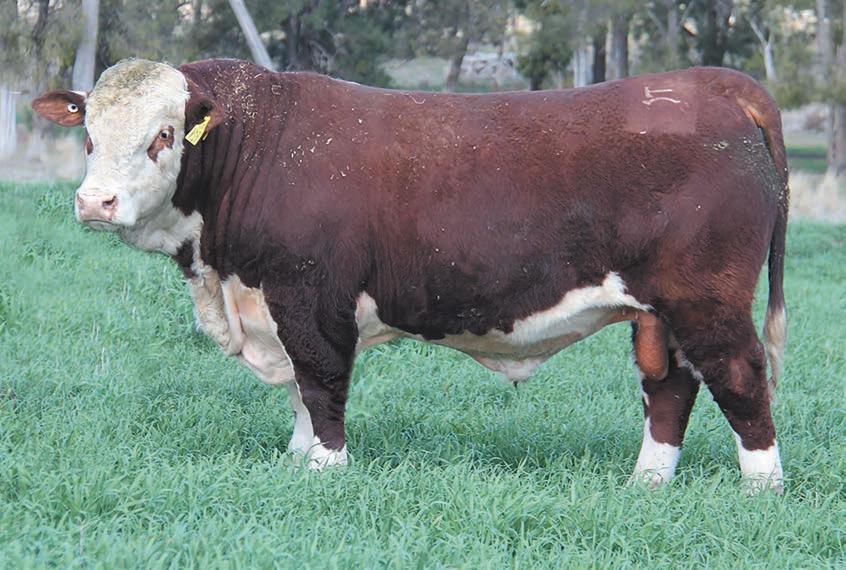
At Talbalba ....we do the basics RIGHT!
At times we can all get caught up in the new beaut technologies and fancy terminology, but sometimes we need to go back to the basics and ensure they’re right.
As business costs go up and margins become tighter, females need to work for you;
• Aim for 85%+ pregnant yearlings (15 mths of age) to calve out at 2YO.
• Aim for 95%+ 2YO’s to rebreed as 3YO, and then rebreed consecutively year after year within a timely joining period.
This will result in more calves on the ground early (open heifers sitting around until 2YO result in an entire year of missed opportunity), similar aged weaners with more consistent weights and a less obvious lead & tail (we all hate drafting out the tail and hanging onto them for longer than we’d like).
If you can prepare your heifers for success at joining as a yearling – by targeting 65% of your mature cow weight, and join them a cycle earlier than your cows, this will set them up for a lifetime of reproductive success. Don’t forget to look after their body condition score in the lead up to their rebreed, as this is a crucial period of time.
If that’s the business model you’d like, seek out bull programs whose dams are raised with the same criteria.
Bulls need to be Fit For Purpose;
• Structurally sound including good feet & leg structure
• Reproductively sound including passing a BBSE semen motility & morph
• Sound Temperament
• Immune Ready
For the $ we spend on bulls these days, you should be getting at least 3-5 matings per bull – at the bare minimum. Longevity will save you extra $ outlay and reduced cost per calf.
Select high performance bulls that fit your criteria;
• High growth/weight for age
• High Retail Beef Yield
• Large CWT
The good news is Herefords excel at this. At Talbalba Herefords we do all of the above. As a result, the average bull in the 2026 Sale Cohort sits in the top 40% of the breed for Fertility, Growth & Carcase Traits.
Talbalba 2026 Bull Sale Cohort Average Percentile Ranking:
The 2026 sale offering
The 2026 sale draft represents the culmination of years of disciplined genetic selection.
This year’s offering features an outstanding lineup of herd sires combining genuine muscle expression, natural softness, structural correctness, excellent temperament and strong weightfor-age performance. Whether your focus is breeding replacement females, feeder cattle, premium grass-fed or grain-fed steers, or future stud sires, we believe this catalogue contains genetics capable of adding measurable value to your operation.
We are equally proud to present a select offering of females from some of our most productive and proven cow families. These females represent generations of fertility, longevity and maternal performance and, with the exception of our show team, have all been developed under commercial pasture conditions. They are genuine working females bred to perform for years to come.
Leading from the front
By Fiona Gowers
Dr Georgina Pengilley, a respected leader with deep roots across agriculture, is set to take the helm of the Cotton Research and Development Corporation (CRDC).
Her appointment marks a significant moment for both the organisation and women in agricultural leadership.
Commencing as managing director on 27 July, Dr Pengilley brings more than 25 years’ experience spanning research, development and extension (RD&E), along with first hand knowledge of life on the land.
Based in Armidale, she offers a rare “paddock-to-policy” perspective.
She brings end-to-end agricultural experience, spanning research investment, on-ground delivery and hands-on farming, including coowning and operating an 8300-hectare Tasmanian enterprise.
Her appointment signals a forward-looking chapter for the cotton industry, one grounded in practical outcomes and innovation that delivers for growers.
CRDC Chair Richard Haire said the CRDC Board was delighted to welcome Dr Pengilley to lead the organisation.
“Georgina is an experienced agricultural research leader, having operated at key parts of the system as an investor in research, as a deliverer of it and as a grower with skin in the game,” Mr Haire said.
“That combination of scientific expertise, executive leadership and genuine grower cred-
ibility is exactly what CRDC needs as we look to the next chapter.
“She has a proven track record of translat-
ing RD&E investment into real, measurable outcomes for Australian agriculture and we are confident she will build on CRDC’s strong strategic foundations and continue delivering on Clever Cotton for the benefit of the entire industry.”
Dr Pengilley’s career spans executive leadership, RD&E investment governance, commercialisation and large-scale farming.
Most recently, as CEO of Rice Breeding Australia, she established a national breeding organisation and led the development of a $10 million facility that reduced variety development timelines by nine years.
But it is her clear focus on delivering value at the farm gate that defines her approach.
“My career has been driven by a simple principle: agricultural innovation only matters if it reaches the paddock faster, performs under pressure, and creates value for growers,“ Dr Pengilley said.
“CRDC is the engine room of that work for the cotton industry and I am privileged to be the next person to lead it. Every dollar invested in research must deliver real, measurable outcomes on the ground. That is, and will continue to be, CRDC’s mission.
“The challenges growers face around productivity, sustainability and profitability are not unique to cotton and I’m excited to bring fresh eyes and broader agricultural experience to a corporation already doing exceptional work.
“The strategic direction CRDC has set is one I believe in deeply and I can’t wait to help drive it forward.“
Dr Pengilley’s appointment also highlights the growing influence of women in shaping the future of Australian agriculture, particularly in senior leadership roles.
She succeeds outgoing Executive Director Allan Williams, whose more than 30 years of service to the cotton industry were acknowledged by the CRDC Board.
“Allan grew up in the Australian cotton industry and has committed his career to it – the CRDC Board and Australia’s cotton growers are deeply grateful for his service,” Mr Haire said.
“Allan has dedicated over 30 years to leadership positions within key Australian and international cotton organisations – the Australian Cotton Growers Research Association, the then Cotton Consultants Australia (now Crop Consultants Australia), the Better Cotton Initiative and, for the past 14 years, CRDC.
“The foundations he has laid position CRDC, our growers, and Georgina at the helm for an exciting next chapter.
“We would particularly like to acknowledge the long lead time Allan provided regarding his decision to step down from the role, which gave the CRDC Board time to plan thoughtfully for the future and to support a smooth and wellmanaged transition from Allan’s leadership to Georgina’s.”
With a new leader at the helm and a clear vision for impact, CRDC is poised to continue driving innovation, with Dr Pengilley representing both continuity and change in equal measure.
Study highlights complexity of women’s roles in farming
By Fiona Gowers
A new University of Adelaide study is challenging long-held assumptions about women in agriculture, finding many do not identify with the traditional “farmer“ label despite playing critical roles in farm businesses.
Published in the Journal of Rural Studies, the research shows women’s identities in agriculture are diverse, with some embracing the title of farmer while others prefer recognition for their professional and business contributions.
Author Dr Emily Buddle, from the School of Agriculture, Food and Wine, said the findings reflected the evolving nature of farming.
“When we talk about women’s role in farming businesses, the default assumption is often that they simply want to be recognised as farmers in their own right,“ Dr Buddle said.
“My research suggests the reality is much more nuanced. Many women are not seeking the title of farmer. Instead, they want recogni-
tion for the important and often highly specialised work they contribute to farming businesses.“
The study, based on focus groups with 27 women from South Australian farms, identified a spectrum of identities, from ‘big-F Farmers’ engaged in daily paddock work to those focused on administration, finance, compliance and business operations.
Many participants described their role as running the farm’s “control room“, reflecting the increasing complexity of modern agricultural enterprises.
“The nature of farming has changed dramatically over recent decades,“ Dr Buddle said.
“As farms have grown in size and become more reliant on global markets, the demands of administration, risk management, compliance and employment have also increased.
“Many women are bringing professional skills developed in other careers to help run multimillion-dollar businesses.“
Dr Buddle said while women have long contributed behind the scenes, the scale and sophistication of their work has grown significantly.
“While women have long been responsible for the control room of the farm, the control room itself has changed,“ she said.
“No longer are women simply milking cows, preserving produce, raising children and completing the tax return. They are helping to manage complex businesses, yet much of that work remains unseen, unremunerated and underappreciated.“
The research also found strong resistance to the term “farmer’s wife“, with participants expressing frustration at being defined by their partner’s role rather than their own.
“Many women have their own professional identities, skills and expertise, yet the ’farmer’s wife’ trope remains surprisingly strong,“ Dr Buddle said.
“The women in our study wanted to be rec-
ognised as individuals contributing to the success of their farming businesses, not simply as supporters standing beside a farmer.“
According to Dr Buddle, the findings have important implications for building a more inclusive agricultural sector, with recognition needing to reflect the diversity of roles women play across modern farming enterprises.
“The image of a farmer remains strongly associated with traditional symbols such as tractors, Akubras and paddock work,“ Dr Buddle said.
“Many women don’t see themselves reflected in that image, even though they are essential to the operation of the business.
“If we want a more inclusive agricultural sector, we need to move beyond a one-size-fits-all understanding of what it means to contribute to farming.
“Recognition should reflect the diverse skills, expertise and identities that women bring to Australian farming businesses.“
Dr Georgina Pengilley will resume her role as managing director of the Cotton Research and Development Corporation (CRDC) in July. (Supplied)
Kylie Porter heads the QFF
By Fiona Gowers
The Queensland Farmers’ Federation (QFF) has announced the appointment of Kylie Porter as its new chief executive officer, marking a significant leadership transition for the peak body.
QFF president Aaron Kiely said Ms Porter brought extensive experience in regional economic development, industry advocacy and stakeholder engagement, positioning the organisation strongly for the future.
“Kylie is a fantastic appointment for QFF, bringing with her a deep understanding of the opportunities and challenges facing regional Queensland,” Mr Kiely said.
“(She has) a strong track record with government at local, state and federal levels (and) a genuine passion for the future of Queensland agriculture.”
Ms Porter joins QFF following her tenure with Greater Whitsunday Alliance (GW3), where she has held leadership roles since 2017.
During that time, she played a key role in advancing economic development across the Mackay, Isaac and Whitsunday regions and helped establish the organisation as a leading voice for regional Queensland.
She also brings broad industry experience as a founding Director of C-Res, one of Australia’s largest social enterprises delivering local procurement solutions in remote and regional communities in partnership with BHP.
Her contribution to policy and industry development includes service on Queensland Government Ministerial Advisory Councils and the Clean Economy Expert Panel, supporting the state’s transition to a low-emissions future.
Ms Porter said she was excited to take on the
role at a pivotal time for the sector.
“Agriculture is a sector full of ambition and innovation with a long legacy and QFF plays a vital role in making sure that story is heard loud and clear by government, industry and the community,“ she said.
“I look forward to building on the exceptional foundations that have been laid and working alongside QFF’s board, peak body members and corporate and industry partners to deliver real outcomes for Queensland farmers.“
Outgoing CEO Jo Sheppard said the organisation was in capable hands, highlighting Ms Porter’s strong connection to regional communities and agriculture.
“Agriculture is such an important sector for Queensland’s economy, regional communities and our way of life and the role QFF plays is ensuring a strong future for farmers is critical,“ she said.
“Kylie’s background, skills and experience are a great fit for QFF and I am confident that under Kylie’s leadership, QFF will continue to deliver cutting edge projects and effective policy outcomes on behalf of our peak body members and Queensland farmers across the state,” Ms Sheppard said.
Greater Whitsunday Alliance Chair Tony Caruso also acknowledged Ms Porter’s contribution to the region.
“Kylie has been a respected leader for GW3 and for our region,“ Mr Caruso said.
“Her appointment to QFF reflects the calibre of leadership she has demonstrated here. We wish her every success and are proud that Queensland agriculture will benefit from her talents.“
Ms Porter will commence in the role full-time on 27 July 2026.
National award for midwife
By Fiona Gowers
A Darling Downs midwife has been recognised nationally for her leadership in improving maternity care for Aboriginal women.
Natalie Hobbs, a proud Kamilaroi woman, recently received the Partnering with First Nations Leadership Award from the Preterm Birth Prevention Collaborative, which focuses on reducing early births across Australia.
Darling Downs Health chief executive Annette Scott said the honour reflected Ms Hobbs’ commitment to improving outcomes for First Nations families.
“As our Assistant Director of Nursing and Midwifery for First Nations, Ms Hobbs has been instrumental in making sure we listen to Aboriginal and Torres Strait Islander women and their families on how they want their care to be delivered,” said Ms Scott.
“This award is also recognition of the work Ms Hobbs has done to build strong relationships with our community partners including Carbal Medical Service and Goondir Health Services.”
Ms Hobbs said she was humbled by the recognition and remains focused on addressing health inequity.
“When I studied midwifery, this was the space that I wanted to land in. There’s such health inequity between Aboriginal women and Aboriginal people in general, and the rest of the community,” Ms Hobbs said.
She said ongoing collaboration would be key to improving care.
“We know that when we listen to their voices, we have a better chance of actually changing health outcomes.”
Preterm birth rates among Aboriginal and Torres Strait Islander mothers are around 1.7 times higher than for non-Indigenous mothers, contributing to increased risks of death and disability.
As part of her work, Ms Hobbs will establish a First Nations maternity consumer advisory group in Toowoomba, bringing together local women to help shape maternity services.
“This will be another avenue for us to really hear from women about what is needed,” she said.
Governor-General on board
By Fiona Gowers
National charity Motherland has reached a major milestone, with the Governor-General of Australia, Sam Mostyn, accepting the role of Patron.
The appointment recognises the organisation’s growing national impact supporting rural mothers through programs, events and an online community aimed at reducing isolation and improving mental health outcomes.
Motherland founder and CEO Stephanie Trethewey said the patronage was a significant moment for rural families.
“The honour of having Australia’s GovernorGeneral as Patron of Motherland is something I could never have imagined,“ she said.
“This is enormous, not just for Motherland, but for every rural mum across this country who forms the backbone of our farming communities.
“Having the Governor-General in our corner sends a powerful message: that rural mothers matter and that their voices deserve to be heard at the highest level.“
Since launching in 2019, Motherland has supported thousands of women through initiatives including its Village program, scholarship fund,
podcast, health platform and events.
The organisation reports that 84 per cent of rural mothers identify loneliness as their greatest challenge, while 86pc say postnatal support is inadequate.
The Governor-General said she was honoured to support the organisation’s work.
“Rural mothers are at the heart of some of Australia’s most enduring and remarkable communities.
Supporting women who are isolated or lonely, particularly in times of need or in rural communities is a vital act of care and generosity. “The work of Motherland reflects values I care deeply about, and I am honoured to serve as Patron and support their vital work.“
Motherland has also expanded its reach with the launch of Father Land, a podcast exploring fatherhood and mental health in rural Australia, reinforcing its focus on strengthening rural families.
With a community of more than 30,000 women and a podcast exceeding 1.3 million downloads, the organisation continues to play a key role in supporting the wellbeing of farming families across the country.
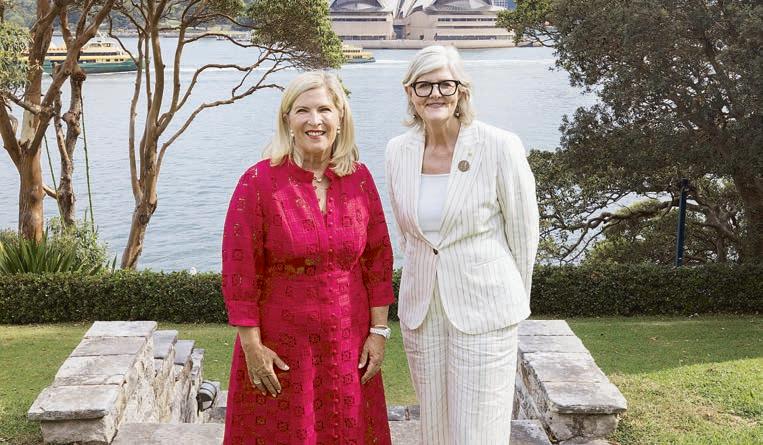
Motherland chair Bronnie Taylor and Governor-General Sam Mostyn. (Supplied)
Natalie Hobbs has been recognised for her work in improving care for Aboriginal women. (Supplied)
Kylie Porter has been appointed the Queensland Farmers’ Federation CEO. (Supplied)
Men don’t talk face to face, they talk shoulder to shoulder
Hammer, hands and heart
By Fiona Gowers
The roller door at the Nambour Men’s Shed rattles open early, letting in the soft Sunshine Coast light and, with it, the steady hustle of local men looking for more than just something to do.
Inside, there’s the hum of conversation, the smell of timber and the quiet rhythm of hands at work. But, what’s being built here goes far beyond chopping boards and chess sets.
It’s purpose. It’s connection. And, for some, it’s everything.
Founded in 2011, the Nambour Men’s Shed has moved a few times - from National Park Road to Doolan Street, then Windsor Road - before finally settling into its current home on 8 Colless Lane in 2015, where it now holds a lease through to 2035.
Today, it’s enjoying its strongest year yet, with about 75 members. And growing.
Secretary Richard Simmons believes the reason is simple.
“More people are hearing about us,” he says. But, step inside, and it’s clear word-of-mouth only tells part of the story.
There’s an easy camaraderie here, the kind built on shared experience and mutual respect. Former tradesmen work alongside teachers and accountants. Skills are swapped freely. Stories are, too.
“Everyone’s always prepared to share their knowledge,” Richard says. “There’s so many people here that can teach you different things… and these are skills that shouldn’t be lost.”
For Richard, who came from a building background, even decades of experience hasn’t dulled the value of learning from others.
“You get these little hints off them (fellow members)… things that just make doing the job easier. That’s knowledge that needs to be passed on.”
The shed itself is modest in size but wellequipped, with solid woodworking facilities and a capable metal shop below. Projects range from community donation boxes and kindergarten builds to possum habitats for local wildlife carers. They’ve made display stands for art shows, supported local events and even hosted a friendly “mate versus mate” challenge between sheds - a tradition they hope will grow.
But, among all of that work, there’s one day each week that stands out.
Every Thursday, the shed transforms.
It becomes - as far as Richard knows - the only men’s shed of its kind to offer a dedicated Disability Day.
Between 10 and 15 participants attend regularly, many accompanied by carers. It’s the busiest day of the week and, in many ways, the most meaningful.
“They enjoy the social interaction,” Richard says simply.
But what unfolds here is something deeper.
There’s Sammy, for example, who is largely non-verbal but whose pride needs no translation.
“He’ll grab you and drag you in to show you what he’s making,” Richard says. “He wants to
show people.”
And then there’s Lukey Jay, a well-known local identity, whose meticulous four-foot model of the Titanic recently won top honours at the Sunshine Coast Show in Nambour.
“He’s quite talented,” Richard says. “Now he’s building a case for it.”
For others, progress is slower - a chest of drawers taking shape over weeks, even months. But here, time isn’t the measure that matters.
“In the scheme of things, it doesn’t really matter,” Richard says. “He’s getting a lot out of doing it.”
Safety limits what the Thursday group can do independently, but the men of the shed have found ways to ensure everyone is part of the process.
They guide hands, share tools and create space for participation, whether it’s pulling the trigger on a nail gun or sanding down a piece of timber.
“They feel included,” Richard says. “That’s very important.”
The results are tangible - chopping boards, simple builds, finished pieces to take home - but the real impact is less visible.
Friendships formed. Confidence built. A reason to get out of bed.
“It’s probably the one thing they look forward to every week,” Richard says.
The dedicated day began in 2021, in the wake of COVID — a time when isolation hit vulnerable communities hardest.
What’s grown since is something quietly powerful.
A place where no one is rushed. Where no one is left out. Where every small achievement is celebrated.
Back in the main shed, the kettle boils for morning tea. Someone cracks a joke. Another project begins.
“Everyone’s welcome,” Richard says. “We don’t discriminate.”
It’s a simple statement but, inside these walls, it’s something you can feel.
Because at the Nambour Men’s Shed, they’re not just building things. They’re building each other.
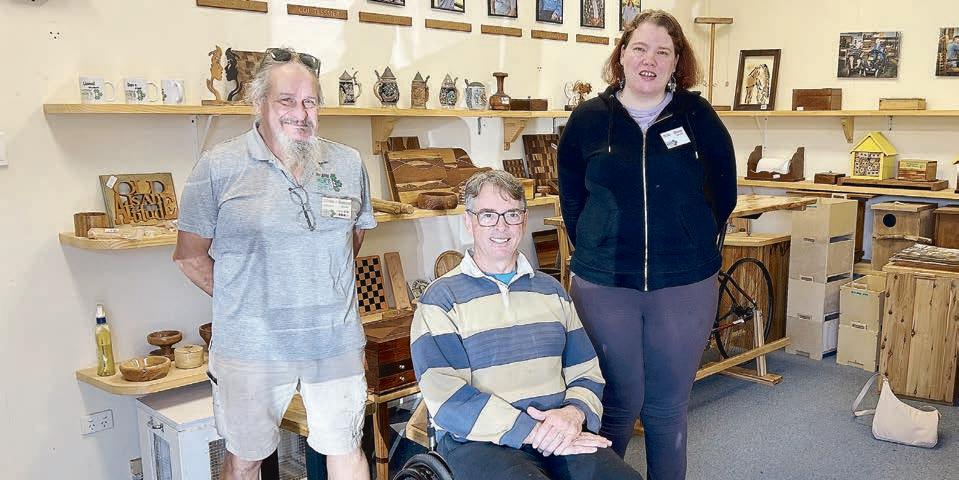
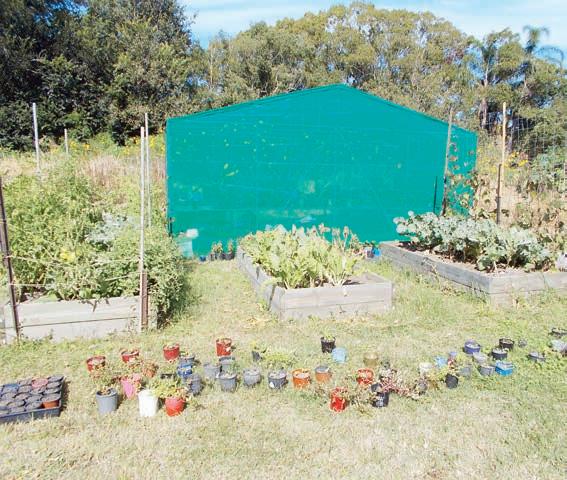
Nambour Men’s Shed secretary Richard Simmons, treasurer David McNaught and office girl Sharon Bell. (Supplied)The Nambour Men’s Shed gardens were blooming in 2017.
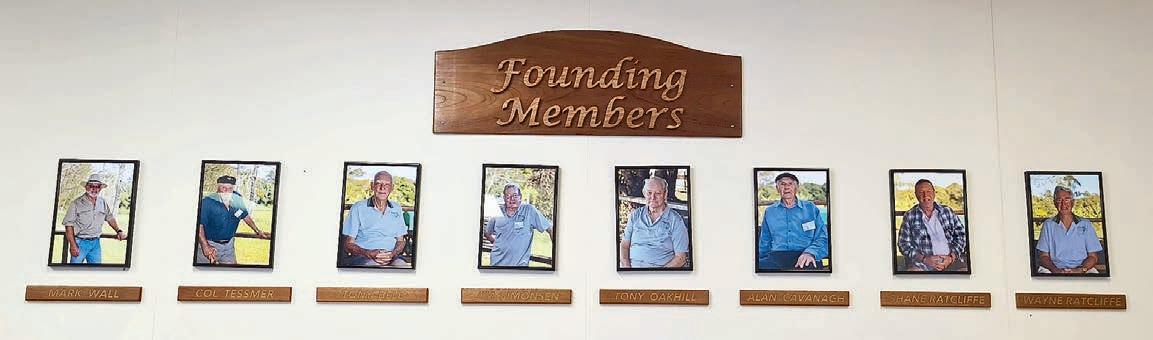
In honour of the Founding Members of the Nambour Men’s Shed, a display was created in 2024.
The Nambour Men’s Shed boasts important local support.
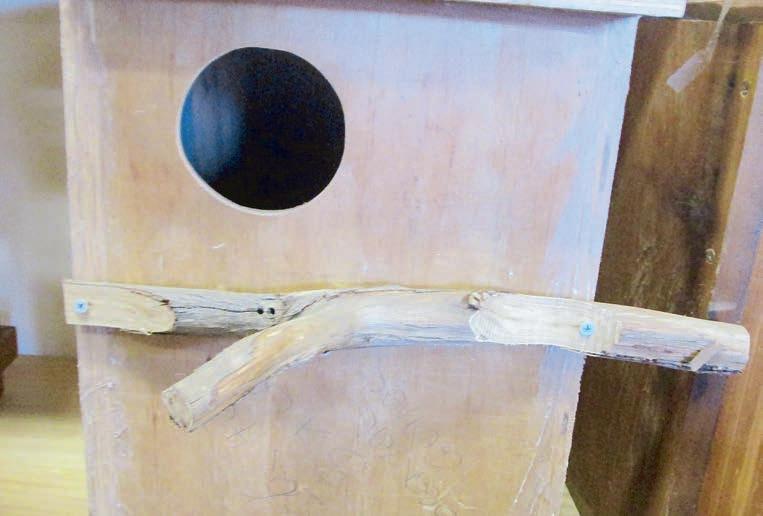
A possum box crafted by a member of the Nambour Men’s Shed. (Supplied)
Bulliac back in the ring
Since 1999, Bulliac Angus has been focused on the production of bulls suitable for Northern Australia.
Additionally, it has not tried to breed Indicus infused cattle in conjunction with Angus.
Bulliac strongly believes that purebred Angus managed with and for adaptability, provide commercial cattle breeding operations with the greatest opportunity to produce a high quality, market desired, beef product.
The 2026 bulls adhere to this core focus and commitment.
Bulliac sources sires globally to achieve this and know that its cows run with the ability to forage and adapt, provide the best foundation.
Sires of the 2026 draft include, Woodhill Comstock, Pine View Vezina J166, LVVF Tanker
14, Hart Network, Te Mania Sander S159, Millah Murrah Paratrooper R94 and Te Mania Pythagoras P44.
Woodhill Comstock - The ultimate flatback maker. Producing moderate framed, thick topped sons with strong heads, good slick coats and smaller ears.
Pine View Vezina J166 - Style, with meat and volume. Impressive cattle which have already topped numerous sales in the south this year.
LVVF Tanker 14 - Brute force without compromise. Son have plenty of weight, with good feet and legs. The foundations are right.
Hart Network - Carcase with classic Angus type. We have already used two of our Network sons as backup sires. The good ones are impressive and will have a positive lasting effect.
Te Mania Sander S159 - Slick coat with shape and the data to back it up. Solid cattle and his first daughters in production have done a great job. A $40k walking sire who loves to work.
These sires have data sets which lead the industry and hopefully phenotypes and performance which will allow us to double up on the data in the future. It is more difficult to stack the data when breeding Angus in the north, due to added environmental pressures.
Bulliac bulls hopefully get three day sickness before vaccination, so they have natural immunity if they aren’t vaccinated in the future.
“We pride ourselves on supplying bulls to the market which are fit for purpose and will go the distance.”
“We believe in using the environment to test,
harden and select the genetics which are most suitable for it. Selection pressure identifies superior genetics. Feed and perfect conditions identify high performance/ high input individuals which don’t necessarily perform when the chips are down.”
In 2026 the Bulliac Bulls are going back to the sale ring. For several years they have sold on video with bulls on display, however due to buyer demand they are building a new sale ring and will once again have the bulls in the ring.
The 2026 draft of 80 bulls will average 21 months. Our main calving is October to December and November to January. As we run females in several locations, we have slightly different calving times to allow for greater bull utilisation and for people to cover the same tasks in each location.
The 2026 draft of 80 bulls will average 21 months. (Supplied)In
2026 the Bulliac Bulls are going back to the sale ring.
Performance, profitability
The Burnett has long been recognised as one of Queensland’s premier beef-producing regions, and this year it welcomes an exciting new addition to the stud cattle selling calendar with the inaugural Kingaroy Simmental, Fleckvieh and Simbrah Bull and Female Sale at Coolabunia Saleyards on 22 August.
The vendors are proud to introduce a dedicated Simmental sale to the Burnett as it reflects the growing demand for Simmental genetics
throughout the region, particularly among commercial producers looking to add weight, fertility, maternal strength and hybrid vigour to their crossbreeding programs. As demand continues to grow, it is clear the Simmental breed is on the move.
This sale offers something for every operation, featuring registered bulls and females alongside a comprehensive commercial Simmental focused offering of steers, heifers and PTIC cows.
Buyers will also have the opportunity to select from Simmental, Traditional Fleckvieh and Simbrah cattle, providing genetics to suit a wide range of breeding objectives.
The 15 vendors, whose commitment to breeding functional, fertile and productive cattle has made this inaugural event possible.
Their dedication ensures buyers have access to quality genetics backed by performance
Saturday 22 Saturday 22 Saturday 22 August 2026 August 2026 August 2026 nd nd nd Saturday22August2026
As the Simmental influence continues to expand across the state, the inaugural Kingaroy Simmental, Felckvieh and Simbrah Bull and Female Sale promises to become an important fixture on the beef industry’s calendar.
For producers looking to invest in proved genetics that will add performance and profitability to their herds, this is a sale worth attending.
15 Vendors commitment to breeding functional, fertile and productive cattle.
Simmental breed is on the move.
Confidence most valuable
By Stuart Upton, RLF Agtech and Liquaforce CEO
When people talk about the challenges facing Queensland growers this year, the conversation usually starts with prices.
But, after speaking with growers across the state recently, I think there’s another issue sitting underneath all of that. Confidence.
As conversations continue around global conflict, easing input prices and uncertain markets, many growers are finding themselves caught between wanting to invest in the season ahead and wondering whether now is the right time.
That’s a very different challenge from simply managing costs. It raises a bigger question: How do you build a farming business that’s less exposed to the next global shock?
The trepidation is understandable considering the past few years have shown just how quickly global events can change and the impact this has on Australian farms.
Conflict, freight disruptions, supply chain constraints and shifting commodity markets have all affected the cost and availability of essential inputs. Prices may soften for a period, but volatility has become the new normal.
Resilience is no longer just about weather. It’s about building a business that can withstand market uncertainty as well.
For years, agriculture has rightly focused on increasing production - bigger yields have driven investment decisions, new technologies and management practices.
But, as the 2026 crops go into the ground, the conversations I am having with Queensland growers are changing, asking if it’s the right time to invest now, or wait and see.
What I am telling those with doubts, is that waiting for certainty sometimes creates another risk altogether.
Delayed decisions, reduced nutrition programs or cutting inputs without a clear strategy can cost more than the savings they deliver and it doesn’t alleviate the anxiety all together - just postpones it until next year.
I believe the opportunity lies in improving nutrient use efficiency. Now more than ever, maximising value from every dollar invested is paramount. When margins tighten, every kilogram of nutrient needs to work harder. If more of those nutrients reach the plant and are utilised effectively, every dollar spent has a greater opportunity to generate a return.
Every farm is different. Soil types, rainfall, crop rotations and seasonal outlooks all influence
nutrition decisions and there is no one-size-fitsall solution, but the principle remains the same.
No one can predict the next industry wide issue, but what growers can control is how effectively every investment in crop nutrition contributes to crop performance.
Queensland agriculture has always been built on adaptability. Whether it’s drought, floods or global markets, growers have consistently found ways to evolve.
The next competitive advantage will not come from applying more inputs than the farm next door, but from building a nutrition program that delivers more certainty, greater efficiency and stronger resilience, regardless of what happens
beyond the farm gate.
Even in an uncertain season, confidence isn’t built by hoping markets settle. It’s built by knowing every dollar invested on-farm is working as hard as possible.
RLF AgTech (ASX: RLF) is an Australian plant nutrition company specialising in foliar nutrition sprays that complement conventional fertiliser programs.
The company works with broadacre graingrowers to improve nitrogen-use efficiency on farm.
Following its acquisition of LiquaForce, RLF has expanded into sugarcane and horticultural nutrition solutions.
Growers’ payroll tax anomoly doesn’t pass the pub test
By Scott Kompo-Harms*
Most Queenslanders would reasonably assume that if a business operates in a Regional Council area, it is considered a regional business.
So it beggars belief that some Queensland horticulture businesses have discovered recently that they don’t qualify for the Queensland Government’s Regional Employer Payroll Tax Discount.
These are businesses producing fresh food in regional Queensland, employing people who at the time are living and spending their hardearned money in regional communities, yet under the current rules they are treated differently because of technical definitions and
arbitrary boundaries.
It simply doesn’t pass the common-sense test.
Queensland Fruit and Vegetable Growers has spent months raising these concerns directly with the Queensland Government. We’ve shared examples from affected businesses. We’ve sought opportunities to engage constructively and asked for one simple thing: a review of the policy settings.
Despite those efforts, the Queensland Government has yet to commit to a review.
This isn’t about avoiding tax. Growers understand their obligations and support a fair tax system. What they don’t support is a policy designed to encourage regional employment and economic growth that fails to recognise the
realities of how a horticultural business operates.
At the very same time the Queensland Government is investing more money into compliance and enforcement activities, it has shown little willingness to examine whether the rules themselves are still fit for purpose.
Some growers are now facing assessments for up to five years of retrospective payroll tax, along with interest and penalties. If businesses are being pursued for years of back taxes, it raises the question of whether the Government should have identified and addressed these issues much earlier.
Surely that’s getting the priorities the wrong way around.
Good public policy isn’t just about enforcing the
Getting the balance right on minerals bill
By Shane McCarthy, AgForce General President
Queensland’s future prosperity depends on getting the balance right.
AgForce recognises the important role responsible resource development plays in supporting jobs and investment. Our state has a proud history of both agricultural and resource production. But AgForce is calling for a substantial rethink of the State Development and Public Works Organisation (Critical Minerals) Bill because it shifts the balance too far towards facilitating projects and streamlining approvals, without adequate protections for agricultural landholders, farming businesses and regional communities.
Agriculture contributes more than $20 billion annually to the Queensland economy. It underpins regional communities, supports thousands of jobs and delivers the food and fibre Australians rely on every day. But land is a finite resource, and once productive agricultural land is permanently compromised, it’s gone forever.
That’s why development approvals can’t come at the expense of reliable food and fibre production.
In its current form, the Bill would have significant implications for agricultural landholders, businesses, and regional, rural and remote communities. Our concern is not with development but with legislation that potentially diminishes landholder rights, weakens procedural safeguards and places agricultural production in direct competition with other land uses.
At a time when Queensland producers are already navigating increasing regulatory pressure, including the implications of reforms to the Commonwealth’s Environment Protection and Biodiversity Conservation Act, it is more important than ever to protect productive agricultural land. Legislation that reduces future agricultural production capacity risks undermining our longterm food security, export competitiveness and economic resilience.
The challenge before the state government is to ensure that one industry is not advanced at the expense of another.
AgForce is also seeking stronger safeguards within the legislation.
We believe agricultural land and productivity, food and fibre production, water resources, animal welfare and biosecurity obligations should be mandatory considerations in every decision made by the Coordinator-General. These issues are fundamental to Queensland’s long-term economic and environmental wellbeing.
We want independent merits review rights for decisions that affect agricultural land. We need safeguards in place that ensure accountability, procedural fairness and public confidence.
Queensland’s agricultural sector is not opposed to progress. Farmers understand the importance of investment and economic development. But any critical minerals development must occur in a way that respects private property rights, protects water resources, safeguards productive agricultural land and maintains community confidence in the approvals process.
The government has an opportunity to improve this legislation and deliver a framework that supports both responsible resource development and a strong agricultural future.
Getting that balance right is in the interests of every Queenslander.
rules. It’s about making sure the rules are fair, practical, and capable of being understood by the businesses expected to comply with them. Queensland growers aren’t asking for a handout or special treatment. They’re asking the Government to acknowledge that the current settings are creating unintended consequences, sit down with industry and commit to a genuine review.
The Government doesn’t have to agree with every concern growers raise. But it should at least be willing to review a policy that is clearly leaving regional businesses questioning whether it still reflects its original purpose.
* Scott Kompo-Harms is chief executive officer of Queensland Fruit and Vegetable Growers.
Shane McCarthy, AgForce General President. (Supplied)
Fertiliser prices have skyrocketed.RLF AgTech and LiquaForce CEO Stuart Upton. (Supplied)
Spirit of the Bush search
Rural Australians are being encouraged to showcase life on the land, with Rural Aid’s Spirit of the Bush Photography Competition returning for 2026.
Now in its seventh year, the national competition invites entries capturing the people, landscapes and stories that define rural and regional Australia.
Submissions open at 8:00am on Wednesday, 1 July 2026 and close at 5pm on Friday, 31 July 2026.
Since launching in 2020, the competition has built a strong visual record of life in the bush, highlighting the resilience, challenges and beauty of farming communities while helping bridge the gap between city and country.
Rural Aid Chief Executive Officer John Warlters said the competition continues to highlight the power of storytelling through photography.
“Every year we are reminded just how powerful a single image can be,“ he said. “These photographs do not just show us the bush, they tell us its stories, its resilience, and its heart.
“Spirit of the Bush continues to bring rural Australia closer to the cities. It opens a window into the everyday realities, the challenges, and the incredible strength of farming communities.”
Mr Warlters said the competition was open to all Australians, regardless of experience.
“You do not need to be a professional photographer to enter. Some of our most moving and memorable images come from people simply capturing life as they see it, honest, raw and real,” he said.
Twelve winning photographs will be selected, with each winner receiving a $250 prepaid Visa card. Entries can be submitted via the Rural Aid website.
Spirit of the Bush photos, 2024. Photographers are this year encouraged to showcase rural and regional Australia in all its forms, from sweeping landscapes and working farms to candid everyday moments that reflect life in the bush. (Supplied)
The export lamb market climbs to new heights
The export lamb market has officially shattered records, topping out at a huge $500!
Credit goes to a prime line of Poll Dorset cross lambs sold in Ballarat, VIC (March 2026).
Overall, the prime lamb market just keeps getting better with heavy crossbred lambs hitting new records over and over again. Poll Dorset cross lambs are almost always in the mix.
Chris & Meryl Rubie from Sovereign Poll Dorsets in southern Queensland see their breeding objectives of targeting the heavy export lamb market as part of their commercial success. With genetics built to provide finished lambs from the trade weights to heavy export lamb.
For western Queensland the market is probably a breeding ground for those store lambs capable of going on to finishing at heavy weights. The Merino cross lamb is ideal for that with Poll Dorset/Merino lambs commanding top prices from the feed on market. When seasons suit, taking these lambs on to heavy weights is easily done. Additionally, Merino ewes pregnancy tested in lamb to Poll Dorset rams always command a premium return.
Queensland Champion of Champions ram every year since its inception and again this year we were eligible in the ram, ewe and breeders group competitions however, unfortunately were unable to attend.
Sovereign Poll Dorsets has won the EKKA
Sovereign has rams available year round. For further information or enquiries contact Chris on 0497094179.
Performance, predictability
By Fiona Gowers
On 223 hectares of scrub country outside Monto, performance is essential.
For Rhonda and Geoff Crozier of “Top View” , every breeding decision must deliver fertility, temperament, growth and market returns.
Running about 80 breeders - primarily Red Brahman cows alongside Limousin and Anguscross females - the Croziers have built a system tailored to their country and refined by experience.
“Over the nine years we have continually improved the pasture by ripping and adding legumes and weed control,” Rhonda says.
And, when it came time to select a new sire in 2024, they turned to 8BK Grazing.
“We were very careful,” Rhonda says. “When you’re only buying one bull at a time, it’s a very big decision, you want to get it right.”
At the Coolabunia Limousin bull sale in March 2024, the Croziers secured a homozygous black polled Limousin bull from 8BK Grazing, a decision driven by data, structure and proven performance traits.
“I was very happy with his Estimated Breeding Values, particularly his calving ease and growth figures,” Rhonda says. “That was a big factor.”
The young bull - just 16 months old at purchase - also impressed on type.
“He’s long, deep through the flank and a softer-type bull with good structure,” she says. “That’s what you’re looking for.”
Equally important, his semen morphology results were excellent, providing further confidence in his reproductive capability.
Despite his age, the bull quickly proved himself under real-world conditions.
Initially joined to 20 heifers at around 19- to 20 months of age, he performed strongly, with any empty females attributed to immaturity rather than sire performance.
But it was when the unexpected happened that his true value became clear.
“Our Angus bull became infertile mid-joining,” Rhonda explains. “So, we put this young Limousin bull in with 25 older cows and he got them all in calf.”
For a young sire, it was a standout result.
“He exceeded expectations,” she says.
Beyond fertility, the bull has demonstrated the traits that matter on the ground - adaptability, temperament and doing ability.
“He’s held his condition really well here, which is important for our type of country,” Rhonda says.
“He’s also extremely quiet and his calves are quiet too.”
That temperament is already opening doors beyond the paddock.
“We’ve sold three of his calves to the local high school,” she says. “They’re good cattle to handle and work with.”
The Croziers’ production system is tightly managed, with a defined three-month joining window from October to January, ensuring all calves are on the ground before Christmas to avoid summer heat stress.
Weaner steers are sold at Monto’s end-of-May and June sales at seven to nine months of age, typically weighing about 280 kilograms.
This year, the results spoke for themselves.
“We received $5.70 a kilo for our steers,” Rhonda says. “We were extremely happy with that, particularly in the current market.”
Their confidence in Limousin genetics isn’t new, it’s built on decades of first-hand experience.
“Before we bought our own place, we worked on a property near Moura for 20 years,” Rhonda says. “They used Limousin bulls over Brahman cows and the progeny were excellent.
“They were always the first bullocks to sell.”
That same performance is now being replicated at “Top View“, where Limousin influence continues to deliver in both steer and heifer markets.
“We recently sold feed heifers that topped the local sale,” she says. “They’re doing very well.”
For Rhonda, the decision to purchase through 8BK Grazing has reinforced the importance of transparency and consistency when selecting seedstock.
“What you see is what you get with 8BK Grazing,” she says.
And, in a business where every joining counts, that reliability matters.
Geoff Crozier, “Top View”, Monto in the saleyards. (Supplied)
A Limousin weaner heifer with Angus mother.
Breeders with Limousin-cross cows.
Rhonda and Geoff Crozier have continually improved their pastures by ripping, adding legumes and weed control.
The 60th anniversary of the Tom Quilty Gold Cup at Imbil showed that an event such as this is about more than horse and rider. ERLE LEVEY was at the ride to experience what goes into such an event, and meet the people who make it happen.
Hoofbeats around globe
People often only see the rider crossing the finish line.
What they don’t always see are the families and friends quietly standing behind them, helping turn what sometimes seems like a crazy dream into reality.
The 2000 Sydney Olympics was not just about those athletes striving to be the fastest, highest, strongest. It was about the people you metstanding in line at the entrances, on a bus or train, chatting at a cafe or restaurant.
People came from all over Australia and from around the world.
The 60th anniversary of the Tom Quilty Gold Cup at Imbil showed that events such as this are about more than horse and rider.
Riders from Far North Queensland spelled it out clearly: There was a whole team of people making this adventure possible.
At the other side of the country, a single rider from Western Australia travelled 4500km with her horse to compete, complete, and return home with a belt buckle.
There were riders from the USA, New Zealand, France, Netherlands and Spain.
By being immersed in the lead-up to the ride, it was seeing that it is as much about what goes into such an event, and to meet the people who make it happen, as to what you get out out of it.
While their is a competitive edge to the event, it is mainly about completing the ride and achieving a commemorative Tom Quilty belt buckle.
Australian Endurance Rider’s Association (AERA) secretary Kim Moir said people always love to catch up at the ride - it is an opportunity for people to come together.
There’s nothing more grounding than being around horses, and on horseback and in nature.”
The 2026 ride was held in near-perfect conditions at Stirling’s Crossing Equestrian Complex at Imbil, and attracted 225 entries.
More than 900 attended as crew for the riders, as committee and volunteers, and those interested in the sport.
This year’s event took on an equestrian fes-
tival look with activities and competitions from the Wednesday evening official welcoming to the Thursday Arabian Horse Show for endurance horses, and the AERA annual awards presentations.
A special presentation 60 Years Down the Track by two-time Golden Guitar winner and five-time
Quilty buckle holder Trevor Knight included rare film footage from the very first 1966 Tom Quilty. There were special guests sharing their own memories, experiences, and tales from Quilty’s past. Friday was the
vetting, pre-
race
Stirling’s Thor and Razorback Rolex. (Sarah Sullivan Photography: 564831)
Lydia Rigby and Z’lights Giselle: First lightweight and best condition. (564831)
Georgie Barber and Concerto: Second lightweight. (564831)
Then in the minutes leading up to midnight, horses and riders gathered for the start.
A near-full moon and clear night gave way to a foggy morning then sunshine to present ideal conditions.
ACROSS AUSTRALIA
While there were riders from every Australian state competing, the journey of the sole Western Australian competitor Donna McKee was exceptional.
From Pinjarra - between Perth and Bunbury - she drove 4500km with her 11-year-old Anglo Arab mare, Tora Mariah, to Queensland to compete.
“I woke up on Saturday and said ’righto, let’s go’ ... I didn’t really think about it.
“I was looking at the entry form and it said there was one campsite left - so things were lining up for me and I decided to book it.
“After calling the farrier to fit new horse shoes on the Monday, it was a matter of hooking the float up as soon as he had finished.
“We stopped every couple of hours to give Mariah a rest and a stretch, and then drove through the early hours of the morning.
“Crossing the Nullarbor, the kangaroos aren’t too bad - it’s the camels that you have to worry about.’’
Donna stopped at showgrounds or racecourses most nights as she made her way through Port Augusta, Broken Hill, Cobar, Gilgandra, then up to Narrabri and the Moree Showgrounds.
There was one more stop at Westbrook, near Toowoomba, before arriving at ride base in Imbil on the Monday afternoon.
While Donna was the only rider from the West, there was a strong contingent coming across as volunteers and spectators.
Western Australia is scheduled to host the 2027 Tom Quilty, late in the year.
Donna has either won or been placed well in a series of Western Australian 80km rides, especially since 2022. That has included winning the 2023 State Championships lightweight division, coming second in the 240km elevator marathon at Easter and winning the Denmark Styx River ride over 102 km elevator ride on 13 June.
As for the Imbil ride, Donna was a bit stressed at the start as her horse had never been in among that many others before. Yet, like so much in life, the only thing to fear is fear itself.
“I left camp at 11.55pm and got to the start gate just after 12 … she just walked out. She was beautiful. So happy.
“That set the scene for the rest of the day. I was so relaxed. She just followed everybody on the first lap.
“Leg 3 was the toughest. Oh my goodness, we don’t have hills like that. We have speed bumps compared to here.
“We’re not conditioned for that … it was such a long hill.’’
The ride needed dedication and focus, Donna said, but she had an end goal.
“My horse is usually a front runner at home. If she’s behind, she is just chasing all of the time.
“We had a goal to just do 10km an hour through the day, and were pretty close to it at the end.
“Coming in off the final leg at 8pm was so emotional. Your heart is going and you’re wondering: ’Am I going to get through the final vet check?’
“You are standing, hardly breathing, waiting. Your head is down. It’s so emotional.’’ Donna and Mariah vetted through successfully as 32nd lightweight in a time of 17:23:27.
“The support from those watching even at that time of night was so fantastic. It just lifts your spirits.
“I’m so happy. I’ve achieved what I wanted to do.
“Been there, done that, got the T-shirt ... and a buckle.’’ FROM TOP TO BOTTOM
Once you meet Deb Wyllie you will never forget her.
The Tasmanian Endurance Riders Association (TERA) vice president was at Imbil in her quest for a fifth Quilty belt buckle for completing the ride.
Deb is a quiet achiever but also one of the friendliest and most polite endurance riders you will come across - on and off the endurance track.
We met her in South Australia for TQ 2024 and then again in 2025 when Tasmania hosted the Quilty.
While setting up camp on the Wednesday she said it was her first time at Stirling’s Crossing but had been to Queensland before to visit family.
“My grandparents and uncles are still there near Toowoomba, so I had nice family catch up with them - the Ellingsons.
“I always joke with them that I would live there
if the ocean was just down below those mountains.’’
Deb has been riding endurance since 2013, and needed to be congratulated for what a good event Tasmania put on last year at Sassafras.
“It was everything we hoped for ... and probably a little bit more. It seems we did learn a lot and hope to do it even better the next time.
“But we had a really great team and everyone worked well together.
“We achieved what we set out for. Tasmania is a small place and we were in Pat’s Paddock, but were able to create a village there.
“We wanted people to feel the love that we poured into it, and I feel that everybody did.’’
The Tasmanian rider brought a strong contingent across, one that saw mother and daughter Lydia and Emerald Rigby winning lightweight division as well as junior.
Fellow junior Piper Braid was second and also presented with the Stirling Shield Award for best conditioned horse in that division.
Deb came sixth in the middleweight division on Beer Street Tarkine - her fifth Tom Quilty buckle.
Will you head West in 2027?
“We’ve talked about it and the family agree it needs to be a holiday as well ... but we’re a bit keen. I have not explored that part of the country yet.’’
ACROSS THE PACIFIC
For US rider Nicole Wertz from California it was a matter of being excited to represent the Western States Trail Foundation.
However, the midnight start at Australian Eastern Standard Time was a bit like going Back To The Future as friends on Pacific Standard Time in California would be watching her progress 17 hours later at 7am on July 3.
Nicole is a mentor and educator of riders about the Tevis Cup race in the Rocky Mountains - a 100-mile ride that inspired the Tom Quilty Gold Cup.
Jay Randle and her Splendacrest Stables team
were among those to host international riders for the Tom Quilty.
It presented an amazing opportunity for the riders, one that included providing seasoned endurance horses.
As well as Nicole, US team members hosted by Splendacrest included Julie Bittick, Lori Oleson and Holly Corcoran.
Riding Shazaam, Nicole completed the Tom Quilty at 3:55pm - second international rider to Carmen Romer from Landgraaf, Netherlands - and was part of the winning standard unrestricted teams, with all four riders completing the course.
Nicole started endurance riding as a nineyear-old, riding quarter horses that she and her mother, Pat Chapell, rode in gymkhana and barrel racing.
“Although I had done 100-milers since the age of 10, I did not get the chance to ride Tevis until I was 16. That was in 1992, when I finished and earned my first buckle.
“My mother was an accomplished endurance rider and got her 11th buckle that same year. She completed Tevis 13 times consecutively from 1984 to 1996, and completed her final Tevis in 2017 for a total of 22 completions - 13 of those on the same horse.’’
As for the Imbil ride, Nicole saw nothing but top-notch supportive riders and excellent sportsmanship and horsemanship.
“Every time I passed by someone they wished us good luck.
“Trail markings were on the left (on opposite side of road from USA) so you also pass on the right.
“The (electronic) timing system was awesome. You carried a card that was on a lanyard attached to your bib and scanned it when you came in.
“No papers to hand off or lose, and no writing stuff for timing volunteers.’’
Julie Bittick of Ennis, Montana - near West Yellowstone National Park - combined a childhood packing and riding in the Rocky Mountains with
her family’s outfitting business, with a more recent passion for endurance racing.
She’s already ticked off some major challenges, including the Tevis Cup.
When I spoke with her, Julie was still working out where the missing day went after crossing the Pacific.
She started out in life hosting hunting trips with a string of pack horses in the mountains.
“I found endurance in 2019 because I read an article. I didn’t even know endurance existed, so I’m fairly new to it.
“About the same time, I read about this event and thought that sounded pretty cool, so I jumped into it full speed.
“Since then I’ve done a bunch of different stuff - from the Tevis Cup to the Gaucho Derby - I was just there in Argentina in February.
The Gaucho Derby is a 500km, multi-horse adventure survival race across Patagonia, organised by the creators of the Mongol Derby.
Julie completed the Tom Quilty as 19th middleweight, riding Splendacrest Clara.
“This is my first time in Australia. I’ve been dreaming about it my whole life and I’ve finally made it.
“Where I live is at the base of the Rockies. Since finding endurance I haven’t looked back. I love it.
“The Gaucho is among the best rides. It’s hard, it’s intense. I absolutely loved it.’’
Now Julie is looking forward to the Shahzada Endurance Ride - a legendary 400km marathon held annually in St Albans, NSW.
“I’d love to do that. That’s on my list to do. Don’t know when, but I would love to come back and make it happen.’’
Julie, like her fellow US riders, found Australia to be an incredible place to visit.
“I have absolutely loved my time here. The people are incredible and the countryside is so stunning.
“Thank you for allowing us the opportunity to attend this
ride.
Continued page 32
iconic
Western Australia lightweight rider Donna McKee and Tora Mariah. (Sarah Sullivan Photography: 564831)
Harrison Berg and Khan Sadyk: First heavyweight and best condition. (Sarah Sullivan Photography: 564831)
Piper Braid and Kasdell Khali: Second junior and best condition, Stirlings Shield award recipient. (Sarah Sullivan Photography: 564831)
Junior rider Maddison Liesegang and Khash MA: First buckle. (Sarah Sullivan Photography: 564831)
Standard Restricted Teams: 4th place. Team Flemingo: Clare Fleming, Ruby Grace, Victoire Alran and Ann Grace. (Sarah Sullivan Photography: 564831)
Division representative teams: First place. Queensland Crocs. Emma Dimech, Sue Sutcliffe, Ute Jordan and Tracey Eastaughffe. (Sarah Sullivan Photography: 564831)
Lori Oleson of Greenwood, California: 14th lightweight on Beersheva Djeishah. (564831)
Hoofbeats around globe
From pages 30-31
“We feel at home, but then horses are universal.
“I’m fascinated by their understanding. Empath.
“They make us have to stay true to ourselves. There’s nothing more grounding than being around horses, and on horseback and in nature.
“They help you be at one with nature and escape the hustle.
“They make us a better version of ourselves. A mirror of the soul.’’
Her tips for young riders include not being afraid to go for it.
“Don’t let fear hold you back. Don’t die wondering and don’t have any regrets.
“Put in the work. Pay your dues, and have pride in that.’’
Lori Oleson is from Greenwood - “a little bitty nothing town near Auburn’’ - to the north-east of San Francisco and Sacramento. The community is famous for its gold rush heritage, outdoor recreation, and the title as the Endurance Capital of the World, there’s a post office and hardware store.
Born and raised in Orange County, Southern California, Lori went to school in Pomona, CA, and has made it a mission to visit Pomona, QLD.
She has been into horses since about two years old.
“We had horses across the street and if my Mom turned her back on me - even for a minuteI was across there.
“I got my first horse at 11, and haven’t been without one since.’’
Having worked in the agriculture department of Santa Clara County in San Francisco until recently, Lori retired and bought a seven-acre property.
She is full of admiration for the way in which Jay Randle encourages young girls in riding as well as in life through Splendacrest.
“They’re a good group of girls. They just dive in and get the job done.’’
Riding Beersheva Djeishah, Lori finished 14th in the lightweight division.
Holly Corcoran, riding De-Sharvarll El Dakar, was 18th in the middleweight division at Imbil.
After discovering endurance in 2003, by 2008 Holly had set a long-term goal to represent the USA internationally. In 2016 she qualified with her horse Faveur for the World Endurance Championships (WEC) in Slovakia.
Then in 2018 she qualified her horses Faveur and Poete for World Equestrian Games in Tryon, North Carolina.
Having been ranked first place FEI endurance rider worldwide in 2020, Holly has maintained a competitive 88 percent American Endurance Ride Conference and 72 percent FEI completion rates.
THE LOVE OF HORSES
The Stirling Shield for 2026 has been awarded to junior Tasmanian rider Piper Braid and her horse Kassel Khaliis.
The prestigious endurance riding award is sponsored by David and Celeste Shields of Flaxton, and is in memory of their son Stirling.
The trophy was created to recognise the commitment and success of junior riders in the Tom Quilty Gold Cup and, the fact that they are the future of endurance riding.
It was always Stirling’s aim to achieve the best condition horse award at the completion of each ride, as he considered that was the highest accolade for a rider and their horse.
He found a special bond with his horse Indy and was grateful for carrying him throughout any journey. In turn he felt an obligation to his horse and to look after him equally.
Stirling had planned to ride Indy at the Stirling’s Classic in 2016. Unfortunately he never made it to the ride but Indy, at the age of 25, completed the 2023 Tom Quilty at Stirling’s Crossing.
The vet’s choose the winner of the award, first presented in 2019.
Stirling died as a result of an accident at home at the age of 18 and a half years. He had taken great comfort in his time with horses and the award is a beautiful way to remember him.
SPECIAL AWARDS
• Heavyweight: First Place and Best Conditioned:
Harrison Berg riding Khan Sadyk.
• Middleweight: Second place, Best Conditioned and Recipient of the Pat Slater Cup: Charlotte Williamson riding Stirling’s Thor.
• Lightweight: First place and best conditioned: Lydia Rigby riding Z’lights Giselle.
• Junior: Second place and best conditioned as well as Stirling Shield Award: Piper Braid riding Kasdell Kahli.
Patrick Riebeling, with Tasmania second and Queensland Possums third.
• Division representative teams: 1. Queensland Crocs. Uta Jordan, Tracey Eastaughffe, Sue Sutcliffe, Emma Dimech. Second was Victoria and third Queensland Koalas.
• Standard restricted teams: 1. Kurrajong Girls. Emma Ireland, Amelia Heafey, Amy Everett and Elizabeth Moir (NSW). Second was SUJO and The Lyon (Qld), third Future Dream Team (NSW).
• Standard unrestricted teams: 1.
Linda Moss of Outback Arabians and Donna McKee of Pinjarra, WA. (564831)
Volunteers co-ordinators Melissa Innes and Sherry Lowe. (564831)
Naomi McGaffin and Kelkette Park Faris. (564831)
Peter Williams and QERA president Dick Collyer. (564831)
USA Stars and Stripes: Nicole Wertz, Julie Bittick, Holly Corcoran and Lori Oleson.
The veterinarins. (564831)
Jay Randle of Splendacrest Stables with Corey and Julie Bittick of Montana, USA. (564831)
Robyn Emerson with US riders Nicole Wertz, Jacob Borger and Holly Corcoran. (564831)
The Splendacrest Stables team. (564831)
Robyn Emerson with US riders Nicole Wertz, Jacob Borger and Holly Corcoran. (564831)
Queensland team members. (564831)
Built for the real world
By Fiona Gowers
In
- from flooding rains to prolonged dry and searing 40-degree heat - one western Queensland operation has stayed firmly focused on what matters most: producing cattle that perform, no matter the conditions.
At Fairview Black Simmentals, just 5km north of Mungallala, stud principal Tony Horvath says resilience isn’t just a goal, it’s a non-negotiable.
“We put our seedstock animals to the test day after day, year after year,” he says.
“They must be structurally correct, efficient and able to hold up without artificial inputs.”
Genetics Proven Under Pressure
Now in its seventh year, the Fairview on-property bull sale will offer 44 Black Simmental composite bulls - including 40 homozygous polled - bred and raised under true commercial conditions.
Despite a challenging season, Mr Horvath says the program has remained true to its core philosophy.
“Our sale bulls must show performance on grass, even during a deteriorating season,” he says. “This hardening-up approach is what stands them in good stead to survive and adapt to whatever environment they’re required to perform in.”
The result is a line-up of bulls presented “in their working clothes” - never clipped, singed or artificially prepared - reflecting the operation’s commitment to durability and transparency.
“What you see is what you get,” Mr Horvath says. “We produce cattle that are adapted and backed by scientific data, but they’ve also had to perform in real-world conditions.”
From Commercial Roots to Stud Success Fairview Black Simmentals is owned and oper-
ated by Tony Horvath and Roslyn Ware, spanning more than 5900 acres across the Fairview and Cochranes properties.
Originally a commercial breeding and finishing enterprise targeting EU and Jap Ox markets - and later operating under organic productionthe introduction of Black Simmental genetics in 2009 marked a turning point.
“They proved to be an immediate success,” Mr Horvath says. “Our turn-off was in high demand, consistently meeting market specifications and achieving strong MSA compliance.”
Recognising the breed’s potential, the decision was made in 2016 to formally register the entire female herd and begin performance recording, laying the foundation for today’s stud operation.
Since then, genetic progress has been acceler-
ated through a whole-herd AI program, drawing on leading bloodlines from Australia, the United States and Canada.
Data-Driven, Commercially Focused
At Fairview, data and discipline underpin every breeding decision.
Genetic evaluations are conducted through International Genetic Solutions, with animals recorded on the CGen system and registered with the Australian Simmental Breeders’ Association. This is combined with genomics to provide what Mr Horvath describes as “a complete picture of an animal’s genetic potential“.
From birth weight and calving ease through to 200, 400 and 600-day weights, scrotal circumference, structural assessments and carcase scanning, every animal is measured and assessed.
“We’re selecting animals that can produce more kilos of beef to the acre — but they must be marketable kilos,” he says.
“They need to hit target weights for age, meet market specifications and attract premiums.”
Equally, the female herd is subjected to strict selection pressure, with fertility, efficiency and longevity key drivers.
“Our cows must be able to perform under the same conditions as commercial herds,” Mr Horvath says. “We let them experience the environment so we can select for true adaptation.”
Profit Starts with the Right Genetics
With a tightly controlled 24-day joining period and a focus on early conception, the Fairview program is geared toward profitability from the ground up. “This all starts with a live calf that can produce kilos, and a cow that can breed back and conceive early,” Mr Horvath says.
Only those animals that meet strict performance and structural benchmarks remain in the herd — ensuring buyers can invest with confidence. “Because we put our cattle to the test, we’re confident they will work for you,” he says. Sale Day Opportunity
For producers seeking reliable, performancedriven genetics suited to Australian conditions, the Fairview Black Simmental Bull Sale offers a proven option.
“We produce durable cattle that are ready to go to work,” Mr Horvath says. “They’ve already proven themselves here and we’re confident they’ll do the same for our clients.”
With 44 bulls on offer and a breeding philosophy grounded in resilience, data and real-world performance, this year’s sale presents a timely opportunity to invest in genetics built for the long haul. Inspections are welcome prior to sale day.
LOT 1 V28. (Supplied)
RELIABLE PRODUCTS ...
Gearing for brutal fire year
By Aussie Pumps
With the fire authorities predicting a massive fuel load, Australian Pump Industries is now in high production with its range of firefighting pumps.
The company is already experiencing pressure to get builds through fast.
“We know the fire season is going to be brutal,” said Aussie Pumps Chief Engineer John Hales. Aussie Pumps are gearing up to help protect folk living on the urban interface, country towns, hamlets and even Australia’s capital cities.
“Aussie’s Free Bushfire Survival Guide is out, and we’ve printed thousands of copies to give away” , said Hales.
The Bushfire Survival Guide is designed for farmers and homeowners in rural settings as well as those who live in the urban interface.
The guide covers the basics of selecting, setting up and maintaining a fire protection pump as part of the plan.
Aussie Pumps makes a range of top-quality portable firefighting pumps to help property owners protect their assets.
With both Honda petrol and Yanmar diesel drive options, the range starts with the Aussie 1” Ultralites and moves all the way up to big 4” Brigade Boss pumps for village protection duties.
The flagship of the range is the Aussie Fire Chief.
THE AUSSIE DIFFERENCE
When the company introduced the Aussie “Fire Chief” 30 years ago, the market was surprised to find out that this modest piece of equipment with a Honda engine fitted would produce 25 per cent more performance than the stated flow and pressure of other brands.
“We respected those brands and believed that they were at the pinnacle.
When we pulled them apart to see how they were built we were amazed to find the impellers
were smaller.
We realised that having a bigger body and impeller, perfectly matched to the power of the Honda GX160 or GX200 engine, was the secret to our better performance”, said Hales.
The Aussie “Fire Chief” also features a front mounted flanged suction port with a standard 2” port.
It can be changed to 1and a half inches or even 3 inches if required. Aussie’s “Mr T” twin impeller fire pump can also be modified to 3” inlets and outlets providing extraordinary performance.
When powered by a Honda GX390 13 hp engine, the pump delivers 200 litres per minute at 80 metres head.
“That’s astonishing and we believe it is not available from any other pump on the market,” said Hales. “A big 4” twin impeller pump is now also available.
With a maximum flow of 700 lpm, and a maximum head of almost 120 metres, the machine performs beautifully,” he said.
All Aussie Pump QP pumps come with a unique five-year warranty against faulty workmanship and materials.
The Honda engines carry a three-year international warranty.
The Aussie Bushfire Survival Guide includes details of the complete range of Aussie Fire pumps.
The company recommends that owners consult with their local Aussie Gold Distributor for expert advice on selecting the right fire pump for the application.
“Often it pays to have more than one pump on standby when the stakes are so high.
One to protect the house and sheds, and one for mobile work, putting out spot fires,” said Hales.
Details on your local Aussie Gold Distributor can be found in the full-page ad, or online at aussiepumps.com.au.
Aussie’s free Bushfire Survival Guide is the oracle for setting up a fire pump and getting a property prepared ahead the fire season. (Supplied)
Keep your homes safe from bush fire danger.
Get Ready with Aussie Fire Pumps.
The Aussie production ‘fired up’ producing Aussie Fire pumps ahead of what is predicted to be a massive fire season.
Budget priorities from QFF
The Queensland Farmers’ Federation (QFF) and its peak body members have its outlined the top priorities for Queensland agriculture in this year’s state government budget.
The priorities included continued support for industry led workforce programs and technology adoption initiatives, the removal or review of tax settings, appropriate rural irrigation water pricing and enhanced biosecurity measures, including a whole of government approach to biosecurity and the continuation of the Fire Ant Suppression Taskforce (FAST) program.
QFF CEO Jo Sheppard said that on the back of a disappointing federal budget for agriculture, Queensland farmers are looking to their state government to uplift dwindling farm business confidence stemming from significant cost pressures, including increases in fuel, fertiliser and labour costs.
“There is a real opportunity for the Queensland Treasurer to deliver a budget that reverses declining business confidence and unlocks greater investment in regional Queensland,” Ms Sheppard said.
Key requests from QFF and its peak body members included the application of genuine Lower Bound pricing for rural irrigation water charges, the removal of stamp duty on crop insurance and similar agricultural income protection insurance policies, and a further investment in the highly regarded industry-led SmartAg Queensland training program.
Queensland Fruit & Vegetable Growers CEO Scott Kompo-Harms said the budget presented an opportunity to address regulatory challenges facing horticulture businesses while ensuring government policies better reflect the realities of regional farm operations.
“We called on the Queensland Government to review the current regional payroll tax settings to address inequities that do not reflect the operating realities of horticulture businesses,” he said.
& Services
“We also supported payroll tax exemptions during periods of significant disruption, providing growers with improved cashflow to retain staff and maintain business continuity when produc-
tion, markets or income are impacted by circumstances beyond their control.”
“QFF and our peak body members will continue to engage with the Queensland Government
highlight areas of essential investment and opportunities to unlock greater productivity, profitability and sustainability in Queensland agriculture,” Ms Sheppard said.
Queensland Farmers Federation have called on the Queensland Government to review the current regional payroll tax settings to address inequities that do not reflect the operating realities of horticulture businesses. (Lara Hart: 566233)
Farm-fresh spirit on court
By Fiona Gowers
The sound of whistles, cheering sidelines and bouncing netballs wasn’t the only thing drawing crowds to Gatton in June, it was also the unmistakable pull of fresh, locally-grown produce.
In a powerful display of what happens when grassroots sport and agriculture combine, the Lockyer Valley Netball Association hosted a major regional tournament at Cahill Park Sports Complex, the first of its kind in the town in more than a decade.
And, local farmers were right at the heart of it.
From 8am to 3pm on 21 June, more than 70 teams and 700 players descended on Gatton, travelling from across regional Queensland - some from as far as six hours away - to compete in the Darling Downs Inter-District Netball Carnival.
With coaches, officials and families included, the event drew more than 1300 visitors, delivering a significant boost to the local economy and reaffirming Gatton’s place on the regional sporting map.
The carnival itself has a proud history, first launched in Toowoomba in 1994 by Megan Englart and Carol French, and remains a key development pathway for aspiring netballers.
Lockyer Valley Netball Association representative Brett Lu said bringing the event back to Gatton had been years in the making.
“The mission was to get it back to Gatton,” he said.
“The energy is fantastic. Everyone is really keen.”
That energy was matched by the facilities, with more than $1.5 million invested into upgrades, including brand-new concrete courts capable of hosting large-scale competitions.
But what truly set this event apart wasn’t just what happened on the courts, it was what was happening beside them.
In a move that perfectly captured the spirit of the Lockyer Valley, local farmers united with organisers to create a vibrant pop-up farm-fresh produce stall right at the grounds.
Visitors were encouraged to “bring bags and bring boxes” and they did.
Tables overflowed with freshly harvested vegetables, sold at affordable prices in a direct show of support for the players and the broader community.
It was a simple idea, but one that carried deep meaning.
The Lockyer Valley is widely regarded as one of Australia’s most productive horticultural regions, often referred to as the “salad bowl” of the nation due to its rich soils and year-round vegetable production.
According to industry sources such as the Australian Bureau of Agricultural and Resource Economics and Sciences (ABARES), the region plays a vital role in supplying fresh produce across Queensland and beyond.
Events like this create a rare and valuable direct link between growers and consumers, cutting out the middleman while strengthening local economies.
For players, the carnival was about competition, development and opportunity, a stepping stone toward higher levels of netball.
“When you step into the Brisbane competition, it’s more intense,” Lu said.
“This gives players a taste of that level.”
But, for the wider community, it was something more. It was farmers backing families. Volunteers backing sport. And a region backing itself.
The success of the tournament reflects a broader truth about rural communities: when industries work together, everyone benefits.
Sport brought the crowd. Farmers fed them.
And, the Lockyer Valley showed exactly what community strength looks like.
As the final whistles blew and cars packed up to head home, many left not just with medals or memories - but with bags full of fresh produce and a deeper connection to the region that made it all possible.
In Gatton that weekend, it wasn’t just netball that thrived, it was community spirit.
Lockyer VS Goondiwindi Open team. (560889)
Lockyer VS Goondiwindi Under 16 team. (Lyle Radford: 560889)
Fassifern VS Highfields age 15-16 team. (560889)
Fassifern girls waiting to start playing. (560889)
Fassifern VS Highfields age 15-16 team. (560889)
Lockyer VS Goondiwindi Under 16 team. (560889)
Lockyer VS Goondiwindi Under 16 team. (560889)
Cattle numbers increase
Cattle report Report Date: 22/07/202
Saleyard: Casino
There was a big drop in numbers that were nearly halved, for a yarding of 1,340 head, with a reduction in all classes of cattle. Quality of the young cattle was mixed consisting mainly of weaners and a few pens of light yearlings. Restocker weaner steers sold firm to slightly easier depending on weight and quality, ranging from 465c to 612c with the medium weights averaging 541c/kg. However restocker weaner heifers could not maintain last weeks prices selling 20c/kg cheaper,ranging from 368c to 500c one out standing line reached a top of 522c/kg. There was only a few pens of yearling steers, the feeders sold to 502c/kg. The yarding of export cattle consisted mainly of cows, along with a few pens of grown steers and heifers. Grown steers to process sold to 424c, while feeder steers sold to 468c/kg. Grown heifers to process toped at 419c/kg. The cow market varied with 2 score medium weights down by 10c selling from 280c to 356c, while 3 scores averaged 362c/kg. Heavy cows were 6c cheaper selling from 370c to 388c/ kg. There was increased numbers of plain cows acquired by restockers selling to a dearer trend and toping at 365c/kg. Heavy bulls reached a top price of 414c/kg. Report by Doug Robson. Report Date: 22/07/202
Saleyard: Dalby
Interim Report. The large numbers of cattle coming to market in recent weeks continued at Dalby, with agents yarding 8,186 head, 455 more than the previous sale and well above average numbers. Cows were again well represented, with 1,874 head penned. The yarding included a large consignment of 1,566 cattle sourced from far Western Queensland, along with 154 head from New South Wales. Overall supply was further boosted by two large consignments totalling 483 head and 447 head respectively, providing buyers with a broad selection of cattle across all categories. Export buyer attendance was good and there was a return to a full panel of feeder operators. Heavy weight yearling steers to feed at the time of this interim report have experienced strong support. Yearling heifers to feed were in demand and improved in price. Medium and heavy weight cows to export processors averaged 4c to 5c/kg better. Heavy weight yearling steers to feed made to 606c and averaged 540c/kg. Medium weight yearling heifers to feed also averaged 540c and made to 558c/kg. Heavy weight yearling feed averaged 510c and made to 540c/kg. A small selection of bullocks sold to a top of 490c and averaged 473c/kg. Heavy grown heifers to export processors made to 441c/kg. Medium weight 2 score cows averaged 353c and made to 365c/kg. Heavy weight 3 score cows averaged 376c and the best of the cows made to 403c to average 392c/kg. Heavy weight bulls made to 455c/kg. Market Reporter, Trevor Hess.
Report Date: 21/07/2026
Saleyard: Roma
Roma was again at the forefront of cattle sales this week with Agents yarding 11,092 head. A quality offering was presented, high lighted by an increase in lighter weight weaners and cattle in lighter condition. Yearling steers under 200kg
sold from 375c to 570c/kg to backgrounders. Yearling steers 200 to 280kg made from 326c to 608c/ kg to backgrounders. Yearling steers 280 to 330kg made to 602c/kg to backgrounders. Yearling steers 330 to 400kg sold to 610c to Lot Feeders and 608c/kg to backgrounders. Yearling steers 400 to 480kg selling from 474c to 610c/kg to Lot Feeders. Yearling steers over 480kg made to 582c/kg to Lot feeders. Yearling heifers under 200kg sold from 340c to 470c/kg to backgrounders. Yearling heifers 200 to 280kg made from 300c to 556c/kg to backgrounders. Yearling heifers 280 to 330kg made to 530c/kg to backgrounders. Yearling heifers 330 to 400kg sold to 540c to lot feeders and 536c/kg to backgrounders. Yearling heifers 400 to 480kg also made 540c/kg to Lot feeders. Yearling heifers over 480kg made to 434c/kg to processors. Grown steers 400 to 500kg selling from 380c to 498c/kg to backgrounders. Grown steers 500 to 600kg sold to 486c to processors to average 420c/ kg. Bullocks over 600kg made from 400c to 474c/ kg to processors. Bullocks over 750kg making to 448c/kg to processors. Grown heifers over 540kg with the score 3s selling to 444c/kg to processors and the score 2s selling to 472c/kg to Lot Feeders. A strong yarding of prime cows penned. The 3 score cows over 520kg sold to 408c/kg to processors. The 2 score cows 400 to 520kg made to 366c/ kg to average 336c/kg to processors. Bulls 450 to 600kg with the processors paying from 390c to 450c/kg. Bulls over 600kg making to 440c/kg to
The supply of stock at Warwick increased to 1,062 head. The yarding contained a good mix of prime cattle and quality feeder and restocker lines. All the regular buyers attended and operated with the prime bullocks and cows selling to dearer trends. Yearling steers and heifers sold close to last week with any price variations being quality related. Yearling steers in the 200-280kg range to background sold from 430c to 608c/kg. Yearling steers over 280kg to restockers sold from 418c to 618c/kg. Medium weight yearling steers to feed sold from 478c to 520c with heavy yearling steers to feed at 510c to 530c/kg. Heavy yearling steers to the wholesale meat trade sold from 470c to 480c/kg. Yearling heifers in the 200-280kg range to restockers sold from 338c to 470c/kg. Medium weight yearling heifers to feed sold from 390c to 480c with those to the butcher trade at 408c to 488c/kg. Heavy yearling heifers to feed sold from 440c to 474c/kg. Bullocks to processors sold from 463c to 474c/kg. Grown heifers to processors sold from 377c to 440c/kg. Light weight plain conditioned to restockers sold from 260c to 337c with those to processors at 290c to 347c/kg. Heavy score 2 cows to processors sold from 260c to 348c/kg. Heavy score 3 and 4 cows to processors sold from 340c to 408c/kg. Light weight bulls to restockers sold from 398c to 456c/kg. Heavy bulls
to processors sold from 380c to 455c/kg. Market Reporter Errol Luck.
Sheep report Report Date: 21/07/2026
Saleyard: Warwick
The supply of stock at Warwick reduced to 864 lambs and 306 grown sheep. The low numbers resulted in several processors unable to operate which resulted in heavy and trade weight lambs selling to easier trends however light weight lambs to the butcher trade improved by $18/head. Young lambs in the 12-16kg range to restockers sold from $142 to $170/head. Young lambs over 16kg to restockers sold from $156 to $198 with those to the wholesale meat trade at $200 to $225/head. Older lambs in the 18-20kg range to the butcher trade sold from $180 to $241 with those to restockers and feeder buyers at $164 to $223/head. Lambs to suit the wholesale meat trade sold from $240 to $260/head. Lambs to processors sold from $244 to $296 with the best heavy lambs at $320/head. Hoggets to processors sold from $180 to $234/head. Light weight ewes to restockers sold from $110 to $215/head. Crossbred and dorper ewes to processors sold from $180 to $242/head. Merino wethers to restockers sold from $167 to $188/head. Ram lambs to processors sold from $194 to $234/head. Meat rams sold from $172 to $205/head. Ewes and lambs sold to $312/unit. Market Reporter Errol Luck.
processors. Market Reporter David Friend. Report Date: 21/07/2026
Saleyard: Warwick
Campdraft unites the Gulf
By Fiona Gowers
Set against the rugged beauty of north-west Queensland, the Gregory Campdraft continues to prove that some of Australia’s most enduring rural traditions are built on community, connection and a shared love of the land.
Now in its 46th year (the first draft held was in 1980), the event is held at Gregory Downs, a small but tight-knit community in the Burke Shire, about 120 kilometres south west of Burketown in the Gulf of Carpentaria.
For treasurer Megan Munchenberg, who has called the region home for more than two decades, it’s a place that offers both lifestyle and legacy.
“It’s a really good place to live,” she said. “I’m on a cattle station and we’ve got a beautiful spring-fed river that runs all year round. It’s a lovely spot to swim and fish - a nice place to call home.”
That sense of place carries through to the campdraft itself, which draws strong local support alongside competitors travelling the northern circuit.
This year’s event attracted about 900 nominations - roughly 300 competitors - making for a busy and successful weekend.
“We had quite a large crowd this year because we opened nominations a little higher than usual,” Ms Munchenberg said.
“The weather played its part too, just a short shower on Friday and some wind on Saturday, but overall really good conditions.”
While the numbers are impressive, Munchenberg said the heart of the event lay in its inclusivity and community spirit.
Many competitors come from surrounding cattle stations and, this year, organisers made a concerted effort to encourage younger participants.
“Our president was really keen to attract younger staff - ringers and station hands - so we opened up the encouragement draft and allowed two horses,” she said.
“We also ran a maiden for maiden draft alongside the maiden, giving less experienced riders another chance to get a score on the board or make a final.”
The result was a more accessible event for emerging competitors, ensuring the next generation had an opportunity to build skills and confidence in the arena.
“It’s 100 per cent a community event,” Ms Munchenberg said. “It’s been run by local people for as long as it’s been around and it gives everyone a chance to come together and do something we all enjoy.”
That involvement extends well beyond those in the saddle.
Volunteers - including committee members who don’t campdraft themselves - play a vital role in keeping the event running year after year.
“It takes a lot of time, energy and commitment,” she said. “But, being part of it, meeting people and bringing everyone together - that’s what makes it worthwhile.”
The Gregory Campdraft also forms part of a broader regional circuit, with events held across the north during the winter season. Travelling competitors and visiting families add to the atmosphere, turning each weekend into a social, as well as sporting occasion.
“There’s pretty much a draft every weekend at
the moment,” Ms Munchenberg said. “So we do see people moving around the region and stopping in, especially if they’ve got kids working up here.”
For a remote community, events such as the Gregory Campdraft are more than competition, they are a vital thread in the social fabric, strengthening ties and celebrating a way of life
deeply connected to the land. And, after 46 years, it’s clear this outback tradition is not only enduring, but evolving, ensuring it remains relevant for generations to come.
The Gregory Mitech Ladies’ Draft: 1. Meg Logan - One Time Scarecrow. 2. Lace Burns - Branchvale Lady Di. 3. Terry Jones - Hustle Like a Chisum. 4. Madison Hall - Somerset Bushranger. 5. Laura Mills - Little Gift. 6. Hannah Simms - Jessie Jay. 7. Carolyn Burns - Darlea Taping Fortissimo. 8. Hayley Coburn - Amaroo Oaks Playboy. Highest cutout: Chelsea McMillan - Sterling. (Supplied)
The Gregory Futurity Draft. 1. Johno Mackay - Shameless. 2. Lachie Shappard - Bullwaddy Shiver. 3. Jason Simms - Beth. 4/5. Peter Raleigh - Geejays Adele/ Ben Stanger - Ann Shirley. 6. Johno Mackay.
Gregory Curleys Open Draft. 1. Dustin Keyes - Seuss. 2. Russell McDonald - Just a dollar. 3. Toni Mackay - Bourke Bling. 4/5. Carolyn Burns - Yulgilbar Baby Roc. 4/5. Maddison Hall - Somerset Bushranger. 6. Ben Stanger - Hunter View Conmaze. 7/8/9. Dustin Keyes - Cold Play. 7/8/9. Dustin Keyes - Miss Magic. 7/8/9. Lachie Sheppard - Gest a Moment. Highest cutout - 23, Dustin Keyes - Seuss.
Gregory Diamond Helicopter Teams Draft. 1. Augustus team 1 - Sam Morrison, Olivia Wilkinson and Victoria York. 2. Gregory team 3 - Mitch Stephens, Ellynie Cameron and John McPhee. 3. Augustus team 2 - BJ Cameron, Jack Clancy and Hope Jones.