October 2026
DALBY 07 4669 7317 TOOWOOMBA 07 4633 5513 WARWICK 07 4661 4126 GOONDIWINDI 07 4519 3801
12808941-CV44-25
Tributes flow
Connecting students
PAGES 4-5
PAGE 16
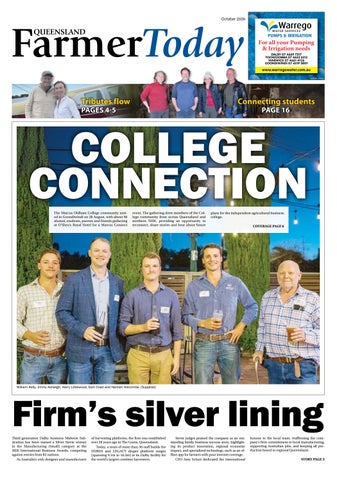
COLLEGE CONNECTION The Marcus Oldham College community united in Goondiwindi on 28 August, with about 90 alumni, students, parents and friends gathering at O’Shea’s Royal Hotel for a Marcus Connect
event. The gathering drew members of the College community from across Queensland and northern NSW, providing an opportunity to reconnect, share stories and hear about future
plans for the independent agricultural business college. COVERAGE PAGE 6
William Kelly, Jimmy Ashleigh, Harry Littlewood, Sam Coad and Hamish Holcombe. (Supplied)
Firm’s silver lining Third-generation Dalby business Midwest Fabrication has been named a Silver Stevie winner in the Manufacturing (Small) category at the 2026 International Business Awards, competing against entries from 82 nations. As Australia’s only designer and manufacturer
of harvesting platforms, the firm was established over 28 years ago in The Gums, Queensland. Today, a team of more than 30 staff builds the DURUS and LEGACY draper platform ranges (spanning 9.1m to 18.3m) at its Dalby facility for the world’s largest combine harvesters.
Stevie judges praised the company as an outstanding family business success story, highlighting its product innovation, regional economic impact, and specialized technology, such as an offline app for farmers with poor internet coverage. CEO Amy Schutt dedicated the international
honour to the local team, reaffirming the company’s firm commitment to local manufacturing, supporting Australian jobs, and keeping all production based in regional Queensland. STORY PAGE 3
INSIDE
NEWS QueenslandFarmerToday.com.au
TRIBUTES FLOW ............................. pages 4-5 COLLEGE CONNECTION ...................... page 6 WELLBEING INITIATIVE ........................ page 8 WOMEN IN AGRICULTURE ......... pages 16-17 RECIPES ............................................. page 22 SPORT ....................................... pages 24, 28 MARKET ROUND-UP........................... page 25
WEATHER BEARDMORE .................................... 62.08% BJELKE-PETERSEN ........................... 94.07% BORUMBA .........................................98.05% BOONDOOMA ................................... 90.35% CEDAR POCKET ................................ 91.02% CHINCHILLA WEIR ............................ 72.07% COOLMUNDA .................................... 52.04% LESLIE ............................................... 56.71% PARADISE ......................................... 90.14% SOMERSET .............................................81% WIVENHOE ........................................ 82.02%
CONTACT US
Researchers at Emerald are endeavouring to understand how warmer conditions could affect future winter crop production and help growers reduce their risks. (Supplied)
Website:
Research heating up
QueenslandFarmerToday.com.au
By Fiona Gowers
Address: 154-156 Haly Street Kingaroy 4610 Telephone: 07 4182 0450
CONTACT US Editorial: Fiona Gowers Editor E: fiona.gowers@QueenslandFarmerToday.com.au Advertising: Lynda Crombie Sales & Marketing E: lynda.crombie@QueenslandFarmerToday.com.au P: 0407 152 967 David Moon Sales & Marketing E: david.moon@BurnettToday.com.au P: 0408 813 296 Jemma Wilson Sales & Marketing E: jemma.wilson@BurnettToday.com.au P: 07 4182 0458 Gayle Hopes Sales & Marketing E: gayle.hopes@TodayNewsGroup.com.au P: 0421 655 138
Queensland Farmer Today is published monthly and part of the Today News Group. Published by South Burnett Today Pty Ltd ACN 641 796 349. Publisher: Daniel Pelcl P: 0408 956 830 Managing Director: Daniel Pelcl. All material is copyright to South Burnett Today Pty Ltd. All significant errors will be corrected as soon as possible. For our terms and conditions please visit QueenslanFarmerToday.com.au/terms-and-conditions/ 2 TODAY October 2026
Queensland researchers are “turning up the heat“ on grain crops at Emerald to understand how warmer conditions can affect future production and identify practical ways growers can reduce the risks. Innovative scientific research is underway at the Department of Primary Industries’ Central Queensland Smart Cropping Centre, where six purpose-built in-field heat chambers are being used to study the impacts of higher night-time temperatures on crops. The chambers, which are the largest of their kind in the world, can lift temperatures inside by up to three degrees above outside conditions, allowing researchers to simulate hotter night-time conditions. The research is focused on providing Queensland farmers with new methods to grow grains and pulses in warmer climates, with the aim of increasing food production and security. Sorghum is among the crops being studied. The grain is widely used for stockfeed and in food products including beer and gluten-free flour. The chambers have been specifically designed for Queensland conditions in partnership with global technology company Biora and are positioned in a paddock. Equipped with remote monitoring devices, they allow researchers to gather data on how crops respond to heat stress and climate variability. Central Queensland provides an important testing ground for the research, with the region experiencing significant temperature variation and supporting a major cropping industry. The research will also examine wheat and chickpeas, with the rotation between the two crops an important part of the state’s winter cropping industry. Understanding how crops respond to variable temperatures is critical to developing practical management options that can improve productivity and, ultimately, profitability for growers. The research forms part of more than 230 ac-
Six purpose-built in-field heat chambers at the Department of Primary Industries’ Central Queensland Smart Cropping Centre are being used to study the impacts of higher night-time temperatures on crops. (Supplied) tions being delivered under Primary Industries Prosper 2050, the Queensland Government’s fiveyear blueprint for the state’s primary industries. Primary Industries Minister Tony Perrett said the scientific infrastructure positioned Queensland’s Department of Primary Industries as a national leader in farmer focused research and development. “By leveraging advanced technologies like infield heat chambers, we are equipping Queensland farmers with the knowledge to better understand and manage the impacts of an increasingly variable climate,” Mr Perrett said. “I have said time and time again that the Crisafulli Government backs our farmers with real investment, not empty promises. “This is just one example of how we are delivering on our commitment to grow our primary industries to $30 billion by 2030, ensuring a strong and sustainable future for agriculture in our state. “We are proud to partner with industry to invest in research that delivers practical management options growers can use now and into the future.”
Mental health must be agriculture’s priority Farmer mental health is one issue the Australian agricultural industry can no longer ignore. The latest 2026 Norco National Farmer Wellbeing Report - produced in partnership with the Black Dog Institute - should scare everyone involved in the rural sector. More than half of farmers surveyed - 54 per cent - reported feeling depressed or down during the past two years, while 24pc said they often or always felt anxious. One in three said their mental health had deteriorated in the past 12 months. Most concerning of all, 15pc reported experiencing thoughts of self-harm or suicide. These figures are not simply statistics. Behind every percentage is a farmer, a family and a business carrying the weight of rising input costs, natural disasters, labour shortages, market uncertainty and global instability. And the consequences reach well beyond individual farms. The report found 41pc of farmers had considered leaving the industry. If farmers are struggling to see a future for themselves in agriculture, then the industry must ask what future it is creating for the people who produce our food and underpin regional communities. We talk constantly about productivity, profitability, sustainability and resilience. But none of these things matter if the people expected to deliver them are struggling just to get through the day. Farmer mental health cannot remain a conversation held after a crisis. It needs to be treated as a fundamental issue for the future of Australian agriculture – and action needs to match the scale of the problem. Immediately.
- Fiona Gowers
QueenslandFarmerToday.com.au
NEWS
The Midwest Fabrication team.
Midwest Fabrication CEO Amy Schutt. (Supplied)
Dalby firm’s global reach A third-generation Dalby manufacturing business has won an international business accolade, with Midwest Fabrication named a Silver Stevie winner in the 2026 International Business Awards. Recognised in the Company of the Year - Manufacturing - Small category, Midwest Fabrication was named as Australia’s only designer and manufacturer of harvesting platforms. The awards recognise outstanding organisations, executives, entrepreneurs and teams worldwide and, this year, attracted entries from organisations in 82 nations and territories, placing Midwest’s achievement on an international stage. Established more than 28 years ago, Midwest Fabrication has grown from a small operation at The Gums, Queensland, into an internationallyrecognised manufacturer of draper platforms for the world’s largest combines. Today, more than 30 staff build the machines at the company’s Dalby facility, producing the DURUS and LEGACY ranges in widths from 9.1 metres to 18.3m, including 60-feet draper heads. The Stevie judges highlighted the company’s strong focus on Australian manufacturing. One IBA judge described Midwest Fabrication as “a standout Australian manufacturing story with clear product innovation, strong farmer relevance and excellent evidence of recent momentum”. He added that “the combination of locally engineered solutions, industry awards, media recognition and direct customer testimony makes this one of the strongest entries in the set”. Another judge called the company “a true family business success story”, noting that “technology designed and patented by this firm helps farmers across Australia maximise their productivity”, and that its offline app was “designed for those with poor internet coverage, an issue often overlooked nowadays”. A third judge said Midwest “presents a strong case for Stevie awards for small manufacturers”, pointing to the company’s growth and its “Made in Australia” branding as points of difference.
Midwest Fabrication CEO Amy Schutt, who has worked in the business since its inception, said the recognition belonged to the team on the floor in Dalby. “We actively choose not to manufacture offshore,” Ms Schutt said. “We want to support Australian-made, Australian jobs, Australian manufacturing and support Australian suppliers. “To be recognised on a world stage while building every platform here in Dalby says everything about the people who work here. I want to congratulate every member of our team. This win is theirs. “We choose the integrity of this company and the integrity of our products to make sure that the end product is the best on the market.” The recognition adds to the company’s growing profile while reinforcing its commitment to designing and manufacturing harvesting equipment in regional Queensland. About Midwest Fabrication Midwest Fabrication is a three-generation, family-owned Australian manufacturer based in Dalby. Established more than 28 years ago, Midwest is Australia’s only designer and manufacturer of harvesting platforms (draper heads for combines) and builds every machine on site with a local team of more than 30 people. The company produces the DURUS and LEGACY platform ranges in widths from 9.1m to 18.3m, featuring the patented Hoverpoint air-ride adapter for ground following without electronics or sensors. Led by CEO Amy Schutt, the company’s first female CEO, Midwest’s mission is to help Australian farmers feed the nation by designing and manufacturing the highest-quality, most reliable and cost-effective harvesting platforms available, built here in Australia. About the Stevie Awards Founded in 2002, the Stevie Awards are widely recognised as the world’s premier business awards programs, honouring outstanding achievements in the workplace worldwide. The name “Stevie” is derived from the Greek name Stephanos, meaning “crowned”.
A Midwest Legacy Harvest Platform.
ROD LYNCH TYRES 16.9-30 (14) ..............................$880 18.4-30 (14) ............................ $1020 18.4-34 (14) ............................$1060 23.1-30 (14). ...........................$1450 825-20 (14) .............................. $289 825.16 16 (14p) + cub........$270 900-20 (16).............................. $320 1000-20 (16)............................$345 825 x R15 (18p) d/deck ...$275 1400 x 20 (20) .......................$800 255.70R-225. .......................... $225 825 R-15 (14).......................... .$320 275.70 R225 ............................ $236 11R 225... ......................................$245 295.80 22.5 .............................$330 30.5-32 (20).........................$2350 245-32 (16) ............................$1980 750-16/RIB (8)........................$150 149.26 (12p) .............................$635 35.65R33-L5 ..........................$8800 29SR25 Yoko ..........................$5600 37.25-35 36P ..........................$8600 305-32 Logger ......................$3500
23.1x34 (5) ...............................$1760 710.70 R42............................. $3700 480.80 R50...........................$2300 480.80 R 42. .........................$1830 520.85 R42 .............................$2120 520.85 R42 ............................$1950 710.70-R38 ............................$2800 800.65 R32 ...........................$3450 900.60 R 42 .........................$5500 35 SL-32. ................................$5000 420-70-28.................................$965 710.45-26.5............................ $2520 540 65R R28 ........................$1400 18.4 x 28 Tractor (12).........$930 18.4 x 28 Industrial ..........$1045 18.4 x 38 38 (16) ................. $1250 20.8 x 35 (14)........................$1500 13.6 x 38 (12) ............................$725 650-65R 38 ............................$1700
169-24 ply.................................$690 540-65 R34 ........................... $1360 800-70 R38 ...........................$4100 380-85 R30 ..............................$975 620-70 R42...........................$2300 380-85-28 ................................$960 900 x 7R 32. .........................$4600 360-70 R24 ..............................$666 380-70 R24 .............................. $790 480-70 R28..............................$1180 480-80 R46..........................$2280 460-88 R34 ............................$1720 124-28 (12).................................$475 11.2-28 (12)................................$400 11R 225 Truck........................$2160 480-70 R28..............................$1180 10-165 10Ply B/Cat. ..............$176 1400-24 16 ply Grader ......$700
Ring Loggers All sizes - Tractor - E/Moving. Many Specials
8 Steel St, Narangaba 4505 0408 735 125 Anthony maximtrailer@gmail.com
12889528-JV35-26
By Fiona Gowers
October 2026 TODAY 3
NEWS QueenslandFarmerToday.com.au
Tributes flow for Campbells By Lloyd Jones/AAP and Fiona Gowers
The Campbell family operated Mañana Pastoral in the Goondiwindi region, producing extra virgin olive oil, grass-fed lamb and beef. (Supplied)
Tributes continue to flow for Queensland farmer Ian Campbell and his daughter Hannah, who passed away in a light plane accident south of Brisbane on 7 September. Mr Campbell, 56, and Hannah, 23, perished when the Beechcraft A36 Bonanza they were flying in crashed into a rural property at Stockleigh, near Musch Road, shortly after taking off from Archerfield Airport. Emergency services were called to the property at about 11.10am. Debris was scattered across the property and flames from a grass fire spread across an area of about 300 metres by 400m, burning close to a farmhouse before multiple emergency crews controlled the blaze. Police Chief Superintendent Mel Adams said investigators were still working to establish what happened during the flight. “As to what happened whilst that aircraft was in the air, we have no information at this time,“ Chief Superintendent Adams said. She described the crash scene as “very confronting“. Initial investigations indicate the aircraft took off at 10.57am, with the Australian Transport Safety Bureau (ATSB) subsequently launching an investigation into the crash. The ATSB sent a three-person team specialising in aircraft operations, maintenance and engineering to the scene to gather evidence and examine the wreckage. “Investigators will also interview any witnesses and involved parties and collect relevant recorded information including flight tracking data, as well as pilot and aircraft maintenance records and weather information,“ the bureau said. Aircraft components were recovered for further examination at the ATSB’s technical facilities in Canberra, with a preliminary report expected in eight weeks. Mr Campbell was a fourth-generation dairy farmer who founded Barambah Organics with his wife Jane in 2002 after converting his family’s farm. The Campbell family also operated Mañana Pastoral in the Goondiwindi region, producing extra virgin olive oil, grass-fed lamb and beef.
Barambah Organics chief executive Chris Elliott said the company’s 100 employees were deeply saddened by Mr Campbell’s death. “We’ve just pulled everyone together and had an open forum where we shared our concerns and thoughts, coming together over a morning tea,“ he told AAP. The loss of Mr Campbell was “incredibly sad for the business“, Mr Elliott said. “He certainly had an impact. His legacy through our brand will carry on.“ Goondiwindi Mayor Lawrence Springborg said the family had the support, prayers and goodwill of the community and that both Mr Campbell and Hannah would be greatly missed. “We feel their grief deeply and what makes it also so hard is that the Campbell family were so generous in their support of the local community,“ he told the ABC. Mr Springborg said the Campbell family had raised more than $70,000 for the Royal Flying Doctor Service. National Farmers’ Federation president Hamish McIntyre described the deaths as an “absolutely heartbreaking tragedy“. Mr Campbell was a highly respected figure in Australian agriculture and a long-time friend, he said. “(And) Hannah was a bright young woman with her whole life in front of her.“ Mr McIntyre said his thoughts were with the family, their many friends and everyone touched by “this devastating loss“. Ian and Hannah were also remembered by the St Albert’s College community at the University of New England, where a tribute described Hannah as a positive, loyal and uplifting presence and Ian as a humble, down-to-earth man passionate about sustainable farming and inspiring students. “Hannah and Ian were two incredibly generous people with so much more left to give. Our hearts go out to the Campbell family during this devastating time.“ The RFDS also remembered the family, with the organisation highlighting the Campbells’ long standing support for rural and regional communities. *The funeral service for Ian and Hannah Campbell will be held at St Margaret’s Anglican Girls School, Ascot on Friday, 25 September.
MUTCHILBA LYCHEE FARM Here is the opportunity to secure this 41.58 Ha orchard with 7,865 trees. The irrigation system is fed with a 50hp electric motor and a Dix water filtering system fed from a 70Ml dam – and a further water licence allowing 69Ml to be pumped from the river. The packing and machinery sheds boast an incredible 1,000 sqm of coverage. The packing room is air conditioned.
The property also has all machinery and equipment, netting, packing and boxes to simply buy and step into production. Contact Alf on 0418 774 849
12899079-AD39-26
The home is a three bedroom, one bathroom dwelling with built-ins, a study, enclosed rear verandah and exposed front verandah. There are separate toilet and rest facilities for workers.
70 Edith Street Innisfail. Ph: 4061 1466 aarealty@aarealty.net | www.aarealty.net Ian Campbell, pictured with wife Jane, trekked the Kokoda Track in August to raise money for the Royal Flying Doctor Service. 4 TODAY October 2026
QueenslandFarmerToday.com.au
NEWS
Passion for farming, giving By Gladys Barreta Ian Campbell shared a passion for farming, aviation and giving back to rural Australia with his wife, Jane. The couple’s love of flying began more than 25 years ago, when they learnt to fly at Archerfield in 1999, completing their pilot training together as part of their honeymoon and obtaining their pilot licences. In the years since, aviation became a central part of their personal and professional lives. Based at Glenarbon - about 55km from Goondiwindi - the family has three farming properties across southern Queensland and northern New South Wales under Mañana Pastoral. The family also founded Barambah Organics. In August, the Campbells accepted a new challenge - trekking the Kokoda Track as RFDS Ambassadors through Trek4RFDS. Their daughter, Hannah, joined them on the historic trek. Speaking to this publication to promote a fundraising lunch for the RFDS ahead of their adventure, Mrs Campbell said becoming an RFDS Ambassador was about raising awareness of the organisation’s work beyond emergency retrievals. In 2022, Mr Campbell participated in the Outback Air Race as a member of the Comanche Flyers, helping raise more than $75,000 for the Royal Flying Doctor Service (RFDS). “What we’ve come to learn is the incredible mental health work they do - not just evacuating and triaging patients, but providing skilled healthcare professionals in rural communities. That’s some of the most important work they do out here,“ Mrs Campbell said in August. She said the couple’s appreciation for the RFDS also came from personal experience. In 2019, Mr Campbell was kicked in the neck by a dairy cow while working alone on the farm and drove himself to Goondiwindi Hospital. “It could have ended very badly,“ Jane said.
Ian Campbell shared a passion for farming, aviation and giving back to rural Australia with his wife, Jane. (Supplied) “We’ve met so many people whose lives, or whose loved ones’ lives, have been saved by the RFDS. Out here, you’re only two or three degrees of separation from someone who’s needed them. “We’ve had lots of accidents on farms, and quite a few of our friends have childhood stories of being saved by the RFDS,“ Jane said.
“If we’re going to support any charity, it makes sense for us to support one that means so much to rural communities.“ Ahead of the Kokoda trek, Mrs Campbell said she was looking forward to sharing the experience with her daughter while learning more about Australia’s wartime history.
“I’m looking forward to walking with Hannah and carving out that time together,“ she said before their journey began. “Friends have told us it’s a physically demanding track, but I’m fascinated by the history of Kokoda and what those soldiers achieved in the 1940s.“
FARMFORCE Post Driver
Australia’s Toughest & Most Versatile Post Driver
Australian Made, in QLD
Hydraulic Post Drivers from
Specialising in heavy-duty Post Drivers for all purposes, including Exclusion Fencing and Vineyards.
$10,120
Rock Spike & Hydraulic Auger options available. 3 Years Warranty
inc GST
07 5442 1915 0408 883 652
www.farmforce.com.au farmforce@live.com 12884664-JV31-26
October 2026 TODAY 5
NEWS QueenslandFarmerToday.com.au
Tim Kelly, Sean Laurie and College Chairman Rob McGavin.
Josh Boland, Daniel Boland, Rob Raines, Hamish Brett and current College Principal Andrew Baker.
Richard Estens, Melissa Hobday and William Harris.
Marcus Oldham connects The Marcus Oldham College community united in Goondiwindi on 28 August, with about 90 alumni, students, parents and friends gathering at O’Shea’s Royal Hotel for a Marcus Connect event. The gathering drew members of the College community from across Queensland and northern NSW, providing an opportunity to reconnect, share stories and hear about future plans for the independent agricultural business college. Cleo Gower, who has been appointed Principal of Marcus Oldham College effective December 15, spoke about the College’s accelerated Bachelor of Business degrees in Agriculture and Agribusiness, its applied learning approach and the importance of selecting students with the motivation and experience to succeed. “Marcus Oldham has always maintained a close connection with the industries and regional communities our students and graduates are part of,” Ms Gower said. “Events such as Marcus Connect allow us to listen to our community, strengthen those relationships and share how the College is continuing to prepare graduates to contribute to the future of Australian agriculture.” Marcus Oldham graduate and College Council Chairman Rob McGavin also addressed the gathering, providing an insight into recent projects, including the opening of Nicholas Hancock House, a new 45-bed student accommodation facility. Nicholas Hancock House was officially opened in October 2025, with the College describing the facility as part of its efforts to restore the full liveand-learn-together experience for students. The Goondiwindi event highlighted the strength of the Marcus Oldham network and the ongoing role graduates, families and industry supporters play in the College community.
Yolande Woods, Ted Tonkin, Phil Tonkin, Glen Smitt and College Council member Andrew Earle. (Supplied)
Archie Wilson and Angus Earle.
Sally Crothers and David Crothers.
Yolande Woods, Ted Tonkin, Phil Tonkin, Glen Smitt and College Council member Andrew Earle. 6 TODAY October 2026
Rob Raines and Rachael Laurie.
Cleo Gower presents to the attendees.
Libby Glasser, Susie Kelly and Scott Glasser.
Rob McGavin addresses attendees.
QueenslandFarmerToday.com.au
NEWS
New King Air fleet for RFDS For almost four decades, the Beechcraft King Air has been the backbone of the Royal Flying Doctor Service (Queensland Section) (RFDS) aeromedical fleet, supporting the safe and reliable transfer of patients across regional, rural and remote communities. Building on this proven platform, the RFDS is investing in the future through the acquisition of six new King Air 260C aircraft, ensuring the organisation continues to deliver worldclass aeromedical care across the vast state of Queensland. As part of this significant fleet modernisation program, the RFDS (Queensland Section) has engaged Sunshine Coast-based company HeliMods to design and integrate a bespoke Aeromedical Mission System (AMS) for the organisation’s new fleet of King Air 260C aircraft. HeliMods is no stranger to working with the RFDS, having modified six Beechcraft King Air B360 aircraft into advanced aeromedical aircraft with state-of-the-art medical stretchers, integrated oxygen systems and digital connectivity. RFDS (Queensland Section) Chief Executive Officer Meredith Staib said the service would take delivery of six King Air 260C aircraft from Textron Aviation over the next four years. “This is an exciting new chapter in the RFDS (Queensland Section) fleet strategy and a oncein-a-generation investment in the future of aeromedical care,” Ms Staib said. “We’re proud to work with HeliMods to transform the new King Air 260C into the organisation’s next generation of life-saving aeromedical aircraft, capable of operating in some of the most challenging and remote locations across the state. “This is an investment in aeromedical care for all Queenslanders. The new aircraft will be more powerful than its predecessor, helping our medical crews reach patients sooner and transfer them safely to the care they need.” Importantly, this aircraft will form part of our
centenary legacy - an investment that honours 100 years of service while strengthening our ability to reach Queenslanders for decades to come. HeliMods founder Will Shrapnel said the organisation was proud to be working alongside the RFDS to develop and deliver the next generation of aeromedical aircraft. “Queensland’s size and remoteness present some of the most challenging healthcare delivery conditions anywhere in the world and the King Air 260C represents an important step forward in Queensland’s aeromedical capability,“ Mr Shrapnel said. “Working closely with RFDS (Queensland Section), HeliMods is developing and delivering an advanced aeromedical mission system that will help unlock the full potential of this nextgeneration aircraft. “Together, we’re focused on ensuring the platform delivers exceptional patient care, crew safety and operational capability, supporting access to critical healthcare services no matter where Queenslanders live.“ The King Air 260C builds on the trusted legacy of the King Air 200 that has served remote and rural communities across the state for decades. The new fleet will deliver improved performance and higher cruise speeds, providing a faster and more comfortable ride for patients. The aircraft will also have the latest avionics, navigation and safety systems, further enhancing operational capability and safety and will maintain capability to land and take-off from shorter airstrips. It is anticipated the RFDS (Queensland Section) will take delivery of the first King Air 260C, with a full HeliMods fit-out in 2028, in time to celebrate the organisation’s centenary. HeliMods founder Will Shrapnel and RFDS (Queensland Section) CEO Meredith Staib. (Supplied)
Vertical Feed-mixers 10 to 40 cubic metre models Single or Twin Augers, Front Door or Side Doors with elevator
Model FS1000D Side doors with Elevator
Also available:
RENN GRAIN BAGGERS & BAG UNLOADERS
Quick and effective mixing, complete and rapid emptying . What you put in your mix gets to your herd, consistently. Large carbide-insert knives
ROLLER MILLS For 60 years the heart of the RENN Roller Mill has been its precision-machined 16” diameter rolls, which provide more grain rolling area per revolution compared to other brands of roller mills with smaller diameter rolls. RENN Roller Mills save time and money year after year by rolling more grain per hour with less horsepower.
RG1020 - 10ft tunnel, with 20” direct drive inclined filling auger
Dry and High Moisture Rolling PTO or Electric 12”, 24”, 36” & 48” Models - Folding Auger
Australian Distributors:
EASTERN SPREADERS PTY LTD
9508 Murray Valley Highway, KERANG, Vic 3579 Sales 0409 691 226
or
Ph: 03 5450 3077
0429 480 337 sales@easternspreaders.com.au 12895044-JO39-26
October 2026 TODAY 7
NEWS QueenslandFarmerToday.com.au
Farmers at breaking point By Fiona Gowers Australian farmers are experiencing sustained levels of stress, anxiety and emotional exhaustion, with a new national report revealing many now question their future in the industry. The 2026 Norco National Farmer Wellbeing Report - produced in partnership with the Black Dog Institute - has highlighted a worsening mental health landscape across Australian agriculture, with several key indicators increasing over the past three years. The findings come as farmers contend with rising fuel, fertiliser and freight costs, repeated natural disasters and increasing global uncertainty. More than half of farmers (54 per cent) reported feeling depressed or down during the past two years, while almost one quarter (24pc) said they often or always felt anxious. One third of farmers (33pc) reported that their mental health had deteriorated during the past 12 months. The report also found farmers were almost twice as likely to report poor mental health as poor physical health, at 19pc compared with 10pc. Of particular concern, 15pc of farmers reported experiencing thoughts of self-harm or suicide during the past two years, a rate substantially higher than that recorded in the general Australian population. The research was conducted before the recent surge in global uncertainty and renewed inputcost pressures affecting Australian agriculture, suggesting the challenges facing many farmers may have intensified further. As pressures mount, 41pc of farmers said they had considered leaving the industry. Norco chief executive officer Michael Hampson said the findings demonstrated the scale of pressures facing Australian farmers and the potential consequences for the sector’s future sustainability. “Our 2023 Farmer Wellbeing Report shone a confronting light on the challenges facing Australian farmers, but these latest findings show those pressures have certainly not eased,” Mr Hampson said. “Over recent years we’ve seen repeated natural disasters, rising operating costs and global instability all converge at once and this report shows that the human impact is becoming increasingly severe. “Farmers produce around 90pc of the food consumed in Australia, yet many are now reconsidering their future in the industry. That has significant implications not only for farming families and regional communities, but for Australia’s long-term food security.” Black Dog Institute executive director and chief scientist Professor Samuel Harvey said the findings highlighted the complex combination of pressures affecting farming communities. “The specific intersection of occupational, social, cultural and environmental stressors experienced by farmers has created a large and growing mental health crisis within Australia’s farming communities,“ Professor Harvey said. “Three years on from the first National Farmer Wellbeing Report, the continued scale of distress and unmet mental health care needs across the agricultural sector is deeply concerning. The results show we now have a situation that cannot be ignored.“ The pressure behind the statistics For farmers, the pressures identified in the report extend well beyond the farm gate. Norco dairy farmer Jane Polson, from Oxley Island in New South Wales, said the findings reflected the growing strain farming families felt. “People see natural disasters, fuel shortages or rising prices in the headlines, but what they don’t always see is the emotional and financial toll farmers are carrying every single day,” Ms Polson said. “The ongoing uncertainty across so many areas is very real and, unfortunately, those pressures don’t switch off when the workday ends. “Farming is not just a job for most people, it’s a way of life for families and one that’s often built over generations. But many farmers are exhausted and carrying the weight of navigating these increasingly difficult circumstances.” Financial pressure is adding to the burden More than one-quarter of farmers (27pc) said their farms had operated at a loss during the past three years, with 75pc of those farmers reporting that the losses had negatively affected their men8 TODAY October 2026
Professor Samuel Harvey, Jane Polson, Ross Blanch and Michael Hampson. (Supplied)
The Farmer Wellbeing Report 2026.
Dairy farmer Jane Polson and Norco CEO Michael Hampson. tal health. To remain financially viable, 59pc of farmers are now relying on off-farm work or secondary occupations. For almost one in five farmers (17pc), that additional work amounts to 30 hours or more each week – effectively another full-time job. The result is widespread fatigue and burnout, with 23pc of farmers saying they often struggle to cope with the demands of farming. Concerns about agriculture’s future The report also points to a growing disconnect between the contribution farmers make to Australian society and how valued they believe that contribution is. More than nine in 10 farmers (91pc) believe their role is undervalued by the Australian public, while 27pc are no longer optimistic about the future of farming in Australia. With 79pc of farmers coming from multi-generational farming families, the findings also raise concerns about succession, particularly as many farming families do not yet have clear succession plans in place. Mr Hampson said farmer wellbeing needed to be recognised as an issue extending beyond individual farms and families. “In an increasingly uncertain global environment, maintaining strong local food production and sovereign capability has never been more
Meet the press! Norco dairy farmer Ross Blanch.
important and farmer wellbeing must now be recognised as a critical food security issue requiring coordinated action. “The fact that 94pc of farmers believe Australia’s long-term food security depends on stronger support for farmers and regional communities sends a powerful message about the scale of concern across the sector. “If we lose farmers, we lose far more than individual farms; we risk losing regional communities, local industries and ultimately Australia’s ability to sustain its own food production. “Forty years ago, few could have imagined Australia would no longer have a car manufacturing sector, but history shows industries can disappear when long-term challenges are left unaddressed. “That’s why it is critical we continue investing in the sustainability and resilience of Australian agriculture and the people behind it, because we simply cannot afford to take our farming sector for granted.” Professor Harvey said the findings, while confronting, also pointed towards the actions needed to support farmers. “We need to equip regional communities to better support each other and ensure farmers can access timely, high-quality professional mental health care when they need it, no matter where they live.
“But we also need to recognise the power policymakers have to improve farmer wellbeing through better responses to the economic and climate challenges they face. “Mental health support is critical, but so too is addressing the underlying pressures that are driving distress in the first place.“ The report ultimately highlights that farmer wellbeing cannot be separated from the economic, environmental and social pressures confronting Australian agriculture. For an industry responsible for producing around 90pc of Australia’s food, the wellbeing of the people behind that production is increasingly being recognised as fundamental to Australia’s long-term food security. FACTS 54 per cent of Australian farmers have felt depressed or down in the past two years One in five farmers report poor mental health - almost double those reporting poor physical health One in seven have had thoughts of self-harm or suicide 91pc feel undervalued by the Australian public 41pc have considered leaving the industry 94pc say Australia’s food security depends on stronger support for farmers and regional communities.
• •
• • • •
Thursday, 5 November 2026 Dalby & Northern Downs Jockey Club, Dalby 5.30pm - 8.30pm Join business leaders, industry innovators, government representatives and regional stakeholders at the Dalby Enterprise Evening. This event will bring together key decision-makers and changemakers to connect, collaborate and explore the growing role of data centres in regional economic development. Attendees will hear the latest industry insights, discuss emerging opportunities in the digital infrastructure sector and receive an update from Zerra on its proposed data centre development in the region. Purchase your tickets at tsbe.com.au 12899401-KF39-26
Scan for more information and to purchase tickets.
October 2026 TODAY 9
THE CATTLEMAN’S CHOICE BULL SALE 12899066-EB39-26
Where thriving bulls belong The Cattleman’s Choice Bull Sale The Cattleman’s Choice Bull Sale consists of three likeminded studs Alpine Charolais, Daraabah Simmental and Bluestone Beef Black Composites, along with guest vendors Caloona Charolais and Goldstar Genetics. The sale has a joint aim of offering value for money, high-performance bulls that are also proven to perform in the harshest of Queensland conditions. Industry relevant, modern-day bulls with oldschool, common-sense cattleman’s principals at heart. They not only perform extremely well in all Queensland conditions, but that performance carries through to their progeny, reliably producing highly marketable calves. The Sanderson, McColl and Ball families are proud to be part of the inaugural Cattleman’s Choice Bull Sale, joining like-minded, commercially focused breeders who share one simple goal - to offer good bulls that get out, go to work and make their buyers money Daraabah & Goldstar Simmentals Daraabah & Goldstar has been successfully selling bulls into Queensland since 2017, including into prominent Queensland Simmental studs. As vendors in the Queensland Simmental Bull Sale since its inception, they have built a strong following of repeat buyers – something they believe speaks volumes for the consistency and performance of their cattle. Daraabah & Goldstar will offer 17 registered Simmental bulls bred with the commercial cattleman firmly in mind. The draft features moderateframed, easy-calving bulls with strong carcase credentials, alongside some exciting young sires with extra growth, power and performance. Since June, their sale bulls have been prepared in Queensland near Clifton, allowing them plenty of time to acclimatise ahead of sale day. Importantly, these bulls are not lot fed at any stage and this preparation gives the bulls the best opportunity to transition quickly and successfully back into full grazing conditions when they arrive at their new home. These are no-fuss, commercially relevant bulls - structurally sound, bred to perform and backed by genetics that are already proving themselves in Queensland herds. Alpine Charolais Jane and Justin Sanderson join 500-700 females annually to Alpine Charolais bulls at their properties at Gwabegar and Tottenham and have built the stud herd to 100 stud females on their home property between Dubbo and Collie. Being the director of a livestock agency, Justin frequently sees the commercial capabilities of the Charolais breed in all conditions throughout Australia. This is proven in the range of areas and conditions Alpine Charolais bulls are sold to, and thriving in, including Hungerford Mulga and Richmond/Croydon forest country. The bulls on offer represent a selection of 14 Charolais sires from their group of sale bulls this year - 10 fully registered and four herd bulls along with two quality Charolais composite sires. This year’s bulls have been raised and weaned on grass country given access to an oat and hay based ration at yearling age when dry conditions took hold. They then moved to a ration at Stephen Hayward’s, Allora QLD, acclimatising to Queensland conditions. Their bulls have a warranty period of 6 months from date of sale. BlueStone Beef BlueStone Beef is based on the philosophy of taking the best in proven science and applying it to their breeding program. Duncan and Sarah Ball believe well managed hybrid vigour will be the next biggest productivity gain for your beef enterprise. Using an Angus base, BlueStone Beef use the best traits of multiple breeds to produce a black, polled animal with superior early growth rates producing a moderate, maternal and highly efficient female. Their sires have longevity, docility, and soundness with moderate mature weights. Our breeding philosophy is uncomplicated and practical. All BlueStone Beef breeding programs have at least 50% Angus component, enabling all 10 TODAY October 2026
The Cattleman’s Choice Bull Sale consists of three likeminded studs Alpine Charolais, Daraabah Simmental & Bluestone Beef Black Composites, along with guest vendors Caloona Charolais and Goldstar Genetics. (Supplied) progeny to meet Angus specifications required for marketing purposes. A price premium matched with enhanced growth and reproductive efficiency equals increased profitability. By combining breeds that have different strengths we harness the effects of breed complementarity. BlueStone Beef composited bulls have increased fertility and longevity, earlier age at puberty, increased yearling scrotal circumference, increased semen production and improved semen quality. The Cattleman’s Choice Bull Sale will be held in the Dalby saleyards & interfaced live online with AuctionsPlus at 11am on Friday 16th of October 2026. Contacts for the sale: Alpine Charolais - Justin & Jane Sanderson 0409912213 Daraabah Simmental - Bruce & Melinda McColl 0429750590 Bluestone Beef - Duncan & Sarah Ball 0428126812 Selling agents: Ray White Livestock Dalby David Felsh 0488 993 931 Keegan De Roo 0407 701 381 Linc’d PTY LTD Lincoln McKinlay 0400552458 For further details contact: David Felsh 0488 993 931 Ray White Livestock Dalby.
• • •
• • • • •
These are no-fuss, commercially relevant bulls - structurally sound, bred to perform and backed by genetics that are already proving themselves in Queensland herds.
THE CATTLEMAN’S CHOICE BULL SALE
Presented by Valley Irrigation
Value for money, high performance bulls that are also proven to perform in the harshest of Queensland’s conditions.
78
26 CHAROLAIS
BULLS
35 BLACK COMPOSITES
Friday 16 October 11am
David Felsch 0488 993 931
17 SIMMENTAL
Dalby Saleyards & interfaced live online with AuctionsPlus
cattlemanschoice.com.au
Keegan De Roo 0407 701 381 Platinum Sponsor
Lincoln McKinlay 0400 552 458 12900547-AF39-26
October 2026 TODAY 11
NEWS QueenslandFarmerToday.com.au
Strong bull sale result NIOA Santa Gertrudis General Manager Shannon Gardner says the Allora stud’s long-term investment in its female herd is reaping dividends following another strong result at the annual NIOA RL Pastoral Sale. NIOA sold 30 of 31 bulls under the hammer to an average of $14,467, including $40,000 sale topper NIOA Winchester W68 (P), a son of Yarrawonga Spartacus S336 (P) and $27,500 second top NIOA Walter W38 (PP), sired by Riverina Roland Sanchez R88 (ET) (PP). Both were from NIOA-bred cows, as were another 13 bulls sold to commercial beef producers from across northern and central Australia who gathered at Talgai Homestead on a hot Southern Downs spring day last Thursday. Mr Gardner said the strong result was the culmination of a decade of investment in selecting, developing and retaining females capable of producing the type of bulls demanded by commercial and stud cattle producers. Since its inception in 2014, NIOA has acquired females from leading studs including Glen Oaks, Yulgilbar, Rosevale, Talgai, Bullamakinka, Santalands Goolagong, Riverslea, Tookey Creek and Gyranda. Not only are NIOA-bred females now performing at industry-leading levels in both the show ring and commercial production, they are also commanding strong market recognition, highlighted by the 2022 sale of NIOA Lucy Q14 (P) for $50,000 and the sustained success of NIOA Helena R03 at local shows. “The sires are one thing, but we’ve put a lot of time and money into our females over the last five to 10 years and it is really starting to pay off in terms of our ability to consistently produce a quality line-up of bulls,” Mr Gardner said. “You can’t build a successful bull program without a strong female herd behind it. We’ve been pretty selective about the females we’ve kept and the genetics we’ve brought into the herd. “There were a lot of NIOA prefixes in the catalogue today - that’s becoming the nucleus of our breeding herd - and to get a sale result like we had is very satisfying.”
NIOA Santa Gertrudis General Manager Shannon Gardner, right, with sale agent Andrew Summerville from APL, and Bill and Gretchen Speed, of Brigodoon Cattle Co. who secured the top-priced bull NIOA Winchester W68 (P), inset, at the NIOA RL Pastoral Sale at Talgai Homestead. (Supplied) The $40,000 top, secured by Bill and Gretchen Speed from Brigodoon Cattle Co. was a highlight of the sale, but the overall clearance was arguably an even stronger indication of buyer confidence. “One thing we pride ourselves on at NIOA Santa Gertrudis is offering genuine value for
money. To sell 30 out of 31 tells you that buyers like the bulls right through the draft,” Mr Gardner said. Bill Speed described the 21-month-old 842kg NIOA Winchester as a top sire prospect for the family’s breeding operation near Taroom.
“This bull is a really special type,” he said. “Very structurally sound, 41 (cm) in the scrotum, beautiful Santa Gertrudis characteristics, very long from hip to pin, his Eye Muscle Area was right and he was actually born out of a first-calf heifer which I like for our commercial operation.” Overall, NIOA and sale partner, Kyogle-based RL Pastoral, cleared 50 out of 52 bulls to an average of $11,460, generating a gross of $573,000. Repeat buyers Rainbow Partnership from Rolleston in Queensland were quick out of the blocks when bids opened securing four of the first eight lots including NIOA Winston W96 (P) $22,500, NIOA William W24 (P) $12,000, NIOA Wally W30 (PP) $18,000 and NIOA Walter W38 (PP) $27,500 for an average of $20,000. For the second year running, Bill and Dallas Scott from MacDonald Downs Station in the Northern Territory took home the most bulls with 15 while first-time NIOA RL Sale buyers Willsdown Pastoral Co. from Boulia in Western Queensland assembled a draft of 13. The Scotts run a 270,000ha commercial beef operation at Hart Range, about 290km north-east of Alice Springs. “They do so well where we are and the market likes them,” Mr Scott said. “At the end of the day the market tells you and they are bringing a premium... small Santa feeder steers are making more money than anything else.” RL Pastoral principal and sale manager Rob Sinnamon said the sale result was another endorsement of the top bloodlines on offer. “It’s a good result overall and it’s great to see many repeat buyers coming back,” he said. “A strong show of support again for the Yarrawonga Spartacus and Riverina Roland Sanchez genetics, particularly in the NIOA catalogue which is a great endorsement of those genetics and the ongoing demand they have. “We love to have people coming back year in year out and we’re extremely humbled to have the ongoing support of buyers like Bill and Dallas Scott from Alice Springs who’ve bought a significant number of bulls.”
Canola crushing expansion hinges on demand Australia could potentially double the amount of canola it processes domestically, but the success of any major expansion in crushing capacity will depend on finding profitable markets for canola meal – a protein source and key ingredient in livestock feed – according to a new Rabobank report. The report, ’Feeding the future: The coproduct that determines how far Australia can scale crushing’, says canola crushing is often viewed through the lens of growing demand for vegetable oils and biofuels. However, the specialist agribusiness bank’s RaboResearch division says the economics of crushing depend equally on the industry’s ability to “commercialise” canola meal, the highervolume co-product generated during processing. Report author, Rabobank senior grains and oilseeds analyst Vitor Pistoia, says Australia imports large volumes of protein feed ingredients that could be partially replaced by domestically produced canola meal, creating a significant opportunity for the Australian crushing sector. “Australia currently imports around 1.02 million tonnes of canola meal equivalent annually – primarily in the form of soybean meal and PKE (palm kernel expeller),” he said. Mr Pistoia said the existing imports highlighted the scale of the opportunity for Australia’s canola-processing industry. “Australia already imports a sizeable pool of feed protein,“ he said. “That existing market provides a practical benchmark for how much additional canola meal could potentially be absorbed if domestic crushing expands.” The RaboResearch report estimates “that import replacement” alone could add up to two million tonnes of additional Australian canola crushing capacity. This is more than double Australia’s current installed crushing capacity of around 1.6 million tonnes. If realised, Mr Pistoia said, this would lift domestic processing from around 25 per cent of Australia’s current canola production to ap12 TODAY October 2026
RaboResearch senior grains and oilseeds analyst Vitor Pistoia. (Rabobank Australia) proximately 50 per cent, moving the country closer to major international processors such as Canada, where crush is projected to reach around 64 per cent of national canola production in 2026/27. Import replacement Mr Pistoia said replacing imported livestock (and some pet food) feed ingredients represented the most immediate and scalable opportunity for canola meal demand growth. “Import substitution is the first logical market because the logistics systems, customers and commercial channels already exist,” he said. “The key challenge is ensuring canola meal remains competitive against soybean meal, PKE and other feed ingredients on a delivered nutrient-value basis. The commercial question is not whether meal can move, but whether it can move profitably.” Dairy and beef sectors strongest market The report identifies Australia’s dairy and beef
sectors as markets with the best long-term potential demand for canola meal. RaboResearch says canola meal is particularly well suited to ruminant feed systems, due to its protein profile and nutritional characteristics, positioning it competitively against alternative feed products in dairy and beef rations. “Australia’s dairy and beef industries represent the most attractive demand pools for additional canola meal,” Mr Pistoia said. Western Australia strong supply-side The research also looks at the ongoing debate around where future Australian crushing capacity should be built. While eastern Australia is closer to livestock demand centres, Western Australia retains a strong strategic position because it produces the country’s largest canola surplus and has relatively limited existing crush capacity, the report says. Mr Pistoia said transport logistics to markets in the eastern states and New Zealand “should
not be seen as a structural barrier” to expanding crushing in Western Australia because wellestablished feed-import supply chains already moved thousands of tonnes of feed ingredients across Australia each year. “Western Australia ... has Australia’s largest exportable canola surplus, limited existing crush capacity, relatively stable production and greater area-growth potential than the east coast,” Mr Pistoia said. The report says Australia has multiple east coast ports already handling large volumes of imported feed products. These established logistics networks could also be used to distribute canola meal from expanded Australian crushing operations. Long-term value-chain gains Mr Pistoia said one of the report’s key findings was that canola meal should be viewed not as a constraint on crushing expansion, but as an opportunity. “Strong oil demand may be what initially attracts investment into crushing, particularly with growing interest in renewable fuels,” he said. “But long-term success depends on developing profitable and scalable markets for meal. “Once that happens, additional crushing can create a powerful feedback loop across the entire canola value chain. “More crushing supports more stable demand for canola seed. “More stable demand can help underpin grower returns and encourage production. “Larger and more reliable canola supply then improves crushing economics, while locally produced canola meal can increase feed availability and reduce exposure to imported protein-meal markets.” The report is the third and final instalment in Rabobank’s research series examining how emerging biofuel demand and processing opportunities could reshape the Australian canola industries.
Monday 19th October 2026 12901595-RV39-26
10am Start
Sale offers diverse line-up By Fiona Gowers Buyers looking for proven Droughtmaster genetics will have 54 bulls to choose from when the seventh annual CQ Invitational Droughtmaster Sale is held at CQLX Gracemere on Monday, 19 October. The sale, which starts at 10am, will feature bulls from 10 long-standing members of the Droughtmaster Society, offering a diverse line-up of young sires selected to perform across a wide range of climatic conditions. Held towards the end of the Droughtmaster sale calendar, the CQ Invitational Sale has established itself as an opportunity for buyers to secure quality bulls backed by generations of breeding and strong Droughtmaster genetics. The offering is designed to cater for a broad range of breeding programs, from potential stud sires and bulls with plenty of content through to more commercially-focused, lower-grade bulls. Key features across the catalogue include strong sire appeal, structural soundness, length, scale and genuine Droughtmaster breed character, along with tropical adaptability and good clean coats. The vendors said versatility and longevity were key features of this year’s offering, with the bulls selected to provide lasting value across a range of commercial and stud operations. The bulls have plenty of leg underneath them, tidy sheaths well off the ground, good length and scale, tropical coats and the characteristics that make Droughtmasters well suited to northern and central Queensland conditions. With the sale held at a convenient central location, bulls will be penned and available for inspection after lunch on Sunday, 18 October.
Minlacowie Arazona 44 (PP) topped last year’s CQ Invitational Droughtmaster Sale, selling to Bill Neill-Ballantine for $26,000. (Supplied) Buyers unable to attend CQLX will also be able to participate online through StockLive. Vendors have thanked buyers for their contin-
ued support and said they were looking forward to welcoming them to Gracemere for the sale. Elders Stud Stock will conduct the CQ Invita-
tional Droughtmaster Sale, with Randall Spann on 0429 700 332 and Mark Scholes on 0409 694 696.
STOCKLIVE EL 12894936-AF39-26
October 2026 TODAY 13
RELIABLE PRODUCTS ... RELIABLE PEOPLE 12652295-AI48-23
Prepare for fire NOW By Aussie Pumps With the Bureau of Meteorology projecting, we are going to have the hottest summer since records began back in the 1860’s, we need to understand we are heading for a very dangerous time. The scorching summers in the northern hemisphere, from the UK and all around the Mediterranean, with horrific fires in Spain, Portugal, Italy and possibly the worst fires that Greece has ever seen. There were fires in North Africa as well, even Kalimantan in Indonesia. We see the same every year with fire services taken by surprise with huge losses. We Australians, particularly in regional areas, are conditioned to what the Americans call bushfires. The idea of what the firies call the ‘Urban Interface’ is where often most of the damage is done and where human lives are most in danger. THANK GOD FOR THE FIRIES Our European cousins going through their fire season don’t have the advantage that we have in Australia. Our volunteer firefighters are the backbone of the efforts to keep wildfires under control. What other country has people that put their lives on hold, give up weekends and practice without being paid for it. What wonderful people they are and how lucky are we citizens to have such selfless people in our midst. HOW YOU CAN PREPARE One Australian company, a pump manufacturer in Sydney’s Norwest district, is dedicated to producing the best fire pumps of their kind in the world. Aussie Pumps burst onto the market thirty years ago with the idea of producing fire pumps that perform and with a quality completely different to a lot of the third world imports. Australian Pump’s Chief Engineer, John Hales, has a sign in his office that says, “We design and build machines as if we are going to use them ourselves”. “A classic example is the Aussie Fire Chief, a single impeller fire pump that makes all other brands, especially third world knock offs second class. Who would design and build a fire pump made from two components held together with a tek screw? How about a plastic impeller? Yes, for years those pumps were in the market and people bought them without understanding the weaknesses in those key components. THE AUSSIE FIRE CHIEF There are now over 220,000 Fire Chiefs out there, with thousands shipped to Indonesia, the USA and Canada. These pumps have done a wonderful job because of the quality of the construction, the unique design with a big 7” impeller, a bigger diameter and more pressure than other brands. They are set up in a big belly pump bowl that enables the pump to prime fast. They are the choice of National Parks, and many government departments. The Fire Chief is unique in it’s features. Mounted on the front of the big belly body is a 2” suction port, flanged to the body, making it easy to service the check valve if required. That 2” suction port with BSP threads, gives the pump the ability to suck 25% more water than a 1.5” inlet and yet, we still see 1.5” inlets cast into the pump bowl, dooming those pumps to only be able to suck in 3/4 of the volume of the Aussie Fire Chief. “We call them QP (that stands for quick prime!) The pump primes easily because of the pump’s 2” inlet and big priming bowl that enables it to get into action fast. Farmers are astonished when they see the performance of the Aussie Fire Chief compared to the pumps they’ve used for decades. Seeing the amount of water the Aussie pump can produce at pressure, is a revelation to them”, said Hales. BE PREPARED Every year, Aussie produce a FREE Bushfire Survival Guide. It covers a wide range of factors enabling townies to prepare their properties for fires. Homeowners in the danger areas in bushland, coastal scrub or even grasslands and paddocks need to make a decision in advance whether to stay and defend the property or have a safe exit plan. Many people living on the outskirts of big cities have pets, some suburbs are extremely horsey. Pets and animals provide another complication that needs to be 14 TODAY October 2026
Thanking Australia’s incredible volunteer firies for their courage and dedication.
Aussie Fire Chief pump. (Supplied) accounted for. If you smell smoke, it can already be too late. Taking action is vital.If you plan to leave, a wellprepared home is more likely to survive a bushfire. An adequate water supply is essential. A quality high-performance fire pump that will start first go is just as important. SETTING UP A PROPERTY Clear gutters and make the roof ember proof. Move flammable items from around the house, including wood piles and cardboard boxes. Where possible, put the fire pump closest to the water source. Make sure there are no air leaks in the suction or delivery sides. Air leaks
Aussie’s New Imposter gives maximum pressure up to 90m head. are the number one reason pumps don’t prime. Ensure the coupling to the pump has rubber gaskets. Make sure your hose is long enough to cover the amount of property you want to save. The Aussie Fire Chief pump has a three-way outlet that connects to two 1” hoses with fire nozzles. A 1.5” outlet allows a maximum amount of water to be aimed at the fire to put out spots easily. The pump can produce 450 litres per minute using the 1.5” outlet. Be prepared, practice and train the family. The power may be out, so don’t expect your pool pump to help. Roads will be closed as well.
FARMERS TOO Imagine 20,000 acres of wheat being harvested on a dangerously hot day and seeing a combine catch fire. It happens every year. Not only can you lose that equipment, but the crop as well. Being prepared is so important. Smart farmers have a water cart with a good quality Aussie Fire Pump, even a big twin impeller pump to gain maximum crop protection. As farmers age, an electric start pump can be a blessing in a fire emergency. More information is available from Aussie’s well experienced regional outlets. Visit aussiepumps.com.au
FIRE ALERT FREE FIRE SURVIVAL GUIDE AussiePumps
OCTOBER 2025
– CHOOSE AUSSIE FIRE PUMP…STAY SAFE, STAY PROTECTED, STAY VIGILANT –
AUSSIE ULTRALITES 1” & 1½” 3 year Honda GX engine warranty Flows to 210 lpm Heads to 60m Suits fire protection & high pressure transfer Light weight
3” & 4” BRIGADE BOSS
1”version QP1/GX25 $611
VILLAGE PROTECTION PUMP Big Pressure Big Flow Electric start
1½” version QP154SX/GXH50 $850
NEW AUSSIE IMPOSTER FIRE CHIEF
$990
A single impeller pump that think’s it’s a twin. 90 metres head!
50m head 1000 lpm 13hp
QP402SL
FROM
$6689
AUSSIE FIRE CAPTAIN MORE POWER
FROM
$1058
High Pressure. High Head Honda petrol & Yanmar diesel options. FROM $3522
Honda 6.5HP GX200 with 3 year warranty Electric start version… (battery not included) Recoil version QP205SL/GX200FF QP205SL/GX200E JUST $1,988 SALE $1,058
WORLDS BEST PORTABLE FIRE PUMP
$880
Essential reading for those living in high risk areas. QP205SE/GX160
AUSSIE QP TRASH PUMPS... FLOOD SPECIALISTS
2”, 3” & 4” AUSSIE GUSHERS... MOVE WATER FAST
QP402/GX240
NEW 2” 3” Honda 6.5HP Honda 4HP Flows to 1,000lpm Flows to 600 lpm QP303/GX200 QP-2/GX120 JUST $1,692 (electric start option avail) JUST $923
4” Honda 8HP Flows to 1,600lpm QP402/GX240 JUST $2,980
2” 3” & 4” 2.2kW - 15kW Ideal for effluent & wastewater transfer 3 year warranty, self-priming from 6m
2”, 3” & 4” self primers
2” QP203T/ GX160 Flows to 630 lpm, solids to 3/4” Honda 5.5HP … $2,379
3” QP301T/ GX240 Flows to 1200 lpm, solids to 1” Honda 8HP … $2,863
NEW MR T TWIN... FROM AUSSIE REAL PERFORMANCE WHOPPER $1188 Honda & Yanmar diesel options $ 1980
4” QP40T/ GX390E Flows to 1800 lpm, solids to 1.5” High Head High Flow Honda 13HP 2” x 2” electric start $9,335
Yanmar diesel & electric start options
480LPM / 68 m Head $1188 QP205SEHF
AussiePumps (02) 8865 3500 Country Co Calliope Rural Traders Tas Mini Motors Clermont Hydraulic & Bearing Advanced Irrigation Services Warrego Water CQ Pump & irrigation Services Superior Irrigation Broad Acre Irrigation
SUITS DAIRY, EFFLU EVEN SEENT, WATER A
QPT205SLT/GX270
QP205SEHF
(battery not included)
(electric start option avail)
6” Honda petrol & Yanmar diesel gushers also available
NEW 316 STAINLESS STEEL
FAST TO SET UP, EASY TO USE
$2379
$3522
$923
FREE BUSHFIRE SURVIVAL GUIDE
FROM
FROM
FROM
FROM
Yanmar 4.8HP diesel options from only $4,339
Honda GX series engines, front opening port, handle solids contaminated water. Silicon carbide mech seals. Ideal for dirty water, site dewatering, efficient transfer, dam level management.
QPT305SLT
AUSSIE FIRE CHIEF Honda 5.5HP GX160 Out-performs and out-features all others QP205SE/GX160 LIST PRICE $1181
BLACKWATER CALLIOPE CHARLEVILLE CLERMONT CURRAJONG DALBY EMERALD GATTON GOONDIWINDI
3” MR T TWIN EXCEPTIONAL PERFORMANCE
(07) 4982 5122 (07) 4975 7475 (07) 4654 1732 (07) 4983 3683 (07) 4779 2677 (07) 4669 7317 (07) 4987 4748 (07) 5462 3510 (07) 4671 6235
JUS
Suits high pressure water transfer, irrigation & fire protection Yanmar 10HP Honda 9HP recoil or electric start diesel, electric start FROM ONLY $7,838 FROM $1,980
T
AVAILABLE ONLY FROM THE FOLLOWING AUSSIE PUMPS GOLD DISTRIBUTORS PRICES EX SYDNEY WAREHOUSE, GST INCLUDED - SUBJECT TO PRIOR SALE
N.B 5 year warranty covers faulty manufacturing or workmanship on QP & Smart Pump components only.
HILLCREST HUGHENDEN INNISFAIL JIMBOOMBA KINGAROY LONGREACH MAREEBA MARYBOROUGH MONTO
Total Water Services Hughenden Motorcycles NQ Power Equipment P/L Pump Service Industries Kingaroy Plumbing Works Centretune Motorcycles Casali's Kingstons Rural Supplies Monto Irrigation & Plumbing
(07) 3800 3177 (07) 4741 0100 (07) 4061 1941 (07) 5546 0904 (07) 4162 2411 (07) 4658 0800 (07) 4092 3841 (07) 4121 6634 (07) 4166 1363
MORAYFIELD MURGON MT ISA PITTSWORTH ROCKHAMPTON ROLLESTON ST GEORGE TOOWOOMBA WARWICK
Email: info@aussiepumps.com.au Full product specs... aussiepumps.com.au
The Stihl Shop Morayfield (07) 5497 8844 Murgon Outdoor Power Equipment (07) 4168 1668 Mitech Air & Allied Service (07) 4743 3966 Lindenberg & Co (07) 4693 1322 Norosco (07) 4928 7777 Rolleston Rural (07) 4984 3166 Myla Motors (07) 4625 4186 Warrego Water (07) 4633 5513 Warrego Water (07) 4661 4126 12902780-JV39-26
October 2026 TODAY 15
QUEENSLAND’S ONLY MONTHLY NEWSPAPER FOR WOMEN IN AGRICULTURE 12582497-JW52-22
Connecting students to ag By Fiona Gowers and Rabobank North Queensland beef producer and Nuffield scholar Michelle Lyons is investigating how immersive farm experiences can strengthen connections between young people and Australian agriculture. Ms Lyons has returned from the first stage of her scholarship, which included travel to Japan, the Netherlands, Ireland and the United Kingdom, where she examined programs connecting farmers, schools and students through hands-on agricultural education. Her research is investigating how these experiences can build the social licence of red meat production, with a particular focus on models where farmers play a leading role in engaging directly with students. Ms Lyons’ research is funded through a partnership between Rabobank and The Northern Pastoral Scholarship, supported by Australian Agricultural Company, Consolidated Pastoral Company, Elders and S. Kidman. “My research was inspired by a simple idea,” Ms Lyons said. “If people can experience agriculture firsthand, develop some connection to the people who produce food, then perhaps they can develop a deeper understanding of where their food comes from and the realities of modern farming.” Her international study has reinforced her belief that direct farm-based experiences can play an important role in building understanding and trust between agricultural producers and the wider community. “The students of today are the consumers of the future,” she said. Ms Lyons said one of the strongest lessons from her travels was the importance of partnerships between schools, farmers and organisations that can help facilitate agricultural education. “Through my travels, I’ve seen innovative programs where students spend regular periods of time on farms throughout the year, combining traditional subjects such as maths and science with hands-on learning in a real-world environment,” she said. “What I’m hoping to understand is how these programs operate, who supports them, what challenges they face and what lessons Australia can take from successful models overseas.” Her ambition is to see Australian students have greater opportunities to experience agriculture first-hand. “My long-term vision is to assist in the development of programs whereby every student in Australia has the opportunity to visit a farm during their educational journey and experience first-hand how food is produced.” Ms Lyons said her research extended beyond agricultural education, with farm-based learning potentially providing broader benefits for young people, including wellbeing, community connection and an understanding of natural resource management. “The more I learn, the more I see the potential for farms to become valuable places of learning that deliver benefits extending well beyond agricultural education,” she said. “Internationally, I’ve seen examples of programs that have operated successfully for many years because schools, communities and producers have worked together to recognise the value of learning on farms. “A key question for Australia is how we can create pathways that make it easier for schools and producers to connect, so more students can access meaningful on-farm experiences. “I believe there may be long-term benefits for students that we are only beginning to understand and that’s one of the most exciting aspects of this research.” Lessons from overseas In the Netherlands, Ms Lyons observed a national network of farmers who voluntarily host students on their properties, supported by organisations that connect schools with farms and provide educational resources. She also investigated programs designed for children who respond particularly well to active and outdoor learning. “One of the strongest messages from the Netherlands was that farmers are incredibly willing to 16 TODAY October 2026
Michelle Lyons meeting with farmers and the founder of Boerderijschool in the Netherlands. (Supplied) share their stories and open their gates when the right support structures are in place,” she said. “The value of having dedicated organisations that connect schools and farms cannot be understated.” In Ireland, she examined school visits to model farms and programs using farming environments to support wellbeing and community connection. Her time in Scotland and England included investigations of the Royal Highland Education Trust and the UK-based Farmer Time initiative, which connects classrooms and farmers through live video lessons linked to curriculum outcomes. Across the countries she visited, Ms Lyons said successful programs shared a common characteristic, they developed relationships over time rather than relying on individual farm visits. “The most successful programs weren’t oneoff visits,” Ms Lyons said. “They created ongoing connections between students, teachers and farmers, making agriculture relevant to what students are learning and helping build understanding over time.” Ms Lyons brings more than two decades of practical experience to the research, having hosted school and university groups at Wambiana Station near Charters Towers. Alongside her husband Michael, she is coowner of Lyons Family Grazing, which operates a 6000-head beef cattle enterprise across several properties in northern Queensland, including Wambiana Station. “For more than 20 years, we’ve welcomed school and university groups onto our property and I’ve consistently seen the positive impact those experiences can have on young people, their teachers and their families,” Ms Lyons said. “A farm offers a learning environment that is completely different from a classroom. Students who may not always thrive in a traditional setting often become highly engaged when they are learning outdoors and participating in practical activities.” That experience has prompted Ms Lyons to consider the broader role farms could play in education. “While building trust and understanding of agriculture is an important outcome, I’ve become increasingly interested in the broader educational and wellbeing benefits that farm-based learning experiences can provide for children.” “Through Nuffield I intend to explore avenues to allow every primary school student the opportunity to visit a farm several times in their educational journey and link this not only to the curriculum but also to their broader life experiences. “Helping make this a reality is my ultimate goal.” Over the next 12 months, Ms Lyons will con-
North Queensland beef producer and Nuffield scholar Michelle Lyons. tinue discussions with Australian organisations involved in agricultural education and social licence initiatives. The next stage of her Nuffield Scholarship will include the Nuffield Global Focus Program, with travel across Asia, Europe and South America, followed by individual study travel in Canada and the United States. Rabobank group executive for Country Banking Australia Marcel van Doremaele said the bank supported research addressing challenges and opportunities for Australian agriculture. “Michelle’s work is exploring new ways to strengthen understanding of agriculture and connect communities with food and fibre production,” Mr van Doremaele said. “These are important conversations for the fu-
ture of Australian agriculture and we are pleased to support her through the Nuffield Scholarship program. “Rabobank has been a long-standing supporter of the Nuffield Scholarship program in Australia, recognising the role it plays in developing industry leaders and fostering innovation, knowledge-sharing and global connections across the agricultural sector. “Through its continued sponsorship, the bank helps provide Australian producers with opportunities to investigate important industry issues and bring valuable insights back to their communities and industries.” For Ms Lyons, the ultimate goal is straightforward, making it easier for Australian children to understand agriculture by experiencing it for themselves.
QUEENSLAND’S ONLY MONTHLY NEWSPAPER FOR WOMEN IN AGRICULTURE 12582497-JW52-22
Colley champions women By Fiona Gowers A childhood spent holidaying on farms and a university job picking and packing avocados helped forge Carolyn Colley’s connection to agriculture. A connection, she says, that has only strengthened throughout her career. Now, as the newly-appointed Chair of Rabobank Australia, Ms Colley looks forward to playing a bigger role in supporting the women helping to shape the nation’s agricultural sector. “In my time at Rabobank, I’ve met some remarkable women and girls in agriculture, most recently at our Client Council Chairs event,” Ms Colley said. “Many are second- or third-generation leaders in Australian agriculture and I find them genuinely impressive and inspiring. I’m proud to play a part in supporting women in agriculture as they grow.” Ms Colley was raised in Sydney by a single mother alongside her three sisters. The family’s connection to Queensland stretches back to her maternal grandmother, who was born, raised and married in Brisbane before moving to Sydney just before World War II while her grandfather served in the Australian Army. Her link to agriculture began through childhood holidays on her great uncle and aunt’s properties at Coolah and Gulgong in NSW. She later gained hands-on experience in the industry through a university holiday job picking and packing avocados on a farm at Alstonville, NSW. Those early connections have underpinned a career spanning more than 30 years in financial services, technology and digital innovation. Rabobank Australia Limited announced the appointment of Ms Colley as its new Chair in September, succeeding James Fazzino, who is stepping down after more than six years on the board. Ms Colley has been a member of the Rabobank Australia Limited board since April 2025 and brings extensive executive and non-executive experience across financial services, technology and digital innovation. The appointment took effect on August 31, 2026. Rabobank managing board member Wholesale & Rural Els Kamphof said Ms Colley’s extensive leadership experience spanning financial services, technology, product development and innovation made her an ideal successor to Mr Fazzino as the bank continues to renew its board and grow its Australian business. “Carolyn’s exceptional understanding of the financial services marketplace, and her expertise in technology strategy and digital transformation, makes her ideally placed to lead the board as Rabobank supports our Australian clients’ future growth,” Ms Kamphof said.
“Carolyn brings deep experience across audit, risk, financial and product governance in complex regulated environments. “Added to this, Carolyn has a strong affinity with, and commitment to, Australia’s food and agri sector.” Ms Colley studied Economics and Accounting at Macquarie University before completing her professional accounting qualifications and a Diploma in Finance and Investments. She later became a Graduate of the Australian Institute of Company Directors. She is currently an independent non-executive director of Count Ltd, the ASX’s Clearing and Settlement boards and Smartgroup Corporation, as well as Chair and Treasurer of not-for-profit Liverpool Neighbourhood Connections. Ms Colley has previously served on the boards of Milford Asset Management, IOOF Trustees and Chartered Accountants Australia and New Zealand and held senior executive roles with Macquarie Bank, St George Bank and BT Financial Group. She also co-founded and served as Chief Operating Officer of Faethm, a global SaaS analytics platform helping companies and governments address the future of work. Ms Colley said she was “honoured and excited to take on the role of Chair of Rabobank Australia”. “This is a great business, backed by the strength of our global parent and I look forward to working with Caroline Oosterbaan (Rabobank Regional Manager and CEO), her executive team, my fellow board members and the wider Rabobank team as we continue to grow our position in the Australian market, strengthen our internal capabilities and deliver great products, services and support to our customers,” she said. Ms Colley succeeds Mr Fazzino, who has served as Chair since 2023 and a director since 2020. Ms Kamphof thanked Mr Fazzino for his contribution to the board. “James’s passion for Australian agriculture and his leadership and business acumen have been invaluable to Rabobank Australia,” she said. Mr Fazzino said it had been a “privilege to work with the exceptional people of Rabobank in supporting Australian farming families and communities”. “I’m grateful to my fellow board members for their dedication and partnership throughout my time as Chair and I leave confident the bank is well positioned for the future,” he said.
The newly-appointed Chair of Rabobank Australia, Carolyn Colley. (Supplied)
AgTech leaders urged to nominate for innovation bursary By Fiona Gowers Emerging leaders driving innovation across Queensland’s agriculture and technology sectors are being encouraged to nominate for the 2027 Liz Alexander Bursary for Leadership in AgTech and Innovation. The $3000 bursary will provide the successful recipient with the opportunity to attend evokeAG 2027 in Adelaide from 16 to 17 February, giving them the chance to connect with industry leaders, build professional networks and showcase their work at Asia Pacific’s premier agrifood innovation event. The Queensland Government bursary honours the legacy of Emerald-based AgTech leader Liz Alexander, who played a pivotal role in developing Queensland’s AgTech ecosystem. It also recognises the importance of leadership, innovation and collaboration in building the state’s agriculture and technology industries. Inaugural bursary recipient Britta Marsh said receiving the award had made a significant difference to her professional development and
profile. “The Liz Alexander Bursary helped elevate my profile not only within Queensland, but across Australia, and gave more people an understanding of who I am, the work I am doing and my passion for connecting and strengthening the AgTech ecosystem,” Ms Marsh said. “I know Liz was a powerful connector within the sector, and that is something I have really aspired to continue through my own work - being generous with contacts, making introductions and helping people navigate the ecosystem wherever I can. “The bursary helped strengthen my ability to act as a connector across industry, government, investment and the broader agritech community. In that sense, I hope I have been able to carry forward a small part of Liz’s legacy through the way I approach my own role in the ecosystem.” Nominations are now open, with the successful applicant to receive $3000 towards attending evokeAG 2027. For more information or to submit a nomination, visit the Department of Primary Industries eHub.
Britta Marsh, an AgTech consultant, ecosystem builder, program designer and early-stage investment associate, secured the inaugural Liz Alexander Bursary for Leadership in AgTech and Innovation. Inset: Liz Alexander. (Supplied)
October 2026 TODAY 17
NEWS QueenslandFarmerToday.com.au
Bush battlers beg for flights By Annabelle Banfield/AAP Bush communities are begging for more budget airfares even as regional airline Rex warns that stiff competition in small markets is pushing the airline to the brink. Isolated and aging populations are being let down by expensive ticket costs, Madeleine Lawler, chief executive of Regional Development Australia on the Mid North Coast of NSW, warned. Her comments came during the latest public hearing into the state of Australia’s regional aviation sector. Flights from Coffs Harbour or Port Macquarie cost about 71 cents per kilometre but from Ballina, where budget flights are available on Jetstar, the average is 12 cents per kilometre, Dr Lawler told the inquiry. “When I first moved to Coffs Harbour, I was able to get a Bonza flight for under 100 bucks, or Tiger Air was in there for a while, and I was able to get around in a really affordable way,” she said. “We are slicing demand out of our economies by not having those lower price points available in the market, and that means our tourism economies suffer as well.” But half-empty planes could not cover costs required to run a flight, so Rex shared the burden with travellers from the bush or cancelled services, the struggling airline’s network strategy general manager Warrick Lodge told the hearing. “You end up in a situation where ... carriers are forced to charge each of those passengers more to try and cover their costs,” he said. In July 2024, Rex entered voluntary administration only to be kept afloat with a taxpayerfunded package of $40 million before being bought by American company Air T in December 2025. Despite this, it was forced to end its Melbourne to Albury route. Rex had already provided 40,000 seats a year to a market that only had 22,000 passengers - then
Rex already provided 40,000 seats a year to a market with only 22,000 passengers - then Qantas added another 31,000. Qantas added another 31,000. The airline chose to redirect services to the Melbourne to Devonport service. Now, no airline flies Melbourne to Albury, while Rex pulled all services to Devonport in June. Across the business, some Rex routes barely covered operating costs, while others were forced
to contribute to overheads, Mr Lodge said. The airline has deals in place with the Queensland and WA governments, which subsidise operations in those states. The Royal Flying Doctor Service told the hearing that regional airlines were critical to their operations.
Adequate air travel supported early intervention and helped patients avoid emergency treatment. “Many of these flights will be to retrieve Australians who are critically ill and need urgent medical evacuation,” RFDS Federation chief executive Emma Buchanan said.
New GM celebrates innovation
John Cochrane with Kenilworth Dairies products. (244248)
Premium ‘single-farm’ milk By Arthur Gorrie A new and very exclusive milk brand, “One Farm,“ will drive the marketing of Kenilworth Dairies’ new “single-origin milk,“ the company announced on Tuesday. A company spokesperson said One Farm would be “a premium new milk sourced exclusively from a single dairy farm in the Mary Valley.“ “Produced from the Brown Swiss herd owned and operated by the Rozynski family near Imbil, One Farm offers consumers something rarely found in Australia: milk that comes entirely from one farm, one herd, and one farming family. “Unlike most milk products, which are blended from multiple farms, One Farm delivers complete traceability from paddock to bottle, allowing customers to know exactly where their milk comes from. “The product has been developed in partnership with the Rozynski family, whose farming roots in the Mary Valley span more than 18 TODAY October 2026
80 years. “The initiative provides a dedicated market for part of the family’s milk production while showcasing the quality and character that come from a single-origin dairy operation. “One Farm is about celebrating local farmers and giving consumers a genuine connection to the source of their milk,“ the spokesperson said. “One Farm joins Kenilworth Dairies’ existing range of bottled milk products, all of which are sourced exclusively from farms within the Mary Valley region. “The launch reinforces the company’s commitment to supporting local agriculture, strengthening regional dairy communities, and producing quality dairy products that showcase the best of the Sunshine Coast hinterland. “One Farm will be available from late September,“ the spokesperson said. The Rozynski family recently lost their milk supply contract with Maleny Dairies.
Matt Linnegar will be the new General Manager at Cotton Australia, succeeding long-serving GM Michael Murray, who retired in November after 16 years with the organisation. Cotton Australia CEO Adam Kay said Mr Linnegar brought more than three decades of experience across agriculture, leadership, advocacy, water policy and stakeholder engagement, making him exceptionally well-placed to lead the organisation into its next chapter. “Matt is highly respected across Australian agriculture, with a proven track record of leading organisations, advocating for rural industries and navigating complex policy challenges,” Mr Kay said. “He understands the importance of strong industry representation and the critical role agriculture plays in regional communities and the national economy. “His leadership experience and deep understanding of rural Australia will help ensure Cotton Australia continues to effectively represent growers and build on the industry’s strong reputation.“ Mr Linnegar is currently Chief Executive of the Australian Rural Leadership Foundation, a role he has held for the past 12 years. He previously served as Chief Executive Officer of the National Farmers’ Federation, where he led work on major national issues including the Murray-Darling Basin Plan.
He has also held senior leadership positions with Murrumbidgee Irrigation and the Ricegrowers’ Association of Australia. Mr Linnegar said he looked forward to joining Cotton Australia and working alongside growers, industry partners and stakeholders. “In my view, there is no more innovative and collaborative industry in Australian agriculture than cotton,” Mr Linnegar said. “The Australian cotton industry has earned a global reputation for innovation, sustainability and quality, underpinned by the dedication and commitment of cotton growers and the broader industry. “It is a privilege to be appointed to this role, and I look forward to working with growers, industry partners and the Cotton Australia team to continue advancing the interests of the industry and supporting the communities that depend on it.“ Mr Kay said Mr Murray had made a significant contribution to the Cotton Australia and the cotton industry. “Michael has been a passionate and tireless advocate for Australian cotton growers and has played a pivotal role in the industry’s success during his time with Cotton Australia,“ Mr Kay said. “He leaves a lasting legacy across the industry, particularly in the water space, and certainly has big shoes to fill.“
Matt Linnegar is the new General Manager for Cotton Australia. (Cotton Australia)
01.09.2026
12895023-EA39-26
STEEL DEALS
October 2026 TODAY 19
Customers First, Competitive Prices, The best backup & support, "Customers for Life." 12901593-MS39-26
Landini’s strength is its practical approach to tractor design.
The Super Cab range also offers an attractive combination of comfort, versatility and value, with models suited to a wide variety of farm applications.
Usable power backed by Qld For Queensland cattle producers, a tractor needs to be more than just powerful – it needs to be reliable, easy to operate and versatile enough to handle the many jobs that come with running a property. That is where Landini is making its mark. Landini Queensland, part of the Harvey Black Group, is the Queensland distributor for Landini tractors, offering sales, servicing and genuine parts backed by a growing network of dealers across the state. From North Queensland, through to Central Queensland, the Darling Downs, Maranoa and beyond, local farmers have access to both the Landini range and the support needed to keep machinery working. Landini’s strength is its practical approach to tractor design. The range combines straightforward operation with robust construction and the versatility required for everything from cattle work and property maintenance to haymaking, slashing and loader applications.
The Discovery 90 is a great example, offering 90hp in a simple, capable package designed for farmers who want dependable performance without unnecessary complexity. The Super Cab range also offers an attractive combination of comfort, versatility and value, with models suited to a wide variety of farm applications. For Queensland cattle producers, having dependable support behind the tractor is just as important as the machine itself. Harvey Black Group provides access to sales, service and parts, supported by a strong network of dealers across Queensland. Leading the Landini sales effort is David McLaren, whose extensive agricultural knowledge and practical understanding of servicing gives Queensland customers a valuable point of contact when choosing the right tractor. With a strong product range, competitive offers and finance, with Queensland-based support, Landini is bringing a compelling combination of value, simplicity and versatility to Australian farming.
The range combines straightforward operation with robust construction and the versatility required for everything from cattle work and property maintenance to haymaking, slashing and loader applications. (Supplied)
12900501-CV39-26
20 TODAY October 2026
Call 1300 138 223 | www.hydrosmart.com.au 12901582-JO39-26
Farmers are successfully irrigating crops, gardens and pastures using water with total dissolved solids (TDS) levels of 3,000 to 4,000 parts per million, while maintaining plant health and productivity.
The team at Hydrosmart Paul, Matt and Jai. (Supplied)
Utilising problem water
Installed 350 B3 ly choke pipes, sprinklers and drippers can significantly reduce irrigation efficiency and increase maintenance costs. Users report that conditioned water progressively assists in reducing these deposits while improving overall water delivery. The potential livestock benefits are also attracting increasing interest from researchers and
producers alike. A recently commenced three-year water quality study supported through PIRSA is examining the impacts of treated versus untreated water on sheep performance. Early observations from the first three months have shown increased sheep weight gains in the treated water group.
Meanwhile, dairy farmers across several regions have reported increases in milk production, along with improvements in butterfat and protein levels after introducing conditioned water into their operations. While the research continues, producers using the technology are increasingly viewing water quality as an overlooked factor influencing both productivity and animal performance. What sets HYDROSMART apart in today’s marketplace is its straightforward business model. The units are purchased once and require virtually no ongoing maintenance. Many systems installed during the company’s early years remain operational more than two decades later. Power consumption is minimal, with units operating from standard power supplies or solar installations and typically costing around $10 per year to run. For regional Australia, where access to service technicians and replacement equipment can be challenging, reliability has become one of the technology’s strongest selling points. From broadacre farms and dairies to council sporting ovals, golf courses and household gardens, the aim remains simple: make difficult water sources more productive and easier to manage. In an era increasingly dominated by subscription services and recurring fees, HYDROSMART’s philosophy remains decidedly old-fashioned. “We’ve always believed in solving the water problem once and letting the technology keep working,” Mr Pearce said. For thousands of Australian users, that simple approach has helped keep farms productive, gardens thriving and livestock performing, even when water quality would otherwise be holding them back. After 25 years in the field, the small Adelaide team continues to focus on what it believes matters most – providing practical, long-term solutions that help rural Australians make the most of every drop.
12901476-RV39-26
For more than 25 years, a small South Australian team has been quietly helping farmers, councils and landholders tackle one of Australia’s most persistent challenges, poor water quality. Operating from Parkside in Adelaide, HYDROSMART has built a loyal following across the country with its patented Ultra Low Frequency (ULF) electronic water conditioning technology, affectionately referred to by many customers as the “magic pipe”. The company remains proudly family-owned and operated. The team consists of founder Paul Pearce, his son, alongside an engineer, a sales specialist, a biologist and an electronics engineer. Together they have spent decades refining a technology designed to help Australians get more from their available water supplies. Unlike chemical treatments or systems requiring ongoing maintenance and consumables, HYDROSMART units are installed onto existing water supply lines, typically after a pump, storage tank or dam. As water passes through the unit, it is electronically conditioned before being distributed to irrigation systems, livestock watering points, sporting facilities or household gardens. The result, according to thousands of users across Australia, is improved water performance in situations where salinity, hardness, calcium scale and dissolved iron have traditionally limited productivity. Among the many success stories is a producer near Keith in South Australia’s South East who reports consistently achieving five lucerne cuts each summer over the past five years, compared with the two to three cuts previously obtained from the same paddocks. For many landholders, the technology has proven particularly valuable where water quality options are limited. Farmers are successfully irrigating crops, gardens and pastures using water with total dissolved solids (TDS) levels of 3,000 to 4,000 parts per million, while maintaining plant health and productivity. The technology is also helping address a costly issue familiar to many irrigators: mineral scale build-up. Calcium and iron deposits that gradual-
October 2026 TODAY 21
Mixed pepper pasta Serves: 4 Ingredients 400 gm spaghettoni 50 gm butter 2 tbsp extra-virgin olive oil 1 tsp pink peppercorns, crushed 3 sprigs pickled green peppercorns 1 tsp each coarsely cracked black pepper and white pepper 120 gm finely grated pecorino, plus extra to serve
· · · · · · ·
Method: 1. Cook pasta in a large saucepan of boiling salted water until al dente (6-8 minutes). Drain, reserving 250ml (1 cup) pasta water. 2. Meanwhile, melt butter and oil in a large deep-sided frying pan over medium heat, add half the mixed peppercorns and stir until fragrant (30 seconds to 1 minute). Add reserved pasta water and bring to a simmer. 3. Add pasta and cheese to the pan and toss until cheese melts and forms a sauce (2-3 minutes). Season with salt and serve scattered with remaining peppercorns and extra cheese. Recipe: ARE Media Group
Pumpkin and pecan brownies Prep time: 15 mins Cook time: 30 mins Serves: 9 (30g nuts per serve) Ingredients 200g dark chocolate 3 eggs 1/4 cup olive oil 1/4 cup honey, plus 1 tbsp extra 250g pumpkin, grated
· · · · ·
Method 1. Preheat oven to 160°C. Line a 20cm square baking pan. 2. Melt chocolate in a heatproof bowl over a saucepan of simmering water. Meanwhile in a separate bowl, whisk together eggs, olive oil and ¼ cup honey. 3. Remove melted chocolate from the heat and combine with the egg mixture. Fold in the pumpkin, almond meal, cinnamon, nutmeg, allspice, pinch of salt (if using), cocoa and 1/2 cup of pecans. 4. Pour batter into the lined tin. Bake for 25-30 minutes or until an inserted skewer comes out clean. Allow the brownies to cool slightly
· 1 1/3 cups (180g) almond meal · 1 tsp ground cinnamon · 1 tsp ground nutmeg · 1 tsp ground all-spice · pinch of salt (optional) · 1/3 cup Dutch cocoa · 3/4 cup pecans, roughly chopped · 1 orange, zested and juiced · 6 dates, pitted and roughly chopped
before turning out and cutting into 9 pieces. 5. Meanwhile, add orange juice, zest and 1 tablespoon of honey into a small pot and bring to the boil. Reduce heat to a simmer and allow the juice to reduce by half. Set aside to cool. 6. In a small bowl, add dates and cooled orange syrup. Stir to combine. 7. Serve brownies topped with dates, orange syrup and remaining 1/4 cup of chopped pecans. Tips When folding nuts into mixtures and batters, you can opt for raw nuts as they will crisp up during the baking process.
·
Recipe developed by Sprout (https://sprout.edu.au/) for Nuts for Life
22 TODAY October 2026
12902648-AF39-26
October 2026 TODAY 23
SPORT QueenslandFarmerToday.com.au
Coopers Animal Health’s David Lacey with Encouragement Team second place JBS Beef City team Donrica, Anna Fisher and Debbie Hughes with JBS’s Scott Minnikin.
Coopers Animal Health’s David Lacey with Encouragement Team fifth place Condabri team, Timmy Drury, Kate Drury and Will Drury with JBS’s Scott Minnikin.
Campdraft connection From page 28
JBS’s Cait Barton, Coopers Animal Health’s David Lacey with Open Team first place JBS Mungindi team, Jason Dorrstein, Allan McNaulty and Tom McNaulty, Coopers Animal Health’s Rob Baines and JBS’s Scott Minnikin.
Open Team Second Place JBS Dinmore team Laid Vegas, Matt Dean, Courtney Mulcahy and Luke Collman with Coopers Animal Health’s David Lacey and JBS’s Scott Minnikin.
Encouragement Team fourth place Smithfield team Not Fast Just Furious, Bonnie Morris, Maddy Graham and Tessa Krogh with Coopers Animal Health’s David Lacey and JBS’s Scott Minnikin. (Supplied)
Cut Out Showcase winner Jessie Stewart representing Camms Wonga Plains Feedlot on Katzenjammer Kid with Coopers Animal Health’s David Lacey and Rob Baine.
Coopers Animal Health’s David Lacey with Open Team third place JBS Beef City team Lethal, Tara Buckley, Megan Crawley and Christopher Hoppe with JBS’s Scott Minnikin. 24 TODAY October 2026
Open Team fourth place NAPCO Aronui team red, Mitchell Elliot and Mac Sheppard with Coopers Animal Health’s David Lacey and JBS’s Scott Minnikin.
Coopers Animal Health’s David Lacey with Open Team fifth place JBS Beef City team Wibinda, Debbie Hughes and Hayley Minnikin with JBS’s Scott Minnikin.
Coopers Animal Health’s David Lacey with Encouragement Team third place JBS team Thomas, Amber Thomas, Chelsea Thomas and Ellie Thomas and JBS’s Scott Minnikin.
Teams from across the Western Downs and beyond saddled up for a day of competition, horsemanship and camaraderie at the JBS Combined Feedlot Community Campdraft.
The second annual JBS Combined Feedlot Community Campdraft.
12750862-RV08-25
Dry forces stock selloff Cattle Sales Report date: 16/09/2026 Saleyard: Casino Numbers fell by 535 to total 1,400 head, with a reduction in most classes of cattle. The yarding of young cattle again consisted mainly of weaners in a mixed quality offering. The market varied considerably depending on weight and breed. Light weight well bred restocker weaner steers met a strong market selling from 480c to 624c, however medium weights were down by 10c to 20c selling from 446c to 572c to average 519c/kg. Restocker weaner heifers followed a similar trend to the steers, with the well bred light weights selling from 420c to 549c while the medium weights averaged 465c/kg. Yearling steers toped at 500c and the yearling heifers to feed sold to 432c/kg. Grown steers reached a top of 440c to process and feeder heifers sold to 434c/kg. The cow market was either side of firm with 2 score medium weights selling from 270c to 355c, while 3 score medium weights averaged 368c and heavy 4 score cows sold from 370c to 394c/kg. Heavy bulls reached a top price of 410c/kg. Report by Doug Robson Report date: 16/09/2026 Saleyard: Charters Towers Numbers lifted by more than 1,000 for a yarding of 3635 cattle. Quality was very mixed with fewer numbers of well finished heavy pens and an increased supply of store cows and northern bulls, supported by mixed lines of young cattle. Additional processor attendance including two southern operators added competition to all categories. Cattle were drawn from Burketown to Croydon and south to the local area. Improved feeder and processor demand resulted in price improvements on most categories. Lightweight steers and heifers showing effects of the season eased 20c to 40c. Medium weight yearling steers to feed rose 9c to 20c, while good numbers of steers above 400kg to feed lifted 24c/ kg. Good quality yearling heifers to feed lifted 56c,bullocks were up to 29c better, prime cows averaged 14c to 24c higher. Good quality vealer steers returning to the paddock sold from 354c to 418c, to average 381c, similar heifers to processors made 320c to 350c/ kg. Yearling steers above 280 kg to feed averaged 372c, steers above 330kg to feed sold from 326c to 442c and steers above 400kg to feed reached 414c to average 400c/kg. Heavy trade steers made from 384c to 398c/kg. Good quality medium weight heifers to feed reached 400c to average 387c/kg. Grown steers above 400kg to the trade made from 370c to 388c, heavy grown steers to processors sold to 388c to average 382c/kg. Solid demand for a good supply of prime grown heifers made from 330c to 392c/kg.Mixed quality heavy full mouthed bullocks to export slaughter topped at 404c, most sales from350c to 386c/kg. Medium weight 3 score cows averaged 346c selling to 372c, prime heavyweight cows topped at 382c to average 363c/kg. Heavy bulls to processors reached 370c/kg. A small number of good quality cows and calves sold to $1,910 per unit. Market Reporter, Mick Kingham Report date: 16/09/2026 Saleyard: Dalby Ongoing dry conditions across the supply ar-
Roma Sale. (Supplied: Roma Saleyards) eas lifted the Dalby cattle yarding by 659 head to 6,945. The offering included a relatively small contingent of 1,180 cows and 351 bulls. Export buyer attendance was less than the previous week however the regular panel of feeder operators remained active in the market while interstate restocker support was very strong for store condition cows. Local restockers and operators from Central New South Wales were also active across all classes of light weight cattle. Light weight yearling steers returning to the paddock generally sold to a firm market. Medium and heavy weight yearling steers to feed also experienced very little change in price. However all classes of yearling heifers could not maintain the levels of the previous week with price reductions of 40c to 50ckg. A fair sample of bullocks averaged 20c/kg less. Plain condition cows to restockers experienced a small lift in price however heavy weight cows to export processors averaged 11c/kg less. Light weight yearling steers to restockers made to a top of 624c with the largest numbers around 542c to 549c/kg. Yearling steers to feed for the domestic market average 519c and made to 589c/kg. Heavy weight yearling steers to feed made to 580c and averaged 533c the over 480kg lines made to 528c/ kg. Light weight yearling heifers to restockers averaged from 379c to 418c with a very isolated sale to 492c/kg. Medium weight yearling heifers to feed averaged from 431c to 441c with sales to 484c/kg. Heavy weight yearling heifers to feed made to 516c with the largest numbers around 448c/kg. A few bullocks made to 476c to average 466c and heavy export heifers made to 472c/kg. A single full mouth bullock made to 423c/kg and returned $3,978/head. Medium weight plain condition cows sold to interstate restockers at an averaged 360c with sales to 370c/kg. Heavy weight 3 score cows to processors averaged 376c and the
best of the cows made to 398c to average 387c/ kg. Heavy weight bulls made to 470c/kg and some returned $5,201/head. Market Reporter, Trevor Hess. Report date: 15/09/2026 Saleyard: Roma Roma Agents yarded 8,314 head this week as the season continued to deteriorate across the region. The yarding comprised a quality selection of cattle, although signs of declining conditions were evident as dry weather persist. The market could not sustain the levels of the previous sale, losing up to 20 to 25c/kg over most categories. Yearling steers under 200kg selling from 350c to 570c/kg for the better pens to backgrounders. Yearling steers 200 to 280kg made to 584c/kg to backgrounders. Yearling steers 280 to 330kg lost almost 15c/kg to make 560c Lot Feeders and 590c/kg to backgrounders. Yearling steers 330 to 400kg went against the trend to make 578c/kg to Lot Feeders. Yearling steers 400 to 480kg selling from 500c to 550c/kg to Lot Feeders. Yearling steers over 480kg made from 468c to 472c/kg to processors. Yearling heifers under 200kg sold to 484c/kg to backgrounders. Yearling heifers 200 to 280kg made to 494c to backgrounders to average 449c/kg. Yearling heifers 280 to 330kg averaged 90c less to make to 518c/kg to backgrounders. Yearling heifers 330 to 400kg sold from 365c to 492c to Lot Feeders and 490c/kg to backgrounders. Yearling heifers 400 to 480kg selling from 420c to 460c to processors and 458c/kg to Lot Feeders. Yearling heifers over 480kg made from 380c to 438c/kg to processors. Grown steers 400 to 500kg sold from 480c to 552c/kg to Lot Feeders. Grown steers 500 to 600kg also topped 522c/kg to processors. Bullocks over 600kg selling to 408c/ kg to processors. Grown heifers over 540kg sold
to 462c/kg to Lot Feeders. A top yarding of cows presented but could not sustain the levels of last sale. The 3 score cows over 520kg sold from 330 to 396c/kg to processors. The 2 score cows 400 to 520kg sold from 210c to 360c/kg to processors. Bulls over 600kg selling to 462c/kg to processors. Market Reporter. David Friend. Report date: 15/09/2026 Saleyard: Warwick The ongoing dry weather encouraged sellers to off load stock which resulted in numbers increasing by 500 head to 1,741 at Warwick. All the regular buyers attended and despite the extra numbers prices have held firm for most classes and any price variations were quality related. Light weight yearling steers to background sold from 426c to 552c/kg. Yearling steers over 280kg the restock sold to 536c with those to feed at 565c/kg. Medium weight yearling steers to feed sold from 452c to 566c/kg. Heavy yearling steers to feed sold from 436c to 490c/kg. Light weight yearling heifers to restockers sold from 402c to 496c/kg. Yearling heifers over 280kg to background sold from 422c to 488c with sales to 510c/ kg. Medium weight yearling heifers to feed sold from 370c to 496c/kg. Heavy yearling heifers to feed sold from 418c to 478c with those to processors at 500c/kg. Bullocks to processors sold from 452c to 486c up by 9c/kg. Grown heifers to processors sold from 408c to 443c/kg. Light weight cows to processors sold from 294c to 364c/kg. Heavy score 2 cows to processors gained 3c and sold from 310c to 365c/kg. Good heavy score 4 cows eased by 2c and sold from 371c to 426c/kg. Light weight bulls to restockers sold from 368c to 484c/kg. Heavy bulls to processors improved by 10c and sold from 380c to 490c/kg. Market Reporter Errol Luck. Sheep Sales Report date: 16/09/2026 Saleyard: Warwick The supply of stock at Warwick remained stable with agents penning 1,213 lambs and 747 grown sheep. The regular buyers attended however one processor did not operate because of shutdown due to plant maintenance. An increase in quality of the young lambs resulted in prices lifting from $2 to $35/head for restocker lines. Trade weight lambs to the wholesale meat trade sold to dearer trends of $2 to $4/head. Heavy processor lambs and mutton all sold to easier prices of $7 to $25/head. Young lambs in the 1216kg range to restockers sold from $104 to $167 with those over 16 kg at $121 to $178/head. Young lambs in the 18-20kg range to the butcher trade sold from $184 to $200 with those over 20kg topping at $271/head. Older lambs to the wholesale meat trade sold from $179 to $260/head. Lambs in the 22-24kg range to processors sold from $233 to $282/head. Heavy lambs to processors sold from $236 to $310/head. Hoggets to processors eased by $7 and sold from $160 to $240/head. Light weight ewes to restockers sold from $88 to $122/head. Heavy ewes to processors sold from $140 to $230/head. Merino wethers to processors sold from $121 to $152 with heavy wethers at $210 to $244/head. Ram lambs to processors sold from $129 to $220/head. Meat rams sold from $160 to $210/head. Ewes and lambs topped at $252/unit. Market Reporter Errol Luck.
Do the job right
just add Santa
CONSISTENT QUALITY THAT GIVES YOU CERTAINTY AND CONFIDENCE
santagertrudis.com.au 12749170-RV08-25
October 2026 TODAY 25
networkclassifieds.com.au networkclassifieds.com.au
Trades & Services CONCRETE PRODUCTS & SERVICES
FARM SERVICES For Livestock, Equine & Canine Breeders in Australia & New Zealand COWS • SHEEP • PIGS • GOATS • HORSES • DOGS
We Will Deliver To Site With Our Crane Trucks “The Trusted Name For Concrete Products”
Our Precast Range;
Our pregnancy testing range starts with a simple to use ultrasound alarm detector and moves upwards into an EQ 1 Wireless cattle ultrasound probe, AS200 Linear Wireless probe. Dedicated screen scanners made by Draminski that have the capacity to scan both sheep and cattle. We offer ultrasound training on or off farm Dog Ovulation & Pregnancy Detector Mastitis Detectors Hay & Grain Moisture Meters Electric Fence netting. 12876428-EA26-26
• Round Water Troughs • Long Water Troughs • Feed Troughs • Cattle Grids • Septic Tanks • Reed Beds
Animal Pregnancy Scanning Equipment - High-End Quality Products
Facebook: Livestock Pregnancy Scanning Ph: 0400 403 883.Philip Schoeffel Email: advancedfarmsystems@gmail.com
Add: 4-8 Craig Street, Kyogle, NSW, 2474. Phone: 02 6632 2978 | Email: admin@grahamsprecast.com.au Fax: 02 6632 2917 | Website: www.grahamsprecast.com.au
NEW WEBSITE RELEASED - FULL RANGE & PRICING - SHOP ONLINE
www.advancedfarmsystems.com.au 12750139-MP08-25
FARM SERVICES
PEST CONTROL
CONTRACT WEED AND VERTEBRATE PEST CONTROLLER Berends have been operating since 1966 and are one of the last Australian tractor implement manufacturers still going. We build a large range of slashers, mulchers, rippers, graders, post hole diggers, cultivators etc and have an extensive dealer network throughout Queensland.
12825601-JV50-25
SHEDDING
OFFICE & DISPLAY CENTER – 97A McEVOY ST. WARWICK Disc Ploughs – disc ploughs to suit most farm operations in either linkage or trailing set-ups. Available in medium or heavy-duty models. (Heavy duty linkage GM40 model pictured)
Grader Blades – a large range of graders from small 1.2m/1.8m hobby farm graders to 2.4/3.0m Heavy Duty linkage Hydraulic graders up to 3.6m trailing road graders.
Contact your local Berends dealer for more information or call direct on (03) 9791 2494 www.johnberendsimplements.com.au | sales@johnberends.com.au 12893003-CV35-26
Find local work with an advert in the
Trades & Services section of Network Classifieds. 26 TODAY October 2026
12524291-CG48-21
Arena Rakes - The perfect machine for maintaining your arena. The combination of ‘S’ tines and Landscape Rake tines allow it to do aggressive deeper digging or just a lighter till. Easy to tow behind an ATV or can convert to linkage tractors. Overall width 1720mm with optional side grader available.
Slashers – the largest range of Aussie made slashers from smaller 1.0m units for hobby farms up to 3.6m twin rotor models. Berends are also leaders in the contractor designed slashers in either 1.8 or 2.1m widths.
Rural
Employment
Real Estate HOUSES & UNITS FOR SALE
FARM SERVICES
Motoring
POSITIONS VACANT
CARAVANS & TRAILERS
WANTED
AT RDO, JOHN DEERE IS WHAT WE KNOW.
Caravan & Motorhomes
For sales, parts, and service, you’re in good hands with RDO Equipment.
FOR SALE
Fish For Farm Dams • Golden Perch
FARM CABINS 1 bedroom with kit and bth/rm. $16,000 2 bedroom with kit and bth/rm. $35,000. In stock. Phone: Maggie August
Yes! Can supply Off Grid Solar Power
0428 304 337 maggie@polygreensolar.com.au
Trade, or no trade, your experience is the key to these positions. Join Aust-Mech, Australian Conveyor Systems, manufacturing locally, distributing nationally from Dalby for 40 yrs. Please submit CV to admin@austmech.com, call 4662 4200 or visit us at 34 Cooper St, Dalby.
12502294-SG27-21
Quick settlement & finance paid out Joe’s Caravan Sales Ipswich • Call Joe - 0418 876 395
12845471-EB09-26
General Classifieds
12893827-AF35-26
RDOequipment.com.au
12775425-JO25-25
1/9 Thiedeke Rd, Beaudesert | (07) 5540 0500 21 Computer Rd, Yatala | (07) 3081 3000
Opportunities for: • Welder Fabricator/ Boilermakers • Fitter and Turners • Mechanics • Assemblers
Find local work in the
Employment section of Network Classifieds.
• Murray Cod • Silver Perch
Phone: 0400 792 986
Find local work with an advert in the
Trades & Services section of Network Classifieds.
12551031-AV21-22
sales@networkclassifieds.com.au
1300 666 808
NEED WORK LOCALLY?
202530001-KF29-25
ARE YOU IN THE AGRICULTURAL SECTOR? Do you have a story to tell, new projects to talk about or just simply highlight an achievement.... 40,000 readership per month
Editorial: newsdesk@queenslandfarmertoday.com.au
For all your classified and advertising enquiries, contact our team. Lynda Crombie 0407 152 967 E: lynda.crombie@queenslandfarmertoday.com.au Daniel Pelcl 0408 956 830 E: daniel.pelcl@burnetttoday.com.au
Classified Advertising Sharon Jones P: 07 4182 0451 E: sharon.jones@burnetttoday.com.au
Next Edition out on 29th October 2026
Inserted into the following newspapers: • South Burnett Today • Central & North Burnett Today • Warwick Today • Stanthorpe Today • Leader Today • Jimboomba Today • Beaudesert Times • Emerald Today • CQ Today • Goondiwindi Argus Also available from the follow outlets: • Hartleys Newsexpress Toowoomba • Roma Sale Yards • Warwick Sale Yards • Highfields News & Post • Pittsworth Newsagency • News Extra Central City • Dalby Saleyards • The Barn, Oakey • Crows Nest Newsagency • CQLX Gracemere, • Longreach saleyards • Emerald saleyards • Meringandan Produce • Goombungee Newsagency
12894937-VP39-26
October 2026 TODAY 27
SPORT QueenslandFarmerToday.com.au
Coopers Animal Health’s Rob Baines with Encouragement Team first place Todd Griffiths, Lucy Griffiths and Penny Doherty with Coopers Animal Health’s David Lacey and JBS’s Scott Minnikin.
JBS’s Scott Minnikin with Encouragement Award winner Sophie Pearce who represented JBS Beef City Feedlot and JBS’s Cait Barton, right.
The novice winners. (Supplied)
Campdraft connection By Fiona Gowers and Jbs
12901471-MS39-26
Dust flew and hooves thundered at Dalby on Saturday, 30 August, as more than 180 competitors traded feedlot pens for the campdraft arena at the second annual JBS Combined Feedlot Community Campdraft. Teams from across the Western Downs and beyond saddled up for a day of competition, horsemanship and camaraderie, with the invitational event bringing together feedlot employees, industry partners and local supporters. Competitors went head-to-head in the Feedlot Teams Draft, Novice Draft and Cut Out events, putting their skills to the test in an arena far removed from their usual working environment. But, while the competition was fierce, the event was ultimately about much more than winning, providing an opportunity for people across the grain-fed beef supply chain to catch up, strengthen relationships and celebrate their shared connection to cattle, horses and the industry. Open Team winner Allan McNaulty, a member of the victorious JBS Mungindi team, said the event had become a major highlight on their calendar. “Campdrafting and the cattle industry go hand in hand,“ Allan said. “It’s always enjoyable to put your skills to the test, spend time with like-minded people and step away from the day-to-day routine.“
28 TODAY October 2026
JBS Feedlots Manager Scott Minnikin said the event was established to recognise the people behind the grain-fed beef supply chain. “Our grain-fed business is built on strong partnerships, from our suppliers and customers to the dedicated people working within our feedlots every day,“ Scott said. “This event is an opportunity to bring everyone together, recognise their contribution and celebrate the communities and relationships that make our industry so strong.“ The event also provided an opportunity for JBS to support the regional communities that underpin the grain-fed beef industry. Thanks to the generosity of sponsors and competitors, JBS donated $5000 to national mental health organisation Beyond Blue. “We’re proud to support the important work Beyond Blue does across our nation, including rural and regional Australia,“ Scott added. With the second campdraft attracting a strong response from competitors and industry supporters, JBS is already looking towards the future of the event. “The response from suppliers, competitors and industry supporters has been fantastic,“ Scott said. “We’re proud to provide an event that brings the industry together and we’re already looking forward to building on its success in the years ahead.“
Honour Roll Open Team Winners 1. JBS Mungindi scoring 345 points Jason Dorrstein, Allan McNaulty and Tom McNaulty 2. JBS Dinmore team Laid Vegas scoring 313 points Courtney Mulcahy, Luke Collman and Matt Dean 3. JBS Beef City team Lethal scoring 307 points Christopher Hoppe, Megan Crawley and Tara Buckley 4. NAPCO Aronui team Red with 295 points Kylie Williamson, Mac Sheppard and Mitchell Elliot 5. JBS Beef City team Wibinda with 290 points David Osborne, Debbie Hughes and Hayley Minnikin Encouragement Team Winners 1. DCC Juniors with 288 points Lucy Griffiths, Penny Doherty and Todd Griffiths 2. JBS Beef City team Donrica with 272 points Anna Fisher, David Osborne and Debbie Hughes 3. JBS team Thomas with 227 points Amber Thomas, Chelsea Thomas and Ellie Thomas 4. Smithfield team Not Fast Just Furious with 216 points Bonnie Morris, Maddy Graham and Tessa Krogh 5. Condabri team Cut Outs with 213 points
Will Drury, Kate Drury and Timmy Drury Cut Out Showcase Won by Jessie Stewart representing Camms Wonga Plains Feedlot on Katzenjammer Kid with 23 + 21 Encouragement Awards Awarded to Sophie Pearce representing JBS Beef City Feedlot and Dan Hoare representing NAPCO Wainui Feedlot Team Dress Up Award Roxborough Feedlot Novice Winners Jason and Joel taking five rounds to split first place 1. Jason Dorrstein scoring 305 points with Baby Don’t Stop 2. Joel Hill scoring 304 points with Redwood Special Cat 3. Cody Christensen scoring 175 points with Brother 4. Mitchell Elliot scoring 174 points with Diamond 5 & 6: Christopher Hoppe with Wibinda Ruby and David Lacey with Medusas Pegasus scoring 172 points 7 & 8: Rick Young with Youngstar Marnies Jack, Daniel Smith with One Helluva Storm and Laura Sadler with Kylandra Houdini scoring 170 points Highest Novice Cut Out Jason Dorrstein Continued page 24
•
•