Queensland Farmer Today - April 2026

Page 1


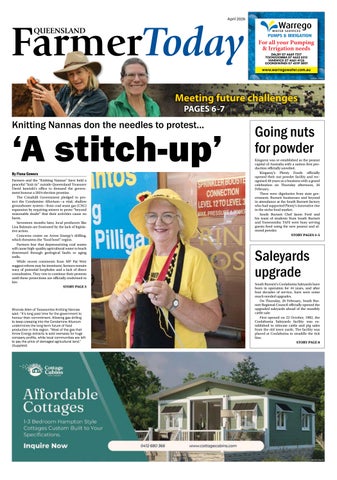
Knitting Nannas don the needles to protest...

‘A stitch-up’

Farmers and the “Knitting Nannas” have held a peaceful “knit-in” outside Queensland Treasurer David Janetzki’s office to demand the government honour a 2024 election promise.

The Crisafulli Government pledged to protect the Condamine Alluvium—a vital, shallow groundwater system—from coal seam gas (CSG) expansion by requiring miners to prove “beyond reasonable doubt” that their activities cause no harm.

Seventeen months later, local producers like Liza Balmain are frustrated by the lack of legislative action.

Concerns centre on Arrow Energy’s drilling, which threatens the “food bowl” region.

Farmers fear that depressurizing coal seams will cause high-quality agricultural water to leach downward through geological faults or aging wells.

While recent comments from MP Pat Weir suggest reform may be imminent, farmers remain wary of potential loopholes and a lack of direct consultation. They vow to continue their protests until these protections are officially enshrined in law.

Rhonda Allen of Toowoomba Knitting Nannas said: “It’s long past time for the government to honour their commitment. Allowing gas drilling to keep creeping into the Condamine Alluvium undermines the long-term future of food production in this region. “Most of the gas that Arrow Energy extracts is sold overseas for huge company profits, while local communities are left to pay the price of damaged agricultural land.” (Supplied)

Going nuts for powder

Kingaroy was re-established as the peanut capital of Australia with a nation-first production officially unveiled.

Kingaroy’s Plenty Foods officially opened their nut powder facility and recognised 40 years as a business with a grand celebration on Thursday afternoon, 26 February.

There were dignitaries from state government, Burnett businesses and beyond in attendance at the South Burnett factory who had supported Plenty’s innovative rise in the niche food market.

South Burnett Chef Jason Ford and his team of students from South Burnett and Toowoomba TAFE were busy serving guests food using the new peanut and almond powder.

STORY PAGES 4-5

South Burnett’s Coolabunia Saleyards have been in operation for 44 years, and after four decades of service, have seen some much needed upgrades.

On Thursday, 26 February, South Burnett Regional Council officially opened the upgraded saleyards ahead of the monthly cattle sale.

First opened on 22 October, 1982, the Coolabunia Saleyards facility was established to relocate cattle and pig sales from the old town yards. The facility was placed at Coolabuina to straddle the tick line. STORY PAGE 8

WILMOT FIELD DAY pages 6-7

SALEYARDS UPGRADE page 8

WOMEN IN AGRICULTURE pages 16-17

MEN’S SHEDS page 18

OPINION page 21

NUFFIELD SCHOLARSHIPS page 24

MARKET ROUND-UP page 31

SPORT pages 30, 32

DAM LEVELS

Producers’ disaster grants available

CONTACT US

Address: 154-156 Haly Street

Kingaroy 4610

Telephone: 07 4182 0450

Website: QueenslandFarmerToday.com.au

CONTACT US

Editorial:

Email: newsdesk@QueenslandFarmerToday.com.au

Advertising:

Email: advertising@QueenslandFarmerToday.com.au

Classifieds:

Phone: 07 4182 0450 or 1300 666 808

Email: sales@networkclassifieds.com.au

EDITORIAL

Fiona Gowers Editor

E: fiona.gowers@QueenslandFarmerToday.com.au

Breanna Lloyd Journalist

E: breanna.lloyd@QueenslandFarmerToday.com.au

ADVERTISING

Jane Lowe Sales & Marketing

E: jane.lowe@QueenslandFarmerToday.com.au

P: 0408 488 609

Jodie Williams Sales & Marketing

E: jodie.williams@WesternDownsToday.com.au

P: 0401 377 140

Jemma Wilson Sales & Marketing

E: jemma.wilson@BurnettToday.com.au

P: 07 4182 0458

Gayle Hopes Sales & Marketing

E: gayle.hopes@TodayNewsGroup.com.au

Queensland Farmer Today is published monthly and part of the Today News Group. Published by South Burnett Today Pty Ltd ACN 641 796 349.

Publisher: Damian Morgan

Managing Director: Daniel Pelcl.

All material is copyright to South Burnett Today Pty Ltd.

All significant errors will be corrected as soon as possible. For our terms and conditions please visit QueenslanFarmerToday.com.au/terms-and-conditions/

Primary producers impacted by latest flood event can now access disaster grants up to $75,000 and disaster loans up to $2 million.

Affected small businesses can apply for grants up to $25,000 and loans up to $250,000, supporting immediate recovery and operational needs.

Newly-activated areas cover the Wide BayBurnett, in addition to parts of western, central and Far North Queensland.

The Albanese and Crisafulli Governments have activated Disaster Recovery Grants and low interest loans for more flooded primary producers and small businesses following last month’s wild weather.

For producers, grants up to $75,000, loans up to $2 million and freight subsidies up to $5,000 will help those impacted in the local government areas of Boulia, Bundaberg, Diamantina, Fraser Coast, Gympie, North Burnett and South Burnett.

Flood-affected small businesses in Boulia, Bundaberg, Diamantina, Douglas, Gladstone and Western Downs can apply for loans up to $250,000. Grants up to $25,000 are also available to eligible small businesses in Bundaberg, Douglas and Western Downs.

Funding can be used for a range of recovery and operational activities unique to each support measure, such as clean-up, repairs, supply, paying wages, rent or rates, replanting or purchasing fuel or water.

All assistance is delivered under the joint Commonwealth-State Disaster Recovery Funding Arrangements (DRFA).

Grant and loan applications can be made via www.qrida.qld.gov.au, while information on freight subsidies is available through Queensland’s Department of Primary Industries on 13 25 23.

Federal Minister for Emergency Management Kristy McBain said the latest expansion of disaster assistance would give hope to hardworking Queenslanders doing it tough.

“Primary production and small business are the heart and soul of these Queensland communities, and we want to see operators recovering as soon as possible,“ Ms McBain said.

“This assistance will provide the urgent liquidity needed to make repairs and replace stock and equipment, but most importantly to stay afloat and recover in full.

“It’s been a really tough disaster season for the state, but we’re determined to help businesses sustain this prolonged severe weather.“

Federal Minister for Agriculture, Fisheries and Forestry Julie Collins said this assistance would support Queensland primary producers.

“The flooding we’ve seen in Queensland has had a terrible impact on farmers and primary producers, who are not only critical to regional economies but also to our food security, which is why making this support available is so important.

“We’ll always back our farmers and primary producers, with this support to help those impacted in Queensland to clean up, sustain livestock and mitigate the impacts of flooding and loss of pasture.“

Queensland Minister for Disaster Recovery Ann Leahy said swiftly activating assistance for flood affected primary producers and small businesses remains a priority for the Crisafulli Government.

“Activating assistance for our small and family businesses as well as our primary producers ensures they will have access to the support they need to recover quicker,“ Ms Leahy said.

Queensland Minister for Primary Industries Tony Perrettsaidit’sbeenaseasonoffloodingacrossmuch of the state, but primary producers need to understand the scale of the disaster is not diminishing the response.

“The impact to grazing, cropping and communities has been significant, so we are responding swiftly to ease the uncertainty and speed recovery,“ Mr Perrett said.

“It’s been cruel timing for some, who have lost crops so close to harvest, but regardless of the production cycle the impacts will be long lasting and widespread across the whole farming community, whether you are a farmer or grazier or both you can have confidence support is available.“

Queensland Minister for Small and Family Business Steven Minnikin said financial assistance was critical to support local small and family businesses to recover as quickly as possible.

“Natural disasters don’t just damage premises, they impact the lives of staff and customers. Support is vital to assist small and family business owners to restore operations and continue to support their local communities,“ Mr Minnikin said.

The quiet hum of a drill, the scrape of sandpaper and the steady rhythm of conversation over a morning cuppa, these are the sounds of something far more powerful than they first appear.

Over the past two months, I’ve had the privilege of writing a new feature for Queensland Farmer Today focused on Men’s Sheds.

What began as a simple storytelling exercise has quickly become something much more meaningful.

Because behind every project, every repaired chair or handcrafted timber piece, there is a deeper story: one of connection.

Time and time again, I’ve seen how important these sheds are for men’s mental health, particularly in rural and regional communities.

They offer something that can be hard to find elsewhere: a place to belong without pressure.

Friendships are formed not through formal conversations, but side-by-side at a workbench.

There is pride in completing a project, whether big or small.

And, perhaps most importantly, there is space - a gentle, unspoken understanding that if something is weighing on your mind, you can quietly share your concerns.

In agriculture, where the pressures can be relentless and often isolating, that matters more than we sometimes acknowledge. What stands out most is that nothing about these spaces feels forced. There are no expectations. You can talk, or not talk. You can build, or simply sit and have a cup of tea.

Either way, you are always welcome. And, sometimes, that simple invitation is exactly what is needed.

* Community, craft and care P18.

Minister Tony Perrett talks to a primary producer in Tansey. (Supplied)
A flood damaged cotton crop in Tansey.

Nannas protest ‘stitch-up’

Farmers stood shoulder-to-shoulder with a group of self-described Knitting Nannas outside the Toowoomba office of Queensland Treasurer David Janetzki last month.

They called on the State Government to honour its election pledge to protect prime farmland and vital groundwater from coal seam gas expansion.

The peaceful “knit-in” was staged amid growing concern about Arrow Energy’s ongoing drilling in the region, which locals say is already affecting the Condamine Alluvium, a shallow and highly productive groundwater system underpinning agriculture across the Cecil Plains district.

Basically, in the lead-up to the 2024 state election, the Crisafulli Government promised stronger protections for the Condamine Alluvium and the fertile food bowl above it.

Condamine MP Pat Weir said at the time the government would amend legislation to require gas companies to demonstrate “beyond any reasonable doubt” that their activities would not detrimentally impact land or water connected to the alluvium.

Seventeen months on, farmers say they are still waiting.

Liza Balmain, who farms at Glendon on the eastern side of Condamine River near Cecil Plains, said local producers attended last month’s

gathering to support the Toowoomba Knitting Nannas and to press for action.

“It was announced before the 2024 election that they would strengthen legislation to better protect the Condamine Alluvium whereby gas miners would have to prove - beyond any reasonable doubt - that they will not have a detrimental impact,“ Ms Balmain said.

“That’s quite a broad commitment and it’s basically where we want to be. We want to see better protections for the alluvium.

“It’s been 17 months since that commitment was made and we haven’t seen anything. We would like to see some action.”

Stretching roughly from Millmerran and Pittsworth in the south to Dalby and west to Chinchilla, the Condamine Alluvium covers a relatively small geographic footprint in Queensland.

Yet Ms Balmain describes it as the state’s most productive alluvial system - shallow, high-quality groundwater held in sands and gravels that support some of the country’s most fertile soils.

“It’s very shallow and it sits directly on top of the Walloon Coal Measures that they’re targeting,” she said.

The concern, she explained, centres on the depressurisation process used to extract coal seam gas. When coal measures are dewatered to release gas, pressure differences can cause water from the overlying alluvium to

migrate downward.

“The water in the alluvium will then become at a higher pressure and it will find whatever connectivity pathways are available to it,” Ms Balmain said.

Potential pathways include natural geological faults and fractures - including a major fault system near Dalby and Cecil Plains - as well as manmade features.

Corroding or ageing gas wells may present integrity issues and historical coal exploration holes drilled from the 1960s to 1980s - some reportedly left uncapped or unsealed - add another layer of uncertainty.

“They represent another connectivity pathway waiting to happen,” she said.

Above the aquifer lies what farmers describe as an “amazing agricultural food bowl”, producing cotton, grains and other crops that rely on reliable groundwater supplies.

“There’s a lot at stake,” Ms Balmain said. Protests against gas development in the region are not new. Ms Balmain said community resistance dated back to around 2010, when Arrow Energy first entered the area.

Large rallies were held in the early years, followed by smaller demonstrations, including a protest at Springvale last year.

“As time has gone on and our knowledge base has increased, we’re seeing all the red flags,” she

said. “We’ve all done a lot of research. Once you go digging, it’s not hard to find the red flags.”

While last month’s action was peaceful - with knitting needles clicking as a symbol of quiet persistence - organisers say the message was firm: the government must deliver on its promise.

Ms Balmain said farmers were encouraged to hear recent comments suggesting legislative reform could be introduced soon, following a local media interview with Mr Weir.

“It’s good to hear that there is something coming,” she said. “But, obviously, the devil’s in the detail. Until we see the bill, we’re in the dark.”

She said there had been no direct consultation with farmers to date on what the reforms might look like.

“There is already legislation in place, but it is diluted by exemptions, which creates loopholes in bypassing planning laws,” she said.

Development has so far occurred predominantly on the western side of the Condamine River, including drilling beneath the river itself. Ms Balmain’s property, Glendon Farm, lies on the eastern side, where farmers remain determined to prevent further encroachment.

For now, the Knitting Nannas and the farmers who joined them say they will continue to apply pressure - one stitch, one protest at a time - until they see the promised protections enshrined in law.

- 20 (16) ...............................$320

- 20 (16)..............................$345

R-15 (14) ...............................$320

R225 ................................$236

R50...............................$2300 480.80 R 42...............................$1830

R42.................................$2120

R42.................................$1950

.70 - R38 ............................$2800

R32 ...............................$3450

. 60 R 42 ...........................$5500

SL -32....................................$5000

- 70 - 28................................$965

- 16 /RIB (8).........................$150 600 - 16 RIB (8) ..........................$125 710.70 R42.................................$3700

Farmers stood shoulder-to-shoulder with a group of self-described Knitting Nannas last month. They called on the State Government to honour its election pledge to protect prime farmland and vital groundwater from coal seam gas expansion. (Supplied)
Springvale farmer Melinda Palmer said: “Coal seam gas wells are getting drilled right over my back fence and we’re already seeing damage done in our backyards. “Our region is some of the most productive agricultural land in the country and it feeds people across Australia and the world. The government must act urgently to halt further harm to our precious water sources.”

Powder reinvents the nut

Kingaroy was re-established as the peanut capital of Australia with a nation-first production officially unveiled.

Kingaroy’s Plenty Foods officially opened their nut powder facility and recognised 40 years as a business with a grand celebration on Thursday afternoon, 26 February.

There were dignitaries from state government, Burnett businesses and beyond in attendance at the South Burnett factory who had supported Plenty’s innovative rise in the niche food market.

South Burnett Chef Jason Ford and his team of students from South Burnett and Toowoomba TAFE were busy serving guests food using the new peanut and almond powder.

“It’s the first of its kind made in Australia -an ingredient we hope will transform the foodscape,” Marketing Director Helen Morgan said.

The nut powder developed in Kingaroy provides a domestic option for suppliers.

Plenty owner and General Manager Josh Gadischke and his wife Jo Gadischke was excited to unveil the new product after years of Plenty specialising in extracting high-quality oils from nuts and seeds.

The facility producing the superfine nut powder, is an Australian first, marking a significant milestone for Australia’s food manufacturing.

Mr Gadischke said the product had a clean label, was plant-based, nutritious and sustainable.

“It positions us, Plenty Foods, not just as a nut processor, but as an ingredient innovator,” he said.

“Importantly, it strengthens Kingaroy’s longstanding reputation as the heart of Australia’s peanut and agri-industry, while expanding into a high value advanced processor.”

Plenty plans on commercially producing peanut powder first, before expanding into almond and macadamia varieties.

The nut powders are produced by gently roasting the whole nuts, extracting the oil and milling the remaining nut solids into a superfine powder.

Plenty states this results in a lighter, silkier ingredient with improved dispersion, absorption and blending properties compared to conventional nut flours.

The nut flours are useful for bakery items, snacks, sports nutrition, functional foods, sauces, coatings, dairy-free ice creams and confections, ready meals and plant-based alternatives.

Mr Gadischke was proud to launch Australia’s first dedicated nut powder processing plant, providing an Australian-made product which food manufacturers have historically relied on imported almond, macadamia and peanut powders.

“It’s proof that Australian manufacturing is alive and evolving and that regional Queensland can lead to food innovation,” he said.

The vision began by discovering many nuts were wasted because they did not fit the retailer mold.

“We learned from growers that several nut grades are consistently difficult to sell due to colour, shape or some other small imperfection not affecting nutrition at all,” Mr Gadischke said.

Plenty’s nut powder utilises this nutrition and reduces this wastage.

“Nut powder production allows us to maximize and utilize all of the raw product extracting value by reducing waste,” he added.

By being more sustainable, the nut powder

processing plant ensures the nut industry has a greater future.

“It means more value retained in Australia’s nut industry, more capability in advanced food ingredient processing, greater resilience in domestic supply chains, increased export potential for premium Australian ingredients, skilled regional employment, and a platform for future growth,” Mr Gadischke said.

The project was not without its setbacks, including Covid-19 pandemic restrictions, escalating building costs and supply chain challenges.

However, the project did not ‘crack’ due to the support of the Federal Department of Industry, Science and Technology, as well as various Queensland Government departments.

Deb Frecklington, Attorney-General, Minister for Justice and Integrity and Member for

Nanango, officially opened the event with Mr Gadischke, marking the first official batch of Plenty nut flour.

“To think that Plenty just goes from one thing to another and it keeps getting bigger and better,” she said.

She reflected on Plenty’s chapter in Australia’s agricultural success story, and use of innovation to drive their growth.

“The vision that this couple [Josh and Jo Gadischke] has put into practice is really quite astounding,” Mrs Frecklington said.

“We are so fortunate that we have this incredible agriculture thriving region.”

Mrs Frecklington went on to assist with a cooking demonstration with Chef Jason Ford, making a tik-tok trend inspired tiramisu using Plenty’s peanut nut flour.

The Nanango MP marvelled at the progress Plenty has made.

“I’m so immensely proud to think that all those years ago when I stood with you and I could see your vision then and back then it was oil and now to think it is the nut flour,” she said.

“I really do wonder what is next for you guys.”

Opening attendees enjoyed a tour of the factory, looking at the machines which roast, pummel and grind the nuts into a super fine powder.

The company still has phase two to go, planning to establish an office space, research laboratory, and a carpark at the Plenty precinct in the future.

On average, Plenty Foods processes approximately 4,000 tonnes of nuts and seeds each year for domestic and export markets.

Nanango MP Deb Frecklington and Plenty Foods Managing Director Josh Gadischke officially open the nut powder processing facility by stamping the first batch of nut flour powder. (538177)
Eamon Viner from Mills Motor Group (centre) with Jake Hobby and Aleisha Gray from SB Hire and Sales. (538177)
Chef Jason Ford and Deb Frecklington make a tiramisu with the hero ingredient of the nut powder. (538177)
Andrew Farah, AndrewMcDonald and Lewis Hunter from AgriVentis Technologies with Kewpie Stockfeeds’ Paul and Delvene Woltmann. (538177)
Plenty team members Ben, Bailey, Sujith and Mary at the facility opening. (538177)
Attorney General Deb Frecklington with Paul Cooper from AMGC. (538177)
Plenty Foods Managing Director Josh Gadischke reflets on the journey of establishing the nut powder facility. (538177)
Scott (second from left) from Teys Australia, with Ben, Matthew and Jay from G3 Engineering. (538177)
The Kingaroy and Toowoomba TAFE students worked hard serving foods inspired by the new nut powder. (538177)
TAFE student Melody serves up some smoothies featuring the nut powder. (538177)
The Plenty Foods team at the nut powder launch. (Jessica McGrath: 538177)
The tiramsu made by Chef Jason Ford and Deb Frecklington inspired by the nut powder. (538177)
Michelle Berkhout from QLD Manufacturing Hub, with Michelle Hansen and Linchon Hawks from Swickers and Nigel Barrett from FaBA. (538177)
A sample of the Australian made Plenty Foods Peanut Powder. (538177)
Scott McLennan from SB Radiology and Chris Sarquis from Kingaroy Golf Club. (538177)
Paula Greenwood, Susan Robertson and Lucy Crumpton at the opening. (538177)
Jo Gadischke presents Nanango MP Deb Frecklington with a memento gift, especially made by Josh. (538177)
Sharon Young from Young Farms and Donna Seiler from Seiler’s Transport. (538177)
Victor Wong and Alice Lee from the University of NSW. (538177)
Nanango MP Deb Frecklington adds in the hero ingredient, the peanut nut powder. (538177)
The Gadischke family: Jo, Ellie, Josh and Kate. (Sarah left the event early) (538177)
Sujith leads the tour of the nut powder facility. (Jessica McGrath: 538177)
Dale Christensen and Dan Cook from G Crumpton and Sons. (538177)

Goondiwindi farmer finds inspiration at Wilmot Field Day

Regenerative momentum

As the sun rose over rolling pastures at Hernani in northern NSW last month, hundreds of farmers, scientists and industry leaders gathered with a shared purpose, to explore how agriculture might evolve to meet the challenges of the future.

The eighth annual Wilmot Field Day, hosted at Wilmot Cattle Co, has become one of Australia’s most influential gatherings focused on regenerative agriculture and natural capital.

Organised by Macdoch Australia and Impact Ag Australia, this year’s sell-out event attracted 356 participants from across the country and overseas.

For Pippa Jones, a farmer and agricultural advisor from Goondiwindi attending for the first time, the experience was both inspiring and practical.

“I loved the beginning with Allen Williams (a sixth-generation rancher and soil scientist from the United States) when he framed the idea that we don’t need a strict definition of regenerative, but instead should focus on restoration,” Ms Jones said.

“I thought that was a beautiful way to start.”

The two-day forum has built a reputation as a space where farmers lead the conversation about land stewardship, soil health and farm profitability.

Nearly 30 per cent of attendees this year were livestock producers, while more than one-third were already running - or seriously consideringsoil carbon projects.

Participants travelled from every Australian state, joined by international visitors from the United States, the United Kingdom and Europe, highlighting the growing global interest in Australian approaches to regenerative agriculture.

Among the keynote speakers was Allen Williams. His presentation drew on extensive research comparing conventional grazing systems with biologically focused grazing management.

The findings were striking.

Grazing systems designed to rely more heavily on soil biology allowed more than twice as much rainfall to infiltrate the soil compared with neighbouring conventional systems.

Across 120 farms transitioning management systems, soil aggregation depth improved dramatically - from around five centimetres to more than 37cm - while plant diversity and fungal activity increased significantly.

For farmers facing increasingly volatile fertiliser and fuel markets, the research suggested soil biology could play a much larger role in longterm resilience.

For Ms Jones, the balance between scientific research and practical farming knowledge was a standout feature of the event.

“I loved the way the speakers combined science with practical farming experience,” she said.

Another highlight came from Jonathan Lundgren, founder of the global 1000 Farms Initiative, one of the largest ecological and economic studies of farming systems in the world.

The project has now assessed more than 1700 farms across multiple countries, analysing roughly 500 data points on each property - including soil carbon, biodiversity, crop nutrient density and farm economics.

“We wanted to put some legitimacy around regenerative, to evaluate what it is and use science to clarify some of the claims,” Dr Lundgren told the audience.

One of the strongest patterns emerging from

the research is the role biodiversity plays in driving regenerative outcomes. According to the data, biodiversity influences soil carbon levels, water cycling, ecosystem health and overall farm productivity.

Regenerative farms within the dataset are showing equal or better yields than conventional operations, alongside stronger net profitability.

Soil carbon levels are also around 50 per cent higher in fully regenerative systems when measured to 60 centimetres depth.

Perhaps most surprising, Dr Lundgren said, was the human impact of the research itself.

“When I started the 1000 Farms Initiative, I thought the most important output would be the data,” he said.

“But something else emerged that I didn’t expect, the project makes farmers feel seen and heard.”

The event also explored how farmers measure and manage emissions on-farm, a topic Ms Jones found particularly engaging.

“I particularly enjoyed the panel on emissions on farm, how we measure them and why data matters,” she said.

For many producers, data collection is becoming increasingly important, whether to understand soil health, track carbon sequestration or improve grazing management.

Ms Jones said one practical idea she plans to take home involves thinking more strategically about water distribution within rotational grazing systems.

“It’s something I’d subconsciously thought about before, but hadn’t properly considered,” she said.

“The data really helps with that.”

The event also reinforced a broader message about innovation in agriculture: change does not have to happen all at once.

“And I loved the messaging around just starting - start small, be open-minded and think about how you can do things differently,” Ms Jones said.

“Start collecting data, even if you start small. Having data is really important.”

For farmers navigating new ideas, shifting practices and uncertain markets, that approach

can be easier said than done.

“It sounds easy, but in reality it can be hard to suddenly start doing,” she said.

“So the advice is simple: just start somewhere.”

Beyond the presentations, the field day also served as a powerful networking opportunity.

“You get so much out of it,” Ms Jones said.

“And the networking - I hate that word - but the people you meet, the new connections and the chance to reconnect with old friends, that’s a big part of it too.”

The international perspective added another layer of insight.

“The context may be different around the world, but the principles are remarkably similar,” Ms Jones said.

“We’re actually not that different after all.”

Those conversations are increasingly important as the global agriculture sector grapples with climate pressures, biodiversity loss and rising production costs.

Hugh Killen, chief executive officer of Impact Ag Australia, said the discussions at Wilmot highlighted a broader shift underway across the sector.

“One of the uncomfortable truths raised at

Wilmot is that many of the metrics we’ve used to define success in agriculture - more land, more inputs, bigger machinery - may no longer be working for family farms,” Mr Killen said.

“What we’re seeing emerge is not just a new set of practices, but a redesign of how value flows through land, supply chains and ultimately family farm businesses.”

Global investment in nature-based markets is also accelerating, he added.

“Despite the rhetoric, money is still flowing into nature and decarbonisation,” Mr Killen said.

“The question for Australia is whether we choose to lead that shift, or watch the opportunity move offshore.”

For Ms Jones, however, the biggest takeaway from Wilmot was far simpler and deeply personal.

“I think the biggest message is just to keep going,” she said.

“Sometimes when things get hard, it helps to look backwards and see what you’ve already achieved.

“That reminds you that you’re moving in the right direction.”

And after her first visit to the Wilmot Field Day, she has little doubt about returning.

Megan Bowden, regenerative farmer and sustainability consultant at Dragon Fields Farm, Prenzlau, Queensland.
Key note speakers at the Wilmot Field Day were Dr Allen Williams and Jonathan Lundgren. Both Dr Williams and Mr Lundgren are from the US and are considered gurus of regenerative agriculture.
Goondiwindi farmer and agricultural advisor Pippa Jones attended the Wilmot Field Day for the first time. (Supplied)
Dr Susan Orgill, Impact Ag Australia and 2025 General Jeffery Soil Health award winner.
Motherland was the charity of choice at the Wilmot Field Day.
The aim of the the eighth annual Wilmot Field Day was to explore how agriculture might evolve to meet the challenges of the future. (Supplied)
Central Queensland cattle producer Adam Coffey, Miriam Vale, Queensland.
Kari Moffat, AAM Investment Group sustainability manager, Toowoomba, Queensland.
Hugh Killen, managing director and CEO of Impact Ag Australia.
The Wilmot Field Day attracted 356 participants from across the country and overseas.

Upgrade secures future

South Burnett’s Coolabunia Saleyards have been in operation for 44 years, and after four decades of service, have seen some much needed upgrades.

On Thursday, 26 February, South Burnett Regional Council officially opened the upgraded saleyards ahead of the monthly cattle sale.

Firstopenedon22October,1982,theCoolabunia Saleyards facility was established to relocate cattle and pig sales from the old town yards. The facility was placed at Coolabuina to straddle the tick line.

The upgrades to the yards saw previous wooden infrastructure replaced with steel, and Capital Works commissioned to paint the buildings on site, and replace the flooring in the admin building, where asbestos flooring was detected.

This project cost a total of $283,000.

“It was knocking down the old wooden yards,“ Michael Hunter, South Burnett Regional Council’s Coordinator of Commercial Enterprises said. “There were originally ten holding yards, and we rebuilt 16 steel holding yards, with also the catwalks.“

“Council is committing to their assets and keeping them upgraded,“ he said.

The catwalks had become very run down and were becoming a workplace health and safety issue, with their upgrade a priority.

Using steel instead of wood will ensure the longevity of the upgraded holding pens and catwalks.

“The difference is, the agents are saying the cattle are flowing better because we’ve changed the shape of the yards, so they’re really happy with the way the cattle run now,“ South Burnett Regional Council Mayor Kathy Duff said.

The upgrades have also allowed the facility to increase their total capacity, allowing numbers to go from 1000 head to 1300 head.

The new design sees the holding pens function as gate systems, allowing the cattle to no longer be needed to move down the laneway and instead filter through internally.

This design also makes it easier for the saleyards officer to clean the yards out with the bobcat.

“The benefit to the community is we’ve got so many people depending on the saleyardswe’ve got the transport company, the livestock agencies, the cattle producers, we’ve got farmers, we’ve got agribusinesses,“ Mayor Duff said. “So many people rely on these saleyards continuing.“

The Coolabunia Saleyards are a “place for farmers and graziers to network and meet people with likeminded interest. It’s about mental health and economic benefits.“

Margie Lee from Broadmere Nanango was selling some cattle at the sale, and said the upgraded saleyards are “absolutely essential and of great importance for the cattle industry in the South Burnett.“

Kingaroy local, Jim Clegg, retired from the cattle industry but still likes to attend the sales, said the upgrades “were a substantial job.“

He said the Coolabunia Saleyards are rather special, saying “these yards tell a story,“ and he hopes the agents can fill them up.

The upgrades to Coolabunia Saleyards allow the yards to remain operational. (Maddison Richards: 537430)Jim Clegg from Kingaroy. (537362)
South Burnett Regional Council representatives stands atop the upgraded yards: Heath Sander, Jane Erkens, Linda Little, Mayor Kathy Duff, Michael Hunter, Danita Potter and Deb Dennien. (537430)
Michael and Brandi Richards overlook their pen of cattle. (537362)
Cassandra Kath and Margie Lee from Broadmare, Nanango are excited to see their cattle sell. (537362)
Auctioneers hard at work. (537362)
Tamika Schultz and Marle Schmidt from Muirs Kingaroy, and Tom Magee from Benair. (537362)
SBRC stand with the agents and auctioneers. (537430)
James, Lilly and Tanya Mackinnon from Blackbutt see their cattle sell. (537362)
Brian Dugpell from Maidenwell with his pen of cattle. (537362)

Deliveringa newToowoomba Hospital

AswellasdeliveringanewToowoombaHospital,herearesomeofthewaysthe newQueenslandGovernmentisdeliveringforDarlingDowns:

• Deliveringabikesafetytrackandcross countrytrailatRamsayStateSchool

• Improvingthemultipurposecourtat JondaryanStateSchool

• DeliveringequipmentforDalbychild safetyofficers

• DeliveringtheBarlilWeirtoincrease watersecurity

• UpgradingCherbourgTownHallwithsecurity, disabilityaccessandkitchenrenovations

• BuildinganewEquestrianCentreofExcellence for2032andbeyond

• UpgradingTanduringieCreekBridge

• Deliveringthreenewearlyinterventionand rehabilitationprogramsinToowoomba.

Findoutwhatelsewe’redeliveringforyou.

by the Queensland Government, Brisbane.
Artistimpression

Kewpie, a family business

Paul and Delvene Woltmann have been at the helm of Kewpie Stockfeeds for just over four years, after a long succession planning exercise which finalised on 6 December 2021.

They have instigated and overseen the recent upgrades to the Kingaroy showroom, which was officially opened on Friday, 27 February.

Initially engaging with a shop fitout service, which assisted to get the design and feel right given the current layout, they later chose to manage the fit out by themselves and the Kewpie Team.

This did extend the timeframe of the fitout and both customers and the Sales Team endured the coldest day of 2025 and the hottest of summer serving from the merchandise shed.

Paul and Delvene have been thrilled to work with some of the local tradies and suppliers who they have had previous dealings with and say that this made the process and makes the showroom all the more special.

Recently, Paul and Delvene were guest speakers at the 2025 Beef It Up rural mental health evening on 6 December 2025.

They shared a bit of their story and their own journey with mental health providing for both their family and their business, and the health challenges along the way.

Kewpie has been in the Woltmann family for generations, starting with Paul’s grandfather Norm and his brother Bill Woltmann, where the brothers had a partnership together and started up a slaughterhouse in Wooroolin and ran butcher shops in Kingaroy, Wooroolin and Memerambi. The Butchers Cafe that is currently in Wooroolin is the old butcher shop.

“That’s where it all started, and then dad (Cedric Woltmann) and his brother (Gayford Woltmann) got involved, where they were feeding pigs, sheep and cattle” Paul said.

From this they set up a little feedmill on the Wooroolin farm where the slaughterhouse was to service their own butcher shops, and then they started getting requests from other farmers wanting to buy the stockfeed.

To keep up with the requests they expanded to build the stockfeeds mill supplier in Kingaroy which is the current site where the newly renovated showroom has had it’s makeover after 58 years.

These days the business not only manufacturers bulk and bagged feed for cattle, poultry, pigs, sheep and goats, but also stocks a large range of rural supplies and rural produce from various suppliers to cater for all other animals, pets and rural requirements. The new showroom is opening with an additional 200 product lines to help assist customers.

Kewpie is based in Kingaroy and has an outlet rural merchandise store in Monto, both of which are the official AIRR stores in these respective towns.

Whilst locally based and the majority of business is conducted in the South and North Burnett, Kewpie currently supplies approximately 65 resellers from Rockhampton, South East Queensland, Longreach and into Northern NSW.

Across the “Kewpie Group” which includes the Stockfeeds, Rural Merchandise, Piggeries, Cattle and Steel Sales and Fabrication the group currently employs 65 local people.

“This is something that we are very proud of, as it was important to Paul’s dad Cedric Woltmann during succession discussions.” Delvene said.

Paul initially worked in the family business in Kingaroy for 19 years, assisting with the feedmill, cattle and trucking side of the business.

Paul had completed Tertiary Studies at the then Gatton Agricultural College in Rural Techniques majoring in Pig Husbandry and Delvene worked at the Leyton Park piggery for a short period after finishing her Bachelor’s Degree in Tourism Management through the University Of Queensland – Gatton Campus.

Seeing the family business had stagnated, Paul and Delvene chose to leave, unintentionally upskilling during their time away.

The pair worked for corporate finance bankers Steve and Jane Wilson of Wilson HTM in Brisbane for ten years. This included managing cattle operations, and caretaking the Barambah Station at Goomeri, overseeing big renovations, budgets and timeframes of the historical buildings and property improvements.

“Everyone thought we were only managing the farming and cattle out at Barambah… but what Steve and Jane exposed us to in corporate

business and lasting personal and business connections was second to none,” Delvene said.

“During that timetime, we had that exposure to that higher level of business, strategy and planning, from that the business world that they [Steve and Jane] live in and is something completely different to here.”

When Paul and Delvene’s children were in Years 1 and 2 they had a health scare that shook their world. Paul had a heart attack and was flown out to hospital.

Delvene reflected this was a big wake-up call for her, knowing that their Barambah Station job was bigger than what she could achieve on her own with a young family.

“That’s when I started to study my masters [in professional accounting], because I figured if there is a chance I’ve got to support this family

by myself, I’ve got to figure out how I can actually earn decent money on my own accord,” she said.

They moved on from the Barambah Station and moved back to Kingaroy, where they initiated a start up with fellow friends and supplied semi trucks and water tankers into the gas wells in the Western Downs for several years. Delvene worked with council for several years and thoroughly enjoyed this time which gave her a different perspective to business than that of private enterprise.

The Woltmann’s second big wake-up call was an incident involving one of their trucks on 27 May 2019, and as Paul was one of the business directors at the time of the crash Paul and Delvene felt the weight of responsibility.

“It was really that day we figured ‘this is it,’ there has to be a solution to the succession plan-

ning, and that is the very day that I resigned from my council position,” Delvene said.

In keeping with Cedric’s wish, they looked at the stakeholders, shareholders and the 50 employees at the time and decided there needed to be a solution.

After a long mediation, Paul and Delvene purchased the other family’s share of the business.

The pair sees their role as stewards, having the privilege to steer Kewpie Stockfeeds into the future, with 65 staff employed across all business units.

“Our future vision is that we want this to be once again, an iconic, modern ag institution that the region is proud of,” Delvene said.

“It’s bigger than me and Paul, it’s not about us, this is just our time to get it there... and we’re not there yet.”

Kewpie Stockfeeds staff Siara Mendez, Kathy Cope and Kate Batts at the Kewpie showroom reopening. (Daniel Pelcl: 537743)
Standing beteween owners Paul and Delvine Woltmann from Kewpie Stockfeeds is Danielle Jeffcoat and Daniel Wojtasek from HitFM at the showroom opening. (Daniel Pelcl: 537743)
Kewpie owners Paul and Delvene Woltmann shared their story at the 2025 Beef It Up. (Jessica McGrath: 536567)

Passing the flooding test

In January this year properties north of Cloncurry, in Queensland’s southern gulf region, received 700-900 millimetres of rain in just 10 days. Parts of one 207,000-hectare property, resembled more of an inland sea, than the open flat grass covered country it typically consists of.

Amongst this ocean of flood water were 20 recently installed large steel water tanks, 14 of them were positioned on a new pad system, a pad system that protects tanks from, amongst other things, erosion.

It was not only Station Manager Peter Raleigh who was keenly interested in how the steel water tanks, along with all the infrastructure, fared at the test Mother Nature had provided, but the tank installer, Jake Roberts, also.

Jake is the creator of, and the one who sold Peter on investing in, Pad-Pro bases for the latest steel water tanks.

Jake Roberts lives in Cloncurry, where he operates a rural construction and infrastructure development business. He has been installing steel water tanks for nearly five years. Prior to that he worked at Alderley station in Boulia for 11 years, where he worked his way from a ringer to head stockman than onto managing all the day to day task across the Blacket’s family various properties.

Over this time, he has witnessed what erosion, vermin, and corrosion does to the steel tanks. Not accepting that this was just part of the course of living and working in such an extreme environment, Jake began to think of the tank pad as more than providing a solid level base for the water tank to sit on for the next 20-plus years, but also as a barrier. A barrier that would not rust, be eaten by white ants, did not require heavy machinery and was easy to install.

Polyethylene, the polymer that most, smaller, water tanks are now made of, does not rust, has no interest to white ants, and can be moulded into different shapes, appeared to Jake as being part of the solution.

A conversation with Will Jones from Outback Poly Products in Mitchell, led to some designing, testing and eventually the development of Pad-Pro. A polyethylene modular base system, that when assembled acts as a retainer wall, pre-

venting the dirt from under the tank from moving outwards and as importantly preventing wild pigs from digging around the base of the tank, preventing run-off rain water pooling at the bottom of the tank causing rust to develop and preventing erosion of the ground the tank is sitting on.

Controlled testing of the Pad-Pro delivered promising results, and gave Jake the confidence to sell it to properties in some of the remote parts of the state, where weather conditions are extreme and ground foundations can vary from red sand to black soil. Soon enough these conditions would provide the ultimate test for the Pad-Pro.

An inspection of the tanks by, Station Manager, Peter Raleigh, after the January flooding, was quite the revelation. Not only were the tanks still in the same position, where they were installed, the ground around the base of the tanks was hardly disturbed. The investment in Pad-Pro’s had paid off in less than six months.

While the tanks, that were surrounded by flood water, without the Pad-Pro base now had their liners exposed, as the ground beneath had eroded away, making it an easy target for feral pigs and goannas to rupture.

It was a similar outcome at another three (3) stations in the southern gulf country, where not only had Pad-Pro been installed with newly installed steel tanks, but were also under Nu-Tank’s 10200-gallon polyethylene tanks.

The story though, like the soil, was slightly different, as black soil was what most of the tanks were sitting on. Notorious for being highly erodible, as it swells, when wet, then significantly shrinks when dry, the tanks and their Pad-Pro bases were hardly affected at all. If anything they looked as if a Gerni had cleaned the base, leaving them looking like new.

For Jake Roberts this was validation that the idea he conceived, and turned into a sellable product, performs, even better than expected, and importantly in different soil types. Pad-Pro is a real solution to the major issues that hound the safe storage of stock water on farms, anywhere in the world. There’s plenty of work to be done, winning over more Queensland farmers for starters.

“We’ve now got some runs on the board, but there’s still a long way to go,“ says Jake.

A new Kewpie chapter

Kewpie Stockfeeds unveiled its upgraded Kingaroy showroom on 27 February, marking a new chapter for the long-running family business under the leadership of Paul and Delvene Woltmann.

The couple officially took over in December 2021 after a lengthy and complex successionplanning process. A serious truck incident in 2019 became a turning point for committing fully to securing and continuing to operate the business. After months of difficult mediation, they purchased the other family shares - balancing the needs of multiple stakeholders and honouring Paul’s father Cedric’s wish to protect local jobs.

Kewpie’s ties to the South Burnett stretch back generations. The business began with Paul’s grandfather Norm and great-uncle Bill, who operated butcher shops across the region before building a small feedmill for their livestock. Growing demand led to the establishment of the Kingaroy mill, which remains the company’s home base 58 years later.

Paul and Delvene had spent years away from the business, working in corporate agriculture, property management and finance, unknowingly developing the skills needed to take the helm at Kewpie and begin modernising the largely unimproved operations. The new showroom is the latest in a series of upgrade projects since 2022 that reflect their commitment to the local ag community.

Kewpie now employs 65 locals and supplies about the same number of resellers across Queensland and northern NSW. “We want this to be an iconic, modern ag institution the region is proud of,” Delvene said. “It’s bigger than us - this is just our time to help get it there.”

Owners of Kewpie Stockfeed Paul and Delvine Woltmann. (Daniel Pelcl: 537743)

Woombye rum is the best

A Sunshine Coast distillery has claimed the nation’s top honour at the 2026 Royal Queensland Distilled Spirits and Beer Awards, held at the Brisbane Showgrounds.

In the distilled spirits competition, Nil Desperandum from Woombye was crowned Grand Champion for its Premier Rum, earning recognition as Australia’s best spirit on the night.

The distillery also secured the title of Best Queensland Distillery and won the inaugural Champion Feature Rum/Cane Spirit Trophy for its Artfully Corrupted Spiced Rum.

Its Premier Rum further claimed The Star Brisbane Best Queensland Distilled Spirit award.

Chief judge Dave Withers said the Grand Champion entry was a clear standout among almost 100 submissions.

“There was an elegance and poise about the rum. It showed real restraint, allowing the spirit to shine without being overwhelmed by too much oak,” Mr Withers said.

“It was of exceptional quality, particularly in the way it appealed to a classic Caribbean style.”

Now in its third year, the distilled spirits competition continues to gather momentum, with Mr Withers noting significant evolution in the sector.

“When I first started judging distilled spirit competitions eight years ago, we certainly didn’t see the same level of diversity, boldness and experimentation that we’re seeing today,“ Mr Withers said.

In the beer competition, Happy Valley Brewing Co claimed the Grand Champion Beer supported by Lion award for its 50K IPA.

Co-chief judge Steve Henderson said the winning brew stood out immediately.

“The 50K IPA was fresh and vibrant, and the aroma just absolutely punched you in the nose,” he said.

“The flavour matched the aroma beautifully and it had good body and carbonation.”

The beer competition attracted a record 704 entries this year — up more than 30 per cent on 2025 — reflecting renewed confidence across the industry.

“The entry numbers tell a really good story –the industry has had a tough couple of years and it’s just starting to turn around again which is fantastic to see,” Mr Henderson said.

Further highlighting the sector’s resurgence, The Star Brisbane Emerging Queensland Brewer Award resulted in a tie for the first time, shared by Ben Kirby of Big Rock Brewing in Rockhampton and Jacob Viel of Blind Boy Brewing in Salisbury.

Mr Henderson described the overall standard as phenomenal, particularly in the increasingly popular Mexican-style lager classes.

“Mexican-style lagers are becoming quite popular in the market and we saw a strong number of these entered that were exceptionally well made.”

The Royal Queensland Awards celebrate excellence across seven categories: distilled spirits, beer, wine, beef, lamb, dairy and ice cream, showcasing the depth and quality of Australia’s food and beverage producers.

2026 TROPHY WINNERS – BEER

GRAND CHAMPION BEER SUPPORTED BY LION (Australia’s best beer)

• 50K IPA Draught by Happy Valley Brewing Co

CHAMPION PALE ALE SUPPORTED BY BINTANI

• Biere De Mer Draught by Madocke Beer Brewing Company

CHAMPION AMBER DARK ALE

• Brown Ale Packaged by Wobbly Chook Brewing Co

CHAMPION PORTER-STOUT

• Extra Extra Packaged by Soapbox Brewing Co

CHAMPION HYBRID BEER

Bourbon Barrel Aged Anniversary Ale VII Packaged by Slipstream Brewing Company

CHAMPION LAGER SUPPORTED BY BARRETT BURSTON

• Alby Draught Draught by Gage Roads Brewing Co

CHAMPION INDIA PALE ALE SUPPORTED BY KEGSTAR

• 50K IPA Draught by Happy Valley Brewing Co

CHAMPION EUROPEAN-STYLE ALE

• Classic Saison Packaged by Slipstream Brewing Company

CHAMPION SESSION BEER

• Alby Crisp Draught by Gage Roads Brewing Co

CHAMPION STRONG BEER

• The Bay Double IPA Draught by Happy Valley Brewing Co

CHAMPION MIXED CULTURE BEER

• Blackberry Sour Draught by Aether Brewing

CHAMPION GINGER BEER OF SHOW

• The Ginger Trade Draught by Pacific Ocean Brewing

CHAMPION LOW / NON-ALCOHOLIC BEER

• Yeah Buoy Packaged by Gage Roads Brewing Co

THE STAR BRISBANE BEST QUEENSLAND

BEER OF SHOW

• 50K IPA Draught by Happy Valley Brewing Co

ThenewQueenslandGovernmentisdeliveringmorehealth servicesrightacrossQueensland. It’sthelargestinvestmentinhealthQueenslandhaseverseen:

3NEWHOSPITALS AND10MOREEXPANDED RIGHTACROSSQUEENSLAND

2,600NEWBEDS AN18%

46,000MOREHEALTHPROFESSIONALS

CHAMPION BEST NEW BREWERY

• No Eye Deer Brewing

CHAMPION LARGE BREWERY SUPPORTED BY CRYER MALT

• Slipstream Brewing Company

CHAMPION SMALL/MEDIUM BREWERY

SUPPORTED BY HPA

• No Eye Deer Brewing

CHAMPION BREWPUB

• Happy Valley Brewing Co

BEST CONTRACT BREWER

• 27 South Brewing THE STAR BRISBANE EMERGING QUEENSLAND BREWER

• Joint recipients: Ben Kirby from Big Rock Brewing and Jacob Viel from Blind Boy Brewing 2026 TROPHY WINNERS – DISTILLED SPIRITS

GRAND CHAMPION DISTILLED SPIRIT (Australia’s best distilled spirit)

• Premier Rum by Nil Desperandum CHAMPION VODKA

• Davenport Vodka by Davenport Distillery CHAMPION GIN

• Imperial Dry Gin Blackwattle Distilling Co

CHAMPION RUM / CANE SPIRIT

• Premier Rum by Nil Desperandum CHAMPION WHISKY

• Country to Coast #6 by Fleurieu Distillery CHAMPION ALTERNATIVE SPIRIT

• Pear Packham by Schnapps Idea Distillery CHAMPION FEATURE RUM / CANE SPIRIT

• Nil Desperandum Artfully Corrupted Spiced Rum by Nil Desperandum

BEST EXPERIMENTAL RUM / CANE SPIRIT

• Stormy Skies Cane Spirit by Milton Distillery THE STAR BRISBANE BEST QUEENSLAND DISTILLED SPIRIT

• Premier Rum by Nil Desperandum

BEST QUEENSLAND DISTILLERY

• Nil Desperandum

Winners of Australia’s best distilled spirit, Nil Desperandum from Woombye, Sunshine Coast. Left to right: Matt Hobson, Michael Conrad and Adam Chapman. (Supplied)

-$2575X6 -$60

-$3075X8 -$80 40X8 -$4075X10 -$100 40X10 -$5075X12 -$120

50X3 -$25100X6 -$80 50X5 -$30100X8 -$100

-$40100X10 -$130

PLATEHEAVY-2400X1200

1.6MM -$125 8MM-$600

2.0MM -$150 10MM-$760

3.0MM -$230 12MM-$900

4.0MM -$300 16MM-$1300 5.0MM -$380 20MM-$1600 6.0MM -$460 25MM-$2200

U-BEAM-12M

•150UB14- $500 •200UB29 - $1000

•150UB18- $650 •250UB25 - $920

•180UB16- $570 •250UB31 - $1100

•180UB18- $650 •250UB37 - $1300

•180UB22- $800 •310UB32 - $1100

•200UB18- $650 •310UB40 - $1450

•200UB22- $800 •310UB46 - $1650

•200UB25- $920 •360UB44 - $1600 STEELPLATE

• 2.5MM-IOWA-400MROLLS PALLETBUYS-27ROLLS-$125EA SINGLEROLLS-$135EA

PACKBUYS-93 -$90EA LOOSEBUYS -$100EA •GOATPANELGATE-$250 GATES-GALV

•10’-3M -MESH-$120

•12’-3.6M-MESH-$140

•14’-4.2M-MESH-$160

•10’-3M-5BARLIGHT-$140

•12’-3.6M-5BARLIGHT-$160

•14’-4.2M-5BARLIGHT-$190

•12’-3.6M-5BARHEAVY-$180

•14’-4.2M-5BARHEAVY-$210

•165CM-5’6”BLACK-HEAVY-$7.50

Sunshine State success

Queensland’s value-adding food and beverage sector has claimed national bragging rights, with a Brisbane brewery and a Sunshine Coast distillery taking top honours at the 2026 Royal Queensland Distilled Spirits and Beer Awards at the Brisbane Showgrounds.

In the beer competition, Happy Valley Brewing Co secured the coveted Grand Champion Beer supported by Lion award for its 50K IPA.

In the distilled spirits section, Nil Desperandum from Woombye on the Sunshine Coast was awarded Grand Champion for its Premier Rum.

RQA Beer Competition co-chief judge Steve Henderson said the winning IPA impressed from the outset.

“The 50K IPA was fresh and vibrant and the aroma just absolutely punched you in the nose,” he said.

“The flavour matched the aroma beautifully and it had good body and carbonation.”

The beer competition - reinvigorated in 2019attracted a record 704 entries this year — up more than 30 per cent on 2025 — signalling renewed confidence across the brewing industry.

“The entry numbers tell a really good story –the industry has had a tough couple of years and it’s just starting to turn around again, which is fantastic to see,” Mr Henderson said.

The Star Brisbane Emerging Queensland Brewer Award resulted in a tie for the first time, shared by Ben Kirby of Big Rock Brewing in Rockhampton and Jacob Viel of Blind Boy Brewing in Salisbury, highlighting the depth of emerging talent in the state.

Mr Henderson said the overall standard was phenomenal, particularly in the growing Mexican-style lager classes.

“Mexican-style lagers are becoming quite popular in the market and we saw a strong number of these entered that were exceptionally well made.”

rum. It showed real restraint, allowing the spirit to shine without being overwhelmed by too much oak,” he said.

“It was of exceptional quality, particularly in the way it appealed to a classic Caribbean style.”

Now in its third year, the spirits competition attracted almost 100 entries.

Chief judge Dave Withers said the Grand Champion spirit was a clear standout.

“There was an elegance and poise about the

In the distilled spirits competition, Nil Desperandum claimed five of the 10 trophies on offer, including Best Queensland Distillery and the inaugural Champion Feature Rum/Cane Spirit Trophy for its Artfully Corrupted Spiced Rum, along with The Star Brisbane Best Queensland Distilled Spirit for its Premier Rum.

RestoringOurRivers2026Expressions ofInterest–NorthernBasin

Reference:ATM_2026_5959

MoreInformation

Open:5Marchto30April2026

Howtoapply:

VisitAusTendertenders.gov.au/atm–search“NorthernBasin”

ReadtheApproachtoMarketdocuments andsubmityourresponse.

Details: dcceew.gov.au/voluntary-water-purchasing-450gl

Support: help.tenders.gov.au| watertenders@dcceew.gov.au

“When I first started judging distilled spirit competitions eight years ago, we certainly didn’t see the same level of diversity, boldness and experimentation that we’re seeing today.”

The Royal Queensland Awards, run by the Royal National Agricultural and Industrial Association of Queensland, celebrate excellence across seven categories — distilled spirits, beer, wine, beef, lamb, dairy and ice cream — showcasing the strength of Australia’s premium food and fibre producers and processors.

TheAustralianGovernmentisinviting ExpressionsofInterest(EOIs)fromsurface waterownersinterestedinsellingwaterrights inthenorthernMurray–DarlingBasin.

TheEOIispartofexploringoptionsforwaterrecovery acrosstheBasintocompletethe450GLtargetby December2027.

ThisEOIwillhelpthegovernmentunderstandinterest fromwillingsellers,locations,volumesandindicative pricestoguidethedesignofanyfuturepurchasing program.

Responsesarenotbindingoffers.However,only respondentstothisEOIcanbeconsideredforany futuretender,shouldapurchaseprogramproceed.

Eligiblecatchments

NSW:BorderRivers,Gwydir,Namoi, Macquarie–Castlereagh,Barwon–Darling, IntersectingStreams

QLD:Condamine–Balonne,BorderRivers

Winner of Australia’s best beer, Happy Valley Brewing Co from Stafford, Brisbane. Left to right: Jett Righetti, Jake Harrison and Cheyne Meehan. (Supplied)

White

30th April - 3rd May

Dog Trials return to CQ

Australia’s most prestigious working dog event will return to Central Queensland when the Ray White Livestock Rockhampton Working Dog Sale and Trial is held from 30 April to 3 May.

Affiliated with Ray White Livestock Rockhampton, the event has grown into a premier showcase of elite stock and working dog genetics thanks to the vision and dedication of organisers Gary and Netty Wendt.

Over the past decade, the pair have developed a platform that attracts top trainers, breeders and buyers from across Australia, all seeking some of the world’s most capable working dogs.

The sale has built a reputation for producing outstanding results and highlighting the immense value of well-bred, highly trained working dogs within the livestock industry.

One of the most memorable moments came during the 2024 Ray White Livestock Working Dog Sale, when a new world record price was achieved. Cabra Glebe Liz stunned the crowd when she sold for $40,000, surpassing the previous Guinness World Record price for a working Border Collie — the United Kingdom’s Kim, which sold for $38,893 in 2021.

The exceptional working dog, affectionately known as Lizzie, began her next chapter working on a cattle property in rural Queensland, demonstrating the real-world value of elite genetics and training.

Strong demand continued in 2025, when 98 lots were offered, achieving a 94 per cent clearance rate, a gross of $639,800, and an average price of $6,907.

“While the sale results are impressive, the true measure of the event’s success is the number of people who travel from far and wide to support

Gary and Netty’s passion for the working dog industry,” Mr Kirkwood Ray White National Livestock Coordinator said.

“Their commitment has been instrumental in building the event into what it is today over the past decade.”

e added that Gary and Netty’s leadership, determination and professionalism had played a key role in establishing the event as a standout fixture on the Australian working dog calendar.

“Their commitment makes them outstanding ambassadors for our network and their local community.”

The 2026 event is again expected to attract strong national interest, with buyers and spectators eager to witness elite dogs compete in the trial arena and the next generation of top-performing working dogs offered for sale.

Crowds watch on as top trainers and breeders put their dogs through their paces in the trial arena.

Farmers’ angel never stops

When Tash Johnston began packing grocery hampers in backyard shipping containers in 2014, she wasn’t thinking about building a national charity.

She was responding to something far more personal - the quiet strain she could see etched across the faces of the farmers around her.

More than a decade later, the founder of Farm Angels is widely recognised as one of Australia’s most influential rural characters, breaking the mould of what leadership in agriculture looks like and revolutionising the way farmer care is delivered.

Working from that original shed, Tash saw a gap that statistics and policy papers often missed.

“We knew of people in the farming community who were carrying the weight of the world on their shoulders to feed our country,“ she said.

“They did it all on their own, without asking for any help. But I could see the silent toll it was taking and I knew I wanted to change that.“

That instinct — to listen first and act with compassion — has shaped Farm Angels into a lifeline for farming families.

With a focus on mental health and practical relief, the organisation has supported more than 4800 farming families across 1400 Australian communities.

The past two years alone have tested the limits of even the most resilient rural support networks.

“I guess over the past couple of years, there’s been disasters in South Australia - really bad droughts - floods in western Queensland, floods again in western Queensland this year and now the fires in Victoria,” Tash said.

“Yes, we never stop.”

From drought to flood to fire, demand for assistance has surged. Farm Angels’ applications for support have increased by 150 per cent, forcing rapid growth within the organisation.

“We’re a team of 16 now and we are looking at expanding that at the moment because obviously our application for assistance has gone up 150 per cent,” she said.

“Between natural disasters in South Australia, Queensland and Victoria, we are getting abso-

lutely inundated.”

Despite the growth, Tash is adamant that scale will never replace sincerity. Farm Angels’ support model is deliberately personal and resource-intensive.

“Our farmer support team are certainly working their tails off, doing an incredible job, as they always do,” she said.

“You know, having personal contact is excellent and we need the right people to do that, too. Like our farmer support team is made up of farmers themselves.”

Farmers can reach out online or by phone, a critical flexibility in regions where connectivity can be unreliable.

Every applicant undergoes an initial assessment, where the team learns about their enterprise and circumstances before beginning tailored support.

Support can range from prepaid Visa cards for essential expenses to ongoing case management over 12 months or longer if needed.

It is always case-by-case, guided by listening

rather than assumptions.

The emotional weight primary producers carry is never far from the surface.

“It is a very, you know, it’s disheartening for them,” Tash said, referring to mounting pressures including price volatility.

“With so much hard work … And then not to believe you are being compensated correctly must be exhausting.“

When disaster strikes - a flood washing away fences, a fire ripping through pasture - the mental fog can be overwhelming.

“I think when you’re in those moments, you can’t think clearly,“ she said. “You can’t make a good decision.

“So, to have somebody standing by you, helping point you in the right direction, or from the distance, I think it helped to take some of the clouds away.”

The reward for that steady presence often comes quietly.

“I had a beautiful farmer … and she just rang me on the phone last week to say, ’I just never got

around to ringing you and thanking you. I just wanted to thank you so much and what a difference you made to us’,” Tash recalled.

“When I get those phone calls or see people that come up and say thank you, they’re the most heartwarming and rewarding moments.“

Based in Crow’s Nest near Toowoomba, Tash continues to travel regularly to affected regions. It is in those community gatherings that her purpose is reaffirmed.

“It’s when I do these groups that it’s like, ’This is why I do what I do. This is what I love’,” she said.

Recognition, including being awarded the Medal of the Order of Australia, is humbling but she sees it as belonging to the broader rural community.

“I think it’s just a great recognition for all the hard work … and the difference that we help to make within, you know, communities and lives and businesses.”

Looking ahead, Tash’s ambitions are pragmatic but bold. She is working to secure long-term strategic partnerships to provide stability for the charity and to expand its footprint nationally.

“So, having somebody based in each state would be our big goal right now,” she said. Rural communities, she believes, rely on trust and relationships. Embedding Farm Angels representatives within each state would deepen that connection and reduce the need to “parachute in” during crisis.

There is also the annual Flanno for a Farmer campaign in August, now in its fourth year, steadily growing as a national fundraiser.

Yet at its core, Farm Angels remains what it was in 2014 — a love letter to Australian farmers. In an era where rural leadership is often associated with boardrooms and policy debates, Tash Johnston leads differently. Her leadership is built on kitchen tables, phone calls and front gates.

And, in a sector that too often prides itself on stoicism, she has helped make something else acceptable: Asking for a hand up.

Alison advances career with deeply personal appointment

When Alison Larard talks about the Advancing Beef Leaders program, her voice carries the steady conviction of someone who has walked alongside it from the very beginning.

Now, as the first executive officer of the Advancing Beef Leaders Foundation, Alison is stepping into a role that feels less like a new appointment and more like a natural evolution.

The Foundation has welcomed Alison to lead the next chapter in delivering its renowned Advancing Beef Leaders (ABL) Program, at a pivotal moment in its history.

Established in 2022, the Foundation supports the ABL Program, designed to champion the development of Australia’s future beef leaders.

It is chaired by Don Heatley OAM and is transitioning from its origins within the Queensland Department of Primary Industries to an independent, board-governed organisation focused on long-term sustainability, national growth and strong industry partnerships.

For Alison, the appointment is deeply personal.

“I have been associated with ABL long term,” she said. “I was one of the original founders and I have had a number of different positions along the way. I was a director for a couple of years, and so, I stepped back a bit from the operations.”

A co-founder and one of the earliest program managers, Alison brings both institutional memory and fresh perspective.

After two years serving on the Foundation’s board, she is resuming operational leadership - gradually stepping across from her current role as a rural financial counsellor in Far North

Queensland.

“It’s been valuable to have been supporting others to shape and lead the ABL Program,” Alison said.

“We are expanding our reach nationally, building new and existing partnerships. My goal is to ensure a stable alumni-focused organisation working together with our dedicated board to guide the ABLF into this next era.“

Raised on a small mixed farm on the Darling Downs, Alison describes herself as a “work girl”, immersed in agriculture from childhood.

She went on to study agricultural economics at university in Brisbane and built a career spanning finance, agricultural economics, succession planning, business management

consulting, beef extension and project management.

In 2018, she was awarded a Nuffield Australia scholarship, an experience she credits with helping shape the networks and vision behind ABL.

“It helped identify the need for ABL,” she said. “It’s about how you lift people to just be confident to have a go.”

That philosophy sits at the heart of the program.

ABL currently runs two annual cohorts of 11 participants, with one group drawn from beef producers and industry professionals across northern Australia and the other from southern Australia.

It is deliberately pitched as a pathway program - that first step off the property into broader community or industry leadership. Participants range from their early 20s to well into their 50s, reflecting the realities of succession in family businesses and the need for leadership at every stage of life.

Over 12 months, participants undertake peer learning, self-awareness development and leadership training. But the impact extends far beyond the program itself.

“Fifty percent of our alumni have stepped up on boards and committees,” Alison said, noting independent reviews have confirmed the result.

Alumni now sit on local government councils - including one deputy mayor - as well as industry bodies such as AgForce and regional beef research councils.

Others have taken on community roles, from local committees to sporting clubs.

To Alison, every step matters.

“We’ve tried to do ours so that we’re a

launching pad,” she said. “You fire them up over 12 months and then try and launch them into the next thing, whatever that next step might be.”

As the Foundation transitions from government-supported project to independent organisation, collaboration remains central.

Strong ties with regional DPI staff continue, and about three-quarters of those now managing and delivering the program are alumni themselves - a sign of both loyalty and momentum.

“We’re always trying to be a connector,” Alison said. “To try and bring private enterprise together with the public sector extension staff is a pretty important thing to us … It’s really just to act as that collaborative approach.”

For Alison, leadership development is not about titles - it’s about confidence, connection and contribution. It is about taking the timid phone call from someone unsure if they belong and helping them see that they do.

As she takes up the executive officer role, the Foundation’s future appears firmly anchored in its original purpose - building capable, confident leaders for Australia’s beef industry - with one of its founders once again guiding the way.

*Applications are now open for the 2026/2027 Advancing Beef Leaders Program, closing on 31 March.

Beef industry producers and professionals from Queensland, the Northern Territory, northern Western Australia and northern New South Wales are encouraged to apply.

Expressions of interest can be made via the ABL Foundation website www.ablfoundation. co/contact-us and full application details will be provided.

Alison Larard is the first executive officer of the Advancing Beef Leaders’ Foundation. (Supplied)
Farm Angels is supporting families impacted by bushfires in north east Victoria in January. (Supplied)

Hoofbeats around world

At one point Pam Karner was lying on the ground, crying to herself in pain.

Her horse was above her. That was when she realised the need to dig deep.

You do endurance riding for a sense of knowing … knowing that you can complete this ride as an individual and as a team, with other riders and with your horse.

It’s knowing that you have the knowledge, training and resilience needed at the time.

The question is: Are you ready to step up? Do have the built-in resilience?

With endurance horse riding it’s just a matter of digging deep enough and finding it.

It’s true grit - a matter of belief in yourself, your horse and the world around you.

From Bellingen on the Mid North Coast of New South Wales and now in her early 70s, Pam Karner has completed the most extreme horse rides in the world.

These have included the Mongol Derby in Asia and the Gaucho Derby in South America.

Pam is in Africa at the moment, participating in another exciting endurance ride - through the Maasai Mara of Kenya’s highlands.

This time her ride is with professional guides, experiencing wildlife encounters, and with the backdrop of one of Africa’s most iconic landscapes – the endless and beautiful savannah.

Riders are expected to encounter elephants, buffalos, giraffes and often big cats such as lions and cheetahs while on horseback.

The Mongol Derby, the world’s longest at 1000km, sees riders using semi-wild horses and survival skills for the 10 days.

The Gaucho Derby, a 500km ride across the rugged wilderness of Patagonia in Argentina, involves switching the native horses at check-points (veterinary stations) to ensure the welfare of the animals.

Pam has also completed the Tevis Cup in the US, which is considered the toughest 100-mile ride (160km) due to its severe Sierra Nevada terrain, high altitude, and extreme temperatures.

Australia’sTomQuiltyGoldCup,heldthroughout some of the more challenging Outback conditions, is among the other notoriously tough rides.

Being based at Bellingen, Pam can select a number of New South Wales rides as well as Queensland, and regularly makes the eight-hour drive to the Mary Valley.

Pam chooses to start the season slowly. She attended the Stirling’s Crossing Education Weekend at Imbil at the end of January, that included some light rides.

It was at Imbil that Pam told me endurance riding gives intimacy with the horse, and the people that you meet.

“All of that. Last night, as difficult as it was after the ride, and as worried as I was about the heart rate of my horse, the water I was cooling her with was as warm as the air temperature.

“On the ride, I never once had to ask her to go forward. She found her way.

“We walked up and down every hill. I got off for some of the downhills.

“Endurance is my life … I really like horses as a species. I also like cows but horses have given me an opportunity to intimately get to know mine.

“I always have one special horse and another that’s semi retired. I get to know them.

“It’s better to get to know or do something well rather than settle for mediocrity.

“Attention to detail is the difference.’’

Born in the US state of New Jersey, no-one in Pam’s family was into farming.

Her father was a painting contractor, her sister an opera singer, and her mother worked in insurance.

“No-one could figure out where my desire for farming came from.

“I saved all my money for horse-riding lessons, and went to uni in Boston, worked for a bit, then attended Cornell Uni in New York for a degree in quantitative genetics.

“There, I discovered extra courses could be taken to apply for veterinary school.’’

At the University of Pennsylvania, Pam met and married an Australian, Timothy Willsallen, who was giving lectures on sheep.

Unlike Australia where most vets virtually do everything, Pam was determined to specialise as a large animal veterinarian.

“I take my small animals to a vet,’’ she said. “I was determined to do cattle and horses.

“We bought a property at Ithaca, in New Yorkjust outside of Cornell.

“Tim had grown up on a property near Jugiong in southern NSW.

“We built the practice. Tim was a sheep farmer and I was a large animal vet for 35 years.

“His parents died and and we already had been farming in the US. Due to our age we didn’t want to take the family farm on, so we bought a place at Bellingen.’’

Pam got into horses in the US, but didn’t start competing until their youngest son was at an age she could go off for a weekend.

Clients had told her that she would like competitive trail riding - similar to endurance but it’s a distance course.

“I had a really fast horse, and a friend said that’s an endurance horse.

“It opened up a whole new sport. I take it very seriously. My only close friends are people that ride.

“I have other friends from other parts of my life but I take it very seriously.

“I go away as the chances present.’’

Most rides in South-east Queensland need an eight-hour drive and it’s a matter of taking time to keep the horse comfortable.

That has seen Pam complete her first Tom Quilty ride in 2022 - at Tooraweenah, in Central Western New South Wales and at the foothills of the Warrumbungle National Park.

As well as earning a Tom Quilty belt buckle for completing the ride, Pam won the lightweight division and her horse Flemingo Sapphire was awarded best conditioned for that division.

Bought as a five-year-old, Flemingo Sapphire is now nine and has carried Pam to division wins at Imbil in recent years - first lightweight in the 100km Stirling’s Classic event in 2023, and the same result in the 2024 Far-A-Way Easter Carnival 83km ride.

Pam admits she likes adventure and when the Mongol Derby came up in 2018 she grabbed the opportunity.

It was the 10th ride in the history of the event, and featured 18 men and 26 women from 12 countries, who rode across the Mongolian steppes.

“It was a big year. They are vast spaces.

“Growing up, my mother would take us to museums and we would see pictures of Mongolia. I was really drawn to it.

“I don’t do social media but somehow the ride crossed my vision and I looked at it and said: ‘That’s me, I’m going.’

“So I got interviewed and accepted.’’

The herders still lead a semi-nomadic lifestyle and follow the vegetation for their livestock.

The international riders were fed a lot of Mongol food that had been cooked by the wives.

“We stayed in gers each night - the traditional Mongolian tents.

“We averaged 120km a day, for eight and a half days. Getting through was my challenge.

“At one point I was lying on ground, crying to myself in pain.

“The horse was above me. That was when I needed to dig deep.

“I’m here,’’ I thought. ‘I have to do this.’

“It was a combination of things and took a long time to process.’’

Back in the US, Pam took the time waiting for a bus in Times Square, New York, to take her home to Ithaca, to write down her thoughts about those few weeks in Mongolia.

“The Mongolian Steppe is absolutely stunning. I cannot adequately describe the beauty of the vast plains, rivers, mountains, sky. The pungent smells and colours of wild flowers. The sharp clicking of grasshoppers the size of mice.

“On the horizon, a band of wild horses - they gallop off as you approach. Hundreds of goats part as you thunder through, often being chased by their owner’s dogs.

“All at a full gallop, all at full attention, all at maximum consciousness.

“We travelled along rivers, through rivers … deep and fast moving, through bogs like quicksand. Always forcing forward.

“There were dirt tracks in part - but one had to keep the distant mountain peak you had chosen on the horizon in sight or you were soon off course.

“Never let the tracks lull you into even a moment’s complacency.

“There were mountain passes so beautiful that at one point I found myself in The Sound of Music, escaping Austria with the von Trapp family. And I sang. And yes the hills were alive.’’

Imagine a full gallop right out of the horse station and off into the general direction of the next one. You are on a semi-feral horse holding the reins and the short “goat” lead in the left hand, at the same time reading the GPS in the outstretched right hand.

“The horses were a phenomenon,’’ Pam said. “They are fiercely strong and independent.

“They negotiated holes, jumped crevices, and managed to fast-trot through grassland with bizarre ridges and dirt lumps every stride for miles.

“Trust in my horse, each and every one, was a given and a must.’’

Yes, Pam had a bolter and a bucker and a slow poke, and even a few just downright naughty horses.

Yet she also had exceptional animals, one of

which will be a part of her soul forever.

“It is not hard to understand how the Mongolians came to conquer a third of the planet with these magnificent creatures.

“My mentors said that whatever you are worried about, that would not be your problem. They were correct.

“I did learn to navigate quite well. However, by about day five I realised that due to the stomach pain - said to be because the gluten was different - all of my competitive energy would need to be focused on just getting across the finish line.’’ Pam lost between four and five kilograms during the ride.

“We all helped and encouraged each other. The human spirit is a wonderful thing.

“I was given food people thought I could digest from their precious supplies.’’

Pam ponied horses - to lead one or more horses while riding another - chased horses, and untangled horses from slipped saddles and reins that had wrapped around feet.

“The very best moment for me was when my friend’s horse dumped him, bolted full tilt, really full tilt, back in the direction of the last horse station.

“Then I was able to get my slightly inferior horse to gallop so fast as to catch up to him and I leaned out of my saddle and caught the son of a gun.

“It felt like I was riding in an episode of Bonanza.’’

The herders and their families were generous and gracious. Riders were treated as honoured guests and each horse station was like a mini rodeo.

“Usually three herders had brought their horses. You would pick one, he would help you saddle up and then almost without exception he would ride it first for you.’’

The weather did not disappoint. From a nasty hailstorm on Day 1 creating hypothermia in several riders, to rain and wind on Day 8 - so strong the ponies could barely move forward, and the rain felt like a leather lash as it whipped onto skin.

As suddenly as that storm appeared, a bright horizon and sun followed. How joyous both riders and horses felt.

The nights were really cold - that meant wearing both a down coat and all clothes when you got into the sleeping bag.

The days were often hot. Lips cracked and skin peeled.

“Mongolian weather would never be called subtle.’’

Pam’s ego was finding it a bit difficult being at the very back of the pack at the finish. Yet at the awards her unofficial placing was 26 of 44 starting.

Continued page 26

Pam Karner sets out on a leg of the 2022 Gaucho Derby in Patagonia. (Sarah Farnsworth.: 532216)
Men don’t talk face to face, they talk shoulder to shoulder

Community, craft and care

On any given Monday or Friday morning in the Scenic Rim town of Boonah, the kettle is on by 10am at the Boonah Activity Shed.

Some visitors come to work with timber or metal. Others simply arrive for a cup of tea, a slice of cake and conversation.

It is exactly the kind of space the founders hoped to create: a welcoming hub where people could connect, learn practical skills and look out for each other.

Established in 2021, the Boonah Activity Shed is unique in one important way. It became the first mixed shed in Queensland, welcoming both men and women as members while also maintaining affiliation with the Australian Men’s Shed Association.

At the time, the concept raised a few eyebrows.

“Our first female president went to a men’s shed presidents’ meeting and it was an interesting experience,” secretary Tim Keeler recalled with a smile. “People weren’t being rude, but they were curious.”

Her response broke the ice.

“She said the women had diversified the offerings of the shed and provided much better morning tea!”

What began modestly beneath a building at the local showgrounds has grown steadily into a thriving community initiative.

In its early days, the group operated out of temporary accommodation under one of the buildings at the Boonah Show Society. But, after a determined period of fundraising, members were able to construct a dedicated shed at the showgrounds in 2022.

The partnership with the show society remains strong.

“We support them in the show and they support us by mowing the grass,” Mr Keeler said.

“It’s a good relationship.”

While the shed offers woodworking, metalwork and pyrography, its deeper purpose is far more human.

“It really started because there was a need for camaraderie, a place for people to go and do stuff,” he said.

Over time, that simple idea has evolved into a regular social gathering point for the whole community.

Locals know that if they turn up mid-morning on a Monday or Friday, the doors will be open and the kettle will be boiling.

“We have people from the caravan park, we have people who don’t build anything, they just call in for a cuppa and a chat,” he said.

To encourage even more social connection, every two months the tools are shelved and the shed hosts a card morning. A different crowd arrives, often women looking for a social outlet and the focus shifts from projects to friendly competition over a deck of cards.

Inside the workshop itself, members stay busy with a wide variety of practical projects.

Some restore furniture or repair broken items brought in by locals: chairs from the retirement village, doors, chicken coops or treasured heirlooms.

One memorable job involved repairing an antique tray a woman had inherited from her grandmother.

“It was falling apart,” Mr Keeler said. “She brought it along and the shed members repaired it.”

Others work on more creative endeavours.

Skilled woodturners regularly produce beautifully finished bowls, though few ever keep them.

Instead, the items are often donated to community raffles or fundraising events. Local groups such as the Country Women’s Association of Australia frequently receive handcrafted prizes from the shed.

Pyrography — the art of burning designs into wood — has also become popular among members. Recently, detailed dog portraits were created on timber plaques and donated to the town’s “Dog’s Day Out” fundraiser.

“It becomes a bit of a self-perpetuating program,” Mr Keeler said. “The shed helps the community and the community supports the shed.”

But perhaps the most powerful example of

the shed’s community impact has come through its partnership with the Fassifern District Suicide Prevention Group.

Together they produced more than 30 small blue tractors - hand-crafted wooden models placed on donation boxes around Boonah and surrounding towns.

The tractors, symbolic of the region’s agricultural roots, collect spare change for mental health initiatives and suicide prevention programs.

The idea proved so innovative it was even mentioned at an international mental health conference in Sydney.

For shed members, that recognition reinforced what they already knew: that their small workshop could make a meaningful difference.

“I think that’s one of the things we love about the shed,” Mr Keeler said. “It’s a bit of a refuge, but it also makes an enormous contribution to the wider community.”

The shed also works closely with the local high school, welcoming students for visits and handson learning opportunities.

Support extends further still through connections with the National Disability Insurance Scheme, offering young people with disabilities the chance to learn practical skills.

“If a young person, particularly a young man, has an interest in working with his hands, we welcome them,” Mr Keeler said.

One regular visitor, Darby, attends with his carer and has developed a talent for pyrography. His timber artwork often becomes Christmas gifts for family and friends.

Behind the scenes, however, members are increasingly focused on another challenge facing

rural Australia: mental health in farming communities.

Life on the land can be rewarding, but it also brings relentless pressures, from unpredictable weather to financial stress and rising input costs.

The shed hopes to play a role in addressing those issues.

On 16 April, the Boonah Activity Shed will host a major community event featuring a wellness expo, a shared dinner and a screening of the Australian film Just a Farmer, which explores mental health challenges in rural communities.

The level of community support has surprised organisers.

“It’s blown us away how many organisations have got behind it,” Mr Keeler said.

Fundraising events are also building momentum. One upcoming initiative is a unique “farm golf day”, where a local farmer has mowed a makeshift golf course around his property.

Participants will play the unusual course while raising funds for mental health and suicide prevention.

Across town, other groups are stepping up too, including a youth-focused Blue Light Disco at the local school to raise awareness of youth suicide.

“It’s quite interesting,” Mr Keeler said. “The community is trying to take control and help (those with poor mental health).”

The motivation is clear. Many farmers and rural workers carry enormous pressures quietly, reluctant to ask for help.

“Nine times out of 10, these blokes in particular, they don’t ask for it,” he said.

“That’s where we’ve got to break down those barriers.”

Economic uncertainty, rising costs and global instability are adding to the strain for farming families.

But the Boonah Activity Shed hopes its welcoming atmosphere can offer something simple yet powerful: connection.

Membership currently sits at 29 people, split almost evenly between men and women.

More importantly, friendships forged inside the shed walls are lasting well beyond them.

“Mighty friendships,” Mr Keeler said. “The friendships formed here go beyond the shed. And I think that’s the best way to explain it.”

Because, sometimes, the most important thing a community can build is not made of timber or steel but trust, support and a place where people know they are not alone.

Members of the Boonah Activity Shed toured the the Agricultural and Technical departments. at Boonah State High School last month. (Supplied)
Hand-crafted blue tractors placed on donation boxes around Boonah and surrounding towns, collect spare change for mental health initiatives and suicide prevention programs.
Members of the Boonah Activity Shed work closely with students at Boonah State High School.
In 2024, the Boonah Activity Shed handed over 30 blue tractors and donation boxes to Ken Meldrum from the Fassifern Suicide Prevention Network. The tractors have attracted attention to the important issue of mental health in the community.

Prostate checks roll out

Heart of Australia and It’s A Bloke Thing Foundation are partnering to deliver a new mobile prostate cancer testing program that will launch in Miles this weekend (7–8 March).

The program will target rural and regional men over the age of 50 or under the age of 50 who have a family history of prostate cancer, who are not already getting checks done with their GP or healthcare provider regularly.

A simple blood test (PSA test) will be delivered by Heart of Australia’s team of clinical nurses, with the service being offered quarterly in the following communities:

• Miles.

• Charleville.

• Quilpie.

• St George.

• Goondiwindi.

Heart of Australia founder Dr Rolf Gomes said Heart of Australia was eager to support the delivery of this program to encourage more country men to access testing earlier and improve health outcomes long term.

“We know that statistically men in rural areas face worse outcomes for Prostate cancer than their city counterparts, in part due to lower testing uptake and late-stage diagnosis,” Dr Gomes said.

“In working with It’s A Bloke Thing Foundation to deliver this important service to country men, we hope to see an improvement in health outcomes by offering an additional pathway to accessing these tests.”

It’s A Bloke Thing Foundation chairman Jack Wagner highlighted that in the absence of a national screening program someone had to take the lead with mobile testing.

“We are determined that every man has an opportunity of a PSA test, no matter where he lives. In working with Heart of Australia, we will deliver

PSA testing and education to the bush and hopefully save the lives of those living under the shadow of prostate cancer.“

Eligible participants interested in receiving the PSA test will be able to call and book an appointment with Heart of Australia directly on 07 3162 5310.

Walk-ins will also be encouraged to attend on the day of dedicated clinics.

Dates for PSA testing clinics will be published on Heart of Australia’s website. Upcoming clinic dates for mobile Prostate

cancer screening this quarter:

• Miles: 7/8 March – Miles Showgrounds

• St George: 17 March – St George Showgrounds

• Charleville: 28/29 March – Charleville Showgrounds

• Quilpie: 11/12 April – Bulloo Park

• St George: 14 April – St George Showgrounds

• Goondiwindi – 17/18 April – Goondiwindi Town Park.

About Heart of Australia: Heart of Australia provides access to mobile

specialist healthcare and testing in rural, remote and First Nations communities. By bringing both the skilled workforce and the toolkit they need to diagnose and treat patients, Heart of Australia is bridging the gap in health equity and ultimately help country Australians live longer and healthier lives. Since launching in 2014, they have seen more than 20,000 patients, saved 900 lives and have offset patients 54 million kilometres in travel for specialist appointments through operations of their seven mobile clinics.

About It’s A Bloke Thing Foundation: It’s A Bloke Thing Foundation is a not-for-profit organisation dedicated to tackling prostate cancer. In partnership with the Prostate Cancer Foundation of Australia, it funds a mobile education program to raise awareness around early detection, funds specialist prostate cancer nurses across Queensland and the Northern Territory and also contributes to vital research. This fight against prostate cancer is crucial, with prostate cancer being the most commonly diagnosed cancer in Australia and rural and regional men facing a 24 per cent higher mortality risk due to late diagnosis.

The program will target rural and regional men aged over 50 years, with exceptions made for those who are younger. (Supplied)
A new mobile prostate cancer testing service is launching in southern Queensland this weekend.

Talking risk management

In 2025, QFF and Biosecurity Queensland launched the Biosecurity in the Boardroom initiative in Brisbane, bringing together corporate, industry and government leaders from sectors outside of agriculture to begin a conversation on the importance of managing biosecurity risk.

The campaign framed biosecurity risk management around the financial, operational and reputational harms that could impact a business that failed to adequately manage their biosecurity obligations.

Through the program, QFF and Biosecurity Queensland worked alongside peak industry organisations including the Queensland Tourism Industry Council, and Cement, Concrete and Aggregates Australia to highlight the proactive biosecurity risk management taking place across their member businesses.

Assets were designed to encourage businesses within these sectors - and others - to kickstart the conversation, from the boardroom down, to ensure biosecurity risk management is embedded across a company’s culture.

Queensland farmers and regional communities already understand biosecurity risk and the substantial costs that can be incurred if they go unmanaged.

The long-term ambition of this initiative is to cement biosecurity as a risk on all boards in businesses from all sectors across Queensland, just the same as they already consider workplace health and safety, or cyber security risks.

In 2026, the Biosecurity in the Boardroom campaign will continue to support business leaders to articulate these risks to their boards and instill biosecurity best practice throughout their operations, through events, stakeholder engagement activities and a media campaign to drive this conversation forward.

QFF and our members CANEGROWERS, Cotton Australia and Queensland Fruit & Vegetable Growers, have consistently advocated for greater

investment in regional biosecurity infrastructure and capacity, enhanced systems for early disease and pest detection and strengthened biosecurity frameworks.

This project complements this body of work by encouraging corporate leaders to play an active role in biosecurity preparedness across the state.

If you wish to get involved in the campaign, visit the project page on the QFF website.

Fuel situation is ridiculous

The government keeps telling us there’s no supply problem, but obviously there’s an issue here because we are hearing it from AgForce members all around Queensland.

It’s absurd how fast we can run out of fuel for essential services like ambulances, fire engines, fuel trucks, and grain supplies going to feed lots.

Producers are then unable to harvest crops, plant crops, get animals to market, or get food and fibre to the consumers. If the trucks stop, so does the food and supermarket isles are empty.

It’s not just the lack of fuel. It’s the price of fuel.

If left unchecked the soaring fuel prices and lack of supply will preclude trucks from running because they simply can’t afford to fill up and operate at that price.

We’ve long talked about the importance of being food secure in this country, and being fuel secure goes a long way towards that. It is amazing how quickly this has become an urgent concern.

Whatever the cause of this situation, whether it be lack of supply, lack of distribution, panic buying, whatever you want to call it, it’s now become a national security issue.

It’s frightening to see how easy it is to bring Australia to its knees if you just cut off the fuel and fertiliser supplies coming to our shores. And ridiculous how quickly it can happen.

In a state with 50 cent fares for public transport, in times of fuel shortages, do we need to consider prioritising fuel going to the right places? To ensure that agriculture as an industry can continue?

For years AgForce has lobbied for Queensland

to start producing fuel and fertiliser to ensure our food security - especially in times of crisis. And what has been done? Nothing. Did we not learn anything from COVID?

Its time to Stop talking and let’s start doing, to make sure this never happens again. Farmers need to be at the table for these negotiations because we know the implications.

There are animal welfare issues here too. If feed lots can’t get feed to the cattle, what happens? If I’m moving livestock from one area to the other and I can’t refuel the truck, what happens?

Rural communities are seeing fuel prices rise before their eyes – while the government tells them isn’t a fuel crisis, with some reports of over $3 a litre.

This is the last thing that farmers need with all the pressures they’re already facing, whether it be flood, drought, lower commodity prices, or new worrisome legislation. It’s just seems another punch in the guts to producers how many more can we take. The best time to plant a tree is yesterday, and second best is today - lets fix the problem.

Remember, Every Family Needs a Farmer.

Queensland Farmers’ Federation CEO Jo Sheppard. (Supplied)
AgForce General President Shane McCarthy.

RELIABLE PRODUCTS ...

Flood impact on fertiliser

This story is contributed by Australian Pump Industries Chief Engineer, John Hales. John comes from an agricultural background and has been instrumental in driving the design team at Aussie Pumps to build what are arguably the best selfpriming centrifugal pumps of their kind in the world.

Flooding rivers and streams don’t only just damage fences and kill livestock but can wash out fertiliser and seed that has already been sown for the coming season. It is tragic to imagine the cost of diesel fuel, seed, fertiliser, not to mention labour.

BIG PUMPS WORK

The inevitable floods that we will receive in this wonderful island continent are worse because of the lack of government harnessing that water, even though they know the next flood is coming sooner or later. Since both Federal and State governments seem to be reluctant to address the harvesting and management of water, it seems to be up to the farmers to do it themselves.

That is why at Australian Pump we started working on designs for high flow pumps that were both reasonably priced and highly effective. Aussie’s 4” pumps are powered by Honda GX240 8hp engine, capable of pumping 1600 lpm and can move water fast.

A portable Honda powered 6” pump is also available. Like all Aussie pumps, these units are self-priming with excellent priming characteristics, backed by a five-year warranty on the pump end. For example, the 4” pump mentioned above can lift water through a vertical suction of 8.2 metres. Even the 6” pump, model QP602, has a priming suction of 7.4 metres.

These pumps are all built to the highest first world quality standards with cast iron impellers that are high SG and pre coated against corrosion before being assembled. Engines are either Honda petrol or Yanmar diesel.

The diesel engine we chose is the Yanmar L series single cylinder. For the 4” pump we put it with an L70 engine, making a very compact, reasonably priced 4” pump that will deliver loads of water. For higher pressure 4” pumps, what we call the Brigade Boss series, we use a 13hp Honda petrol engine or if diesel is required, a 10 hp Yanmar L100 engine.

The beauty of the drives we select is they are available for service and support throughout Australia, the South Pacific and even customers in South East Asia.

ULTIMATE WATER MOVERS

When it comes to serious water management and flood protection, the company has produced 6” pumps, capable of pumping up to 6,000 litres per minute. Selected by the United Nations for controlling the Nile River in South Sudan, these big pumps are self-primers, simple to use with minimal components!

It’s a big lump of iron with huge shoulders which make self-priming easy. They will prime from 7.6 metres vertical lift and have loads of other benefits as well. For example, the mechanical seal is a titanium tungsten oil bath type seal, designed to pump even dirty, sandy liquids.

The huge open impeller is capable of passing solids in suspension. There is a clean out port built into the front of the pump, to make it easy to clean the pump out if necessary.

For a big pump like that, we use a Deutz air cooled diesel engine, 80 hp, set up with a panel mounted control box. These big pumps were the choice of Winton Shire Council when they bought four of them on heavy duty trailer mounts, delivered some months before the current floods.

AUSSIE’S FERT FEVER

The Aussie team are preparing for massive requirements for fertiliser pumps so farmers can catch up on fertilising what may be washed out paddocks. These are called Smart Pumps because the pump ends are manufactured in 30% glass filled polyester to a recipe, compliments of the US government’s NASA space program. They are matched to Honda petrol engine drives or Yanmar diesel engines and even hydraulic motors.

THE VITON OPTION

Aussie make the pumps in three different configurations of elastomers. Selecting the appropriate elastomer is crucial as it can directly impact the

quality and performance of the pump.

Viton is the most universal seal and can handle most liquid fertilisers. EPDM seals will handle milder solutions.

Buna N is designed for diesel fuel or seawater. These versions are often used in professional fishing boats, ferries and even the Royal Australian Navy. They are virtually corrosion free. The pumps are available in 2” and 3” and are simple to maintain and repair. The 2” is designed for pumping up to 835 lpm, that translates to being able to fill a 5,000-litre tank in around six minutes. For faster speed, the 3” version of the same pump can deal with larger flows of up to 1,010 lpm. These pumps are extremely popular for fast filling sprayers, saving time and improving spraying efficiency.

AUSSIE SUPPORTS REGIONAL AUSTRALIA

Aussie’s Fert Pump Program has never been bigger than it is this year. The demand is already starting, and we are already increasing the quantities for production, running four production lines in the new state of the art Norwest, Sydney factory. When farmers are in need we respond in a very positive way.

Aussie’s 4” fast self priming pump powered by Honda.Durable and chemical resistant-Aussie Smart Pumps.
Aussie Pumps Norwest factory in action, running 4 production lines. (Supplied)

Influence what comes next

Applications have opened for the next round of scholarships through Nuffield Australia, with farmers and agribusiness professionals encouraged to put their hands up for what is widely regarded as one of the sector’s most prestigious development opportunities.

Now in its 75th year, Nuffield Australia continues to invest in building the capacity of Australian agriculture by backing individuals prepared to explore new ideas, challenge conventional thinking and help drive a resilient and profitable future for food and fibre production.

Each year, about 20 scholarships are awarded across a broad cross-section of agricultural industries.

Some are aligned to specific sectors or priority areas, while others are open to applicants from across the food and fibre supply chain.

Scholars complete 15 weeks of international travel and research, pursuing a self-directed study topic relevant to Australian agriculture.

The program enables participants to collaborate with farmers, researchers, policymakers and industry leaders around the world before returning home to share their findings with industry.

Nuffield Australia chair and 2008 scholar Jane Bennett said the program remained the pinnacle of industry-based learning for primary producers.

“Through Nuffield, scholars gain access to global networks and perspectives that challenge how we think about agriculture,” Ms Bennett said.

“The experience equips participants with the confidence and capability to explore new solutions and return home from their overseas study ready to lead with purpose.”

Ms Bennett said the impact of the program extended well beyond individual businesses.

“From paddocks to boardrooms, Nuffield scholars are contributing ideas and leadership that strengthen resilience, sustainability and competitiveness across the sector,” Bennett said.

The organisation is governed by a skills-based board and led by a dedicated management team, providing strong oversight and long-term strategic direction.

2024 scholar Catherine Marriott described the opportunity as “transformative“.

“It’s a privilege to spend 12 months fully embracing an opportunity like Nuffield. The experience has been nothing short of life-changing,” she said.

Ms Marriott said the scholarship had been invaluable in enabling the next phase of contributions she and her colleagues would make to Australian and global agriculture.

Beyond individual development, investment in Nuffield Australia supports broader sectorwide innovation and leadership, while also aligning with corporate social responsibility and environmental, social and governance objectives.

Successful applicants will join a respected alumni network of agricultural leaders who actively share knowledge and drive positive change across the industry.

Applications close on Friday, 8 May 2026, with recipients to be announced at the Nuffield Australia National Conference in Darwin on 9 and 10 September 2026.

Further details and application information are available via the Nuffield Australia website.

2026 Nuffield Scholar Blythe Calnan, Future Drought Fund investor. (Supplied)
2025 Nuffield scholar Iain MacLennan, Hort Innovation - Apple & Pear Fund.
2026 Nuffield scholar Sam Clothier, Public Sector Pension Investment investor.
Catherine Marriott, 2024 scholar, AgriFutures investor.
Nuffield Australia chair and 2008 scholar Jane Bennett.

Sale helps a good cause

The 2026 Beaudesert Santa Gertrudis Show and Sale is scheduled for 18 April at Beaudesert, featuring a showcase of Santa Gertrudis and Santainfused cattle.

The event is a premier local sale for vendors, showcasing high-quality studs and commercial cattle, often with hundreds of head booked.

The show and sale of commercial Santa Gertrudis-infused cattle (steers and heifers) will start at 9am at the Beaudesert Sale Yard, Beaudesert.

The event is renowned for showcasing highquality local commercial cattle, with previous sales featuring competitive classes for cows, calves, and pens of heifers.

The event is supported by Bartholomew and Co and the Santa Gertrudis Breeders Association of Australia.

Previous sales have seen strong results for local producers, with Santa Gertrudis heifers selling for up to $1475 and cows with calves reaching $4200 in past events.

The classes for the event are Pen of Santa or Santa Infused Heavy Feeder Steers.

Pen of Santa or Santa Infused Feeder Steers.

Pen of Santa or Santa Infused Weaner Steers.

Pen of Pure-Bred Santa Steers.

Pen of Santa or Santa Infused Females Suitable for Breeding.

Pen of Santa or Santa Infused Weaner Heifers.

Pen of Pure-Bred Santa Heifers.

CHAMPION PEN OF THE SHOW

On Saturday 18 April, four steers generously donated by Max and Roz Baldwin, Talgai Santa Gertrudis, Mal and Chic Gadsby, Jamie and Angela Gadsby, Red Oak Santas and Barry Cronin, will be sold at the 2026 Santa Gertrudis and Santa Infused Show and Sale at the Beaudesert Saleyards, with all proceeds going to Breakthrough Type 1 Diabetes.

Bartholomew and Co the selling agents will sell with no commission charges. The steers are not in the competition

This cause is incredibly close to our hearts, as Type 1 diabetes affects our daughter. Living with this condition every day gives us a deep understanding of the challenges faced by those with T1D and their families, which is why supporting research towards better treatments — and ultimately a cure — means so much to us.

If you’re attending the sale, we would sincerely appreciate your support, whether through bidding, sharing this post, or helping spread awareness. Every contribution, no matter the size, truly makes a difference. Jamie and Angela Gadsby, They extend their heartfelt thanks to Talgai Santas, Malcolm and Chick Gadsby, Sponsored and our sale agents Bartholomew & Co., for their generosity and support of this important cause. Know the signs of Type 1 Diabetes:

• Excessive thirst and frequent urination

• Unexplained weight loss

• Extreme tiredness

• Increased hunger

• In children — bed-wetting or frequent accidents.

Early diagnosis can be life-saving Breakthrough T1D has been advocating, campaigning and representing the T1D community and driving T1D research for over 50 years around the globe. In Australia, our journey began in 1982.

Go to their website for more information at www. breakthrought1d.org.au

T1D has seen tremendous progress. Life expectancy has increased, insulin pumps once the size of backpacks can now be carried in pockets, and glucose monitoring technology is subsidised for the entire Australian T1D population.

The sponsors for the Beaudesert Santa Gertrudis Show: Santa Gertrudis Breeders Australia Association, Insurance Advisernet, Haack Logistics Group, Coulson View Santas, Brisbane Valley Santa Gertrudis Promotional Group INC, Red Oak Santas andTalgai Santas.

Howard & Jeff Beutel - Boonah - Champion Pen from 2025.
Dave McCabe,Tully McCabe, Malcome Gadsby. (Supplied)
Santa Gerturdis Show & Sale.
Each year the sale is building to a greater show and sale.Beaudesert
Gertrudis Show and Sale is scheduled for at Beaudesert, QLD, featuring a showcase of Santa Gertrudis and Santa-infused cattle.
Steers from the past show and sale.

Hoofbeats around world

from page 17

This was due to penalties being subtracted after the finish for other riders.

Pam was most proud at having ridden the entire derby and being the “oldest” rider to complete.

To take part, riders needed to raise funds through donations and sponsorships and when completed Pam’s share was: Doctors Without Borders received over US$4000 and close to 500 British pounds for Cool Earth - a charity that protects the largest rainforests in the world by supporting the indigenous people who live there.

THE WILDS OF PATAGONIA

The Gaucho Derby in 2022, unfolds over 10 days in the rugged wilderness of Patagonia in southern Argentina.

Held in the foothills of the Andes and close to the border with Chile, the Gaucho was the better of the two rides, Pam said.

“It required a lot more - a different set of skills. You carried your food, a tent and tiny cooker stove.

“I became pals with some people - from Ireland and Switzerland. Lifetime mates.

“What was really neat was I was 68, going on 69. We were in the Andes. On Day One, everybody got off their horses to walk up.

“I had been training, but remember there was 35 years difference in our ages, and I said: ‘That’s the last time you will have to wait for me.’

“Persistence, determination, fitness - you have to be ready for it.’’

The name of the ride comes from the South American cowboys, gauchos, who herd cattle across estancias, similar to Australian cattle stations.

The race is a test of endurance, a true survival adventure on horseback. Spanning 500km, riders are pushed to their limits as they must adapt to seven different horses throughout the race.

Each horse, unfamiliar and unpredictable, presents a new challenge, amplifying the perilous nature of the race.

The terrain is treacherous, varying from steep inclines to hazardous descents, where every step can spell triumph or disaster.

This is not merely a race; it’s a battle against the elements, the unknown, and oneself.

Pam got quite ill while riding and was very much near the end of the pack.

“It was me, not the food or anything.

“I hate to admit it. I took too many electrolytes and not enough water.

“But I completed, which was a big deal. I did every kilometre - every one of them.

“Two 40km rides in two days can take it out of you.’’

Start camp was on an estancia (La Perseverancia) that had 10,000 sheep and 800 Hereford cattle. There were seven hexagonal domes set up that, despite being pinned to the ground, refused to stay put thanks to the challenging Patagonia wind.

There were lessons on navigation, familiarisation with the tack and the horses, learning how to use an emergency “In Reach” device and getting scared to death by the medics.

Making weight caused much nail biting: 10kg for tent, sleeping bag, food, stove, set of dry clothes, the saddle bag itself. There was not much room for extras.

“Toby and Sarah, the Swiss brother and sister pair in my dome, made me laugh without any idea of what they were saying.’’

“I met Ciara in the bathroom as we were contemplating the six-inch by six-inch towel of sorts for showering. There were now four of us, a team.’’

Most things sort themselves out on the trail, Pam said. Each rider had chosen a horse number from the hat and they then had to catch that horse.

Fellow riders were allowed to help - but no gauchos.

Some clever strategies were developed, but then the horses did not like the saddlebags.

“Just getting them securely fastened behind the saddle was a feat. The best way to guarantee a bucking horse is to have loose or unbalanced saddlebags.

“The ground is very uneven, but these horses negotiate it so well especially at a canter and gallop.’’

Pam’s first clue to the overall theme of her Gaucho Derby ride came about 5km from where they would stop the first night.

Her stirrup broke then, when she dismounted, her chaps fell off - and a safety lead that had been “secured” to the saddle had gone.

With the stirrup fixed from a pile of scrap metal at the camp, finding a spare lead and cow suture used for sewing the pants, it was back in business.

“The foursome worked immediately. I had much anxiety about navigating even having been tutored by Tim at home.

“A gaucho at start camp had told me: ‘Don’t worry, go in the direction your GPS directs you and when you run into a mountain, go around it.’

“Well, that’s pretty much what we did. We used our maps, although being 40 years old they were not always accurate.’’

The rock bogs are an evil enigma. You would be walking up a shale mountain, watching every step closely and suddenly drop entirely to your horse’s belly in a bog.

Pam went completely in and fortunately had a horse willing to give his all to fight for survival.

“He thrashed and thrashed until he hit a bit of hard ground and pulled us out. I was quite shak-

en and didn’t lead for quite a while.

“Then the mountains, oh the mountains. The winds would screech past us. The condors just glided by.

“We had to hold onto our helmets and the horses seemed to be moving in place. These were the spots that I most appreciated Toby and Ciara navigating and Sarah’s reassurances - her favorite phrases were: ‘We will get there’ and “It’ll be OK!’

“We were in Star Trek, this couldn’t possibly be real.’’

In the end it was hard to believe that the finish was just in front. However, the flags scared the horses and started a chain reaction of crashes across the line.

“Funny and fitting. Equal 13th place although there have been some adjustments to that apparently.

“Who cares, I would have done nothing different. It was awesome, and I thank my friends for their devotion to each other and our horses.’’

Pam was awarded the Gaucho Award - it has something to do with being the most gaucho-like and is considered an honor.

For this ride Pam raised over $10,000 for the Enfield Food Shelf- a non-profit organisation in Connecticut that offers essential food items and support to families in need.

So what is next for Pam Karner?

The Far-A-Way Easter Carnival at Imbil and the 2016 Tom Quilty Gold Cup at Stirling’s Crossing are on the cards.

Yet for someone who tackles and finishes events such as the world’s toughest horse races, Pam puts her efforts into perspective by relating to the 13-year-old boy in Western Australia who recently swam 4km in the open ocean to get help for his mother and siblings after they had been swept out to sea on inflatable kayaks.

He had not completed a swimming certificate for 350m. Yet managed this effort.

“This shows what people are capable of when left to their own determination and resilience.

“The minute you start saying that you can’t do stuff, you start to shrink. I don’t want to shrink.”

The 2018 Mongol Derby winners, Australian-based Annabel Neasham and Adrian Corboy in one of the Mongolian gers. (Laurence Squire: 532216)
Pam Karner and the crew from the Gaucho Derby. (Sarah Farnsworth.: 532216)Pam Karner and Flemingo Saphire: First lightweight in the 2023 Stirling’s Classic 100.0km Endurance event. (Sarah Sullivan Photography)
Pam Karner with Flemingo Saphire at the 2024 Imbil Far-A-Way 80km event. (398615)

Elders Outback Invitational Longreach

New date for bull sale

The 2026 Elders Outback Invitational Bull Sale in Longreach, Queensland, has been postponed to Wednesday 15 April, following widespread wet weatheracrossmuchofWesternQueensland.The sale will now be held at the Western Queensland Livestock Exchange (WQLX) in Longreach, with the auction commencing at 11am Queensland time.

Despite the change of date, the highly anticipated event will still showcase a strong line-up of quality stud bulls from some of northern Australia’s progressive breeding operations, offering commercial cattle producers access to proven genetics suited to the region’s demanding conditions.

A powerful draft of 124 performance-driven bulls representing eight breeds and composite lines will go under the hammer. The catalogue has been assembled from nine respected studs and includes 20 Shorthorn, 24 Angus, 10 Angus x Charolais x Senepol, 10 Angus x Santa Gertrudis, 15 Santa Gertrudis, 23 Charolais, six Charbray and 16 Simbrah bulls.

Vendors contributing to this year’s sale include Royalla Shorthorns, K5X Angus, Moongool Charolais, Yarrawonga Cattle Co, Bendalla Santa Gertrudis, Glenlea Beef and Challambi Charolais. Each stud brings a reputation for producing structurally sound, performance-oriented cattle designed to thrive in northern production systems.

The diversity of the offering ensures buyers will have access to sires suited to a broad range of breeding objectives.

British-bred cattle such as Angus and Shorthorn provide strong maternal traits, fertility and calving ease, while European-influenced breeds including Charolais offer additional growth and carcase yield. Tropically adapted breeds and composites such as Santa Gertrudis, Charbray and Simbrah deliver the resilience and weightfor-age performance needed in harsher environments.

The Elders Outback Invitational Bull Sale has built a reputation for presenting bulls backed by sound data, structural integrity and practical onfarm performance. With Longreach positioned in the heart of Queensland’s grazing country, the sale continues to attract repeat buyers looking for reliable herd improvers capable of adding value in commercial herds.

Buyers will have the option of attending the sale in person or bidding remotely via the StockLive online platform, ensuring those still managing wet conditions on their properties can participate without travelling.

To support agents and buyers, a two per cent rebate will be available to outside agents who attend the sale, introduce buyers in writing at least 24 hours prior to the auction and settle accounts within seven days. An Elders Insurance representative will also be present on the day, offering competitive livestock insurance options to pro-

tect purchases from the fall of the hammer. Previous sales have demonstrated strong demand for the quality genetics on offer. In 2025, 77 of the 88 bulls offered sold to a top average of $7591, achieving an 88 per cent clearance and a gross of $583,000 across seven studs representing five breeds. The 2024 sale also delivered solid results, with 90 of the 110 lots selling to record an 82 per cent clearance and an average of $6429 for a gross of $578,610.

With proven genetics, a diverse catalogue and strong buyer confidence, the rescheduled 2026 Elders Outback Invitational Bull Sale is shaping as another important fixture on the northern seedstock calendar.

Contacts: Tim Salter (0429 649 693), Andrew Meara (0427 210 634), or Cipp Murray (0477 977 982).

Andrew Meara, Elders stud stock agent and Rod Binny, Glenlea Charolais, with the top selling $13,000 Charolais bull, Glenlea Kowboy U825 at the Elders Outback Invitational Longreach Bull Sale 2025.
Lot 24 Carabar Vince V123.
Lot 23 Carabar Vincent V121. (Supplied)

Pledge of ‘beautiful’ unity

The coalition has promised teamwork and unity after a chaotic year involving two divorces and fresh leaders.

Queensland senator Matt Canavan was elected as the new Nationals leader, with Victorian MP Darren Chester elevated to deputy after David Littleproud announced he was “buggered“ and quit the role.

The former Nationals leader’s departure shocked members of his party as well as backers of ousted Liberal leader Sussan Ley, after Mr Littleproud split the coalition twice.

Opposition Leader Angus Taylor toppled Ms Ley in February, with the new Liberal and Nationals leaders vowing at their first joint press conference to work through any future disagreements to prevent another split.

“Matt and I have worked together over many, many years very successfully and we have a very strong, long-standing relationship and we are both strong coalitionists,“ Mr Taylor said.

“We’re going to have a wonderful, beautiful relationship as a Liberal-National coalition.“

Mr Canavan said he already had a strong relationship with the Liberal leader, but said there may be differences on policy down the track.

“This is an incredibly strong relationship, because Angus and I are great mates, really good mates, (going) back a long way,“ he said.

“We’ve got a great Nationals Party team as well, and sometimes we do disagree, but I’m confident that, given my great relationship with Angus, we’ll work those disagreements out.“

Breaking up the coalition for the second time since the 2025 federal election, Mr Littleproud said no one within the Nationals could serve in a shadow cabinet under Ms Ley.

He blamed her for the split after she accepted the resignations of three Nationals senators who breached shadow cabinet solidarity by voting against an agreed position on hate crimes laws in the upper house last month.

While the two leaders were able to mend the fracture, the instability ultimately lead to Ms Ley being dumped as the opposition leader.

Mr Taylor said cabinet solidarity will be maintained through its usual “processes“.

Consecutive polls have revealed disastrous re-

sults for the coalition, with the political alliance’s primary vote plunging to record lows.

One Nation has made significant gains in the polls, taking over the coalition as the second party of choice among voters, alarming conservatives they might face a wipe-out at the next federal election.

The Nationals are at risk of losing all of their seats in regional NSW and Queensland to Pauline Hanson’s party, which is expected to perform particularly well in those states, based on polling.

Nationals senator Bridget McKenzie admitted winning the upcoming Farrer by-election, which was triggered by Ms Ley’s resignation from parliament, will be a “huge test“.

“We’re all focused on the by-election going forward, it’s going to be a huge test not just for the Nationals or the Liberal Party or One Nation, but I think for the Labor Party,“ she told Sky News.

“When the prime minister came to power, he said he was going to govern for everybody.

“Well, that also means us out of capital cities and to not even field a candidate, I think says a lot about the Labor party’s reflection on the region.“

A backer of Sussan Ley said some Liberal politicians were “incredulous“ at Mr Littleproud’s decision to step down.

“What he did to Sussan Ley was awful and many on the right view his actions as interference into the party’s internal workings,“ the parliamentarian said.

“The whole thing is unsavoury.“

The Liberal said there were reservations within the Nationals that Mr Littleproud couldn’t take on One Nation sufficiently.

Jane Lowe 0408 488 609

E: jane.lowe@queenslandfarmertoday.com.au

Daniel Pelcl 0408 956 830

E: daniel.pelcl@burnetttoday.com.au

Sharon Jones

P: 07 4182 0451

E: sharon.jones@burnetttoday.com.au

40,000 readership per month

Inserted into the following newspapers:

• South Burnett Today

• Central & North Burnett Today

• Warwick Today

• Stanthorpe Today

• Leader Today

• Jimboomba Today

• Beaudesert Times

• Emerald Today

• CQ Today

• Goondiwindi Argus

Also available from the follow outlets:

• Hartleys Newsexpress Toowoomba

• Roma Sale Yards

• Warwick Sale Yards

• Highfields News & Post

• Pittsworth Newsagency

• News Extra Central City

• Dalby Saleyards

• The Barn, Oakey

• Crows Nest Newsagency

• CQLX Gracemere,

• Longreach saleyards

• Emerald saleyards

• Meringandan Produce

• Goombungee Newsagency

Australian Opposition Leader Angus Taylor, Shadow Industry Minister Andrew Hastie and Nationals Leader Matt Canavan speak to a worker during a visit to Eze Steel Canberra

Stockman’s Challenge on

For the first time in show history, the Stockman’s Challenge is set to unite across three South Burnett regional shows in the Stockman’s Challenge High Points Series.

Over the weekend, Saturday, 7 March, the Proston Show kicked off the show season, and held the first of the three rounds of the Stockman’s Challenge.

The united Stockman’s Challenge will see three rounds -Proston Show, Murgon Show and Goomeri Show.

To be eligible, competitors must compete in the Stockman’s Challenge at all three shows.

The idea first originated to get more people riding at the local Agricultural Shows and supporting them. As a result, there were many new entries.

Sandy Hagan, steward for the Proston Show Stockman’s Challenge, said the number of entries was double from the previous year.

“It was exciting to see so much interest and also new faces who were competing at a show for the first time,“ Sandy said. “The series is off to a flying start and will be a close, tight competition as there is not a lot of difference in the points at this stage.“

Murgon Show President, Josh Steinhardt, said this is the first time the shows will join together to host a joint event.

“I think it’s a good idea, it helps all of us out, they go to all the different shows,“ he said.

The Proston Show round of the High Point Series saw many winners for all rounds, with Dan Newson as the cattle donor, and Brian Smith as the one who kindly carted the cattle.

Norco Murgon has come on board as a sponsor to the high point junior rider in the High Point series.

Montana Saddlery, located at Wilksdale, sponsored an encouragement award, which was awarded to Zoe Hoskinson.

Congratulations to all place getters in the first round of the High Points Series. Junior Horse Dry Work

1. Corinne O’Dwyer on Desert Cat

2. Joanna Anderson on Braveview Bitcoin

3. Alisha Donald on Willinga CV Wilmatallic Junior Horse Utility 1. Corinne O’Dwyer on Desert Cat

2. Lachlan Rockemer on She’s Stlish N Smart 3. Hayley Ahern on Sunnys Sweet But Psycho 4. Melinda Taylor on Diamontay Mr Smooth High Point Junior Horse 2026 1. Corinne O’Dwyer on Desert Cat 2. Lachlan Rockemer on She’s Stlish N Smart

Alisha Donald on Willinga CV Wilmatallic

Scoring

Riders Cutout
Hayley Ahern on Double Deuce
Lachlan Rockemer on Branchvale Playboy Style Open Horse Cutout
Memphis Diamond on Mabo
Hayley Ahern on Fat Cat
Taylor Cunningham on Millungera’s Maverick
Point Open Horse 1. Hayley Ahern on Sunny’s Duplicate
2. Hayley Ahern on Shot Gun Shirley
3. Lachlan Rockemer on Branchvale Playboy Style
Highest Scoring Open Australian Stock Horse
1. Hayley Ahern on Sunny’s Duplicate Due to widespread flooding, the Murgon and Goomeri Shows which were both due to be held in March have been postponed. Murgon Show, which was originally scheduled for 14 March, will now be held on 20 June. The Goomeri Show, which was originally scheduled for 21 March, is yet to reveal its new event date.
Junior Riders kick off at the Stockman’s Challenge at Proston Show. (Maddison Richards: 539608)
Competing in the stockman’s challenge. (539608)Matching her horses vide in the Stockman’s Challenge. (539608)

Regional market round-up

Cattle Report

Report Date: 11/03/2026

Saleyard: Casino

Casino penned 1571 mixed cattle 279 less than last sale. Trends varied with weaner steers and heifers dearer for the most part although lighter categories saw a cheaper trend with a lack of quality through some drafts. The regular buyers attended and operated. Light weaner steers slipped 28c/kg 380c to 542c/kg to background conversely similar heifers were 30c/kg dearer 288c to 382c/kg. Weaner steers to 280kgs gained 26c/kg 308c to 560c/kg. Background heifers to 280kgs were back 14c/kg 314c to 420c/kg and light processors lifted 22c/kg 320c to 400c/kg. Light feeder heifers were dearer 370c to 384c/ kg. Heavy grown steers to process 356c to 458c/ kg the heifer portion cheaper 400c to 450c/kg. Prime heavy cows gained 9c/kg 378c to 406c/kg and three score cows 5c/kg better 340c to 384c/ kg. Medium weight cows to 10c/kg dearer 346c to 365c/kg. Heavy bulls to 6c/kg better 372c to 404c/ kg. Stephen Adams MLA

Report Date: 04/03/2026

Saleyard: Gracemere

CQLX Gracemere vendors penned 3115 head for sale - 1011 less than last week with cattle drawn from the local districts, north to St Lawrence, west to Clermont and south to Gin Gin and Theodore. There was a bigger than usual offering of grown steers for feedlot buyers to operate on whilst condition throughout the yard was ahead of last sale. The usual feeder buyers and processors were represented although not all operated. Prices for the best bred pens throughout the day improved a little whilst some plain lines were harder to shift. Light weight yearling steers in well bred lines topped at 603c/kg to return averages from 542c to 580c/kg. Medium weight lots topped at 529c/ kg to return averages from 467c to 494c/kg. Light weight yearling heifers reached 421c/kg, averaging 363c to 381c/kg for the best. Medium weight yearling heifers averaged 385c to 434c/kg to restockers and backgrounders. A few bullocks, selling to processors averaged from 439c to 447c/kg, topping at 460c/kg whilst those to feedlots averaged 439c to 490c/kg. Grown heifers to the trade returned condition related averages from 373c/kg to 396c/kg with sales to 413c/kg. Grown heifers to feed averaged 399c to 428c/kg. Two score cows to back ground averaged 296c to 298c/kg. Heavy, four score cows averaged 384c to processors, topping at 397c/kg. Heavy bulls averaged 386c/kg to Livex. Good framed cows with calves at foot sold from $1,650 to $2,550 per unit. Reporter: Richard Thomson Report Date: 18/03/2026

Saleyard: Dalby

Interim Report. Numbers surged at the Dalby cattle sale this week with a yarding 8,046 head representing a significant increase of 5,556 compared to the previous sale. Cow numbers lifted sharply to 1,438 head, while 212 bulls were offered. Steer numbers were also strong with just under 2,000 head penned. The yarding included a relatively small but notable contingent of cattle drawn from outside the local supply areas comprising 399 head from far Western Queensland and 470 head from New South Wales. Export buyer attendance

was not as good as the previous week how southern operators were still active in the market. The larger numbers allowed buyers to be selective and average prices eased across a number of classes.

Heavy weight yearling steers to feed at the time of this interim report have averaged 8c/kg less. Yearling heifers were well supplied and sold to a market 20c/kg cheaper. Good heavy cows to export processors averaged 5c/kg less however medium weight plain condition lines were firm to dearer pushed on by restockers. Medium weight yearling steers to feed made to 548c to average 505c/ kg. Heavy weight yearling steers to feed averaged 487c and made to 510c/kg. Medium and heavy weight yearling heifers to feed averaged 395c and sold to 424c/kg. Bullocks made to 458c to average 440c/kg. Heavy grown heifers averaged 419c and made to 430c/kg. Medium weight plain condition cows to restockers made 360c to average 350c/kg. Heavy weight 3 score cows to processors averaged 368c and the best of the cows made to 390c to average 381c/kg. Heavy weight bulls made to 392c/ kg.Market Reporter, Trevor Hess.

Report Date: 17/03/2026

Saleyard: Roma Store

With the roads becoming more accessible Roma Agents yarded 5,860 head. Cattle were drawn from NSW and also the regular supply district. A mixed quality yarding penned and the market showed accordingly. Not all of the export operators were active. Yearling steers under 200kg topped 585c/ kg to restockers. Yearling steers 200 to 280kg sold from 310c to 572c/kg to restockers. Yearling steers 280 to 330kg made from 370c to 560c to restockers and 496c/kg to Lot Feeders. Yearling steers 330 to 400kg topped 554c to average 507c/kg to restockers. Yearling steers 400 to 480kg sold from 432c to 510c to Lot Feeders and 458c/kg to restockers. Yearling steers over 480kg made from 474c

to 492c/kg to Lot Feeders. Yearling heifers under 200kg topped 420c/kg to restockers. Yearling heifers 200 to 280kg sold from 300c to 438c/kg to restockers. Yearling heifers 280 to 330kg made to 432c to Lot Feeders and 434c/kg to restockers. Yearling heifers 330 to 400kg topped 466c to average 420c/kg to restockers. Yearling heifers 400 to 480kg sold from 410c to 452c/kg to Lot Feeders. Yearling heifers over 480kg sold to 434c/kg to processors. Only a small number of grown steers penned with steers 500 to 600kg selling to 492c/kg to Lot Feeders. Bullocks over 600kg to 440c/kg to processors. Grown heifers over 540kg to 452c/kg to Lot Feeders. Even with some exceptional cows penned they still could not maintain the levels of the previous sale. The 3 score cows over 520kg made to 395c/kg. The 2 score cows 400 to 520kg sold from 280 to 350c/kg. Bulls 450 to 600kg to 410c/kg to processors. Bulls over 600kg to 422/kg to processors. Market Report David Friend. Report Date: 18/03/2026

Saleyard: Warwick

The increase in supply of stock across most selling centres continued at Casino with agents penning 2,373 head of mixed quality and finished vealers and cows. All the regular buyers attended and operated with cheaper trends across most classes. Light weight vealer steers to background sold from 352c to 484c with those over 200kg at 250c to 550c/kg. Vealer heifers sold from 250c to 428c/kg. Yearling steers in the 200-280kg range to restockers sold from 350c to 505c with those over 280kg topping at 502c/kg. Yearling steers to feed sold from 460c to 500c/kg. Heavy yearling heifers to feed sold to 398c/kg. Grown steers to processors sold to 391c to 430c/kg. Grown heifers to processors sold from 360c to 405c/kg. Light weight plain conditioned cows to restockers sold from 242c to 338c with those to processors at 272c

to 368c/kg. Heavy score 2 cows to processors sold from 330c to 358c/kg. Good heavy cows to processors sold from 372c to 392c/kg. Light weight bulls to restockers sold from 298c to 420c/kg. Heavy bulls to processors sold from 374c to 410c/ kg. Market Reporter Errol Luck.

Report Date: 09/03/2026

Saleyard: Gympie

A reduced yarding of 1,035 head was presented at the Gympie cattle sale, with numbers affected by recent rain across the district.

Cattle were drawn from Murgon, Kilkivan, Cinnabar, Maryborough, Gin Gin and surrounding local areas, with a good mix of quality store and export cattle offered. Competition was solid throughout the sale.

Meatworks cattle sold to a very strong market, while the rest of the categories remained generally firm and similar in price to previous sales.

Several quality lines attracted strong buyer competition: Brangus steers from Brooyar topped 550c/kg, returning $1,401/head, Charbray steers from Curra sold to 488c/kg, returning $1,786/ head, Droughtmaster steers from Ferney reached 481c/kg, returning $2,361/head, Brangus heifers from Running Creek made 450c/kg, returning $1,762/head, Simmental heifers from Cinnabar sold to 430c/kg, returning $1,202/head.

In the breeding section, cows and calves sold to $1,925, averaging $1,509/unit.

Overall, despite the rain reducing numbers, the market remained strong with good competition from processors, backgrounders and restockers.

Sullivan Livestock and Rural Services thanks vendors and buyers for their continued support at the Gympie sale.

Next sale Monday, 23 March 2026. Market Report Sullivan Livestock Sheep Report Report Date: 11/03/2026

Saleyard: Warwick

The supply of stock at Warwick increased to 1,039 lambs and 1,626 grown sheep. All the regular buyers attended and operated on market similar to last week with any price variations in the lambs attributed to type and finish. Young crossbred lambs in the 12-16kg range to restockers sold from $82 to $135 with those to the butcher trade at $151/head. Young lambs in the 16-18kg range to restockers sold from $149 to $166/head. Young lambs over 18kg to the butcher trade sold from $165 to $177 with those to feed at $180/head. Older lambs in the 18-20kg range to feed sold from $134 to $209/head. Lambs to the butcher trade sold from $200 to $237/head. Lambs to the wholesale meat trade sold from $227 to $257/ head. Lambs to processors sold from $265 to $295 with the best heavy lambs topping at $382/head. Hoggets to processors sold from $135 to $250/ head. Merino ewes to processors sold from $130 to $160 with dorper and crossbred ewes at $134 to $236/head. Merino wethers to processors sold from $130 to $177 with the crossbred wethers at $130 to $221/head. Ram lambs to the butcher trade sold from $176 to $228/head. Meat rams sold from $140 to $160/head. Market Reporter Errol Luck.

Footy field to farm gate

Premiership-winning forward Corey Jensen has spent his professional rugby league career earning a reputation for toughness, consistency and quiet determination on the field.

Now, the proud Queenslander is bringing those same qualities to a new role off it, becoming the latest ambassador for rural charity Rural Aid.

The organisation has announced Jensen as its newest ambassador, strengthening its connection with regional Australia and the farming communities it supports.

For Jensen, the role is deeply personal.

Raised in the North Queensland town of Bowen, agriculture has always been part of his life. His father has farmed tomatoes in the region for decades, while his wife comes from a grazing family and works as a veterinarian travelling to remote cattle properties.

Those experiences have given Jensen a clear understanding of the pressures facing farming families.

“I think for me, it’s all sort of for my upbringing,” Jensen said.

“My dad’s a tomato farmer back in Bowen, has been a farmer his whole life. Also, my wife’s from a grazing family, having grown up on a cattle property. And I guess for me, I’ve seen first hand how hard things can be on the property.

“Uncontrollable weather events can have a huge impact on farmers’ livelihood and they don’t tend to complain about things but they obviously do it very tough in those sorts of circumstances.

“It’s just showing farmers that Rural Aid is there to help, if needed.”

Since making his top-grade debut in 2017, Jensen has built a respected career in the National Rugby League, earning recognition for his work ethic and resilience.

Last season he reached the pinnacle of the sport, playing a key role in a premiership-winning side.

Off the field, he hopes his new role will help bring attention to the realities facing rural Australia.

John Warlters, chief executive officer of Rural Aid, said Jensen’s appointment comes at an important time for farming communities across the country.

“Corey represents the values we see every day in the bush – hard work, humility and strength,” Mr Warlters said.

“Having someone of Corey’s profile join the Rural Aid family helps us shine a national spotlight on the very real challenges facing farmers and rural communities, from natural disasters and financial stress to mental health pressures.

“Importantly, Corey understands these challenges because he has lived them through his family and his upbringing in a regional town like Bowen.

“His voice will help bridge the gap between the city and the country.”

As an ambassador, Jensen will help raise awareness of Rural Aid’s work, which includes providing financial assistance, mental health counselling, water and hay deliveries and ongoing support before, during and after natural disasters.

For Jensen, a major part of the role will be simply spreading the message that help is available.

“For me, it’s just spreading the word and also trying to get out to properties and places where I can sort of spread the awareness around Rural Aid and also the benefits they can have to the properties,” he said.

“Farmers are people that don’t tend to complain or show any sort of signs that they’re struggling. They just get about their business and go about their work from day-to-day. And they’re a really resilient bunch.”

That resilience, however, can sometimes make it harder for farmers to reach out when times become tough.

Jensen said the key message he hoped to share is that support was always available.

“It’s just to show that there is help out there,” he said.

“I know that people might not want the help or might not think they need help, but it’s the awareness that the help is there and for them to reach

out and seek help if need be.”

The importance of that message was reinforced for Jensen when he reviewed the findings from Rural Aid’s latest Pulse of the Paddock survey.

“I think for me, it’s just the sustained pressure that the people on the farm really face,” he said.

“It affects their family relationships, mental health and the ongoing pressures on the property.”

One statistic in particular stood out to him.

“About 94 per cent of farmers who associated with Rural Aid found a positive outcome,” he said.

“Not just from the resources that are available, but having the knowledge that those resources were available.

“They didn’t always need the help, but having the knowledge that it was there really helped their mental wellbeing.”

With agriculture underpinning so much of Australia’s economy and food security, Jensen believes supporting farmers is something every

Australian can play a role in.

“The farming industry is a huge industry, not just cattle but right across agriculture,” he said.

“And for people thinking about donating to Rural Aid, I’d just encourage them to go and donate.

“All donations will definitely help and it shows people that you care.”

While he is used to putting his body on the line on the rugby league field, Jensen says this new role is about standing alongside a different kind of team - the farming families who quietly keep Australia fed.

And, if his message can help even one farmer pick up the phone and ask for support, he believes it will be worth it.

“Just know that the support is out there,” he said.

“Don’t be shy to ask, because sometimes we’re only a phone call away from helping people get back on their feet.”

Premiership-winning forward Corey Jensen and John Warlters, chief executive officer of Rural Aid. (Supplied)

Turn static files into dynamic content formats.

Create a flipbook