MAG - North West Farmer - 17th April 2026

Page 1


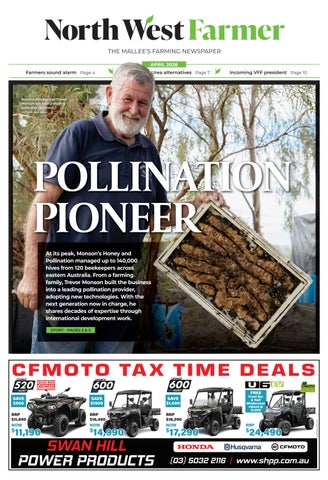
At its peak, Monson’s Honey and Pollination managed up to 140,000 hives from 120 beekeepers across eastern Australia. From a farming family, Trevor Monson built the business into a leading pollination provider, adopting new technologies. With the next generation now in charge, he shares decades of expertise through international development work.

Pollination pioneer

AT its peak Monson’s Honey and Pollination coordinated up to 140,000 hives, sourced from around 120 beekeepers across eastern Australia.

So it is no surprise that Mr Monson’s idea of retirement doesn’t involve putting his feet up and having a cup of tea.

Although, if he does find some time to take a sip, he is sure to add a spoonful of honey.

Born in Smithton, Tasmania, his grandfather John was chairman of the award-winning Duck River Butter Company, developing an abattoir that exported pork and lamb.

Mr Monson said John and his father Maurice also kept “up to 30 beehives.”

In 1949, Maurice sold his share at Duck River and moved his family to Mildura in Victoria’s northwest, initially to support his mother’s family with their pest control business across Victoria, New South Wales and South Australia.

However, Maurice’s love of bees led to a problem.

“When it came to getting rid of bees for clients that he found in houses and dried fruit boxes, he refused to destroy them,” Mr Monson said.

“Instead, he would rehouse them in bee boxes and add them to his new apiary.”

Eventually Maurice would purchase a fruit block at Mildura South.

Mr Monson said his first encounter with bees was memorable but unpleasant.

“I was riding on the fruit cart, being pulled by a big white horse, while my father loaded buckets of currants on the trailer behind.”

“This aggravated a swarm of bees hanging in the vines, who then attacked the horse, causing him to bolt off with the trailer still attached.”

“My father told me to run so I didn’t get stung. Later, I watched from a distance as he put the bees in a box.”

Despite this scary scenario, Mr Monson said he was immediately “fascinated by these bees, especially the different coloured pollens they were carrying on their bodies.”

This lifelong devotion to bees was evident when Mr Monson, without veil or gloves, gently slid a frame from one of his hives and delicately pinched a single drone between his fingertips.

“They’re pretty calm,” he said.

At ease among his bees, the amiable apiarist pointed out the workers and the queen, describing their behaviour with an air of gentle curiosity.

By 1954, Maurice had sold the fruit block and his pest extermination business and moved the family across the river to Gol Gol, where he

became a full-time beekeeper.

While he dabbled with the idea of becoming an accountant, it didn’t take long for Mr Monson to realise he was also destined to be a beekeeper for life.

Mr Monson said the early years were tough for the family farm.

“We were doing well until the 1967 drought hit us hard.”

As a result, he spent the next few years managing a packaging shed at a citrus property at Monak.

After marrying his wife Carolyn, a school teacher from Hobart, at the end of 1971, he returned to Gol Gol, hoping to return to beekeeping in 1972.

However, as they often do, circumstances changed.

“It wasn’t long before a neighbour from Monak asked me to manage a second farm he owned with his brother at Nangiloc,” Mr Monson said. “The farm was rundown and badly needed some TLC. By then my brother Lyle was helping my father with the bees. So I was given the okay to accept the offer for at least the next five years. I ended up staying for seven,” he said.

Eventually, in 1979, and now with a young family of three children, Mr Monson returned to his family’s honey and pollination business.

He hasn’t looked back since.

“It wasn’t long before we were supplying so many growing industries with bees for pollination, to the almond growers, to market gardeners, to watermelon and pumpkin growers, and any other crop that improved yields with bees

been

with international ag-tech

and their pollination skills,” he said.

The expansion of Mr Monson’s beekeeping business to larger managed properties, such as those owned by Timbercorp, required him to sub-contract other beekeepers.

“Thismeantalotoftrustonbehalfofthosebeekeepers, that we would care for their bees and give them a reasonable return, plus provide the crop and returns expected by the farms,” he said.

Over time Mr Monson’s son Jonathon, who is now the director of Monson’s Honey and Pollination, his son-in-law Daniel, and his nephew Reece, would take on more responsibility, allowing him to step back and smell the sunflowers.

“My role nowadays is mainly using my knowledge of beehive placement,” he said.

That expertise is critical in modern agriculture, where pollination underpins crops ranging from almonds and blueberries to canola and sunflowers.

With orchards expanding in scale and complexity, particularly in the almond sector, the logistics of pollination have become a major operation in their own right.

Matt Elliott
Mr Monson’s business has
working
company BeeHero, trialling in-hive sensors designed to monitor bee health and activity in real time. Pictures: Ben Gross
Queen bee.
In recent years Mr Monson has been sharing his expertise globally with Brendan Irvine of the non-government organisation Adventist Development and Relief Agency (ADRA).
Beehives being wrapped for the cooler weather. Mr Monson said that beehives were “mostly managed by women“ in Mongolia. Picture: Supplied

Mr Monson has since taken his expertise from his eclectic farm in Gol Gol to Laos, Cambodia, Thailand, Myanmar and Mongolia.

In recent years Mr Monson’s business has been working with international ag-tech company BeeHero, trialling in-hive sensors designed to monitor bee health and activity in real time.

These small devices measure temperature, humidity, sound and vibration within the hive, offering insights into hive strength, before and during pollination.

“The strength of a hive has become a real problem,” he said.

“With thousands of hives being provided, many are not strong enough to do their job in the cold spring conditions.”

Thankfully the BeeHero transponder can perform a pre-audit to ensure a hive has enough food and insulation prior to wrapping.

Mr Monson said the technology was already proving its value, significantly reducing the time required to assess hive performance across large orchards.

Beyond saving time, the sensors help to create a more level playing field across the industry, with consistent data replacing subjective

assessments of hive strength.

There is also growing potential to use the technology in new ways, from tracking bee activity in specific crops to analysing how weather impacts pollination.

“It is exciting to have the ability to place sensors in an orchard or on a canola crop to record bee activity,” Mr Monson said.

With his younger family members assuming control, Mr Monson decided to take his experience beyond Australia’s borders and into developing agricultural communities, where his practical knowledge could have immediate impact.

“I had travelled on government-sponsored trips to the US and China over the years, but when I turned 70, I decided that I needed to share the knowledge that I had.”

What began as a guest speaking engagement at Mildura Deakin Rotary Club led to a deeper involvement in international development work and a growing appreciation of how the organisation connects local communities with global projects.

In Laos, Mr Monson engaged in spirited negotiations with locals about the merits of leaving drone broods in their hives.

“Swarms of bees would fly into the hives and the keepers would rush to get the drones out,” he said.

Drones are male bees that are necessary to fertilise the queen but do not produce honey. Historically, they have been removed from hives because they sap resources and are susceptible to Varroa mites, which can evolve to parasitise Apis cerana, the honey bee species native to Asia.

However, researchers have discovered that drone blood left in the hive can be used as a pollen supplement that keeps hives thriving during winter, through droughts, or at times when nectar and pollen are scarce.

Drone blood can also be used to produce a flour, providing a rich source of protein and essential nutrients for the hive.

In recent years, Mr Monson has worked alongside Brendan Irvine, who serves as an agricultural advisor with non-government organisation Adventist Development and

Relief Agency (ADRA).

One of their most significant undertakings hasbeenasheep-breedingprojectinMongolia.

Established by the Australian Embassy in Ulaanbaatar, the project involves implanting the embryos of super fine merino sheep into Mongolian ewes, with the aim of lifting wool quality and improving long-term productivity in the local sheep industry.

Mr Monson said the process reduced the amount of livestock required for cashmere production, helping to protect native grasses and improve both economic outcomes for herders and environmental sustainability.

“We set up a request for the Fine Wool Program to be funded through the International Rotary body of RAWCS (Rotary Australia World Community Service).”

Always looking to the future, Mr Monson said the project gave him the opportunity to pass on his expertise while supporting work that delivered real benefits.

“There are many international projects listed on their website that are worthy of attention and can genuinely make a difference,” he said. Even in retirement, Mr Monson is finding new ways to put a lifetime spent with bees to work.

In Laos, Mr Monson taught locals the value of keeping drone bees for the purpose of transforming their broods, into a pollen substitute to feed the rest of the hive, providing a rich source of protein, fats, and essential minerals.

Farmers sound alarm as basin plan blasted at packed forum

Peter Bannan

HUNDREDS have rallied in Barham, demanding an immediate halt to Murray-Darling Basin Plan reforms they say are crippling rural Australia.

The heated forum, held on 31 March under the banner Saving the Murray Darling Basin from the Highway to Hell, brought together irrigators, farmers, scientists, legal experts and industry leaders from Victoria, New South Wales and South Australia, with many more watching online.

The event will form part of a submission to the Murray-Darling Basin Authority’s ongoing review.

Southern Riverina Irrigators chief executive

Sophie Baldwin said the message was unanimous.

“Everyone in attendance called for an end to all basin plan reform which is destroying our rural communities and crippling productivity,” she said.

“Ultimatelythebasinplanisbasedonflawedmodelling and some unachievable environmental outcomes, something the MDBA has finally acknowledged in the review they released in February.”

Ms Baldwin said her organisation was calling for an end to all water recovery measures.

“No more buybacks, no Sustainable Diversion Limit Adjustment Mechanism shortfall and no relaxing of constraints because these are all mechanisms used to deliver water downstream for unachievable environmental outcomes,” she said.

She warned communities were at breaking point, with more cuts looming.

“Basin plan reform is killing productivity and we are at a critical point,” she said.

“There is still 221GL of water to strip from communities under the 450GL restoring our rivers legislation and if they come for the 305 to 350GL SDLAM shortfall, they are basically wiping out the entire annual productive pool of Murray irrigation.

“Who will grow our staple foods and feed our nation if we no longer have our farmers growing rice, cereal, dairy, fodder, livestock and fruit and vegetables?

“It is an absolute disaster.”

An industry panel featuring Ricegrowers Australia, Kagome and Australian Consolidated Milk painted a grim future of consolidation, job losses and shrinking regional economies.

Australian Consolidated Milk chief executive Jason Limbrick said modelling showed water recovery of 302GL would cut the consumptive pool by eight per cent and push temporary water prices up 20 per cent.

He said dairy farmers could face losses of up to 40 per cent, forcing some of the region’s 40 processing facilities, employing about 2000 people across eight local government areas, to shut.

“This reform is not just an industry issue, it’s a food security issue, a regional development issue and a national economic issue,” he said.

Speakers from agriculture, science and law echoed the concerns, including De Bortoli Wines managing director Darren De Bertoli, Ricegrowers Association’s Justin Sutherland, Kagome’s Darcy Kirchofer, horticulturist Nathan Free, Federation University wetland scientist Emeritus Professor Peter Gell, Citrus South Australia chair Mark Doecke, agribusiness leader David Farley and water law specialists Tim Horne and Bobbie Pannowitz.

This reform is not just an industry issue, it’s a food security issue, a regional development issue and a national economic issue.”

- AUSTRALIAN CONSOLIDATED MILK

They warned industries were already struggling after 4687GL had been removed from agricultural production, with a further 450GL planned, plus a SDLAM shortfall of up to 355GL.

Despite more than $11.5 billion spent over 14 years, critics say the basin plan has failed to balance environmental, social and economic outcomes or provide water security.

There are now more than 4622GL in government water accounts, yet speakers said critical infrastructure remained underfunded and future planning for farmers was becoming impossible.

“With the purchase of every extra megalitre of water from the consumptive pool, it becomes increasingly difficult to forward plan and budget,” the forum heard.

“Buybacks escalate the price of water and when combined with drought, global conflict, fuel and energy shortages, we see businesses collapse.”

Ms Baldwin said rising costs were compounding the crisis.

“IPART has just released another round of potential fee increases of 10 per cent over the next three years plus CPI and there is just no end in sight,” she said.

“We need drastic action now to change this trajectory and there needs to be immediate flexibility with environmental water so it can be returned for use in the productive pool and keep our farmers farming.”

She delivered a stark warning.

“Our farmers will soon need to be recognised as critically endangered just like the lower Murray River,” Ms Baldwin said.

Critics also pointed to environmental outcomes, claiming fish and bird numbers were declining despite water recovery efforts, while the lower Murray River has been declared a critically endangered ecological region.

After 14 years, they say the policy has failed both the environment and the people who depend on the land, contributing to the collapse of generational farms, closure of milk processing plants and rising mental health issues in rural communities. The forum called for a shift away from buybacks toward measures such as carp eradication, cold water pollution control, fish passages, improved water quality, sediment management, riverbank revegetation and on-farm refuges.

MDBA chief executive Andrew McConville said the review was an important opportunity to assess the plan’s future.

“The basin plan review is an important opportunity to consider how the basin plan is working and what needs to change for the next decade,” he said.

“RepresentativesoftheMDBAareoutandaboutin the Basin throughout the consultation period, with meetings scheduled across the catchment areas.

“Existing commitments meant it was not possible for us to attend the forum, but I have spoken directly with the organisers to arrange an alternative time to meet.

“This is a really important group for us to meet with, and I am keen to hear from them in person.

“The MDBA is committed to engaging with all basin stakeholders and to listening and learning as we shape how the basin’s water is managed for future generations.”

Organisers of the basin plan forum Geoff Kendell (left) and Lloyd Polkinghorn (right) with water lawyer Bobbi Pannowitz from Griffith. Picture: Supplied

Challenging harvest for almond growers

THE uncertainty around fertiliser and fuel supplies in 2026 has emerged as a major issue for all of Australian agriculture.

Doubt around ongoing availability is being compounded by much higher prices.

The war in the Middle East has left our main source of urea blocked.

Almost 70 per cent of the nation’s urea needs have been sourced from Middle Eastern countries.

Just how and where replacement stocks can be sourced is causing widespread concern as people finish off post-harvest nutrition and finalise their nutrition plans for spring.

We are already hearing anecdotes of annual horticultural croppers pulling back their winter planting plans based on this uncertainty.

Suppliers are struggling to supply contracts with volumes or pricing, such is the uncertainty of availability.

Almond growers continue with one of the most problematic harvests in recent memory

The wet harvest of 2011 has been recounted many a time in recent weeks.

Wet, humid conditions are presenting many challenges for growers and processing product on farm and at the processing facilities will take much longer this year.

The inshell market will be hit hardest.

China and India purchase more than 90 per cent of the world’s almond inshell.

They prefer blemish-free product, but the rain and the paper-thin shell of Nonpareil make it particularly vulnerable to staining and other defects that trigger supply-chain pushback.

Communities encouraged to speak up

Lochlainn Heley

VICTORIAN Farmers Federation is calling on regional community members to make submissions to the Murray Darling Basin Plan Review. Consultation for the 2026 review opened on 5 February, inviting stakeholders to submit their thoughts on the plan’s regulatory design and the current health of the Murray-Darling system.

The submission period will close on 1 May and VFF Water Council chair Andrew Leahy said it was important for local communities to make their voices heard.

“This is one of the most important policy moments for our region in over a decade,” he said. “If we want decisions that reflect the reality on the ground, we need people to speak up and share their experiences.

“It’s a real strength in numbers game. We

In most seasons, inshell can deliver a premium over kernel, but marketers will be dealing with much smaller volumes that can be used for this purpose in 2026.

Reports suggest the crop size seems to be holding up despite the conditions, and the versatility of the almond means it still has a place on the supermarket shelf in many other guises.

In times when food security becomes an issue, consumers can turn to almonds as a nonperishable product that can be used in so many ways in dishes across all meals.

It is this versatility of the almond, along with its two-year shelf life that has resulted in so

need as many people as possible to use the VFF template, add your own experience, and make a strong, practical submission before the deadline.”

Interested stakeholders can use VFF’s resources and templates to make a submission to the consultation.

Mr Leahy said it was important that local community members took the time to put a submission together.

“We know people are busy, so we’ve taken the hard work out of it and we hope it delivers a strong message to decision makers,” he said.

many growers turning to the almond industry. In tough times like these, almonds will present some challenges during and after harvest, but there is still a crop to sell and a grower return that can be relied upon.

Although more diesel is required, enhanced drying technology and on-farm practices are also improving the saleable volumes, despite the heavy rain and ongoing moist weather.

It is ironic that as we head into the tail end of one of the wettest harvests on record, we see short-term water prices are hovering around $400 per megalitre, and low Murray storages in much need of strong winter rains.

“The most powerful submissions are often the simplest. Talk about your connection to the Basin, what water means to your farm or business, and the impacts you’ve seen.

“That real, lived experience is what decisionmakers need to hear.

“It’s critical that we get a strong, united response from the Northern Victorian community and demonstrate that we matter and can make a real difference.”

Submissions to the Murray-Darling Basin Plan Review will close on 1 May and a report of the findings will be released later in the year.

Large Scale Cropping, Grazing, Feedlot & Irrigation Development Opportunities

These two (2) bordering properties each form a key piece of the highly regarded ‘Grand Junction Station’ property (refer outline within image). With dual frontages to the Silver City Highway and Pomona Road, along with direct ‘over the bank’ access to each of the Darling and Great Darling Anabranch Rivers.

Future land uses include; Irrigated Cropping, Dryland Cropping, Intensive Horticultural Development, Grazing, Protected Cropping and/or Feedlot, Intensive Animal Husbandry or alternate development.^

Additional parcels of ‘Grand Junction Station’ will also be considered for sale by the Vendor.

All areas & distances are approximate*

Wentworth, New South Wales Irrigation Development,

for Sunraysia growers.
Wet, humid conditions have presented challenges for growers with processing taking longer this year.

WINE GRAPES with COLIN FREE

Vintage wraps up

ANOTHER memorable winegrape harvest is almost over, or by the time you read this, it shouldbecompletedwiththelastfourtruck loads expected to be harvested this week.

Yieldswerefair,pricespoorandweended up harvesting a little under 200 tonnes that couldn’t be sold off the ground.

We had a couple of major breakdowns during harvest but thanks to my excellent pit crew of Charlie, Jamie and John, we were able to get things rolling again and meet our crush times at the wineries.

The 200mm of rain during harvest was interesting to say the least with the only benefit being less irrigations being required, with it probably saving us about 50 megalitres.

The ridiculous diesel price has directly impacted us, along with many others, and our freight and harvesting costs will be higher.

Grapevines are fertilised after harvest to put them in a happy place while dormant but the Nitrogen prices have about doubled and other popular fertilisers are in short supply because China has halted their exports.

Urea will be available in June at an unknown price, which is too late for

post-harvest applications.

In the big picture, recent times have been a wake-up call to Australia.

We have lost our ability to compete on the world market in so many commodities.

Our current focus on green issues and climate change is having damaging consequences.

Reduced water availability through buybacks, along with rising electricity and fuel costs, will mean fewer businesses and producers able to feed the country and support regional communities.

In the smaller picture, most of the creatures are winding down for the season.

The remaining snakes have wandered off for a nap, and the crows are eating a few of the remaining grapes before heading to feed on some crickets in the flood irrigation paddocks.

The snails are sprinting around enjoying the dewy mornings, while the ants are being very industrious and are having a crack at digging for oil.

There are some large mounds of dirt around as they continue their exploration activities.

I caught up with a group of ants who had started the front-end loader and were trying to reverse it out of the shed to help with their activities.

Talk to your mates.

Urea alternatives as global trade stalls

James

INCORPORATING organic carbon and diversifying crop cycles could reduce reliance on synthetic nitrogen fertilisers, as disruption to global urea supply channels look set to continue.

Mallee share farmer Ross Watson has spent more than a decade learning about and trialling methods of cultivating nutrient-rich soil for growing, including growing his own nitrogen source.

“The idea is to set the farm up with crop rotation and soil cover so you don’t have to buy urea,” he said.

“Breaking up the crop for half cereal, half legumes on rotation can fix nitrogen from the atmosphere into the soil.

“You could harvest the legumes and plough the soil, or roll or drop the crop, leave it to mat the soil and act as mulch to store moisture to grow a healthy soil.

“When you’re trying to produce tonnes of cereal off of a farm year after year, you’re relying on an imported nitrogen product, but growers have told me the best crop they’ve got is harvested from the homegrown nitrogen rotations.”

Introducing organic matter rich in carbon and nitrogen to the soil such as compost, manure or worm castings can also increase microbial activity, which can encourage crop growth.

“Carbon is in every natural product on Earth, and everything comes from carbon. A product like Calder Permaculture Stimulator, which is a form of carbon, is recognised by the living organisms that already exist in the soil,” Mr Watson said.

“When you add urea to soil, it is a granule that has to turn into a nitrate, or a gas, to become available to a plant in the soil, but gas kills the microbes because they need oxygen.

“Over time, I believe Stimulator would create soil that is more healthy and more conducive to microbes if you still have them, whereas they don’t recognise the synthetic chemical products.

“If you’ve killed your microbes with synthetic products, it takes a while to come back.”

While geopolitical unrest has disrupted nitrogen-based fertiliser production in the past decade, the closure of the Strait of Hormuz has grounded a third of global seaborne fertiliser, according to United Nations Trade and Development figures.

Arab Gulf nations export about 13 per cent of nitrogen and nine per cent of phosphate fertiliser nutrients.

Rising gas prices are also expected to push fertiliser production costs even higher, as a key input in the production of urea and ammonia.

Moscato Giallo is due to be harvested this week, bringing harvest to a close.
Nurturing organisms in the soil could reduce reliance on nitrogen-based fertilisers. Picture: File

Almond boss resigns

ALMOND giant Select Harvests is on the hunt for a new boss after shock news its chief executive is stepping down.

Chief executive and managing director David Surveyor has told the board he will resign, bringing an end to a three-year stint marked by a major turnaround in the company’s fortunes.

Appointed in November 2022 and starting in early 2023, Mr Surveyor oversaw what the company described as a “material transformation” , boosting operational capability, expanding scale and strengthening its international standing.

The turnaround was stark. Select Harvests went from a substantial loss in FY23 to posting a net profit after tax of $31.8 million in FY25. Under his leadership, the company also lifted safety performance, increased employee engagement and delivered major operational improvements across horticulture, processing and sales.

The gains helped earn the business the Regional Exporter of the Year title at the 2025 Governor of Victoria Export Awards.

Chairman Travis Dillon praised Mr Surveyor’s impact.

“The board extends its best wishes to David for his future pursuits and expresses appreciation for his dedicated service and leadership, which has resulted in exceptional safety standards and notable financial improvement,” he said.

“David has built a capable executive leadership team that is well-positioned to further drive the company’s growth.”

Mr Surveyor said leading the company had been a highlight of his career.

“It has been a privilege to lead Select Harvests over the past three years,” he said.

“I am proud of the transformation we have achieved together.

“Our people have lifted strategy and execution across the business, from improving our horticultural practices to changing our processing capability and redefining our approach to market.

“All of which has been supported by dedicated corporate and back-office staff. Our people have done this in a manner that is consistent with our values.”

He also thanked the board and staff, adding he was confident the company would continue to deliver for shareholders.

The company will now begin a search for a new chief executive and managing director, with Mr Surveyor to remain in the role for a six-month notice period to ensure an orderly transition.

The company headquarters is in Melbourne while some of its orchards are near Robinvale.

MP urges interest-free loans for farmers

Denika Anderson

MEMBER for Mallee Anne Webster has called for interest-free loans to support farmers affected by increased costs resulting from the fuel supply crisis.

Government expects them to absorb that burden while others can adjust their prices or add a margin, if we don’t stand behind our farmers, we put our food supply at risk leaving Australian families exposed.”

TRACTOR&FARMMACHINERY

Ms Webster said farmers across the region had approached her “very concerned” they have been left out of the Economic Resilience Program, which provides access to zero-interest loans for eligible businesses to support domestic industries and supply chains impacted by market disruptions.

“The interest-free loan package is meant to support businesses, but it’s still unclear if farmers dealing with skyrocketing fuel and fertiliser costs are included,” she said.

“Mallee farmers are already doing it tough, and it’s only getting worse.

“Primary producers are paying more to run their machinery and more for the inputs that grow our food and fibre, but unlike others in the supply chain have no way to pass these costs on.

“It’s not a level playing field, the Federal

Shadow Minister for Agriculture, Fisheries and Forestry Darren Chester said the government had failed to provide any details on the program and eligibility criteria.

“As it stands right now it appears farmers and agri-businesses have missed out completely under this scheme,” he said.

“Key industry groups are already warning that further disruptions to fuel and fertilser supplies could lead to shortages and higher prices for Australian families and the agricultural sector can’t keep absorbing all the extra costs.

“As a nation we produce more than enough food for domestic consumption, but the agricultural sector relies heavily on imported inputs like fuel, fertiliser and pesticides which have been severely disrupted by the current crisis.”

Harvest suspended as heavy rain impacts key growing regions

SELECTHarvestswasforcedtohitpauseon harvest last month as heavy rain drenched key growing regions across three states.

The company confirmed its orchards in the Riverland, Sunraysia and southern NSW were lashed by rain, peaking during the weekend of 28 February to 1 March.

In a scramble to stay ahead of the weather, harvesting was stopped in the worst-hit areas, with crews and machinery redeployed to drier orchards in the Riverina to keep the crop moving.

“With dry conditions now forecast across the remaining orchards and as conditions improve, harvest will recommence,” the company said.

The full extent of the damage remains unclear, with the crop still to be harvested and processed.

“As the affected crop has yet to be harvested or processed, it is premature to assess potential impacts on yield or quality,” the statement said.

Despite the setback, the company said it was better equipped than ever to deal with wet conditions, pointing to upgraded high-capacity drying facilities at its Carina West site.

Those improvements are already attracting attention, with external growers hit by the same rain now seeking access to the company’s drying and processing capabilities.

Importantly, any fallout was expected to be limited.

“It should be noted if there is any impact it is only in relation to the 2026 crop and the company expects no impact on future years,” the company said.

Member for Mallee Anne Webster MP has called for interest-free loans to support farmers affected by increased costs resulting from the fuel supply crisis. Picture: File
Select Harvests chief executive and managing director David Surveyor has resigned. Picture: Supplied

Fierce fight for rural communities

A BROADACRE farmer from the Wimmera is set to take the reins of the state’s peak farming body, promising a fierce fight for rural communities under pressure.

Minyip cropping farmer Ryan Milgate has been named incoming president of the Victorian Farmers Federation after nominations closed, with no vote required.

Mr Milgate and Ballan livestock farmer Scott Young, who steps in as vice-president, were the only nominees for the top roles and will be declared elected unopposed.

The pair will officially begin their tenure after the VFF conference in Ballarat on 2 June.

Speaking from his sprayer in the paddock, Mr Milgate said the phones had already been “running pretty hot” as he connected with members ahead of taking office.

“It’s going to be a big job,” he told North West Farmer.

Mr Milgate said success in his first 12 months would hinge on rebuilding and maintaining strong engagement with both farmers and government at a time of mounting pressure on the sector.

“We’ve got some really big things coming our way,” he said.

“There’s a state election in November, and we’ve got issues with transmission lines, wind turbines, mining and the lack of investment in rural Victoria.

“To be successful, we’ve got to be at the table and advocating for farmers. You’ve got to have those relationships where you can have the hard conversations and still keep the door open.”

He credited outgoing leadership, including

Brett Hosking and the VFF team, with restoring the organisation’s influence.

“Brett’s done a sensational job rebuilding that. We are back at the table, and we need to stay there,” he said.

“It might look from the outside like we’re not having input, but the reality is things would be much worse if we weren’t there having a red hot go.”

Mr Milgate said his leadership style would focus on empowering members rather than dictating policy.

“My role is not to be the boss,” he said.

“It’s about making sure farmers have the structures to have input, building strong policy, and then advocating for it.

“I’m not a battering ram. It’s about getting the best outcomes from the ground up.”

Cost pressures remain a major concern, particularly fuel and supply chain disruptions, but

Mr Milgate admitted there was no easy fix.

“I don’t think I can walk in and cut fuel by a dollar a litre. It’s just not realistic,” he said.

“But what we can do is fight for supply. If I can’t get diesel, I can’t harvest a crop.

“We need sovereign capability. Whether it’s fuel, fertiliser or chemicals, we’re too exposed globally.”

He warned farmers were increasingly vulnerable to international shocks.

“Covid, war in Ukraine, global instability.

We’re so exposed here in Australia,” Mr Milgate said.

“We can’t flick a switch, but we can plan for the future and make sure we’ve got investment and manufacturing onshore.”

Mr Milgate said farm viability remained a moving target, heavily dependent on commodity, weather and market forces.

“A frost in November can turn a great year into a disaster overnight,” he said.

He also raised concerns about supermarket power over sectors like dairy and horticulture, and called for stronger safeguards.

Despite the challenges, he said most farmers did not want heavy government intervention.

“They just want the guide rails to do what they do best,” Mr Milgate said.

He also urged city Australians to better understand farmers.

“We’re just real people doing our best,” he said.

“Farmers are the ultimate environmentalists. The better we look after the land, the more profitable we are.”

Mr Milgate acknowledged an ongoing divide between city and country but said efforts to bridge it must continue.

“There’s always going to be extremes, but it’s the sensible centre we need to connect with,” he said.

On renewable energy, he said projects must be done properly, warning poor consultation had damaged trust.

“The lack of transparency and genuine engagement has been a disaster,” Mr Milgate said.

“Farmland has been treated like vacant land. That has to change.”

He was also critical of compulsory acquisition powers and broader government engagement with rural communities.

“My biggest frustration is the lack of genuine engagement,” Mr Milgate said.

“It feels like decisions are made without understanding the impact on the people living there.”

Mr Milgate said the Murray-Darling Basin

Plan review was another major concern.

“Everything I’m hearing is that it’s having severe impacts on regional communities,” he said.

“We need to go back to basics and get it right.” Despite the challenges ahead, he said he remained committed to farming and regional Victoria.

“I love the challenge,” Mr Milgate said.

“Some days you get a curveball, but you knock off and think, we got through it.”

He called on farmers to get involved in shaping the VFF’s future.

“It’s easy to sit on the sidelines,” he said.

“But we need members involved to drive better outcomes for everyone.”

Mr Milgate said he had no political ambitions.

“You’ve got people like Brett who are open about wanting to go into politics, and some are quite critical of that. Yet across the country, people involved in advocacy say it’s a great thing when farmers step into those roles,” he said.

“We often say farmers don’t have a voice in Parliament, so who better to represent us than someone who has come up through the ranks, who understands the structures, and who still lives and breathes it on the farm? They’re the ultimate advocates.

“Having said that, I still love farming too much. It’s not something I’m interested in at all.

“To be honest, I didn’t even really want to step outside the grains sector. I wanted to stay in that lane, but opportunities come along and you take them.

“But politics doesn’t interest me. I think too often it loses sight of what’s right and what’s actually needed. It becomes about maintaining popularity, and that doesn’t sit well with me.”

Wimmera farmer Ryan Milgate has been elected unopposed to the VFF presidency position. Picture: File

A tough season, a strong team, and reasons to stay cheerful

DAIRY with PAUL BETHUNE

I WOULD say the farm is a bit of a mess really.

The big rain was really welcome but it has made for the perfect germination of all summer and winter weeds at the one time.

We are in the process of trying to clean it up but it’s hard to see how we can make a full recovery this season from the current position.

The fuel job is a pain and a distraction we don’t need.

We typically use between 3000 and 4000 litres of diesel per week - more during sowing. With prices currently $1.50 per litre higher, the cost impact is obvious.

Ourtransportpartnersareobviouslyresponding with higher fuel levies (and legitimately so), but we don’t have the ability to respond with a milk price correction on farm or factory as quickly, so we are going to hurt.

If I am sounding like a grumpy bear, well that’s okay, it’s better out than in.

A good grump every now and then never hurt anyone, and I’m almost guaranteed to be more cheerful after breakfast and a cup of coffee. I never mooch for long.

There’s plenty of good news.

I have lost 17kg over the last year, still on a mission, but nearly half way.

It took me 25 years to turn into a whaling heiferlump.

My boys are sceptical when I tell them I was a stick rake at their age.

As long as I’m heading in the right direction, I don’t mind how long it takes to move from heiferlump to choice cut.

We also possibly have the best calf rearing combination ever, one young lady from Indonesia and another whose family has a farm in the Amazon jungle in Peru.

This takes a massive load off Sally and is working really well.

Actually, I feel like for the first time in a lot of years, we nearly have all the right people in the right places, and we are building a really good crew.

Ever so slowly, we are winning the war in commissioning the new Bethune lane dairy processing plant.

We could not get the continuous-flow pasteuriser to put enough load on the gas boiler to

Haystacks ignite without warning

WITH winter fast approaching, cooler temperatures should suggest a reduced risk to haystack fires, however, hidden hotspots inside damp bales can ignite without warning, regardless of the weather outside.

Rich in essential nutrients like proteins and readily available sugars, combined with the presence of residual moisture, haystacks provide the ideal breeding ground for a vast array of microorganisms.

This biological process begins almost immediately after baling, particularly if the hay was not sufficiently dried before storing.

Within the tightly packed confines of baled hay, bacteria begins the process of breaking down plant matter, ultimately generating enough heat to spontaneously combust.

Agriculture Victoria dairy extension officer, Michele Joliffe said haystacks can spontaneously ignite within two weeks of baling and can remain a threat for more than three months.

“Most heating occurs within the first fortnight

keep it running, and the cooling wasn’t really working - despite having very cold product to put through the heat exchanger.

We have been pulling it apart bit by bit and have found multiple complete blockages on both the production and heating/cooling agent side.

With bits of sponge, plastic milk bottle lids, hair nets and a fair bit of pretty disgusting grime and muck, these are the joys of buying second hand equipment.

Whilst it has taken a few days of heavy work, the back of it is broken and we are building trust in the equipment, and also know everything will be spotless before we put any milk through it.

Throughout my 35-year farming journey, I have been constantly amazed by the people who have randomly turned up at critical moments and made significant contributions.

I started chatting to a guy at a funeral at Kyabram of a few months ago.

It turned out he was a microbiologist with 30 years’ experience running milkprocessing plants, and he has been volunteering his time to help push us from installation mode into operation mode. Remarkable, really.

The thought of someone giving up their own time, travelling to Lake Boga, for no charge

after baling, although hay can still reach ignition point up to eight weeks later, especially during fluctuating autumn temperatures,” Ms Joliffe said. “Cooler weather can hide the risk, but moisture in hay can still spark trouble if vigilance drops. Simple actions like testing temperatures and watching for warning signs can prevent a heating haystack from becoming a dangerous ignition.”

While there is currently no technology available to track the internal temperatures of hay stacks, CFA Victoria is urging producers to make use of a metal rod or crowbar to manually monitor internal temperatures. If, two hours after inserting a crowbar into the centre

because they want to see Australian manufacturing succeed, genuinely lifts my spirits. I always think the more you give, the more you get, and that encourages me to stand up and help where I can.

of the haystack, the handle is too hot to touch, producers are encouraged to call Triple-zero.

The CFA warns against touching the haystacks as pulling it apart may introduce the oxygen required to ignite the flame.

To avoid the spontaneous combustion of haystacks, producers should ensure hay is fully curedpriortobaling,keepbalesawayfromrain, store hay away from machinery and workshops, and maintain fuel breaks to reduce the risk of a potential fire spreading to surrounding areas. Producers are urged to avoid walking on haystacks as internal charring on at-risk bales may cause stacks to collapse and cause serious injury.

Amy Hyde
Sally and Paul Bethune have had a busy month and continue to work towards commissioning their new dairy processing plant.

LIVESTOCK REPORT

Lamb prices surge as producers cash in on winter demand

SHEEP and lamb prices are climbing fast, with strong demand and tightening supply delivering a welcome boost for producers heading into winter.

Elders Swan Hill livestock agent Matt Rowlands said the market had continued its upward run since last month, defying seasonal expectations.

“Since last month, we’ve seen a continued steady increase in sheep prices. They expand and improve as we go along, which is phenomenal for the time of year,” he said.

Mr Rowlands said the strength was being driven largely by supply, with numbers still tight across the board.

At the latest fortnightly prime market at Swan Hill, yardings fell to just over 7000 head, including just under 5000 locally, with quality beginning to tail off as the season progresses.

Despite that, well-finished stock continued to command a premium.

“The better fed, well presented lambs are still attracting a premium,” Mr Rowlands said.

Heavy export lambs topped at $395, while Merinos reached $345. Crossbred lambs at the heavy end were trading between $10.80 and $11.30 a kilogram, while neat trade lambs pushed beyond $12 a kilogram.

Mr Rowlands said forward contracts were adding further confidence, with winter pricing already being locked in.

“We’ve got contracts coming into May and June anywhere from $11.80 to $12.20, which is fantastic for producers to secure those prices into winter,” he said.

However, Mr Rowlands warned of potential disruption ahead, with processor activity expected to ease due to limited supply.

“Some processors will drop kill days or shut down for maintenance for two to four weeks. That’s due to a lack of numbers,” he said.

“It’s something to watch, but at the moment it’s not having a huge impact on pricing.”

The mutton market remains under pressure from low supply, raising concerns it could eventually flow into lamb availability.

Meanwhile, the store lamb market remains firm, particularly for later drop types suited to winter feeding.

Quality store lambs are now selling well above $6.50 a kilogram liveweight, while lighter lambs are being snapped up between $240 and $290 to go back onto feed.

Young cattle under 280kg are presenting the best buying opportunities seen for some time.

“All in all, the sheep and lamb job is progressing very well,” Mr Rowlands said.

In the cattle market, conditions are shifting in the opposite direction, with prices easing slightly in recent weeks.

Mr Rowlands said increased turnoff from drought-affected areas in northern New South Wales and Queensland was pushing more stock onto the market.

“They’re dealing with very poor feed and minimal water, so cattle are coming onto the market in bigger numbers,” he said.

The result has been a drop of about 15 to 20 cents a kilogram across most categories.

Despite the softening, opportunities are emerging for buyers.

“We’re seeing large lines of well-bred weaner cattle under 300 kilos that have softened in the last two weeks,” Mr Rowlands said.

“It’s probably the best buying opportunity we’ve seen in 18 months.”

He said the chance to secure lighter cattle

at similar cents per kilogram to heavier stock presented a rare upside.

“You’re getting the benefit of weight gain and the potential rise in price as they move into the next category,” he said.

“If you can add 100 to 200 kilos, there’s real upside going into winter and spring.”

Mr Rowlands said strong numbers at store sales across the eastern seaboard, with yardings of 4000 to 7000 head, were also creating buying opportunities.

Centres including Ballarat and Barnawartha were offering quality lines of well-bred cattle suited to feeding or finishing programs.

“There’s plenty of opportunity for anyone with feed or country to take advantage,” he said.

“Good cattle bought now should stand out later in spring.”

Mr Rowlands encouraged interested producers to contact Elders Swan Hill to explore current market opportunities.

‘Curries’, Woorinen South VIC 258 hectares* / 637 acres*

Broadacre cropping adjoining major grain delivery site

• Undulating mallee loam producing high quality cereals, legumes and oilseed crops.

• Excellent rotations. ’22 Lentils. ’23 wheat, ’24 lentils, ’25 wheat. 232ha* arable.

• GWM pipeline water connected. Adjoins Emerald grain delivery site at Woorinen.

• Future investment opportunity. All relevant approvals, licenses and permits secured to develop this asset to high value horticulture to Woorinen Irrigation District Scheme.

• Planned summer spraying by vendor. 10% deposit. Settlement 60 days. Immediate working access on signing.

Asking Price $1,376,000 ($2,160/acre*)

*approx

Warnings Information at www.bom.gov.au/vic/warnings or Ph: 1300 659 210 (local call cost)

Mallee Forecast

Mallee

Partly cloudy. Slight chance of a shower in the southeast in the morning. Light winds becoming south to southwesterly 15 to 25 km/h during the morning then becoming light during the evening.

Saturday. Sunny. Light winds.

Victoria

A chance of morning fog in the north, then a dry and mostly sunny day. Partly cloudy with isolated showers mostly near and south of the Divide, tending scattered about the coasts. Snowfalls above 1600 metres. Showers easing and contracting to the southeast later in the day. A cool day with mainly moderate southwesterly winds, tending fresh about the coasts. Saturday. The chance of morning frost and fog. Partly cloudy and mostly dry south of the Divide. Dry and sunny across the north. A cool day with mainly light and variable winds, tending northerly in the west.

Sun and Moon

6:54am5:56pm10:03am7:39pm 6:54am5:55pm11:15am8:40pm 6:55am5:53pm12:19pm9:48pm

Chances of exceeding median maximum temperature.

Chances of exceeding median rainfall.

Water Storages

FullCurrentChangeLast Year Dartmouth3,856,23264.82,499,3714,5343,031,554 Hume3,005,15725.4764,505-18,024732,490 Eildon3,334,15841.81,394,883-8,1162,102,488 Others1,421,54554.3771,534-2,118847,621 Total11,617,09246.75,430,293-23,7246,714,153

Ocean Dipole

The crew at Goodyear Curlewis Street have all your commercial tyre needs covered, from truck to tractor tyres and repairs – we do it all.

Stocking the biggest range of tyres in the area at competitive prices. With our on farm service truck, we have all your on site jobs and after hours call outs covered, we will keep you on the road or in the paddock.

Allocation Outlooks Raises Concerns

Water availability across the Southern Murray Darling Basin is emerging as a key issue ahead of the 2026–27 season, with early allocation projections pointing to a potentially difficult year for irrigators in Victoria, SA and New South Wales.

Figures from the Murray Darling Basin Authority (MDBA) show major Southern Basin storages currently sitting at around 43% capacity, down from 52% at the same time last year (below the long-term average). The reduction reflects ongoing dry conditions across much of the Basin and limited inflows during the latter half of the current season.

While seasonal declines are expected at this time of year, it has raised concerns about water security if winter and spring rainfall fails to materialise.

Victoria: Low Starting Point for Allocations

In Victoria, early modelling under an average inflow scenario indicates low opening allocations for High Reliability Water Shares in both the Goulburn and Victorian Murray systems.

Although allocation levels can change as the season progresses, particularly with late inflows, the starting point for 2026–27 is expected to be well below full entitlement. The highly variable nature of recent climate patterns has made allocation outcomes increasingly difficult to predict.

Market behaviour suggests many Victorian irrigators are factoring this uncertainty into their planning.

Many traditional sellers are now considering carrying over their water with the risk of spill in the Murray system expected to be around 35% and the Goulburn system at around 10%, carryover and parking strategies against high-reliability water shares are increasing in demand.

New South Wales: Pressure on General Security Users

Conditions in New South Wales appear more constrained, particularly for General Security licence holders in the Murrumbidgee and NSW Murray systems.

Early projections suggest these users should prepare for zero or very low opening allocations at the start of the 2026–27 season.

South Australia Allocations:

The projected minimum, or worst case, opening Class 3 (High Security) allocation for South Australian River Murray irrigators for the 2026-27 water year is 62%.

Current projections indicate that, in the wet and average

scenarios, allocations are likely to reach 100% by the end of 2026-27, while in the moderate, dry, very dry, and extreme dry scenarios, there is a lower likelihood of allocations reaching100%.Astheprojectedminimumopeningallocation is greater than 50%, the carryover trigger for 2026-27 was not met and private carryover will not be available in 202627.

Historical comparisons are informing market expectations.

In low-allocation years such as 2019–20, allocation markets experienced sharp price increases. This history appears to be influencing current trading behaviour, with some irrigators seeking to secure water earlier or retain carryover where possible.

Leasing activity and forward agreements are receiving increased attention as growers look to manage exposure to potential price volatility next season. Despite these ongoing seasonal uncertainties, confidence in

the permanent entitlement market appears to be rebounding. Buyers are showing renewed interest, actively acquiring water entitlements as part of their long-term strategies.

Outlook

While many growers are still managing day-to-day operational decisionsbasedoncurrentseasonavailability,thecombination of below-average storage levels, conservative opening allocation projections and historically responsive markets suggests early planning for 2026–27 may be prudent.

As has been demonstrated in past low-allocation years, water markets tend to move rapidly once supply constraints become clear. How the season unfolds will depend heavily on winter and spring inflows, but the early indicators point to another year where water availability and its cost will remain central to farm decision-making across the Basin.

– Wendy Saunders

Permanent Entitlement market is firming, with a clear lift in demand across all major zones, including NSW Murray, Murrumbidgee, and Victorian High Reliability entitlements, particularly in the Goulburn and Vic Murray Zone 7.

The Commonwealth EOI 1 (RFT 2) has now closed.

Tough, reliable, and designed with your sheds in mind, the Dieci Poultry Pro 30.7 is more than just a telehandler - it’s your allin-one workhorse. Engineered with advanced cooling systems to perform in hot, dusty conditions, the Poultry Pro 30.7 delivers the strength to lift, load, and manoeuvre with ease, even in tight shed spaces. Every feature is tailored to the demands of Australia’s poultry industry, giving you a machine that works as hard as you do - day after day, season after season. With Dieci, you’re not just getting a telehandler; you’re investing in productivity, durability, and peace of mind on the farm.

Turn static files into dynamic content formats.

Create a flipbook