Australia’s National Local Government Newspaper LGFocus.com.au
August 2026
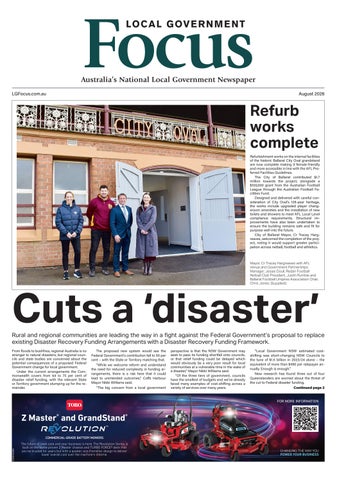
Refurb works complete Refurbishment works on the internal facilities of the historic Ballarat City Oval grandstand are now complete making it female-friendly and more accessible in line with the AFL Preferred Facilities Guidelines. The City of Ballarat contributed $1.7 million towards the project, alongside a $100,000 grant from the Australian Football League through the Australian Football Facilities Fund. Designed and delivered with careful consideration of City Oval’s 128-year heritage, the works include upgraded player changeroom amenities and the installation of new toilets and showers to meet AFL Local Level compliance requirements. Structural improvements have also been undertaken to ensure the building remains safe and fit for purpose well into the future. City of Ballarat Mayor, Cr Tracey Hargreaves, welcomed the completion of the project, noting it would support greater participation across netball, football and athletics.
Mayor, Cr Tracey Hargreaves with AFL Venue and Government Partnerships Manager, Jessie Doull, Redan Football Netball Club President, Justin Rumble and Ballarat Football Umpires Association Chair, Chris Jones. (Supplied).
Cuts a ‘disaster’
Rural and regional communities are leading the way in a fight against the Federal Government’s proposal to replace existing Disaster Recovery Funding Arrangements with a Disaster Recovery Funding Framework. From floods to bushfires, regional Australia is no stranger to natural disasters, but regional councils and state bodies are concerned about the potential consequences of a proposed Federal Government change for local government. Under the current arrangements the Commonwealth covers from 64 to 75 per cent of disaster relief funding, with the relevant State or Territory government stumping up for the remainder.
The proposed new system would see the Federal Government’s contribution fall to 50 per cent – with the State or Territory matching that. “While we welcome reform and understand the need for reduced complexity in funding arrangements, there is a risk here that it could lead to unintended outcomes,” Coffs Harbour Mayor Nikki Williams said. “The big concern from a local government
perspective is that the NSW Government may seek to pass its funding shortfall onto councils, or that relief funding could be delayed which would obviously be a very poor result for local communities at a vulnerable time in the wake of a disaster,” Mayor Nikki Williams said. “Of the three tiers of government, councils have the smallest of budgets and we’ve already faced many examples of cost-shifting across a variety of services over many years.
“Local Government NSW estimated costshifting was short-changing NSW Councils to the tune of $1.5 billion in 2023/24 alone – the equivalent of more than $490 per ratepayer annually. Enough is enough.” New research has found three out of four Queenslanders are worried about the threat of the cut to Federal disaster funding. Continued page 2
12883787-AD32-26
EDITORIAL DESK Boosting economies and knowledge It was interesting to read Rod Brown’s idea of “education tourism” as a way of helping country towns feeling the pressure of belt-tightening and high petrol prices. It is a scheme that certainly has merit. I still remember my own train trip to Sydney from Western NSW at the same age. Out with all your school mates – exploring the bush (even if it was just out the window of the old rattler) - imagine if we could have got off that train. There is so much out there to see. We would visit family in Adelaide by car – at the time the kids grumbled but they learned so much about our country. We went many different ways and saw so many towns. They still talk about it now in their 20s. - Tania Phillips, EditorialCoordinator, Local Government Focus
INSIDE THIS EDITION MINISTERS ........................... page 3 PEAK BODIES .................... page 4 GOOD OIL ............................ page 6 STAFF ................................... page 10 TOPICS .........................pages 11-12 RURAL AND REGIONAL ................. pages 13-14 METRO AND SUBURBAN ........................ page 15
CONTACT US
Australia’s National Local Government Newspaper Website: LGFocus.com.au Noosa Office: Telephone: (07) 5455 6946 Address: 36 Mary Street, Noosaville Qld 4566 Pakenham Office: Telephone: (03) 5945 0666 Address: 10 Army Road, Pakenham VIC 3810 Network with LG Focus facebook.com/LocalGovernmentFocus Editorial: E: editorial@LGFocus.com.au Advertising: E: advertising@LGFocus.com.au Classifieds: P: 1300 666 808 E: sales@NetworkClassifieds.com.au EDITORIAL Tania Phillips Journalist E: tania.phillips@StarNewsGroup.com.au ADVERTISING Michelle Gibson Sales Manager E: michelle.gibson@StarNewsGroup.com.au P: 07 5292 5304 M: 0413 608 678 Jacqueline Trewin Sales Executive E: jacqueline.trewin@NoosaToday.com.au P: 07 5292 5307 M: 0497 621 843 Published by Star News Group Pty Ltd ACN 005 848 108. Publisher Paul Thomas. All material is copyright to Star News Group Pty Ltd. All significant errors will be corrected as soon as possible. Distribution numbers, areas and coverage are estimates only. For our terms and conditions please visit LGFocus.com.au/terms-andconditions/ 2 LOCAL GOVERNMENT FOCUS August 2026
NEWS LGFOCUS.COM.AU
Upcoming events ALGA Local Roads Congress Cairns 25-26 August The National Local Roads, Transport and Infrastructure Congress is the premier national gathering of local government specialists, experts and leaders responsible for the management of these critical community assets. This year, we invite you to beautiful Cairns, in tropical Far North Queensland, for an exciting and in-depth program that will focus on areas of priority concern to the nation’s councils, including data innovations for heavy vehicle management, how driver behaviour can be influenced by infrastructure design, building (and retaining) a more capable workforce, funding and sequencing for enabling infrastructure, accessible and inclusive design, and much more.This year’s technical tour will provide an opportunity
for delegates to visit the groundbreaking Gordonvale water security project. Coastal Leaders Forum Airlie Beach, Whitsundays IPWEA International Asset Management Summit Rydges Melbourne 22 – 23 October IPWEA’s International Asset Management Summit 2026 will bring together leading professionals, decision-makers, and innovators from across Australasia to explore the future of asset management. Hosted by IPWEA, this two-day event is designed to address the challenges and opportunities facing our sector as we build sustainable, resilient, and technology-driven infrastructure for communities. Theme: Advancing Asset Management: From Practice to Per-
formance IPWEA International Public Works Conference The Crown, Perth 13 – 16 September 2027 The IPWEA International Public Works Conference has a rich history of bringing together professionals, innovators, and leaders from the public works sector to share knowledge, foster collaboration, and shape the future of infrastructure and community development. The central conference theme for IPWC27 is Sustaining Change: A Framework for Transformation, capturing the urgency and opportunity of creating a resilient, forward-thinking foundation for public works and engineering. In a rapidly transforming global landscape, the choices we make today lay the groundwork for a sustainable, thriving future. The event is held every two years.
Cuts a ‘disaster’ say mayors From page 1 An online survey of 1268 Queensland adults between 18 June and 9 July, commissioned by the Local Government Association of Queensland, has found deep concern across the state. Queensland currently receives an average Commonwealth contribution of approximately 64 per cent under Disaster Recovery Funding Arrangements (DRFA), with the Commonwealth contribution reaching up to 75 per cent for some disaster categories. The proposed framework would reduce this to 50 per cent, exposing Queensland communities to a funding gap. LGAQ President Mayor Matt Burnett said Queenslanders were right to be concerned. “The survey found 72 per cent of Queenslanders are concerned about potential reductions in Federal funding for Queensland’s disaster relief efforts, including 24 per cent who are very concerned,” LGAQ President Mayor Matt Burnett said. “As councils have been telling the Federal Government, Queenslanders are genuinely worried about the threat of Queensland missing out on the federal support it needs when it needs it most. “Canberra receives 80 cents in every dollar of taxation, compared to our three cents, they have the deepest pockets so are best placed to shoulder the bulk of the financial burden when communities are smashed by Mother
Nature. “This would be incredibly unfair on many vulnerable communities in Queensland. “As the peak body for the State’s 77 councils in Australia’s most disaster-prone state, we urge the Government to boost rather than cut disaster recovery funding.” LGAQ chief executive officer Alison Smith said councils across Australia are strongly opposed to the proposed Federal Government cuts to disaster recovery funding. “With Queensland’s next disaster season just around the corner, the issue is a top priority for the state’s councils,” she said. Late last month LGAQ took six Queensland mayors from different corners of the state to Melbourne as the sector ramps up the fight The local government leaders – who travelled a combined 16,000km one-way - were outside the Melbourne hotel where the Federal, State and Territory Ministers met and discussed the proposed disaster recovering funding changes at the National Emergency Management Ministers meeting. “We all pay our taxes. Communities expect that when they need help, it should be provided. Yet when the Federal Government collects 80 per cent of all national taxation revenue, and councils collect just three per cent, the expectation is that Canberra should make the strongest contribution during natural disasters,” said Etheridge Shire Mayor Barry Hughes.
“Instead the Commonwealth has decided it wants to slash disaster funding, and pocket more than $600 million a year across Queensland if the last disaster season is anything to go by,” said Douglas Shire Mayor Lisa Scomazzon. “No one wants or deserves a natural disaster. No one asks for their town to be cut off, their roads to be washed away, their main street to be flooded and covered in mud, or their food to run out or go off because the trucks can’t get through. But disaster recovery funding is like an insurance policy – you want it to pay out when a community is on its knees,” said Hinchinbrook Shire Mayor Ramon Jayo. Country Mayors Association of NSW (CMA) Board and its 89 remote, rural and regional member Councils have also slammed the Federal Government’s proposed changes. CMA chairman Mayor Rick Firman OAM (of Temora Shire) said “it is totally unacceptable that the Federal Government is going to shift more of the burden for disaster recovery onto the NSW State Government and Local Government. “So many of the natural disasters that occur in NSW happen in the communities that our Member Councils represent. I can say without reservation they are in no position to pick up more of the financial responsibility just because the Federal Government thinks it is okay to walk away from its responsibilities.”
Gladstone set to host conference Gladstone Regional Council (GRC) and Gladstone Entertainment Convention Centre (GECC) will welcome hundreds of delegates to the region next August when it hosts the 2027 Developing Northern Australia Conference. As Northern Australia’s leading forum focused on economic development, investment, innovation and regional collaboration, the conference brings together leaders from government, industry, business, First Nations organisations, research and community sectors to shape the future of the north. Gladstone Region Mayor Matt Burnett said hosting the conference at GECC will showcase Gladstone’s economic strengths, innovation, investment potential and role as a key contributor to Northern Australia’s future. “This is a fantastic opportunity to showcase why Gladstone is such an important strategic enabler for the future development of Northern Australia,” Mayor Burnett said. “Our region is home to industry, infrastructure, energy and innovation and we are helping unlock opportunities across Northern Australia through our world-class port, emerging projects, advanced manufacturing capability and strong connections to global markets. “Gladstone is playing a leading role in Australia’s energy transformation and economic future, making it an ideal location to bring together the leaders, investors and innovators shaping the next chapter of Northern Australia’s development.
Kristy Marks (GRC Manager Economic Development), Carly Quinn (GRC General Manager People and Strategy), Cr Simon McClintock, Leisa Dowling (GRC Chief Executive Officer) and Donna Mauchline (GECC Destination and Events Specialist) at the 2026 Developing Northern Australia Conference. “We’ve also got runs on the board having successfully hosted major conferences in the past, including the 2023 and 2017 LGAQ Annual Conferences, as well as other major events and conferences that have brought in delegates from across the country. “We look forward to welcoming delegates from across Australia and showcasing the people, partnerships, infrastructure and industries that make Gladstone a key contributor to the
prosperity and future development of Northern Australia.” The 2027 conference will be the 13th since its inception in 2015, with Gladstone the southernmost city to host the event. This year’s conference (5-7 August) was held in Alice Springs for the second time. It has previously been held in other major cities including Townsville, Cairns, Darwin, Karratha and Rockhampton.
LGFOCUS.COM.AU
NEWS
Norfolk democracy push A Norfolk Island Assembly is set to be established under primary legislation as the Federal Government moves another step closer to restoring local democracy to the Island. Drawing on the important work done by the Norfolk Island Governance Committee (NIGC) and its community representatives, the new governance model will be implemented through primary legislative changes, reflecting the community’s preferences. The reinstatement of a preamble in an amended Norfolk Island Act 1979 will be part of these legislative changes. Minister for Regional Development, Local Government and Territories, Kristy McBain while this approach would take longer, she said the government had listened to the community and acknowledges its clear view that the legis-
lative pathway for the new model is more important than the timeframe. “Restoring local democracy on Norfolk Island is a commitment the Albanese Government takes seriously and today marks an important step forward,” she said. “We have listened to the community’s strong preference for primary legislation and are delivering a governance pathway that reflects that feedback while supporting Norfolk Island’s long-term success. “I want to thank the Norfolk Island Governance Committee, community representatives
and Norfolk Islanders who have contributed their time, expertise and feedback throughout this process. “Their engagement has helped shape this approach and will continue to be critical as we work together to restore local democracy on Norfolk Island. “I look forward to the community’s participation in the new election process, so Norfolk Island voices are heard clearly as we progress the establishment of the statutory assembly.” The first stage will be the election of a fivemember Norfolk Island Transition Assembly.
This democratically elected body will make recommendations over a two-year period to the Australian Government on the future statutory governance framework for Norfolk Island. More details about the Transition Assembly, including community engagement opportunities, the election date, and nomination and voting processes will be available shortly. The minister said the government strongly encouraged community members to participate in the upcoming Transition Assembly election, and to actively contribute to the development of the governance model.
Shoestring budgets hanging on by a thread OPINION By Jamie Chaffey As the Shadow Assistant Minister for Regional Development, Local Government and Territories, I have met elected members from right across Australia. One thing they have all had in common is their absolute frustration at struggling to provide the necessities for their communities. At the Australian Local Government Association (ALGA) National General Assembly in June, more than 1,100 local government leaders from across the country came to Canberra to listen to speakers on a range of issues – and to be heard. At four drop-in sessions during the week, I listened to the call from each state and territory to address the ever-increasing list of tasks they must perform with dwindling funds. These are people who are committed, who are innovative, who are resourceful, but who are now desperate. They do not have the funds that are needed. Some are facing coastal erosion, some need help with infrastructure for new housing to address growing populations, some are doing their level best to provide solutions for aged care, and most are responsible for expensive and regulation-bound water infrastructure, sewerage infrastructure, waste disposal facilities and animal handling facilities. Councils have the least power but are tasked with providing most of the essentials of life. They struggle to keep their communities afloat, particularly in regional areas. Councillors and staff must manage a hugely diverse portfolio of services and infrastructure. And yet, in Federal Parliament during the week of the ALGA National General Assembly,
Jamie Chaffey meets with councillors in Canberra. (Supplied) Australia’s Prime Minister stood up in Question Time and said: “This isn’t a council. This is a serious parliament.” This remark was made as a number of local government representatives, including council mayors, were present in the chamber. It is a statement that shows great dismissal and harsh disrespect of our third level of government. The remark explains the recent Federal Budget that was deafening in its silence when it came to local government. The national campaign by councils to return the Financial Assistance Grants to 1 per cent of Commonwealth taxation revenue was instead met by a reduction in the program from 0.51% to 0.49 per cent. This
sparked an emergency motion at the National General Assembly and a letter to the Speaker of the House of Representatives calling on the Australian Parliament to return Financial Assistance Grants to one per cent of taxation revenue. The emergency motion underscores the level of financial unsustainability being felt throughout local government – they are continually being asked to do more with less. The Federal Budget also cut the Local Roads Community Infrastructure Program, cut $4.7 billion from infrastructure funding with only 2% of what’s left going to the regions, cut $21.4 million from regional communications funding, put an end to the Inland Rail north of Parkes, and sliced $103 million from
the National Water Grid. People are doing it tough, and so are councils. They cannot keep going to ratepayers to make up the shortfall. Councils need non-contestable funding rounds for equitable grants – they should not all have to compete with each other – small councils against big councils, remote councils against metropolitan councils – for funding. The House of Representatives Standing Committee on Regional Development, Infrastructure and Transport’s public inquiry into the funding and financial sustainability of local governments in Australia is hearing the same messages loud and clear: current funding frameworks are not fit for purpose; councils are having to make impossible choices; financial sustainability is declining. I await the outcomes of the inquiry with interest, and I know the Coalition will be looking to the recommendations to develop policy. The Coalition wants to invest in communities through their local councils to build on the aspirations of those communities. This is because we trust and respect local government. Only local government can deliver on these aspirations with the support of state and federal governments. The Coalition has already announced it would implement a Future Generations Fund to go towards cutting government debt, investing in national security, and financing major infrastructure projects. The Regional Australia Future Fund will help out councils with major infrastructure projects and community services outside metropolitan areas. Councils put people first, and all of government needs to do the same. We need to do better by our communities.
Award nominations open for women in LG Nominations have opened for the 2026 NSW Ministers’ Awards for Women in Local Government, recognising the outstanding women whose leadership, service and commitment are strengthening communities across New South Wales. Now in their 19th year, the Awards recognise women working and serving in councils whose enduring contributions have helped build stronger communities across the state. The Awards will be presented by Minister for Local Government Ron Hoenig and Minister for Women Jodie Harrison at Parliament House on 22 October 2026. This year, two new award categories have been introduced – Excellence in Mentoring and Sponsorship and Emerging Councillor Leadership. Together with the existing awards, they recognise women whose leadership, innovation and service are helping shape the future of local government. “Throughout my years in local government, I’ve worked with many outstanding women who have given an enormous amount to their communities. They’ve served as councillors, managers, engineers, planners, community workers and across every part of local government. Their contribution deserves to be recognised.
“These awards acknowledge women whose leadership, judgement and commitment have made a real difference in their councils and in the communities they serve. “It’s encouraging to see more women stepping forward to serve their communities, with women now making up 40 per cent of elected councillors in New South Wales following the last local government elections. That’s significant progress, but we should continue working towards councils that reflect the diversity of the communities they represent. “I know there are remarkable women making a difference in councils across New South Wales every day. I encourage councils, colleagues and community members to nominate someone whose contribution deserves to be recognised.” Nominations are open in the following categories for both metropolitan and rural/regional councils: Rising Star Award – recognises an outstand-
·
· · · ·
ing female employee aged 25 or under (including apprentices, trainees and cadets) who demonstrates strong performance and initiative early in her career. Champion of Change Award – recognises a general manager or senior leader who has driven meaningful cultural or structural change to advance gender equity in local government. Breaking Barriers Award – recognises a woman in local government who has challenged traditional career pathways and helped break down gender barriers and stereotypes. Excellence in Gender Equity Award – recognises a council that is creating inclusive workplaces and supporting women’s participation, progression and leadership. Woman of Distinction Award – recognises a woman who has demonstrated excellence, integrity and leadership, and who is a positive role model within her organisation, community or the sector.
· Excellence in Councillor Leadership Award
– recognises a female councillor who has strengthened the presence, voice and impact of elected women in local government. Excellence in Mentoring and Sponsorship Award – recognises a woman who has supported, mentored, sponsored or championed the development and progression of women in local government. Emerging Councillor Leadership Award – recognises a first-term female councillor who has demonstrated strong early leadership, commitment to public service and contribution to her council or community. Nominations for the 2026 Ministers’ Awards for Women in Local Government close on 28 August 2026 and can be made via the Office of Local Government website: https://www.olg.nsw.gov.au/about-us/ministers-awards-women-local-government
·
·
August 2026 LOCAL GOVERNMENT FOCUS 3
NEWS LGFOCUS.COM.AU
Farewell to group
A farewell function Thursday, 30 July has celebrated the 25-year legacy of the Southern Metropolitan Regional Council and Resource Recovery Group, marking a quarter-century of local government leadership in recycling, organics recovery, waste education and climate action. Beginning in 2001, the regional local government brought southern metropolitan councils including the Cities of Melville and Fremantle together to develop waste solutions at a scale no single council could readily deliver alone. Its central achievement was the Regional Resource Recovery Centre, an integrated precinct that processed household recycling, green waste and organics and consistently delivered landfill diversion rates above State targets. Over its history, the organisation developed and operated Materials Recovery Facilities, recovered green waste as mulch, produced compost for agriculture, pioneered carbon abatement from municipal waste, established waste auditing systems and delivered major community education programs including Living Smart, ClimateWise and Recycle Right. The organisation also led the transition to Food Organics and Garden Organics processing after a major three-bin trial undertaken with the City of Melville in 2017 demonstrated strong community support, improved compost quality and lower processing costs. In its final full operational year, the team received approximately 82,000 tonnes of material and recovered 74,530 tonnes across FOGO, recycling and green waste, achieving a 91 per cent recovery rate. The organisation also retained independent quality, environment and safety accreditation and recorded no lost-time injuries.
Past and present Executive Leadership Team, Senior Administration, CEOs and Elected Members who were all involved with the RRG at the Sundowner. (Supplied). “This organisation was built on a bold idea: councils working together could turn waste into resources, reduce emissions and deliver infrastructure that would otherwise be beyond the reach of individual local governments,” Resource Recovery Group Chair Cr Karen Wheatland said. “Its legacy is not only the Regional Resource Recovery Centre. It is the systems, skills, education programs, FOGO services and public expectations that have grown from 25 years of innovation.” Cr Wheatland acknowledged the contribution of former Chairs including Cr Clive Robartson, Cr Doug Thompson, inaugural CEO Stuart McCall, Former CEO Tim Youe, Cr Tony
Romano and Cr Cameron Schuster, along with all Regional Councillors, member council representatives, chief executives, staff, contractors, volunteers and community partners. She also acknowledged the final Regional Council: Cr Wheatland as Chair, Deputy Chair Cr Andrew Sullivan, Cr Daniel Lim and Cr Frank Mofflin, who carried responsibility for the organisation through its final chapter. She further recognised former City of Melville Director Environment and Infrastructure Mick McCarthy and current Manager Resource Recovery and Fleet Services Paul Molony, Graham Tattersall and Matt Hammond, Helen Hardcastle, and Ann Johnson and her team for their contribution to the transition and wind-up.
WALGA welcomes road funding The WA Local Government Association has welcomed the State Government’s announcement of $33.9 million towards Local Government roads as part of the Regional Road Safety Program. This second tranche of funding will see upgrades to more than 20 road projects, spread across 15 Local Governments over 430 kilometres of the Local Government road network. Projects include low-cost road safety treatments, aimed at reducing the risk of serious injuries on regional Local Government roads. Previously, $39 million was allocated to the first tranche of the Regional Road Safety Program in 2025-26 to assist 27 Local Government projects delivering proven safety treatments such as road widening, sealed shoulders, and audible edge and centre lines. WALGA President Mark Irwin AM welcomed the funding and highlighted the importance of collaboration across all levels of government towards road safety. “Road safety is a shared priority for all levels
of government and every death or serious injury on our roads is one too many,” he said. “Consistent with State and Federal road safety strategies, Local Governments across Western Australia are committed to improving safety outcomes across the network. “WALGA acknowledges the State Government transport portfolio’s critical partnership with Local Governments, particularly through the State Road Funds to Local Government Agreement and recognises this collaborative approach to road safety. “WALGA will continue to seek support from the Australian Government to match the State Government commitment of $125 million over five years to apply proven road safety countermeasures on 1,474km of regional roads, representing the prioritised sections of the proposed
Regional Road Safety Program.” WALGA’s RoadWise Program also supports Local Governments to build their capacity and capability to adopt best practice road safety approaches and effectively manage the safety performance of their local road networks. Reducing fatalities and serious injuries on Local Government roads is critical to achieving the National Road Safety Strategy target of a 50 per cent reduction in fatalities and a 30% reduction in serious injuries from road trauma by 2030. WALGA and the RAC worked with Main Roads WA and the National Transport Research Organisation (NTRO) to identify 8,200km of priority roads for safety improvements, extending from the outer metropolitan area through regional areas.
Renewable scheme applauded Local Government NSW President Darcy Byrne has welcomed the Clean Energy Council’s call for the creation of a national Renewable Resources Payment scheme. The proposal, announced late last month at the Australian Clean Energy Summit by CEO Jackie Trad, would see a national scheme established to require standard payments to councils from all renewable energy projects in the regional communities hosting infrastructure. Mayor Darcy Byrne, President of LGNSW, said the proposal recognised the fundamental need for communities hosting renewable energy projects to receive a fair share of the benefits. “Councils want renewable energy to succeed, but host communities must see real, lasting benefits from the infrastructure in their backyards,” Mayor Byrne said. “A national payment scheme would help build trust, strengthen local support and ensure rural and regional areas share in the value created by these projects. “It’s not every day you see an industry pro4 LOCAL GOVERNMENT FOCUS August 2026
posing a royalty on itself, but this is the right call to build trust and confidence in the renewables sector. “Regional councils are used to getting left behind by big agencies and utilities, so locking in a simple system of financial contributions directly paid to local government would help overcome the cynicism that they are feeling about the renewables roll out. “Local councils in the bush know their communities best and will invest any royalties collected from wind and solar projects in the infrastructure local people need. “The shift to renewable energy must be managed in genuine partnership with councils and their communities, including those impacted by storage and transmission infrastructure. Mayor Byrne said the transition to renewable energy and the development of renewable energy infrastructure networks was an
important sustainability issue currently facing rural and regional local governments and their communities. “Nearly 200 renewable energy projects are currently progressing through the NSW planning system. “The cumulative impact of this rapid development is significantly affecting the local labour market, housing, infrastructure, water, essential services, emergency response and transport routes. “At the same time, councils recognise that transition presents opportunities through economic diversification, investment and creation of highly skilled, well-paid jobs. “Getting this right will help shape the longterm prosperity and wellbeing of communities across NSW, particularly within and around the state’s five Renewable Energy Zones.”
Idea rejected The Australian Local Government Association (ALGA) strongly rejects any idea of Financial Assistance Grants being tied to council housing performance, warning this would unfairly penalise communities for outcomes that are well beyond the control of local government. The Productivity Commission’s interim report on housing supply regulation has indicated that it will be considering ‘carrots and sticks’ in its final report. ALGA President Mayor Matt Burnett said these grants are the only untied federal funding councils receive, and they help keep essential local services running in every community across the country. “Putting that funding at risk won’t build more homes. It will just make it harder for councils to maintain local roads, manage community facilities and deliver the services people rely on every day.” Mayor Matt Burnett said councils across Australia were ready to keep working with all levels of government to support housing growth. “The Productivity Commission is right to call out infrastructure as a key part of the housing solution,” Mayor Burnett said. “The Government has already recognised this through the $2 billion Local Infrastructure Fund which will be used for local government and state utility enabling infrastructure.” “Councils have been saying this for a long time - you can’t build more homes without the roads, water, drainage, parks and community infrastructure to support them. “We also welcome the report recognising that planning approval alone does not automatically translate into new housing supply.” Mayor Burnett said the report rightly acknowledged that housing delivery depends on a range of factors, including infrastructure funding, construction costs, workforce shortages, finance and project feasibility. “We’ve heard for years that planning is the problem. But the reality is, the housing challenge is much bigger than that,” he said. Mayor Burnett said local governments were not obstacles to housing delivery, but essential delivery partners. “Local governments are on the ground every day planning for growth, approving development, maintaining local roads, managing community facilities and delivering the infrastructure and services communities rely on,” he said. “That is why we are concerned about any move to expand state-led approval pathways if it means local communities have less say in how their towns, suburbs and regions grow. “Council planning schemes exist for a reason. They reflect local priorities, local infrastructure capacity and the views of local communities.” Mayor Burnett said ALGA was also concerned that changes to developer contributions could leave councils with infrastructure funding gaps at exactly the time they are being asked to support more housing.
LGFOCUS.COM.AU
ADVERTORIAL
Showcasing grant impact Community groups, councils and not-for-profit organisations across Australia are being encouraged to apply for Australia Day 2027 grant funding, with a successful Bruny Island event highlighting how the program can help communities reflect, respect and celebrate. What began as a community recovery initiative following the COVID-19 pandemic has become one of Bruny Island’s biggest annual events, drawing around 1,000 people annually and showcasing local talent, businesses and volunteers. The Bruny Bowls and Community Club’s Australia Day at Adventure Bay event first received support through the National Australia Day Council’s Community Events Grant Program in 2022. Event Vice President Chris Mann said the funding provided an opportunity to reconnect a community that had felt the impacts of isolation during the pandemic. “Being a small rural community and remote, it took its toll,” Mr Mann said. “People felt isolated not only from mainland Tasmania but also from the rest of Australia. We had this idea of bringing the community to life again and the opportunity came along to apply for an Australia Day grant.” The successful application helped establish a free community festival featuring live music, food, family activities and local entertainment. “It was about enjoying ourselves, involving families and children. It was a festival, a celebration of Australia Day, but also about getting back on our feet after COVID,” Mr Mann said. The event quickly grew beyond organisers’ expectations. “It took off. I still have to pinch myself every now and again,” he said. “It is now the most important social event on the calendar for the island.” Today, Australia Day at Adventure Bay features live bands, children’s entertainment, face
Bruny Island shows what can be achieved through the grants. (Supplied) painting, circus acts, dancing competitions and opportunities for local businesses to showcase Bruny Island produce and services. Much of its success has been driven by volunteers and strong community support. “We’re very proud of our island and very proud to showcase what’s available down on the island,” Mr Mann said. “It’s grown through the enthusiasm of the local Bruny Island community.” Mr Mann said grant funding remains essential, helping cover the costs of staging, sound
production and musicians for the free event. The Bruny Island celebration is one of nearly 4,000 events that have been supported through the Australia Day Community Events Grant Program since its launch in 2021. Events funded through the program range from community barbeques and concerts to citizenship ceremonies, flag raisings and parades. This year, grants of $10,000 are available, with a further $5,000 in funding available for events that include significant Aboriginal and Torres Strait Islander elements.
For a second year in a row, smaller grants of $2,000 are also available for topping up existing budgets or covering the cost of smaller community events. National Australia Day Council Chief Executive, Carrie Leeson encouraged organisations to apply. “Australia Day is a day to connect with family, friends and community. We are delighted to again provide support to communities to host inclusive and accessible events that bring people together,” Ms Leeson said. The Bruny Bowls and Community Club plans to apply again for 2027 funding, with hopes of introducing a dedicated children’s stage and expanding family activities. “We’re very keen to apply,” Mr Mann said. “There’s a lot of work involved, but it’s all joyful.” Applications for Australia Day 2027 Community Events Grants open 27 August and close on 22 September 2026. Visit australiaday.org.au/ grants.
Australia Day Community Events Grants open 27 August 2026 Apply for a grant of up to $15,000 for events that bring your community together to Reflect, Respect and Celebrate. Learn more at australiaday.org.au/grants
2027 Community Events Grant Program
12888902-AM31-26
August 2026 LOCAL GOVERNMENT FOCUS 5
THE GOOD OIL LGFOCUS.COM.AU
Educational tourism I got back last month from a road trip to regional Victoria and Southern NSW, and was mulling over the sad state of many country towns.
THE GOOD OIL ROD BROWN
Boarded up shops, pubs in their death throes, empty streets, footy teams in decline. My contacts suggest highway traffic in some country towns is down to 40-50 per cent of normal levels due to high petrol prices and general belttightening. Is there anything we can do to ease the pain? I raised this with Garry Watson, an old friend who runs the National Capital Educational Tourism Project. He’s been in the job for around 25 years. He explained that his small group is tasked with organising 170,000 schoolkids annually to visit cultural institutions in Canberra viz. National Museum, War Memorial, New and Old Parliament Houses, Questacon, Deep Space Complex, National Archives, High Court etc. The kids come from all over Australia, and even Singapore. Those from WA, NT and north/central Queensland generally fly in, but most come by bus - which equates to around 4,000 buses annually. My specific interest was in the potential for some of those buses to stop on a scheduled basis for meals and/or accommodation at ‘deserving’ towns on their way to and from Canberra, thereby boosting local businesses. I’m thinking Binalong, Orbost, Stawell, Bombala, Gundagai, Canowindra, Jerilderie for starters. A busload of say 40-45 students and teachers stopping for a meal would pump $600-800 into a town, and if this occurred three or four times a week it would surely make a difference. But before I could extol the virtues of these towns, Garry jumped in with some salutary and cautionary advice. Which I was sort of expecting. These bus trips are like a military operation – sometimes booked a couple of years in advance. Schools need to book time slots at the Canberra institutions, and be on time. The buses tend to travel on double lane highways where possible - for safety and convenience. Getting the buses to stop at local cafes etc will probably run counter to the kids’ wishes to stop at Maccas. The local stops also need to conform to a military operation - quality food, ready on time. No excuses. A Way Forward After shooting the breeze with Garry, we came to an understanding that the businesses looking to become meal stops would need to conform to certain protocols. The start point would be the Tourism Manager at the local council who would get worthy businesses on side regarding the protocols. The second step would be to get them onto the NCETP website so they’re known to schoolteachers and bus companies planning the itineraries. As an example, Gundagai on the Hume Highway has considerable historical tourism product, but it’s unknown to the most buses because they stop adjacent to the Tucker Box for a fix of KFC or Subway. The better option surely is to come into town to dine at the famous Niagara Cafe nestled among the historic buildings. It would leave an indelible impression on schoolkids, rather than a memory of a nondescript fast food outlet. Gundagai also has numerous motels to accommodate busloads of schoolkids. Jerilderie is another example. It’s where John Monash grew up, and where his schoolmaster identified his intelligence and talent and recommended he be further schooled in Melbourne. During the dark periods on the Western
· · · ·
6 LOCAL GOVERNMENT FOCUS August 2026
Gundagai could become more of a stop for education tourism. (Supplied) Front, Monash would regularly write back to his former schoolmaster. It deserves a Monash Centre. And it’s where Ned Kelly robbed the bank and then holed up in the pub to dictate the Jerilderie Letter defending his actions and demanding justice for his family and other Irish settlers. Every Aussie schoolkid should get acquainted with Jerilderie. It’s on the Newell Highway, and thus a feeder route to Canberra. Binalong, near Yass, is a third example. Another Australian icon, Banjo Paterson, grew up there and returned there throughout his life But there’s virtually nothing to celebrate him. But Banjo spent three weeks in Winton (Queensland) where he wrote Waltzing Matilda – and there’s an Interpretive Centre there worth $20 million upwards. An Interpretive Centre in Binalong would make just as much sense. Banjo is a major part of our social history. A classy Banjo Centre would be a drawcard for busloads of schoolkids en route to Canberra. Wider options As I drive around Australia and mull about ways that tourism can be boosted in small towns, I’m struck by the vast number of initiatives that have been taken over the years. Some have worked, others haven’t. But townsfolk have had a go. It got me wondering about the possibility of regions - outside the NCETP radar - ramping up an agenda to similarly attract schoolkids to their historical and cultural features. This already happens to some extent, but I figure there is scope to Grow it further. Convince people that City kids need to better appreciate the Bush, map out interesting itineraries as does the NCTEP, and bus them around the Wimmera, Mallee, Darling Downs, the Peel or the Atherton Tablelands while soaking up the culture, visiting iconic places and studiously avoiding fast food outlets. National Archives – potential supporter for educational tourism National Archives Australia (NAA) is a very significant repository of our Australia’s history. I’m informed that it holds 60,000 physical items and 55 million digital records. As I’ve suggested above, regional communities - viz. Binalong, Jerilderie and Gundagai and hundreds more - haven’t quite nailed their tourism offering. If a Monash Centre or a Banjo Centre were to take shape, or if existing regional galleries want to boost their offering, the NAA
has a vast amount of material that could hopefully be curated and displayed. There are seemingly two obstacles. The first is that the regional gallery would need to be high standard and have low risk of fire, water or vermin damage. The second obstacle may be a NAA policy against decentralisation of this sort. But there are benefits to the NAA - taking pressure off its storage requirements in Canberra, and being recognised as a funky supporter of regional Australia. I’m hoping to discuss this with the NAA this month. If this interests your council, please contact me. Lessons from NZ and Scandinavia Ifor Ffowcs-Williams is an internationally-recognised cluster expert based in New Zealand. He is known to numerous local councils in Australia. He recently posted an article on Linkedin about political party manifestos in New Zealand showing limited understanding of how to build a stronger, more knowledge-intensive economy. He said his consultancy work in Scandinavia over 30 years explained why these countries have stronger economies than NZ. Ifor argued that the main reason is Scandinavia’s two-level approach to economic development. At the first level - macroeconomic policy – they are active in building their economic foundations, whereas the NZ party manifestos compete only for voter attention on tax, business support, energy etc. The second level - microeconomic policy - is centered on cities and regions. This is where the Scandinavian countries are active (but not NZ). Their place-based approach is notably focused on distinct local specialisations because they underpin high growth businesses and well-paid jobs. The microeconomic level is particularly important in moving beyond commodities Ifor explained that a well-tested microeconomic approach across Europe and most OECD countries is cluster development. In Europe alone, 1,500 local cluster initiatives are well underway. They underpin the flow of information and the building of trust. Capital cities are empowering their regions, appreciating that they cannot manage the complexity from afar. National cluster programs enable proposers to shape and own their initiative. A national program can encourage specific proposals, such as defence, aerospace, renewable energy, creative, bio processing and for left-behind regions. Lo-
cal economic development agencies, councils and local business groups are well positioned to organise proposals. Each cluster initiative then works through its development priorities, usually with a focus on capability and connections to global innovation systems. In the NZ context, there are numerous regional specialisations, viz. Northland - subtropical produce; Auckland - fintech; Waikato agritech; Rotorua - forestry; Taranaki - energy; Taupo - geothermal; Christchurch - aerospace; South Canterbury - seeds; Southland - engineering. However Ifor stresses that NZ is short on deliberate, coordinated engagement to build on these specialisations. Implications for Australia Australia is in the same bind as NZ – no coordinated engagement, limited federal interest in advancing regional specialisations, and no national cluster program. Councils might ponder the above. Just a thought – a $200m hardwood timber hub at Portland was announced this past month. Could the feds and the Victorian Government now fund a cluster program to ensure this hub delivers on the promise? In brief New UK Prime Minister Burnham - says that regional devolution and financial empowerment are needed to unlock national growth. Centralisation and macroeconomic levers are insufficient. More next month. New Victorian Premier Ben Carroll has announced a Royal Commission into Victoria’s disgraceful construction industry antics. Long overdue. Ed Husic MP - his articulate support for gas export taxes is in contrast to Albanese’s procrastination. His dumping as Industry Minister - due to his NSW Right faction having to give up a Cabinet position – will haunt Labor. Boag’s brewery Launceston - last month’s purchase of the site by the Tasmanian Government is welcomed. The goss is that the site will be the centrepiece of a food precinct. Victoria’s roads - used to be the best in Australia. Now riddled with potholes, especially the Western Highway (to Adelaide) and around Bendigo and Shepparton. Proof of the state’s financial problems. Rod Brown is a Canberra-based lobbyist specialising in industry/regional development. Email apdcockatoo@iprimus.com.au
LGFOCUS.COM.AU
ADVERTORIAL
Help to ask the question New research has revealed that nine in ten Australians who were asked, are you OK? report feeling more connected and supported as a result of the conversation. Yet despite this positive impact, one in three Australians underestimate the power of an R U OK? conversation, and the difference they can make by asking. As communities across Australia prepare for R U OK?Day 2026 on Thursday 10 September, R U OK? is encouraging people to trust their instincts and start a conversation when they notice someone they care about might be struggling. This year’s message is simple: ‘If you’re thinking it, Ask R U OK? Any Day’. R U OK? has developed free and bespoke resources to help councils share the message across their staff, residents and community groups. For local government, the message is especially important. Councils are at the heart of their communities, connecting with residents, supporting local services, working alongside community groups, and creating places where people feel seen, included and supported. That means councils are uniquely placed to help normalise the simple act of checking in, not just on R U OK?Day but any day of the year. R U OK? CEO Lach Searle reflected on the importance of starting a conversation. “So many people want to help, but sometimes they hold back because they’re not sure if asking ‘are you OK?’ will be welcomed or helpful,” said Lach. “What this research tells us is that these conversations are often more appreciated than people realise. While a conversation might not solve everything, it can help someone feel supported and remind them they don’t have to face life’s ups and downs alone. “That’s why we’re encouraging people to act on that instinct. If you’ve noticed someone
Convoy Shepparton Conversations. doesn’t seem themselves, trust that feeling and reach out. A genuine conversation could help turn around someone’s day, support them through a difficult week, or be the first step towards getting through a tougher time.” To help councils bring this message to life, the R U OK? Guide for Local Councils includes practical ideas and ready-to-use resources to empower local councils to be hubs of belonging and support. Councils have a unique opportunity to
strengthen community wellbeing by embedding the R U OK? message across their local communities and workplaces. Using the free resources from R U OK?, councils can encourage residents, staff, volunteers and community partners to build confidence in having meaningful conversations by learning the four steps of an R U OK? conversation: Ask, Listen, Encourage Action, and Check In. From libraries and community centres to events, newsletters, social media or customerfacing services, every touchpoint can help cre-
ate a more connected and supportive community. “R U OK?Day is our National Day of Action, but life happens every day,” said Lach. “That’s why we want individuals, workplaces, neighbourhoods and community groups to use their R U OK?Day activities to build a culture of genuine care any day of the year.” Councils can download the free R U OK? Guide for Local Councils and campaign resources at ruok.org.au/LGA or use the QR code.
12887975-RV32-26
August 2026 LOCAL GOVERNMENT FOCUS 7
NEWS LGFOCUS.COM.AU
New Coffs director moves in Like most people, the City of Coffs Harbour’s new Planning and Communities Director is an individual of many planes, just don’t ask him to work with penguins and giant sheepdogs – again. Husband, father of three teenage girls, surfer and onetime tradie, Ian Fitzgibbon heads a directorate with a workforce nudging 300 fulltime employees, casuals and volunteers. It’s the City’s most diverse directorate as the team includes town planners, librarians, lifeguards, rangers and staff at sports facilities like the C.ex Coffs International Stadium through to cultural services such as the Jetty Memorial Theatre and Yarrila Arts and Museum (YAM). “I’m a plasterer by trade and I started out as an 18-year-old apprentice in 1994 on $164 a week,” Mr Fitzgibbon said. Fast-forward to 2006 when he joined Warrnambool City Council, the rookie public servant found himself at the centre of an international media circus. The then environmental officer had his first ‘project’, to see if Maremma sheepdogs could be effective guardians of penguins against fox attacks. “I didn’t think too much of it at the time, but my boss warned it might go global,” Mr Fitzgibbon recalled. “Next minute Channel Seven and Channel Nine were flying news crews in by helicopter from Melbourne and the story was covered by agencies from as far away as BBC London and the Discovery Channel Canada. This eventually provided inspiration for the movie Oddball. “I was fortunate to have a number of influential roles at Warrnambool, with involvement in Oddball, its main street renewal, growth area and transport planning and coastal upgrades helping shape Warrnambool to be the most Liveable Re-
The City’s Planning and Communities Directorate is an eclectic mix. Pictured (from left) are Adam Temesi (Operations Coordinator, Pools), Angus Pell (Team Leader, Event Operations), Nithya Kalarikkal Sabu (Development Engineer), Mary Tate (Community Village Venues Coordinator), Aaron Bebarfald (Ranger), Ian Fitzgibbon (Director), Matt Kelly (Team Leader, Development Assessment), Danielle Bottomley (Library Assistant), Sian Young (Team Leader, Planning and Urban Design) and Cath Stretton (Directorate Coordinator). (Supplied) gional City in Australia.” Opportunity knocked when the Group Leader Sustainable Places position came up in the harbour city in 2017. Mr Fitzgibbon served in that substantive role through to 2024, and as Acting Director in spurts for the best part of the past three years. “I looked at that time as like my second apprenticeship, but it was a valuable experience,” he said. “With three young primary school kids the move to Coffs was easy and we immediately felt at home. It takes a village to grow a child as they say and we got involved in the community – whether that was Nippers or soccer or Coffs Harbour Boardriders.
“Warrnambool is also a coastal regional city so we saw the move to Coffs not so much as a tree or sea-change but as a climate-change as the weather is so much better here. “Coffs ticked all the boxes for us – an airport, great schools, a university, a good-sized hospital. My daughters are now aged 19, 17 and 15 and they’re all still living here. It’s a great community.” As Director, Mr Fitzgibbon said the single biggest project on the immediate horizon is planning for life post-Highway Bypass. “It’s a once-in-a-lifetime opportunity to see how that 10-kilometre stretch of road (of what will become the old highway when the Bypass opens in December) functions and how it presents,” he said.
Revitalisation work kicks off The City of Melville has begun works on the ecologically significant Point Waylen in Attadale, with foreshore restoration and enhancement works now underway. To mark the start of works for the Point Waylen Revitalisation Project, the City hosted a turning of the sod event on Friday, 10 July, with Member for Tangney Sam Lim, Member for Bicton Lisa O’Malley, Elected Members and staff, and representatives from project partners the Department of Biodiversity, Conservation and Attractions, as well as Melville Bird Sanctuary and SERAG members in attendance. City of Melville Deputy Mayor Matthew Woodall said the city had received $850,000 grant funding from the Australian Government through the Local Environmental Projects Program and $145,000 grant funding from the Western Australian Government’s Small-Scale Election Commitment Program towards the $1.2 million project. “It’s fantastic to see the Point Waylen Revitalisation Project get underway, with works now commencing to restore important habitat, improve foreshore resilience and strengthen the community’s connection to the river and the Melville Bird Sanctuary,” the Deputy Mayor said. “The City is grateful to the Australian Government’s $850,000 grant funding through the Local Environmental Projects Program and the Western Australian Government’s $145,000 grant funding through the Small-Scale Election Commitment Program from Member for Bicton Lisa O’Malley towards this $1.2 million project.
Uncle Neville Collard, Melville Bird Sanctuary representatives Jenny Christenson and Tom Lubin, SERAG representative Margaret Matassa, Member for Tangney Sam Lim, City of Melville Councillors Karen Wheatland and Glynis Barber, Chief Executive Officer Gail Bowman and Member for Bicton Lisa O’Malley gather to plant a tree to signal the start of works at Point Waylen. “I would also like to acknowledge our partners, the managers of the Alfred Cove Nature Reserve and Swan Estuary Marine Park, the Department of Biodiversity, Conservation and Attractions, who are also working on this project. “Point Waylen and the surrounding Melville Bird Sanctuary are ecologically significant, with more than 131 bird species recorded in the
area, including the critically endangered Eastern Curlew. “This project will protect and enhance an important natural area while also creating opportunities for the community to connect with nature through improved access, bird-viewing opportunities, interpretive signage and community gathering spaces.” Point Waylen and the surrounding Melville Bird Sanctuary are home to more than 131 bird species, including the critically endangered and internationally protected Eastern Curlew, highlighting the ecological significance of the area. The project forms part of the City’s ongoing commitment to protecting and enhancing the natural environment, ecosystems and biodiversity. Identified as a key action in the City’s Attadale Alfred Cove Foreshore Masterplan, the project will include the revegetation of more than 1.4 hectares with a diverse range of native species, helping to improve habitat value, strengthen foreshore resilience and respond to the increasing pressures of climate change, urbanisation and foreshore degradation. The project will also include the construction of a bird-viewing area near the northern foreshore, providing the community with a place to view local birdlife, the estuary and the Perth city skyline.
Cockburn celebrates football The best things in life are Freo and the best place to be is Cockburn when it comes to AFL Women’s and AFL footy at the Cockburn Central-based Fremantle Football Club. The City of Cockburn is celebrating the Club’s AFL Women’s home games moving to Cockburn ARC Oval for 2026, while also backing the AFL team’s tilt at the Grand Final. Cockburn Council approved an allocation of $100,000 to support both the Dockers 2026 AFLW season and AFL Grand Final footy pur8 LOCAL GOVERNMENT FOCUS August 2026
suits at its 14 July Ordinary Meeting. An allocation of $50,000 will support community activation associated with the 2026 AFLW season at Cockburn ARC Oval while a second $50,000 allocation will be available for community activities if the Club’s AFL team qualifies for the 2026 AFL Grand Final, set down
for 26 September in Melbourne. City of Cockburn Mayor Logan Howlett said it was an exciting time for the City and the Dockers as its partnership, cemented with a Memorandum of Understanding in 2023, continued to provide benefits for the Cockburn and wider community.
“Change can be polarising but it’s inevitable when a community is growing fast. “We want a place where our kids can stay here and find jobs here. There will always be that sense of nostalgia for how things used to be but it’s about growing sustainably and striving to keep that unique character of Coffs.” Coming off a well-rounded and grounded community background including volunteer work for Landcare and 25 years chasing a Sherrin in club footy, Mr Fitzgibbon believes the area is on the precipice of a ‘purple patch’. “We have the Coffs (State Government) Workplace Hub, the Jetty Strip (design) and the postBypass planning. Coffs is evolving into more than just a tourist destination,” he said. While chilled when taking his dog for its daily walk or catching a wave at Diggers Beach on a weekend, a director role brings with it some weight of office. “I have a high expectation on myself to meet the community’s needs but understand resources are limited,” he said. “Local government is an incredible space to work in as more so than State or Federal government it gives you a chance to engage directly with your community, and to help shape outcomes for community benefit. “I often say local government is a team sport, I have a great team who also work and live in the Coffs Harbour community. From a kid who started out as a plasterer, then studied and worked hard in many different roles, I feel very privileged to have the job I have today.”
Milly inspires An icon of Queensland’s proudest sporting moment has returned, and she has chosen City of Moreton Bay. Announced as Milly, she is a nine metre replica of Matilda, the winking kangaroo who captured the hearts of the nation at the 1982 Brisbane Commonwealth Games. On the eve of the Glasgow Commonwealth Games, she took pride of place at The Mill Water Park and Play Space in Petrie, and next to the City’s future Olympic venue, the Moreton Bay Indoor Sports Centre. City of Moreton Bay Mayor Peter Flannery said Milly’s arrival marked a defining moment for the City. “Forty four years ago, Matilda announced Queensland to the world. Today, her spirit returns,” Mayor Flannery said. “Milly is our way of saying that City of Moreton Bay believes in what is coming and the legacy it will bring to our community. “Milly will stand here as a proud, daily reminder of the role our City continues to play in shaping the Brisbane 2032 Olympic and Paralympic Games, and I hope she inspires the next generation of local athletes to set their sights on competing in 2032.”
When trust is a must Reliability is everything to your clients. It’s more than just getting from A to B. It’s routine. Confidence. The unwavering faith that a helping hand is just around the corner. Your clients trust you to show up when it counts, so you put them in a vehicle that does the same. The New Toyota bZ4X is electric you can count on. When you’re ready to go electric, and trust is a must, choose Toyota for Business. To find out about our novated leasing, visit your local Toyota dealer or go to toyota.com.au/fleet
Find out more about the New All-Electric bZ4X
12864437-JV32-26
August 2026 LOCAL GOVERNMENT FOCUS 9
STAFF LGFOCUS.COM.AU
Baker to conclude tenure Gold Coast Council Chief Executive Officer, Tim Baker has announced that he will not seek renewal of his contract as Chief Executive Officer and will conclude his tenure with the City of Gold Coast in December 2026. Mayor Tate said Mr Baker had advised him of his intention not to seek a further term as Chief Executive Officer. “Tim has served as Chief Executive Officer of the City of Gold Coast since 2021 and I thank him for his service to the City during that time. “Tim has led one of Australia’s largest local governments through a period of significant change.” “Under his leadership, the City strengthened its long-term financial sustainability, modernised its operating model, delivered major infrastructure and service improvements, enhanced organisational capability and positioned itself to meet the opportunities and challenges associated with the Gold Coast’s continued growth and the lead-up to the Brisbane 2032 Olympic and Paralympic Games.” “On behalf of Council, I thank Tim for his
service to the Council and wish him and his family all the very best for the future.” Chief Executive Officer Tim Baker said serving the Gold Coast had been a privilege. “Serving as Chief Executive Officer of the City of Gold Coast for the past five years has been a privilege. “Over recent months, my wife and I have been considering the next chapter for our family and what that means for our future. “After careful reflection, I determined that I was unlikely to be in a position to make the longer term commitment required of the role beyond my current contract. I therefore considered it important to provide the Mayor and Council with sufficient notice to plan for the future leadership of the organisation. “I am grateful to the City’s employees for
their professionalism, dedication and commitment to serving the Gold Coast community. “My focus for the remainder of my tenure will be on supporting Council’s priorities, continuing to lead the organisation and ensuring a smooth transition to new leadership.” The Mayor said that over the coming months Council’s focus will be on ensuring continuity for the organisation, our employees and the community as Council undertakes the process of appointing the City’s next Chief Executive Officer. While Mr Baker will continue to serve as Chief Executive Officer until December 2026 Mr Baker will take a period of leave. During this period an Acting CEO will be appointed. Council will commence a recruitment process for Mr Baker’s successor in due course.
Tim Baker.
Greater Bendigo pays tribute to Cr Nicholas The City of Greater Bendigo expressed its deepest sympathies on the passing of Cr Donna Nicholas. Mayor Cr Thomas Prince and Chief Executive Officer Andrew Cooney are leading tributes on behalf of Council and the organisation following this sad news. Together they issue this statement: Although she had only been a Councillor for a short time, Donna took to the role with great enthusiasm and a genuine commitment to serving her community. She was excited to represent the residents of the Lockwood Ward and quickly immersed herself in the responsibilities of Local Government, eager to learn
and contribute. She was committed to attending community meetings and events, and had a wonderful, natural way of engaging with people that quickly endeared her to fellow Councillors, staff and members of the community. She approached every interaction with kindness, authenticity and a genuine interest in others. Our thoughts are with Donna’s husband Drew, her son Cody and his partner Ella, and her beloved granddaughter, Stella. Beyond her role on Council, Donna was a devoted
grandmother and had a passion for her animals and horse riding. It was a privilege to know Donna and to welcome her to the City of Greater Bendigo team. Although brief, we acknowledge her wholehearted service and contribution to our community, and we are grateful for the care, enthusiasm and dedication she brought to the Councillor role. May she rest in peace.
The late Cr Donna Nicholas.
Hornsby chief executive officer confirmed
Hornsby Shire Council has appointed long-serving Council executive Glen Magus as its new Chief Executive Officer, following a competitive recruitment process. Mr Magus has served as Acting General Manager since November 2025, following the resignation of the previous General Manager. His appointment as Chief Executive Officer was formally ratified by Council at its meeting last night. The appointment follows an extensive recruitment process, with Councillors serving on the recruitment panel to ensure the successful candidate possessed the leadership, experience and vision required to lead the organisation into the future. Mr Magus brings more than 28 years of experience with Hornsby Shire Council to the role. During his tenure, he has held a number of senior leadership positions, including Chief Financial Officer and, most recently, Director Corporate Support, a position he held for seven years. As Director Corporate Support, Mr Magus led a range of significant organisational initiatives, including the development of Council’s Leadership Framework, major improvements to customer services, technology and transformation change
management programs, and the strengthening of Council’s cyber security capabilities. He also played a key role in maintaining Council’s strong financial position and reputation for sound financial management. Since assuming the role of Acting General Manager, Mr Magus has provided stability and continuity across the organisation while overseeing the delivery of a number of major projects and strategic initiatives. These include the delivery and opening of the Crusher Plant Precinct and Southern Lookout at Hornsby Park, commencement of the next stage of the Hornsby Park project at Old Mans Valley, delivery of the new pavilion at Mark Taylor Oval, and commencement of works to revitalise the Galston Village Centre. During this period, Council also adopted its 2026–2030 Delivery Program and 2026–2027 Operational Plan and the 2026/27–2035/36 Long Term Financial Plan, providing a clear roadmap for the delivery of services, infrastructure and
financial sustainability over the coming decade. Hornsby Shire Mayor Warren Waddell said he was pleased to welcome Mr Magus to the role on a permanent basis. “I am delighted to welcome Glen as the permanent Chief Executive Officer of Hornsby Shire Council,” Mayor Waddell said. “His impressive professional credentials, extensive experience and deep knowledge of local government and our community made him the standout candidate in a highly competitive recruitment process. “Glen has demonstrated strong leadership during his time as Acting General Manager, ensuring stability across the organisation while overseeing the delivery of significant projects and strategic planning initiatives. “My fellow councillors and I look forward to working closely with Glen to make a positive impact on the Hornsby Shire community and continue delivering the services, infrastructure and
outcomes our residents value.” Mr Magus said he was honoured to be appointed to the position and excited about the opportunities ahead. “I am delighted to be appointed Chief Executive Officer of Hornsby Shire Council,” Mr Magus said. “As a third-generation Hornsby Shire local, I take great pride in seeing the significant contribution Council staff make to the lives of our community every day. “I have been fortunate to work alongside dedicated and talented colleagues throughout my 28 years with Council, and I look forward to continuing that work in this new role. “Together, we will ensure Council helps deliver the community’s vision and aspirations as outlined in the Community Strategic Plan, while maintaining our focus on service excellence, sustainability and responsible financial management.”
Lockyer Valley close to appointing new CEO Lockyer Valley Regional Council has identified Nick Hauser as its preferred candidate for the position of Chief Executive Officer. Councillors are expected to formally consider Mr Hauser’s appointment at the Ordinary Meeting of Council on Wednesday, 19 August. Mayor Tanya Milligan said Mr Hauser emerged as the standout candidate from a highly competitive recruitment process. “We received 44 applications for the position, demonstrating that our Council and region are seen as attractive places to work, lead and contribute,” she said. “Our recruitment priorities included proven local government leadership experience, a commitment to building a positive organisational culture, the ability to lead by example and a focus on strengthening what is already working 10 LOCAL GOVERNMENT FOCUS August 2026
well within our organisation. “Nick strongly demonstrated all of those qualities throughout the recruitment process.” Mayor Milligan said Mr Hauser brings more than 20 years of local government experience to the role and a strong understanding of the challenges and opportunities facing regional communities. “Nick grew up in Helidon and Gatton and has strong multi-generational family ties to the Lockyer Valley, giving him a genuine connection to our region and community,” she said. “He currently works with Toowoomba Regional Council and has held a number of senior leadership positions, including several periods
as Acting Chief Executive Officer. “His experience spans strategic planning, governance, disaster management, service delivery and organisational leadership, making him exceptionally well placed to lead our organisation into the future.” Mayor Milligan said Council was looking forward to working with Mr Hauser and supporting the organisation’s continued success. “While Council has experienced a period of leadership change over the past nine months, the organisation has remained stable, continued delivering services to our community and maintained progress on key projects and priorities across the region,” she said.
“That ongoing stability is a credit to our staff, leadership team and Councillors, who have remained focused on delivering outcomes for the community. “We have a strong organisation, a dedicated workforce and a clear direction for the future. We are confident Nick has the experience, leadership style and local understanding to build on those strengths. “Council looks forward to working collaboratively with Nick as we continue delivering for the Lockyer Valley community.”
LGFOCUS.COM.AU
COMMUNITY SERVICES, LEISURE, PARKS AND GARDENS
Fresh look for popular spot A visit to the Swan River foreshore is set to be even more enjoyable following completion of the Norm McKenzie river wall and plaza project. The $430,000 project has improved the safety, durability and amenity of the popular foreshore area outside Cool Beans cafe on Riverside Road in East Fremantle. Works included construction of a new retaining wall, additional seating, restoration between Norm McKenzie Reserve and the beach, upgraded paving and improved pedestrian access around the existing eucalyptus tree. A new keep clear zone has also been added to the car park to improve vehicle access and traffic flow. Town of East Fremantle Mayor Tony Natale said the restoration was a notable project in the Town’s 2025-26 budget.
“I am pleased to announce that the project was completed to a high standard and on budget,” he said. “Community members who enjoy a walk along the river or a visit to Norm McKenzie Reserve, can relax once again with a coffee and a bite to eat, take in the view of the river, amongst a new and improved amenity.” The project was funded through a $181,339 Riverbank grant from the Department of Biodiversity, Conservation and Attractions, with the Town contributing the remaining funds. The next stage of the project will see the installation of interpretive signage highlighting the river’s environmental and cultural significance.
Norm McKenzie river wall and plaza project.
Major playground upgrades in Darwin City of Darwin is continuing to invest in safer, modern and inclusive play spaces, with another round of playground upgrades completed across the municipality. The works form part of City of Darwin’s ongoing Playground Revitalisation Program, which delivers improvements that support active, healthy lifestyles and create welcoming places for families. Lord Mayor Peter Styles said City of Darwin was committed to maintaining high-quality recreational spaces for the community. “City of Darwin is proud to deliver quality outdoor spaces that encourage children
to play, support healthy development and bring our communities together,” Mr Styles said. “Recent upgrades include the installation of new shade, playground equipment and new rubberised softfall at Fong Park, along with replacement softfall at Lake Alexander Playground, Nightcliff Foreshore Playground, Sunset Park Playground and Tiwi Oval Playground. “These projects ensure our playgrounds
remain safe, accessible and enjoyable for children of all ages and abilities,” he said. City of Darwin manages 151 play spaces across the municipality, including 129 playgrounds, 20 exercise stations, one skate park and one obstacle course. All playground upgrades are guided by City of Darwin’s Play Space Strategy, which helps prioritise investment in playgrounds, outdoor exercise stations and other recreational assets across the municipality.
Playground upgrades in Darwin. (Supplied)
Construction starts on Youth Precinct Construction has begun on the redevelopment of the City of Greater Geraldton’s Youth Precinct, marking a major milestone in the transformation of one of the community’s most popular recreational destinations. The highly anticipated renewal will feature the Lotterywest Skatepark, trampolines, a parkour course, zipline, shaded seating areas, swings and a revitalised Rage Cage. City of Greater Geraldton Mayor Jerry Clune said the project demonstrates the City’s commitment to creating safe, inclusive and appealing places for young people. “The City and Council have long recognised the importance of providing welcoming, accessible spaces where young people can connect with friends, stay active and enjoy free recreational opportunities,” he said. “That why we worked closely with young people throughout the process ensuring their ideas and feedback helped shape the final design. “The result is a contemporary and inclusive space designed by young people, for young people, with facilities and amenities that reflect the needs of those aged 12 to 25.
“This investment supports health and wellbeing, encourages active lifestyles and creates a vibrant community asset that will be enjoyed for years to come.” Opened in 2016, the Youth Precinct had experienced significant wear and tear due to coastal conditions, prompting the City to refresh the space. In early 2024, high school students, stakeholders and the broader community were invited to help design an active destination that reflects the needs and aspirations of young people aged 12 to 25. The resulting Masterplan incorporates feedback gathered across multiple rounds of engagement, including workshops with local high school students, stakeholder meetings and community consultation. The $4.73 million project has received major support from Lotterywest who is providing a grant of $1,707,300 to complete the works.
City of Greater Geraldton’s Project Manager Caleb Alford, CEO Ross McKim, Mayor Jerry Clune, Minister for Local Government, Disability Services, Volunteering, Youth and Gascoyne the Hon Hannah Beazley BA MLA, the Hon Sandra Carr MLC and the City’s Director Infrastructure Services Chris Lee at the presentation of the Lotterywest Certificate of funding support for the redevelopment of the Youth Precinct.
The Wildflower garden kids program.
Wild about flowers Ku-ring-gai Wildflower Garden has been recognised for its award-winning school holiday programs. The Wildflower Garden received a Highly Commended in the Outdoor Play category at the Outdoors NSW Awards earlier this month. Ku-ring-gai Mayor Christine Kay said the award was recognition of the enriching and engaging outdoor play opportunities the Wildflower Garden has to offer. “Ku-ring-gai kids come away from a day at the Wildflower Gardens with mud on their hands, bush skills under their belt and smiles on their faces,” Mayor Kay said. “Our award-winning school holiday programs enrich the lives of so many young children in Ku-ring-gai and help spark a passion for conservation. “This award reflects the dedication of the Wildflower Garden team in creating meaningful, hands-on outdoor play experiences for children in our stunning natural environment.”
At Ku-ring-gai Wildflower Garden, children aged 6-12 years can take part in fullday school holiday activities, including survival skills, camping and cooking, nature art and animal encounters. For Ku-ring-gai families, the programs offer far more than a fun day out. The highquality holiday care is engaging, safe and imaginative. It encourages kids to step away from screens, get active in the great outdoors, make friends and build confidence through hands-on experiences. Educators bring local flora and fauna to life, sparking a lasting curiosity and passion for the environment. Tucked away at 420 Mona Vale Road, St Ives, the Wildflower Garden is one of Sydney’s best kept secrets. Set across 123 hectares of pristine bushland, with free entry all year round, it is the perfect place to bushwalk, picnic, explore and play. August 2026 LOCAL GOVERNMENT FOCUS 11
COMMUNITY SERVICES, LEISURE, PARKS AND GARDENS LGFOCUS.COM.AU
Important program launched Just over six months since adopting its Five-Year Master Plan, City of Palmerston Library is already bringing its vision to life through practical initiatives which strengthen inclusion, accessibility, and community connection. Guided by a commitment to be a welcoming community hub where people of all ages and backgrounds can connect, create, and discover, the library continues to evolve its services to meet the needs of Palmerston’s growing community. Recognising that not everyone can visit the library in person, the Library to You program delivers books and library resources directly to residents who are unable to access the facility due to age, illness, or mobility challenges. The service helps more members of the community continue enjoying reading, lifelong learning, and access to library services from home. The library has also joined the Hidden Disabilities Sunflower program, supporting visitors living with non-visible disabilities through increased staff awareness and understanding. Combined with dementia-friendly resources,
accessible spaces and staff training, these initiatives help create a welcoming environment where everyone can confidently access library services. Reflecting Palmerston’s rich cultural diversity, the library continues to expand its collections with First Nations resources, multilingual materials and programs which celebrate the stories, languages, and cultures of the community. These collections help ensure more residents can access resources which reflect their own experiences while fostering understanding and connection across the city. Together, these initiatives demonstrate how City of Palmerston Library is delivering on its Five-Year Master Plan, not simply by expanding services, but by ensuring every member of the community has the opportunity to connect, learn and belong.
City of Palmerston Hidden Disabilities Launch. (Supplied)
Young artists to give a warm ‘Wanjoo’ Creativity and connection have come together at Richmond Primary School in July, with students helping to create a large-scale artwork that celebrates caring for the environment and each other. As part of a NAIDOC Week initiative, Nyoongar artist Sharyn Egan worked with students from years one to six to explore caring for environments where humans, nature and animals cohabit. Using natural and recycled materials found in their environment, students made individual artworks that will be woven together to form the Nyoongar word Wanjoo (Welcome). The
finished piece will be displayed at the school. Town of East Fremantle Mayor Tony Natale welcomed the opportunity to partner with Richmond Primary School and Ms Egan. “Through projects like this, the Town is working to educate future generations about reconciliation and our local environment,” he said. “This is a fantastic opportunity for young
people to learn from, and work with, a renowned Nyoongar artist. Ms Egan will teach the students what it means to care for nature and each other.” Community members were also invited to contribute to the artwork by donating objects found in the environment. The project formed part of the Town’s commitment to reconciliation and was launched
in celebration of NAIDOC Week. This year’s NAIDOC Week theme was ’50 Years of Deadly.’ The Town supported the theme by celebrating the strength, culture and achievements of Aboriginal and Torres Strait Islander people. Through partnerships and a commitment to reconciliation, the Town continues to honour the past, celebrate the present and help build a more inclusive future.
Darren Harvey with Mobile Preschool students at Rand playground.
Working with kids Doorways and Origami House Making - Mayor Helen Blackburn and Larissa Dabrowski.
Building creativity in Bundaberg Local Bundaberg artist Larissa Dabrowski is helping reshape the Bundaberg CBD this August through a creative, community-led activation designed to spark conversation and connection. The Doorways and Origami House-Making event invited residents to fold small paper houses and contribute to a growing installation at the Bundaberg CBD Pavilion during Homelessness Week, held nationally from 3 - 9 August. The activation centres on a symbolic door a simple structure that represents the need for a safe place to call home. As people add their origami houses, the door becomes a collective artwork that reflects shared commitment to belonging, safety and support for community members experiencing housing stress or crisis. Larissa will guide participants through the origami-making process, encouraging people of all ages to take part. Schools, services and com12 LOCAL GOVERNMENT FOCUS August 2026
munity groups can also access origami packs to extend the activity beyond the Pavilion. Throughout the day, social service providers will be onsite offering information, referral pathways and support for individuals and families in crisis, ensuring the event is connected to practical assistance for those who may need it. The project is delivered by Bundaberg Regional Council through its Safe Spaces, Thriving Places initiative, an innovative place-making program focused on revitalising the CBD by encouraging positive activity, creativity and community ownership of public spaces. The program supports small, meaningful activations that help people feel welcome, con-
nected and confident in the city centre. Mayor Helen Blackburn said the activation supported Council’s work to build a more vibrant, welcoming and safer CBD through community-led initiatives. “This activation not only helps us talk openly about homelessness but it shows how our artists, services and residents can work together to support one another,” Mayor Blackburn said. Doorways and Origami House-Making was held on Thursday 6 August at the Bundaberg CBD Pavilion on Bourbong Street from 10 am to 4 pm.
Federation Council’s mobile preschool students called a special meeting with Council staff at the Rand Recreation Reserve playground to investigate mysterious black material on softfall mulch. “They even brought their own hand drawn evidence to show us,” the council said. “After a thorough investigation, our team identified the culprit: Black Slime Mound. “The good news: it is completely harmless. It’s just a natural organism that loves to show up on wood chips after wet weather. “We love seeing our youngest community members taking such great care of their playground.”
LGFOCUS.COM.AU
RURAL AND REGIONAL
Inclusive Shellharbour When Shellharbour City Council adopted its Disability Inclusion Action Plan (DIAP) 2026–2030, it wasn’t just a roadmap for a more accessible and inclusive future, it was also an opportunity to celebrate the talents and contributions of people with disability, according to Mayor Chris Homer.
The smiling faces of some of the MALC’s Learn2Swim team.
CRC is OK After serving the community for over two decades, in April 2026, Murray House Resource Centre (MRHC) announced that the delivery of Pinjarra Community Resource Centre (CRC) services and Department of Transport (DOT) services will cease as of 30 June 2026. Following this announcement, the Shire of Murray, working closely with the State Government, made prompt and necessary arrangements to allow for services to continue under our management. “Council thanks all current and past Committee members and staff for their important and tireless work for our community over the past 25 years. “Each person involved has made a positive difference,” said Mr McLarty. In May, we welcomed Minister Stephen Dawson’s announcement that the Shire received a $116,000 grant to continue services for the 2026/27 financial year, with a view to the Shire continuing these services permanently.
On 6 July 2026, the Shire was pleased to announce that we had officially assumed responsibility for the delivery of local DOT and CRC services, ensuring the community experienced minimal disruption in access to these important services. Shire of Murray Chief Executive Officer, Dean Unsworth, reinforced the Shire’s commitment to ensuring the community continues to have convenient access to essential services locally. “We are pleased to welcome these services to the Shire team,” Mr Unsworth said. “As time goes on, we will be looking to enhance these services further and potentially expand where community demand requires it,” he added.
Miles ahead of tree planting schedule Fraser Coast residents were encouraged to roll up their sleeves and help the Council plant its 100,000th tree at a community tree planting event in Takura in late July. Fraser Coast Councillor Michelle Govers said the free event marked a significant environmental milestone, with Council achieving its goal of planting 100,000 trees well ahead of its 2030 target. “Planting our 100,000th tree is a fantastic achievement and reflects Council’s longterm commitment to protecting and enhancing the Fraser Coast’s natural environment,” she said. “It’s also a milestone the whole community can be proud of, with hundreds of residents volunteering their time at community planting days over the years.” Fraser Coast Councillor Paul Truscott, who moved a motion in 2019 for Council to plant 100,000 trees by 2030, said he was delighted to see the target reached well ahead of schedule. “When Council adopted this ambitious goal in 2019, it demonstrated our commitment to investing in the region’s natural environment for future generations,” he said. “I’m delighted to see that commitment has resulted in us reaching this milestone four years ahead of schedule. “Every tree planted helps create a greener, healthier and more resilient region for future generations.” Cr Govers said residents were invited to be part of the historic moment by attending the Takura Community Tree Planting Day, which coincided with National Tree Day.
Community tree planting. “Community planting days are a great opportunity for people to get outdoors, connect with nature and make a lasting contribution to the Fraser Coast’s environment,” she said. “Trees provide important environmental benefits, including improving air quality, providing shade, supporting local wildlife, protecting soil and helping absorb carbon dioxide. “The Takura event follows successful community tree planting days held in Booral and Maryborough earlier this year, where around 5,000 trees were planted.”
The plan outlines practical actions to improve accessibility, inclusion and participation across Council services, facilities, programs and public spaces over the next four years. Featured on the cover of the newly adopted plan is original artwork by local artist Alison Bathe from the Greenacres Outsider Art Program. Her vibrant ocean-inspired design helps bring the plan’s vision to life, reflecting the themes of connection, belonging and inclusion that underpin the document. Shellharbour City Mayor Chris Homer said Alison’s contribution was a powerful representation of the community Council is striving to create. “The Disability Inclusion Action Plan is about ensuring everyone has the opportunity to participate, contribute and thrive in our community, and Alison’s artwork beautifully captures that spirit of connection and belonging,” Mayor Homer said. “Her artwork serves as a reminder that inclusion is about recognising and celebrating the talents, perspectives and contributions of every member of our community,” Greenacres CEO Karen Burdett welcomed the recognition of Alison’s work. “Greenacres is incredibly grateful for the opportunity to have Alison’s artwork featured on the cover of Shellharbour City Council’s Disability Inclusion Action Plan,” Ms Burdett said. “It is a proud and fitting recognition of Alison’s creativity and the important role artists with disability play in our community.”
Mayor Chris Homer and Alison Bathe. For Shellharbour City Council, the plan is about more than meeting legislative requirements. By featuring Alison’s artwork on the cover, Council is sending a clear message that people with disability are not only included in the conversation but are helping shape the city’s future.
Big Robinvale change Visitors to the Robinvale Community Arts Centre will soon enjoy a more comfortable and accessible theatre experience, with the venue’s seating being upgraded using high-quality commercial theatre seats from Melbourne’s iconic Princess Theatre. Swan Hill Rural City Council’s Acting Director Community and Cultural Services, Simon Myers, said the new seating represents a significant investment in the venue and will enhance performances, concerts, school productions and community events for years to come. “The new seating will significantly improve the comfort and overall experience for audiences. “Designed specifically for professional performing arts venues, each fully upholstered and cushioned seat features an automatic retracting mechanism that folds away when not in use. This creates additional circulation space within the aisles, improving accessibility and making it easier for patrons to move throughout the theatre,” he said. Mr Myers said the project has also delivered an important community benefit, with the Arts Centre’s original seating finding new homes with local organisations. “Rather than sending the existing chairs to landfill, Council offered them to local community groups, and we’re delighted that a number of organisations have enthusiastically taken up the opportunity to give them a second life. “It’s a great example of sustainability in action. By repurposing these chairs, we’re extending their useful life, reducing waste and supporting local organisations with resources they can continue to use for many years,” Mr Myer added. The theatre seating upgrade forms part of the Council’s ongoing investment in the Robinvale Community Arts Centre, ensuring the venue continues to provide a high-quality performing arts experience for residents and visitors while supporting a vibrant arts and cultural community.
Sitting ready - emptied out and ready for the new chairs from Melbourne.
Removing the old chairs. (Supplied) August 2026 LOCAL GOVERNMENT FOCUS 13
RURAL AND REGIONAL LGFOCUS.COM.AU
Mayor calls for fair funding Cootamundra-Gundagai Regional Council’s mayor Cr Abb McAlister is calling on the Australian Government to restore proper funding for local councils as part of the Country Mayors Association of NSW’s (CMA) ‘Invest in Us’ campaign. The campaign urges the Commonwealth to return Financial Assistance Grants to at least one per cent of total Commonwealth taxation revenue so councils can continue delivering the essential services and local infrastructure communities rely on. Local government is the backbone of rural communities, but funding has not kept pace with increasing costs and demands. “Local government is the backbone of our community. We maintain roads, parks, libraries,
sporting facilities, waste services and more — but funding from the Federal Government has not kept up. Restoring Financial Assistance Grants to one per cent would allow councils like ours to keep delivering the services our residents depend on.” Cr McAlister said. For many years, Commonwealth Financial Assistance Grants have been reduced to around half of what they were intended to be. Most other federal programs are project-based and cannot support day-to-day operations.
The Country Mayors Association of NSW members across rural, remote and regional NSW are jointly advocating for change. “This is about fairness. Rural councils don’t ask for much — but we need the Federal Government to invest in us so we can invest in our communities.” Cr McAlister added. As part of the campaign, CootamundraGundagai Regional Council will: Share campaign messages with the commu-
·
nity
· Display posters and information in Council venues · Engage with local media and stakeholders · Write to Federal representatives including
the Prime Minister, Treasurer, Minister for Local Government and local Members of Parliament. Residents can learn more about the campaign at www.countrymayors.com.au
Commitment to a thriving visitor economy Circular Head Council and the Circular Head Tourism Association (CHTA) have reaffirmed their long-standing commitment to working together to support a resilient and thriving visitor economy, signing a new Memorandum of Understanding (MOU) that will strengthen collaboration across destination marketing, industry development and tourism advocacy. The signing comes during an exciting time for the municipality, with Stanley being crowned the 2026 People’s Choice Tasmanian Top Tourism Town, a recognition that reflects the passion, collaboration and dedication of local businesses, volunteers, community groups and Council. The new agreement provides a clear framework for Council’s annual investment in CHTA and reinforces a shared commitment to promoting the entirety of Circular Head as one of Tasmania’s leading visitor destinations through coordinated marketing, industry support and strategic tourism initiatives. Mayor Gerard Blizzard said the agreement recognised that successful tourism outcomes are built on strong partnerships. “Tourism is one of Circular Head’s most important industries, supporting local businesses, creating jobs and contributing to the vibrancy of our communities. This agreement acknowledges that the best outcomes are achieved when Council, industry and community work together toward a shared vision.” “Last week’s recognition of Stanley as Tasmania’s People’s Choice Top Tourism Town is a wonderful example of what collaboration can achieve. It belongs not only to Stanley, but to everyone across our municipality who contributes to creating exceptional visitor experiences.” Council will provide $50,000 in annual funding during 2026–27 to support destination marketing and tourism industry development through CHTA, alongside ongoing collabora-
Stanley and Godfrey’s Beach. (Supplied) tion through visitor servicing, strategic planning and advocacy. CHTA President Valentino Surjan said the renewed agreement provides confidence for the tourism industry and reinforces the strong relationship that has developed between the two organisations over many years. “This partnership enables us to continue promoting everything that makes Circular Head special while supporting local operators to navigate the challenges and opportunities that come with operating in the current climate.” “The People’s Choice award demonstrates what can be achieved when industry, volunteers and Council work together with a shared
Staff are locals too As part of Local Government Week, Griffith City Council is launching a new campaign reminding the community that behind every Council service is a local person who deserves to be treated with respect. The “We’re Locals Too” campaign shines a light on the people who keep Griffith running, from customer service officers and librarians to parks staff, lifeguards, engineers, mechanics and outdoor crews. Throughout Local Government Week and beyond, the campaign will feature real Council employees, sharing a glimpse into who they are beyond their roles and the work they do to support the community every day. Griffith Mayor, Councillor Doug Curran, said Local Government Week was the perfect opportunity to recognise the people who proudly serve the Griffith community. “Our staff are your neighbours, friends, parents, volunteers and community members. They are committed to delivering services that make Griffith a great place to live, work and visit,” Mayor Curran said. “Like everyone, they deserve to be treated 14 LOCAL GOVERNMENT FOCUS August 2026
with courtesy and respect. A simple smile, a thank you or a respectful conversation can make a real difference.” While the vast majority of interactions between Council staff and the community are positive, Council is reminding residents that abusive or aggressive behaviour, whether in person, over the phone or online, is never acceptable. Council’s General Manager Scott Grant, said the campaign was about encouraging kindness and understanding. “Every day our staff work hard to help the community, often in challenging situations,” Mr Grant said. “This campaign is about recognising the people behind the uniforms, the counters and the work vehicles. They’re local people who care about Griffith and are here to help.” Matisse and Tofu. (Supplied)
purpose. We’re excited to build on that momentum. Next year we will be entering Smithton into the top tourism town awards for the first time!” The agreement also formalises ongoing governance arrangements, including regular meetings between Council and CHTA, shared planning, performance reporting and collaborative tourism projects that support long-term growth across the municipality. General Manager, Paul Gardner said the partnership recognised that tourism extends well beyond marketing. “Great destinations don’t happen by chance. They are created through sustained investment, collaboration and a shared commitment to con-
tinuously improving the visitor experience.” “Whether it’s supporting local tourism businesses, advocating for infrastructure, welcoming visitors through our visitor information centres or telling the stories that make Circular Head unique, this agreement provides a strong foundation for working together.” The renewed Memorandum of Understanding commenced on 1 August 2026 and reflects the shared ambition of Council and CHTA to continue building a resilient, sustainable and prosperous tourism industry that benefits businesses, residents and visitors alike.
LGFOCUS.COM.AU
METRO AND SUBURBAN
Council builds Games legacy Better transport connections, new community facilities and exciting opportunities for local businesses are among the lasting benefits the Sunshine Coast is set to gain from co-hosting the Brisbane 2032 Olympic and Paralympic Games. With help from local students and young athletes, Sunshine Coast Council has launched the Sunshine Coast Legacy Action Plan 2026–2031, a roadmap of 40 practical actions that use the Games as a catalyst to accelerate the infrastructure, programs and investment our growing region already needs. Shaped by the community, the Legacy Action Plan focuses on delivering important community infrastructure and world-class sporting venues, alongside everyday benefits for Sunshine Coast residents. Sunshine Coast Mayor Rosanna Natoli said the plan was about making sure residents were the real winners from our role as a Co-Host City in 2032. “For the Sunshine Coast, co-hosting the Games was never just about sport. It’s about the once-in-a-lifetime opportunities and the positives for our community, long after the closing ceremonies in 2032,” Mayor Natoli said. “This plan brings forward the things our residents have been asking us for. Better transport, community facilities and stronger support for grassroots sport, plus more opportunities for local business, our artists and our young people. “Our community shaped the Legacy Action Plan – their priorities are on every page. I am incredibly proud that this Legacy Action Plan has been created by local voices, reflecting their hopes and dreams. “It’s practical and its ambitious. Delivering the plan will take every level of government, industry and our community, working together.” Sunshine Coast Council 2032 Legacy Group Chair and Paralympian Dr Bridie Kean said it had been a privilege to work alongside other community representatives and Council to ensure the Sunshine Coast was better off for cohosting the Brisbane 2032 Games. “We brought together voices from First Na-
Mayor Natoli said these opportunities were already coming through the pipeline. “We want our local businesses and local workers sharing in the benefits, that come with co-hosting the Games,” Mayor Natoli said. “Opportunities linked to The Wave and other Games infrastructure projects are already flowing to Sunshine Coast businesses.” “Now is the time to get ready. Let’s build capability and strengthen networks. Put your hand up to be part of this incredible opportunity.” Building on Council’s 2023 10+10+ Vision, the Legacy Action Plan outlines 40 actions residents will see in their everyday lives. Key actions include:
· better connections to key destinations and Games venues, including the Beerburrum to Nambour Rail Upgrade and the Mooloolah River Interchange Sunshine Coast Mayor Rosanna Natoli, members of Council’s 2032 Legacy Group, students from Currimundi Special School and young local Olympic hopefuls. tions, sport, tourism, youth, education, disability and business. We have worked collectively over several years to shape a Legacy Action Plan that reflects what our region wants and what will create lasting benefits for everyone,” Ms Kean said. Mayor Natoli said major infrastructure investments would be among the region’s most significant and exciting Games legacies. “The Sunshine Coast Stadium upgrade, the Sunshine Coast Arena, The Wave, the Sunshine Coast Mountain Bike Centre and the Athletes’ Village will shape the region for decades,” she
said. “Our region identified these projects years ago. The Games give us the catalyst, the reason to bring them to life now.” “When the athletes go home, the infrastructure stays with us - for local clubs, local families and local events.” The plan includes actions to support local suppliers, strengthen procurement networks, grow tourism, attract investment and accommodation, develop Games-related supply chains and connect local and First Nations businesses with future projects and events.
· new opportunities to get active, through improved facilities and programs
· more accessible and inclusive venues, events and programs across the region
· showcasing local arts, culture and First Nations heritage to a global audience
· volunteering and community involvement opportunities in the lead-up to 2032
· growing sustainable tourism and new visitor experiences
· delivering the new Sunshine Coast Mountain Bike Centre
· supporting delivery of the Sunshine Coast Stadium upgrade and The Wave.
Library fine paid in food in City of South Perth The City of South Perth is introducing the novel idea of a library fine amnesty, in exchange for a donation to our Foodbank Food Drive. From 1 August to 30 August, book lovers will be able to bask in the warm glow of library love and drop off overdue books without fear of fines or judgement. All they ask is a donation to our food drive to wipe their slate clean. Whether the library item is a few days late or the borrower has been hanging onto a favourite volume for years, returned items will be fine-free during this period, provided they come with a donation. Outstanding charges on the library account will also be waived. Items should be dropped at the front desk, where borrowers
will need to present their library card in order to have their fines written off. From canned soups and vegetables to bags of rice or pasta, they are happy to accept all non-perishable pantry items that are in date. Items in high-demand include: Canned meals Canned fruit and vegetables Long-life milk Pasta sauces, spreads, and jams Cereal and oats Meal bases Donations are accepted at both South Perth and Manning Library. All donations will be collected and distributed directly through our Foodbank partnership.
Food for fines. (Supplied).
Showcase your region’s attractions, experiences and events to more than 200,000 readers every quarter in Travel Today. Inspire them to make your destination their next escape. TravelTodayAU For further information on Travel Today, please contact us on: Michelle: michelle.gibson@noosatoday.com.au Jacqueline: jacqueline.trewin@noosatoday.com.au Sofia: sofia.sanders@noosatoday.com.au 07 5292 5304
12890383-AM32-26
August 2026 LOCAL GOVERNMENT FOCUS 15
NEWS LGFOCUS.COM.AU
Mural’s resilience refresh A landmark mural in Toowoomba’s CBD has been refreshed to tell a new chapter in the region’s story of resilience, recovery and preparedness following Cyclone Alfred. Created by award-winning street artist Matt Adnate in collaboration with Indigenous social enterprise Adapt Mentorship, the updated artwork retains the much-loved original portrait of a young First Nations boy while introducing new elements that reflect the community’s experience during and after the disaster. The mural’s expanded background features a cyclone-inspired sky, birds emerging from the storm and flowing water forms, symbolising the impact of Cyclone Alfred while celebrating renewal, recovery and the region’s capacity to move forward together. Toowoomba Regional Council Mayor Geoff McDonald said the refreshed mural was a powerful reflection of community spirit. “This artwork captures the strength, resilience and determination of our community,” Mayor McDonald said. “The original mural has become an iconic part of Toowoomba’s streetscape, and this refresh respectfully builds on that legacy while acknowledging an important chapter in our region’s history. “The new elements recognise the challenges our community faced during Cyclone Alfred, while also highlighting the hope, recovery and preparedness that have emerged in its aftermath. “Public art has a unique ability to tell our stories and bring people together, and this mural serves as a lasting reminder of how our community responds in times of adversity. “It demonstrates that while challenges may shape us, they also strengthen our connections and our commitment to supporting one another.” The refreshed mural transforms an already
Adam Wenitong (left) from Adapt Mentorship joined street artist Matt Adnate, Susy Wenitong and Toowoomba Regional Council Mayor Geoff McDonald at the unveiling of the refreshed First Nations boy mural in Neil Street. (Supplied). celebrated artwork into a visual reminder of the community’s ability to unite during times of crisis and prepare for future disasters, while remaining recognisably the same work that resi-
dents and visitors have embraced. Located on the Youth Justice building at 49 Neil Street, the mural was completed in early August.
The mural refresh was made possible through the Australian and Queensland governments jointly funded Disaster Recovery Funding Arrangements.
Subscribe to our FREE monthly newspaper Local Government Focus is a highly regarded, independent national newspaper and website reporting on the key issues that impact this vital sphere of government. Have the Digital Edition sent to your device every month... It’s FREE
Scan the QR CODE
OR VISIT: Igfocus.com.au/subscribe 12890368-AF32-26
16 LOCAL GOVERNMENT FOCUS August 2026