LG Focus - February 2026

Page 1


Australia’s National Local Government Newspaper

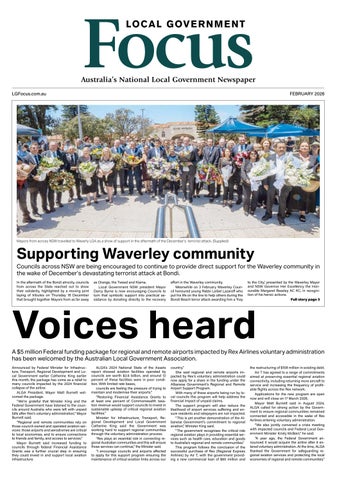
MayorsfromacrossNSWtravelledtoWaverlyLGAasashowofsupportintheaftermathoftheDecember’s terroristattack.(Supplied)

SupportingWaverleycommunity

CouncilsacrossNSWarebeingencouragedtocontinuetoprovidedirectsupportfortheWaverleycommunityin thewakeofDecember’sdevastatingterroristattackatBondi.

In the aftermath of the Bondi atrocity, councils from across the State reached out to show their solidarity, highlighted by a moving joint laying of tributes on Thursday 18 December that brought together Mayors from as far away

as Orange, the Tweed and Kiama.

Local Government NSW president Mayor Darcy Byrne is now encouraging Councils to turn that symbolic support into practical assistance by donating directly to the recovery

effort in the Waverley community.

Meanwhile on 3 February Waverley Council honoured young Rabbi Leibel Lazaroff who put his life on the line to help others during the Bondi Beach terror attack awarding him a ‘Key

to the City’, presented by the Waverley Mayor and NSW Governor Her Excellency the Honourable Margaret Beazley AC KC, in recognition of his heroic actions. Full story page 3

Voicesheard

A$5millionFederalfundingpackageforregionalandremoteairportsimpactedbyRexAirlinesvoluntaryadministration hasbeenwelcomedbytheAustralianLocalGovernmentAssociation.

Announced by Federal Minister for Infrastructure, Transport, Regional Development and Local Government earlier Catherine King earlier this month, the package has come as a relief to many councils impacted by the 2024 financial collapse of the airline.

ALGA President, Mayor Matt Burnett welcomed the package.

“We’re grateful that Minister King and the Federal Government have listened to the councils around Australia who were left with unpaid bills after Rex’s voluntary administration,” Mayor Burnett said.

“Regional and remote communities rely on those council-owned and operated aviation services: those airports and aerodromes are critical to local economies, and to ensure connections to friends and family, and access to services.”

Mayor Burnett said increased funding to councils through federal Financial Assistance Grants was a further crucial step in ensuring they could invest in and support local aviation infrastructure.

ALGA’s 2024 National State of the Assets report showed aviation facilities operated by councils are worth $3.6 billion, and around 12 percent of these facilities were in poor condition. With limited rate bases, councils are feeling the pressure of trying to maintain and modernise their airports.”

“Restoring Financial Assistance Grants to at least one percent of Commonwealth taxation revenue would support councils to invest in sustainable upkeep of critical regional aviation facilities.”

Minister for Infrastructure, Transport, Regional Development and Local Government Catherine King said the Government was working hard to support regional communities through the voluntary administration process.

“Rex plays an essential role in connecting regional Australian communities and this will ensure those services can continue,” the Minister said.

“I encourage councils and airports affected to apply for this support program ensuring the maintenance of critical aviation links across our

country.”

She said regional and remote airports impacted by Rex’s voluntary administration could now apply for a share in the funding under the Albanese Government’s Regional and Remote Airport Support Program.

With many of these airports being run by local councils this program will help address the financial impact of unpaid claims.

The support program will also reduce the likelihood of airport services suffering and ensure residents and ratepayers are not impacted.

“This is yet another demonstration of the Albanese Government’s commitment to regional aviation,” Minister King said.

“The government recognises the critical role regional aviation plays in providing essential services such as health care, education and goods to Australia’s regional and remote communities.”

This program follows the conclusion of the successful purchase of Rex (Regional Express Airlines) by Air T, with the government providing a new commercial loan of $60 million and

the restructuring of $108 million in existing debt.

Air T has agreed to a range of commitments aimed at preserving essential regional aviation connectivity, including returning more aircraft to service and increasing the frequency of profitable flights across the Rex network.

Applications for the new program are open now and will close on 17 March 2026.

Mayor Matt Burnett said in August 2024, ALGA called for strong action by the Government to ensure regional communities remained connected and accessible in the wake of Rex Airlines entering voluntary administration.

“We also jointly convened a crisis meeting with impacted councils and Federal Local Government Minister Kristy McBain,” he said.

“A year ago, the Federal Government announced it would acquire the airline after it entered voluntary administration. At the time, ALGA thanked the Government for safeguarding regional aviation services and protecting the local economies of regional and remote communities.”

Regional air network a must

It is good to see the Federal Government coming good on promises to support regions affected by the downfall of Rex Airlines.

In a country as big as Australia having a regional air carrier is essential and many of the more isolated communities would not have airports without the support of local councils. In these times of natural disasters, housing shortages and economic hardship the last things councils across Australia need is the loss of a regional carrier and the extra debt that brings.

Website: LGFocus.com.au

Noosa Office:

Telephone: (07) 5455 6946

Address: 36 Mary Street, Noosaville Qld 4566

Pakenham Office: Telephone: (03) 5945 0666

Address: 10 Army Road, Pakenham VIC 3810

Network with LG Focus twitter.com/@LGFocusau facebook.com/LocalGovernmentFocus

Editorial:

E: editorial@LGFocus.com.au

Advertising:

E: advertising@LGFocus.com.au

Classifieds: P: 1300 666 808

E: sales@NetworkClassifieds.com.au

EDITORIAL

Tania Phillips Journalist

E: tania.phillips@StarNewsGroup.com.au ADVERTISING

Jacqueline Trewin Sales Executive

E: jacqueline.trewin@NoosaToday.com.au

P: 07 5292 5307

M: 0497 621 843

Brett Greene Sales Executive

E: brett.greene@NoosaToday.com.au

P: 07 5292 5302

M: 0407 711 139 Michelle Gibson Sales Manager

E: michelle.gibson@StarNewsGroup.com.au

P:

Newdeputyfor LiverpoolCouncil

CouncillorPeterHarlehasbeenelectedDeputyMayorofLiverpoolCityCouncilfollowing theresignationofCllrDrBettyGreen.

Councillor Harle, who has served the office in the past, is a retired TAFE teacher and has been a Councillor for the last 18 years, being first elected to represent North Ward in 2008.

“It is indeed an honour to represent this Council as Deputy Mayor,” Councillor Harle said.

“I am grateful for the support shown to me and it is a pleasure to know that you support me.

“I have served as Deputy Mayor in the past and hope I can live up to the expectations that have

been placed on me in this important position.”

At the same meeting, the Council formally accepted the resignation of Dr Green.

Mayor Ned Mannoun paid tribute to Dr Green’s service.

“Throughout her term as Councillor, she worked closely with community groups, elders, women’s organisations and multicultural networks, always emphasising listening, collaboration and practical outcomes, he said.

Upcomingevents

LGAQ Civic Leaders Summit

· 25 March

The Westin Brisbane

The LGAQ Civic Leaders Summit is a unique event in local government in Australia, bringing together Queensland Mayors, Deputy Mayors, Councillors, CEO’s and senior officers.

LGANT AICD Governance Essentials for Local Government

· 12-13 March

Vibe Hotel Darwin

The Governance Essentials for Local Government course is designed specifically for Councillors, Mayors, and executive staff and provides an overview of their duties and responsibilities through interactive working sessions and the use of relevant case studies.

A second event is planned for Alice Springs – April/May – date to be confirmed.

Local Government Association SA Conference and OGM

· 28-29 May

Location to be advised

Join the LGA for this key decision-making and

policy setting forum. Help shape the future of local government in South Australia. Visit LGA Conference and OGM for event details

National General Assembly

· 23-25 June

National Convention Centre Canberra

The National General Assembly of Local Government (NGA) is the largest annual gathering of local government leaders in Australia.

Since 1994, council leaders have converged in Canberra for the NGA to advocate for better federal funding, policy reforms and effective partnerships.

The national event regularly attracts more than 1000 delegates from around Australia and overseas, and provides an exciting opportunity for mayors, shire presidents and councillors to come together, network and consider the big issues for communities.

ALGA is now calling for councils to submit motions for the 2026 National General Assembly.

LGAT Annual Conference

· 20-21 August

“Dr Green championed initiatives such as the Social Inclusion Masterplan, the Koala Management Plan and projects that amplified women’s voices, including the Giving Voice Exhibition marking the 50th Anniversary of Liverpool Women’s Health Centre.

“Her engagement with grassroots organisations and local leaders reflected a genuine commitment to supporting vulnerable communities and recognising local achievement.”

Crowne Plaza Hobart

Further details to be announced. LGAT is the peak body for Tasmania’s 29 local councils. WALGA Annual Conference2026

· 16-18 September

Perth Convention Centre

The premier event for Western Australia’s local government sector will feature industry speakers, an LGC Icons Breakfast, and a Gala Dinner.

Local Government NSW Annual Conference

· 22-24 November 2026

WIN Entertainment Centre Wollongong Wollongong has been announced as the host city for the 2026 Local Government NSW Annual Conference, from Sunday 22 to Tuesday 24 November at WIN Entertainment Centre. The Annual Conference is the supreme policy-making body of LGNSW and an opportunity for councillors to come together to share ideas and debate issues that shape the way LGNSW is governed and advocates on behalf of the local government sector.

DeputyMayorCrPeterHarleandLiverpoolMayorNedMannoun.

MayorsTheNSWMayorssurveyingthetributes. camefromallaroundNSWtoshowsupportintheaftermathof theBonditragedy.(Supplied)

Unwaveringsupport

CouncilsacrossNSWarebeingencouragedtocontinuetoprovidedirectsupportfortheWaverleycommunityinthe wakeofDecember’sdevastatingterroristattackatBondiwhileWaverleyhaspaidtributetooneofheroesoftheday.

Local Government NSW president Darcy Byrne said in the aftermath of the atrocity, councils from across the State reached out to show their solidarity, highlighted by a moving joint laying of tributes on Thursday 18 December that brought together Mayors from as far away as Orange, the Tweed and Kiama.

Mayor Byrne is now encouraging Councils to turn that symbolic support into practical assistance by donating directly to the recovery effort in the Waverley community.

“I’ve been completely blown away by the compassion and solidarity expressed by Mayors and Councillors across the state for the community of Bondi and Waverley Council” Mayor Byrne said.

“As councils are now about to start meeting for the first time since the attack, many of their leaders have asked us how they can provide some practical assistance to our friends in Waverley.”

“We are well advanced in identifying with Waverley the best way for councils across the state to donate to the local community recovery and we’ll have confirmed information about how to do that within the first weeks of February.”

Waverley Mayor Cr Will Nemesh expressed his gratitude to councils across the state for their support since the attacks in December.

“The outpouring of support and solidarity shown by Mayors and Councils across Australia has been incredibly moving and greatly appreciated,” Cr Nemesh said.

“We are so thankful for those who have sent messages and provided both moral and practical support. It has meant so much to us.

“This has been an incredibly challenging time, but Waverley is a strong and resilient community. We are united in our determination not to live in fear.”

Mayor Nemesh and Mayor Byrne have filmed a joint message thanking councils for their support and solidarity.

LGNSW will continue to assist Waverley

CityofCanterburyBankstownMayorBilalEl-HayekandHerExcellencytheHon.SamMostynAC, Governor-GeneralofAustraliawithBondiheroAhmedAlAhmed.(CityofCanterburyBankstown)

Council’s consideration of appropriate methods of support and will then contact all councils to advise on the next steps forward when possible.

Meanwhile Waverley has been honouring those who helped during the Bondi terror attack with young Rabbi Leibel Lazaroff, 20, the first to be honoured for his “incredible bravery and selflessness” at a ceremony on Tuesday 3 February where he received the Key to the City and a special lifetime beach parking permit.

“Rabbi Lazaroff was assisting the late Rabbi Eli Schlanger at the Chanukah event, when he rushed to help critically wounded NSW Police Constable Scott Dyson, using his own shirt to stem the bleeding,” Waverley Mayor Will Nemesh said.

“While he was bravely helping the officer, Leibel himself was shot and seriously injured.

“The entire Waverley community is incred-

ibly thankful to Leibel, and these gestures symbolise a token of our never-ending gratitude.”

At an extraordinary meeting of Council in January, a Mayoral Minute detailing various measures to acknowledge the courage of all those who put their lives on the line on 14 December was passed unanimously.

“Ahmed al-Ahmed and Gefen Bitton will also be presented with a ‘Key to the City’ and a lifetime Waverley Beach Pass in recognition of their bravery,” Cr Nemesh said.

Mr al-Ahmed, 43, wrestled a gun from one of the alleged shooters as attendees at the Chanukah by the Sea event were being targeted, slowing down the attack and undoubtedly saving countless lives.

Mr Bitton, 30, ran to Mr al-Ahmed’s aide and then also confronted the alleged gunman in a bid to end his reign of terror.

OneoftheheroesoftheBondiBeachattack, RabbiLeibelLazaroff,waspresentedwithaKey totheCityandlifetimebeachpassonTuesday 3FebruaryataceremonyhostedbyWaverley MayorWillNemesh.(WaverleyCouncil)

Meanwhile Ahmed Al Ahmed has already received the Key to the City of Canterbury Bankstown as part of its 2026 Australia Day Awards.

In a special recognition from the City, Ahmed became the first ever recipient of the Key to the City, and named the Local Hero of the Year, for his selfless act of bravery during the Bondi attack on 14 December 2025, and his efforts to promote unity.

“It’s an honour to receive this award on Australia Day – it’s very meaningful to me,” Ahmed said.

“I’ve had three operations, two bullets still in my arm and in great pain but I’m strong and I’m going to recover as quickly as I can.”

“What made me do what I did? Humanity –we’re all human beings and we’re all Australians.”

ALGAcallsforaction

Australia’srecyclingsystemisfacingacrisis,withcouncilsandratepayersinthelineoffire.

The new report from the Australian Council of Recyclers and the Australian Packaging Covenant Organisation, Securing Australia’s Plastic Recycling Future, presents a sobering picture of an industry in danger of collapse without urgent reform.

Companies that use packaging currently have no responsibility for the packaging they put into the market, and local councils and landfills are overwhelmed by rising volumes of material that could be recycled.

The Australian Local Government Association (ALGA) is urgently calling for a regulated, national product stewardship scheme for packaging and plastics.

It would require companies to reclaim, recycle and reuse their commercial packaging and plastic.

Local councils are overwhelmed by rising volumes of packaging and plastics, with landfill capacity nearing its limits.

Each year, Australia uses over 1.3 million tonnes of plastic packaging, but more than 1 million tonnes ends up in landfill or as litter.

Although recyclers can process plastics, low demand for recycled material threatens facility closures, leading to more waste, increased imports, and job losses.

Investments in domestic recycling were made in anticipation of a mandatory national scheme, a promise yet to be fulfilled.

Regulatory uncertainty now threatens the entire system, with some recyclers considering withdrawal from services, which could increase landfill and restart stockpiling.

Councils and ratepayers already carry a significant cost burden.

They can’t afford to bear the additional cost of doing nothing.

Environmental costs are projected to exceed $5 billion by 2050, and councils will be left to shoulder the burden.

By contrast, modelling by the Australian Council of Recyclers shows that moving the responsibility for packaging waste back to indus-

“RedFleet”solutions

try would only add 0.1 percent to product costs.

National Packaging Reform is urgently needed to support recycling, create a level playing field, and shift responsibility to industry over ratepayers.

Local government seeks a practical solution that provides investment certainty.

The Government should explore using the Recycling and Waste Reduction Act to mandate an extended producer responsibility scheme, ensuring systematic monitoring of risks and impacts on local government services, and guaranteeing minimum service levels for regional, rural, and remote communities.

Australia can be a leader in packaging and plastics stewardship, but leadership requires action.

The time for a national product stewardship scheme is now, before financial and environmental costs become unmanageable and before vital infrastructure and jobs are lost.

Watch the ACOR ‘Securing Australia’s Plastic Recycling Future’ webinar

The Country Mayors Association of NSW (CMA) has met with NSW Emergency ServicesMinistertheHonJihadDibMPabouttheRedFleetissue,whichrefersto localCouncilscurrentlyhavingownershipofRuralFireService(RFS)assets,onpaper.

Councils do not own RFS plant and infrastructure, however their financials are negatively impacted by the legislative mess.

CMA Chairman, Mayor Rick Firman OAM of Temora Shire together with CMA Board Member and NSW JO Chairs Network Chairman, Mayor Sue Moore of Singleton Council sat down with Minister Dib to discuss immediate concerns of rural, remote and regional Mayors and left seeing the light at the end of a tunnel, according to Mayor Firman.

The NSW Government’s Public Accounts Committee’s “Inquiry into the assets, premises and funding of the NSW Rural Fire Service”, in 2025 resulted in a report with 14 recommendations, foremost of which was that the State’s Rural Fire Service (RFS) fleet should be legally recognised as NSW Government assets.

The Minns Government’s official response left the CMA Board and its’ 89 members underwhelmed, with a comprehensive RFS asset audit not necessarily heralding the end of the issue.

“We appreciate that Minister Dib is al-

ways generous with his time and plays with a straight bat.

We have lobbied for the Red Fleet issue to

be resolved for years now.,” he said.

“Our CMA Members and Board were concerned that the asset audit may have been a stalling tactic that would leave the matter adrift in a bureaucratic never-never.

However, in response to our advocacy, Minister Dib has given the CMA assurances that it is to be completed within six months and that Councils will not be paying for it.

“Minister Dib also agreed that the CMA should be part of his working group to assist in implementing the Government response to the inquiry, which we appreciate.

The CMA Board and members are keen to work with all sides of Government for the best outcomes for rural, remote and regional Mayors, Councils and their communities,” Mayor Firman said.

“We believe that Minister Dib has a genuine desire to right the Red Fleet wrong. It’s crucial that the CMA is involved with and continues to be bought on the journey.

Knowing that the NSW Government has deadlines and timeframes in mind for this journey has restored our faith in it.”

Gulgongmedicalreopening

ThereopeningofGulgong’sonlygeneralpractitionerclinicafteran18-monthclosure iswelcomenewsforthelocalcommunity,butalsohighlightsthedeepeningGPcrisis affectingrural,regionalandremoteNSW.

The return of GP services to Gulgong was the direct result of financial incentives and assistance being provided by the “Doctors 4 Mudgee Region” initiative which aims to attract 10 doctors to the Central West region over the next three years.

Local Government NSW president Mayor Darcy Byrne said the experience of Gulgong was being repeated across the state, with many towns either without a resident GP or facing severe shortages, forcing residents to travel hours for basic primary care.

“When a town has to celebrate the reopening of its only GP clinic after 18 months, that should set off alarm bells” said Mayor Byrne.

“Dozens of rural, regional and remote councils are continuing to report the need for urgent action to ensure their communities have adequate access to GPs – a basic human right”.

“Councils in small and regional communities are increasingly stepping in to fill gaps in the provision of primary health care, often funding services that should sit with state and federal

governments. But they can’t always fill those gaps and the human consequence is that thousands of citizens across NSW are simply missing out on seeing a doctor,” Mayor Byrne said.

A 2025 NSW parliamentary inquiry found rural and remote primary care is in crisis, with GP shortages predicted to worsen and more than 40 towns expected to lose their doctor by the end of the decade.

“Access to a GP shouldn’t depend on your postcode” Mayor Byrne said. “Communities are also dealing with closed birthing units, stretched emergency departments and short-term locum solutions that are costly for the government and lack stability and certainty for patients.”

Mayor Byrne congratulated the not-for-profit initiative Doctors 4 Mudgee Region on its work to secure the services of two doctors for the Gulgong Medical Centre.

The initiative is backed by Mid-Western Regional Council and three local mining companies and Mayor Byrne acknowledged that many other councils across NSW have also stepped

Bigsupport

TheWesternAustralian LocalGovernment Association(WALGA) hassupportedthe StateGovernment’s finalisationoftheUrban GreeningStrategy forthePerthandPeel regions.

WALGA believes the “much-needed strategy”, which was first announced by the State Government in February 2024, outlines the State’s vision for a greener Perth and Peel.

The strategy details how the State Government plans to enhance tree canopy and create more greenspaces across the Perth and Peel regions and recognises green infrastructure as a key element in building cool, resilient and leafy suburbs and towns.

The Urban Greening Strategy also includes an Urban Greening Grant Program for community groups and schools and affirms the State Government’s commitment to supporting Local Governments with their public realm planting programs.

WALGA President Karen Chappel AM JP said the Association had been at the forefront of advocacy efforts in calling for measures to increase urban canopy across the State for many years.

“The release of the strategy represents important progress and WALGA looks forward to working with the State Government to see its implementation across Government and more importantly across our communities,” President Chappel said.

“We are particularly pleased the State Government has established an ambitious target to increase tree canopy across Perth and Peel to 30 per cent by 2040, which corresponds with WALGA’s advocacy.

“WALGA and the Local Government sector are committed to assisting in achieving this target and welcomes this recommitment in the Strategy.”

President Chappel said WALGA would continue its advocacy for more measures to boost Western Australia’s tree canopy.

“WALGA’s 2026-27 State Budget Submission calls on the State Government to invest $40 million over 10 years from 2026-27, to expand the Urban Canopy Grant Program, including for urban areas across the State,” President Chappel said.

“These important initiatives would create cooler urban areas and more green spaces, improved health and wellbeing and increased biodiversity across the State.

“Building and maintaining a healthy, resilient and diverse urban forest requires coordinated action by State and Local Governments, landowners, industry and the community.”

up to the same challenge on behalf of their communities.

“They’ve done an outstanding job, but it shouldn’t be the responsibility of councils and local businesses to ensure basic primary health care is provided,” he said. “The fact that local employers are having to fund and initiate programs to attract GPs to serve in their communities is a really worrying sign of the times.”

Mayor Byrne said LGNSW continued to take a strong position in the fight to ensure rural and regional communities had equitable access to health services.

LGNSW is calling for the meaningful implementation of all 44 recommendations of the NSW parliamentary inquiry, which cover the breadth of what is needed for rural and regional communities, including addressing service delivery gaps, transport services to healthcare, growing the primary health sector as well as workforce recruitment and retention strategies for doctors, nurses and other health professionals.

It is important that growing Western Australia’s tree canopy sees a continued effort in retaining trees on private land. As the Strategy outlines, it is essential that Western Australia does not go backwards with respect to tree canopy.

President Chappel said Local Governments was leading the way in protecting trees on private land, with nine Local Governments adopting WALGA’s Model Local Planning Policy (LPP) that provides regulatory protection for trees of significant size.

She said Local Governments can adopt the Tree Retention LPP, which clarifies whether tree removal (or other tree damaging activity) is works that requires development approval.

The LPP aims to provide broad protections for trees of a reasonable size, taking a pragmatic approach that is cognisant of the need to balance the retention of trees with the provision of housing and development.

CMABoardMemberandSingletonCouncil MayorCr.SueMoore,MinisterforEmergency ServicestheHonJihadDibMPandCMA ChairmanandTemoraShireMayorCr.Rick FirmanOAM.

Threesmallchanges

Localgovernmentgrantprogramsaredesignedtocreatecommunityimpact.Yetformanycouncils,theeffectiveness ofthoseprogramsisshapedlessbyintentandmorebytheprocessesthatsitbehindthem.

Too often, grant teams begin the year locked into systems that are already working against them. Complexity has been normalised. Spreadsheets, manual checks and workarounds are accepted as part of the job, even when they absorb time and limit visibility. The longer these processes remain in place, the harder it becomes to step back and focus on outcomes.

One of the most impactful changes councils can make is simplifying where complexity has accumulated. Over time, grant programs gather layers of administration designed to manage risk or compensate for system gaps. Individually, these steps make sense. Collectively, they create friction that pulls attention away from purpose. Removing duplication and streamlining workflows early can materially reduce administrative effort across every funding round that follows.

Another small but important shift is bringing information together. When applications, assessments and reporting data sit across emails, shared drives and individual files, insight is fragmented and continuity depends on individuals rather than systems. Councils that centralise this information gain clarity, not just for grant teams, but for managers and elected members who need confidence in how programs are performing.

A third change is treating impact insight as part of the process, not an afterthought. Outcome data is often collected at the end of a funding round purely to meet reporting requirements. When insight is captured consistently throughout the grant lifecycle, it becomes a practical tool. It enables comparison across programs, identification of trends and better future decisions.

These shifts reflect a broader change across

the sector. Tools such as SurePact are designed around a simple idea: all your grants in one easy to use platform. By bringing applications, assessment, management and reporting into a single system, councils can reduce administrative burden while improving visibility across their programs.

As SurePact CEO Dan Pritchard observes grant programs rarely lose their impact all at once.

“It happens gradually, as the process builds up and insight becomes harder to access,” he said.

“ Small changes to how grants are managed can have a significant effect over the course of a year.”

Importantly, this is not about reducing governance or oversight. Strong accountability remains essential in public funding. The opportunity lies in removing unnecessary friction so

governance supports better decision making rather than competing with it.

February is a critical window. Councils that simplify, centralise and align their grant processes now are better positioned to spend the year focused on what matters most: delivering meaningful impact in their communities.

To learn more about how councils are streamlining grant management and improving visibility of impact, visit SurePact.com

Slowtourismandpotential

Did you know that the Thai island of Phuket attracts almost 10 million international tourists annually? That is an outstandinglyhighnumber,outstrippingAustraliawitharoundeightmillionarrivals. Why so? Several reasons probably explain Phuket’s performance – beaches, relatively cheap food and accommodation. Close to China and Japan. Longstanding tourism interest from Russia and Scandinavia.

On the other hand, Australia is relatively expensive in terms of food, accommodation, airfares (outside the main trunk routes). And most Europeans and North Americans view a 24-hour flight as a huge turn-off.

Now don’t get me wrong, Tourism Australia and the state equivalents have done a great job over the years, but their focus has been on mass tourism to iconic locations like Sydney, Gold Coast, Cairns, Melbourne, Uluru etc.

But there is a niche tourism market that isn’t being serviced – a more sophisticated market of people with more time, and a stronger appreciation of environmental, wildlife and cultural features. The niche market is Australia’s regions, where international tourists are thin on the ground.

The opportunity is best explained by Denis, my walking mate in Canberra, who recently visited north Queensland with his Canadian relations.

“Óur unique flora and fauna was a focus on our trip. I have been on about tourists seeing wildlife in non-zoo settings for years. Indeed, our visitors went up on Red Hill (in Canberra) the first morning and were blown away seeing a mob of roos in that setting…there is great scope to develop complementary tourism experiences in regional areas.”

Denis’ observations are so true. The world is becoming increasingly complex, fearful and divided. People are looking for solitude and nature - places where they can chill out with friendly people. And take it slowly.

Retirees, or indeed anyone, living in cramped apartments in France, Manchester or Los Angeles, and with a sense of adventure, should jump at the chance to chill out Downunder for a couple of weeks. The proviso is to focus on one or two regions, rather than race around our vast country ticking off the glitzy tourism features.

The opportunity needs to be pushed.

· The inbound tour operators, who shape the itineraries for international tourists, need to be convinced.

THE GOOD OIL

· The 24-hour flight problem needs to addressed. Hence sell the notion of 1–2-day stopovers in Dubai, Singapore, Hong Kong, Honolulu.

· We need to continually upgrade our regional tourism product. Sure, we don’t have monasteries, ancient churches, walled cities and cobblestoned villages – hence our regional tourism pitch has traditionally been pristine forests, secluded beaches, odd wildlife etc.

But there’s more to weave in - our sports and RSL clubs (unique social hubs), numerous ethnic communities, environmental management by indigenous groups, mining sites, country pubs.

· We should collaborate on a new and bold marketing campaign. Forget shrimps on the barbie and bikini-clad girls. The pitch is nature - solitude - adventure. And new stories to tell when they get home.

An example of a localised regional tour for international tourists would be 10 days around the wider Adelaide region – the Flinders Ranges, wine-tasting in the Barossa and Clare Valleys, Hahndorf (German settlers), backroads pubs surrounded by magnificent white gums, Victor Harbor and Maclaren Vale, the indigenous community in the Coorong, Kangaroo Island, the Adelaide Market, perhaps an AFL game, a fishing trip and the Riverland/Sunraysia (multicultural communities to make tourists welcome).

Key features would be food and accommodation at reasonable prices (not the extortion evidenced in our tourism hotspots), and 10-20 seater buses with friendly and knowledgeable drivers. This type of offering works well. I recently enjoyed a bus tour through the Balkans with Tour Radar, which could readily increase

its operations here.

Other examples of localised regional tours for international travelers are:

· The Atherton Tablelands and the southern parts of Cape York, including Cooktown which every Aussie should experience, let alone our foreign friends.

· Western Australia, from Kalbarri National Park (magnificent place north of Perth) down to Albany and Esperance.

· The Dandenong Ranges, Wilson’s Promontory, Gippsland Lakes, Mallacoota, Eden, Merimbula, Narooma and back to Melbourne via Canberra and towns in the Riverina and northern Victoria.

· And Tasmania, which has it all within a localised setting.

The point is to showcase the best of Australia without the pizazz. It would shine a light on the real Australia and its people. And regional tourism bodies would work harder with the tour operators to ‘curate’ outstanding offerings to attract international and domestic tourists to our regions.

To start the process, we will prepare a scoping study. If this interests you, please contact us.

A journey through the Murray Darling Basin

‘The River’ is a book written by Chris Hammer in 2010 and recently updated. Hammer was a journalist who discovered after writing the book that ‘there is something deeply satisfying in completing a considered and long-term endeavour compared with the reactive immediacy of daily journalism.’ And it’s deeply satisfying for readers as well.

He travelled the Murray-Darling Basin (MDB) from its headwaters in Queensland to its mouth in SA during the Millenium Drought, describing the plight of irrigators, farmers and townsfolk. Dying redgum forests, collapsing ecosystems, plummeting wildlife numbers. Indeed, I recall the Murrumbidgee River - close to our home in Canberra - actually drying up!

He laments that much of that is now forgotten. Dams are full and rivers are flowing. Three out of the last four years have been ‘cooler’, but he says that’s a relative term given that 2024 was the hottest year on record. He contends that the scientists were right and the climate change

deniers were wrong. Hammer references the important work of the Wentworth Group of Concerned Scientists. Its website says the Basin Plan falls well short of returning the volumes of water that science has shown are required for a healthy river, vast sums of money have been wasted, and communities’ confidence in government has been shattered’. Ouch.’

The beauty of this book is that it gets people thinking. Every resident of the MDB should surely read it, together with every politician and bureaucrat responsible for environmental policy and programs.

It got me thinking. Some facts and issues that stood out:

· While the Darling and its tributaries push enormous flows down the system, down south it’s the Murrumbidgee and Murray River catchments – with the Murrumbidgee being more important in terms of catchment.

· The size and extent of irrigated farms in the MDB are not widely appreciated - rice, vegetables, olives, almonds etc. - with high levels of labour-saving mechanisation.

· Likewise dryland farming on properties that combine 2-3 surrounding properties. City folk don’t fully comprehend the job losses involved, and the hollowing out of previously vibrant communities.

· It gets you wondering why the Nationals haven’t been pushing for stronger investment attraction policies for the MDB and the Bush in general.

· As Hammer says, we need to get ready for our next drought. I’m interested in the scope for localised desalinisation plants to play a role, like on many of the Greek islands. The Greeks aren’t exactly flush with cash, and the costs of desal plants has reportedly fallen by 50 per cent over the last decade.

· And can grey water systems come into vogue? It’s crazy to use tap water to water lawns and gardens.

The River sells for around $37 in bookstores and $24 on the Amazon website.

Rod Brown is a Canberra-based lobbyist specialising in industry/regional development. Email apdcockatoo@ iprimus.com.au

WithPhuketcontinuingtoboomDusitInternational-oneofThailand’sleadinghotelchainsissettoopenthe DusitCollectionandDusitResidencesLayanVerdeonPhuket’swestcoastin2027.
just800metresfromBangTaoBeach,whereDusithasoperatedtherenownedDusitThaniLagunaPhuketresortforover30
LayanVerdespansover108,000squaremetresand comprises15mid-risebuildings.(Supplied)

REIMAGINING THE ROADS WE GREW UP WITH

Smart local councils around Australia have discovered the next generation of road and path surfaces. Made with crumb rubber from recycled tyres, they are safer, cost effective and more resilient than ever before.

Ready to discover the crumb rubber difference?

Contract extended

BawBawShireCouncilhasextendedthecontractofActing ChiefExecutiveOfficerSallyJonesuntil30June2026.

The matter was considered as a confidential item in the late January meeting agenda as prescribed by the Local Government Act 2020.

Baw Baw Shire Mayor Cr Kate Wilson said she was pleased to announce Sally’s extension, while Chief Executive Officer Tilla Buden focuses on treatment and recovery following a breast cancer diagnosis.

“Council remains committed to supporting Tilla as she focuses on her health and I am confident we have made an interim appointment that will keep Council operations in good stead until she is able to commence the role,” the mayor said.

“Sally has hit the ground running since coming on board in early January and is proving her

able support to Council in the delivery of our Council Plan and a strong focus on community service.

“Sally and Tilla are connecting and collaborating during this period, and providing the organisation with strong leadership and support.

“We can assure the community that Council will continue to deliver positive outcomes for our beautiful Baw Baw during this time.

“Sally has a wealth of experience in Local Government, and we look forward to working alongside her in the months ahead.”

Storm-proofingSeymourRiverBridge

IfIhadadollarforeverytimeIsawthequestion,“IstheSeymourRiverBridgeopen?”onsocialmedia,theupgrade tothatstretchofroadmightalreadybepaidfor.

Whilst there is no doubt that the Bruce Highway is a very vital transport corridor for Queensland, linking Brisbane to Cairns, it is also the main access road for around 250 residents of our community whom reside in a farming and rural residential lifestyle in the northern reaches of our Hinchinbrook community.

The Mount Gardiner and Seymour communities rely on this section of the Bruce Highway to travel to work, to attend school, or conduct business in Ingham daily, and unfortunately disruption by weather events is becoming neither rare nor unexpected.

This year the road at the Seymour has gone under three times and has remained cut for four days already, all from storms of 200mmplus, not riverine flooding.

The section of road through the Seymour system is part of the Herbert River flood plain, and it’s ridiculous for anyone to suggest you can flood-proof a floodplain.

The issue we have is far more basic: the Seymour River Bridge can’t even handle storms. This is about storm-proofing, not flood-proofing.

When the bridge goes under, causing disruption to our northern residents as aforesaid, commerce in general also grinds to a halt. Produce can’t get south, stock can’t go north.

Fuel, groceries, and crucial supplies are delayed. Trucks carrying goods between Brisbane, Rockhampton, Townsville, and Cairns are stranded.

Travelers are cut off, tourism suffers, and regional communities are reminded how fragile their connectivity really is.

There is a $9 billion pledge currently on the state books to improve the Bruce Highway — but the funding earmarked for our section of the Bruce through Seymour appears focused on safety rather than addressing flooding.

I am lobbying our State Government to reconsider current design and plans for our section.

A relatively modest lift of say half a metre in bridge or culvert fashion, enabling more water to flow freely beneath rather than damming, will, with a very good clean out of the system

between the bridge and Seymour River proper, significantly reduce closures caused by routine wet season storms.

Storms carrying 200mm-plus of rain are not an anomaly in our part of the world. They are a certainty.

As part of the National Land Transport Network, the Bruce is more than a highway. It is the lifeblood of the state, carrying around 20 million tonnes of freight each year, supporting agriculture, resources, construction, manufacturing, and services, and connecting to 11

coastal trading ports.

It services 62 per cent of Queensland’s population — more than 3.2 million people — a figure expected to exceed four million by 2041.

Given those statistics of the vitality of the Bruce, it is really a no brainer in my books.

Does your mayor have a column to share or a project they think will interest other councils across Australia – contact Editorial Coordinator Tania Phillips at Tania.Phillips@starnewsgroup.com.au to have your story included in forthcoming issues or online.

DubboremembersPeterMillingOAM

DubboRegionalCouncil(DRC)flewtheflagsoutthefrontoftheDubboCivicAdministrationbuildingathalf-maston3 February,inamarkofrespectandmourningforthelateMrPeterMillingOAM.

Mr Milling was a well-respected leader in the livestock, thoroughbred and property industries and worked with Dubbo City Council and Dubbo Regional Council on a number of projects over the years.

He died on 19 January 2026, aged 95, and is remembered by his family and the community.

Dubbo Regional Council Mayor Josh Black said Mr Milling’s contribution to the community had made it stronger in so many ways.

“Mr Milling was a man of action, and you can see that through the way he engaged with the community through property development, his work with the community at the showground and the Dubbo Regional Livestock Markets.

“He was an active community member who worked very closely with Council over the years, and it was a privilege to have known him,” Clr Black said.

In 1973, Mr Milling diversified his family business to include dedicated livestock and prop-

erty selling, local real estate in 1974 and an international travel agency in 1976.

He also served as president on several stock and station agency bodies and was instrumental in the development and expansion of the Dubbo Sale Yards, which have grown to be the largest in NSW.

He was also the inaugural chairman of the Dubbo Development Corporation from 1977 to 1978, assisting in bringing natural gas to Dubbo, establishing the Charles Sturt University Cam-

pus and delivering the first housing development with the creation of Delroy Gardens. Mr Milling was awarded an Order of Australia medal on the King’s Birthday for his services to the livestock industry in 2023.

In a tribute to Mr Milling, the Dubbo Regional Livestock Markets also held a minute’s silence in his honour on Thursday, 22 January before the day’s sales.

Toolkitresources

OrganisationalvaluesareatthecoreofeveryworkdayandtaskandBundabergRegional Councilhasdevelopedapracticaltoolkittosupportitsworkforceandpromoteitsvalues.

The values outlined in the Bundaberg Council’s Corporate Plan 2025 – 2030 were introduced to the workforce in 2025 and CEO Rob Williams was determined to ensure they didn’t exist only in a corporate document which collected dust on the shelf.

This led to the launch of The BRC Way We Work project which provides Bundaberg Regional Council staff a comprehensive toolkit with resources and educational materials for display and staff development.

The innovative approach to embedding values within the organisation was a combination of Council’s existing The BRC Way development program and Mr Williams’ The Way We Work philosophy which he has honed throughout decades of experience in Local Government and leadership.

The Way We Work rests on the simple foundation that by building trust every worker can be their best, exemplified by:

Being the best we can – by aspiring for success staff can create a supportive and continuously improving spiral of achievement.

Doing the right thing – compromising your ethics or beliefs will only hold you back from positivity so always do what is right.

Creating the right environment – acknowledge and understand the importance of legislation and bureaucracy but apply common sense to every situation by asking the right questions and reviewing and updating where necessary.

Improving ourselves – not in terms of competence and training (that’s a given) but by being self-aware and never allowing personal challenges, like a lack of self-confidence, impact how you interact with others.

Mr Williams said The BRC Way We Work toolkit included values posters for display in work areas and flyers with a detailed breakdown of actions and behaviours that represent the organisation’s values.

Leader resources, such as behaviour maps,

were also developed to foster positive and productive conversation about workplace interactions and attitudes.

“I’m not a poster on the wall kind of guy usually however this is more than just displaying words on a wall, The BRC Way We Work program has the substance to back those words up,” Mr Williams explained.

“The wall charts were developed with support from staff across the organisation who volunteered to take part in workshops and with their help the actions that are featured on the posters were created.

“This support was appreciated and valuable, helping to ensure the resources are relevant to a diverse range of staff.

“This is a truly remarkable result and one of the best and most practical applications of an organisation’s values that I have ever seen.”

He added that promoting the organisation’s values while simultaneously creating a positive culture was a critical key for success.

“Culture eats strategy for breakfast,” Mr Williams said.

“When our attitudes and behaviours are in alignment we can then consider our vision, mission and strategies.

“Neither vision, nor mission, nor strategy has merit or worth if the culture of the organisation is to undermine our deepest held desires and the promises we have made to our community about delivering them.”

The BRC Way We Work program is continuing to develop with Bundaberg Regional Council’s learning and development team now working to embed the program and its principles into training and induction resources.

Aliceskatingprogram

Free ice skating, packed programs and smiling faces have marked the end of a hugelysuccessfulschoolholidayprogramdeliveredthroughapartnershipbetween Alice Springs Town Council, the Northern Territory Government and the National IndigenousAustraliansAgency.

The highlight for many families was the return of free ice skating, which proved enormously popular and drew children and young people from right across Alice Springs, creating a safe, fun and welcoming space during the school holidays.

Delivered entirely free of charge, the school holidays program offered a wide range of activities designed to keep young people active, connected and engaged, while supporting families during a busy time of year.

Almost twice as many young people took part in the most recent school holiday program in Alice Springs, following a coordinated approach that brought together government and community partners - 8,394 ice skating participants, 15,399 total school holiday participants – almost double last year’s figures,

A record 30,224 people through the Alice Springs Aquatic and Leisure Centre.

Activities included virtual reality workshops, obstacle courses, BMX workshops,

graphic novel workshops, 10 pin bowling and much more, with a strong focus on accessibility, wellbeing and positive social connection.

Alice Springs Mayor Asta Hill said the program shows what’s possible when governments work together with a shared focus on our young people.

“The school holidays can be a challenging time for families. By offering free and welcoming activities right across town, we’re helping kids keep cool, stay active, build friendships and feel connected to their community.

“I’d like to extend a massive thank you to NIAA and the Northern Territory Government for their partnership, and to everyone that delivered a program that helped put a smile on the face of a young person through the holidays.”

Counteringextremeheat

Ascouncilsaroundthecountrygrapplewiththehumanandfinancialcostsofextreme heat, the Australian Local Government Association (ALGA) has been working with the Australian Red Cross and Sweltering Cities promoting the second Extreme Heat AwarenessDayon4January.

ALGA President, Mayor Matt Burnett said “Local governments are feeling the heat - literally, and in terms of the pressure on their budgets.”

“Many like Darwin City are researching and planting climate resilient vegetation,” he said.

“Others, like Moonee Valley, are monitoring

and reaching out to members of the community that are most at risk from heatwaves. Wagga Wagga council is incorporating heat considerations into their planning schemes. Others are piloting future solutions - like the Western Sydney councils experimenting with reflective roads.

Job pathways

TheShireofCarnarvon iscreatinglong-term employmentpathways andstrengthening workforcecapability throughitsparticipation intheRemoteJobsand EconomicDevelopment (RJED)Program,a nationalinitiative designedtosupport sustainablejobcreation inremotecommunities.

Through RJED, the Shire has secured $3 million in funding over three years, equating to approximately $1 million per year, enabling the creation of 13 full-time equivalent positions across a range of operational and service areas.

This investment is delivering direct benefits to both the organisation and the wider community, with funding reinvested locally to support economic resilience and workforce stability.

The program is focused on building meaningful, secure employment opportunities while addressing workforce development and retention challenges commonly experienced in regional and remote local governments.

RJED roles are structured to provide participants with ongoing support, clear expectations and access to professional development, ensuring employees can build skills, confidence and long-term career pathways within local government.

In partnership with Real Futures Pty Ltd and local schools, the Shire is actively connecting school leavers and community members with employment opportunities that align with their interests and capabilities.

This collaborative approach ensures participants are supported both in the workplace and through tailored development pathways, helping them transition successfully into the workforce.

A key strength of the RJED program is its emphasis on training and upskilling.

All RJED employees have access to professional development and the opportunity to undertake formal qualifications, supporting both individual career progression and organisational capability.

This approach aligns closely with human resource best practice, embedding workforce planning, skills development and succession planning into everyday operations.

By investing in local people and creating genuine employment options within the community, the Shire aims to reduce barriers to employment, encourage young people to remain in the region, and build a skilled, locally based workforce for the future.

The RJED program demonstrates how targeted investment, strong partnerships and a people-focused HR approach can deliver lasting benefits — strengthening local economies, improving workforce outcomes and supporting the long-term sustainability of regional local governments.

“Councils are on the front foot of protecting communities and reducing heat impacts. They know what is needed in their areas.

“ALGA is calling for a dedicated local government adaptation fund so councils can manage intensifying climate impacts like heat.”

CEORobWilliams.

Timetoregister

FarmersacrossAustralia–particularlythoseindisaster-impactedregions–havebeen strongly encouraged to register with Rural Aid now, as ongoing natural disasters and worseningweatherconditionscontinuetothreatenruralcommunities.

Large areas of Victoria are currently battling bushfires, while North Queensland continues to experience flooding and cyclone impacts, and parts of New South Wales face storms, heavy rainfall and damaging winds. With further bad weather forecast for the weekend, conditions are expected to deteriorate in many regions, placing additional strain on farmers already under pressure.

Rural Aid is urging farmers to register immediately to ensure support can be delivered as quickly as possible when it is needed most.

“Disasters don’t wait, and neither should farmers,” Rural Aid Chief Executive Officer John Warlters said.

“Registering with Rural Aid now means we can act fast when conditions worsen, whether that’s financial relief, counselling, or delivering hay and water to farmers who need it most.”

Rural Aid is already responding in disasteraffected regions, providing direct financial assistance to farmers in north-west Queensland and Victoria to help cover urgent and unexpected expenses as they recover from floods, fires and severe weather events.

“Our teams are already working in disaster zones, supporting farmers who are exhausted, overwhelmed and facing enormous uncertainty,” Mr Warlters said.

“By registering early, farmers ensure critical support can be delivered as quickly as possible when disasters strike.”

Wariters said Rural Aid provided free support to registered farmers and their families, including:

· Financial assistance for urgent and unexpected expenses

· Professional counselling and wellbeing support

isurgingAussiefarmerstoregisternow.

· Hay deliveries to feed livestock

· Water deliveries for household needs

· Volunteer assistance through Farm Army and Farm Recovery Event programs

With severe weather forecast across multiple states this weekend — including dangerous fire conditions in Victoria and Western Australia and heavy rainfall and consequent flooding in parts of Queensland and New South Wales – Rural Aid is reinforcing the importance of early registration.

“Farmers are incredibly resilient, but they

shouldn’t have to face disasters alone,” Mr Warlters said.

“We strongly encourage every farmer, especially those in high-risk areas, to register now so help can be mobilised immediately when it’s needed.”

Farmers can register for free immediately at faa.ruralaid.org.au or by calling 1300 327 624.

Registering now ensures Rural Aid can act fast and deliver critical support as fires, floods and severe weather continue to impact rural Australia.

Bathursthasitsscrap

Bathurst Regional Council has successfully concluded its ‘Let’s Get Our Scrap Together’ campaign, launched on 1 September 2025 with funding from the NSW GovernmentanddeliveredincollaborationwithNetWasteandeightotherregional councils.

Mayor Cr Robert Taylor noted the campaign aimed to raise awareness and encourage community participation in Food Organics and Garden Organics (FOGO) recycling.

“Over the past five months, Council has engaged with more than 500 community members about food and garden organics recycling through two vibrant pop-up displays - one at the spectacular Junklandia show at BMEC and another at the annual Bathurst Christmas Market,” he said.

“As part of the ‘I Love FOGO’ extension of the campaign, Council distributed 40 kitchen caddies for food scrap collection, shared more than 600 educational resources including FOGO magnets and stickers as a gentle reminder to keep your food and garden scraps out of landfill, and achieved nearly 4,500 views across digital platforms, amplifying the impor-

tant message of sustainable waste practices,”

Community feedback during the ‘Let’s Get Our Scrap Together’ campaign highlighted strong support for FOGO, with residents sharing comments such as:

· “I love my green lidded bin for all my food scraps,” and

· “I love FOGO because it protects our world”.

Mayor Cr Robert Taylor extended appreciation to the Bathurst community for their outstanding support throughout the campaign.

“A sincere thank you to everyone who engaged in our ‘Let’s Get Our Scrap Together’ initiative. Together, we are maximising the effectiveness of Council’s waste management services, increasing resource recovery, and significantly reducing the amount of waste sent to landfill,” remarked Mayor Taylor.

Alicecompanywinstender

AliceSpringsTownCouncilhasawardedthetenderfortheconstructionoftheTourism Central Australia (TCA) headquarters and Visitor Information Centre (VIC) Fit-Out –

PhaseOnetolocalcompanyCompleteConstructions,markinganimportantstepinthe transitionoftheformerLibraryspaceswithintheCivicCentre.

The fit-out will take place in the former Library staff offices and Alice Springs Collection area, supporting the planned co-location of Tourism Central Australia while planning continues for the new Alice Springs Public Library and TCA and VIC complete fit out.

The project will adapt the existing space to meet Tourism Central Australia’s operational needs, while ensuring the impacted current library services are minimized and remain acces-

sible to the community.

The Alice Springs Collection has been safely stored to protect its integrity, with appropriate measures in place to ensure the long-term care of these important local historical materials. Council is currently in discussions with Charles Darwin University regarding an arrangement to house the collection, which would allow it to continue to be accessed by the public.

The new Alice Springs Public Library is

Safetyis first

Traversingamajor Townsvilletransit corridorspanning threesuburbswill soonbesaferfor motorists,cyclists andpedestrians,with TownsvilleCityCouncil commencinga$3.8 millionupgradeofHugh andGulliverstreets.

This significant infrastructure investment highlights the Council’s ongoing commitment to improving active transport options across the city, delivering around 2.5 kilometres of 2.5 metre-wide shared path along the converged streets, which connect Woolcock Street and Ross River Road.

The works will also include 1.5 metre footpath sections, on road bike lane line marking, raised crossings at minor intersections, and a signalised SMART pedestrian crossing near Wellington Street.

Additionally, the Council will upgrade sections of driveways and crossovers with associated kerb and channel, construct concrete medians, and add new cycle and pedestrian ramps. It is anticipated that eight trees may need to be removed, as shown on the project map.

Townsville Mayor Nick Dametto said the Gulliver and Hugh Streets Active Transport Facilities Upgrade Project had been identified as a priority due to the area’s high traffic volume, with around 16,000 vehicles travelling the roadway each day.

“This busy stretch of road also experiences high pedestrian and cyclist numbers, which peak during morning and afternoon traffic as students from Pimlico State High School and TAFE Townsville campus travel to and from classes,” Councillor Dametto said.

“The corridor has a combination of high-density residential properties and commercial mises that increase traffic demand in the area.

“Currently, cyclists mix with motorists on-road as there are only partially constructed footpaths and no dedicated cycle facility – this project will address this congestion and improve overall safety.”

Division eight councillor Andrew Robinson said the project would improve safety and accessibility in a central, and bustling, part of Townsville.

“The planned upgrades will improve the safety of pedestrians and bike riders along the Hugh and Gulliver streets corridor from Ross River Road to Woolcock Street,” Cr Robinson said.

“In particular, the footpath will allow full access up and down the road and will close the existing gaps in the path.

“This will allow for the safer travel of pedestrians, especially school aged children and people who require the use of mobility scooters.”

a $19.96 million project, jointly funded by the Northern Territory Government and Alice Springs Town Council, which will deliver a modern, accessible facility designed to meet the needs of a growing and changing community.

The Tourism Central Australia Headquarters fit-out is a $4.8 million project, fully funded by the Northern Territory Government with in-kind support from Alice Springs Town Council.

Preparingforthenewroadworks. (Townsville)
BringingFOGOtoBathurstareAiswarya Santhosh-WasteProjectOfficer(black shirt)andCharlotteRobinson-Litterand SustainabilityProjectOfficer.
Rural-aid

Punchingabove

Warrumbungle Shire Council has welcomed new data confirming the Coonabarabran VisitorInformationCentreasoneofthetopthreeperformingVisitorInformationCentres inNewSouthWales.

Official figures released by The Tourism Group, which administers the Accredited Visitor Information Centre program, show the Coonabarabran Visitor Information Centre ranked third statewide for walk-in visitor numbers during the July to September 2025 reporting period.

During this quarter, the Coonabarabran Visitor Information Centre recorded 25,623 visitors, placing it behind only Echo Point and the Snowy Region, and ahead of several larger coastal and metropolitan-adjacent destinations.

Top five NSW Visitor Information Centres (July to September 2025)

1. Echo Point Visitor Information Centre, 128,563 visitors

2.Snowy Region Visitor Information Centre, 58,391 visitors

3.Coonabarabran Visitor Information Centre, 25,623 visitors

4.Greater Port Macquarie Visitor Information Centre, 21,127 visitors

5.Eden Visitor Information Centre, 20,315 visitors

Despite servicing a smaller population catchment and experiencing higher seasonal variation than many coastal centres, the Coonabarabran Visitor Information Centre outperformed a number of larger regional destinations.

According to the council the result highlighted the strength of the Warrumbungle Shire’s tourism offering and its appeal to visitors seeking nature-based and experience-led travel.

Strong visitation continued well beyond the formal Accredited Visitor Information Centre reporting period, demonstrating that interest in the Warrumbungle region was not limited to a single season. Visitor activity remained steady through spring and early summer and continued into the Christmas holiday period, reflecting ongoing demand for regional travel and local experiences.

Across 2025, the Coonabarabran Visitor Information Centre saw an overall increase in visitation compared to the previous year, including growing interest from interstate and international travellers. This trend reflects broader shifts towards inland and experience-led travel, with visitors choosing to explore regional destinations and spend more time in local communities.

Warrumbungle Shire Council attributes this

continued growth to the region’s key attractions, including Warrumbungle National Park, Australia’s first Dark Sky Park, world-class astronomy and observatory experiences, outdoor recreation opportunities, and an expanding calendar of regional events.

The results highlight the importance of ongoing investment in visitor facilities, destination marketing and high-quality visitor services to encourage visitors to stay longer, explore more of the Shire, and increase the economic benefits across local towns and businesses.

The Council views the combined statewide ranking and year-round visitation figures as a clear indicator of changing travel behaviour towards regional destinations, and a strong validation of Coonabarabran’s role as a leading inland tourism gateway for New South Wales.

Farewelltomuch-lovedbridge

Giftcard giving

Onemonthafterthe Christmasrush,the WarrnamboolGift Cardhasdelivereda strongearlyresult,with everyoneremindedthat cardscanbepurchased year-round,notjust duringthefestiveseason.

Since launching in late October, a total of 580 cards worth more than $47,000 have been purchased. So far, these have been redeemed at 77 different local businesses.

Warrnambool Mayor Cr Ben Blain said that it was a strong start for the program.

“To have almost $50,000 loaded onto the cards so far, that’s a significant amount of money that is going to stay in the local economy,” he said.

“We’ve been really happy with how everyone has gotten on board. The card is accepted at over 160 local businesses, and the support from individuals, as well as corporates has been very strong.

“Christmas is always going to be the peak time, but gift cards can be purchased throughout the year. So whether it’s for birthdays, celebrations like Valentine’s Day or any occasion where you’d like to give a gift, make it a Warrnambool Gift Card.

“The person receiving it has a wide range of options at their fingertips, and you can be satisfied knowing that your gift will help support local businesses and local people.

“And if you were one of the hundreds of people who received a Warrnambool Gift Card over the holidays, now is a great time to use it and support your favourite local business.”

Mayor Darrell Tiemens officially opened the event, reflecting on the bridge’s history since its opening in May 1975, it’s everyday role in the life of the town, and the many flood events it has withstood over more than five decades.

Community members were briefed on the bridge’s replacement and the chosen design.

Flood modelling, geotechnical testing and a detailed feasibility study confirmed that a low level bridge was the only acceptable design option for effective flood mitigation at this location. While higher - level replacement bridges were explored, modelling showed that these options would require elevated approaches that would restrict the waterway,

impact flood flows and increase flood risk to nearby properties.

An alternative design similar in height and length to the Newell Highway bridge over Narrabri Creek was also investigated but deemed cost - prohibitive, with estimated costs exceeding $30 million.

A special moment of the morning came

with Mayor Tiemens presenting the original 1975 opening plaque to Terry Miller, whose father, Vic Miller, was an Alderman of the Municipal Council at the time of the bridge’s opening.

Narrabri Shire Council hosted a special community farewell event in mid-January, BrekkieontheBridge,aheadoftheupcomingdemolitionoftheVioletStreetBridge. The event brought together community members selected by ballot, Council staff and representatives from Saunders Civilbuild, the contractor delivering the bridge replacement project.

Also in attendance was Robert Kneale, one of the original designers of the bridge, who later served as Council’s Roads Manager and as a Councillor.

Mr Kneale shared his long-standing involvement with the bridge and insights into the early stages of its construction.

Attendees participated in a guided walk across the bridge, learning how construction of the replacement structure will take place.

The event concluded with a shared breakfast. The event was more than a farewell to an important piece of local infrastructure; it provided the community with valuable insight into the project and a closer look at local government decision-making.

YassValleytoretaindevelopment

Cr Blain said that physical cards can be purchased at the Civic Centre on Liebig Street or the Visitor Information Centre at Flagstaff Hill. Digital cards can also be purchased online and added to a digital wallet like Google Pay or Apple Pay.

“It’s good to have the option of either, but looking at the numbers so far, there’s a strong preference for a physical card,” Cr Blain said.

“Whichever option you choose, they can be loaded up with your choice of dollar amount.

“They work just like a debit card, and if stores take tap and go payments, they work with those. Otherwise the physical cards can also be inserted in an older EFTPOS machine.

“And if your business hasn’t signed up, it’s a very quick and easy process, and it’s free.”

AtitsDecember2025meeting,YassValleyCounciladoptedaformalpositionontheParkwoodhousingprecinct-part of the ACT/NSW cross-border Ginninderry development - supporting the retention of the precinct within the Yass ValleyLocalGovernmentArea(LGA).

This decision follows many years of planning and discussions with the ACT, NSW and Federal Governments, during which time no formal Council resolution providing a position on Parkwood had been recorded. With the first Development Application anticipated to be lodged in 2028–29, Council recognised the importance of providing clarity on the long-term future of the project.

The decision was informed by detailed financial modelling undertaken by external consultants, AEC Group. This modelling focused on services that would be delivered by local government - and found the development would deliver a net financial benefit to Yass Valley Council, subject to an appropriate Parkwood-specific Special Rate Variation.

Yass Valley Council CEO Gayleen Burley said once completed, Parkwood was expected

to accommodate approximately 13,100 residents across 5,620 homes. AEC Group’s analysis confirms that the development will contribute positively to operating surpluses and underpin a strong cash position for Yass Valley Councilbenefiting all residents of the local government area.

“Council has based this decision on the longterm financial modelling work undertaken by AEC Group which details the benefits of retaining Parkwood within our LGA,” the CEO said.

“ Not only is it financially beneficial, but there are also significant broader economic benefits that Parkwood would bring to the region, particularly for Yass Valley’s internationally acclaimed cool-climate wineries, local small business operators, and local construction trades and services - small to medium enterprises that form the

backbone of the local economy”.

She said Council’s commitment to delivering positive housing outcomes in Parkwood is reaffirmed by this resolution.

Mayor Jasmin Jones, commended the due diligence of the executive and consultant’s work that provided the firm foundation of evidence for councillors to confidently arrive at an informed and strong position, saying:

“Council unanimously resolved to support the Parkwood housing development within Yass Valley because it is in the best interests of both our community and New South Wales,” she said.

“We look forward to continuing inter-governmental cooperation to ensure that infrastructure keeps pace with this much needed regional and state significant housing growth.

“Yass Valley remains dedicated to working productively with both the ACT and NSW Governments to support the success of the Ginninderry joint venture, while maintaining our existing jurisdictional boundaries and what is in the best interests of all our Yass Valley ratepayers.”

The location of the development opens new opportunities to activate future growth corridors across the Yass Valley. The Council’s position supports the delivery of much-needed housing for the region, with population forecast to reach approximately 28,000 by 2036 and around 45,000 by 2056.

Council has worked collaboratively with State and Territory governments for almost 10 years. Discussions will continue with ACT and NSW governments to reach a final informed decision on the benefits of maintaining the current border.

NarrabriShireCouncilRoadsManager
MichaelCain,ProjectManagerMickBloem, TerryMiller,MayorDarrellTiemens,Robert Kneale.(SuppliedNarrabri)
CoonabarabranVisitorsInformationCentreranksthirdforvisitorsnumbersinNSW.

NewrulesforBathurst

FollowingBathurstCouncil’sadoptionoftheupdatedCodeofMeetingPracticeinDecember2025,newregulations nowapplytothePublicForumheldbeforeCouncilMeetings.

Mayor, Cr Robert Taylor, noted these changes will apply to the Public Forum at all Council meetings starting from 4 February 2026, the first Ordinary Council meeting of the year.

“At our Ordinary Meeting on 10 December last year, Council adopted the draft Code of Meeting Practice, aligned with the 2025 Model Code issued by the Office of Local Government. Community feedback played an important role in drafting this version that was put forward for consideration.

“From 4 February this year, new rules for addressing Council in Public Forum will take effect as per this adopted code. Those in our community who wish to address Council in relation to an item on the meeting agenda, or any other matters, must submit a request form by 4pm the day of the meeting. Speakers will then be allo-

cated four minutes to address Council and must not discuss matters other than those noted upon registration.

“In addition, Public Forum will now be livestreamed. This will be streamed via Council’s YouTube channel and continue to record the subsequent Council meeting, as is regular practice.

Lockyersendfloodexpertnorth

“It is important that all registered speakers comply with this code and all other relevant Council codes, policies, legislation and procedures. These new regulations are about ensuring that voices in our community are heard clearly and respectfully, creating conditions for better conversations and better decisions,” said Mayor Taylor.

LockyerValleyRegionalCouncilhasansweredthecallforassistancefromacommunityimpactedbyEx-Tropical CycloneKoji,withastaffmemberfromCouncil’sDisasterManagementUnitdeployedtosupportMcKinlayShire Council.

Lockyer Valley Local Disaster Management Group chair, Mayor Tanya Milligan said a key staff member would complete a 14-day deployment, based at Julia Creek, as part of the Council-to-Council (C2C) program.

“Our Disaster Management Officer has extensive experience in this space and is highly regarded, so it is our pleasure to do what we can to assist with community recovery off the back of the recent severe weather events in North West Queensland.

“There is a significant recovery effort already underway, and this response reflects the strength of our partnerships with other Queensland councils doing it tough.

“As a Council, we are committed to working closely with any local governments impacted by severe weather and flooding and share our expertise when it’s needed most.

“We know only too well how stressful this environment can be – the long hours and night shifts take their toll.

“Our Council has been the grateful recipient of assistance before through the C2C program, and has deployed officers to other regions several times, and working in partnership with our fellow councils is what it’s all about,” Mayor Milligan said.

Throughout her deployment, Lockyer Valley’s Disaster Management Officer will be located in McKinlay Shire Council’s Local Disaster Coordination Centre, where she will assist with disaster operations, response, planning, logistics and recovery.

Busstopupgrade

Fifty-fourbusstopsacrosstheSouthernDownsRegionalcouncilareawillbeupgradedtomeetmodernpublictransport standards,aspartofa$38,000TransLink-fundedprojectaimedatimprovingsafety,accessibilityandsustainability. The upgrades follow a recent audit by TransLink, which identified priority improvements in signage, infrastructure and access. The project will ensure each stop aligns with best-practice transport standards and delivers a safer, more inclusive experience for all passengers including those with mobility challenges, vision impairments and other accessibility needs.

Portfolio Councillor for Liveability Deputy Mayor Sheryl Windle welcomed the project, saying the upgrades will improve the experience for commuters and encourage more people to consider sustainable modes of transport.

“Public transport should be safe, accessible and easy to navigate for everyone in our community,” Cr Windle said.

“Whether you’re catching the bus to work, school or the shops, these improvements will make your wait for the bus safer and more accessible.”

The refurbishment will be rolled out in stages over the coming months, with minimal disruption to existing services.

Upgraded stops will feature clearer signage,

improved lighting and safety infrastructure, and better access for wheelchairs and prams.

In addition to improving usability and safety, the project supports broader sustainability goals. By enhancing the quality and appeal of public transport infrastructure, the upgrades are expected to encourage more people to choose buses over cars to reduce environmental impact.

“Upgrades support a more sustainable future by making public transport a more attractive option,” Cr Windle added.

“This project is another step forward in making our region more connected and inclusive.”

Works are expected to commence early in 2026 and be completed by April.”

BusStopupgradeforSouthernDowns.
JuliaCreekFlooding.

Coolsummerplan

ExtremeheatisthebiggestkillerofnaturaldisastersinAustralia,exceedingthatforany otherenvironmentaldisastercombined,includingfloods,storms,bushfiresandcyclones.

While high temperatures pose risks for everyone, some members of our Community are far more vulnerable. Older residents, people with chronic health conditions or disabilities, young families, and those unable to afford air-conditioning or leave hot homes face the greatest danger.

For Campbelltown City Council (SA), this was not acceptable. In a modern, connected Community, no one should be left to endure dangerous heat alone.

That belief led to the creation of the Cool Spaces program, which has now supported local residents through the past three summers, beginning in 2023/2024.

When a heatwave is declared, designated air-conditioned venues across the City are “activated” as Cool Spaces. Activation includes extended opening hours until 8pm, transport

assistance, cool water, free WiFi, accessible facilities, device-charging stations, activities, and, perhaps most importantly, a welcoming place to connect with others.

One resident who used the service last sum-

mer said the program made a real difference: “Thank you very much for the option. I live alone and am often ‘out and about’ but stayedhome in the heat. A 6pm visit to the library (Sat and Sun) was a welcome break, a cooler venue, and a delight to see so many other people.”

Mayor Jill Whittaker said the program is becoming more vital each year

“Our summers are getting hotter and heat is more dangerous as people resist putting air conditioners on because of the price of electricity. Cool Council Spaces helps keep vulnerable people safer through the heat of the day.”

The success of Campbelltown City Council’s Cool Spaces program has not gone unnoticed, having won several awards in 2024, including the Resilient Australia Award. The model has since inspired similar programs now being rolled out across South Australia.

RedlandsKoalapopulation

RedlandCityCouncilhasbecomethefirstlocalgovernmentinsouth-eastQueensland – and within the koala’s federally-listed northern endangered range – to report stabilisationofitscity-widekoalapopulation.

Independent analysis by both the University of the Sunshine Coast and Griffith University showed there was no evidence of continued population decline since 2018.

Mayor Jos Mitchell said the data referred to was an indication of the positive work being done by Council.

“Council’s officers have advised me that the investments made by Redland City Council in science-based conservation, innovative technology and community engagement and education have contributed to a stabilised population at this time,” the Mayor said.

“Council’s investment and strategic partnerships, along with the work being undertaken by our committed community in Council’s Koala Conservation Program initiatives such as Redlands Coast Koala Watch and Koala Safe Neighbourhood, have played a pivotal role.”

The Mayor said, despite positive signs, the Redlands Coast koala population remained vulnerable.

“There is an estimated 350 to 500 koalas on the mainland, facing threats such as urbanisation, habitat fragmentation, vehicle strikes, domestic dog attacks and disease,” the Mayor said.

“Increased state and federal government investment is needed to accelerate critical koala conservation work, including strategic habitat enhancements, advancing genetic connectivity and strengthening disease management.”

University of the Sunshine Coast Detection Dogs for Conservation co-founder Dr Romane Cristescu said the team had closely monitored the Redlands Coast koala population since 2018.

“Our work has included repeated popula-

tion density surveys at more than 20 sites, three genetic surveys, over 1000 detection dog surveys, and genetic analysis of more than 1500 scats,” Dr Cristescu said.

“Our key findings show the estimated effective population size has remained stable since 2018, despite increasing urbanisation pressures.

“Chlamydia infection prevalence – an escalating threat across Queensland – has also remained unchanged, though it continues to be the primary threat to Redlands Coast koalas.

“Importantly, signs indicating genetic erosion observed in 2018, compared to the 2006 Redlands Coast koala population, have not been detected when comparing 2018, 2021 and 2024 genetic surveys.”

Griffith University Senior Research Fellow Dr Douglas Kerlin from the Applied Transport Ecology Group said his team assessed available koala hospital care records and sightings data as a proxy measure to assess trends or changes in the Redlands Coast koala population from 2013 to 2024.

“Since 2020, there has been a significant increase in the number of koalas entering care alive, receiving treatment and successfully being released back into the wild, allowing them to continue contributing to the population,” Dr Kerlin said.

“We attribute this positive trend to heightened public awareness, facilitated by Council’s Koala Conservation Program initiatives such as Redlands Coast Koala Watch and Koala Safe Neighbourhood.

“While there is evidence of recent population stability, koala abundance on Redlands Coast remains severely diminished compared

to the 1990s.

“The population remains at risk, particularly from major random events such as drought, flood or bushfire, which could easily send this population into a downward spiral.”

Environment Portfolio representative Cr Julie Talty said the reported stabilisation reflected the work undertaken by Council since 2018 to address threats facing koalas.

“We know that disease and fragmentation in urban areas are the main threats and our programs since 2018 have been tailored to track and treat ill koalas,” Cr Talty said.

“To this extent, Council’s koala conservation program has established strategic research partnerships with four universities to integrate cutting-edge science and technology into conservation efforts.

“This includes groundbreaking work on koala food tree nutritional ecology and seed propagation, koala genetics and disease monitoring, and strategies to reduce road mortality.

“Council has also championed using technology and applied science such as Bluetooth koala ID tags, drop-off high-fix GPS collars, koala scat detection dogs and AI-powered koala recognition software.

“Theworkofourcommunityhasalsoplayed a pivotal role in this success, with residents empowered to become active custodians of their local koalas through initiatives such as Koala Safe Neighbourhoods, Redlands Coast Koala Watch and citywide campaigns during dispersal and breeding seasons.”

The Mayor said Council remained committed to ongoing work.

Erosionreefwinsawards

New system

BlacktownCityCouncil haslaunchedDAISY, anewdigitalplanning assistantdesignedto helpresidentsbetter understandplanning requirementsand prepareresidential development applications.

DAISY, which stands for Development Application Information System, is an artificial intelligence-powered tool available through Council’s website. It provides 24hour access to general planning information and guidance to support people at the early stages of the development application process.

More than 80 per cent of development applications received by Council come from individual residents seeking to build a new home, renovate or extend an existing property, or subdivide for dual occupancy. Council staff identified that improving the quality of applications at the point of submission is one of the most effective ways to reduce delays and improve the customer experience.

DAISY helps users understand applicable planning controls, identify required documentation and check whether basic submission requirements have been met before lodging an application through the NSW Planning Portal.

Blacktown City Mayor Brad Bunting said the tool was introduced to make the planning process clearer and more accessible for the community.

“For many residents, the development application process can feel complex and overwhelming,” Mayor Bunting said.

“DAISY is designed to give people clearer information earlier, so they can submit better-prepared applications and avoid unnecessary delays.

“It doesn’t replace Council’s planning staff or decision-making processes, but it is a practical customer service tool that helps residents understand what is required before they lodge.”

DAISY was developed with support from the NSW Government’s Artificial Intelligence in NSW Planning – Council Early Adopter Grant Program, administered by the Department of Planning, Housing and Infrastructure. Council partnered with design and development agency Adaptovate to deliver the tool.

Council will continue to refine DAISY over time based on user feedback and ongoing improvements to planning data and systems.

DAISY is available now on Blacktown City Council’s website.

AWestAustralian-firstcoastalerosionresearchreefinstalledoffC.Y.O’ConnorBeachin2022,reducingwaveheight andenergyandblossomingintoathrivinghabitat,tookouttwosignificantawardsinlate2025.

It won the 2025 WA Coastal Awards for Excellence on 27 October and the Collaborative Impact award at the National Growth Areas Alliance 2025 annual awards in Canberra on 26 November.

The North Coogee engineered fringing reef pilot project led by the City of Cockburn received the WA Coastal Management Award in recognition of its positive outcomes in reducing the impact of wave erosion and significantly increasing biodiversity.

The awards were coordinated by the Department of Planning, Lands and Heritage for the WA Planning Commission’s Coastal Zone Management Program and CoastWA.

City of Cockburn Mayor Logan Howlett said

the project was a demonstration of leadership and the power of successful partnerships.

“Faced with intolerable erosion risks iden-

tified in our Coastal Adaptation Plan, the City chose innovation over retreat,” Mayor Howlett said.

“It demonstrates leadership in addressing climate-driven shoreline loss while creating a unique recreational and ecological asset for Perth.

“A partnership between the City, global marine and subsea services company MMA Offshore (now Cyan Renewables), and The University of Western Australia (UWA) Oceans Institute created a two-stage 270-module reef that mimics nature.

“Like a natural reef, its concrete module bomboras attenuate wave energy and have created a marine habitat that is now a snor-

kellers’ paradise inhabited by abundant fish species and covered in macroalgae, seaweed and mussels.”

Research from UWA has confirmed a 10 per cent reduction in wave height and a 20 per cent reduction in wave energy hitting the shoreline. It has also resulted in a significant increase in biodiversity with fish species doubling within a year of the installation of 135 stage one modules in March 2022.

Mayor Howlett said the fringing reef model could be easily transferred and modified to other coastal environments where communities wanted to consider options other than traditional hard structures like rock walls and groynes.

EngineeredFringingReefC.Y.O’ConnorCityof Cockburn.
CoolspacesprogramforSAcouncil.

Deeploss

Members of the Country Mayors Association of NSW (CMA) are mourning the loss of former NSW Governor, ProfessorDameMarieAD,CVOattheageof95.

CMA Chairman, Mayor Rick Firman OAM (Temora Shire) said the Narrandera born Dame Marie was a ‘lady who possessed dedication, warmth, compassion and grace’.

“Most, if not all of our 89 Rural, Remote and Regional Member Councils had the honour of having a Vice-Regal visit from Dame Marie.”

“Dame Marie and her late husband, former Lord-Mayor of Sydney, Sir Nicholas Shehadie made a strong team and immersed themselves in our rural, remote and regional communities of NSW. Dame Marie truly cared and always made others feel good about themselves – regardless of their rank or station in life”, Mayor Firman said.

“A lady with true presence and genuine warmth, Dame Marie was the first female Governor of NSW. She was passionate about many things, especially inspiring young ladies in rural,

remote and regional parts of the State,” he said.

Dame Marie was the second longest-serving Governor of NSW, and was the 37th Governor of NSW.

She served from 2001 to 2014.

“What amplifies the integrity of Dame Marie was that we understand she did not accept reappointment as Governor as she didn’t wish to surpass the tenure of another esteemed former NSW Governor, the late Sir Roden Cutler. This confirms all that we feel about our dear Dame Marie”, Mayor Firman added.

“The CMA Board, Members and Staff will always hold a special place in our collective hearts for Dame Marie. The thoughts and prayers of us all in the CMA remain with Dame Marie’s family,” Mayor Firman concluded.

Remarkablewoman

Narrandera Shire Council extends its deepest condolencesonthepassingofDameMarieBashirAC CVO,aremarkableAustralianandoneofNarrandera’s mostdistinguishedlocal-borncitizens.

Born in Narrandera, Dame Marie Bashir went on to lead an extraordinary life of service, becoming one of Australia’s most respected medical professionals, advocates and leaders. Her achievements were many, including her historic role as the 37th Governor of New South Wales and the first woman to hold that office.

Dame Marie’s lifelong commitment to education, public health, social justice and community wellbeing left an enduring impact not only across New South Wales, but nationally and internationally. She was widely admired for her intellect, compassion, humility and unwavering dedication to improving the lives of others.

Despite her global achievements, Dame Marie never lost her connection to her roots, and Narrandera was always proud to count her as one of our own. Her legacy stands as a powerful reminder of what can be achieved through determination, service and a deep sense of responsibility to community.

On behalf of Narrandera Shire Council and our community, I extend sincere sympathy to Dame Marie Bashir’s family, friends and all those whose lives were touched by her remarkable contributions.

Dame Marie Bashir’s life and legacy will continue to inspire generations to come.

NSWmournslong-servingGovernor

OnbehalfofthefamilyofDameMarieBashir,Iamsaddenedtosharethenewsofherpassing.

Married to Sir Nicholas Shehadie AC OBE for 61 years, and a deeply loved mother of three children and six grandchildren, Dame Marie was an extraordinary Australian and one of New South Wales’ most respected public servants.

On behalf of the people of New South Wales, I extend my deepest condolences to Dame Marie’s family, friends and all those who were inspired by her remarkable life.

Dame Marie Bashir served our state with distinction as the first female Governor of NSW from 2001 to 2014, bringing to the role immense dignity and compassion.

Reflecting on her 14 years as Governor, Dame Marie Bashir explained that she deliberately chose not to extend her tenure beyond that point, despite being widely respected, because she did not wish to surpass Sir Roden Cutler as the longest-serving Governor.

It was a decision that reflected her humility and deep respect for those who came before her.

She was a distinguished psychiatrist and a long-standing advocate for mental health, education and social inclusion.

time of service.

In recognition of her extraordinary contribution to our state and nation, a State Funeral will be held in honour of Dame Marie Bashir. Details will be provided in due course.

Professor The Honourable Dame Marie Bashir AD CVO

Professor The Honourable Dame Marie Bashir AD CVO served as Governor of New South Wales from 1 March 2001 to 1 October 2014 and was the first woman to be appointed to the role.

Born in Narrandera in the Riverina district of New South Wales, and educated at the Narrandera Public School and Sydney Girls High School, Marie Bashir completed a Bachelor of Medicine and Bachelor of Surgery at the University of Sydney in 1956.

Professor Bashir taught at the Universities of Sydney and NSW, increasingly working with children’s services, psychiatry and mental health services, and Indigenous health programs.

At the time of her appointment as Governor of New South Wales, she was Clinical Profes-

MurrayLibraryupgradeopen

sor of Psychiatry at the University of Sydney; Area Director of Mental Health Services Central Sydney; and Senior Consultant to the Aboriginal Medical Service, Redfern and to the Aboriginal Medical Service, Kempsey. She was appointed an Officer of the Order of Australia in 1988 for her services to child and adolescent health, and was invested by Her Majesty, the Queen, with the insignia of a Commander of the Royal Victorian Order (CVO) in 2006.

In June 2014, Professor Bashir was named as a Dame of the Order of Australia for extraordinary and pre-eminent achievement and merit in service to the administration, public life, and people of New South Wales, to medicine, particularly as an advocate for improved mental health outcomes for the young, marginalised and disadvantaged, to international relations, through the promotion of collaborative health programs, and as a leader in tertiary education.

Chris Minns, Premier of New South Wales

TheMurrayLibraryrefurbishmentisnowcomplete,andtherevitalisedspaceisofficiallyopentothecommunity.

The upgrade delivers a brighter, more accessible and flexible library that reflects the evolving needs of residents while honouring the library’s place as a valued community hub.

The refurbishment included a full interior refresh, improved layout, updated furnishings, enhanced accessibility features and modernised spaces designed to support reading, learning and connection.

Alongside the physical transformation, the library has also unveiled refreshed branding that better reflects its welcoming, contemporary identity.

Shire of Murray Shire President Douglas McLarty said the upgrades mark an exciting new chapter for the library and the community it serves.

“The Murray Library is much-loved by our residents, and we are delighted to open the doors to a space that is more vibrant, accessible and adaptable,” President McLarty said.

“These improvements ensure the library continues to grow with our community and remains a place where people of all ages feel welcome.

“The refreshed branding complements the revitalised space. Our new look reflects who we are today, a modern, community-focused library that celebrates learning, creativity and connection.”

The Murray Library hosted a community event on 10 January 2026 to celebrate the refurbishment. They included kids’ entertainment, a

petting zoo, coffee and ice cream van.

Community Bank Pinjarra Chair Shane Rowley said they were proud to have sponsored the refurbishment of the Murray Library.

“This project is only possible thanks to

the continued support of our customers who choose to bank with us,” he said.

“The Community Bank model is unique, profits generated locally are reinvested back into local projects, rather than leaving the community. Every dollar we contribute comes from the loy-

alty of those who believe in local banking and want to see their community thrive.

“Together, we’re creating spaces that strengthen connection, foster learning, and enrich the lives of residents.”

Cr Neville Kschenka, Mayor, Narrandera Shire Council
The people of New South Wales held Dame Marie in great respect and affection, reflecting the trust and goodwill she earned over a life-
FormerNSWGovernorDameMarieBashir isbeingmournedacrossNSWfollowing herpassinginMid-January.(Supplied:NSW Government)

JackIorihonoredbyHills

TheHillsShireCouncilhasofficiallynamedthegrandstandatKellyvilleMemorialParkCommunityCentretheJack IoriGrandstand,recognisingtheenormousimpactJackIoriOAMhashadonrugbyleagueandthedevelopmentof communitysportacrosstheHillsDistrict.

For more than 60 years, Mr Iori has been one of the region’s most dedicated supporters of junior sport, local clubs and grassroots rugby league. His long-standing commitment to the Parramatta Eels, stretching back to the late 1960s, has seen him contribute financially, personally and passionately to the growth of the game at every level.

Mayor of The Hills Shire, Dr Michelle Byrne, said the naming was a fitting tribute to an individual who has shaped the fabric of the district.

“Jack has spent a lifetime lifting others up. His generosity has strengthened our sporting clubs, supported local families, and given countless young people the chance to participate and thrive,” Mayor Byrne said.

“Naming the grandstand in his honour recognises a legacy built over more than 60 years of service, passion, and genuine community spirit.

“The Jack Iori Grandstand celebrates a lifetime of dedication to rugby league and the community it brings together.”

Parramatta Eels Chief Executive Officer Jim Sarantinos said the naming of the grandstand was a deserved recognition to a lifelong Eels supporter and a highly respected leader within the Hills District community.

“Jack Iori’s contribution to the Parramatta Eels, the game of rugby league, and the wider Hills community is truly extraordinary and spans more than five decades,” Mr Sarantinos said.

“Since 1975, Jack has been a passionate supporter and generous contributor to junior rugby league, while also providing unwavering support to our Club and our players across multiple generations. Beyond the game, his commitment to community has been equally profound, with sig-

nificant support extended to schools, churches, hospitals, grassroots sport and a wide range of community organisations throughout the Hills District and Western Sydney.

“Jack’s warmth, generosity and passion have left a lasting impact on so many. Many of us, past and present, at the Parramatta Eels feel proud and privileged to call Jack a friend. Honouring Jack in this way is a deserved recognition of a lifetime dedicated to giving back and caring for others, and it ensures a permanent legacy for Jack with our Club and the Hills community.”

A steadfast supporter of the Parramatta Eels,

Mr Iori sponsored end-of-season awards in the Club’s early years, supplied eggs to players from his Rouse Hill farm, and remained closely connected with Eels legends including Peter Sterling, Steve Ella and Peter Wynn.

The Iori family is also a major contributor to the Parramatta Eels Foundation, directly supporting grassroots development, participation programs and community sport across the Hills and Western Sydney.

The renaming is especially significant given the Kellyville Memorial Park Community Centre’s location alongside the Parramatta Eels

Centre of Excellence. The facility’s 1,500-seat grandstand hosts weekend sport for local families and serves as a key delivery site for the very programs supported by the Iori family.

Mayor Byrne said the grandstand was the ideal place to honour Mr Iori’s lifetime of impact.

“Jack’s influence can be seen across our schools, our clubs, our charities, and our sporting fields,” she said.

“Naming the grandstand in his honour ensures the story of Mr Iori’s commitment to local sport, the Parramatta Eels and The Hills District lives on.”

Honouring Jack. Deputy Mayor Cr Frank De Masi, Margaret Iori, Jack Iori and Mayor Dr Michelle Byrne.

Turn static files into dynamic content formats.

Create a flipbook
Issuu converts static files into: digital portfolios, online yearbooks, online catalogs, digital photo albums and more. Sign up and create your flipbook.