LG Focus - April 2026

Page 1


Crisistalks...

Looking tothe future

Flinders Lane will be abuzz for two days this month with Townsville Youth Council – supported by Townsville City Council – set to deliver a free festival focused on the real-life priorities of teens and young adults.

The Learning for Life Youth Fest at Flinders Lane provides opportunities for young people to explore study, work and personal growth pathways.

Professionals and service providers will be on hand to chat about money and finance, moving out and gaining independence, and mental health and wellbeing.

Across two days festivalgoers can rotate through a series of zones, each with their own unique offerings ranging from leadership workshops and money literacy lessons through to free professional headshots and creative activities.

LocalGovernmentAssociationsacrossthecountryhavebeencallingforactionoverthepastfewweeksasfuelsupply constraintsandrisingcostsputcouncilsandcommunitiesunderincreasingpressure.

The Australian Local Government Association has been advocating for local government to be recognised as a key part of the national response to fuel supply challenges, and to be included in national-level decision-making.

While LGNSW held a meeting of mayors from across NSW in an effort to prevent waste collection services grinding to a halt as the fuel crisis escalated and WALGA hosted it’s first meeting with new State Fuel Security Controller Rob Cossart. ALGA President, Mayor Matt Burnett, said councils are feeling the impacts of supply uncertainty and escalating costs.

“Local government is a key piece of the puzzle when it comes to fuel supply and service delivery

across Australia,” Mayor Burnett said.

“We know how hard it is for councils to continue delivering essential services when their bottom lines are affected by rising fuel costs.”

Councils rely on fuel to deliver a wide range of services that communities depend on every day, including road maintenance, waste and recycling collection, water and sewerage operations, and community transport.

There are also challenges with the safety of residents storing large quantities of fuel in communities. Councils are often the first to respond to community safety concerns like these.

Mayor Burnett said many councils are already feeling the impacts of rising fuel costs flowing

through contractor arrangements and limiting the scope of infrastructure works.

“Councils and ratepayers can’t continue to absorb ever-increasing costs,” he said.

“Without recognition of these pressures, there is a real risk to service delivery and infrastructure outcomes, particularly in regional and remote communities that are also at risk of missing out on essential deliveries of food and other goods.”

ALGA is calling for practical, coordinated policy responses that recognise the essential role of local government.

“We welcome every opportunity to engage with the Federal Government on this issue, including through forums like National Cabinet,”

Mayor Burnett said.

“It’s important that local government perspectives are part of these discussions, so councils can continue to deliver for their communities.”

More than 60 Councils from across NSW issued a call for the NSW Government to guarantee fuel supplies for Council garbage and waste collections in the face of increasing shortages and costs.

The meeting of Councils convened by LGNSW President Mayor Darcy Byrne also proposed that any fuel cost increases incurred by Councils for waste collections be subsidised by the waste levy Councils pay to the Government.

Continued page 2

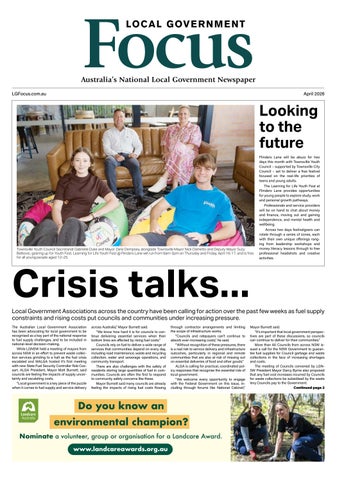
TownsvilleYouthCouncilSecretariatGabrielleDukeandMayorZaneDempsey,alongsideTownsvilleMayorNickDamettoandDeputyMayorSuzy Batkovic,gearingupforYouthFest.LearningforLifeYouthFest@FlindersLanewillrunfrom9am-3pmonThursdayandFriday,April16-17,andisfree forallyoungpeopleaged12–25.

EDITORIAL DESK

Vale Jenny Dowell

Everyone knows that person that really personifies community spirit in their area– and it’s a fabulous thing when that person not only seeks election but becomes a councillor and maybe even mayor. Jenny Dowell from Lismore was one of those people – even after she retired from office, Jenny continued to be a major part of the community still watching over the library system, parkrun, local and regional theatre, relay for life and helping to mentor would-be councillors.

After bouts of cancer, Jenny Dowell died in late March - on her own terms and at her own time after openly and honestly talking about her battle.

Vale Jenny and thank you for your service.

Tania

MINISTERS .............................page 1

STAFF ........................................ page 5

GOOD OIL page 7 REGIONAL AND

12-13 METRO AND

page 14-15

Australia’s National Local Government Newspaper

Website: LGFocus.com.au

Noosa Office:

Telephone: (07) 5455 6946

Address:

36 Mary Street, Noosaville Qld 4566

Pakenham Office:

Telephone: (03) 5945 0666

Address: 10 Army Road, Pakenham VIC 3810

Network with LG Focus twitter.com/@LGFocusau facebook.com/LocalGovernmentFocus

Editorial:

E: editorial@LGFocus.com.au

Advertising:

E: advertising@LGFocus.com.au

Classifieds:

P: 1300 666 808

E: sales@NetworkClassifieds.com.au

EDITORIAL

Tania Phillips Journalist

E: tania.phillips@StarNewsGroup.com.au

ADVERTISING

Jacqueline Trewin Sales Executive

E: jacqueline.trewin@NoosaToday.com.au

P: 07 5292 5307

M: 0497 621 843

Brett Greene Sales Executive

E: brett.greene@NoosaToday.com.au

P: 07 5292 5302

M: 0407 711 139

Michelle Gibson Sales Manager

E: michelle.gibson@StarNewsGroup.com.au

P: 07 5292 5304

M: 0413 608 678

Published by Star News Group Pty Ltd ACN 005 848 108.

Spendingup

AustraliaandNewZealandareenteringanessentialdecade forinfrastructure.Governmentsareinvestingrecordsums intransport,water,regionalgrowth,andclimateresilience. Australia’s infrastructure projects now total over $230 billion, while New Zealand will need more than NZ$200 billionoverthenext30years.

While the physical evidence of investment is obvious, the human capability required to sustain and execute these projects poses some challenges. The people who design, maintain, and renew our infrastructure are leaving faster than new workers are joining.

As many as 40 per cent of Australia’s engineers may retire or leave full-time work in the next decade. Local governments, which look after about a third of public infrastructure, are especially vulnerable. The problem isn’t a shortage of expertise. There’s a shortage of people to take over.

Public works engineers deliver the systems Australians use every day: safe drinking water, reliable roads, flood protection, waste services, and public spaces. These projects may not be glamorous, but they are vital for health, the economy, and social life.

The real challenge is how people view this profession. Private sector projects dominate graduate aspirations. They offer prestige, scale and visibility. Local infrastructure, by contrast, is often regarded as routine or administrative, despite its enormous societal impact.

This is a branding issue for one of today’s most important professions.

It’s outdated to think young professionals only care about salary and status. More and more, data shows graduates want purpose, flexibility, and a real chance to help their communities.

Public works engineering offers all these things. It provides broad technical experience, lasting results for communities, and a direct role in tackling climate resilience and sustainability. Still, the profession struggles to share this story in a way that attracts new talent.

Engineering enrolments are still strong, but not many people know about careers in public infrastructure. Many students graduate with little experience in asset management, infrastructure planning, or community-focused engineering.

Work-integratedlearning,regionalplacements, and industry partnerships are helping students

get job-ready. But recruitment will stay weak unless we present infrastructure as a career that shapes communities, not just physical assets.

Career development matters just as much. Young professionals want varied career paths, the chance to move between roles, and opportunities to keep learning. Traditional, top-down career models no longer fit today’s workforce.

Digital twins and predictive analytics are transforming how we manage infrastructure. Instead of replacing engineers, these tools are changing the nature of their jobs.

In the future, public works professionals will spend less time designing individual assets and more time managing complex systems, analysing data, and balancing social, environmental, and financial needs. The profession is shifting from building infrastructure to coordinating it.

Climate change, urban growth, and fairness across generations are prompting us to rethink how we value infrastructure. Roads, drainage, and water systems are no longer just engineering projects. They now shape liveability, safety, and social inclusion.

Public works engineers are now at the heart of these outcomes. Their job is becoming as much about building strong communities as it is about technical skills. The greatest danger facing infrastructure is not funding or technology. It is the risk that society underestimates the human capability required to sustain it.

When infrastructure fails, it makes the news. When it works, most people don’t notice. But our prosperity depends much more on systems that quietly do their job than on flashy projects.

Australia and New Zealand have a clear choice to make. We can see infrastructure as just a cost, managedbyfewerworkers,orasanation-building investment supported by skilled, forward-thinking professionals.

If we choose poorly, the consequences won’t appear immediately. Instead, problems will slowly and quietly build up, causing high costs across the systems that hold our communities together.

Crisistalksprogress

From page 1

“Councils across NSW are gravely concerned that without a guarantee of fuel supply, garbage services will be disrupted in coming weeks and months” Mayor Byrne said.

“That’s why we have today called with one voice for the NSW Government to commit to supplying the fuel we need to deliver basic services.”

“Councils are already at the front line in terms of waste collection and we need the State Government to partner with us to ensure that any increased costs are not being borne by us or our communities.”

“Across the state this year, Councils and landfill operators will pay almost $900million in a waste levy that currently just goes into consolidated revenue. That money needs to go back into the system to help soften the blow of increases in the cost of petrol”.

Earlier in the day Mayor Byrne met with the Treasurer and with the Minister for Environment, Energy and Climate Change to outline the position of local government.

At the request of the Treasurer, LGNSW will be collating information on experiences and impacts from local Councils about fuel distribution issues.

“We’re happy to assist the State Government by providing this information direct from Councils on the ground” said Mayor Byrne. “In this situation, Councils really are best placed to inform Government responses and policy.”

Another outcome of the meeting is that

LOCAL GOVERNMENT EVENTS

Queensland Disaster Management Conference

27-29 May

Rydges Southbank, Brisbane

In partnership with the Queensland Police Service, Queensland Fire Department, Queensland Reconstruction Authority and Office of the Inspector-General Emergency Management, planning is underway for what is set to be another not to be missed event. One of the largest Disaster Management Conferences, this opportunity is dedicated to supporting our members and their key partners from both government, industry and nongovernment organisations, to strengthen the critical relationships, to partner, share insights and generate ideas as we face more frequent and intense severe weather seasons.

2025 NGA 2025

June 24-27 Canberra

Register now for the 2025 National General Assembly, incorporating the Regional Forum, in Canberra from 24-27 June, with a theme of ‘National Priorities Need Local Solutions’.

The 2025 NGA 2025 will provide a great opportunity to help shape a newly-elected government or refocus a returned government on the needs of councils across Australia. Council’s 2025 NGA motions should be lodged on the ALGA Website before 31 March.

NSW Destination and Visitor economy conference 26-28 MAY 2025

Tweed Shire

The 2025 Destination and Visitor Economy Conference will be held in the Tweed Shire, with destination host being Tweed Shire Council.

For those who wish to speak at the 2025 conference, please contact the Events Manager at events@lgnsw.org.au or call 9242 4000 (Option 3 for Events) to express your interest.

Interesting in partnering? Please email sponsorship@lgnsw.org.au.

LGNSW will meet with senior representatives from the waste sector to jointly discuss responsible ways forward for communities, Councils and waste service providers.

At the meeting concerns were also raised over a range of other council services including the operating of council cemeteries and airports, the impact on community events and festivals, and the rising unpredicted cost of materials for ongoing projects, particularly regarding projects covered by Disaster Recovery Funding Arrangements.

Meanwhile in the west WALGA hosted it’s first meeting with new State Fuel Security Controller Rob Cossart on 24 March.

New President Mark Irwin said WALGA continues to demonstrate its leadership on critical energy resupply matters, working closely with the State Government to ensure Local Government insights directly inform statewide fuel security and resilience planning.

Mayor Irwin and CEO Nick Sloan convened a meeting with representatives from State Council and newly appointed State Fuel Security State Controller, Rob Cossart.

In mid-March, Premier Roger Cook appointed Mr Cossart as Fuel Security State Controller and announced the establishment of a State Management Team to facilitate coordination across both State Government and Australian Government, in the delivery of WA’s fuel security response.

NSW Executive and Administrative Assistant’s Conference

19-20 June 2025

Swissotel Sydney

After the incredible success of the 2024 conference, this highly anticipated event returns to inspire, educate, and empower professionals in executive and administrative support roles within local government.

IPWEA International Public Works Conference

Sydney 25-28 August

IPWEA invites the submission of abstracts to be considered for presentation at the next International Public Works Conference (IPWC), the largest public works Conference held in Australia. Running at the International Convention Centre Sydney from August 25 to 28, 2025.

Contributed abstract presentations are an integral part of the IPWC program. Offering delegates the chance to hear from local practitioners on innovative, creative, and relevant projects, that will expand their thinking on a variety of issues within the conference theme: ‘Shaping Tomorrow’s World’.

Socialcohesion grantsclosing

NSWcouncilshavejustaweeklefttoapplyforthelatestroundofGovernmentSocial CohesionGrantsaimedatstrengtheningcommunityresilienceandtacklingracismand discriminationatalocallevel.

Over the past five years, the grants program has delivered almost $2 million to 21 local governments, aimed at providing practical tools to address local social cohesion challenges and foster inclusive, connected communities.

When social cohesion is undermined, communities suffer and division grows. We must combat the rise in hateful rhetoric and division, especially following the horrific events in Bondi in December, and look towards building more cohesive and resilient local communities across NSW.

“Communities are strongest when people feel connected to each other and to the place

they live,” Minister for Local Government Ron Hoenig said.

“Local government sits closest to the community. These grants will help councils work with residents to understand their experiences, address racism and discrimination, and develop practical local strategies that strengthen inclusion and trust.

“I encourage councils across New South Wales to apply before applications close on 17 April.”

He said Councils would work closely with communities to understand their experiences and identify practical solutions, ensuring local

perspectives are at the heart of each strategy.

These strategies will provide clear, local plans to strengthen councils’ ability to address complex issues, prevent discriminatory behaviour, and build community resilience, connection and trust.

The fifth round of the program will deliver $800,000 to empower councils to develop tailored local Anti-Racism strategies (and other related strategies) to facilitate new opportunities for local communities to be heard.

Applications are now open, with local Councils invited to apply for a share of $800,000 to deliver projects in 2026 and into 2027.

CCTVgrantsforWACouncils

Grants are available to local governments to install or upgrade CCTV cameras to targetneighbourhoodcrimeandantisocialbehaviourinWAlocalgovernmentareas.

Local Government Minister Hannah Beazley said eligible local governments would be able to apply for funding for up to five cameras.

“This grant program will assist local governments to target hotspots by installing CCTV.

“By working with the WA Police Force, local governments will be able to make sure the cameras are in the right locations to deter crime and antisocial behaviour.

More closer ties

TheFederal Governmentislooking tostrengthenitsclose partnershipwithlocal governmentatthe AustralianCouncilof LocalGovernment (ACLG)inJunethisyear –withregistrationsnow open.

Representatives from councils nationwide will have the opportunity to meet Federal ministers and discuss shared priorities.

Minister for Regional Development and Local Government, Kristy McBain MP said Local government was a trusted delivery partner for the Federal Government, delivering the services which local communities rely on.

The CCTV Grant Program funding is part of a $22.5 million 2025-26 community safety election commitment to provide additional resourcing to tackle criminal activity.

The State-wide CCTV Grant Program will provide a major boost to local government security with a greater number of cameras to monitor crime hotspots that are well known to local authorities.

“This program is part of the Cook Labor Government’s commitment to making our communities safer and more inclusive.”

The WA Police Force will be able to remotely access the cameras to assist them to respond to instances of crime and antisocial behaviour.

Local governments will work with the WA Police Force to identify suitable locations within a high-risk area that require increased camera coverage.

Applications for the CCTV Grant Program opened on Monday 30 March 2026 and close on 18 May 2026.

TemoraGMjoinsNSWpanel

TemoraShireCouncilhaswelcomedtheappointmentofitsGeneralManager,Melissa Boxall,totheNSWGovernment’sLocalGovernmentExpertAdvisoryPanelbytheMinister forLocalGovernment,theHonRonHoenigMP.

The Panel forms part of the NSW Government’s response to the NSW Parliament inquiry into the ability of local governments to fund infrastructure and services. Members have been appointed for three-year terms to provide practical advice to the Minister on reforms aimed at strengthening the long-term financial sustainability of councils while maintaining their independence.

General Manager Melissa Boxall said she was honoured to be invited to contribute to the work of the Panel.

“Financial sustainability is the number one priority for Temora Shire, and it’s a challenge shared by many rural councils across New South Wales”, she said.

“This is a valuable opportunity to contribute to reforms at a sector-wide level and ensure the challenges facing rural councils such as Temora are clearly understood.”

“I look forward to playing my part in advising the Minister and contributing to practical solutions that help councils remain sustainable while continuing to deliver essential services and infrastructure for their communities.”

Mayor Rick Firman OAM, said the appointment recognised both the capability of the General Manager and the standing of Temora Shire within the local government sector.

“This is an exceptional acknowledgement of the General Manager’s skills, respect and ability,” Mayor Firman said.

“It also reflects the regard Temora Shire has across Government, the Opposition and the crossbench.”

“I know Councillors, Staff and our community, will join me in extending our warm congratu-

lations to the General Manager on this valuable appointment to such a crucial panel.”

“It’s important that rural, remote and regional

have a voice in these critical conversations, and we’re proud that Temora Shire will be able to contribute to that work.”

“This is a unique opportunity for us to come together and talk about the issues that matter to local communities across Australia, helping us to better understand how federal policies and initiatives are affecting them,” she said.

“I encourage delegates coming to this year’s NGA to come a day earlier and join us for ACLG. I’m looking forward to seeing faces, old and new, from every part of the nation.”

The event is set to take place on the afternoon of Monday 22 June at the Great Hall of Australian Parliament House and will features a packed agenda of panels and presentations crucial to local government, including housing, emergency management, and productivity.

ALGA president Mayor Matt Burneet said the afternoon will also feature the 40th National Awards for Local Government, celebrating innovation from across the sector.

“We are very pleased to work with Federal Government on the 2026 ACLG and look forward to this year’s event to be held immediately before our 2026 National General Assembly,” he said.

“The ACLG is a valuable opportunity for local representatives to engage with Ministers on what our communities around the country urgently need from our biggest urban centres to regional, rural, remote and first nations councils.

“We are all being called upon to deliver more services than ever before –which is why we need shared priorities and partnerships across all levels of government.

“Councils will no doubt continue their productive discussions at the ACLG and into the NGA, and I sincerely thank Prime Minister Anthony Albanese for continuing to work with us to deliver improved outcomes for all communities.”

The ACLG underscores the Albanese Government’s ongoing commitment to strengthen the services local government deliver in every community and to genuine engagement with the advocates and champions for each of Australia’s local government areas.

To maximise participation, the 2026 ACLG will align with the annual Australian Local Government Association’s (ALGA) National General Assembly, which will take place from 23 -25 June 2026 in Canberra.

Registrations opened on 23 March 2026 and more information can be found here: www.infrastructure.gov.au/territories-regions-cities/local-government/ australian-council-of-local-government

MelissaBoxall.(Supplied)

Leadersfeelingsting ofmisinformation

Newreporthighlightsgrowingdisinformationandharassmenttargetinglocalleaders.

The Municipal Association of Victoria (MAV) has partnered with the Australian National University (ANU) and the German Marshall Fund (GMF) to deliver a new report revealing the scale and impact of targeted disinformation and harassment against local elected representatives.

The research paper, Information Manipulation and Harassment of Local Leaders: Impacts and Implications, authored by the MAV’s Head of Democracy and Diplomacy Ika Trijsburg and GMF Cities’ Paul Costello, examines how emerging technologies, polarised public debate and organised campaigns are being used to intimidate, undermine and silence local leaders across Australia.

The report finds that harassment of councillors and other local leaders is increasingly enabled by digital platforms and new technologies, including social media amplification, bot networks and AI generated and manipulated content such as deepfake imagery, audio and video.

These capabilities significantly increase both the volume and reach of harmful content, placing new and ongoing pressures on those serving in public office.

MAV President Jennifer Anderson said the findings reflect what councils across Victoria are increasingly experiencing on the ground.

“Information Manipulation and Harassment of Local Leaders: Impacts and Implications con-

firms what many councillors have been telling us for some time – targeted disinformation and harassment are no longer isolated incidents, but a growing systemic challenge for local democracy,” Cr Anderson said.

“Locally elected representatives are often managing these hostilities. The impacts of these challenges have real life consequences for democratic representation and effective local decision making.”

The report highlights that harassment is particularly prevalent in highly polarised policy areas, including migration, gender and sexuality, and climate action, and that organised campaigns are increasingly challenging the legitimacy and authority of councils and the local government sector more broadly. MAV Chief Executive Officer Kelly Grigsby said the consequences extend well beyond individual harm.

“When local leaders withdraw from public engagement because of sustained abuse or disinformation, communities lose diverse voices, debate becomes narrower, and fewer people are willing to nominate for council,” Ms Grigsby said.

“This undermines trust, weakens local services and creates space for anti government agendas to gain traction.”

The research finds that existing regulatory and legal protections are often inadequate, difficult to navigate, or too slow to respond to the

immediate needs of those being targeted.

The report recommends a holistic response model that addresses not only individual incidents, but also the broader social, political and technological drivers enabling information manipulation and harassment.

The report has been released through the Resilient Democracy Data and Research Network - a network of Australian researchers, civil society leaders and government agencies.

MAV will use the report’s findings and recommendations to inform its ongoing advocacy to ensure councils can help create safe and cohesive communities and safe council workplaces.

“Local government is the closest level of government to the community. Protecting those who serve is fundamental to protecting democratic participation,” Cr Anderson said.

“MAV is proud to be a partner in this important report and will continue to work with governments and sector partners to ensure local leaders can serve their communities safely and with confidence.”

The full research paper, Information ManipulationandHarassmentofLocalLeaders:Impacts and Implications, is available at politicsir.cass. anu.edu.au/research/publications/informationmanipulation-and-harassment-local-leadersimpacts-and?utm_source=substack&utm_ medium=email

NewpresidentforWALGA

Mark Irwin is considered highly qualified for the role with more than a decade of Local Government leadership experience.

First elected as a Councillor at the City of Stirling in 2015 and serving in his current role as City of Stirling Mayor since 2017.

President Irwin also has a deep understanding of WALGA having previously served on WALGA State Council from 2021 - 2023, before being re-elected as a Zone Delegate of the WALGA Northern Metropolitan Zone and to State Council in 2025.

WALGA State Council also elected Shire of Northam President, Chris Antonio, as WALGA Deputy President. Mr Antonio has been a member of WALGA State Council since 2023 and sits on the WALGA Finance and Services Committee, in addition to being a Director of LGIS.

President Irwin said leading Western Australia’s largest Local Government, the City of Stirling, for nearly a decade, demonstrated his commitment to public service and positioned him strongly to effectively advocate on behalf

of WALGA’s 139 Member Local Governments.

“I am honoured and grateful to have been elected as President of the Western Australian Local Government Association,” President Irwin said.

“I am passionate about the role Local Government plays in making a better future for our communities.

“I am committed to upholding inclusive leadership that acknowledges the strength and depth of knowledge across WALGA State Council.

“I am keen to acknowledge the incredible contributions of Karen Chappel AM JP and Paul Kelly as former WALGA President and Deputy President. They have been incredible representatives for our sector.

“I want to continue to build on that success and bring an even stronger voice, ensuring WALGA is advocating effectively for the benefit of WA Local Governments and their communities.

“The best things happen in our local com-

munities when Federal, State and Local Governments work collaboratively together.

“We want to work closely with the State and Australian Government, ensuring that the voice of our Members is heard, and that engagement and collaboration with Local Government happens when it matters most.”

WALGA Chief Executive Officer Nick Sloan said the Association welcomed both President Irwin and Deputy President Antonio.

“We look forward to working together to drive results so that Local Governments are empowered to deliver for their communities.”

Mr Sloan said.

“WALGA extends its sincere thanks and appreciation to the significant work of outgoing President Karen Chappel AM JP and Deputy President Paul Kelly and we celebrate and acknowledge their incredible achievements for the Local Government sector.”

Both President Irwin and Deputy President Antonio have been elected on a two-year term, in accordance with WALGA’s constitution.

Farewell

TheNSWlocal governmentsectoris deeplysaddenedby thepassingofformer LismoreMayorJenny DowellOAM,awidely respectedandmuchlovedleaderwho dedicatedherlifeto servinghercommunity.

LGNSW President Mayor Darcy Byrne said Jenny Dowell was an outstanding representative who exemplified what is best about local government.

“Jenny Dowell was a natural leader who brought people together, inspired those around her, and always put her community first,” Mayor Byrne said.

“She was deeply respected across the sector, not just for her achievements, but for the way she made people feel - valued, heard and supported.

“Jenny served on Lismore City Council from 2004 to 2016, including eight years as Mayor, where she was a strong and thoughtful advocate for her community.

“After finishing her time at Council, Jenny worked for LGNSW as a highly experienced teacher, facilitator and educator.

“She was known for her warmth, integrity and determination, and for her ability to lead with both compassion and clarity.

“Beyond her work in local government, Jenny made a lasting contribution through her tireless fundraising efforts and her commitment to supporting others.

“Her legacy is one of generosity, strength and a deep connection to the Lismore community that she served so proudly.

“On behalf of LGNSW, I extend our heartfelt condolences to Jenny’s husband Ron, her family, friends, and all those who had the privilege of knowing and working with her.”

Murraycouncilsmeetforbasinreview

TheMurrayRiverGroupofCouncils(MRGC)metinMelbourneinFebruaryforadedicatedstrategicforumtodiscuss andshapeitsinitialresponsetothe2026BasinPlanReview.

Mayors and CEOs from the MRGC, together with representatives from the City of Greater Shepparton and the Co-Chairs of the GMID Water Leadership Forum, received a comprehensive briefing from Murray–Darling Basin Authority CEO Andrew McConville and senior executives on the MDBA’s recently released Basin Plan Review Discussion Paper.

MRGC Chair Cr Stuart King, said the meeting reflected the significance of the Review for communities across northern Victoria.

“This is not an abstract policy exercise. The Basin Plan has impacted our communities, our agriculture sector and our industries and it will continue to do so. This is a rare opportunity to improve the Plan for the next decade” he said.

MDBA Chief Executive Andrew McConville and senior staff briefed the Group noting that environmental water holders now control 27

per cent of Basin water entitlements valued at around $11 billion.

The Review is an opportunity to decide how this water can best be utilised to achieve the ecological outcomes to ensure healthy rivers and wetlands, even in a hotter, drier future.

Cr King noted that agriculture, food production and Basin communities - and the impacts associated with the transfer of irrigation water - were largely absent from the Discussion Paper, a point acknowledged by Mr McConville.

“Northern Victoria sits at the heart of the Basin’s irrigated food and fibre production. The MRGC region generates $8.3 billion in food each year, supporting thousands of regional jobs and contributing significantly to Victoria’s economy and Australia’s food security.

“Over the life of the Basin Plan, the transfer

of around one quarter of water entitlements out of irrigation has had profound impacts on our communities,” Cr King said.

He added that MRGC members were clear the next phase of the Basin Plan must move beyond water recovery and focus on delivering tangible environmental outcomes by maximising the $11 billion environmental water asset already secured.

“Australia’s food security depends on a strong, sustainable irrigated agriculture sector in northern Victoria - and the Basin Plan must support that. The Plan’s primary water recovery task is largely complete, with no justification for further recovery or increases to Sustainable Diversion Limits.

“The focus must now shift to using existing environmental water efficiently and strategically, leveraging allocation markets and operational

tools to maximise impact. SDLAM projects and carefully assessed constraint measures should proceed only where they deliver clear environmental benefits and genuine value for money,” Cr King said.

Cr King said the Review shows that investment should prioritise modernising ageing dams and weirs across the Basin rather than purchasing additional water. Structural adjustment funding must become a permanent part of the Basin framework, helping regional communities adapt, diversify, and attract new investment.

“We support a healthy river system, but we also stand for thriving communities, sustainable food production, and evidence-based decisionmaking. The Basin Plan Review must get that balance right,” he concluded.

FormerLismoremayorJennyDowell.
CityofStirlingMayorMarkIrwinisthenewWALGAPresident.

ValeRay DonaldOAM

NSWCountryMayorsmournRayDonaldOAM.

“Through Local Government and community organisations, Emeritus Mayor Ray Donald OAM gave so much to his community and rural, remote and regional NSW in general. His contributions, his life deserves to be celebrated and will be remembered,” said Chairman of the Country Mayors Association of NSW (CMA) Mayor Rick Firman OAM (of Temora Shire) said.

“Mr Donald’s family have described local government as his calling and I believe that sums it up, and for many of our country Mayors.”

The long-serving former Bogan Shire Mayor, Ray Donald OAM passed away this week following a brief illness. He served as a Bogan Shire Councillor for 30 years.

“Mr Donald was a true Champion for our rural, remote and regional NSW communities, not just his own,” Mayor Firman said.

Mr Donald was Deputy Mayor in 1991 – 1997, then Mayor from 1997 until his retirement in 2021. He was elected to the Shires Association Executive in 2004, Vice-President in 2008 and

elected President in 2011, serving in that role until March 2013. He also managed to run his family farm near Nyngan.

Mr Donald received the Order of Australia Medal for his services to Local Government. In 2021 he was recognised for his 30 years of service to Local Government, receiving the honorary title as a Patron of LGNSW and was awarded the LGNSW Lifetime Service Award.

CMA Board Member, Immediate past-President of LGNSW and Forbes Shire Mayor Phyllis Miller OAM has joined fellow Local Government leaders in paying tribute to Mr Donald.

“Ray’s commitment to his community was unwavering. He dedicated decades to ensuring rural and remote voices were heard at every level of government,” she said. “His passing is deeply felt but his impact will continue for generations.”

“The prayers and thoughts of the CMA Board, our Members and Staff remain with Mrs Donald and her family. Mr Donald.

Librariesatrisk

TooGoodToLose:SouthAustralia’spubliclibrariesat riskwithoutfairerfunding.

Public libraries are facing cuts to services, programs, staff and opening hours unless the next state government commits to increased and indexed funding, LGA has warned.

As part of its Too Good To Lose campaign, LGA and South Australian councils are urging major party leaders and candidates to recognise the indispensable role libraries play in every electorate across the state.

“Our public libraries are some of the most vital community institutions, delivering literacy, digital inclusion, connection and safety for South Australians of all ages,” said LGA President, Mayor Heather Holmes-Ross.

“But shrinking State Government investment is forcing councils to absorb more of the burden, with consequences to services locals rely on.”

Libraries deliver huge social and economic benefits, collectively generate an estimated $253 million in social and economic value annually, nearly three times the return on every dollar invested and offering more than 64,000 free programs each year.

State library funding from the original agreement in 2022, which stated a funding amount of $20.7 million, has already dropped

by $600,000.

Libraries face an additional $3 million shortfall over the next two years, threatening book supply, community programs and opening hours if this funding deficit is not addressed.

“Public libraries are more than places to borrow books - they are free, safe, trusted spaces for learning, connection, job support, digital access and community participation,” said Mayor Holmes-Ross said.

“They are too good to lose, which is why we’re calling on the next government to deliver funding that’s fair, sustainable and indexed so libraries can keep serving South Australians well into the future.”

Localcouncilscurrentlycontributearound $86 million annually to keep public library doors open and thriving, about 84% of all funding, and without increased state government investment, councils may face tough decisions on delivery of services and programs.

For more information and campaign resources, visit LGA’s Too Good To Lose campaign

It’sgameonforcommunitysports

It’sthattimeofyearwhentheWhatsAppchatstartsfiringupandtheuniformsandfootweararebeingcheckedforfit –it’swintersportsseason!

This week I visited St James Park at Coledale and met with Coledale Waves FC Club President Roger Carter to hear about the recent field drainage improvements that have been undertaken to ensure these pitches are more resilient in wet weather.

It was a really timely and positive conversation, given rain was threatening. I was pleased to hear how well the field was holding up, thanks to these improvements and that Council’s investment meant more access and playing time on these valuable fields.

The visit followed last week’s media opportunity to mark the opening of the all-gender change rooms which form part of the new amenities at Thirroul’s Thomas Gibson Park.

At Thirroul, I chatted with enthusiastic young women from the Thirroul Butchers Rugby League Club who shared with me how important to have a space to get ready and change on game days and that it enhanced their whole playing experience.

It really demonstrated why Council’s ongoing investment in sporting infrastructure is essential to our wellbeing.

As my fellow Councillors and I know too well, it’s not easy to balance the competing priorities for Council to invest in. And the list keeps growing.

We’ve got so many sporting codes that seek places to train and play across the city, and players – from grassroots to the elite level – who are equally enthusiastic about wanting their sport to grow.

Sport is such a key part of our lives in Wollongong. Not only is it an important physical outlet and gets our bodies moving and exercising, but it is also a vital piece of social engagement.

At sport, including community sports, people come together, talk, relax and just enjoy being part of where they live.

I’ll see this in action this Friday night when I join the Bulli Junior Football Club for their 2026 season launch.

And, no doubt, parents, grandparents and carers will see this as the winter sports seasons kick off in earnest over the coming weeks, and weekends get that little bit more hectic – but also fun.

But, as the boots go on and the netball uniforms get dusted off, I can assure our community that Council remains resolute in our promise to continue to invest in providing a wide range

of sporting facilities for all.

Especially since these facilities might just inspire the next generation of sporting heroes for our city. Players like Caitlin Foord, Michelle Hey-

man and Mary Fowler who I, as I’m sure many others will be, cheering on this Saturday as our fabulous Matildas seek to be the Asian Women’s Cup 2026 winners.

ColedaleWavesClubPresidentRogerCarterandLordMayorofWollongongCouncillorTania BrowninspectthefieldsatColedale.

Theplightofcountrypubs

Country pubs are disappearing at an alarming rate - due to falling rural populations and farm workforces, a decline in road traffic (competition from airlines), more DUI testing, continual rises in excise tax and now the Middle East fuel imbroglio.

The business model of many country pubs is no longer viable.

The owners of these country pubs are consequently financially stretched, and unable or disinclined to invest in building or equipment upgrades to improve their offering.

This is a crying shame. Country pubs are a fundamental part of the regional landscape. A town without a pub is not attractive to locals, tourists or potential investors.

Country pubs are also an important means of maintaining the mental health of the rural population. They provide a focal point for social interaction. The high suicide rates in rural communities can be traced back to human isolation.

In this context, the Cockatoo Network figures that federal and state governments can play a pivotal role in assisting pubs to transition to a stronger financial footing while also addressing mental health issues.

The role is NOT to subsidise the financial operation of the pubs - but to fund public facilities and activities within, or adjacent to, the pubs. This would then increase patronage and justify the public expenditure.

Our proposal is for the operators of country pubs to consider the possibility of developing Country Hubs, as distinct from simply pubs and, to this end, to incorporate public activities, and to engage with relevant government agencies to this end.

We are currently talking to country pubs in the Canberra and Gippsland regions, as well as the Australian Hotels Association and a couple of federal agencies.

Early days, but we’d welcome the involvement of local councils at some point. Please contact us.

Flood refuge mounds

Huge stock losses continue to wreak havoc in rural economies – figures of 100,000 stock losses were reported in the January 2026 floods,

THE GOOD OIL

and there will be more resulting from the February-March floods.

A common view is that these losses are a normal cost of running farms across flood-prone properties. That’s bunkum. Some of these stock losses are entirely avoidable, and flood refuge mounds are a real option.

This is not a random idea. Two years ago, the NSW government committed $13 million towards the cost of building approvals and associated expenditure for cattle refuge mounds in the Shoalhaven River Valley.

We are advised that six farmers accessed limited funding, but the program was ended after concerns were raised by farmers about crosscontamination of dairy cattle. This shouldn’t be an issue in those river systems where properties are huge and cross-contamination is unlikely.

We have prepared a discussion paper on this subject. The gist is as follows.

· There are at least 200,000 stock losses annually. Valued at say $2k/beast, this represents a $400 million cost to the nation. A feasibility study would present scenarios, but a saving of at least 10 per cent of those stock losses ($40 million) is plausible.

· Adding to existing dam walls might be a good option. Two reasons – the earthworks would be less than starting from a zero base, and the cattle would be familiar with the terrain.

· Feeding the stock on the refuge mounds has been presented as a problem. Then look at helicopters, with pilot training if required.

· One option is to fund construction contractors to undertake the work. A better option might be to get a small network of property owners to collaborate by purchasing equipment

Sewergrantsought

(with modest funding from the feds and participating states) and do the work themselves.

Please contact us if this resonates.

Construction industry woes

Treasurer Jim Chalmers is keen to lay out some reform agendas in the May Budget. Tax reform is one area, and reducing the 50% concession on Capital Gains Tax, and limiting negative gearing (perhaps capping the number of properties that can be geared) are gathering momentum.

The second area of reform that is crying out for reform is the construction industry. But don’t hold your breath.

The industry has faced a 12 per cent productivity decline over the last decade, and federal agencies have been acting to increase modular home construction, talking about pausing the National Building Code (reducing red tape), fast-tracking clean energy projects, boosting TAFE places for tradies, moving to value-based procurement, and driving low-carbon materials. This is all very well, but federal and state governments are missing three elephants in the room:

· The failure to rein in construction expenditure. The problem escalated when Tony Abbott declared himself the Infrastructure Prime Minister. The nation has since gone on an infrastructure splurge without thought to the ability of the industry’s capacity to absorb the relentless demand for buildings materials, labour and construction equipment. The result - construction costs running at 25-30% higher than in ‘normal’ times.

· The pervading influence of inefficiency and corruption in the CFMEU as exampled in judicial enquiries in Victoria and Queensland.

· The vast anecdotal evidence of poor tender management by government agencies.

In brief

The Defence Department’s sale of excess land is gathering pace. It’s important for local government to be in the drive seat on this. The Building Better Cities program of the 1990s is a valuable precedent. Note that yours truly predicted the Defence sell-off in this column back in April 2023.

The federal Liberal Party is almost in a terminal state. The National Party has arguably more

talent. Another prediction – two members of the Nationals executive are X factors if they’re allowed to blossom. They are Kevin Hogan, deputy leader of the Nationals, a cluey bloke from the Northern Rivers. The other is Darren Chester, member for Gippsland who has been weighed down by being outside the Queensland/NSW power bloc.

He was the CEO of Champions of then Bush, and thus very well-versed in regional development.

Morwell is on the move. This is a town of 15,000 population, east of Melbourne. It fell on hard times during the Kennett Government’s purge of the SECV in the 1990s. It was recently announced by Keppel Ltd (Singapore) as the location for Australia’s largest ($10 billion) Data Centre. Its competitive advantages include water, grid connection, access to renewables and a skilled workforce.

Discussions are ongoing, but we sincerely hope that Latrobe City Council can pull this off. It would be a testament to (a) sticking to competitive advantages and (b) perseverance.

Manufacturing Industry

The nation now wants to rediscover manufacturing industry. This is particularly galling for someone who spent his career fighting the free trade zealots in Treasury and the Productivity Commission. A big tip – 90 per cent of Australia’s scientific and medical (SCIMED) equipment is imported. Dialing this down does not require grants. It requires proactive purchasing by federal and state governments who are the huge spenders. And the beneficiaries can be Aussie SCIMED companies scattered among the multinationals on Sydney’s north shore, and around Clayton/Springvale/Parkville in Melbourne etc. More next month.

Rod Brown is a Canberra-based lobbyist specialising in industry/regional development. Email apdcockatoo@ iprimus.com.au

FraserCoastRegionalCouncilwillseekQueenslandGovernmentfundingfortwomajorwaterandsewerageprojects withcapacitytosupportmorethan11,000newhomesacrosstheregion.

At its meeting on Wednesday 25 March, the Council agreed to nominate the Fraser Coast Water Grid and Pulgul Sewage Treatment Plant upgrade for Round Two of the Queensland Government’s Residential Activation Fund.

Fraser Coast Mayor George Seymour said the projects would help deliver the essential infrastructure needed to support new housing and population growth.

“Infrastructure such as water and sewerage networks is critical to unlocking new housing opportunities,” he said.

“These projects will help ensure the Fraser Coast is ready to support future residential development while maintaining reliable services for our growing community.”

Cr Seymour said Council had already secured funding in the first round of the program for infrastructure upgrades at Hockley Lane and Scrub Hill Road.

“We are continuing to advocate strongly for investment that supports sustainable growth in our region,” he said.

Economic Development spokesperson Cr Lachlan Cosgrove said the Residential Activation Fund was designed to help councils deliver the infrastructure needed to activate housing developments.

“These projects support the essential infrastructure that allows new homes to be built,” he said.

“The Water Grid project will strengthen water supply connections between Maryborough and Hervey Bay, improving reliability

and long-term water security.

“The Pulgul Sewage Treatment Plant upgrade will increase wastewater treatment

capacity to support future residential growth across the region.

“Together, these projects are expected to

support more than 11,000 new homes, helping ensure the Fraser Coast can continue to grow in a planned and sustainable way.”

Pulgul Sewage Treatment Plant.

WAleadstheway

TenmillionpeoplenowcallregionalAustraliahome,andWesternAustraliaisleadingthewaywithitsregionalpopulation growingfasterthanthecities,accordingtoadeepdiveintothelatestpopulationstatisticsreleasedbytheAustralian BureauofStatistics(ABS).

Ten million people now call regional Australia home, and Western Australia is leading the way with its regional population growing faster than the cities, according to a deep dive into the latest population statistics released by the Australian Bureau of Statistics (ABS). New ABS Estimated Regional Population (ERP) data released last week shows Australia’s regional and remote population grew by 1.1 per cent in 2025, reaching 10.02 million, up from 9.91 million in 2024, and up 6.3 per cent since 2020.

An analysis of the data by the Regional Australia Institute (RAI) provides insights into the local government areas (LGAs) seeing the most growth. RAI CEO Liz Ritchie said regional Western Australia had the highest growth rate (1.9 percent) among the regions, while Tasmania was the lowest on 0.3 per cent. Interestingly, Perth had the highest growth rate among the cities, too (2.4 per cent).

“Digging into this data gives us a better understanding of what is happening in the regions. We see Western Australia dominating our table of top 10 regional LGAs by growth rate – with Serpentine-Jarrahdale with its natural beauty and closeness to Perth leading the way with 4.5 per cent growth, this is well above the metropolitan average growth rate of 1.8 per cent.

This shows the value Australians place in the benefits of a regional lifestyle, while still needing the amenities that being close to a major city provides.

“These smaller centres, close to major cities - we call these Connected Lifestyle Regions - have seen bigger growth rates than major metropolitan centres (8.7 percent versus 8.5 percent) over the last five years,” she said. The only LGAs outside of Western Australia to

make the top 10 regional areas for growth rate are Mitchell in Victoria (second on 4.2 per cent growth) and Adelaide Plains (sixth on 3.8 per cent growth).

Both are only a short distance from their state capitals.

Ms Ritchie said the growth rate tells the story of places that are expanding, while the population increase shows the absolute growth numbers for LGAs.

“When we look to population growth, many of these regions are reflected in our Regional Movers Index, the latest report was released just last week.

We know the Gold Coast (annual change: 11,944 people) is popular with capital city movers, while our perennial favourites across the board – the Sunshine Coast and Greater Geelong are second and third by annual change in population numbers. Fraser Coast and Lake Macquarie also rate a mention in the top 10.”

Ms Ritchie said the data makes a strong case for a National Population Plan that identifies growth areas in the regions and puts investment into those places to ensure the infrastructure, housing, childcare and health resources are there to support that community to maximise the population growth.

“We know regional Australia is growing, we have had evidence of that going back well before the COVID-19 pandemic.

Now we need to support those communities to grow and prosper as Australians vote with their feet and move out to the regions.”

There are different factors determining population growth through the regions. Queensland is experiencing population growth from all angles – natural increase, net internal migration and overseas migration.

“Gold Coast, Townsville and Cairns are all seeing population growth from net overseas migration and natural increase, while Sunshine Coast and Fraser Coast see more from internal migration.” Ms Ritchie said.

“In Victoria, Greater Geelong is boosted by internal migration as well as natural increase and overseas migration, while Darwin is also seeing more babies arrive and overseas migrants adding to their population numbers.”

Of the regional LGAs, 54 of them had a growth rate higher than the metropolitan average of 1.8 per cent.

“This includes regions like Byron, Maitland,

Changeintheweather

It’s obvious to everybody that we are seeing weather changes.

AUSSIE FLOOD RESCUE

It appears to be more erratic and frequent than ever before. Local government bodies are plagued by flash floods that can result in major damage to roads and even highways.

This story, contributed by Australian Pump Industries, was written on the 2 March 2026, and on that particular day, South Australia, Victoria, Queensland and parts of New South Wales had undergone major deluges. Even Alice Springs was subject to massive flood.

AUSSIE PUMPS SOLUTION

Australian Pump Industries build heavy duty 6” portable trash pumps that move up to 6,000 litres per minute. The pumps have been widely used by quarries, mines, construction sites and similar infrastructure applications.

Most recently, they’ve been used to divert the Nile River around the capital city of Juba in South Sudan. The United Nations chose Aussie Pumps 6” pumps because of the ability to pump huge amounts of water, potentially contaminated with overflowing sewage and debris, of all types.

“The feedback we got from the site was that they had tried wet prime pumps using compressors or vacuum pumps for priming with poor results. Our wet prime pumps are designed for high volume trash handling applications that are required in mine sites or flood situations like South Sudan”, said Aussie Pumps Chief Engineer, John Hales

QUEENSLAND FLOODS

We feel sorry for the Queenslanders who seem to be getting more frequent floods than any other part of the country.

Winton Shire Council, innovative and proactive, acquired four heavy-duty Aussie MQ600TD trash pumps, they are just like the ones in the Sudan mounted on heavy-duty trailers. Those four machines together will produce 24,000 li-

Cessnock and Fraser Coast. It tells us the focus on our metropolitan population, while growing, misses the vital work that needs to be done to support regional areas with significant growth.

“The regional renaissance shows no signs of slowing down, we know more than one third of citydwellersareconsideringaregionalmoveand weknowwhy–housingaffordability,costofliving pressures and the chance to get back to nature. “We need governments to keep pace with what Australians already understand - regional living is a genuine and desirable choice. Our focus should be on making it possible for people to live where they want, without compromising access to essential services and amenities.

“This is the goal of our Regionalisation Ambition, which is built around 25 targets across six pillars from Liveability, Health and Jobs and Skills – and Population. Each year we measure the progress of each target with the objective of rebalancing the nation. We continue to see progress, but it’s slow progress and we are ambitious for the regions. Australians are choosing the regions for the life they offer, and we will continue to work to ensure those regions have what they need to thrive — because when regions thrive, Australia does too,” she said.

RAI analysis of ABS ERP data:

Population growth was driven by:

· Net overseas migration (+55,262)

· Net internal migration (+35,093)

· Natural increase (+22,258)

There was growth in all regional areas in the past 12 months.

Connected Lifestyle Regions recorded the fastest growth between 2024 and 2025 at 1.6 per cent, closely approaching the growth rate of metropolitan areas (1.8 per cent).

tres per minute flow!

The Big Pumps have a huge heavy duty high SG cast Iron impeller that will pump up to 3” spherical solids in suspension. The body itself is cast iron, with a built-in priming tank that enables the pump to prime first time every time.

They are ideal for flood mitigation where there are no levees. The company proved this many years ago when Horsham in Victoria was flooding and a local contractor diverted the

flood waters from the town using his 6” Aussie trash pump. Miller’s Contracting saved the town with that pump, it was regarded at the time as a virtual miracle.

Australian Pump has developed a program for flood mitigation to aid council’s resilience in the face of what are often completely unexpected weather events.

“We often get requests from panic-stricken councils wanting to rent these big machines”,

said Hales. We are a manufacturing company building these machines with 80 horsepower diesel engines and designing them for rugged work. We can offer local government lease deals but are not in the business of hire. That’s the job of great hire companies like Kennards.

Further information on how Winton Council decided to spec four of these big pumps is readily available from aussiepumps.com.au.

WintonShire’s6”pumpspreppedbeforeshipment.
RAICEOLizRitchie.(Supplied)

Projectwinsaward

CityofGreaterGeraldtonbridgereplacementprojectwinsprestigiousengineeringaward

Inovative engineering has earned the recently completed Nangetty-Walkaway Road Bridge Replacement Project top honours at the 2026 Institute of Public Works Engineering Australasia (IPWEA) WA Excellence Awards.

In a year with a record number of nominations, the City of Greater Geraldton was awarded Best Public Works Project Greater than $5 million – Regional, recognising the lower impact construction approach used to deliver this essential project.

The replacement of the 60-year-old bridge was necessary as it could no longer safely withstand the demands of the modern transport industry that primarily uses RAV7 vehicles.

The effective use of the City’s in-house Project Delivery and Engineering Team kept the bridge replacement costs down as they sourced State and Federal Government grants and later project managed the design and construction of the bridge.

Some of the contractor innovations on the project included reusing the existing abutments and piles which reduced material quantities while maintaining structural performance. Additionally, the use of precast concrete planks instead of in-situ Super-T girders simplified transport logistics and proved highly advantageous in the constrained river environment.

This high level of engineering innovation through a series of design, constructability and

Leadwestcallfor fast-tracking

LeadWest,anallianceofMelbourne’sfivewesternregional Councils, continues to urge the Victorian Government to prioritise and fast-track the Melbourne Airport Rail Project, ensuring it is progressed with the same level of commitmentandurgencyastheSuburbanRailLoopEast, alongwiththefullimplementationoftheSunshinePrecinct StationMasterplan.

LeadWest is an alliance of Melbourne’s five western region Councils of Brimbank, Hobsons Bay, Maribyrnong, Melton and Wyndham. It represents 20% of Greater Melbourne’s population.

This week the Victorian Government released early designs for the Sunshine Superhub and announced that construction has begun on stage one of the Melbourne Airport Rail.

LeadWest Chair, Cr Susan Yengi said the group is made up of Brimbank, Hobsons Bay, Maribyrnong, Melton and Wyndham Councils and represents 20 per cent of Greater Melbourne’s population.

“We acknowledge the funding commitments made by the State and Federal governments to date towards the Melbourne Airport Rail Project, Sunshine Station upgrades and Sunshine Precinct,” she said.

“The Sunshine Precinct is a nationally significant transport and employment hub with the capacity to unlock billions in private investment and tens of thousands of jobs to bring significant benefits to Melbourne’s west. Delivery of the Melbourne Airport Rail via Sunshine is critical to realising this potential.

“It’s critical the upgrades to Sunshine Station, as part of the Melbourne Airport Rail proj-

ect, includes the full delivery of the Sunshine Precinct Station Masterplan, as promised by the Victorian Government ahead of the 2022 state election.

“These projects are crucial to economic growth and prosperity in Melbourne’s west including the future electrification of the Melton and Wyndham lines.”

LeadWest also welcomed the announcement of plans to build a new Tottenham Station.

“We’re pleased with the announcement that a brand new, fully accessible Tottenham Station will also be built on the realigned Sunbury Line. This is great news for the west, and a fantastic win for communities in the City of Maribyrnong,” Cr Yengi said.

LeadWest continues to advocate for:

· the full implementation of the Sunshine Precinct: Sunshine Station Masterplan, coupled with the development of a precinct plan for Sunshine that focuses on investment in civic spaces and facilities that will transform Sunshine into Melbourne’s second CBD.

· Fulfilment of State and Federal commitments to deliver Melbourne Airport Rail via Sunshine.

· Construction of the MAR ahead of the Airport’s third runway becoming operational in 2031.

delivery improvements helped to reduce cost, time and environmental impacts while enhancing long term asset performance.

It also resulted in the project being delivered under budget and it would have been completed ahead of schedule; however ongoing winter rains delayed the final asphalting by four weeks.

Greater Geraldton City Mayor Jerry Clune said the award reflected the high standard of work undertaken by the project team, contractors and partner organisations.

“On behalf of Council, I’d like to congratulate our staff on this outstanding achievement and thank them for ensuring this essential transport link will continue to support our community for

many years to come,” he said.

“I also want to acknowledge our contractor, whose brilliant engineering solutions have set a new benchmark for sustainable project delivery.

“Most importantly, I want to thank the community for their patience throughout the eight month construction period, especially RAV 7 operators and local residents who relied on detours while works were underway.”

The $8 million project was joint funded with the Australian Government contributing $4,539,307 under their Safer Local Roads and Infrastructure Program, the WA State Government providing $1 million with the City contributing the remaining funds.

Pavingtheway sustainably

City of Moreton Bay is paving the way for more sustainable roads, partnering with infrastructure company Fulton Hogan in 2024/25 to facilitate a Queensland first research and development project aimedatadvancingsustainabilityinroadsurfacing.

Incorporating environmentally friendly technologies to develop a sustainable dense graded asphalt solution tailored to Queensland’s sub-tropical climate, Fulton Hogan trialed mixing crumb rubber binder with up to 30 per cent recycled asphalt pavement (RAP).

With support from City of Moreton Bay, trial mixes were tested on local roads for functionality and durability.

The extensive project established a fit for purpose surfacing solution for local governments and was recognised at the Australian Flexible Pavement Association (AfPA) Awards as the Queensland state winner for ‘Outstanding project less than $10m’.

City of Moreton Bay Mayor Peter Flannery said partnerships like this are a demonstration of Council’s commitment to ‘Going Green as We Grow’.

“Council is always looking for ways to keep products and materials in circulation to help reduce waste and pollution.” he said. “

Local roads are one of the largest infrastructure assets we manage, so it makes sense to collaborate with businesses who are pioneering new advancements in sustainability.” During the City of Moreton Bay 24/25 Road Resurfacing Program, Fulton Hogan resurfaced 82 streets across Divisions 1,2,3,4,5,6 and 12.

The project utilised 7838 tonnes of recycled asphalt and 28,748 end-of-life passenger tyres were recycled back into roads – with a total emission saving of 556,361 kg of CO2.

The highly sustainable asphalt mix was manufactured as warm mix asphalt, which allows lower production temperatures compared to traditional hot mix asphalt. The research and development project has now established an effective and future-ready solution for Australian council roads.

“At City of Moreton Bay, we have ambitions to achieve net zero emissions for Council operations by 2039 and reduce our City’s carbon footprint, encouraging innovation along the way,” Mayor Flannery said.

WesternDownslooksfornewCEO

WesternDownsRegionalCouncilwilllooktorecruitanewCEOlaterin2026afterJodieTaylorannouncedshewill notseektorenewhercontract.

Mrs Taylor concludes an exceptional 21-year career in Local Government on the Western Downs including five years as CEO and will conclude her tenure in December to embark on extended travel adventures with long-time husband Brad.

Western Downs Regional Council Mayor Andrew Smith said Mrs Taylor’s legacy would be one of empowerment, collaboration, and genuine commitment to the wellbeing of Council staff and the region’s residents.

“Jodie has been an extraordinary leader, whose unwavering commitment to our region and its people has profoundly shaped both our organisation and our communities,” Mayor Smith said.

“Her dynamic leadership sparked a cultural transformation within Council, fostering an environment of transparency, teamwork, and accountability.

“Jodie’s passion for continual improvement and innovation has seen Western Downs Council become a benchmark for best practice in local government.

“As a key member of Council’s Executive Leadership Team and more recently as our CEO, Jodie has fostered a relationship of trust, respect, and transparency with our Elected Member team, guiding the organisation to deliver operational excellence at every turn.

“Jodie has been a transformative leader who places community needs at the heart of every decision and balances vision with practical action, ensuring the Western Downs has earned a reputation for financial responsibility, excellent governance and as a region to do business.”

Mrs Taylor’s achievements were recognised when she was named LGMA Queensland’s Manager of the Year in 2023, a testament to

her exceptional impact during her tenure as Western Downs Regional Council CEO.

Mayor Smith said while Mrs Taylor’s departure will mark the end of a remarkable chapter, it also presents an exciting opportunity for an exceptional new leader to build on Council’s achievements and guide Western Downs into the future.

“Western Downs is one of the few debt-free Councils in Queensland and the region is an economic powerhouse due to our thriving agriculture, intensive agriculture, manufacturing, energy, and tourism industries,” he said.

“As Council prepares to launch its recruitment for our next progressive CEO to take the reins in December, we’ll be committing to a robust and intensive selection process to ensure the continued success of our region and its communities.

“This early announcement provides Coun-

cil with time to conduct a thorough recruitment campaign, ensuring the appointment of a high-calibre successor to maintain stability and progress for the organisation to best serve our communities.

“On behalf of my fellow Councillors, Council staff, and the Western Downs community, I’d like to extend our heartfelt thanks to Jodie for her vision, service, and inspirational leadership.

“We wish Jodie and Brad every happiness as they set off on their well-earned travels next year and look forward to following their adventures.”

For more information contact Council on 1300 268 624 (COUNCIL) or visit www.wdrc. qld.gov.au.

Navigatinggrants

HowAdministrativeComplexityIsErodingOneofLocalGovernment’sMostPowerfulTools

Local government grants exist to create impact in communities. Yet across the sector, that purpose is increasingly being overshadowed by administration.

Grant teams are under growing pressure. Application volumes are rising, compliance expectations are tightening and reporting requirements are becoming more complex. With limited resourcing, many teams spend the bulk of their time managing process rather than stepping back to understand outcomes. The focus shifts from why grants exist to how they are administered.

Over time, grantmaking has become increasingly transactional. Success is measured by whether rounds are delivered on time and in line with policy, rather than by the difference fund-

ing makes in communities. Impact hasn’t disappeared, but it’s becoming increasingly harder to step back and measure grant impact.

This is not a failure of intent. Councils care deeply about the outcomes their grants support. But when administrative workload dominates, insight is lost. Outcome data sits in acquittal reports that are difficult to compare. Lessons from previous rounds remain buried in documents. Opportunities to refine programs, improve targeting or demonstrate value to elected members are missed. Sound familiar?

The result is a growing disconnect. Councils know their grants matter, but struggle to clearly articulate how. Elected members want evidence of community benefit. Communities want transparency. Grant teams want to learn from what

works and what does not. Without clear visibility of impact, all three are left frustrated.

There is increasing recognition across local government that this balance needs to change. Reducing administrative burden is not about lowering standards or avoiding scrutiny. It is about creating space for higher-value work, understanding outcomes, improving program design and strengthening community relationships.

SurePact CEO Dan Pritchard notes: “Grants are one of the most powerful tools councils have to create positive change. When administration dominates, that change still happens, but it becomes harder to see and harder to learn from.”

That perspective reflects a broader shift across the sector. Platforms like SurePact have

emerged to help councils reduce the administrative load associated with grants while improving visibility across the full grant lifecycle. By bringing applications, assessment, management and reporting into a single, streamlined and easy-touse system, councils are better able to move beyond compliance and focus on outcomes.

Ultimately, remembering the purpose of grants does not require councils to do more. It requires them to see more clearly. When impact is visible again, grant programs can fulfil their original intent, not simply distributing funds, but creating lasting value for the communities they exist to serve.

To learn more about how councils are using SurePact to streamline their grant management visit SurePact.com.

Hard-lineonplastics

Givingsoftplasticsasecond,third,fourthlife-andcounting.

“Nice work Surf Coast, your soft plastic recycling efforts are paying off, with the first shipment from Anglesea now on its way to becoming valuable new products.

“A total of 2.28 tonnes of baled soft plastics from the Anglesea Transfer Station have arrived ready for recycling at APR ChemCycle in Dandenong South.

The response from the recycler says it all:

“We’re incredibly impressed by the quality of the material. Please pass on our thanks to the community.”

Surf Coast Shire Cr Adrian Schonfelder said this was a fantastic result and “a real credit to our community.”

“Residents are showing that when given the right options, they’re committed to reducing waste and doing the right thing for the environment,” he said

“To receive such positive feedback from the recycler about the quality of our materials is something the whole community should be proud of. It shows the care people are taking to recycle right.”

Once received, the bales are opened and carefully sorted using a combination of density separation, shredding and optical technology to isolate the right plastics for recycling.

From there, the materials begin a new life.

Some are transformed into recycled plastic resin, ready to be used in new soft plastic packaging. Others go through advanced recycling, where they’re converted into oil that can be used to create food-grade plastic packaging.

Both pathways keep materials in use and out of landfill - creating a truly circular loop according to the mayor.

“A key part of this process is APR’s Australian-first pyrolysis unit,” he said.

“Using high heat in a zero-oxygen environment, the technology breaks plastics down into simpler compounds, producing gas (to power the plant), plastic oil (for new plastics) and char (used in road base).”

He said when operating at full capacity, the German-made unit would process up to five tonnes of plastic each day, with just one kilogram of plastic waste producing around 850

Thefirstloadofsoftplastics.(Supplied)

millilitres of recycled oil.

By October, a phase two upgrade will increase capacity to up to 60 tonnes per day using additional infrared technology.

“We’d love to see even more residents get

involved. By dropping off eligible soft plastics at Anglesea Transfer Station, you’re helping create real environmental benefits. Every bag and wrapper makes a difference - keep up the great work!” Cr Schonfelder said.

Housingsurgeexposescracks

The surge of close to 10 million Australians now living in regional areas has exposed deepandgrowingcracksinthenation’shousingsystem,highlightingtheurgentneedfor adedicatednationalhousingplanthatworksforregionalAustralia,accordingtoHousing IndustryAssociation(HIA)ChiefExecutive–IndustryPolicy,SimonCroft.

“A one size fits all approach to housing policy is failing the regions,” Mr Croft said ahead of a housing roundtable which was hosted by HIA in Albury on Wednesday, 8 April, preceding the Farrer by-election on 9 May.

“Nowhere is this more evident than in regional electorates such as Farrer, which has experienced strong population growth but continues to face chronic housing shortages, rising rents and limited housing choice for workers, families and young Australians.”

“Since the pandemic, regional Australia has welcomed tens of thousands of new residents seeking affordability, employment opportunities and a better quality of life. While this shift has delivered economic benefits, housing supply has simply not kept pace with demand.”

In Farrer—a vast electorate spanning the Murray and Border regions—the impacts are increasingly acute.

“Essential workers are struggling to find rental accommodation, young people are being priced out of their home communities, and local businesses are unable to attract staff because workers simply cannot find a place to live,” Mr Croft said.

“Regional communities are doing the heavy lifting when it comes to population growth, yet housing policy remains overwhelmingly metropolitan focused. This is not a fringe issue—it is a structural failure.”

Despite demand surging in regional

centres, smaller towns and rural cities continue to face:

· Severe rental shortages, often with vacancy rates near or below 1 per cent

· Rapidly escalating rents and purchase prices, increasingly disconnected from local wages

· Limited new housing construction, driven by higher build costs, labour shortages and fragmented planning systems

· A shortage of diverse housing types, particularly social, affordable and key worker housing.

Mr Croft said what is required now is a dedicated, long term national housing plan that explicitly recognises the distinct pressures faced by regional, rural and remote communities.

“Housing must be treated as critical economic and social infrastructure, especially in regions expected to absorb future population and workforce growth,” he said.

Such a plan must:

· Include place based housing targets and funding streams for regional Australia

· Support new housing supply in growth regions, not just capital cities

· Address gaps in social, affordable and key worker housing

· Align housing investment with infrastructure, health, education and workforce planning

“These challenges are clearly outlined in HIA Housing the Regions Report , which sets

out a blueprint to address housing supply constraints, infrastructure gaps and work force shortages in regional Australia.”

“Without decisive action, regions like Farrer risk a future where population growth outpaces liveability—undermining the very communities Australians are choosing to move to.”

“If governments want people to live and work in the regions, they must match that ambition with a housing system designed for regional realities.”

“The housing crisis is not confined to cities—it is even more pronounced in the regions. It demands a coordinated national response that finally puts regional Australia at the centre of housing policy, not as an afterthought.

“HIA will continue to press this case nationally, including as part of this critically important Farrer by-election and through the Senate Select Committee on Productivity in Australia, which is examining objectives for a multi decade National Settlement Strategy.

“Australia can no longer rely on reactive, stop start housing policies. We need a system that plans for long term growth, improves population distribution and productivity, and puts regional Australia at the centre of a national housing policy,” Mr Croft concluded.

Residents can drop off eligible soft plastics at the Anglesea Transfer Station.

Items must carry plastic resin codes 2, 4 or 5, including bread bags, chip packets, cling wrap, pet food bags and more.

Newtech

Apainttrialistakingthe heatoutofAlexandrina’s councilinfrastructure.

Alexandrina Council’s Alexandrina Wastewater division is trialing new paint technology to cool down the temperatures inside cabinetry housing essential electrical equipment.

The Australian-developed thermal paint can reduce the internal temperature of electrical cabinets by up to 15 degrees, significantly reducing the risk of operational problems and system failures due to extreme heat conditions.

Council recently compared temperatures inside two pump station cabinets located in full sun a kilometre apart in Goolwa over a seven-day period.

The pump station with the new thermal paint on the exterior reached a maximum temperature of 37 degrees. The pump station with standard exterior paint reached a maximum of 55 degrees.

As a result of the trial, Alexandrina Wastewater will progressively repaint Council cabinet assets with the new thermal paint.

The challenge is selecting appropriate colours that provide the best thermal performance with acceptable community aesthetics.

The lighter the colour, the better the thermal properties but light, bright colours don’t often blend in with certain environments.

Alexandrina Wastewater is council’s water management division and operates 24/7 tomaintain the five Community Wastewater Management Schemes across our district.

Mayorscallforfunding

MayorsfromacrossQueenslandhavespokenoutaboutthealarmingnumberofpoor-qualityroadsinregional,rural andremoteareasandarecallingontheStateGovernmentforincreasedfundingtocarryouturgentupgrades.

The mayors have thrown their support behind a Local Government Association of Queensland (LGAQ) campaign to lock in a permanent annual road infrastructure funding boost in the June State Budget.

The LGAQ says a permanent increase in the Transport and Infrastructure Development Scheme (TIDS) to $100 million a year is needed to improve road safety and support local economic development.

The LGAQ campaign is supported by recent research revealing nearly half of Queensland’s unsealed roads are in either poor condition or in need of repair.

The Queensland State of the Assets Report also confirms that dilapidated timber bridges and failing water infrastructure are posing on-going risks to community safety.

LGAQ CEO Alison Smith said the report validates calls from councils for a long-overdue increase in road funding, essential to keeping Queenslanders moving safely while supporting stronger local economies.

“We need a long-term funding commitment to allow councils to work in genuine partnership with the State to build safer, more resilient road networks in the regions,” Ms Smith said.

“Well-maintained roads sit at the heart of a strong transport network that keeps people and freight moving efficiently, helping to underpin economic development.

“Along with improved safety and reliability, increased road infrastructure funding will deliver stronger connections between regional centres, businesses and essential services.”

Ms Smith said that while councils welcomed the State’s commitment of $75.95 million in TIDS funding through to 2027–28, more funding was needed to ensure critical infrastructure upgrades could continue.

“TIDS plays a vital role in supporting pavement rehabilitation and widening, new and up-

graded pathways, the progressive sealing of unsealed roads, and targeted safety improvements across the state,” she said.

“The projects delivered through TIDS improve access and reliability for agricultural producers, freight operators and regional industries by strengthening links to markets, processing facilities and transport hubs.

“Just as importantly, they improve everyday connectivity for local communities, supporting economic activity and safer travel for all Queenslanders.”

Longreach Regional Council Mayor Tony Rayner said TIDS funding was critical for his council in western Queensland.

He said Longreach had a lot of vital road networks that were experiencing increased traffic volume every year and it was critically important that people were able to get to destinations safely.

Diamantina Shire Council Mayor Francis Murray said an increase in road funding was “all about safety and accessibility”.

“We still have gravel roads out here. The sooner they’re sealed the better,” he said.

“It’s costing at least $1 million a kilometre to seal roads out here – and that keeps going up.”

Etheridge Shire Mayor Barry Hughes said economic development was key to the long-term sustainability of communities across the North and Northwest. “TIDS certainly plays a major role in that,” he said.

Boulia Shire Council Mayor Rick Britton said his region had many roads that were shared by triple road trains, cars and caravans.

“It’s all about road safety… for some people, it’s pretty daunting when you leave Brisbane and come out here on to narrow roads with a car and caravan, and you see these massive triple road trains,” he said.

Mayor Britton said drive tourism was increasing in the region – it was no longer just “grey no-

mads” but also families during school holidays. With safer roads, even more tourists would be encouraged to visit and enjoy the local area, he said.

Isaac Regional Council Mayor Kelly Vea Vea said assets like roads were the lifeblood of the Isaac community.

“They connect us to our healthcare, connect our workers to homes and loved ones to families. Statewide, sealed and unsealed roads are the highest value asset ranked in ‘poor’ condition in the Queensland State of the Assets Report. A permanent State funding boost to road funding would make our roads safer – and better connect our regions.”

Flinders Shire Council Mayor Kate Peddle said councils were not immune to cost of living challenges – which were placing additional pressure on building roads and supporting contractors.

“I think any financial support that regional councils can get is absolutely vital. We have quite large and diverse shires. We have major industries that we need to support in the region. We don’t have the resources to be able to put onto these roads ourselves. So TIDS is vitally important to us.”

In the heavily populated area of South East Queensland, well maintained roads are critical.

Somerset Regional Council Mayor Jason Wendt said in Somerset, roads were vital arteries keeping industries and communities connected.

“Road construction costs have increased around 30-40% in the last three years in our region – this means that to build the same road, we need more funding.”

Logan City Council Mayor Jon Raven said that with the population of Logan set to almost double in coming decades, the demand on its travel and road network would intensify.

“Both our long-term and new residents are crying out for more upgrades to our roads than rates alone can afford. A boost to roads funding is critical to meet our community’s expectations and keep them safe.”

Noosa Shire Mayor Frank Wilkie said adequate funding for roads played a key role in maintaining safe travel across Noosa.

“We face a range of pressures on our infrastructure – including increased costs as we continue to evolve as a community and a popular visitor destination.”

“It is critical that road funding keeps pace with increased costs and demand to allow Noosa to thrive.”

Toowoomba Regional Council Mayor Geoff McDonald said that the population in Toowoomba was growing – increasing by 1.4 per cent, or around 2,500 people, per year.

“Thisputspressureonourexistingassets–but also requires new infrastructure like roads, sewers and water to support growth.

“Councils have limited ways to raise funds, and we need to keep providing the services that make our community liveable. We need greater State and Federal support to maintain and grow our assets in line with population growth.”

Charters Towers Mayor Liz Schmidt said that safe, efficient, and effective road networks were critical to the key economic pillars of her region: mining, agriculture, and tourism.

“North Queensland’s size, population and weather conditions – like our wet season – all contribute to the requirements of our road networks.

“Greater investment in a program like TIDS would help unlock opportunities and capitalise on the potential we have to grow.”

Blackall-Tambo Regional Council Mayor Andrew Martin said roads were key drivers of the agricultural industries across Queensland. “

“TIDS is a program that is the vital link in providing products like tourism and agriculture – it is most important.”

NSWcountrymayorscallforGSTreform

A review of the 2018 GST distribution reforms is badly needed according to NSW Country Mayors Association ChairmanMayorRickFirman.

Mayor Firman, Temora Shire, said made the call after NSW received only 25.5 per cent of the pool following the latest GST distribution.

“The formula being used by the Commonwealth Grants Commission (CGC) is obviously flawed,” he said.

“We question how WA’s share of the pool rises. WA has a population of around 3 million, most of whom live in Perth and it earns almost $10 billion a year in mining revenues. Meanwhile, there are three million people living and working in remote, rural and regional NSW who are watching their state’s share of the GST pool fall.

“Our members are heavily focused on fi-

nancial sustainability. Local Government in remote, rural and regional NSW provides a range of services and facilities that are critical for the wellbeing of the communities our members represent. We need a financially strong State Government to support councils to deliver on those community needs.”

“The CMA Board and members are extremely concerned that the CGC fails to fully comprehend the costs associated with the population spread in NSW and the consequent need for the State Government to support hundreds of delivery points for services and facilities across thousands of square kilometres.

Daviestakesonrole

Flinders Shire Council is pleased to announce the appointment of Kylie Davies as its new Chief Executive Officer.MsDavieswillstartintheroleon13Aprilfollowing asuccessfulnationalrecruitmentprocess.

The fit-out will take place in the former Library staff offices and Alice Springs Collection area, supporting the planned co-location of Tourism Central Australia while planning continues for the new Alice Springs Public Library and TCA and VIC complete fit out.

The project will adapt the existing space to meet Tourism Central Australia’s operational needs, while ensuring the impacted current library services are minimized and remain accessible to the community.

The Alice Springs Collection has been safely stored to protect its integrity, with appropriate measures in place to ensure the long-term care of these important local historical materials.

Council is currently in discussions with Charles Darwin University regarding an arrangement to house the collection, which would allow it to continue to be accessed by the public.

The new Alice Springs Public Library is a $19.96 million project, jointly funded by the Northern Territory Government and Alice Springs Town Council, which will deliver a modern, accessible facility designed to meet the needs of a growing and changing community.

The Tourism Central Australia Headquarters fit-out is a $4.8 million project, fully funded by the Northern Territory Government with in-kind support from Alice Springs Town Council.

The work of Local Government and State Government in remote, rural and regional areas is interlinked, and it relies on our NSW State Government getting its fair share of the GST pie. CMA have and will continue to work beside our NSW Premier and Treasurer, to help ensure NSW are treated fairly. We can’t take our foot off the peddle on this one”.

“Our CMA slogan is ‘what we want is nothing more than equity’, and this latest carve-up is the complete opposite of that,” Mayor Firman said.

“Quite frankly, we are appalled that NSW, the most populous state, is being forced to subsidise a wealthy jurisdiction like WA while

our own rural, remote and regional councils are seriously struggling with financial sustainability”.

“The CMA has lodged a submission to the Productivity Commission’s Review of the 2018 GST Distribution Reforms. We have clearly stated that it is imperative that there is an overhaul of the 2018 reforms to ensure that NSW which has the largest and most dispersed population in Australia receives its fair share.

“Without an appropriate share of the pool, NSW will struggle to meet the needs of the almost 3 million people that our member councils represent. We just want a fair go,” Mayor Firman concluded.

Lismore’sprogress

Fouryearson:HowLismoreisbuildingbackand settinganationalbenchmark.

When the 2022 flood inundated Lismore, it was not simply another extreme weather event. It became Australia’s most significant natural disaster in recorded history, devastating homes, businesses and critical infrastructure across the city.

Four years on, the defining story is not just about restoration. It is about reform.

Lismore did not have the benefit of a precedent.

Unlike in Queensland, there were no established guidelines or templates for a disaster of this magnitude. That meant Council had to develop the settings as the work

rolled out. In doing so, Lismore has helped reshape how large-scale recovery programs are structured, governed and delivered, setting a new national standard.

Since 2023, Council has been managing a $1 billion flood restoration portfolio spanning 338 projects, the largest capital works program ever undertaken by a council in NSW and unprecedented nationally in a local government context.

The portfolio spans roads and bridges, landslip remediation, public buildings, and water and waste infrastructure. It is a complex program typically associated with state agencies.

Newlawsembraced

TweedShireCouncilhaswelcomedtheNSWGovernment’snewlegislationgivingpoliceandtransportofficerspowers toaddressillegale-bikeuseacrosstheState.

The Road Transport Amendment (Non-registrable Motor Vehicles) Bill 2026 includes measures like roadside testing and strengthened enforcement powers targeting throttle-only, high-powered e-motorbikes which are being used illegally in public spaces.

The new laws allow officers to test whether an e-bike exceeds the legal 25 km/h speed limit at te roadside.

Devices that do not meet the legal definition of a pedal-assisted e-bike — including those with throttle-only operation, excessive power output or modified speed limiters — are subject to seizure and crushing powers. NSW will be the

Sorting

first state to introduce roadside testing units for this purpose.

Tweed Shire Mayor Chris Cherry said Council welcomed the state’s action as a direct response to what Tweed residents had been calling for.

“Our community has made it very clear that they want to feel safe on our shared pathways, in our town centres and in our neighbourhoods,” Cr Cherry.

“This legislation reflects what residents across the Tweed have been telling us, and we are glad the state government has listened.”

thestate’s priorities

Asthe2026VictorianStateElectionapproaches, GoldenPlainsShireCouncilhasidentifiedeightkey priorityareasandiscallingforbipartisancommitment toprogresstheessentialinfrastructureandservices neededforourgrowingcommunities.

Across the Golden Plains Shire Golden Plains Shire Mayor Cr Owen Sharkey says Council is dedicated to advocating for commitments that benefit and support the people and townships of Golden Plains Shire.

“Our towns and rural communities continue to attract families, businesses and investment because of our location, our strong sense of community and the lifestyle that regional Victoria offers,” Cr Sharkey said.

“Growth brings opportunity, but it also brings responsibility. As our population increases, so does the demand on our infrastructure, services and community facilities,” he said.

“The priorities we’ve identified are evidence-based, shaped by community feedback and aligned with State Government responsibilities, addressing both local needs

and Shire-wide challenges such as transport, road safety and digital connectivity.

“This advocacy is about partnership, not politics. We’re committed to working constructively with whichever government is elected in 2026 to deliver outcomes that strengthen liveability, safety and economic opportunity across Golden Plains Shire.”

The 2026 State Election Priority Projects : • Improved Public and Active Transport • IncreasedInvestmentinRoadSafety,Roadsand Active Transport • Investment in Tracks and Trails•InvestmentinEmergencyServicesand Community Safety • Sewerage Infrastructure for Supporting Growth • Investment in Early Years, Young People and Liveability • Scrapping the Emergency Services and Volunteers Fund (ESVF) • Mobile and Digital Connectivity Across the Golden Plains State Election.

Rotaryhonours libraryemployee

WhyallaPublicLibrary’sChrisBarsbyhasbeen recognisedforheroutstandingcontributiontoyouth learning,receivingaSpecialCommunityAwardfrom theRotaryClubofWhyalla.Theawardcelebratesher dedicationtotheChildren’sUniversityprogramandthe opportunitiesitprovidesforlocalchildrentoexplore learningbeyondtheclassroom.

Children’s University encourages young people to take part in educational activities outside of school, with the Whyalla Public Library acting as a key local learning destination where children can participate in workshops, school holiday programs, and a range of hands-on learning experiences. Through her role at the Whyalla Public Library, Chris has helped promote the program across the community while creating engaging activities. As the only non-school based Children’s University Coordinator in the Spencer Gulf region, her work helps connect local families with opportunities for children to gain new skills, discover interests, and record their learning achievements through the program.

Chris Barsby said she was proud to support the program and see local children get ex-

cited about learning, “Children’s University is all about giving young people the chance to try new things and discover what they enjoy. The library is a place where families can get involved, take part in activities and help children continue learning outside of school.”

Richard Parker from Rotary Club said the award recognised Chris’s dedication to creating opportunities for young people in Whyalla, “Chris has gone above and beyond to support Children’s University and promote learning opportunities for young people in our community, her passion and commitment continue to make a real difference for local children and families.”

The award was presented during the Rotary Club of Whyalla’s monthly gathering.

On13 March, NSW Member for Tweed Geoff Provest, supported by Tweed Shire Council and Tweed-Byron Police, hosted a community meeting at Tweed Heads Civic Centre for residents to share their concerns about illegal e-bike use.

People came from across the Shire describing e-bikes being ridden at dangerous speeds on footpaths, through shopping centres and in areas used by families and pedestrians.

“What came through at that meeting was a community that wants to get this right,” the Mayor said.

“Residents weren’t anti e-bike — they were

asking for safety and respect for shared spaces. Council will keep working with our community and with the state government to make sure those practical local needs are addressed.”

The NSW Government is reminding parents to check that any e-bike purchased for a child meets current legal requirements before use on public roads or pathways. Not all e-bikes sold in shops meet NSW’s legal standard.

For more information on e-bike laws and what is legal in NSW, visit E-bike seizure and crushing powers to become law | NSW Government

Reconciliationtime

TheWaggaWaggacommunityisbeingencouraged totakethetimetoreadCouncil’sdraftInnovate ReconciliationActionPlan2026–2028,whichprovidesa strategicframeworkofprioritiesandactionsforCouncil forthenexttwoyears.

At its Ordinary Meeting on 23 March the Council endorsed placing the draft document on public exhibition until 27 April.

Acting Community Services manager Alex Osgood said the Innovate Reconciliation Action Plan 2026 – 2028 reflects some of the actions already taken by Council in its previous Reconciliation Action Plan (RAP) and looks at what it will strengthen going forward.

“Council is proud of our achievements made on our reconciliation journey to date, but we also recognise that we have work to do,” Alex Osgood said.

“There is a lot to celebrate from the outcomes of the 2022-2024 action plan, and this third RAP is about building on that progress with a set of clear actions.

“The document was developed with the guidance and knowledge of the Wiradjuri/ Wiradyuri and First Nations Elders, Cultural Knowledge Holders, and community, including the RAP Working Group with First Nations community representatives and Council staff.

“Across Council, we have developed mean-

ingful relationships and opportunities for collaboration with Wiradjuri/Wiradyuri and First Nations people.

“It is important that we continue to take this guidance from those who are the knowledge keepers in our community, being Wiradjuri and other First Nations Elders.

“We would also like to acknowledge the ongoing feedback and guidance of Reconciliation Australia, Elders and Cultural Knowledge Holders, and community throughout this process.”

This RAP includes a message CEO of Reconciliation Australia and by senior Wiradyuri Elder Aunty Isabel Reid.

“The consultation that has occurred to date in the development of this RAP demonstrates Council’s commitment to reconciliation to empower our local Wiradjuri/Wiradyuri and First Nations community here in Wagga.”

There are four key areas for the draft Innovate Reconciliation Action Plan 2026 – 2028: relationships, respect, opportunities, and governance.

ChrisBarsbyfromtheWhyallaPublicLibraryhasbeenrecognisedforheroutstanding contributiontoyouthlearning,receivingaSpecialCommunityAwardfromtheRotaryClubof Whyalla.

Movingforward

TheCootamundra-GundagaiRegionalCouncil(CGRC),DemergerTransitionCommitteeistakingthenextcriticalstep toensurebothfuturecouncilsarefinanciallysustainableandoperationalfromdayone.

A key requirement of the demerger process is that each successor council (Cootamundra and Gundagai) can operate independently with strong financial foundations. To support this, CGRC previously developed a Financial Sustainability Plan (FSP) in 2024, later updated in 2025, which informed its submission to the Local Government Boundaries Commission Inquiry.

However, with financial conditions continuing to shift across the local government sector— and within CGRC itself—the Committee has recognised the need for a refreshed and more robust plan.

At its meeting on Tuesday 10 March, the Committee resolved to engage a specialist contractor to update the FSP and carry out addi-

tional preparatory work ahead of the new councils’ establishment.

Building a roadmap for long-term sustainability

The updated FSP will focus on identifying practical, evidence-based pathways to ensure both councils remain financially viable well into the future.

Key areas of focus will include:

· Understanding the factors shaping CGRC’s current financial position

· Reviewing existing financial settings, governance, and performance frameworks

· Identifying opportunities to strengthen revenue and reduce costs, including:

· Rates, fees and charges

SurfcoastEcotourism

champs

Ecotourism Australia is proud to announce that the Surf Coast Shire has officially earned ECO Destination Certification,formallyrecognisingtheregion’sadherence to global best practice sustainable tourism and environmentalmanagementstandards.

Located southwest of Melbourne, the Surf Coast marks the official start of the iconic Great Ocean Road. Comprising eleven distinct townships, the region is one of Victoria’s fastest-growing municipalities and a premier destination for domestic and international travellers.

“We are delighted to welcome the Surf Coast region to our growing cohort of ECO Certified Destinations throughout Australia. This certification recognises the dedication of the Surf Coast Shire team, businesses and residents in making the Surf Coast a model for responsible tourism in Australia,” said Elissa Keenan, CEO of Ecotourism Australia

“With exceptional nature-based experiences offered by ECO Certified operators such as Torquay Surf Academy, Southern Exposure Eco Adventure Sports and Go Ride A Wave, and sustainable accommodation offerings from Desa Retreats, RACV Torquay Resort, Great Ocean Road Resort and Mantra Lorne, visitors can explore the Surf Coast knowing they are supporting a region that values its environment as much as its vibrant lifestyle.”

This milestone establishes the Surf Coast Shire as the second destination in Victoria to attain ECO Destination Certification, following East Gippsland’s certification in April 2023, and the 15th destination in Australia.

“We’re absolutely rapt for the Surf Coast

Shire to receive ECO Destination Certification, as it strengthens our status as a place where visitors can soak up nature-focused experiences,” said Surf Coast Shire Mayor, Cr Libby Stapleton.

“Our world-class environment is a huge drawcard for the 2.6 million visitors to the Surf Coast each year – from internationals exploring the Great Ocean Road, to people from across Australia taking in our charming hinterland.”

Surf Coast Shire Council thanked various partners – Barwon Water, Great Ocean Road Coast and Parks Authority, Great Ocean Road Regional Tourism and Parks Victoria – for the comprehensive range of sustainability initiatives as part of its ECO Destination Certification.

The region carefully monitors visitor numbers and behaviour to manage impacts on natural and cultural sites, while strict guidelines and licensing protect wildlife and sensitive ecosystems.

Water conservation measures, low-impact transport options and climate adaptation strategies ensure tourism infrastructure and practices remain resilient and environmentally responsible.

At the same time, the Shire supports authentic cultural engagement, ensuring local communities benefit economically while preserving their traditions.

· Service delivery and operational efficiency

· Capital works and asset management

· Governance and monitoring systems

· Considering equity and fair distribution of resources across communities

· Aligning financial strategies with broader planning and service levels

The final outcome will include clear recommendations, risk and benefit analysis, and a practical implementation roadmap. Separate long-term financial plans and draft revenue policies will also be prepared for each successor council, along with a public-facing summary of findings.

Council expects to go to tender shortly, with the work to be completed by November this year.

Investment in smarter operations.

The Committee also turned its attention to improving operational efficiency, considering a proposal to replace an older 3-ton lime spreader with a larger 10-ton unit.

The business case highlighted not only productivity gains, but also the potential to generate additional income by offering lime-stabilisation services to neighbouring councils.

The Committee has recommended proceeding with the acquisition of a suitable secondhand unit and exploring opportunities to expand service delivery beyond the region.

The next meeting of the Demerger Transition Committee is scheduled for Tuesday 14 April, as planning continues to build a strong and sustainable future for both successor councils.

TogetherButchulla Talkasuccess

A new Indigenous book celebrating the Butchulla language and local animals was launched at Hervey BayLibraryearlierthismonthwithstorytime,language, danceandartactivitiesforfamiliestoenjoy.

Fraser Coast Mayor George Seymour said the book, Gambay Butchulla Yaa (“Together Butchulla Talk”), features illustrations by Butchulla Elder Aunty Karen Hall and families from across the Fraser Coast, alongside Butchulla words.

“Aunty Karen Hall is a respected Butchulla Elder, artist, educator and community member based in the Fraser Coast region, and we are thrilled to have worked with her to create such a special book,” he said.

“Aunty Karen created the illustrations with the help of children from local childcare services, making this a wonderful community project.

“The book features animals found across the Fraser Coast region, including dolphins, crabs, whales, turtles, pelicans and kangaroos, with colourful illustrations and the Butchulla words for each animal.”

Cr Seymour said the community is invited to celebrate the launch at a series of library events being held across the region.

“At these special sessions, Aunty Karen Hall will lead storytime, language, dance and art activities, giving families a chance to learn more about Butchulla culture and language,” he said.

Bigattractionfortinytown

DozensoftouristshavecreatedhistoryasthefirstpassengersindecadestoarriveinthetinysouthernQueensland townofThallonbyrail.

Excited passengers travelled for hours on a special Steam Train to attend the grand opening of the Thallon Rail Interpretive Centre on the 28 March.

Thallon Progress Association’s Leanne Brosnan, said it was a huge milestone for Thallon.

“Our town is a very proud railway town, and our Goods Shed was the perfect location to showcase this,” Mrs Brosnan said.

“So, we moved it across town, gave it a scrub, and have filled it with amazing rail memorabilia and stories from the area.

“It’s our way of paying tribute to the region’s strong rail history which has helped the Balonne Shire prosper.”

Mrs Brosnan said that it’s been 40 years

since passenger trains regularly pulled into town.

“We still have a strong freight train presence; we are one of the busiest grain depots in the country.”

“But there are plenty of locals who’ve never seen a train with people on it in Thallon.

“So, it was a real thrill to host hundreds of visitors on the weekend on the Steam Train trips.”

The train, run by Downs Steam Toowoomba, travelled west from Toowoomba, overnighting in Goondiwindi before making its way to Thallon for the Rail Centre Opening.

Downs Steam also ran a Steam train shuttle from Thallon to Gradule on the day, which proved hugely popular attracting more than

130 passengers from the local area.

The Queensland Government’s Building Bush Tourism Fund was a catalyst for the creation of the Thallon Rail Interpretive Centre.

Member for Warrego Ann Leahy said that the Thallon Progress Association were a dedicated group of locals who had worked tirelessly to promote the community of Thallon.

“With stunning painted silos, wombat sculpture, and now steam trains, the Thallon Progress Association punch well above their weight,” Ms Leahy said.

“The Association’s hard work has created a once in a lifetime opportunity for railway passengers and again they have succeeded in putting Thallon on the map as a great community and outstanding tourist destination.”

Steamtrainisacoming.

GambayButchullaYaaHerveyBayLibrary Launch.(SuppliedFraserCoastCouncil).

NewLoganarena

An upgraded arena for equestrians has officially opened at Skerman Park in North Maclean.

Logan City Council delivered the $928,000 project, which includes a weatherproof roof, to support members of the Park Ridge Active Riding Group (PRARG), which calls the park home.

Mayor Jon Raven said investing in community infrastructure was important for a growing city.

“With more families choosing Logan as their home, it’s community building projects like this that give them every reason to stay,” Mayor Raven said.

“The new cover will mean this arena at Skerman Park can be enjoyed by local riders in all weather and draw visitors to Logan.”

The new 2,000sqm arena cover also features solar panels that will power overhead lighting, allowing riders to train well into the evening.

Division 11 Councillor Natalie Willcocks said the weather proof space was a significant win for the equestrian community.

“PRARG has a proud history spanning more than 40 years, and I’m glad Council has played a role in what will be a lasting legacy,’ Cr Willcocks said.

“Now, thanks to new upgrades, PRARG members can ride for longer, later and in all weather, meaning more time spent doing what they love.”

The project was jointly funded by Council ($648,000), including $50,000 from the Division 11 Local Infrastructure Program, PRARG ($30,000), and the Queensland Government’s Department of Sport, Racing, and Olympic and Paralympic Games ($250,000).

Minister for Sport and Racing and Minister for the Olympic and Paralympic Games Tim Mander said the new facility would not only benefit current members but also encourage

11

more locals to get into riding.

“The Queensland Government want to get more Queenslanders more active, more often and the upgraded facilities will help more people to get involved,” Minister Mander said.

“The Park Ridge Active Riding Group has been an integral part of the local equestrian community for decades with a track record of producing champions.

“We are proud to partner with Logan City Council to deliver these new facilities and nur-

NoosamasteringAI

ture the dreams of future state and national representatives.”

PRARG President Kay Paulson said the club was excited to use the covered arena, which has the capacity to host official Queensland equestrian competitions.

“This will help increase PRARG’s exposure to the rest of the community,” Ms Paulson said.

“The arena’s new features will also provide club members with a sun-safe environment to ride in.”

DigitalHubistryingtohelpNoosalocalsgetthemostoutofAI.

Mastering AI can make life easier in countless ways. From planning weekly meals with specific dietary requirements, to organising family schedules, researching holidays, or coming up with fresh work and hobby ideas, the possibilities are endless.

Peregian Digital Hub is helping locals learn these practical skills with two new Get the Most Out of ChatGPT workshops on 30 March and 10 April.

The Hub is trialling the free workshops to understand the community’s current AI literacy and appetite for more training. Feedback from participants will help shape future sessions.

Program Officer - Peregian Digital Hub, Deidre Marczynski, said the Hub is eager to hear what locals want from AI.

“We’ll be asking participants what other AI tools they’d like to use and which they think would most benefit them, and this information will form the basis of the topics we cover in

follow up workshops,” she said.

Young entrepreneur Darcy Smith will lead the sessions, sharing the simple tips and

practical tricks she uses every day for planning schedules, developing business ideas and guiding fitness routines, and nutrition.

“AI can help you learn a new language, plan meals and shopping lists around allergies or preferences, research your dream trip, plan fun activities with kids or grandkids, or spark new ideas - all from your smartphone, tablet or laptop,” Ms Smith said.

The workshops are ideal for people who aren’t technically minded and new to ChatGPT.

Each free workshop is capped at 30 participants. Attendees should bring a device with ChatGPT already installed, or arrive 30 minutes early to receive help to download the app.

The AI workshops are part of the Digital Hub’s Tokenizer Program - a multi-year program supported by Queensland Government’s Regional Enabler Program funding.

CreativityandlearninginKingston.

Creative future coming

Thecommunityhasbeen invited to help shape Kingston’s creative and culturalfuture.

Kingston residents are being invited to help finalise the city’s cultural roadmap, with the Draft Creative and Learning Strategy 20262030 now open for community feedback until 26 April.

The draft strategy brings together Kingston’s arts, events and libraries for the first time under a single vision, outlining how these services will support creativity, learning and community connection across the city over the next five years. More than 1,600 community members contributed ideas and feedback during the first round of consultation, helping to shape the draft now being shared with the community.

Kingston Mayor Cr Georgina Oxley said the strong response highlighted just how important arts, events and libraries are to the Kingston community. “Our arts, events and libraries are at the heart of what makes Kingston such a vibrant, welcoming and connected community,” Cr Oxley said.

“They are the places where people come together to learn, create, celebrate and share experiences, and the feedback we received from more than 1,600 community members has helped shape this draft strategy.” Cr Oxley said the second round of consultation was an important opportunity for residents to review the draft and ensure it reflects the community’s vision.

“We’re now asking the community to take a look at the draft strategy and let us know if we’ve got it right,” she said.

“This strategy is about strengthening opportunities for creativity, learning and connection across Kingston, and ensuring our cultural services continue to reflect the diversity and aspirations of our community.”

The Draft Creative and Learning Strategy outlines priorities including accessible facilities, diverse programming, support for local creative communities and new opportunities for participation across arts, events and libraries.

Dandyconsettoreturnforbigevent

DandyCon,GreaterDandenong’smuchlovedcomicandpopculturefestival,returnsonSaturday11April2026between 11am–4pm,biggerthanever.

moments, facepainting, cosplay rovers and arcade machines.

Harmony Square will come alive with Urban Play by RMIT and a 16 player gaming

Dandenong Library,
can
of
art exhibitors including Next Level Games Dandenong, Alternate Worlds, SCAR Studios and Sabina Wills. Creative sessions will run with drawing workshops, tech activations by Chisholm Institute TAFE, clay making and tabletop roleplay, alongside photobooth
truck offering
fast paced multiplayer action.
At the Drum Theatre, a 518 seat state of the art venue, fans can explore the Pixel Play Lounge
stage demo.
Walker Street Gallery and Arts Centre hosts immersive Dungeons & Dragons adventures inside the atmospheric Maze exhibition.
The festival closes with a show stopping on stage cosplay competition at the Drum Theatre, followed by a raffle for visitors who complete the Dandy Con passport scavenger hunt.
DarcySmith(picturedright)willsharesimple tipsandpracticaltrickstohelplocalsgetthe mostoutofAI.
Division
CouncillorNatalieWillcocks,KayPaulsenfromPRARG,MayorJonRaven,State MemberforScenicRimJonKrauseandStateMemberforLoganLinusPoweratSkermanPark, NorthMaclean.

Strengtheningties

WollondillyShireCouncilistakingitsplacefrontandcentreontheregionalstage.

The council is seeking to add to its strong partnership with the Councils of Outer Western Sydney through The Parks, Sydney’s Western Parkland Councils.

It is set to become a full member of the Illawarra Shoalhaven Joint Organisation (ISJO) under newly proposed changes from the Minister for Local Government.

The move would strengthen the Shire’s connection with the Illawarra, while continuing its strong advocacy partnership with the Councils of Macarthur and Greater Western Sydney.

Although Wollondilly has been an associate member of ISJO for several years, the previous Joint Organisation framework did not provide a pathway for Wollondilly to become a full member. Under the proposed changes outlined in recent correspondence from the Minister for Local Government, the Hon. Ron Hoenig MP, Wollondilly will now have the opportunity to be a full member for the first time.

Wollondilly has been a longstanding member of The Parks, Sydney’s Western Parkland Councils (to be named the Outer Western Sydney Alliance) which the Minister has recently approved as an Incorporated Association under s358 of the Local Government Act NSW. In 2018,

The Parks, Sydney Western Parkland Councils established an alliance of local Councils that partnered with the Australian and New South Wales Governments to deliver the Western Sydney City Deal.

Mayor Matt Gould said the alliance included Blue Mountains, Camden, Campbelltown, Hawkesbury, Liverpool, Penrith and Wollondilly and has achieved significant outcomes through a strong and coordinated regional voice.

“This strong collaboration with the Councils of Outer Western Sydney is delivering positive results for our community, with the strong, united voice of many Councils advocating for major infrastructure such as the Macarthur Metro,

major road upgrades and community infrastructure,” he said.

“We now have a significant opportunity to strengthen our existing collaboration, share resources, and work collectively on issues that matter to our communities by expanding our links into the Illawarra.

“In future, this would allow Wollondilly to be a full participant in regionally important matters.”“Last year, Wollondilly joined together with seven other Councils including Camden, Campbelltown, Kiama, Shellharbour, Shoalhaven, Wingecarribee and Wollongong to become ‘the LG8.’

“The review of the Joint Organisation framework will provide an opportunity to formalise the LG8 relationship.

“By 2041 over two thirds of Wollondilly’s population is expected to live closer to Wollongong than to Liverpool, Penrith or Parramatta.

“At the same time, Western Sydney International Airport is expected to provide significant additional opportunities for our residents.

“As the geographical heart of this important economic corridor between Western Sydney International Airport to the north and Port Kembla to the south, it is in Wollondilly’s interest to continue building strong partnerships with both Greater Western Sydney and the Illawarra/Shoalhaven, including by pursuing full membership of ISJO.”

Following the proposed response to the Minister for Local Government, Council will receive further guidance on next steps and any financial implications. Council will request that any future changes to the Joint Organisation framework ensure the benefits to Councils continue to clearly outweigh the associated costs, and that the framework enables access to external funding opportunities to minimise impacts on Councils’ operational budgets.

Unitdemolishedasfloodrecoveryongoing

IpswichMayorTeresaHardinghaswelcomedthedemolitionofMihiGrove,aflood-hit42-unitcomplexinBrassall purchasedaspartoftheQueenslandandAustralianGovernment’sResilientHomesFundVoluntaryHomeBuyBackProgram.

Mihi Grove, initially deemed ineligible for the program, was the subject of a protracted advocacy campaign from council and the community pushing for the buy-back of the unit complex and a fair offer for its owners.

“This demolition marks the end of a four-year saga for the former owners of Mihi Grove, which started with the 2022 floods and led to a long and emotional battle to see this site included in the Resilient Homes Fund Voluntary Home Buy-Back Program,” said Mayor Harding.

“While we were successful in advocating for the unit complex’s place in the program, what followed was a tough negotiation process with the

previous State Government which left many ownersfeelingshortchangedontheoffersreceivedfor their units. “In the end, 40 units in the Mihi Grove complex in Brassall were purchased under the VoluntaryHomeBuy-BackProgram,andtwounits were compulsorily acquired. The entire complex is now owned by council,” Mayor Harding said.

“I am sure it must be a bittersweet moment for those former Mihi Grove owners to see their homes of many years being demolished, but it’s a relief to see this lengthy chapter is now coming to an end.” Former Mihi Grove owner and resident Odette Summers said the demolition of MihiGrovebroughtupmixedemotions,astheunit

complex was once a tight knit community.

“While Mihi Grove had been home for many of us for years, it was at high risk for flooding during heavy rainfall. During the 2011 and 2022 floods, the site was completely inundated,” said Ms Summers. “For this reason, many owners felt they simply could not sell and move on after the 2022 floods. The right thing to do was to apply for the unit complex to be part of the Resilient Homes Fund Voluntary Home Buy-Back Program.

“Thefour-yearbattlewewentthroughtogetto this point was extremely emotional and stressful for many of the owners, so hopefully this demolition provides some closure for all involved.”

Sydneylooksforhousinganswers

TheCityofSydneyhasreleasedanewdiscussionpapertoleadconversationonwhereandhowmorelocalhousing shouldbedelivered.

Lord Mayor Clover Moore AO has opened consultation on the Housing for All discussion paper, encouraging the community to explore new opportunities to address the housing affordability crisis.

“Affordable housing is essential for a diverse, cohesive and economically successful global city, and more importantly, is a basic human right,” the Lord Mayor said.

“All levels of government, industry and the community must rise to meet the housing af-

fordability challenge and deliver the homes our city needs.

“The NSW Government’s draft Sydney Plan sets out a clear expectation that councils should be reviewing their planning controls to ensure there is additional capacity to increase private housing development.

“Our discussion paper will help lead a conversation about what type of housing is needed, where it can be delivered and what infrastructure is necessary to ensure successful commu-

nities.

“Our planners believe that through zoning changes, increased building densities or heights, and incentives for more homes in strategic locations, we could create space for thousands of new homes, on top of existing zoned capacity.”

Since June 2004, over 66,000 new homes have been approved in the City of Sydney, making it one of the fastest growing local government areas in Australia. The City of Sydney met

77 per cent of its previous NSW Government-allocated housing target within just 9 years of the 20-year goal and has almost 18,000 more homes currently in the development pipeline.

“For the past 20 years, the City of Sydney has been at the forefront of approving high quality housing density alongside the infrastructure needed for liveable communities,” the Lord Mayor said.

IpswichMayorTeresaHarding,formerMihi GroveownerandresidentOdetteSummers andDivisionFourCouncillorDavidMartin attheflood-hitIpswichunitcomplex. (Supplied).

Counciltakeongarden

GlenorchyCityCouncilwilltakeontheadministrationoftheChigwellCommunityGarden,securingthefutureofthe much-lovedcommunityspaceandsupportingcontinuedshareduseby

Glenorchy Mayor Sue Hickey said the transition will enable Council to formalise access arrangements for the site and provide greater coordination and support for community activities, including the return of the weekly Playgroup and as a base for the Grow It Local Program.

“The Chigwell Community Garden is an important local space that brings people together and Council is pleased to be able to administer this site to support community connection, learning and sustainability,” she said.

“By taking on the administration of the garden, Council will ensure community access, support regular community use and ensure the site continues to thrive.

“We will also work with Playgroup Tasmania to ensure activities are well coordinated between Playgroup use and Council-led programs,” Mayor Hickey said.

The garden has been supported to date by Bucaan Community House, whose stewardship has helped establish it as a valued community asset.

Bucaan Community House CEO Mary-anne Evans welcomed the transition and Council’s commitment to supporting the garden’s future. “This garden has always belonged to the community,” Ms Evans said.

“The response after the temporary closure announcement showed how important this space is to local families. While funding challenges remain, it’s wonderful to see everyone working together to keep the garden thriving.”

To support the garden’s next chapter, Bucaan Community House will donate its existing garden infrastructure, tools and play equipment, ensuring these resources remain available for community use.

Playgroup Tasmania Programs Coordinator

Andrea Read welcomed Council’s move.

“We are delighted to see the Chigwell Garden Playgroup up and running through people power. “The determination of the families involved to keep the group going points to how highly playgroups are valued and the important role these groups have in local communities. “Playgroups provide warm, welcoming spaces where caregivers can connect and share experiences while their children make their first friends and develop new skills through play.” Council is already planning a range of future activities at the garden, including workshops focused on sustainability, composting and natural area management such as seed collection. Mayor Hickey said Council looked forward to working with Playgroup Tasmania, Bucaan Community House and other community partners to ensure the Chigwell Community Garden continues to be an inclusive, active and welcoming space for the community.

“This outcome shows what can be achieved when organisations work together with a shared purpose,” she said. “We look forward to seeing the garden and playgroup continue to grow and flourish.”

Forginganewpartnership.
AldermanStuartSlade,AndreaRead,Mary-AnneEvans,GCCstaff,andChigwellCommunity Gardenvolunteers.(Supplied).
Enjoyingthegarden.
Anofficialvisit.

Turn static files into dynamic content formats.

Create a flipbook
LG Focus - April 2026 by Star News Group - Issuu