FR
EE
AUGUST 2026 6
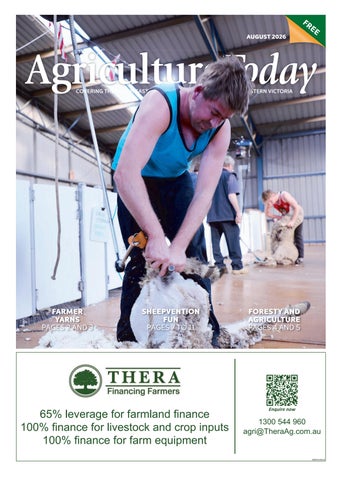
FARMER YARNS PAGES 2 AND 3
SHEEPVENTION FUN PAGES 7 TO 11
65% leverage for farmland finance 100% finance for livestock and crop inputs 100% finance for farm equipment
FORESTY AND AGRICULTURE PAGES 4 AND 5
ŶƋƵŝƌĞ ŶŽǁ
1300 544 960 agri@TheraAg.com.au
12882444-EA28-26
AGRICULTURE TODAY
Beautiful Bogan in the Mount CHARLOTTE VARCOE THE Beautiful Bogan brought his belly laughs to the Mount Gambier and Districts Saleyards as part of this year’s Yarns Over the Yardrails. Marc Ryan travelled from Adelaide’s northern suburbs to the Limestone Coast, providing a comedic take on mental health.
Mr Ryan entertained the crowd with his witty and dark sense of humour while also relating to some of his own darkest moments throughout his life. He said it was good to be able to talk about things and get a message out there all while breaking the stigma around mental health. “Laughing shows us that not everything is
Tracey speaks on help CHARLOTTE VARCOE YARNS Over the Yardrail attendees were treated to a short and sharp reminder of where to seek help from. Focus One Mount Gambier Medicare Mental Health Centre manager Tracey Wanganeen shared what services were available to the full room. Held last month, Yarns Over the Yardrail promoted mental health support and space for those of all walks of life to listen, connect and share a feed at the Mount Gambier and Districts Saleyards. Ms Wanganeen said people often did not know what services were available nor how to find them. “We [Mount Gambier Medicare Mental Health Centre] can help with service navigation to the right service if we are not it,” Ms Wanganeen said. “People can just walk in and if now is the moment you think you need to talk to someone about that, you can just walk in.” She said appointments were also an option
The Border Watch Address: Level 1 / 1 Commercial Street East, Mt Gambier SA 5290 Telephone: 08 8741 8170 Website: www.borderwatch.com.au Hamilton Spectator Address: 84 Gray Street, Hamilton, Vic 3300 Telephone: 03 5572 1011 Website: www.hamiltonspectator.com.au Portland Observer Address: 92 Percy Street, Portland, VIC 3305 Telephone: 03 5522 3000 Website: www.portlandobserver.com.au CONTACT US Editorial: Email: editorial@agtoday.com.au EDITORS: Elisabeth Champion E: elisabethchampion@tbwtoday.com.au Marlene Punton E: marlene.punton@portlandobserver.com.au
for those who needed to work around school pick ups or other life events. “If it suits people to make an appointment we can do that as well and it is just important for people to look after their own mental health and not let the issues which become so big that it is hard to get help,” she said. Speaking on the event, Ms Wanganeen encouraged people needing to speak up to seek help sooner rather than later, giving them a chance to “unpack what is going on” and prevent it from “blowing into something bigger”. “I think our younger generation are getting better at seeking help, however I have noticed in the three years our centre has been open we are having a lot of men come through the door of all ages,” she said. “We are an 18-years and older service and we are getting men from 18-years all the way to 80-years.” Ms Wanganeen also noted the benefits of not having to make an appointment was a benefit for men, allowing them to just walk in. “If you are thinking about it now, you need to do it now and that sort of thing resonates with men,” she said. “We know a lot of people are coming in because it is word of mount as well, someone else has said they have been there and it breaks down the concern for people as well.” Ms Wanganeen said people were also able to come in with a support person whether it be a friend or a paid carer. “Whatever brings them through the door we will work with,” she said. She also welcomed the Yarns Over the Yardrails event stating it was a good opportunity to bring things to people’s attention in a “relaxed atmosphere”. “It allows everybody to get information without feeling like it is being directed at them,” she said. Focus One Mount Gambier Medicare Mental Health Centre is located at 7/165 Commercial Street East and is open Monday to Friday from 9am until 5pm.
bad, it is a contract between dark and light and if we can laugh then we know there is some hope in the world,” Mr Ryan said. “Hopefully laughter brings some of the hope back.” He said throughout the event, Mr Ryan also learnt about carbon in the soil as well as succession planning, things he would not have the
opportunity to learn about in the metropolitan setting. “What I take away from most events is that we are getting back to community events and getting off our phones and actually just being present in the same building together which is lovely,” he said. “It has been good fun in Mount Gambier.”
Get eID ready with practical new resources SOUTH Australian sheep and goat producers can access practical resources to help them make the switch from visual tags to electronic identification (eID) tags. Developed by the Department of Primary Industries and Regions (PIRSA) through the eID Advantage Program, the new suite of traceability videos and producer case studies showcase how eID is already being used on South Australian farms and across the supply chain to improve livestock management and traceability. Drawing on practical, real-world experiences, the producer case studies have been designed to help producers confidently adopt eID and make the most of the technology in their businesses. From 1 January 2027, all sheep and
farmed goats must have a National Livestock Identification System (NLIS) accredited eID tag before leaving a property. Currently, eID is mandatory for sheep and farmed goats born on or after 1 January 2025 before they leave their property of birth. Producers can access a 47.5-cent point-of-sale discount on NLIS-accredited eID tags in the designated year-of-birth: orange for animals born in 2026 and light green for animals born in 2027. A rebate is available for approved eID tags in nonyear-of-birth colours until 30 June 2027. Producers are encouraged to visit the PIRSA website to explore the new videos and producer case studies and access more information about tag discounts, rebates and the transition to eID at pir. sa.gov.au/eID.
A lamb and a kid with ear tags.
Prime Lamb
Advertising: Email: advertising@agtoday.com.au
ADVERTISING CONSULTANTS Leesa Cook E: leesa.cook@portlandobserver.com.au Sierra Laird E: sierra.laird@portlandobserver.com.au Shannon Benge E: shannon.benge@hamiltonspectator.com.au Christine Cock E: christine.cock@tbwtoday.com.au Christine Black E: christine.black@tbwtoday.com.au Josh Phelan E: josh.phelan@tbwtoday.com.au
Published by SA Today Pty Ltd. ACN 644 311 937
! " # $ " % &
2 AG TODAY | AUGUST 2026
Christine Black: christine.black@tbwtoday.com.au Christine Cock: christine.cock@tbwtoday.com.au Josh Phelan: josh.phelan@tbwtoday.com.au
12785817-RV29-25
12890504-AF33-26
All material is copyright to SA Today Pty Ltd. All significant errors will be corrected as soon as possible. Distribution numbers, areas and coverage are estimates only. For our terms and conditions, please visit https://borderwatch.com.au/terms-and-conditions/
AGRICULTURE TODAY
Talking about carbon credits BY CHARLOTTE VARCOE CARBON credits was a hot topic at this year’s Yarns Over the Yardrails with Peel Pastoral’s Todd Woodward speaking to attendees on its benefits. Mr Woodard noted his personal experience with carbon credits and carbon projects on his farm just shy of Naracoorte. During the event, Mr Woodard spoke about his journey through the carbon project, building carbon in the ground and what it entailed. He also spoke on the benefits he discovered during the journey. “We went from the concept of what we wanted to achieve and then the process before touching on the outcomes we got and what benefits it has given us as a business and a family,” Mr Woodard said. “The benefits are huge, it is seriously the missing link in a lot of soils which have not got a lot of carbon.” He said while some farms and areas had terrific carbon levels, it was still important to identify levels which were already in the soil as well as levels needed. “In a lot of cases that is the limiting factor which is stopping you from increasing your production,” he said. “People need to start by understanding where their levels are at to start with and if you are really keen and want to measure it because you think there is some benefit there for you, they can go and have a look at a carbon project or talk to the clean energy regulator to get a carbon project up and going.’’ He said farmers would be able to have their carbon projects managed by someone else or
Peel Pastoral’s Todd Woodard spoke to the audience on the benefits of carbon farming. (Charlotte Varcoe)
gain help and advice on where to start. He also noted the increase in carbon projects and its popularity due to soaring prices. ‘The carbon price has gone from $8 to $38 in the last seven years so there is a lot more interest, there is a lot more of a demand for it from companies and businesses as well as industries which are emitting carbon and who
need to offset that carbon by offsetting those emissions and buying carbon credits,” Mr Woodard said. “The carbon is locked in the soil, you use plants and animals to lock it in there and increase the carbon in the soil. “Once it is in there the only way you can unlock it is to maybe mine it or turn your soil all
OF OUR BUSINESS COMES FROM REPEAT AND REFERRAL CUSTOMERS*
LARGE OPEN ENDED $48,720 INC GST 15M x 31.5M x 5.1M (50’ x 105’ x 17’)
OPEN & SECURE
ONLY
$45,970 INC GST
Concongella, VIC, 3384 Includes a roller door and PA door
AUSSIE SHELTER
1XPEHUV WDNHQ IURP VDOHV GXULQJ WKH FDOHQGDU \HDU b
LARGE OPEN ENDED
ONLY
$48,720
ONLY
$35,570 INC GST
ONLY
$29,050 INC GST
Wondai, QLD, 4606 18M x 18M x 5.1M (60’ x 60’ x 17’) Great farm shed with easy access from both ends. Price listed in Zinc, Colorbond extra.
ONLY
$19,650 INC GST
SECURE INDUSTRIAL
Roma, QLD, 4455
15M x 31.5M x 5.1M (50’ x 105’ x 17’) Lots of storage space with easy access. Add an extra bay for $6,290.
AUSTRALIAN TREASURE PLUS
FARM SAVER
INC GST
Dabee, NSW, 2849
9M x 30M x 5M (30’ x 100’ x 16’8”) Three sided protection with four 6M open bays plus enclosed & lockable 6M bay. Includes roller door & PA door. Extend to 13M (43’) wide version $59,310 or 15M (50’) wide version $65,870.
the way over and release it.” He said farmers would be able to seal the credit produced from the carbon while the carbon itself remained in the soil. “As a farmer that is pretty cool because you are selling something but still keeping it and it is still working for you, improving the soil and increasing production,” Mr Woodard said.
10M x 22.5M x 5.1M (33’ x 75’ x 17’) 10M openings at both ends. A treasure! . Add an extra bay for $5,210.
INC GST
ONLY
$32,670 INC GST
Full Colorbond included
9M x 13.5M x 4.5M (30’ x 45’ x 15’) Open front three-bay shed. Priced in Zinc, Colorbond extra. Add an extra bay for $4,230.
THE MAN CAVE
EASY ACCESS
ONLY
$54,600
ONLY
$42,590 INC GST
13M x 22.5M x 5.1M (43’ x 75’ x 17’) Perfect shed for securing large machinery or vehicles. Includes a 5.1M H x 3.95M roller door, a second 4.2M H x 3.1M roller door and PA door. Full Colorbond included.
ROBUST INDUSTRIAL
9M x 24M x 5M (30’ x 80’ x 16’8”) Four large 6M bays to suit all storage needs. Extend to 13M (43’) wide for an extra $10,520 or 5.7M (19’) high version for $34,980.
HUGE BAYS, GREAT HEIGHTS
ONLY
$50,550 INC GST
Lyrup, SA, 5343
Geraldton, WA, 6350
10M x 20M x 3.9M (33’ x 66’ x 13’) Three 3.3M high roller doors plus a PA door. Ideal shed for a secure workshop (or man cave/she shed). Price in Colorbond.
15M x 18M x 5.1M (50’ x 60’ x 17’) Quality industrial grade building, including a 5M H x 4.2M industrial roller door in the centre, a second 3M x 3M roller door and a PA door. Price listed in Colorbond.
ONLY
$134,370 INC GST
20M x 45M x 6.4M (66’ x 147’ x 21’) So many options with these 5 large bays and extra height.
MANUFACTURING LOCATIONS: VIC: LYNDHURST, GEELONG AND ALBURY SA: NOVAR GARDENS (DELIVERY AVAILABLE TO MOST AREAS) 100% Australian steel, 100% Australian made, 100% Australian family owned High tensile bolts & class 4 fasteners, gutters & downpipes included 6LWH VSHFLF HQJLQHHULQJ KHDY\ GXW\ FRQQHFWLRQ IRRWLQJ GHVLJQ High grade industrial strength materials and design
CALL ON 1300 491 839 REILLY 0459 259 920
WEB: www.nowbuildings.com.au
JAMES 0413 104 820
JOHN 0437 699 111
Images are from the Now Buildings range, for illustration purposes only. Imperial measurements are approximate. Shed price only. WA, NT & TAS slightly extra. Prices are based on collection, delivery extra. Extras pricing in bold is applicable at the shed purchase stage only. Extensions for H[LVWLQJ VKHGV 32$ 1RZ %XLOGLQJV ZLOO QRW EH UHVSRQVLEOH WR KRQRXU WKHVH SULFHV RQFH WKH WRWDO DOORFDWLRQ KDV EHHQ VROG ( 2( 3ULFHV DUH 5HJLRQ $ 7HUUDLQ FDW 5HJ % VOLJKWO\ H[WUD &XVWRPHUV VKRXOG VHHN LQGHSHQGHQW QDQFLDO DGYLFH UHJDUGLQJ DQ\ SRWHQWLDO WD[ EHQHWV
12890403-KF33-26
THE NOW BUILDINGS ADVANTAGE
AUGUST 2026 | AG TODAY 3
AGRICULTURE TODAY
Forests, farms, wildlife, water PATRICK MACKARNESS FARMERS are forever being burdened with red tape and compliance demands. These can drag on productivity and detract from rural life. Sometimes, however, controls protect farmers and landowners from competing uses that impose costs on agriculture, water and the wider landscape. Across the Green Triangle and Limestone Coast, the relationship between farming, plantation forestry, water and biodiversity is becoming more complicated. A major change now under way - the conversion of some bluegum plantations to radiata pine - brings these issues together. In simple terms, farming and forestry compete for land and water; pine has a strong domestic construction market and can attract carbon advantages from a longer rotation; and blue gum provides food and habitat for koalas that pine does not. The prospect of a substantially smaller blue-gum estate therefore raises questions extending well beyond timber economics. A central policy question is whether largescale plantation forestry should remain, in effect, a relatively unconstrained rural land use, or whether regulators should distinguish more clearly between plantation species and their cumulative effects. Planning rules: permitted does not mean unregulated In Victoria, ‘timber production’ is a defined use under the planning provisions. In many Farming Zone schedules, no maximum permit-free plantation area is specified. Where the relevant conditions are met, plantation establishment can therefore occur without a conventional planning permit for the use itself. That does not mean there are no rules: setbacks, overlays, earthworks provisions, the Code of Practice for Timber Production, road and waterway protections, and later Timber Harvesting Plans can still apply.[1] South Australia operates under the statewide Planning and Design Code. Forestry is addressed through rural zoning, overlays and general forestry policies, while the precise assessment pathway depends on the site’s zone, water-resource status and other overlays.[2] In the Lower Limestone Coast, commercial forestry also intersects with a separate and unusually explicit water-licensing regime. The contrast with ordinary agriculture is worth examining. A shift between sheep, beef, cropping and dairying can have environmental consequences, but it rarely transforms an entire district’s tree cover, wildlife carrying capacity, hydrology, fire profile and road use in the way that thousands of hectares of plantation establishment or species conversion can.
The MIS legacy The hardwood estate expanded rapidly from the late 1990s and through the 2000s. Tax-effective Managed Investment Schemes channelled large amounts of outside capital into short-rotation blue-gum plantations. Many schemes later collapsed or were restructured, leaving investors with heavy losses and a plantation estate that passed increasingly into professional institutional management. It is too sweeping to say that every MIS failed, but the forestry MIS era remains a warning about tax-driven investment outrunning realistic land selection, biological growth rates, processing capacity and market assumptions. Some poorer sites were returned to agriculture after harvest; better estates were consolidated by specialist forestry and investment managers. Blue-gum chips continue to be exported through Portland and other ports. Blue-gum chip prices have also been more exposed to export pulp markets and exchangerate movements than pine logs sold into domestic processing. This does not prove that blue gum is now generally less profitable on every site, but it helps explain why owners with access to domestic sawmilling and carbon income may favour pine. OneFortyOne’s conversion program The clearest current example is OneFortyOne. On 30 May 2025 it completed the acquisition of Limestone Forest Estate. The purchase included about 14,800 hectares of mixed blue-gum and radiata-pine plantation resource or plantable land within approximately 20,500 hectares of associated freehold land in the Green Triangle and Western Australia.[3] OneFortyOne subsequently said blue gum comprised about 75 per cent of the acquired plantation resource and that it planned to convert the majority to radiata pine over approximately five years.[4] Its publicly stated reasons were demand for structural timber, supply to the Jubilee sawmill at Mount Gambier, a roughly 30-year pine
thorisation and operate under a recognised Koala Management Plan. Trained spotters must be used; at least nine live trees or relevant stumps must be retained around each detected koala; incidents must be reported; and welfare checks continue up to 10 or 11 days after operations.[8] These rules are directed chiefly at preventing injury during harvesting. They do not guarantee that the receiving habitat can feed the displaced animals for years. Nor do they appear to require permanent replacement eucalypt habitat when the site is converted to pine. A harvest can therefore comply operationally while the district’s long-term koala carrying capacity falls. The likely consequences are crowding in remaining eucalypts, increased road crossings, dog attacks, poorer condition and eventual population contraction to match the reduced food supply. Relocation and fertility control may be proposed, but these are expensive responses to a landscape problem created partly by earlier policy settings. Birds and other wildlife Blue-gum plantations are not substitutes for native woodland. They lack old hollows, diverse understoreys and the structural complexity required by many species. Nevertheless, when established on cleared pasture they can provide canopy, insects, nectar, shelter and movement habitat for numerous native birds. A 2025 study of blue-gum plantation landscapes in south-west Victoria recorded 107 bird species and more than 25,000 bird observations. Native remnants remained the better habitat for many species, but the research confirmed that blue gum plantation landscapes support a substantial native bird assemblage and that retained native vegetation is critically important.[9] Radiata pine is not biologically sterile, and some cockatoos and adaptable forest birds use it. But pine generally provides fewer resources for eucalypt-associated nectar feeders, foliage insectivores and smaller woodland birds. Sugar gliders may use pine as sheltered movement cover between native remnants, yet still depend on native eucalypts for food and tree hollows. Pines just don’t hack it in the biodiversity stakes but, unfortunately we can’t afford to do away with them. Farmland conversion and the Tasmanian warning There are reports of forestry interests acquiring some lower-performing farmland in the Green Triangle and Limestone Coast, but the scale of purchases specifically for new pine planting is not publicly quantified.
CONTINUED PAGE 5
REAL ESTATE
Railway vineyard - Ravenswood Lane, Coonawarra For Sale - Two Allotments - $25,000 per ha
Bellairs vineyard - V & A Lane, Coonawarra For Sale - Two Allotments - $20,000 per ha
McBain vineyard - Mc Bain Road, Coonawarra For Sale - $20,000 per ha
Allotment 10 - (4.452 ha) Allotment 11 - (4.453 ha) Close to the township of Penola with power connected, ideally suited to lifestyle residential development (STCA) within 3km of town with good access and picturesque views. Or an opportunity to bring your own water licence and retain the site as a vineyard with set frost irrigation.
Allotment 10 - (18.70ha) Allotment 300 - (14.54ha) Strong sandy loam soils with picturesque gum trees surrounding the sites with both lifestyle appeal as well as several repurposing opportunities. The vineyards could be retained if desired. There is a quality bore with diesel turbine dripper pump.
Approx (57.3ha) subject to boundary realignment Strong fertile soils with excellent cropping and grazing potential. Sheltered site with fodder potential, or repurposing possibility to various horticulture, or agriculture pursuits. Productive land with good access and location benefit. The lot also has five Bores.
Michael Wetherall 0438 372 104
Michael Wetherall 0438 372 104
Michael Wetherall 0438 372 104
4 AG TODAY | AUGUST 2026
12883860-MS33-26
LIVESTOCK
Across the Green Triangle and Limestone Coast, the relationship between farming, plantation forestry, water and biodiversity is becoming more complicated. (Supplied)
rotation, carbon-credit benefits from longer carbon storage, and pine’s greater tolerance of drying conditions on some sites. Those reasons are commercially understandable. Australia urgently needs structural timber for housing. Pine also fits OneFortyOne’s existing processing system. However, the change is not ecologically neutral. The Commonwealth Plantation Forestry ACCU Method allows eligible projects to earn credits when short-rotation plantations are converted to longer rotations, provided the method’s conditions are met. The project must demonstrate additional carbon above the baseline, and the new rotation must be at least ten years longer, with thinning or pruning requirements.[5] The method measures carbon, not the habitat value lost when a blue-gum feeding resource becomes pine. OneFortyOne has not publicly said that koala-protection costs drove its decision. Nevertheless, Victorian blue-gum operations face costs that pine generally does not: koala surveys and management plans, trained spotters, operational delays, retained trees, reporting and post-harvest welfare checks. These costs create an obvious economic distinction between the species, even though their precise influence on investment decisions is not publicly quantified. Blue gums and the koala population The expansion of blue gums radically increased koala habitat in south-west Victoria. A 2019 landscape study reported about 130,000 hectares of blue-gum plantation in the Green Triangle, including roughly 80,000 hectares within the Victorian koala distribution area. Much of this was established on previously cleared agricultural land that had provided little resident koala habitat.[6] There is no reliable before-and-after regional census beginning in 1997. Even so, field studies, habitat mapping and expert estimates point to a very large increase. A recent estimate placed about 42,500 koalas in south-west Victorian blue-gum plantations, while approximately 8,000 to 10,000 hectares are harvested each year.[7] Using published plantation-density observations gives a plausible order-of- magnitude increase of tens of thousands of animals, rather than a precise count. The biological distinction between species is stark. Blue gum is a preferred food tree. Radiata pine is not edible by koalas at all. When a blue-gum block is harvested and replanted to pine, its former koalas must move into native remnants, roadside gums, creek lines, neighbouring blue gums or scattered farm trees. Victorian rules require plantation managers likely to disturb koalas to obtain an au-
AGRICULTURE TODAY
The more clearly documented current change is conversion within existing plantation estates and the use of ACCU projects to keep some harvested plantation land in forestry rather than returning it to agriculture. A much larger warning comes from Tasmania. In July 2026, the Commonwealth approved the sale of Rushy Lagoon and East Wyambi, totalling 21,745 hectares, to a fund managed by UK-based Gresham House for more than $100 million. The purchaser said it intended pine planting on lower-productivity land alongside continued grazing, conservation and restoration.[10] This is not a Green Triangle transaction, but it illustrates the capacity of forestry and carbon capital to compete directly for very large agricultural holdings. Water: two states, two systems Blue gum should not simply be labelled more water-demanding than pine in every circumstance. Both plantation systems use substantially more of the available water than dryland pasture, and their relative effect varies with rotation, age, thinning, soil and depth to groundwater. South Australia deals with the issue explicitly. The Lower Limestone Coast Water Allocation Plan manages commercial plantation impacts through water licensing. Its regulatory assumptions distinguish recharge interception from direct uptake of shallow groundwater. The plan has used rotation-average coefficients under which pine intercepts a slightly higher proportion of recharge than blue gum, while blue gum may have slightly higher direct groundwater uptake where the water table is accessible.[11] New or expanded commercial forestry therefore needs sufficient water allocation under the applicable regime. Victoria does not impose an equivalent plantation water entitlement merely because tree roots intercept recharge or draw groundwater. Instead, plantation water effects are addressed indirectly through planning, catchment policy, waterway buffers and timber-production standards. Victorian paired-catchment research at Gatum, Digby and Mirranatwa compared blue-gum plantation catchments with farmed catchments under different geological settings. The studies confirmed increased evapotranspiration and, at some sites, reduced streamflow, reduced groundwater recharge and longer periods without streamflow. At Gatum, the plantation catchment produced less than half the streamflow of the neighbouring farmed catchment and flowed for a much smaller proportion of the monitoring period.[12] For farmers, this can translate into weaker creek flows, less baseflow and reduced inflow to catchment dams. The effect is not uniform: south-west Victoria’s undulating terrain, duplex soils, basalt, limestone, fractured rock and groundwater systems produce markedly different results from site to site. But the evidence is sufficient to show that plantation establishment can impose hydrological effects beyond the planted title. A case for clearer controls The emerging issue is not whether Australia needs plantation forestry. It plainly does. Nor is the issue a simple contest between virtuous farming and harmful trees. Well-managed plantations supply renewable timber, store carbon and can provide environmental benefits compared with cleared land. The harder question is whether present controls recognise the material differences between blue gum and pine, and whether they assess cumulative effects across an entire landscape. A carbon method may reward a longer pine rotation; wildlife rules may minimise immediate harvesting injuries; and planning rules may treat both species as timber production. Each system can operate as intended while the combined outcome is a loss of koala food, changed bird habitat, reduced agricultural land and altered catchment yield. Farmers reasonably seek fewer unnecessary controls. They also require a level playing field when other industries compete for productive land and water or transfer costs to neighbouring properties and the community. The strongest case is not for a blanket ban on plantation expansion or species change, but for transparency, mapped monitoring and targeted assessment where large conversions may materially affect agricultural capacity, water resources or established wildlife populations. At minimum, governments need reliable annual figures showing hectares moving from
agriculture to blue gum, agriculture to pine, blue gum to pine and plantation land back to farming. Without those flows, policy is being made without a clear view of the landscape change already under way.
References [1] Victorian Government, Victoria Planning Provisions, Clause 35.07 Farming Zone and relevant municipal schedules; Victorian Government, Code of Practice for Timber Production 2014. [2] Government of South Australia, Planning and Design Code, Rural Zone, Forestry general development policies and applicable overlays, version current July 2026. [3] OneFortyOne, ‘OneFortyOne announces largest Australian forestry land acquisition in a decade’, 2 June 2025. [4] ABC Rural, ‘Forestry companies shift focus to pine to meet demand for housing
timber’, 5 June 2025. [5] Clean Energy Regulator, Plantation Forestry Method 2022: project activities, eligibility and 25-year crediting period. [6] Ashman, K.R. and Watchorn, D.J. (2019), ‘Quantifying landscape change as a consequence of plantation forestry expansion: a case study of the Koala Zone in south-west Victoria’, Australian Forestry, 82(2), 116-122. [7] The Guardian Australia, ‘Koalas face death, attacks and starvation as blue gums chopped down in Victoria’, 11 May 2025, reporting estimates by Dr Desley Whisson and other specialists. [8] Victorian Conservation Regulator, Minimising impacts to Koalas in blue gum plantations: Regulatory Guide, June 2023; and ‘Koalas in blue gum plantations’, updated 2026.
[9] Thompson, E., Keenan, R.J. and Kelly, L.T. (2025), study of bird occurrence across blue-gum plantation landscapes in southwest Victoria, Landscape Ecology. [10] ABC News, ‘Sale of Tasmania’s biggest farm, Rushy Lagoon, to UK pine plantation investor approved’, 8 July 2026. [11] Limestone Coast Landscape Board, Lower Limestone Coast Water Allocation Plan and current amendment information; Government of South Australia forest-water licensing guidance. [12] Victorian Government research report, Catchment Scale Impacts of Land Use in South-West Victoria, paired plantation and pasture catchment studies at Gatum, Digby and Mirranatwa.
Complete your Census now. It‘s not too late.
12871731-RV33-26
FROM PAGE 4
Census night was Tuesday 11 August. It’s compulsory for each household to complete the Census to help plan for Australia’s future. For help, visit census.abs.gov.au or call 1800 181 227.
Every answer matters. Authorised by the Australian Bureau of Statistics, Canberra AUGUST 2026 | AG TODAY 5
AGRICULTURE TODAY
Tractor safety A FATHER and son from Gippsland are highlighting the importance of working safely on and around tractors as WorkSafe publishes new resources to support farmers. What began as a routine day on the family’s 700-acre property in the Latrobe Valley nearly ended in tragedy when 21-year-old Aydan Garrett suffered life-threatening injuries after the tractor he was operating collided with the bucket of a front-end loader. Six years on, Aydan remembers little of the incident that nearly killed him, but for his fa-
Tractors are a major safety risk for farmers.
Worried, stressed, or overwhelmed? Check in on your mental health with free access to new online self-guided tools. Plus telehealth ˦˨ˣˣˢ˥˧ ˙˥ˢˠ ˤ˨˔˟˜Ѓ˘˗ ˠ˘ˡ˧˔˟ ˛˘˔˟˧˛ ˣ˥˔˖˧˜˧˜ˢˡ˘˥˦ʡ
mentalhealthcheckin.gov.au 1800 595 212 8:30am – 5pm weekdays (except public holidays)
Authorised by the Australian Government, Canberra. 12873236-MS33-26
6 AG TODAY | AUGUST 2026
ther Brendan, the memories remain vivid. “In the distance I saw him hanging out the back of the tractor and the adrenaline started to kick in. That’s when I sprinted towards him,” Brendan said. “When I got there the tractor was still running. I saw Aydan’s head split open with blood everywhere. There was smashed glass, so I knew he’d got thrown around in the cabin.” Sustaining eight broken vertebrae, a traumatic brain injury, multiple skull and sternum fractures and a permanent deep depression in his skull, Aydan said the road to recovery was long. “It took the paramedics about four hours just to get me out of the tractor,” he said. “I was in hospital for five weeks after major spinal fusion surgery and it took me another three years to get back working full-time.” “Even now I still struggle with lifting and bending over, and managing pain and fatigue.” Tractors remain the leading factor of workplace harm on farms and have been involved in eight fatal incidents since the start of 2025. Common hazards include starting tractors from the ground, connecting attachments, operating near people, and getting on or off a moving tractor — all of which have resulted in deaths and serious injury. Victorian WorkSafe Chief Health and Safety Officer Sam Jenkin said while tractors were an essential part of daily farm work, they could become deadly in seconds. “Through experience and familiarity with the work, farmers can become desensitised to safety hazards – normalising risks instead of treating them as preventable dangers,” Mr Jenkin said. “Every year, families and their communities are devastated by incidents that could have been prevented if the right safety measures and processes were in place.” Since 2021, there have been 39 work-related fatalities in the agriculture industry, including six this year, while 2937 agriculture workers – an average of 10 every week – have been injured. Aydan and Brendan shared their story for the recent National Farm Safety Week to show how simple safety measures can spare families from life-changing incidents. “It was a big wake-up call. You realise things can go wrong pretty quickly,” Aydan said. “Since then, we’ve become a lot more conscious of all our equipment. We’ve got pre-start checklists for machinery, and we always make sure we’re using the safety features on our vehicles and machinery like PTO covers, rollover protection and seatbelts.” This year’s theme, Set the Standard: Show ‘em how it’s done, asks farmers to lead by example and model safe behaviours that can be passed down through generations. “I never want to see my son, or anyone else, go through something like that again,” Brendan said. “People find some safety requirements a burden or costly, but when you see your son unconscious with barely any signs of life, or when a massive ambulance bill comes your way, you realise working towards a safer farm is worth everything.” National Farm Safety Week is the perfect time to review practices, check machinery and equipment, and start a conversation about the importance of safety with workers, family and fellow farmers. “A family farm can be passed down for generations, but only if the people who work on it are protected through a strong safety culture,” Mr Jenkin said. “One small safety step today could save a life tomorrow.” WorkSafe has been working closely with the agriculture industry to develop and publish fresh, practical information for farmers – including new resources on tractor stability and runover prevention, which are available now.
AGRICULTURE TODAY
Celebrate Sheepvention success THIS year’s annual Sheepvention has been hailed as an overwhelming success with outgoing President Darren Schurmann describing this year’s rural expo as “outstanding.” Kicking off the event, the fashion parade on Saturday evening featured local, models and designers alongside prominent brands like S. Kidman and Co. and Driza-Bone. Mr Schurmann called it, “the absolutely the perfect way to start off Sheepvention.” After a quiet showing last year, the Sheepvention Inventions category had a massive turn out of backyard inventors and farm shed tinkerers who came up with some innovative solutions to modern problems. Attendees at the 4th annual Peter Schroder lecture were challenged by presenter and respected journalist Chris Uhlmann on the push to renewables and its affects on national security, with the well-researched presentation a major talking point among the crowd. Later that night on national television, Mr Uhlmann praised the event and “put Hamilton on the map,” encouraging people to attend next year’s Sheepvention. The 2026 event marks the end of Mr Schurmann’s successful two-year tenure as president. He confirmed he will be handing the reins to Will Crawford, a local Merino breeder whose family has been long-time contributors to the region and Sheepvention. Both Mr Schurmann and Event Manager Mikayla Rice extended their immense gratitude to the many sponsors and the dedicated volunteer team. Ms Rice echoed Mr Schurmann’s sentiments on the event’s overall success.
CONTINUED PAGE 8
Crowd getting excited for the fashion show.
From Cordilly Park, Julie Delcort, with her winning rams in the Valais Blacknose.
Crowds on Sunday.
Dzira Bone Collection, S Kidman.
Kilmaille
Collection from A W
Quality machinery built with pride
The crew at Truline Machinery. (Supplied)
Truline has the flexibility to customise designs and provide practical solutions that suit individual farming operations, helping improve efficiency and make everyday tasks easier. Quality is at the heart of everything Truline does. Every machine is built with no shortcuts taken, using premium manufacturing processes including individual component preparation, zinc priming, and powder coating to achieve a superior finish and long-lasting protection. As a long-standing Australian manufacturer, Truline Machinery remains committed to building strong relationships with its customers and providing the support and service they need throughout the lifetime of their machines. The team at Truline Machinery looks forward to connecting with farmers, industry members, and visitors at Sheepvention Hamilton, showcasing the quality, craftsmanship, and innovation that goes into every machine built in their Victorian workshop.
12890978-LD33-26
FOR more than 60 years, Truline Machinery has been proud to play a part in Australian agriculture, designing and manufacturing machinery that helps farmers get the job done. Since 1962, Truline has remained committed to one simple philosophy — build machinery of exceptional quality that farmers can rely on. Based in Victoria and locally owned, every Truline machine is proudly manufactured in-house, allowing the team to maintain complete control over workmanship, quality, and attention to detail. From the initial design through to fabrication and finishing, each component is carefully produced to ensure strength, longevity, reliability, and ease of use in the paddock. Truline’s range of hay feeders and farming implements has been developed by listening to farmers and understanding the challenges they face every day. By working directly with customers,
1300 776 848 www.trulinemachinery.com.au AUGUST 2026 | AG TODAY 7
AGRICULTURE TODAY
Trusted partners for 78 years ADVERTORIAL SINCE 1948, Fox & Lillie Rural has been a trusted partner to Australian producers, providing expert advice and practical solutions primarily across wool brokerage and export and more recently livestock and property services. With an extensive network of regional stores and experienced wool, livestock and real estate representatives, the business is committed to helping growers achieve the best possible outcomes for their enterprises. At the core of Fox & Lillie Rural is a deep understanding of the wool industry. The company offers a range of straightforward and innovative wool marketing options, supported
by market intelligence and personalised service. These include weekly auction selling, direct wool buying, wool brokerage, direct wool supply contracts, forward contracts, Price on AWTA Test Result (POR) and Wool trade internet selling. Through the integration and support of Fox & Lillie’s export division, growers benefit from enhanced market access and tailored marketing solutions designed to maximise returns. Building on its strong wool industry foundations, Fox & Lillie Rural has also developed a respected livestock division, providing Australian producers with a range of livestock marketing and selling options. Supported by experienced livestock representatives and ex-
tensive industry networks, the team delivers premium advice and service across a broad range of livestock enterprises. Fox & Lillie Rural is also an accredited member of the RMA Network, an association of independently owned livestock and property agents. Further strengthening its service offering, Fox & Lillie Rural is now a licensed real estate agency in both Victoria, New South Wales and South Australia, providing advice and support for the sale and lease of rural property. Backed by more than 75 years of experience in the rural sector, the business continues to connect producers with opportunities while delivering trusted advice, strong industry relationships and a commitment to regional Australia.
Fox and Lillie Rural at a recent Sheepvention.
Sheepvention attracts big crowd FROM PAGE 7
Sheep judging. Sheep judging.
Shearing comp, Lachie Stevenson from Brit Brit.
Suzanne Holme, from Willow Drive, Grassmere with her Champion Ewe, in the South Suffolk.
Rob Bast creating a wood sculpture with his chainsaw.
Lachie Stevenson on the shears during the shearing competition.
Having a go at the Farmers Challenge, a new event for Sheepvention.
CONTINUED PAGE 9
12875214-RV33-26
Reserve Champion Ram in the South Suffolk owners Damon and Barry Shalders, Willow Drive, Grassmere.
8 AG TODAY | AUGUST 2026
AGRICULTURE TODAY
The top terminal sires ADVERTORIAL BRUAN Poll Dorsets are dedicated to breeding top genetics for the prime lamb industry. Situated at Condah, Victoria in the heartland of the south west, the Bruan Poll Dorset stud produces the very top of industry terminal sires. Their annual sale is held every 3rd Monday in October giving clients and new buyers the opportunity to purchase top ranked sires. Currently on Sheep Genetics, Bruan have the 1st and 3rd ranked highest rams for LEQ for the 2025 drop (Poll Dorsets) in Australia.
At Bruan phenotype is also paramount, muscle and length of loin, teeth, toes and testicles are all very important in selection. Genomic testing and Lambplan ASBV’s help clients to identify the best sires for their specific needs. At Bruan we are particular at collecting accurate data, which is quite intense. Birth weights, correct parentage, weaning weights, individual WEC, eye muscle depth, fat depth measurements and DNA on both rams and ewes. Genomics or DNA greatly improve the ac-
curacy of the data. All data collected is processed through the national data base Sheep Genetics for analyse. At Bruan we are commercially focused with Bruan rams used over their cross bred ewes to produce sucker lambs that hit the grids. Rams are not over fed and we are very aware of the balance to have sale rams presented well but not overdone. This has proved to be a challenge over the past few seasons due to seasonal challenges.
Braun Poll Dorsets are a standout.
Sheepvention success FROM PAGE 8
Having a go at the Farmers Challenge, a new event for Sheepvention.
Suzanne Holmes, Willow Drive, Grassmere, Reserve English Leicester Ram.
Paris Barker, Tayla Reid, 10, and Maddie Mayne. Father and Son Duo, Scott and Doug Mitchell from Culcairn, NSW, winning the April, May drop ram, Poll Dorset.
Liz Fenton with Di Fort at the fashion parade on Saturday night.
Showing off her wool handling skills, Briony Knoll.
Luke Robertson during the wool handling competition.
Ron Diamond, Melbourne, with his product Byron Nuts.
Millie Austin, Laura Chakir and Isabella Thomson, ready to walk. Guest MC Hugh Koch.
CONTINUED PAGE 10
• Genomic Testing • Lambplan Recorded • Structural Assessments • Health and Fertility • Phenotype and Performance • Commerial Focus • Honesty and Integrity • Depth of Genetics David and Colleen Gordon “Commercially Focused Seedstock Producers”
P: 0417 142 863 E: bruanpolldorsets@gmail.com www.bruan.com.au
Save the Date
12872227-AM30-26
Carramar Lincolns, Warrong, Champion Ram Lincolns, Zoe Askew.
Annual Ram Sale
Monday 19th October 2026 | on property at Condah AUGUST 2026 | AG TODAY 9
AGRICULTURE TODAY
The proof is in the paddock ADVERTORIAL “BORN in the paddock, not on a spreadsheet” is a phrase often heard at the Mount Monmot Perendale and Perendale/Poll Dorset sheep stud at Skipton — and it perfectly reflects the stud’s breeding philosophy. For the Mount Monmot team, sheep must perform both in the paddock and on paper. Strong figures are important, but ultimately the proof is in the paddock. “We are fortunate to have our foundation bloodlines from Newhaven Perendales, New Zealand’s largest registered Perendale stud,” says stud owner Trudy Boyer. The Mount Monmot stud has worked in genetic partnership with the New Zealand-based Newhaven stud for the past 16 years, united by a shared focus on breeding tough, resilient sheep that thrive in harsh conditions. The Newhaven stud now has a waiting list for their 500 sale rams sold annually due to demand for
At Mount Monmot all sale rams must meet strict selection standards, including resilience, low-input animal health, sound feet, good structure and quality wool.
their bloodlines. Based in the high and dry hills of Otago in New Zealand’s South Island, the Newhaven stud produces around 2,600 stud lambs annually. A defining feature of the operation is its
long-standing nil-drench policy — something the stud became known for back in the 1990s, well before drench resistance became a widespread industry concern. That foresight is now proving invaluable, with drench resistance affecting many sheep farms across New Zealand and Australia but their Perendale clients already have an in-built advantage against drench resistance due to their genetics. “It’s not just about nil or low drench; it’s about building resilient genetics,” explains Trudy. Mount Monmot breeding is centred around what Trudy describes as the “trifecta” — combining ewe fertility and mothering ability with lamb survival and strong growth rates, even in very dry seasons. As Perendales continue to gain popularity for their efficiency and low-input performance, the stud aims for every ewe to wean
her own bodyweight in lambs each year. “Efficient production drives profitability for our clients, no matter what the climate throws at them,” says Trudy. Responding to commercial demand, the stud has also developed a Poll Dorset/Perendale cross ram alongside its pure Perendale offering. “We wouldn’t offer anything for sale that we couldn’t stand behind in terms of quality and performance,” says Trudy. “We want to make sure we are producing the very best sheep for our clients.” Mount Monmot is taking orders now for their Perendale rams and Perendale-Poll Dorset rams, with their sale season kicking off in October. Contact Trudy and Tony Boyer to come and inspect their ram offering or to get your name on their mailing list on 0419 565 450 or 0429 402 127 or email mountmonmot@ gmail.com
Sheepvention success FROM PAGE 9
Leyland Seddon during the shearing competition.
Ziake
Flash IA Backstage with Tim Farquharson, Adam Giles and Gordon Last at the Fashion parade event on saturday night. A W Collection
Carlie Collection.
Catwalk ready, Liz Mecham with Kirstin Diprose.
Pure Perendale Performance Elite New Zealand Bloodlines :H DUH RHULQJ SXUH 3HUHQGDOH 5DPV DQG 3ROOGDOHV IRU LQVSHFWLRQ DQG SULYDWH VDOH IURP 2FWREHU VW
12875501-AD33-26
10 AG TODAY | AUGUST 2026
Winner of the White Suffolk’s Ram, May Drop, Guy Treweek from Wakool, NSW.
Dzira Bone Collection, S Kidman.
Enquiries: Trudy 0419 565 450 and Tony Boyer 0429 402 127 E: mountmonmot@gmail.com W: www.mountmonmot.com
REGISTERED STUD NO 144 | BRUCELLOSIS ACCN NO: 3669 | OJD VACCINATED
AGRICULTURE TODAY
Looking over the fence INTEGRATED workplace learning isn’t a buzz phrase at RIST (Rural Industries Skill Training Centre). It is deeply rooted throughout the curriculum which encompasses sheep, cropping, dairy, and beef. RIST students are hands-on in the field – from marking, vaccinating, implementing feeding plans and stock handling to assessing soil health and establishing pastures. It’s this direct exposure which sets RIST graduates apart. “Students spend 10 per cent of their time in classroom theory and 70 per cent immersing themselves in practicing their newly acquired knowledge on-farm. The remaining time is viewing best practice through visiting host farms and gaining firsthand experience working directly with employers,” said RIST Head of Student Experience, Helen Read. RIST CEO, Bill Hamill added, “Our staff have an unwavering commitment to providing on-farm experience, partnering with some of the most respected producers and industry experts in our region. Students walk through working properties, observe modern farming technology in action, and engage with producers at the leading edge of
their industries. That experience – the combination of innovation and lived reality – cannot be manufactured. It must be lived. And it is precisely that combination which gives our graduates their competitive edge.” RIST proximity to Agriculture Victoria at its Hamilton Campus gives students access to the important agronomy research being undertaken, and an operating dairy 30 metres from the doorstep of the Terang training facility. Students of all ages and varied life experience are enrolled at RIST. The small class sizes enable highly specialised staff to nurture student skills and develop them into highly employable graduates. RIST staff are available to discuss their Certificate and Diploma courses, Lifetime Ewe Management, Weaners for Profit, Heifers for Profit and their comprehensive Short Courses focused on safe work practices.
RIST students are hands-on in the field.
12877388-EB33-26
ADVERTORIAL
AUGUST 2026 | AG TODAY 11
AGRICULTURE TODAY
Make a plan WHEN a relationship ends, it often brings significant changes to living arrangements, finances and future plans. During this time, estate planning is frequently pushed down the priority list. However, reviewing your Will and related documents should be one of the first steps taken after separation. A common misconception is that separation automatically changes a person’s Will. It does not. If your estate planning documents are not updated, a former partner may still be named as a beneficiary, executor, attorney, trustee, or recipient of superannuation and life insurance benefits. This can be particularly important for farming families and business owners, where asset structures may include family trusts, companies, agricultural land, water licences and intergenerational succession arrangements. An outdated estate plan can create uncertainty, disputes and unintended outcomes if something happens before your affairs are formally updated. Even after separation, many couples remain legally married while property settlements, business arrangements and parenting matters are resolved. During this period, an existing Will may no longer reflect your wishes or current financial circumstances. It is also important to review how assets are owned. Property held as joint tenants, including farmland or the family home, may pass automatically to the surviving owner regardless of what a Will says. Similarly, superannuation benefits may not be distributed according to your Will unless appropriate nominations are in place.
Built here to last
Senior Associate at Mellor Olsson Lawyers Nestoras Alexandropoulos
These issues are not limited to married couples. Similar considerations apply when a de facto relationship ends. Separation, divorce and property settlement can each significantly alter your financial position. For that reason, your estate plan should be reviewed at every major stage to ensure it remains aligned with your wishes and continues to protect the people and assets that matter most. Mellor Olsson is a full-service law firm with experienced Family Law and Estate Planning teams who work together to provide practical guidance and support during major life transitions. We can help you navigate the challenges of separation while ensuring your affairs remain up to date and aligned with your wishes. For assistance, contact Mellor Olsson on (08) 8414 3400 or email lawyers@molawyers.com.au. Nestoras Alexandropoulos Senior Associate | Mellor Olsson Lawyers
WHEN investing in a new shed, it’s tempting to focus on price first. But what matters most in the long run is where that shed is made and the quality behind it. As overseas imports continue to flood the market, choosing an Australian made shed has never been more important. A family business backing local manufacturing since 2008 Now Buildings is one shed company proudly backing Australian manufacturing. Family owned and operated, Now Buildings holds Australian Made certification (the green and gold logo) across its entire range of steel sheds, a commitment held since 2008. The certification is independently verified by the not-for-profit Australian Made organisation, confirming the shed in your paddock was genuinely manufactured here using local suppliers and materials. Why “made here” matters more on the land Now Buildings works exclusively with Australian manufacturers and suppliers, partnering wherever possible with other family-owned businesses who share the same standards of accountability and longterm thinking. That matters because farm sheds don’t get an easy run: baking heat, hail, dust storms, and years housing machinery, hay and livestock. Materials engineered for Australian conditions, built to meet or exceed Australian standards, are simply better placed to handle it than material designed and manufactured for someone else’s climate. Local manufacturing also means stronger warranties you can rely on, local customer support instead of a time-zone difference, trusted Australian workmanship, and fewer supply chain surprises, with no shipping delays or stock shortages.
Now Buildings use Australian manufacturing, bringing quality and longevity.
Cheaper isn’t always cheaper Imported sheds may look like the better deal upfront, but uncertain quality standards, patchy aftersales support, and overseas parts chasing can turn a bargain into a headache, especially when a shed needs to keep working, season after season, for decades. Supporting your own backyard Choosing Australian made also supports Australian jobs, regional suppliers, and the wider economy, including the regional communities. For SA farmers, that’s a simple equation: buying local keeps the money, jobs and accountability closer to home, while putting up a shed genuinely built for the conditions it has to survive. The bottom line An Australian Made Now Buildings shed isn’t just steel and screws. It’s a structure designed to last generations, backed by a family business that’s put its name behind Australian manufacturing since 2008. For more information on Now Buildings’ range of Australian Made steel sheds, visit www.nowbuildings.com.au
Supporting success Olsson provides clear legal advice to family-owned and across generations. Mellor owner-managed businesses. We support individuals, families P: 08 8414 3400 E: lawyers@molawyers.com.au molawyers.com.au y Adelaide y Barossa Valley y Clare Valley y Port Lincoln By appointment: Balaklava, Bordertown, Burra, Ceduna, Cleve, Cummins, Elliston, Kadina, Keith, Kimba, McLaren Vale, Riverton, Streaky Bay and Wudinna.
and family businesses at every stage, from establishment and growth to transition, succession and dispute resolution. We advise on: y Succession planning and asset protection y Governance and advisory services y Business structuring and strategic advice y Contracts and commercial agreements y Mergers, acquisitions and business sales y Property, leasing and conveyancing y Employment and workplace relations y Regulatory compliance and risk management y Dispute resolution and litigation y Mining & Native Title negotiations y Family matters and estate planning
Trusted legal guidance for family businesses. 12890391-RV33-26
12 AG TODAY | AUGUST 2026