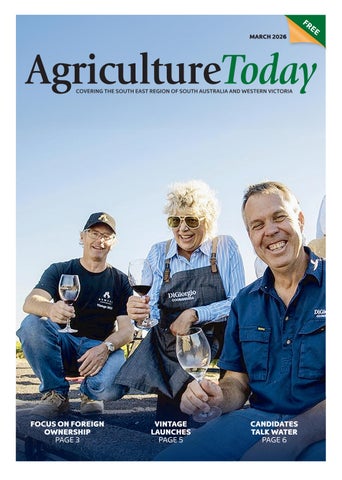
FOCUS ON FOREIGN OWNERSHIP PAGE 3

VINTAGE LAUNCHES PAGE 5


CANDIDATES TALK WATER PAGE 6


![]()
FOCUS ON FOREIGN OWNERSHIP PAGE 3

VINTAGE LAUNCHES PAGE 5


CANDIDATES TALK WATER PAGE 6


THE beef industry in the Limestone Coast region of Australia is set to face significant adjustments as a result of new import quotas announced by China late last year.
According to a report by Rabobank’s RaboResearch division, these changes will reshape the global beef trade.
China, the world’s largest beef importer, has implemented a three-year import quota system as part of safeguard measures following an investigation into the impact of rising imports on its domestic cattle producers.
RaboResearch’s senior animal protein analyst, Angus Gidley-Baird, explained that the total quota for Chinese beef imports is set at 2.688 million tonnes for 2026, which is 4 per cent lower than 2025 volumes.
This development will have a substantial impact on Australia, one of China’s largest beef suppliers.
The report indicates that the quotas are expected to be reached for Australia, after which any additional exports will be subject to a 55 per cent tariff on top of the in-quota import duties.
As a result, RaboResearch estimates that around 100,000 tonnes of Australian beef will need to be diverted to alternative markets.
For beef farmers in the Limestone Coast region, this means finding new markets for their products.
Gidley-Baird suggests that a significant proportion of Australia’s exports to China were grain-fed beef, particularly cuts such as manufacturing, brisket, and shin/shank, which may be challenging to place in other markets at comparable price points.
While exports to South Korea reached re-
cord levels in 2025 and demand from Japan has been relatively stagnant, the report highlights that the US market, despite its stronger import demand, is primarily focused on lean trim beef, a key ingredient for hamburger patties.
Additionally, Australia’s volumes to the US were already at record levels in 2025, and the industry will face increased competition from Brazilian product in 2026.
Gidley-Baird suggested that the best solution for Limestone Coast beef farmers may be to distribute their products across a range of markets, most likely through Southeast Asia.
However, this will require an expansion of existing markets to accommodate the additional volumes.
The report also notes that the global beef trade will be reshaped by China’s new import quotas, with the spillover effects being most visible in markets that could absorb the redirected product.
This could potentially lead to downward pressure on prices in markets such as the US, Southeast Asia, the Middle East, and Canada.
As beef farmers navigate these changes, they will need to closely monitor market conditions and be prepared to adapt their strategies to ensure the viability of their operations.
The industry’s ability to diversify its export markets and maintain competitiveness will be crucial in the face of this evolving global beef trade landscape.
RaboResearch senior animal protein analyst Angus Gidley-Baird. (Supplied)

VICTORIA continues to lead the nation in supporting its livestock producers, offering Australia’s lowest priced National Livestock Identification System (NLIS) ear tags.
Agriculture Victoria Biosecurity Executive
Director Charlotte Austin said the outcome of recent competitive tender process means producers can buy tags at prices equal to or lower than last year.
‘Victorian producers continue to access NLIS tags at some of the nation’s lowest prices, keeping on-farm costs down and upholding our world-class traceability reputation,’ Ms Austin said.
‘The cheapest NLIS cattle tag is now available for just 72 cents when ordered online through Agriculture Victoria, down from 75 cents last year.
‘By comparison, cattle producers in other


states are paying between $2.50 and $4.00 per NLIS cattle tag,” Ms Austin said.
The range of approved NLIS cattle tags has also expanded, including a one-piece metal

tag from Shearwell Australia and NLIS tags manufactured by Enduro Tags and FOFIA.
Sheep producers will also benefit, with the cheapest NLIS sheep tag now available for $1, well below unsubsidised prices in other jurisdictions.
‘The recent tender process secured strong wholesale pricing, supported by subsidies from Victoria’s livestock compensation funds, delivering significant savings producers.
More than two million cattle tags and 10 million sheep tags are expected to be purchased in 2026.
The electronic tags enable livestock movements to be recorded on the NLIS database as animals move between properties, saleyards and abattoirs.
‘This system allows livestock to be traced quickly and efficiently during food safety or
disease incidents, helping protect Victoria’s domestic and protect access to export markets.
‘Victoria led the development and introduction of the NLIS (cattle) in the 1990s, and the NLIS (sheep and goats) commencing on a mandatory basis in 2017.
‘Victoria’s livestock industries can be justifiably proud of their long-standing contribution to the development and operation of Australia’s internationally recognised traceability system,’ Ms Austin said.
Producers can order their NLIS tags by visiting Purchase Tags Online Purchase Tags Online. For more information on the operation of the NLIS in Victoria, visit agriculture. vic.gov.au/livestockand-animals/national-livestock-identification-systemor call 1800 678779 during business hours.


AS the Chinese proverb would have it: We have the misfortune to live in interesting times.
You hardly need to be reminded that, these days, there is political turmoil in Australia, particularly at the federal level. What is more, the once derided and briefly imprisoned Pauline Hanson now commands serious attention as One Nation appears to read the room more astutely than the two major parties. This “get it” moment has translated into policy initiatives — including One Nation’s proposed slamming of the door to foreign investment in Australian farm and forest assets.
And in the bush, that door-slamming has struck a chord.
What would One Nation actually do?
One Nation has stated it would: Ban new foreign freehold purchases of Australian agricultural land
Restrict long-term foreign leasehold interests
• Tighten scrutiny under the Foreign Investment Review Board (FIRB)
• Treat farmland as a strategic national asset rather than just another tradable commodity.
Australia currently operates a screening model under the Foreign Acquisitions and Takeovers Act 1975 *1 . Foreign buyers may acquire agricultural land subject to monetary thresholds (generally $15 million cumulative for private investors) and Treasurer approval.
One Nation would move Australia from screening to restriction — fewer foreign buyers at the farm gate.
How much foreign ownership is there really?
According to ABARES’ Register of Foreign Ownership of Australian Assets *2 , foreign interests hold roughly 13–14 per cent of Australia’s agricultural land by area, with substantially higher concentrations in parts of northern Australia.
Despite public rhetoric, most foreign ownership is not Chinese state control. It is predominantly UK private capital, Canadian pension funds, US institutional investors, Middle Eastern sovereign or semi-sovereign funds, and a smaller number of Chineselinked holdings.
The ownership base is diverse, institutional and globally financed. It expanded steadily over two decades. Yet there are signs of reassessment: in 2026, Paraway Pastoral was formally offered for sale.
How does Australia compare globally? France actively manages its farmland market through ‘SAFER’ , (Societes d’amenagement foncier et d’etablissement rural) this includes pre-emption rights *3 .
Argentina caps foreign ownership at 15 per cent of total rural land area nationally (under


Law 26,737) *4 .
The United States requires disclosure under the Agricultural Foreign Investment Disclosure Act (AFIDA) *5 , but restrictions operate mainly at state level. For example, Iowa *6 , Minnesota *7 , and North Dakota *8 restrict foreign corporate ownership of farmland, while Florida’s 2023 legislation restricts purchases by citizens of designated “foreign countries of concern” in specified circumstances *9.
Canada is a provincial patchwork, with acreage caps and approval requirements in provinces including Saskatchewan, Alberta and Manitoba *10 .
Australia sits between the extremes — neither fully open nor fully closed. One Nation would shift Australia toward the restrictive end of the spectrum.
The efficiency argument
There is no clear empirical evidence that foreign or corporate ownership automatically makes farms more efficient than large Australian family enterprises.
Professor Yu Sheng of the Australian National University has shown that productivity gains are linked more to scale and technology adoption than nationality of ownership *11 .
Cropping does exhibit stepped economies of scale because machinery is expensive and “lumpy” . Larger enterprises can optimise fleets, labour and logistics, but larger does not


necessarily mean foreign — and institutional operators may carry governance and management overheads that family enterprises do not.
What foreign capital does bring is cheaper money. Pension funds and institutional investors can operate on lower required returns, and in some cases use structures such as Managed Investment Trusts. Lower required returns allow higher land bids. That may inflate land values without necessarily increasing output.
The young farmer squeeze
The National Farmers’ Federation’s 2030 Roadmap highlights generational renewal and succession challenges *12 .
In its December 2025 submission to Treasury’s foreign investment consultation, NSW Farmers warned of increasing competition for farmland from investors with greater purchasing power and tax advantages *13 .
ABARES’ Agricultural Land Values 2023–24 update confirms sustained farmland price growth across many regions *14 .
For established operators that strengthens equity but for new entrants it raises barriers — larger deposits, heavier debt and thinner margins. In many districts the perception is that global capital can absorb today’s prices more comfortably than a young local family.
Perception matters in politics.
Rural communities and ownership
Rural sociologists such as Lawrence and Cheshire have examined how land concentration and corporate restructuring can weaken local civic participation and social capital *15 .
Locally owned farms sustain schools, sporting clubs, volunteer brigades and regional suppliers. Remote ownership, even when professionally managed, shifts the centre of gravity away from the district.
Canberra versus the bush Treasury’s “Streamlining and Strengthening the Foreign Investment Framework” reforms (2023–25) aim to accelerate low-risk approvals and adopt a risk-based approach *16 .
Most agricultural land acquisitions fall outside national security categories. The contrast is stark: Treasury smooths the pathway; farm groups urge caution; One Nation promises to apply the brakes.
Queensland’s warning shot Queensland increased its foreign land tax surcharge from 2 to 3 per cent from 1 July 2024, the original impost dating from 2019. *17
The surcharge applies to foreign companies and trusts (based on ownership structure) and, unlike other Australian States, extends to agricultural, land subject to structural tests. It demonstrates that fiscal settings can materially change foreign ownership economics. Why it resonates
Lowy Institute polling shows Australians are cautious about foreign ownership of strategic assets *18 .
The major parties say: manage it. Treasury says: streamline it. Farm groups say: level the field. And what does One Nation say? Stop it.
In interesting times, blunt clarity can be powerful.
* author Patrick Mackarness is a locallybased certified practising valuer, a licensed estate agent with extensive qualifications in agriculture, forestry and estate management. Footnotes
1. Foreign Acquisitions and Takeovers Act 1975 – https://foreigninvestment.gov.au
2. ABARES, Register of Foreign Ownership of Australian Assets – https://www.agriculture. gov.au/abares/foreign-ownership
3. SAFER (France farmland regulation) –https://www.safer.fr
4. Argentina Law 26,737 – http://servicios.infoleg.gob.ar
5. USDA, Agricultural Foreign Investment Disclosure Act (AFIDA) – https://www.fsa.usda. gov/programs-and-services/economicand-policy-analysis/afida
6. Iowa Code Chapter 9I – https://www.legis. iowa.gov/docs/code/9I.pdf
7. Minnesota Statutes §500.221 – https://www. revisor.mn.gov/statutes/cite/500.221
8. North Dakota Century Code §47-10.1 –https://www.ndlegis.gov/cencode/t47c101.pdf
9. Florida SB 264 (2023) – https://www. flsenate.gov/Session/Bill/2023/264
10. Saskatchewan Farm Security Act; Alberta Agricultural and Recreational Land Ownership Act; Manitoba Farm Lands Ownership Act – see respective provincial legislation websites
11. Yu Sheng (ANU Crawford School), relationship between farm size and productivity – Australian Journal of Agricultural and Resource Economics (see ANU researcher profile/publications)
12. National Farmers’ Federation, 2030 Roadmap – https://nff.org.au/policy/roadmap
13. NSW Farmers, Submission to Treasury (Dec 2025) – https://www.nswfarmers.org. au
14. ABARES, Agricultural Land Values 2023–24 – https://www.agriculture.gov.au/abares/ research-topics/agricultural-land-values
15. Lawrence & Cheshire, rural restructuring literature – University of Queensland (UQ)
16. Australian Treasury, Streamlining and Strengthening the Foreign Investment Framework – https://treasury.gov.au
17. Queensland Revenue Office, foreign land tax surcharge – https://qro.qld.gov.au/taxes/land-tax
18. Lowy Institute Poll – https://poll.lowyinstitute.org


THERE is still time to have your say on the future of the Sheep Industry Fund (SIF) and Cattle Industry Fund (CIF), and the Livestock SA team will be at the South East Field Days to discuss it.
Livestock SA recently launched a major consultation with South Australian sheep and cattle producers on the future of the funds as part of the scheduled review and remaking of the regulations governing the two funds.
The regulations must be remade by 1 September 2026 under the Primary Industry Funding Schemes Act 1998.
Livestock SA Chair Gillian Fennell said the review was a statutory process, but also a critical opportunity for producers to shape how their industry invests in the systems that protect productivity, market access and long-term resilience.
“These funds pay for the things individual businesses simply can’t do alone – animal health, biosecurity, traceability, predator control, workforce capability and regulatory defence,” Ms Fennell said.
“They protect our markets, reduce risk and lift productivity across the whole supply chain. But the funding model hasn’t changed since 2016, and it is no longer keeping pace with the scale of the challenge facing our industry.”
Independent analysis shows SIF and CIF investments deliver returns of three to more than ten dollars for every dollar invested, while demand for funding now exceeds available revenue by up to three times.
Ms Fennell said without reform, few-

is
time
er industry priorities would be funded at a time when compliance, climate risk, animal welfare and market access pressures were increasing.
“Doing nothing is not an option,” she said.
“The system is structurally under-funded and that ultimately puts our competitiveness and market access at risk,” she said.
“This is not a decision being made in a back room. This is an industry-led consultation and producers will determine the final proposal


that goes to government.”
Consultation opened in February, with regional meetings, online sessions and an industry vote in April before final recommendations are submitted to the Minister for Primary Industries in May.
“This is your levy, your system and your future,” Ms Fennell said.
“If industry doesn’t design its own funding model, someone else will. This is our chance to get it right for the next decade.”

According to the discussion paper, rates have not increased since 2016–17.
The current SIF rate is $0.55 per head - $0.74 if indexed for inflation - and the CIF rate is $1.50 per NLIS tag - $2.03 if indexed.
The costs of long-standing programs have increased rapidly against flat revenue streams, such as the footrot management program, where costs have increased by 63.7 per cent, and dog fence maintenance, which increased by 73.6 percent since 2016–17.
The discussion paper proposed a staged increase in contributions from SIF over three years to reach $0.75 per head, and it also proposes raising the trigger price for collection from $5 to $10 per head to better reflect current market condition.
The major proposal for tthe CIF is to shift from a per-device (NLIS tag) collection mechanism to a per-transaction contribution set at $1.50 per head, which aimed to improve consistency with national levies and ensure equity, as the current model forces breeders to fund benefits that help the entire industry.
Consultation opportunities will be Thursday 19 March online at 3pm, 20 and 21 March at the SE Field Days and Friday 27 March online at 5pm.
Voting will be held in April and anyone who owns and sells sheep or cattle can vote. Visit Livestock SA online for more information.


SUSTAINABLE Winegrowing Australia, a national program supporting environmental, social, and governance practices in the Australian grape and wine sector, has appointed Siobhan Toohill as its independent Chair.
This marks an important milestone in the program’s governance evolution and future strategic direction.
The appointment of Ms. Toohill is the first step in implementing governance reforms announced in December 2025.
These reforms established the transition to an independent Chair, a skillsbased Board, and a dedicated Executive Officer to strengthen oversight, responsiveness, and long-term impact across the sector.
Ms. Toohill brings extensive experience in sustainability strategy, risk management, and the development of industry frameworks and tools related to climate, nature, and social impact.
As Chair, she will play a central role in guiding Sustainable Winegrowing Australia through its next phase of development, including the selection of the Board and Executive Officer, as well as the creation of the program’s strategic plan.
Ms Toohill will work closely with the industry partners to finalise the appointment of the Sustainable Winegrowing Australia Advisory Board and commence the recruitment of an executive officer for the program.
“I’m delighted to take on the role of Chair for Sustainable Winegrowing Australia,” she said.
“The program plays a critical role in supporting the sector’s sustainability ambitions, and I look forward to working with industry to strengthen its impact, accessibility, and global credibility.”
Chief executive officer of Australian Grape and Wine Inc Lee McLean said Siobhan’s appointment as independent Chair represents a significant step forward for Sustainable Winegrowing Australia.
“Her expertise in sustainability leadership and system transformation will be invaluable as the program enters this next phase of governance maturity and strategic impact.” he said.
Sustainable Winegrowing Australia is a collaborative effort between Australian Grape & Wine, Wine Australia, and the Australian Wine Research Institute (AWRI), providing a framework for continuous improvement, benchmarking, and certification across environmental, social, and governance practices.
The establishment of an independent Chair and a refreshed governance model reflects the sector’s shared commitment to strengthening sustainability performance and ensuring the program is equipped to meet evolving market, climate, and regulatory expectations.
Dr. Mark Krstic, Managing Director of AWRI said Siobhan’s appointment confirmed the sector’s commitment to strong, independent governance and credible sustainability leadership.
“Sustainable Winegrowing Australia and its members will benefit from her knowledge and guidance across climate, nature, and social impact,” he said.
THE Coonawarra wine community gathered at the historic Coonawarra Siding on March 4 to mark the launch of the 2026 vintage.
This much-loved tradition celebrates the growers, winemakers, and industry supporters whose efforts bring each vintage to life.
The ceremony began with the stirring sound of bagpipes, played by Neil McLean and Coonawarra Vignerons Patron Doug Balnaves, honoring the Scottish heritage of the region’s
founder, John Riddoch.
Guests then gathered beside the railway siding for the symbolic transfer of freshly harvested grapes into barrels and the traditional smashing of a wine bottle to christen the season ahead.
The highlight of the event was the grape stomp, featuring three members of the region’s vintage workforce, showcasing the diversity of the modern wine industry.
The ceremony also included the traditional bottle smash, conducted by Coon-
awarra Vignerons Patrons Greg Clayfield and Bruce Redman, marking the conclusion of the 2025 season and the beginning of Vintage 2026.
With promising early signs, the 2026 harvest is expected to commence later than average.
As the first grapes of the season begin their journey, the new vintage promises to continue Coonawarra’s reputation for producing wines of elegance, balance, and longevity.

SOUTH Australian election hopefuls in MacKillop have shared their thoughts on water security within the region.
At a candidates forum hosted be South Australian Forest Products Association (SAFPA) on Tuesday, March 4, candidates were asked by SAFPA chief executive officer Nathan Paine how they would ensure long-term water security for agricultural production in the Limestone Coast during the current amendment phase of the water allocation plan.
A follow-up question was posed to the panel asking whether they believed there should be a compensation scheme for farmers if water allocations are reduced under the new plan.
Liberal candidate Rebekah Rosser said that water security must start with aquifer management and that any decisions must be grounded in hard science rather than modeling, which she claimed is often riddled with assumptions.
She cautioned against assuming a reduction is inevitable, but stated that if science shows a reduction is necessary, it must be fairly administered across all relying sectors.
Independent Nick McBride spoke on his history with the water catchment management board and agreed that the process must be based on science and confidence.
He expressed concern over talks of a 30 per cent reduction, warning it would devastate those dependent on aquifer licenses.
Mr McBride also suggested that localized water issues should be addressed with local solutions (such as a 5-10 kilometer square rule) rather than broad regional changes.


Mark Braes, Labor Party candidate, said he agreed with Ms Rosser that the approach must be driven by science and sustainability but said he was confident that the current detailed administrative process for water allocation will be handled correctly.
National candidate Jonathon Pietzsch said he supported a compensation scheme and said that water allocations were previously considered assets and therefore require compensation if reduced.


He said it was important to protect the aquifers, ensuring local adaptability, and avoiding negative impacts on communities downstream.
One Nation’s Jason Virgo also agreed with the need for compensation and adhering to science, and said that farmers and forestry do not always use their full water allocations. He said One Nation’s policy was to prevent further cuts to forest water licenses, eliminate discriminatory policies that impede plantation forestry expansion, and amend water allocation plans to appropriately balance environmental protection with industry jobs.


Other topics included strip mining, housing, infrastructure and healthcare.


SHEEP owners are reminded of their responsibility to manage wool length, so it doesn’t become excessive.
Agriculture Victoria Senior Veterinary Officer Dr Jeff Cave said sheep with more than one year’s wool growth are highly susceptible to heat stress and disease and those with over-long fleeces are also more likely to become cast - lying on their side and unable to rise.
A person who allows sheep in their care to grow excessively long fleeces may be exposed to cruelty provisions of the Prevention of Cruelty to Animals Regulations 2019.
Under the regulations, a person must not allow the fleece of a sheep to grow to a length greater than twice the average annual growth for the breed of sheep or more than 250mm (whichever is shorter).
Dr Cave said most sheep producers undertake shearing annually and won’t have issues complying with this requirement.
“People that keep sheep as pets also need to ensure they plan ahead and arrange for their sheep to be shorn annually,” Dr Cave said.
Dr Cave said all people who own or man-
age sheep must take appropriate actions to prevent their sheep’s wool becoming over-long.
“Sheep with excessive fleece length are at increased risk of heat stress, becoming cast and serious animal health issues such as flystrike.
“This regulation applies to anyone responsible for sheep, including sheep kept for commercial or hobby reasons. Anybody who owns or is in charge of sheep can be fined for having sheep with excessive wool growth.”
“It’s also important anyone responsible for sheep consider the time of year they undertake shearing, particularly during the warmer months when hot conditions can have serious impacts on the welfare of sheep.
“Freshly shorn sheep should be placed into paddocks that contain proper and sufficient shelter to protect them.”
For further information regarding sheep health and welfare visit the Agriculture Victoria website, call 136 186 or consult with Animal Health and Welfare staff.
Agriculture Victoria said shearing prevents animal welfare issues with overly long fleeces likely to cause problems. (File)

IN regional South Australia, many separating couples work hard to reach an agreement about dividing property without going to court. Once that agreement is reached, it can feel like the matter is finished. But without formalising it properly, you may be leaving yourself exposed.
The Border Watch
Address: Level 1 / 1 Commercial Street East, Mt Gambier SA 5290
Telephone: 08 8741 8170
Website: www.borderwatch.com.au
Hamilton Spectator
Address: 84 Gray Street, Hamilton, Vic 3300
Telephone: 03 5572 1011
Website: www.hamiltonspectator.com.au
Portland Observer
Address: 92 Percy Street, Portland, VIC 3305
Telephone: 03 5522 3000
Website: www.portlandobserver.com.au
CONTACT US
Editorial:
Email: editorial@agtoday.com.au
EDITORS: Elisabeth Champion
E: elisabethchampion@tbwtoday.com.au
Marlene Punton
E: marlene.punton@portlandobserver.com.au
Advertising:
Email: advertising@agtoday.com.au
ADVERTISING CONSULTANTS
Leesa Cook
E: leesa.cook@portlandobserver.com.au
Sierra Laird
E: sierra.laird@portlandobserver.com.au
Alicia Galloway
E: alicia.galloway@hamiltonspectator.com.au
Shannon Benge
E: shannon.benge@hamiltonspectator.com.au
Christine Cock
E: christine.cock@tbwtoday.com.au
Christine Black
E: christine.black@tbwtoday.com.au
Josh Phelan
E: josh.phelan@tbwtoday.com.au
Under the Family Law Act 1975, a property settlement only becomes legally binding if it is formalised in one of two ways: by filing Consent Orders in the Federal Circuit and Family Court of Australia, or by entering into a compliant Financial Agreement. Anything else, even a written agreement you draft yourselvesis considered informal and is not legally enforceable.
That can have serious consequences.
Without formal documentation, a former partner may bring a future claim- potentially years later. This risk does not just apply to the assets you owned during the relationship. It can extend to property you acquire after separation, including an inheritance, growth in superannuation, increased farm values, or the purchase of new land or equipment.
There are also strict time limits. After a divorce becomes final, parties generally have 12 months to commence property or spousal maintenance proceedings. Missing that deadline can significantly complicate matters.
It is also important to understand that divorce and property settlement are separate processes. A Divorce Order legally ends a marriage, but it does not finalise financial arrangements or parenting matters. Divorce applications are filed through the Federal Circuit and Family Court of Australia.
For regional families- particularly those with farms, family businesses or complex asset structures- certainty matters. Properly for-


regional South Australia, many separating couples work hard to reach an agreement about dividing property without going
malising your agreement protects current and future assets, limits the risk of later claims, and provides clarity for estate planning. Taking the final legal step ensures you can move forward with confidence and security.


If you need assistance with formalising your agreement or protecting your assets following separation, contact Mellor Olsson Lawyers on 8414 3400 or email lawyers@molawyers.com. au.


NEW trials are testing the potential of different varieties of sorghum to improve summer fodder options for growers in southeast South Australia.
The replicated trial at Struan, south of Naracoorte, is designed to assess different sowing dates, the merits of three different sorghum varieties and the impacts of nitrogen applications.
The Grassland Society of Southern Australia (GSSA) Limestone Coast branch research project is titled `Improving the sustainability and irrigation use efficiency of summer fodder through improved management decisions’
The project is funded by a Grassroots grant from Limestone Coast Landscape Board and supported by Barenbrug Australia.
GSSA Limestone Coast branch member and agronomist Adam Hancock said there hadn’t been sorghum trials in the region for more than a decade.
“We’re trying to see the yield potential from the new varieties of sorghum,” Mr Hancock said. “It’s not a crop that we’ve had a lot of work done on for a long time. There are a few things that have changed over the decade, including the new varieties, we’re also sowing a lot earlier with the soil temperature at 13 or 14 degrees instead of 16. For southern parts, this could be
a really big deal if we could get the crop in the ground three or four weeks earlier.”
The trial site was sown twice 28 days apart to capture information about what earlier sowing could be worth to growers in south-east South Australia.
Variable nitrogen applications are also being tested. “Because the yield potential is so much higher, we’re testing how much fertiliser you need to apply to capture your maximum yield potential. It could be anywhere between 18 and 30 so we need to understand the ideal number,” Mr Hancock said.
The site has been zoned, with one area being cut once and another twice. A South Australian Research and Development Institute (SARDI) soil agronomy team is running the site and conducting the research.
The GSSA Limestone Coast branch hosted a field day on the site in February to raise awareness of the project. A further event is planned to outline the findings of the one-year project.
People interested in joining the GSSA can visit https://www.grasslands.org.au. Students can become members for free. GSSA has successfully promoted the business of grass, science and farming since 1959 and has branches in Victoria, South Australia and southern NSW. The

THE death of an old horse in a community sparks sadness and some wonderful memories.
For more than three decades, she gave much to her local community through her kind nature and ability to excel at the job in front of her - but after 32 years, Gorae (near Portland) farmer Brian Rundell said one final farewell to his horse Mystique.
Before passing away at the age of 32, Mystique had become a well-known and muchloved horse through a number of roles, including but not limited to farm work, leading riding lessons and participating in annual Anzac Day marches in Portland.
Mr Rundell said that Mystique’s kind nature was evident from the earliest stages, but that it was to be expected due to her lineage.
“Both the bloodlines were really good, and
then that just makes it pretty easy to work with the horse – the other thing was handling her right from the get go, basically the training starts as soon as the horse is born.
Mr Rundell said Mystique grew to be so highly regarded for her calmness that she was able to become involved in the local Riding for the Disabled organisation, as well as many other community-focused roles.
“Mystique was just about perfect when I was allowed to use her at the riding school, because my daughter Kareena would end up taking her to Pony Club,” he said.
“She was suited to so many different things, from quiet little kids riding her and Pony Club to cross-country, show jumping and dressage – when we used to to Riding for the Disabled here, you really needed a trustworthy horse and Mystique just did that easy.
“Then you would turn around and she would be fast and quick when rounding up
cattle when you needed her to do that – she was just a very versatile horse, and one you don’t find many of.”
Mystique’s legacy will likely continue for decades and generations to come, having bore six foals across her breeding years.
Mr Rundell said the outpouring of support following Mystique’s passing showed not only how special of a horse she was, but also the inherent connection between humans and horses.
“A horse will do almost anything for you if they have that trust with you – we worked in this business, but so did the horses,” he said.
“I was aware of the community’s support and love of Mystique over the years, but I’m so thankful for all of the comments and people saying things about her because I felt it was a really wonderful way to say goodbye to such a good horse.”

KATE Kirk admits she was a total novice when she was introduced to dairy farming.
At the time, she was working in a Leongatha supermarket in South Gippsland.
Her then boyfriend, share farmer Jason Kirk whose family had two farms at Loch, needed to find a new worker when his sister moved on to run the second other farm.
“I said I don’t know anything about farming but I’m happy to give it a go,” Ms Kirk said.
“What’s the worst that could happen – If I suck at it and you fire me; I can go back to the supermarket.”
Turns out Ms Kirk was a good learner who quickly adapted to farming life, and at the same time their relationship blossomed and led to marriage and became part of the share farming arrangement.
Part of her success came from the mentorship of Jason and his family and the deluge of Dairy Australia courses she undertook to learn about industry standards.
She’s never forgotten the importance of that support and today she continues to pay it forward.
Ms Kirk will present `From Frankston to Gippsland: A Journey in Farming and Mentorship’ at the GA 2026 Today, Tomorrow and Beyond conference hosted by Genetics Australia in Geelong on March 17-18.
Ms Kirk had been raised in Frankston and no intentions of becoming a farmer but now she wants to help young people find their way in the industry.
She remembers joining the farm as a 19-year-old rookie. “Jason and his father taught me everything about what they wanted on their farm and they supported me to learn the industry standards,” she said.
“Because I wasn’t qualified for diddleysquat, I started doing all the Dairy Australia courses like Cups On-Cups Off, calf rearing and Fert Smart.
“I think I’ve done every single course they’ve had in the past 20 years. I’ve always been a gogetter person and if I’m going to do something, I’m going to do the best I can.”
She even became confident and experienced enough to instigate on-farm changes based on data.
While continuing to lease in Loch, in 2016 the couple bought their own farm at Dumbalk, adding to it over the years to build up to a milking herd of more than 500 on 364 hectares.

They have four staff and more than 1100 animals all up including young stock, and also do their own hay and silage conservation.
In recent years Ms Kirk completed her Diploma of Agriculture qualification online, along with a training and assessors’ course at TAFE and became qualified in food safety and lead auditing.
Along with working as a verified dairy food safety auditor with Dairy Food Safe Victoria au-
diting farms for their milk licences, she is keen to help young people to navigate their way into the industry, including their own staff.
“We support people to take time off for training because I know how important that was when I was a novice,” she said.
“There are not a lot of younger people in agriculture and it’s way harder for them to get into it than it used to be, but we need them.
“Farms are much bigger so the industry

needs more employees, from managers to farm hands, and those people need a chance to skill up.
“They need on-farm training as well as formal training so they know what industry best practice is.
“It is difficult to get in, but it’s possible if you’re patient. Find someone that you admire and ask them questions and use the industry opportunities that we have. If there’s a part of the farming that you don’t enjoy, find a bit that you do enjoy.
“If you’re going to do it, do your best.”
They also host on-farm tour groups, including visitors from Zimbabwe organised by Genetics Australia.
She will be part of an online seminar for Zimbabwean women in ag this month
Recently turned 40, she said she and Jason continue to work well as a team, but she hopes to phase out of the hands-on heavy-lifting part of farming.
“I want to do the things I enjoy, like supporting staff, teaching skills, explaining the importance of food safety legislation, connecting people to industry resources and just talking to and supporting dairy farmers and their goals.”
The GA 2026 Today, Tomorrow and Beyond conference hosted by Genetics Australia on March 17-18 will be at GMHBA Stadium 370 Moorabool Street South Geelong. People can visit trybooking.com/events/landing/1511339 for ticketing information and the full program.
A TRIO of south-west Victorian students looking to make their mark in the agricultural industry have been awarded this year’s Andrew Jack Memorial Agricultural Scholarship by Portland Rotary Club, who remain committed to supporting those seeking to further their agricultural education.
Alexandra Twomey, Alice Peddie and Lachlan Bourke were the well-deserving recipients in 2026, with Ms Twomey telling the Observer her successful scholarship application had taken away much of the angst surrounding her studies.
The three students will each receive $12,000 for each year of study.
“It feels so amazing, I feel like the scholarship has taken away so much of the stress around my study,” she said.
“I will be studying animal and veterinary biosciences at La Trobe University – I was going to have a gap year and work for a bit, but I was just way too excited to get straight into my course.
In recent years, the scholarships has been opened up to a wider range of agriculturally-
focused industries, which has allowed Ms Twomey the opportunity to follow her interest into animals and veterinary science.
Portland Rotary Club’s John Pye said the organisation were proud to continue carrying on the legacy of Andrew Jack and his passion for local farming and agriculture.
“When Andrew died, he left a lot of money to hospitals in Portland and Warrnambool, and as well as being a Rotarian, he left money to help further local scholarships,” he said.
“Andrew was so involved in agriculture, and the people who he left in charge of the money decided a scholarship was the best way to distribute his money.
“It’s been over 10 years now, and we will continue to support all the recipients who have been approved and then see how we go after that – we’ve probably still have a few more years left of scholarships.

AUSTRALIA’S red meat industry has delivered another year of strong performance, with new ABS data confirming exceptional beef production, historically high cattle slaughter and resilient lamb and mutton supply despite varied seasonal conditions.
Meat and Livestock Australia (MLA) says the data reflects both the strength and adaptability of Australian red meat producers, as well as the continued shift toward higher throughput and heavier carcase weights across key species.
Cattle
The Australian cattle sector continued its extraordinary run in 2025.
Beef production reached 712,888 tonnes in Q4 and 2.87 million tonnes across the calendar year. This is 12per cent higher than 2024 and is now the largest annual beef production on record.
Cattle slaughter reached 9.28 million head for the year. This represents a 12per cent increase on 2024 and surpasses the previous modern record set in 2014. It is the highest cattle kill Australia has recorded since 1978.
Q4 slaughter totalled 2.3 million head, a 7per cent decline from Q3 due to normal end of year plant shutdowns. Queensland slaughter fell 10per cent in Q4 to 939,300 head after two consecutive quarters above one million.
Twice in 2025, the March and December quarters, Victoria processed more cows than Queensland for the first time since 2008, demonstrating the flow of females south to maintain processor capacity despite lower local availability.
Average cattle carcase weights reached 309kg for the year.
The Q4 average was 311kg, continuing the upward trend supported by strong northern pasture conditions. Carcase weights remain below the peak of 324kg that occurred in early 2022.
The national female slaughter rate (FSR) eased to 52.3 percent in Q4 after peaking at 54.5 per cent in June.
MLA Senior Market Information Analyst Emiliano Diaz said the results show an industry performing at a very high level.
“Beef production has remained above 700,000 tonnes for three consecutive quarters. That is unprecedented and signals a new sus-

tained production level for Australia,” Mr Diaz said.
“Producers in the north have benefited from strong pasture growth, while many southern regions experienced much drier conditions.
“The fact that national output still reached record levels speaks to the resilience and adaptability of producers in every state.”
Lamb Lamb slaughter totalled 24.6 million head in 2025.
This represents a 7 per cent decline from 2024 but still places the year as the third highest on record behind 2023 and 2024.
Q4 lamb slaughter totalled 5.8 million head, which is 6 per cent lower than Q4 2024.
Annual lamb production reached 597,068 tonnes, a decline of 5.2 per cent from 2024.
In Q4 Australia produced 136,941 tonnes, a decline of 3 per cent year-on-year.
Carcase weights averaged 24.3kg across 2025 and remained stable at 23.8kg in Q4.
All states recorded year-on-year increases in carcase weights in Q4.
New South Wales increased by 3 per cent.
Victoria increased by 2 per cent.
South Australia increased by 5 per cent.
Western Australia increased by 7 per cent.
Mr Diaz said improved feeding strategies have helped maintain productivity.
“The increase in lamb carcase weights demonstrates how effectively producers have adapted, particularly through the growing use of containment feeding,” Mr Diaz said.
“Many sheep regions had to work through extended dry conditions, yet producers were still able to lift weights and support strong production levels.”
Mutton: Supply remains historically high despite easing from 2024 levels
National sheep slaughter reached 2.65 million head in Q4. This was 32per cent higher than Q3 but remained 24per cent lower than the exceptionally elevated slaughter levels recorded in late 2024.
Across 2025, mutton slaughter totalled 10.19 million head, a decline of 14per cent from 2024 but still historically high.
New South Wales processed 920,400 head in Q4, an increase of 24per cent on Q3. For the full year NSW processed 3.66 million head, a decline of 9per cent .
Victoria processed 1.05 million head in Q4, an increase of 27per cent . For the full year Victoria processed 3.79 million head, a drop of 19per cent , but it remained Australia’s largest mutton processing state with a 37per cent share.
Mutton production reached 258,757 tonnes in 2025, a reduction of 13 per cent from 2024. Q4 production totalled 71,599 tonnes, which was 37per cent higher than Q3 but 21 per cent lower than the same quarter last year.
Carcase weights remained firm. The Q4 national average was 27kg, which is 5 per cent above the five-year average.
New South Wales recorded an average of 29kg, Victoria recorded 25.4kg and South Australia recorded 26.9kg.
Values: Record producer receipts for sheep and cattle farmers
For the 2025 calendar year Australian cattle producers received $20.43 billion for the sale of finished to processors, a record and $5 billion more than in 2024.
Similarly, lamb and sheep producers received record revenue for the sale of animals to abattoirs, netting $6.9 bilion over the last 12 months.
SOUTH Australian beekeepers have been on high alert after varroa mite detections were confirmed across several regions of the state over the past few months.
The first detection occurred in September 2025 at Pooginook in the Riverland, with all impacted hives subsequently moved interstate by their owner in line with permit conditions.
On 20 November last year, new detections emerged in the Limestone Coast near Salt Creek and further detections were confirmed on 26 November at Taratap on the Limestone Coast and Sellicks Hill in the upper Fleurieu Peninsula.
Additional confirmed detections have included Aldinga, Aldinga Beach, Sellicks Hill, and Waitpinga on the Fleurieu Peninsula; Birdwood, Paechtown, and Woodside in the Adelaide Hills; and Coombe, Hundred of Lewis, near Tintinara, Salt Creek, and Taratap in the Limestone Coast.
There is also surveillance at numerous sites across South Australia, including Baroota, Port Davis, Murtho, Alldendale and Birdwood.
Department of Primary Industries and Regions (PIRSA) continues to work closely
with affected beekeepers to undertake surveillance at linked sites, with additional sampling and tracing to determine the full extent of the incursion.
PIRSA urges all beekeepers who have had hives within 25km of detection sites since mid-August, or plan to place hives in the area, to shorten their monitoring intervals to every three to four weeks.
PIRSA also provides monthly update and information webinars for South Australian beekeepers and has biosecurity resources such as the Australian Honey Bee Industry Biosecurity Code of Practice and the Bee Biosecurity Manual, all of which are available on its website.
The National Varroa Mite Management Program (NVMMP) is supporting the response, focusing on maintaining business continuity for pollination-dependent industries, training beekeepers, and providing guidance on monitoring and reporting requirements.
Beekeepers who suspect varroa mite should contact the PIRSA Biosecurity Apiary Unit or phone the Exotic Plant Pest Hotline on 1800 084 881.