THE MALLEE’S FARMING NEWSPAPER SEPTEMBER 2026 Visa slowdown Page 3
Locust response preparedness Page 4
Rice growers demand fair policy Page 5
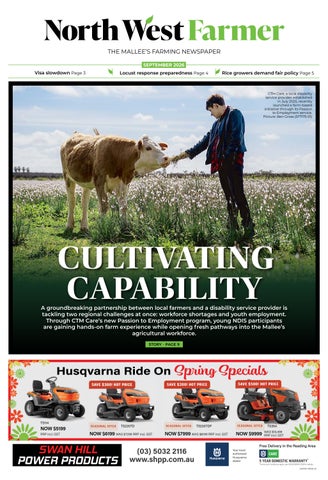
CTM Care, a local disability service provider established in July 2025, recently launched a farm-based initiative through its Passion to Employment service. Picture: Ben Gross (577175 01)
CULTIVATING CAPABILITY A groundbreaking partnership between local farmers and a disability service provider is tackling two regional challenges at once: workforce shortages and youth employment. Through CTM Care’s new Passion to Employment program, young NDIS participants are gaining hands-on farm experience while opening fresh pathways into the Mallee’s agricultural workforce. STORY - PAGE 9
Husqvarna Ride On Spring Specials
TS114
NOW $5199 RRP incl. inc GST
TS220TD
NOW $6199 WAS $7299 RRP incl. GST
TS220TDF
NOW $7999 WAS $8199 RRP incl. GST
TS354 $10 $10,499 499 NOW $ N $9999 WAS RRP incl. GST
Free Delivery in the Reading Area
(03) 5032 2116 www.shpp.com.au
Your local authorised Husqvarna dealer
5 YEAR DOMESTIC WARRANTY
#
#
Terms and Conditions apply, see HUSQVARNA.COM for details.
2 | September 2026
NorthWestFarmer.com.au
Boost to drought-proof Victoria By Peter Bannan VICTORIAN farmers and regional communities will receive more than $66.8 million to strengthen their defences against future droughts and increasingly challenging climate conditions. The federal and state governments announced the joint investment to continue the Victorian Farm Business Resilience Program and Regional Drought Resilience Planning Program through to 2029. The funding comes on top of the Victorian Government’s $146.5 million Drought Support Package for farmers. Federal Agriculture, Fisheries and Forestry Minister Julie Collins said the programs were designed to give farmers and regional communities practical tools to prepare for drought and other climate pressures. “The Albanese Government is committed to working with Victoria to help farmers and
communities prepare for and respond to changing drought and climate conditions,” Ms Collins said. “Through the Future Drought Fund, we are investing in practical programs that help build stronger, more resilient farms, businesses and communities. “Victorians are no strangers to drought and other natural disasters, and we are pleased to support and invest in the future of Victoria’s farmers and regional communities.” The Farm Business Resilience Program provides farmers with practical skills to make informed decisions about their businesses, including preparing for drought. Farmers can access short courses, workshops, webinars, field days and farm walks covering profitable decision-making, drought preparedness, farm management and other topics. Since 2021, more than 4000 people have
participated in intensive activities through the program, while more than 2400 farm business plans have been developed or updated to improve business performance and resilience. The Regional Drought Resilience Planning Program focuses on helping communities put locally developed drought plans into action. Every region across Victoria now has a regional drought resilience plan following the first phase of the program. Under the continued funding, up to $1.5 million will be available in each region to coordinate and deliver priority actions identified in those plans. The money will be available to support communities, local governments, industry and regional organisations to deliver projects aimed at improving drought and climate preparedness. More than 47 on-ground projects have already been delivered across Victoria through the Regional
Drought Resilience Planning Program. Victorian Agriculture, Water and Rural and Regional Development Minister Michaela Settle said drought remained a familiar challenge for the state’s farmers. “Drought is a challenge farmers know all too well, which is why we’re investing in practical support that helps them plan ahead, adapt and remain strong through climate changing conditions,” Ms Settle said. “We’re working alongside farmers and regional communities to ensure they have the knowledge, resources and local partnerships they need to prepare for future drought, no matter the conditions.” The governments said the programs would help farmers prepare for future dry conditions while protecting regional jobs, local economies and Victoria’s food security.
New barley raises the bar
come from a relatively limited group of local seed breeders. “Gretchen is a spring barley well suited to the high and medium rainfall production areas with proven agronomic performance,” Mr Torpy said. “It can also add a malt profile to the industry that is currently in short supply.” Mr Torpy said maltsters had shown interest in Gretchen because of its malting characteristics, with micro malt testing producing encouraging results. “Micro malt testing shows that it doesn’t require the addition of gibberellic acid (GA) in the malting process to achieve quality malt, opening more possibilities for export markets,” he said. The variety also offered an improved disease resistance package, particularly against Net Form Net Blotch and Scald. Both diseases have increased in the widely grown RGT Planet variety and contributed to a downturn in its production. AGF Seeds introduced Gretchen to Australia in partnership with prominent German plant
breeding company Breun Seed. The variety has also produced promising results in official National Variety Trials and other independent trials. Gretchen consistently recorded yields five to 10 per cent higher than RGT Planet and produced competitive yields compared with Neo CL. Mr Torpy said AGF Seeds planned to continue sourcing varieties from international breeders to screen and develop under Australian conditions. “We can tap into the huge breeding resources of major international breeding companies and combine them with our ability to evaluate genetics in Australian conditions and release top varieties,” he said. Mr Torpy said the company was confident Gretchen would ultimately secure malt accreditation. “If we are successful in achieving malt accreditation for Gretchen, and we are confident that will happen, it adds a malt barley that brings genetic diversification, disease resistance, strong yield performance for growers and the right characteristics for maltsters.”
By Peter Bannan
AGF Seeds’ spring barley variety Gretchen has been accepted into the Grains Australia malt accreditation process. Picture: Supplied
AUSTRALIAN barley growers could soon have access to a new malt variety promising stronger disease resistance, higher yields and valuable European genetics. AGF Seeds’ spring barley variety Gretchen has been accepted into the Grains Australia malt accreditation process, marking the first time one of the company’s barley varieties has reached the accreditation stage. If approved, Gretchen would introduce genetics not previously available to Australian growers, while offering a malt profile that has already attracted strong interest from the malting industry. AGF Seeds R&D manager Brendan Torpy said Australian malt barley varieties had traditionally
2-4 October, 2026 Mapping the Shire with creative energy, the Loddon Valley Arts Trail is
Out there - in every way
www.loddonvalleyartstrail.com.au Scan the QR code for more information and to book any of this year’s events
For updates: @loddonvalleyartstrail www.loddonvalleyartstrail.com.au u
Over 30 events and exhibitions
September 2026 | 3
NorthWestFarmer.com.au
Visa slowdown sparks harvest fears The Victorian Farmers Federation has warned that changes to working holiday and skilled visa processing could disrupt the agricultural sector.
By Peter Bannan VICTORIAN farmers fear visa processing delays could leave them without enough workers at one of the most critical times of the year. The Victorian Farmers Federation has warned changes to working holiday and skilled visa processing could disrupt harvests, horticulture and dairy operations, with president Ryan Milgate saying farmers were already facing workforce uncertainty. “We are already seeing the impacts of workforce uncertainty, and the timing could not be worse as Victorian agriculture heads into peak harvest and production periods,” Mr Milgate said. “If a crop is ready to harvest and the cattle are needing to be milked and the workers are not there, it will be a potential disaster.” The concerns followed Immigration Minister Tony Burke confirming last month that working holiday visas were still being processed, but “more slowly than they were previously”. Mr Burke rejected suggestions agriculture was primarily dependent on backpackers, saying the Pacific Australia Labour Mobility scheme was the sector’s principal visa program. He said stronger worker protections introduced under PALM had led some operators to consider shifting towards backpackers instead. “One of the things that happened when we started to improve worker protections on PALM was not overwhelmingly, but some of the worst operators said, ‘well, if we’ve got to have better standards for PALM workers, we’ll just switch to backpackers’,” Mr Burke said. “And that’s not the way this system’s meant to work.”
The Department of Home Affairs has also said Working Holiday Maker reforms were designed to better control demand and provide a fairer allocation of visas, while maintaining critical workforce needs, including agriculture. Separate changes under Ministerial Direction 119, which took effect on 25 July, altered skilled visa processing priorities. The new system prioritises law enforcement and defence occupations, followed by onshore applicants in construction, healthcare and teaching. Other applicants already in Australia are then prioritised ahead of other offshore applicants. The changes replaced the previous system that gave specific processing priority to some employer-sponsored regional applications. VFF grains president Jason Mellings said the shift came as grain growers prepared to harvest one of their most expensive crops. “We have faced the fuel and fertiliser crisis in March, alongside massive increases in input and operating costs,” he said. “Farmers have put an enormous amount of money on the line and we now need to get the crop harvested. “If workforce disruptions mean we cannot get that job done efficiently, farmers could be left with a massive financial hole in their hip pocket.” VFF horticulture president Michael Crisera said growers had little room for delays because fruit and vegetables had narrow harvesting windows. “When fruit and vegetables are ready, they need to be picked,” he said. “You cannot put a crop on hold while you wait for workers to arrive.” He said shortages could leave produce in paddocks, reduce quality and cost growers
income. VFF United Dairyfarmers of Victoria acting president Mark Billing said dairy operations faced a different but equally pressing challenge, with workers needed every day. “Cows still need to be milked, calves need to be cared for and we must have staff for every day of the week,” he said. “Visa uncertainty makes it harder for farmers to plan their businesses, secure the people we need to keep our farms operating and puts a massive workload on the staff we do have.” Mr Billing said fatigue and burnout were also becoming safety concerns. Mr Milgate said the VFF recognised the Federal Government faced broader migration pressures
but warned agriculture should not become collateral damage in the debate. “This isn’t a speculative issue. We’re already hearing real world stories and concerns of workers and farmers trapped in limbo,” he said. “Farmers are not asking governments to ignore the broader migration debate. We are asking them to recognise that agriculture has a unique workforce and skills requirement and that the consequences of getting this wrong are very real.” Mr Milgate said failure to secure enough workers could affect food production, regional communities and the financial viability of farms. “This is why we are calling for governments to work with industry, not make decisions about agriculture without agriculture,” he said.
Northern Wool is a locally owned wool business in Swan Hill and district associated with Endeavour Wool Export - a large Australian family-owned wool exporting business 3 Consignment for export 3 Price on result 3 Competitive auction rates 3 Prompt payment
Exporting to all major countries around the world
Tony Keam Wool Buyer 0427 993 041 E: tony-keam@bigpond.com
15 Shepherd Road, Swan Hill
4 | September 2026
NorthWestFarmer.com.au
Locust response preparedness takes flight AGRICULTURE Victoria is stepping up support for landholders and managers to prepare for higherthan normal locust numbers in the state’s northwest over coming weeks. An incident management team has been established, and spring surveillance has begun in the Mallee, initially to confirm the locations of egg beds where earlier egg laying activity was recorded. Surveillance is focusing on seven priority local government areas based on forecasts showing a moderate to high chance of high locust numbers in the Mallee and a low to moderate chance of high locust numbers in the Wimmera. Incident controller Melissa Cann said priority areas were determined through surveys in May, following reports of high locust activity driven by favourable weather conditions for breeding. “The May surveillance, undertaken with the Australian Plague Locust Commission, provided the data to inform the likely spring risk and direct where response efforts should be focused,” Ms Cann said.
THE MALLEE’S FARMING NEWSPAPER
___
PUBLISHED monthly in The Guardian (Swan Hill), Sunraysia Daily (Mildura) and Gannawarra Times (Kerang/Cohuna)
“Agriculture Victoria has established the incident management team as the coordinating agency to ensure information and support is provided to all land managers who are responsible for surveying and spraying on their land. “We are encouraging landholders and managers to join surveying efforts over the coming weeks and report sightings of locusts which will refine priority areas and timing for spraying.” Ms Cann said spraying was most effective around two weeks after hatching, when young locusts were on the ground and banding together but not yet flying. “It’s difficult to predict the exact hatching times but based on forecasting data and surveys from earlier in the year, we expect it to start in the northern Mallee from mid to late this month and slightly later in the Wimmera,” Ms Cann said. Agriculture Victoria will support private landholders, councils and public land managers throughout September and October by conducting surveillance and collecting public reports and identifying when and where locust
The Mallee is preparing for higher-than normal locust numbers in the coming weeks.
management activities such as ground spraying should be implemented. Locusts can cause serious damage to pasture, crops and horticulture, while also impacting road users. “Early reporting helps support accurate advice
Leading research, industry insights and big laughs set for conference By Almonds Australia chief executive Tim Jackson
CLASSIFIEDS Phone: 1300 666 808 Email: sales@networkclassifieds.com.au ___
ADVERTISING Phone: 03 5032 2161 Email: advertising@northwestfarmer.com.au ___
EDITORIAL Phone: 03 5032 2161 Email: editorial@northwestfarmer.com.au
View Online www.northwestfarmer.com.au Published by SA Today Pty Ltd. ACN 644 311 937. All material is copyright to SA Today Pty Ltd. All significant errors will be corrected as soon as possible. Distribution numbers, areas and coverage are estimates only. For our terms and conditions, please visit theguardian.com.au/terms-and-conditions.
to landholders and managers and leads to a reduced risk of widespread impacts,” Ms Cann said. Priority local government areas include Mildura, Swan Hill, Gannawarra, Buloke, West Wimmera, Yarriambiack and Hindmarsh.
THE countdown is on for the 2026 Australian Almond Conference. A top line up of speakers has been assembled for the Australian Almond Conference in Adelaide from 13-15 October. The three-day event has something for everyone and will tackle the big issues within the industry by bringing together some of the world’s leading experts on pests and disease. It will also include an interactive masterclass where growers can tap into the vast amount of experience on expert panels. Experience true star power as one of the world’s leading culinary authors takes the stage alongside Poh Ling Yeow, culminating in a gala dinner that promises to be an unforgettable highlight. Expect a comprehensive overview of the global tree nut industry when Ashok Krishen, the chairman of the International Nuts and Dried Fruit Council takes the stage. His keynote address will focus on the recent developments in the almond market and the broader context of worldwide tree nut supply and demand dynamics. Mr Krishen will also highlight the opportunities and challenges facing the sector, as well as the key drivers that are expected to influence the outlook for almonds. The Almond Board of California’s president and CEO Clarice Turner will also mark her first appearance at the Australian Almond Conference. Three quarters of the world’s almonds are produced in California by 7600 growers, where a typical orchard
The Australian Almond Conference returns to the Adelaide Convention Centre next month.
is 40 to 100 acres (16-40 hectares). The Almond Board of California has 57 staff and while most are based in Modesto, there are others in New Delhi, London, Hong Kong and Seoul. In 2023 and 2026, Land IQ mapped Australia’s almond orchards, revealing that plantings had increased by 8539 hectares over the three-year period. Joel Kimmelshue’s team has been doing similar work for the Almond Board of California since 2011. He’ll outline how this work is carried out, the results, trends, accuracies and applications for mapping in Australia and California. California State University, Bakersfield Professor Abran (Abe) Padilla will explore the economics of almonds. The almond industry veteran has spent almost three decades working in nut processing, strategy, sales, finance and agricultural analytics. He is in the final stages of completing his Doctorate in Business Administration at Pepperdine University, where his dissertation explores how price-forecasting techniques used for publicly traded commodities like corn, soybeans and wheat can be adapted to speciality crops including almonds. International almond researchers also feature prominently on the program. Professor Astrid Volder from the University
of California will discuss root architecture and maximising growth potential. Maciej Zwieniecki, also from UC Davis, will talk about how orchard management can influence carbohydrates, which in turn influence dormancy, budbreak and yield. The Z Lab at the university has been analysing the sugars and starch in wood and bark samples supplied by almond, pistachio and walnut growers throughout California on a monthly basis. Bringing decades of research experience, Greg Browne, recently retired from the United States Department of Agriculture’s Agricultural Research Service, will lead an opening day masterclass at the Australian Almond Conference, exploring almond diseases and disorders, including the challenges of Prunus replant disease. He returns to the stage on day two to discuss tackling soil borne disease and soil disinfestation. Sumit Saran from India and Joseph Yuan from China will discuss their respective markets, which are the top two buyers of Australian almonds during the marketing showcase. A renowned chef and trailblazer who has changed the landscape of cooking in India will appear on stage with Australian Almonds Ambassador Poh Ling Yeow for an international MasterChef collaboration, focusing on maximising the use of almonds in cooking. Sanjeev Kapoor has authored more than 150 cookbooks and has more than 20 million followers on social media. The Australian Almond Conference gala dinner promises plenty of laughs, with acclaimed comedian Peter Helliar set to entertain attendees. A favourite among Australian audiences, Helliar has spent more than three decades performing at festivals, theatres and comedy clubs nationwide. Industry service awards will also be presented and new growers will be inducted into the Hall of Fame. Further information about the conference, including the full program and how to register can be found at www.australianalmonds.com.au/events.
September 2026 | 5
NorthWestFarmer.com.au
Rice growers demand fair water policy reset By Peter Bannan RICE growers have called for a major reset of national water policy, declaring enough water has been stripped from productive agriculture and warning regional communities cannot keep carrying the cost of Murray-Darling Basin reform. The Ricegrowers’ Association of Australia (RGA) used the independent review of the Water Act 2007 to push for a shift away from water recovery towards measures it said would deliver genuine environmental outcomes while protecting food production, regional communities and Australia’s food security. RGA president Justin Sutherland said rice growers had spent decades adapting to water reform and should not continue to be treated as the solution to every environmental problem confronting the Basin. “Rice growers have done more than their fair share when it comes to water reform,” Mr Sutherland said. “Our industry has adapted, invested in water efficiency and continued producing food despite significant reductions in water availability and ongoing policy uncertainty. “The reality is that taking more water from productive agriculture is becoming harder to justify when many of the Basin’s environmental challenges cannot be solved through water recovery.” The intervention came as the Commonwealth continued working towards the basin plan’s target of recovering an additional 450 gigalitres of water for the environment. Federal figures updated this week showed 380.7GL had been registered or contracted towards the 450GL target as of 30 June, leaving 69.3GL still to be recovered.
Rice growers warn they cannot continue carrying the cost of every environmental challenge facing the Basin.
Federal Environment and Water Minister Murray Watt has defended the government’s approach, arguing water recovery was necessary to restore the health of the river system while supporting agriculture and basin communities. In June, Senator Watt said nearly 85 per cent of the 450GL target had been achieved through a combination of federally funded water-efficiency infrastructure projects and voluntary water purchases. He said the government’s 2023 reforms had provided greater flexibility to deliver the basin plan and claimed they were producing “real progress” towards a healthier and more sustainable river system for the environment, agriculture and communities. The Commonwealth has also stressed that water purchasing is voluntary and that the Water Act requires the minister to consider socio-economic impacts on communities before approving purchase programs towards the 450GL target. But the RGA argued the next phase of reform
should tackle environmental problems that could not simply be fixed by adding more water. It called for greater attention to water quality, invasive species, habitat degradation, river connectivity and river operations. “There are practical measures that can deliver meaningful environmental benefits without inflicting further damage on regional economies, local businesses and food production,” Mr Sutherland said. RGA executive director Perin Davey said the review also needed to recognise the cumulative economic and social consequences of two decades of water reform. “Southern basin communities have already delivered enormous volumes of water for environmental outcomes and have carried a significant share of the burden associated with water reform,” Ms Davey said. “Communities have lost productive capacity, jobs, investment and population. Those impacts cannot continue to be treated as secondary considerations
in water policy.” Ms Davey called for the Water Act to give greater weight to socio-economic outcomes and require decision-makers to assess the cumulative impact of water policy on regional Australia. “Every major water management decision should be assessed against three tests: environmental benefit, community impact and agricultural productivity,” she said. “Australia’s food and fibre producers deserve confidence that decisions affecting their future are based on robust science, transparent evidence and a fair assessment of all consequences.” The Water Act review is examining how the legislation has operated, whether its objectives have been achieved and whether changes are needed to ensure resilient communities and water security. It will also consider opportunities to align the Act with the National Water Agreement and other water reform processes. A draft report is expected in November, with the final report due to the Federal Government by 28 February next year. Mr Sutherland said the review was an opportunity to rebuild trust with Basin communities and recognise the contribution of irrigated agriculture to the environment and economy. “The communities producing Australia’s food and fibre are also the communities caring for our rivers and landscapes,” he said. “Enough water has already been recovered from productive use. The next chapter of Basin reform must focus on getting better outcomes from the water already held for the environment, rather than continually targeting agricultural production. “This review must deliver balanced policy, genuine accountability and practical solutions that support healthy rivers, strong regional communities and a secure future for Australian agriculture.”
Community Information Sessions Drop in and speak with our project team to learn more about the proposed Tchelery Wind Farm and its latest developments. Come along to: – view the updated project layout – learn more about the Environmental Impact Statement amendment – ask questions and speak directly with the project managers – tell us about community priorities and local needs
YOU’RE INVITED
Hay War Memorial Hall Tuesday, 22 September 2-6pm
Moulamein Bowling Club Wednesday, 23 September 2-6pm
Everyone is welcome. Drop in any time— no appointment required. We look forward to seeing you there.
1800 966 103 | contact@tchelerywindfarm.com.au tchelerywindfarm.com.au
6 | September 2026
NorthWestFarmer.com.au
Safety first as harvest looms By Peter Bannan FARMERS across north-west Victoria are being urged to put safety first before the hectic harvest season begins. The Victorian Farmers Federation’s Making Our Farms Safer project has partnered with Real Skills Ag Training to deliver practical pre-harvest safety workshops across regional Victoria from 21-24 September. Workshops will be held at Ouyen, Jarklin, Lake Bolac, Donald and Swan Hill, with farmers, workers, contractors and families encouraged to attend. Real Skills Ag Training’s Troy Smith said distraction and fatigue were among the biggest factors contributing to harvest incidents, while collisions in dust, reversing machinery, entanglement, fire and powerlines remained major hazards. “Mobile phone distraction is probably the biggest one that everyone is really concerned about,” he told North West Farmer. “Distraction and fatigue are the two big contributing factors. “Collision due to dust is a big one, reversing chaser bins are a lot of people’s pet hate, and then there are always those entanglement risks of getting caught in moving machinery.” Mr Smith said augers could pose an enormous danger, particularly when unguarded, while something as simple as incorrectly climbing machinery regularly resulted in injuries.
Powerlines were another potentially deadly hazard he believed remained poorly understood. “The standard response is to stay in your machine, you’re safe,” he said. “But headers do catch fire when they’re connected, and a lot of people don’t know how to safely get away from it without being electrocuted.” Mr Smith said a farm recently contacted him after an operator struck a power pole and brought a line down onto a planter. Having watched Real Skills Ag Training’s videos, the operator remained inside the machine, stayed calm and called for help while the manager kept clear until emergency assistance arrived. “You’re only 10 seconds from a fatality if you don’t know what to do because your instinct is to get clear of the risk,” he said. The workshops will cover machinery safety, fire prevention and response, powerline awareness, fatigue, traffic management, grain handling, dust, poor visibility, heat, dehydration and emergency planning. Mr Smith said one of the most effective things farmers could do was hold a pre-harvest meeting once the entire workforce had assembled. That included experienced operators, casual workers, truck drivers and even people delivering meals to paddocks. He said farms could use a safety video to start conversations about how their own operation would manage risks
such as mobile phones and reversing chaser bins. “It’s everyone doing a little bit more,” he said. “It’s whether we start using the steps correctly, wearing that seatbelt every time we get in the ute, or making another little change.” Mr Smith said his passion for training grew from his experience on large cropping and cotton farms in northern NSW and returning to agriculture during Covid-era workforce shortages. The pressure on experienced staff to constantly train and supervise inexperienced workers prompted the development of short, practical videos. He said video had proved particularly effective in agriculture, where many workers were visual learners, while clear language and subtitles helped backpackers and workers from nonEnglish-speaking backgrounds. Mr Smith said complacency could be particularly dangerous among experienced farmers. He pointed to the death of his friend, 70-year-old farmer Ian Burnett, and his seven-year-old grandson in a telehandler rollover earlier this year as an incident that strengthened his resolve. “For someone that experienced to come to grief like that, it really reminded me of how much the reminder is necessary among experienced people,” he said. VFF president Ryan Milgate said harvest was traditionally one of farming’s most dangerous periods as long hours,
The VFF-funded workshops will be delivered by Troy Smith, from Real Skills Ag Training, and focus on hazards farmers and workers are likely to encounter during harvest. Picture: Supplied
heavy machinery, inexperienced workers, fatigue, fire and grain-handling risks converged. “I saw an immediate change in how we operate on our own farm after attending a previous pre-sowing workshop,” Mr Milgate said. “It wasn’t just ticking a box, it changed the way we talk about risk
every day.” With workshops falling during the school holidays, Mr Milgate encouraged families to attend together. “It’s never too early to build good habits, and having the whole family and farm team on the same page is critical when harvest gets busy,” he said. Visit the VFF website for more details.
Vertical Feed-mixers 10 to 40 cubic metre models Single or Twin Augers, Front Door or Side Doors with 3ft - 9ft elevator options See us on site at Henty & Elmore Field Days
ROLLER MILLS
Quick and effective mixing, complete and rapid emptying. What you put in your mix gets to your herd, consistently. Large carbide-insert knives for efficient and uniform cutting.
For over 60 years the heart of the RENN Roller Mill has been its precision-machined 16” diameter rolls, which provide more grain rolling area per revolution . Save time and money year after year by rolling more grain per hour with less horsepower. Long lasting chill cast rolls.
BIO SPREADERS
Heavy duty design, reinforced beaters with patented reversable and replaceable teeth, consistent spreading pattern.
Ideal for all types of grain, corn and legumes.
12”, 24”, 36” & 48” models
Eastern States Distributors for MARSHALL MULTISPREAD Fertilizer Spreaders — 2.5 to 16 tonne
EASTERN SPREADERS PTY LTD 9508 Murray Valley Highway, KERANG, Vic 3579 Mob: 0409 691 226 or 0429 480 337
Ph: 03 5450 3077
easternspreaders.com.au
September 2026 | 7
NorthWestFarmer.com.au
Annual Stud & Flock Ram Sale
Young Prosecco shoots have begun to emerge with the arrival of spring, signalling the start of another growing season.
Spring has sprung WINE GRAPES with COLIN FREE SPRING is a great time of year; with the warmer weather and longer days the grapevines are coming to life again for another season, and as the new shoots emerge, we ponder what vintage 2027 has in store for us. The pruning is done, there are grapevines that received a good haircut, some that look a bit rough around the edges and some that missed out, and won’t see spring at all. The amount of expensive hand pruning each variety receives relates to our confidence in the profitability of the various varieties. We have seen the wine industry face significant
challenges over the years, but never to this extent. Growers are not only worried about finding buyers for next year’s fruit, they are also deeply concerned about whether they will receive the final payment for last year’s crop, which is due at the end of this month. This is especially concerning given the large number of wineries that, like many growers, are facing extremely challenging conditions. Spring is bringing a new generation of young crows from their nests, as they take their first tentative flights and learn to navigate the world. A few golf balls inevitably find their way into the vineyard, and some fall victim to the local crows. The result is a new generation of young crows sporting tiny dimples on their cheeks and small numbers on their beaks. The real giveaway, however, comes when they call out. Instead of the usual “arrk,” it sounds remarkably like a golfer yelling, Fore. Good luck to your sporting teams this weekend, and don’t forget to talk to your mates.
30th SEPTEMBER 2026 Benalla Showgrounds, Cnr Maud and Arundel St Benalla, Vic Daniel 0437 684786 Imogen 0439 864477 Margaret (Rodwells) 0428 822154 Inspection at 11am, Sale at 1pm Lunch catered for, Eftpos and Cash accepted.
facebook.com/vortexws
NorthWestFarmer.com.au
8 | September 2026
Dingo decision sparks farmer fury By Peter Bannan VICTORIAN farmers have blasted a Federal Government decision recognising a north-west dingo population as distinct, warning it could further restrict wild dog control and leave livestock vulnerable to attack. Federal Environment Minister Murray Watt declared the Wilkerr dingo population, spanning north-west Victoria and South Australia, a species for the purposes of the Environment Protection and Biodiversity Conservation Act. The decision cleared the way for a bid by Big Desert Dingo Research and the Australian Dingo Foundation to have the population listed as critically endangered under federal environmental laws. The nomination was set to be considered by the federal Threatened Species Scientific Committee. Victorian Farmers Federation livestock councillor Peter Star said the decision relied on disputed science and risked serious consequences for farmers already dealing with wild dog attacks. “The fact this has made it as far as it has is a massive failing by the Federal Government,” Mr Star said. “The so-called science on that dog population is about as solid as a fence with no wire. “It’s completely disputed, but the government seems to have taken it hook, line and sinker.” Mr Star said farmers needed transparency and a proper assessment of the impact greater protections could have on livestock. “Farmers in the north-west are the ones dealing with wild dogs on the ground,” he said. “They are the ones finding sheep that have been mauled, killed and left to suffer.
“If this goes ahead, more livestock will be killed and maimed.” The status of dingoes has long been scientifically contested. The International Union for Conservation of Nature previously classified the dingo as a breed of dog and considered it common and abundant across its range, while Australian taxonomists have also argued dingoes are not sufficiently distinct from domestic dogs to warrant separate species status. Other researchers have argued Australian dingoes are genetically distinct and warrant conservation protection. The Big Desert Dingo Research group welcomed progress of its nomination, saying recognition as a priority was a significant step towards national protection for the population. The debate has become particularly contentious in Victoria since the State Government ended lethal wild dog control in the north-west in March 2024. Sheep producers surrounding the Big Desert have claimed attacks have since cost them about $3 million in livestock. The Victorian Government’s decision was informed by Arthur Rylah Institute estimates that placed the wild dog population across Wyperfeld National Park and the Big Desert at between 40 and 230 animals. Mr Star warned federal protection could also affect other pest control undertaken by landholders if activities were considered a threat to dingoes. “Governments cannot claim to care about animal welfare while creating conditions where more livestock are exposed to wild dog attacks,”
Federal Environment Minister Murray Watt declared the Wilkerr dingo population, spanning north-west Victoria and South Australia, a species for the purposes of the Environment Protection and Biodiversity Conservation Act. Picture: File
he said. He said native wildlife, including the iconic malleefowl, could also face greater predation if the population expanded. “It is inevitable that these dingoes will spread across the countryside through the Little Desert and onwards to the Grampians,” Mr Star said. “It’s not out of the question that they reach the Otways and everything in between, while at the same time having a massive impact on native animals and livestock.” The federal move also threatened to complicate the Victorian Coalition’s election promise to restore wild dog controls in the state’s north-west, with federal environmental protections able to constrain what a future state government could implement. Victorian Opposition public land spokeswoman Melina Bath said a Coalition government would pursue controls that protected livestock without wiping out the dingo population. “Labor is putting ideology ahead of finding practical solutions that protect livestock and livelihoods,” Ms Bath said.
Mr Star said the Federal Government’s intervention risked undermining efforts to restore effective controls. “Farmers need practical, effective wild dog control, not Canberra politicians creating more hurdles for the people actually managing this problem,” he said. “Farmers should not be forced to stand by and watch their livestock suffer because of a decision made in Canberra.” The VFF called on the Federal Government to withdraw the assessment and consult directly with affected landholders. Mr Star stressed farmers were not seeking the eradication of dingoes. “At no point is the VFF or even the local farmers calling for the extermination or eradication of the dingo,” he said. “We’re asking for practical control measures and at the moment that’s falling on deaf ears. “Murray Watt needs to recognise the consequences of this overstep and ensure Victorian farmers retain the tools they need to protect their livestock.”
A GREAT LAWN STARTS WITH THE RIGHT CARE Keep your lawn healthy, green and looking its best with Aurora Lawn Pro Professional mowing, edging, trimming and lawn care, supported by essential nutrients including Nitrogen, Potassium and Iron for healthy growth and a vibrant finish.
SWAN HILL CHEMICALS Nyah Road, Swan Hill | Phone (03) 5032 9255 Fax (03) 5032 9525 | Website www.shc.com.au
✓ Greener, healthier lawns ✓ Clean, professional finish ✓ Regular lawn maintenance ✓ Residential, acreage & commercial
NorthWestFarmer.com.au
September 2026 | 9
Cultivating capability By Matt Elliott ACROSS the Mallee region, agricultural and horticultural producers share a familiar challenge when it comes to securing a reliable local workforce. While employment gaps remain a persistent talking point, an innovative community collaboration between local care providers and regional landholders is offering a potential solution to regional labour shortages. CTM Care, a local disability service provider, established in July 2025, has launched a farm-based initiative through its Passion to Employment service. Designed for young NDIS-funded adults, primarily aged 18 to 24, the program aims to bridge the gap between school exit and meaningful economic participation. Founder and managing director Chelsea Martinovich recently posted on a Mildura social media space encouraging local growers to connect with her organisation. “We’ve been blown away by the number of positive responses, especially from people seeking opportunities for the young people in their families,” Ms Martinovich said. By pairing local agribusinesses with enthusiastic young adults, the Passion to Employment initiative offers participants hands-on outdoor experience while laying the groundwork for a practical, disability-inclusive pathway into the region’s primary industries. Judy Harnath, a hobby farmer from Merbein, was among the first local landholders to open her property to CTM Care participants. Ms Harnath has a diverse property with horses, alpacas, chickens, and sheep scattered throughout her paddocks. “We have had so many participants come through our doors who have a genuine passion for animals and tell us they would love to work with animals in some capacity,” Ms Martinovich said. “The challenge has always been finding somewhere locally where they can actually explore that interest.” Since the farm visits began, participants have engaged in practical farm work, including feeding animals, grooming, egg collection, cleaning enclosures, gardening, watering, and general maintenance. For participant Kane Wilkinson, the initiative was exactly what was needed to get active in the rural sector. “Animals are my life. I love it,” Mr Wilkinson said. Having grown up around livestock and assisted extended family with Hudson’s Circus during
Founder and managing director Chelsea Martinovich recently posted on a Mildura social media space encouraging local growers to connect with her organisation. Pictures: Ben Gross (577175 03)
their annual Sunraysia stops, Mr Wilkinson is no stranger to hard work. “I would happily help take care of their animals, pick up their poo, all those types of work,” he added. Mr Wilkinson said he had recently gained additional work experience helping on Garry Pretty’s farm in Merbein and would ideally like to continue working with animals. Even at this early stage, the Passion to Employment program is highlighting how farming can offer an ideal environment for NDIS participants whose preference for quiet working spaces over bustling social settings suits outdoor work. Pico Hester completed secondary schooling at Irymple Secondary College and Mildura Senior College during the Covid-19 pandemic and has found the farm-based program deeply rewarding. “I always connected with animals more than people,” Ms Hester said. “I prefer to be away from noise, and I often struggle picking up social cues, so the opportunity to work by myself, outdoors in the fresh air, is ideal for me.” Ms Hester hopes to pursue ongoing opportunities in agriculture or horticulture, including assisting at a local farm or nursery during picking season.
“Yes, as long as I could be supported to feel comfortable and safe, that is something I would like to do,” she said. Meanwhile, Lachy Niemann, who lives on a 2000acre family property, brings existing farm experience to the team, offering guidance to his fellow participants. While allergies have made hands-on livestock work challenging, Mr Niemann remains keen to explore alternative pathways across the broader agricultural and horticultural supply chain. Beyond outdoor tasks, CTM Care focuses heavily on developing transferable workplace habits, including following instructions, communication, reliability, and establishing work routines. Program mentor Olivia Milne has observed the practical benefits of the program firsthand. “I love it. It gets people out of the house and socialising in a safe environment. It teaches them about the land,” she said. Ms Milne highlighted how the program helped clients develop core workplace skills, such as scheduling, appropriate workplace behaviours, and task commitment. “It’s all about finding the right space for the client, supporting them to feel comfortable, and helping them stick with it,” she said. “For many young adults with NDIS funding, tra-
ditional classroom-based day programs or standard job agency interviews fail to ignite genuine engagement,” Ms Martinovich added. “Rather than sitting someone down and telling them what jobs they should apply for, we start by asking what they actually enjoy. Hands-on learning gives them a sense of purpose, which can completely change their motivation and confidence.” To ensure safety, tasks are individualised, demonstrated visually, broken into smaller steps, or initially completed alongside a support worker. As confidence grows, direct support is gradually reduced to encourage independence. Seeking to address common employer concerns regarding onboarding staff with support needs, CTM Care offers dual-sided transition support when a participant moves into paid employment. Support staff assist the employee in learning workplace routines while helping the employer implement effective communication strategies. “Passion to Employment does not finish when somebody gets a job,” Ms Martinovich said. “Our goal is independence. We want to see them become confident in their role, earn their own income, and know that they are a valued employee because of what they contribute.” Ms Martinovich said the program was structured around individual NDIS plans, utilising funding streams such as Finding and Keeping a Job or Core Supports. To strengthen this pathway into paid roles, Ms Martinovich explained that CTM Care also partnered with employment agencies like Inclusive Australia to assist with job matching, on-site support, and accessing wage subsidies for local growers. She noted that while the structured pathway from supported farm visits to paid employment trials was a new initiative for CTM Care, the model had already proven successful in other industries. With Mildura and Sunraysia representing major agricultural hubs, CTM Care is actively seeking additional local farms, growers, nurseries, and agribusinesses willing to offer work experience, skill building, or employment pathways. “When a participant tells you they love animals, and you can finally say we’ve found somewhere where you can have a go, their reaction says everything,” Ms Martinovich said. “Sometimes an achievement might look small from the outside, but for that participant, it can be enormous. Those achievements build confidence, and confidence creates the willingness to try the next thing.”
For participant Kane Wilkinson, the initiative was exactly what was needed to get active in the rural sector. (577175 06)
Even in its early stages, the program is demonstrating how farming can provide an ideal work environment for NDIS participants such as Pico Hester, who thrive in quieter settings. (577175 04) ABOVE: Lachy Niemann (left), who lives on a 2000-acre family property, brings existing farm experience to the team. While allergies have made hands-on farm work challenging, Mr Niemann remains keen to explore alternative pathways across the broader agricultural and horticultural supply chain. (577175 02) LEFT: “Passion to Employment does not finish when somebody gets a job,” Ms Martinovich said. “Our goal is independence. We want to see them become confident in their role, earn their own income, and know that they are a valued employee because of what they contribute.” (577175 05)
10 | September 2026
NorthWestFarmer.com.au
Dalton fires back By Peter Bannan INDEPENDENT Member for Murray Helen Dalton has slammed NSW’s looming gun buyback scheme, arguing it unfairly targeted law-abiding rural firearm owners instead of criminals. The NSW and Federal governments will jointly fund the scheme, which begins on 2 November and could affect up to 274,000 registered firearms, about 24 per cent of the state’s total. About 50,000 licence holders are expected to be affected by new ownership limits and firearm reclassifications. “Why would any government spend millions of dollars buying guns back from law-abiding citizens?” Ms Dalton asked. “Surely that money would be better spent tracking down and stopping actual criminals.” The reforms followed the deadly antisemitic terrorist attack at Bondi Beach on 14 December last year. National Cabinet subsequently agreed to strengthen gun laws, while NSW introduced firearm ownership limits, stronger background and eligibility checks, firearm reclassifications and reduced licence periods from five years to two. “The Bondi shootings were an absolute tragedy,” Ms Dalton said. “But governments should be focusing on illegal weapons and political extremists. “They shouldn’t be targeting law-abiding citizens who have multiple guns which are secured safely and legally in their homes or at their gun clubs.” Ms Dalton said firearms remained important tools for farmers and were also legitimately used
recreationally. “On our farms, guns aren’t seen as weapons, they are seen as tools, just like a shovel,” she said. “But once again, we have city politicians showing that they simply don’t understand the people of rural NSW.” The Albanese and Minns governments will split the buyback cost 50-50, with NSW Police administering the scheme. Under its first phase, affected licence holders will receive fixed compensation, including $1000 for revolvers and centrefire rifles, $850 for semiautomatic handguns and double-barrel shotguns, $650 for single-barrel shotguns, $600 for rimfire rifles and $450 for air rifles. A flat fee will also be offered for associated ammunition. Ms Dalton described the compensation as “bargain basement prices”, saying owners may have paid considerably more for their firearms. “If these firearms are going to be bought back, then they should only be bought back at a fair market price,” she said. Eligible businesses and dealers will also be able to access grants of up to $25,000 and licence fee relief worth $500 over two years. A second phase, beginning in early 2027, will provide a compensation pathway for eligible firearms valued above $3000, capped at $10,000 per firearm. Prime Minister Anthony Albanese said meaningful nationwide gun reform was needed to prevent another attack like Bondi. NSW Premier Chris Minns said hundreds of thousands of firearms could be affected.
Member for Murray Helen Dalton. Picture: File
“We want those guns handed in, compensated for and safely destroyed,” he said. “Fewer dangerous guns in our community means a safer New South Wales.” Ms Dalton said better enforcement of existing
laws and improvements to the NSW Firearms Registry would be more effective. “This scheme is poorly conceived, it won’t save lives and I urge the State and Federal Government to change course immediately,” she said.
Growing the dairy range DAIRY with PAUL BETHUNE FOR as long as I can remember I have been the tallest and strongest (never fittest) in my family. It’s pretty easy with five little boys, but five smelly teenagers is a different kettle of fish. I’m working on a new unit of measurement it’s called the KGR, or Kid Growth Rate. Pretty soon I’ll have to hand over the height crown to my 13-year-old, who’s already 189cm and growing like a Scotch thistle on steroids. His KGR has been a full centimetre a month since Christmas. I was still teasing him about being a “Collingwood six-footer”, but nine months later
he’s almost looking me straight in the eye. Obviously, the main reason for his exceptional feed conversion efficiency, and the resulting growth rate, is the excessive consumption of high-quality dairy products. I have also been walking a touch taller this month as we are back on top of our quality issues in the factory and the farm is slowly starting to dry out after a wet winter. Finally, some of the new equipment, particularly the HTST pasteurising unit and the milk separator, is now being incorporated into our regular production runs and is beginning to deliver tangible benefits. Our light milk, or nominally two per cent milk, will finally go on sale in about a week’s time. We’re only nine months behind schedule. How do we make light milk? We cheat. Using a 1000-litre production run as an example, we fully skim 500 litres of regular milk, removing all the cream. We then blend that skim milk back with 500
litres of full-cream milk to create a mid-strength brew that comes in at around two per cent fat. The aim is to retain as much of the flavour and creamy mouthfeel of full-cream milk as possible. Everyone seems excited except me. My overwhelming emotion is relief, tempered by the expectation of several high-stress moments that will inevitably be rebranded as “minor teething problems”. It should be a real boost to our marketing efforts, and over time I expect light milk sales to reach around 30 per cent of our full-cream milk volume. When we approach a stockist, it makes little sense for them to buy full-cream milk from us and light milk from someone else. Our goal is to become a supplier that can meet nearly all of their dairy requirements. The addition of light milk is another step towards making us a more useful and complete dairy partner. I’m not making any rash promises about the
speed of development or the availability of cream, iced coffee, or butter, but they are all firmly on the drawing board. Making ice cream would be also be great fun. However, it would add yet another layer of complexity to an already struggling business. We’d need freezer storage, refrigerated transport, and all the logistical challenges that come with them. Whilst it’s not on my imminent radar, I understand with great power comes great responsibility, and it would be negligent for me not to do extensive trials, and more importantly tasting. I’ll probably need some volunteers.
Providing quality shearing and crutching services with a professional approach and a friendly work environment. Whether it’s a small job or a full shed, you can count on Poulton Shearing for
reliable service and quality workmanship. Our experienced team takes pride in delivering efficient, quality shearing and crutching services while maintaining a positive work environment.
Cary Poulton | 0429 952 884 | carypoulton@gmail.com
Reliable service. Quality work. Every time.
FOR ALL YOUR SHEARING AND CRUTCHING NEEDS
September 2026 | 11
NorthWestFarmer.com.au
LIVESTOCK REPORT
with Matt Rowlands
Spring sheep sales offer buyers prime opportunity SPRING sheep sales across the Mallee and Riverina are shaping as a major buying opportunity, with quality stock, strong seasonal conditions and renewed confidence expected to draw buyers into saleyards. Elders Swan Hill livestock agent Matt Rowlands said increasing numbers of springdrop lambs, breeding ewes and mature sheep were beginning to hit the market across Victoria and New South Wales. He said the strong season meant many sheep would enter the coming run of store sales in better condition than in recent years. “Spring is well and truly upon us and more store yardings are starting to present across Victoria and New South Wales,” Mr Rowlands said. “Over the next couple of months, there’s going to be a really good opportunity to purchase both young and mature sheep, as well as lambs through these store sales.” Mr Rowlands said many flocks had benefited from a reasonable start to the season before enjoying high-quality winter and early spring feed. Producers had also remained proactive with animal health treatments, with many lambs crutched and drenched as preventative measures. “A lot of the sheep we’re seeing have got a really good bill of health,” he said. “The store sales will present some outstanding stock in very good condition.” For producers chasing breeding ewes, Mr Rowlands said strong body condition should allow purchased stock to maintain weight through joining and summer, improving the prospects of strong conception and scanning rates. The season had also created opportunities for producers looking to buy lambs for feedlotting or finishing on stubbles. Mr Rowlands said lambs were likely to enter store sales at heavier weights and in better condition than buyers had become accustomed to. That could potentially allow buyers to finish lambs two to six weeks earlier than in previous years, reducing their exposure to changing market conditions. “If you can turn those lambs into heavier lambs in a shorter window, it makes for good trading opportunities,” he said. “You’re not exposed to the market for as long, so there’s less chance of prices or markets changing while you’re holding them.” A busy calendar of store sales will begin with
Buyers from three states will again line the rails at Wycheproof Store Sheep Sale on 30 October. the annual Hay September Store Sale at the Hay Saleyards today. About 24,000 sheep are expected to be offered from 11am. The John Wells Memorial Store Sheep Sale at Jerilderie will follow on Friday, 2 October, while another store sheep sale will be held at the Swan Hill Regional Livestock Exchange on the same day. Deniliquin will host a store sheep sale on 16 October, with entries open for producers wanting to consign stock. Attention will then turn to Wycheproof on 30 October for what Mr Rowlands described as the Mallee’s biggest store sheep sale. The long-running sale traditionally attracted buyers from south-west, central and eastern Victoria, as well as South Australia. Mr Rowlands said early discussions with buyers had revealed strong interest in this year’s Wycheproof offering, particularly as feed availability was expected to increase across southern and western districts during October. “There’s quite a lot of positivity and interest in the sheep being presented for that later sale in October,” he said. “Those buyers are looking at quite a large season with a lot of feed, so there’s good confidence that there’ll be competition for sheep.” Good numbers of Merino wether lambs were
also expected to feature at Wycheproof. A second Elders Wycheproof store sheep sale will be held on 27 November, rounding out the major spring selling season. Mr Rowlands said the return to physical store sales had also strengthened during the past two years as buyers sought to inspect livestock and genetics firsthand. “It’s a great opportunity for producers to showcase their breeding flocks,” he said. “People increasingly want to come to these store sales, see the sheep in the flesh, get up close and really have a good look at them. “Online selling doesn’t always allow people to see everything they want to know about the sheep.” With one-and-a-half-year-old ewes expected to command anywhere from about $380 to $500 a head, Mr Rowlands said inspecting stock before buying was particularly important. “We’re talking about a significant, long-term investment,” he said. “Attending these sales gives people the opportunity to make a sound financial decision.” Mr Rowlands expected younger breeding stock to remain in limited supply this year and over the next few seasons, as reduced sheep numbers and producers retaining more ewes to rebuild their own flocks tightened availability.
INDURO WHITE SUFFOLK & ULTRAWIDE STUD
12 | September 2026
NorthWestFarmer.com.au
HAY BALING - NO TIME FOR A FLAT The crew at Goodyear Curlewis Street have all your commercial tyre needs covered, from truck to tractor tyres and repairs – we do it all.
STOCKING THE BIGGEST RANGE OF TYRES IN THE AREA AT COMPETITIVE PRICES With our on farm service truck, we have all your on site jobs and after hours call outs covered, we will keep you on the road or in the paddock.
32 Curlewis Street, Swan Hill Ph: 5032 5922 / 0457 322 716
September 2026 | 13
NorthWestFarmer.com.au
WEATHER Mallee Forecast Mostly sunny
Sunny
Fri
Partly cloudy
Cloudy
Chance Shower Showers, Drizzle, Showers Rain shower or two storms chance rain
MILDURA Sat Sun Mon Tue
Windy
Warnings Information at www.bom.gov.au/vic/warnings or Ph: 1300 659 210 (local call cost)
4° 8° 12° 8° 5° 25° 28° 31° 21° 22°
Fri
OUYEN Sat Sun Mon Tue
Fri
Rain, storms
Dust
Mallee The chance of morning frost in the south. The chance of morning fog. Sunny afternoon. Light winds becoming northwesterly 15 to 20 km/h during the morning then becoming light during the afternoon. Saturday. Sunny. Light winds becoming northwesterly 15 to 20 km/h during the day then becoming light during the afternoon.
Snow
Swan Hill Sun protection recommended
Victoria Patchy morning fog and frost inland. A dry, mild and mostly sunny day with light to moderate north to northwesterly winds and afternoon sea breezes along the Gippsland coast. Saturday. Patchy morning fog in the east. A dry, mild to warm and mostly sunny day with light to moderate northwesterly winds.
9:10am - 3:20pm
Sat Sun Mon Tue
3° 6° 10° 7° 4° 22° 26° 27° 19° 20°
SWAN HILL
3° 6° 11° 7° 4° 23° 27° 28° 18° 19°
Fog
Fri
Sun and Moon
Sat Sun Mon Tue
KERANG Fri
3° 6° 10° 9° 5° 22° 26° 27° 18° 19°
Sat Sun Mon Tue BIRCHIP
2° 5° 9° 7° 3° 21° 25° 25° 17° 18°
Edward River Edward River Murray River Murray River Murray River Murray River Murray River Murray River Murray River
AROUND AUSTRALIA
10am Saturday 1016 1016
DARWIN 34
1016
1016 1024
1024
27 CAIRNS
BROOME 33
Sunset 6:19pm 6:19pm 6:20pm 6:21pm 6:22pm 6:22pm
Moonrise Moonset 10:07am 12:39am 10:57am 1:34am 11:52am 2:23am 12:51pm 3:06am 1:52pm 3:43am 2:54pm 4:16am
River Heights
© Commonwealth of Australia 2026
w w w. b o m . g o v. a u Issued September 16, 2026
10am Friday
Sunrise 6:21am 6:20am 6:18am 6:17am 6:16am 6:14am
Friday Saturday Sunday Monday Tuesday Wednesday
Moulamein 2.43 Liewah 3.21 Swan Hill 3.79 Wakool Junction 7.03 Boundary Bend 5.80 Euston Weir DS 4.68 Colignan 5.03 Mildura DS (AHD) 32.61 Wentworth 4.68
steady steady steady steady steady steady steady steady steady
River height in metres from 11am Wed Sep 16 ALICE SPRINGS 29
Water Storages
BRISBANE 24
1024
Weekly Change
Last Year
Dartmouth 3,856,232 76.7 2,957,942 30,333 Hume 3,005,157 86.1 2,588,551 102,958 Eildon 3,334,158 60.9 2,030,366 24,591 Others 1,421,545 96.3 1,368,555 3,942 Total 11,617,092 77.0 8,945,414 161,824
2,707,230 1,707,037 1,953,421 961,667 7,329,355
Capacity % Full 1030
1032 1006
1024
1024
1016
ADELAIDE 22
1016
1001
1008
PERTH 25
MELBOURNE 23
1008 1000
1000
Chances of exceeding median maximum temperature.
23 SYDNEY 23 CANBERRA 19 HOBART
Chances of exceeding median rainfall.
Current
Storage data via Goulburn-Murry Water & MDBA from Wed Sep 16
Indian Ocean Dipole +2.0 +1.0 0.0 -1.0 -2.0 I
I
I
I
I
2022
2023
2024
2025
2026
Southern Oscillation Index +20 +10 0 -10 -20 -30 I 2022
Wimmera Mallee rainfall figures Rainfall mm Annuello ........................................ 56.6 Birchip (Marbled)............................ 82.2 Birchip (Marbled Comparison) ......... 78.0 Boundary Bend .............................. 68.1 Bronzewing .................................... 60.0 Canary Island................................. 80.0 Charlton ........................................ 62.8 Charlton (Donald St)....................... 72.8 Coonooer Bridge ............................ 74.8 Dimboola....................................... 51.2
Donald...............................................na Dunolly.........................................118.6 Hopetoun Airport............................ 58.6 Inglewood ..........................................na Jeparit........................................... 57.2 Kaniva........................................... 44.0 Kerang .......................................... 68.4 Kerang (Meran Downs) ................... 69.6 Lake Boga ..................................... 74.4 Lindsay Point ................................. 56.2
I
I
I
I
2023
2024
2025
2026
August 2026 Manangatang................................. 72.4 Mildura.......................................... 57.6 Mincha.......................................... 59.0 Murrayville ..................................... 48.8 Nhill .............................................. 42.8 Ninyeunock ........................................na Ouyen ........................................... 68.1 Paringi ...............................................na Pira............................................... 77.7 Quambatook South ........................ 77.4
Sea Lake....................................... 75.5 Swan Hill ....................................... 66.8 Tutye ............................................. 54.6 Ultima ........................................... 71.8 Walpeup ........................................ 57.0 Werrimull....................................... 48.6 Woomelang.................................... 86.6 Wycheproof ........................................na Yaapeet......................................... 69.6 Warracknabeal Airport .................... 55.2
14 | September 2026
NorthWestFarmer.com.au
September 2026 | 15
NorthWestFarmer.com.au
Southern Basin Water Market Update Higher-than-expected rainfall over the past few months has delivered a welcome boost to storage levels across the Southern Basin. As of Wednesday, 16 September, Southern Basin storages are sitting at 70% capacity, up from 67% at the same time last year. The increased water availability is already contributing to optimism around future allocations. On Tuesday, 15 September, Victorian Murray High Reliability (HR) entitlement holders received a 13% allocation increase, bringing allocations to 70%. Based on current outlooks, they could be on track to achieve 100% allocation by November 2026. In contrast, inflows into Lake Eildon have not tracked at the same rate as Murray storages, resulting in a more modest 4% increase for Victorian Goulburn and Loddon systems, with allocations now at 51%. Notably, the Northern Victoria Resource Manager (NVRM) stated that the system’s early-season reserve has now been established. This means that all additional available water in the Goulburn and Loddon systems will now be directed towards increasing allocations. In New South Wales, the Murrumbidgee market remains closed to trade into the Murray. General Security entitlement holders received a 7% allocation increase, bringing the cumulative allocation to 41%. While planting decisions for cotton and rice across the Riverina are still being finalised, next month’s allocation update is likely to play a decisive role. NSW Murray General Security entitlement holders also received a healthy 10% increase, taking total allocations to 28%. Considering that as recently as May, outlooks were suggesting dry to very dry conditions, this represents a positive outcome. The coming months will be important for storage inflows and determining whether further allocation increases can be announced. Victorian Murray HR entitlement holders received an updated risk of spill announcement last week. While it was anticipated that the risk of spill would exceed the 50% trigger required to implement the trade barrier from NSW to Victoria, the NVRM surprised many by incorporating expected water usage over the coming
Back row: Jon Armstrong, Grant Stoeckel, Phil Grahame. Front row: Gokul Parambalath, Wendy Saunders, Allan Anderson. months into its assessment. This kept the spill risk at 45%, meaning the trade barrier was not implemented. At the time of writing, approximately 22 GL of trade capacity remains available from NSW into Victoria. With irrigation demand expected to increase, the next update in midOctober will be an important one.
allocations, and water-use decisions. As a result, price movements are likely to remain sensitive to short-term changes in seasonal conditions. For those intending to participate in the market this season, it may be prudent to consider securing a portion of water requirements early to help manage the risk of potential price increases later in the season.
Likewise, the next Goulburn-to-Murray Inter Valley Trade (IVT) announcement is scheduled for 15 October. Trade volumes have not yet been announced, as they are dependent on water usage measured at Torrumbarry. Given that usage has been well below anticipated levels, this will be an interesting announcement and may not provide the same level of trading opportunity from the Goulburn into the Murray as seen in previous years.
At a time when uncertainty remains high and market conditions can change quickly; the value of informed decision-making cannot be overstated. Engaging with a trusted water broker can help irrigators develop and execute water strategies that align with both operational requirements and risk tolerance. - Wendy Saunders Operations Manager Ruralco Water
The water market will continue to be shaped by the classic supply-and-demand equation: rainfall, inflows,
Water Market Alert!
Southern Basin Market Update
Temporary Allocation Market
As we enter a period of increased water market volatility and uncertainty, we are beginning to see growing interest in products for next season, particularly from buyers who have already secured their water requirements for the current season. With wetter-than-expected conditions across many irrigation districts, water usage has generally been lower than originally anticipated. $OWHUQDWLYH ZDWHU SURGXFWV LQFOXGLQJ ,QWUD 6HDVRQ )RUZDUGV 1H[W 6HDVRQ $OORFDWLRQ )RUZDUGV DQG /RQJ 7HUP (QWLWOHPHQW /HDVHV DUH EHFRPLQJ LQFUHDVLQJO\ SRSXODU DV LUULJDWRUV ORRN IRU JUHDWHU FHUWDLQW\ LQ DQ HYROYLQJ PDUNHW
ALL STORAGES 28%
WEEK
-7GL
97%
EE RIVER
VE
0408 596 678
0419 937 982
0447 058 873
0419 369 944
0429 554 480
0418 365 683
Online Trading / Subscribe ruralcowater.com.au
M
Indicator
WEEK
Hume 85%
UR
RA Y
51%
LR
Goulburn
lowerin
g
Heather Henderson
R
0%
VIC
65%
M’bidgee
+10GL
LR
VIC Murray
urrinjuc
68% WEEK
GOULBURN RIVER
WEEK
+30GL
+169GL
Eildon 61% WEEK
+32GL
mo art ut
76% WEEK
+43GL
Local Service, National Strength
RI
GS
B
HR
HS
M’BIDG
0%
NSW
95%
B
NSW Murray
h
Shaannie Webb
GS
RIVER MURRAY
SA
67%
41%
HS
70%
70%
Last Year
D
G IN RL R DA RIVE
18/08/2026
k
market r s and you r trading needs.
SA
Tota Total Entitlement Entitlem Volum Volume issue on iss
Allan Anderson
Price Range $8,100/ML - $8,200/ML $7,500/ML - $7,700/ML $4,000/ML - $4,200/ML $9,150/ML - $9,250/ML
kes
28%
HR
Grant Stoeckel
345 345 230 330 340
dee La nin
100% Class 3 Cl
Jon Armstrong
Recent Trend
Current as at 16 September 2026
,I \RX ZRXOG OLNH WKH ODWHVW SULFLQJ LQIRUPDWLRQ RU H[SHUW JXLGDQFH RQ DYDLODEOH RSWLRQV RXU ORFDO EURNHU QHWZRUN LV UHDG\ WR DVVLVW 6WD\LQJ LQIRUPHG DQG PDLQWDLQLQJ UHJXODU FRQWDFW ZLWK Call us D WUXVWHG EURNHU FDQ KHOS \RX QDYLJDWH FKDQJLQJ PDUNHW FRQGLWLRQV DQG PDNH ZHOO LQIRUPHG to discu s the wat s GHFLVLRQV e
Phil Grahame
335 335 220 320 330
Permanent Entitlement Market SA Murray Zone 12 Class 3 VIC Murray Zone 7 High Reliability VIC Goulburn Zone 1A High Reliability NSW Murray Zone 11 - High Security
)RU WKRVH ORRNLQJ WR PDQDJH ULVN DQG VHFXUH ZDWHU QHHGV PRUH VWUDWHJLFDOO\ QRZ PD\ EH DQ RSSRUWXQH WLPH WR H[SORUH WKHVH DOWHUQDWLYHV
3OHDVH GRQ W KHVLWDWH WR JHW LQ WRXFK WR GLVFXVV \RXU ZDWHU VWUDWHJ\ DQG H[SORUH WKH RSSRUWXQLWLHV DYDLODEOH IRU \RXU EXVLQHVV
To $/ML
SA Murray VIC Murray – Zone 7 VIC Murray – Zone 6 VIC Goulburn NSW Murray – Zone 11
Me
:KLOH WKHVH SURGXFWV W\SLFDOO\ FDUU\ D SUHPLXP FRPSDUHG WR WKH WUDGLWLRQDO VSRW PDUNHW WKH\ FDQ SURYLGH LQFUHDVHG FHUWDLQW\ DQG DOORZ LUULJDWRUV WR SODQ ZDWHU UHTXLUHPHQWV ZLWK JUHDWHU FRQILGHQFH EDVHG RQ SURMHFWHG DYDLODELOLW\
From $/ML
16 | September 2026
NorthWestFarmer.com.au