Thursday, 13 August, 2026
Phone: (03) 5945 0666 Trades & Classifieds: 1300 666 808
starcommunity.com.au FREE
The ‘day-to-day’ of MND
One Nation settles here
Neighbourhood Watch is back
Lions lock in top spot
PAGE 2
PAGE 3
PAGE 5
SPORT
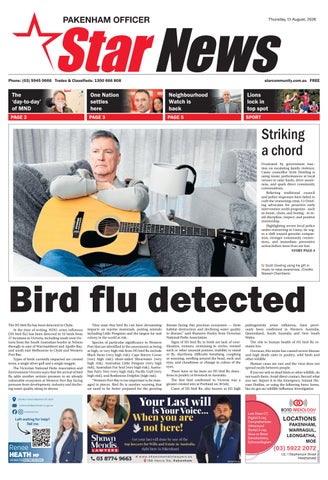
Striking a chord Frustrated by government inaction on escalating family violence, Casey councillor Scott Dowling is using music performances at local venues to raise funds, drive awareness, and spark direct community conversations. Believing traditional council and police responses have failed to curb the worsening crisis, Cr Dowling advocates for proactive early intervention youth programs - such as music, chess, and boxing - to instil discipline, respect, and positive mentorship. Highlighting severe local police under-resourcing in Casey, he urges a shift toward genuine compassion, stronger community connections, and immediate preventive action before more lives are lost. STORY PAGE 4
Cr Scott Dowling using his gift in music to raise awareness. (Credits Stewart Chambers)
Bird flu detected They state that bird flu can have devastating impacts on marine mammals, putting animals including Little Penguins and the largest fur seal colony in the world at risk. Species of particular significance to Western Port that are identified in the assessment as being at high, or very high risk from H5 bird flu include Black Swan (very high risk), Cape Barren Goose (very high risk), short-tailed Shearwater (very high risk), Australian Little Penguin (very high risk), Australian Fur Seal (very high risk), Australian Fairy Tern (very high risk), Pacific Gull (very high risk), and Bottlenose Dolphin (high risk). “Western Port Bay is too important to be managed in pieces. Bird flu is another warning that we need to be better prepared for the growing
threats facing this precious ecosystem — from habitat destruction and declining water quality to disease,” said Shannon Hurley from Victorian National Parks Association. Signs of H5 bird flu in birds are lack of coordination, tremors, swimming in circles, twisted neck or other unusual posture, inability to stand or fly, diarrhoea, difficulty breathing, coughing or sneezing, swelling around the head, neck and eyes, and cloudiness or change in colour of the eyes. There have so far been no H5 bird flu detections in poultry or livestock in Australia. The first bird confirmed in Victoria was a greater crested tern at Portland on 30 July. Cases of H5 bird flu, also known as H5 high
pathogenicity avian influenza, have previously been confirmed in Western Australia, Queensland, South Australia and New South Wales. The risk to human health of H5 bird flu remains low. Overseas, this strain has caused severe disease and high death rates in poultry, wild birds and other wildlife. Human cases are rare and the virus does not spread easily between people. If you see sick or dead birds or other wildlife, do not touch them. Avoid direct contact. Record what you see. Report it to the Emergency Animal Disease Hotline, or using the following form: forms. bio.vic.gov.au/wildlife-influenza-investigation
Low Dose CT, Digital X-ray, Comprehensive Ultrasound Dental X-ray, Dexa or Bone Densitometry, Echocardiogram
LOCATIONS PAKENHAM, WARRAGUL, LEONGATHA, MOE
(03) 5922 2072 U2, 1 Stephenson Street PAKENHAM 12869611-CB21-26
12831900-JV02-26
12781081-EB26-25
The H5 bird flu has been detected in Clyde. At the time of writing, H5N1 avian influenza (H5 bird flu) has been detected in 53 birds from 37 locations in Victoria, including south west Victoria from the South Australian border at Nelson through to east of Warrnambool and Apollo Bay, and south east Melbourne in Clyde and Western Port Bay. Types of birds currently impacted are crested terns, a single silver gull and a single magpie. The Victorian National Parks Association and Environment Victoria warn that the arrival of bird flu adds another serious pressure to an already vulnerable ecosystem at Western Port Bay facing pressure from development, industry and declining water quality along its shores.