Art arrives
The celebration included a smoking ceremony, and traditional dance by the Bindjareb Middars.
The Bindjareb Maar – Maar means five –are five stunning interpretive poles containing imagery collected and created by the local community.
They were created through a collaborative process involving local people and tell stories of the community’s past, present and future.

Their installation is the realisation of a vision that emerged when the shire began its Murray Town Square and Foreshore Redevelopment project.
It was identified at the time that there was a keenness to celebrate and showcase the rich culture of the local Nyungar people.
Shire president, Cr David Bolt said it was satisfying to see this project come to fruition.
“Sharing histories and cultures through art engages and inspires. It also strengthens relationships and aids reconciliation so, for many reasons, it is a great pleasure to see theBindjareb Maar in place,” Cr Bolt said.
Planning rethink
State governments must urgently overhaul their approach to land use planning to ensure no more homes are built without regard to risk on flood plains, according to a round table of organisations representing planners, builders and insurers held earlier this month.
Local Government Association president Linda Scott stressed how important it was to future proof infrastructure at a local level.
“Australia’s 537 councils play a vital role in building resilient communities, assisting in every corner of the nation to ensure our communities can better prepare for, respond to and recover from increasing natural disasters,” she said.
“It’s crucial we rebuild damaged local infrastructure to a more resilient standard. Councils will continue to strongly advocate for ‘building back better’ to be a core value and overriding principle of joint state/federal Disaster Recovery Funding Arrangements.
“On behalf of local governments, I look forward to attending the Planning Ministers’ meeting.”
In response to the flood emergency of recent years, the Insurance Council of Australia (ICA), Master Builders Australia (MBA) and the Planning Institute of Australia (PIA), supported by the Australian Local Government Association (ALGA), convened the inaugural National Industry Roundtable: Land Use Planning and Resilience. Planning Institute of Australia CEO Matt Collins said planning was a key factor in mitigating disaster impact.
“Planning is a critical tool for influencing the level of future disaster risk, and our changing climate means we need to act now to limit the impact of extreme weather on our communities,” he said.
“By adopting new risk-based policies and investing in better mapping and data, we can en-


sure development avoids or minimises exposure to flood hazards.
“Australia’s town planners support governments taking clear action to ensure more climate-conscious planning systems, and this roundtable is an important step towards this goal.”


Around 60 experts from government, financial services, property, and community joined the discussion, which called on state and territory governments when thinking about future housing challenges, to urgently rethink planning rules so no more homes are built in high-risk floodprone locations. A communique from the three sponsoring organisations outlining recommendations for reform has been released and will be sent to planning ministers, who also met today
to discuss this issue. The roundtable heard that all Australians are bearing the costs of worsening extreme weather events, and these costs are increasing because of historic planning decisions. Attendees agreed that without reform, population pressures and inadequate planning laws will see further development of flood-prone land putting lives at risk, costing taxpayers billions of dollars in recovery and remediation, and adding to an already strained insurance sector.
“The flood events of 2022, with almost 300,000 disaster-related claims costing around $7 billion, has driven up premiums and has resulted in affordability constraints for those at highest risk,” Insurance Council of Australia CEO Andrew Hall said.
Continued page 2
National
Newspaper AUGUST 2023 Supporting
Find out more about renewable gas projects and opportunities in NSW: gorenewablegas.com.au 12626435-AI33-23
Australia’s
Local Government
a secure, stable and sustainable energy system for the future
Celebrating the installation of the Bindjareb Maar art installation in the Pinjarra Town Square. The Bindjareb Maar was created through a collaborative process involving local people and contains imagery collected and created by the local community. The five interpretive poles tell stories of the past, present and future of our community.
The Shire of Murray celebrated the installation of the Bindjareb Maar artwork at the Pinjarra Town Square recently.
Success starts at local grounds
Since taking on this role I have been heartened to see so many councils putting in changerooms and facilities to allow more women and girls to play sport at a local.
The success of the Matildas, the Diamonds and the Australian Women’s Cricket team is only possible if there are young players coming through the ranks. And that is only possible if the facilities and infrastructure is there to encourage them.
Coming from a sporting family, I was the odd one out – not able to play cricket and Aussie Rules like my male siblings –this is a common story for those in Gen X and above. But now it’s all changed and it all starts with the facilities and support of LGAs across the country.
- Tania Phillips
MAYORAL PROFILES PAGE 4
THE GOOD OIL PAGE 7
COMMUNITY SERVICES, LEISURE, PARKS AND GARDENS PAGES 9-12
ENVIRONMENTAL MANAGEMENT PAGES 13-16
METRO AND SUBURBAN PAGE 18
RURAL AND REGIONAL PAGE 19
CONTACT US
Asset management planning in focus
Whether they have been elected to serve on a council such as a major urban centre with a multi-million dollar budget or a small community with a sparse population, the principles are the same: for the period of their tenure, they have a stewardship responsibility for infrastructure assets from roads and bridges to sporting ovals and water treatment. It’s important to think about the legacy you are leaving
behind for future generations.
This stewardship responsibility can be a steep learning curve for many elected officials. The council’s executive officers will brief them on budget planning, and many will come to a new understanding of the competing priorities and challenges the organisation is grappling with.
Qld to host summit
The Asia Pacific Cities Summit (2023APCS) and Mayors’ Forum is set to return to Brisbane from 11 – 13 October 2023, bringing together worldwide leaders and innovative speakers to share ground-breaking ideas and unlock new opportunities for cities.
The Summit is the Asia Pacific’s landmark event for those who lead cities and is an initiative of Brisbane City Council with a history of more than 25 years. In 2019, the Summit attracted over 1400 delegates from 140 cities and 83 mayors and deputy mayors and was awarded ‘Conference of the Year’ at the Australian Event Awards in 2020, commended for its clear vision and purpose.
opportunities for attending leaders to create their own global network of peers and learn from each other.
IPWEA’s Infrastructure Asset Management Planning for Elected Members short course explores the concepts, theories and application of infrastructure asset management as it relates to their roles.
This course will better equip you with the knowledge and skills required to make informed contributions to not only your organisation but the communities you serve too.
Rethink
From page 1
“Without insurance, homeowners likely can’t access a mortgage, and that is the wrong direction for our country.
“This roundtable set out the actions governments must take to ensure future financial losses to homeowners, businesses and the community are avoided, and better government planning and investment is taken seriously.”
Master Builders Australia CEO Denita Wawn said with a housing crisis at the forefront for many communities and a growing population, “we must ensure that our planning laws are fit for the future and take an appropriate risk-management approach”.
“Governments are encouraged to take a balanced approach to development and resist a default of building out with alternative considerations such as building up to take the pressure off the housing system and supported with infrastructure that is more resilient and adaptable to extreme weather events.
“Without fit for purpose planning laws technical building regulation will always fail. The housing industry needs clear and concise rules, that allow the industry to function and the community to have confidence.”
DIARY DATES
Classifieds:
P: 1300 666 808
E: sales@NetworkClassifieds.com.au

EDITORIAL
Tania Phillips Journalist
E: tania.phillips@StarNewsGroup.com.au
ADVERTISING
Phill Le Petit Sales Manager
phill.lepetit@StarNewsGroup.com.au
M: 0439 377 525 Louisa Kneller Sales Executive
louisa.kneller@StarNewsGroup.com.au M: 0413 380 545
Brisbane is proud to host this iconic and outcome-oriented gathering of city and industry leaders, with award-winning author and global urbanist, Charles Montgomery, revealed as the first keynote speaker.
It is a major coup to welcome Charles Montgomery to the 2023APCS in Brisbane, as his research helps people live better together using storytelling, public experiments, and collaborative design. His acclaimed book ‘Happy City’ raises valuable questions around how we can create happier communities.
Alongside Charles, we will also welcome innovation and leadership expert Andrew N. Liveris AO to the speaker lineup and Channel Nine’s Sylvia Jeffreys as MC for the event.
As well as ground-breaking speaker sessions, attendees can look forward to Major Project Announcement Briefings- announcement of upcoming tender projects in the region and a APCS Market Square exhibition and Meet@APCS business program. Opportunities are also available for youth aged 18-30 in the Young Professionals’ Program. Two cornerstone events of the Summit are the Mayors’ Forum and City Leaders’ Forum – exclusive
The Summit brings experts from business and government together to strategise and collaborate, while giving our local businesses the opportunity to create new connections and showcase their brand, services and products to a captive global audience of more than 100 cities representing half a billion people.
The 2023APCS’s overarching theme ‘Shaping Cities for the Future’ opens opportunities to create global collaborations and continue towards a sustainable outlook for the Asia Pacific and beyond. The overarching theme will be supported by sub-themes of Cities of Connection, Cities of Sustainability and Cities of Legacy.
Brisbane looks forward to welcoming more than 1000 mayors and delegates representing over 100 cities worldwide when the 2023APCS kicks off on 11 October 2023.

As leading industry players in their respective fields, each participating organisation brings a wealth of expertise to the table, making the 2023APCS program even more valuable for attendees.
The 2023APCS will primarily take place at the Brisbane Convention and Exhibition Centre in South Brisbane
This is a sponsored editorial brought to you by Brisbane City Council.
For more information and to register for the 2023 Asia Pacific Cities Summit (2023APCS) and Mayors’ Forum, visit apcsummit.org
ALGA’s 2023 National Local Roads, Transport and Infrastructure Congress
6-7 September
Canberra
Registrations are now open for ALGA’s 2023 National Local Roads, Transport and Infrastructure Congress in Canberra. This year’s Congress, with a broader focus on infrastructure, will be held in the Kambri Precinct at the Australian National University.
Local Government Queensland Conference
16 October
Gladstone Entertainment Centre.
Registration is now open for this year’s Local Government Queensland Conference.
LGNSW Human Resources Conference
10-12 October
Sydney
The Human Resources Conference has been specially designed to provide you with the practical strategies and invaluable insights needed to address key workforce challenges facing local government today.
2 LOCAL GOVERNMENT FOCUS August 2023 LGFOCUS.COM.AU
Beautiful Brisbane - host city.
Australia’s National Local Government Newspaper Website: LGFocus.com.au Noosa Office: Telephone: (07) 5455 6946 Address: 36 Mary Street, Noosaville Qld 4566 Pakenham Office: Telephone: (03) 5945 0666 Address: 10 Army Road, Pakenham VIC 3810 Network with LG Focus twitter.com/@LGFocusau facebook.com/LocalGovernmentFocus Editorial: E: editorial@LGFocus.com.au Advertising: E: advertising@LGFocus.com.au
E:
Published by Star News Group Pty Ltd ACN 005 848 108. Publisher
Thomas. All material is copyright to Star News Group Pty Ltd. All significant errors will be corrected as soon as possible. Distribution numbers, areas and coverage are estimates only. For our terms and conditions please visit LGFocus.com. au/terms-and-conditions/ INSIDE THIS EDITION EDITORIAL DESK
E:
Paul
When people are elected as councillors or mayors of their local government authority or local municipality, they are also elected as stewards and custodians of that community’s infrastructure assets.
NEWS
Advocating for urban infill
Western Australia’s Cook Government has introduced amending legislation to Parliament to boost housing supply and encourage more buyers to purchase off-the-plan properties to encourage urban infill.
Treasurer Rita Saffioti said the Cook Government committed $33 million in the 2023-24 State Budget to extend the off-the-plan transfer duty rebate and lift the concession thresholds.

“The Duties Amendment Bill delivers tax reforms and incentives to encourage urban infill and improve housing affordability,” she said.
“The Cook Government’s generous off-theplan duty scheme gives purchasers who enter into a contract to buy a new residential unit or apartment a rebate of up to 100 per cent of the duty payable depending on the value of property, capped at $50,000.
The Duties Amendment (Off-the-Plan Concession and Foreign Persons Exemptions) Bill 2023 simplifies the process for receiving transfer duty support when buying off-the-plan apart-
ments in multi-storey developments. Purchasers will receive an upfront concession on the duty payable, instead of paying the full amount of duty upfront and receiving a rebate after settlement.
The concession thresholds will also be increased for eligible contracts signed on or after 11 May 2023, to make the concession available for more purchasers and boost housing supply.
The Duties Amendment Bill will provide:
· a 100 per cent duty concession (capped at $50,000) for properties valued up to $650,000 (formerly $500,000); and
· a concession phasing down to 50 per cent of the duty (capped at $50,000) for properties valued at $750,000 or more (formerly $600,000).
NSW awards open
Nominations are now open for a prestigious awards program that showcases inspirational women and their achievements in the state’s councils.
The 2023 Ministers’ Awards for Women in Local Government will recognise the significant contribution women make to NSW councils.
The annual awards are now in their 16th year and recipients will be announced at a ceremony co-hosted by Minister for Local Government Ron Hoenig and Minister for Women Jodie Harrison at Parliament House on 4 October.
Jodie Harrison said the awards play an important part in showcasing the achievements of women in local government.
“Having come from local government myself, I know that there are women across NSW making a difference in local government every day as elected representatives and council staff,” she said.
“I encourage everyone in the local government sector to consider nominating a talented female colleague or elected representative for the Women in Local Government Awards.”
“The number of women elected to councils rose from 31 to 39 per cent at the last local government elections and I’d like that percentage to continue to grow, along with an increase in the number of women in leadership roles in councils, Local Government Minister Ron Hoenig said.
“It’s important that we recognise and celebrate the accomplishments of women in the sector and hopefully these awards will inspire more women to consider nominating when the local government elections are
held next year.”
The award categories include:
· Alternative Pathways Award – a female staff member who is breaking down gender stereotypes.
· Champion of Change Award – a general manager or senior manager (male or female) who has excelled in supporting and encouraging women’s participation at their council.
· Elected Representative Award – a councillor who has advanced the position of female elected representatives.
· Young Achiever’s Award – an outstanding trainee/apprentice (aged 25 and under).
· Employment Diversity Award – a successful council program to increase female participation in senior leadership roles or at the elected representative level Woman of Distinction Award – a woman who has demonstrated exceptional innovation, integrity and initiative or who has a positive influence on others.
· Councillor Lilliane Brady OAM Award –nominations not required. Winner will be determined by the Minister to recognise and honour the dedication and tireless work of a female council staff member.
· Nominations for the 2023 Ministers’ Women in Local Government Awards close on 17 August.
For more information or to make a nomination go to olg.nsw.gov.au/ourminister/ ministers-awards-for-women-in-local-government
Finance Minister Sue Ellery said the current scheme was due to expire on 24 October 2023, but has now been extended to 30 June 2025.
“Our focus is supply. This Bill is one of a range of important tax reforms and incentives being offered by the State Government aimed at boosting housing supply across Western Australia.
“The Bill also removes restrictions on when the foreign buyers duty exemption applies for acquisition of land that support residential developments.”
Existing foreign developer exemptions will be expanded to remove restrictions on the type of land eligible for a refund of foreign buyers duty if it is acquired for a residential development.
The foreign buyers duty amendments will apply retrospectively from 1 January 2023.
“Our Government is using every lever we can to bolster the supply of housing throughout Western Australia – including through a range of tax and stamp duty reforms and incentives,” Housing Minister John Carey said.
“By extending the off-the-plan duty assistance and lifting the thresholds for the concessions, we are providing opportunities for more people to purchase off-the-plan properties, which assists in getting new apartment developments off of the ground, increasing overall housing supply.”
More information about the proposed legislation is available on the Western Australian Parliament website. Parliament of Western Australia
Can’t beat homage
Gold Coast Mayor Tom Tate celebrated the announcement that global music icon Sir Paul McCartney will play a concert in the city as part of his recently announced tour by “doing an Abbey Road’’ outside the HOTA precinct.

“Better still, I’ll rename the thoroughfare Abbey Road just for a day as we celebrate the announcement,” he said.
“Life’s too short to take ourselves seriously. We love the news about Sir Paul McCartney and want everyone to know that the
McCartney concert is a chance to visit, enjoy the music and stay on. Make it a long weekend with the Melbourne Cup on the Tuesday after.”
The concert is at Heritage Bank Stadium on November 4.
More sport for city
Latrobe City Council endorsed the recommendations of the Tourism and Major Events Advisory Committee to bring more sport to the region at its most recent council meeting.
The recommendations included that council funds two events through the Major Events attraction budget, those being a 2023 Deakin Melbourne Boomers Women’s National Basketball League match and the 2024 – 2026 Baseball Victoria U16 Winter Championships.
This funding will allow council to support the Deakin Melbourne Boomers’ return to Gippsland Regional Indoor Sports Stadium for the fourth year running, to compete in an in-season Women’s National Basketball League match.
This event will be broadcast live on streaming platforms 9Now and FIBA YouTube, ensuring national and international exposure for Latrobe City.
The event will also provide opportunities for local community engagement, allowing residents to actively participate and immerse themselves in the basketball festivities.
Hosted in Latrobe City for the past three years, the Baseball Victoria U16 Winter Championship is set to return for an addi-
tional three-year period. This event will see up to 200 of the best Under 16 baseball players from across Victoria compete over two days in a round-robin style championship at venues in Traralgon and Morwell.
This event has been well supported by the local baseball associations. Baseball Victoria is excited for the continuation of this event.
Mayor of Latrobe City Council, Councillor Kellie O’Callaghan, said major events are a fantastic way to bring visitors to our region.
“Council will contribute $10,000 to the basketball match, which will bring an estimated economic impact of $289,130 to the region. Baseball will also bring a great estimated economic benefit of $175,000, with a council spend of $5000,” Cr O’Callaghan said. “Major events like these create an opportunity to showcase the region and our impressive sporting facilities to a wider audience, whether it be those who attend in person or who watch the live stream locally or across Australia, and in some instances internationally.”
LGFOCUS.COM.AU August 2023 LOCAL GOVERNMENT
3
FOCUS
NEWS
NSW Minister for Women Jodie Harrison speaks to the media during a press conference in Sydney.
Picture: AAP IMAGE/BIANCA DE MARCHI
Mayor Tate, Cr Donna Gates, Cr Hermann Vorster and Cr Brooke Patterson cross the new “Abbey Road” pedestrian crossing at HOTA.
From the farm to council
Tell us about your area: what makes your council special or different?
Snowy Monaro Regional Council (SMRC) is in the southeast corner of New South Wales. Our region covers 15,000km2 from the Victorian border in the south to the ACT border in the north, Kosciuszko National Park in the west and the coastal escarpment to the east.
SMRC has the largest road network in our council category.
Do you have a favourite part/aspect/ attraction in the council area?
The top part of my family’s farm overlooks the Monaro plains from the north of Cooma, down to the Victorian border. The sweeping vista of the Monaro treeless plains, flanked by the snow-covered mountains in the west and the rolling eastern coastal fog that comes in in the evening is spectacular.
How long have you been on council and why did you become involved in local government?
I have been involved in local government for 20-plus years. I was elected to the former Cooma-Monaro Shire Council in 1999, serving until 2008. My motivation was ensuring council represented the community fairly and provided the public with transparent, accurate information.


In 2021 I decided to stand for election again. I felt I had a lot of experience and the right skillset to contribute to a constructive and productive council.
Do you have another job? Tell us about that and how it contributes to your role/views as a councillor.
My husband and I own and operate a merino sheep farm. I worked in health for 35 years, which included 20 years in management. What activities do enjoy outside of work hours?
Hiking beautiful walks across the world, gardening, developing a sustainable farm, and spending time with my family.
What are they key challenges facing you and your council?
The number one challenge we face is in achieving and sustaining financial sustainability. It is an unenviable task to maintain our enormous asset base of 2700km of roads, 371 buildings, and numerous parks and recreational spaces with such a small population. The continuous cost shifting of costs from State and Federal Governments to local government contributes in no small part to our precarious financial situation. The emergency services levy should not be paid out of rate revenue, and should be applied separately. The red fleet “gift” will add to our overburden asset base and depreciation costs. Our council has resolved not to accept this “gift“.
What innovative projects or policies is council working on?
Our custom-designed, comprehensive and independent Financial Sustainability Review.
This project has provided a road map to financial sustainability, defining the services that the council can provide effectively and enabling changes to the services that are inefficient. Tell us about a specific success you have had in local government.
I strongly believe that success in local government is a team effort. While my fellow councillors may have different views, we have undertaken the Financial Sustainability Review and applied for a Special Rate Variation in less than 12 months of new council with many first term
councillors. This a major achievement in righting the course of this organisation, which has been plagued by financial difficulty since its inception.
What is the best part about being a councillor?
Engaging with and listening to our community, and finding solutions to their problems. What is the worst part?
Social media posts defaming, slandering and misrepresenting council and councillors. What do you hope to accomplish in the future?
An engaged community who has confidence in our council.
‘Place where you can have it all’: Mayor
Tell us about your area: what makes your council special or different?
The City of Cockburn is a magnet for families and lifestyle hunters who want to live, work, play and invest here. It’s a place where you can have it all.
Cockburn is centrally located south of the Perth CBD, on Whadjuk Nyungar Boodjar (the traditional country of the Whadjuk Nyungar First Nations people) between the Cockburn Sound coast and Jandakot Airport, WA’s major general aviation airport.
It’s home to 125k+ people across 24 vibrant, diverse communities, old and new, where you can experience everything from pristine beaches and internationally significant wetlands to theme parks and worldclass recreation facilities.
This includes the headquarters of an AFL and AFLW team in the emerging strategic centre of Cockburn Central where a $1b transformation of Cockburn Gateway Shopping City will take place over the next decade.
Cockburn is a place of opportunity, providing around a third of all employment in the Perth southern metro region and generating $6b in domestic and international exports.
We have more than 9200 businesses, and host five of WA’s most successful industrial and commercial hubs, covering defence to manufacturing and employing about 18,000 people.
Do you have a favourite part/aspect/ attraction in the council area?
The Cockburn coast holds a special place in my heart with its crystal clear waters offering an abundance of recreational opportunities.
I’m also attracted to the wetlands and banksia woodlands that form a chain of natural beauty
north-south in our district and beyond, again offering amazing places to explore all that nature has to offer.
How long have you been on council and why did you become involved in local government?
I was an elected Councillor from 1990 to 1999 and since March 2009 have been the popularly elected Mayor with my current term ending in October 2025. My wife Pat and I are at a time in our lives where we can commit
ourselves to representing the city by being out and about in the community usually seven days and six nights a week. We love immersing ourselves in all things community and actively listening to its dreams and aspirations.
What activities do enjoy outside of your work as an elected member?
Family is very important, so spending as much time as possible with them is important.
I am also very committed to long established volunteering roles including as a Justice of the Peace, member of the Royal WA Historical Society and Cockburn Historical Society, involvement across the community and the responsibilities of patron of many organisations.
What are they key challenges facing you and your council?
The legacy of the pandemic is still evident with rising costs for scant labour, skills shortages, inflated cost for materials, insurance and risk mitigation combined with high inflation. More than ever, this requires careful setting of priorities going forward.
What innovative projects or policies is council working on?
Council has recently endorsed a request to the WA Minister for Planning to grant approval to update our Town Planning Scheme to include specific orders to provide greater protection for trees on our Significant Tree List.
We will also receive a report in the next 12 months to investigate further amendments to our TPS that would require development approval for the removal or substantial pruning of trees in areas of the city where it has development control.
These decisions are in line with our desire to provide extra protection for trees in our city.
Tell us about a specific success you have had in Local Government. Having spent a total of 24 years on council there is a long list of achievements resulting from council decisions. This includes the very successful Cockburn ARC (Aquatic and Recreation Centre) project. The $12.5m facility opened in May 2017 after five years of planning and decision making. This state-of-theart integrated aquatic, recreation, education and elite athlete training facility attracts over 1.3m visitors a year. Cockburn is just one of 18 local governments around Australia to host AFL and AFLW teams, with the Fremantle Dockers’ HQ located at the award-winning Cockburn ARC facility, which is on target to undergo a $12m expansion in the future.
What is the best part about being an elected member?
The opportunity to be out and about talking ‘face to face’ with our community. I regularly attend business forums, sporting and community events, schools and faith groups. I am motivated by understanding the dreams and aspirations of those who choose to call Cockburn home, or as a place to run a business, recreate and invest as we strive to make Cockburn the best place to be.
What do you hope to accomplish in the future?
I will continue to lead our organisation as elected member, ensuring that we deliver on the range of services using the resources of our staff and volunteer base. We will remain responsive and alive to the challenges of the pandemic and how best to address the current economic climate where labour, skills, materials and risk mitigation currently influence our decision making.
4 LOCAL GOVERNMENT FOCUS August 2023 LGFOCUS.COM.AU
City of Cockburn Mayor Logan K. Howlett, JP.
This month Local Government Focus catches up with the City of Cockburn’s Mayor Logan K. Howlett, JP.
Local Government Focus catches up with Snowy Monaro Mayor Mayor Narelle Davis this month.
MAYORAL PROFILES
Mayor Narelle Davis.
Reynolds to lead LGNSW
Following a strong recruitment round, David Reynolds joins the peak body of local government from The Hills Shire Council, where he has been group manager, shire strategy for five years.
Prior to this, he was the director customer and corporate strategy at Camden Council for three years.
LGNSW president Darriea Turley welcomed Mr Reynolds’ appointment.
“David’s extensive experience and drive for excellence will ensure that LGNSW can continue to deliver for our members right across NSW,” Cr Turley said.
“Very importantly, his commitment to further building the positive culture within LGNSW will make him a terrific leader and colleague for the team at LGNSW.
“I am especially glad that we have been able to fill this position from within the local government sector and I am confident that David will be a great fit for the organisation.”
Just hours after his announcement, he joined local government colleagues at the Local Government Week Awards which were handed out at an event in Doltone House.

Fourteen city and regional councils took home 14 awards out of 116 entries.
The big winners were Singleton City Council, Gunnedah Shire Council, Wingecarribee Shire Council, Penrith City Council and Hawkesbury City Council which each took home two awards.
“These awards help move the conversation beyond the traditional roads, rates and rubbish by demonstrating the far-reaching role councils’ play in their communities,” Cr Turley said.
“The real winners are the communities which the councils represent.”
The awards covered included:
· The RH Dougherty Events and Communications Awards;
· The Leo Kelly OAM Art and Culture Awards;
· The LGNSW Planning Awards; and
· The Department of Communities and Justice (DCJ) NSW Youth Week Awards.
On hand were the Minister for Local Government Ron Hoenig MP as well as the Minister for Youth Rose Jackson MLC.
All of the awards were judged by panels of experts who commented at the high standard of entries.
Winners
· Leo Kelly OAM Arts and Culture Awards Project. Division A (population 0- 30,000 people)
Winner: Singleton Council, We Are Singleton: Portrait of a Town; Division B (population > 30,000 - 70,000 people) Winner: Bathurst Regional Council, Central Tablelands Collections Facility; Division C (population > 70,000
people) Highly commended: Waverley, Council Bondi Story Room, Highly commended: Campbelltown City Council, Bad Machine; Winner: Blacktown City Council, Contemplate - Public Art work
· Strategy/Plan; Division C (population > 70,000 people) Winner: City of Parramatta, First Nations Engagement Framework.
· LGNSW Planning Awards: Division A (population 0-30,000 people): Highly commended: Murray River Council, Development Services Restructure; Winner: Singleton CouncilBuilding Capacity Program; Division B (population 30,000 - 70,000 people) Winner: Wingecarribee Shire Council, Robertson; Division C (population > 70,000 people) Winner: Penrith City Council, St Marys 2041: A planning pathway towards a thriving strategic centre.
· RH Dougherty Events and Communications Awards: Excellence in communication: Division A (population 0 - 30,000 people) Win-
Group a step in the right direction
In celebration of Local Government Week, the NSW Parliament has re-established its Parliamentary Friends of Local Government group.
At the first meeting of the group on 3 August, Dr Amanda Cohn MLC and Mr Rory Amon MP were appointed as co-chairs, with the Hon Peter Primrose MLC appointed as deputy chair.
Dr Cohn, Mr Amon and Mr Primrose are among the 50 members of parliament who are also former local government councillors.
According to LGNSW president Cr Darriea Turley AM, the creation of the multipartisan group is a step in the right direction.
She said the creation of the group was an opportunity for the NSW Government and local government to achieve better outcomes for the community.
“It’s also crucial that members of our State Parliament liaise with the local government sector to get a sense of the issues and problems that local government is facing,” Cr Turley said.
“It’s a difficult time for the sector with costs skyrocketing as a result of high inflation and the lack of a subsidy from the State Government to cover the increase in costs of the Emergency Services Levy.
“Such a group will enable local government to let Members of Parliament know firsthand just what problems local communities are facing and the broader issues within the local government sector.”
The first meeting was at Parliament House.
ner: Central Darling Shire Council, Printed Resident Newsletters; Division B (population 30,000 - 70,000 people) Winner: Wingecarribee Shire Council, Seniors Festival 2023; Division C (population > 70,000 people)
Highly commended: Ku-ring-gai Council, Net Zero Champions volunteer program; Highly commended: Inner West Council Uluru Training, Inner West Council; Winner: Penrith City Council, 2022 Trees for Mum campaign.
· RH Dougherty Events and Communications Awards: Innovation in special events: Division A (population 0- 30,000 people) Highly commended: Murray River Council, Lighting
Up the Murray - Moama Lights; Two Winners: Gunnedah Shire Council, Book paper folding for Fairy Tale February - Gunnedah Library; and Narrabri Shire Council, The Exchange Business Activator (TEBA) Program; Division B (population 30,000 - 70,000 people)
Winner: Hawkesbury City Council, Event passports; Division C (population > 70,000
people) Highly commended: Willoughby City Council, Willoughby City Library Intergenerational digital literacy; Winner: City of Canterbury Bankstown, Ramadan Nights Lakemba.
· Reporting to your community: Division A (population 0- 30,000 people) Highly commended: Richmond Valley Council, Rebuilding the Richmond Valley; Division B (population 30,000 - 70,000 people) Winner: Hawkesbury City Council, Renewing Hawkesbury’s Roads; Acknowledging Individual contribution: Highly commended Lismore City Council - Tony Duffy, Opening Our Heart Event.
· NSW Youth Week Awards Most Innovative Youth Week Program winner Fairfield City Council; Most Inclusive Youth Week Program winner Inner West Council; Best Small Council with Most Outstanding Youth Week Program winner Gunnedah Shire Council; and Best Local Youth Week Program winner Camden Council.
Council body refutes minister’s claim
strongly refutes Planning, Housing, and Homelessness Minister
WALGA president Karen Chappel said the implication that councils were engaging in some sort of “Nimbyism” around housing and community housing, particularly in Homelessness Week 2023, was unhelpful and unjustified.
“Local government is the backbone of the planning system, determining over 20,000 proposals each year,” said Cr Chappel.
“WALGA is not aware of any concerns raised by community housing developers around planning timeframes or refusals of proposals.”
WALGA data collected over the last five years shows that 99 per cent of planning approvals are approved by local governments, and around 85 per cent are determined within statutory timeframes.
Cr Chappel also pointed out that housing
and homelessness are State Government responsibilities.
“Yet, in addition to their statutory planning responsibilities that support housing approvals, local governments are doing more and more to support housing and homelessness.
“This includes grants to community housing developers, providing land, providing frontline staff such as rangers supporting and referring people experiencing homelessness, and working with police and volunteer and charity groups.
“As a former Local Government Minister and Mayor, the Planning Minister knows this and has clearly chosen to ignore the facts in an effort to divert attention away from the State Government’s lack of progress in addressing critical housing shortages and homelessness in this state.”
LGFOCUS.COM.AU August 2023 LOCAL GOVERNMENT FOCUS 5
NEWS
WALGA
John Carey’s recent assertions that local governments are stymying the delivery of housing, including community housing.
The board of Local Government New South Wales (LGNSW) has appointed a new chief executive.
LGNSW president Cr Darriea Turley AM welcomes new chief executive David Reynolds and thanks outgoing CE Scott Phillips.
Stirling to his bones
The City of Stirling has proudly announced that Stevan Rodic has been selected as the next chief executive officer of the City of Stirling.
Mayor Mark Irwin described the incoming CEO as ‘Stirling to his bones’ in an email to all employees announcing the appointment earlier this month.
With more than 25 years of local government experience, Mr Rodic started his career at the City of Stirling as part of the planning team on the city’s front counter working directly with residents and businesses. Mr Rodic has a strong connection to the local community, and is dedicated to excellence in customer service under his personal and professional mantra ‘do better’.
Mr Rodic was employed by the City of Stirling from 1997-2007, and then served in other leadership roles in the local government sector for more than a decade. He then returned to the City of Stirling as manager of development services in June 2019.
By December 2019, his ability to positively influence organisational culture, understand and respond to community needs, and deliver on their aspirations led to his appointment as director of planning and development. Mr Rodic has served effectively in that role for almost four years through the challenges of the COVID-19 pandemic, which saw the city provide millions in support for community services and small businesses.
Mayor Mark Irwin said council was blown away by Mr Rodic’s deep understanding of the City of Stirling, not just the local community but the organisation itself.
“In addition to being highly experienced across a broad range of planning and development services and functions, Mr Rodic has genuine concern for the community he serves and the employees in his care. He presented clear plans for the future of the City of Stirling, and showed an ability to deliver on the aspirations of our community,” he said.
“He has demonstrated innovative thinking
and problem solving at the level required in leading Western Australia’s largest local government. Council is confident he will build upon the city’s highest standards and award-winning performance.”
Incoming CEO Stevan Rodic said he was both humbled and incredibly excited to take on the role of leading Western Australia’s largest local government.

“I am honoured by the trust council has shown in my abilities to lead our city into a new era of prosperity and sustained success and I look forward to working alongside our employees, stakeholders and community,” he said.
“I love the City of Stirling and what it represents. I have worked for this organisation for
Seeking new cr
Nominations for the vacant councillor position on Toowoomba Regional Council must be lodged by Tuesday, 15 August, 2023.
Council’s acting chief executive officer Nick Hauser said nominations for the vacant councillor position would close at 5pm on 15 August.
Mr Hauser said nominations for the vacant councillor position are invited from any person who is qualified to be a councillor, and from each person who was a candidate for election at the previous Local Government election in 2020.
most of my career and the opportunity to lead the city is an absolute privilege.
“People are the key to a successful organisation and I am focussed on further developing a culture where we strive for excellence in everything we do here at the city.
“Together, with our community and council, we will build on our strong foundation, continue to lead the sector and deliver on our vision to be a sustainable city with a local focus.”
Following council endorsement at a recent meeting, the handover period between the current CEO and the new CEO will begin to ensure a smooth transition for employees and the community. Mr Rodic will formally commence on 3 January 2024.
Councillor Boyd takes her place
Shoalhaven City Council has inducted its newest councillor, Gillian Boyd, before the council meeting held in late July.
Cr Boyd fills the Ward Three vacancy arising from Liza Butler’s resignation following her election to State Government in March.
She is the successful candidate resulting from the mid-term countback election which recounted the votes from the December 2021 Local Government Election.
With a background in human services, Cr Boyd is experienced in policy development and program delivery.
She has pursued a varied career path, starting as a science teacher in Victorian sec-
ondary schools, and more recently working as a federal public servant in vocational education and training policy in Canberra.
As a parent and passionate community advocate, Cr Boyd has participated in playgroups association, primary and secondary school P&C and boards, hockey coaching, chairing community services organisation (delivery of childcare and aged care services).
Cr Boyd is currently the chairperson of the Land Management Board for the South Pacific Heathland Reserve, a Crown Lands biodiversity conservation reserve in Ulladulla.
She is also active in the Ulladulla and District Garden Club, promoting greater awareness of gardening and gardens as valuable community assets.
Cr Boyd is also a committed cyclist, gardener and dog owner.
Shoalhaven City Council is made up of 13 councillors including a popularly elected mayor. There are four councillors representing each of our three wards. Information and contact details for all councillors can be found on council’s website.
Coughlan to lead city growth
Warrnambool City Council has appointed Luke Coughlan to the position of director of city growth.
Mr Coughlan, who has been acting director in the role over the past eight months, will oversee council functions including strategic and statutory planning, environmental health, economic development and the visitor economy.
“We’re really pleased to appoint Luke to the role,” chief executive officer Andrew Mason said.
“He has done a terrific job as acting director and has a great work ethic. Luke has a background in engineering and land development and is well placed to work with the development sector to ensure that our approval processes produce good outcomes for the community.
“I’ve been lucky enough to have served in the position for the past eight months and worked in the directorate over the past two years,” Mr Coughlan said.
“Warrnambool is a city which has enjoyed steady growth over an extended period.
“This comes with its challenges but also tremendous opportunities.
“The directorate’s three departments comprise enthusiastic staff who as a team provide many years of technical expertise along with new ideas for the future.”
Mr Coughlan joined council six years ago working firstly as a manager within the City Infrastructure directorate.
“I’d like to thank the staff in the City Infrastructure and City Growth directorates who have helped me along the way and put the council in a strong position when it comes to managing the growth of the city.”
When not at work Mr Coughlan is kept busy with a young family and also “makes up the numbers” in the South Rovers reserves.
“Warrnambool is a really beautiful and liveable city with tremendous natural assets and opportunities for residents,” he said.
“Notices calling for nominations have been published, including on council’s website, and former candidates have been individually notified, where the candidate provided authorisation to publicly release their particular contact details at the time of their nomination at the March 2020 elections (as advised by the Electoral Commission of Queensland),” Mr Hauser said.
“Several former candidates did not provide the authorisation to allow the release of their contact details.
“Council must then meet and formally resolve to fill the vacant office of councillor by appointing one of those nominees within two months of July 21, 2023.” (Following their appointment by council, the CEO will then swear in a new councillor.)
Mr Hauser said individuals who meet the eligibility criteria outlined in the Councillor Nomination form can register as a nominee and be considered for appointment until the end of the current electoral term in March 2024.
To be considered for this position, nominees must live in the Toowoomba local government area and meet the conditions outlined in Chapter Six, Part Two Division One Qualifications of Councillors, Sections 152-156 of the LGA. Intending nominees are invited to view the application requirements and lodge their application. Enquiries can be directed to 131 872 or info@tr.qld.gov. au
Other informative resources are available by visiting the Local Government Division of the Department of State Development, Infrastructure, Local Government and Planning, statedevelopment. qld.gov.au/local-government or calling (07) 4616 7314.
Other information about the responsibilities of a councillor (and details relating to the March 2024 local government election, for people who are considering nominating for the election) can be viewed at ecq.qld.gov.au by calling 1300 881 665 or via email, ecq@ecq.qld.gov.
au
Mr Hauser said council was following the requirements under the Local Government Act 2009 (LGA) to fill the vacant councillor position for the remainder of the term. The position became vacant following the resignation of former Mayor Paul Antonio in July this year.
At subsequent Special Meetings of Council, Cr Geoff McDonald, the former Deputy Mayor, was appointed Mayor of the Toowoomba Region, followed by the appointment of Cr Rebecca Vonhoff as Council’s new Deputy Mayor.
Under the LGA there is no requirement to hold an election to fill the vacant office of councillor as the vacancy is now too close (within 12 months) to the next quadrennial local government election, set for Saturday, 16 March, 2024.

6 LOCAL GOVERNMENT FOCUS August 2023 LGFOCUS.COM.AU NEWS
Luke Coughlan, new director of city growth, with chief executive officer Andrew Mason.
Deputy mayor Stephanie Proud JP, incoming CEO Stevan Rodic and mayor Mark Irwin.
Our under-utilised towns
I was at a gathering last month in a swish London
towns. Her eyes lit up when she reminisced
That’s a bit harsh I thought, but on reflection she has a point.
Why? The sparseness of our small towns is arguably a function of our low population densities, and their ‘relative’ youth vis-à-vis Europe towns. And here cities and big towns get planned, but small towns rarely. Facilities and businesses are often in odd places. Councils offer up marginal land with little thought as to the need to create a commercial focal point and the synergies that come with it.
I believe there is a compelling case for federal and state governments to establish a program to facilitate the densification of our small towns, and thus provide a platform for their continued existence. There are three reasons:
· They are critical to a region’s tapestry of economic and social infrastructure. When they dwindle on a significant scale across a region, there are BIG unintended consequences. Farm and business closures lead to the Swiss Cheese effect. A classic example has been the impact of Murray Darling water policies on small towns like Moulamein.
· Small towns are where environmental and disaster management problems are best understood and addressed. As a Tallangatta (Vic) farmer stressed to me recently ‘last summer our volunteer fire brigade attended nine fires. This effort went largely unnoticed. If the local population was to shrink further, our ability to look after the surrounding environment would be severely compromised.’
· Small towns are where Australia’s forgotten people have the opportunity to mingle and share experiences - about the drought,
THE GOOD OIL
ROD BROWN
or efforts to recover from flood damage, or the fortunes of the local footy team. The importance of small towns in facilitating mental health and combatting suicide is poorly understood.
The particular rationale for a small town program is market failure, especially the inability of the market to put a value on the environmental and social benefits of small towns. Another type of market failure is coordination failure –the difficulty in connecting people and agendas across large distances. Unfortunately rural councils often don’t have the in-house expertise to run these arguments.
The essence of my small town program would be to address this market failure with $100 million per year, shared by the federal and state governments. This is about the cost of a submarine fin. It would finance small-scale infrastructure to enhance the investor and tourist attractiveness of small towns.
It would involve a range of small-medium projects. In the upper cost bracket - toilet blocks, signage, car parks, RV parks, court-
yards, street and path lighting, footpaths, sporting clubs (within reason), Mens’ Sheds, CWA facilities, Silo Art. In the lower cost bracket - water dispensers, tables-chairs-umbrellas, mature shade trees, water features, pot plants, cans of paint and funding for 3-4 youths to brighten up tired public buildings.
Excluded would be swimming pools, tennis courts, roads, bridges and other high cost items that have other funding streams as well as considerable recurrent costs.
A good example is Binalong, near Yass, where Banjo Paterson grew up. It has nothing to show for it, no signage, no nothing. Meanwhile Winton, where Banjo spent three weeks mulling over the lyrics to Waltzing Matilda, has a $23 million tourism facility! That is coordination success for Winton and coordination failure for Binalong on a grand scale.
Devolution
Devolution would be a key feature of this program – it wouldn’t be run out of Canberra or the state capitals! It would be led and administered by the RDA Committees. Their members are incredibly well qualified - but hardly appreciated - in my view. There are 52 RDACs in total, but we’re talking about the 35 in rural areas. The program budget would thus provide each with around $3 million to get on with it.
Isn’t there a risk of more pork barrelling you say? Well the matching funding requirement with the states, and the necessary liaison with local councils, would require a collaborative effort that would snuff out pork barrelling. And my model would have a senior federal official (with state counterparts) to do a quick sign-off.
Gone would be the days of convoluted program criteria, months of submission writing, months of waiting, and the inevitable letdown of programs that have an average success rate of 15 per cent for applicants.
We propose floating the above proposal with some RDACs and federal politicians. Will keep you posted.
Mediterranean discovery
Inter-island ferries are a crucially important component of the Greek economy. And Blue Star Ferries is the market leader.
Its Mykonos to Paros service is an example. As the ferry’s diesel engines power up, the 1200 passengers are genuinely excited. The main deck is 35 metres wide and the seating is sumptuous, even in economy class, I ask a steward where this impressive vessel is made, and he replies – very proudly - ‘Australia!’
On further digging it transpires that the manufacturer is Incat, the brainchild of John Clifford. It’s based in Hobart and employs about 400. Its ferries are the pride of fleets throughout the world. Who needs fancy marketing when these ferries are on show 24/7.
Meanwhile Austal has been manufacturing similar vessels in Perth for decades. Their SplitDubrovnik ferry is a standout.
Both are remarkable companies. They must surely be competitive given our weak $A, and the US Navy is already an important client. Presumably lots of up-side there.
Rod Brown is a Canberra-based lobbyist specialising in industry/regional development. Email apdcockatoo@iprimus.com.au

No Commonwealth Games, but funds flow
The Victorian Government’s decision not to proceed with hosting the 2026 Commonwealth Games in regional areas was met with disappointment in many of the areas that had been earmarked to host events.

Greater Shepparton City Council Mayor, Councillor Shane Sali, said he was extremely disappointed following the announcement.
Latrobe and Ballarat, while still disappointed, were quick to see the bright side.
“This decision comes as a great blow to our community, which was eagerly anticipating the opportunity to showcase our region’s capabilities, culture and hospitality on an international stage,” Latrobe City Council said in a statement at the time of the announcement.
“Latrobe City had been actively preparing for the Commonwealth Games, investing time, resources and effort to ensure the successful hosting of this prestigious event.
“Hosting the games brought the promise of substantial economic benefits for local businesses and tourism, infrastructure improvement, social and affordable housing and a sense of community pride to our region.
“While this news is disappointing for our community, we acknowledge the government’s announcement of a $2 billion package to ensure regional Victoria receives lasting benefits.”

The Ballarat statement also focussed on the $2billion package to be shared across regional Victoria.
“The decision from the State Government not to proceed with hosting the Commonwealth Games in 2026 is disappointing for the City of Ballarat,” the statement read.
“However, despite the announcement, we are committed to ensuring the State Government delivers on what they have committed to the community and remain optimistic about the legacy items that have been promised.
“We are reassured by the promise of a $2 billion package to be shared across regional Victoria to deliver lasting sporting and housing infrastructure.
“For Ballarat, this will mean we will continue to advocate for: A 5000 seat upgrade at Mars Stadium, the train station upgrade that includes DDA access at Ballarat Station (as
costed in the recent State Budget papers at $49.181 million), Upgrades at Ballarat Sports Events Centre, The Creswick mountain biking project, base infrastructure work at Saleyards site (including removal of King’s caveat, decontamination of the site and delivery of services), a permanent athletics track in the Major Events Precinct and Sharing in a new $1 billion regional housing fund (mix of social and affordable housing).
“We look forward to continuing to work with the government to ensure they honour the legacy projects that will provide benefits across tourism, sporting infrastructure and social housing.”
Greater Shepparton had been announced to host a suite of cycling events, including both the men’s and women’s road race time trials, as well as the BMX Racing competition, which was set to be a major drawcard for the region.
“Disappointed is an understatement. The
Greater Shepparton region had already began gearing up for the 2026 Commonwealth Games and we were extremely excited to have been announced as one of the five host cities,” Cr Sali said.
“The regional Victoria model was set to bring thousands of athletes, visitors and spectators to Greater Shepparton and provide a positive boost to the region’s economy, which would last long after the games were over. It was this Commonwealth Games legacy which our region was most excited for, and this is what we will now turn our efforts to.”
The Victorian Government has acknowledged that the funding allocated for upgrades to the Shepparton BMX track will still go ahead, which Cr Sali said would help the region attract more state, national and international sporting competitions.
“This funding for upgrades to the Shepparton BMX track is a great result. The Vic-
torian Government also announced our region will shared in the $150 million Regional Tourism and Events Fund which will offer new events, attractions and more accommodation in Greater Shepparton,” he said.
“Conversations will now take place in the coming weeks and months, with our expectation for further funding to be allocated towards the Shepparton Sports and Events Stadium upgrade. This upgrade is high on the priority list and a major project which we will continue advocating for.
“We will also continue to push for the State Government’s contribution to Stage One of the Goulburn Valley Highway Shepparton Bypass which is an extremely important piece of infrastructure, not just for our region for but all of regional Victoria. We will continue these conversations to ensure Greater Shepparton can get the most out of the $2 billion regional package announced by the State Government.”
LGFOCUS.COM.AU August 2023 LOCAL GOVERNMENT FOCUS 7
Victorian Premier Daniel Andrews (second right) speaks to media during a press conference at Parliament House in Melbourne.
Picture: AAP IMAGE/JAMES ROSS
Shadow Minister for Infrastructure Bridget McKenzie and Nationals senator Matt Canavan at a press conference to speak on the Senate inquiry into Commonwealth and Olympic Games, at Parliament House.
Picture: AAP IMAGE/MICK TSIKAS
hotel, and a British lady asked what it’s like engaging with small Australian
‘they’re so cute, they’re all the same, always a pub, but no town square or focal point’.
NEWS
Study into US tech help for Australia
A new report launched by the Tech Council of Australia (TCA), Microsoft and LinkedIn has shown the important contribution that investment by US tech companies make in Australia’s thriving tech ecosystem.
The report - entitled Harnessing the hidden value: How US Tech workers boost the growth of Australia’s tech ecosystem - was launched with a keynote speech from Australia’s Ambassador to the United States and former Prime Minister, Dr Kevin Rudd AC.
The report highlights the economic importance of the strategic economic investment relationship between Australia and the US in technology. Overall US investment contributed more than $1 trillion to the Australian economy in 2021, the highest investment in Australia by any trading partner. US tech firms are large direct employers, employing 100,000 people in Australia. This trading relationship can strengthen in the wake of major new alliances, such as AUKUS and the QUAD.
This in turn is likely to bring greater jobs and skills to Australian workers and the economy.
The report also finds that US firms also act as talent incubators, fast-tracking junior workers and providing the skills necessary for new companies to scale globally.
These firms bring access to a higher proportion of experienced tech workers, which is the single biggest area of skills shortage in Australia’s tech sector.
For example, only 1 per cent of people working in the tech sector in Australia have experience in a scaling-up firm, compared with 17 per cent in Singapore. Australian tech workers benefit from having more experienced tech workers in the economy.

The report finds that when an early - mid career worker can work alongside an experienced worker it lifts the productivity of a more junior Australian worker by 2.6 per cent because of the extra coaching and training they receive.
Finally, the report shows that each year 4000 experienced workers leave US tech firms in Australia to work in tech jobs in Australian tech businesses, other industries or to found new companies. This increases access to skilled workers across the economy.
TCA CEO Ms Kate Pounder said that technology is an increasing focus of the AustraliaUS alliance and continued strengthening of these ties will offer economic and strategic benefits to both nations.
“The US and Australia have always shared a close alliance. This report highlights how that relationship directly boosts productivity, as well as grows jobs and skills in Australi,” said Ms Pounder.
“The alliance is also important to creating jobs and opportunity in Australia. We have a shared goal with the Australian Government of having 1.2 million people in tech jobs in Australia by 2030. To achieve this, we need to reskill 300,000 Australian workers, and train 160,000 younger Australians to work in tech jobs. This report shows Australian workers will have access to more job opportunities, and a better coaching and training experience, due to the investment that the US-Australia alliance is facilitating.”
Support for parks
The Caravan Industry Association of Australia has released its industry road map, consisting of a five-point strategy to help guide caravan parks through a hard market cycle in the insurance industry.

Working with the insurance industry and key national bodies, Caravan Industry Association of Australia is embracing risk mitigation, data-driven and technology approach to answer insurance challenges in the sector.
“We also know the US market presents a huge export opportunity for Australian tech firms. When Australian firms can get access to one globally experienced worker, it has a multiplier effect for the Australian business because it helps them take on the world from home. It also means more Australians get access to global skills and experience to help develop them in their career without having to leave Australia.”
According to Matt Tindale, LinkedIn’s Managing Director for Australia and New Zealand, US tech-alumni have been crucial to developing Australian tech talent.
“Based on our experience in the Australian tech sector, we know that US tech firms play a significant role in bolstering our industry. They equip their employees with sought-after skills that are in high demand in the talent marketplace.”
“According to our Economic Graph data, around 4,000 experienced local workers transition annually from US tech firms to Australian businesses. This diffusion of skilled professionals contributes positively to our local economy by enabling Australian companies to stay competitive in the global market, drive innovation, and expand their operations,” Mr Tindale said.
The report reveals that 80 per cent of those Australians employed by US tech firms who leave, move on to home-grown companies, start-ups or the public sector. All up, each annual cohort of US tech alumni that take up roles in Australian firms contribute $613 million in value added to the economy.
20 per cent of US tech alumni found or play a significant role in the establishment of new startups.
Belinda Dennett, Microsoft Australia’s Director of Corporate Affairs, says: “The report shows that US tech firm workers pass on knowledge and skills even without leaving their positions. Whether it is in working with their Australian business customers, with Government, mentoring and supporting startups or through their volunteer hours supporting not for profits - the spillover effect and tech uplift is happening across the economy.”
“Microsoft has been part of the Australian tech ecosystem for over 40 years and we have long recognised the contribution our people make. This report demonstrates the skill transfer goes beyond just the tech sector and helps put a value on that contribution,” Ms Dennett said.
The report also outlines the impact US tech organisations have on the rest of Australia’s economy, with CEO of the Business Council of Australia, Jennifer Westacott, AO, saying: “This research shows that overseas investment is critical to create jobs, boost productivity and encourage innovation in Australia. We need to get the settings right to encourage and enable overseas investment if we want to be a top 5 digital economy by 2030.”
“We know businesses in Australia need to take up new technologies if we are going to remain competitive, and a key part of that is having access to the right talent.”
“This research shows the importance of large global tech businesses adding value, skills and experience for Australian workers needed by all businesses in the economy,” Ms Westacott said.
A copy of the report can be found online at techcouncil.com.au/research
Road impact inquiry launched
Ms Cate Faehrmann MLC, chair of Portfolio Committee No. 6 – Transport and the Arts, said: “This inquiry will examine the extent, nature and impact of pressures on heavy vehicle driver practice and how regulatory obligations are observed. In particular, the committee will investigate how these pressures contribute to over height vehicle incidents and the use of rest areas and other fatigue management practices.”
The chair continued: “The committee is also
interested in exploring the impact, effectiveness and enforcement of current mechanisms to address the pressures on heavy vehicle drivers, including training and education requirements, penalties for over height vehicle incidents, and the availability, suitability and accessibility of heavy vehicle rest areas in metropolitan Sydney and rural and regional New South Wales.”
“In addition, the committee will consider the capability for new and emerging technologies to assist in reducing pressures for heavy ve-
hicle drivers,” Ms Faehrmann added.
The committee welcomes submissions from heavy vehicle drivers, other interested stakeholders, and members of the community.
The closing date for submissions is 18 September 2023, with committee activity to follow later in the year.
For further information about the inquiry, including the terms of reference, please visit the inquiry page at parliament.nsw.gov.au
The industry has recently seen increasing pressure on public liability and property insurance policies. This has had a flow-on effect to the over 1400 caravan parks across the country, with many facing large premium increases or either finding it extremely difficult in renewing policies, or in some instances removing infrastructure assets to maintain cover.
Caravan Industry Association of Australia CEO, Stuart Lamont, said: “We cannot deny the industry has faced challenges of late, as an industry we recognised the insurance market turning towards a harder cycle seeing firmer pricing elements and more conservative approaches to risk. We knew we needed to be practical and pragmatic in our approach to help guide industry through these downward pressures through a proactive risk mitigation approach, while also assisting the insurance industry better understand the industry’s risk profile.”
“Working with the insurance industry and caravan industry stakeholders we have developed a collaborative five-point approach to caravan park insurance. An industry approach that embraces data driven risk mitigation measures, deeper risk analysis, universal and centralised technology solutions for data and education, and awareness to embrace an even better risk culture.”
The Industry Road Map sets to inform and educate both the broader elements of the insurance industry and caravan parks across the country. The Industry Roadmap has already started to pay minor dividends through early engagements on certain pieces of par infrastructure coverage. The increase in risk articulation has shown a willingness for liquidity to flow back to the market.
“This Road Map isn’t the silver bullet in isolation but it is a great start. There is still a long way to go as we educate both industries, sharpening caravan parks risk profiles and mitigation strategies. Parks provide a marvellous environment with great value for money for families, yet we aren’t very good at telling insurers why we are safe. That’s what we need to start doing better,” said Stuart.
Caravan Industry Association of Australia looks forward to working closely with the Federal Government, Insurance Council of Australia, insurance brokers and industry businesses on bringing the Road Map to life.
8 LOCAL GOVERNMENT FOCUS August 2023 LGFOCUS.COM.AU
Picture: ASTON YAO ON UNSPLASH
NEWS
An Upper House inquiry has been established into the pressures on heavy vehicle drivers and their impact in New South Wales.
Centre almost ready
Benalla Rural City Mayor Bernie Hearn has announced that council is planning an official opening of the new building in mid-September, however some services are planned to be open to the public by the end of August.

“We are planning a soft launch of the new Mair Street building in late August, starting with the Visitor services team moving in first,” Cr Hearn said.
The extensive upgrades to this important community venue are nearing completion. Once completed the redevelopment will be an integral part of the community, providing essential regional information to thousands of visitors and residents each year.”
“The community will have noticed we currently have significant works taking place on Mair Street,” Cr Hearn said.
“The installation of new drainage, footpath and parking areas along the west side of Mair Street, from the corner of Bridge Street East to the Aquatic Centre, will ensure improved parking, drainage, accessibility and safety for pedestrians.”
The project will also deliver toilets and change facilities for the Splash Park, something the community have been asking for since the Splash Park opened. Another exciting development is the construction of an accessible path from Mair Street to the Splash Park and Benalla Lake Trail.
“The project has achieved significant milestones, and we are pleased to announce that it
is on track to reach the lock-up stage shortly,” Cr Hearn said.
The relocation of Visitor Services to the new facility are currently planned for mid-August. Please note that the existing Visitor Centre at the Commercial Hotel on Bridge Street Benalla will close during the transition period.
Forward Fest a hit
More than 1000 people connected with Australia’s top entrepreneurs, industry experts, visionaries, global futurists and trailblazers at this year’s Forward Fest (August 2-3) on the Sunshine Coast.
The two-day innovation festival at Venue 114, Bokarina offered a jam-packed program with 99 guest speakers delivering dynamic presentations and exploring ground-breaking ideas, trends and strategies.
Additionally, the new Benalla Cinema, a much-anticipated addition to the project, is set to begin its operations shortly after the Visitor Services have settled into the building.
“The exact date of the cinema’s opening will be communicated soon, delivering a centrally located cinema for locals and visitors alike to enjoy.”
The Round set to open doors
The Round has announced its debut season, Home, and red carpet opening night, with a mini season of theatre and music to welcome City of Whitehorse and Melbourne to their new home.
Home showcases the best performances from around the country for a taste of what is to come at The Round.
This diverse mini season includes the timeless play Death of a Salesman, the uplifting Personal by Jodee Mundy, the iconic music of Lennon & McCartney in Two of Us by Damien Leith and Darren Coggan and a star-studded cabaret tribute to Love Actually in Christmas Actually.
Opening night will be an opportunity to celebrate the much-anticipated opening of
The Round with two of Melbourne’s most beloved performers, Lucy Durack and Gary Pinto. This once in a lifetime concert will establish The Round as the cultural heart of Melbourne’s East.

The Round is Whitehorse City Council’s landmark performing arts centre. This new and inspiring venue offers and exciting cultural program, function centre, rehearsal rooms and state-of-the-art indoor and outdoor spaces in an expansive parkland setting.
Museum tackles land care
Said Hanrahan: Land. Care. Climate. Crisis was launched at the Museum of the Riverina’s Historic Council Chambers site on Saturday 12 August, and the community is invited to attend the event.
Wagga Wagga Art Gallery and the Museum of the Riverina have partnered to present the exhibition, inspired by John O’Brien’s 1921 poem ‘Said Hanrahan’.
The exhibition features historical photographs from the Riverina which show the development of farming, land management practices and the harsh environmental circumstances of droughts, floods and fires.
Alongside the photographs are the artworks of Canberra-based artist Wendy Teakel, Wiradjuri artist Lorraine Connelly Northey and Wagga Wagga-based photographer Tayla Martin.
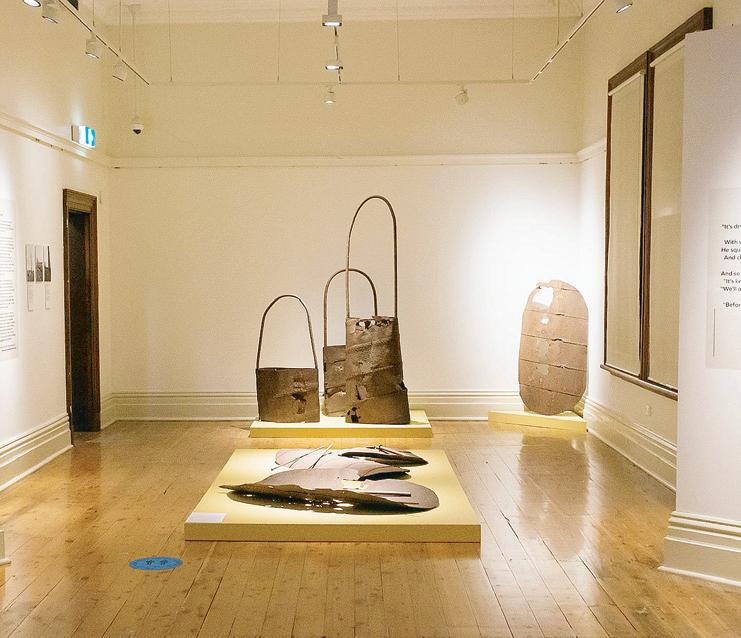
Gallery director Dr Lee-Anne Hall said “each artist offers insight into our relationship to land and the challenges before us”.
“Raised on a farm in the Riverina, Wendy Teakel explores her deep connection with the land, while also investigating the effects of farming practices on the natural environment through her artistic work,” said Dr Hall.
“The work of Lorraine Connelly Northey re-

flects upon traditional agricultural practices of Aboriginal women in the gathering of Yam Daisies.”
In the photographs from Tayla Martin, the state of the environment under stress is apparent during recent flood events and the 2020 Dunns Road Fire.
The event kicked off with one of Australia’s most successful start-ups – Daniel Flynn, co-founder of Thankyou – who shared his remarkable journey and reminded the audience that ‘it’s never too late to reimagine your business’.
Queensland chief entrepreneur Julia Spicer shared her passion and insights on the power of regional entrepreneurship and reassured the audience that innovation can happen anywhere.
One of the highlights was the inclusion of Sunshine Coast Council’s popular Thriving Through Change Business Resilience Expo, where global futurist Chris Riddell delivered a compelling keynote address sharing his predictions for 2030 and beyond.
Sunshine Coast Council mayor Mark Jamieson congratulated Silicon Coast for the key role they played in fostering innovation and delivering a successful event, now in its second year.
“This is the sort of event you’d normally have to travel to a capital city for, but with our emerging technology and innovation ecosystem, there is no better home for Forward Fest than our Sunshine Coast,” Mayor Jamieson said.
“Council is proud to partner with Silicon Coast to support Forward Fest, which aligns strongly with our Regional Economic Development Strategy.
“Through this strategy we support local businesses to respond and adapt to market change and promote entrepreneurship, innovation, research and digital connectivity.”
Silicon Coast’s chief engagement officer and co-founder Craig Josic said the event fostered connections and knowledge sharing.
“From fireside chats to solving problems and forming relationships, it was fantastic to see the business community come together to collaborate and celebrate Forward Fest,” Mr Josic said.
“The Innovation Showcase provided a dynamic platform for local businesses to promote their cutting-edge products, services and digital solutions including an AI assistant for emergency services communications officers.
“Now in its second year, Forward Fest is going from strength to strength and will hopefully become a permanent feature on the Sunshine Coast’s business event calendar.
“We’re also thrilled about our three-year partnership with Advance Queensland which validates our commitment to fostering innovation and entrepreneurship.
“Together, we’ll drive business growth, create jobs and position Sunshine Coast as a global innovation hotspot.”
Forward Fest is proudly supported by Silicon Coast, Sunshine Coast Council, Queensland Government through Advance Queensland, CSIRO, Dataminr and Queensland Investment Corporation (QIC).
LGFOCUS.COM.AU August 2023 LOCAL GOVERNMENT FOCUS 9 FOCUS ON COMMUNITY SERVICES, LEISURE, PARKS AND GARDENS
Ready for the red carpet.
A thought-provoking exhibition addressing land management choices since colonisation – and in the context of climate change – is asking us to rethink our land care practices.
Said Hanrahan installation view, Lorraine Connelly-Northey, Murnang Harvesting Yam Daisy.
Said Hanrahan installation view, Wendy Teakel, Museum of the Riverina.
The highly anticipated transformation of the Benalla Visitor Information Centre on Mair Street has entered its final stages.
New facilities for Benalla.
Heart beats anew
City of Gosnells Mayor Terresa Lynes said the temporary transformation will attract more people into the town centre, after plans to redevelop the site were postponed due to market conditions.
The project was delivered in partnership with RAC through its Reconnect WA initiative, which aims to create vibrant streets and public spaces for Western Australians to interact and connect with each other.
“This practical and attractive space was designed to encourage community members to spend more time in the Gosnells Town Centre, connect with others, support local businesses and use more active transport,” Mayor Lynes said.
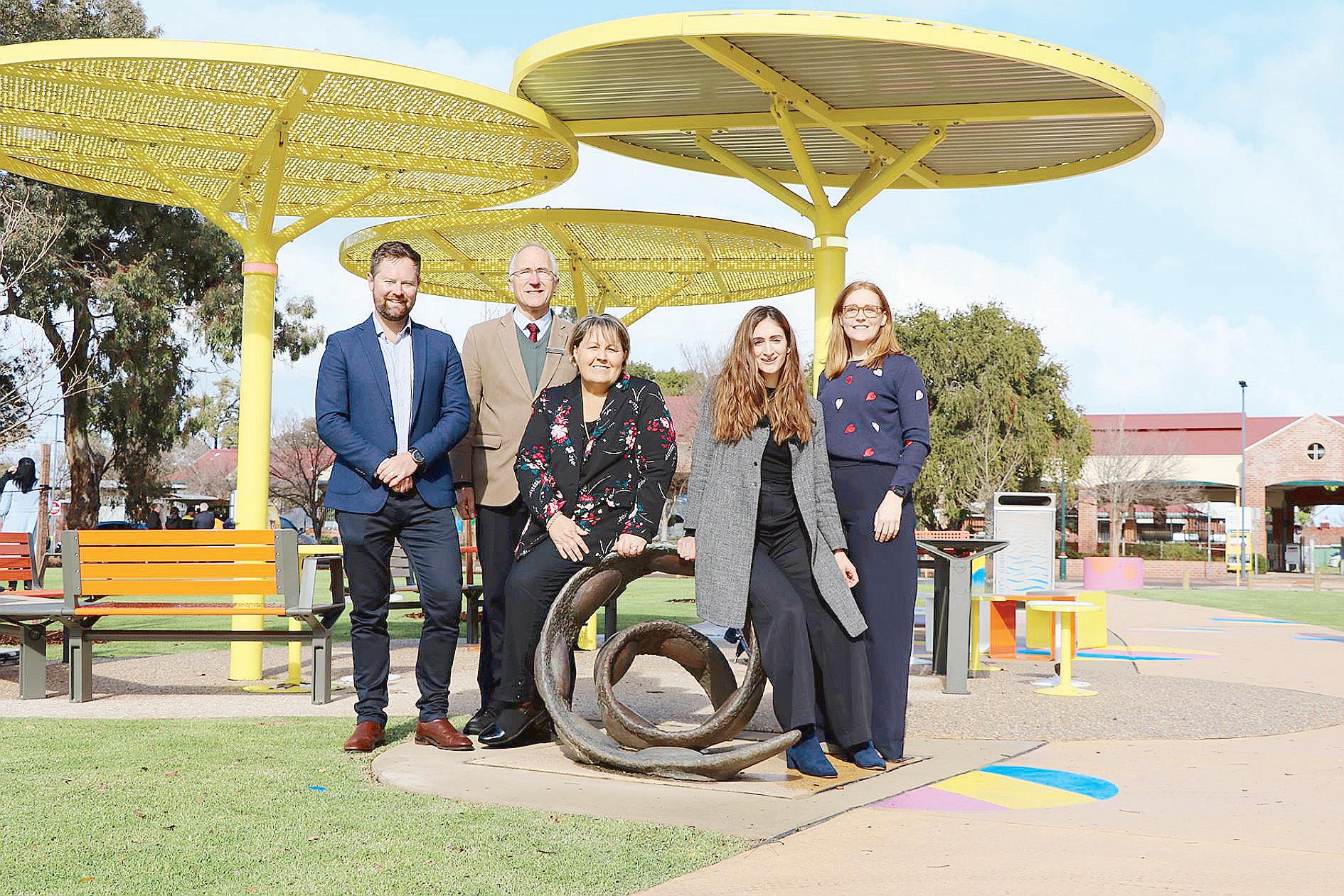
“It also provides a safer and more attractive pathway between the town centre and the train station, to welcome visitors.
“The city has been working to revitalise the Gosnells Town Centre for many years and this temporary development will demonstrate the community’s support for revitalisation to landowners in the area and private investors.”
RAC Acting Group Executive Social and Community Impact Will Golsby said the Reconnect WA initiative provided local governments across Western Australia with funding to deliver community-based projects which change the look and feel of streets and public spaces.
“Through our Reconnect WA initiative, RAC is thrilled to have supported this project, which has transformed vacant land with bright and colourful active travel paths, places to sit and
rest, lighting, landscaping and artworks,” he said.
“Projects like this are so important to building connected communities, inspiring positive change and making Western Australia an even better place to live.”
Have your say
The Cairns Regional Council has endorsed that the proposed amendments across 12 existing Local Laws and an additional Local Law specifically governing waste management be open to the community for consultation.
The suggested amendments reflect the needs and expectations of the community on a range of issues from fines for wandering dogs to mechanical work being carried out on roads.
Mayor Bob Manning said the Local Laws review process was a unique opportunity for residents to influence how day-to-day activities are regulated.
“We receive thousands of suggestions and complaints from residents and businesses every year,” Cr Manning said.
Buildings formerly on the site were demolished in August 2021 as part of a plan to redevelop the space as a mixed-use development. This project is on hold due to the current market, allowing temporary revitalisation while the city waits for market conditions to improve.
STI testing machine trial starts
Sexually Transmitted Infection (STI) test vending machines have been introduced for the first time in regional Victoria, providing accessible and affordable sexual health services to regional Victorian communities.
Echuca, in the Capaspe Shire, is the first town to receive one of two custom-built STI vending machines, which has been installed at the Echuca Library.
The test vending machine will be moved across regional Victoria in a unique 12-month trial program, an initiative led by the University of Melbourne, Department of Rural Health, Centre for Excellence in Rural Sexual Health (CERSH).
The initiative is part of a pilot program led by the CERSH that aims to improve sexual health outcomes for regional communities, particularly LGBTIQIA+ communities, younger people aged between 16 and 25 and Indigenous Australians.
The vending machines have been created in response to documented rural and regional barriers. Some of these barriers include access to specialist services, long wait times at the doctors, stigmas and privacy concerns.
This is an innovative alternative to healthcare that is accessible for the Campaspe community. The vending machine has been placed discreetly within the library and tests

located within are free.
The STI vending machine contains selftesting kits for Chlamydia, Gonorrhoea and HIV. Any kits that require lab testing should be mailed to the Melbourne Sexual Health Centre for testing. Individuals requiring treatment will be contacted and will receive ap-
propriate care in a safe and suitable location.
The two test vending machines will be rotated across five communities in the Loddon, Mallee and Hume regions. The STI test vending machine will be placed at the Echuca Library until October 2023.
“This feedback is a key component of the Local Laws review process and ensures our regulations are keeping pace with community expectations.
“As well as tackling problems such as abandoned vehicles and illegal camping, the review has focused on cutting red tape to make it easier for residents to obtain permits and other permissions for events and activities.”
Key proposed changes include:
· An overhaul of the Temporary Entertainment Events Local Law to simplify the process for holding events.
· Introduction of the Waste Management Local Law to ensure Council can manage waste responsibly following changes to State Government legislation.
· Changes to the Animal Management Local Law to double fines for dog owners who repeatedly allow their dogs to wander or have their pets off lead in on-lead areas.
· Prohibiting mechanical works on roads and nature strips and making it easier for council to remove unregistered vehicles that are causing a nuisance.
· Banning feeding wildlife from council parks and reserves.
· Allowing Cultural Fires and fires for commercial filming / photography on council-controlled land through a permit process to support community groups and to accommodate film industry needs.
· Increasing the number of pest species council can manage to protect the environment.
This is the first major review of council’s Local Laws since 2015. The review has not considered changes to Local Law No. 4 (Advertising Devices) which was adopted in 2019.
Scholarships for Port Stephens students
High-achieving local students who are starting TAFE or university can receive a $2000 scholarship to cover their study costs through the Port Stephens Mayoral Academic Scholarships Program. This program, now in its 15th year, has grown with the help of 16 Port Stephens businesses who contributed $40,000 to the scholarship pool in 2023, creating 20 scholarships.

The program is a partnership between council and leading local businesses that not only provides funding but offers specialised support and mentoring to the scholarship recipients. Students are presented with their scholarships at a celebratory dinner where they are seated with matched sponsors to help kick-start pro-
fessional mentoring and networking.
Sponsors help recipients not only with funding, but to learn about the local business environment, career pathways, and foster connections to help recipients to build a network and employment in our region post-study.
Mayor Ryan Palmer says the calibre of applications received each year for the program continues to impress. “This is a workforce development program that continues to grow and help local students on their way to further
education. “The scholarships go a long way to helping students pursue their passions and achieve their goals through further education, the scholarship help pay for textbooks, buying a laptop or assist with rising living costs.
“I want to thank all of our amazing business sponsors. Many of which have been with us since the start and recognise the value of investing in this program,” he said.
For more information visit pscouncil.info/ mayoralacademicscholarships The 2023 recipients and Mayor Ryan Palmer.
10 LOCAL GOVERNMENT FOCUS August 2023 LGFOCUS.COM.AU
The test vending machine will be moved across regional Victoria in a unique 12-month trial program.
FOCUS ON COMMUNITY SERVICES, LEISURE, PARKS AND GARDENS
A project to revitalise a large vacant block in the heart of Gosnells has provided a colourful, attractive space for pop-up events and activities, public art, seating, and paths to encourage active travel.
City of Gosnells Deputy Mayor Adam Hort, Councillor Peter Abetz, Mayor Terresa Lynes, RAC WA representatives Anita McCracken and Dana Harrold celebrate the temporary transformation of a vacant block of land in the heart of the Gosnells Town Centre.
Cairns residents will have the chance to have their say on proposed changes to the local laws that govern a wide range of activities that impact the community.
FOCUS ON COMMUNITY SERVICES, LEISURE, PARKS AND GARDENS
Gardeners’ one-stop shop
Dozens of market stalls, workshop demonstrations, trade sites, live entertainment and even a Gem Show are just a few of the exciting activities planned for the new Garden Precinct at this year’s Laidley Spring Festival.
Proudly presented by the Laidley Garden Club, the Garden Precinct will be held at the Laidley Cultural Centre on Friday, 8 September and Saturday, 9 September.
The event will run from 8am-4pm on both days, and entry is a gold coin donation.
Lockyer Valley Regional Council Deputy Mayor, Cr Jason Cook said the Garden Precinct would be a one-stop shop for avid gardeners.
“The Garden Precinct will be one of the most popular spots for visitors to drop by as there will be so many things to see, do and buy,” Cr Cook said.
“The Laidley Garden Club will create an amazing space for visitors where they can come and purchase a diverse range of plants and garden products, plus learn some handy tips and tricks from the many gardening professionals who will be on site over the two days.”
Laidley Garden Club President Eileen Zahnow said there would be lots of unique stallholders selling one-of-a-kind items.
“I am excited to have so many different market stalls and trade sites at this year’s event,” Mrs Zahnow said.
“There are more than 60 sites for people to

browse, so you are sure to find lots of different things you won’t find anywhere else.
“We will have people selling handmade garden art using stainless steel, as well as garden ornaments made from horseshoes, and beautiful hand painted pots, just to name a few.
“It is going to be a really fun and lively precinct, so be sure to come on down with the family.”
Laidley Spring Festival Ambassador Paul West will make a special appearance on Friday where he will MC the Garden Stage at 10am and 11am, and then host three workshops
Thousands of plants going in
There is no denying trees play an important role in enhancing local character, increasing biodiversity by serving as a home for animals and birds, improving air quality and making the places we live and work greener, cooler, and more connected.
More than 2000 native trees, 2000 shrubs and 2000 ground cover will soon be greening spaces on the Northern Beaches thanks to the NSW Government’s Greening our City initiative.

In partnership with the NSW Department of Planning and Environment, Northern Beaches Council was one of 17 Greater Sydney councils chosen to receive a $97k grant.
Flora and Ritchie Roberts Reserve at Curl Curl and the dunes near the start of Mona Vale Headland are the locations selected for the native plant roll out. Over 30 different native species of flora from the local area will be planted to provide much needed food and habitat for native animals and shade for pedestrians and park users.
TURF TALK
The tree species include swamp mahogany (Eucalyptus robusta), coastal banksia (Banksia integrifolia) and snow-in-summer paperbark (Melaleuca linariifolia). Swamp mahoganies provide nectar when they flower in winter, for migrating threatened species such as the swift parrot and the regent honeyeater.
Thick growing spikey shrubs, such as coastal rosemary (Westringia fruticosa), coast beard-heath (Leucopogon parviflorus) and dagger hakea (Hakea teretifolia) will provide protective nesting areas for small wrens, while groundcovers, like native violets (Viola hederacea), will hide small frogs and reptiles.
During the past couple of months staff and Bushcare volunteers have been hard at work removing tonnes of tenacious weed species like lantana that previous overrun both locations.
However, council and volunteers are continuing to work to ensure all weeds on site have been controlled before more trees are planted. The community will be invited to plant more trees in March 2024.
Weeds indicate other problems
Weeds can be used as indicators of soil conditions and as environmental indicators. This information can then be used to help create the best possible conditions for lawns and your turf grass.
By Jerry Spencer
What weeds are present also has a direct effect on what herbicides to use to control them and is a key factor affecting herbicide performance in turfgrass systems.
Weeds help indicate soil conditions and using them like this is the first step in getting an idea of what may be limiting turf growth. When you see weeds, your first reaction should be why are they there, rather than simply reaching for the spray bottle and applying a preemergent weedkiller or post emergent herbicide!
Indicator weeds are plants that are present due to factors like soil type, soil moisture, soil fertility, pollution, or soil disturbance.
First, identify a weed with the turf weed ID chart. Then you can use the information below to discover what conditions favour it. For example, if bindweed is present, it shows that the soil is compact.
So if you carry out a soil aeration program, this will create less favourable conditions and so you won’t possibly need to use a weed killer in the future.
When it comes to sports turf, there are many weeds that can provide insights into the turf management and as environmental indicators. Weeds as indicators of wet soil conditions:
· Plants like cat-tails, bulrushes (Cumbungi), and sedges show wet soils.
· Yellow Nutsedge is a common weed in wet soils.
· You’ll find Common Purslane in disturbed areas, and wet soils.
Weeds and what they tell us about soil
fertility:
· White Clover shows low fertility levels. It is a nitrogen-fixing plant that thrives in low nutrient soils.
· Inkweed likes low nutrient soils.
· Stinging Nettle prefers nitrogen-rich soils.
· Black Medic thrives in low-nutrient soils.
· The presence of redroot pigweed means that the iron-manganese ratio is out of balance.
· Twitch grass shows low soil fertility.
· Chickweed shows a nitrogen rich soil. It also indicates very low calcium and phosphorus levels, and very high potassium and sodium levels. Chicory favours high nitrogen soils and so does lambsquarters.
· Knapweed shows high soil potassium.
· Both mustard and purslane indicate high phosphorus levels.
· Summergrass weed shows very low levels of calcium and phosphorus, and high levels of magnesium and potassium.
· Dandelions show very low levels of calcium, and very high levels of potassium.
· Oxalis sp show very low levels of calcium and high levels of magnesium.
Indicator weeds that show soil
disturbance:
· Weeds that are quick to colonise disturbed
areas, include fireweed.
· Other examples include: Common Ragweed, Shepherd’s Purse, Field Thistle, Japanese Knotweed, Red root Pigweed, Knapweeds, Russian Knapweed, Spotted Knapweed, Prickly Lettuce, Horsetail, Wild Mustard and Ox-Tongue.
Environmental indicators:
· Certain plants, such as mosses and lichens, are useful bio indicators for air quality and pollution. For instance, lichens are sensitive to air pollution.
Indicator weeds that show soil pH:
· Some weeds prefer acidic or alkaline soils. For example, mossy stonecrop (Sedum acre) grows well in acidic soils. In contrast alkali grass loves alkaline soils.
· Oxalis, Plantain, summergrass, Velvet weed, ox-eye daisies, Pearly everlasting, Sheep sorrel, and prostrate knotweed indicate acid soils.
· Chickweed and Chicory grow well in alkali soils.
Compaction:
· Broadleaf plantain prefers compact soil. Others include: Ground Ivy, Dandelion, Crowsfoot is found on compact sportsturf in warm-season grasses, Burdock has deep tap roots and likes compact soil, Bindweed, Chickweed, Chicory, Knotweed is an excellent indicator of compaction, Inkgrass will grow in heavy clay or compact soil.
based on gardening, sustainability and produce in the afternoon.
Attendees will also get the chance to chat to members from the Gatton Lapidary Club, who will be hosting their Spring Gem Show at the same time.
Leon Steinhardt from the Gatton Lapidary Club said the club will have its own area with trade stalls selling everything from handcrafted jewellery to gemstones, opals, crystals, agates, thunder eggs and more.
Park boost
A new $8.4m sports pavilion, sportsgrounds, multi-purpose batting cage, car park and path network, mean more people can use More Park throughout the year.
The new community sports pavilion and sports facilities at More Park on Esmond Street in Ardeer, were officially opened on 9 August 2023.
“Thanks to the investment of the Victorian Government and Brimbank City Council, More Park has a new lease of life and is ready to become a home for softball and as well soccer,” Brimbank Mayor Cr Bruce Lancashire said
“The new multi-purpose batting cage will delight softball players of all ages, and special consideration has been made to ensure the new facilities are accessible and female friendly.
“More Park is an asset for the whole community.”

The works include a complete upgrade of the whole reserve with new sportsground floodlighting, a new car park and new paths.
It also includes construction of an accessible sports pavilion complete with four new female friendly change room facilities, along with umpire, office, kitchen, first aid, social areas and storerooms.
The new pavilion will allow greater use by tenant sports clubs and the broader community.
Community groups can use the meeting space in the social room during the day, maximising use and participation by community of the park and facilities.
In the past the facility could only accommodate summer use (softball), but with the upgrade it can now be used in winter (soccer) as well.
The project was completed thanks to a $4,000,000 grant from the Victorian State Government’s Community Sport Infrastructure Stimulus Program.
Brimbank Council contributed $4,400,000 to the project.
LGFOCUS.COM.AU August 2023 LOCAL GOVERNMENT FOCUS 11 A soil stabiliser and dust control solution
Stabiliser,
&
Suppressant
Granitic Sand
Binder
Dust
more
information contact: T: 1300 764 526 | sales@soilbond.com.au Made in Australia soilbond.com.au 12626656-AI33-23
Naturally derived, environmentally friendly and non-hazardous alternative to cement and chemical products Ideal for paths, tracks, public spaces, unsealed roads & road shoulders, median strips, carparks, playgrounds, sportsgrounds and
Further
Northern Beaches Mayor Sue Heins.
Early literacy boost
Macquarie Regional Library is committed to boosting early literacy in the local community following a report from The Insight Centre for NSW Public Libraries that ranks NSW sixth of all states and territories for mean reading performance. This places NSW behind both national and OECD benchmarks.


“The report is very concerning that children in NSW have declining literacy and child development outcomes,” Macquarie Regional Library Manager, Kathryn McAllister.
“Your local library is a great place to start to help encourage early literacy skills and a love of reading. Libraries are local, accessible and free. Libraries offer a welcoming environment for all families and Macquarie Regional Library have a large range of resources for children from books through to educational boxes.”
Macquarie Regional Library have a number of programs designed specifically for children including the 1000 Books Before School Program for children aged nought to five years as well as Storytime, Rhyme Time and Wriggle and Rhyme. These sessions are free to the community and filled with stories, rhymes and activity fun.
“The 1000 Books Before School Program encourages sharing books with your child and building their literacy skills before school. We welcome families to come along to their local library and join the program to introduce your child to the wonderful world of books.”
Library literacy activities are multi-generational and help to address the literacy gap by supporting the critical relationships between children and parents or caregivers.
“Public libraries are particularly important as they offer a number of early literacy programs and support children may not be enrolled in formal education or childcare,” Mrs McAllister said.
Local Dubbo resident Melissa Dunkerley signed up her six month old son Theodore (Teddy) to the 1000 Books Before School Program this year.
“We joined the program because it is a great
way to keep track of reading, and stay motivated to read. It’s a wonderful reminder to keep reading and spend that quality time together, sharing reading and quiet time,” Ms Dunkerley said.
“We love the program. We like that it is broken up into achievable goals, each reading log is 50 books with incentives awarded after each log so it’s easy to progress through the program.”
Locals aid locals
Journey into the sky
SkyWatch Astronomy Education is a South Australian business that encourages people to learn about the night sky. The facilitator will present a 360-degree movie inside an inflatable planetarium ‘mirror dome’ related to the age group in attendance.

While experiencing the 360 degree movie Earth’s Wild Ride, participants in session 1 and 2 travel to the moon in the year 2081. They view the shadow of the moon crossing Europe before they are then transported back in time to an ice age, flying up the slopes of an active volcano, visiting with dinosaurs and more.
Participants in session 3 will experience the movie Oasis in Space which will take them on a ride through the solar system learning about discoveries made over the last few decades.
As well as showing an exciting 20-minute movie, the planetarium showcases the night
sky and looks at the constellations, galaxies, nebulae, planets, Sun and Moon.
It also examines their movement across the sky from any time and place.
City of Victor Harbor Deputy Mayor, David Kemp, says this is set to be a great experience for all ages.
“From preschoolers to adults, this is about harnessing your curiosity, broadening your knowledge of space, astronomy, geography and prehistoric history in an interactive and exciting format.
“You’re never too young or old to learn about the wonder of space. The Victor Harbor Library is so excited to be offering this unique experience.”
The facilitator Dean Davidson, the owner of SkyWatch, is past President of the Astronomical Society of SA, and has been a keen amateur astronomer for many years.
The ‘pantry’ is stocked with everyday essentials – such as rice, long-life milk, baby nappies, and tinned goods – to help those who might be struggling to make ends meet to have access to items they may find useful.

The initiative encourages community members to ‘take what you need, give what you can’ to ensure the pantry is always stocked.
Mayor David McMullen said the Community Pantry was a small initiative that has the potential to make a big impact for some people.
“This is a great example of community helping community,” he said.
New era for library
The opening of the refurbished Tamborine Mountain Library in Queensland’s Scenic Rim has marked the beginning of its new chapter as a dynamic community hub with a range of facilities catering for all ages and interests.
The project, that has seen an almost trebling in size of the former library space, has been funded with more than $2.14 million from the Australian and Queensland governments through the Local Economic Recovery (LER) Program to support areas impacted by the 2019 Queensland bushfires.
Scenic Rim Mayor Greg Christensen said the library’s move into its new location on the site of the former IGA supermarket within the shopping centre on Main Street was symbolic of the region’s journey since 2016 and the Black Summer bushfires.
“We have come a long way since 2016 when the need for a new library was first identified, and this new, modern space will be a focal point for the Tamborine Mountain community for decades to come,” he said.
“Council’s vision for the library was for a vibrant hub that not only held a wider range of books and electronic resources but also offered more meeting rooms, quiet study spaces, areas for children and young people, improved technology hubs with free internet and a place for the community to gather.”
Queensland Reconstruction Authority CEO Major General Jake Ellwood (Retd) said the revitalised and expanded library is a real showcase of what the LER Program is all about.

“Through the Local Economic Recovery Program we’ve invested in projects that support social and economic recovery, and strengthen community resilience,” Major General Ellwood said.
“Tamborine Mountain’s refurbished library is a significant achievement in the community’s recovery from the devastating 2019 bushfires.
“Libraries have a truly special place in communities as places of learning, connection and discovery.
The family reading corner.
An overview of the library.
“This refurbishment project is a wonderful outcome for the local community, delivering a facility that will continue bringing people together for many years to come.”
Assistance for this project has been provided through the jointly-funded CommonwealthState Disaster Recovery Funding Arrangements.
12
LGFOCUS.COM.AU
LOCAL GOVERNMENT FOCUS August 2023
The Victor Harbor Library is hosting SkyWatch and their educational planetarium program, with sessions for all ages, for National Science Week 2023.
Sky Watch Dome.
hand at the library. FOCUS ON COMMUNITY SERVICES, LEISURE, PARKS AND GARDENS
Subiaco Library is helping those doing it tough through the introduction of a new initiative – the Community Pantry.
Helping
Melissa Dunkerley with son Theodore who signed up to the 1000 Books Before School Program.
Playing to gas strengths
An effective transition to renewable gas could play a crucial role in helping Australia reach emissions reduction targets, while addressing any emerging energy shortages.
That is the belief of Jemena’s Shaun Reardon, Executive General Manager of Jemena Networks, urging us to look to Europe and North America for compelling evidence that the worthy pursuit of emissions reduction does not need to exclude gas networks. Rather, embrace renewable gas.
Europe is in the midst of a gas revolution, methodically weaning itself off Russian natural gas and developing its own renewable energy source; dotting its map with an extensive array of biomethane plants, in-turn reducing emissions. With gas, not without.
“Rather than pivot away from gas, Europe played to its strengths, transitioning the very

gas its nations were so reliant upon, to a renewable source,’’ Mr Reardon said.
“It was collective common sense; using the EU’s extensive gas infrastructure already in place to deliver biomethane, made from organic waste, to homes and businesses.”
In France, 149 biomethane plants were opened last year alone, either connected to the gas network, or powering community and industrial zones. Denmark too is well on the way to a renewable gas transition. Biomethane already makes up 25 per cent of its gas supply. Energinet Denmark predicts it will be at 100 per cent by 2034.

“Reducing emissions, building fuel security,


Supporting a secure, stable and sustainable energy system for the future


Gas is not merely a transitional fuel; it is a fuel in the midst of a transition. By investing in Renewable Gas now, we can secure reliable and sustainable more options for households, businesses, industries, and transportation. Renewable Gas, which includes green hydrogen generated from renewable electricity and biomethane made from organic waste, is an additional source of energy that is already being successfully utilised in other parts of the world. It has the potential to help Australia meet its opportunities for regional employment and many circular emissions goal by 2050.
and ensuring manufacturers and industry maintain their competitiveness, all via renewable gas,’’ Mr Reardon said. “Given our reliance on gas, the opportunities to replicate this sustainable transition being experienced in Europe is there for the taking. But it requires the policy framework to be put in place to encourage investment, develop capacity, and help build sovereign capability of renewable gas here in Australia,’’ Mr Reardon said.
A recent energy roundtable hosted by the Australian Financial Review in July highlighted our state of policy preparedness.
The head of growth at Australian bioenergy group EDL Energy, Jason Dickfos, told the
roundtable his company had invested $600 million into the renewable gas sector in the US, where demand for biomethane and renewable fuels is insatiable.
“That is $600 million more than we’ve been able to invest in Australia. Imagine the benefits for many local economies with that level of investment in an Australian renewable gas sector,” Dickfos told the AFR.

Earlier this year, Jemena began injecting biomethane into its NSW network at the Malabar Biomethane Project in South-East Sydney, aiming to scale-up production over one-to-two years.



Find out more about renewable gas projects and opportunities in NSW: gorenewablegas.com.au




LGFOCUS.COM.AU August 2023 LOCAL GOVERNMENT FOCUS 13
12626428-AA33-23 FOCUS
ENVIRONMENTAL
ON
MANAGEMENT
Malabar Jemena Biomethane Injection Plant.
EU Biogas Plant.
New idea floated
Kingborough Council has installed the first Floating Wetlands stormwater treatment system in Tasmania.
Mayor, Paula Wriedt, said with the development of Kingston Park and the increase in residential development in inner Kingston, council needed to upgrade the stormwater treatment system.
“Floating Wetlands have not been used previously in Tasmania but are becoming widespread across Australia as an innovative water treatment solution,” Cr Wriedt said.
“The Floating Wetlands, designed by Atlan Stormwater utilises natural and sustainable technology to treat polluted stormwater collected in surrounding areas.
“They remove excess nutrients and eliminate sediment from the water column and have allowed the retrofit of the existing stormwater ponds with a positive environmental solution.”
Operations and Maintenance Manager, Oscar Salisbury, said the wetland platforms allowed for the uptake of pollutants and toxins through natural processes.
“The wetlands systems were constructed with carefully selected vegetation sitting on top of 600m2 of recycled plastic pontoons,” Mr Salisbury said.
“The technology is a sustainable, long-term solution that allows for continued growth and management of existing waterways, improving the quality of life for the surrounding ecosystem.
“The plants grow through the rafts and the water column creating a large treatment matt which is 300 per cent more efficient than a standard wetland treatment system by equivalent area.
“In addition to the environmental benefits, the floating wetlands also contributes to the sustainability movement by supporting recycled products and promoting native plant life.”
Mayor Wriedt said the innovative wetlands design was by far the most cost effective and efficient way to treat the stormwater and negated the need for large scale earthworks in the wetlands.
The upgrades are being co-funded by Kingborough Council and Traders in Purple, who are currently delivering 80 homes at Kingston Park as the first stage of the overall Kings Quarter master planned development.
Newcastle digs deep for trees
Local residents, students and City of Newcastle (CN) staff dug deep to plant more than 8000 native trees, shrubs and grasses as part of National Tree Day celebrations.
Around 120 students from Wallsend and Wallsend South Public Schools pulled on their gardening gloves to revitalise and restore an area alongside Ironbark Creek during Schools Tree Day on 28 July before members of the wider community took part in a planting event at the Wallsend site today.
The community efforts provided the finishing touches to the latest stage of CN’s ongoing Ironbark Creek Rehabilitation Program.
Lord Mayor Nuatali Nelmes said connecting with local school students and residents to plant trees and learn about Newcastle’s largest tidal creek was a special way to mark the national event.
“I was delighted to see such a large turnout today and I want to thank everyone who came down to join us. The response from the community highlights how important natural areas like Ironbark Creek are to Newcastle,” Cr Nelmes said.
“Over the last decade CN has worked tirelessly to improve creek stability and enhance water quality along Ironbark Creek.
“We’ve invested more than $8 million into this multi-stage, award-winning rehabilitation program. During the past 12 years, CN has delivered more than 3000m of rehabilitated creek lines within the catchment and revegetated previously weedy and eroding creek banks with hundreds of thousands of native shrubs and grasses to reinstate native wildlife corridors.
“By involving residents and students in the work being done at Ironbark Creek we hope to encourage a strong and lasting connection between the community and this important ecosystem.”

National Tree Day is just one of the initiatives supported by CN under its Natural Connections program, which is designed to increase Newcastle’s urban forest, mitigate urban heat, connect our communities to their local natural places and create pockets of habitat for native fauna.
During the past financial year, more than
Tree Day a hit
National Tree Day on Sunday 30 July proved to be a huge success in Benalla Rural City, with 23 volunteers planting more than 300 native trees and shrubs along the Hollands Biolink Channel.
Organised by Benalla Rural City Council in partnership with the Regent Honeyeater Project, residents of all ages planted native shrubs and trees to mark the national day.
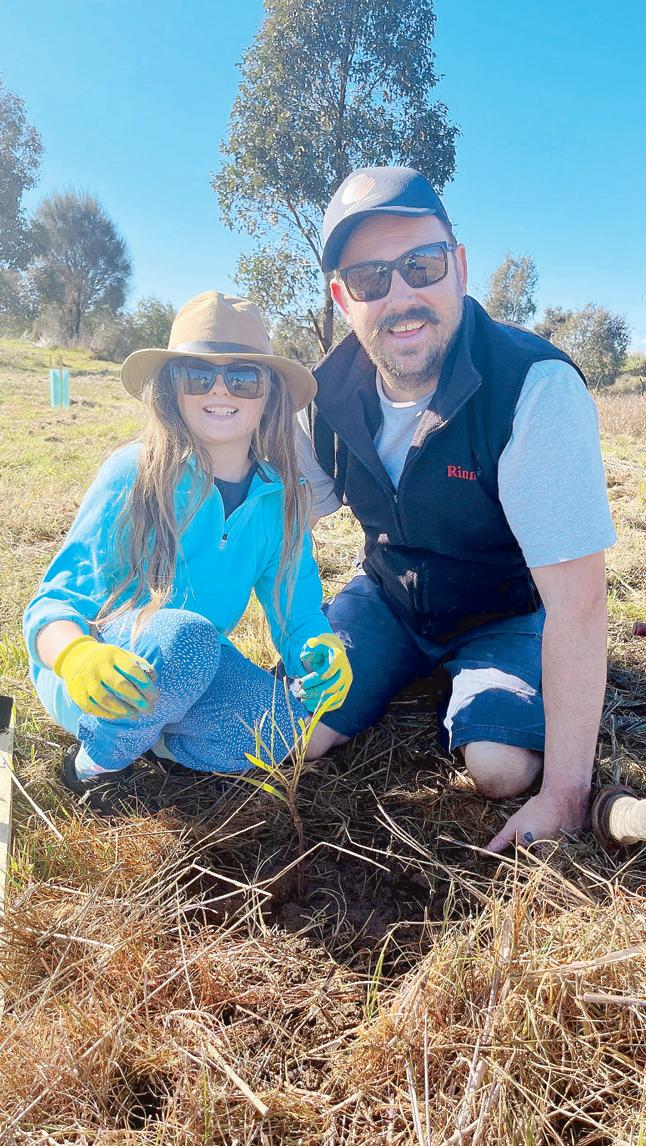

Mayor Cr Bernie Hearn said the community response was fantastic, with the turnout on the day a credit to the community’s appreciation and understanding for our natural environment.
“A big thank you to everyone who attended our National Tree Day celebration on Sunday. It was great to get outdoors, get our hands dirty and celebrate this important day with the community,” she said.
“Council will continue to spread the importance of maintaining and enhancing the environment for our native wildlife and to ensure our region is a great place to live.”
Volunteers on the day were privileged to have members of the Regent Honeyeater Project providing expert advice and assisting with the planting.
74,000 native plants were established across the city as part of our revegetation efforts, while suburbs across Newcastle benefitted from the addition of almost 2000 new street trees as part of a $1.5 million investment by CN.
CN recently awarded a tender for $1.2 million for an expansive natural area’s rehabilitation program in 2023/24, which will see around 170 hectares of bushland regenerated.
Work will include around 70,000 sqm of riverbank revegetation, the planting 150,000 native tubestock plants along riparian zones, coastal dune systems and bushland sites, and the establishment and maintenance of new and existing revegetation works. Coastal stabilisation and dune rehabilitation works, fire access trail maintenance, the installation of 500 metres of wind protection fencing and the maintenance of 40 devices to improve the quality of stormwater will also be completed during the
next 12 months.
Cr Nelmes said CN was committed to caring for Newcastle’s natural areas and was currently seeking public feedback on its Draft Environment Strategy.
“We want Newcastle to be an even more sustainable city, where we value our natural environment and continue to take decisive action at the local level to respond to challenges like climate change, biodiversity loss, and the overuse of resources,” Cr Nelmes said.
“The Newcastle Environment Strategy is our definitive roadmap for achieving our progressive environmental ambitions. Through this strategy, we are sending a signal to the community that we are strongly committed to protecting and enhancing Newcastle’s natural environment today and for future generations of Novocastrians.”
The Regent Honeyeater project has established itself as one of the most active volunteer conservation projects in the nation. Since 1995 the Regent Honeyeater Project has restored over 2000ha of habitat across our region.
Project coordinator, Andie Guerin said the trees would go a long way towards improving the calibre of this important green space.
“Overall we planted more than 300 native plants including eight indigenous varieties at the site, which will create diverse habitat for a range of native fauna and birds,” he said.
“This planting is being completed as part of a strategic revegetation program, including several other sites along the Hollands Biolink Channel.
“We have three planting weekends scheduled over the coming months and are always looking for more volunteers,” Mr Guerin said.
14 LOCAL GOVERNMENT FOCUS August 2023 LGFOCUS.COM.AU
National Tree Day in Newcastle.
FOCUS ON ENVIRONMENTAL
The community getting together to plant trees.
MANAGEMENT
Mayor Clare Glade-Wright, Deputy Mayor Paula Wriedt and Jennifer Cooper (Traders in Purple).
Landcare Week unites
Landcare Australia proudly announced the annual return of Landcare Week (7-13 August), a heartfelt initiative celebrating the tireless
efforts of everyday Australians.
This annual campaign aims to raise awareness and ignite a powerful sense of unity among individuals devoted to restoring, protecting and enhancing both the natural environment and the vital agriculture sector within their local communities.
According to the Biodiversity Council’s recent publication ‘Biodiversity Concerns Report’, 97 per cent of Australians want more action to safeguard our precious natural resources, recognising that each and every person bears the responsibility to preserve Australia’s biodiversity.
Landcare Australia is working hard to provide meaningful change, offering a unique avenue to positively impact the environment.
With the support of government and corporate partners, for the past 34 years, Landcare Australia has proudly led the charge in supporting Australians as they tackle critical environmental and agricultural issues. In every community across Australia, there is a landcare group or other community-led environmental group with volunteers getting their hands dirty to care for the natural environment.
“Landcare Australia, landcare peak bodies, landcare groups and organisations, together with governments, business and industry, Traditional Owners and First Nations organisations, continue to shape the growing landcare movement. Through collaboration and a shared vision, we are building a future where environmental sustainability and agricultural prosperity go hand in hand,” Landcare Australia CEO, Dr Shane Norrish said.
“Together, let us seize this moment. Let us forge a legacy of environmental stewardship and ensure that future generations inherit a land teeming with life, abundance and resil-
ience. Landcare Week is not just a celebration; it is a catalyst for change, an embodiment of the collective power we possess to shape a sustainable and thriving future for Australia. Join us on this journey of hope, empowerment and restoration.

“Landcare truly is for everyone! Whether you seek to make a tangible difference from the comfort of your own home, workplace, youth group, or school. Landcare Week extends an

Keeping parks clean
Biogone’s home compostable dog poop bags biodegrade within a few of months in landfill, meeting Australian/ NZ home compostable standard AS5810, compared to regular dog waste bags that can take up to hundreds of years to fully decompose.


Biogone have both landfill-biodegradable and home compostable council parks and gardens dog waste bags available, along with mountable dog bag dispensers.
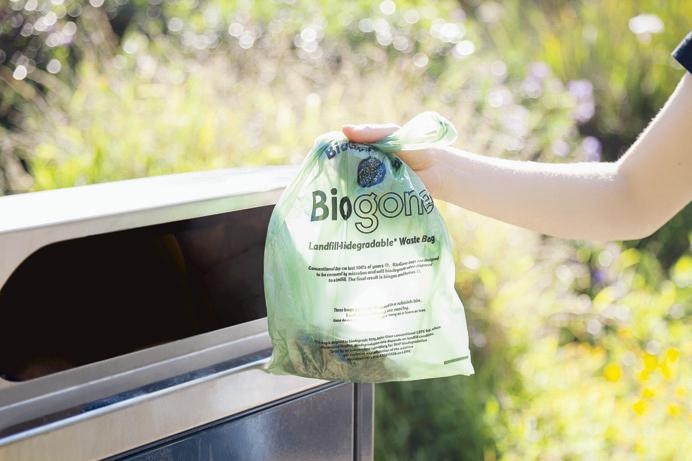

Biogone now also have a larger sized roll of 800 dog poop waste bags available and a larger sized bag dispenser, so you will only spend half the time refilling the dispensers.
Biogone landfill-biodegradable bags do not have a limited shelf life, and they do not fragment into microplastics over time.
Michael Feaver, Team Leader Open Space Asset Management at City of Glen Eira Council said, “Our residents have been very clear and articulate that the Biogone dog
Biogone landfill biodegradable dog bags.
poop waste bags tick all the boxes when it comes to durability, sustainability and functionality”.


To learn more about Biogone everyday landfill-biodegradable plastic products, including bin liners, garbage bags and everyday biodegradable plastic products that are suitable for councils, visit biogone.com.au


invitation for all to come together to learn, share, be inspired and empowered,” said Dr Norrish.
ABC TV presenter and Landcare advocate, Costa Georgiadis has also welcomed the return of the week.
“Wherever my travels take me around the country, I’m constantly inspired by the incredible commitment and genuine care
demonstrated by volunteers and Landcare groups,” he said.
With more than 6000 groups and more than 140,000 volunteers, Landcare Week provides a powerful reminder that there are opportunities for all Australians to get involved in a local community group like landcare, bushcare, ‘Friends of’ to help improve biodiversity and restore local natural environments.


LGFOCUS.COM.AU August 2023 LOCAL GOVERNMENT FOCUS 15 MEET & BE PLASTIC SMART biogone.com.au/councils ENQUIRE NOW info@biogone.com.au LANDFILL-BIODEGRADABLE & HOME COMPOSTABLE COUNCIL DOG POOP WASTE BAGS KEEP OUR PARKS & STREETS CLEAN NEW LARGER SIZED 800 BAG ROLL & BAG DISPENSER 12626090-RR33-23
A
doggy bag for the environment.
Biogone have created Australia’s first landfill-biodegradable dog waste bags that are considered to break down 90 per cent faster than conventional plastic bags in landfill.
FOCUS ON ENVIRONMENTAL MANAGEMENT
ABC personality and Landcare advocate Costa.Landcare groups from around Australia.
Recovering the final 10pc
Turns out there is something to see: what ‘only 10 per cent left to recover’ looks like for local councils and communities.
Australia can be proud of the close to 90 per cent of passenger, bus and truck tyres the nation recovers, but the remaining 10 per cent gap is critical to achieving national waste reduction goals, reducing carbon emissions and deterring tyre eco-hazards in the future.
Data shows that the impact of only 10 per cent of unrecovered tyres is still an unacceptable eco-hazard and, until we eliminate illegal dumping, stockpiling and rogue waste operators, we run the risk of going backwards.
“There’s a misguided and, arguably, dangerous belief being perpetuated that we have done enough in the recovery of passenger, bus and truck tyres. That the job is done. That there is nothing to see here,” says TSA CEO Lina Goodman.
“This couldn’t be further from the truth. Data provided by Snap Send Solve shows that, on any given day, there are at least eight reports of tyres dumped on the side of the road, in a creek, or the bush around Australia, with local government and communities bearing the brunt of costs and risks.
“We’re not talking about bottles and aluminium cans that are easy to put in a wheelie bin, transport, and process. Tyres, like mattresses, are another logistics ball game altogether.”
Here’s the reality for local councils and communities: 10 per cent of passenger, bus and truck tyres unrecovered equates to 5.7 million passenger tyres not being collected each year. This is greater than the population of Queensland. Sadly, the cost is shouldered by rate payers, as local councils are left with precarious and costly clean ups of illegally dumped tyres and the ongoing risk of dangerous fires.
Dumped tyres are taking up more time and more money for councils to deal with. Time and money used to clean up tyres is taken away from other rate payer services – like road and facility maintenance - to deal with tyres dumped by cowboy operators who are profiting at the cost of our environment and future progress.
Goodman says: “Whilst we are being notified by councils and landowners across the na-
tion of an increase in dumped tyres, it is councils in regional, rural and remote Australia that are disproportionately exposed to the excessive strain of managing dumped tyres.
“These are the same communities that bear the brunt of environmental forces – such as drought and fire - and can ill-afford council resources being diverted from local services. It really isn’t a fair go.”
So, how do we tackle the 10 per cent? What’s left to do?
We need to face reality – to listen to and look at what the data is telling us.
Snap Send Solve is a useful tool for communities to let their councils know the reality of the problem at a local level.
Managing Director, Danny Gorog says: “Dumped tyres have a tendency to ‘multiply’ if left unattended for too long; and a quick ‘snap’ can be the easiest first step to preventing this environmental issue getting bigger.
“We have over 530 councils connected to the application to receive reports on local is-
sues, and we’re working hard to connect over 400,000 ‘snappers’ to provide real time alerts of illegally dumped tyres.”
We need to learn from those that have dealt with the problem.
This is a problem not isolated to Australia, the cost of dumped tyres is well documented.
Progressive countries that have dealt with this problem have one thing in common – a regulated scheme and supportive policies.
An ‘all-in’ structure, rather than the existing ‘opt-in’ structure, for the national tyre scheme would prevent industry from discharging its responsibilities to manage used tyres on to local councils and communities. Globally ‘all-in’ tyre schemes with regulatory support increase the capability and sustainable value across the industry for all stakeholders.
“We’ve learnt that ‘all-in’ schemes around the world succeed in driving a circular economy for tyres,” says Goodman.
“The opt-in and opt-out approach of Australia’s current tyre scheme has only been able to
go so far, and it’s not far enough.
“An ‘all-in’ scheme means a fair go for everyone, which is good news for local government and regional, rural, and remote Australians, who currently bear the brunt of illegal dumping and stockpiling.
“And the story gets even better for those communities where there is around 130,000 tonnes of mining, agriculture and other offthe-road tyres being buried in pit each year. An ‘all-in’ scheme would see these mining and agriculture used tyres create the opportunity for local economic growth, increased manufacturing, and ultimately regional jobs.”
A regulated scheme is on the federal, state and territory governments’ radar, with end-oflife tyres included on the Federal Minister’s Product Stewardship Priority List in October 2022, telling the industry that if it doesn’t act, the government will. The government doubled down at the June Environment Ministers Meeting, agreeing to fast track a review of the Australia’s tyre stewardship framework.
Think of a tyre per year for everyone in Qld
Australia, on average, generates over 450,000 tonnes of used tyres annually, however, this is on the rise, post-pandemic lockdowns, with generation estimates in 2021-22 reaching over 500,000 tonnes.
Over the same period national tyre recovery rates have stalled under 70 per cent falling to 64 per cent in 2021-22, the lowest levels in years. Persistently low recovery for off-theroad (OTR) tyres is the major factor for Australia’s stalling recovery, with little evidence to suggest this is going to change anytime soon.
Australia’s used tyre recovery rate is led by the almost 90 per cent recovery rate for passenger, truck, and bus tyres (automotive tyres). Off-the-road tyres are used mostly in mining and agriculture, and these are recovered at a rate of about 10 per cent each year with the rest disposed of on-site (mostly on mining sites), stockpiled, or sent to landfill.
Australia’s unrecovered tyres have significant social, economic, and environmental costs. Only around one in five of the used tyres recovered are used back in Australia as a value-added product.
The remainder are exported overseas for re-use, retread, further processing and over half for use as tyre-derived fuel in cement kilns. While export is necessary, an overreliance on exports exposes Australia to global market risks including disruption to shipping, foreign bans on waste tyre imports, and significant exchange rate fluctuations.
Australia’s unrecovered automotive tyres are the equivalent of 5.7 million car tyres annually, which is more than one tyre for each person in Queensland.
This is also about New Zealand’s total automotive tyre generation, which they are implementing a regulated scheme to address.
It is misguided to think that unrecovered
tyres are not a problem. Like mattresses, unrecovered tyres are problematic due to their size and the difficulty of retrieving them from hard to access creek beds or parklands.
Australia can recover and use almost all its tyres if there is adequate investment in domestic facilities supported by a Scheme that works across the supply chain to promote the onshore consumption. national policy alignment is required to achieve this goal.
As an example, Tyre-derived fuel (TDF) substitution to coal or where coal is used as a reductant could represent up to 164,000 tonnes per annum of EOLT nationally, providing emission reductions of approximately 149,000 tonnes of CO2 per annum.
Crumb rubber used in roads could represent almost 180,000 tonnes of crumb rubber annually. If only the current use of synthetic polymer modified binder in Australian roads was replaced with crumb rubber modified binder, this would lead to estimated GHG savings of about 6,600-13,100 t CO2 eq emissions per year and improved road performance. This application is supported by the Australian Flexible Pavement Association (AfPA) and the National Transport Research Association (NTRO).
TSA has committed $9M to market development projects since inception. The advanced manufacturing and civil engineering projects have the potential to use a further 80,000 tonnes of EOLT. If these three points alone were realised, possible only with government policy and regulation, Australia would be much closer to becoming custo-
dians of their own waste. Turning used tyres into the valuable resource they can become and moving further down the pathway to a circular economy for tyres in Australia. Impact of dumped tyres on local council and communities

Since the waste export ban was introduced in December 2021, there has been an increase in the number of tyres illegally dumped. According to data provided by Snap Send Solve, each day there are approximately eight reports of tyres dumped on the side of the road, in creek beds, or stockpiled.
Local councils across the nation are burdened with the cost of managing the increasing number of dumped tyres within their municipality.
A motion (Motion 128) made at the recent ALGA convention in June 2023 identified the increased cost of tyre disposals to the sector and the need for a regulated Scheme to support this cost to Councils and their communities.
The motion, put by Murweh Shire Council Queensland, reads:
· This National General Assembly calls on the Australian Government to continue lobbying the federal government to impose a levy on all tyres imported or produced in Australia and highlights the failure of the Tyre Stewardship program. Further, the National General Assembly devises a mechanism to assist with the increased cost of tyre disposals under the state governments waste management. The levy should go directly to the local government.
· TSA works closely with Victoria’s Litter Enforcement Officer Network (LEON), a grassroots initiative involving Local Government officers. LEON officers have reported an increase in the number of illegally dumped tyres across their municipalities. Opportunities for used tyres in Australia
· Of recovered tyres, around 80 per cent (over 250,000 tonnes) are exported. Only 20 per cent of recovered tyres are used within Australia.
· Australia has existing applications that could use 424,000 tonnes of Australian tyrederived material right now:
· Up to 164,000 tonnes of tyre-derived fuel could be used in Australia every year, aligning with the government’s Safeguard Mechanism.
· Almost 180,000 tonnes of crumb rubber could be used in Australian roads every year. Rubberised roads are higher performing and longer lasting than standard roads – more information is available on TSA’s website and AfPA.
· An additional 80,000 tonnes of tyre-derived material could be used across advanced manufacturing and civil engineering projects, driven by TSA’s market development initiative.
· New technologies, processing and endmarkets for tyre-derived material are showing real promise for even more uses for Australia’s used tyres, and increasingly circular outcomes.
16 LOCAL GOVERNMENT FOCUS August 2023 LGFOCUS.COM.AU
FOCUS ON ENVIRONMENTAL MANAGEMENT
Reducing the final 10 per cent.

LGFOCUS.COM.AU August 2023 LOCAL GOVERNMENT FOCUS 17 12626688-KG33-23
Major milestone
The City of Melbourne’s visionary Greenline Project has reached another major milestone, with the release of a draft Master Plan to guide the city-shaping transformation of the Yarra River –Birrarung.
At the 15 August Future Melbourne Committee meeting, councillors will consider a consultation process for the draft Master Plan – inviting community members and stakeholders to have their say on the proposed vision for the river’s north bank.
Lord Mayor Sally Capp said the Greenline Project will create four kilometres of interconnected promenades, parks, open spaces, native plantings, cultural activations and environmental renewal between Birrarung Marr and the Bolte Bridge. It will be Melbourne’s largest green space and will have a strong focus on Traditional Owner culture and heritage.
“The Greenline Project will transform the north bank of the Yarra River – Birrarung into a globally-significant community space – securing thousands of jobs, attracting waves of new visitors, injecting millions of dollars into our economy, and delivering biodiversity and wellbeing legacies for Melbourne,” the Lord Mayor said.

“In partnership with award-winning landscape architecture and design experts, we’ve crafted an incredible vision for what the Greenline Project could look like – with stunning boardwalks, event spaces, native vegetation, and outdoor dining.”
“The draft Master Plan has been informed by extensive community and stakeholder engagement – and we’re continuing the conversation, asking Melburnians for their views on this city-shaping project.”
“The Yarra River – Birrarung is one of Melbourne’s most culturally and environmentally significant landmarks, and we’re working with our community to ensure it continues to be a place for all people.”
It is set to deliver a range of benefits for locals and visitors, including positive economic, cultural and social outcomes.
The transformation is expected to create more than 3400 jobs during construction, more than 6400 ongoing jobs by 2042, and attract more than 1.1 million additional visitors to the city every year. For every $1 invested, the project will return $3.29 in value to the community.
The draft Master Plan details the vision and design for five interconnected precincts – featuring lush waterfront destinations, spaces for
events and community gathering, picturesque new boardwalks, six-metre-wide promenades, new native habitats and cultural activations.
Design ideas for each precinct include:
· Birrarung Marr Precinct (Birrarung Marr, Federation Vaults, Flinders Walk).
· Cultural event and performance spaces to celebrate Melbourne’s Aboriginal history and multiculturalism.
· An expanded riverside promenade, with greater views of the river and Southbank that will boost visitation.
· Terraced steps for enhanced riverside public space and dining experiences.
· New pathways to connect the CBD to the sports and entertainment precinct.
· Australian native plantings at the river’s edge to promote improved river health and biodiversity.
· The Falls Precinct (Sandridge Bridge, Banana Alley Vaults, Turning Basin, Enterprize Park).
· New public open space around the Sandridge Bridge to promote health and wellbeing.
· An ecological river’s edge and floating pontoons that will focus on native plantings and sustainability.
· Upgrades to Enterprize Park and new habitats for local wildlife.
· Enhanced connections with the river and habitat creation at Banana Alley promenade.
· River Park Precinct (Batman Park).
· Generous open space and lawns for play, exercise, social activities and cultural events to
Stronger gambling harm protections
Hard work pays off for Brimbank as the Victorian Government introduces gambling reforms.
Brimbank Council has welcomed stronger gambling harm protections in Victoria, following sweeping reforms announced by the Victorian Government on 16 July 2023.
The reforms are designed to prevent gambling harm and anti-money laundering. These include reducing the number of operating hours for gaming venues, aligning gaming venue closing hours across the state and introducing a carded mandatory pre-commitment scheme.
Reducing gambling harm is a priority for council, which has the highest losses to electronic gaming machines of any Victorian local government area with community losses of $128 million in 2021/22.
The council has been advocating for gambling reform over a period of years. Advocacy on the issue has been led by Mayors and Councillors, who have met regularly with local MPs and Ministers for Gambling.
In addition, Brimbank has tabled several motions at conferences of the Municipal Association of Victoria, most recently in May 2023, to bring attention to the impacts and harms of gambling harm in local government areas.
While the Victorian Government gambling reforms will go a long way to minimising the detrimental social and economic impacts of gambling, there are a number of additional
Redland targets
encourage community gatherings and wellbeing.
· A new accessible play space with nearby cafes. Riverside areas to encourage waterbased uses including fishing and boating.
· New activities space under the Flinders Street viaduct.
· Large ecology site, habitat creation and significant indigenous botanical garden.
· Maritime Precinct (Crowne Plaza, Seafarers River Frontage).
· New riverside promenade at Crown Plaza to facilitate new public spaces and waterside dining experiences that will attract ongoing tourism and visitation.
· Increased public space, including smallscale decks over the river.
· Improved boating access and amenities.
· Educational installations and play-based learning activities to encourage exploration of maritime history that will provide a valuable learning resource for our community.
· Saltwater Wharf Precinct (Collins Wharf Park, Collins Street and North Wharf Road River Frontage).
· New parkland with an ecological focus at North Wharf, highlighting sustainability in the city.
· Improved boating and fishing access and amenities, contributing to a growing and vibrant commercial precinct.
· Raised waterfront platforms and increased public space and promenades.
· New boardwalks and seating to attract more riverside recreation with potential for a new river punt to Fishermans Bend and New Quay.
The draft Master Plan has been informed by extensive stakeholder and community consultation – including surveys, pop-ups, workshops and walking tours of the site.
If approved, Melburnians will be invited to provide feedback on the proposed plans from 16 August to 13 September via Participate Melbourne. Feedback will inform the final Master Plan, which will be released later this year.
Trucking
Ku-ring-gai Council has taken delivery of its first e-truck.
reforms that would contribute to further harm reduction.
Council urges the Victorian Government to consider extending the reforms to include additional measures, such as: bring forward the closing time to 12am; lower the daily EFTPOS withdrawal limit to $200; decrease the maximum bet to $1 per spin, and the introduction of a ‘sinking cap’ whereby gaming machines are not replaced once entitlements have been forfeited.
Brimbank Mayor Cr Bruce Lancashire said council had worked with the Alliance for Gambling Reform and the Victorian Responsible Gambling Foundation to advocate for stronger reforms and increase community awareness of gambling harm.
“The announcement by Premier Dan Andrews and Minister for Casino, Gaming and Liquor Regulation Melissa Horne is a welcome one. These reforms will help to reduce the gambling harm in communities such as Brimbank where the impact is significant,” he said.
“We’ve been talking in Brimbank as a community about the harms and damage caused by gambling for a long time. My thoughts are with everyone who has experience of gambling harm, and we should acknowledge that these reforms have been a long time coming.”
Once on the road, the truck will perform tasks ranging from waste collections and road repairs to water spraying. The new tip truck is 100 per cent powered by electricity through a three-phase charger and fitted with a hoist as well as other maintenance equipment.
The truck has been sourced from technology provider SEA Electric, an Australian company that has been producing commercial vehicles powered by electricity since 2012. The council has previously pledged to expand its fleet of electric and hybrid vehicles as part of its Net Zero action plan adopted by the council last year.
The Net Zero Ku-ring-gai plan aims for zero greenhouse gas emissions by the year 2040. Mayor Jeff Pettett said the new truck would soon be in service with the council’s operations team.
“This is an exciting development in our aim to electrify the council fleet.”
The Mayor added that the council was also investigating locations for more electric vehicle charging stations.
“We’ve successfully installed electric vehicle chargers in the new Milray Street car park at Lindfield which are being widely used.”
Redland City Council will advocate for key issues on behalf of the community at the Local Government Association of Queensland (LGAQ) annual conference, to be held in Gladstone from 16-18 October 2023.
The annual conference will bring together delegates from all tiers of government, external stakeholders and the media to consider the challenges facing local government and their communities.
Mayor Karen Williams said Redland City Council would table six motions at the conference covering key issues such as koala habitat protection, local crime management, island communities support, state and local government relationships, application of RTI legislation and seeking clarity around the federal Environmental Protection and Biodiversity Conservation Act 1999 (EPBCA).
Cr Williams said the LGAQ is an important advocacy channel for Queensland councils to collectively voice matters of statewide importance and collaboratively achieve positive outcomes for our communities, in conjunction with other levels of government.
“Local governments play an important role in delivering for Queensland communities every day and we possess firsthand knowledge of the specific challenges faced by our diverse regions. The LGAQ has been an effective platform in advocating for the necessary changes that enhance the quality of life for all Queenslanders across the state.”
Cr Williams and Division One Councillor Wendy Boglary will be council’s official delegates at the LGAQ Conference, with other councillors able to attend as observers.
Link is welcomed
Liverpool Mayor Ned Mannoun has welcomed the announcement by the NSW Government that it will complete the long-awaited metro link to Bankstown.
This is great news for Sydney’s south-west and a long overdue announcement, Mayor Mannoun said. “This gives certainty to the people of Sydney’s south-west that they are getting the public transport services they need and deserve,” the mayor said.
“What the government now needs to do is provide a shuttle train service from Bankstown to Liverpool to cater to the growing population in our area.”
“With Liverpool being Sydney’s third CBD, it is vital this additional measure is provided as soon as the metro is completed.”
The Sydney Metro City and South-West offers the government much-needed urban renewal opportunities along the rail corridor, providing a boost to housing supply, connection to better services and improved amenity for Greater Western Sydney residents.
“On behalf of council, I strongly urge the NSW government to continue the planning to extend the metro from Bankstown to Liverpool.”
METRO AND SUBURBAN
Batman Park.
18 LOCAL GOVERNMENT FOCUS August 2023 LGFOCUS.COM.AU
Move hailed
Goondiwindi Region Mayor Cr Lawrence Springborg AM has welcomed the Queensland government announcement to review the regulatory framework requirements for wind farm developments.

According to the recent announcement, the review of the guidelines and the Wind Farm Code (State Code 23) aims to minimise adverse effects on the natural environment and ecological processes and will require proponents to investigate the impact their construction will have on local workforce and accommodation, among other guidelines.
The mayor has been advocating for the state government to introduce regulatory legislation requirements, community engagement strategies, and benefit funds for major renewable energy infrastructure projects that impact regional communities since one of the largest onshore wind farm developments in the country, the $2 billion Macintyre Wind Farm project, obtained approval as a Queensland Government priority infrastructure project, bypassing the need for consultation with the local council.
“We welcome renewable energy projects like the Macintyre Wind Farm in the Goondiwindi Region, and I applaud the state government for taking the important first steps in addressing issues concerning the renewable energy sector in regional Queensland,” the Mayor said.
“However, we must work together with the state government to create a regulatory framework that prioritises community involvement, job creation, and environmental responsibility for all infrastructure projects – including renewable energy.
“This would ensure that renewable energy projects are legally bound to work with and give back to the local communities that host them.”
Cr Springborg said other major infrastructure projects, such as mining, are legislatively required to work with and contribute back to the local community.
“If you were to spend $100 million on a dam or water infrastructure project, you would be getting hundreds of jobs over the years in construction, road construction and maintenance,
and expanding agricultural precincts.
“Some of our neighbouring regions have worked closely with the mining and gas sector to generate exceptional outcomes for the local region - like the LifeFlight facility at Roma,” he said.
The mayor’s additional concerns about the state-approved Macintyre Wind Farm include the impact on the community during the decommissioning phase.
Cr Springborg said the companies involved in building these wind farms tend to change hands frequently.
“This has raised fears that the local community may be left with the burden of cleaning up once the wind turbines reach their end of life,” he said.
“While renewable energy solutions are vital for our future, these concerns are warranted, leaving our local communities worried about the economic impact,” he said.
Mayor Springborg will continue to actively collaborate with local government colleagues and the state government to address these concerns and advocate for better outcomes for communities across the Queensland when it comes to major infrastructure projects.
Magpie swoops in
After many months of anticipation, the Tank and Tobin Magpie Sculpture was installed in the Seven Creeks Park with the Strathbogie Shire Council, the Euroa Chamber of Business and Commerce and local artists inviting the community to help celebrate.
Strathbogie Shire Council Mayor, Cr Laura Binks, said the long-awaited installation of the magpie sculpture was certainly cause for celebration.

“Council hosted the official opening from 4pm to 5pm,” Cr Binks said.
“After this the Euroa Chamber of Business and Commerce took over to have some fun.
“The event was open to everyone, and we hope to see as many people as possible in the park.”
Euroa residents may have noticed council has been doing some work to a garden bed near the bridge at the corner of Kirkland Ave and Clifton St in the lead up to the the 3.5m high Magpie being installed.
Chamber president Stephanie Swift said the launch party included music, food trucks and drinks vendors.
“We invited the community to come and join in the fun,” Ms Swift said.
“We were proud to see the installation of this sculpture.
“It was initiated by a joint submission by the Chamber and the Euroa Community Action group to council’s Pitch My Project initiative in the 2022/23 Budget.
“It received significant community support, and we can’t wait to see this support
Anti-social crackdown
very concerned about anti-social and criminal activities across its central business district. Businesses have been impacted and council’s own community assets have been vandalised and destroyed. This is completely unacceptable.
The council has been working in partnership with Tasmania Police to address these behaviours. The obvious starting point is that if you see anti-social or criminal behaviours report it to Tasmania Police as a priority.
Where council itself becomes aware of particular anti-social issues, they have acted and will continue to do so. For example, they have more recently experienced antisocial behaviours in and around council’s multi-storey car park. In response they are installing additional infrastructure in an effort to reduce these behaviours; they now close the car park earlier (10pm); and they have engaged security guards to be on site late afternoon and into the evening.
Some months ago the council had problems at the former ‘Baltimores Restaurant’, near the port, as it was a gathering point for groups that would then engage in antisocial behaviours. Council secured that site with new fencing, installed additional CCTV coverage and entered an agreement with a new tenant for the building. This has reduced the anti-social behaviours that were occurring around that area.
Over the past two years they have also installed infrastructure into other areas of the city to curb hoon driving and other antisocial behaviours, with some success.
Unfortunately there are no quick fixes or magic solutions.
Mayor Teeny Brumby said the council understood the community’s concerns, as this had been expressed very clearly in their current strategic plan development. He said they are committed to doing what they can to address these concerns.
Burnie City Council is currently developing an urban design plan that includes and is informed by urban design principles to increase public safety. When finalised it will provide a blueprint for how they upgrade the city centre so that it provides a safe and welcoming environment.
“Our council officers are available to meet with local business owners who are experiencing anti-social or criminal behav-
iours, to identify whether there is more that council should be doing,” the Mayor said.
“There is no doubt that some of what we have done has worked, however council acknowledges that sometimes the measures we take displaces the problem to elsewhere in the city. That is why it is important for business owners to talk with us directly, so we can work with them to try and address their legitimate concerns.
“I am asking our community to please make sure that you report all instances of anti-social behaviour to Tasmania Police. If we don’t report it, then the statistics don’t reflect that there is indeed an issue, and more funding to address these concerns will not be made possible.”
“My current priority for our community is continuing to pursue this additional support from the Tasmanian State Government.
“I have reached out to our Minister for Police, Felix Ellis and Tasmania’s Commissioner of Police, Donna Adams and will be meeting with these state leaders in the coming weeks to advocate for a higher level of police presence in and around our CBD in the way that community policing occurred within our city in the past. We feel strongly that this type of ongoing policing provides a visible and engaging presence within our community, and would assist greatly with not only reducing the instances of anti-social behaviour, but also the way in which our community perceives their own safety and wellbeing.
“Additionally I will meet with Attorney General Elise Archer as I feel strongly that the justice system plays such an important role in developing a long-term solution to this problem. I also intend to invite a range of stakeholders including representatives of the business community, to participate in a round table discussion on the matter of antisocial behaviour, in order to further discuss the issues being experienced within our city, with a view to collectively developing strategies that may assist to reduce these occurrences.”
Free vaccinations
With an influx of Parvovirus compromising furry friends during the wetter months, a free vaccination day was offered by the City of Greater Geraldton to concession card holders as protection for unvaccinated dogs.
Partnering with Central Regional TAFE, Geraldton Dog Rescue, RSPCAWA and local veterinary clinics, the city distributed vaccinations in a bid to lower the number of cases as well as providing free microchipping and registrations.
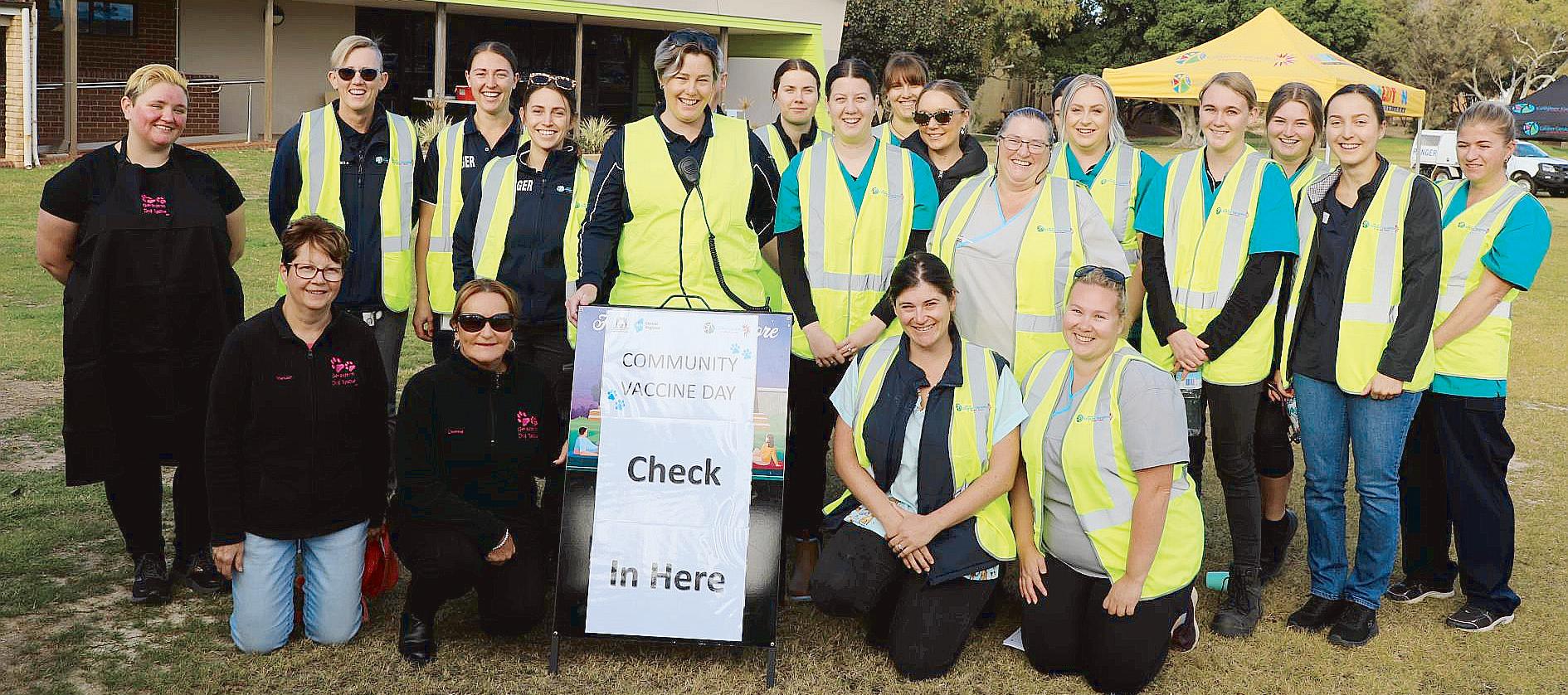
Generously supporting the event through the Mayor’s Discretionary Fund, City of Greater Geraldton Mayor Shane Van Styn was delighted by the turnout.
“We know that the virus is highly infectious and kills dogs, but it can be easily prevented by
vaccinations,” he said.
“As a dog owner and lover myself, I was over the moon to be able to team up with stakeholders from our community to offer this service and I was excited to see that over 60 eligible dog owners bought their unvaccinated pooches down to be treated.”
In future, the city plans to hold similar sessions in Mullewa and other areas to allow easier access for those who were unable to attend the clinic in Geraldton.
come to fruition.”
Cr Binks said it represented a wonderful story of a community led project, that the council embraced.
“It’s fantastic to see what we can achieve by working together,” she said.
Artist and Longwood resident Steve Tobin said he and fellow artist Tank had not held back when they created the biggest Magpie sculpture in the country.
“Move over the big banana, Euroa and Strathbogie Shire has something better,” he joked.
LGFOCUS.COM.AU August 2023 LOCAL GOVERNMENT FOCUS 19
Burnie City Council is
Magpie swoops in.
RURAL AND REGIONAL
Something wonderful happened in Euroa on Friday, 11 August.
Mayor Lawrence Springborg speaking about his concern surrounding renewable energy projects at the recent LGAQ in Goondiwindi.
Picture: SUPPLIED
City of Greater Geraldton rangers and volunteers at the city’s free Parvovirus vaccination clinic.
Strengthening ‘sister’ link


Northern Beaches Council is strengthening its Sister City relationship with Brewarrina Shire Council in north-west New South Wales and exploring new ways to support the regional council.


More than 800km from Sydney, Brewarrina is on the banks of the Barton River upstream from Bourke. The region is rich in Aboriginal culture and was a significant meeting place for Aboriginal nations of eastern Australia. Brewarrina is also known for its heritage listed Brewarrina Aboriginal Fish Traps.
Since 2000, when the Sister City agreement was made, Northern Beaches Council has supported the regional council with staff exchanges, assistance during floods, cultural exchanges, administrative support, travelling exhibition and youth exchanges.


The Brewarrina Youth Exchange will see six young people from Brewarrina spend a week in the Northern Beaches, and six young locals from the Northern Beaches will head to the bush.

Mayor Sue Heins said the youth exchange program is an invaluable opportunity for young people to experience life in a totally different community.
“City kids living on the Beaches have a unique opportunity to see what life is like in the bush, experience a different community and culture, and build new friendships,” Mayor Heins said.
“It’s a real opportunity to build a deeper understanding and respect for Aboriginal culture – and that experience is so life changing.
“Young people from Brewarrina get a taste of life in metropolitan Sydney, can explore new pathways for education and employment, and of course experience the very best of the Northern Beaches, from surf lessons to sailing.”


An important part of sister city relationships is the upskilling of staff from each council. Discussions will continue between the councils regarding options to support their staff through exchange programs.
For more information about the Sister City program, visit northernbeaches.nsw.gov.au/ council/about-northern-beaches-council/sister-cities

20 LOCAL GOVERNMENT FOCUS August 2023 LGFOCUS.COM.AU 12619573-FC29-23 NEWS
Exchanging the bush for the beach.
