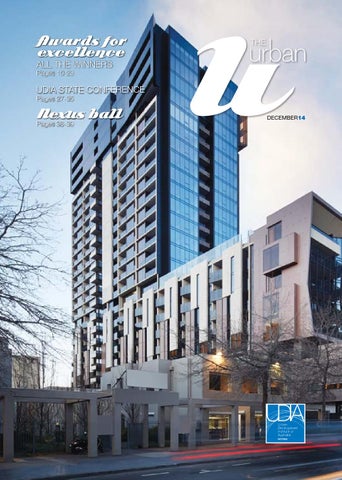
Awards for excellence all the winners
Pages 10-23
UDIA STATE CONFERENCE Pages 27-35
Nexus ball Pages 38-39
DECEMBER14
VICTORIA
ElectioN brings focus of regulators to the task at hand DAVID PAYES [UDIA VICTORIA PRESIDENT] There is nothing like an election to focus our regulators and would-be regulators. Now that the campaign is over, we can finally begin working with the new Government on the industry’s major issues. In the lead up to the election, the board wasted no time meeting with Government and the Opposition to advocate for some of the key structural issues that will make our industry more efficient. Issues like the increasing burden of red tape that not only affect our bottom line but also results in poor outcomes for the communities we are building. Our submissions to both sides of government called for a number of reforms and structural changes to address these inefficiencies. There are many issues that we put forward prior to the election. A response was received in November and we have been advised that some changes will be considered. The UDIA will continue to work with the new Government to progress the matters raised in our submission. The issues we put forward for consideration were: Allowing super lots to be created without triggering the GAIC – under the current regime there is an advantage for larger developers. A super lot exemption and abolition of the 30% staging requirement is necessary to create a level and equitable playing field for the industry. Addressing the issue of land tax being levied when land is placed in the Urban Growth Zone – it is the Board’s view that the imposition of Land Tax when land is unable to be developed, in some cases for decades, is inequitable and inefficient. The most equitable and efficient trigger for Land Tax is when the land is being developed and brought to market. A more detailed industry issue is the length of time taken for engineering approvals in local government – successive governments have not seen this micro economic issue as being important enough to regulate. In our view, the introduction of statutory timeframes and private certification is one the most significant reforms that could be implemented immediately with immense cost saving for the industry and communities. Planning reform remains an ongoing issue for our industry. The proliferation of local policies and zone schedules that results in ridiculous inconsistencies Statewide and within local council areas is creating a more difficult and convoluted planning process. The Board has called for greater consistency, and greater use of the “Code Assess” model to allow fully compliant applications to be simply rubber stamped when all the necessary requirements are met. We also highlighted the worrying trend by local government to “Gold Plate” social and community infrastructure and the unnecessary costs and subsequent impact on affordability. The board strongly believes that industry and government must explore creative options to deliver local facilities as opposed to strict adherence to often outdated or unnecessary 2 theurban | december14
facilities because of a desire to stay with the established delivery model. One the most worrying issues for our industry is the new Biodiversity Conservation Strategy. The UDIA has called for a Standing Advisory Committee to be established to review the issues that contribute to the confusion, and impact on housing affordability. Currently there are many unintended consequences of the new BCS and the industry requires urgent and immediate action to ensure that the industry isn’t trapped in a regulatory spin cycle.
Our submissions to both sides of government called for a number of reforms and structural changes… Finally the Board considers that it is time for Government to review the structure of local government. The unprecedented growth in our newly developing suburbs and radical change in demographics of many inner and older suburbs means that many councils just don’t have the resources to keep up with growth. The Board considers that a review of local government is essential to ensure that maximum efficiencies are delivered to all communities. The inner and outer west of Melbourne is the case in point, with the inner suburbs being pushed financially and unable to raise enough revenue because they are constrained by a small rate base, yet we have the outer suburbs that cannot deliver services and facilities fast enough because of the unprecedented growth. We consider the time has come to review the efficiency of local government with a view to reducing the duplication of services and cost to ratepayers. The introduction of larger more regionally based Councils also has the potential to depoliticise local planning matters by ensuring regional issues rather than local matters are fairly and squarely on the agenda of a larger authority. On another matter, no doubt many of you will now be aware of Tony De Domenico’s departure from the UDIA to take up the position of Chairman of the Places Victoria Board. It is a role he is well positioned to take on with a 40-year career incorporating various roles in the government sector, higher education and international diplomacy. Tony joined the UDIA in Victoria in 2004 and during that time, its membership has doubled and its influence has grown accordingly. The Board and I congratulate Tony on his appointment with Places Victoria and we thank him for his commitment and contribution to the UDIA in the past 10 years. The Board has now begun the process of recruiting for a new Executive Officer to the UDIA. Hopefully, we will be able to update you on an appointment in the near future.
contents 2 Election brings focus of regulators to the task at hand 4
UDIA chief moves on
8
Greening the West
9
The Urban Alert
10-11
Awards reflect industry shift
12- 23
Awards for excellence
24
A vision for the land
27-35 Conference tackles the bigger picture 36
In brief
37
How PwC can help
38-39
Nexus Ball
40-41
Urban Renewal
42-42
Properties tour a sell-out
43
Tracking the Asian investor market
44-45
Geelong Cup
46-47 Envirodevelopment – A star attraction 48 Developers’ secret sauce 49 Red carpet treatment 50
Placemaking: Marketing spin or development essential?
52 Bendigo – A new golden era
Awards for excellence ALL THE WINNERS Page 10-23
Published By:
UDIA STATE CONFERENCE Pages 27-35
Nexus ball Pages 38-39
DECEMBER14
Star News Group Pty Ltd Cnr Army Rd & Princes Highway, Pakenham, VIC 3810 Editorial: Kylie Mannix Ph: 03 9832 9600 E: kylie@udiavic.com.au Advertising:
VICTORIA
Paul Bewicke Ph: 5945 0666 E: udia@starnewsgroup.com.au 1162912-CB50-14
december14 | theurban 3
UDIA CHIEF moves TONY De Domenico has been a significant contributor to the UDIA (Vic) as its Executive Officer over the past ten year but things are about to change, with Tony recently announcing his retirement from the UDIA to take up the role of Chairman, at Places Victoria. UDIA Victoria President, David Payes congratulated Tony on his appointment and praised him for taking the UDIA into a position as the pre-eminent voice in the Victorian property industry. “Under Tony’s and the board’s leadership, UDIA Victoria has grown immensely over the past 10 years with its membership almost doubling to over 300 corporate members, and its influence growing accordingly. “UDIA Victoria is now recognised by all sides of politics and all levels of government for its strategic input into all aspects of the development industry, one of Victoria’s key economic drivers.” Tony commenced with the UDIA in May 2004 when the office consisted of three staff members in a small set of rooms on Malvern Road, Glen Iris. It didn’t take long for Tony to relocate the office to St Kilda Road to become more centrally located to some of Victoria’s major developers. The staff have also grown to incorporate a dedicated team who run the organisation’s policy, events, marketing, administration and the nationally-driven sustainability certification program, EnviroDevelopment. Membership numbers during Tony’s tenure have also doubled.
(03) 9501 2800 enquiries@taylorsds.com.au www.taylorsds.com.au
on Tony’s career has spanned almost 40 years in various roles throughout Australia and overseas, across industry and commerce, education, insurance, government relations, advocacy, property and the media. For the past three years he has also served as Deputy Chancellor at LaTrobe University, acting as Chair of the Infrastructure and Estates Planning Committee and Deputy Chair of the Corporate Governance and Audit Committee. He is also president of the Italian Chamber of Commerce and Industry. Places Victoria has seen changes to its board and management in the past year and Tony commented that it was entering a period of major responsibility in assisting in the delivery of sustainable development with innovation that reflects Melbourne as the world’s most liveable city. “My experience over the past decade with the UDIA has enabled me to work closely in a collaborative spirit with all levels of government and the community to produce viable outcomes for meeting the increasing demands for housing,” Tony said. David Payes thanked Tony for his contribution to UDIA (Vic) over the ten years and on behalf of the Board of Directors and members wished Tony well in his new role. The UDIA has engaged the services of Kingfisher Recruitment to assist in the recruitment of the new Executive Officer. At the time of writing, no appointment has been made.
Melbourne | Brisbane | Christchurch | Jakarta
Tony De Domenico.
4 theurban | december14
the good old
days of planning
LUCY BOTTA [UDIA POLICY DIRECTOR] As I reflect back to my time as an urban planning student studying the original Melbourne Metropolitan Planning Scheme (which was then administered by the Melbourne Metropolitan Board of Works and later the Ministry for Planning and Environment), I recall a much simpler planning system. The MMPS applied across the metro area and had standard planning controls. When I started my first job as a statutory planner in local government, it was a relatively straight forward role. The planning controls were simple and easy to follow. The election of a Liberal government and the amalgamation of councils in the mid 1990s started a new phase. In the late 1990s, the new format planning schemes were introduced with the Victoria Planning Provisions as the basis.
When I started my first job as a statutory planner in local government, it was a relatively straight forward role … The planning controls were simple and easy to follow… For a short time in the early part of my 20+ year career, dual occupancy was an “as of right” development if it met certain criteria. If the dual occupancy proposal complied with the criteria, a planning permit was not required. Then, in the early to mid 90s, the no permit required provision was deleted by the newly elected Liberal government as it wasn’t considered effective in achieving urban consolidation and the dual occupancies were built in areas where consolidation was not intended. Unfortunately the baby was thrown out with the bath water. The problem was not that a planning permit wasn’t required; it was the design requirements and minimum lot size specification that were inappropriate and did not achieve a high quality product at a higher density. The design and lot size requirements should have been amended to get the desired outcome. This would have achieved a much better result than deleting the no permit required provision altogether. So it seems we have gone from an “as of right” philosophy, to a system that can take a year or more to get approval for two houses on a lot due to the advertising process, council reporting process, unreasonable requests from councils for further information, over complex controls and so on. By the time the new format planning schemes were introduced, I had moved into strategic planning and written the first version of the new Darebin Planning Scheme that was placed on public exhibition. The task was enormous and at the time it seemed that the new zones, overlays, MSS and local policies would provide a clearer direction for decision making on planning permit applications. 6 theurban | december14
Initially the new system was an improvement, but statutory planning has now become such a complex maze of controls, adding enormous cost and time delays in obtaining planning approvals. It is also very parochial and highly political with little consistency across councils. One of the key objectives of the UDIA is to achieve planning reform that take the planning system back to logic and efficiency. There are many aspects of planning that can be reformed and without an extra page or two allocated, I can’t elaborate on the details. But the crux of it is to have a Code Assess process which could have a private certification component and stricter time limits for decision making. An important area of reform that has been mooted by government is in reference to Code Assess. This would be a series of Codes that would specify standards and design requirements for particular types of developments. Once the Codes are developed and in place, there is no reason that approval of an application assessed under the Code could not be privately certified by a qualified planner in the private sector and a planning permit automatically issued. Codes could be developed for various sizes of residential development such as single detached houses (usually triggered by an overlay), dual occupancies, 3 - 4 dwelling developments and residential developments between 5 and 10 dwellings. These could be tailored to varying provisions for open space, lot size, site coverage, number of storeys etc. depending on scale of development. The writing of the Codes is the key, as we wouldn’t want to repeat the effect of the former dual occupancy criteria. These Codes could also be extended to other land uses such as retail, office and industrial developments. Concentrating on residential developments in the first instance would greatly contribute to the immediate need for more affordable housing. The lengthy planning process, application fees and so forth add significantly to the cost of housing development. The other aspect of planning reform that can be amended easily and quickly is the statutory time frames under the Planning & Environment Act. The UDIA has submitted to government that these time frames could be reduced at various stages of the application process. There also needs to be some recourse if the timeframes are not being met. At present, all an applicant can do is appeal to VCAT against failure to make a decision. This is not ideal and unnecessarily adds to the current backlog of cases. A better solution would be for councils to be required to meet the statutory time limits, otherwise a planning permit application is “deemed to comply”. The UDIA has submitted that the entire process should not take more than 90 days to make a decision (including advertising, further information requests and an outcome). This article touches on a few aspects of planning reform. Stay tuned for further dialogue on this issue as the UDIA lobbies for change.
THE DIFFERENCE IS CLEAR. EXPERTISE PASSION COMMITMENT RESULTS TRUST
Call Red23 on 03 9540 0477 to discuss the sales & marketing of your current or proposed development.
1162916-CB50-14
As a specialist sales and marketing company for residential developments our clients trust us to bring their communities to life. We set ourselves apart by our expertise, our passion and the results we deliver.
www.red23.com.au
Greening the West project at Western Oval.
Greening THE WEST transport specialists: key projects
Chadstone External Roadworks Transport Design Colonial First State Retail Property Trust Group
Masters Cranbourne Transport Impact Assessment and Design BB Retail Pty Ltd
Melbourne Sydney Brisbane Canberra Adelaide Gold Coast Townsville Perth
8 theurban | december14
Knox Private Hospital Expansion Detailed Transport Advice Healthscope Pty Ltd
ons greetings seas from
Melbourne’s western suburbs are growing rapidly; the project area is expected to house an additional 250,000 people in the coming years and become home to over one million people by 2021. Low-density estates with inadequate public transport make the car the key mode of travel to workplaces, services and shops. Victoria also has the largest house sizes in the world, where there is often little to no room for private gardens. Greening the West aims to deliver positive health and social outcomes and enhanced liveability for communities in the western suburbs of Melbourne through collaborative partnerships with the Urban Development Institute of Australia (UDIA) to negotiate positive and sustainable outcomes with developers and the building industry. It is through the collaborative partnerships of the Greening the West initiative instigated by City West Water in 2011 that we can further assist in positive, greener, sustainable outcomes for future developments across the west of Melbourne. As a member of the steering committee, the strategy of Greening the West offers all developers an opportunity to engage and further support the development of liveable communities. For further information go to <http://healthyurbanhabitat. com.au>
the URBAN ALERT
UDIA
Online Survey results
Have you seen an improvement in the approval process since the introduction of the new residential zones on 1 July 2014?
Students and staff at Learning Day.
Real learning Day On 28 August, Oliver Hume Corporation hosted the inaugural Industry Learning Day in conjunction with the Royal Melbourne Institute of Technology (RMIT). The purpose of the day was to provide ‘real life’ examples of development to students who had covered many aspects of property development through their course including the property development process, planning requirements, property law, investment options/finance and feasibility analysis, but very few had engaged with an active project and actually visited a medium density or traditional residential subdivision. Students visited Oliver Hume Property Fund’s soon to be released ‘Ilixir’ in Cheltenham and Villawood Properties’ award winning ‘Marriott Waters’ in Lyndhurst. By all accounts, it was an incredibly productive and valuable day.
Bernard Salt
NO 24%
YES 66%
unlocks middle Australia
Australia’s leading demographer and social commentator Bernard Salt has just released his latest book, titled “More Decent Obsessions” which unlocks the inner monologue that goes on in middle Australia. Bernard says in the way people are living, there are three main trends developing over the past 40 years:
“The Mediterraneanisation of Australia’s Anglo culture (out with tea, in with coffee); the wealthification of the average Aussie home effected by women remaining in the workforce – we are richer in so many ways for this trend; and the trend towards later commitment to relationships giving rise to what some call the man drought!” all of which shape the places we are choosing to call home.
Former Epping quarry has exciting possibilities: Remedi(y) Development Group has commenced the rezoning, masterplanning and rehabilitation of 215 Cooper Street Epping.The 46-hectare site is expected to include an exciting mixed-use precinct in central Epping. Remedi(y) Director Michael King says the site is ideal for the
organisation, which is expert in turning liabilities into assets. The land is currently zoned industrial 3, abuts the Northern Hospital and Epping Plaza Shopping Centre and is a short distance from the new $600 million Melbourne Wholesale Fruit and Vegetable Market. december14 | theurban 9
Awards reflect
industry shift THIS year’s Awards for Excellence saw a continuation of the changes in the types of projects entering. Now in its 19th year, the UDIA Awards for Excellence have for many years given industry participants a chance to showcase their best projects. The submissions cover excellence in environment, urban renewal, high and medium density, as well as residential and masterplanned developments. Separate landscape awards are also available as well as a judges award, recognising a project’s efforts overall. This year the judges had a whopping 24 submissions to consider, indicating very healthy signs for the industry. The judging team of five saw a high number of projects in the inner city and surrounds, with a good representation in the middle ring and growth areas. Chairman of the judges and partner at law firm HWL Ebsworth Mark Bartley was joined by returning judges Mike Brickell, who is an architect, town planner and developer; Kathy Mitchell, Chief Panel Member of Planning Panels Victoria (PPV) and Past President and a Fellow of the Victoria Planning and Environmental Law Association (VPELA); and, Bernard McNamara, principal of BMDA Development Advisory. New to the judging panel this year was Karl Fender, of Architecture firm Fender Katsalidis bringing his international architectural experience to the judging. Following on from a trend commenced last year, it is significant, and a reflection of the transition in the urban development industry that this year one of the largest and most contested award categories was High Density. This was matched also by Masterplanned Development. There was no Residential, Affordable Development or Seniors Living category awarded this year. ■
Category Sponsors
10 theurban | december14
Young Professional Award Partner
Supporting Sponsors INTRAPAC
december14 | theurban 11
MASTERPLANNED DEVELOPMENT
WINNER
MERNDA VILLAGES Stockland
LOCATED on the site of a former dairy farm 27 kilometres north of Melbourne’s CBD, Mernda Villages’ rural past and position in a key growth corridor inspired planning for a community where modern living is delivered alongside old-fashioned values. The pillars of economic, environmental and social sustainability have been carefully implemented, ensuring a bright and successful future for the development and its residents. Juxtaposed with large rural lots and townhouse living, Mernda Villages’ urban planning provides a self-contained estate with a lively town centre and diverse product mix that has attracted more than 4500 first home buyers, family upgraders, downsizers and retirees. Accounting for more than 75 hectares of green open space and ecological prerogatives such as preserving 300-year-old native river red gum trees, Stockland has created a smart, practical and ecologically sound vision for the development while retaining the precinct’s rural character. By maximising the potential for sloping and elevated lots, Stockland has also delivered innovation in housing product to increase lot yield and create an integrated leisure and residential destination in line with the City of Whittlesea Mernda Strategy Plan. The Mernda Villages’ Aquifer Storage and Recovery scheme is the first in a Victorian residential estate and conservation zones, raingardens and parks full of native trees and flora all contribute to sustainability at this HIA GreenSmart-accredited community. ■ 12 theurban | december14
december14 | theurban 13
MASTERPLANNED DEVELOPMENT
COMMENDATION
EDGEWATER Lend Lease
BUILT on the former Australian Defence Industry ammunitions factory site, works were begun by Lend Lease in 2001 and the development is currently in the final stages of selling its apartments precinct. Edgewater is an urban renewal development of national significance aimed at setting new benchmarks in urban design excellence, community connection and environmental remediation and reuse. Located 7 kilometres west of Melbourne CBD, Edgewater covers 95 hectares with an expected 1450 dwellings on completion. It is situated along 1.5kms of Maribyrnong River frontage with a central seven-hectare Lake Edgewater holding around 200 million litres of water and offering both private and public harbour moorings. Almost half (45 hectares) the 95-hectare site is retained as open space including 15 hectares of newly created parks, gardens and wetlands. Edgewater is connected through a regional hike and bike path which features public artworks. Edgewater Place is a mixed use precinct including shops, cafes, an Aldi supermarket, office space as well as Club Edgewater, a restaurant and accommodation currently in planning. Lend Lease has implemented a number of key initiatives to respond to the significant constraints of the site. Remediation works included substantial clean up and treatment of contaminated soils, retention and restoration of heritage buildings and the construction of a significant fill platform. â– 14 theurban | december14
december14 | theurban 15
HIGH DENSITY DEVELOPMENT
JOINT
WINNER
THE QUAYS MAB Corporation
THE multi-award winning Quays is MAB’s largest project to date, with a construction cost of $190m. MAB was awarded development rights in 1999 to the North End of Victoria Harbour now known as ‘NewQuay.’ Since this acquisition they have delivered seven high rise residential developments across the precinct with The Quays being the most recently completed project in 2013. The creation of The Quays has been the culmination of several years of master planning and ideas from a range of experts and stakeholders. This project challenged the status quo in the marketplace and within MAB’s apartment business. Alternatively, it could see a niche in the market for more affordable dwellings, with an edgier design and an emphasis on exceptional facilities that would supplement apartment living. This was underpinned by a marketing strategy that involved targeting architecture, personality, affordability and sustainability. Ultimately this assisted in achieving 500 sales and prior to construction commencement. The NewQuay Docklands Precinct continues to grow, gaining greater market acceptance of a variety of housing and commercial options including apartments, townhouses, retail shops and offices. With some 900 residents in The Quays and 2100 in NewQuay already calling Docklands home, the new community will enjoy the master planned open space, and the convenience of shopping and dining along the waterfront. ■ 16 theurban | december14
HIGH DENSITY DEVELOPMENT
JOINT
WINNER
ILK Little Projects
LOCATED close to one of Melbourne’s most iconic intersections (Toorak Road and Chapel Street) ILK South Yarra is a 24-storey mixed-use development. ILK has been conceived with ‘place making’, ‘event’, ‘environments’ and ‘craft’ as key concepts. This provides a platform for a diverse community to integrate with and make positive contributions to the Toorak Road precinct. Each part of the architecture responds to its specific location within the site. The building’s facade and forms complement the surrounding commercial and retail precinct while creating a more textured and detailed setting that alludes to the intimate spaces of ILK. The quality of living that ILK affords is achieved through the considered blend of interior and exterior spaces; apartments are designed for their sense of sanctuary while shared internal environments foster a sense of community, encouraging interaction and engagement. ILK contains world-class resort inspired amenity across three separate zones: the ground level, Level 3 and Level 9. The key marketing strategy was the creation of an iconic brand for ILK, which was achieved through a sophisticated display suite, and minimal advertising. The aim in constructing ILK was to remove the existing building and crossover to Toorak Road and develop a new structure to reinstate an active street wall to Toorak Road. The design incorporates a podium to reinforce the scale and desired articulation for the broader Toorak Road precinct, as well as a 24-level tower behind it. ■ december14 | theurban 17
HIGH DENSITY DEVELOPMENT
COMMENDATION
MONARC Evolve Development
MONARC features 227 apartments across 12 levels, while 215 car parks are included within three levels of basement parking. It sits upon a 2782sqm rectangular site bound by Queens Road to the west and Queens Lane to the east. Due to the location of Monarc, the intent was to create a high level of amenity within the building, while still encouraging residents to make use of the 2.25km2 of parkland and facilities of Albert Park Lake. The design of Monarc is sensitive to the local area. Established residential neighbours to the north and south boundary saw the logical inclusion of considerable setbacks. Setbacks ranging from 7m to 25m were incorporated into the design to create a diverse aesthetic to the overall building. The circulation of the site means that each elevation is perceptible. This allowed SJB Architects to distinguish each elevation of the building. The extensive use of spandrel and coloured glass creates lightness to the structure. The glass is further accentuated by vertical battens positioned at varying heights and lengths. The western facade is the prominent ‘face’ of Monarc, and it presents strong solid materials and incorporates a contrast of angles and soft round edges. Monarc includes a tiered set back beginning on Level 8, with Level 9 acting as a transition level for a more significant setback to Levels 10 - 12. The inclusion of setbacks created an opportunity to frame Level 7 and below and segment the Western elevation to mask the true density of Monarc. ■ 18 theurban | december14
MEDIUM DENSITY DEVELOPMENT
WINNER
CHANCELLOR RESIDENCES Sunland Group Ltd
CHANCELLOR Residences within the idyllic neighbourhood of University Hill, Bundoora, has the Plenty Gorge National Park and Wetlands forming natural boundaries. The development, which sits on about 1.847 hectares, is located 18 kilometres north of Melbourne’s CBD in the City of Whittlesea, within the thriving master-planned community of University Hill. Gracing the perimeter of Plenty Gorge Park, this design-driven community of 58 premium family terrace homes has been developed to commune with the abundant nature of the area. The private courtyards capture the sun and thoughtful landscaping blends tastefully with the natural surroundings. The three home types featured at Chancellor Residences were carefully designed to complement the pristine and unspoilt environment, and embrace the natural surroundings through subtle design elements. Each home maximises the natural light and breezes with high ceilings, large windows and glass sliding doors. Open plan, spacious living and entertaining areas lead to sensitively designed landscaped gardens. In keeping with the design integrity of Chancellor Residences, all of the homes achieve a 5-star energy rating and incorporate environmentally sensitive design principles such as energy efficient lighting and fully concealed grey water tanks. ■december14 | theurban 19
MEDIUM DENSITY DEVELOPMENT
COMMENDATION
LEX Kokoda Property Pty Ltd
LOCATED along the famed millionaire’s row of Alexandra Avenue looking over the iconic Yarra River, Lex is a boutique residential development from Kokoda Property built with a vision to deliver affordable luxury in one of Melbourne’s most sought after pockets. A block of just eight luxury apartments, seven, three-bedroom and one, two-bedroom, each with two bathrooms, two undercover car parks and a terrace or balcony. Lex provided Kokoda with the unique opportunity to combine its reputation for creating high-end luxury homes with its more recent high-density development expertise. Architecturally designed by the multi-award-winning architect firm, Rothe Lowman, the interiors were created by the acclaimed interior designer, Stuart Rattle, in what would become the last residential project he completed before his death. The development was built on a challenging trapezoid site with strict planning restrictions protecting the area’s heritage and character. Rothe Lowman delivered a striking, sculptural facade with a beautifully understated urban form. This elegant design response resolved the complex challenge of delivering abundant natural light to all apartments while maintaining view lines to the river and the city skyline. Complex engineering issues included a sheer rock-face abutting the allotment’s rear, adjoining buildings encroaching on the site’s boundary and issues connecting the building’s services to the ageing underground infrastructure. ■ 20 theurban | december14
URBAN RENEWAL
WINNER
TIP TOP Little Projects Pty Ltd
THE Tip Top development is a pioneering urban renewal project in Brunswick East, transforming a large iconic industrial site into a complete residential community including the provision of a childcare centre. The project is on the site of the former Tip Top Bakery: a local landmark that was established in 1939 by Northern Bakeries. It comprises a principal building along the Edward Street frontage, which is significant as a large and sophisticated example of the Dutch Modernist approach, with the remainder completely closed in, occupied by production and manufacturing areas. The result of two years of extensive planning and rigorous consultation with the local and State Government and the community, not only does this development honour the site’s iconic history, the former Tip Top bakery site, but also creates a successful project that adds life and value to this emerging, inner city community. Designed by architecture firm RotheLowman, the site has been transformed into a series of six residential buildings containing a mix of apartments; from interior-designed apartments, townhouses, duplexes and entry-level apartments, to suit a range of owner-occupiers and investors, as well as a high proportion of first home buyers, who took advantage of the generous first home owners grant available at the time. The interior spaces have been designed with a warm, neutral palette to encourage the resident to inject their own personality into their home. â–
december14 | theurban 21
ENVIRONMENTAL EXCELLENCE
WINNER
Urban Wetland and Cascades, Caroline Springs Lend Lease
THE Urban Wetland and Cascades at Caroline Springs is an innovative storm water treatment solution for higher density urban environments that is both functional and aesthetically pleasing. When the traditional ‘organic’ shaped wetland didn’t fully meet the objectives of the planning scheme provisions nor the urban vision of the Caroline Springs Town Centre, an alternate approach was sought. The vision for the Urban Wetland and Cascades was formulated in 2003, with Lend Lease Communities presenting a precedent setting water management system to Melbourne Water Corporation and Melton Shire Council. A formal contemporary straight-edged, geometric system with wetlands, open water ponds, sand filters and bio-swales all linked through the pedestrian circulation system and road network was proposed. Detailed modelling determined that it would meet water quality and stormwater objectives. This innovative approach challenged stakeholders as it appeared somewhat foreign, expensive and a maintenance liability. The Urban Wetland and Cascades has cost $6.1m to construct with $3.1m reimbursed under the Stony Hills Creek Drainage Scheme. The Urban Wetland and Cascades aims to enhance the urban character of the Caroline Springs town centre and provide open space amenity to support the surrounding mix of high density apartments and townhouses. ■
22 theurban | december14
Judges’ Award Willow Park, Interlandi Mantesso Architects & JMC Group THE Willow Park project has taken an industrial area and turned it into a new community. Set on a 57,650 square metre site in the predominantly industrial area of Maidstone, the site itself was occupied for industrial use that was no longer required. Along Omar Street to the west of the subject site, the land is occupied by single allotments of residential use, with their private open spaces abutting the subject site. Residential dwellings began to appear in other disused parcels of land in close proximity, but the area was still mainly industrial with several design constraints to overcome. This included Hampstead Road itself, which is very industrious and carrying heavy vehicular traffic. Nearby Crefden Street was a new council road already in place when the initial design stages began – providing a north facing frontage to the development. The introduction of a new internal road system, a major drainage reserve, open space and a park with wetlands formalised the outline of the stages that were to complement the multi residential precincts. From the outset of the development, a conscious approach was adopted to establish a residential development that would evolve in its architectural form and composition over the duration of the development. This enabled the development to be given a sense of community - via an architectural response of contemporary built forms, with various heights and materiality contributing to a skyline that would set a new preferred neighbourhood character. ■
Landscape Award Chancellor Residences, Sunland Group Ltd The significant landscaping within the site provides tree canopies and considerable internal streetscape amenity. Landscaped gardens and pathways connect the residences leading to a 975 sqm central park. In total, 1,500 square metres of communal green space is provided across two primary landscaped precincts. Sunland Group is to be congratulated on the integration of these beautifully crafted gardens, which frame the living spaces and provides communal open spaces for the community to enjoy. ■
Consultant Award Rothe Lowman For more than 20 years, Rothe Lowman has been helping to shape Australia’s residential and commercial landscape over a period of more than 20 years. It was the consulting architect on a number of the UDIA Awards for Excellence entrants this year including; Tip Top, winner of the Urban Renewal category and; Lex, receiving a commendation for Medium Density Development. Established in 1991 and led by respected architects and industry specialists, Shane Rothe, Kim Lowman, Jeff Brown, Chris Hayton, Nigel Hobart and Ben Pomroy, Rothe Lowman is a worthy recipient of the Consultant Award. ■
december14 | theurban 23
A vision for the land WITH a vision to create unique and inspiring communities in well-connected locations around Melbourne and Geelong, ID_Land was founded six years ago by Jeff Garvey and Matthew Belford. Focusing on both masterplanned communities in Victoria’s growth areas and medium density townhome projects in Melbourne’s inner ring, ID_Land has grown to encompass projects spanning five of the six key growth areas as well as the popular suburb of Brunswick, with a development pipeline in excess of $700 million. ID_Land will launch four new projects to the market this financial year: a 1600-lot community in Truganina, a 144-lot community in Officer, an 800-lot project in Plumpton, and a 550-lot project in Armstrong Creek. Site of ID_Land’s Truganina project Elements.
24 theurban | december14
The first of these projects is ‘Elements’ in Truganina, which launched to the market in November and is set to deliver a new town centre, P-9 Primary School, over 16 hectares of public open space and the regeneration of two key waterways running through the masterplan. The developer also boasts active communities in Mernda and Officer with a further sold-out townhome development in Brunswick called ‘The Barkly’. Driven by a team of young and enthusiastic professionals, ID_Land is committed to the growth of individuals within the development industry and is proud to be this year’s partner of the UDIA Outlook Young Professional Award in 2014. For more information on ID_Land please visit www.idland. com.au
your p lac e
for true village living Mernda Villages is a proud UDIA’s 2014 winner of Australia’s Best Masterplanned Development.
Ever wanted the convenience of a modern lifestyle with the old-fashioned standards of a real community? Build your dream home in Mernda Villages which is known for its great sense of community spirit plus its natural and relaxed lifestyle that still includes all the key services and modern family needs.
Call 13LAND or visit www.stockland.com.au/merndavillages for more information.
1162964-CB50-14
december14 | theurban 25
CardnoKnows
the value of expert advice At Cardno, we have been providing expert witness services at VCAT and planning panels for over three decades. We act for both public and private sector clients, with the value of our expert witnesses recognised across the industry and preferred by many leading Barristers and Town Planners, who regularly refer clients to Cardno for planning panel and VCAT work. Getting the right strategic planning and modelling advice is a key element in determining the feasibility of any project. Cardno has provided services to major projects such as Eastlink, Dandenong Rail Corridor, Wallan, Bacchus Marsh and Beveridge Central Structure Planning. Cardno has a strong Melbourne-based team of close to 50 TRAFlCÏANDÏTRANSPORTÏSPECIALISTS ÏANDÏAÏNATIONALÏNETWORKÏOFÏ more than 90 experts. For further information about our capabilities, please contact: Expert Witness Stephen Hunt Group Manager, Traffic, Transport & Parking stephen.hunt@cardno.com.au
Chris Butler Area Manager, Traffic & Buildings chris.butler@cardno.com.au
Strategic Transport Planning and Modelling Services Manesha Ravji Strategic Planning manesha.ravji@cardno.com.au
Erna Sukardi Strategic Modeller erna.sukardi@cardno.com.au
www.cardno.com 1163073-CB50-14
26 theurban | december14
Conference
tackles the bigger picture
Speakers and delegates at the 2014 UDIA State Conference wholeheartedly embraced this year’s theme, ‘Towards 2051: Preparing for Victoria @ 10 million’. The day was focused largely on the future of property development and envisioning lasting strategies for urban design, and the array of presenters offered many different perspectives on this topic and others affecting the industry. Held at the picturesque RACV Resort in Torquay, many arrived on Wednesday to take advantage of the mountain bike, winery or developments tours that took place in the afternoon and the welcome reception that night. It was on Thursday 16 October that delegates took their places for a day of sharing ideas, addressing pertinent issues and, of course, networking over quality regional food. 140 industry professionals attended the plenary and breakout sessions, hearing from the likes of Mat Dunckley, Matt Ainsaar, Brian Haratsis, Dale Stokes and Darryn Lyons.
$1 billion and growing. Cr Hodge’s key message was one of community engagement as she emphasised the high importance placed by the council on consulting with the community in the planning stages of various projects. She highlighted the particular example of recently approved plans for a chocolaterie, which initially drew criticism but maintained that it was important to keep the best interests of the community as a whole in perspective.
In working together, we can make this region a great and successful place…
The conference was opened by Tony De Domenico, former Executive Officer at UDIA (Vic), and Paul Bewicke, Group Real Estate Manager at Star News Group, welcomed participants and introduced Surf Coast Shire mayor Rose Hodge.
Kirsten Kilpatrick, Chair of the UDIA’s Geelong Region chapter provided further insight into the growth of regional Victoria. Kirsten talked about a range of commercial, health, education, community and residential projects that are opening up more growth areas in Geelong as well as key government announcements that will transform the area.
Cr Hodge provided some relevant background on the Torquay and Surf Coast area and its recent property boom. The economy in the Surf Coast Shire alone is worth almost
She also encouraged delegates to utilise the services of the UDIA: “In working together, we can make this region a great and successful place.”
december14 | theurban 27
Mat Dunckley, editor of Business Day at The Age and The Sydney Morning Herald, started the presentations with an overview of politics and economy. Mat spoke in detail about the economic state of Melbourne, particularly from the viewpoint of the Reserve Bank. Though overall the message from the RBA is a positive one and Melbourne is undoubtedly benefitting from a rise in housing prices, sentiment is flat and the RBA has concerns for the future of the Melbourne market. The end of the car industry and decline in manufacturing will be cause for a few bumps in years to come.
Dale Stokes of Spatial Economics continued the property report, presenting property market figures in unique and relevant ways. Dale’s statistics highlighted major trends in housing and lot supply. He focussed particularly on broadhectare lot production and believed that the market was able to respond quickly when there was a high demand for this type of development. Broad-hectare lot production has recently seen a significant decline and is down overall by 37 per cent. This decline is causing a significant increase in major projects, as can be seen in today’s market.
Mat spoke about the then coming State Election and what he believed would be a very close final call. He said payroll tax was a key issue for both sides and East West link would also play a major factor in voters’ decision. Mat spoke of Labor’s tactics of using face-to-face campaigning with firefighters and nurses in uniform, and the likely success of this strategy. He finished by adding neither leader had won the trust of the people, and that we could look forward to a period of “continued fragility” as both parties struggle to make any real waves with voters. Rounding out the economic and political report, Angie Zigomanis of BIS Shrapnel provided a property market overview. Angie delivered “mostly good news for developers”; there is high demand for real estate at the moment due to factors including population growth, low levels of unemployment, little incentive to move overseas or interstate and fairly affordable areas that are not too far from the CBD. Angie covered growth by area and drew attention to the big jump in building approvals and housing prices, while unit prices have seen very limited growth. It is clear that the current level of affordability is conducive to price growth, and this is positive for those in the development business. He predicted that this upturn will continue over the next two years and would be volume driven rather than price driven.
28 theurban | december14
Matt Ainsaar, Managing Director of Urban Enterprises, presented his views on the cost of Greenfield development and raised interesting cost data in analysing these developments. The average cost of Greenfield development is $2.02 million per developable hectare, which equates to $153,900 per lot based on average densities per estate. In breaking down the cost of development per hectare, it is clear that development costs are rising dramatically.
Land and holding costs are both on the increase and drainage costs are rising in some areas by 20-30 per cent per hectare. Matt then raised some possible solutions to these escalating costs, including capped levies and charges, encumbered land to be used productively, authorities to budget for reimbursements, mandating cost efficiencies and a fast dispute resolution process. Matt noted that all solutions to the problem required government intervention, which could be difficult and slow to obtain.
Director of AMEX Corporation Adam Shepherd also touched on dispute resolution when presenting a case study of the development of Spring Creek, an area of the Surf Coast set for development. AMEX conducted a week-long workshop in 2008 to develop an understanding of growth issues confronting Torquay and to enable informed planning of Spring Creek to begin. Since then, the corporation has undergone many rounds of proposals and amendment submissions to the council and continues this process to this day. Adam drew on his experience developing other areas in Queensland and Western Australia and noted the challenges that developing land in an area such as Torquay brought. The company has placed a strong focus on community consultation right throughout the process. In an effort to understand the town’s sense of identity, AMEX consulted the plans of similar developments in the region and undertook consultations with various groups. It was important to ensure the process was in the best interests of the community and this could sometimes make for an extended planning stage.
Following the lunch break, Executive Chairman of Macroplan Dimasi Brian Haratsis gave a presentation on meeting population growth, which proved very relevant to the theme of the day. Brian focused on whether or not residential growth zones are effective and looked at several factors in answering this question. He spoke of an attitudinal change in demand for location and about creating an internal regional economy. Ultimately, the affordability of an area affects its growth and unaffordability equates to little growth. Residential growth zones are not working at the moment because of several issues including the difficulty in getting land. As a result of this, Brian believes there needs to be a new market sector in Melbourne to make the future viable. Brian also spoke about the relationship between employment and property and relayed new concepts developed to understand employment. He examined the difference between “job makers” and “job takers” and what role these two groups play in the property market. He finished by setting clear and concise goals for the short-term future to ensure that development heads in the right direction. These included designated precincts, general residential infill, development of Greenfield areas, reconceptualising the urban fringe and planning for new infrastructure. Beyond 2016, goals should include removal of stamp duty, shared equity schemes for first home owners, negative gearing limitations, facilitative zoning, the Regulator-General to control the level of tax on property development and monitoring of supply, price and sales outcomes against objectives.
Beyond 2016, goals should include removal of stamp duty, shared equity schemes for first home owners, negative gearing limitations and facilitative zoning…
december14 | theurban 29
Marcus went on to talk about the idea of the metropolis, and whose responsibility it should be to look after a metropolis such as Melbourne. Currently there exists a society where the State Government looks after the state, and the councils look after their municipalities. Under this system, the best interests of the city can slip through the cracks. Marcus’ final points were suggestions on planning reform and what needs to happen in the future. He believes that the MPA should be given a democratic mandate, that payroll taxes should be rolled back in favour of land taxes and that a new national urban policy based on united transfers was required.
The next speaker was Dr Marcus Spiller, Principal, Partner and Director of SGS Economics and Planning. Marcus presented on planning reform and his speech focused largely on whether or not there were ways of cutting costs through planning reform. He began by saying that those working in planning should not be in conflict with developers, and that it was important for planners and developers to maintain shared goals. Marcus focused on infrastructure and noted that the three types of infrastructure that drove the structure of the economy were strategic, structural and follower infrastructure. It was important both to make the right infrastructure decisions and then to ensure that these decisions could be funded.
Currently there exists a society where the State Government looks after the state, and the councils look after their municipalities … Under this system, the best interests of the city can slip through the cracks… A session on sustainability in development was hosted by Phil Hanna of Villawood Properties and Mark Whinfield of Newland Developers.
STATION PRECINCT ENHANCEMENT PROGRAM Delivering transport improvements by developing under-utilised railway land
www.victrack.com.au
30 theurban | december14
phone. 03 9619 8889
Both speakers discussed their current projects and the ways that they were implementing sustainability strategies into these communities. Phil spoke about Armstrong at Mt Duneed and highlighted the 24 hectares of parks and features such as fibre-optic internet which helped Armstrong set itself apart from other estates. Villawood also hosts events to maintain a strong community atmosphere at Armstrong and has opened an exclusive club within the estate known as ‘Club Armstrong’. Phil believes this community engagement is crucial to the success of the project.
To conclude the conference, Mike Day of Roberts Day gave a presentation highlighting excellence in Urban Design. This session was unique to the others and focused on different attitudes throughout history as to what makes a good town. Mike rewound to pre-World War II when town founders were trusted and revered. The notion of the ‘walkable city’ was a strong focus and Mike spoke on the immense value and demand that was added to a property if it was located centrally to community services. The walkable city was crucial to people living in that era but remained a desirable feature of today’s towns. Mike presented on good strategies in urban planning and the impact that effective planning can have on an area.
Mark Whinfield spoke about Warralily, a project undertaken by Newland Developers just outside of Geelong. With a similar focus on sustainability, Warralily uses mostly recycled water and stormwater is captured to water local sporting facilities. There are also plans to plant over one million plants and shrubs throughout the park and an energy rating is required at each home.
Mike’s presentation concluded an informative and beneficial conference where many were encouraged in stepping away from traditional ideas and considering what the future of property development would look like. The conference concluded with a dinner held on Thursday night where comedians ‘Rusty and another guy’ entertained guests with their hilarious musical comedian act. This is a conference favourite as delegates get the chance to unwind and socialise as well as discuss the events of the day.
Conference Sponsors Conference Partner
Sustainability Partner
Legal Partner
Dinner Sponsor
Gold Sponsor
Gold Sponsor
Silver Sponsor
Satchel Sponsor
Platinum Sponsor
december14 | theurban 31
32 theurban | december14
Congratulations to the winners of the 2014 UDIA Excellence Awards Proud supporters of the UDIA Excellence Awards, Ecology and Heritage Partners look forward to continuing to work with the urban development industry to achieve even more award winning outcomes in the future. Specialising in: > > > > >
Aboriginal Consultation Archaeological Excavation BushďŹ re Risk Assessment and Management Built Heritage Cultural Heritage Advice
> > > > >
Cultural Heritage Management Plans Environmental Impact Assessment Environmental Management Plans Expert Witness and Presentations Flora and Fauna Surveys
Accredited: Department of Environment and Primary Industries BushBroker and Over-the-Counter offset broker
MELBOURNE
ADELAIDE
Further information contact us on 03 9377 0100 PROFESSIONAL
BRISBANE
CANBERRA
GEELONG
/
www.ehpartners.com.au 1162915-CB50-14
december14 | theurban 33
34 theurban | december14
december14 | theurban 35
IN BRIEF Work to start on $130 million over 55s resort
Construction of a pioneering $130 million resort-style luxury residential development for the growing over 55s market at Woodend is set to begin in early 2015. A Prestige Lifestyle Estates (PLE) project, Woodend Estate will include 205 independent living villas, more than 90 aged care apartments, a 10-bed specialist care facility, a network of walking tracks, barbecue areas, parklands and children’s playgrounds. For more details visit www.woodendestate.com.au or call Raine and Horne on 03 5427 3200.
Places Victoria sells its Epping North and Officer sites
The sale of 410 hectares of land at Aurora to Lend Lease marks the conclusion of a thorough market process to sell land owned by Places Victoria in the growth corridors of Melbourne. The property acquired by Lend Lease for $126.7 million will ultimately deliver more than 3100 residential lots. Work on a new Community Activity Centre in the town centre is nearing completion and Coles has committed to building a supermarket there. Lend Lease will immediately assume responsibility for the land it has purchased and is expected to take over the sales and marketing at Aurora in late 2015. At the opposite end of Melbourne, Satterley Property Group acquired Places Victoria’s Aspect estate in Officer for $53.45 million. Satterley will immediately assume responsibility for the 127 hectares it has purchased including all sales and marketing, as well as managing the ongoing development of stages 10 to12 for Places Victoria. Places Victoria will continue to manage the development of the Officer Town Centre, with the Cardinia Shire Civic Centre expected to be completed next month.
TIP TOP
BRUNSWICK E AST LIMITED APARTMENT AND TOWNHOUSE OPPORTUNITIES AVAIL ABLE FROM $539,000.
RYE LOFTS BRUNSWICK E A ST
C A L L LUK E R O WAT T T O A R R A N GE A N IN SP EC T ION ON 0 3 9 2 3 4 0 0 6 0 DI SP L AY OP EN S AT-T HUR S 10 A M – 4 P M , 18 3 W E S T ON S T R EE T, BRUN S W ICK E A S T DI S C OV ER MORE AT L I V EBRUN S W ICK E A S T.C OM. AU
36 theurban | december14
How PwC can help PwC has assisted many UDIA members access the benefits available through the Federal Government’s R&D tax incentive program, with the most recent opportunity resulting in a $500,000 cash refund for a company. The benefit available to companies equates to a net cash benefit of 10 cents for every dollar spent on R&D where aggregated turnover is greater than $20 million and a net cash benefit of up to 45c for every dollar spent on R&D where the company has sufficient tax losses and aggregated turnover is less than $20 million. In order to gain access to the R&D tax incentive, companies must undertake activities that meet the definition of eligible R&D. Work undertaken as part of a company’s ordinary business activities can often qualify as R&D as defined by the R&D Tax Incentive Program. Examples of R&D within the urban development industry include: ·· Development of improved site remediation methods; ·· Development of new construction methodologies (e.g. to overcome specific time, cost or site constraints);
·· Development of commercial or residential projects incorporating unique and leading edge design elements, such as facades, water systems, piles or back propping; ·· Development of solutions to reduce the quantity of materials used in construction; and ·· Investigations and trials as a consequence of adapting new or non-industry standard technology or materials. Eligible R&D costs include staff salaries, contract labour and building materials. PwC can help identify eligible R&D costs and can assist companies navigate the complexity of the R&D Tax Incentive and ensure you get the benefit you’re entitled to. The services PwC provides range from reviewing R&D applications and schedules prepared by companies, to managing the claim process from end to end by assisting companies with identifying their eligible R&D activities and completing and lodging the company’s R&D application and tax incentive schedule. For further information contact Marcus Tierney m.tierney@ au.pwc.com or Hugo De Jong hugo.de.jong@au.pwc.com
·· Development and trialling to achieve improved energy efficiency through new material use or construction techniques, increasing green star building ratings; ·· Development of noise reduction techniques;
DEFINING MELBOURNE’S SK YLINE.
I L K S O U T H YA R R A
L I T T L E P R OJEC T S I S FO C U SED ON DEL I V ER IN G INN O VAT I V E , HIGH Q UA L I T Y R E SIDEN T I A L A ND C OMMERCI A L DE V ELOP MEN T S ACRO S S MEL BO URNE T H AT W IL L S TA ND T HE T E S T OF T IME . DEL I V ERY T HR O U GH INN O VAT ION .
DISCOVER LIFE AT LIT TLEPROJECTS.COM. AU P H ONE 13 0 0 L I T T L E
december14 | theurban 37
Behind the
masquerade With a Masquerade Extravaganza theme, this year’s Cardno Nexus Ball was once again a hit amongst the industry’s young planning and development professionals. Designed and hosted by VPELA, UDIA & PIA, 145 guests enjoyed divine food, drink and some photo booth frolicking at Blue Diamond on Friday 3rd October. This year’s event raised funds for Kids Under Cover in support of their work to prevent youth homelessness. A big thank you to our sponsors: Back Tie: Cardno; Cocktail: Core Projects and; Masked: Deep End Services, Edgepoint Homes, Greencap NAA, Herbert Smith Freehills, Planned Resources, Select Planners and SMEC Australia.
38 theurban | december14
38 theurban | december14
december14 | theurban 39
Urban renewal – a double for density and diversity KAREN CHAU AND MATTHEW O’CONNOR [OUTLOOK COMMITTEE MEMBERS]
Plan Melbourne has set the vision for residential growth within our established suburbs. We need to double the number of dwellings in Melbourne and do it in 20 per cent of the time it’s taken to build what we have now. At August’s Outlook event we heard from Jane Monk, the MPA’s Director Inner City, that the MPA is using more effective decision making processes to facilitate urban infill. As an authority on Plan Melbourne’s implementation, the MPA has adopted a mindset that ‘planners are ready to be the champions of change’. At the same event we heard key note speakers discuss the advantages and pitfalls of urban infill projects in reference to the Ashwood Chadstone Gateway Project (ACGP) and the redevelopment of Studio 9 in Richmond. Although it seems as though the concept of urban renewal is a positive approach to development in existing urban environments, there is still a ways to go to realise the targets for density and diversity that the MPA has set. Act One – Density: Double the dwellings in 20 per cent of the time it’s taken to build what we have now. The MPA recognises that one of the biggest challenges to development is the time-consuming and cumbersome planning process. To improve efficiency, the MPA will plan the urban structure of the significant change precincts and co-ordinate a wholeof-government approach to not only build more housing but deliver all the associated facilities and infrastructure – the shops, schools and transport to support the growing population. As the central authority, they will work with the local governments, infrastructure co-ordination partners and private sector, to masterplan specified precincts and make the land ‘market ready’.
act
It is forecasted that Melbourne requires an additional 39,000 new dwellings each year to meet the demand, and the MPA will be targeting development favoured around the key areas of national employment clusters, metropolitan activity centres and precincts, health and education precincts and urban renewal precincts close to rail. Currently, Melbourne’s apartments make up 4 per cent of the total housing stock compared to Sydney’s 9 per cent and we can expect approximately 70 per cent of the new dwellings to be apartments and townhouses in infill areas. The remaining 30 per cent or 12,000 dwellings per annum will be houses in greenfield and some general infill areas. In all areas, the priorities will be to: ·· Reduce distance between home and work – the 20 minute city; ·· Get government and private sector looking co-operatively at existing infrastructure as well as surplus and underutilized land; ·· Engage with different players to bring new forms of ‘mixed use’ to market. The two case studies presented by Reshape Development’s Director, Matthew Reszka (ACGP) and Lend Lease’s Senior Development Manager, Tim Mills (Studio 9) were testimony that these priorities can be achieved. Completed in 2013, the ACGP exemplifies how six government owned vacant sites were consolidated to deliver 272 dwellings in a development encompassing community housing, private owners, bike paths and the redevelopment of a neighbouring park. Proximate to both the CBD and the Monash National Employment Cluster, this project is proving to be a successful model for well located affordable housing. Even closer to the CBD, in inner city Richmond, Studio 9 has restored the heritage TV studio’s façade and at completion will deliver more than 400 new dwellings in a three-stage townhouse and apartment development. Both developers agreed that a more transparent and streamlined planning process will contribute greatly to delivering the dwellings and infrastructure required to meet demand. Planners are ready to be the champions of change. According to Jane Monk, a collaborative approach across government will streamline the approval processes, and in doing so, promote a mindset of ‘outcomes focused planning’. Using new tools such as 3D modeling and visualisation strategies to show framework plans, the MPA will be able to better ‘provide advice on the timing, staging and enabling investment for urban renewal precincts’. Act Two – Diversity: Consultation and infrastructure for socially sustainable and integrated development. With increased density, the upgrade of existing transport links and service infrastructure can benefit the level of service provided to existing residents in proximity to new urban infill projects.
40 theurban | december14
Ashwood Chadstone Gateway project. However, this physically proximity to neighbours can be challenging during the development phase. Studio 9’s site is bordered by established leafy Richmond streets and heritage homes and a road closure meant that residents could not park outside their house.
The assistance of local councils and service authorities through the facilitation of increased awareness of these projects, and a collaborative approach with the developers and consultants involved will ensure the MPA’s target growth rates are achieved.
Lend Lease’s security guards helped neighbours carry their shopping from their car to their house.
The MPA has been charged with a responsibility to implement the plan.
Consultation with the community is key to success for urban infill projects.
We hope that in this double act for urban renewal, they will have the authority to execute.
Through regular correspondence with council and existing residents Lend Lease’s redevelopment of Studio 9 provided a consultative approach for those external, however impacted by the project.
To experience a bird’s eye perspective of infill construction, check out Studio 9’s drone imagery - vimeo.com/65221451.
Reshape Development also found that a new engaging, consultative approach to dealing with neighbours benefited the developer. Neighbours, in addition to multiple government departments and a not-for-profit housing provider, Matthew Reszka said that “ACGP was a challenging project that demanded transparent relationships, clear lines of inquiry and a commitment to constant communication with stakeholders”. In both developments a variety of dwelling types and sizes target different segments of the market and open spaces are provided for the community. The Finale - A holistic approach to planning and development. Urban renewal as a development concept has and is impacting on the increase of amenity, infrastructure and community facilities through the revitalisation of previously defunked land within Melbourne’s existing metropolitan areas. The success of these projects, however, relies on a holistic approach to planning, approval, design and construction, and the collaboration and implementation not only of the Victorian Governments framework for urban renewal, but the dedication and consciousness of the development industry. Without effective collaboration by the all stakeholders within the development space, and the positive involvement and consultation with the existing communities, these projects will not succeed.
Studio 9.
december14 | theurban 41
Properties tour a sell-out It was another early start for the participants of the Women in Property 2014 Developments Tour, with the sell-out event incorporating the committee’s most ambitious itinerary to date. Kicking off the tour at UDIA’s 2013 Best Medium Density award-winning development Banbury Village, senior development manager Theo Della Bosca of Cedar Woods spoke to a captivated audience at the development’s sales office about the trials and tribulations of the urban renewal project. The history of the site is well known; the Olympic Tyre and Rubber Co. commenced operations at the site in 1933, with the factory’s expansion officially opened by Prime Minister Robert Menzies in 1939. The large Banbury machines, used to mix the rubbers to make the tyres, revolutionised the factory and remain on the site to this day. The company’s founder, Sir Frank Beaurepaire, was known for more than his multimillion dollar rubber empire. An Olympian, serviceman, and Lord Mayor of Melbourne, Sir Frank Beaurepaire was an important social and political figure in the remarkable history of Footscray. A walking tour of the award-winning development revealed some impressive master planning. The project incorporates a mix of product types including over 300 townhouses and houses, as well as the impressive Botanica Apartments, nestled within the iconic village. The project incorporates sustainable design features, including 6-star energy rated homes, drought-tolerant native planting and stormwater harvesting to irrigate the reserve, and integration of local and surrounding cycle and walk trails to encourage alternative transport options. Following a delicious morning tea at Barker’s Cafe (part of the recently redeveloped Whitten Oval), we were off to our next destination; a driving tour through Cedar Woods’ landmark masterplanned community – Williams Landing. Nestled between Truganina and Laverton on the Princes Highway, Williams Landing is a mere 19 kilometres from Melbourne CBD. Along with its impressive display home village (boasting 45 display homes and 15 builders), the 225ha development will incorporate an impressive town centre with Masters Home Improvement Store as an anchor tenant. Senior development manager Ray Kearns explained that the installation of the new state-of-the-art train station which opened in mid-2013 has only enhanced liveability in one of Melbourne’s newest suburbs. Next was Caroline Springs. Since winning the UDIA Masterplanned Development award in 2006, a lot has changed at Lend Lease’s flagship community project. Sean Pinan, project director at Lend Lease, joined the tour participants for a driving tour of the 800ha development, highlighted the key areas of success for the community project, as well as
42 theurban | december14
those that proved challenging with the benefit of hindsight. These included the statement roundabouts at the entry of the development, which were designed to assist traffic flow through the community but which have also inadvertently resulted in a hazard for pedestrians, and the 7.8ha Lake Caroline which was central to the amenity of the town centre, but which is still being managed by the developer despite earlier forecasts for handover to Melbourne Water. There were certainly many lessons learnt from this landmark development. Participants were treated to lunch at West Waters Mercure, in the heart of Caroline Springs and overlooking Lake Caroline. The tour continued after lunch, with Sean taking the group walking through the medium density and high density living options, the $883 million town centre and employment hub, and the recreation precinct, including a visit to the much celebrated library and civic centre. It was interesting to see how the development, and the community now growing within it, had matured and flourished. Caroline Springs is now very much a self-sustaining suburb, home to 23,000 people at completion. The last stop on our tour was the luxurious 50 Albert Road. The developer, Hampton, spared no expense in making this project the pre-eminent address in South Melbourne. Groups split into two groups to inspect the highly acclaimed common areas of this project, which included the lobby bar, health club (including fully equipped gym and full sized exercise studio), day spa (including treatment rooms for massage and beauty services, indoor garden retreat, Japanese style plunge pool and sauna) and of course the much talked about rooftop terrace. The tour groups were joined by Caleb Smith and Kim Lai from Elenberg Fraser, the architects for the project, to discuss various aspects of the design process, including the use of Asian influences and references in the exterior and interior components of the building itself, as well as the cherry blossom installations in the lobby and lounge areas. Sarah Halkyard, marketing manager at Hampton, also joined the group to discuss the original sales and marketing campaign. With the generous consent of the owners corporation, the tour finished with drinks and nibbles on the rooftop terrace, surrounded by the sun deck, hot tubs, barbecues, kitchen, dining and lounge rooms, cinema and poke room and, of course, the breathtaking 360-degree views of Melbourne town. The Women in Property Committee would like to acknowledge the generous support of Cedar Woods, Lend Lease, Hampton, Owners Corporation 1 at 50 Albert Road, and Elenberg Fraser in agreeing to participate in this year’s tour. We also thank our generous sponsors, without whom events like this would simply not be possible. We look forward to creating an even more ambitious itinerary for next year’s tour.
Tracking the Asian investor market WITH the industry’s interest in the Asian property market, we went straight to the source and asked CBRE’s Mark Wizel three key questions about the state of the Asian investor market in Victoria. Are Asian investors looking more for residential or commercial sites? Without doubt over 90 per cent of Asian capital in the development space has targeted residential development sites in the main. In certain locations like parts of the Melbourne CBD there will be a mixed use component to a project such as some strata offices and ground floor retail tenancies but the main focus is large-scale, high-density residential development sites. Typically deals have varied in size from $10 million to $50 million however there have been several high-profile and larger transactions such as UEM Sunrise acquiring two sites in the Melbourne CBD recently for $65.65m and PJ International buying a site in Southbank for around $140m earlier in the year. What is your advice for Victorian companies wanting to pitch business to the new developers? Patience. We have an insatiable urge to want things straight away and have new clients sign before they are ready or
what glass
before we have really proven ourselves. I think there are some standout firms in the market that are leading from the front in terms of how they match up with Asian capital, Elenberg Fraser, Hayball and Rothe Lowman in the architecture space as well as Pomeroy Pacific, PDS and Sinclair Brook in the Project Management Space. It has been interesting to see the emergence of Asian capital as a topic in our industry of late, I have personally been focused on the Chinese market since 2009 and I am so thankful I started then because it takes serious practice to be able to understand how and why they act in the way that they do when it comes to property transactions. What is your view of the Victorian property scene in 2015? Asian Investment won’t go away in a hurry; it is different to the Japanese run of the ’80s and very different to the Malaysian run in the mid-’90s. We anticipate that interest from Singapore and Malaysia may soften but we expect mainland China to take up the slack for any shortfall in the next 24 months. There is such serious money and intent from wealthy individuals and corporations wanting to diversify funds away from the mainland. We are set to benefit from this but we must make it attractive to Chinese to invest in Australia and Victoria, it is not something that should be taken for granted.
ceiling?
In an industry often dominated by men, Caydon Property has built stairs to the glass ceiling with women in many of its senior management roles. Caydon Principal Joe Russo says he has simply employed the most highly skilled and best people for the job and believes that they are most often women. With a Masters in Property, Georgia Willis is Development
Manager Acquisitions, Sonia Fava is Sales and Corporate Relations Director, Jasmine Woodward heads up the marketing team, Maxine Thompson and Janet Walker manage retail sales and Giuditta De Santis is the design and documentation lead. Women are heavily represented across all departments at Caydon including finance, marketing, sales, design and customer service.
winners
roll on The UDIA’s Roseview Marquee was the place to be on 22 October, when the UDIA hosted its annual Geelong Cup event. Some of the guests arrived by bus from Melbourne, having spent the hour’s trip sharing tips and discussing the day ahead. It was a bright sunny day as the 60 guests enjoyed a spring buffet lunch complete with antipasto platters, salmon salad, roast beef and seasonal vegetables. The Roseview Marquee was decorated in black and white with floral centerpieces on tables. The marquee’s prime position on the rails ensured a perfect view of the day’s races and guests were treated to a thrilling Geelong Cup of the Geelong Cup with Caravan Rolls On finishing just ahead of Marksmanship and Like a Carousel to take out the Geelong Cup. The Geelong Cup has been a launching pad for runners heading to Flemington, with Media Puzzle (2002), Americain (2010) and Dunaden (2011) completing the double. It wasn’t to be for Caravan Rolls On though, who wasn’t a starter during the Melbourne Cup Carnival. Our thanks to Arlington Rise and Select Group who sponsored the day.
44 theurban | december14
december14 | theurban 45
ENVIRODEVELOPMENT
A star ATTRACTION RICKI HERSBURGH [UDIA MANAGER SUSTAINABILITY] On 27 November the EnviroDevelopment team celebrated the year that was at PwC’s offices in Freshwater Place. The event was well received by all; guests mingled with likeminded industry professionals, and we recognised all our valued partners, sponsors and volunteers. We were also treated to a presentation from Global Leader for Sustainability at Cundell Australia’s David Clarke, who shared his views about environmental trends and legislation affecting Australian developers. Apart from showcasing our EnviroDevelopment success stories, we highlighted our latest recipients with recognition certificates. One of the new developers to earn EnviroDevelopment certification is Deal Corporation; their latest project, Polaris is a wonderful addition to Bundoora. Polaris 3083 is an urban development set across 12 hectares with a $500 million-plus build that is as progressive as it is impressive. Aptly named after the brightest star in the northern sky, Polaris is a shining example of forward vision and urban renewal. The project is transforming a State Government surplus land site into a thriving and sustainable residential and lifestyle destination that combines housing, retail, dining, recreation and business within an integrated community.
Polaris.
46 theurban | december14
With a meticulous plan to rejuvenate and rebuild the location, developer DealCorp embarked on the project with the ideals set down by Places Victoria by building to exceed standards in master-planned design, sustainability, community and affordability. DealCorp have been UDIA members for years so we are delighted that this project has become Victoria’s first mixeduse project to be recognised nationally under the new technical standards. The site, in its entirety, celebrates all six elements in the EnviroDevelopment ratings, ensuring the project is on track to realise the developer’s ambition to achieve environmental, economic and social sustainability for the vibrant community. Clearly stating its identity and differentiating itself from traditional developments, Polaris uses varied residential typologies and diverse architectural designs that are connected by carefully considered streetscapes and laneways and anchored by a lively town centre that is the social heart of the development. The multi-staged design has already delivered 64 shoptop apartments within the town centre featuring a full-sized Woolworth’s, Dan Murphy’s and 26 retailers, restaurants, cafes and lifestyle services that encourage community interaction. The pedestrian friendly design shuns the impersonal shopping mall in favour of a village-like atmosphere with social spaces to sit and relax and buzzing laneways that reference Melbourne’s inner-city style.
ENVIRODEVELOPMENT
CHC Architects lead a team of consultants to create the centre (named Polaris Town Centre) that is set to grow further in the near future. The Polaris Village also boasts a council community centre, within a restored heritage building. Urban art installations have been commissioned to complement the walkways and landscapes that give the town its distinctly cosmopolitan character.
On completion, the development will be home to 1100 residences, more than 35 retailers, numerous social spaces and community facilities that shine a light on future forward urban design.
Best practice master-planning has placed the development well above the standard while setting its sights into the future. Residents can enjoy measurable, sustainable outcomes as well as numerous behind the scenes initiatives that benchmark the development such as:
Polaris is, and will be, a great example of urban renewal that looks beyond prescribed initiatives and guidelines.
·· Innovative transport initiatives; ·· Architecture that considers solar orientation and microclimate; ·· ESD inclusions for reduced energy and water consumption, less waste and use of environmentally friendly materials; ·· A focus on integrating the old and new with conserved heritage architecture and diverse modern apartment and townhouse designs; ·· Energy efficient inclusions for reduced greenhouse gas emissions; ·· Rainwater collected on the site is cleaned to a high standard before it joins with LaTrobe University river system; and ·· Using social media to facilitate connection within the community.
Currently Polaris Town Centre has on offer many different eateries that are catering to a wide palate range.
The UDIA certification for Polaris is more than compliance, it reveals a genuine desire to create a positive long-term impact, committed to the future of the community and the precinct, generating numerous user benefits for residents and visitors to the community. Of course smart design that comes with EnviroDevelopment will bring tangible benefits to the community including better landscaping, lower use of energy and less reliance on water just to name a few. For more information on Polaris please visit the website at www.polaristowncentre.com *Bundoora is a historically significant precinct, rich in amenity and parkland, just eight kilometres north of Melbourne with direct tram routes to the heart of the CBD. The location is expected to grow from 400,000 to 470,000 by 2031 (a 48 per cent population increase by 2021) driving capital growth and rental income. For further information on how you can become involved in the EnviroDevelopment program please contact me directly on 9832 9605 or ricki@udiavic.com.au
december14 | theurban 47
secret
Developers’ sauce – the recipe to creating thriving residential communities By Michael Darby THE success of Wyndham Harbour and many other large-scale residential communities is no accident with a commitment to building active, engaged communities the key to delivering long-term success and dramatic brand enhancement. Gone are the days of the short-sighted approach of getting in, developing, selling up, and abandoning the community. Instead, building long-term trust with homeowners long after roads are laid and playgrounds constructed is what influences future land sales. Why? Because buyers choose to live in communities by developers with a demonstrated history of delivering the lifestyle to which they aspire. While a well-funded and impressive marketing campaign may position your brand above others during the initial ‘sale’ phase, if you don’t partner with the right management company for the long-term health of the community you’ve created, you risk leaving behind a ’trail of destruction’ of angry and frustrated landowners and residents, who can bring your brand crashing to the ground, with a long road to recovery. Worse still, you risk the success of future developments and significant damage to your bottom line. The specialist area of managing communities within large residential estates is just that, specialist. Partnering with an inexperienced management company, or a management company that tries to bite off more than it can chew by juggling the management of high rise and large communities, is not likely to create and maintain a successful community that will ultimately enhance your brand. Specialist residential management companies understand that managing communities is not about cutting the grass, paying bills, calling once-a-year meetings or dragging owners kicking and screaming to VCAT.
48 theurban | december14
It’s about active ongoing communication with owners, creating and developing a strategic plan for a community and enhancing community through community events and engagement.
Creating and maintaining engaged communities is about creating a place that owners are proud to call home… Creating and maintaining engaged communities is about creating a place that owners are proud to call home – a place they’re keen to actively promote as a great place to live to their family and friends. Importantly for developers, the key ingredient to building this ongoing trust with residents is partnering with a specialist management company that is dedicated and passionate about working with developers to manage communities that elevate and enhance a developer’s brand. Setting up this great partnership ensures not only a financially successful development, but one the developer remains proud to be aligned with, paving the way for further successful development. About the author: Michael Darby is Managing Director of Quantum United Management, an award-winning owners corporation management and consulting company specialising in turning large estates into thriving residential communities. Quantum United Management is also proud sponsor of the Community leaf within the UDIA EnviroDevelopment program. http://www.linkedin.com/in/quantumunited
Red carpet treatment for some of the industry’s best THE number 23 was the number worn by sporting legend Michael Jordan as well as soccer player David Beckham and red is the colour of energy, passion and action. So, according to founder and managing director Terry Portelli, the name Red23 was the right combination when he was looking to name his sales and marketing business back in 2007. Seven years on, the Red23 has grown into a very successful marketing agent for the industry’s residential developers, including the likes of Intrapac, Pask Group, Sunland and Evolve Developments. “We have secured our place with our clients by demonstrating our exceptional sales results as well as our continued focus on driving the success of each project as it evolves from a Greenfield site to an established community,” Terry said. It also appears that a strong combination of outstanding results, experience, determination and a commitment to personal service may have set Red23 apart from some of its competitors. “Red23 continually looks to innovate and add value - from our research department to our new homes division for built form we like to stay ahead of the market”. With a long and successful career in sales specialising in land developments, Terry knew what to look for in his team: experience, passion and commitment. His first priority was to engage an experienced management team who have worked with him to recruit and then develop the right people across the business for roles in sales, marketing, research, finance and contract administration. The company conducts detailed research which shapes its sales approach and provides critical market information to its developer clients, along with the sales and marketing teams. Red23 believes strongly in the alignment between sales and marketing activity to drive leads and secure sales, and has invested in the development of a marketing department,
graphic design capabilities and an extensive CRM system. “Competitor intelligence and research is critical to our industry and we appointed a full time research manager to ensure we are able to stay ahead of the market and provide our clients with the most up-to-date information relevant to their development,” Terry said. “We use the research right across the business and it is very useful for our marketing team who combine it with their experience to create marketing programs that drive leads and deliver a positive ROI.” Productive two-way relationships with builders are a critical component in delivering sales for the company’s clients. The company’s structure reflects this with its director and business development manager responsible for managing these key relationships at a senior level and the sales manager and consultants who work closely with builders at a local level. Red23 helps build communities by bringing together the property developers that are their clients and the property buyers that are their customers. The strong relationships with builders means they have a selection of house and land packages as well as blocks of land so we can help customers with different requirements. Red23 has also helped many local and international investors and investor groups find the right opportunity. “We’re proud of the communities we help build and work closely with you to make sure that buying land and creating your new home is the enjoyable experience it should be,” Terry said. “We are pleased that many of our clients have entrusted us with new developments as they come on board. We’re in this for the long haul and view our relationship with clients in the same way. It’s a small industry and we all know each other. Reputation is everything.” To find out more contact Red23 on (03) 9540 0477.
Terry Portelli.
december14 | theurban 49
Placemaking: marketing spin or development essential? deon white [managing director of urban planners, robertsday]
THE idea of placemaking has captured the attention of the property industry over recent years. It’s a fashionable concept, but is it more than marketing spin at the tail end of a project or a one-size-fits-all formula to be used on every development? At RobertsDay we believe it is far more than that. In our recent special report, ‘Placemaking: marketing spin or development essential?’, we set out how effective placemaking can play a vital role in defining the personality of a development and in creating its unique sense of identity. From the discovery of a unique piece of site history that becomes the bedrock for a project brand, to scouting out the latest crop of small bar entrepreneurs for a mixed-use apartment project, place and placemaking gets us thinking well beyond design and approval. For us it’s about allowing a development to capitalise on the distinctiveness of its history, community or location. If done well, it enables differentiation and a unique brand identity that resonates with the market, bringing benefits to the bottom line. So what are the special report’s key findings on placemaking? 1. Authenticity matters: People buying property within a Greenfield development may want a new house but they don’t want to feel like they are the first person to have lived in the area. It’s why we put a high premium on listening, learning and engaging with the local community and future residents as widely as possible, before we put pen to paper. Our report found that the use of short term ‘tactical urbanism’ – temporary planning actions like pop-up shops or market stalls – can offer cheap, short-term flexibility without the cost or delay associated with building something permanent. 2. Bikes and pedestrians boost local economies: When people leave their cars at home, they tend to spend more when they are shopping because they linger more and dip into their discretionary spending budget. A study in Lygon Street in Melbourne showed that bicycle parking generated five times more revenue for local businesses compared with car parking. 50 theurban | december14
International reports have recorded similar results. A study in 2012 by the New York City Department of Transportation found that retail sales rose when bicycle infrastructure was built. The first protected bicycle lane in the United States on 9th Avenue in Manhattan led to an increase of up to 49 per cent in retail sales of local businesses. 3. Great shopping areas offer experiences beyond retail: Since the global financial crisis there has been a seismic shift in how people approach a visit to their local shops. No longer satisfied with just getting the groceries, shoppers are looking for an experience when they venture out, particularly in cafes, bars, restaurants and public spaces that offer opportunities to socialise. The key placemaking message is to encourage people to stay and browse, rather than just drive to the supermarket and back. A multi-purpose trip is the ultimate endgame, with significant economic benefits. A one-size-fits-all approach to retail is no longer enough; centres and strips must create a genuine ‘third place’ away from home or work, where people can have social experiences. A fine-grained mix of retailers whose shop fronts constantly engage customers is a must. 4. Lean Urbanism: Lean Urbanism is an emerging global movement that calls for reduced regulation to help facilitate solutions in urban planning, community building and development. Lean Urbanism is immensely relevant to Australia. After all, as a nation, we’re in the midst of a huge push towards urban renewal, with redevelopment authorities around the country coordinating urban growth precincts. Many planning regulations are about ‘box ticking’: if you don’t comply, you don’t get approved. A Lean Urbanism approach is to think outside the square and find solutions to individual problems, rather than be forced into a onesize-fits all approach. Learn more about adding value to your development through placemaking – get a copy of the placemaking report here. http://robertsday.com.au/placemaking-special-report. Deon White is the managing director of urban planners, RobertsDay. His experience spans strategy, planning and design of a cross-section of major urban regeneration and new urban growth projects. He has worked in Australia, New Zealand and the Middle East.
www.udiacongress.com.au
Bendigo – a new golden DAMIEN TANGEY [CHAIR UDIA NORTHERN CHAPTER] The Northern Victorian Chapter held a luncheon with the Premier of Victoria, The Hon Dr Denis Napthine, on 1 August 2014. The theme of this function was a new golden era for Bendigo. The Bendigo Town Hall was filled to capacity with the business community of Bendigo, and it was a very successful function with the mayors of Bendigo and Ballarat attending. The focus of discussion was the importance of key regional Victorian cities such as Bendigo and Ballarat in terms of population growth management within the state. The precursor to population growth is the investment and infrastructure to support it and the Premier highlighted the investment by his government in the region. He also spoke about the value of Plan Melbourne’s philosophy and vision of a State of Cities. The function was sponsored by Spiire, whose Bendigo office services the region. Also attending the function was immediate past president of the UDIA, John Cicero. John was recognised on the day for his significant contribution to the UDIA in Victoria.
era
As an industry professional I believe John has worked on nearly every major planning scheme amendment in Bendigo relating to development in the past 10 years. He is a great friend of Bendigo and the regions. I wish to thank John again for his wonderful contribution as president and ongoing contribution to the UDIA as a board member. An observation I drew from the function is that it’s important to note that the currency of ‘community building’ is now seen as a shared responsibly beyond that of council and the development industry. A wide range of broader industry sectors were present at the function and are now quite engaged in the issues of the growth and development of Bendigo. The largest developer in Bendigo region at present is Bendigo Health, which is in the process of delivering a new hospital. It is also the largest employer in the region. Bendigo is an interesting city; initially poorly planned, no fixed water source, an instant population of tens of thousands in a cultural melting pot. This was the establishment of the Bendigo goldfields along the central creek 160 years ago. Shortly after gold was found in December 1851 Bendigo had a population of 800. Six months later it had a population of 20,000 mostly immigrants from a range of backgrounds. By the 1860s, 20 per cent of the population was Chinese.
John served as president for four years giving tirelessly to the institute and to this industry.
A diverse and dynamic population, Bendigo was home to John Quick who drafted the Australian Constitution in Bendigo before Federation in 1901.
John is one of the really inspirational figures in the property industry and makes an invaluable and ongoing contribution to the industry particularly in regard to planning policy matters.
The gold mined here helped fund the construction of the Victorian Parliament in Spring Street in the late 1800s at a time when Victoria boomed under a gold rush.
John was instrumental in supporting the formation of the Northern Victorian Chapter based in Bendigo in 2011.
This significant gold history left a long-term brownfields legacy, the issues of which we still deal with today. These remaining sites may well now contribute to a new golden era by providing the key to a more diverse development future with a whole-of-government approach to allow their delivery. Significant yield can be obtained in inner urban Bendigo if reclamation of these sites is made possible. Bendigo sits on the cusp of this new era. As a city it bears a responsibility for population growth while also reaching a point where a combination of demographic change, increasing cultural diversity, increasing cost of product and more limited land availability mean that change in our market and the way in which this city will grow is inevitable over the medium term. Collectively we need to take the community on this journey of change. We require well planned and more diverse growth. The council is establishing a clear framework for our long-term population growth and the appropriate mechanisms to deliver it in a new residential strategy which is currently going through an amendment process.
The Hon Dr Denis Napthine.
52 theurban | december14
This strategy is accompanied by other co-operative and interrelated bodies of strategic planning work such as an integrated transport and land use strategy (ITLUS) and the
L-R: Denis Napthine, Tony De Domenico, Damien Tangey, Cameron Clarke. Commercial Land and Activity Centre Strategy (CLACS). The UDIA is involved in strategic discussion of each of these strategies. Bendigo is preparing its framework to allow for growth and while all proposals will be tested on merit, will have an open door for business with clear direction. Although different planning strategies may be employed, a similar approach is being taken in Geelong and Ballarat. The solution to unlocking population growth potential lies in meeting a changing market with a continued maturing of the city and the alignment of a number of market segments to deliver a wider range of products as demographic change drives a need for greater diversity. Integrated housing stock, the support of the finance sector to build and deliver this, the delivery of clear decision making by council and the education of the community to accommodate the change necessary to balance the requirement for more diverse demand (NIMBY); this is where the UDIA has worked hard to generate broader industry and community understanding of the role that it plays in the process as community builders. It was clear at the luncheon that the Bendigo business community accepts the offer of growth, accepts the offer of government investment and accepts the responsibility that comes with it. The Bendigo marketplace is well positioned to balance the necessary change while maintaining the affordable liveable nature of a 10-minute city. The final key element in achieving change to foster growth is the requirement for ongoing investment in Bendigo from government in strategic planning, community education, services, facilities, culture and employment generation. Balancing the investment in not only an economy but a sense of place, in liveability, in the culture of a city is the true art of building a community. The State Government working co-operatively with its agencies and council needs to continue to achieve this balance, positioning Bendigo with a range of investment initiatives to sustain a new platform for growth, a new golden era providing affordable liveability.
I note in this issue an article by Deon White from Roberts Day regarding Placemaking. As we move from a very standard format of homogeneous product into more diverse markets we need to consider carefully the benefits of placemaking beyond yield. In building a community, an essence of place is critical. In building a regional community that essence of place should reflect the culture of that city and not necessarily all of the borrowings from metropolitan marketplaces. The challenge for councils in delivering planning for new development areas and also developers participating in areas or leading independent planning process is to fit examples of best practice placemaking into these lower cost marketplaces. This marketplace is changing rapidly with new development contribution requirements and advancements in other technology areas such as whole of water cycle management. Development industry led initiatives can take investments in these areas and turn them into a long term vision for an essence of place in a community where there is great product relevance for the life of the development and beyond. Our Essential Industry Update, held on 21 November in Bendigo, addressed these key issues with a range of quality speakers in these areas of planning strategy, standard development contributions, fire and vegetation regulation change and new innovation in delivering whole of water cycle management processes. Regional cities are beginning to demonstrably change their community and housing product demands and will do so significantly over a medium term period. In any new development front that takes years to deliver, placemaking beyond minimum standard is now necessary for product relevance and sales demand in the latter stages of the development. This long-term vision at present will often exceed community expectations and understanding. There is risk in getting this balance correct. In many cases there is more risk in a business as usual approach. december14 | theurban 53
the urban directory URBAN AFFAIRS directory ASSET MANAGEMENT
ENVIRONMENTAL
LAND SURVEYING Please refer ad under Town Planning - Peyton Waite
Please refer ad under Land Development Consultants - Millar Merrigan
Please refer ad under Land Development Consultants - Millar Merrigan
CIVIL ENGINEERING
MEDIA BUYING SPECIALIST Civil Engineering & Project Managment
Strategically specialising in builders and new developers.
03 9501 2800 Melbourne | Brisbane Christchurch | Jakarta
www.taylorsds.com.au
ECOLOGY Please refer ad under Environmental - ecology & heritage partners
LANDSCAPE ARCHITECTURE Please refer ad under Land Development Consultants - Millar Merrigan Please refer ad under Urban Development - Taylors
LAND DEVELOPMENT CONSULTANTS
Call 03 9640 0551 or email eng@agbgroup.com.au
Land Development Consultants
Town Planning Landscape Architecture
ENVIRONMENTAL
Urban Design Civil Engineering WSUD Land Surveying
Natural and Cultural Heritage Consultants
HEAD OFFICE: 292 Mt Alexander Rd, Ascot Vale VIC 3032 PH: (03) 9377 0100 FAX: (03) 9377 0199 GEELONG: (03) 5221 8122 Email: admin@ehpartners.com.au
PROJECT MANAGERS
353 Plenty Road, Preston P: 03 9478 4933 E: admin@peytonwaite.com.au www.peytonwaite.com.au
Please refer ad under Land Development Consultants - Millar Merrigan
Project Management Asset Recording
Metro. +61 3 8720 9500 Regional. +61 3 5134 8611 millarmerrigan.com.au
TRANSPORT
25YEARS
Contact: SAMANTHA SMITH samantha@jmtlmedia.com.au
transportation planning design and delivery
0438 211 261 MORTGAGE BROKER
celebrating
03 9851 9600
www.gta.com.au
URBAN DESIGN Please refer ad under Urban Development - Taylors
Please refer ad under Urban Development - Taylors
Multi-discipline building services, engineering and sustainability consultancy.
■ Structural ■ Environmental ■ Civil ■ Hydraulic ■ Electrical ■ HVAC ■ Mechanical
TOWN PLANNERS
Town Planning Urban Design Land Surveying Subdivision
Effective and affordable metro and local print/digital media buying plans.
ENGINEERING
AGB ENGINEERING
LAND SURVEYORS
Please refer ad under Urban Development - Taylors
Urban Development Built Environments Infrastructure
Please refer ad under Environmental - ecology & heritage partners
PEYTON WAITE
QUALITY CERTIFIED
Please refer ad under Urban Development - Taylors
Please refer ad under Land Development Consultants - Millar Merrigan
CULTURAL HERITAGE
TOWN PLANNING
MORTGAGE BROKERS “Our knowledge, your choice” Principal: Brett McKay
1800 168 868 0448 168 168
brettmckay@homesaverhomeloans.com.au
www.homesaverhomeloans.com.au
PROJECT MANAGEMENT Please refer ad under Civil Engineering - Taylors Stizza Please refer ad under Land Development Consultants - Millar Merrigan
Please refer ad under Land Development Consultants - Millar Merrigan
Development Strategy Masterplanning Urban Design Land Surveying & GIS Civil Engineering Project Management Architecture Landscape Architecture
Urban Development Built Environments Infrastructure Civil Engineering & Project Managment
03 9501 2800 Melbourne | Brisbane Christchurch | Jakarta
www.taylorsds.com.au
To place your advertisement here please call Liesel or Karen on 5945 0666 or email udia@starnewsgroup.com.au 54 theurban | december14
JUNE14 | THEurban 37
2015 CALENDAR of events FEBRUARY Friday 6
Industry Lunch
MARCH Friday 6
Industry Lunch
Wednesday 18
Women in Property Breakfast
APRIL Thursday 16
Outlook Function
MAY Friday 1
Industry Lunch
Wednesday 13
Women in Property Trivia
Wednesday 20 Research Breakfast JUNE Friday 5
Industry Lunch (Geelong)
Thursday 18
Outlook Function
Events dates and details subject to change
UDIA New members Australian Cultural Heritage Management Pty Ltd Australian Ecosystems Pty Ltd Austvest Holdings Pty Ltd Brady Constructions (Vic) Pty Ltd Clause 1 Pty Ltd Deakin University Delphi Bank DN SecureParking Pty Ltd
Land Surveys Lawlab Pty Ltd Mitchell Brandtman Motion Property PDG Corporation Pty Ltd QuickSmart Trading Senversa Pty Ltd Spectrum Homes
Foresite Planning & Bushfire Consultants
Three Pillars Development Management Pty Ltd
Fyfe Pty Ltd
Urban Enterprise
Golden Age Development Group
VicTrack
J.D. Civil Engineers Pty Ltd
Water Technology
For a more comprehensive list of UDIA members, go to www.udiavic.com.au
As a member, you can list your business on UDIA’s new online Members’ Directory. Email kylie@udiavic.com.au to find out more.
december14 | theurban 55