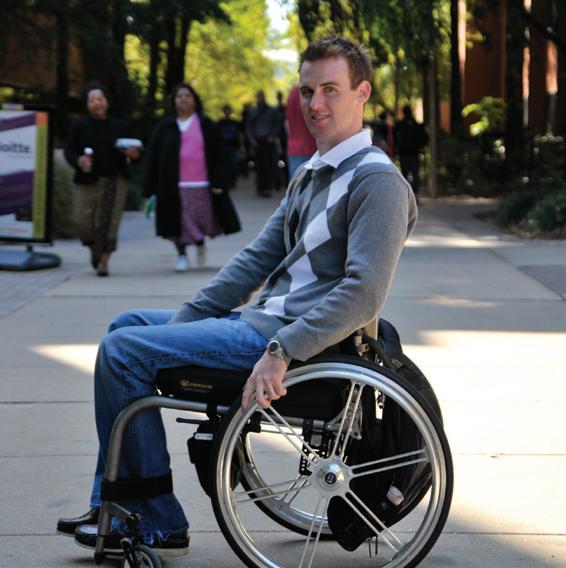
Patient Story
continued from page 1
“I laid out there all night calling for help,” Matt says. It was only the next morning that a fireman found him and took him to the hospital. His jaw was broken in two places, his back bone was shattered. He underwent an eight-hour surgery to repair the damage to his spine.
In a matter of moments, Matt’s life had turned upside down. Doctors gave his injury a classification of ASIA A complete, meaning he would essentially never recover any activity below his spinal cord injury. Walking was out of the question.
“I would be sitting in my chair, watching other people as they got up and walked and wonder how you would do it,” he says.
But Matt was determined not to let his injury get the best of him. Even when he lay immobile in a hospital bed, the first thing he told his dad was, “I am not going to let this injury beat me. I am going to make a difference.”
In 2007, more than a year after his injury, Matt arrived at the International Center for Spinal Cord Injury (ICSCI) at Kennedy Krieger Institute to work with specialists whom he calls “some of the most knowledgeable spinal cord injury doctors in the world.”
What makes the center different is its commitment to its philosophy that, with the right combination of therapies, recovery is possible months or years after an injury. The center’s activity based restorative therapy (ABRT) uses techniques that show great promise in helping individuals with chronic spinal cord injuries recover sensation, movement, and independence.
While he was at Kennedy Krieger, Matt’s therapy included gait training and daily sessions on a bike that employs functional electronic stimulation (FES). With FES, a computer sends electrical messages telling a person’s legs to contract and relax, just as the brain normally would.
When Matt left the Institute, he was reevaluated as an ASIA C incomplete injury, giving him greater hope of recovery—he was even able to walk 300 feet using leg braces and a walker. His therapists
“The therapists went the extra mile to do everything they could to help me get back on my feet.” — Matt Courson
taught him how to continue his therapies at home, and now he can stand up by himself for a short time.
Looking back, Matt says he knew right away that Kennedy Krieger was different.
“The first day I knew there was hope. There are a lot of heroes here,” says Matt. “The therapists went the extra mile to do everything they could to help me get back on my feet.”
Now, in between speaking engagements and therapy sessions, Matt is finishing up his undergraduate degree online. His dream is to go on to law school and then make a career for himself in politics.
“My goal now is to help others,” he says. “My injury just happens to be a spinal cord injury, but everyone goes through something like this in life.”
For more information on Matt Courson and other success stories, visit www.spinalcordrecovery.org.
Matt Courson: Never Giving In, Never Giving up
“In three months here, she improved more than she did in an entire year at her previous rehabilitation center.”
— Mother ICSCI patient Lily Wilkinson
Department of Defense Contract
The International Center for Spinal Cord Injury (ICSCI) completed the first year of a contract awarded by the Department of Defense to perform research and training on the role of neural activity in recovery from spinal cord injury. The contract, Advanced Restoration Therapies in Spinal Cord Injury , is led by principle investigator Dr. John McDonald, and addresses the problem of spinal cord injury (SCI) from both clinical and basic science perspectives. The awarding of this contract reflects the comprehensive nature of our mission as a department and shows the commitment by the defense department to provide the most up-to-date care for injured soldiers and veterans.
Under the contract, Dr. Cristina Sadowsky leads a project aimed at measuring the effectiveness of activity based restorative therapy (ABRT), including functional electrical stimulation (FES), applied to arms and shoulders of patients recovering from SCI. Dr. Visar Belegu is using advanced MRI techniques to investigate how the structure of the injured cord correlates with function in the injured individual.
Drs. Devin Gary and Andres Hurtado lead the basic science research efforts focused on understanding how ABRT and FES work at a cellular and tissue level, and how neural activity influences regeneration of the injured nervous system. This basic science research is crucial for developing future clinical treatments and interventions aimed at improving recovery from paralysis.
Ms. Karen Good, Drs. Larry Schramm, and Albert Recio developed a two-day training program outlining the principles and practices of ABRT for rehabilitation professionals at military and Veterans Administration medical centers across the country. The goal is to allow our successful therapeutic approach to be implemented widely in military hospitals to help injured soldiers and veterans. The first workshop was held in September 2009 at Kennedy Krieger and included participants from Walter Reed Army Medical Center, Bethesda National Naval Hospital, and the VA Hospital Center in Pittsburgh, Pa.
ICSCI Faculty Publications
“Poststroke subgranular and rostral subventricular zone proliferation in a mouse model of neonatal stroke.” Kadam SD, Mulholland JD, McDonald JW, Comi AM. J Neurosci Res. 2009 Sep;87(12):2653-66. PMID: 19396874
“The role of animal models in evaluating reasonable safety and efficacy for human trials of cell-based interventions for neurologic conditions.” Regenberg A, Mathews DJ, Blass DM, Bok H, Coyle JT, Duggan P, Faden R, Finkel J, Gearhart JD, Hillis A, Hoke A, Johnson R, Johnston M, Kahn J, Kerr D, King P, Kurtzberg J, Liao SM, McDonald JW, McKhann G, Nelson KB, Rao M, Siegel AW, Smith K, Solter D, Song H, Sugarman J, Vescovi A, Young W, Greely HT, Traystman RJ. J Cereb Blood Flow Metab. 2009 Jan;29(1):1-9. Epub 2008 Aug 27. Review. PMID: 18728679
“Physical transfer of membrane and cytoplasmic components as a general mechanism of cell-cell communication.” Niu X, Gupta K, Yang JT, Shamblott MJ, Levchenko A. J Cell Sci. 2009 Mar 1;122(Pt 5):600-10. Epub 2009 Feb 10. PMID: 19208767
“Acute Spinal Cord Injury and Infection with Multi-Drug Resistant Acinetobacter Calcoaceticus – Baumannii Complex Among Returning Operation Iraqi Freedom (OIF) Soldiers: Successful Innovations in Rehabilitation during Isolation.” Recio AC, Bohart ZW, Havens, SR, Stiens SA. Am J Phys Med Rehabil. In Press
“Bone marrow stromal cells elicit tissue sparing after acute but not delayed transplantation into the contused adult rat thoracic spinal cord.” Nandoe Tewarie RR, Hurtado A, Ritfeld GJ, Rahiem ST, Wendell DF, Barroso MM, Grotenhuis JA, Oudega M. J Neurotrauma. 2009 Jul 31. Epub ahead of print
“Creation of highly aligned electrospun poly-L-lactic acid fibers for nerve regeneration applications.” Wang HB, Mullins ME, Cregg JM, Hurtado A, Oudega M, Trombley MT, Gilbert RJ. J Neural Eng. 2009 Feb;6(1):016001.
“Stem cell-based therapies for Spinal Cord Injury.” Nandoe Tewarie RD, Hurtado A, Bartels RHMA, Grotenhuis JA, Oudega M. J of Spinal Cord Med. 2009; 32(2):105-14.
“Chronically CNS-Injured Adult Sensory Neurons Gain Regenerative Competence upon a Lesion of their Peripheral Axon.” Ylera B, Ertürk A, Hellal F, Nadrigny F, Hurtado A, Tahirovic S, Oudega M, Kirchhoff F, Bradke F. Current Biology, 2009 Jun 9;19(11):930-36.
“Activity-based restorative therapies: concepts and applications in spinal cord injury-related neurorehabilitation.” Sadowsky CL, McDonald JW. Dev Disabil Res Rev. 2009;15(2):112-16. Review. PMID: 19489091
“Assessment of the reproducibility of tract-specific magnetization transfer and diffusion tensor imaging in the cervical spinal cord at 3 Tesla.” Smith SA, Jones CK, Gifford A, Belegu V, Chodkowski, BA, Farrell JAD, Landman BA, Reich DS, Calabresi PA, McDonald JW, van Zijl PCM. NMR in Biomedicine. In press.
Spinal Cord Injury. In: “Essentials of Stem Cell Biology” 2nd edition (Lanza R, Thomas ED, Thomson J, Pedersen R, Gearhart J, Hogan B, Melton D, West M, Ed.) McDonald JW, Becker D; pp 497-506. San Diego: Academic Press, Elsevier Science 2009.
“Unintended changes in cognition, mood, and behavior arising from cell-based interventions for neurological conditions: ethical challenges.” Duggan PS, Siegel AW, Blass DM, Bok H, Coyle JT, Faden R, Finkel J, Gearhart JD, Greely HT, Hillis A, Hoke A, Johnson R, Johnston M, Kahn J, Kerr D, King P, Kurtzberg J, Liao SM, McDonald JW, McKhann G, Nelson KB, Rao M, Regenberg A, Smith K, Solter D, Song H, Sugarman J, Traystman RJ, Vescovi A, Yanofski J, Young W, Mathews DJ. Am J Bioeth. 2009 May; 9(5):31-6. PMID: 19396681
Stompin’ For the Cord: A Recipe For Good Times
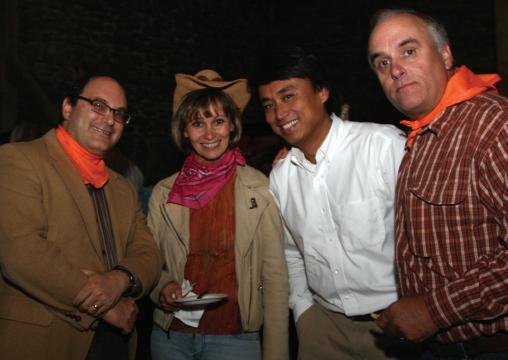
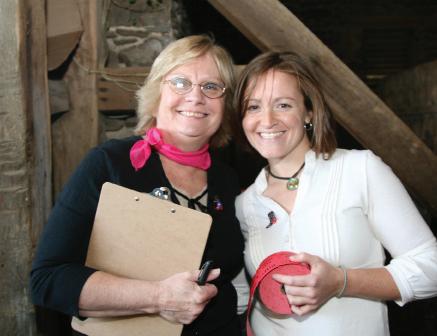
Nearly 200 friends of the International Center for Spinal Cord Injury sipped wine and socialized at our second year “Stompin’ for the Cord” at Boordy Vineyards. Guests en joyed entertainment from the Lonesome River Band, and many took home some extraordinary auction items. Bid ding was intense at times, but at the end of the evening everyone was a winner, including Dr. McDonald, who took home a vintage 1929 slot machine.
In addition to Scott Donohoo, who served as our local celebrity auctioneer, a featured highlight of the evening was the ICSCI first-edition cookbook. The book is filled with favorite recipes from Kennedy Krieger staff, patients, friends, and supporters. The cover features photo graphs of our therapists and doctors, all of whom make a difference every day in the lives of the patients who come to our facility.
More than $70,000 was raised for spinal cord research, thanks to the generous support of our patients, friends, and community. The money raised allows us to help the many people living with paralysis by advancing research and providing access to the best care and a world-class rehabilitative therapy program.
3rd Annual - Stompin’ For The Cord
When: Saturday, September 25, 2010
Where: Boordy Vineyards
For ticket information contact Vickie Rosellini at 443-592-6142 or vickierose@hughes.net.
Our Mission 707 North Broadway Baltimore, Maryland 21205
“My continued recovery is a miracle in and of itself. More important than my own improvement is the knowledge that my recovery may help someone else.” — Santa Wallace, ICSCI patient
INTeRNATIoNAl CeNTeR FoR SPINAl CoRD INJuRY PARTICIPATeS IN 2009 WoRlD STeM Cell SuMMIT
Representatives from the International Center for Spinal Cord Injury (ICSCI) took part in the 2009 World Stem Cell Summit held in Baltimore, Maryland. ICSCI joined more than 1,200 of the world’s most influential stem cell stakeholders. Dr. John McDonald, director of ICSCI, and Josh Basile, a spinal cord injury patient at Kennedy Krieger, spoke on recent stem cell progress surrounding spinal cord injury (SCI). Dr. McDonald focused on embryonic stem cell transplantation in the injured spinal cord and also discussed spontaneous spinal cord repair and recovery, as well as using endogenous stem cells for repair through activity based restoration therapy (ABRT) strategies and based on principles of brain activity.
Mr. Basile spoke from the patient perspective, addressing the importance of advocacy and the role patients play in motivating scientists and policymakers toward future cures. He hoped to inspire attendees to influence the direction of this potentially life-changing research. Other panelists included Peter Kiernan from the Christopher & Dana Reeve Foundation, Dr. Wise Young from Rutgers University, and Jane Lebkowski from Geron biopharmaceutical company. The panel was moderated by Thomas Scalea from the University of Maryland School of Medicine.
Transitioning today’s science to near-term therapeutic applications, we focus on developing and applying advanced restoration strategies for optimizing spontaneous recovery in those living with paralysis.