Neurorehabilitation Updates
Collaborative care, innovative approaches and research-driven therapies to help patients get back to their lives.
Collaborative care, innovative approaches and research-driven therapies to help patients get back to their lives.
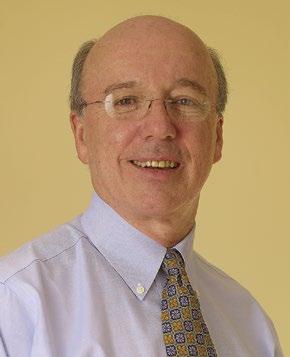
From our director, Frank S. Pidcock, MD:
When a child is living with pain, childhood can become a daily struggle. Our patients have often stopped attending school and socializing with friends. Many, like Faythe, whose story is featured in this newsletter, spend much of their time in bed because of the debilitating pain they experience every day.
That’s where our Pain Rehabilitation Program can help. We offer full-scale evaluations, outpatient therapies, day treatment, inpatient rehabilitation and—through our partnership with The Johns Hopkins Hospital’s Department of Anesthesiology and Critical Care Medicine—interventional procedures (e.g., nerve blocks and joint injections) for relieving pain. We are one of the few pediatric pain programs in the country to offer interventional pain services guided by imaging in an operating room.
Although our approach to pain treatment avoids using narcotics, we do assess patients with current prescriptions for narcotics, with the goal of replacing narcotics with non-narcotic therapies. Ultimately, we provide the tools our patients need to conquer their chronic pain and get their lives back.
Read on to learn more about our Pain Rehabilitation Program, and be sure to watch for future issues of “Neurorehabilitation Updates” for the latest in neurorehabilitation research and treatment options. If you have any questions or would like to learn more about our services, please call our Physician Referral Line at 443-923-9403
Dr. Pidcock is the vice president of rehabilitation at Kennedy Krieger Institute and director of the Department of Physical Medicine and Rehabilitation at The Johns Hopkins Hospital.
Rehabilitation Specialty Programs at Kennedy Krieger
Kennedy Krieger Institute has a wide variety of rehabilitation programs to meet patient needs at all levels. Please visit Rehabilitation.KennedyKrieger.org for a complete listing.
Pediatric Rehabilitation Unit
• Brain disorders and injuries, including disorders of consciousness
• Chronic pain
• Complex medical rehabilitation
• Post-orthopedic surgery
• Spinal cord disorders and injuries
Outpatient Rehabilitation Programs
• Brachial Plexus Clinic
• Center for Brain Injury Recovery
• Community Rehabilitation Program
• Concussion Clinic
• Constraint-Induced and Bimanual Therapy Program
• Cranial Cervical Clinic
• Focused Interdisciplinary Therapy Program
• International Center for Spinal Cord Injury
• Limb Differences Clinic
• Neurorehabilitation Day Hospital
• Neurosurgical Services
• Orthopedic Clinic
• Pain Rehabilitation Program
• Phelps Center for Cerebral Palsy and Neurodevelopmental Medicine
• Philip A. Keelty Center for Spina Bifida and Related Conditions
• Physical Medicine and Neurorehabilitation Clinic
Related Services and Clinics
• Aquatic Therapy Program
• Assistive Technology Clinic
• Audiology Clinic
• Behavioral Psychology Outpatient Programs
• Neuropsychology Department Outpatient Clinics
• Nutrition Clinic
• Occupational Therapy Clinic
• Pediatric Psychology Consultation Clinic
• Physical Therapy Clinic
• Seating Clinic
• Speech and Language Clinic
Learn More. Get Involved. Stay Connected. Visit KennedyKrieger.org/Connect .
at 443-923-9403.
Kennedy Krieger’s Pain Rehabilitation Program helps kids and young adults learn to conquer chronic pain without the use of narcotics.
On the day Faythe was admitted to Kennedy Krieger Institute’s inpatient rehabilitation hospital, she had been experiencing constant pain for the past seven years, following a gastrointestinal illness in 2010. The pain had gradually gotten worse over time, and was unrelieved, despite many previous interventions.
That was in February 2017. At her high school graduation the previous June, Faythe had needed all the strength and determination she could muster to walk across the stage with the aid of a walker. By the end of 2016, she was confined to the living room couch at her parents’ home. She could barely sit up, and she needed her parents to help her do everything.
But Faythe tried one more doctor. As it turned out, that doctor was familiar with the challenges of treating the chronic pain Faythe had been struggling to overcome, and referred Faythe to the Pain Rehabilitation Program at Kennedy Krieger.
The program’s outpatient team, which is directed by Dr. Irfan Suleman, assistant professor of pediatric anesthesiology at the Johns Hopkins University School of Medicine, examined Faythe, performed an extensive workup on her, and recommended she be admitted to Kennedy Krieger’s inpatient rehabilitation hospital for comprehensive pain rehabilitation.
Initially, “the idea of staying in a hospital was really nerve-racking and scary,” Faythe says, “but on the first day, everyone made me feel really comfortable, like I really belonged there.”
interaction with therapy dogs—a favorite activity for Faythe, who loves animals—were just some of the activities designed to help Faythe re-engage with the community.
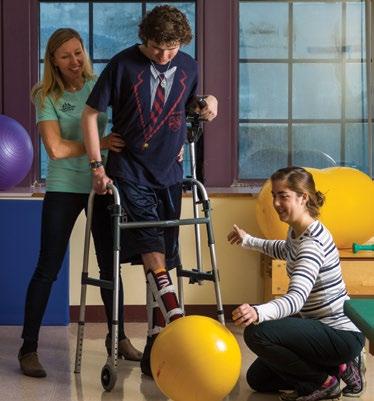
At first, she worked on re-mastering simple movements, like getting out of bed and taking small steps with a walker. Physical and occupational therapists guided and encouraged her through every movement, which she practiced over and over again, getting stronger every day. The stronger she got, the less pain she felt. The more she practiced, the more confidence she had in her abilities.
Behavioral therapists used cognitive behavioral therapy to teach her coping strategies like deep breathing exercises and mindful meditation to help her deal with the pain that she did still feel. Soon, she was walking again, and even climbing stairs, says Alissa Marzetti, Faythe’s primary inpatient physical therapist.
“We helped her break the cycle of thinking a movement would cause so much pain,” says Jacqueline Wineholt, Faythe’s primary inpatient occupational therapist, “and helped her retrain her brain into thinking she could move without pain—or without quite so much of it.”
“We used all the tools we had in our toolbox to rehabilitate her,” Dr. Suleman adds.
Faythe stayed at Kennedy Krieger’s inpatient hospital for nearly eight weeks, improving every day. All of her progress was accomplished without narcotics.
“I’ll never forget her showing me that photo,” Holt says. “I knew how much she loved animals, and knowing that she felt she was in a place now where she could manage a dog and do all the things needed to care for her pet—that made me really happy.”
During her stay at Kennedy Krieger, Faythe’s rehabilitation plan included occupational, physical and behavioral therapies for several hours a day, six days a week. Therapeutic outings and
Having entered Kennedy Krieger in a wheelchair, Faythe left the Institute’s inpatient hospital on her own two feet. She continued to improve at the Institute’s Specialized Transition Program, a neurorehabilitation day hospital.
At the day hospital, Faythe received daily occupational and physical therapies and behavioral services for an additional four
weeks, to help her complete a successful return to her home and community. Her goals included walking with a smoother gait and regaining arm strength, in order to do things like prepare a meal and walk a dog, says Haley Holt, Faythe’s occupational therapist at the day hospital.
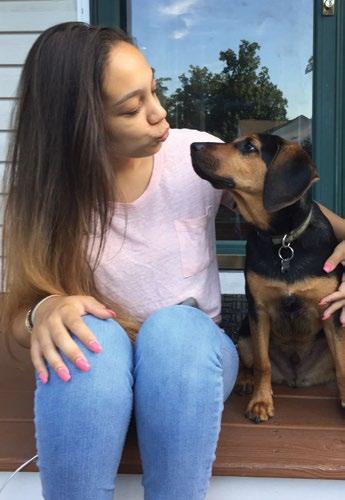
Faythe has continued to make progress through ongoing therapy and gym workouts. Her pain is now manageable, and she’s gained back a lot of independence. This past summer, she adopted a hound
puppy, whom she named Deacon. This past fall, she started college with the intention of majoring in biology.
When Faythe returned to Kennedy Krieger for a follow-up appointment last September, she showed Holt a photo of Deacon. “I’ll never forget her showing me that photo,” Holt says. “I knew how much she loved animals, and knowing that she felt she was in a place now where she could manage a dog and do all the things needed to care for her pet—that made me really happy.”
Successful outcomes following critical pediatric illness often involve transfer to an inpatient pediatric rehabilitation facility. Dr. Frank S. Pidcock, vice president for rehabilitation at Kennedy Krieger Institute, and Jody Luttrell, director of care management at Kennedy Krieger, will give a presentation titled “Successful Transitions From PICU to Inpatient Rehabilitation” at the Case Management Society of America’s 28th annual conference, to be held June 19–23 in Chicago. Please email us at Pidcock@KennedyKrieger.org if you are interested in discussing this topic or learning more.
Kennedy Krieger Institute’s clinicians and researchers are leaders in pediatric chronic pain treatment and research. Below is a selection of research focused on treating chronic pain in children and adolescents.
Dilley, J. D., Siddiqui, M. S., Dassinger, S., & Suleman, M. I. (2015). Central line placement in the presence of a ventriculoatrial shunt [Abstract]. The Journal of the Arkansas Medical Society, 111(8), 162.
Suleman, M. I., Akbar Ali, A. N., Siddiqui, M. S., & Alfonso, W. F. (2015). A shared operative field and the dispute—Is there a way out? [Abstract]. Middle East Journal of Anesthesiology, 23(2), 257–9.
Suleman, M. I., Edala, T., Abraham, E., & Siddiqui, M.S. (2015). Non-trigger anesthesia management in a patient with Leigh’s syndrome presenting for dental rehabilitation [Abstract]. Anesthesiology and Pain Medicine, 5(6), e28804.
Celedon, X., Amari, A., Ward, C., Prestwich, S., & Slifer, K. J. (2014). Children and adolescents with chronic pain and functional disability: Use of a behavioral rehabilitation approach. Current Physical Medicine and Rehabilitation Reports, 2, 86–92.
Slifer, K. J., Ward, C. M., Amari, A., Bierenbaum, M., McLean, H., Pidcock, F., & Kost-Byerly, S. (2012). Interdisciplinary behavioral rehabilitation of pediatric pain-associated disability. Proceedings of the 15th World Congress of Pain Clinicians (pp. 11–116). Bologna, Italy: Medimond SRL.
Maynard, C., Amari, A., Wieczorek, B., Christensen, J., & Slifer, K. J. (2010). Interdisciplinary behavioral rehabilitation of pediatric pain-associated disability: Retrospective review of an inpatient treatment protocol. Journal of Pediatric Psychology, 35(2), 128–137.
Gorski, J. B., Slifer, K. J., Kelly-Suttka, J., & Lowery, K. (2004). Behavioral interventions for pediatric patients’ acute pain and anxiety: Improving health regimen compliance and outcome. Children’s Health Care, 33(1), 1–20.
Sakurai, M., Suleman, M. I., Morioka, N., Akça, O., & Sessler, D. I. (2003). Minute sphere acupressure does not reduce postoperative pain or morphine consumption [Abstract]. Anesthesia & Analgesia, 96(2), 493–497.