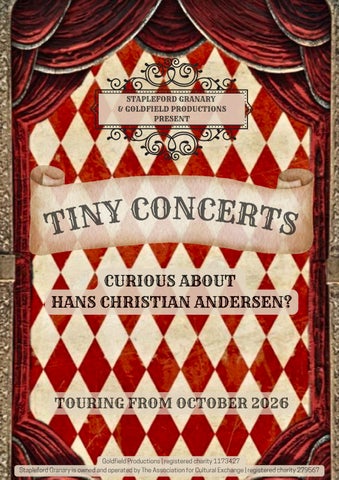
STAPLEFORD GRANARY & GOLDFIELD PRODUCTIONS PRESENT
N O C C E R Y T N I S T CURIOUS ABOUT HANS CHRISTIAN ANDERSEN?
TOURING FROM OCTOBER 2026
Goldfield Productions | registered charity 1173427 Stapleford Granary is owned and operated by The Association for Cultural Exchange | registered charity 279567
what are tiny concerts?
TINY CONCERTS, a co-production between Stapleford Granary Arts Centre and Goldfield Productions, are 45 minute classical music events which tour to primary schools and venues. They are performed by a professional company of six: four musicians, a narrator, and a technician. Unique, inspirational and unforgettable, they combine storytelling with extraordinary pop-up staging, props and puppets, to bring live chamber music and theatre of the highest calibre into the heart of schools and festivals, and into the imaginations of young audiences. Founded in 2014, Goldfield Productions are renowned for their uniquely engaging cross-arts shows which have toured UK venues and festivals, and visited countless primary schools.
‘A magical and wonderful performance…really very special indeed’ - Moorlands Primary ‘Our complex needs students remained absolutely enthralled throughout the show as the sounds and pictures appeared and disappeared’ - Castle School 'The Tin Forest was, without a doubt, one of the most incredible events for our pupils that I have had the privilege of attending since the Trust was formed 10 years ago. The sound, light, space and words came together to create a powerful immersive experience that pupils and staff will not forget for a long time...quite magical'. - Jonathan Culpin, CEO Anglian Learning
The first TINY CONCERT, touring from October 2026, is called:
curious about hans christian andersen? A selection of Hans Christian Andersen’s best-loved and lesser-known tales are told in a seamless blend of music, theatre and story. Aspects of Andersen’s own extraordinary life - from his childhood home in deepest poverty, his love of music, theatre, and paper-snipping, to his belief that his stories and dreams would become famous throughout the world - are woven into the show, set within a life-size Victorian paper theatre. The backstage workings - the scene changes, the props and puppets - are visibly seen by the audience, revealing a curious toy-like world of shadow, light and illusion, where nothing is quite as it seems.... ‘His tiny tales expand dramatically to shine a light on the peculiarities of the world with humour, irony and perspective. Andersen's 160 fairy tales were not written for the nursery, but for the child in all of us’. - Kate Romano, writer
enter the fairytale... read on...
toy theatres -a little bit of history As a child, Hans Christian Andersen’s favourite pastime was the toy theatre made by his father, for which he wrote plays to be performed by the dolls whose clothes he designed and sewed. In the 1800s, theatre was incredibly popular. There weren’t enough theatres for the fast growing population of London. When the theatres were full, crowds packed into unofficial performances in empty shops, warehouses and pubs called ‘penny gaffs’. Lit by just a few candles, they were dirty and cramped and the stories that the actors told were scary and shocking. There were sometimes as many as six performances a day seen by hundreds of people, most of them children. But people wanted even more entertainment, so toymakers came up with a clever way to bring theatre into the home: paper theatres. They cost ‘one penny plain, or two pence coloured’. For their penny (or two pennies) children could be the proud owner of a tiny cardboard stage about the size of a book, with a proscenium arch, curtains, and sometimes a paper audience. The characters were set out on sheets of paper, frozen in dramatic poses. The scenes were illustrations of palaces, gardens and forests, which you could slot in and out of the back of the theatre behind the characters. Tiny little scripts came with the theatres so that children could act out the shows. But it’s very likely that children made their own stories up. After all, the smaller the stage, the greater the potential for incredible, impossible things...
the creative team
Writer, producer, director - Kate Romano Set design - Jonny Boatfield Musicians - Goldfield Ensemble (string quartet, clarinet) Technician - Paul Hunt Kate Romano has written and presented over 200 stories for BBC Radio 3, and written and directed five stage shows for children. All of the musicians of the acclaimed Goldfield Ensemble are renowned chamber and orchestral musicians. Jonny Boatfield is one of the UK’s finest draughtsmen, and has designed installations for the Royal Opera House, the Barbican and The National Theatre. Paul Hunt is Head of Sound at Stapleford Granary Arts Centre, and brings a wealth of technical experience in theatre, live music and events. ‘A mesmerising performance which the children and adults all enjoyed enormously – the Goldfield Ensemble has once again inspired and amazed us – wow!’ - Linton Heights Junior School
information for schools working together, inspiring one another We are skilled and enthusiastic about helping schools embed creativity and arts opportunities in their work. CURIOUS ABOUT HANS CHRISTIAN ANDERSEN? has been created with primary schools in mind, though we find that our shows appeal to story-lovers of all ages. This multi-sensory performance is designed to demonstrate how a mixture of art forms can be used to tell a powerful tale, and serves as an inspiration for children to pool their skillsets and interests and explore collaborative, inclusive ways of working together. After the show, we leave each school with a selection of WORKSHOP-KITS. These supportive packs are created so that a large-group or all-class workshop can be run by a teacher in a classroom using non-specialist materials that most schools or pupils would be able to access. The ideas are designed to pool resources and skills, nurture talent and create a lasting legacy; a pattern of working which mimics a professional production team, where roles are clearly defined and the end result is greater than the sum of the parts. How about making a museum of miniature shoe-box dioramas? A giant comic book? A cardboard city in which to enact tales from the streets? Dramatic scenes and scenarios using shadows, paper, sound and lighting? From pre-written scripts and cutout paper patterns to ‘blank canvas’ sparks to help develop an idea into an experience for visitors, we’ve thought of lots of ways to recreate the collaborative magic of TINY CONCERTS after the event. Workshop support visits from the Stapleford Granary team are also available - and free!
your questions
When is the show touring? October 2026, Spring / Summer 2027. Please enquire for details. What kind of space does the show need? SCHOOLS & VENUES Typically, a flexible hall or theatre space. Our portable theatre is based on the look and scale of a Victorian Paper Theatre. Measuring approximately 2m(h) x 2.5m(d) x 3m(l), the theatre is large enough to accommodate a performing string quartet and a narrator who moves in and out of the set to tell the story and operate the show. The toy theatre has its own LED lighting system operated by our technician. The narrator has a collar mic (we tour with our own amp / speaker) and we would need access to a minimum of 4 sockets (we can supply extension cables). The technician usually sets up in a corner of the room and needs a chair and small table. All touring items are PAT tested and fit to be used in a school setting. Does your hall have curtains or blinds? It would be desirable to make the hall as dark as possible to appreciate the full impact of the theatre. We need parking for one Vauxhall Movano van (5.4m long, 2.6m wide, 2.5m high) as close to the performance space as possible. Musician cars can be parked further away if necessary. How many children / audience members can see the show? As many as you can safely and comfortably fit into your performance space, in addition to the pop-up theatre, allowing room for the narrator to move in front of and around the set. The show is suitable for years 1 to 6. Our experience has shown us that the multi-sensory nature of the show makes it especially suitable for children with Special Educational Needs. We are very happy to give two performances in one day at a school so that all children can see the show in comfort. An ideal sized audience would be around 100-150 to ensure that they all have a good view of the theatre, but we are happy to discuss various options and seating plans. How do the timings work? We need a couple of hours to set up and an hour to take the set down. We can set up the show before school opens (eg from 7:00am if a caretaker is on site) or we may be able to set up the day before the show at the end of the school day (eg 4:00pm onwards) if this suits you. We need some time in between performances to reset and grab a drink / snack. Please allow a minimum of 60 minutes per show (to accommodate pupil get in and out, and question time after the performance). What does the show cost? Please enquire for details; we can often help support school productions with grants.
your questions continued
Do teachers need to prepare anything in advance? We will provide targeted year-appropriate suggestions for schools before the show to ensure that a year 1 pupil gets as much out of the experience as a year 6 pupil. It is not essential to undertake any preparatory work, but we anticipate that children will benefit more with age-appropriate familiarity of the music, stories, and the concept of the Victorian Paper Theatre. Do the post-show workshops need a specialist arts teacher? No; they are designed to encourage everyone to bring their imagination and the skills they have to the table, exactly like a professional production. Working in this way, children can learn about the importance of collaboration and the spirit of being part of a team, respect for others and resilience in the face of challenges. Their sense of emotional intelligence starts to develop, they become more comfortable with self-expression and experience a great sense of pride in their collective achievement. We can and will provide both support and encouragement as needed or required. Are the post-show workshops essential? No; but we hope that you will enjoy creating something of your own in response to the TINY CONCERTS experience. You might like to use your workshop project towards Arts Award.
book a show!
More questions? Just drop us an email Kate Romano Kate@staplefordgranary.org.uk
PE TO SEE YOU SOON ! WE HO
www.staplefordgranary.org.uk STAPLEFORD GRANARY IS OWNED AND OPERATED BY THE ASSOCIATION FOR CULTURAL EXCHANGE REGISTERED CHARITY 279567