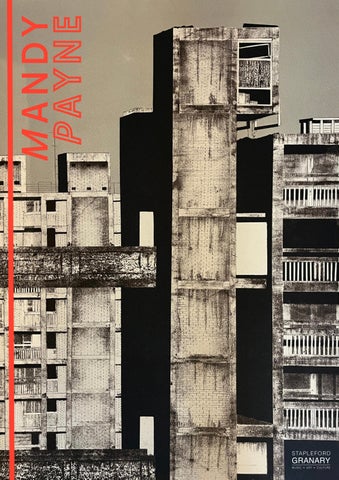
M A N D Y P A Y N E
ARTIST BIOGRAPHY
Mandy Payne lives and works in Sheffield. She originally trained as a dentist, working in the Hospital and Community Dental Services, before transitioning to a full-time art career. She graduated with a BA Fine Art (First Class) from Nottingham University in 2013.
Recent group exhibitions include the Royal Academy Summer Exhibition, London (nine occasions); John Moores Painting Prize, Walker Art Gallery, Liverpool (Prize Winner, 2014; shortlisted 2016, 2020); ‘Made In Britain’ at the National Museum in Gdansk (2019); and ‘Contemporary Masters From Britain: 80 British Painters of the 21st Century,’ Nanjing and Yantai, China (2017).
Solo exhibitions include Angear Gallery, Lakeside Arts Centre, Nottingham (2018), Huddersfield Art Gallery (2019), Manchester Modernist Society (2021) and Art At Home, London (2024). She is a member of the Contemporary British Painting group.
Between 2015 and 2017, Mandy Payne completed a two-year Fellowship in stone lithography at Leicester Print Workshop, for which she received Arts Council England funding and an Elizabeth Greenshields Foundation Award.
Her work is held in public and private collections, including The Devonshire Collection, Chatsworth; The Yale Centre For British Art; Yantai Art Museum, China; Elizabeth Greenshields Foundation, Canada; and the Ruskin Collection, Millennium Gallery, Sheffield.
CONTENTS
artist interview price list modernist cambridge
ARTIST INTERVIEW
Mandy Payne is a multiaward winning artist whose work is inspired by Brutalist architecture. She spoke to Kate Romano about her deep-rooted connections with the sites she depicts.
Sheffield is a city of hills, with a centre nestled in a
confluence of industrial valleys. Looking up beyond the railway station, Park Hill flats dominate the skyline; functional, imposing and muscular. This iconic Brutalist estate opened in 1961, credited as being the first successful community-wide slum clearance since the end of the Second World War.
Park Hill features strongly in Mandy Payne’s work. She grew up on the outskirts of Bradford and her school was a large concrete comprehensive in Saltaire built by Chamberlin, Powell and Bon (the architects of the Barbican). ‘It was rather like the Barbican in many ways’ she says. ‘Ponds, a rotunda…. I really liked it, but most didn’t. Maybe it seeded my love of modern architecture. I was familiar with the style.’ The school was also very accommodating, allowing Mandy to study art as an extra A level subject in her free periods alongside her science-based A levels.
For 25 years, Mandy worked as a community dentist for the NHS in areas of high social need. ‘I worked with marginalised sections of the community’ she says, ‘and I think this is why I’m drawn to the places that I paint. They’re also overlooked, undervalued and disenfranchised’. Her father worked in Sheffield’s steel industry, and those monolithic views of Park Hill were indelibly etched in her memory as a result of regular visits to the city.
It took Mandy a long time to leave dentistry. Sensing that she needed to pursue her lifelong love of art, she started a part-time art degree course at Nottingham University in 2011 alongside her day job, and began to explore the Park Hill Estate in depth. At this point, Park Hill was in a state of flux. The pioneering utopian dream with its elevated walkways and clever topographical design, had shown the world a new way of thinking about social housing. But it had fallen into decline in the 1970s and 80s. As neighbouring estates were raised to the ground, Park Hill was surprisingly and controversially awarded Grade II* listing from English Heritage in 1998, and a regeneration process begun in 2005. ‘It felt important to document this state of transition, together with the loss of the existing community' Mandy says. She interviewed past residents and people who had worked on the estate and was struck by the happy memories and affection for Park Hill in stark contrast to its more recent reputation as a sink estate.
Mandy’s fascination with social histories, the notions of utopias and dystopias, and her own experience of working within the NHS, pervade her work. As public access to Park Hill became increasingly limited, she started painting similar locations undergoing gentrification in London, Manchester, Salford and Liverpool. In 2019, she received an Arts Council award to investigate the North East of England but returned to Park Hill between 2020 - 2022 during lockdown, documenting both the new build and referring
back to old photographs before regeneration got seriously underway.
Materials are important to Mandy. She shares a love of concrete with the architects who valued it for its economic efficiency, sculptural opportunities, uncompromising modernity and honesty. ‘I wanted to use materials that had a physical connection to the sites I was depicting’ she says. Using her own home-made process, she casts a concrete ‘canvas' then applies masking tape to create negative areas (‘quite repetitive, but also meditative’) and applies spray paint, then oil paint for detail. She explains the self-imposed restrictions of her process; ‘Concrete is limiting because of weight, so many of my pieces are quite small, which also makes hanging easier for people. For larger images, such as the bus stop painting, I create a sort of cement fondue mixture which I apply to a board; concrete without the weight.
I don’t like the surface quality quite so much... I prefer the little ones which are poured so they have a lovely glossy finish and air bubbles - they are never quite perfect. Concrete is a pretty forgiving material; if I don’t like something I can sand it back and have another go’. She feels that her patience with details and handling of material comes from dentistry; ‘We worked with dental plaster and stone to make false teeth as dental students, so mixing concrete seemed fairly straightforward!’
Mandy admits to ‘loving a clean line’, resulting in elements of abstraction in her work. Naturally drawn to the geometry and grid-like structures of buildings, she describes a certain atmosphere, an underlying sense of loss and melancholy, often evoked by textures and varying surface qualities which she actively seeks. There’s grime, pollution and graffiti in the pictures, but not people. ‘It’s intentional’ she says. ‘You can create a sense of presence through absence. I prefer to focus on the things people leave behind to bring in a touch of the human element. It might be a half opened curtain or a broken window… something that says someone was there’.
Mandy graduated in 2013 and finally left dentistry to devote her time fully to art. She describes her long period of arts education - which included evening classes and a part time HND - as ‘transformative’ and the blend of experiences as crucial to her practice. She was taught sculpting, printing and model making, combined with rigorous academic work, mentored by gifted, inspiring teachers. She received immediate recognition as one of the five shortlisted prizewinning artists for the John Moores Painting Prize in 2014, and was twice more selected for the John Moores exhibition, along with a succession of other awards and exhibitions. ‘I felt like a complete imposter’ she says. ‘But at the same time, it sort of validated the difficult decision to give up dentistry. Surreal, but very special’.
LIST OF WORKS
For The Many Not
Priced Out II, 35 5 cm x 35 5cm, Spray paint and oil on cast concrete, £1500
Nothing Is Ordinary 60cm tondo
Spray paint and oil on cast concrete
£2750
Regents Mill With Cones
33cm x 33cm
Spray paint and oil on concrete
£1500
Four Garages
30cm x 30cm
Spray paint and oil on concrete
£1500
Shaft I
33cm x 33cm
Spray paint and oil on concrete
£1500
Looking At The Overlooked
50cm x 50cm
Spray paint and oil on cast concrete
£2975
Life In A Northern Town
31cm x 31cm
Spray paint and oil on gesso panel
£1000
Windows At Wendover 24cm x 24cm
Spray paint and oil on marble
£1000
The Inherent Magic Of The Everyday 40cm x 40cm
Spray paint and oil on concrete
£1700
The Few, triptych 20cm x 20cm, Spray paint and oil on marble, NFS
Through The Railing
30cm x 60cm
Spray paint, ink, oil paint and varnish on found roofing slate
£1500
Old Cobblers
Playground
44cm x 60cm
Spray paint and oil on micro-cement on tile backer board
£1300
St George’s Warehouse
30cm x 30cm
Spray paint and oil on cast concrete
£1500
Out Of Time
60cm x 60cm
Spray paint and oil on cast concrete
£3000
Tower Blocks At Thamesmead I
30cm x 70cm
Spray paint and oil on concrete
£3000
Precinct II
45cm x 37cm
Spray paint, oil and Letraset on marble
£1700
Tower Blocks At Thamesmead II
30cm x 70cm
Spray paint and oil on concrete NFS
Maxwell Building III, 39cm x 29cm, Spray paint and oil on concrete, £1700
lithographs and monoprints:
Still Standing Edition 2/25
48cm x 57cm
2 colour Plate lithograph on Somerset Newsprint paper, printed in collaboration with Lemonade Litho
£375
Winter Is Coming Edition 2/25
44cm x 64cm
2 colour Plate lithograph on Somerset Newsprint paper, printed in collaboration with Lemonade Litho
£375
View From A Bridge Edition 3/10
39cm x 34cm
4 colour stone lithograph on Somerset Newsprint paper, printed in collaboration with Stone Tree Press
£400
Fragment A/P
25cm x 51cm
Stone lithograph on Somerset Newsprint paper
£200
Scaffold
17 5cm x 24cm
Stone lithograph and monoprint on Japanese Kozo paper collaged on concrete, protected with UVA matt resistant varnish
£600
Brave New World Edition 2/15
62cm x 80cm
2 colour Plate lithograph on Somerset Newsprint paper printed in collaboration with Lemonade Litho
£500
Church House Edition of 1/10
Stone lithograph with multiple monoprint on Somerset Newsprint paper, printed in collaboration with Stone Tree Press
£300
lithographs on concrete:
Streets In The Sky
52cm x 89cm
Monoprint and spray paint A/P
£350
Embodied Carbon Edition of 6, A/P
32cm x 32cm
Stone lithograph and monotype on Japanese Kozo paper collaged on to Somerset Newsprint paper
£300
Everything Of Value Has Been Removed Edition 4/5
70cm x 64cm
2 Stone lithograph with multiple monotypes
£700
This Is Tomorrow Today III Edition of 16, A/P
51cm x 54cm
Stone lithograph with monoprint on Somerset Newsprint paper
£500
Faded Glory Edition 3/10
13 5cm x 13 5cm
Stone lithograph and on Japanese Kozo paper collaged on concrete, protected with UVA matt resistant varnish
£500
Churchill College
Grade II listed, completed 1968
MODERNIST CAMBRIDGE
Cambridge is full of Modernist architecture. These striking and ambitious structures are the legacy of colleges and institutions which had both funds and foresight to employ some of the most accomplished architects of the day. Here are a handful to whet your appetite. (Please check individual websites before visiting)
Architects Richard Sheppard, Robson and Partners
In stark contrast to Cambridge’s historic colleges corralled behind high walls, Churchill College is nestled in an almost rural setting on the outskirts of the city; modern in design, Brutalist in detail.
Churchill College was founded to commemorate the life of Sir Winston Churchill. The design is a result of a 1959 competition which galvanised a who’swho of mid-century British architects to submit their ideas, hoping to make their mark on Cambridge’s academic landscape. Many designs included a lake and nearly all featured a chapel at the front of the College on Storey’s Way. Some designs incorporated a future burial place or mausoleum for Winston Churchill.
Winston Churchill visited the exhibition at RIBA, London, in July 1959 to select four finalists from the 19 competitors. The four finalists were: Chamberlain, Powell and Bon; Howell, Killick and Partridge; James
Stirling and James Gowan; Richard Sheppard, Robson and Partners.
Richard Sheppard, Robson and Partners were selected, and construction on the new College for 540 students and 60 fellows began. While Churchill College is a Modernist design, the straight lines and concrete are softened by the surrounding grounds and internal decor. There’s a nice design detail too; the concrete used in beams in buildings across the original site has been ‘shuttered’ to create markings which look like wood. Don’t miss the sculptures, including pieces by Dhruva Mistry and Barbara Hepworth (image top left).
Garret Hostel Bridge (Garret Hostel Lane)
Grade II listed, completed 1960
Architect Timothy Morgan
The Garret Hostel Bridge is an elegant Modernist classic, completed in 1960 to replace William Chadwell Mylne's 1837 cast-iron arch which had fractured due to settlement. It was engineered by Guy Morgan and Partners, and designed by Guy’s son Timothy who was studying at the Cambridge School of Architecture. Timothy died shortly after the bridge was completed; a poignant post-script to this simply done, yet immediately attractive bridge. The bridge is a shallow arch of pressed concrete. The bronze handrails are a lovely feature. It is the 6th bridge on the site since records began in 1455.
Queens’ Erasmus Building
Noted building (not listed)
Completed 1960
Architect Sir Basil Spence
Named after Desiderius Erasmus of Rotterdam, a famous scholar who studied and taught at Queens’ in the 16th century, the Erasmus Building was the first building along the Backs to be designed in a Modernist style. It is the only structure in Cambridge designed by noted architect Sir Basil Spence who, influenced by Le Corbusier, raised the building off the ground on stilts and added a rooftop pergola, mimicking the spires and
turrets of its neighbouring buildings, mixing old with new.
The College is currently undertaking a major project to decarbonise and refurbish the Erasmus Building, installing a lift and air source heat pumps.
Cripps Building St John’s College
Grade II* listed
Completed 1967
Architects Powell & Moya
The Cripps Building, accommodating 200 undergraduates, was the result of a donation remarkable even by Cambridge standards. The entire cost of over £1 million (in 1967) was met by philanthropist Humphrey Cripps (1915-2000), an alumnus of the college who had made a fortune from manufacturing metal car components. The Cripps family foundation also funded a large hall of residence at Nottingham University and additions to Magdalene and Selwyn colleges, but the St John’s Cripps Building is his most notable memorial
Cripps was built during an optimistic era when Cambridge University was expanding with a growing influx of state school pupils. Powell & Moya’s contemporary design provided a solution to the challenge of slotting new buildings into sensitive historic locations. Philip Powell commented on the picturesque riverside location: ‘Whilst never containing courtyards itself, the building gives the effect of courtyards by its confrontations with other buildings or with other parts of itself, continuing the collegiate pattern of court following court established by older parts of the college’ .
‘A masterpiece by one of the best architectural partnerships in the country’
- Sir Nikolaus Pevsner on The Cripps Building
Stapleford Granary is owned and operated by The Association for Cultural Exchange registered charity 279567
This in-house publication has been designed to accompany the 2025 Mandy Payne exhibition
‘A masterpiece by one of the best architectural partnerships in the country’
- Sir Nikolaus Pevsner
Cripps Building St Johns
Grade II* listed
Completed 1967
Architects Powell & Moya
‘The Cripps Building, accommodating 200 undergraduates, was the result of a donation remarkable even by Cambridge standards. The entire cost of over £1 million (in 1967) was met by Humphrey Cripps (1915-2000), an alumnus of the college who had made a fortune from manufacturing car components. The Cripps family foundation also funded a large hall of residence at Nottingham University and additions to Magdalene and Selwyn colleges, but the St John’s Cripps Building is his most notable memorial.
Cripps was built during an optimistic era when Cambridge University was expanding with a growing influx of state school pupils. Powell & Moya’s contemporary design provided a solution to the challenge of slotting new buildings into sensitive historic locations. Philip Powell commented on the picturesque riverside location: ‘whilst never containing courtyards itself, the building gives the effect of courtyards by its confrontations with other buildings or with other parts of itself, continuing the collegiate pattern of court following court established by older parts of the college’ .