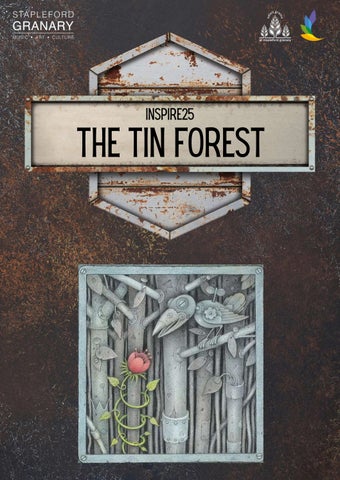
Inspire25 - TIN FOREST BOOKLET

Page 1


THE TIN FOREST

YOU’VE BEEN TO THE TIN FOREST!

This little booklet is packed full of ideas for you to explore at school or at home. There’s things to think about, things to discover, plus puzzles, games and lots of fun. You can also use it for your Arts Award.

INSPIRED BY NATURE - BIRD SONG IN THE TIN FOREST

There was a lot of bird song in The Tin Forest; some of it was recorded from real birds, and some was played on musical instruments

Do you remember which musical instruments represented the birds?

Which musical instrument family do they come from?

STRINGS? WIND?

PERCUSSION?

In The Tin Forest, you also heard some bird song which sounded strangely ‘metallic’! This was created especially for us by a composer called Rob Godman. Rob is a sound recordist and has spent many hours recording birds. He then changes the sounds that he has captured from nature, so that they appear to be coming from inside metal forests, under water, or even glass bottles! Rob is fascinated by acoustics and different environments; he can put a sound anywhere!

Many composers have been inspired by bird song. The French composer Olivier Messiaen (say it ‘Messy-Ann’) lived

from 1908 to 1992 and wrote a huge piece for solo piano all about birdsong. It is called Catalogue d’oiseaux (Catalogue of Birds). It consists of 13 pieces of music in seven books, and it takes around two and a half hours to play! (It is incredibly difficult). There are 77 birds in the pieces, all portrayed musically in the places where they live in the wild.

Messiaen loved bird song all his life, ever since he was a young boy. He called birds ‘the greatest musicians on our planet’. It seems strange that he would write such a long piece for a solo piano and not an orchestra, but he said that the piano was the only instrument that had such a big range (from the very lowest notes to the highest) and was capable of the fast speeds and leaps that he needed to imitate birds.

This video shows some of the birds that Messiaen represents in his Catalogue of Birds https://www.youtube.com/watch?v=biJCU8jK3x4

Messiaen described nature as ‘an inexhaustible treasure of sounds and colours, shapes and rhythms’

LET’S GET CREATIVEDRAWING BIRDS

WHAT ABOUT SOME TIN BIRDS? OR ROBOT MINI-BEASTS?

Use your imagination to draw some incredible metal birds or forest creatures!

Look at the ways in which artist Wayne Anderson paints his real birds and metal birds in The Tin Forest; what are the differences?

Which are the tin creatures and which are the real ones?

PUZZLE TIME

Can you find your way out of the forest maze? Start in the middle where the arrow is pointing

Mazes are over 2000 years old, dating back to the labyrinths of ancient Greece! In Europe in the 16th century, hedge mazes were built in gardens to keep royal families amused. In the 1970s and 1980s, mazes found their way into puzzle books and then video games. The longest maze in the world is the Pineapple Garden Maze in Wahiawa, Hawaii. It is made up of more than 14,000 tropical plants and has 2.5 miles of paths. It has eight secret stations that offer clues to solve a mystery for bold people who dare to venture in!

MAKE A LITTLE HOUSE (LIKE THE OLD MAN’S HOUSE IN THE TIN FOREST)

Cut out the template (stick it onto cardboard if you want your house to be nice and sturdy)

Cut out the doors and windows. Fold along the dotted lines and glue the flaps together. You could pop a little battery operated tea light inside it for a night-time glow (don’t use a real candle though!)

MAKE YOUR OWN RECYCLED ANIMALS (OR FORESTS!)

There were a lot of tin cans in The Tin Forest! Tin cans are brilliant for all sorts of creations! Paint them and stick on big eyes and feet to make characterful owls. Or decorate your tin cans and grow herbs or cress in them to make a mini-forest! (Make sure that there are no sharp bits where the lid has been removed, and wash them out carefully before you get creative)

Cardboard tubes are excellent for making woodland creatures; you could make a fantastic paper forest display of all your animals!

Do you remember the night time scenes in The Tin Forest?

DRAW A FOREST AT NIGHT

You’ll need: chalk sticks and black paper

Chalk is wonderful for creating atmospheric night time secenes. Try a combination of crisp lines (firm strokes with the tip of the chalk), textured effects (using the side of the chalk stick) and smudging, using your fingers. Don’t forget a beautiful silvery moon!

Here are a few tree and leaf designs to inspire you

HANS ZIMMER & SOUNDSCAPES

We heard a piece of music called Earth by Hans Zimmer throughout TheTin Forest

Hans Zimmer is a master film-score showman.

He’s a film composer and music producer, and is one of Hollywood's most innovative musical talents. He has written music for over 150 films and won a huge number of awards for his music.

Find out which films Hans Zimmer has written music forhow many have you seen?

Have a listen to a Hans Zimmer soundtrack without looking at the film. Imagine what is going on whilst the music is playing. Is it dramatic? A fight? A race? A stormy sea? A love scene? A heartbreaking moment?

You will be able to tell from the music alone! It’s incredibly evocative music; it creates powerful emotions, which is exactly what films need. What’s going on in the music

If you listen to Zimmer’s music without looking at the film, you might notice that there is a lot of repetition in this music. Hans Zimmer takes a very simple musical idea and uses powerful orchestral writing to make the idea bigger and build to huge climax points. He contrasts this with more delicate music, often relying on unusual instruments and electronics to create the atmosphere he wants.

LET’S MAKE A MUSICAL SOUNDSCAPE!

We might not have a big orchestra or recording studio, but it’s still possible to create an evocative soundscape using things we can find. READ ON!

FIRST, WE NEED WAYS OF CREATING SOUND...

You could use:

Your voices and bodies (remember how we all became sound machines in The Tin Forest?)

Are there any musical instruments in school? Look for percussion instruments such as shakers, glockenspiels, chimes, bells, cymbals

You can make instruments!

Think about all the sounds you could make with your voice & body & write them down here

MAKING INSTRUMENTS - A FEW IDEAS

Zither

MORE INSTRUMENTS TO MAKE Glasses

Tin Cans

Flower Pots

HOW TO MAKE A SOUNDSCAPE

Now that we have a selection of things we can make sound with, we need a scene to create music for! (It’s fun do this in small groups)

Find a picture: a spooky house, some snowy mountains, an old factory, a forest at night... anything that appeals to you.

Think about the sort of sounds that you might hear in this environment and see if you can make them on your instruments or with your voices / bodies. Think about the atmosphere that the picture suggests to you. How do you want your listeners to feel? Experiment with any instruments you have (for example, you can use a gentle brush on a cymbal to make a soft, metallic ‘shhhhh’ sound)

If you like a sound, repeat it!

Repeat it again

Add another sound to it. Do you like the two sounds together? If so, play them again. And again.

(If you don’t like the sound, just try something else!)

Are there patterns in your sounds? If so, see if you can copy that pattern on another instrument or voice. Try a contrasting pattern, like a question and answer.

Play your sounds louder, then quietly. How does it change the mood?

Play your sounds faster - does it change the mood?

Play your sounds slowly - does it change the mood? Can you go from fast to slow, and loud to quiet smoothly? What about sudden changes? What effect do those have?

Try a completely new idea, something totally different, and test it out in the same ways

Play the ideas together, one after the other. Mix them up. Listen carefully all the time to the effect of your experiments and choices

When you like what you have created, think of a way to write it down so you don’t forget it! You can use words, symbols or drawings.

YOU’RE A COMPOSER!

PERFORM YOUR MUSICAL SCENES TO THE REST OF THE CLASS, ALONG WITH THE PICTURE YOU CHOSE

Instead of a picture, you could use a poem to inspire you. Check out the online children’s poetry archive for lots of ideas

FACTS ABOUT FORESTS

One of the most important messages in The Tin Forest is about how we should care for our planet, and how small things can make a big difference

Forests once covered just under half of the earth's land. The total number of trees has fallen by nearly half since the start of human civilisation. Over 15 billion trees are cut down each year That’s roughly one football pitch every two seconds.

Forests are home to over 80% of the world's land-based species of animals, plants and insects, who help to keep the forests healthy by eating and distributing seeds. Forests can make rain.

Over three-quarters of the world’s freshwater comes from rivers in or around forests. Forests move so much water from the soil into the atmosphere that they create rain. Parts of the Amazon actually trigger their own rainy season.

We still don't know all there is to know about our forests.

We don’t know how many tree species there are on Earth, but scientists estimate there are about 63,000 known species. There could be as many as 9,000 tree species still unknown to science.

More ideas: Search WWF Schools Sustainability Guide and download the brilliant booklet

THE TIN FOREST

My ideas, doodles, brainwaves & things I don’t want to forget

This in-house publication has been designed to complement Inspire 25,TheTin Forest

Not for sale orwider distribution

Booklet author & design Kate Romano

The Association for Cultural Exchange

Turn static files into dynamic content formats.

Create a flipbook