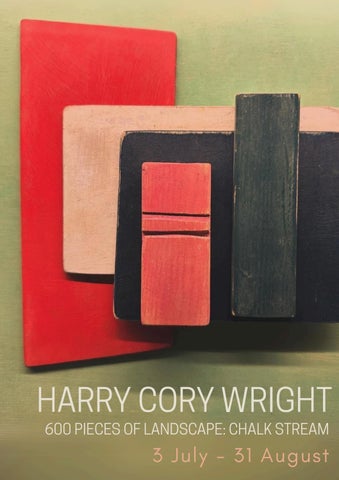
HARRY CORY WRIGHT
600 PIECES OF LANDSCAPE: CHALK STREAM
3 July - 31 August
HARRY CORY WRIGHT
Harry Cory Wright is a leading landscape artist working in photography, drawing, painting and relief For Stapleford Granary, he has created a site-specific exhibition responding to our local Chalk stream habitat, one of the rarest and richest ecosystems on the planet.
600 Pieces of Landscape: Chalk Stream is formed from 600 small hand-painted wooden panels, all representing some aspect of the the Chalk stream landscape through colour, shape, texture orvia superimposed photographs By reducing a real landscape to its most basic components, Harry Cory Wright has created a 'play kit' of building blocks with which to construct imaginary abstract landscapes. Over three distinct areas in the Granary, these 600 unique units are positioned in different linear and layered formations, the patterns and rhythms suggesting horizons or composite views Some of these arrangements are curated by the artist, and some by the visitor
Born in 1963, Harry lives and works in Norfolk He has exhibited extensively and continually throughout the UK for over 30 years. He has been commissioned by some of the most recognisable places and brands including Blenheim Palace, Gylndebourne, Women's OlympicTeam, Chanel, Windsor Castle and the Frida Kahlo Museum. His prizewinning images have been featured in 17 books and countless times in Harper’s Bazaar,Town and Country,TheTimes,The Guardian,The Observer,Vogue, World of Interiors and Boat International His 2017 shot of artist Maggi Hambling was exhibited at the National Portrait Gallery as part of theTaylorWessing portrait prize. Harry's work was included in Landmark:The Fields of Photography at Somerset House, London (2013) curated by William A. Ewing. Solo exhibitions include Hey Charlie, Eleven (2013, 2011), Place in Mind, and JourneyThrough the British Isles (2007)
CONTENTS
In conversation with Harry Cory Wright
Sound Within Sound: Rob Godman on unfamiliar sonic landscapes
The Chalk stream landscape at Stapleford Granary
List of works
‘The shed installation provides an opportunity for a piecing together of colours and images, finding your own patterns and clues that suggest a very personal experience of being in landscape'
- Harry Cory Wright

The exhibition takes place in three areas:
GALLERY WALKWAY: site-specific relief work, consisting of a curated selection of hand-painted panels positioned along a narrow shelf indicative of a horizon
FOYER GALLERY: watercolours, relief and photography.
ORCHARD ROOM: immersive shed installation, featuring hundreds of painted panels which visitors can playfully arrange to create their own landscapes Rob Godman’s soundscape, featuring sounds from the outdoor Chalk stream habitat and from the bottom of the brook, enhances the experience
All photographs and art works in this booklet reproduced with kind permission by Harry Cory Wright
IN CONVERSATION WITH HARRY CORY WRIGHT
Leading landscape artist and photographer Harry Cory Wright has created some of the most evocative and memorable images of the British Landscape, and his award-winning pictures have been seen in countless magazines, journals and exhibitions He spoke to us about the creative process behind 600 Pieces of Landscape, and why he feels that reduction and simplification are pathways to space, freedom and autonomy.
‘All my work is some sort of contradiction between the vastness of things and intimacy’ Harry Cory Wright says ‘I usually pick big landscapes, but I’m interested in the detail the things that the eye doesn’t pick up, but the camera does’
He uses a 10 x 8 inch wooden Gandolfi plate camera to produce negatives of immense clarity. ’You have to trust the camera to catch what you have in mind, and then reveal it later on ’ he explains. ‘It’s only afterwards that you realise what you ’ ve got’
Harry’s muse is his home on the north Norfolk coast, feted for its big skies, dunes and expansive sand and shingle beaches. Indeterminate strips of sea and land merge into one othervia grey-green marshes It's a young coastline which dates back just a few thousand years to the last ice age, moulded by tides, currents and winds, and riddled with traces of human intervention from the past 400 years or so

‘The estuary at Burnham Overy is made up of shape-shifting, ethereal substances’ Harry says. ‘Scolt Head Island isn’t rock; it’s sand, marsh, water, mud, air I started making abstract single line drawings of this landscape. I was intrigued as to how a single, simple line could evoke aspects of the island. What soon became clearwas that a line didn’t necessarily have to be a precise, accurate silhouette The lines that really resonated with people had some sort of human fallibility about them; a sense of gesture and playfulness, which was possibly right or possibly wrong. It seems to be connected with the idea of having your own personal experience of a place’.
People and their experiences of place are important to Harry, though they don’t feature in his landscape images ‘When I photograph, I aspire to put the viewer ‘into’
the landscape’, says Harry His photos often have a sense of drama and aspects of immediacydrifting clouds, sunrise or sunset, branches swaying - as if the viewer is caught passing through the scene Indeed, the loosely drawn landscape lines are perhaps more akin to traces; wayfaring lines, going where they will for movement's sake, having no particular beginning or end
The line drawings led to a new area of abstract painting and relief work, all captured under the collective title Vision of an Estuary This multi-disciplinary project includes four bespoke artist books, where photographs and watercolours are placed side by side. ‘It's a development of the same idea’ Harry explains, ‘but rather than a line, I’m now playing with blocks of colour and moving them around.The paintings give you a fleeting glimpse of a landscape; something green and upright might suggest a tree, something blue might signify water or sky, but they are all motifs of a landscape I put them together and confuse them a little; I’m interested in the territory of the unknown.The pairings of the paintings and the photographs in the book are intuitive; they are not supposed to be connected, but they illuminate each other in some fundamental way Humans are programmed to make connections and so we find parallels even if they aren’t really there. We make our own pathways’.
Even more reductive than the watercolours are Harry’s relief works created from small painted blocks, each unit suggestive of an element of landscape in some way (colour, texture, imprint) ‘It’s the exact opposite of the precision of photography’ says Harry ‘Photography bears witness, but these blocks are abstract and playful and I can control and organise them, though there’s definitely a sort of dialogue between the two forms that I can’t fully define It has opened up a whole new way of working and thinking for me; the flip side of what I usually do The enigma is part of the appeal and what drives the process ’ .


A critical development of this thinking is the immersive shed installation. Harry has fitted out a full-size garden shed with lights, seats and shelves, upon which are displayed hundreds of the same small relief blocks, all hand-cut, painted, and irresistibly tactile Visitors to the shed are invited to playfully arrange their own selection of blocks in any way they like. Harry describes the process as a further step in removing order Photography is all about precision: his watercolours and relief pictures are about ordering, but the shed is all about the arranging of things in which he plays no part ‘I wanted to open up the playfulness to others,’ says Harry ‘I wanted to take the creative process further and hand it over to other people I feel there is something dualistic about the way that we consider stuff. It's often this or that, right orwrong… but we become much more free when we are told that we don’t need to make sense of things If you tell someone that there are no rules, it opens up a sort of confidence in a lack of expertise’.
For Stapleford Granary, Harry has adapted his project, including the shed installation, to reflect the Chalk stream environment. 600 newly whittled blocks are now painted in colours which reference the colours of the natural world around the Granary Some of these blocks are displayed along the Gallery walkway; others are displayed as complete relief pictures in the foyer gallery (along with watercolours) and the rest are available to visitors in the shed installation (located in the Orchard Room) Visitors to the Orchard Room will also hear a specially commissioned ambient soundscape by Rob Godman called Sound Within Sound, derived from the live recordings of the landscape and the bottom of the Chalk stream
‘I’m curious about what people create in the shed’ says Harry, ‘but I also don’t need to know.This isn’t about the finished result; it's about making marks Throughout history, humans have created pathways and lines wherever they go Thinking about lines and blocks is to think about the world in terms of processes; of becoming rather than being. It's about learning from observation and experience, and embracing the unfinished and incompleteness of things Perhaps it's about the distinction between the traveller and the wayfarer.Travelling is about a destination But wayfaring is about forging knowledge along the way and wherever the wayfarer is, there is always somewhere further to go ’
Harry Cory Wright was talking to Kate Romano


SOUND WITHIN SOUND: ROB GODMAN ON UNFAMILIAR SONIC LANDSCAPES
Rob Godman is a composer and field recordist Using live recordings of bird song and underwater sounds from the Chalk stream, Rob spoke to us about how he created Sound Within Sound to complement Harry Cory Wright’s 600 Pieces of Landscape.
‘I have always been interested in how sound behaves; the ways in which architects throughout history have changed acoustics by shaping spaces, such as domes and amphitheaters, and by the use of specific materials, all of which can make speech or song louder or more or less intelligible I am particularly fascinated by unfamiliar landscapes - the ones we don’t know about, because we can’t exist in them. I am a keen scuba diver and when I dive, I’m often struck by the sheer quantity of sound you can hear underwater, just with your ears, but it is very different to the sounds we hear in air Sound still travels in waves in water, alternately compressing and decompressing the water molecules. But it travels four to five times quicker in water than it does in air Spatialisation gets messed up underwater too On the surface, our brains are staggeringly good at processing the information we get from our two ears to tell us exactly where a sound is coming from Underwater, you can’t localise sound anywhere near as well and it's virtually impossible to determine where a sound is coming from
Harry Cory Wright wanted a meaningful sonic element for his shed installation, which is located in the Orchard Room.This is the part of the exhibition where visitors can come and playfully arrange the painted units themselves It seemed obvious to draw on the two natural environments directly around the Orchard Room; the wildlife in the historic Orchard, and the Chalk stream itself. So I made some field recordings. As visitors enter the Orchard Room, they will hear familiar ‘outside’ sounds recorded from the Cambridgeshire rural air - birdsong, buzzing insects, the rustling of leaves, all subtly enhanced a little to give a greater sense of space, like being in a big expansive meadow.Then, when visitors enter the shed itself (in the centre of the room) it all changes You’re ‘in’ the acoustic of the Chalk stream itself; a tight, dry space - not at all ‘wet’ or sloshy and resonant, as you might imagine. Because this is what things really sound like underwater Underwater sounds are angular; they don’t have nice smooth transitions like sound does in air
Obtaining the sounds from the Chalk stream was trickier than I imagined it would be! Collecting sounds from the bottom of a stream is not difficult in itself; I use a hydrophone, which is essentially a waterproof microphone.You drop the rig in, press record, leave it (often overnight) and see what you get It’s all very trial and error I usually record at different times, and during different weather conditions Sometimes, you don’t get anything at all, as was the case when I first dropped two hydrophones into the Granary’s Chalk stream in February!The water in the Chalk stream is very still, and the weatherwas very cold, so perhaps that wasn’t surprising But I tried again in the spring and happily picked up the sounds of munching tadpoles; lovely clear mechanical beating sounds. I was recording in stereo and I think that one tadpole was closer to the mic than the other, so there are some nice polyrhythms coming from two sources I think they were also eating at slightly different speeds!
Generally the sounds you hear underwater are like this; disjointed clicks and bangs. We’ve probably become accustomed to a false idea of what things sound like underwater through films and documentaries On television, you’ll sometimes see a tiny fish swim away accompanied by a ‘whoosh’ sound; but this is all fake! Films like ‘Finding Nemo’ have gloriously rich, resonant ‘aquatic’ sound tracks which appear to grow from the acoustics of an underwater cathedral; but it’s not like that at all It is still, strange and super-quiet Hydrophones allow you to hear things that even as a diveryou wouldn’t be able to hearwith


Away from the field, most of my music is about rhythm, pulse and time When I first started making field recordings, I had no intention of doing anything especially musical with them. Recording was just an excuse to go and listen to things (people tend to think you ’ re a little odd if you stand around listening, but if you carry a mic, they assume you ’ re doing a job!) I started off just documenting things, but then began to integrate the sounds into film work.
For this project, the raw sounds alone wouldn’t hold enough interest to make the sound installation effective. Rather than manipulating the sounds (I do want visitors to hearwhat the microphones picked up) I have used them to create a composition which is to do with pulse and rhythm and how things unfold over time (very slowly) There are four or five different layers of sound which move around in the same angular, disjointed way that they would underwater.
It’s not only the animals in the water that have rhythms; water has a naturally occurring macro-rhythm too in its waves and tides The first phase of Harry’s 600 Pieces of Landscape project focused on the estuary at Burnham Overy Staithe in North Norfolk. That’s a very different environment to a Chalk stream, but I’ve introduced some of the estuary patterns as a reference to the origins of the artistic work Even our little Chalk stream has its own natural rhythms; there are times of extreme inactivity and moments of activity too. In the last few weeks before the exhibition opens and as the weather gets warmer, I’ll be recording in the Chalk stream again to see what has changed, and all of this will inform the final sounds of the installation Everything you will hear are live recorded sounds. I love the idea of Harry’s reduction of a landscape into blocks; a sort of binary system which he describes as a ‘wordless evocation of the experience of being in the landscape’ I’ve done the same thing with sound; I’ve recorded the landscape, and I’m moving the sonic blocks around’


THE CHALK STREAM LANDSCAPE AT STAPLEFORD
GRANARY
The brook at the end of the Granary’s Orchard is part of the Chalk stream landscape Chalk streams are one of the rarest habitats on earth, yet many have low flows and are polluted, threatening the wildlife that call them home.They support a characteristic, even unique, fauna of fish such as trout and lamprey and invertebrate animals including mayflies and caddisflies in water fed from underground rock storage (aquifers) in the porous Chalk The country rock around Stapleford Granary is Chalk and boasts such streams within easy walking distance. The Chalk forming the Chilterns and its extension beyond Hitchin to the northeast is the main aquifer for these rivers and streams.
The nearest river to Stapleford Granary is the River Granta There are two rivers of that name. One flows towards the Granary from the east having passed through Babraham and passes approximately 350 meters south of the Granary’s orchard This river rises from the extension of the Chilterns between Haverhill and Saffron Walden The second River Granta (or River Cam as it is sometimes known in its upper course) flows northwards from Whittlesford; the two rivers joining near Great Shelford to the west of Stapleford.
A river that is dead straight is an unstable situation If there is the slightest curve along its course, then the tendency of the water to go straight (to maintain the momentum that it has) means it erodes the outside bank due to the slight curve. That water then further erodes that side which accentuates the curve making the waterwear away the sediment in that curved portion even more The result is that over time rivers tend to produce meanders which are a series of regular sinuous curves in the channel of the river.
From Babraham to the east, the River Granta shows typical sinuosity of a meandering river in its floodplain. However, any topographic map at least from 1885 onwards of the area around Stapleford shows the course of the River Granta south of the Granary as a more or less straight line for a distance of at least 1 5 kilometres The reason for this unusual and unnatural feature is that the river has been dredged and straightened, or channelized, resulting in the river not functioning naturally, and thereby reducing the number of habitat niches. It is possible that the straightening waterway is a result of bringing water towards the original stable block of the Granary, primarily for use in farming and for cleaning carts It is also the reason why sound artist Rob Godman found our section of the Chalk stream to be rather quiet.


Friary Layout, 2021
Pastel on board
61 x 56cm
£2,900

Friary Estuary Meadow II, 2021
Pastel on board
61 x 56cm
£2,900
LIST OF WORKS
Meadows, 2021
Pastel on board & wood
50 x 56cm
£2,400

About Landscape XXIII, 2020
Pastel on board
36 x 45cm
£1,750

Candover Brook
Chalk Stream, 2006
C type print from 10x8 inch negative
82 x 102cm
£3,900

Friary Estuary Meadow I, 2021
Pastel on board
56 x 51cm
£2,900

Across to St Clements 0232, 2021
Pastel on board & wood
38 x 43cm
£2,400
Watercolours: all artworks are watercolour & collage on board


Outdoors 2025
78 x 102cm
£3,900
In Landscape 723, 2025
33 x 33cm
£1,900

In Landscape 715, 2025
33 x 33cm
£1,900

In the Woods, 2025
100 x 150 cm
£6,900

First River View, 2025
53 x 67cm
£2,900

National Landscape I, 2025
78 x 102cm
£3,900