
Brutalism for Beginners

Page 1


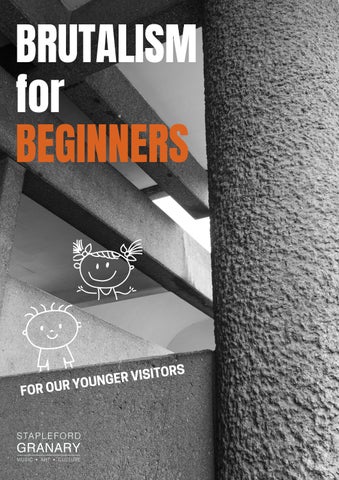
BRUTALISM for BEGINNERS

FOROURYOUNGERVISITORS

Join us to find out all about Brutalism, a type of architecture that blazed though the 1950s and 60s. This little booklet is packed full of facts, stories, fun and games.

DRAW A PICTURE OF YOURSELF IN THIS AMAZING BUILDING RIGHT HERE

howdiditall BEGIN?

Le Corbusier

- he is often described as ‘the father of Modernism’

Marseille is one of the oldest cities in France, famous for its ancient port, churches and narrow streets. It was heavily bombed during World War II and the city was in desperate need of new homes for people. They turned to Le Corbusier, a brilliant French architect Le Corbusier was to architecture what Picasso was to paintinga controversial, radical, modern pioneer He designed the ‘Unité d’Habitation’ (Housing Unit) for Marseille; a sort of vertical city, where families could live close to one another, shop, play and meet, all in one space. As you can see from the picture below, it was big, bold, boxy and made of concrete. It was a huge shock to the people of Marseille because it looked so different to the other buildings Locals called it la maison du fada

theneedforHOUSES

Meanwhile, in Britain, there was a housing crisis.

In the 1950s, cities were grim, food rationing was still in place and thousands of people had been made homeless by the bombing of the Second World War.

But everything was about to change....

Many of the working class were still living in back-to-back Victorian slum houses with no bathrooms or central heating.

Temporary housing (‘prefabs’) was basic, and not built to last.

‘300,000 homes a year’

In October 1950, at the Conservative Party annual conference, Prime Minister Winston Churchill declared ‘You’ve demanded that the target we should put in our programme is 300,000 houses a year. I accept it.’

Draw a little mouse here for the cat to chase!

The 50s were about to become the decade that would transform Britain. After the destruction of the war, it was time for a fresh start, new ideas and hope for the future

Housing Minister Harold Macmillan was the man in charge of this revolutionary project. The boldest visions for his new housing came from the architects.

The Brutalist style was relatively cheap and quick to build, and that was exactly what was needed after the Second World War. In the post war years, eight and a half million homes were built. Three hundred libraries went up between 1960 and 1965, along with churches, community buildings and schools

This Brutalist School in Hunstanton was built by two young pioneering architects Alison Smithson was just 21 and Peter Smithson was 26 when they won a competition to build a secondary school. Today, the school is in good condition and is much loved

1954, Smithdon High School, Hunstanton

CONCRETE HOUSES and other buildings

Le Corbusier and his Unité d’Habitation was the greatest inspiration for young British architects They designed radical housing schemes, like Sheffield’s Park Hill; thousands of homes, shops and meeting areas, all connected by ‘walkways in the sky’

This striking style, based on concrete and towering forms was known as Brutalism

How to spot a BRUTALIST BUILDING

Brutalism was a reaction to the fashionable smooth, glassy, elegant buildings, like this house here

Would you like to live in this house?

You’d have to be very tidy!

This lean, clean style is called Modernism.

Brutalist buildings were always made of concrete, and often had extraordinary futuristic shapes They were sometimes described as the ugliest buildings ever built

The word Brutalist doesn’t actually mean ‘brutal’; it comes from the French for ‘ raw concrete’ (béton brut).

Think of Brutalism as a cooler, edgier and grumpier version of Modernism!

Park Hill, Sheffield

MAGNIFICENT OR A MONSTROSITY?

Some people love Brutalist bulidings, and some people hate them!

Here are some Brutalist buildings from around the world. YOU CHOOSE whether you think each one is magnificent... or a monstrosity!

WHICH ONE DO YOU LIKE THE BEST AND WHY?

WHICH ONE DO YOU LIKE THE LEAST AND WHY?

LOOK AT ALL THOSE INCREDIBLE CONCRETE SHAPES!

see if you can draw some 3D shapes next to these examples ooh,that’sa trickyone!

FUN with 3D CUBES

Here are some 3D cubes. The ones on the left have patterns on different sides. Can you copy the patterns onto the blank cubes on the right?

BRUTALIST BUILDINGS SOMETIMES HAD QUITE INTRICATE WALKWAYS AND PATHS!

Thisoneisreallyhard!

CAN YOU FIND YOUR WAY TO THE CENTRE OF EACH CONCRETE MAZE?

theendof BRUTALISM?

One of the biggest challenges for concrete buildings was the British weather. Over the years, rain aged and destroyed the concrete, pooling on flat roofs and staining the walls. As councils ran out of money to care for the buildings, estates like Park Hill started to fall apart. Many people described them as ‘ eyesores ’ and called for their demolition.

But it's not all sad. Some of the Brutalist buildings were given special ‘listed’ status, which means that they have to be cared for and protected (not everyone agreed with that!) Perhaps the most important thing of all is that these buildings saved lives. Moving families from terrible living conditions into safe, dry homes

was an urgent task. And concrete - raw, rugged, reliable - was the answer!

This in-house publication has been designed for younger visitors to accompany the 2025 Mandy Payne exhibition

Turn static files into dynamic content formats.
Create a flipbook