Beginners Guide to abstract art HCW

Page 1


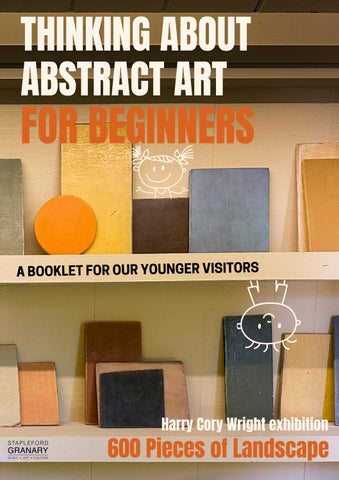
THINKING ABOUT ABSTRACT ART FOR BEGINNERS

ABOOKLETFOROURYOUNGERVISITORS

600 Pieces of Landscape Harry Cory Wright exhibition

WELCOME TO THE EXHIBITION

Have you ever played with a box of bricks? You’ll know how much fun it can be making all sorts of different things from them! Our exhibition is created from 600 little handpainted wooden panels which the artist uses to build imaginary landscapes. The colours and textures on the wooden panels are inspired by the natural world around Stapleford Granary.

There are three parts to this exhibition:

Gallery Walkway

The artist has positioned some of the 600 little painted pieces on a narrow wooden shelf running along the wall This is his ‘playkit’ of building blocks, which he uses to create abstract landscape art works

My visit to the exhibition

Date

Time

I am visiting with

Foyer Gallery

Here you will find watercolour paintings by the artist, which focus on shape, colour and pattern He has also created 3D sculptural pictures using some of the small painted panels

Orchard Room

You’ll find a full size shed in the middle of the room. You can go inside the shed and playfully arrange hundreds of the small painted panels yourself!

I’m going to see...

I’m looking forward to...

In this booklet, we’re going to be exploring Harry Cory Wright’s exhibition.

We’ll also be asking some BIG questions like...

What does art express? How do artists think?

Join us as we meet the experts, get creative, and discover the answers!

Some words you might not be familiarwith:

ABSTRACT ART: art that uses shape, colour, line, pattern and texture Abstract art does not try to recreate something exactly as you see it in real life.

RELIEF: a type of 3D art which is a cross between a painting and sculpture

MOTIF: a motif in art is something that is repeated like a shape or a pattern

AMBIGUOUS: when something could mean more than one thing

Meet the artist:

Harry Cory Wright

Harry takes beautiful photographs of the British landscape, and he paints wonderful harmonious abstract pictures with watercolours. He also works in relief, using painted blocks to create a 3D picture, building up layers like a sculpture on the canvas.

Takealine

DIDYOUKNOW?

Harry uses an old Gandolfi camera to take his photographs. Gandolfi cameras were world-class, made by an exceptional family of craftsmen, during the late 19 and throughout the 20 century. th th

After many years of taking landscape photographs, Harry became interested in other ways of representing a landscape. He started to draw lines which he felt reflected what he was seeing. They were not perfect lines, and they were not exact replications of a landscape. But they felt very important.

Harry says...

‘The line drawings are ambiguous; their meanings are not absolutely clear, and that is the most exciting thing for me in the world. Suddenly I was able to express, emotionally, how I actually feel about these landscapes. With a photograph, it is much harder to say how a place makes me feel.’

Let’s draw some non-perfect, ambiguous lines like Harry’s...

Take a look around you; maybe you ’ re outside, or if not, perhaps you can see out of a window? Look for the horizon (the line where the earth meets the sky) and think about how it makes you feel Calm? Happy? Uneasy? Anxious? Excited? Let your pencil move freely across the page You might want to thicken some parts of the line, like Harry does. Don’t try to make your lines perfect; use the landscape to inspire you and let your imagination and feelings guide you, rather than trying to draw exactly as you see things.

My lines

Can you find a word to describe each of your lines? Are they wavering, straight, crooked, tense, bold, upright?

Unlike photography, works of art do not need to look exactly like the things that they represent. Harry says that the lines he draws express how he feels about a place

But how can a line ti ?

Let’s bring on an expert... meet John Dewey

John Dewey was an American philosopher. He was born in 1859 and died in 1952

John Dewey explored art from the point of view of the creator. He was interested in questions like these... What is the relationship between art and people, and art and emotion?

How is experience related to art?

JohnDewey

John Dewey also reminds us that fine art used to be part of everyday life Before the invention of the museum and the gallery, people saw incredible works of art as part of their normal routines and activities, such as paintings and frescos in churches Think of Leonardo da Vinci’s Last Supper in Milan’s Santa Maria delle Grazie Cathedral.

John Dewey believes that we can find art in everyday experiences

What sort of everyday experiences does he mean?

He says that we can find art in the way a person lovingly cares for their garden, the way a good tennis player hits the ball, or in the flickering flames and crumbling coal of a fire everyday, ordinary things which are quite special if we stop to notice them and enjoy them as little artistic occasions John Dewey calls these moments ‘ sources of art.’ Harry finds ‘sources of art’ by looking at landscapes

Findingartineverydaythings

What have you seen today that felt like a little artistic moment? Did you enjoy seeing a shadow making a pattern on the wall, a tree branch silhouetted against the sky, a shelf of books beautifully arranged, a dark stormy sky, the colour of the food on your plate? Write a list of your ‘ sources of art’ Or draw them below

What happens when an ARTIST looks at ordinary things?

John Dewey says we should ALL be able to enjoy these little creative interactions with everyday things. But when an ARTIST looks at a scene or an object that they want to represent, that is a special kind of experience

Inside the mind of an artist

Roger Fry was one of the twentieth century’s most important art critics and a champion of modern art He was also a superb painter himself In a fascinating passage from his 1920 book Vision and Design, Roger Fry described what happens inside an artist’s mind when a piece of abstract art is created

He says that when an artist looks at a scene, all the different complex and chaotic parts of the scene start to ‘crystallise into a harmony’. As this crystallised image takes shape in the artists’ mind, the artist starts to get particularly fixated on certain things; perhaps a colour, or a texture, or a line or shape These things that start to stand out for the artist are not random; they are strongly connected to the creative life of the artist, and all the things they have painted before

Because the artist is so passionate about these things (the lines, shapes colours and textures), they become more and more important in the picture. The artist is not so concerned about creating an exact copy of the scene, but follows their instincts and interests As the lines, shapes, colours textures grow stronger and stronger, they start to form their own patterns and rhythms in the picture. The final picture might be very different to the original scene; and the important shapes, lines, colours and textures now have a life and identity all of their own They are full of emotion and meaning for the artist.

Roger Fry calls this

So THAT’S what goes on inside an artist’s head!

Fill this artist’s head with all sorts of thoughts and ideas!

Harry Cory Wright’s abstract watercolour paintings

Harry says

‘Rather than just lines, I’m now playing with blocks of colour and moving them around. The paintings give you a fleeting glimpse of a landscape; a white circle might be a moon or a sun, something blue might suggest water or sky, but they are all motifs of a landscape I put them together and confuse them a little It’s the total opposite of photography’.

Look at the wonderful shapes and beautiful swathes of colour in Harry’s watercolour paintings in the exhibition They are all abstractions of a landscape in the way that Roger Fry explains. Lines, colours, textures and shapes that are very important to Harry dominate the picture. They form their own rhythms and patterns. It’s as if Harry is ‘drawing out’ all the things that he loves from the original landscape scene, and using them to create a new abstract landscape that is full of new meaning and expression.

In the shed: Be an abstract artist

Head down to the Orchard Room in the Stable Block.

This is the part of the exhibition whereYOU can play with shapes, colours lines and textures Pick up the pieces that you like, see how they fit with other pieces Keep arranging and rearranging until you find something you like

what’sthatsound?

You’ll hear a special soundtrack in the Orchard Room. When you first enter the room, you’ll hear the familiar outdoor sounds of the wildlife and birds who visit the Orchard. But inside the shed, you’ll hear the unfamiliar underwater sounds of the Chalk stream itself.

Harry says...

‘As you choose and arrange the pieces in the shed, you might think about the landscape and the Chalk stream outside.You might choose pieces that remind you of summerwith all the wildlife Oryou might choose pieces that made you think about life underwater, imagining the creatures and plants that live in the Chalk stream You might choose pieces that make you think about what it was like here a thousand years ago Oryou might imagine what it could be like here in the future You can piece together colours and images, find your own patterns and make your own personal experience of being in a landscape'.

What will you create?

When you get home:

Make your own 600* Pieces of Landscape

*or maybe just a few pieces!

Find a picture - it can be anything. Because we ’ ve been talking about landscapes, we ’ ve chosen an outdoor scene with a church. our original picture details

Now look really hard at your picture.You could try breaking down the image into little pieces and see what sort of lines, shapes, colours and textures you can find. If you ’ re allowed (check with a grown up!) you could actually cut up the picture as we ’ ve done below into little rectangles to help you focus on the details.

(can you spot where they all came from?) here are our shapes

Then, like Harry, we made some shapes which were inspired by the lines, colours and textures of the details (at h yo ld paint pieces of paper in the colours you want to use and cu in pes).

Now have a play with the shapes on a dark background and make some abstract arrangements

Try moving just one or two pieces and see what a difference it makes

Which of your arrangements do you prefer? Can you work out why you prefer some to others? Do the ones you like have anything in common?

As Harry says...

There are no rules There is no right orwrong Be playful, have fun Have confidence in not quite knowing what you are doing, orwhy Take time. Enjoy making art.

This in-house publication has been designed for younger visitors to accompany the 2025 Harry Cory Wright Exhibition: 600 Pieces of Landscape Booklet author & design Kate Romano The Association for Cultural Exchange

Turn static files into dynamic content formats.

Create a flipbook