INDIANA DUNES NATIONAL PARK: EASTERN GATEWAY PROJECT STATEMENT
CURRENT GATEWAY STATE + NEEDED IMPROVEMENTS
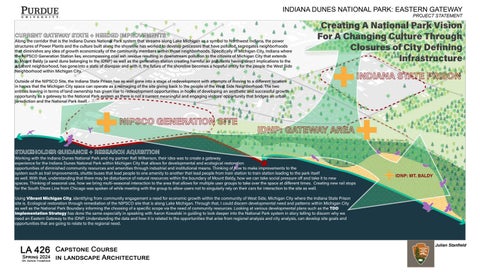
Along the corridor that is the Indiana Dunes National Park system that streams along Lake Michigan as a symbol to Northwest Indiana, the power structures of Power Plants and the culture built along the shoreline has worked to develop processes that have polluted, segregates neighborhoods that diminishes any idea of growth economically of the community members within those neighborhoods. Specifically in Michigan City, Indiana where the NIPSCO Generation Station lies, encompassing coal ash residue resulting in downstream pollution to the citizens of Michigan City that extends to Mount Baldy (a sand dune belonging to the IDNP) as well as the generation station creating harmful air pollutants having direct implications to the adjacent neighborhood, has gone into a state of disrepair and with it, the future of the shoreline becomes a hopeful entity for the people the West Side Neighborhood within Michigan City.
Creating A National Park Vision For A Changing Culture Through Closures of City Defining Infrastructure
Outside of the NIPSCO Site, the Indiana State Prison has as well gone into a stage of redevelopment with attempts of moving to a different location in hopes that the Michigan City space can operate as a reimaging of the site giving back to the people of the West Side Neighborhood. The two entities leaving in terms of land ownership has given rise to redevelopment opportunities in hopes of developing an aesthetic and successful growth opportunity as a gateway to the National Park system as there is not a current meaningful and engaging visitors’ opportunity that bridges an urban jurisdiction and the National Park itself.
STAKEHOLDER GUIDANCE + RESEARCH AQUISITION
Working with the Indiana Dunes National Park and my partner Rafi Wilkerson, their idea was to create a gateway experience for the Indiana Dunes National Park within Michigan City that allows for developmental and ecological restoration opportunities of diminished community resources and amenities through industrial and institutional means. Thinking of how to make improvements to the system such as trail improvements, shuttle buses that lead people to one amenity to another that lead people from train station to train station leading to the park itself as well. With that, understanding that there may be disturbance of natural resources within the boundary of Mount Baldy, how we can take social pressure off and take it to new spaces. Thinking of seasonal use, how we bring multi-seasonal interaction to the area that allows for multiple user groups to take over the space at different times. Creating new rail stops for the South Shore Line from Chicago was spoken of while meeting with the group to allow users not to singularly rely on their cars for interaction to the site as well. Using Vibrant Michigan City, identifying from community engagement a need for economic growth within the community of West Side, Michigan City where the Indiana State Prison site is. Ecological restoration through remediation of the NIPSCO site that is along Lake Michigan. Through that, I could discern developmental need and patterns within Michigan City as well as the National Park Boundary informing the choosing of a specific scope via the need of community resources. Looking at various developmental plans such as the TDD Implementation Strategy has done the same especially in speaking with Aaron Kowalski in guiding to look deeper into the National Park system in story telling to discern why we need an Eastern Gateway to the IDNP. Understanding the data and how it is related to the opportunities that arise from regional analysis and city analysis, can develop site goals and opportunities that are going to relate to the regional need.
Julian Stanfield