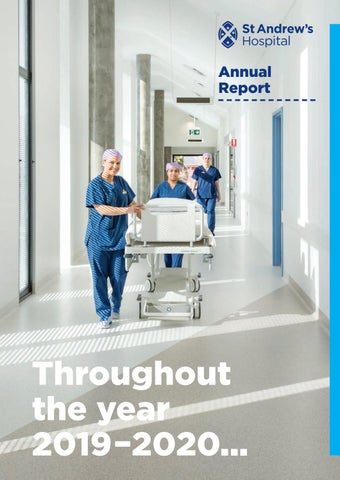
Annual Report
Throughout the year 2019 –2020...
We provided 43,363 occasions of high quality care to South Australians.
This is one of our proudest achievements.
Contents 01 Mission, Vision and Values 02 Chairman’s and CEO’s Report 03 Highlights Australia Day Awards 04 Nursing and Clinical Services 08 Patient Safety and Quality Hospital Accreditation 09 Quality Improvement Measuring Our Performance 12 Finance and Administration 16 People, Organisational Development and Safety 18 Information Systems 19 Engineering and Support Services 20 Research and Ethics Projects 22 Medical Education 24 St Andrew’s Hospital Foundation 28 Financial Report 29 Organisational Structure 30 Board Sub Committees 31 Board of Governors
Medical and Surgical Excellence St Andrew’s is a 240-bed private surgical hospital overlooking Adelaide’s south-eastern parklands. It houses eleven state-of-the-art operating theatre suites; a 28-bed cardiac unit; an 18-bed critical care unit; an emergency department including an after hours chest pain unit; a new procedural suite complete with DOSA (Day of Surgery Admission); an angiography suite; and, South Australia’s most comprehensive private cancer-care facility.
In addition to these facilities, we believe that we have some of the best people in South Australia working at St Andrew’s. This belief is supported by the team’s numerous national quality and clinical excellence awards.
Mission Medical and Surgical Excellence.
Vision St Andrew’s will be known as the best private hospital in Australia, with a culture where relationships matter. We will achieve this by creating an environment that promotes: •q uality healthcare supported by exemplary customer service, • best-practice patient care and support, • partnerships with patients, carers and consumers that facilitate a service responsive to their needs, • a positive culture based on teamwork that allows us to attract and retain the best staff, • sound business and financial practices to maintain a stable base for future growth, • a strong affiliation with the Uniting Church and its agencies, • innovation and creativity in all our pursuits, • the use of up-to-date facilities and equipment.
Values We Care, We Create, We Deliver. 01
Stephen Walker
David Whitbread
Chairman’s and CEO’s Report
Welcome to the St Andrew’s 2019/20 Annual Report. What an extraordinary and challenging way to end the year with the world facing and continuing to deal with the COVID 19 pandemic. The pandemic has caused all of us, whether as individuals or as a business, to alter the way we do things. It has caused concern, grief and anxiety, but it has also helped us to come together. At St Andrew’s and like all other hospitals and health care facilities, the impact has been significant. On a positive note, we are so proud how the St Andrew’s team has come together and embraced the challenge. We responded decisively during times of great uncertainty and the hospital continued, and will continue to provide safe high quality care for all our patients. Due to the nature of the clinical services we provide we remained busy throughout and we must take this opportunity to thank all of our staff, volunteers, visiting medical officers, board and contractors for their unwavering commitment during this time. It is this collective team effort that makes us the hospital we are. At the same time the COVID 19 pandemic hit Adelaide in March we welcomed Dr Paul Gaetjens as our new Medical Director and his expertise was immediately deployed. Paul has considerable experience as a doctor working in various emergency departments and as a clinician in SA, NSW and Queensland. He also has an extensive background working as a management consultant providing advice across many parts of the health sector.
02
Aside from the pandemic we have had another busy and successful year and this report outlines a number of our key achievements. Our patient activity and range of clinical services continues to grow. Our Cardiac Service was further improved with the launch of an after-hours Chest Pain Unit in September 2019 resulting in 24 hour access to St Andrew’s through the SA Ambulance Service for any private patients with a cardiac condition. In late 2019 GenesisCare opened Australia’s first dedicated Cardiac CT service on the ground floor of St Andrew’s Hospital with the installation of the dual energy Siemens Somotom Drive CT scanner. Currently operating two days per week the service is directly supervised by a Cardiologist with a dedicated interest in cardiac CT. This service complements the diagnostic cardiac work undertaken in the Angiography Suite by providing another pathway for patients. The service is planned to expand beyond two days in the coming months due to external demand and growth in the cardiac market. On top of this we have increased our number of cardiothoracic surgical cases and TAVI (Transcatheter Aortic Valve Implants) and more details of this are provided in the report. We have had a significant increase in Urology work with the relocation of the South Terrace Urology day procedures to St Andrew’s and we continue to be recognised as a centre of excellence in robotic surgery. In the past 12 months we have undertaken 720 robotic cases and whilst the majority are urology cases, the figure also includes a large number of cases covering gynaecology, ENT and general surgery. We have also had an increase in orthopaedics, ENT and gynaecology patient volumes. It is worth remembering that St Andrew’s Hospital is the largest stand-alone private hospital in Australia and in an era where corporatisation of healthcare is the norm, it is wonderful to retain our independence and our parochial approach in South Australia.
We are proud of the fact that we continue to grow in size as a hospital and health service but we are more proud that as we grow, our focus is steadfast on providing exemplary patient care. To support our outstanding nursing and clinical teams we have made major inroads into improving our IT systems, enhancing our infrastructure and technology, providing excellent training and development opportunities and most importantly maintaining our amazing team culture. A number of these initiatives are included within this report and we hope it demonstrates our commitment to advancing St Andrew’s Hospital. The governance of our hospital is so important and we are in safe hands with a dedicated and committed Board of Governors. We have updated our Clinical Governance Framework resulting in a refreshed range of board sub committees with all of these chaired by a board member. These committees provide opportunities for insight, advice, feedback and improvement from a range of experts in their field and we thank them all for their support. Once again we would like to thank and acknowledge the entire St Andrew’s team including our dedicated nursing staff and visiting medical officers, our non-nursing staff, volunteers, our board and foundation, all of whom have contributed to another successful and outstanding year. Until next time, stay happy and healthy.
Stephen Walker Chief Executive Officer
David Whitbread Chairman
Highlights Expansion of Cardiac Services - After Hours Chest Pain Unit - Cardiac CT South Terrace Urology - Dr Andrew Fuller recently performed his 1,000th robotic surgery as primary surgeon at St Andrew’s Hospital Over 20 existing staff promoted to leadership positions internally Retaining 100% of our graduate nurses in ongoing employment with the Hospital Maintaining low staff turnover and high levels of employee tenure - our average length of service being more than 9 years Improved Information Systems Training and Development Refurbished staff cafeteria
Australia Day Awards We are pleased to advise that two of our medical specialists received awards in The Australia Day 2020 Honours list. Medal (OAM) in the General Division
Member (AM) in the General Division
Dr Joseph Ken Montarello For service to medicine, particularly to cardiology.
Dr Susan Josephine Neuhaus For significant service to medicine, to community health, and to veterans and their families.
03
Nursing and Clinical Services CLINICAL EDUCATION The Graduate Nurse Program at St Andrew’s has long been recognised as a valuable recruitment and retention strategy. Over the years, we have been extremely fortunate to have consistently employed high quality graduate nurses. Late last year, over 400 newly registered nurses submitted applications with the hope of making the transition from nursing student to registered nurse within St Andrew’s supportive environment. In keeping with our mission of medical and surgical excellence, we have increased our intake from thirteen to sixteen graduates in order to continue the journey of training tomorrow’s expert clinicians. Our graduate nurses are given the opportunity to request areas of interest in relation to clinical placements. This year, we had 6 graduates working within the procedural areas and the rest of the group were in a variety of 10 wards, the chemotherapy suite, critical care unit and cardiac units. Whilst their introduction to the role of registered nurse in an acute care setting has been quite challenging and different from that of previous years due to COVID-19, they have settled in well and contributed to both clinical care and to the camaraderie for which St Andrew’s is so well known. The safety of our staff and our patients is always paramount; even more so in recent times. Training encompassed re-visiting of hand hygiene protocols, practicing donning and doffing of personal protective equipment (PPE), and checking that face masks fit well. Nurses within the ward areas undertook training to learn new skills in the area of resuscitation procedures due to changes required for COVID-19. We have been pleased with the increased levels of education developed in-house, the strong attendance by staff, and subsequent positive outcomes.
04
In September 2019, St Andrew’s reviewed and made changes to our Advanced Life Support training pathway. While nurses attend an Australian Resuscitation Council accredited ALS1 course every four years, annual in-house workshops now provide the opportunity to experience a range of simulated scenarios in groups of 5. These 1.5 hour interactive workshops provide a supportive environment that enhances learning, from each other and our experts, and the ability to refresh protocols and techniques. The workshops are led by the clinical educators from the Anaesthetics department and the critical care unit. The critical team also held a Cardiac Advanced Life Support Study Day on site where both medical and nursing personnel simulated potential scenarios that
can arise following a patient undergoing cardiothoracic surgery. St Andrew’s has always been passionate about training and education. Many methods contribute to the culture where clinicians seek knowledge and skills to ensure patients are always safe in our care. The St Andrew’s Hospital Foundation scholarships, daytime and evening workshops, seminars, and online learning are a few ways that training may be accessed. A total of 7,697 online courses were completed by St Andrew’s staff, with 6,889 (90%) of these courses completed by the 578 clinical division staff. These courses are mostly developed in-house and cover a very broad range of knowledge and skills including analysing arterial blood gasses,
understanding cardiac arrhythmias, medication safety, advanced and basic life support, child safe environments, cultural awareness of the needs of Aboriginal and Torres Strait Islanders, and asepsis and massive transfusion protocols. Seminars and study days held on-site this year included topics such as accessing ports and peripherally inserted central catheters (PICCs), basic principles of administering chemotherapy, diabetes updates for nurses, including caring for patients taking SGLT-2 inhibitors, managing acute or chronic pain, nursing paediatric patients, urodynamics, breast cancer, stoma management and wound care principles, topical negative pressure dressings (VAC therapy), and nursing management of intra-aortic balloon pumps (IABP). In-service sessions such as designing personcentred care and delivering the best care to our patients were well attended.
UniSA Experiential Nursing Grant recipient Robyn Hutchins
UNISA EXPERIENTIAL NURSING GRANT St Andrew’s has been providing financial support to final year nursing students from UniSA since 2003/04, along with the opportunity to have a placement at St Andrew’s Hospital. Students who are facing financial disadvantage due to location, or who are unable to work during their final eight-week placement, are eligible to apply. We have consistently been able to financially support high calibre student nurses, and based on the students’ feedback, the main advantage of this grant is the ability to complete their placement with us.
This scholarship has enabled us to not only work with these students but it has had a flow-on effect, providing access to our Graduate Nurse Program. These students so enjoy being members of the St Andrew’s community and often successfully apply to become one of our graduate nurses. We are fortunate that our Graduate Nurse Program has a 96% post-program retention rate, with a number of our graduate nurses moving into leadership roles. To date, St Andrew’s has contributed almost $100,000 to this program.
...our Graduate Nurse Program has a 96% postprogram retention rate, with a number of our graduate nurses moving into leadership roles. 05
Nursing and Clinical Services continued
CARDIAC SERVICE St Andrew’s launched the 24-hour access Chest Pain Unit in September 2019. The service is open to all South Australian residents with private hospital insurance. Between the hours of 8 am until 10 pm, patients are assessed by our Emergency Service team and after hours by the on-site Chest Pain Unit Medical Officer. All team members are highly skilled in the care of cardiac patients. There are no out-of-pocket fees for patients being admitted through our Emergency Department, and the overnight admission is by SA Ambulance Service only. St Andrew’s Eastern Clinical Development opened in December 2018 and houses a 28-bed cardiac ward as well as two angiography suites. The service undertakes interventional cardiology and is a registered TAVI site. The cardiologists, angiography and ward nursing staff have participated in global cardiac trials, resulting in positive outcomes for the South Australian community.
‘During the past 12 months, we have performed 40 transcatheter aortic valve implants (TAVIs). This transcatheter procedure is now being used to treat all patients with severe symptomatic aortic stenosis regardless of surgical risk category, with large randomised controlled studies showing at least equivalence to traditional open-heart surgery. Increasingly, the procedure is being performed under local anaesthesia rather than conscious sedation (general anaesthesia is rarely used) and most patients are discharged the following day. St Andrew’s, having been seen as a centre of excellence already adopting a minimalist approach with excellent early discharge data, will soon start enrolling in an international trial looking at the safety of such rapid discharge (SAFE TAVR). At present, only high risk surgical patients are undergoing the procedure in the private sector. The expectation is that there will be private health fund rebates for intermediate and low risk surgical patients in the first
quarter of 2021, increasing demand for the procedure at St Andrew’s.’ Dr Joseph Montarello, Interventional Cardiologist, GenesisCare. The STEMI (ST-Elevation Myocardial Infarction) and Chest Pain Unit are supported by both our cardiothoracic team and our Intensive Care Service. On-site, we have South Australia’s only CT Angiogram facility where results will be reported by a cardiologist. St Andrew’s is an accredited STEMI hospital where patients proceed to Angiography, 24 hours a day, seven days a week, in an efficient and timely manner, ensuring time to door standards are met. Patient feedback is consistently positive, delivering a high standard of care to our patients.
VALE MR CLAYTON LANG Plastic and reconstructive surgeon Mr Clayton Lang was a member of the St Andrew’s family, operating at the hospital for over five years, and a partner at Dextra Surgical (formerly Sach Day Surgery). Mr Lang, along with his father, Dick, tragically lost their lives in the Kangaroo Island bushfires of January 2020. Mr Lang was well known and highly respected by many in our community and is sadly missed.
06
The cardiologists, angiography and ward nursing staff have participated in global cardiac trials, resulting in positive outcomes for the South Australian community. 07
Patient Safety and Quality
Hospital Accreditation
St Andrew’s is committed to delivering excellence in patient care and clinical services. Our vision to provide safe and high-quality care for all our patients is articulated to all our staff and volunteers via the Safety and Quality Framework which defines that the care provided at St Andrew’s Hospital is patient-focused, driven by information, and organised for safety.
St Andrew’s Hospital is accredited with the Australian Council on Healthcare Standards (ACHS). Accreditation is recognised as an important driver for safety and quality improvement. It is public recognition by a healthcare accreditation body of the achievement of a set of accreditation standards by an organisation and their level of performance in relation to these standards.
Our visiting medical officers (VMOs) continue to play an important role in ensuring patient safety and quality with many actively participating in our clinical governance committees.
In 2021, the hospital will participate in an organisationwide survey with the Australian Council on Healthcare Standards (ACHS) to verify the hospital’s compliance with the second edition of the National Safety and Quality Health Service Standards (NSQHSS). The hospital also continues to maintain accreditation under the national Diagnostic Imaging Accreditation Scheme (DIAS) Standards.
08
St Andrew’s is committed to delivering excellence in patient care and clinical services.
Quality Improvement The St Andrew’s team is committed to improving patient safety and quality. Where possible, we work with our consumers to co-design quality improvement projects with fantastic results. Our team has recently implemented two significant quality improvement projects. The first is an online clinical governance platform, CGov, implemented in September 2019. CGov enables quick and easy incident reporting for our staff, and has enhanced our ability to monitor and report patient safety and quality data. Additional modules for the management of patient feedback, auditing, and quality improvement projects have also been developed and implemented.
A second project team has implemented a revised version of the hospital’s online admission platform (PersonifyCare). This project was co-designed with consumers, and ensures we receive important information from our patients before they are admitted. It ensures that care can be planned to keep the patient safe during their admission, such as fall prevention strategies for high risk patients. We were also thrilled that our Blood Management Committee’s project for improving timely administration of blood for patients requiring massive transfusions was selected as a finalist in the 2020 Australian Private Hospitals Association (APHA) Awards for Excellence in the Clinical Excellence category.
Measuring Our Performance Our desire and ability to continually measure how well we are performing across the organisation underpins our commitment to delivering excellence and continuous improvement. This performance measurement includes clinical indicator monitoring, audits, independent stakeholder surveys, patient feedback mechanisms and accreditation surveys. Patient feedback continues to be an integral part of informing us on patient safety and quality. In 2019, 78% of the feedback received indicated patients were ‘very satisfied’ with the care they received. Many patients also provide positive comments about our staff, recognising them for being welcoming, caring, cheerful, friendly, efficient, helpful and professional in the excellent care they provide.
The Department of Veterans’ Affairs Patient Experience Survey (July – December 2019) indicated the hospital’s overall satisfaction rating remains a very high 100%, with 97% of respondents indicating they would recommend the hospital. The hospital’s participation in the ACHS Clinical Indicator Program enables us to benchmark our results against our peers. A large number of other performance indicators are monitored internally. Action is taken to address performance indicator results that fall outside expected norms. The following is a sample of performance indicators that are measured and monitored to further improve patient safety and quality at St Andrew’s Hospital:
PATIENT FEEDBACK This graph demonstrates patient satisfaction.
78.21% Very Satisfied
16.34% Satisfied
3.44%
Neither
1.26%
Dissatisfied
0.76%
Very Dissatisfied
Patient feedback continues to be an integral part of informing us on patient safety and quality. 09
AVERAGE LENGTH OF STAY Over time we have seen a decreasing length of stay (time in hospital), as well as surgeries now being performed as day surgery.
2019-20
1.64
2018-19
1.73
1.79
2017-18
0
1.0 DAY
2.0 DAYS
HAND HYGIENE National Benchmark 80% Higher rate is a good result. The hospital hand hygiene rate is 85.5% and the national benchmark is 80%. Hand hygiene is one of the ways to reduce the Staphylococcus aureus bacteraemia rate.
SAH: 85.5%
0%
10%
20%
30%
40%
50%
60%
70%
80%
90%
100%
RAPID RESPONSE CALLS WITH CARDIOPULMONARY ARREST Rapid response calls are made when concern exists for the patient condition and extra help is required to prevent the condition from worsening. Benchmark 0.065%
Lower rate is a good result. The rate of rapid response calls with cardiopulmonary arrest is 0.071% which is slightly higher than the ACHS private national average of 0.065%. The increase in indicator rate resulted in a review which showed some of the arrests were sudden and had no early signs which could be acted on prior to the event.
SAH: 0.071%
0.00%
0.05%
0.10%
0.15%
0.20%
0.25%
0.30%
0.35%
0.40%
0.45%
0.50%
TOTAL FALLS The hospital monitors its falls rate in a number of ways, including the total number of falls and falls that occur in patients over the age of 65, which is the high-risk group of patients for falling. Benchmark 0.210% Lower rate is a good result for both of these indicators. The rate of falls is 0.165% which is lower than the ACHS private national average of 0.210%. This is an outstanding result.
SAH: 0.165%
0.00%
0.05%
0.10%
0.15%
0.20%
0.25%
0.30%
0.35%
0.40%
0.45%
0.50%
0.04%
0.05%
0.06%
0.07%
0.08%
0.09%
0.10%
FALLS IN PATIENTS WITH FRACTURE
The rate of falls resulting in fracture or closed head injury is 0.002%, which is lower than the ACHS private national average of 0.008%. This is also an outstanding result.
SAH: 0.002%
Benchmark 0.008%
0.000%
0.01%
0.02%
0.03%
Our desire and ability to continually measure how well we are performing across the organisation underpins our commitment to delivering excellence and continuous improvement.
11
Finance and Administration
We have a strong and reliable team whose experience continues to grow.
Our finance team continues to work closely with all other areas of the hospital, providing key support services such as billing, payroll, accounts payable, accounting, clinical costing and financial reporting. We have a strong and reliable team whose experience continues to grow. This year, we employed an in-house clinical costing specialist to strengthen our understanding and management of clinical costs. We continue to submit patient episode cost data to the National Hospital Cost Data Collection, with the Independent Hospital Pricing Authority for benchmarking purposes. Our Epicor ERP system was recently upgraded to the latest cloud version. In July 2020, in recognition of our efforts Epicor awarded St Andrew’s the prize for Best Epicor SaaS Deployment in Australia and New Zealand. We have continued to develop other Epicor modules to help maintenance, biomedical and
12
clinical staff perform their work more efficiently, and to develop a better understanding of the cost of services that we provide. The hospital’s financial performance in 2019/20 was sound, however the last quarter was heavily influenced by COVID-19 and related federal government restrictions on elective surgery. However, the impact of restricted surgery was lessened by government financial assistance, which supported full employment for our staff, and covered all other costs to run the hospital. This enabled St Andrew’s to remain fully functional and ready to support the wider health sector if a coronavirus outbreak were to overrun public hospitals in South Australia. To date, COVID-19 has not hampered our capacity and ability to operate the hospital effectively, and we continue to invest in the business. Sufficient funds were generated this year to continue with our normal capital works and business development initiatives.
CAPITAL Our Engineering Services Master Plan continued this year with spending of $1.4 million on major refurbishments to hospital facilities and services, including: • bathroom upgrades, • public lifts, • water and sewer services, • suction plant. On our regular capital program, the hospital spent $2.4 million this year, allowing us to maintain a high level of medical and surgical equipment to improve staff facilities, and to develop our IT systems. Major capital purchases included: • CCU monitoring upgrade, • Staff cafeteria upgrade including new combi ovens*, • gamma probe*, • cystoscopy equipment, • gastroscope and soluscope machine trolley, • Cgov patient incident management,
• Epicor Enterprise Resource Planning, • business intelligence and data integration. * Funds donated by St Andrew’s Hospital Foundation
PATIENT SERVICES Our Patient Services team has welcomed the dedicated move to online admission forms, leaving behind the old paper format. The benefit of all patients registering online is significant. Information is now being received earlier, with no need for patients to post or deliver paperwork back to the hospital. Errors are reduced in translation of hand-written information, and patients with subsequent admissions will have most information already pre-filled to save time. Information is entered directly into the hospital’s patient administration system (TrakCare), completely eliminating the printing of paper admission forms. The other main focus of the Patient Services team has been on patient feedback, which is taken very seriously. Out of this feedback, new procedures have been identified and adopted with a view to improving the patient’s experience. It is our aim to make the overall hospital admission process including online registration and provision of Informed Financial Consent, as straight forward as possible for our patients.
HEALTH INFORMATION MANAGEMENT The Health Information Management Service has continued to further develop and deliver a range of initiatives to improve services and, in particular, address the changing business needs of the hospital. Clinical coding staff moved to a remote working environment for several months due to COVID-19, supporting service continuity for the billing and legislative reporting functions. This achievement, and the time taken to deploy it, was significant, particularly as St Andrew’s medical records are paper-based. A key to this agility was the adoption of improved electronic workflows for the clinical coding function earlier in the financial year, and the purchase of a high speed, high resolution in-house scanning capability. Should the need arise again, the service is well positioned to move to a workfrom-home environment at short notice and with full confidence.
The St Andrew’s Hospital Clinical Coding Internship program was fully implemented over the last 12 months to ensure the hospital can maintain a qualified workforce in a national skills shortage area. Three newly qualified coders have successfully undertaken placement opportunities with us, to build on their coding education theory within a mentored framework in a hospital setting. Applications for the St Andrew’s Hospital program were highly competitive and came from across Australia with many prepared to move to South Australia if successful. The hospital’s off-site record storage for both medical and corporate records has been successfully transitioned to a new service provider, under the Synergy Uniting Church contract. This is now delivering significant cost savings for the hospital, along with improved record management capabilities and further opportunities that are being explored. The hospital continues to be represented on a number of state and national committees in the health information and coding fields. Health Information Manager Lorraine Van Gemert is now the nominated Australian Private Hospitals Association representative on the national DRG Technical Group (DTG), providing technical input and expert advice to the Independent Hospital Pricing Authority (IHPA) with respect to the development and refinement of the Australian Refined Diagnosis Related Groups (AR-DRG) classification. This classification underpins the health funding in both the public and private Australian healthcare sectors.
SUPPLY After our Epicor ERP cloud upgrade in March 2019, we have worked consistently to improve warehousing and inventory management. In the perioperative suite, stock locations for all medical and surgical consumables have now been clearly defined and identified. Item location mapping is now in place to assist nursing and supply staff to locate items more efficiently. This is done through the use of: • clear signage, • location guide maps, • item catalogues, including part numbers, item descriptions and locations.
The item catalogue is particularly helpful for new theatre and supply staff who are unfamiliar with items and storage locations. Positive comments have been received about time savings achieved through this new system. Supply and IT staff have implemented a number of business intelligence dashboards to improve our analytical capabilities and to better manage our $3.5 million inventory. The introduction of cyclic counting of stock in the main warehouse has improved the accuracy of our inventory throughout the year and, as a consequence, we have been able to avoid the traditional annual stocktake. In addition to managing our own stock, we have conducted a joint review of sutures with Johnson & Johnson to identify unnecessary or obsolete items that could be removed from our shelves. This optimisation of stock generated additional space which is a precious commodity in our perioperative area. We also worked closely with Medtronic during a recent changeover of their global computer systems, which was expected to interrupt normal distribution channels. Prior arrangement of stock to meet the needs of St Andrew’s was secured, and the hospital maintained access to critical supplies. The COVID-19 has interrupted supply chains across the world, and Australia has been significantly affected. The hospital’s supply team has been actively involved in sourcing alternative Personal Protective Equipment (PPE) used throughout the hospital. Across Australia, PPE has been a major concern with the heightened need to protect our healthcare workers from the spread of the virus. Other medical and surgical supplies have also been affected. The supply team has responded by concentrating on delivery timeframes and back-order management. Stock holdings for critical items have been increased and we have established off-site warehousing for backup and alternative items. COVID-19 has affected supply and demand factors in the economy, putting upward pressure on the cost of supplies. However, we continue to seek purchasing cost savings where possible and have achieved some annual savings of about $90,000 through targeted procurement activity.
13
2020 is International Year of the Nurse and Midwife.
They are integral to the day-to-day care we provide.
People, Organisational Development and Safety PEOPLE Over the past year, the hospital has continued to maintain a highly skilled and engaged workforce. Our leaders remain committed to building and maintaining teams that are focused on the provision of exceptional patient care, and espouse our values ‘We Care, We Create, We Deliver’. Our positive culture is demonstrated by our continued high levels of employee tenure. At 30 June 2020, our average length of service for permanent employees was 9.6 years, with one third of our staff having been with the hospital for more than 10 years. Our employee base grew by some 150 staff during the year, including a mix of permanent and casual staff in both nursing and non-nursing roles. Our focus throughout the recruitment and selection process continues to be the recruitment of people who not only possess relevant skills and experience, but importantly align with our culture and values.
Our 2019 Graduate Nurse Program has again resulted in 100% of the participants being offered ongoing employment at St Andrew’s. This is an excellent reflection of the program and the support our participants received from our nursing leadership team. Whilst our staff mobility increased slightly during 2019-20, our employee turnover of 9% has remained low relative to industry averages, which are around 16% for hospitals and health care (12 month moving average). During this year, we farewelled a number of longterm staff members, including the following people who retired after 20 years’ service or more with St Andrew’s: Tessa Williams – 34 years Clerical Assistant - ED/Reception Fran Lindner – 30 years Medical Records Prue Jones – 30 years Registered Nurse – Procedural Suite Helen Lewis - 30 years Registered Nurse – Procedural Suite
Virginia Bossy - 22 years Registered Nurse – Procedural Suite Heather Osborn – 21 years Night Duty Hospital Coordinator Cheryl Dennis – 21 years Enrolled Nurse 2nd Floor Yvonne Cowling - 22 years Secretary – CCU (commenced in Reception) Rosemary Ridley - 46 years Enrolled Nurse – Procedural Suite Despite some staffing changes occurring within the HR Division over the past year, the team has continued to deliver a high level of service in relation to human resources matters, injury management and workplace health and safety. Some of our key achievements have included: • providing critical internal communications and WHS support to staff and leaders as part of the hospital’s COVID-19 pandemic response, • reviewing the Day One Hospital Orientation content in collaboration with key stakeholders and feedback received from past participants, including the development of two new modules focused on customer service and resilience/self-care, • developing and delivering a range of leadership development sessions for current and emerging leaders, including a number of training sessions for our clinical nurse group to equip them to play a greater leadership role within their work areas, and relieve for clinical managers where required.
Left to right: Georgina Noske, Suzannah Elliott, Jessica Hillier and DeArne Holmes
16
ORGANISATIONAL DEVELOPMENT
WHS AND INJURY MANAGEMENT
As in previous years, this year we maintained a strong focus on the personal and professional development of our people. Our nursing cohort continued to access significant levels of clinical learning and training opportunities through our studies assistance program, and two staff members were successful in gaining leadership development scholarships funded through our hospital foundation, in partnership with the University of South Australia.
The hospital has continued to focus on ensuring the health and safety of our staff, which has been of particular importance in response to the COVID-19 pandemic. This included partnering with local safety specialists to assess and address improvement opportunities within our safety management system, such as systems and processes for the reporting and management of hazards, and our processes around the identification of WHS training requirements and management of contractors who attend our site.
A major part of our leadership development plan this year was our Power of Coaching program, which was specifically designed and delivered for us by organisational development psychologist Deb Sarre. This program aligns well with our culture, and focuses on promoting meaningful, quality conversations in the workplace through the use of coaching techniques. During the year, approximately 50 of our current and emerging leaders participated in the program as part of our journey towards establishing a coaching culture across the hospital. The learnings will continue to be embedded during the coming year as more leaders undertake the program, with previous participants having the opportunity to participate in further skills refinement and reflection through interactive workshops.
This year, the WHS team worked with the management team from Dietary Services, and an external provider, to implement a specialist safety improvement program. The program took a multi-pronged approach to identify opportunities
for improvement, enhance communication about safety issues, and position the team so they can positively influence the required changes in work methods to reduce the risk of work-related injury. We continued to support workers who had incurred a work-related injury, with 50% of these people having less than five days lost. We recognise the importance, for both the individual and the team, of returning injured staff members to their workplace as soon as possible. To this end, our Claims and Injury Manager continued to work closely with staff and their leaders to ensure open and effective communication, and identify alternative duties or hours where required. We also supported a number of workers to receive initial treatment and support for low risk work injuries through our early intervention program.
This year we promoted approximately 24 of our current staff members into leadership positions, including clinical nurse roles. This demonstrates our ability to recruit and identify future leaders, and provide meaningful development and growth opportunities for our staff. Effective communication with our workforce has also continued to be a key focus for the HR Division, as we further embedded our electronic communications app, SnapComms. Over 60% of our workforce are now registered and receiving regular alerts. This tool was invaluable throughout the COVID-19 pandemic, enabling us to provide regular information to our employees in a timely manner.
17
Information Systems The Information Systems Department continues to deliver high availability of their systems. St Andrew’s patient information system, TrakCare, has achieved a scheduled availability KPI of 99.99% throughout the reporting period. We continue to deliver the TrakCare product at the most recent release, ensuring availability of the very latest technologies. The latest version of TrakCare extends the mobile-enabled user interface to all clinical workflows, improving the user experience wherever care is delivered. New mobile functionality includes support for operating theatre bookings and administration, and nursing care plans, and delivers dynamic patient lists, a patient journey tracker, and additional graphing capabilities. Intersystems has announced that it has built the newest version of TrakCare on its new InterSystems IRIS for Health
18
Data Platform, which boosts systems interoperability, cloud scalability, and healthcare big data capabilities. These are just a few of the capabilities to be explored into the future. The data warehousing and reporting capability has continued to evolve, delivering enormous benefits. The installation of the IRIS integration function has improved the efficiency of linking the various different data repositories and allowing for easier analysis. IRIS is also being used to integrate TrakCare patient information with real time medical systems within theatres. Other systems implemented throughout the past year include CGov, for incident data capture and reporting, and PersonifyCare as a central location for the online hospital admission process, including patient follow-up protocols.
The advent of COVID-19, and the subsequent and urgent requirement of accommodating work-from-home capabilities, put some initial pressures on IT. These pressures were quickly overcome with an expansion of the hospital’s firewall and remote support devices. Distance was no barrier, with the recommendation and implementation of a secure, user friendly video conferencing solution. It is recognised that these changes may become a thing of the future.
Engineering and Support Services The 2019/20 year has proved to be a very different and, in many ways, a challenging year for Engineering and Support Services, particularly with the impact of the COVID-19 virus issues. Engineering and Support Services consists of: • maintenance, • capital works projects, • dietary services, • bio medical services, • cleaning services, • security services, • property services (leases).
ENGINEERING This department is kept extremely busy providing preventative and corrective maintenance services to the hospital and related off-site facilities. This year we welcomed two new staff to the Maintenance Department: • Frank Voca - electrician • Steve Sparkes – fitter Both staff members bring excellent trade skills and a wide range of experience.
CAPITAL WORKS In addition to routine maintenance and repairs, we have completed the allocation of capital works within the project timeline and budget constraints. Projects undertaken, but not limited to, include: • replacement of the two multipurpose combination combi ovens in the kitchen,
Existing incandescent and fluorescent light fittings are being replaced with LED light fitting technology throughout the hospital on an on-going basis to provide the facility with a superior level of lighting throughout.
DIETARY SERVICES DEPARTMENT The Dietary Services Department continued to retain our Hazard Analysis Critical Control Points (HACCP) accreditation and have done so since 2005, being one of the few hospitals in Australia to do so. This high standard of meal service is provided on a paddock-to-plate basis, where our meals are all freshly cooked and designed by dietitians to support patients’ needs such as modified textures and special dietary foods, including gluten free, lactose free, low potassium, and low fibre, high protein modified consistencies. The provision of the refurbished staff cafeteria was very well received, providing better work flows, as well as upgraded facilities for all staff.
ENGINEERING SERVICES MASTER PLAN (ESMP) The hospital has committed to the ESMP program which ensures that all major fixed plant and equipment throughout the hospital is replaced and upgraded in a timely and efficient manner. Projects completed for this year (Year 5 of the ESMP), include: • replacement of sewer stacks (ongoing),
• replacement of joinery in the B end patient rooms,
• back flow prevention devices (on going),
• new ice machine for Ward 4a,
• upgrade and extension of the building management computerised system controls,
• new bed pan steriliser for Ward 1a. The department also undertook project management responsibilities for the refurbished staff cafeteria and was involved with the new cardiac CT scanner project. The department was heavily involved with the relocation of the central sterile services department from the ground floor to the purpose-built first floor area.
BIOMEDICAL ENGINEERING SERVICES DEPARTMENT Biomedical Engineering Services Department is staffed by three qualified and experienced biomedical engineers. Maged Shenouda, Colin Hill and Paul Wood have continued to provide an excellent standard of service to the hospital, providing technical support to the new and exciting technologies being employed in theatres. In particular, our biomedical engineers have provided support to every cardiac procedure performed in during the entire year. In addition to providing services to St Andrew’s, we extend our service provision to clientele outside of the hospital. Tasks provided by the Biomedical Engineering Services Department include: • preventative maintenance, • corrective maintenance, • external work.
CLEANING SERVICES ISS Healthcare Services has continued to provide a high level of cleaning services to St Andrew’s. They have recently celebrated their sixth year of association with the hospital. In addition to providing cleaning services, including the making of beds in all ward areas, ISS also carries out the specialised services for the theatre, Vancomycin-resistant Enterococci (VRE) and Methicillin/ multi-resistant Staphylococcus aureus (MRSA) cleaning schedules. ISS continues to work with our major contracting services, creating innovative ways to improve the quality of services to the hospital.
• refurbishment of patient rooms (from shared en-suites to rooms with dedicated individual en-suites), • fire compartment barrier upgrades, • major controls and motors of lifts 1, 2 and 3 replaced with current technology.
19
Research and Ethics Projects
20
ALL RESEARCH IS ADMINISTERED BY THE RESEARCH AND ETHICS COMMITTEE. WE ADHERE TO AUSTRALIAN STANDARDS IN THE CONDUCT OF ALL RESEARCH OR PROJECTS. St Andrew’s is committed to clinical research and currently supports a number of projects, including: • Collection of data for the Australian Orthopaedic Association National Joint Replacement Registry • The South Australian Audit for the Clinical Management of Advanced Colorectal Cancer • Bi-National Colorectal Cancer Audit • Spine Tango Registry for Spinal Surgery • Application to become an Authorised Prescriber for the Trabecular Metal Glenoid Augment (TMGA) • The South Australian Prostate Cancer Clinical Outcomes Collaborative (SA-PCCOC): In pursuit of a state-wide population based cancer registry
• The significance of rectal cancer patients with positive lymph node threatening circumferential resection margin (CRM) or positive pelvic side wall nodes on magnetic resonance imaging (MRI) • Onyx ONE Study; A Randomized Controlled Trial with Resolute Onyx in One Month DAPT for HighBleeding Risk Patients • Australasian Cardiac Outcomes Registry Ltd TAVI Registry • To establish a living bank of gastrointestinal tissue to develop new treatments and new preventative strategies for digestive diseases • ConfirmRxTM: Effects of Patient Posture and Physical Activity • Colonisation of Probiotic in Neoplasia
• The Australian Prostate Cancer BioResource
• WAveCrest Vs. Watchman TranssEptal LAA Closure to REduce AFMediated STroke 2
• A prospective MRI evaluation of multifidus structure and composition following percutaneous facet joint denervation in chronic lower back pain
• Feasibility study of the HighLife 28mm trans-septal trans-catheter mitral valve in patients with severe mitral regurgitation and at high surgical risk
• Australian Breast Device Registry • Magnetic Resonance to Manage Breast Disease • Fertility SA BioResource • Fertility Understanding through registry and Evaluation (FUTuRE Fertility) • The couple in the spotlight of fertility treatment. Can couplebased approach improve the standard of care and shared decision making? • Mitral Valve Repair Clinical Trial (MAVERIC Trial)
• Septal Mapping And Resynchronisation Therapy(SMART) Study • Evaluation of the Portico™ NG Transcatheter Aortic Valve in High and Extreme Risk Patients with Symptomatic Severe Aortic Stenosis • Artificial intelligence may help predict lymph node status on staging imaging for colorectal cancer • Total Neoadjuvant Therapy: A prospective study in rectal cancer
• AMPLATZER™ Amulet™ Left Atrial Appendage Occluder Randomized Controlled Trial • Evolution of prostate MRI and reporting: Audit of MRI vs prostatectomy
21
Medical Education MEDICAL STUDENT SELECTIVE PROGRAM (MBBS) 2019/20 The University of Adelaide’s Year 6 MBBS program consists of two semesters; one semester of selective program which incorporates Medicine, Primary Care, Psychiatry and Surgery, and a Student Selected Experience (elective), the other semester consists of hospital internship placements. These electives comprise 4 four-week placements with a community emphasis. St Andrew’s has now been involved in the 6th year electives program for eleven years, offering placements in breast/endocrine, urology and cardiology and is the only private hospital to do so. Unfortunately, due to COVID-19, we were unable to accommodate any medical students after April and, as a consequence, we have had only four medical students this year. These students attended in breast/ endocrine, urology and cardiology. Medical students, in line with the University of Adelaide programming, will recommence in 2021. A consultant is selected in each of the specialty areas to supervise the students. They attend sessions with these consultants and are required to do a PowerPoint presentation to the specialists and other staff upon completion of their rotation. The supervising consultants are generous in ensuring that the students are exposed to a variety of specialty areas offered at St Andrew’s and this is facilitated by a flexible program. Dr Melissa Bochner supervised the breast/ endocrine students; Dr Peter Sage was responsible for the cardiology student; Dr Raj Singh-Rai ensured the supervision of the urology student. Although the students are assigned to one specialty area, the opportunities to experience a variety of surgical procedures are maximised during the rotation.
22
This flexibility has been consistently recognised in the feedback statements provided by students as a positive attribute of the program. All students whose attendance occurred at the beginning of the year have been able to attend a session in the cardiac theatre and the following morning in CCU, supervised by the consultant. Students have been present in robotic procedures and participated in surgical sessions for vascular, plastics, breast/endocrine, urology, spinal/neurosurgery, and orthopaedics. Students have been fortunate to gain knowledge from anaesthetists both in assigned sessions and in additional sessions where they are working with the surgeon. Many surgeons allow the students to scrub in to procedures and, to ensure they are proficient in scrub techniques, gowning and draping, they attend a practical session with Leanne Batten, Clinical Placement Coordinator. This session has been well received by all students with comments received: ‘It was beneficial to revisit some previously learned skills’ and ‘Learning about surgical tools was new to me and I have used this information since”. St Andrew’s also provides medical sessions with the cardiology students spending time with the various cardiologists at Adelaide Cardiology (GenesisCare). They experience consulting sessions, exercise stress ECHO, sleep clinic, CT reporting, angiography laboratory sessions, transoesophageal echocardiograms and electrophysiology laboratory sessions. The breast/endocrine rotation students spend sessions with the consultants in the Breast Centre to provide an insight into the care of these patients both pre and post operatively. A session with the breast care nurses and stomal therapy nurses give the students an insight to the holistic care that St Andrew’s provide. Adelaide Radiotherapy Centre (GenesisCare) continues its involvement by facilitating a two-day program introducing the students to this specialty area.
Dr Jones & Partners also provides an education session with Dr Randell Brown sharing his knowledge with the students. Consultants from both Adelaide Oncology and Haematology and South Terrace Oncology have provided exposure to the specialty of oncology and haematology. A session with Clinpath Pathology allows the students to spend time at the Mile End facility, with a pathologist reviewing specimens through the multi-header microscope. Rev Peter Morel facilitates a session with all students on delivering bad news. He shares his experiences and gives students practical tips and resources for further reading. Feedback from the session continues to recognise the importance of developing this skill, with students commenting on the benefit they gain from this session: ‘It was great having a conversation with Peter. It’s always interesting to gain new insight, experience and
knowledge on breaking bad news and general communication with patients. Very important in our future careers.’ We continue to receive outstanding feedback from this program. The following extract is indicative of the positive impact of the program: ‘Thank you for organising the past four-week placement. It was a fantastic variety of operations and experiences.’ And, ‘I would like to say that this placement has been a memorable one for me. It is one of the more organised placements compared to those I had before. I personally enjoyed the various exposures to different surgical specialties and sub-specialties throughout my four weeks at St Andrew’s. The amount of time spent in the theatres was excellent for my own interest in surgery. To add, all of the staff at St Andrew’s were really helpful and nice at all times, which is different from what I have encountered in the public system. I would highly recommend this rotation to other students who are surgically inclined.’
The success of this program is due to the time and commitment shown by all those involved. The many specialists who continue to share their knowledge, the breast care and stomal therapy nurses, the theatre and angiography nurses, the CCU team, Rev Peter Morel, the staff from Adelaide Radiotherapy Centre (GenesisCare), Adelaide Cardiology (GenesisCare), Clinpath, Dr Jones & Partners, Adelaide Oncology & Haematology and South Terrace Oncology, all provide a diverse and successful placement opportunity. Thank you to all those involved, with special thanks to the consultants who continue to support the program: Dr Vinod Aiyappan Mr James Aspinall Mr Michael Berce Dr Melissa Bochner Mr John Bolt Dr Michael Brown Dr Randell Brown Dr Julie Bradley Mr Jim Burnett Dr Catherine Cartwright Dr Rick Catterwell Dr Daniel Cehic
Dr Georgy Chacko Dr Marianne Chapman Dr Johnathon Cho Mr Trevor Collinson Dr Rod Cooter Dr Gareth Crouch Dr Sommit Dan Dr James Dickson Dr Patrick Disney Mr James Edwards Dr Andrew Fuller Dr Jonathan Fraser Mr Phillip Game Dr Tabitha Healy Dr Tom Jaensch Mr Arman Kahokehr Dr Steve Kinnear Mr David King Mr Jim Kollias Dr Jerrett Lau Mr Quoc Lam Mr Mark Lewis Dr Andrew Lord Dr James McLean Dr Joe Montarello Mr James Moore Dr Joe Morton Dr Nick Murray A/Prof Susan Neuhaus A/Prof Robert Parkyn Dr Peter Sage Dr Luay Samaraie Dr Tarik Sammour Dr Simon Sandler Dr Maria Santos Dr Samuel Sidharta Dr Varjeet (Bob) Singh Dr Raj Singh-Rai Dr Mike Smith Dr Luigi Sposato Dr Govindarajan Srinivasan Dr Peter Steele Dr Karen Teo Dr Michelle Thomas Dr Sarah Thompson Dr Charles Tie Dr James Trumble Mr Paul Varley Dr Fabiano Viana Mr David Walsh Dr David Walters Mr Adam Wells Mr Richard Wells Dr Rob Whitfield Dr Thuc-Nhi Wilson Mr Roger Woods Mr Phillip Worley Dr Mike Worthington Prof Stephen Worthley A/Prof Glenn Young
23
St Andrew’s Hospital Foundation Supporting St Andrew’s Hospital in achieving medical and surgical excellence.
Celebrating
24
From our Chairperson and Director OUR FUNDRAISING RESULTS HAVE ENABLED US TO MAKE SIGNIFICANT CONTRIBUTIONS TO THE HOSPITAL. I am delighted to report a strong year of support for the St Andrew’s Hospital Foundation. Ironically, the last 12 months have been arguably our most impactful yet, all during a global crisis. Our fundraising results have enabled us to make significant contributions to the hospital. Major refurbishments, equipment purchases and our annual scholarship program have helped to provide the very best in medical and surgical care for the patients of St Andrew’s. Highlights of the year have included the provision of funding for the refurbishment of the staff cafeteria, the purchase of a gamma probe for use in breast cancer node biopsy, the refurbishment of another two patient lounges, and support for five individual scholarship recipients, plus the hospital’s learning and development program. As always, a very special thank you to our volunteers. We are very proud of the service this group provides and the positive impact their presence has on the hospital and its staff and visitors. This was most keenly felt during their brief absence throughout the height of COVID-19. The foundation team has expanded this year to welcome Administration and Communication Coordinator, Hayley Pryzibilla. Volunteer Coordinator Valerie Turnbull and Coffee Shop Manager John Coates, supported by Director Amy Bredon, make a strong team. Thank you also to my fellow directors for their guidance and dedication to the foundation. My sincere thanks go to Amy and the team in what has been a very difficult, but successful year.
Chris Wright Chairperson
HOW A GLOBAL CRISIS HELPED THE FOUNDATION SHINE BRIGHT.
Reflecting upon the last financial year, it really felt like it was in two separate parts. The last half of 2019 was full of planning for our 20th anniversary celebrations. In what was intended as a year of events and donor tours throughout 2020, COVID-19 demanded we revisit our plans. Although, along with many other events, our flagship anniversary event was cancelled, our team rallied and reinvented our celebrations. During the last few months of 2019, we were preparing to go full steam ahead to launch our most ambitious annual appeal in early 2020 – the refurbishment of the Paediatric Ward. During March and into April, it became clear that COVID-19 was going to significantly impact our plans. Knowing that we were entering a very difficult time, the foundation team agonised over whether we should in fact cancel our plan to run the appeal. After some industry research and discussion with our donors, we decided to march ahead and launch the appeal. The foundation team and I are absolutely thrilled we chose to run the appeal. By the end of June, we had reached $40,000 of the $70,000 target. What an achievement! This result was an important demonstration of the commitment of our donors. Their appreciation and dedication to supporting St Andrew’s is stronger than ever. I would like to pass on my heartfelt thanks to our donors, volunteers, supporters and the foundation staff and board for their ongoing support and dedication to the hospital and our philanthropic endeavours. COVID-19 has shown us that we have a strong community behind us, helping us achieve our goals.
Amy Bredon Foundation Director
I would like to pass on my heartfelt thanks to our donors, volunteers, supporters and the foundation staff and board for their ongoing support.
25
Key Impacts, Items Funded and Achievements
Staff cafeteria redevelopment
Gamma Probe - breast cancer surgery
4th floor patient lounge
Inaugural Hay Society Dinner (bequest program) – 10 members
Waverley Network (major gifts program) – six members
Scholarship program – five nursing recipients
Further enhancements to rooftop garden
Three AED HeartStart defibrillators
Catheterisation simulation training set
IV training arm simulator
Recliner chair – critical care unit
Two sofa beds and three recliner chairs purchased for the 3rd floor
SALA Exhibition, featuring Wil and Sid Day
Open Garden Day event – joint event with The Secateurs Group
Golf Day fundraiser
Wine and Cheese Night
Memorial Day
Volunteer Christmas function
Establishment of Foundation and Hospital Projects Committee
Pink and Blue Swim/Walk event
26
Donations WE WOULD LIKE TO ACKNOWLEDGE THE INDIVIDUALS, COMMUNITY GROUPS AND SERVICE PROVIDERS WHO HAVE SO GENEROUSLY SUPPORTED THE WORK OF THE ST ANDREW’S HOSPITAL FOUNDATION. THEIR SUPPORT ENHANCES THE QUALITY OF CARE PROVIDED TO OUR PATIENTS. Mr Robert Adam Ms Zoi Athanasopoulos Mr Manfred Baer Mr John Bishop AO Mr Graham Blacket Mr Richard and Mrs Margaret Blake Mrs Mollie Bradford Mrs Amy and Mr Robert Bredon Mr Bruce Brockelbank Mr Scott Butler Mrs Bronwyn and Mr Jim Cant Mrs Tania Capone Mr Frank Cardone Reverend Don and Mrs Lesley Catford Mr Peter and Mrs Ellen Cavanagh Mr Wing-Nam Cho Mrs Adrienne Coombes Mrs Denise Cotterill Ms Maren Cowley Mrs Pauline Craven Mr Keith and Mrs Janet Crawford Mrs Jillian and Mr Wayne Crouch Ms Ruth Daws Mr William and Mrs M De Saram Ms Gianna Del Zoppo Mr Ian Dempster Dr Christoper Dibden Mrs Janet and Mr Jack Dixon Mr Max Duhring Mrs L Ey Dr Darren Foreman Ms Erica Fotineas Mr Graeme French Dr Andrew and Dr Karyn Fuller Ms Suzanne Galpin Dr Ian Gould AM Mrs Ros and Mr Peter Griffiths Mr Rudolf and Mrs Elisabeth Grilz Miss Gweneth Grundy Ms Kathy Guthrie Miss Rosalie Harding Dr Hugh and Mrs Jo Harley Mr and Mrs Haynes Ms Benita Healy Mrs Barbara Howland Mr James Howlum
Dr Alex Hubczenko Dr Andrew Hunter Mr Christopher Johnston Mrs Tracy Jones Mr Ronald and Mrs Judy Kelton Mr David Klingberg AO and Mrs Margaret Klingberg Mr Geoffrey and Mrs Sylvia Lake Mrs Sau Lau Mrs Annette Loiterton Ms Klementine Lutz Mr Michael and Mrs Lesley Madigan Mr Bob Major Mrs Barbara Marshall Dr David Matison Mrs Joan May Mr Andrew McArthur Mr Richard McKay AM and Mrs Jean McKay Mr Peter and Mrs Pamela McKee Mr Geoff McKinnon Ms Joanna McLachlan Miss Helen Mickan Dr Neville and Mrs Lynette Minnis Ms Wendy Monger Mr Raymond Mules OAM Mrs Jill Neumann Ms Sue Nudl Mr Richard Num Mrs Margaret O’Loughlin Mr Lindsay and Mrs Lynn Oxlad Mrs Chris Pinnington Mr Sydney Pryor Mr Tim Pryzibilla Mr Robert Read Dr Sally Reid Ms Sharon Reinke Mr Paul Rice Mrs Barbara Richards Mr Gary Richards Mr Brett Robson Ms Jackie Roupas Mr Giocondo Rusinski Mr David Sanders Mrs Katie Sarah Ms Alison Sarles Dr Richard Sarre Mrs Rosalie Scutter Ms Amanda Seaton Dr Pradeep Sen Mr David Smith Mr Richard Smithson
Mr Bruce and Mrs Carolyn Spangler Mrs Barb Stace Mr Andrew Stoler Mr Peter Sutherland OAM and Dr Mary Sutherland OAM Ms Cassie Tachos Dr David and Mrs Fran Taplin Mr Kym Teh Mr John Thomas Mrs Joan and Mr Lyn Thomson Mr Erik Tils Mrs Ros Tucker Mrs Valerie Turnbull Mr Malcolm Tyrrell Ms Dawn Volle Mr Ian and Mrs Rosemary Wallage Mrs June Ward Ms Rachel Webber Mr Philip Williams Mrs Elizabeth Wilson Mrs Chammy Wong Mrs Sah Lan Wong Mr Barry Worrall Bendigo BankAdelaide Branches Boileau Business Solutions Clinpath Laboratories Commonwealth Bank Epicor Software ISS Facility ServicesAustralia and New Zealand Pickard Group West Beach Surf Life Saving Club West End Community Fund Secateurs Community Garden Group
WE GRATEFULLY ACKNOWLEDGE DONATIONS RECEIVED IN MEMORY OF THE FOLLOWING PEOPLE WHO HAVE BEEN IN OUR CARE. Leonie Clarke Fiorina Colangelo Angela La Vista Tony Polling
WE GRATEFULLY ACKNOWLEDGE THE CONTRIBUTION OF THE MEDICAL SPECIALISTS WHO HAVE PARTICIPATED IN THE 6TH YEAR MEDICAL STUDENT CLINICAL PLACEMENTS PROGRAM AND HAVE KINDLY DONATED TO THE MEDICAL EDUCATION RESEARCH FUND. Mr James Aspinall Dr Samuel Sidharta Mr Michael Berce Dr Varjeet (Bob) Singh Dr Melissa Bochner Mr Michael Smith Mr John Bolt Dr Govindarajan Srinivasan Dr Julie Bradley Dr Peter Steele Dr Randell Brown Dr Catherine Cartwright Dr Karen Teo Dr Michelle Thomas Dr Daniel Cehic Dr Sarah Thompson Dr Georgy Chacko Dr Marianne Chapman Dr Charles Tie Mr Fabiano Viana Dr Jonathan Cho Mr David Walsh Mr Trevor Collinson Dr David Walters Dr Gareth Crouch Mr Adam Wells Dr Sommit Dan Mr Richard Wells Dr Patrick Disney Mr Robert Whitfield Dr Jonathan Fraser Dr Thuc-Nhi Wilson Mr Phillip Game Mr Roger Woods Dr Tom Jaensch Mr Philip Worley Mr Arman Kahokehr Mr Michael Worthington Mr David King A/Prof Glenn Young Dr Steve Kinnear Mr Jim Kollias Dr Jerrett Lau Mr Mark Lewis Mr James McLean Dr Joe Montarello OAM Dr Jamie Morton Dr Nick Murray A/Prof Susan Neuhaus AM A/Prof Robert Parkyn Dr Peter Sage Dr Luay Samaraie Dr Simon Sandler
27
Financial Report STATEMENT OF FINANCIAL POSITION AS AT 30 JUNE 2020 2019/20 2018/19 $,000 $,000
(Extract from audited accounts)
Current assets Non-current assets Total assets Current liabilities Non-current liabilities Total liabilities
31,957
22,665
143,055*
124,305
175,012
146,970
32,210
25,126
24,041*
6,909
56,251
32,035
Net assets
118,761
114,935
Total accumulated funds
118,761
114,935
*Introduction of AASB 16
ST ANDREW’S HOSPITAL STATISTICS
AUDITOR
2019/2020 2018/2019
Occupied bed days
57,432
Separations
34,871 33,741
Average length of stay
58,122
1.65 days
1.72 days
15,220
14,225
Day suite procedures
6,898
6,190
Emergency Department attendances
4,329
4,366
Emergency Department admissions
1,635
1,737
Emergency Department average waiting time 22.56 minutes
17.61 minutes
Theatre procedures
Workforce statistics – employees
757
702
BDO Chartered Accountants Level 7 420 King William Street ADELAIDE SA 5000
BANKERS
Commonwealth Bank of Australia 96 King William Street ADELAIDE SA 5000 ANZ 121 King William Street ADELAIDE SA 5000
LAWYERS
DW Fox Tucker Level 14 100 King William Street ADELAIDE SA 5000 HWL Ebsworth Lawyers Level 21 Westpac House 91 King William Street ADELAIDE SA 5000 Laity Morrow 25 Grenfell Street ADELAIDE SA 5000
28
Organisational Structure BOARD OF GOVERNORS CHIEF EXECUTIVE OFFICER - MR STEPHEN WALKER DIRECTOR NURSING AND CLINICAL SERVICES Ms Jacquie Wiley Associate Director Nursing – Wards and Privacy Officer Mr Adrian Saunders Associate Director Nursing – Theatres and Procedural Areas Ms Nicole Russell-Higgins Clinical Manager Theatre Ms Renee McHugh Clinical Educator Theatre Ms Kath Reval Clinical Manager Recovery/ Anaesthetics Ms Sharon Blaney Clinical Manager/Procedural Suite Ms Sharon Maslen Clinical Manager – 2nd Floor Ms Liz Knight/Ms Heather Grady Clinical Manager – 3rd Floor Ms Michelle Mantrip Clinical Manager – Cardiac Ward Ms Lisa Walter Clinical Manager – 4th Floor Ms Janet Hannigan Clinical Manager – Angiography Suite Ms Joyce Restell Clinical Manager – Critical Care Unit Ms Edel Silke Clinical Manager – Emergency Service Ms Catherine Turner/ Ms Carla Zampatti Clinical Manager – Day Chemotherapy Suite Ms Jasmin Mazis/Ms Lyndee Powell
Case Manager Ms Elizabeth Jones Pre Admission Coordinator Ms Tricia Fanning Infection Control Coordinator Ms Linda Jarratt Clinical Educator Recovery/ Anaesthetics Ms Jenny Slade/ Ms Kathryn Humphries Clinical Education Coordinator Ms Alison Sarles Graduate Nurse Coordinator Ms Kerry Holm Clinical Educator, Theatre Ms Kath Reval Clinical Educator, CCU Mr Duncan Bamford
DIRECTOR OF FINANCE Mr Garry Crispin Patient Services Manager Ms Meredith Staggs Management Accountant Mr David Ormsby (to Jan 2020) Financial Accountant Mr Stuart Campbell Supply Manager Mr John Ioannou Health Information Manager Ms Lorraine Van Gemert
DIRECTOR OF HUMAN RESOURCES Ms Rebecca Wyness (to Dec 2019)
Ms Rachel Stephenson
(Acting - Dec 2019 - June 2020)
Bookings Manager Ms Viv Gill
WHS Manager Ms Libby Brooke
Quality and Risk Manager Ms Tina Donaldson
Injury/Claims Manager Ms Carly Leaker
DIRECTOR OF ENGINEERING AND SUPPORT SERVICES Mr Peter Cooper Maintenance Controller Mr James Crinson Dietary Services Manager Mr Paul Smith Bio Medical Engineer Mr Maged Shenouda
DIRECTOR OF MEDICAL SERVICES Dr Paul Gaetjens DIRECTOR OF INFORMATION SYSTEMS Mr Greg Laing DIRECTOR OF EMERGENCY SERVICE Dr Steven Schueler DIRECTOR OF CRITICAL CARE UNIT Dr Alex Wurm DIRECTOR OF FOUNDATION Mrs Amy Bredon St Andrew’s Hospital Coffee Shop Manager Mr John Coates
PROGRAM MANAGER BUSINESS INTELLIGENCE Ms Eleanor Royle COORDINATING CHAPLAIN Rev Peter Morel
29
Board Sub Committees WE THANK OUR BOARD SUB COMMITTEE MEMBERS, MANY OF WHOM ARE CURRENTLY VISITING MEDICAL OFFICERS AT ST ANDREW’S WHO VOLUNTEER THEIR TIME. Board Sub Committees are made up of the following committee members, many of whom are currently visiting medical officers at St Andrew’s.
The Committees provide recommendations for action to the Board of Governors.
PATIENT SAFETY & QUALITY COMMITTEE
FINANCE & AUDIT COMMITTEE
Mr Jim Sweeney (Chair) Mr Stephen Walker Mr Geoff Lake Ms Jacquie Wiley Mr Adrian Saunders Ms Tina Donaldson Ms Nicole Russell-Higgins Ms Deidre Galezowski Dr Paul Gaetjens
Ms Sonya Furey (Chair) Mr Stephen Walker Mr David Whitbread Dr Daniel Cehic Mr Jim Sweeney Mr Garry Crispin Ms Jacquie Wiley
CAPITAL & DEVELOPMENT COMMITTEE
RISK MANAGEMENT COMMITTEE
WHS COMMITTEE
Ms Susy Daw (Chair) Mr Stephen Walker Ms Jacquie Wiley Mr Peter Cooper Mr Greg Laing Ms Tina Donaldson Ms Deidre Galezowski Mr Garry Crispin Mrs Rachel Stephenson
Mrs Amy Bredon (Chair) Mr Stephen Walker Mr Chris Mouratidis Mrs Nicole Russell-Higgins Mrs Libby Brooke Mr Peter Cooper Mrs Carly Leaker Rev Peter Morel Mrs Rachel Stephenson
Mr Trevor Lambert (Chair) Mr Stephen Walker Ms Sonya Furey Mr David Whitbread Mr Peter Cooper Mr Stuart Campbell Mr Garry Crispin Ms Jacquie Wiley
HUMAN RESEARCH & ETHICS COMMITTEE Rev Richard Miller (Chair) Mr Stephen Walker Mr David Whitbread Rev Peter Morel Mr Geoff Lake A/Prof Glenn Young Ms Joan Sedsman Prof Rob Fraser Ms Cate Davis A/Prof Susan Neuhaus OAM Mr Adam Ritchie
MEDICAL ADVISORY COMMITTEE
CREDENTIALS COMMITTEE
PEER REVIEW COMMITTEE
Dr David Walters (Chair) Mr Stephen Walker Ms Jacquie Wiley Mr Markus Nikitins Dr Alex Wurm Mr Andrew Hunter Dr Chiron Bartholomeusz Dr Nicholas Murray Dr Sonia Latzel Dr Peter Sage Dr John van Essen Dr Simon Sandler Mr Richard Wells
Dr Daniel Cehic (Chair) Mr Stephen Walker Dr Andrew Fuller Dr Mark Lewis Mr Roger Woods A/Prof Sarah Thompson Dr Rob Culver Dr Nicholas Marks Dr Gareth Lyttle Dr Neisha Wratten Dr Paul Gaetjens Dr Sandy Patel Ms Jacquie Wiley
Dr Mary Sutherland OAM (Chair) Mr Stephen Walker Dr James Moore Dr Richard Wells
Dr Paul Gaetjens Dr Sandy Patel
30
Mr Rod Cooter Mr Rob Young Dr Paul Gaetjens Ms Jacquie Wiley
Board of Governors
Rear (L-R): Jacquie Wiley, Jim Sweeney, Trevor Lambert, Daniel Cehic, Garry Crispin, Sonya Furey Front (L-R): David Walters, Susy Daw, David Whitbread, Stephen Walker, Mary Sutherland, Richard Miller.
CHAIR
BOARD MEMBERS
EX OFFICIO MEMBER
Mr D Whitbread BEc, FCA, FAICD
Dr D Cehic MBBS, FRACP, FCSANZ
DEPUTY CHAIR
Ms S M Daw GAICD, FGLF (03)
Rev R Miller Min.Dip., Grad.Dip.Ed. The Moderators Alternate, SA Synod Uniting Church in Australia
Dr M F Sutherland MBBS, FFARACS, FANZCA
Prof R D Fraser AM, MBBS, MD, FRACS, FAOrthA (until October 2019) Ms S C Furey BEc (Acc), LLB (Hons), LLM, FCA, GAICD Mr T Lambert BE (Civil), MEnvSt, GradDip BusMgt Mr J L Sweeney MBBS, FRACS Dr D J Walters MBBS, FAICD, FRACS
31
We Care, We Create, We Deliver.
ISO 14001 EMSEnvironmental Management Systems
350 South Terrace, Adelaide South Australia 5000 Telephone 08 8408 2111 Facsimile 08 8232 0328 www.stand.org.au
Paper is manufactured by a mill that is accredited with ISO 14001, the international standard for organising and achieving continual improvement in environmental management systems. This standard reviews the total manufacturing process and seeks continuous improvement in aspects such as energy efficiency, waste reduction and pollution control.
Printed using vegetable based inks.